




Abstract
The branch of social science known as “legacy studies” has identified the stubborn persistence of political differences, such as levels of prejudice and trust, even between communities that are geographically proximate and otherwise largely similar. The theoretical focus of this literature has largely been on establishing the origin of political divergence. I add instead to theories explaining why such differences manage to persist across time, focusing explicitly on how neighbouring communities with political differences can, under certain circumstances, neither influence nor be influenced by each other. Using a series of simple evolutionary games, I demonstrate that differences can persist so long as intra-community interactions are sufficiently more likely than cross-community interactions. These conditions remain substantively easy to meet across a variety of basic game designs, providing further theoretical basis for the empirical findings of legacy studies.
How do political differences between neighbouring communities persist even when there are no overt present-day political institutions perpetuating these differences? The branch of scholarship known as “legacy studies” looks at exactly such scenarios (see Nunn 2009; Simpser et al., 2018 for overviews). I focus here largely on two sets of political differences that have been the attention of existing legacy studies. The first is differences in levels of prejudice, namely the prevalence of anti-Semitism (Homola et al., 2020; Voigtländer and Voth, 2012), racism against Blacks (Acharya et al., 2016, 2018a; Mazumder, 2018) and sexism (Damann et al., 2023). The second set relates to differences in levels of trust and corruption in society (Becker et al., 2016; Guiso et al., 2016). These studies look to explain these persistent differences in neighbouring communities that otherwise live under largely identical circumstances. There are therefore no overt institutions that continuously enforce and perpetuate the political differences in these cases. Instead, the differences in these cases originate from a divergence in history.
Legacy scholars articulate their theories on why these differences persist in slightly different ways, but they are perhaps best packaged by Acharya et al. (2018a) as “behavioural path dependence”. Social science typically associates path dependence with the persistence of overt or “hard” institutions (e.g. North 1990; Pierson 2011). Behavioural path dependence instead highlights social mechanisms (or perhaps “soft” institutions) through which politics may also persist. As Acharya et al. (2018a) writes, behavioural path dependence must address two components to properly explain the divergent legacies effect: (1) the origin of the political difference, and (2) how these differences resist alteration or convergence as history proceeded from its origin to the present day.
Legacy studies typically focus on—and tend to be very good at—explaining the first component. This paper will largely engage with the second component that addresses the persistence of political differences. The ability to convincingly explain this second persistence component is key to the integrity of behavioural path dependence. This is because in the absence of overt institutions enforcing differences between groups, it is typically argued that they will converge. For example, the cultural evolution literature (Boyd and Richerson, 1985, 2005; Cavalli-Sforza and Feldman, 1981) identifies biases in cultural change that favour convergence towards the more common (conformist bias) and the more successful (prestige bias).
I add to the discussion of persistence mechanisms by discussing how a community’s direct neighbours complicates the story. The capacity of political differences to neither influence nor be influenced by their neighbours with different viewpoints is a missing piece in theories of legacy effects. This gap is particularly conspicuous because the empirical design of many legacy studies—including the selection earlier referenced—deliberately pick proximate communities as part of their identification strategy. Why then do their values not bleed between communities to influence each other and what are the conditions necessary to sustain this?
I offer a formal-theoretical model that tracks two separate communities and whether political differences persist between them. Using evolutionary game theory, I design a game played by two neighbouring populations where the types of citizens in the game are allowed to change over time. I introduce a novel parameter into standard evolutionary games to represent “integration” to capture how often citizens of one population interact with those of the other population. Through this parameter, I demonstrate the level of cross-population interactions that are necessary before populations of different types meld together after extended exposure for different game designs. The results show that, under several different games, even fairly high levels of inter-community integration will still lead communities to retain their differences.
My results add to attempts to provide richer and more comprehensive theoretical understanding for the persistence of political differences. In doing so, I specifically hope to provide a theoretical basis for empirical studies of persisting differences in political outcomes across geographically proximate communities (Acharya et al., 2016, 2018a; Becker et al., 2016; Grosfeld et al., 2013; Guiso et al., 2016; Homola et al., 2020; Mazumder, 2018; Voigtländer and Voth, 2012) that is more directly relevant than other theories that have come before (Berliant and Fujita, 2012; Bisin and Verdier, 2000, 2001; Giuliano and Nunn, 2021; Greif and Tadelis, 2010; Tabellini, 2008).
Mechanisms of persistent differences
Legacy studies describe the persistence of political differences across time that are not enforced by overt institutions. In the US, county-level variance in the historical incidence of slavery (Acharya et al., 2016; 2018a) and civil rights protests (Mazumder, 2018) predict contemporary political preferences. Moving to Europe, persistence across time has been shown in levels of anti-Semitism across Germany (Homola et al., 2020; Voigtländer and Voth, 2012). In northern Italy, Guiso et al. (2016) show higher modern levels of social capital for areas historically within free city-states compared to those outside. Becker et al. (2016) show that regions within the borders of the former Habsburg Empire have greater contemporary trust and lower corruption in bureaucracy than those beyond it.
Several different sub-mechanisms are likely collectively responsible for persistence. The most commonly invoked mechanism is “intergenerational socialisation”, or the passing of political differences from older generations to the younger. A chain of such socialisation connects the origin of political divergences to the present, creating long-term persistence in differences. Acharya et al. (2018a), Homola et al. (2020) and Mazumder (2018) are examples of works that emphasise this mechanism. Intergenerational socialisation is simultaneously compounded by other mechanisms that help lock the differences in place. This includes the presence of social structures such as schools, churches and industry that kept like-minded people together (Acharya et al., 2018a) or the operation of psychological effects like cognitive dissonance that re-shape preferences to perpetuate the political differences (Acharya et al., 2018b).
Outside of the specific context of legacy studies, there have been major scholarly attempts to formalise theories of persistence in a similar spirit. Tabellini (2008) describes the inter-generational transmission of cooperative norms as a strategic response to the socio-political environment. Parents are more likely to pass down cooperative norms when local institutions encourage such cooperation and this may, in turn, be complemented by “endogenous enforcement” as previous generations choose to establish strong institutions to ensure future cooperation. An alternate framework is offered by Bisin and Verdier (2000, 2001) who find that parents are more motivated to invest into socialising their children when their ways are a minority in their community to explain why minorities may fail to assimilate. These broader formal works take seriously the presence of alternate viewpoints and describe conditions under which political outlooks neither influences nor is influenced by other locally occurring outlooks. This has been overlooked by theories employed by legacy studies despite the presence of a nearby community with divergent politics being part of their identification strategy.
Through a series of simple formal models, I present a theoretical framework of the legacy effect that centrally accounts for the nearby presence of alternate views. To achieve this, my approach focuses on the persistence of differences specifically in relation to how integrated or isolated a community is from other communities. In this manner, my theory may be most similar to the recent work of Giuliano and Nunn (2021) who theorise that stability is what determines persistence. Stability, here meaning the relative absence of exogenous shocks, allows for communities to practice traditions uninterrupted and leads to their persistence. My theory can be considered a specific application of this idea where, rather than broad exogenous shocks, I focus instead on the influence of a neighbouring community of a different persuasion as the external stimulus of interest.
Persistent differences in an evolutionary setting
Motivating the evolutionary approach
I rely on evolutionary game-theoretic models (Maynard Smith and Price, 1973) in my approach and use standard evolutionary stable states (ESS) (Maynard Smith, 1974) in my solutions. Evolutionary games are well suited for modelling persistent legacies as they are explicitly designed to track differences in large populations across an extended period of time.
In evolutionary game theory, a large population of players play iterations of a game with a partner that is randomly chosen in every period. Players here do not actively choose their strategy in the way typical of standard game-theoretic models. Instead, players are constrained by their “type” that dictates what strategy they will play. Such a constraint is the appropriate mechanism for persistent legacies given how differences in prejudice, trust and the like are expressed in behaviour. Consider, for example, a player that is highly prejudiced and a player that is not. These differences held by individual players will be expressed as different player types that condition them to approach strategic interactions in different ways. The types that determine strategy choice instead can change in between interactions. This allows the model to capture whether differences in neighbouring communities will remain persistent or otherwise.
Although I consider a variety of designs later in the paper, I base my initial model on simple coordination games. Coordination games are an attractive starting point for my inquiry as they are more neutral towards political differences. The use of a coordination game design also makes my initial approach robust to “biases” in transmission. Boyd and Richerson (1985) identify a conformist bias and a prestige bias in cultural change: cultures tend to replicate elements that are either more frequent or more successful. Under a pure coordination game played by a population of players, the successful strategy and the frequently played strategy will be the same as strategies that are more frequently played are more likely to be successful in coordinating. This allows me to simultaneously account for both biases.
Modelling integration and isolation
Existing evolutionary works in long-term socio-political change include Skyrms (2004) and Bowles and Gintis (2011) who study the possibility of “good” outcomes, such as cooperation or altruism, in an evolutionary setting. A key difference in my project here is that I am not merely interested in the possibility of “good” outcomes, but also in the more difficult outcome where “good” and “bad” communities can exist and persist as neighbours. Thus, my key formal departure here is not the evolutionary structure in itself, but rather the incorporation of two distinct populations of players and a variable level of integration between the two populations.
Another related approach is taken by Wickström and Landa (2018) who study trust between ethnically distinct trading networks (see also Landa 1994, 2016). They identify equilibria where one group demonstrates trust whilst the other group cheats, similar to the “good” and “bad” coexistence I am interested in. A key distinction between their approach and mine is that Wickström and Landa (2018) allow players to condition their choice based on identity. That is, their players can know which community their game partner hails from and, by using strategies that condition on this identification, allow for the coexistence of trust and mistrust. By contrast, my players cannot discern the identity of their game partners. This gives my model greater generalisability as it can explain persistence in scenarios where community members may not be overtly distinct—as is the case in many of the cited legacy studies.
I make a very simple modification to the standard evolutionary game to capture the persistence of political differences in spite of tendencies towards convergence. This is achieved by adding a parameter of “integration” (later η) to represent the level of interactions across the neighbouring communities. To facilitate this parameter, I divide the players of the game into two populations. In every period, all players are paired with another player to play a specified game. The integration parameter governs the probability of whether a player is matched within their own population or across populations to play the game. This parameter therefore allows the game to vary whether these populations of players are highly isolated and keep to themselves (low η), highly mobile and frequently interact with outsiders (high η), or somewhere in between. I then ask of the models how much isolation is necessary to resist convergence and maintain differences across the two populations.
Some comments on my approach
My use of evolutionary models diverges from existing efforts to theorise the persistence of differences (Bisin and Verdier, 2000, 2001; Giuliano and Nunn, 2021; Tabellini, 2008). Correspondingly, there are strengths and weaknesses to this design choice. I hope to have been sufficiently persuasive in extolling the merits. Here I will address potential weaknesses.
The overt divergence of the evolutionary approach from existing works is in the lack of agency it allows for actors. This stands in stark contrast to works such as Bisin and Verdier (2000) or Tabellini (2008) where strategic parenting is attributed as the mechanism allowing for long-run persistence. Whilst attributing social phenomena to human strategy is often attractive, I believe it is also valuable to consider answers not centred upon strategy and this may be especially true for long-run patterns. Thus, providing an answer in terms of social structure and not strategy may be a contribution of the evolutionary approach.
My model places significant emphasis on transmission as the mechanism for change. Yet, an understanding of human culture is incomplete without allowing for individual innovation as a source of change. Evolutionary models accommodate stochastic individual-level changes through solution concepts, such as ESS, that require not only equilibrium but also stability. Stability requires the model to describe social outcomes whilst accounting for the intrusiveness of individual innovation. Such solutions still greatly prioritise social transmission over individual innovation as the source of change, but this imbalance conforms with existing theories (Boyd et al., 2011).
A final—and likely most important—potential criticism of my approach is in how it largely captures political viewpoints as monoliths. Real world communities only produce differences as statistically different averages and are more nuanced than the stable outcomes of my model where I find conditions that ask for near complete divergence in type. I acknowledge the lack of similarity on this front as a major weakness of my current approach. Ideally, a model of “culture” will allow for more cosmopolitan outcomes that reflect real world diversity, perhaps in the manner achieved by Bednar and Page (2007) and Bednar et al. (2010).
Despite this, I hope the reader will still find value in my approach. My primary aim is to formally describe that a mild degree of separation is capable maintaining significant sociopolitical divergences—and my approach has the additional strength of fitting the story of persistent legacies well on several angles. Thus, a combination of the mechanisms I highlight in this paper and the mechanisms allowing for diversity in existing works (Bednar et al., 2010; Bednar and Page, 2007; Bisin and Verdier, 2000; Tabellini, 2008) should begin to give us a picture of society that describes the persistence of different social averages and distributions. I resist the temptation to combine these approaches at this stage in order to focus on the mechanical clarity of my contribution, as should be the objective of a formal model (Ashworth et al., 2021; Paine and Tyson, 2020).
Pure coordination design
Motivating the game
Consider the simplest possible coordination game as expressed in Figure 1. Such a game might represent a scenario between, for example, an employer looking to fill a vacancy and a job-seeker. The prospective employer might find the job-seeker to be highly qualified for the advertised position but, upon due diligence in the hiring process, discovers that the job-seeker has previously made political comments that the employer strongly disagrees with on social media. As a result, a coordination failure ensues where the job-seeker fails to land the position and the employer misses out on a highly qualified recruit. Pure Coordination Design game.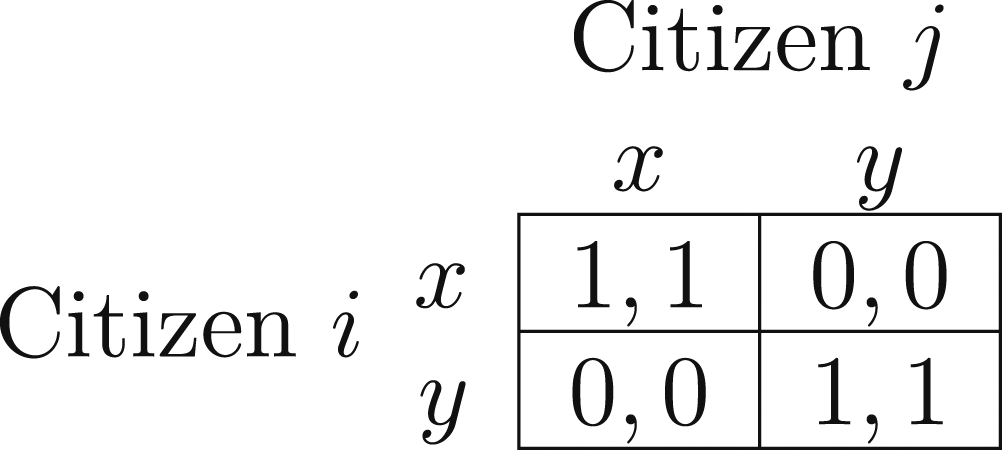
The example economic miscoordination above resulted from how existing political dispositions the actors brought into the interaction constrained their ability to successfully coordinate. Such coordination failures seem a common facet of everyday life: a home-owner may not be comfortable inviting a tradesman with clashing political values to perform repairs, a prospective customer may be deterred from entering shop by a political sign on display that they disagree with, and so on. I capture the repeated experiences of such potential interactions by embedding games like the one in Figure 1 into an evolutionary game.
Evolutionary games appropriately capture the scenarios described because players are unable to directly choose actions during interactions. Instead, their choices are constrained by their disposition or “type” that they carry with them into the interaction. These differences in types represent the political differences discussed earlier. For example, one type may represent individuals that hold a particular prejudice, whilst another type represents those that are not beholden to such prejudices. Alternatively, types may represent the propensity for trust or corruption. I will later vary the design of the stage game at the base of the evolutionary game to better capture different possible representations, but I begin with simplest possible design in Figure 1.
Baseline game
Let there be two sets of players, P and Q. In every period t, each player i ∈ P ∪ Q is randomly matched with another player j ≠ i ∈ P ∪ Q to play the game in Figure 1. Each player i in P ∪ Q has a particular type that predisposes them into playing a particular strategy. Let there be two types in this game, where x-type players always play x and y-type players always play y. The distribution of types in the population is always common knowledge. Define p as the proportion of x-type players in population P and 1 − p as the proportion of y-type players in population P. Define analogously q and 1 − q for population Q.
The game takes place amongst neighbouring communities and the two populations, P and Q, represent citizens of each community. Even if the communities are literally separated only by a line-in-the-sand, it would be reasonable to expect that players are more likely to meet citizens of their own population than those of the other population. To account for this, I take inspiration from the correlation mechanism from Eshel and Cavalli-Sforza (1982) (see also Skyrms, 1996).
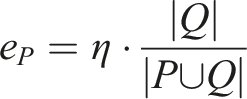
I introduce a parameter η ∈ [0, 1] to represent cross-community integration. As η decreases, any player i becomes more likely to play someone from the same population, and, as η increases, becomes more likely to play someone from the other population. Thus, when η = 0, the game features perfect isolation and players only play fellow citizens of the same community. Conversely, when η = 1, integration is complete, leading to an equal chance of playing any other player in P ∪ Q.
The integration parameter achieves its intended effect by weighting the probability of meeting a player from the other community. For individuals in P, their weighted probability of cross-community encounters is
and for those in Q it is
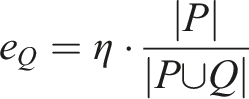
Players in P and Q, in turn, meet players from the same population 1 − e P and 1 − e Q of the time, respectively. The individual, one-period utility of all players is simply the utility from playing the game in Figure 1 with the player they are matched up with. This completes the description of one-period interactions at the base of the larger evolutionary game.
Utility and replication
The pattern in expected utilities is fairly obvious upon brief inspection. As the only non-zero utilities in Figure 1 are of value 1, the expected utility of any player is simply the probability they are paired with a player they will successfully coordinate with. That is, their expected utility is the probability that they are matched up with a player of the same type. Let πP,x be the one-period utility of an x-type player from population P. Analogously define π for all combinations of types and populations. The expected utilities for individuals from each respective type-population pair are




Note that, given large enough numbers of players, these individual expected utilities are exactly analogous to the average utilities of the entire type-population. It is the latter that we are interested in in the evolutionary context I have specified here, though to save on notation I use the same definitions above for average utilities of type-populations.
At the end of each period, the number of players of each type grows or shrinks based on how well its players performed in their two-player interactions in the previous period. That is, if a particular type as a whole does better than the average player in the population, then that type grows in proportion in the population. If the type does worse than average, then it shrinks. This is how the model captures the transmission of different types.
For the solution concept used throughout this paper (ESS), many different specifications of the replication process will still lead to the same ultimate outcome. This allows my model to be agnostic as to the exact processes involved in the replication of type. This reflects how the legacy studies literature, through behavioural path dependence (Acharya et al., 2018a) or other explanations, generally considers there to be a bundle of different mechanisms that collectively allow for persistence. Abstracting away from the other mechanisms of persistence allows my model to isolate and focus on studying its main interest: how persistence resists the influence of neighbouring communities with dissenting views.
The replication of types in the game occurs separately for the two populations. That is, a type in a particular population grows or shrinks relative to the average performance of individuals from that particular population only. Let
This aspect of the model design is necessary for results that allow for persistent differences. Without it, the “pull” of converging upon the the same types becomes too strong to resist due to the coordination nature of the problem at the base of the larger game. Substantively, a consequence of this design element might be that the game isolates the “economic” or “transactional” consequences of neighbouring a politically different community and ignores other complications such as marriage markets or migration.
Solution
The standard solution to evolutionary games is to find evolutionary stable states (ESS) (Maynard Smith, 1974) and this applies here. In a standard evolutionary game, ESS are simply strict Nash equilibria to the base games and it is straightforward to motivate what solutions will be under such circumstances. A straightforward coordination game as in Figure 1 has two strict Nash equilibria where either both players play x or both players play y. When integration is complete (η = 1) and the game is simply the evolutionary equivalent of Figure 1, the ESS will reflect these strict Nash equilibria and the ESS are where all players in P and Q are collectively of the same type (be it x-type or y-type). I refer to solutions where all i ∈ P ∪ Q share the same type in equilibrium as a convergent outcome.
However, as the communities grow more integrated, additional solutions become possible. Recognise that, under perfect isolation, citizens only play with players from the same population. Therefore, when η = 0, there can exist ESS where the citizens of P are all of one type, while the citizens of Q are all of the other type. I refer to such solutions, where P and Q are of different types, as divergent outcomes. There must then be some critical value of η below which the game is capable of sustaining divergent outcomes. Assessing this critical value of η is the goal of this section.
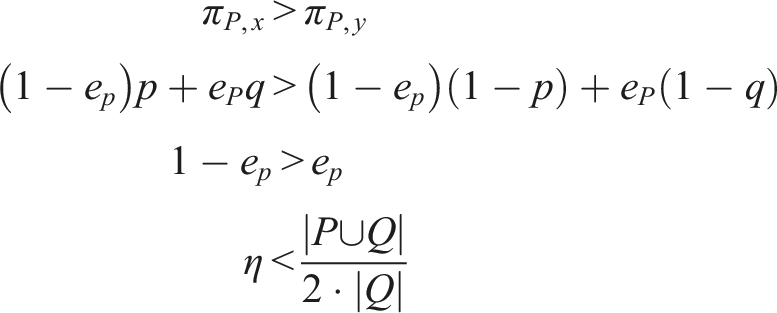
A divergent ESS is possible under the Pure Coordination Design when both Proof. Let Population P consist only of x-type individuals and Population Q consist only of y-type individuals. Thus, p = 1 and q = 0. Population P is at equilibrium when x-type players outperform any invading y-type players. This is true when πP,x > πP,y. Solving for this gives us Similarly, Population Q is at equilibrium when y-type players outperform any invading x-type players. This is true when πQ,y > πQ,x. Solving for this gives us The conditions in Proposition 1 mean that so long as, on average, more than half of the interactions of any given individual is within their own population, then we can maintain a divergence of types across the two populations. The threshold of half should not be surprising; it is the mixed strategy Nash equilibrium to the game in Figure 1. If integration is high enough that cross-community interactions are greater than half, then the game will eventually end up at a convergent equilibrium of whichever type is more numerous at the beginning of the game. However, should the majority of interactions be contained within communities, then a divergent equilibrium will emerge given the conditions in Proposition 1 are met and that different types are advantaged at the outset of the game in the two respective populations. This result is fairly simple but quite powerful. It shows that under the assumed game, it is possible to have political differences exist between neighbouring communities in a stable manner even at fairly high levels of inter-community interactions. So long as a slim majority of my interactions are within my own community, the political uniqueness of my community will be retained (given that it was indeed unique to begin with). The red line in Figure 3 demonstrates the change in the threshold value of η in Proposition 1 as relative populations change. Fixing some parameters allows the force of this result to be further illustrated. Recognise that, when |P| = |Q|, any η < 1 will fulfil the condition in Proposition 1 and is sufficient to maintain differences that were originally distinct. Two neighbouring communities of the same size can thus maintain their differences so long as integration falls just short of perfect. As one community grows larger with respect to the other, then the necessary level of separation to maintain differences increases as the citizens of the larger community become more successful in coordinating their interactions, influencing the smaller community to adapt. Such a result may suggest that smaller communities may have an incentive to fence-off themselves to restrict cross-community interactions from eroding the views and values of their community. This may provide a social explanation to why some states reinforce their borders to complement recent economic theories for such preferences (Carter and Poast, 2017; Hassner and Wittenberg, 2015).
Empirical implications
Proposition 1 has potential implications for the design of empirical studies. The critical value of η describes when it is and is not appropriate to assume that political differences have been geographically separated. Provided that (1) cross-community interactions are sufficiently low and (2) history suggests that there were initially political differences, then it is possible to conclude that neighbouring communities will remain politically distinct. Conversely, when cross-community interactions are sufficiently high, then it should be concluded that the communities will become largely similar.
A strength of this critical value of η is that it can be empirically quantified. Travel and trade, for example, are measurable ways of capturing cross-community interactions. When such interactions are measured to be relatively low and reflect that most regular interactions are intra-community, then the above model can be invoked as the theoretical explanation for why political differences persist. The above cited legacy studies describing the persistence of geographic differences are key areas where this result can be applied. Conversely, where cross-community interaction is measured to be relatively high and citizens primarily interact between communities, this can be used as support for political convergence across different communities.
Isolation as the source of persistent differences is consistent with existing empirical results. The results of Voigtländer and Voth (2012) stand out in this respect. Voigtländer and Voth study how Black Death-era pogroms in particular German towns predict anti-Semitism under the Nazi regime in the same locality roughly 600 years later. Later in their paper, Voigtländer and Voth interact their predictor with various local characteristics and discover that the effect of legacy disappears for towns that are members of the Hanseatic League—a confederation of towns in Europe associated strongly with long-distance trade. Using the results of my model, such a result can be interpreted to suggest that towns in the Hanseatic League lose their anti-Semitism because such towns fail the conditions of Proposition 1 as they are significantly exposed to outside interactions.
Further designs: Overview and applications
The game in Figure 1 is blind to the value of political content; utility only varies based on the success of coordination without accounting for substantive content. This allows for different and equally valuable ways to skin a cat, which may be the fairest way to evaluate political differences. There remains, however, the question of how the above result will fare under different assumptions.
I proceed to consider other base game designs. In these further designs, welfare may now vary depending on the resultant coordination outcome. Specifically, I will discuss variations involving Stag Hunts, Prisoner’s Dilemmas and Bach-or-Stravinsky games. For now, I present a proposition that summarises the findings from these additional designs:
Divergence becomes more likely when the design at the base of the evolutionary games is Stag Hunt, iterated Prisoner’s Dilemma or Bach-or-Stravinsky.
Propositions 3 through 5 will later walk through these results more closely, but I will briefly touch upon the intuition for these results. Stag Hunts and Prisoner’s Dilemmas are typical games used to capture strategic scenarios involving trust. Here, players of different types may represent those with high and low levels of social trust, respectively. Under a Stag Hunt, a “low-risk” (loosely-speaking) option exists in hunting hares. This safer option makes playing the less efficient outcome more attractive, balancing out the competitive advantage possessed by the more efficient outcome of coordinating on hunting stag. This facet of Stag Hunts, in turn, promotes the divergent ESS outcome. As iterated Prisoner’s Dilemmas strategically resemble Stag Hunts (Skyrms, 2004), similar logic is hence applicable. Either approach may provide the theoretical basis for the findings of papers such as Becker et al. (2016), who find that high trust and low corruption persist within the former borders of the Habsburg Empire but not their immediate neighbours, or Guiso et al. (2016), who find that areas of northern Italy that were within the borders of a free city-state in the Middle Ages demonstrate greater “civic capital” (in the manner of Putnam et al., 1993) than their immediate neighbours. I adapt Bach-or-Stravinsky for my evolutionary structure to mean two populations of players that prefer different coordination outcomes. Through this, Bach-or-Stravinsky straightforwardly promotes divergence through the different preferences of the populations. This may be appropriate for modelling dispositions involving prejudice and tolerance. Consider x-types to represent players that are prejudiced towards a particular minority and y-types as more egalitarian. The egalitarians may prefer not to do business with bigots, however they may prefer business with bigots over no business at all. The Bach-or-Stravinsky design captures such nuances and shows the ease with which prejudice can be sustained in the long-run. This provides further theoretical basis for legacy studies that show the particularly robust persistence of prejudice against Blacks (Acharya et al., 2016, 2018a; Mazumder, 2018) and Jews (Homola et al., 2020; Voigtländer and Voth, 2012).
Further designs: Results and analysis
General coordination design
Before considering alternative designs, I begin with a generalisation of the baseline game in order to facilitate comparisons. Specifically, I allow for the possibility that one choice is more “efficient” than the other: successful coordination on one strategy now can give greater utility than the successful coordination around another. This is represented by the matrix in Figure 2, where a > b > 0. Generic Coordination Design game.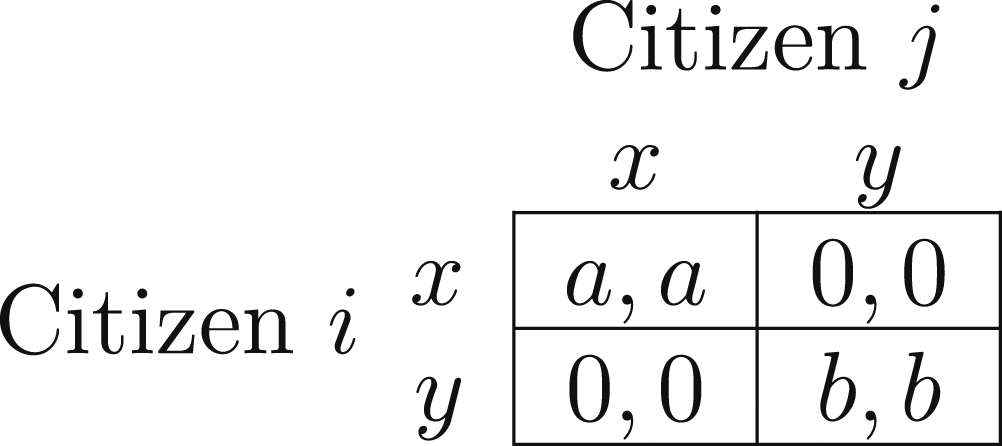
The set-up of the game is thus exactly the same, except that individual one-period pay-offs are now represented by Figure 2. I present the equivalent to Proposition 1, fixing P to be of x-type and Q to be of y-type, under the new generalised version of the game.
A divergent ESS, where all players in P play x and all players in Q play y, is possible under the General Coordination Design when both The proof for Proposition 3 is analogous to the proof for Proposition 1. Now that one type is more “efficient” than the other, the condition for a divergent outcome tightens. Mathematically, this is driven by the condition This is visualised in Figure 3. The red line represents the maximum η to support divergence under Proposition 1. The green, blue and purple lines are for Proposition 3 where a/b equals 2, 3 and 5, respectively. This reflects circumstances where one type is two, three and five times more efficient upon successful coordination than the other. The lines indicate that the maximum threshold on η decreases as the advantage grows for the more efficient type, making convergence more likely and separation more difficult.
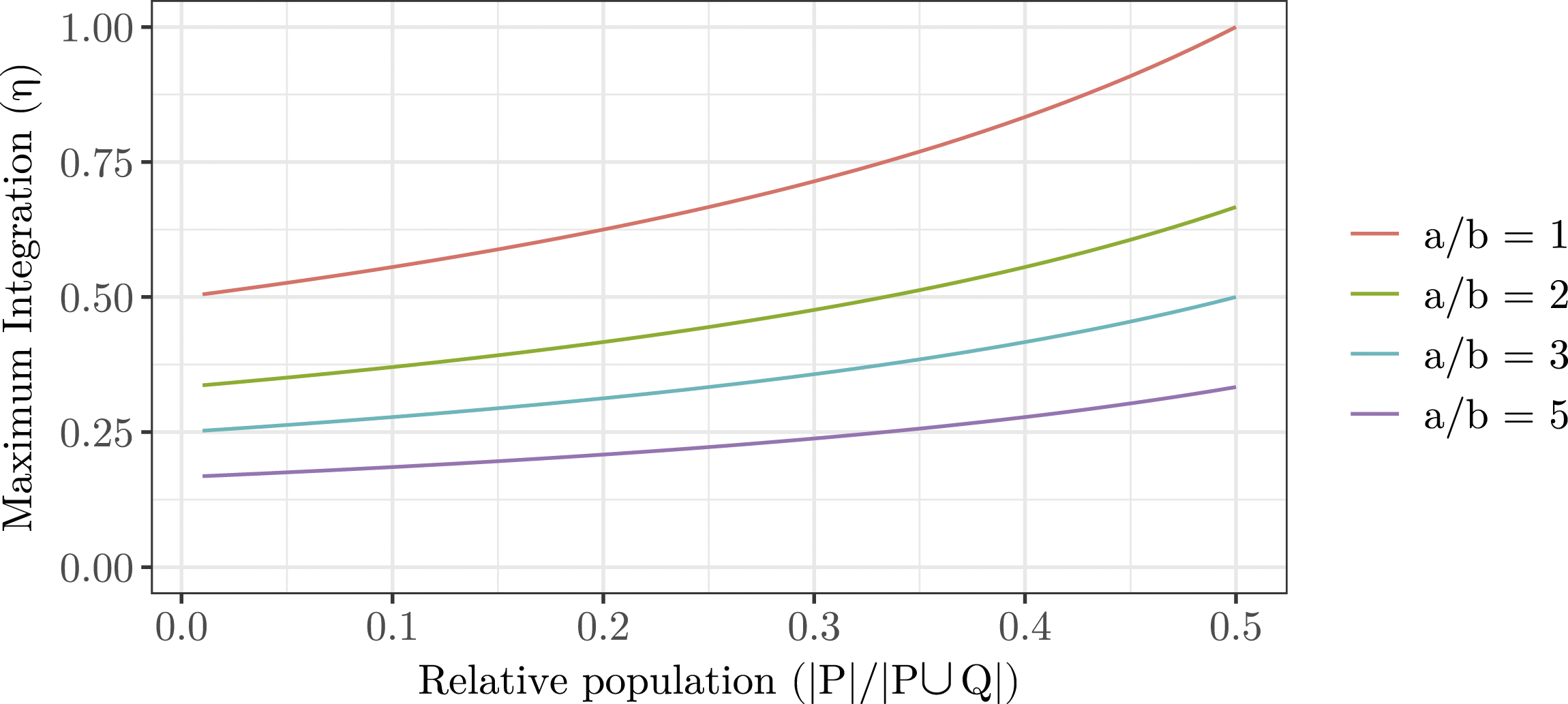
Maximum integration allowing for divergence in Proposition 2.
Stag Hunt and Prisoner’s dilemma designs
A Stag Hunt Design, seen in Figure 4, is very similar to the previous game in Figure 2, where once again a > b > 0. However, this time the “basin of attraction” of one type, the hare-hunting y-type, is larger as successful coordination is no longer necessary to obtain a positive pay-off when hunting hares. This makes playing y more attractive and balances out the advantage of efficiency that the x-type possessed in the previous design. As a result, divergence is always easier to enforce under a Stag Hunt Design relative to the General Coordination Design for the same values of a and b. Stag Hunt Design game.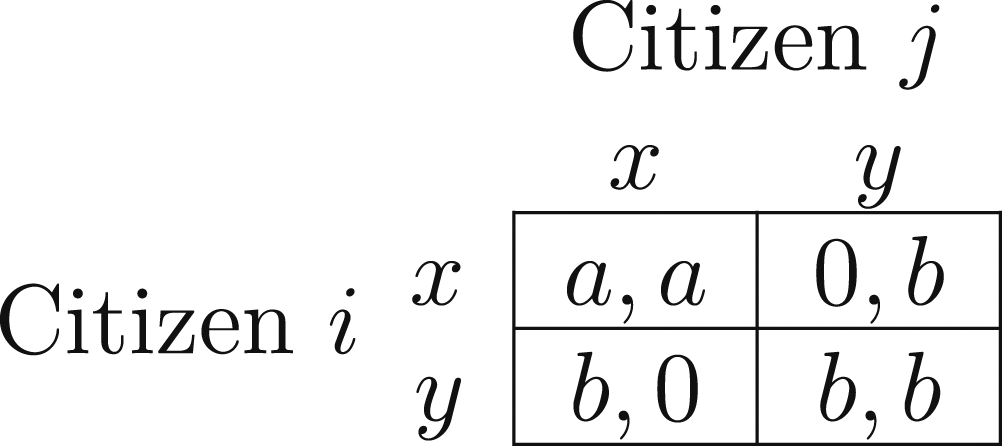
A divergent ESS, where all players in P play x and all players in Q play y, is possible under the Stag Hunt Design when both The plot in Figure 5 demonstrates this graphically. It can be seen that the green, blue and purple lines (representing a stag i.e. two, three and five times more valuable than a hare, respectively) are “higher up” on the plot in Figure 5 compared to Figure 3. A Prisoner’s Dilemma cannot be straightforwardly incorporated into my broader game as it only has one strict Nash equilibrium at the stage game level—and correspondingly only one ESS. This is incompatible with this paper’s attempt to show that two cultures playing different choices can co-exist as neighbours. Fortunately, there is a long literature in adapting the Prisoner’s Dilemma to allow for cooperative outcomes. Folk Theorem-type solutions allows for cooperation to emerge in Prisoner’s Dilemmas so long as the players believe they are sufficiently likely to interact again. With such incentives, iterated Prisoner’s Dilemmas resemble a Stag Hunt (Skyrms, 2004). Successful coordination outcomes (playing Cooperate on equilibrium and enforcing punishment when necessary) give greater benefits than non-coordination outcomes (playing Defect) and the incentive to unilaterally Defect characteristic to Prisoner’s Dilemmas disappears. In evolutionary settings, creative modifications can allow for similar incentive structures (Bowles and Gintis, 2011). Through Proposition 4, we already know that separation of middling integrity can support neighbouring societies of different Stag Hunt cultures. This, in turn, implies that modified Prisoner’s Dilemmas may also result in segregated levels of trust or corruption in the same way. The result in Proposition 4 thus affirms the empirical findings that cooperative societies can persist despite long-term exposure to neighbouring treacherous societies. This applies regardless of whether we believe situations of trust in society are better modelled by a Stag Hunt outright, as Skyrms (2004) argues, or by allowing for coordinated punishments in Prisoner’s Dilemmas, as Bowles and Gintis (2011) argue.
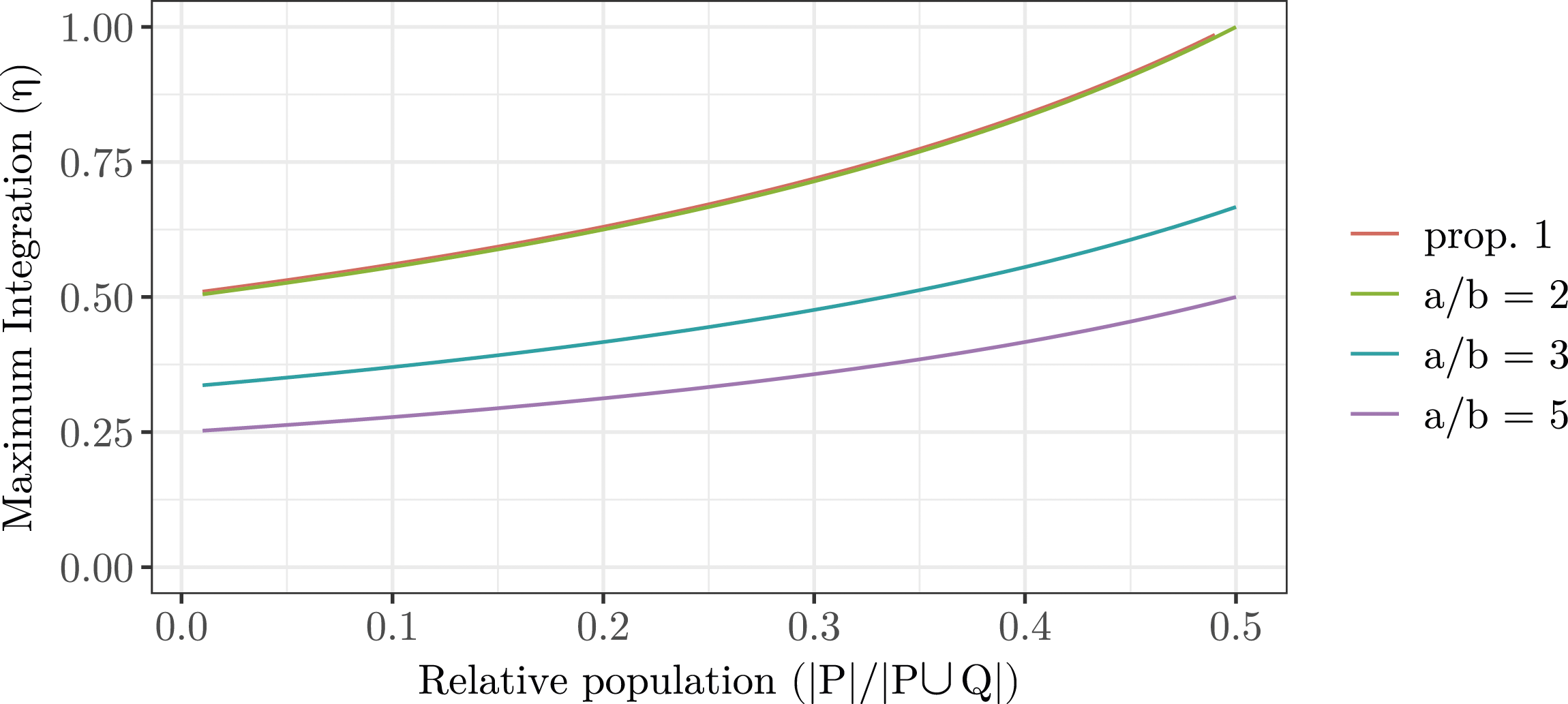
Maximum integration allowing for divergence in Proposition 3.
Bach-or-Stravinsky design
A further alternative design assumes that different populations have different political preferences beyond simply coordinating. That is, individuals first prefer to successfully coordinate and, given that coordination is achieved, also have varying preferences over which coordination outcome is reached. Such preferences suggest a Battle-of-the-Sexes design (as originally introduced by Dawkins 1976) or here referred to as a Bach-or-Stravinsky design (Osborne, 2004).
Let P population players gain greater utility when coordinating in x and Q population players gain greater utility for coordination under y. Successful coordination in the preferred strategy gives pay-off of a and in the other strategy gives b. Unsuccessful coordination again gives 0. Evolutionary games require that the requisite base game be symmetric, which a standard Bach-or-Stravinsky game is not. Expressing pay-offs for a generic player i in the manner of Figure 6, where again a > b > 0, resolves this. Pay-offs for Citizen i under Bach-or-Stravinsky Design.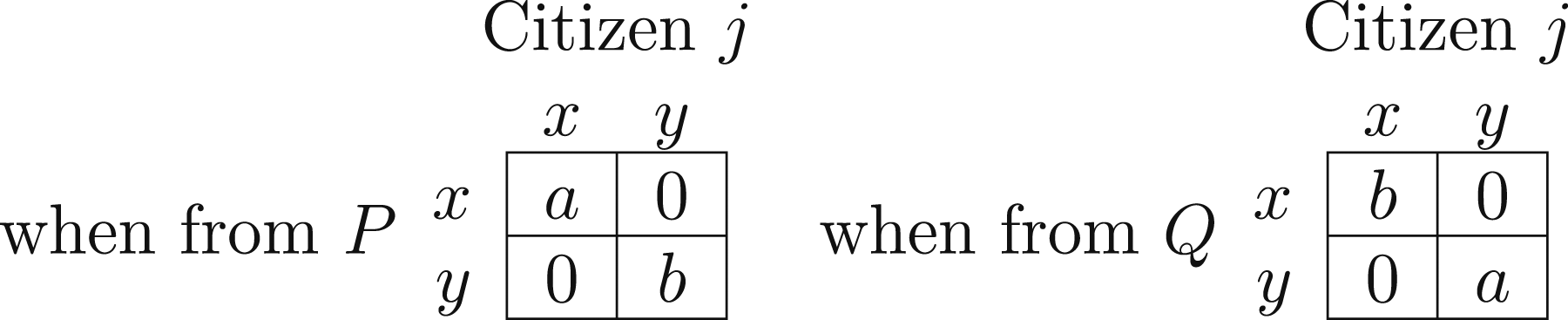
As the populations are no longer symmetric, there are two variations of divergent outcomes to consider. The first is the more straightforward outcome where each population collectively plays their respective advantaged strategy.
A divergent ESS, where all players in P play x and all players in Q play y, is possible under the Bach-or-Stravinsky Design when both Alternatively, the reverse outcome where the populations instead collectively play their disadvantaged strategy may also be possible.
A divergent ESS, where all players in P play y and all players in Q play x, is possible under the Bach-or-Stravinsky Design when both As these propositions highlight, it is easier to enforce outcomes where the strategy played matches the population preferences than outcomes where they mismatch. This emerges in the smaller numerator for the conditions on η for Proposition 6, tightening the restriction on η, compared to the larger numerator in Proposition 5. Substantively speaking, the outcome in Proposition 5 seems more sensible than Proposition 5 as it seems more focal (Schelling, 1980) and hence I will suppress the result in Proposition 6 from further discussion. I illustrate graphically the increased ease with which a Bach-or-Stravinsky design, through Proposition 5, manages to enforce divergence in Figure 7. The red line again represents Proposition 1 and the green, blue and purple lines represent where a/b equals 2, 3 and 5, respectively, but this time under the conditions in Proposition 5. This pattern demonstrates how the divisiveness of prejudice, captured by both populations’ preferences for different coordination outcomes to the other, makes separation increasingly likely and is perhaps illustrative of why prejudice can be stubbornly persistent in certain societies. The nature of my theory naturally invokes comparisons to contact theory (Allport, 1954; Pettigrew, 1998). Contact theory argues that positive interactions with targets of prejudice can diminish such prejudices. While there are similarities in how my models also argue that attitudes can be changed through interaction, my approach to prejudice (particularly relevant to the Bach-or-Stravinsky Design) does not involve interacting with the targets of prejudice. It instead considers the much weaker stimulus of potential interactions between individuals with and without prejudiced attitudes. This is the appropriate design given that the literature that it speaks to (Grosfeld et al., 2013; Homola et al., 2020; Voigtländer and Voth, 2012) considers scenarios where the targets of prejudice are are not necessarily significant proportions of the studies communities. In turn, my results show that these types of interactions are unlikely to change prejudiced attitudes (Proposition 5) bringing it in line with contact theory given that my model exposes players to a much milder stimulus than what contact theory argues can bring change.
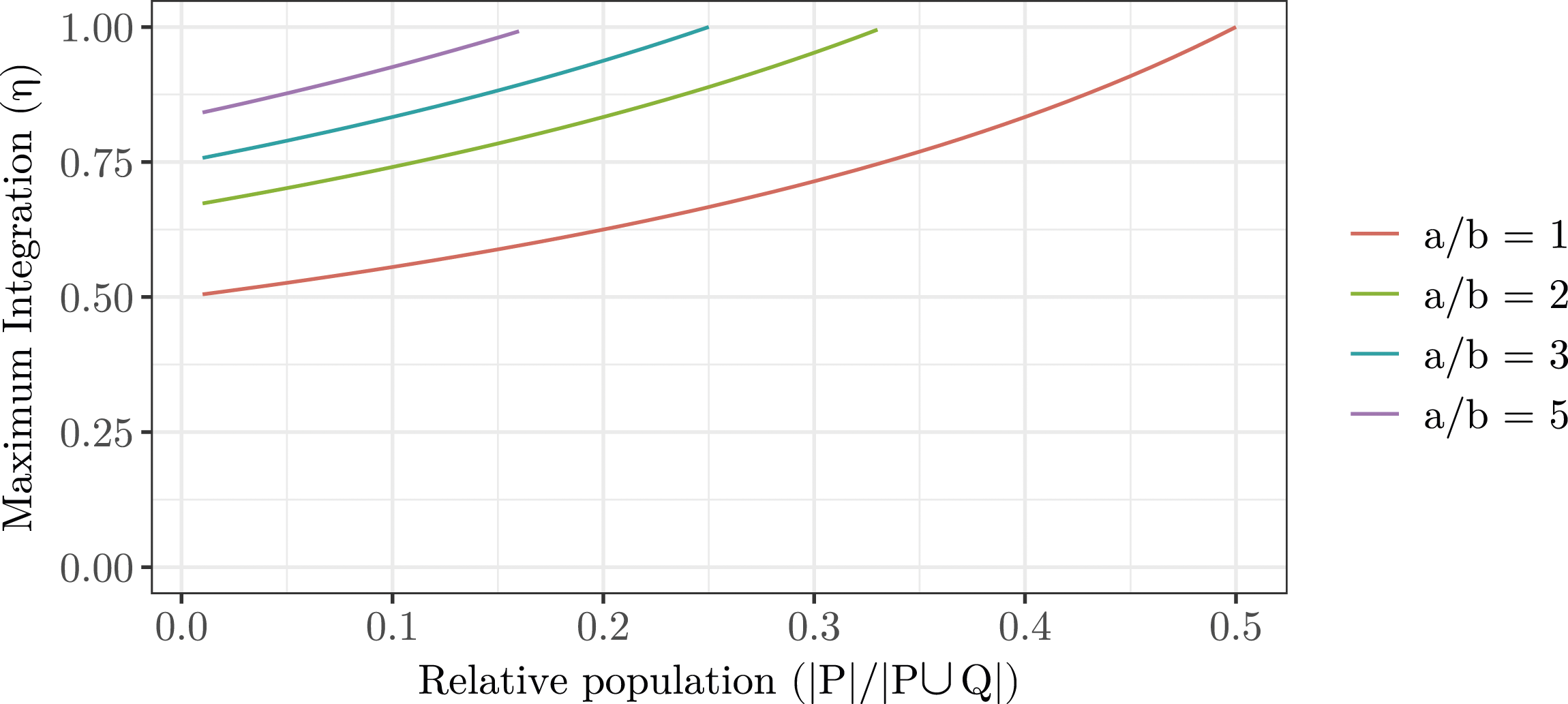
Maximum integration allowing for divergence in Proposition 5.
Fixation probabilities
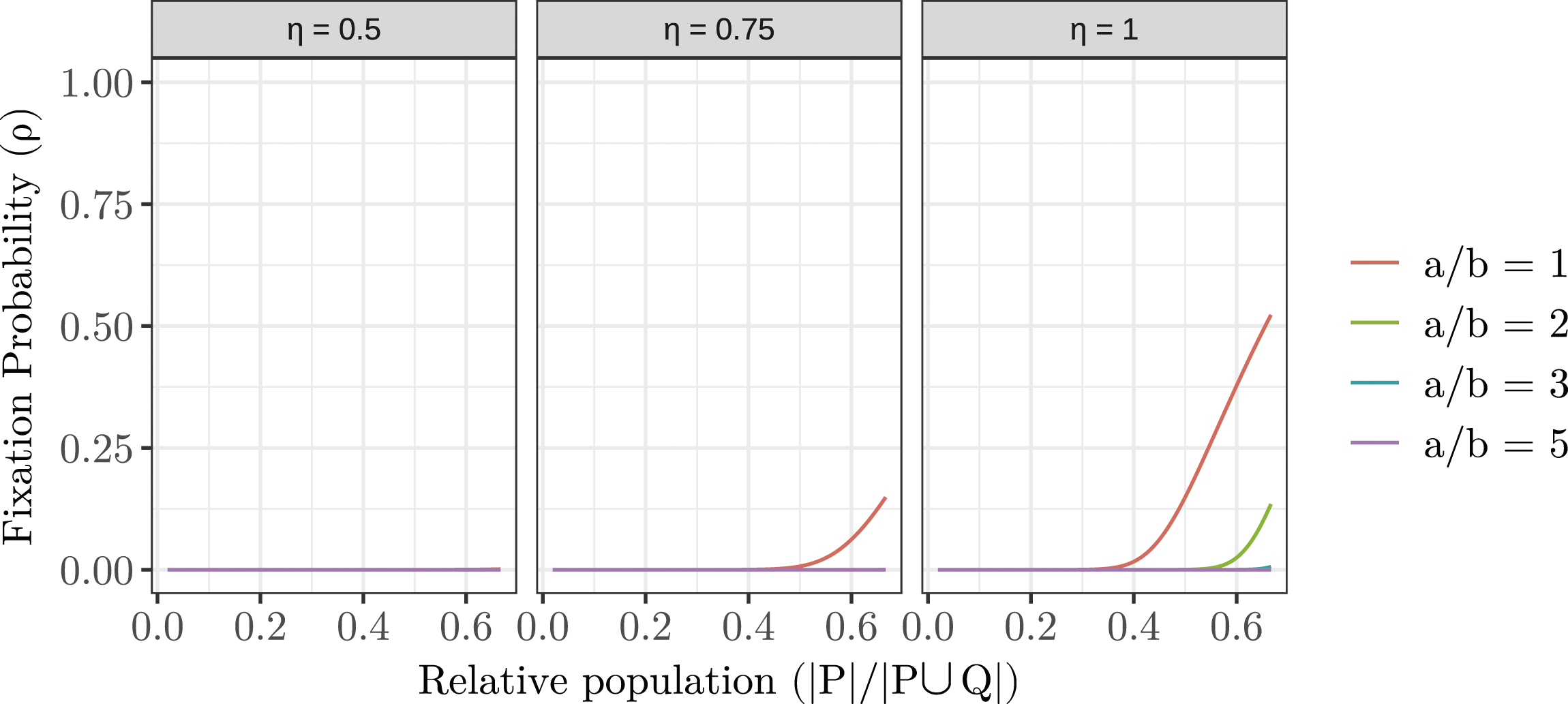
For completeness, in this section we study the finer dynamics of the above games to facilitate further comparisons between the various designs. For this purpose, reimagine the game as a Moran process (Moran, 1958) where in every period, one random individual is randomly selected for “death” and one random individual is randomly selected for “replication”. The fitness of the players—the pay-offs from playing the various games—determine the probability of being selected. Like the main model and unlike standard Moran processes, game partners will continue to be determined through the integration parameter η. I present fixation probabilities (ρ) for various game designs and parameterisations under this process.
Consider a starting scenario where all members of the P-population are x-types and all-members-except-one of the Q-population are y-types. Exactly one individual in population Q is thus of x-type. Let ρ be the probability that, from the starting scenario, all players in P ∪ Q become of x-type through a Moran birth-death process. That is, ρ is the probability that the process reaches a convergent outcome from a beginning point where there is only one “mutant” in starting populations that are otherwise divergent. Under the General Coordination Design from the aforementioned starting scenario, this is
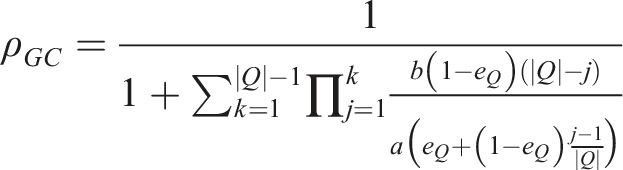
Proof. Under a standard Moran process, the fixation probability of a single mutant is
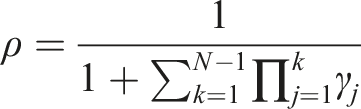
where, in a game with two types, γ j is the pay-off of the non-mutants divided by the pay-off of the mutants given that there are j mutants in the population.
This formula is directly applicable to my scenario, where there is one mutant x-type in the Q-population, because replication in my design occurs separately between the two populations. The further x-types in the P-population only effect the pay-offs of the Q-population, not their reproduction.
What remains then is to establish γ
j
. Recognise that non-mutants in population
Collectively, this makes
Through analogous processes, we can obtain the probabilities for the remaining designs. For the Stag Hunt Design, it is
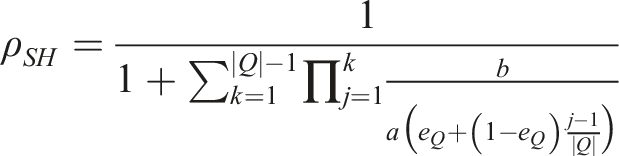
Notice the disappearance of the probabilities following the pay-off of b as hunting hares grants you b regardless of what your game partner plays.
Finally, for the Bach-or-Stravinsky Design it is
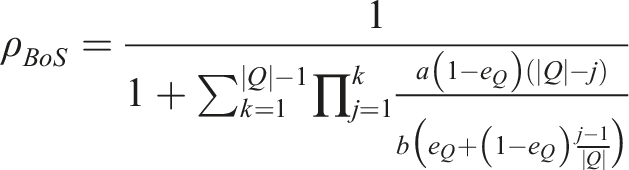
Here, notice that a and b are reversed, capturing how the mutant in the Q-population wishes to achieve coordination in the choice that gives it the lower pay-off. As a result, ρ GC and ρ BoS are effectively mirrors of each other and more generically represent scenarios where the mutant coordinates either in the more efficient choice (ρ GC ) or in the less efficient choice (ρ BoS ).
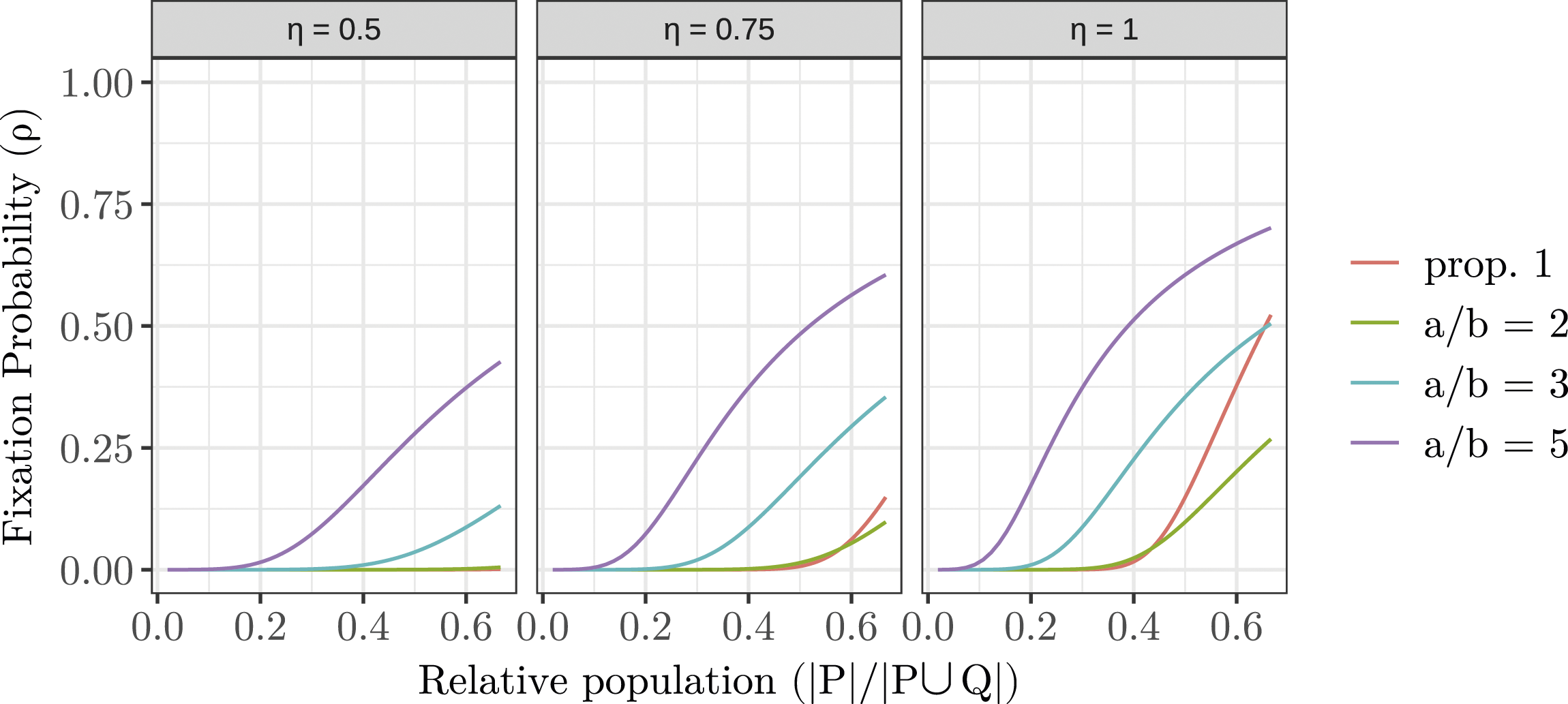
Figures 8 through 10 visualise ρ across various parameterisations. These results largely echo what we learned earlier studying the games under ESS. General Coordination scenarios are particularly vulnerable to convergence, whilst Stag Hunts are less so. Convergence is very unlikely under Bach-or-Stravinsky. Fixation probabilities for the General Coordination Design. Fixation probabilities for the Stag Hunt Design. Fixation probabilities for the Bach-or-Stravinsky Design.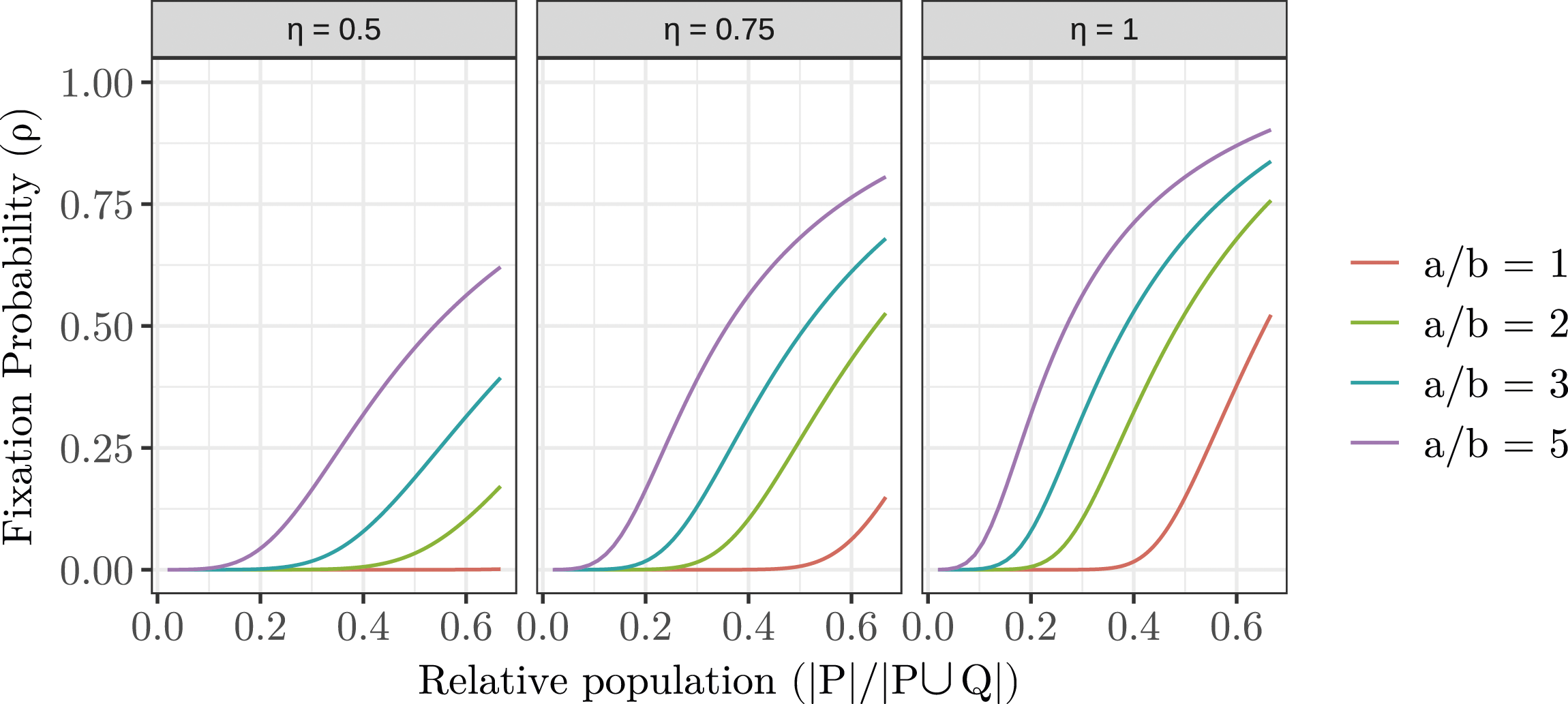
Conclusion
I have proposed a model of political change that focuses on when communities can and cannot resist the influence of a neighbouring community with political differences. The results of my models suggest that, under a variety of strategic scenarios, even fairly high levels of integration between neighbouring communities may still be capable of resisting political convergence. The results of the models address a gap in theories of long-term persistence of political differences and gives further theoretical grounding for the persistence effect documented by empirical studies. These “legacy studies” have identified the persistence of prejudice (Acharya et al., 2016; Homola et al., 2020; Mazumder, 2018; Voigtländer and Voth, 2012) and trust (Becker et al., 2016; Guiso et al., 2016) in spite of their proximity to communities that are comparatively more tolerant or more treacherous, respectively.
My results may also apply to separation that is not based on geography. So long as interactions between two communities are below the thresholds identified by the model, then they are appropriately separated enough to prevent convergence regardless of what mechanism creates this separation. An example might be the work of Nunn and Wantchekon (2011) that finds that ethnic groups raided during the era of slave trades demonstrate lower levels of contemporary trust. If my model were to be applied to the results of Nunn and Wantchekon, then it might be concluded that the reason differences in trust persist between ethnic groups is because, despite the fact that ethnic groups are more geographically integrated today than in the past, the level of interactions across ethnic groups remains sufficiently low. This suggests that future works may use the integration mechanism introduced in this paper to study a greater variety of scenarios involving inter-community change or persistence.
Footnotes
Author’s Note
I am indebted to Marcus Berliant, Lucas Boschelli, Randall L. Calvert, David B. Carter, Justin Fox, Benjamin S. Noble, Keith E. Schnakenberg, İpek Ece Şener, Yixuan Shi, Jeremy Siow, Tony Zirui Yang, audiences at Washington University in St. Louis, the Virtual Formal Theory workshop, the Comparative Politics and Formal Theory conference, and CROSS, the editor, and two anonymous reviewers for their invaluable input at various stages of producing this paper.
Declaration of conflicting interests
The author(s) declared no potential conflicts of interest with respect to the research, authorship, and/or publication of this article.
Funding
The author(s) received no financial support for the research, authorship, and/or publication of this article.
