




Abstract
Online peer-to-peer markets decentralize the distribution of resources, creating a trust problem in economic exchange on the internet. Individual characteristics of trustees — as determinants for being trusted — are therefore increasingly important. In light of this societal development, this study investigates the role of socioeconomic status and reputation as drivers of interpersonal trust. Some have argued that lower status trustees are trusted more easily because over the life course, they repeatedly rely on others' resources. Others state that higher status trustees are perceived as being more trustworthy, because they are more vulnerable to social control and loss of reputation. We propose a novel, experimental method for examining interpersonal trust situations that resembles the reality of peer-to-peer market platforms. 626 subjects in an online experiment were asked to place trust in their preferable trustee based on the asking price, and seller characteristics. The results from conditional logistic regression models showed that status increases perceived trustworthiness and positively affects the trust premium for past trustworthy behavior. Strong reputation effects were found, sending out a warning for inequitable emergent inequality of trust through reputation cascading.
Introduction
The popularity of social networking websites and online (sharing) markets has made it easier to connect, and engage in economic exchanges with large numbers of other individuals (Botsman and Rogers 2010). Peer-to-peer market platforms such as airbnb, eBay or etsy allow direct interaction between buyers and sellers, eliminating costly agency of a third party (Leismann et al., 2013). Relatively anonymous sellers who depend less on their gains from peer-to-peer markets may have stronger incentives to behave opportunistically and betray a buyer than companies invested in an economic branch who put their reputation on the line in an exchange. To overcome this trust problem, cues that incite interpersonal trust become increasingly important, sparking researchers’ interest in the establishment of trust in peer-to-peer markets (Robbins 2017). Scholars have, for example, found evidence for systematic discrimination on rental service Airbnb (Ge et al., 2020), and on decentralized taxi service platforms Uber and Lyft (Edelman et al., 2017). Whether the actors involved are able to establish a successful exchange depends on characteristics of the seller, buyer, the platform, and the nature of the transaction at hand (Ter Huurne et al., 2017).
To be able to understand the incentives and motives of both parties in an online in-terpersonal economic exchange, we conceptualize the exchange as trust game (Dasgupta 1988). Here, a trustor decides whether or not to voluntarily place resources in the hands of a trustee who subsequently has a choice either to honor or abuse trust. Whether trust will be honored depends on the willingness and competence of the trustee to behave in a trust-worthy manner. To overcome the trust problem, trustors have to rely on cues that signal willingness to honor trust, or engage in repeated interactions such that a trustee’s behavior can be learned (from past behavior) or controlled (by anticipated future interactions) (Buskens and Raub 2002).
For trustees, being trusted is a valuable resource: a form of social capital (Coleman 1988). In markets where sellers are abundant, signaling trustworthiness is crucial to stand out from the crowd. While economic exchange might also be established by contracts or formal agreements, taking a leap of trust is valuable because costly agreements can be avoided (Barney and Hansen, 1994: 182–186; Gambetta, 1988: 222–225). Whether trust thus enables exchange, or simply eases the establishment of mutual cooperation, trust is both valuable and interpersonal, and thus a form of social capital.
Reputation systems can help to overcome the trust problem (Diekmann et al., 2014; Kas et al., 2021; Ter Huurne et al., 2018). They offer parties involved in a potential exchange information about their counterpart’s past behavior, casting a ‘shadow of the past’— behavior in past exchanges that foreshadow future trustworthiness—over the present as-sessment (Gulati 1995). By making reputation information accessible to the exchange network as a whole, a large ‘shadow of the future’—interest in engaging in more exchanges in the future that elicit present trustworthy behavior—emerges that might affect perceived trustworthiness in later interactions (Axelrod and Hamilton 1981).
In addition to or in the absence of reputation systems trustors might differentiate between trustees on other grounds. Here, we investigate the hypothesis that socioeconomic status (SES) as a proxy for class affects a trustee’s perceived trustworthiness and how this effect is moderated by congruence with the observed reputation score. Although rarely stated explicitly, there are many ways in which individuals implicitly signal their socioeconomic status (Kraus and Keltner 2009; Kraus et al., 2012). How SES will affect the perceived trustworthiness of a trustor is, however, not so clear. Some have argued that a trustee’s SES is positively related to her perceived trustworthiness because they are more vulnerable to social control and loss of reputation (Coleman 1990). Others argue that exactly the opposite is true, as lower status trustees would have been socialized into trustworthy behavior through learning (Piff et al., 2010).
The contributions of this study breaks down into empirical, theoretical and methodological elements. Testing the relation between interpersonal trust, SES, and reputation, applied in the modern reality of peer-to-peer market platforms offers empirical insight into the establishment of trust in peer-to-peer markets. What is more, by conceptualization of the research problem as a trust problem, we aim to extend the findings beyond peer-to-peer marketplaces and aim to contribute to a sociological understanding of the role of SES in interpersonal trust generally. Methodologically, the contribution of this study is an inno-vative, experimental method for testing the influence of certain factors on the probability to receive trust. This method is applied here to test the influence of SES and reputation on the preferences for one of two sellers, using a sample of 623 respondents recruited through Amazon’s Mechanical Turk (AMT). We find that socioeconomic status positively affects the likelihood of being trusted, and that higher status trustees seem to receive a reputation bonus for positive reviews.
Theory
Socioeconomic status and trust
In this section we make the strategic interdependence of the actors involved in the exchange explicit by disentangling the incentives of both parties. We aim to provide a comprehensive overview of the motives and incentives for a trustee and a trustor to behave trustworthy, in relation to their and the other party’s socioeconomic status (SES) or social class. In sociology, there is some disagreement over the definitions of class and SES. Here, we use the term socioeconomic status to refer to the social position of individuals and their associated differences in access to resources like economic, cultural and social capital.
Conceptually, we think of the exchange in peer-to-peer markets as trust games (Dasgupta, 1988). In a trust game, as shown in Figure 1, the trustee first makes a decision to place trust in the hands of a trustor or not. If no trust is placed at all, both receive the ‘punishment’ payoff P. If, however, the trustor does choose to trust a trustee, this trustee is given the decision to honor or abuse trust. When honored, the payoff for both parties is ‘reward’ R, but when abused, the trustor receives the ‘sucker’ payoff S, while the trustee walks away with ‘temptation’ T. The payoffs may differ in sizes, but their relation should always satisfy T > R > P > S. In a one-shot trust game, the outcome where no trust is placed at all is the only pure-strategy Nash equilibrium. Trust game.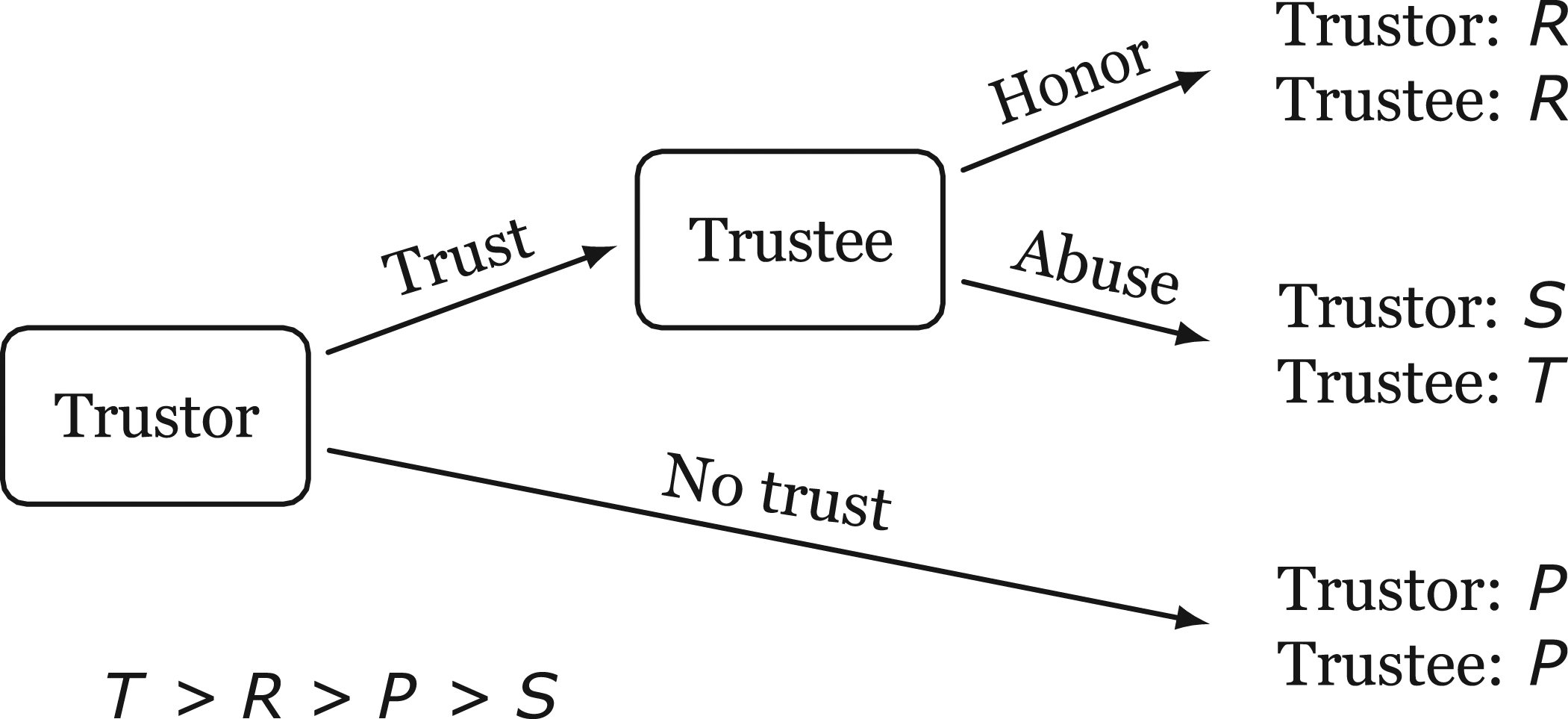
Trustee perspective
From the perspective of a trustee, behaving in a trustworthy manner in one-shot trust games is a loss in the form of the direct costs of reciprocation and opportunity costs for the foregone best alternative. However, social punishment and/or loss of social stature is avoided by behaving cooperatively. In repeated games, a trustee might benefit from behaving trustworthy through building a positive reputation, as will be discussed in the section ‘Reputation systems and trust’. Following this view there are two arguments to make for the expectation that higher status individuals experience greater benefit from behaving trustworthy, and are therefore trusted more easily. First, it is reasonable to assume that the marginal utility from pos-session of resources exchanged in a trust situation decreases with the amount of possessed resources. We also know that the amount of material resources possessed and status are positively correlated (Ridgeway, 2014). Ceteris paribus, the strength of the incentive to violate the norm of trustworthiness thus decreases with SES (Diener et al., 1993: 217). Second, violating someone’s trustfulness comes at a cost: the loss of social stature.
Violation of the norm to behave trustworthy yields some social punishment related to the number of people that are exposed to the trustee’s behavior. This is supported by the finding that trustworthiness increases with an individual’s centrality in a network (Buskens, 1998: 285). Since we know that higher status individuals are more central in networks (Sauder et al., 2012: 273–275), it is commonly argued that the visibility that comes along with status increases the net social punishment for such actors (Coleman, 1990; Sauder et al., 2012). 1
In sum, the cost and benefit of the ‘temptation’ payoff is relatively smaller for high status trustees than for their lower status counterparts. A trustor who is able to infer the trustee’s strategies picks up on those differences and is likely to link trustworthiness to SES.
Trustor perspective
Besides a trustors inference of trustee strategies associational preference bias also predicts higher levels of interpersonal trust in high status trustees. This argument assigns a higher likelihood to any interaction with high status actors because people hope to raise their own status through association (Gould, 2002: 1151; Ridgeway, 2014; Sauder et al., 2012). Under equal suitability, trustors prefer high status trustees because cooperating with high SES partners may yield status through association. As a consequence, placed trust does not reflect a trustor’s belief that the trustee is more trustworthy, but simply that the trustor gains additional utility through association with a higher status individual.
Based on the diminishing marginal returns from resources, the greater net social pun-ishment and the associational preference arguments we hypothesize that socioeconomic status of the trustee is positively related to the probability to be trusted (H1).
The hypothesized positive effect of SES on trust and trustworthiness is not undisputed. Others have argued that socialization into pro-social behavior makes low status individuals more trustworthy (Piff et al., 2010, 2012). For lower status individuals, a lack of material resources increases the need to rely on others’ resources. Where higher status individuals can use their economic capital to face life’s challenges and problems, lower status indi-viduals have to cope through cooperative behavior. By frequently facing trust problems they learn that trusting can be beneficial and invest in social capital that might help them when they are in need (Piff et al., 2010). This frequent practice of trust behavior socializes people with lower SES into acting trustful and trustworthy (Piff et al., 2010).
In line with the incentive structure posed before, we can say that status negatively correlates with the utility gained from abiding to the social norm. To put it simply: indi-viduals with low SES will be happier following the norm of trustworthiness than individuals with higher SES, because being trustworthy is more important to them.
All arguments taken together, the hypothesis proposed by Piff and colleagues that status has a negative effect on trustworthiness seems to depend on a large number of intermediate assumptions. At most, it is not a direct effect of status, but rather a status effect on various degrees of learning that placing trust is the most viable option, between groups of varying status. Yet, the fact that the utility of abiding to the social norm for lower SES trustees has to be greater than the higher temptation outcome for betrayal, plus the lower social reward, relative to high status trustees, makes it at least unlikely that the pure effect of status on perceived trustworthiness will be negative.
Empirically, findings are mixed. There is indeed evidence for a negative effect of SES on prosocial behavior, including trust and trustworthiness (Piff et al., 2010), and a positive effect on unethical behavior (Piff et al., 2012). However, these results are most often found in laboratory studies using a small sample of students, a group for which determining SES is rather difficult, and therefore may create empirical artifacts. 2 Moreover, the internal consistency and possible susceptibility to publication bias of these experiments has been challenged (Francis 2012; Korndörfer et al., 2015: 3–4). In a large sample representative for the German population, the opposite is found: SES is generally positively related to prosocial behavior such as donating, but also to behavioral trust and trustworthiness in a trust game (Korndörfer et al., 2015).
Puzzled by the inconsistency of results, scholars have pursued many types of possible moderators for the relation between SES and trust. Ermisch & Gambetta propose to follow a status mobility approach rather than a status level approach, and find that given past income, higher current income increases trustworthiness and vice versa (2016). Others argue that the effect is actually an artifact from the different social contexts where people reside, e.g. the neighborhood, work settings and social networks might influence trustful behavior. The homogeneity of the neighborhood status levels has been shown to positively affect social trust (Murayama et al., 2014: 2783; Subramanian et al., 2003), hinting towards a possible course of future research. Finally, experimental work by Côté et al. (2015) was able to model both the positive and the negative effect of SES on prosocial behavior by introducing a macro condition of social inequality. In a context of greater inequality, SES had a negative effect on prosocial behavior whereas direction of the slope reversed under less structural inequality (Côté et al., 2015).
The proposed moderators of the effect of the trustee’s status on the perceived trustwor-thiness by trustors offer fruitful theoretical mechanisms and empirical insights, but do not offer a conclusive proposition about the main effect. This inconclusiveness does stress the importance of a broad, diverse, and representative sample to be able to deduct generalities about the dependence of perceived trustworthiness on status, which we will attempt to do in this paper.
Reputation systems and trust
The presence of a reputation system explicitly adds the possibility to monitor past and predict future behavior of an actor in the platform (Kas et al., 2021; Ter Huurne et al., 2018). Such systems create the possibility to exercise power over the trustee in two im-portant ways: through learning and control (Buskens and Weesie 2000; Buskens and Raub 2002). A reputation score represents someone’s history of trustworthiness and offers future trustors the ability to learn about the trustee, even if they didn’t cooperate with the given trustee themselves (Frey, 2017). A shadow of the past is cast over future behavior, giving trustees some information about the expected trustworthiness of a trustee (Gulati, 1995). Furthermore, the possibility to punish uncooperative behavior with a bad review gives a trustor leverage over the trustee. Given that a trustee will want to engage in successive exchanges, a bad review works as an indirect sanction making it harder for the trustee to be trusted in the future. The possibility of sanctioning alone casts a shadow of the future, increasing trustworthiness of the trustee (Axelrod and Hamilton, 1981).
If a trustee believes that reputation scores represent expected trustworthiness, at least to some extent, it follows that the number of positive reviews is positively related to the probability to be trusted (H2) and the number of negative reviews is negatively related to the probability to be trusted (H3). 3
Reputation systems on peer-to-peer auction sites like eBay have received quite some attention in the literature. Generally, substantial and robust results are found supporting both the positive effect of positive reviews and the negative effect of negative reviews in the field (Ba and Pavlou, 2002; Diekmann et al., 2014; Snijders and Zijdeman 2004), and in experimental settings (Bolton et al., 2004; Lumeau et al., 2015). Interestingly, not only are buyers willing to pay for a good reputation, but sellers also seem quite aware of their reputation value and tend to offer products at a higher price (Przepiorka, 2013).
Whether positive reviews are as important as negative reviews in the trust decision is doubtful. After all, ‘trust is hard to gain, but easy to lose’. Prospect theory suggests that potential losses are more important than potential gains in decision making (Kahneman and Tversky, 1982). When evaluating positive reviews, one is evaluating the probability that the given actor will act trustworthy, whilst the evaluation of negative reviews assesses the potential of exploitation (Standifird, 2001: 282). We thus expect that the negative effect of bad reputation is stronger than the positive effect of good reputation on the probability to be trusted (H4). Empirical evidence is found for this hypothesis in a few studies using eBay data (Ba and Pavlou, 2002; Diekmann et al., 2014).
Reputation premiums and punishments
So far we’ve looked at the main effects of SES and reputation scores on trust and reasoned assuming a certain level of rationality in the exchanges under study. Yet, in behavioral economics, there has been much attention in the past decades for models of bounded rationality, highlighting important biases that influence decision making (Kahneman, 2003). One of these is especially relevant for the factors under study here, namely: confirmation bias (Hoff and Stiglitz, 2016). This well-established mechanism involves the rejection of infor-mation that is not in line with the beliefs that one holds and susceptibility for information that is. This tunnel vision like process presumably enters the trust decision under study here, since actors have an expectation about trustworthiness based on SES of the coun-terpart, and information about trustworthiness in the form of reputation scores. A higher status, and therefore deemed more trustworthy individual would thus experience a more pronounced negative effect of a bad reputation (the reputation punishment) and a stronger positive effect of a good reputation (the reputation premium). On the other hand, a lower status trustee, who is believed to be less trustworthy, encounters weaker effects of both negative and positive reviews. We thus formulate the expectation that the positive effect of positive reviews on the probability to be trusted is positively related to socioeconomic status of the trustee (H5) and the negative effect of negative reviews on the probability to be trusted is negatively related to socioeconomic status of the trustee (H6).
Study design
Past research on the topic of trust and cooperation in online market platforms generally performed well in describing e.g. the economic value of reputation or the emergence of reputation cascades, but failed to omit the possibility of confounding factors or omitted variable biases (Diekmann et al., 2014; Edelman et al., 2017). The use of a fractional factorial design offers a remedy here (for a review, see Wallander, 2009; an excellent introduction to the method can be found in Auspurg and Hinz, 2014). In this experimental design, vignettes are created that contain an even and complete distribution of all possible levels across the factors of interest. This enables the researcher to study respondents’ choices in a controlled, but realistic setting. The omitted variable bias is circumvented because covariance of variables in the population of vignettes is controlled (often set to zero by default).
Critics may challenge the external validity of the experiments by suggesting that de-cision making in experiments does not reflect everyday life behavior, for instance because of a social desirability bias (Schwarz, 1999). Yet, recent research has validated several unincentivized vignette designs and concluded that this type of designs match real-world behavior rather well (Hainmueller et al., 2015: 2397). Central to the success of achieving external validity seems to be engagement of the respondent in the survey (Hainmueller et al., 2015). In this study, this engagement was sought by posing a scenario that resonates with the respondent, and the paired offering of the vignettes. When testing preferences, “paired designs, in general, outperform the single-profile designs, and the evidence suggests that the paired designs induce more engagement and less satisficing among respondents” (Hainmueller et al., 2015).
The experiment was conducted online and respondents were recruited on AMT. AMT is an online marketplace for Human Intelligence Tasks (or HITs) and is commonly used for tasks such as processing photographs, information collection, data cleaning, and data processing. Over the past few years it has become a valuable source of information for social scientists.
The scenario
The treatment began by introducing the respondents to a fictional peer-to-peer market named FleaBee, on which they picked their preferred exchange partners. Respondents were told that they are looking for a used iPhone 4 and now had to decide ten times whom they would rather buy it from depending on the offered price and a few of the seller’s personal characteristics. The choice of product here is important, because all respondents need to be familiar with it and could see themselves in a situation where they would buy this product. A mobile phone fits this profile because it is widely used, not exclusively used in any particular social class, expensive enough for placing trust to be of considerable risk and its condition is hard to evaluate over the internet due to the technological complexity of the product (Snijders and Zijdeman, 2004).
Introducing a fictional marketplace made sure that nobody had any previous experience with the platform. As a consequence, respondents wouldn’t place a high degree of institutional trust in the platform as is. Institutional trust is trust that is placed in a trans-action because of the context of the interaction rather than because of the actors involved in it (Rousseau et al., 1998: 396–397). As the vignettes are only mimicking reality, a considerable disadvantage is that people might not experience risk about the outcome of the interaction. The instructions to the experiment therefore attempted to make clear that it is a risky exchange by stating “Buying products on peer-to-peer markets may be risky, somebody may try to scam you or be dishonest about the products quality.” and “FleaBee offers no guarantee that a transaction will be successful.”
The experiment itself consisted of ten subsequent choices between two vignettes where the respondent was simply asked “Which offer do you like best?” (for a similar method, see Buskens and Weesie, 2000). The respondent evaluated the two sets of information and chose the preferred one. This decision is the trust decision in our experiment and was therefore used to measure our main dependent variable: trust placed in the trustee. Keeping the product constant in all decisions increases the likelihood that the respondent will perceive the decision as a decision about trust in the trustee rather than about differences in the product. The analysis of data on actual trust decision, for example, would make it much harder to distinguish between beliefs about the product (e.g. perceived quality due to beliefs about how it has been treated by its owner) and beliefs about the trustworthiness of the trustee.
Operationalization
Vignette characteristics
The vignettes contain seven different characteristics on the product as well as the seller. Since the product, a used iPhone 4, is stable across all vignettes, only its price was varied. A mean
Perhaps the most common characteristics one would expect to find on an online profile are name and photograph. However, since both factors are not under study and might overcomplicate the design, we chose to display an anonymized picture and blacked out name. We did include age and sex of the respondents, to increase realism of the vignettes, but they are not considered in the analysis.
5
Occupation and education are used to construct a formative factor for
The vignette population is constructed out of every possible combination of values, with the exception of education and occupation combinations. This results in a total number of possible combinations:
Finally, to improve realism, the vignettes in the lowest age category (18–24 years) but with the highest two educational levels (‘Professional degree’ and ‘Doctorate degree’) are removed from the population. This results in a total population of 21,450 vignettes. From this population a sample of 8,000 vignettes is randomly drawn and used in the experiment. Participants had to pick their desired vignette out of two randomly drawn from this sample. Figure 2 shows an example question from the experiment.
Respondent characteristics
Following the experiment, respondents fill out a questionnaire containing various measures for their background characteristics and opinions used to construct some independent - and control variables used in this study.
To get an estimate of
Education and occupation of the respondent are then used as indicators in our formative scale for SES. A second measure for SES that is commonly used in the literature around SES and trust was also administered, namely the MacArthur scale of subjective social status (Adler et al., 2000). Here, respondents are asked to indicate their social status by placing themselves on one of 10 rungs a ladder. The objective and subjective measures for SES show only a moderate positive correlation of .33 in our data.
Data
We recruited 696 respondents on Amazon Mechanical Turk who are located in the United States. 6 A challenge in online survey methods is that the involvement of the respondent is hard to assess and control. We therefore administer two extra selections to ensure data quality. Firstly the time it took for respondents to fill out the questionnaire is checked. Responses that were submitted in less than three minutes were removed from the sample (N = 54). Secondly, the proportion of item non-response per respondent is calculated and those who scored above 10% are excluded from the analysis (N = 28). Since 9 respondents are in both categories, the total sample size after selection is 623.
Descriptive statistics of the sample.
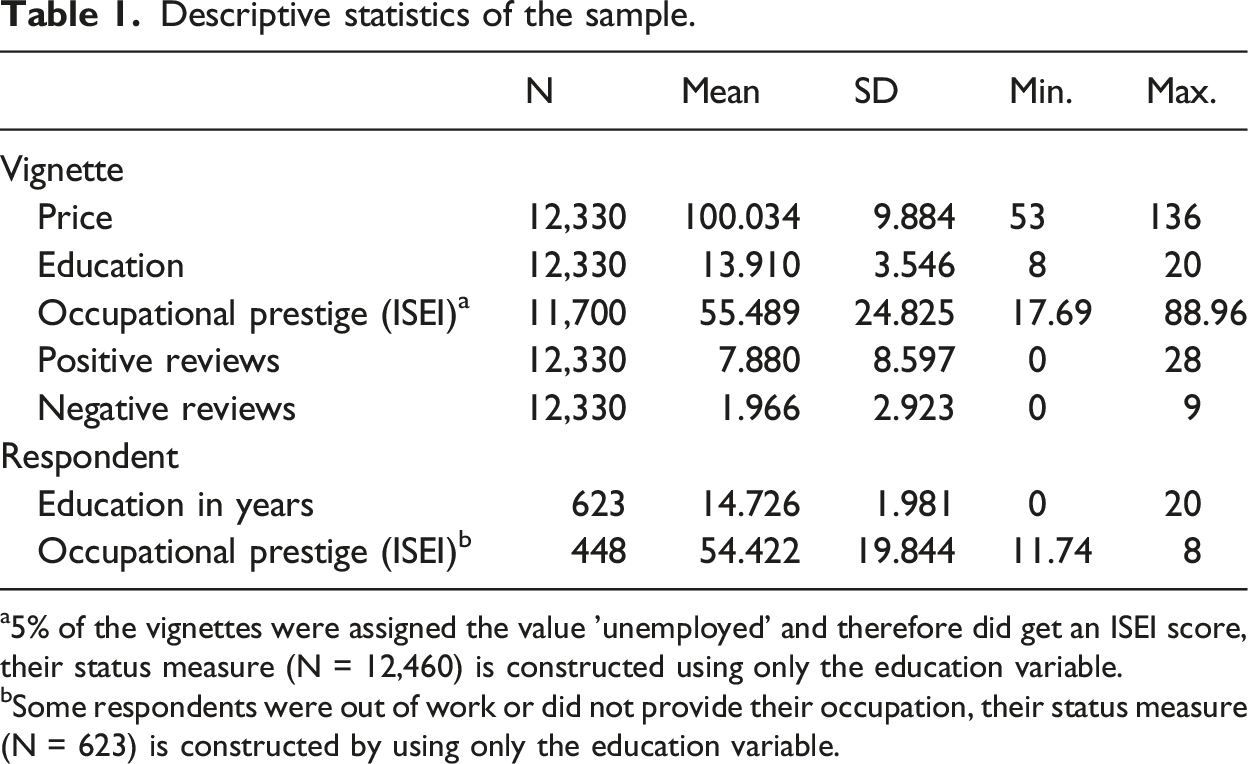
a5% of the vignettes were assigned the value ’unemployed’ and therefore did get an ISEI score, their status measure (N = 12,460) is constructed using only the education variable.
bSome respondents were out of work or did not provide their occupation, their status measure (N = 623) is constructed by using only the education variable.
Analytical strategy
The data were analyzed using a conditional logistic regression model (McFadden, 1974). This type of analysis is able to model individual’s preferences for qualitative choice be-havior by finding general rules, or representative tastes for an alternative out of a given set of alternatives. When the properties of the alternatives are realistic, comprehensive and accurately presented, the conditional logit model offers a clear test of generalities in decision making (McFadden, 1974). We model the decision rules, given a certain set of alternatives. This is necessary because in this study the choice of trustee is dependent upon the characteristics of that trustee given the characteristics of the alternative. There-fore, the data are grouped by runs of the experiment. Additionally, because there were multiple experimental runs administered per respondent, we cluster the standard errors by respondents in order to obtain robust estimates.
Results
Conditional logistic regression models on the placement of trust.
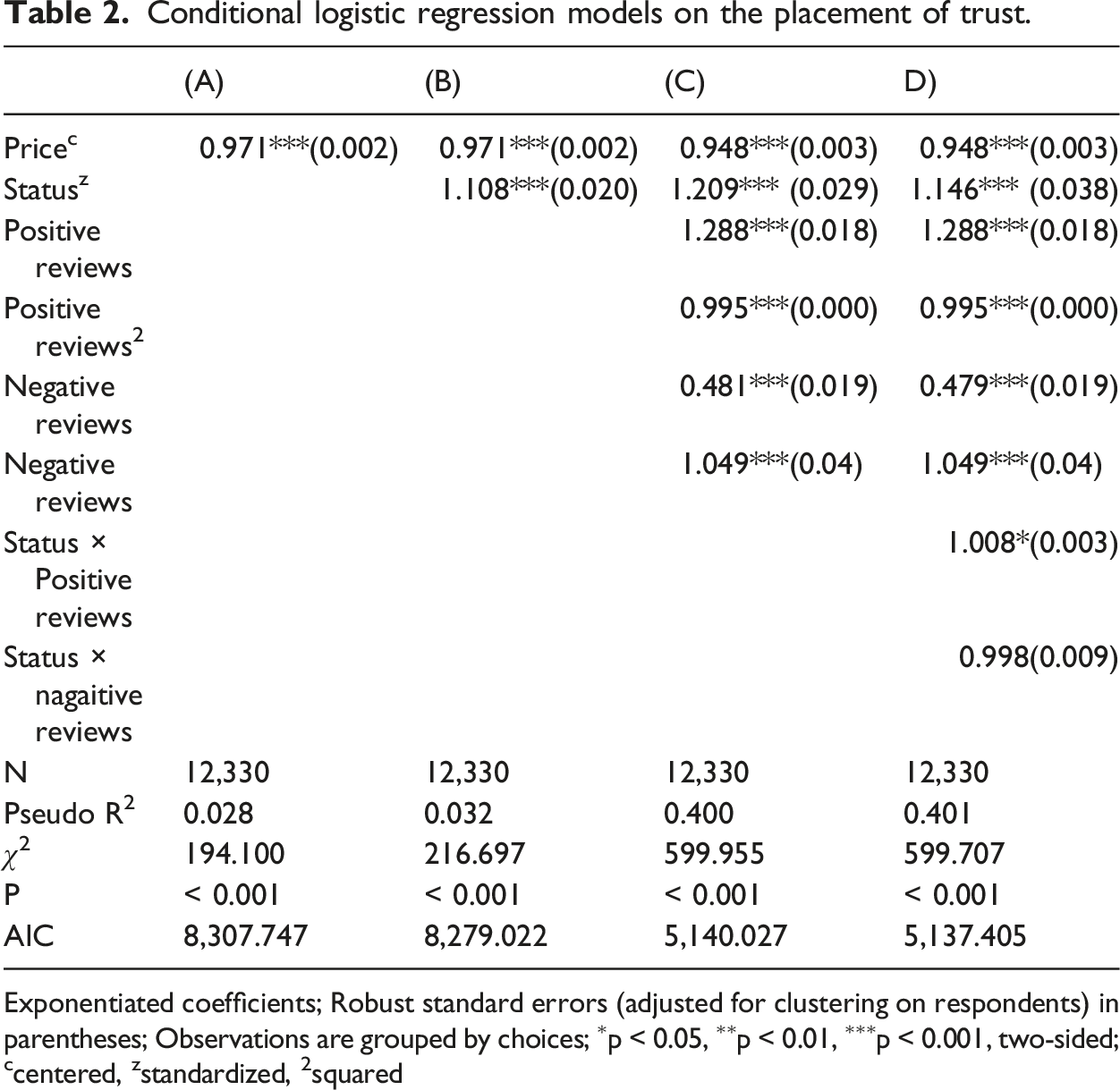
Exponentiated coefficients; Robust standard errors (adjusted for clustering on respondents) in parentheses; Observations are grouped by choices; ∗p < 0.05, ∗∗p < 0.01, ∗∗∗p < 0.001, two-sided; ccentered, zstandardized, 2squared
Before assessing the models associated with the hypotheses we turn to the effect of stated price on the probability that a vignette is picked. This manipulation check is a minimal way to validate the experiment for it is assumed that, ceteris paribus, rational decision makers will prefer the cheapest option. Model A in Table 2 shows that, indeed, the effect of price is negative. For each additional dollar, the odds of choosing a vignette are reduced by almost three percent.
The consecutive model assesses the effect of the trustee’s status on the probability of placing trust by the trustor. Model B shows, in line with Hypothesis 1, that status increases the perceived trustworthiness of the trustee. We have tested the robustness of the result with different operationalizations of status and the main result remains intact. Models with the two standardized indicators of SES are included in the online Appendix, Section A. 9
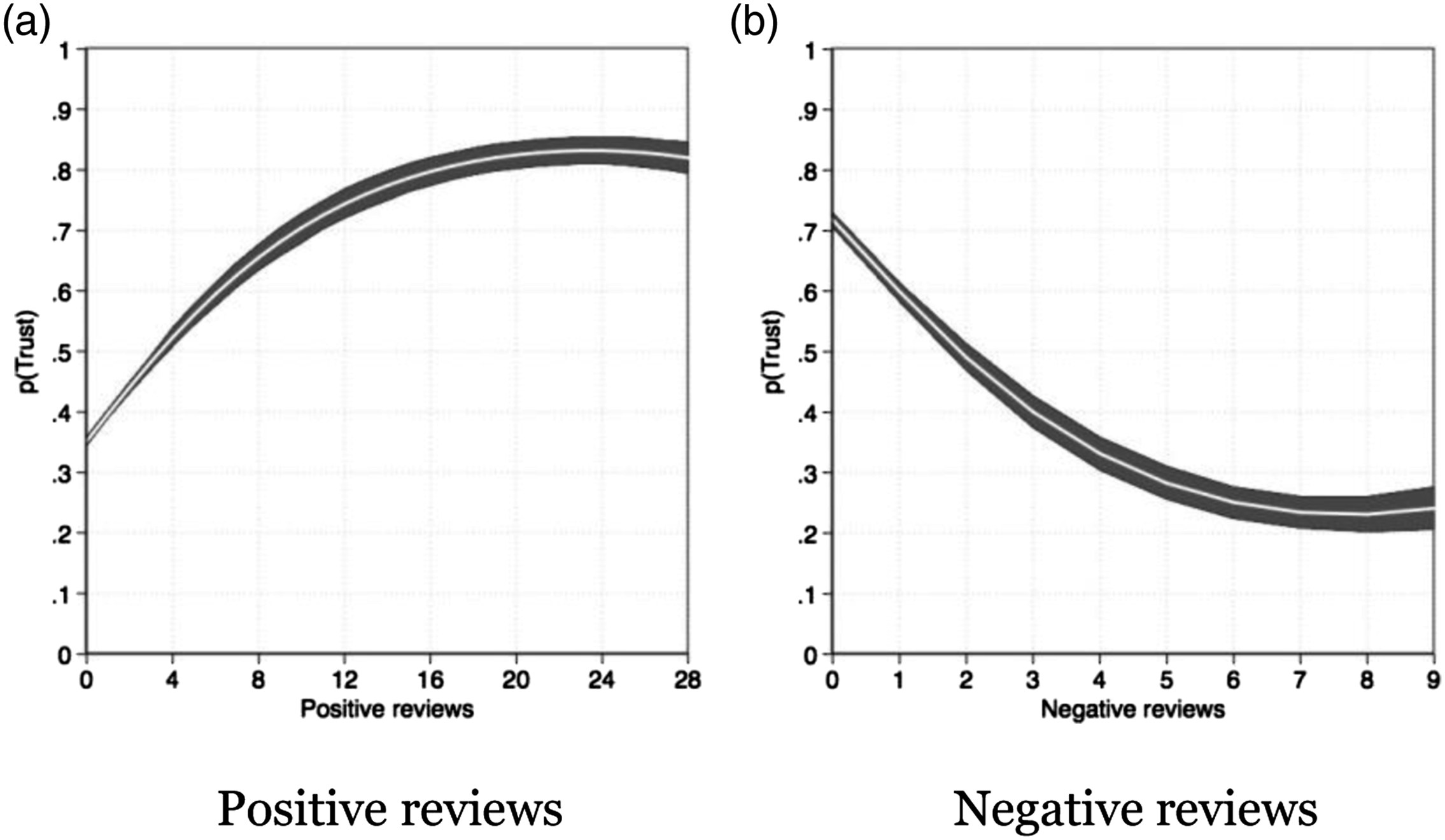
The hypotheses on positive effect of positive reviews (H2) and the negative effect of negative reviews (H3) are assessed simultaneously in model C. Both effects are significant and in the expected direction. The effects of positive and negative reviews, in concord with their quadratic terms affecting trust in the opposite direction of their respective main effects seems to corroborate with our expectation formulated earlier; information gained by positive and negative reviews has a diminishing marginal utility function. It shows that at each added review, the impact of this review is weaker than of those preceding it. 10
Figure 3 presents plots of the predicted probabilities at different numbers of positive (panel a) and negative (panel b) reviews. When there are no positive reviews present, the average marginal probability of picking that particular vignette, ceteris paribus, is only 35%. As the number of reviews increases, the probability to pick that vignette steeply rises and exceeds 50% at five reviews. The effect seems to stabilize at around twenty reviews resulting in a probability of around .8. The plot of predicted probabilities by negative reviews, Figure 3 reveals a similar image. The slope is inversed and on a smaller range of reviews indicating a stronger effect per unit increase on the x-axis, but the effect seems to flatten out similarly to the positive reviews plot. The predicted probability for choosing a vignette without negative reviews is 71% and then rapidly exceeds the 50% boundary at three negative reviews. The curve’s floor is reached around 6 or 7 reviews at a probability of around .23. Whether status positively moderates the effect of reputation on perceived trustwor-thiness measured through positive reviews (H5 - the reputation premium) and negative reviews (H6 - the reputation punishment) is assessed jointly (model D). The interaction term of status and positive reviews in combination with the main effects of status and positive reviews shows that the positive effect of reputation slightly increases with status. The vignette experiment. 7 (age) × 2 (sex) × 11 (education and occupational prestige) ×13 (good reputation) × 11 (bad reputation) = 22,022 vignettes. Predicted probabilities p(Trust) by positive and negative reviews. Based on the estimates of model D - the full model.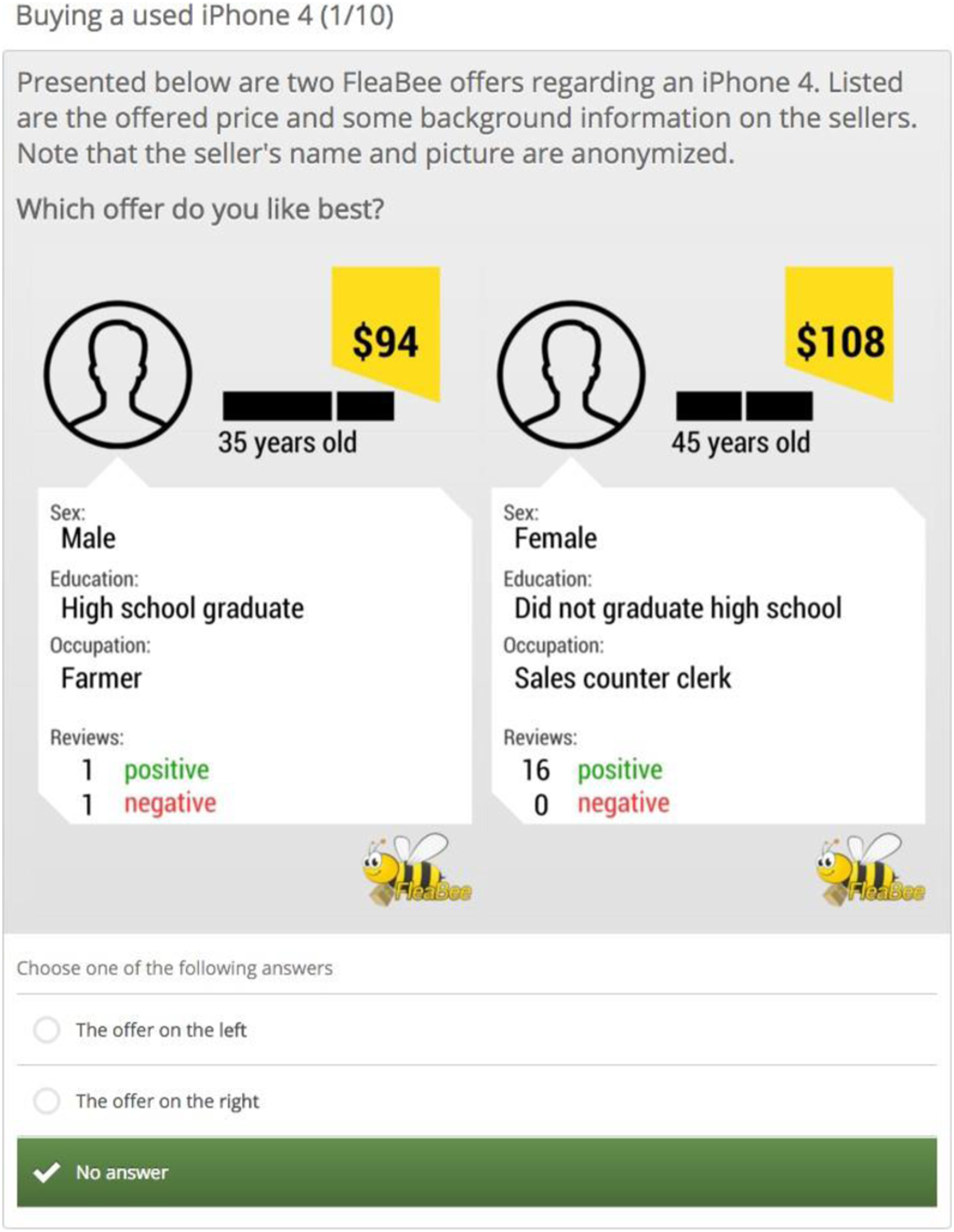
In other words, lower status individuals receive a lower premium for past trustworthy be-havior expressed through positive reviews than their higher status counterparts. The effect seems small, yet significant.
We hypothesized that if trustors more strongly reward a reputation that is in line with their expectation about the trustworthiness of the trustee, they might also more severely punish a reputation that is not in line with their expectation (H6 - the reputation punishment). Yet, the results of model D are not in line with this claim and did not signify an effect of the interaction term of negative reviews and status. Thus, the data offer no support for a possible stronger negative reputation punishment effect for higher status individuals.
Finally, we use the coefficients of model D to address Hypothesis 4, which states that the effect of negative reviews is stronger than the effect of positive reviews. A Wald likelihood ratio test is conducted comparing the composites of the effects of the main and squared review items. In line with the expectation, we found that the negative effect of negative reviews is indeed stronger than the positive effect of positive reviews; Wald χ2(1) = 172.19, p < .001.
Magnitude of effects and model fit
Due to the experimental set-up of the survey we have been able to disentangle effects of price, status and reputation. Yet, assigning qualitative meaning to the effects poses a challenge. The dependent variable, whether trust was placed in a trustee or not, was designed to have a mean of .5 and to have no variance across choice sets or individuals. This precludes an interpretation of trust in absolute terms; we do not know how much trust people place in a trustee with a given status level per se. In relative terms we are able to interpret the results, and look at the relative value of status and reputation in the context of peer-to-peer markets.
The effect of status in our data is clearly positive, but its low explained variance indicates that it’s not the most important factor in the equation. McFadden’s adjusted R2 for conditional logistic regression models is rather small in models A, with only price, and B, with price and status, indicating that these two are not the most important predictors of trust. The influence of price in this case should be interpreted with care, because it is highly dependent upon the range and distribution that was chosen in the design of the experiment. A higher standard deviation than the one that was picked in our scenario (which was $10;-) would not result in a stronger effect of price, but would result in higher explanatory power of the variable, i.e. more choices are driven by the price variable, thus a bigger effect on the pseudo R2. The status effect relates to this in the sense that its order of size will most likely be similar in comparable situations. Its explanatory power though, i.e. the importance of status as a determinant of trust, will not necessarily increase. Uniformly distributed in the vignette population, a large amount of variance is achieved and only when this variance of status in online peer-to-peer market platforms proves to be larger, the importance of status increases. Compared to the effect of a decrease in price on the probability to be trusted, with a reasonable amount of confidence we can say that for products with a mean value of $100;-, having a status of one standard deviation from the mean enables the trustee to raise the asking price by two to three dollars. 11
Explanatory power of the model was substantially increased when the reputation effects were taken into account. Model D, which includes the main reputation effects and their squared products, has a McFadden adjusted R2 of .40 indicating excellent model fit. In line with theoretical predictions as well as empirical results in the field, the effect of reputation, if available, seems to be of high importance in the decision to trust in one-shot interactions. But additionally to its importance in decision-making, the size of the effects appears rather large as well.
Expressed in its monetary value the first positive review will yield the same effect on probability to be picked as subtracting almost five dollars from the asking price for a product with mean value of $100,-. 12 In other words, a trustee with one positive review can ask about five dollars more than a similar trustee without positive reviews. The first negative review is even more costly; it has the same effect as subtracting almost fourteen dollars off of the asking price. 13
Discussion
The theory and evidence presented in this study contributed to clarifying the relationship between status and trust, as well as to exposing inequalities that can arise in the sharing economy. We hypothesized that, along with a higher status, a decrease in marginal utility of the temptation outcome in the trust game (Diener et al., 1993), as well as the greater utility loss from social punishment associated with that outcome both indicate that status would positively relate to trustworthiness (Sauder et al., 2012). Under the assumption that both actors are aware of each other’s strategies, higher status individuals will therefore be trusted more easily. Moreover, the associational preference bias argument identifies a direct relation between status and perceived trustworthiness (Gould, 2002). Hoping to raise one’s own status by association should directly result into higher levels of trustfulness in higher status trustees.
The evidence from our vignette experiment suggest that there exists a positive relation between obtained trust and status. It is clear that higher status trustees are perceived to be more trustworthy, ceteris paribus. Little is known about the justification of this bias. In the light of inequality studies, it would be valuable to address whether the trustor’s perception of the trustee’s strategy, and actual behavior of the trustee do match. Past research did find a positive effect of status on trustworthiness (Glaeser et al., 2000; Korndörfer et al., 2015), but studies are scarce and predominantly executed in experimental settings, constraining generalizability to various types of social exchange. However, we have shown that trust, as a type of social capital, is in fact part of the discriminatory advantages that come with status. Scholars have warned for the increasing importance of status, skewing the distribution of social capital over society (Coleman, 1990; Glaeser et al., 2002).
Peer-to-peer market places can be useful and economically efficient for the exchange and use of resources (Leismann et al., 2013), but also bring about more uncertainty in these exchanges compared to big trustworthy companies which enjoy a great level of insti-tutionalized trust (Botsman and Rogers, 2010; Rousseau et al., 1998). Knowing who you are dealing with in such a marketplace generally lowers uncertainty and thus increases the net amount of trust that is placed on these platforms. Yet, scholars have warned that the inclusion of personal information on online profiles could bring about discrimination (Edelman et al., 2017). In the context set out in this study, objective SES is explicitly mentioned in the presented vignettes, and therefore easily quantified. This enabled us to induce a precise, and clear signal of our trustee’s status and measure an effect that can solely be attributed to SES. In most real life situations, however, this signaling takes place much more implicitly. Even though trustees would not necessarily state their occupation, education or income when facing a trust problem, people seem to be able to pick up on class backgrounds through subtleties in behavior and expressed tastes (Bourdieu, 1985).
As established by past research in this area: “[…] human behavioral patterns reflecting class-based differences in independence may signal social-class identity during even the briefest face-to-face encounters” (Kraus et al., 2012: 160). This implies that perceptions of trustworthiness assigned to status are a determinant of social capital distribution in everyday life, even when they’re not expressed explicitly.
Our results indicate the importance of reputation in peer-to-peer market places. The large effect sizes and explanatory power of both negative and positive reviews indicate that reputation scores, as signal for past trustworthiness, are likely to be the principal criterion for determination of the most preferable trustee. At face value, this is not necessarily problematic, but the implications in repeated interactions uncover a negative externality. Being trusted precedes building a reputation; therefore newcomers to a network with a reputation system have a competitive disadvantage over equally trustworthy individuals with a positive interaction history. In general, “reputation systems may avoid misplaced trust in some, but at the expense of misplaced distrust in others.” (Frey and Van de Rijt, 2016: 153). Following the principles of the cumulative advantage literature, reputation cascades rapidly amplify small differences in perceived trustworthiness for two comparable trustees (DiPrete and Eirich, 2006; Frey and Van de Rijt, 2016; Merton 1968; Van de Rijt et al., 2014).
Reputation cascades influence the way we think about indicators of trustworthiness. The main effect of status on trust may be small, but it might be enough to obtain the benefit of the doubt once, and appearing more and more trustworthy in subsequent interactions (Kas, 2022). Reputation systems act as a third-party in the trust problem by substituting the necessity to place trust in promises of the trustee for past proven trustworthiness (Coleman, 1990).
We have seen that the strength of the positive effect of positive reviews depends upon status levels such that those who enjoy a greater benefit from trust enhancing characteris-tics enjoy an even greater benefit of their shadow of the past. In other words, higher status trustees enjoy a greater benefit from a good reputation. This is remarkable since it opposes the premise of reputation systems that more clearly signaling past trustworthiness would lead to less arbitrary estimates of trustworthiness by trustors (Jøsang et al., 2007). To put it even more strongly, our results indicate that reputation systems strengthen status-based differentiation in the placement of trust.
The methods used in this study pose some challenges for generalizability of the results. There are two main sources of concern; the participant pool, and the experimental set-up. Sampling through AMT challenges generalizability. The population of AMT workers have proven to be much more diverse and representative for the US population than a typical laboratory sample (Buhrmester et al., 2011; Paolacci and Chandler, 2014), but cannot compete with the golden standard of a perfect random sample. Yet, the variation on basic demographics such as age, gender, and most importantly: SES, indicates that the sample is at least diverse. The distribution of status scores in our sample differed from the vignettes, due to the uniform distribution of prestige scores in the vignette population. Originally, we planned to test a status similarity hypothesis—based on principles of in-group favoritism and homophily—but could not because of a negative skew in status difference scores be-tween the vignette and the population. 14 Future research could improve on our work, and estimate the status difference effect, by distributing prestige and education over the vignette population proportional to the distribution of status among AMT subjects.
Second, the experimental set-up allowed for disentangling effects of variables that are often interrelated, and therefore hard to unravel in reality. Because of the control over the correlations in our vignette population we can be sure that the effects found are not confounded by omitted variables. The downside to this approach of course is that it also constrains external validity. In a given population of sellers on a peer-to-peer market platform we will most likely find correlations between status and presentation on a personal profile expressed through names, pictures and so on.
Fractional factorial survey designs are not often used in sociology (Auspurg and Hinz, 2014; Wallander, 2009) and to the best of our knowledge, no real comparable design has been implemented in research on interpersonal trust thus far. Therefore, it is hard to assess whether the experimental manipulation was successful and the respondents actually felt like they were facing a trust problem. Based on the analyses we cannot support nor reject this presumption, but finding substantial effects of price and reputation bodes well with the success of the experimental manipulation. It seems as though people did experience uncertainty about the trustworthiness of the trustees they encountered, by not always choosing the lowest price available to them, and thus faced a trust problem in their choice of vignette.
The current design does not warrant uncertainty in the decision between trustees be-cause the choice by the trustor lacks economic consequences. Using an artificial vignette population, one would have to impose a trustworthiness hierarchy of trustees based on their characteristics. It would be hard to justify why some trustees are more trustwor-thy than others, and difficult to communicate the mechanics of the trustees’ decision (i.e. the mechanism for granting a certain payoff to the subject) without explicitly training the respondents to trust certain people more than others in our context or without using deception in the design. What is more, suggesting a relationship between socioeconomic status and trustworthiness could create harmful impressions on the participants that they could use to discriminate between trustees in real life. We suggest that in the future, work like ours—that exploits the advantages of full control over an artificial population of vignettes—needs to be complemented with studies that use subjects in both the role of trustor and trustee, incentivizing respondents through actual payoffs in the trust game.
Future research using vignettes could focus on validating the design by replication or the use of variations of the design. Including names, pictures, and/or short personal descriptions would enhance realism of the vignettes and substantiate robustness of the findings posed here. Alternatively, the use of different choice or rating schemes for the vignettes could extend our findings with estimates of effect size differences at different levels of uncertainty, that is, for smaller and larger trust problems (e.g. by increasing the trust problem by raising the price), and give measures of absolute amounts of trust (e.g. by letting respondents indicate perceived trustworthiness of a vignette on a scale. What is more, the design could be optimized by using D-efficient sampling of vignettes (Dülmer, 2016). This method ensures that the vignettes matched up against each other are more meaningful and yield more statistical power than random draws from the population of vignettes will.
This paper showed that trust is relevant to the study of inequality. Trust, as a form of social capital, adds to the long list of forces that deepen social cleavages. Combined with inequality amplifying effects of reputation, socioeconomic status may contribute to the emergence of a sharp inequality of trust.
Supplemental Material
Supplemental Material - Socioeconomic status, reputation, and interpersonal trust in peer-to-peer markets: Evidence from an online experiment
Supplementary Material for Socioeconomic status, reputation, and interpersonal trust in peer-to-peer markets: Evidence from an online experiment by Marijn A Keijzer and Rense Corten in Rationality and Society.
Footnotes
Acknowledgements
We thank Samuel Langton, Alexander Dicks, Benjamin Rosche, and all other participants and teachers of the Sociology and Social Research program at Utrecht University for their contributions. Thank you, Vincent Buskens and Jeroen Weesie for your remarks on an earlier version of this paper. Also, thank you to Lydia Stulen, Danique van der Burg and Anna la Verge for your support in the process.
Declaration of Conflicting Interests
The author(s) declared no potential conflicts of interest with respect to the research, authorship, and/or publication of this article.
Funding
The author(s) disclosed receipt of the following financial support for the research, authorship, and/or publication of this article. Marijn Keijzer acknowledges IAST funding from the French National Research Agency (ANR) under the Investments for the Future (Investissements d’Avenir) program, grant ANR-17-EURE-0010. Rense Corten acknowledges funding from the Dutch Research Council (project number 452-16-002). Funding for the compensation of the research subjects came out of the first author's own pocket.

Supplemental Material
Supplemental material for this article is available online.
Notes
References
Supplementary Material
Please find the following supplemental material available below.
For Open Access articles published under a Creative Commons License, all supplemental material carries the same license as the article it is associated with.
For non-Open Access articles published, all supplemental material carries a non-exclusive license, and permission requests for re-use of supplemental material or any part of supplemental material shall be sent directly to the copyright owner as specified in the copyright notice associated with the article.
