




Abstract
On-side fighting – outright violence between armed groups aligned on the same side of a civil war’s master cleavage – represents a devastating breakdown in cooperation. Its humanitarian consequences are also grave. But it has been under-recognized empirically and therefore under-theorized by scholars to date. This article remedies the omission. Existing research can be extrapolated to produce candidate explanations, but these overlook spatial and temporal variation in on-side fighting within a war. I provide a theory that accounts for this ebb and flow. On-side fighting hinges on belligerents’ trade-offs between short-term survival and long-term political objectives. Enemy threats to survival underpin on-side cooperation; in their absence, belligerents can pursue political gains against on-side competitors. I evaluate this threat-absence theory using evidence from the ongoing Syrian Civil War’s first years. Fine-grained fatalities data capture fluctuating enemy threats to on-side groups’ survival and situate on-side fighting and its absence. Findings support threat-absence theory and contribute to research on warfighting and political competition in civil wars and to the study of coalition dynamics in other settings, including elections and legislatures.
Introduction
On-side fighting – outright violent conflict between armed groups aligned on the same side of a civil war’s master cleavage – represents a devastating break-down in cooperation. In the context of alignments, cooperation occurs along a wide spectrum. At one end, armed groups that maintain a meaningful alignment against a common enemy may harness this latent potential for cooperation to forge an alliance and work jointly together at the tactical and strategic levels. In the middle, aligned groups might tacitly coordinate by avoiding undermining one another’s activities. At the other end, such groups may not only fail to translate shared interests into any sort of cooperation or coordination but, in the extreme, fighting can break out between them.
This article draws attention to this source of violence, human suffering, and strategic failure, which existing scholarship has not acknowledged properly: on-side fighting is under-recognized empirically and therefore under-theorized. On-side fighting’s terrible consequences are evident in the ongoing Syrian Civil War, in which it has been pervasive. It has stymied both sides of the war’s master cleavage, damaging military interests. Foreign governments have balked at assisting a side riven by factionalism and not focused on defeating its enemy. And the depredations of war 1 have stalked civilians who shelter well behind the front lines. 2
But the phenomenon is not of recent origin, nor a peculiar feature of Levantine civil wars. On the incumbent Republican side of the Spanish Civil War, Communists fought against Trotskyists and Anarchists, suppressing them both. The Nationalist side in the Chinese Civil War, Eritrean secessionist groups in Ethiopia in the 1970s, rival Marxist groups in Peru in the early 1980s, and the forces that deposed Yemen’s sitting government in 2015 and the revanchists now battling them all also grappled with the seemingly self-destructive behavior that is on-side fighting. 3
To be sure, scholarship has documented and studied the complexities of fighting in civil wars. 4 Belligerents switch sides, defecting from an alliance to join the former enemy; 5 but this is not on-side fighting. Armed groups disintegrate following the breakdown of cohesion and splinter, forming new organizations; 6 but this is not on-side fighting. On-side fighting maintains the war’s master cleavage and simultaneously entails the addition of a vector of violence between pre-existing organizations within a side.
Hints of the empirics of on-side fighting appear in existing research on inter-rebel violence, 7 but this literature has conceptual, theoretical, and empirical shortcomings. It conceptualizes fighting only as occurring between disparate rebel groups often even only among a subset of rebel actors, either organizations within a single separatist or national movement or those that fight on behalf of a single ethnic or sectarian group. 8 It does not acknowledge nor develop a general concept that can apply to rebel and pro-government actors alike and across social identity cleavages. Most such scholarship theorizes structural factors that might account for the incidence of inter-rebel fighting cross-sectionally across wars, but cannot account for change over time within a single war. Research that theorizes the effects of the distribution of power across groups and changes in relative power does speak to this latter question. But balance of power theories do not address within-conflict spatial variation in internecine violence. Finally, previous studies measure explanatory variables of interest at aggregate levels – typically across groups or dyads by year, with no spatial variation. Yet a belligerent’s operating environment often changes daily, and at a local level.
This article’s definition of on-side fighting – outright violent conflict between armed groups aligned on the same side of a civil war’s master cleavage – includes, but is not restricted to the inter-rebel, intra-movement, and co-ethnic fighting covered by extant studies, extending usefully also to the incumbent government and its supporters. It is important to recognize the more general concept so that we can identify where and when on-side fighting takes place. Once we follow the conceptual path laid out in this article, we can investigate fluctuation in on-side fighting in civil wars comparatively; future research can begin to map its prevalence systematically.
I theorize on-side fighting as political strategy. Civil war belligerents allocate resources toward safeguarding their survival over the short-term and toward achieving their long-term political objectives. I argue that this trade-off lies at the core of understanding on-side fighting. Enemy military threats to survival increase the salience of security and draw resources away from pursuit of political agendas, increasing the space for cooperation between on-side groups. If the perceived level of threat that the enemy poses abates sufficiently to assure on-side groups’ short-term survival, they can prioritize long-term political agendas. Doing so increases friction between them, since such on-side groups compete for political support. 9 During wartime, groups that wish to enhance their political power in the eventual post-conflict period can use violence as a cost-effective tool in bids to consolidate control at the expense of those aligned with them.
This explanation has two parts, one on-side, one across the master cleavage. Within a side, belligerents as political competitors can have interests that are zero-sum or not zero-sum. When zero-sumness exists, it implies a division between political competitors sufficient as incentive for the use of violence in bids for domination. Across the master cleavage, I assume a zero-sum interaction between enemies.
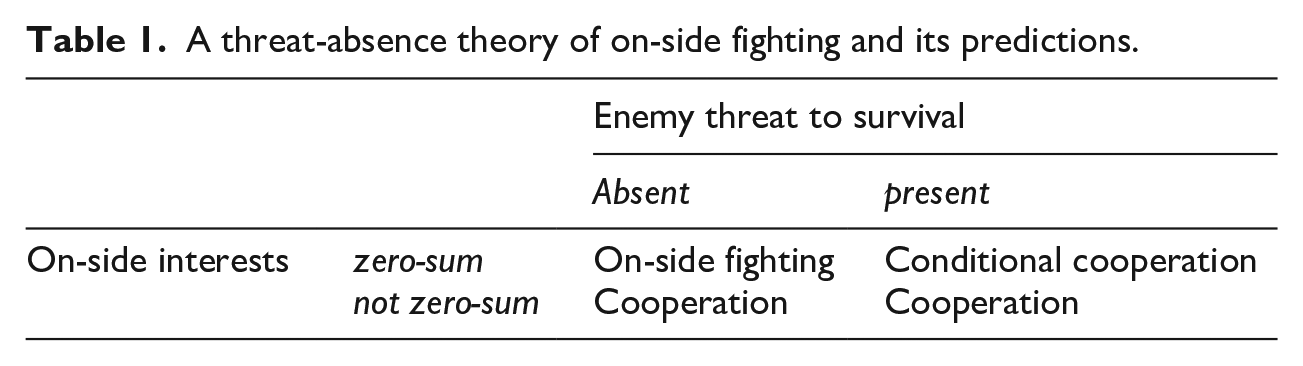
Two necessary and jointly sufficient conditions produce on-side fighting: the existence of zero-sumness within a side and the opportunity to fight. The latter is a function of interaction across the war’s master cleavage, namely whether or not there exists a perceived enemy threat to on-side groups’ survival. The reprieve from violent elimination by the enemy provides the opportunity for on-side groups to turn on one another, while the broader context of the war keeps these fratricidal groups aligned against their common enemy. Table 1 illustrates the theory and its predictions.
A threat-absence theory of on-side fighting and its predictions.
Existing scholarship provides no explicit theories of on-side fighting, but we can extract from it five broad categories: structural factors, balance of power, organizational characteristics, social cleavages, and ideology. These candidate explanations may lay the groundwork for on-side fighting to occur, but the wartime military dynamic of enemy threats to survival helps to account for the timing and location of on-side fighting.
I examine this threat-absence theory of on-side fighting against evidence from the first years of Syria’s ongoing civil war, from March 2011 through August 2013. I describe the pattern of on-side fighting in the four Syrian provinces in which instances of it were documented during this period, as well as a fifth in which it did not occur. Then, using disaggregated data on fatalities, I track the absence and presence of on-side fighting in each province alongside the enemy threat to survival (Section 5, below, lays out the rationale for these temporal and geographic bounds on the empirical analysis).
The Syrian Civil War is an important case in which to test the theoretical account. The war is rife with factors like the presence of multiple armed groups, economic resources, and foreign state financing. Observers of Syria explain on-side fighting along these lines and we should expect these factors to drive on-side fighting if existing research is a helpful guide. The presence of these same factors also provides an unusual amount of analytic leverage to test rival theories. In Syria, then, the plausibility of the threat-absence theory can be examined against rival explanations. In addition, the availability of fine-grained data on fatalities in Syria makes it possible to rigorously characterize the absence of threats to survival that on-side groups face from their common enemy so that we can observe whether patterns of on-side fighting are consistent with the theory’s predictions.
The Syrian case alone is cause to take the phenomenon of on-side fighting seriously. Beyond Syria, it is observed in diverse geographic settings and historical eras, as the opening anecdotes, above, illustrate. It is not possible for this article to describe the distribution of on-side fighting in civil wars worldwide and over time because it is not yet the subject of empirical study. This article aims to chart a course upon which such work can embark.
The concept of on-side fighting
Civil wars vary considerably in the number of military actors that operate within them. They often depart from the stylized case of a single military actor on each side, although this does fit some cases, like Finland in 1918. Multiple groups aligned with the government may fight against a unified insurgency, as was the case during the Dhofar rebellion in Oman, 1965–1976. Multiple aligned insurgent organizations may fight in concert to overthrow the government, as in El Salvador in 1976. Multiple aligned insurgent groups fighting against the government may be pitted against multiple groups aligned with that government, as was already the case in Lebanon in 1975, at the outset of its decade-and-a-half-long civil war. 10
I define the concept of on-side fighting using the war’s master cleavage, where by master cleavage I mean the principal polity-level dispute that separates civil war belligerents. 11 It is straightforward to identify this dispute. Civil war’s core feature is the rupture of state sovereignty via the use of armed force. 12 The basis for that sovereignty rupture, either the contest to control the state or one to bring about territorial change by altering the borders of the state, therefore constitutes a civil war’s principal dispute, its master cleavage. 13 Multiple master cleavages may be observed in a single country if the contest for control of the state exists alongside one or more territorial disputes, or if multiple territorial disputes exist. But such disputes constitute separate wars within a single country. 14 Thus, for a given war, there can be only one master cleavage, separating two sides, each with its own on-side groups.
Armed groups can be classified as on-side based on their stated aims with respect to the war’s master cleavage; those aligned on the same side of the master cleavage are on-side groups. 15 If the master cleavage is control over the state, all armed groups that support the incumbent government, including state security forces, would be coded as falling together on one side of the master cleavage, those opposed to it, on the other. If the master cleavage is territorial, forces of the incumbent government and any armed supporters fall together on one side of the master cleavage, while all armed groups that support the territorial change in question fall on the other.
Defining on-side groups with reference to a civil war’s master cleavage contrasts starkly with acknowledging the diversity of armed actors in civil wars. Observers refer, sensationally, to “kaleidoscopes,” “dizzying numbers,” or “countless” warring groups. Shifts in inter-group relations from conflict to cooperation and vice versa are seen as similarly opaque, even “out of control.” Attending to motives for violence further complicates the picture. Comparing an expansive range of cases, Stathis Kalyvas documents how individuals not only use the context of war to satisfy personal goals but also fight out sets of local political issues distinct from those captured by the master cleavage. Armed groups are thus the sometimes conscious, oftentimes unwitting instruments through which disparate motives for violence are fulfilled; their activities may have little to do with the master cleavage. 16 However, I argue that the master cleavage narrative is instructive precisely because it highlights apparent contradictions in belligerents’ behavior. 17 Specifically, it is a useful tool for interpreting alignment behavior.
On-side fighting pits on-side groups against one another, while they simultaneously maintain a common enemy in the big-picture struggle that characterizes the civil war. Two examples, from Ethiopia and Yugoslavia, illustrate how the terms master cleavage and on-side groups can be used in studying civil war (see Section 5 for their application to Syria). From the mid-1960s until 1991, insurgent groups fought against the Ethiopian government with the goal of achieving Eritrean independence. The sovereignty rupture in this case was territorial and specific to Eritrea. Additional opposition groups fought the government during the same period, but either in order to overthrow it, or as separatist or irredentist groups that contested its sovereignty over other regions of the country.
Two Eritrean secessionist insurgent organizations – the Eritrean Liberation Front and the Eritrean People’s Liberation Front – are not on-side groups with respect to organizations that fought against the Ethiopian government for control over the state, nor those that fought against it in non-Eritrean territorial contests; these were separate civil wars, with separate master cleavages. But the ELF and EPLF do constitute on-side groups with respect to one another: they were always aligned on the same side of their civil war’s master cleavage, namely the struggle between the government of Ethiopia and armed groups fighting for Eritrean independence. With their war against the Ethiopian government ongoing, the battles between the ELF and EPLF in the early 1970s and 1980s were striking, 18 and constituted an instance of on-side fighting.
Next, consider a negative case, Yugoslavia during the Second World War. Following the German invasion in spring 1941, the royalist Chetniks and the communist Partisans both mobilized to oppose the Axis powers’ occupation. Initial cooperation between the two groups soured and turned to open hostilities by the late fall. 19 Tony Judt lays out an apparent puzzle, noting that despite the “strategic goal” of expelling the Axis, presumably shared by both groups, the Partisans “devoted time and resources to destroying the Chetniks first.” 20 However, with the Chetniks fighting on behalf of the pre-invasion incumbent government and the Partisans fighting to achieve a socialist revolution, resistance to occupation was not the master cleavage in Yugoslavia’s civil war. Rather, the desired type of political system to be put into place following the eventual end of international war in Europe divided them, the Chetniks aiming to restore the monarchist government in exile, the Partisans seeking the objective of a socialist state. 21
Through the lens of the master cleavage, the Partisans were the Chetniks’ “main enemy”; collaboration with the occupying armies was labeled “use of the enemy” in the battle against foreign occupation to the ultimate end of defeating the Partisans and “restoring the monarchy,” 22 victory in the civil war. One Partisan leader’s description of the fighting as “armies clamber[ing] up rocky ravines to escape annihilation or to destroy a little group of their countrymen, often neighbors, on some jutting peak 6000 feet high, in a starving, bleeding, captive land” 23 loses some poignancy if the Chetniks and Partisans are understood not to be on-side groups. Aligned on opposite sides of the civil war’s master cleavage, they fought with surely what they perceived to be real stakes.
Candidate explanations
The literature explains related phenomena but not on-side fighting itself, so I use it to identify five potential accounts of on-side fighting. These candidate explanations represent prevalent ways of thinking about civil war belligerents’ behavior. They address underlying motivations for on-side fighting but have difficulty accounting for geographic and temporal patterns within a war. The threat-absence theory that I lay out in Section 4 addresses these deficiencies.
Structural factors constitute the most common candidate explanation in the literature. Research on resources and intra-rebel relations hypothesizes that three sets of structural conditions affect the incidence of inter-rebel fighting. First, potential gains to eliminating rivals may vary spatially according to the presence of material spoils like natural resource wealth or political resources like the presence of civilian constituencies. 24 Second, the number of rival groups 25 – the structure of competition itself – shapes the intensity of the struggle for access to vital war-fighting resources, like territorial safe havens or loyal civilian populations, and to the spoils of war. 26 The greater the number of rival groups, the higher is the likelihood of fighting between them. Third, outside support constructs “financier-insurgent” relationships between foreign governments or private sources and rebels. Armed groups may use violence to demonstrate organizational productivity to their backers. Should backers fund operations rather than paying based on future-oriented results like strategic victories, groups have the incentive to increase their operational tempo regardless of tactical or strategic impact. 27 Both mechanisms might produce opportunistic on-side fighting. More directly, backers engaged in proxy warfare may set groups against one another, or groups may seek out backers whose foreign rivals sponsor their domestic competitors. 28
An additional strand of research focuses on the effects of the balance of power among groups. Fotini Christia explains side-switching in civil wars as a result of changes in relative power. Groups seek to be part of a minimum winning coalition to increase their eventual gains to victory and to minimize the risk of being taking advantage of by allies; to achieve this, they are willing to flip on current allies. 29 The behavior in question, however, is not conflict between on-side groups, but the rupture of alignment itself as groups switch sides of the master cleavage. But this scholarship suggests a link between relative power and on-side fighting. Peter Krause’s study of national movements can also be extrapolated to elaborate a relationship between power balances and the cooperative or conflictual nature of on-side relations. Movements in which a single group has not established hegemony tend to be more prone to destructive cycles of rivalry and competition between groups, including out-bidding and spoiling behavior. 30 Costantino Pischedda studies the effects of relative power on co-ethnic armed group relations and argues that a significant power imbalance or expectations of change in relative power should lead to fighting between such groups. 31 The relatively stronger party can gain from this “window of opportunity” by fighting to establish hegemony. A relatively weaker party, or one that expects its power to wane, should have an incentive to fight a co-ethnic rival in response to the insecurity that this “window of vulnerability” generates. 32
Armed group interactions might also depend on organizational characteristics. Amelia Hoover Green identifies internal institutions related to a group’s use of violence and ability to act with restraint. 33 The argument here concerns group members’ actions and civilian victimization, but extending the logic of the “Commander’s Dilemma” to inter-group relations is intuitive. Political education (Hoover Green’s focus), military training, selectiveness of recruitment, socialization, and discipline shape commanders’ ability to effectively control combatants’ actions. If commanders lack the tools with which to control or channel combatants’ behavior due to the particular configuration of these institutions, indiscipline might generate on-side fighting. 34
Beyond research on armed group behavior, a storied tradition in the social sciences suggests social cleavages as a basis for inter-group conflict. 35 Seymour Lipset and Stein Rokkan provide a well-known example of this logic, arguing that long-standing, ingrained social cleavages constitute the lines of competition between political parties in democratic systems. 36 We might expect a civil war 37 belligerent who recruits from or represents a particular social group to be more likely to come into conflict with and fight against an on-side group if the latter represents a constituency from which it is divided by a social cleavage. 38 Indeed, scholars studying topics ranging from electoral approval of secession, 39 the type of civil war a country experiences, 40 to civil war onset, 41 rebel groups’ mobilization for civil war, 42 armed group perceptions of refugees’ susceptibility to recruitment, 43 violence targeting civilians during and after civil war, 44 ethnic cleansing, 45 civilian mobilization in pursuit of non-violent strategies during civil war, 46 the persistence of insurgent institutions, 47 and individual motivation to participate in insurgency 48 all point to social cleavages as potential explanations. 49
Finally, international relations scholarship indicates the potential for ideology to affect on-side relations. Stephen Walt’s balance of threat theory contends that states’ relative power, particularly as defined by capabilities, is insufficient to account for alliance formation patterns. Since states ally to secure themselves against threats, the elements that combine to produce the level of threat that one state poses to another affect alliance formation. Ideology can help to build alliance or drive enmity by its link to threat perception – a state may find another state with which it has “ideological solidarity” to be inherently less threatening than others. 50 Note, though, that the implication is that ideological considerations should matter most in environments of relative security. 51 Extending the argument to on-side group behavior in civil war, we might expect ideology to be divisive and to motivate tension, 52 but conditional on the level of threat posed by the common enemy. 53 Recent research provides evidence that ideology can drive differences across armed groups in important behaviors, including use of violence against civilians (Ahmadov and Hughes, 2019) and participation of women as combatants (Szekely, 2020; Wood and Thomas, 2017), suggesting that it can indeed serve as a potential basis for inter-group disagreement and contention. 54
Taken together, the five candidate explanations are a useful framework for understanding the potential for on-side fighting. They help us think about why average levels of on-side fighting might vary across wars, or, within a single war, why some armed groups have a greater tendency to be involved in its incidence than others, even which sorts of cross-group differences might be more likely to lead on-side groups to square off against one another in a bout of violence. Most, however, cannot account for disparate experiences within the same war.
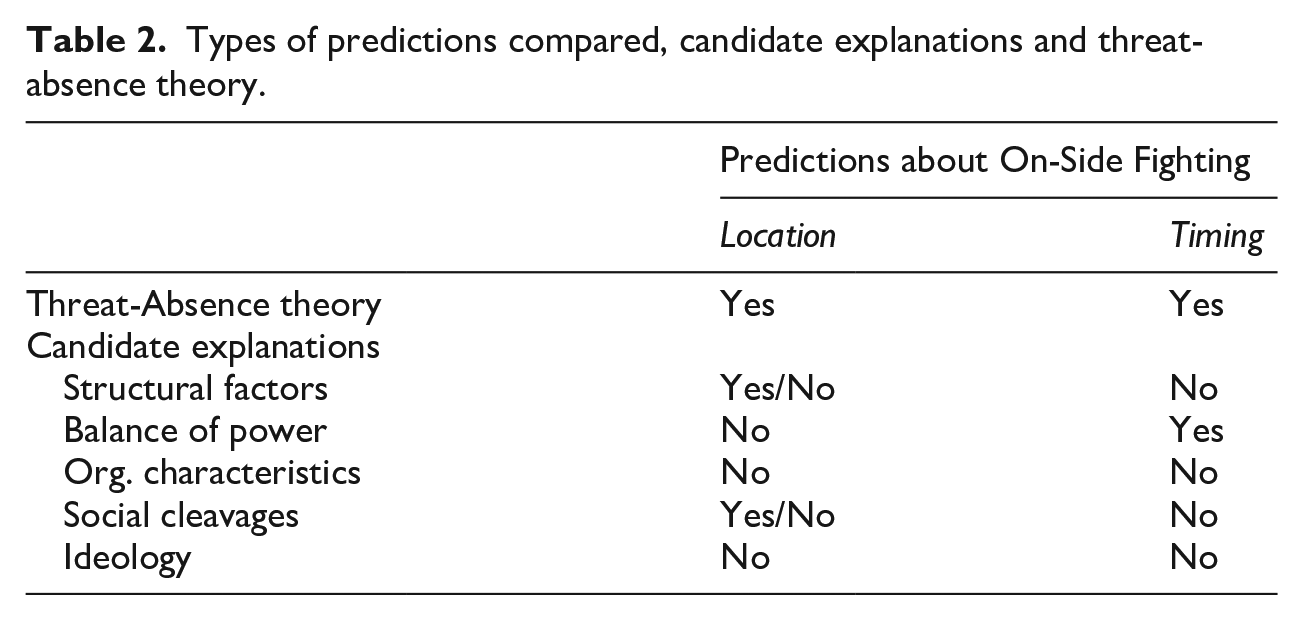
Based on the preceding discussion, Table 2 compares theoretical accounts according to whether spatial and temporal predictions can be gleaned from them. Some structural factors might help to identify potential sites of contention between on-side groups. Resource-rich areas of a country, or areas in which higher numbers of on-side groups operate compared to others, for example, might be more likely to experience on-side fighting than others. But these types of structural explanations do not address when on-side fighting is likely to occur. The presence of another structural factor, foreign financing, predicts a higher likelihood of on-side fighting for a war as a whole, but does not predict timing or location subnationally. Balance of power theories speak to timing; they indicate that changes in the on-side distribution of power via battlefield successes or set-backs may be likely precursors to on-side fighting. But these still have difficulty accounting for where on-side fighting is likely to occur. Social cleavages, if spatially delineated, as is often true of ethnic divisions, may predict the location of on-side fighting; but many social cleavages lack this characteristic, including class and religiosity. 55 Social cleavages are not informative regarding the timing of on-side fighting, while ideological divisions speak neither to timing nor location. To sum up, then, for the specific outcome of on-side fighting, the literature is a strong foundation, but one which has conspicuous gaps.
Types of predictions compared, candidate explanations and threat-absence theory.
A threat-absence theory of on-side fighting
An armed group that is unsure about its ability to survive into the future faces a situation in which the cost of continuing to fight compares unfavorably to the expected returns to doing so. The natural response would be to pool resources with on-side groups. Winnings would have to be divided among these groups, but because they occupy one side of the war’s master cleavage, their preferences with respect to the key issues at stake in the war are similar enough that winning can be thought of as producing a public good. A group can then attempt to cooperate strategically and operationally to the greatest extent possible with on-side groups, sharing the cost of fighting the enemy with these partners so that the choice to continue to fight becomes worthwhile for each individual group.
Whether an armed group will engage in even the minimum level of latent cooperation with on-side groups by refraining from on-side fighting therefore depends critically on the extent to which its survival is at stake due to threat by the enemy across the master cleavage. But this statement seems trivial in that the standard portrayal of war assumes it to be the ultimate risk to participants. It is a mental model that does not allow for variation in the level of threats to survival during conflict.
The growing body of research on the micro-dynamics of civil war, 56 however, has examined conflict processes in increasing empirical detail and theoretical depth, often casting doubt on the previously unquestioned assumptions of earlier research. Heeding this literature’s call to avoid portraying war as a “black box,” I relax the assumption that war is the ultimate risk; to assume it is so obscures decision-making processes during conflict. I consider the possibility that the enemy threat from across the master cleavage to the survival of on-side groups may vary according to the progress of the war. 57
In theorizing the effects of variation in the enemy threat to survival across locations and over time, I follow geographers’ calls to attend to space by considering the character of a locale and to avoid conflating the nature of space with measures of distance (O’Loughlin, 2000).
From an armed group’s perspective, should the enemy threat from across the master cleavage recede, a resort to cooperation with on-side groups is no longer necessary. Instead, the armed group can shift its focus to future political competition. Here, its rivals are on-side groups; as scholars have recognized, for example, Cunningham et al. (2012) in their “dual contest” framework for understanding self-determination movements and Pischedda (2018) in his research on war between co-ethnic rebel groups, the quest for factional power is an inherent source of tension and creates the potential for conflict among organizations that have common cause. 58
I argue that the two dimensions of enemy threats to survival and the nature of competition between on-side groups combine to produce on-side fighting. If on-side relations are characterized by what groups understand to be even a modicum of compatible interests and therefore are not zero sum, this provides a window through which cooperation can emerge regardless of the enemy threat to survival. I do not theorize zero-sumness in on-side groups’ interests; that is beyond the scope of this article. I simply note that is a necessary condition for on-side fighting. However, as a window into this, it is important to recognize that groups’ perceptions of on-side competitors’ interests can depend on the existence of past interaction. Lack of information, misunderstandings, and doubt regarding the sincerity of stated intentions and interests all increase in the absence of prior relationships among groups.
If the zero-sumness condition is satisfied, I hypothesize that on-side fighting depends on the presence of perceived enemy threats to survival. The more secure an armed group perceives itself to be from threats posed by its enemy across the master cleavage, the more it can concentrate on political competition with on-side groups, to the point of using violence to dominate those rivals. 59 As a conservative rule of thumb, we can consider that a group is unlikely to perceive an enemy threat to its survival if an enemy offensive aimed at re-capturing territory from the group has been attempted and has failed.
Table 1, above in the Introduction, depicts the theory and its predictions. On-side fighting is most likely to emerge as conditions on the battlefield limit the prospects for on-side groups’ violent elimination at the hands of the enemy, and least likely to emerge when the enemy threatens their survival. When the later abates, on-side groups are likely to move from a world of conditional cooperation to a world of on-side fighting (the top right cell to the top left cell). Note that an important scope condition of the theory is that enemy threat be shared by all on-side groups present in a given area. 60
Threat-absence theory of on-side fighting is distinct from theories of well-recognized armed group behavior like side-switching or fragmentation, in what it studies as the outcome of interest, as explained above in the Introduction. In addition, it has important differences with the theoretical emphases of this scholarship. Side-switching rests on belligerents’ complex calculations of the balance of power; 61 the effect of assured survival with respect to the enemy underpins threat-absence theory. Fragmentation stems from the pressure that hardships exert on an armed group; 62 threat-absence theory implicates conditions of security in the breakdown of cooperation between on-side groups.
Threat-absence theory’s hypotheses about on-side fighting parallel coalition dynamics beyond civil wars. William Riker’s discussion of the disintegration of victorious coalitions at the end of total wars is one example: victory changes what was a minimum winning coalition into one that is larger, leading to fighting between former allies over the remaining resources that the group possesses. 63 Gordon Tullock uses a similar logic to explain the transformation of junta-led governments into autocracies. 64 George Tsebelis’ study of political parties’ electoral coalitions raises a similar possibility. Although parties’ positions push them together as coalition partners, back-stabbing can occur once the likely results of the inter-coalitional competition are clear. At that point, each party within the coalition in question tries to maximize its own representation in parliament. 65
The aforementioned coalition dynamics center on the role of victory as the midwife of conflict. My claim is that the reduction of imminent threats to survival creates a situation akin to this for on-side groups. These groups may have the most to gain by dominating on-side rivals and only then turning back across the master cleavage to focus on defeating the enemy.
Empirical approach and sources 66
The Syrian Civil War, now in its tenth year, has wrought vast devastation. By the beginning of 2015, war-related deaths had reached at least 220,000. 67 By that same point in time, the United Nations had recorded nearly 4 million Syrian refugees, more than half of whom were children. 68 Taking into account an estimated 7.6 million internally displaced people, the total number of Syrians who had fled their homes to escape the conflict had reached a staggering 52.7% of the pre-war population. 69
Peaceful protests against the regime of President Bashar al-Asad began tentatively in February 2011, in the context of popular uprisings in other countries in the Middle East that had already toppled governments or pushed forward reform initiatives. As the protests gained some momentum, it was security forces’ responses that spurred on the uprising. Draconian repression of schoolchildren who had written anti-regime graffiti in the southern city of Deraa sparked massive popular demonstrations in March. 70 The more the regime cracked down on protestors, the more the conflict militarized. This occurred through two main channels. First, a sizable number of officers and enlisted personnel in the Syrian military could not countenance the use of force against civilians and began to defect to the opposition, providing it with a core group of military personnel. Second, the regime’s extensive use of force repressed peaceful demonstrations while at the same time presenting opponents of the regime with no alternative than to deepen their involvement in opposition activities. 71 As ʻAzmī Bishāra argues in his painstaking analysis of the war’s first 24 months, the conversion of the peaceful revolution sought by opposition activists into an “armed rebellion was the regime’s choice.” 72
The regime’s extensive use of force is key to understanding the nature of the armed groups fighting against the regime during the 2011–2013 period. Observers tend to focus on the sheer proliferation of groups and the complexity of identifying their personnel, bases of support within Syria, external patrons, and even simply their political agendas. Rather than take the number of groups, often small and localized, as a sign of inherent fragmentation, 73 this characteristic of the armed opposition to the al-Asad regime was in large part an operational imperative given the regime’s preponderance of military power and its security services’ reach in the war’s early days. 74 The rapid birth of a mass movement to topple the regime also meant that the Syrian opposition organized simultaneously across the country, 75 in contrast to the steady development of clandestine opposition movements in other countries. 76
As armed conflict escalated, defectors organized within Syria and in exile in Turkey, 77 and external support to the opposition got underway. The National Coalition for Syrian Revolutionary and Opposition Forces (Syrian National Coalition) represented the Syrian opposition politically at the international level. Formed in Qatar in November 2012, the SNC became a member of the Arab League in late March 2013.
Syria’s master cleavage and on-side groups
The picture of armed groups in Syria, in its plethora of local actors and diverse instances and types of foreign involvement, appears to defy characterization according to the master cleavage concept. The variety of actors, all arrayed against the backdrop of the country’s sectarian, ethnic, social, and geographic fault lines, 78 suggests wide-ranging motivations and agendas. The rapid birth of a mass movement to topple the regime of Syria’s President Bashar al-Asad and the regime’s long-standing suppression of any organized opposition to it prior to the war resulted in the organic formation of numerous armed opposition groups across the country, separately. 79 Defecting military officers and troops 80 played a key organizing role and external support fostered the opposition’s growth, while diverse local conditions and the multiple sources of that foreign support 81 – whether in the form of arms, finance, and experienced fighters – contributed to a proliferation of armed opposition groups. 82 Support from beyond Syria’s borders also expanded the number of actors in support of the al-Asad regime, as foreign advisors, fighters, and militias sponsored by the its international allies came to its aid. 83 And, suffering from attrition in the regular military due to defections and an inability to deploy many units for fear of additional defections, the regime organized its own militias. 84
Yet the resulting characterization of the war as “intensely complex,” even a “war of all against all,” 85 notwithstanding, sovereignty rupture in Syria is straightforward, the consequence of an armed contest for control of the state. Diverse analyses agree on this point. All of the armed groups active in Syria fought over control of the state. None sought territorial change to Syria’s borders. 86 Under the concept of sovereignty rupture, therefore, all were fighting within a single civil war. And so, I contend that a clear master cleavage exists along this line. The Syrian Civil War’s many belligerents can be readily categorized according to the side of this master cleavage on which they fall: according to a group’s stated aims, was its objective to depose the al-Asad regime or did it seek to defend its hold on power?
Table 3 divides the militarily significant armed groups in Syria between March 2011 and August 2013 according to the master cleavage. 87 I do not count the Free Syrian Army among the groups on the opposition side. Although I refer to it when it is the only characterization of an armed group in the available sources, in practice, FSA was a label only, representing neither coherent coordination across disparate groups that claimed affiliation with it, nor an actual command structure. 88
The master cleavage and militarily significant armed groups in Syria, 2011–2013. 1
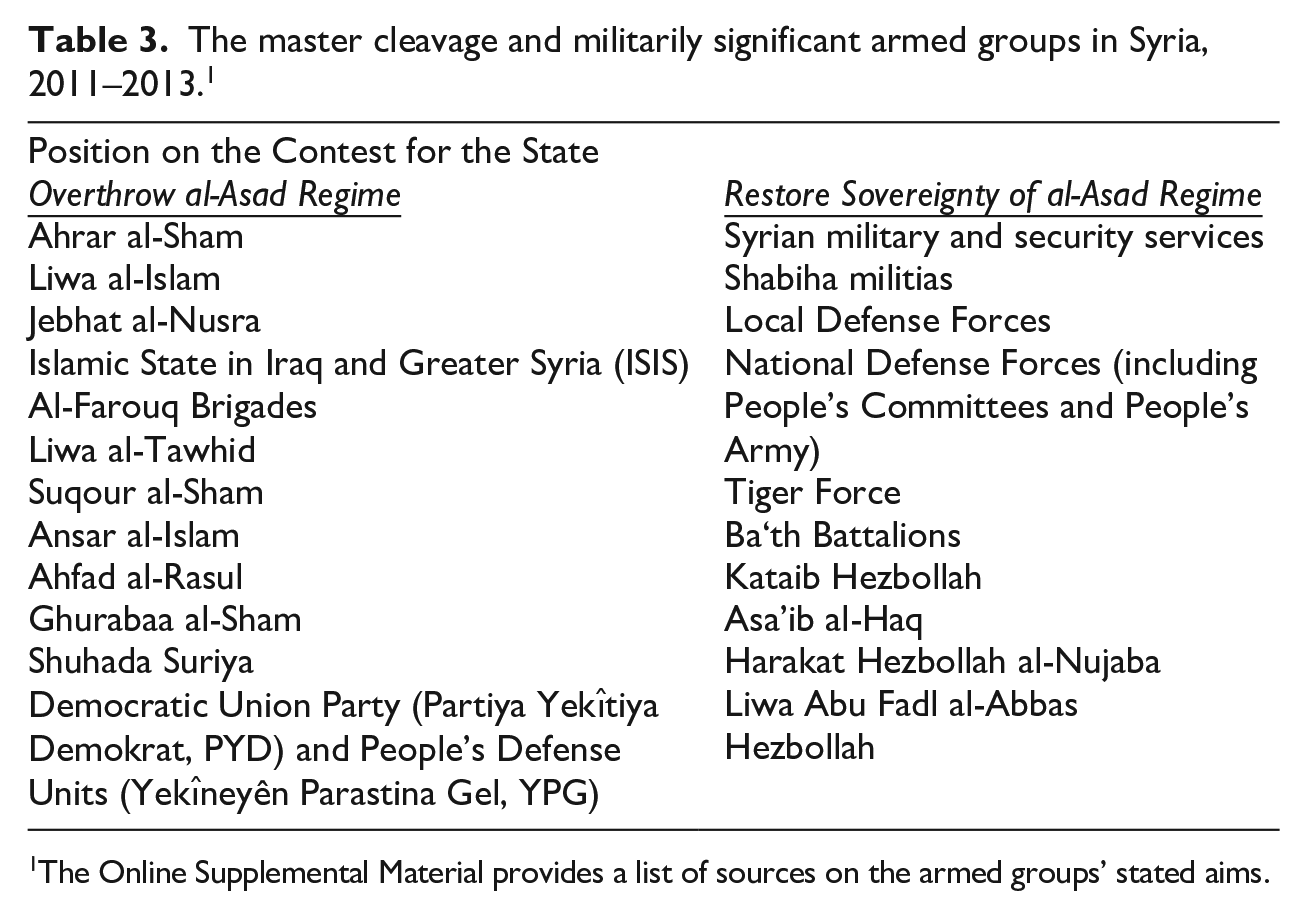
The Online Supplemental Material provides a list of sources on the armed groups’ stated aims.
The strongest potential objections to the above categorization of on-side groups for the opposition derive from the examples of ISIS (and Jebhat al-Nusra) and the PYD: the claim that one or more territorially-based, additional sovereignty ruptures exist in Syria and the claim that a group should be categorized based on its actions on the ground because these expose other goals that overshadow its stated aims.
First, territorially-based sovereignty ruptures might exist due to the presence of armed groups that espouse a globalist Islamist ideology (like that of al-Qa‘ida) 89 and so-called nationalist Kurdish armed groups, such that multiple civil wars and a master cleavage for each one should be coded. The Islamist groups in question envision a future in which Syria, after having been conquered by them, will join other Islamic states outside Syria to form a pan-Islamic polity, the Caliphate. Jebhat al-Nusra falls into this category. 90 So did the Islamic State of Iraq and Greater Syria (ISIS; now the Islamic State), and in a more immediate way, since its stated aim was to establish a state spanning the territory of Iraq and Syria before taking steps to bring about a wider Caliphate. 91 Kurdish “nationalist” groups, namely the Democratic Union Party (Partiya Yekı̂tiya Demokrat, PYD) and its People’s Defense Units (Yekı̂neyên Parastina Gel, YPG), have the stated aim of establishing an autonomous Kurdish region within Syria. 92
For a territorially-based sovereignty rupture to exist, the globalist Islamists would have to be considered irredentists, or the Kurdish “nationalist” groups judged to be secessionists. The facts do not support either possibility. The former aim to remove the al-Asad regime from power entirely; they do not accept the possibility of a territorial settlement that leaves a rump state to the regime. 93 The latter have lucidly explained that while they identify with the historical plight of Kurdish populations throughout the Middle East, their political project is confined to autonomy within Syria and explicitly rejects secession. 94 PYD officials have emphasized that the party’s goals for Syrian Kurds can only be achieved via a country-wide solution and that they aim to overthrow the al-Asad regime. 95 As the PYD’s leader, Salih Muslim, stated, “Since September 17, 2011, the PYD has called for the fall of the regime and all of its related symbols.” 96 Muslim further underscored the struggle over the control of the state as the basis for the group’s participation in the civil war, explaining that the motto “A Democratic and Federal Syria for All Peoples of Syria” encapsulates the PYD’s aims. 97 The PYD and YPG are, in essence, Syrian nationalists, but reject the Arabist definition of Syrian identity and advocate a new, pluralist one instead. 98
Second, ISIS and the PYD, even if opposed to the al-Asad regime according to their stated aims, have acted in ways that appear to have supported the regime, such that perhaps they should be coded on the regime’s side of the master cleavage based on these actions, not their apparently insincere stated aims. Robin Yassin-Kassab and Leila al-Shami, for example, describe ISIS as “a third force in the conflict, and an enemy of the revolution before Assad.” 99 It attacked armed opposition groups and seized territory from them while declining to act against regime targets. It sold oil to the regime. 100 Its radicalism helped to validate a regime narrative that the civil war was a battle between the forces of order and Syrian patriotism (read, the regime) on one side, and foreign agents and terrorists on the other. Its presence disrupted armed opposition groups’ ability to obtain support from foreign governments. And all the while it grew stronger due to the regime’s deliberate choices, for example to release hardline Islamist prisoners 101 or not to use its airpower against ISIS. As for the PYD, it proudly billed its strategy as a “third way” between the armed opposition and the regime. It did not participate in calls for the ouster of the regime early in the uprising, and even criticized the armed opposition for using violence. 102 It benefited from the regime’s decision to allow the PYD’s leader to return from exile, and, even more, from the regime’s partial handover of security functions to it in some majority-Kurdish areas, which it used to consolidate its control on the ground against competitor Kurdish organizations. So when the regime withdrew its security forces from a number of the country’s peripheral regions in summer 2012, observers concluded that the PYD was acting as an agent of the regime; 103 it controlled the population, freeing up regime forces to be redeployed against the opposition elsewhere, and fought armed opposition groups to oppose their entry into these areas.
I do not dispute that in the ways detailed, ISIS harmed the opposition’s cause, nor that as an organization the PYD grew stronger through a relationship with the regime and, at various turns, tactically assisted it, if indirectly. However, the unchanged reality is that ISIS and the PYD share a stated aim with other armed opposition groups: deposing the al-Asad regime. This aim has not wavered, despite the actions that observers view as having benefited the regime. ISIS could not achieve its eponymous state with the al-Asad regime still in power. Neither can the PYD achieve its stated objective of a democratic Syria for all Syrians within Syria’s current borders and with autonomy for a Kurdish region while the regime remains. 104 Both groups have fought the regime and exercised control over areas to which the regime lays sovereign claim. My categorization of ISIS and the PYD as on-side groups alongside the rest of the armed opposition follows the definitions laid out in Section 2 and avoids the mistake of coding a group’s side of the master cleavage based on instances of conflict or cooperation with others of the war’s armed groups.
Subnational case selection
To investigate the threat-absence theory at the subnational level in Syria, I study the war’s first 30 months, March 2011-August 2013, in five provinces: the northern theater of Idlib, Aleppo, Raqqa and Hasaka; and the capital city of Damascus. Due to space constraints, I confine this study to the Syrian opposition’s on-side relations. 105
The temporal bounds are selected so that the analysis covers a period that stretches from the war’s beginning through a period of significant military operations, but minimizes the potential for confounding factors to make it difficult to observe clearly whether the pattern of events is consistent with threat absence theory.
Large-scale military operations had begun in mid-July 2012, so the early cut-off point of the end of August 2013 still places the war’s onset and the first year of these operations within the analysis. To make the analysis more tractable, the cut-off point places outside it later periods in which the profound consequences of a shock to foreign involvement were felt locally. Specifically, the U.S.’ abrupt, unexpected early September decision not to attack the al-Asad regime in response to the latter’s chemical attack on civilians in August 2013 shifted the war’s international politics. The effects on Syrian belligerents were strong. The U.S. decision not only slammed the door on hopes of intervention, but undercut many armed opposition groups’ expectations of receiving any meaningful U.S. assistance. The U.S.-Russia agreement regarding the destruction of Syria’s chemical weapons, formally reached in mid-September, also signaled Russia’s larger role to come as a power-broker in the conflict.
The change in prospects for international support made moderate armed opposition groups that were not hostile to the U.S. suddenly vulnerable, and doubly so. The regime emerged relatively stronger and could reinvigorate its military campaign against the opposition. Meanwhile on-side groups, particularly more radical Islamist ones that had rejected U.S. support all along, could capitalize on the moderates’ loss of backing to attract away from them fighters and resources. 106 The result was an unprecedented spate of organizational mergers and on-side fighting among the opposition. 107
The geography is selected to provide coverage of all documented instances of on-side fighting during the time period (see Section 5.3), while capturing variation in the dependent variable by also including the context of all on-side relations in the provinces in which those incidents occurred. The fifth province, Damascus, is selected to corroborate the link between the presence of enemy threats to survival and conditional cooperation among on-side groups by assessing it in a setting – the capital city – that differed along multiple dimensions from the northern theater provinces. 108
To sum up, the purpose of confining the empirical analysis to the March 2011-August 2013 period, to the five provinces mentioned, and to the opposition’s on-side relations, is to make that analysis presented here more tractable. The theoretical predictions should apply to later periods of the war, to other regions in Syria, and to the armed groups on the regime’s side of the master cleavage.
Identifying episodes of on-side fighting
To identify on-side fighting in Syria, I consulted the daily reporting of the three major wire services – Agence-France Presse, the Associated Press, and Reuters – and expert reports of the International Crisis Group, the Institute for the Study of War, and the Swedish Institute for International Affairs for the period in question. I then verified the record of on-side fighting and its absence using Arabic sources – the newspapers al-Ḥayāt and al-Sharq al-Awsaṭ, and the Syria-focused online reports of Zamān al-Waṣl, ‘Anab Baladī, and the Syrian Observatory for Human Rights. 109
The wire services had correspondents on the ground inside Syria during this time and their reporting is the most comprehensive on the war. This contrasts with the reporting of newspapers and online sources that regularly covered Syria, which often relied on the wire services as the basis for their own articles, and with that of major international news organizations, which provided intermittent and thematic rather than systematic coverage. The ICG, ISW, and SIIA have provided objective coverage of military developments and in-depth assessment of armed groups.
Measuring enemy threats to survival
I operationalize the absence of an enemy threat to survival conservatively. I code it as such if the opposition had gained control and subsequently successfully repelled a new regime offensive aimed at re-taking the area in question. With threat absence so defined, the theory predicts that episodes of on-side fighting will be more likely to occur not after the initial transition in control but only once the regime failed to re-establish control. Successful opposition defense against a regime offensive does not imply that no fighting between the opposition and regime should be observed. 110 Rather, opposition on-side groups in such locations and at such times clearly held sustainable defensive positions. The regime’s on-going military operations therefore did not constitute an existential threat. 111
To code the presence or absence of the enemy threat to survival, I employ disaggregated data on civilian fatalities as reported by the Violations Documentation Center in Syria (Markaz Tawthı̄q al-Intihākāt fi Sūriyā, VDC). These data overcome limitations of journalistic accounts by providing the detail and completeness of spatio-temporal coverage necessary to allow me to measure battlefield developments systematically. 112
The data
VDC “relies on a multi-stage process of documentation in order to arrive at an acceptable level of precision.” First, “a group of human rights activists, field activities, and volunteer correspondents in different regions” collect information about deaths, detentions and disappearances due to the conflict and provide this to the team that manages the VDC website. The team managing the website checks the information to eliminate repeated entries in the database, to ensure that it is up to date, and searches additional sources for details to supplement the entries. Second, this team rounds out the database entries by collecting videos, pictures, and any other details about the victims. Third, and finally, there is “a periodic audit”: data for specific regions is sent to local activists to ensure that it is error-free, and to fill in missing information. 113
VDC’s records distinguish between civilian and combatant fatalities, and within the latter, unlike other sources (e.g. Shuhadā’ Sūriya, Syria Tracker), VDC covers regime and opposition deaths. I compiled every individual death report from March 18, 2011 through August 31, 2013. These total 54,099 civilian fatalities, 17,780 opposition combatant fatalities, and 11,929 regime fatalities (Figure 1). 114
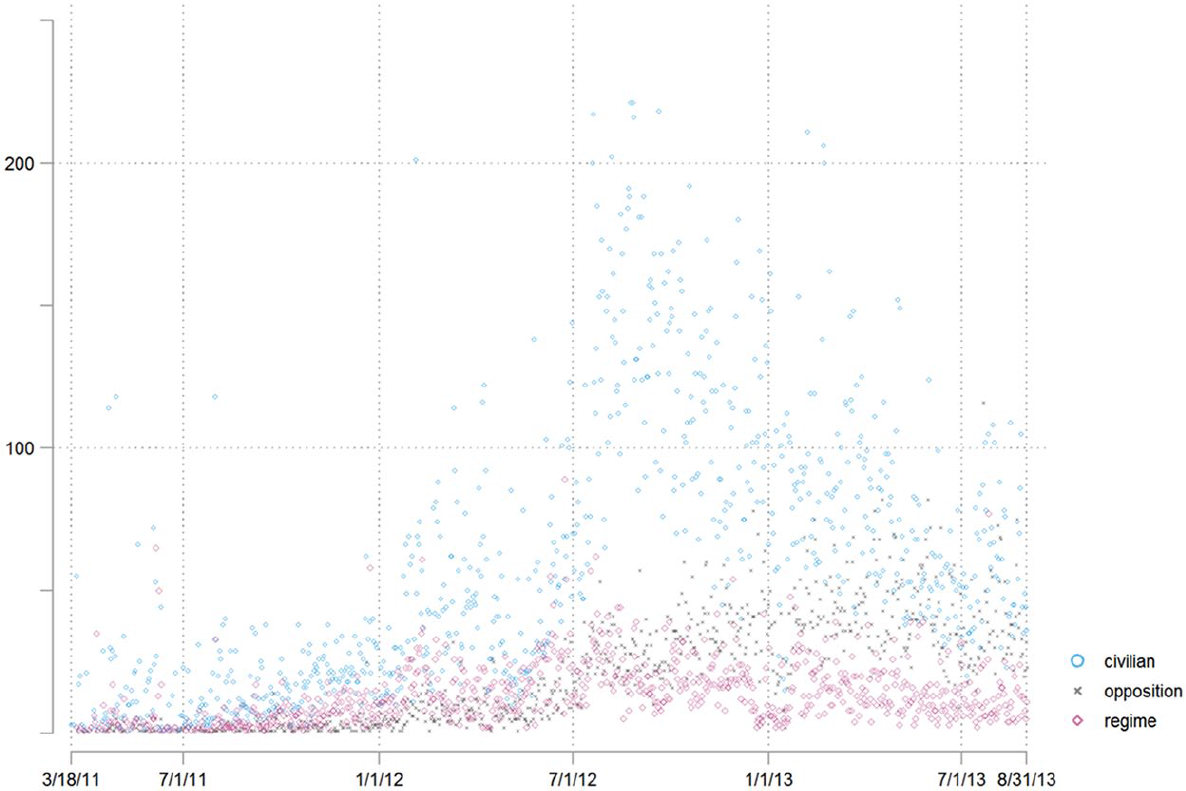
Fatalities, March 2011–August 2013, daily count.1
Civilian deaths as indicator of battlefield developments
I obtain a systematic picture of battlefield developments via the VDC data because they catalog each victim’s cause of death (Table 4). I use cause of death as an indicator of the intensity of fighting and regime forces’ presence. This allows me to establish patterns of military campaigning and the corresponding threat that the regime posed to opposition on-side groups’ survival.
Cause of death, civilians and opposition combatants, March 2011–August 2013. 1
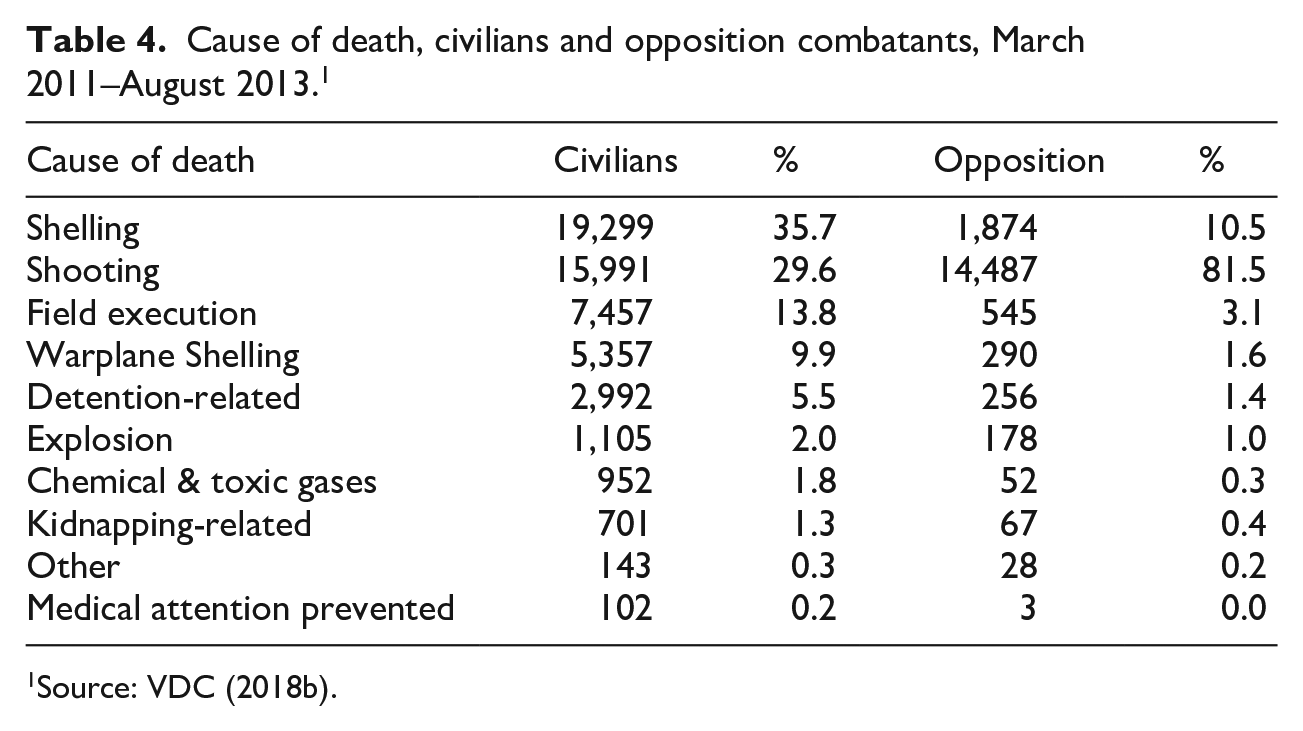
Source: VDC (2018b).
The regime resorted to air power and heavy artillery in areas where its control was severely challenged. As a result, I identify time periods in which these caused a high proportion of civilian deaths as turning points. If a decline in the monthly level of deaths and a reduction in the proportion of deaths due to air power and artillery followed, this indicates that the regime re-asserted control. To put it bluntly, civilians can only be shot or detained and executed by personnel on the ground. If, however, a reduction in monthly deaths followed a turning point but a high proportion of civilian deaths continued to occur due to air power and artillery, this indicates that the armed opposition gained control and began to establish secure defensive positions to keep the regime at bay. Subsequent spikes in civilian deaths indicate regime attempts to re-take control.
The pattern of on-side fighting in in Syria, 2011–2013
In what follows, I establish the sequence of transitions from conditional cooperation to on-side fighting among opposition groups and the level of threat posed by the regime for the five provinces, March 2011 to August 2013. For narrative coherence, I structure the account that follows by the sets of groups involved in on-side fighting. I describe on-side fighting and its absence: the shifts from conditional cooperation to conflict between Kurdish and non-Kurdish armed groups in Aleppo and Hasaka, those shifts as they occurred between moderate Islamist and extremist groups in Idlib and Raqqa, and consistent cooperative on-side relations in Damascus. The episodes of on-side fighting discussed range from recurring battles to assassinations of rival leaders and minor clashes. Following each description of on-side relations, I evaluate the regime’s threat to the survival of the opposition groups in question, and the relationship of that threat to on-side fighting, as well as the inapplicability of alternative explanations. I conclude by assessing the plausibility of threat-absence theory compared to the candidate explanations outlined in Section 3.
I characterize on-side interests for the opposition groups as zero-sum due to the absence of pre-war interactions on which they and affiliated political parties might have established trust. 115 The threat-absence theory stipulates zero-sum on-side group interests as a necessary condition for on-side fighting (see Table 1, above). As noted in Section 4, while I do not theorize zero-sumness, pre-war relationships may be a prerequisite for on-side groups to assess one another’s interests objectively and to recognize common ground that may have existed.
Under successive Ba‘th party dictatorships beginning in 1963 and continuing until the present, all opposition political parties in Syria have been illegal; the presence of covert organized opposition has been thoroughly suppressed, as has the expression of unorganized forms of dissent. 116 The political factions and parties that counted themselves among the opposition at the war’s outset in 2011 were the result of organizing abroad, 117 or individual efforts of previously imprisoned Syrian dissidents or opposition figures who had been tolerated or partially coopted by the regime in the past. 118 The penetrating capabilities of Syria’s police state, through its multiple domestic intelligence and security agencies, 119 created a thick layer of suspicion that colored any opposition group’s evaluation of its fellow travelers. 120
Episodes of on-side fighting (I): Kurdish militias against the Non-Kurdish opposition
Fighting broke out between Kurdish militias and non-Kurdish (mostly Arab) groups in Aleppo and Hasaka provinces in fall 2012. Journalists attributed this on-side fighting to differing long-term visions and a resulting lack of trust. Arab opposition armed groups viewed the Kurds’ desire for autonomy with suspicion and feared that it might lead to Kurdish demands for secession from a post-civil war Syria. 121 They also suspected Kurdish militias of cooperating with the regime in order to secure a Kurdish political future at the expense of the opposition side as a whole. 122
Yet on-side fighting was not inevitable. When Kurdish militias entered the war against the regime that July, they neither targeted other opposition groups, nor did those groups immediately come into conflict with them.
Aleppo Province
Heavy fighting between the regime and opposition began in Aleppo in July 2012. On July 19, opposition forces began to seize territory in the city of Aleppo from the regime. Fighting across the master cleavage settled into a stalemate by the end of August. Opposition forces mounted a new offensive at the end of September, but were unable to sustain its momentum. Fighting thereafter continued in the city of Aleppo and surrounding areas. 123
Fatalities data illustrate the fluctuation in the regime’s threat to opposition survival in Aleppo (Figure 2). With the onset of heavy fighting against the regime in July 2012, civilian and combatant deaths, including from direct forms of violence, shot up, indicating that the regime posed an increased threat to the survival of the armed opposition. During this period, the opposition’s on-side relations were characterized by conditional cooperation. Some groups actively worked together to fight the regime, others simply stayed clear of one another so as not to undermine all efforts being undertaken against their common enemy.
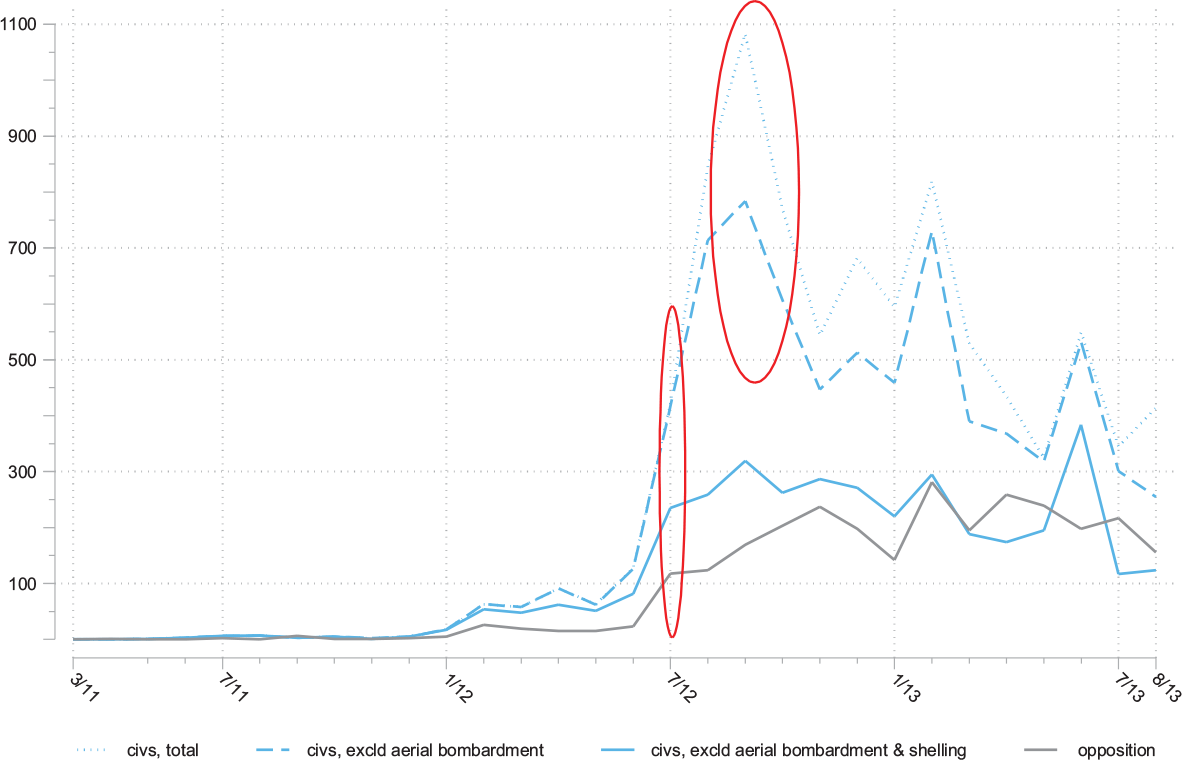
Aleppo Province – Civilian and opposition deaths by month.
Artillery and aerial bombardment became substantial causes of civilian fatalities starting in August, and rose dramatically in September (Figure 2, right-hand oval). The increasing reliance on artillery and air power indicated a turning point in the regime’s ability to control all of Aleppo. In the months that followed, a return to a high proportion of fatalities due to methods other than artillery and aerial bombardment would have indicated regime efforts to re-assert control. However, this was not the case. Instead, from October on, the data are consistent with the carving up of Aleppo into defensible positions held by the armed opposition and pockets of regime presence, and the abatement of the regime’s threat to the survival of opposition groups.
During a renewed push to take Aleppo on October 25, fighters from Liwa al-Tawhid, Jabhat al-Nusra, and the Salaheddine Brigade – an FSA-affiliated Kurdish unit composed partly of fighters opposed to the PYD – entered the Sheikh Maqsoud and Ashrafiyeh neighborhoods, both of which had been PYD-controlled. 124 As its name suggests in Arabic, Ashrafiyeh “overlooks” much of the city to its south, as does Sheikh Maqsoud. The two neighborhoods are strategic locations for controlling the city due to the advantages afforded by the high ground and proximity to two main roads leading out of the city.
This late October operation resulted in on-side fighting between the PYD on the one hand and al-Nusra and the Salaheddine Brigade on the other, and also touched off on-side fighting between the PYD and non-Kurdish opposition forces in Aleppo and surrounding areas. In the aftermath, both sides engaged in retaliatory kidnapping of at least 200 people, and non-Kurdish opposition forces attacked the Kurdish village of al-Qastal north of Aleppo. 125
Yet the PYD and Arab armed opposition groups in Aleppo province later engaged in on-side cooperation when the regime threat to the opposition there increased. In early April, for example, Sheikh Maqsoud was the site of active cooperation between the PYD and FSA forces while under heavy regime attack. One FSA battalion commander credited the PYD with helping to cut a regime “supply and reinforcements route,” forcing the regime to bring materiél in by air as its only resupply option. Another commander in the neighborhood explained that the PYD had provided his fighters with “ammunition, and their fighters are on the front lines of the battle against the regime.” PYD forces highlighted their common ground with the Arab armed opposition. One of its fighters explained, “Together we fight the same enemy; the regime.” 126
On-side relations in Aleppo tracked the opposition’s ability to secure its survival against the threat. During the heavy fighting in July, August, and into September, the regime posed a threat to the opposition, one that the opposition experienced even when it went on the offensive. On-side fighting did not occur during this time. The regime’s inability to successfully carry out counteroffensives against opposition-controlled territory in Aleppo in late-September and October demonstrated to the opposition that its survival in those positions was secure with respect to the threat from across the master cleavage. It is after this point, at the end of October, that on-side fighting began, and the later instance of on-side cooperation in April 2013 took place after the threat posed by the regime had returned.
Hasaka Province
The regime began to withdraw from most areas of Hasaka province starting in July 2012, retaining a presence only in major population centers like the capital city, Qamishli, and at the Ras al-‘Ayn border crossing with Turkey. The withdrawal limited the level of fighting across the master cleavage. Kurdish militias, for example, challenged the regime in mid-July 2012, but easily pushed its forces out of a large number of towns. Thereafter, opposition forces expanded their presence throughout the province and only then came into more contact with the regime. In November, a coalition of opposition groups engaged in heavy fighting against the regime in the border town of Ras al-‘Ayn, ultimately capturing it.
Events in Hasaka province corroborate the use of the difference in the proportion of deaths caused by direct methods versus artillery and aerial bombing as an indicator of challenges to regime control (see Figure 3). While the use of artillery briefly increased in July 2012, the level of fatalities was not sustained, meaning the regime did not attempt to reassert control. In October, the regime began to use artillery once more as it sought to re-take some areas of the province. The increase in deaths in November, which occurred along with an increased use of artillery and air power, corresponds to the opposition’s successful fight against the regime in Ras al-‘Ayn.
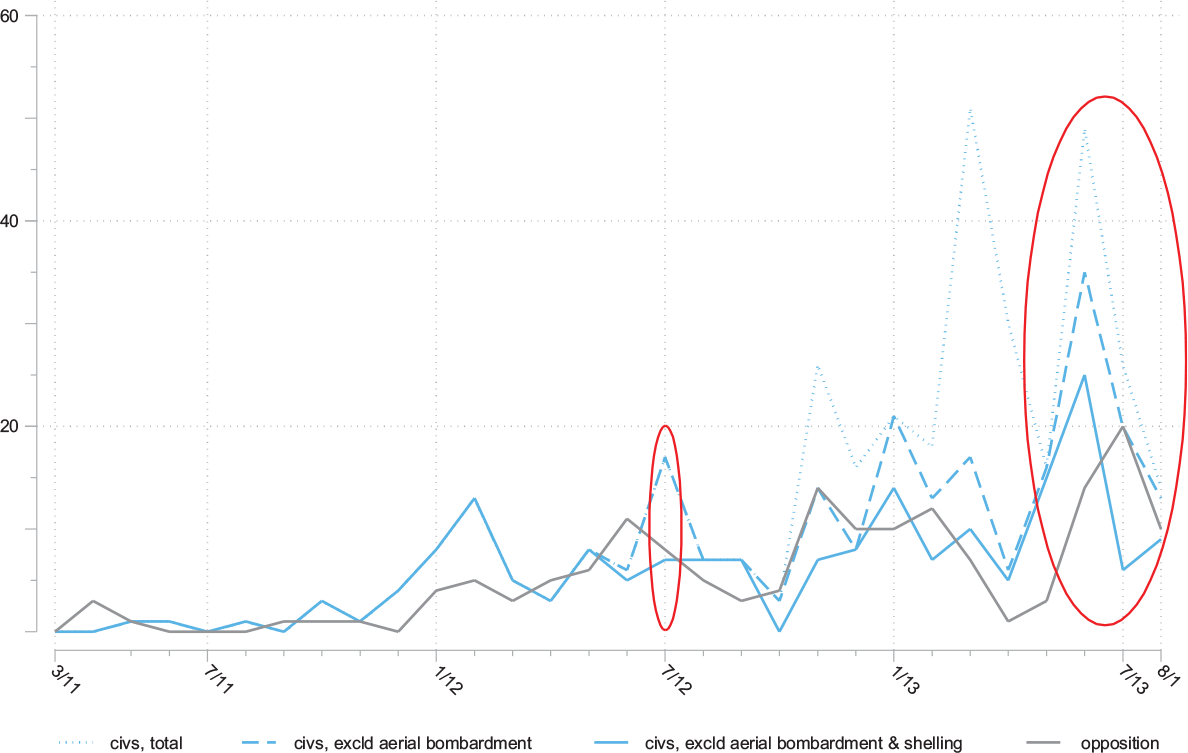
Hasaka Province – Civilian and opposition deaths by month.
On-side fighting between Kurdish and non-Kurdish armed groups emerged only after the opposition’s heavy fighting against the regime in November 2012 (Figure 3, between the two ovals). After the opposition took Ras al-‘Ayn from the regime, the PYD battled the non-Kurdish opposition groups Ghurabaa al-Sham and Jabhat al-Nusra; each accused the other of initiating the hostilities. 127 By the end the month, this on-side fighting had killed roughly 150 people. 128 A temporary cease-fire tamped down the violence. The PYD reinforced defensive positions in the city, 129 but clashes continued intermittently. 130 However, two weeks into the new year, Ghurabaa al-Sham and Jabhat al-Nusra mounted a fresh attempt to control the city. This new round of on-side fighting was large-scale and immediately claimed many casualties. 131 Mediation halted the escalation, bringing about a February cease-fire between the PYD and most of its on-side rivals; Jabhat al-Nusra, however, refused to sign. 132
Beginning in April 2013, the regime threat to the opposition increased. From April through June 2013, the total number of civilians and opposition combatants killed increased steadily. In April and May, direct forms of violence account for nearly all civilian fatalities. But from May to June (Figure 3, right-hand oval), even as the level of fighting continued to intensify, there were indications that the regime again faced a loss of control – a significant proportion of civilian deaths now came from artillery and aerial bombardment. Finally, by July, it was clear that the regime was unable to re-establish control: violence declined thereafter, but artillery and air power continued to be responsible for a high proportion of civilian deaths.
On-side relations tracked changes in the threat posed by the regime to the opposition. From mid-late February through the beginning of the summer there was conditional cooperation between these on-side groups, as the regime fought to retain control in the region, although sporadic fire-fights between the PYD and non-Kurdish opposition groups, especially Jabhat al-Nusra, occurred.
A new round of large-scale on-side fighting began only in mid-July, after the opposition observed the regime’s inability to re-take territory in Hasaka. The main actors, again, were the PYD and non-Kurdish opposition groups, primarily Jabhat al-Nusra and ISIS, with a few smaller groups fighting alongside them. The YPG managed to dislodge non-Kurdish groups from positions in Ras al-‘Ayn and took the border crossing. The on-side fighting spread as Kurdish and non-Kurdish groups both moved to take control of oil-rich areas in Hasaka province. It also spilled over into Raqqa province, with clashes in the town of Tel Abiyad. The YPG captured ISIS’ local commander, prompting a retaliatory kidnapping of “hundreds” of Kurdish civilians; an exchange ultimately freed the ISIS commander. 133
At the end of July, the assassination of a prominent Kurdish leader sparked the PYD to issue a “call to arms,” mobilizing its forces for widespread action against the Islamists. 134 The PYD also announced that it would form a provisional government for the Kurdish region. In August, Jabhat al-Nusra and ISIS continued to fight the PYD for Tel Abiyad, and in Kurdish towns around Aleppo. 135 By mid-August, the non-Kurdish groups had also begun a major push to take back Ras al-‘Ayn and its border crossing, deploying heavy weaponry. 136
The absence of opposition on-side fighting in Hasaka immediately following the regime’s withdrawals, and its emergence later only after the regime’s efforts to re-assert territorial control failed, underscores the relationship between the regime threat to the opposition’s survival and on-side relations.
Episodes of on-side fighting (II): Moderate Islamists against extremist groups
The on-side fighting described below pitted extremist groups like Jabhat al-Nusra and ISIS (the globalist Islamists) against moderate Islamist organizations, such as al-Farouq Brigades, Liwa al-Tawhid, and Ahfad al-Rasul. Observers pointed to an ideological and discipline gap between extremists and moderates to explain on-side fighting between them. 137 Depending on the moderate group in question, the ideological gap could be considerable despite the “Islamist” label held in common. Extremists sought to order politics and society according to their interpretation of religion, and to one day bring an Islamist state in Syria into a broader pan-Islamic state. Moderate Islamist groups, on the other hand, had strictly Syrian nationalist political goals, not globalist ones, 138 ranging from a large role for religion in public life and politics, to a minimalist understanding of Islamism. A leader of a small armed group in Raqqa province explained the latter this way: “What does Islamist mean? For me, and most Syrians, it just means I am a Muslim. I want a democracy and Islamic law to rule over family matters only.” 139 This characterization does not differ much from what analysts label secular in the Middle East. Notoriously secular Syrian regimes, for example, have implemented Islamic family law.
On-side fighting between moderate Islamists and extremists was not inevitable. In northern Syria, opposition groups had divided territory among themselves after seizing it from the regime. Border crossings were objects of contention, but not always violence. For example, the Bab al-Hawa border crossing with Turkey in Idlib province was taken from the regime in July 2012. Al-Farouq, one of the largest armed opposition groups then active countrywide, operated in close proximity with al-Nusra at the Bab al-Hawa crossing and other parts of northern Syria. It was only in September, a time of relative reprieve from the threat posed to it by the regime, that al-Farouq consolidated its control over the crossing by pushing out extremist competitors. 140
Idlib Province
January 2012 marked the transition from the opposition registering its presence via attacks on regime forces to the beginning of the struggle for control over the province (see Figure 4). During this period, direct causes of death account for a large proportion of civilian fatalities. The regime managed to retain control, and operations declined in intensity after March through May. The regime, present in force on the grounded, posed a significant threat to the survival of opposition groups.
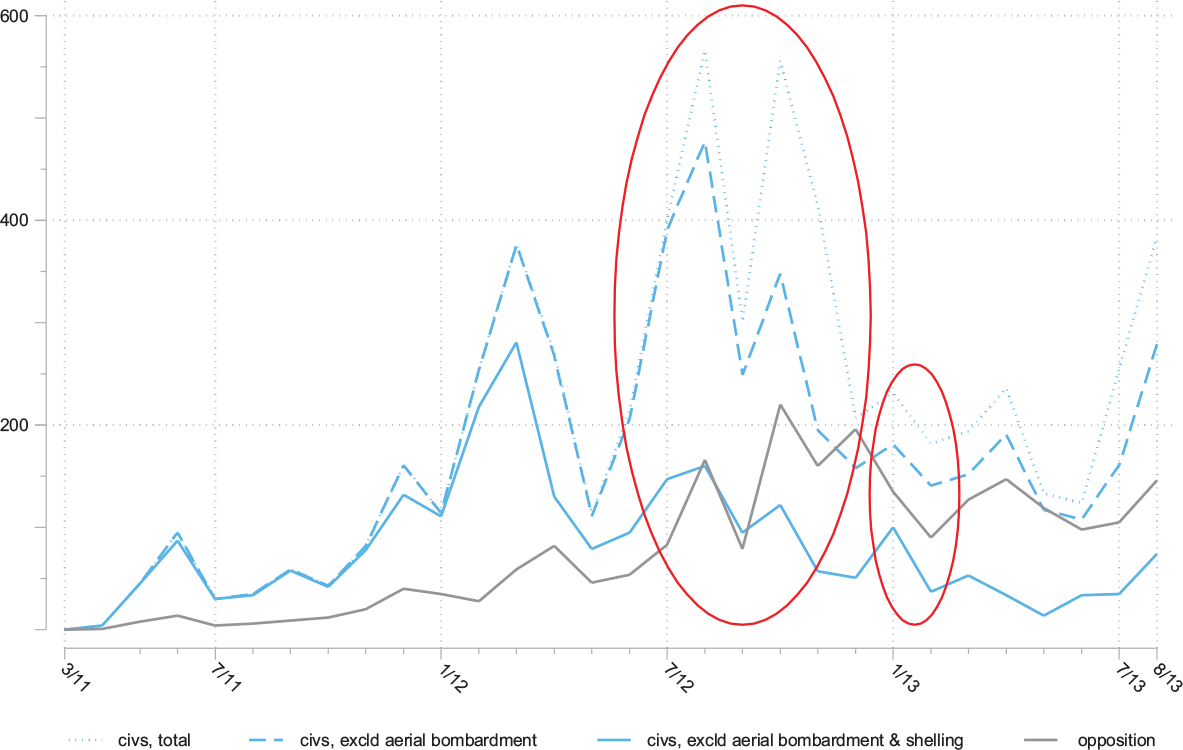
Idlib Province – Civilian and opposition deaths by month.
The battle resumed in earnest after May 2012. Civilian fatalities increased substantially, but there was also a large shift in the proportion caused by direct means. From June on, the vast majority of fatalities were due to shelling and aerial bombardment, indicating that some territorial control had begun to slip away from the regime. While the opposition could not take over the whole province, it seized the Bab al-Hawa border crossing from the regime in July 2012.
Over the next months, civilian fatalities twice rose and declined rapidly twice: intensified operations in August, a relative reprieve in September, and then redoubled operations with the regime’s much increased use of air power in October. The gap between direct and indirect causes of death reached its widest that August, but direct causes never again claimed as large a portion of deaths as they had in May 2012.
The transition from conditional cooperation to on-side fighting in Idlib began in January 2013 (Figure 4, right-hand oval). In January, Thaer al-Waqqas, a top al-Farouq commander, was assassinated near the Turkish border. Although publicly al-Farouq accused the regime, many in the opposition attributed the assassination to Jabhat al-Nusra. Al-Waqqas was alleged to have been involved in the assassination of Firas al-Absi, a high-level al-Nusra commander at the end of August 2012. Al-Waqqas’ death therefore appeared to be retribution. 141 Other incidents in Idlib followed up to early February 2013, including confrontations between moderate groups and al-Nusra, and an exchange of fire between the two sides. 142 Additional, intermittent clashes took place between ISIS and moderates. In one instance at the beginning of July, a local armed group fought ISIS in al-Dana after unknown individuals opened fire on an anti-Islamic State protest. 143
On-side fighting in Idlib coincided with shifts in the threat posed by the regime. The opposition proved to itself that it was capable of withstanding the regime’s intensified operations starting from summer 2012 into January 2013. Only then did on-side relations switch from conditional cooperation to on-side fighting.
Raqqa Province
The pattern of deaths in Raqqa, more starkly than in Idlib, illustrates how civilian fatalities data can indicate developments like regime retrenchment and the opposition’s establishment of sustainable defensive positions against the regime.
From July to September 2012, civilian casualties increased steadily, falling back to a low level in October (Figure 5). But even at September’s relative peak, the regime’s use of direct means of violence indicated that it retained territorial control. From October 2012 through March 2013, the opposition and the regime fought an intense battle for control of Raqqa. Civilian deaths spiked, and artillery and air power accounted for many of these deaths.
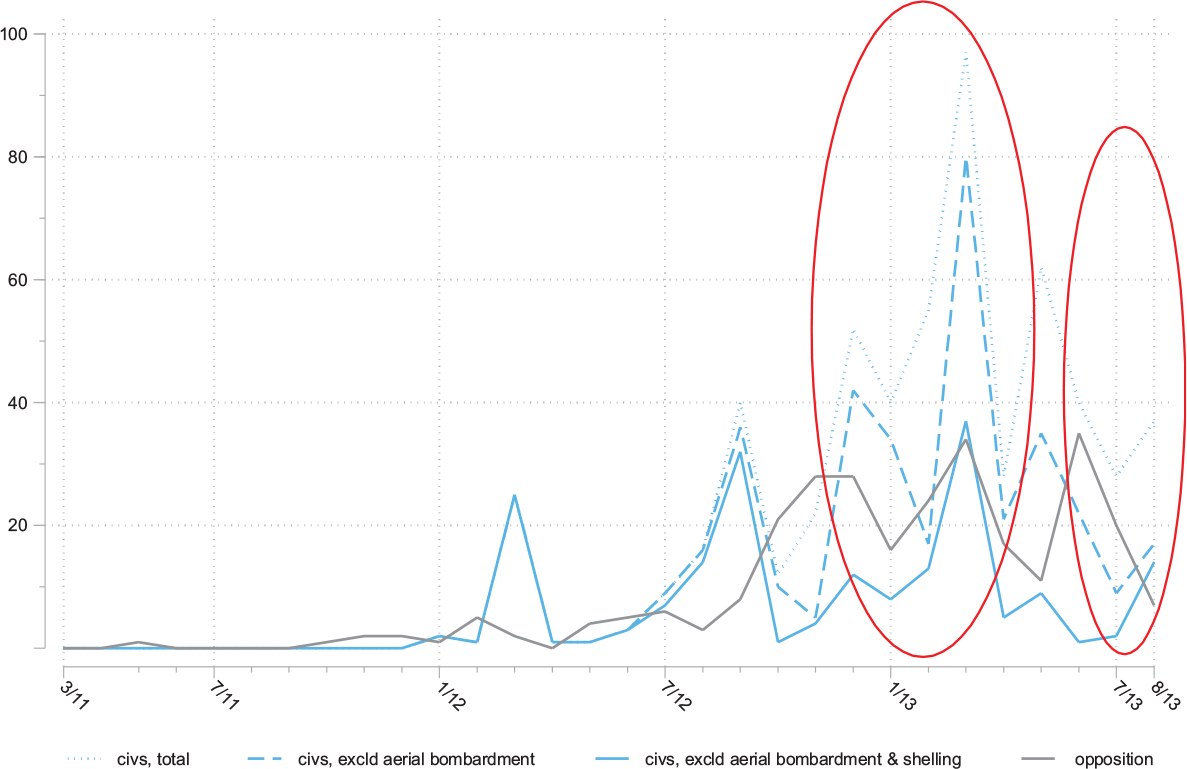
Raqqa Province – Civilian and opposition deaths by month.
The opposition captured the city of Raqqa, the provincial capital, in March 2013. The shift of control accounts for the drop in the level of fatalities between March and April (Figure 5, left-hand oval). The subsequent uptick in violence in April and May, with artillery and air power accounting for the majority of civilian deaths, indicates that the regime retained the capacity to punish the population, but that the opposition had gained a secure defensive position in Raqqa against the regime.
The city of Raqqa became the site of on-side fighting in spring 2013, including the assassinations of leaders of moderate Islamist armed groups and clashes. Extremist groups eroded al-Farouq’s position during this period. Toward the end of March, al-Nusra detained some of its members in Tel Abiyad and then attempted to assassinate Mohammad al-Daher, al-Farouq’s leader there. Al-Daher sought refuge in Turkey and al-Farouq reinforced Tel Abiyad from Aleppo and Idlib provinces. Some clashes continued in the following days. Al-Farouq subsequently lost its hold on the Tel Abiyad crossing. Clashes between it and al-Nusra in Tel Abiyad then resumed in April 2013. 144 High profile assassinations also continued: Within the space of days in early May, a local leader of al-Farouq and one of Ahfad al-Rasul were killed in Raqqa, most likely by al-Nusra. 145
In the months following its loss of Raqqa, the regime continued its fight against the opposition – violence ratcheted up again in May, dropped somewhat in June, and even further in July. The spike and subsequent decline in the level of violence, the heavy use of air power and artillery compared to other methods, and the continuing high proportion of deaths due to artillery and air power indicated the regime’s inability to re-establish control (Figure 5, right-hand oval). The opposition proved to itself its ability to maintain defensive positions against the regime’s onslaught during the April-July 2013 fighting. Opposition survival in the face of the threat posed by the regime was thus assured to a greater extent than it had been after Raqqa fell in March.
On-side fighting followed this second change in the cross-master cleavage threat to the opposition. In August 2013, the moderate Islamist-extremist confrontation that had been simmering since March escalated. Starting on the 15th of the month, ISIS battled Ahfad al-Rasul within the city of Raqqa. ISIS attacked and took control of Ahfad al-Rasul’s headquarters, killing its leader in the process. The fighting spread to the smaller city of Tabqa, resulting in additional casualties. 146
On-side fighting in Raqqa, though perhaps small-scale, was of key importance in establishing which group would go on to control territory. Dislodged due to assassinations and the episodic fighting, groups like al-Farouq and Ahfad al-Rasul did not manage to make come-backs. 147
On-Side cooperation: The Damascene example
Armed opposition groups on Syria’s southern and central fronts coordinated closely with each other. The transitions from conditional cooperation to on-side fighting and back that characterized interactions in the four provinces discussed above from March 2011-August 2013 were absent. The experience in the capital city, Damascus, during that same period illustrates an absence of on-side fighting consistent with the theoretical account. There, the regime was able to consolidate its position after turning points and continued to take the fight to the opposition, raising the specter of violent elimination.
The opposition’s July 2012 attack on the regime’s inner circle in Damascus coincided with a massive escalation in violence (Figure 6, left-hand oval). Opposition forces went on the offensive. The July-September period saw the regime introduce artillery into the battle within the city itself. Fatalities declined through October, indicating that the regime had managed to regroup. But subsequently fighting again escalated, and artillery continued to be used.
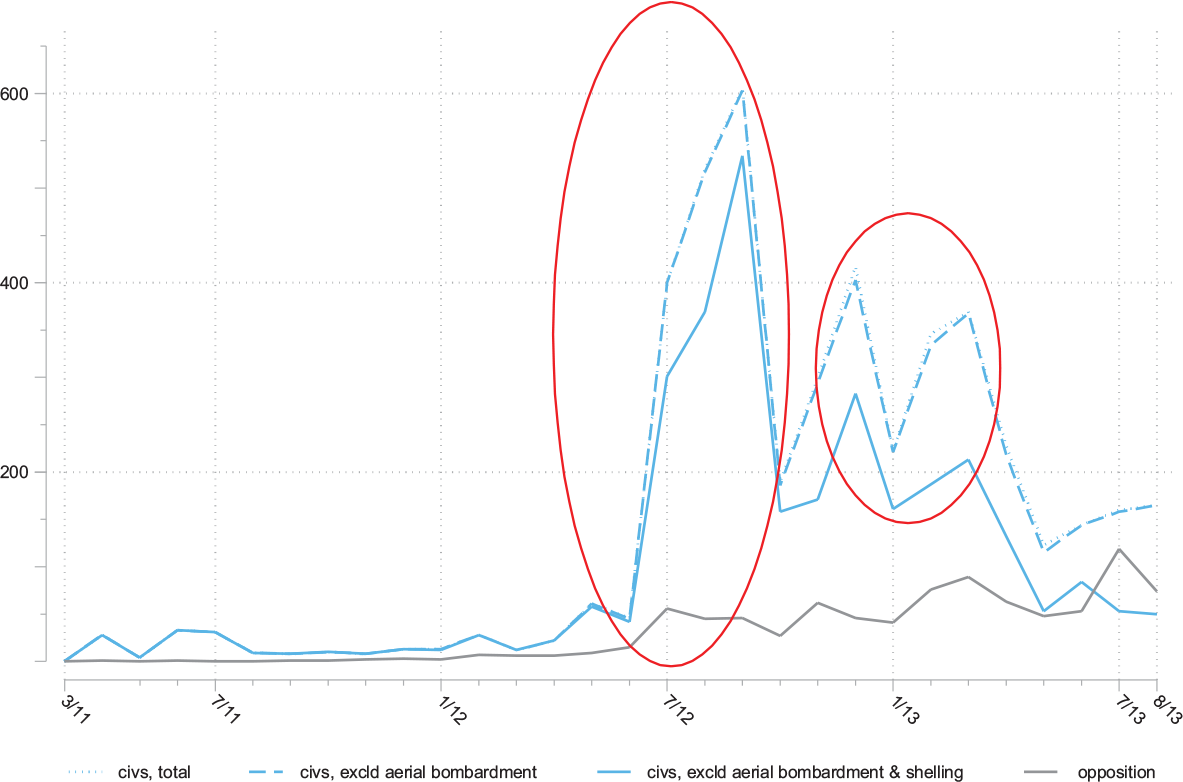
Damascus - Civilian and opposition deaths by month.
Compared to the four northern theater provinces discussed above, the regime retained a high capacity to use direct methods of violence against the population in Damascus (Figure 6, right-hand oval). The concentrated power of the regime’s military, intelligence, and security forces in and around the capital posed a grave threat to the armed opposition’s survival, despite the latter’s intermittent ability to mount offensive operations.
Regime threat secured cooperative on-side relations, despite the operational presence of scores of opposition groups and a salient moderate Islamist-extremist divide among them. In a June 2013 interview, Zahran Alloush, the leader of Liwa al-Islam, the largest opposition armed group operating in two provinces, and a staunchly Islamist one, described his organization’s commitment to maintaining good relationships with on-side groups, irrespective of whether these were secular or Islamist. Islamist groups including Alloush’s faced pressure from the mainstream Syrian opposition and foreign governments to shun the extremist organizations, the globalist Islamists al-Nusra and ISIS. But cooperation was a higher priority. Alloush noted that Liwa al-Islam certainly had no formal relationship with al-Nusra, but that it may have coordinated with al-Nusra-affiliated groups. 148
There is clear evidence of the opposition’s on-side cooperation in the military arena in Damascus. Numerous multi-group joint operations were conducted there and in the surrounding province of Rif Dimashq in summer 2013. 149 At the beginning of July, armed opposition groups announced the formation of a unified command encompassing “the majority of military and revolutionary forces in the city of Damascus and its southern suburbs.” Their statement elaborated that the decision to form this unified command was taken “in light of the difficult circumstances through which our beloved country in general, and the city of Damascus in particular, are living, from a suffocating siege to a suffocating international and regional failure.” Emphasizing the gravity of the regime threat, the statement noted that “not more than 1500 meters separate the opposition’s fighters from [the center of the regime’s power].” 150
Threat-Absence theory and its alternatives in Syria
If the candidate explanations discussed in Section 3 help us understand patterns in on-side fighting, Syria represents an easy test. A multiplicity of armed groups appeared early in the war, foreign powers quickly became involved, 151 and the opposition managed to seize peripheral territory, which encompassed international border crossings, smuggling routes, and oil production. The collapse or withdrawal of the institutions of a strong, highly repressive regime in opposition-controlled territory and high levels of pre-war repression and the absence of legal opposition politics left a vacuum ripe for the naked use of force as the ultimate arbiter of relations among opposition groups. The swift escalation of a peaceful uprising to civil war left armed opposition leaders to play a game of catch-up in building their military organizations, such that lax practices and indiscipline among the rank and file were not uncommon. Syria’s multi-ethnic, multi-sectarian society 152 and the country’s pronounced urban-rural divide 153 implicated social cleavages in wartime dynamics. Finally, as featured prominently in rhetoric and discourse surrounding events in Syria, competition between secular or pluralist ideologies and Islamic radicalism was fierce. The ideological divide exacerbated inter-ethnic tensions, as Kurdish groups tended to be secular, while Arab-Kurdish ethnic tension in turn exacerbated the ideological divide.
Yet the pattern of on-side fighting poses problems for the candidate explanations. The four northern provinces saw cooperation between opposition groups in the same areas in which on-side fighting occurred, challenging structural, organizational, and ideological accounts. The absence of on-side fighting in Damascus and its suburbs and cooperation between the scores of opposition groups present there, while under the regime’s intense military pressure, which placed great stress on groups’ resources, also challenges these accounts. The experience of Damascus is inconsistent with balance of power explanations, as such an environment would be among the most likely to generate unequal losses across opposition groups, yet if such opportune (vulnerable) moments occurred, on-side competitors did not take advantage of them. Nor is the timing of on-side fighting in the four northern theater provinces consistent with balance of power accounts; the power differences to which they would attribute on-side fighting created earlier opportunities for it, but it did not materialize until after shifts in the level of enemy threat to survival occurred. On-side fighting between moderate Islamist and extremist groups, the members of which had relatively similar backgrounds and ideological preferences compared to non-Islamist groups, is difficult to explain using the social cleavage and ideological accounts. The timing of on-side fighting between Arab and Kurdish groups is also inconsistent with these accounts; the ideological differences and ethnic cleavage implicated existed from the war’s very beginning, yet no on-side fighting took place until much later. Neither is Arab and Kurdish armed groups’ active cooperation in Aleppo when under military pressure from the regime, across the ethnic and ideological divides, anticipated by these accounts.
Table 5 summarizes the predictions of the candidate explanations and threat-absence theory and compares them to the actual dates of the onset of on-side fighting among opposition groups. More than other factors, enemy threat to survival, in line with the predictions of the threat-absence theory, accounts for the temporal and spatial pattern of on-side fighting and its absence. As I showed above, that pattern is two-fold. When and where the regime posed a military threat to the survival of opposition armed groups, those groups were more likely than under other conditions to cooperate actively or at the very least abstain from using force against one another to further their own political ambitions. Conversely, when and where those groups perceived that the enemy threat to survival was absent, as signaled by the regime’s loss of territory and subsequent inability to retake it, on-side fighting became more likely than it would have been otherwise.
Expected and observed onset of on-side fighting in Syria, March 2011–August 2013.
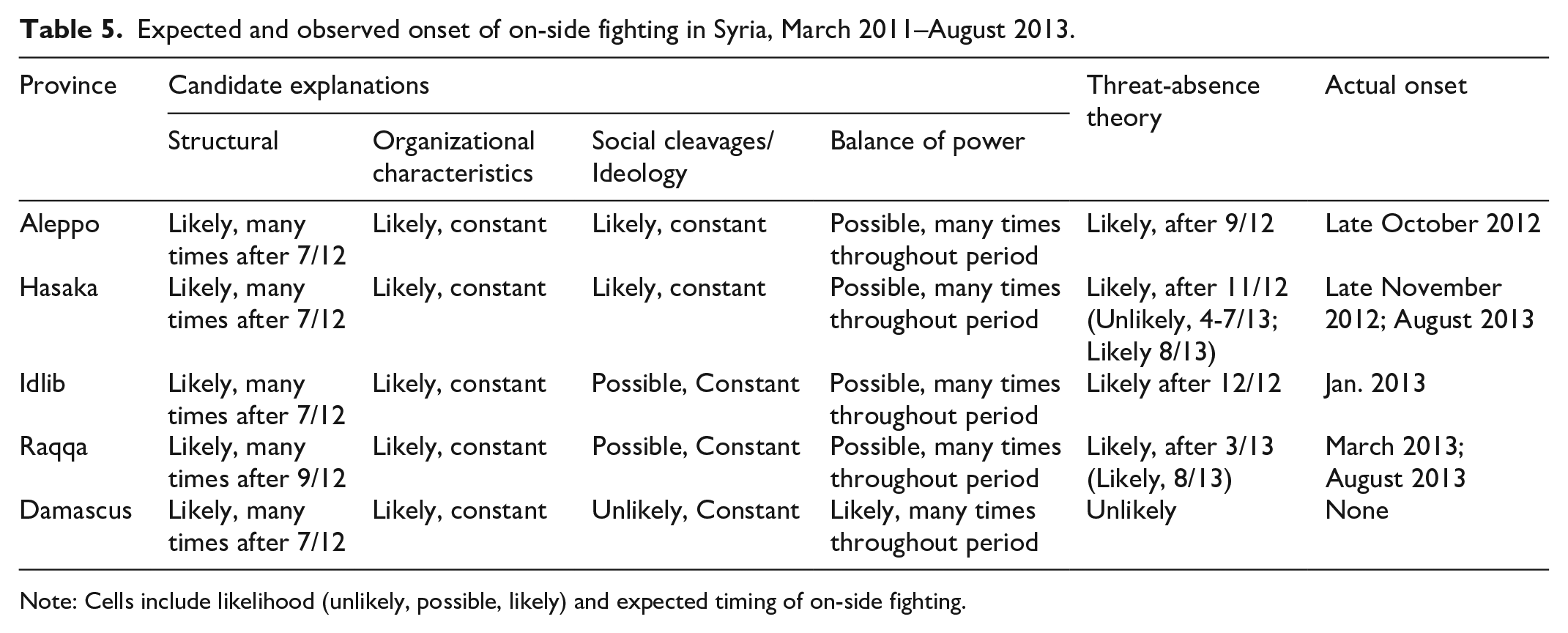
Note: Cells include likelihood (unlikely, possible, likely) and expected timing of on-side fighting.
The experience of one participant in the war sums up, subtly but emphatically, the crucial role that the presence and absence of enemy threat played in the armed opposition’s on-side relations. An al-Farouq commander, active at the Tel Abiyad border crossing in Raqqa, lamented the on-side fighting that had occurred there when the regime was no longer a threat in the area. He recalled, in contrast, the regime’s operations to re-take the opposition stronghold neighborhood of Baba ‘Amr in Homs, which culminated in an intense, month-long siege that ended in March 2012. With survival at stake, “How much simpler things were in Baba Amr. . .when [we] were fighting for God and country and each other.” 154
Conclusion
This article conceptualizes on-side fighting in civil war and investigates its causes. I provide a systematic assessment of the extent of the threat the regime posed to opposition armed groups at the subnational level in the Syrian Civil War using fine-grained data on fatalities. Episodes from its first years, 2011–2013, show that on-side fighting emerged in areas and during periods in which the armed opposition became relatively secure against violent elimination by their enemy across the war’s master cleavage – the al-Asad regime.
Existing literature implicates structural factors, the balance of power, organizational characteristics, social cleavages, and ideology as candidate explanations for on-side fighting. But such accounts have difficulty explaining the spatial and temporal patterns of on-side fighting within a civil war. The threat-absence theory that I set out in this article acknowledges the politics of alignment, specifically the rivalries embedded in partnerships forged to fight a common enemy. In this light, it is the enemy’s military threat to the survival of on-side groups which can push them to continue cooperating. If this threat abates at a particular time and place, belligerents gain the opportunity to move against on-side competitors in order to secure long-term political objectives. It is difficult to obtain direct evidence concerning on-side groups’ political calculus, but the timing and location of on-side fighting in Syria are at odds with the expectations of candidate explanations and consistent with the predictions of the threat-absence theory of on-side fighting. Since this article’s empirical analysis ends in August 2013, future research is needed to assess threat-absence theory as an explanation of on-side fighting in Syria after that point.
Threat-absence theory does not address several aspects of on-side fighting that are important topics for future research. First, which on-side groups are more likely than others to engage in on-side fighting? The work of scholars like Fjelde and Nilsson (2012) and Gade et al. (2019) indicates that groups that are either relatively strong or relatively weak are more likely to fight other groups with whom they have shared interests. These predictions may intersect with threat-absence theory if it is expanded to allow the level of enemy threat to be conditional on an on-side group’s strength relative to other on-side groups. Second, how intense is on-side fighting likely to be? Under what conditions are assassinations and low-level violence likely, versus skirmishes or even full-scale battles? Third, in which ways do ideological differences among on-side groups interact with the level of enemy threat? Gade et al. (2019) and Hafez (2020) explore how such differences affect armed group behavior in Syria. Might certain ideological differences or distances be insignificant enough such that they will not lead to on-side fighting even in the absence of enemy threat? Future research addressing relative strength and enemy threats, dynamics of escalation or tactical or operational choice, and bringing research on the effects of the spectrum of on-side group ideologies into dialog with questions of enemy threat may therefore add to our understanding of on-side fighting.
The article’s theory and findings have implications for three research agendas. First, copious literature on coalition dynamics, mentioned briefly in the discussion of the threat-absence theory, investigates betrayal by allies. Whether it is impending victory in inter-state war, the success of a coup attempt, an electoral win, or control of a legislative majority, 155 this research suggests that success threatens cooperation. This article’s findings indicate that circumstances other than a well-defined, mutually-understood marker of success may lead to betrayal. The key is to determine what factors might tip trade-offs between long-term competition and short-term success. The absence of enemy threats to on-side group survival is no straightforward condition, but this article nevertheless creates a measure of variation in it. Studies of electoral and legislative politics may find it useful to theorize and investigate influences that might act on parties in a manner similar to victory, and the presence of which can vary over time, perhaps even across localities, without reference to something as easily recognized as election results or floor votes.
Second, the growing body of scholarship on civil wars that studies micro-level dynamics of violence has demonstrated clear links between armed groups’ use of violence and objectives including territorial control, civilian cooperation, the mobilization of new combatants, and the creation of small-unit cohesion. 156 Such studies almost uniformly focus on the use of violence against civilians. This article’s use of fine-grained data on civilian deaths to examine variation in enemy threats to on-side groups’ survival demonstrates that seemingly incongruent data can be leveraged to measure key elements of the military conduct of civil war. Attention to the battlefield dynamics of civil wars is a fruitful avenue for future research. 157
Third, another, emerging strand of research on civil wars investigates connections between belligerents’ wartime behavior and post-war political competition. 158 Prospective political competition can motivate the use of violence against civilians 159 and displacement campaigns. 160 The nature of post-war political systems can stem from variation in governance during war 161 and the extent of belligerents’ territorial control at war’s end and inclusion in a peace settlement. 162 Parties’ post-war electoral returns may be better in areas in which their predecessor armed groups fought during the war due to local organizational advantage this generated. 163 And the quality of peace, indeed its very stability, can depend on during-war practices like recruitment. 164 These studies, like research on dynamics of violence, focus heavily on armed group-civilian interactions. This article underscores the relevance of such findings. But it also points to political competition as an explanation of wartime, military dynamics. 165
Supplemental Material
OSF_Supplementary_Material_-_FINAL_30_Sept – Supplemental material for On-Side fighting in civil war: The logic of mortal alignment in Syria
Supplemental material, OSF_Supplementary_Material_-_FINAL_30_Sept for On-Side fighting in civil war: The logic of mortal alignment in Syria by Jonah Schulhofer-Wohl in Rationality and Society
Footnotes
Acknowledgements
I am grateful to Ana Arjona, Laia Balcells, André Bank, Lisa Blaydes, Mark Beissinger, Alex De Juan, Jefferson Gray, Elena Grissom, Morgan Kaplan, Rana Khoury, Sasha Klyachkina, Adria Lawrence, Sean Lee, Marc Lynch, Ian Lustick, Tarek Masoud, Rich Nielsen, Marc Opper, Sarah Parkinson, David Patel, Wendy Pearlman, Sam Plapinger, Hilary Rantisi, Lawrence Rubin, Sana Sekkarie, Todd Sechser, David Waldner, and participants at the 2015 meeting of the Northeast Middle East Politics Working Group and seminars at the Harvard Kennedy School and Northwestern University for their helpful comments on earlier drafts, and to the Editor and two anoymous reviewers, whose feedback strengthened this article. Undergraduate students in multiple semesters of the Syria section of the Research Group on Civil Wars at the University of Virginia provided stimulating discussions. Dominick Giovaniello, Elena Grissom, Tom Hische, Sam Plapinger, Jonathan Sheppard, and Selin Zenginkinet were excellent research assistants. I especially thank Sana Sekkarie, whose consummate skill as an RA contributed greatly to the project.
Funding
The author(s) received no financial support for the research, authorship, and/or publication of this article.

Supplemental material
Supplemental material for this article is available online.
Notes
References
Supplementary Material
Please find the following supplemental material available below.
For Open Access articles published under a Creative Commons License, all supplemental material carries the same license as the article it is associated with.
For non-Open Access articles published, all supplemental material carries a non-exclusive license, and permission requests for re-use of supplemental material or any part of supplemental material shall be sent directly to the copyright owner as specified in the copyright notice associated with the article.
