




Abstract
This article proposes a decision model of the British support for leaving the European Union (EU) that includes both identity aspirations, attitudes towards the political system and economic interest and test it on the Understanding Society 6th, 7th and 8th surveys. Current studies tend to interpret the British Euroscepticism as a combination of attachment to British identity, lack of economic opportunities and dissatisfaction with the political class. Using this approach where factors are additive, it is not possible to account for the substantial portion of socio-economically advantaged individuals which prefer to leave the EU, and for those who, despite their low attachment to their British identity, the relatively high educational level and satisfaction with domestic democracy, prefer to leave the EU. I use a theoretical approach which considers both economic and cultural considerations as rational considerations and conceptualise their interaction in terms of trade off. I use classification tree analysis to evaluate the relative importance of the main explanatory factors and of their interaction. The results show that the negative evaluation of the political system makes certain groups, which otherwise tend to support European integration, lean towards Euroscepticism. It helps to explain the Euroscepticism of those who are less attached to their British identity and of advantaged classes. The results have also showed that anti-establishment attitudes are not associated with disadvantaged socio-economic groups. The dissatisfaction with domestic democracy is relevant mostly for the advantaged classes, and the lack of political efficacy affects equally the attitudes of advantaged and disadvantaged groups. Last, disadvantaged groups’ support for European integration is driven by identity aspirations not by economic interest.
Introduction
This article analyses the individual and motivational drivers of the support for the departure of the United Kingdom from the EU using data from Understanding Society, which in 2016 – the year of the EU referendum – asked the survey members a question about the British membership to the EU. 72.2 percent of British voters participated in the referendum and decided with a slight majority (51.9%) to leave the EU. The existing empirical studies on Brexit and support for EU across Europe have used various theories to analyse the support for the EU, yet none has developed an analysis based on rational behaviour. This article tries to fill this gap by developing a systematic analysis of the attitude towards the EU that hinges on the maximisation of cultural and economic goals.
Extant literature shows that both economic and cultural factors are associated with support for leave. The utilitarian, rational-choice approach to explaining the support for leave argues that Euroscepticism and the outcome of Brexit are the consequence of economic grievances among the losers of globalisation and economic integration, who found themselves competing with migrant workers from eastern Europe and with companies using cheaper labour in developing countries. On the other hand, the highly educated, professionals seem to have benefited from market integration and globalisation through the widened trade and travel opportunities, and are therefore inclined to support the United Kingdom’s continuing membership of the EU (Azmanova, 2011; Hobolt, 2016; Hobolt and de Vries, 2016; Kriesi et al., 2012; Teney et al., 2014). The identity approach argues that European integration erodes national-based identity and generates scepticism among those who are more attached to their national identity (Carey, 2002; Carl et al., 2019; Curtice, 2017; Hobolt, 2016; Hobolt and de Vries, 2016; Hooghe and Marks, 2005, 2009). A second type of cultural explanation is that the attitude towards European integration is driven by the strategy of punishing or confirming the political establishment which during the Brexit referendum in general backed ‘Remain’ (Abrams, 2018; Fox, 2020; Franklin, 2002; Franklin et al., 1994, 1995; Hobolt, 2009; Hug, 2002; Iakhnis et al., 2018; Reif and Schmitt, 1980).
Existing research offers mixed results regarding the relative importance of economic and cultural factors (Hobolt, 2016; Norris and Inglehart, 2018) and fails to account for some unexpected trends (Swales, 2016). Such trends are the substantial portion of socio-economically advantaged individuals which prefer to leave the EU, and of those who, despite their low attachment to their British identity, their relatively high educational level and their satisfaction with domestic democracy, prefer to leave the EU (Swales, 2016).
The failure of the current empirical analyses at explaining those major trends and the lack of conclusive evidence regarding the relative importance of cultural and economic factors warrant further research. Current theoretical approaches conceive cultural and economic factors as distinctive forces – one rational and utilitarian and the other one non-utilitarian and cultural – and tend to neglect their interaction (Carl et al., 2019; Curtice, 2017; Hobolt, 2016; Hobolt and de Vries, 2016; Kriesi et al., 2012; Teney et al., 2014). Such a framework is not suitable to analyse instances where individuals care about both types of considerations yet have a threshold beyond which economic (cultural) considerations are traded for cultural (economic) considerations. Referring to the unexpected result cited above, socio-economically advantaged individuals tend to support the United Kingdom’s membership of the EU, yet when they are very attached to their British identity – that is, above a given threshold of attachment to British identity – they will have to trade between the two motives. The lack of focus on the interaction and trade-off between cultural and economic motives prevented current research from looking into those unexpected patterns.
To overcome this limitation, this article proposes to eliminate the separation between utility-based rational considerations and identity-based considerations (Barberis, 2013; Gintis, 2016; Kahneman and Tversky, 2013). Using an extended notion of utility, I include both cultural-based and economic-based motivations as rational considerations and focus on their interaction and trade off. This comprehensive framework provides a flexible way to deal with cases of conflict between identity-based and economic-based considerations. Within an extended notion of utility, individuals with conflicting interests trade between them following specific decision rules.
It is possible that those decision rules will be revealed by analysing the interaction between the diverse motives. This type of analysis aims to identify the threshold value of the motives above which they will cause a reaction in the individuals and influence them to prefer one motive over the other (Barberis, 2013; Cantillo et al., 2006; Gintis, 2016; Kahneman, 2011; Kahneman and Tversky, 2013). Alternatively, it is possible that analysing those decision rules will require exploring factors which have been neglected by existing research. Research shows that decision making mechanisms depend not only on the motivational drivers, but also on the perceived ability to achieve the desired goal (Breen and Yaish, 2006; Tutić, 2017), including political ones (Craig, 1993; Gil de Zúñiga et al., 2017; Southwell, 2012). As important as this result is, existing research on the support for EU has neglected this aspect of decision making. To overcome this limitation, the second innovation of this paper is the inclusion of political efficacy in the decision model. Political efficacy captures the perception of having an impact on the government. The feeling of being an active part of the political decision process is distinct from other measures of the perceived quality of the political system which are generally used such as the satisfaction with democracy or political class. The construct has been linked to higher voter turnout (Craig, 1993; Gil de Zúñiga et al., 2017) and candidate choice (Southwell, 2012). Drawing on the idea that those with a higher level of political efficacy are more likely to vote (Craig, 1993; Gil de Zúñiga et al., 2017; Southwell, 2012), I hypothesise that individuals with a high level of political efficacy are reluctant to take the risky option of leaving the EU because they feel they can make their preferences heard and that the political system is responsive to their interests. Hence, they perceive that there is little incentive to take the Brexit gamble, which entails the risk of facing negative economic consequences, to modify the political system. Conversely, the lack of political efficacy predisposes to rely on exogenous shocks to realise own political aspirations.
The third innovation is the use of good longitudinal measures of income and social class. Current analyses of the individual factors of the support for European integration and Brexit are handicapped by the lack of good measures of income. The controversy regarding the importance of economic circumstances therefore could reflect the varying reliability of the measures of income across studies rather than differences in theoretical approaches. Understanding society has the advantage of containing measures of both political efficacy and income with a breakdown of its main components (benefits, earnings, pensions, etc.).
The article extends current literature in a fourth way as well. It determines the relative importance of the heterogenous set of motives that individuals consider when expressing their preference for EU. It does this by utilising a technique which is rarely used in social sciences – classification trees. Classification trees are a type of non-parametric regression that help to identify the most important factors in a statistical model. They are particularly suitable for analysing preferences as they identify the relationships between factors that determine choices that individuals make, starting from the most important factors and moving through various branching points to the more specific factors.
Explaining the attitudes towards European integration
The extant literature finds that both cultural and economic considerations operate in determining the individual support for the EU in Britain and across Europe.
Cultural explanations rest on the notion that the European integration blurs the separation between national identities, which can generate a disorientation among individuals with a stronger attachment to their national identities and hostility towards other cultures. Carl et al. (2019), Curtice (2017), Hobolt (2016) and Carey (2002) showed that individuals with a strong national identity are less supportive of European integration. There is also evidence that Euroscepticism is closely related to negative attitudes towards minority groups and immigrants (Abrams, 2018; Curtice, 2017; De Vreese and Boomgaarden, 2005; Henderson, 2017; Hobolt, 2016; Hobolt et al., 2011).
The attitude towards European integration is also a second-order reflection of the dissatisfaction with the domestic political class and government. When given the opportunity, such as in EU referendums, people often use their vote as a punishment strategy towards the establishment and the government (Abrams, 2018; Fox, 2020; Hobolt, 2016; Iakhnis et al., 2018). Referendums on European integration proposed by the government have been often rejected, particularly when supported by mainstream political parties and experts (Hobolt, 2009). Despite the governing conservative party being quite divided in the campaign, all the other major parties in parliament, business interests, trade unions, foreign leaders and international organizations were in favour of remaining in the EU. According to this perspective, an individual with anti-establishment feelings would have rejected this preference and voted to leave the EU.
The literature postulates that individuals evaluate also the economic consequences of being in the integrated market that the European union created. The argument is that market integration will favour mostly those with higher educational levels and income, who are equipped to take advantage of a bigger and more open market. Conversely, market integration will place low educated workers across the integrated market area in competition between each other, exerting a downward pressure on the work conditions and wages of the low educated in more advanced countries. Hence, the highly educated and professionals groups are more likely to support European integration, whilst the low educated to oppose it. The empirical literature provides mixed support to this proposition. Hobolt (2016), using the pre-referendum survey of the British Election Study (BES), showed that the young, well-educated and those with higher incomes – the so-called winners of globalisation – are less likely to report an intention to vote for Brexit. Norris and Inglehart (2018) used the BES surveys after the referendum and did not find any significant association between income, education and occupational variables with the Brexit vote.
Swales (2016) conducted an analysis of the profiles of the voters in the EU referendum using the British Social Attitudes survey and found that the so-called middle-class liberals voted largely for remain. On the opposite end of the spectrum, the economically deprived anti-immigration voted strongly for leaving the EU. However, among the Eurosceptics there were also affluent individuals and older working classes. As Euroscepticism is common among both affluent and deprived groups, those with anti-immigration feelings and those more tolerant, it is not clear whether attitudes or socio-economic are more important in determining the support for EU.
It should also be noted that a positive attitude towards European integration requires an understanding of the mechanisms of the single market and an assessment of its heterogeneous consequences on the population. The development of a European identity requires a high level of political awareness that transcends the domestic borders and relates to an abstract supranational political community. The support for the EU therefore requires well-developed competences in politics and economics, which are generally possessed by those with a degree.
A theoretical framework to understand the attitudes towards European integration
In the proposed decision model, individuals seek to realise both their national identity and economic aspirations. The decision model assumes that individuals are uncertain about the consequences of leaving the single market. As no country up until the British EU referendum left the EU, it is impossible to foresee the possible scenarios of leaving the single market. Therefore, leaving the EU entail a high degree of hazardousness for any individual. The slogans of the leave campaign were more control over immigration – or protectionism – and greater sovereignty for the United Kingdom, while the remainers focused on the economic risks associated with leaving the single market. While the leave campaign was successful in stressing the linkage between leaving the single market and the greater control over immigration, people were less certain regarding the economic consequences of leaving the single market.
The literature focused also on anti-establishment feelings. We know that individuals with anti-establishment feelings tend to oppose European integration as a strategy to punish the predominantly pro-European political class. In the proposed decision model, individuals will consider the trust in political class and domestic democracy to assess whether their aspirations can be realised in the current domestic political system. Should they trust the domestic political system to assist them realising their aspirations, they will be more likely to support the status quo and therefore to prefer to remain in the EU. If, conversely, they hold little trust in the domestic political system, they will be more likely to prefer to leave the current political system to try a new one outside the EU, despite all the uncertainty that it entices.
I also include a novel factor in the analysis – political efficacy. I hypothesise that individuals with a high level of political efficacy believe that they can influence political decisions and therefore will resort on own initiative to realise their aspirations rather than taking the gamble of leaving the EU. Those with low levels political efficacy instead are more likely to resort on exogenous shocks, such as leaving the EU, to realise their unmet aspirations.
Agents will prefer to leave the EU if the post-Brexit expected utility
I assume that leaving the single market implies trade protection and a greater control over immigration, which generates a redistribution between highly educated, high earning workers and low educated, low earning workers. Limiting immigration protects the British workers, and particularly its low educated segment, from the competition with workers from other EU countries. This protection can have the effect of improving the income of the least skilled segments of the labour force in the short term. Conversely, protectionism causes a loss of income in the short term for the highly skilled and educated because this group receives a higher income in a bigger market. I also assume that a greater control over immigration realises the aspirations of those attached to their British identity.
Individuals will support the leave option if the left end side exceeds the right end side in the following inequality.

where
I expect the support for leaving the EU to be higher among those groups:
Economically disadvantaged groups, because they have less to lose and are more likely to gain by taking the Brexit gamble. Conversely, advantaged groups can lose income in a post-Brexit scenario and are less likely to take the risk by voting leave.
Lower levels of trust in domestic democracy to improve own income and realise the desired national identity. If trust in domestic democracy is low, then individuals have an incentive to take the Brexit gamble.
Lower levels of political efficacy, which rules out the possibility of realising own aspirations using political participation and increases the propensity to take the Brexit gamble.
Low levels of education, because understanding the consequences of leaving the single market and developing a European identity requires political and cognitive competences, which generally are associated with the experience and choices of those who obtain a degree.
Methods and analysis
Classification tree analysis
A decision model such as this one involves several determinants, which furthermore interact among each other in complex ways. Trying to assemble the complex relationships between the data with a global model could be very difficult or even confusing. The solution proposed here is to use an alternative approach to liner regression – classification tree analysis – which subdivides the data into smaller regions separating individuals based on their support for leave depending on the combinations of independent variables. In these regions, therefore, the interactions between independent variables are easier to interpret. In classification tree analysis, the prediction of a given observation is the most frequent class of observations in the region to which the observation belongs to. The predictor space is divided in mutually exclusive regions so that each region minimizes the classification error, the fraction of the observations in that region that do not belong to the most common class (Berk, 2008; Breiman et al., 1983). The measure of the classification error is the cost complexity pruning. The splitting begins at the top of the tree (at which point all observations belong to a single region) and then recursively splits the predictors space, looking for the best predictor and best cutpoint in order to split the data further so as to minimize the classification error rate within each of the resulting regions. 1 The resulting partitioning of the data space can be represented using a tree, where each node is a simplified local model, which conditions on a certain variable. The ‘leaves’ of the tree are terminal nodes in the sense that further splitting of the data space does not explain enough variance of Y.
Compared to linear regression analysis, the technique has the advantage of identifying the most important variables providing a parsimonious model of the chain of decisions.
Data
I use data from the 6th (2014), 7th (2015) and 8th survey (2016, 2017 and 2018) of the UK Understanding Society study: The UK household longitudinal study (US). 2 The EU membership question was asked throughout the 8th survey. The dataset is suitable as it contains reliable indicators of occupation, educational levels and sources of income, measures of political efficacy, attachment to British identity, trust in political system and attitude towards the EU. Compared to alternative plausible datasets such the British Election Study (BES), it has the advantage of containing reliable and longitudinal measures of socio-economic status. The BES asks about personal and household income using a single banded question, which is known to be associated with a large measurement error. The longitudinal nature of US enables me to look at the impact of the various income sources not only at the moment of expressing the preference for EU, but also on the variation over time of income, including welfare transfers, which are a proxy for the impact of austerity on individual income. In addition, understanding society contains measures of political efficacy, which BES does not have. Political efficacy is pivotal to our decision model as it pertains the perceived possibility of being an active part of the political system. All observations with complete values for all the variables used in the model are included. Linking the sample for which information on the EU membership referendum is available to explanatory variables from both the three waves, I am able to use 14221 cases participating in the classification tree modelling, roughly 51 percent of the total cases participating in the three waves of interest and with a non-missing value on the Brexit question (27712). In classification tree analysis, it is not possible to use survey weights to take into account the sampling design. The results of the classification tree analysis therefore are generalisable to the UK population only under the assumption that the sampling design does not make a difference for the preference for Brexit. The amounts to assuming that the population of Northern Ireland is comparable to the rest of the UK; that people of ethnic minority origin are comparable to British; ‘that recent immigrants to UK do not differ from people who stay in the country longer; that people who live at an address with more than three dwellings or more than three households are the same as those who don’t; that people who responded at Wave 1 are the same as those who did not; that people who continued to respond at later waves are the same as those who did not; and that people who responded to each particular instrument used in the analysis (individual interview, self-completion questionnaire etc.) are the same as those who did not’ (Knies, 2018: 98). Prior research on the attitude towards European integration and Brexit does not suggest that factors such as being Irish, and the number of households are relevant to the preference for Brexit (Abrams, 2018; Carl et al., 2019; Curtice, 2017; Fox, 2020; Hobolt, 2016; Iakhnis et al., 2018; Norris and Inglehart, 2018; Swales, 2016). However, I cannot exclude that ignoring attrition and the method of interviewing the survey members may limit the generalisability of the results. In the results section I will analyse the extent to which the inability to use weights undermines the generalisability of the results.
The dependent variable is the answer to the 8th survey question ‘Should the UK
I use the following independent variables.
The highest
The current
I consider three components of personal income: Current
The i
The
The evaluation of the political system is captured by variables taken from the 6th survey. The measures are weather the individual perceives to be
Results
The classification analysis selected 8 variables and identified the critical value in each variable that discriminates the sample’s support for EU (the distribution of the variables is reported in the Appendix). The complexity or number of nodes of the tree is decided by trading off between subtree complexity and fit to the data. This process is performed using a parameter that define the cost of complexity,
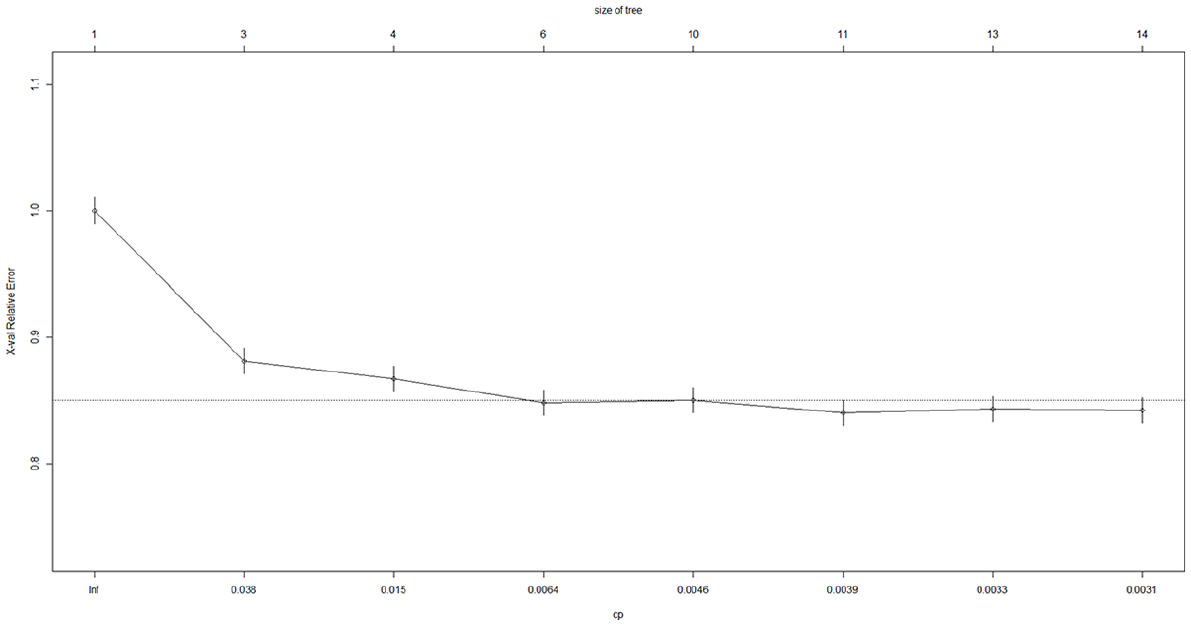
Variation of cross-validated error by cost of complexity.
Another criterion for the tree building process is to look at the number of cases in each partition. A highly complex model would have a high predictive power, but would have only a few cases in each partition, potentially signalling an overfitting problem. I decided to continue to split the tree up to a cp value of 0.003 to include age groups and quarter of interview, which identify relevant groups.
The model is able to correctly classify 67% of cases overall. In order to test the predictive validity of the model, I split the dataset in a training and test samples and computed the predictive accuracy of the model on the test dataset, obtaining the same predictive accuracy, 67%. In terms of predictive accuracy, the classification tree does not perform better than a logistic regression using the same selection of variables, yet it allowed me to select the most important variables and to assemble them in a decision tree that improves the interpretability of the decision process.
To inspect the extent to which the inability to use weights undermines the generalisability of the results, I present the proportion of individuals who prefer to leave the EU by selected predictors, comparing the figures produced using weights to the unweighted ones (Table 1).
Support for ‘leave’ the EU by selected characteristics. Weighted and unweighted proportions. Understanding society 6th, 7th and 8th surveys (n = 14221).
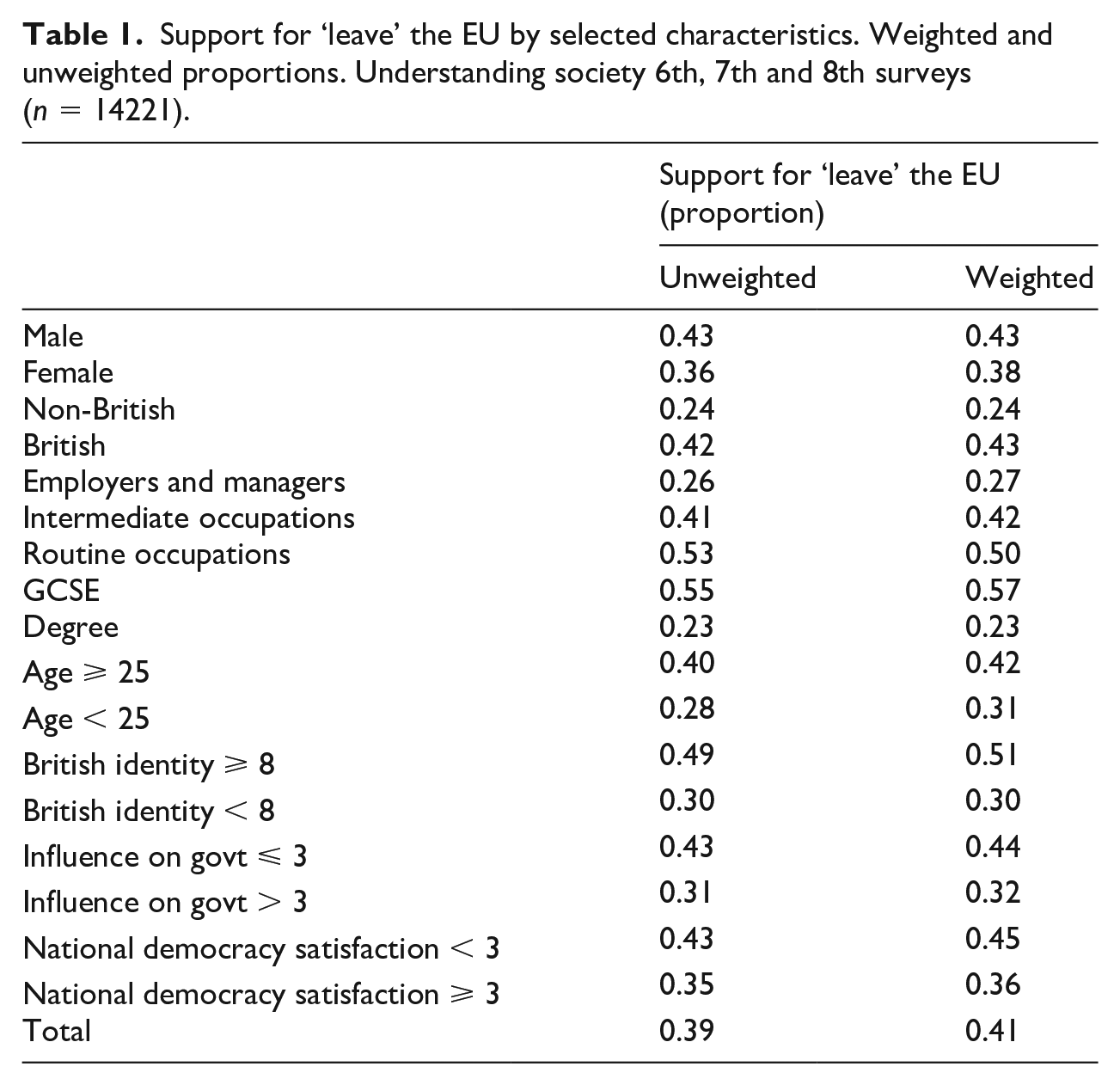
The weighted and unweighted results are very similar and overall, there is a two percent point discrepancy for the support for leave using the unweighted and weighted figures (0.39 vs 0.41). Therefore, it is very likely that the results of the decision tree, which do not use weights, are generalisable to the UK population. The results also confirm the expectation regarding a larger preference for ‘leave’ the EU among disadvantaged individuals with respect to occupation and qualifications, older individuals, non-British, individuals with a higher attachment to their British identity and with a lower level of satisfaction with national democracy. As reflected in this sample, Understanding Society data overreport the general preference for ‘remain’. A plausible reason is the over sampling in Understanding Society of ethnic minorities, which are more likely to prefer ‘remain’. The analysis includes the British/non-British ethnicity variable and shows two branches that are specific to the non-British (comprising respectively 5 and 3 percent of the sample, Graph 2). It is possible that the quantitative importance of those two groups is upwardly biased by the oversampling of ethnic minorities, yet the remaining results are not affected by the prevalence of the non-British individuals.
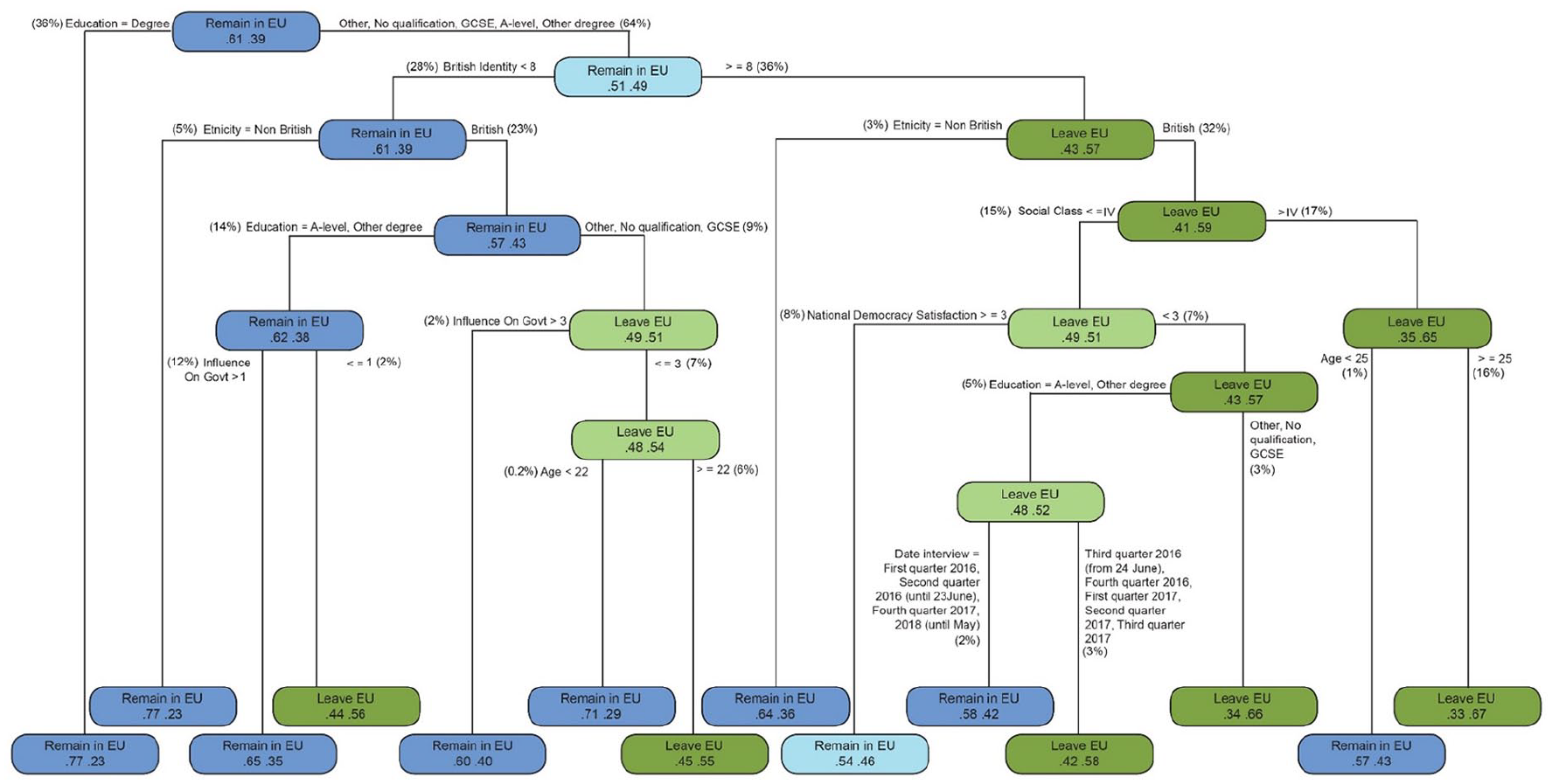
Classification tree for the preference for leave/remain in the EU, Understanding society 6th, 7th and 8th surveys (n = 14221).
Graph 2 reports the decision tree which subdivides the data into branches – defined by specific combinations of the predictors – which minimize the classification error. The observations are split when the resulting branches minimize the classification error. Graph 2 reports the probability of support for leave/remain in the EU at each branch and the size of each sub-group with respect to the total sample (in parentheses). Starting from the root node at the top, the tree shows that the most important factor explaining the support for EU is having a degree, confirming the importance of being knowledgeable on European integration. Those who have a degree tend eight out of ten times to support European integration regardless of their attitudes, aspirations and socio-economic status.
Being part of a single market has become second nature to those individuals and they would not give up the possibility to move freely to another country or to exchange goods and services with another European country even if they are disadvantaged and are attached to their British identity.
The second most important factor is the attachment to British identity. Among those who do not have a degree, being highly attached to their British identity – having a variable’s score greater than the threshold value 7 - is associated with a preference for leaving the EU, irrespective of social class. To aid with the substantive interpretation of this result, it should be considered that individuals with a score larger than 7 have one of the three most extreme values on the 0-to-10 scale of the importance of being British, and represent 51% of those with a valid value on the variable (Appendix). Roughly 61 percent of those who have a high attachment to their British identity prefer to leave the EU, while 57 percent of those who are less attached to their British identity prefer to remain in the EU. The left-hand side of the graph identifies individuals with a lower attachment to their British identity. The absence of social class on the left-end side of the graph implies that for those with a low attachment to their British identity, social class is nor relevant and does not change their tendency to support the United Kingdom membership to the EU. The result is at odds with the short-term economic interests of disadvantaged classes. Conversely, disadvantaged social classes (Small employers and own account workers (V), lower supervisory and technical occupations (VI), semi-routine occupations (VII), routine occupations (VIII)) prefer largely to leave the EU when they are more attached to their British identity (65 percent preference for leaving the EU), while advantaged social classes (large employers and higher management (I), higher professionals (II), lower management and professionals (III), and intermediate occupations (IV)) are more undecided when they have a stronger attachment to their British identity (51 preference for leaving the EU). Those results show that economic interest is probably more relevant for advantaged social classes than for disadvantaged ones.
By looking at the interaction between British identity with other variables, it is not surprising that the effect of British identity is magnified when combined with a British ethnicity. To inspect the interaction, one follows the branches that originates from the variable British identity. For example, the branches on the left-hand side of the graph identified by the British ethnic background show at propensity of leaving the EU of individuals with a low attachment to their British identity (values on the British identity variable lower than 8) depending on the ethnic background (British, non-British).
Non-British prefer to remain in EU, although with different intensity depending on how attached they are to their British identity (74 percent for those who are less attached to their British identity and 64 for those who are more attached to their British identity). British, instead have more complicated decision processes that depend on the variables regarding the evaluation of the political system.
Moving downward the decision tree, the evaluation of the political system become relevant. Advantaged social classes on the right end side of the graph – which is the one with high attachment to the British identity – tend to be undecided, yet when they are dissatisfied with the domestic democracy (variable lower than the threshold value 3 on the 4 point Likert scale, that is, 69% of those with a valid value on the variable), they shift towards scepticism towards the EU 57 percent of the times. Vice versa when they are more satisfied with domestic democracy, they tend to support integration 54 percent of the times. Advantaged classes are willing to pay an economic price to express their disappointment with the domestic political system via the ‘leave’ option.
On the left-hand side of the graph (with low levels of attachment to British identity), individuals react to the low level of perceived political efficacy by becoming sceptical about European integration. British individuals with a lower educational level are less favourable to European integration (as they prefer to remain in the EU 49 percent of the times as opposed to 62 of the higher educated), yet when they have a high level of political efficacy (variable ‘influence on government’ with a score larger than 3), that is, perceive to have an impact on the government, they become favourable to EU integration (60 percent of the times). Conversely, when with a low level of political efficacy, they become sceptical and support to leave the EU 54 percent of the times. To aid with the substantive interpretation of the political efficacy variable, the threshold >3 identifies those with the top two scores on the five-point Likert scale and represent 32% of those with a valid response on the variable.
British individuals with a relatively high educational level (A-levels or other degree) react to a low level of perceived political efficacy (variable with a score at leave five) by preferring to leave the EU 56 percent of the times. When they perceive to have some impact on the government, instead, they prefer to remain in the EU 65 percent of the times.
At the bottom of the decision tree, the branches are defined by age, quarter of interview and educational level. On the right-hand side of the graph, disadvantaged individuals, which tend to prefer to leave the EU (65 percent of the times), prefer to remain in the EU if they are younger than 25 (56 percent of the times), whilst they prefer to leave the EU 67 percent of the times if they are 25 or older. It should be mentioned that the younger group consists of a relatively small group of 169 individuals. On the left-hand side of the graph, among those with lower levels of education and low levels of political efficacy, individuals who are 21 or less tend to prefer to remain in the EU (71 percent of the times), while older individuals prefer to leave the EU (55 percent of the times). The younger group is small (42 individuals) and does not allow to generalise those results to the overall population with confidence.
Advantaged individuals with little trust in domestic democracy will prefer to leave the EU even more if they have GCSE or lower levels of education (66 percent of the times). When they have A-levels or other degrees they reduce their support for leaving the EU to 52 percent.
Finally, the least important decision factor is the date of the interview, which is relevant only on the right-hand side of the graph for the advantaged groups with high levels of satisfaction with domestic democracy and with a relatively high educational level. For this group there is an upward trend towards Euroscepticism starting from the beginning of the year of the referendum – 2016. Up until the date of the referendum its preference for leaving the EU is 42 percent. After the referendum and throughout 2017 until the third quarter the preference increases up to 58, then it decreases again to the previous level until May 2018, which is when the observation period ends.
The measures of total income, benefits, labour income and the over time changes in benefits do not have a substantial role in the process of preference formation.
Conclusion
This article proposes a rational choice model of the British support for leaving the EU that includes both identity-based aspirations and economic interest and uses decision trees analysis to test it. The decision model differs from extant analyses in that it does not distinguish between rational and cultural considerations, but considers both identity aspirations and economic interest as rational considerations to be included in the same utility maximising model. The model is premised on the notion that leaving the EU has uncertain economic consequences and therefore is accompanied by a certain degree of risk. It is also based on the notion that the perceived quality of the political system mediates the trust of the individual in realising her aspirations and goals in the current status quo. If the individual does not trust the political system, she might use the rejection of European integration to punish the establishment, which largely supports European integration. Similarly, if the individual perceives to be powerless with respect to political decisions, she might reject the system that is excluding her. The second innovation of the proposed model is therefore the inclusion of political efficacy, which captures the extent to which the individual thinks he/she can have an impact on the government. Third, the model uses better measures of socio-economic characteristics than those used by existing models.
Thanks to those innovations, the presented analysis can account for some unexpected results and shed light on new results. First, while advantaged classes tend to prefer to remain in the EU more than disadvantaged ones, a substantial portion of individuals in an advantaged class prefer to leave the EU, which is at odds with their expected economic interest. The presented analysis shows that advantaged classes become sceptical about European integration when they have little trust in domestic democracy. A plausible interpretation of the result is that they use the preference for the EU to punish the domestic political class, which supports integration by and large.
Second, disadvantaged classes are mostly driven by identity-based considerations, whilst advantaged classes trade between economic considerations and identity-based considerations. Disadvantaged classes tend to express their preference more consistently with their national identity. When they are more attached to their British identity, they prefer leaving the EU, when they are less attached to their British identity, they become pro-integration, even at the cost of placing themselves in competition with migrants coming from other EU countries. Conversely, advantaged classes react to the possibility of conflicting interests by trading off. They tend to prefer European integration, yet when they are attached to their British identity, they do not shift their position in favour of leaving the EU but remain uncertain.
Third, the evaluation of the political system is multidimensional and political efficacy shows to have an independent effect on the attitude towards the EU. The lack of political efficacy accounts for the preference for Brexit among those who are least attached to their British identity, which otherwise tend to prefer European integration. Among those who are less attached to their British identity, which in general tend to support European integration, the perceived lack of individual influence on the government triggers anti-establishment attitudes, shifting preferences towards leaving the EU.
Fourth, regarding non-attitudinal factors, education is the most important decision factor and its effect is not accounted for by income or social class. It is possible that education proxies for the importance of being knowledgeable on European integration, and the ability to develop a sopra-national identity. Indeed, understanding the debate around the uncertain consequences of European integration distinguishing between short- and long-term consequences requires the mastery of complex notions. It is also possible that individuals with a degree, who are those who travel the most and have connections abroad, do not want to give up their connections with Europe.
Fifth, income measures do not have a significant independent role in the presented decision-making model. Thanks to longitudinal nature of US, I could include the main sources of income and track their change over time with the view to assess the impact of increasing austerity for the disadvantaged groups. This allows me to conclude with confidence that the attitude towards European integration is not influenced by variations in income such as earned income or welfare transfers. This is relevant for the debate around the relative importance of economic and cultural factors for the support for European integration as it confirms that income per se is nonconsequential for this decision. Social class does have an impact tough, suggesting that it is the perceived position within the labour market that is relevant for the attitude towards European integration.
Those results imply that the interpretation of the Brexit referendum result as a combination of attachment to British identity and worries about immigration, lack of economic opportunities and dissatisfaction with the political class (Abrams, 2018; Carl et al., 2019; Curtice, 2017; Fox, 2020; Hobolt, 2016; Hobolt and Tilley, 2016; Iakhnis et al., 2018; Kriesi et al., 2012; Norris and Inglehart, 2018; Swales, 2016) should be rectified. Disadvantaged groups’ support for European integration is driven by identity aspirations not by economic interest. The results have also showed that anti-establishment attitudes are not associated with disadvantaged socio-economic groups. The dissatisfaction with domestic democracy is relevant mostly for the advantaged, and the lack of political efficacy affects equally the attitudes of advantaged and disadvantaged groups.
A negative evaluation of the political system makes certain groups, which otherwise tend to support European integration, lean towards Euroscepticism. In particular, it helps to explain the apparently contradictory Euroscepticism of those who are less attached to their British identity and of advantaged classes. Among those who are least attached to their British identity, the perceived lack of influence on the government, which is a trigger for anti-establishment attitudes, shifts the preference towards leaving the EU. The other trigger of anti-establishment attitudes, the unsatisfaction with domestic democracy tents to shift towards Euroscepticism the attitude of the advantaged classes, which when satisfied with domestic democracy tend to support European integration despite their attachment to their British identity.
The article also showed that decision tree is a useful tool to describe decision processes when the decision is the result of multiple and potentially conflicting interests.
