



Abstract
Despite growing interest in serendipity in entrepreneurship, its antecedents, contingencies, and outcomes remain understudied. We find that new firms with a monochronic orientation—a preference for handling tasks sequentially—experience more serendipity, which in turn enhances innovation performance. This is amplified in dynamic environments, where unexpected discoveries are more likely to generate value. Challenging assumptions that systematic search and broad information inputs drive innovation, our study highlights focused attention as a driver of serendipity. By linking serendipity to strategic attention allocation and environmental conditions, we offer insights into how firms can foster and capitalize on unexpected discoveries to drive innovation.
Keywords
Introduction
While entrepreneurship research most often emphasizes systematic, deliberate search within known domains as the foundation of innovation (Fiet & Patel, 2008; Shane, 2000), it is increasingly argued that opportunities are frequently found without actively looking (Busch, 2024; George et al., 2016). The growing recognition that many opportunities are discovered unintentionally highlights the limitations of theorizing focused on controlled search, which has neglected the role of unexpected discoveries in driving innovation (Denrell et al., 2003). In addition, for the vast majority of new firms—which are ordinary, low-tech, low-growth businesses with few employees and little income (Shane, 2008)—controlled search is not only challenging but often impractical (Aldrich, 1999; Dew, 2009; Sarasvathy, 2001; Zahra et al., 2006). Yet in such “everyday” firms, even modest innovation in products, services, or processes can enhance market fit, differentiation, or operational viability and drive survival and competitiveness (Buenechea-Elberdin et al., 2018; Kirner et al., 2009; Räisänen & Tuovinen, 2020; Welter et al., 2017). Unfortunately, strikingly little is known about how most new firms discover innovation opportunities or the role that “chance” plays in their discovery.
An emerging research stream has begun addressing these gaps, recognizing what many business leaders have long suspected: Innovation opportunities often arise from a mix of effort and chance—or serendipity—where outcomes differ significantly from what was being sought (Denrell et al., 2003; Yaqub, 2018). Defined as an unexpected discovery brought about by purposeful action (Fultz & Hmieleski, 2021), serendipity is increasingly studied in entrepreneurship and management as a process where opportunities and solutions emerge unpredictably and independently of their associated problems during day-to-day operations (Busch & Grimes, 2023; Ciborra, 2002; Cohen et al., 1972). This growing research stream provides an alternative perspective to traditional views of opportunity recognition and innovation by highlighting chance and surprises alongside agency, offering a framework for understanding the emergence of unsought discovery in new firms (Busch, 2024).
Nevertheless, despite the burgeoning interest in its origins and its role in revealing entrepreneurial opportunities, serendipity’s potential as a means for understanding unsought discovery is constrained by the focus on factors beyond new firms’ control and a lack of attention to conditions that make it more likely to occur and be leveraged. For example, serendipity is often attributed to “dumb luck” or uncontrollable exogenous shocks (Görling & Rehn, 2008; Lee et al., 2023). In addition, few studies account for challenges that disproportionately affect small and new firms—such as constrained resources and limited prior knowledge—that make systematic search impractical (Dew, 2009; Shah & Tripsas, 2007; Shane, 2000). Systematic search refers to goal-directed exploration aimed at solving known problems, requiring deliberate planning and resource allocation (Fiet & Patel, 2008). Such conditions are often unattainable for new firms operating under resource scarcity and high uncertainty. Further, many new firms operate in dynamic environments, where rapid change exacerbates the inherent uncertainty of launching a business and complicates the process of identifying which problems need solving (Denrell et al., 2003; Sine et al., 2006). Despite how critical incremental innovation can be for new firms’ survival and ability to navigate uncertainty, little research has examined the conditions that increase the likelihood of serendipitous discoveries or how firms subsequently leverage them to innovate (Busch, 2024), often treating serendipity as inherently value-creating without considering its contextual nuances. Together, these issues highlight challenges for both theory and practice, forming the foundation of our research question: What can new firms do to cultivate unexpected discoveries, and under what conditions do such discoveries most positively relate to innovation performance?
To address this question, we draw from the attention-based view (ABV) of the firm. According to the ABV, firm behaviors and outcomes are shaped by how attention is allocated in an organization, which is determined by the firm’s attention structures, situational context, and operating environment (Brielmaier & Friesl, 2023). The ABV’s main premise is that attention allocation is shaped by a firm’s context—attention is “situated,” meaning it emerges from and is a response to a firm’s specific situation (Ocasio, 1997). Further, because attention is a limited resource, particularly in new firms, as much as possible it must be directed toward strategically relevant areas. We argue that new firms that structure attention by prioritizing sequential tasks (i.e., monochronicity) rather than multitasking (i.e., polychronicity) are more likely to experience serendipitous discoveries and increased innovation performance. 1 In addition, the ABV emphasizes that external factors, such as environmental dynamism, shape not only how attention is allocated toward the pursuit of innovative opportunities but also influence the value generated from such opportunities (Abebe, 2012; McCann & Bahl, 2017). Building on this logic, we argue that the positive effect of monochronicity on innovation performance (through serendipity) will be strongest in dynamic environments—where industry changes are frequent and unpredictable. This framing raises an important tension: While monochronicity may offer the structured attention needed to spot unexpected opportunities, such focused work patterns can be difficult to sustain in new firms where time and resources are stretched thin. We treat this not as a contradiction but as a central paradox—one that invites deeper exploration into whether, how, and under what conditions resource-constrained firms benefit from attention structures that enable serendipitous innovation. Our full conceptual model is shown in Figure 1.
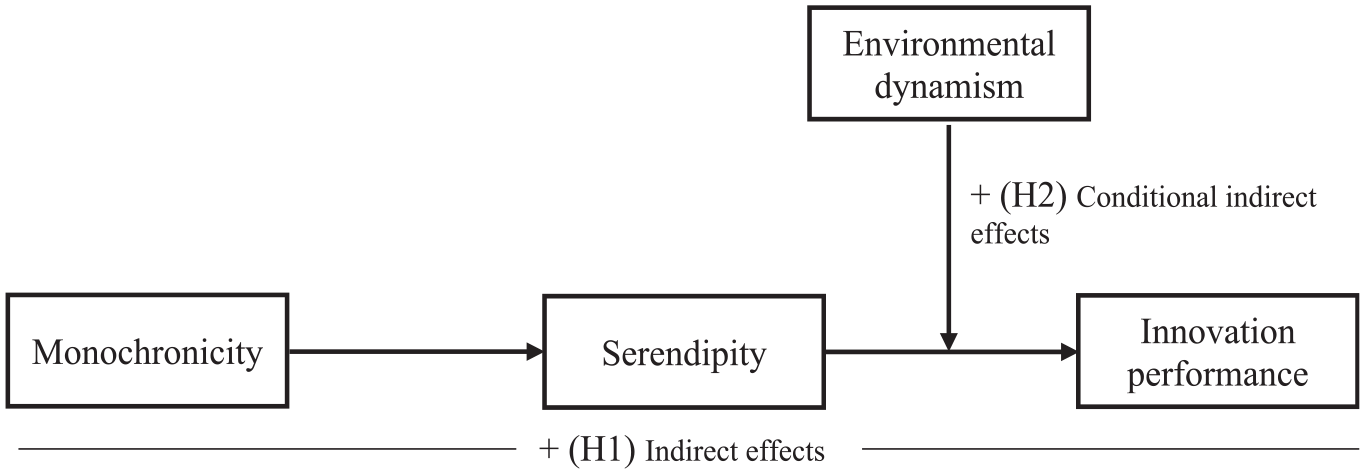
Conceptual model linking monochronicity to innovation performance via serendipity, moderated by environmental dynamism.
To test our hypotheses, we employed a lagged survey design targeting new businesses—defined as firms no more than 5 years old with 50 or fewer employees—using the Data Axle database to generate a representative sample of United States-based businesses. Data were collected in two waves, with a final sample of 156 new firms after recontacting respondents 6 months after the initial survey. Respondents were the main strategic decision-makers for their firms. Monochronicity, serendipity, and innovation performance were measured at the organizational level, with respondents using their firm as the referent, while environmental dynamism was measured at the industry level. Our focus on relatively small and new firms reflects the modal form of entrepreneurial activity globally and offers a theoretically appropriate setting for our research (Aldrich, 1999). Since the ABV highlights attention as a scarce and context-dependent resource, early stage firms—operating under uncertainty and with low capacity for structured search—provide an ideal context to examine how attention structures, such as monochronicity, influence the emergence of innovation through serendipitous discovery.
Our study contributes theoretical insights and evidence regarding how new firms can cultivate serendipity and under what conditions it is more likely to create value. First, unlike prior research that emphasizes systematic processes and deliberate search, we develop and test theoretical arguments suggesting how unexpected discoveries arise organically through day-to-day operations without active search. This perspective extends creativity research, which often argues that broader information inputs—like those facilitated by multitasking or polychronicity—enhance innovation by exposing individuals to a wider range of material (Amabile & Pratt, 2016). Our findings suggest that, in new firms, the opposite may hold true. Monochronicity appears to provide the cognitive bandwidth necessary for deeper focus. Such an approach allows members of new firms to fully engage in tasks and recognize unexpected opportunities that might be missed in the distractions of multitasking.
Second, our study highlights the contingent nature of serendipity’s value, offering a nuanced understanding of when unexpected discoveries contribute to innovation performance. Unlike prior research that primarily focuses on the positive outcomes of serendipity and reifies “value” as inherent (Murayama et al., 2015), our findings show that its benefits are more pronounced in dynamic environments. In stable environments, where innovation needs are predictable, serendipity’s potential to spark meaningful innovation is more limited. In contrast, dynamic environments—where unforeseen challenges and opportunities arise frequently—present fertile ground for serendipitous opportunities to drive innovation (Busch et al., 2024; Denrell et al., 2003). Further, by examining how attention is allocated in such settings, we contribute to attention-based theory by highlighting the importance of situated attention—a key yet underexplored dimension of the ABV (Brielmaier & Friesl, 2023; Ocasio, 1997). Our findings suggest that a monochronic focus on sequential tasks facilitates deep engagement, enabling unexpected discoveries to emerge through operational activity rather than deliberate search. This perspective expands theorizing within the ABV, which has largely emphasized goal-directed attention aimed at planned innovation outcomes (Li et al., 2013) and highlights the value of attentional patterns that foster serendipity in dynamic environments.
Literature Review
The Relationship of Polychronicity and Monochronicity With Innovation
Polychronic and monochronic orientations refer to distinct temporal preferences for how tasks are managed and attention is allocated (Bluedorn et al., 1992). Firm-level polychronic orientation refers to a preference and tendency within the firm for engaging in multiple tasks simultaneously and frequently switching between them as needed, whereas monochronic orientation is a preference and tendency for focusing on and completing one task at a time before moving to the next (Bluedorn, 2002). These orientations are “attention structures” that shape how cognitive resources are allocated (Souitaris & Maestro, 2010), with important implications for problem-solving, opportunity recognition, and innovation in organizations.
Although contemporary research often conceptualizes polychronicity and monochronicity at the individual level, early and recent work examines these constructs at the firm level, exploring how organizations prefer to allocate time and attention across competing priorities (Bluedorn et al., 1999; Sirén et al., 2020). In the current study, we treat a firm’s monochronic orientation as a temporal attentional structure—reflecting how the strategic focus is organized across initiatives. This firm-level orientation does not require that all employees engage in single-tasking all the time or that all employees work together on the same single task. Rather, it reflects how leadership or key decision-makers constrain organizational bandwidth by prioritizing a narrower set of tasks at any given time. Such temporal focus may be particularly adaptive in new firms, where attentional fragmentation can overwhelm limited cognitive and operational resources (Sine et al., 2006). Conceptualizing monochronicity in this way enables us to consider firm-level attentional dynamics without assuming uniformity in individual behaviors.
Polychronicity is often viewed as advantageous in environments where creativity and innovation are essential. This is because the multitasking inherent in polychronicity exposes organizational members to a wide array of information inputs, increasing the likelihood of encountering novel ideas (Bluedorn et al., 1999). Such exposure can spark unconventional thinking and foster cognitive flexibility—key drivers of creativity (Amabile & Pratt, 2016; Kapadia & Melwani, 2021). These qualities are particularly valuable for exploratory innovation, which involves experimenting with new concepts and disrupting existing markets (Chen, 2022). In highly creative environments, such as advertising or R&D, polychronic firms often excel by managing multiple projects simultaneously and integrating diverse knowledge streams (Howard & Cogswell, 2023). Moreover, polychronic multitasking has been shown to increase cognitive activation and flexibility, resulting in future creativity (Kapadia & Melwani, 2021). Other studies have similarly confirmed a positive relationship between polychronicity and innovation, especially in smaller, young firms where agility and creative adaptation are critical (Chen, 2022; Franczak et al., 2024; Jankelová & Joniaková, 2022).
Importantly, however, polychronicity’s advantages can diminish in certain contexts. Although multitasking may stimulate creativity after the fact, it can impair performance on current tasks when cognitive resources are stretched too thinly (Kapadia & Melwani, 2021). For example, in resource-constrained environments, limited attention and cognitive bandwidth can impair the ability to effectively switch between tasks (Madjar & Oldham, 2006). Multitasking—in such environments—can generate cognitive overload, resulting in shallow engagement with tasks, reduced depth of problem-solving, and hindered organizational learning that may hamper innovation (Chen, 2022; Sparrow, 1999). For resource-constrained new firms, constant task-switching can intensify uncertainty, impeding their ability to recognize and develop innovative solutions (Waller et al., 2001). The broader exploration and influx of new information facilitated by polychronicity may, counterintuitively, undermine learning and exacerbate ambiguity (Sine et al., 2006). This can complicate current challenges and make it harder to recognize valuable opportunities that may unexpectedly emerge during daily activities.
Monochronicity, in contrast, may foster better outcomes in such constrained contexts. Dedicating uninterrupted time to single tasks can allow deeper engagement with complex problems, promoting the kind of focused effort that leads to innovation (Czerwinski et al., 2004). Monochronicity is particularly well-suited to exploitative innovation, which involves refining and optimizing existing processes and technologies (Ocasio, 1997). Sequential task completion can enhance planning, decision-making, and execution—key factors in developing incremental innovations that prioritize consistency and reliability (Chen, 2022). Monochronicity also provides advantages in dynamic and uncertain environments. Focusing on one issue at a time allows firms to remain adaptable and responsive to rapid change while avoiding the cognitive strain of juggling competing priorities (Ethiraj & Levinthal, 2009; Leroy, 2009).
Background on Serendipity and Entrepreneurship
Serendipity is defined as an unexpected discovery brought about by purposeful action (Fultz & Hmieleski, 2021; Oo et al., 2025). Such unexpected discoveries are widely recognized as important drivers of new knowledge—indeed, serendipity is portrayed “primarily as a type of process for creating new knowledge” (Godoe, 2000, p. 1036; see also Yaqub, 2018). In a recent review, Busch (2024) identified three necessary conditions that distinguish serendipity from related concepts. First, whereas luck is purely random, serendipity involves agency—serendipitous discoveries often emerge, at least in part, from purposeful effort. Second, in contrast to targeted innovation, serendipity is characterized by surprise—it is never entirely intended or controlled, whether that refers to how the discovery occurs or what is uncovered. Third, serendipity involves potential value—a serendipitous discovery carries potential that can be materialized into realized value. While these characteristics appear in all serendipitous discoveries, research increasingly highlights diversity in the origins and context of serendipity.
Serendipity research in new firms (summarized in Appendix A) has identified several antecedents. Echoing innovation research in entrepreneurship, studies have noted that prior knowledge (Shane, 2000), prior experience (Shah & Tripsas, 2007), and deliberate, systematic search (Dew, 2009) can enhance the chances of unexpected discoveries. Others emphasize external contingencies beyond a firm’s control, such as “dumb luck” (Görling & Rehn, 2008) or exogenous shocks, such as the COVID-19 pandemic (Lee et al., 2023). A smaller body of research has begun exploring how behaviors and organizational designs can foster serendipity. Fultz and Hmieleski (2021) developed a model where improvisation positively influences serendipity, particularly in resource-constrained conditions. They also demonstrated that informal structure strengthens the relationship between serendipity and performance. Busch and Barkema (2022) additionally highlighted flexible organizational structures, emphasizing the role of community-enabling leadership in creating conditions conducive to serendipity. Nevertheless, by highlighting the role of deliberate search, accumulated experience, and the environment, the extant theory provides limited insight into how resource-constrained new firms encourage serendipity.
All serendipity arises in part from purposeful action, yet prior studies distinguish between serendipity that emerges from the deliberate search for specific solutions to defined problems and serendipity that occurs during day-to-day activities where no specific solution or problem is actively sought (Busch & Grimes, 2023; Yaqub, 2018). Studies often focus on deliberate search in cultivating serendipity. For example, Dew (2009) emphasizes “systematic exploration… [and] purposefully searching knowledge corridors” (p. 739). Irving et al. (2020) found in their study of collaborative workspace that groups lacking deliberate search efforts were less likely to experience “potential serendipitous encounters with new collaborators” compared to higher-performing groups that actively sought collaboration (p. 1138). Similarly, Fultz and Hmieleski’s (2021) study of new firms positioned organizational improvisation as deliberate, goal-directed behavior that facilitates unexpected opportunity discovery.
A smaller body of research explores serendipity that arises without deliberate search. Such discoveries occur when firms have “no particular problem in mind” (Yaqub, 2018, p. 171) or are engaged in day-to-day activities where “no search for a solution is under way” (Busch & Grimes, 2023, p. 71). For instance, Lee et al. (2023) found that the unexpected COVID-19 pandemic was linked to higher levels of product innovation in young businesses. Similarly, Engel et al. (2017) investigated serendipity as arising from “situations where goal-directed approaches are simply not an option… situations that are extremely ubiquitous in entrepreneurship” (p. 36). Such cases, where unexpected discoveries emerge organically, likely represent a primary way entrepreneurial opportunities are identified (Fiet & Patel, 2008; Shane, 2000). However, prior studies often explain such discoveries in terms of blind luck and alertness, offering limited insight into how firms might actively foster or leverage these occurrences.
Theoretical Development and Hypotheses
The ABV argues that firm behaviors and outcomes reflect how attention is distributed and regulated in an organization. Specifically, the distribution of attention is influenced by a firm’s internal social and cultural structures, which are embedded in its situational and environmental contexts. These structures drive not only where attention is focused (Ocasio, 1997) but also how the firm approaches problems and opportunities more broadly (Souitaris & Maestro, 2010). Attention is a limited resource, and its allocation—where it is focused and on what issues—plays a central role in shaping firm actions, strategy, and outcomes, including innovation, learning from unexpected events, knowledge transfer, growth, and performance (Rerup, 2009). The ability to identify and pursue opportunities is similarly tied to how attention is managed (Rhee & Leonardi, 2018). Thus, because attention shapes how firms identify and act on problems and opportunities, performance improves when these attentional patterns are well aligned with the demands of the firm’s operating environment (Ocasio, 1997).
In new firms, where uncertainty and ambiguity are particularly high (Baron, 1998), attention may be most effectively allocated by focusing on fewer issues at a time (Ethiraj & Levinthal, 2009; Sine et al., 2006). Building on the ABV, monochronicity is an attention structure that guides what issues and potential solutions are prioritized within a firm (Souitaris & Maestro, 2010). Our conceptual model proposes that monochronicity channels attention in a way that enhances the likelihood of experiencing serendipitous discoveries. Monochronic firms emphasize deep, uninterrupted attention to single tasks, aligning with the ABV’s assertion that focused attention improves the detection of emerging opportunities and enables a more thorough analysis of new information (Rhee & Leonardi, 2018). In addition, environmental factors such as dynamism shape how attention is allocated and to what effect (Brielmaier & Friesl, 2023). In highly dynamic environments, new firms often benefit from narrowing their attention to manage uncertainty more effectively (Hmieleski & Ensley, 2007; Sine et al., 2006). By integrating the ABV, we argue that monochronicity can channel attention in a manner that makes serendipity more likely and enhances innovation performance, particularly in dynamic environments where adaptability and focused responsiveness are critical.
Linking Monochronicity to Innovation Performance in New Firms Via Serendipity
Consistent with the ABV, firms benefit when their limited attention is directed at strategically relevant areas. The effectiveness of monochronicity or polychronicity depends on how well they fit situational demands (Slocombe & Bluedorn, 1999). While polychronicity has been linked to innovation by enabling multitasking and cross-functional collaboration, monochronicity offers its own advantages through distinct mechanisms. Attention-based research indicates that focused attention is an important pathway to generating new ideas by attending to narrower information sources, which reduces distraction and increases the depth of information processing (Rhee & Leonardi, 2018). Monochronicity’s sequential focus may fulfill several functions that are likely to trigger serendipity and drive innovation performance, particularly in the constrained context of new firms. Specifically, monochronicity is likely to reduce distractions, thereby increasing firms’ alertness and their abilities to recognize patterns and filter out extraneous information. Despite its potential benefits, however, empirical evidence linking monochronicity to innovation performance, especially in new firms where both focus and flexibility are crucial (Fultz & Hmieleski, 2021; Sine et al., 2006), remains limited.
Monochronicity can contribute to innovation performance in new firms through its effect on serendipity. A preference for sequential focus and structured attention does not imply rigidity or an inability to shift priorities. Instead, monochronicity may serve as a framework that guides firms toward noticing new connections between resources, markets, and customer needs by creating cognitive and organizational conditions that heighten sensitivity to meaningful anomalies or unexpected cues that emerge during daily activities. By focusing attention on single tasks sequentially, monochronicity is likely to reduce distractions and increase firms’ “preparedness to recognize” potential opportunities (Baron, 2006, p. 105), which is central to serendipity (Busch & Grimes, 2023; Denrell et al., 2003). Further, sequential focus can deepen a firm’s familiarity with its resources and operating environment, enabling it to detect subtle cues that less focused firms may overlook (Ardichvili et al., 2003; Jett & George, 2003).
Similarly, pattern recognition—connecting the dots between seemingly unrelated trends or events—benefits from focused attention, as demonstrated by studies showing that experienced entrepreneurs are better able to recognize opportunities due to their concentrated focus (Baron & Ensley, 2006). Even though a polychronic orientation may facilitate broader scanning for potential opportunities, monochronicity enables firm members to fully engage with tasks at hand, filtering out extraneous information and reducing cognitive load among organizational members (Shane, 2000). These structured attention mechanisms create conditions in which unexpected discoveries can emerge and be recognized as valuable opportunities (Sine et al., 2006).
Serendipity, in turn, is closely tied to innovation across industries (Oo et al., 2025). Knowledge creation is central to both serendipity and innovation. When unexpected discoveries occur, they often trigger abductive reasoning, which drives the creation of new knowledge (Campanario, 1996). By synthesizing disparate knowledge sources, serendipitous discoveries generate insights that can be translated into products, services, or processes (Foster & Ford, 2003; Lane et al., 2021). Serendipity’s main “output” is new knowledge (Godoe, 2000; Yaqub, 2018), which, in turn, is the foundation of innovation (Baker et al., 2003). Bringing these insights together and aligning with the ABV, we suggest that monochronicity’s relationship with innovation performance in new firms is indirect by enabling serendipity as a mechanism for uncovering and acting on unexpected opportunities. Accordingly, we predict the following:
The Moderating Role of Environmental Dynamism
Dynamic environments are characterized by rapid and unpredictable change (Hmieleski & Baron, 2009). In such contexts, firms must adapt quickly to survive or grow, which amplifies the pressure to innovate (Lengnick-Hall, 1992). Yet rather than respond adaptively, many firms exhibit threat-rigidity—where heightened stress and anxiety limit decision-makers’ ability to “conceive of actions that are different from traditional ones” (Osiyevskyy & Dewald, 2015, p. 543). Others struggle with the fundamental choice of whether to persist with their current strategy or pivot (Hunt et al., 2024). Even those attempting to pivot often face challenges in identifying promising new directions or becoming distracted in ways that impede learning (Chen et al., 2024). Indeed, pivoting itself can induce levels of uncertainty and disruption comparable to launching an entirely new business (Hampel et al., 2020).
While many businesses struggle to pivot effectively in dynamic environments, monochronic firms with a propensity for serendipitous discovery may hold a distinct advantage. Unexpected breakthroughs can reveal promising pathways forward, offering clear objectives that sharpen organizational focus while competitors remain uncertain about which direction to pursue. A small number of clear objectives can be critical for formulating rapid responses to shifting environments, particularly in new firms that are easily overwhelmed (Ethiraj & Levinthal, 2009). For example, Baker et al. (2003) observed a small business that secured an unexpected but highly lucrative contract—this serendipitous opportunity gave the firm a clear target around which it quickly reoriented. Further, sequential task focus supports comprehensive decision-making (Souitaris & Maestro, 2010)—small firms that give careful attention to harnessing a new idea are more likely to create a product that meets customer needs (Friedman & Carmeli, 2018). Busch and Barkema (2022), for example, found that serendipitous encounters provided entrepreneurs with crucial resources that enabled them to adapt effectively to community needs despite high environmental uncertainty. In dynamic contexts, serendipity can thus serve as a powerful mechanism for rapid adaptation and innovation.
Finally, in stable environments where market conditions are predictable and competition evolves gradually, the urgency to explore unexpected opportunities diminishes (Hmieleski & Baron, 2008)—firms tend to prioritize efficiency and the refinement of existing capabilities over experimentation and innovation (Winter, 2003). Stable environments tend to encourage the exploitation of existing knowledge rather than the pursuit of serendipitous opportunities as a response to uncertainty and change (Jansen et al., 2006). In contrast, dynamic environments push firms to explore novel or unconventional opportunities as a response to uncertainty and change. Under such conditions, innovation becomes a strategic necessity (Lengnick-Hall, 1992), and firms that prioritize it tend to outperform their competition (Garg et al., 2003). Rather than maintaining the status quo, firms operating in dynamic environments are more inclined to pursue emergent opportunities as a means of adaptation (McCann & Bahl, 2017). Thus, the extent to which serendipity enhances innovation performance is likely contingent on the degree of environmental dynamism, with dynamic settings amplifying the likelihood that firms recognize and convert unexpected discoveries into valuable innovations. In sum, we propose the following:
Methods
Sample and Statistical Procedures
We employed a lagged survey design. The sample was drawn from Data Axle (formerly Reference USA), a database that has been frequently used in entrepreneurship and management studies (Baron et al., 2011). This database provided access to a diverse set of firms and their leaders, ensuring the robustness and generalizability of our findings. Consistent with our focus on opportunity discovery and innovation in firms lacking the capacity for systematic search, our sampling frame included relatively small, new businesses—specifically, firms in operation for no more than 5 years, with 50 or fewer employees, and operating in one of eight prominent industry sectors. 2 An initial random sample of 3,125 firms received an invitation letter, a follow-up postcard, and several email reminders. We obtained 326 usable responses, yielding a first-wave response rate of 10.4%. Six months later, all first-wave respondents were recontacted, resulting in 156 usable responses from the second wave—a follow-up response rate of 47.85%. This final sample size aligns with other studies surveying new business leaders (Baron et al., 2016). Respondents had an average age of 48 years (SD = 13.10), with 33% identifying as women. All respondents confirmed serving as strategic decision-makers for their firms, and more than 90% identified as founders. At the time of the initial survey, the sampled firms averaged 2 years old (SD = 1.42), $1.2 million in annual sales (SD = 2.42), a leadership team between 2 and 3 decision-makers (SD = 1.53), and six employees (SD = 5.03).
Measures
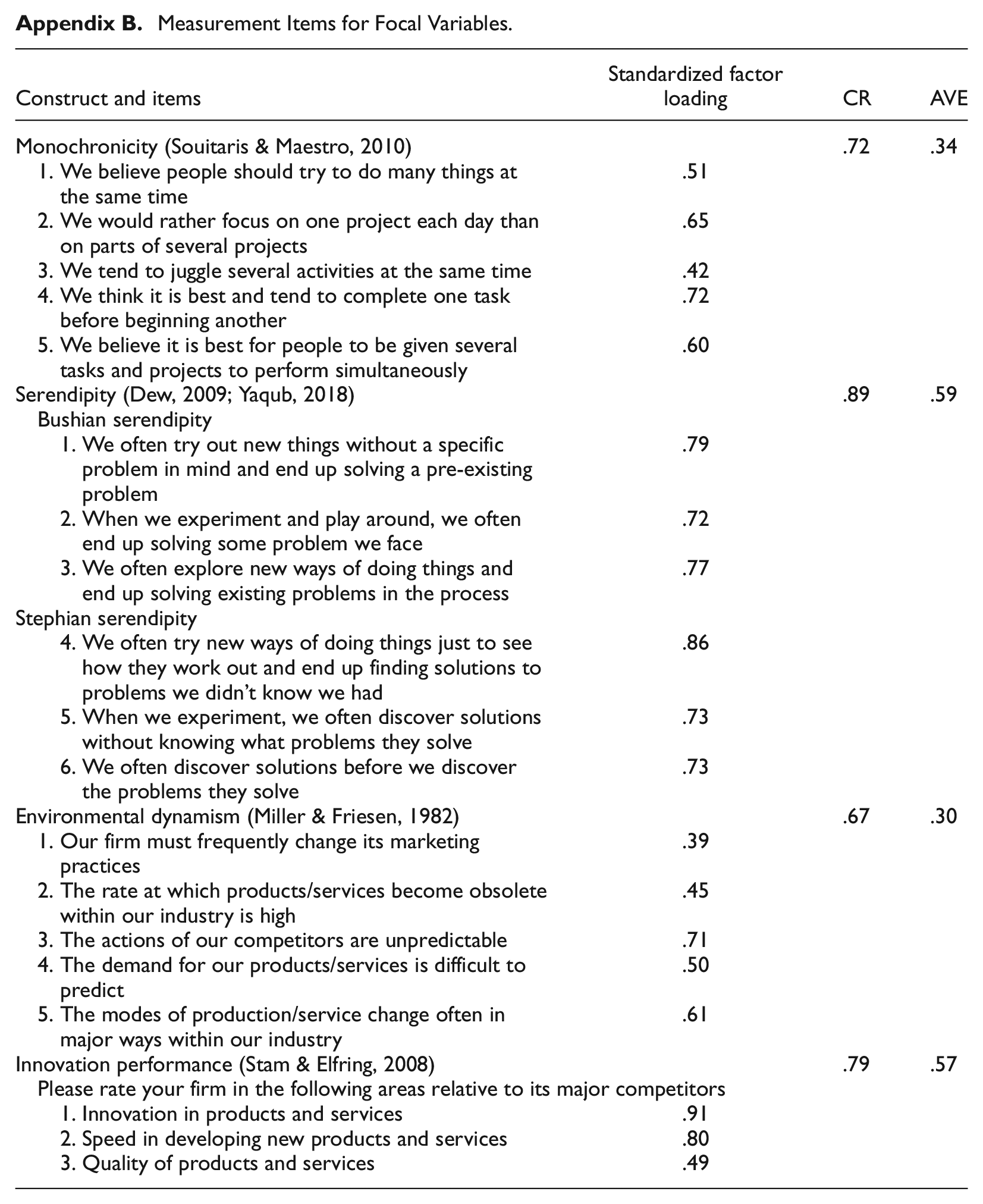
All focal measures (shown in Appendix B) used 5-point response scales ranging from low to high agreement unless otherwise specified. Respondents were instructed to treat their firm as the primary referent throughout the survey. Specifically, they were repeatedly reminded to “…think about your firm when you answer. When I say ‘we’ or ‘our’, I mean your firm.” Responses were averaged to create composite measures for each variable.
Monochronicity
We measured firm-level monochronic orientation (α = .72, Time 1) using five items from Souitaris and Maestro (2010). This measure captures the preference and tendency for engaging in single tasks sequentially—rather than multiple tasks simultaneously—and the belief that this is the optimal approach to work.
Serendipity
Prior research categorizes serendipity as arising from either (a) an active search or (b) the absence of an active search (Busch & Grimes, 2023; Fultz & Hmieleski, 2021; Yaqub, 2018). Focusing on discoveries arising without active search, serendipity (α = .89, Time 2) was assessed using six items based on Yaqub’s (2018) descriptions of “Bushian” and “Stephian” serendipity—which occur through effort that is not directed at specific problems.
Environmental Dynamism
Environmental dynamism (α = .67, Time 1) was examined using a five-item measure developed by Miller and Friesen (1982). This measure captures the rate and unpredictability of change in the firm’s operating environment and has been widely used in prior entrepreneurship research (Hmieleski & Cole, 2022).
Innovation Performance
Innovation performance (α = .79, Time 2) was examined using three items from Stam and Elfring (2008). This measure evaluates the innovativeness, speed of development, and quality of new products and services, ranging from “much worse” (1) to “much better” (5) compared to major competitors.
Controls
We included several control variables to address potential confounding factors. Improvisation, shown to trigger serendipity, and informal organizational structure, found to enhance the relationship between serendipity and performance (Fultz & Hmieleski, 2021), were controlled for. In addition, we controlled for differences in industry, firm age, and firm size. Finally, baseline measures of serendipity and innovation performance at Time 1 were included as controls, with the same variables treated as lagged focal variables at Time 2.
Confirmatory Factor Analysis (CFA)
A CFA was conducted for the focal variables (i.e., monochronicity, serendipity, environmental dynamism, and innovation performance) and demonstrated an acceptable fit with the data (χ2/df = 1.84, RMSEA = .074 with a 90% confidence interval of [.060, .088], CFI = .877, and SRMR = .074). Supporting convergent validity (see Appendix B): the average standardized factor loading is .65 (range = .39–.91), the average composite reliability (CR) is .77 (range = .67–.89), and the mean average variance extracted (AVE) is .45 (range = .30–.59). Supporting discriminant validity: the average maximum shared variance (MSV) is .11 (range = .07–.13), and in each case the AVE > MSV. These results support the overall construct validity of our focal constructs.
Statistical Procedures
We tested our hypotheses using both hierarchical regression and the PROCESS macro in SPSS 29.0 (Hayes, 2013; Hmieleski & Sheppard, 2019). Specifically, an indirect effects model was examined to test the mediation effects predicted in H1, and a conditional indirect effects model was used to test the moderated mediation effects predicted in H2. In addition, the two-way interaction was plotted, and the simple slopes were examined (Dawson, 2014).
To mitigate common method bias, we incorporated both research design features and statistical remedies. Following Podsakoff et al. (2012), our survey included lagged measures of serendipity and innovation performance at Time 2 while controlling for their baseline levels at Time 1. Although the mediator (serendipity) and dependent variable (innovation performance) were both measured at Time 2, the moderation by environmental dynamism introduces a conditional effect. Importantly, prior simulation studies and mathematical proofs strongly indicate that significant two-way interactions (conditional effects) cannot be generated by common method variance (Evans, 1985; Siemsen et al., 2010). We further validated the robustness of our results by incorporating an alternative measure of innovation performance derived from a separate data source; results from this robustness test were consistent with those of our primary analysis. Lastly, Hausman specification tests provided evidence indicating a lack of endogeneity (p > .10) for both direct relationships in our model (monochronicity → serendipity, and serendipity → innovation performance), offering further assurance that common method bias is unlikely to be influencing our results (Antonakis et al., 2010).
Results
Descriptive statistics and correlations are displayed in Table 1. Regression results are shown in Table 2, while the two-way interaction is illustrated in Figure 2. Finally, results from the PROCESS macro are reported in Tables 3 and 4, providing overall tests for H1 (indirect effects) and H2 (conditional indirect effects). Below, we describe these results in detail.
Descriptive Statistics and Variable Correlations.
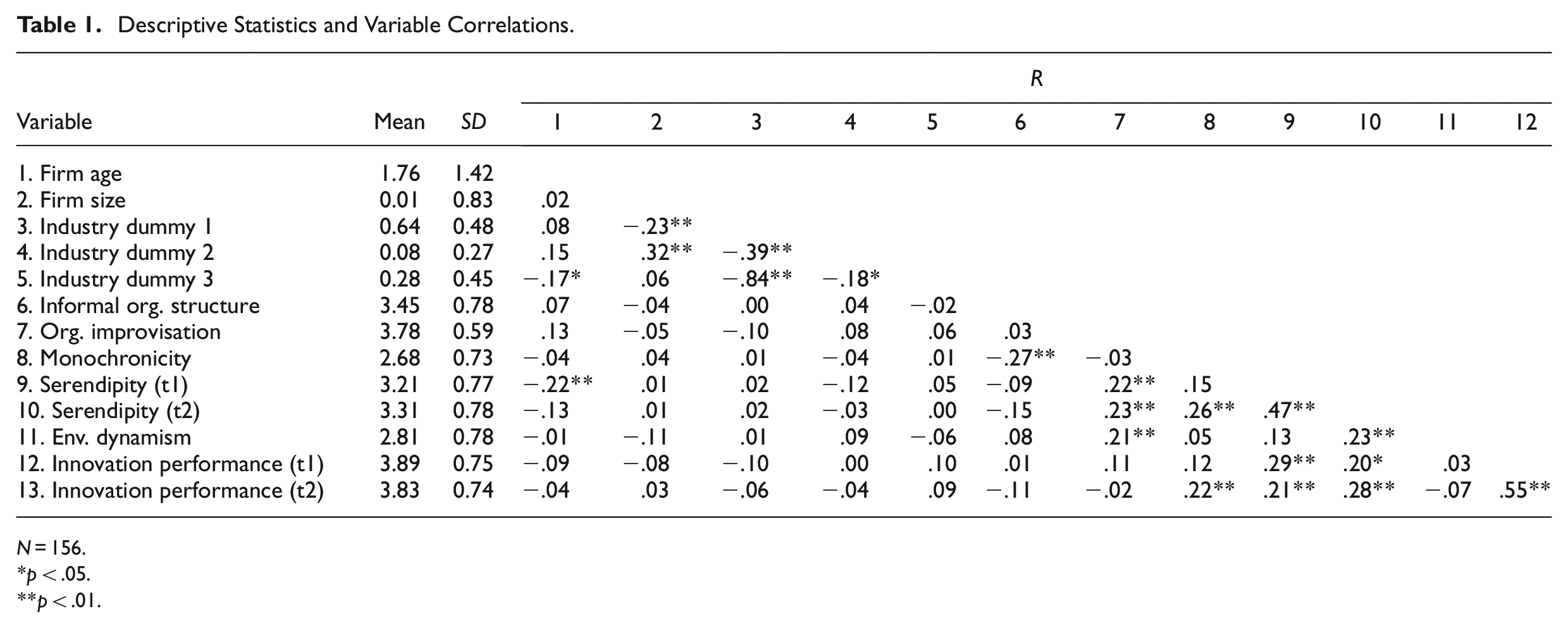
N = 156.
*p < .05.
**p < .01.
Hierarchical Regression Models for Serendipity and Innovation Performance.
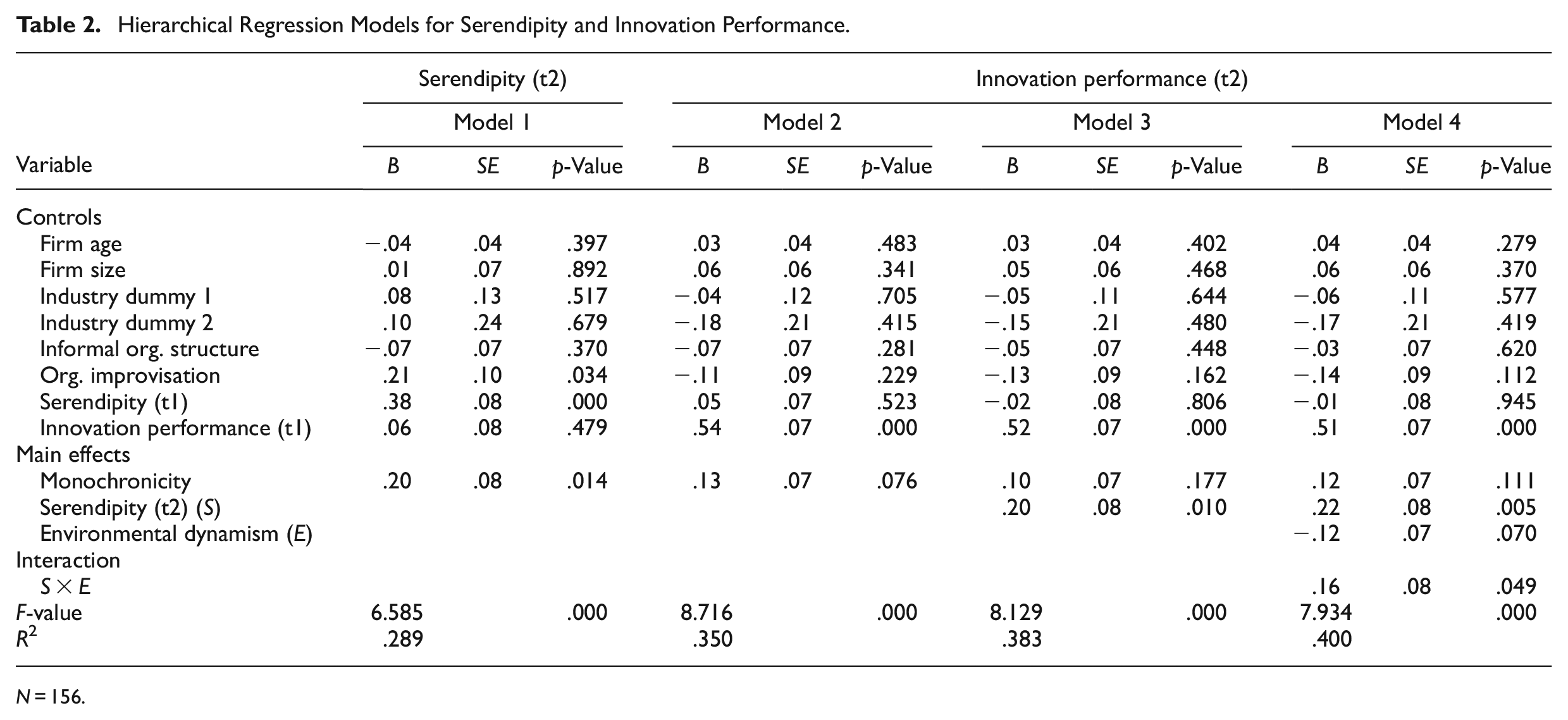
N = 156.
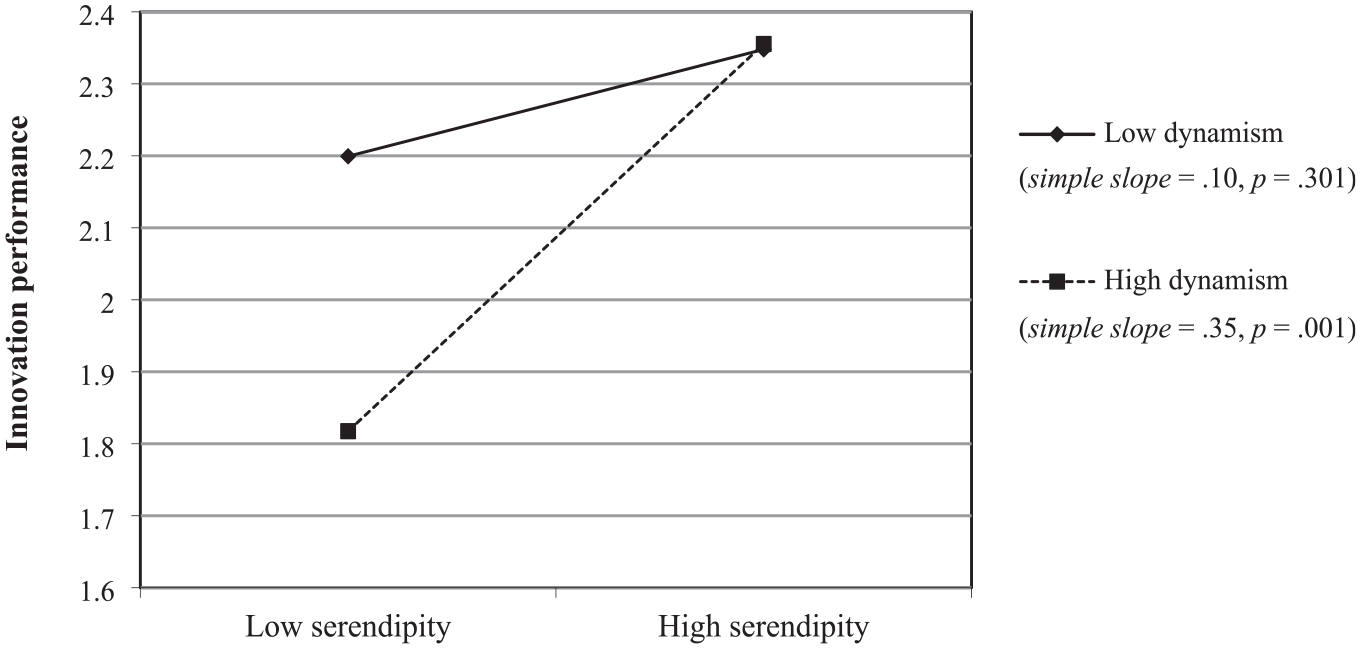
Interaction of serendipity with environmental dynamism on innovation performance in new firms.
Indirect Effects of Monochronicity (Via Serendipity) on Innovation Performance.
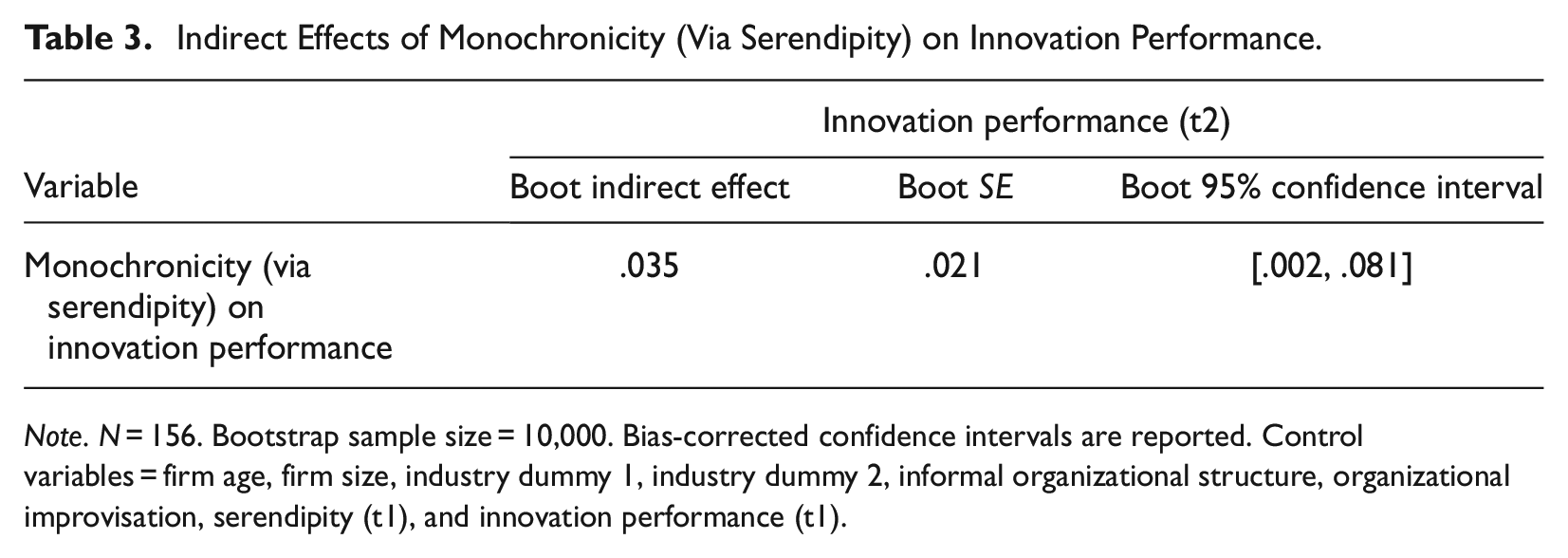
Note. N = 156. Bootstrap sample size = 10,000. Bias-corrected confidence intervals are reported. Control variables = firm age, firm size, industry dummy 1, industry dummy 2, informal organizational structure, organizational improvisation, serendipity (t1), and innovation performance (t1).
Conditional Indirect Effects of Monochronicity and Environmental Dynamism on Innovation Performance Via Serendipity.
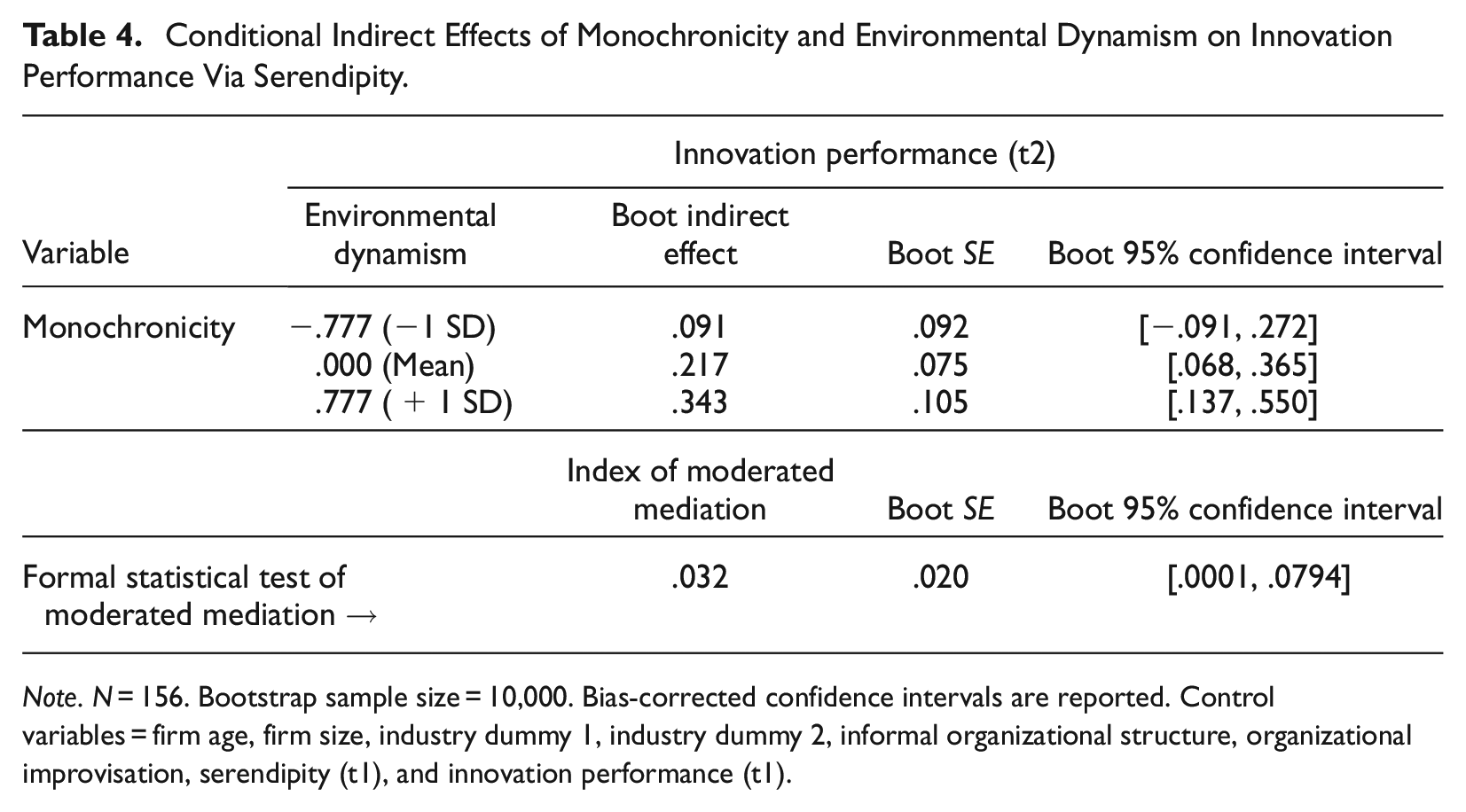
Note. N = 156. Bootstrap sample size = 10,000. Bias-corrected confidence intervals are reported. Control variables = firm age, firm size, industry dummy 1, industry dummy 2, informal organizational structure, organizational improvisation, serendipity (t1), and innovation performance (t1).
Tests of Indirect Effects
Hypothesis 1 predicted that monochronicity will be positively associated with innovation performance through serendipity. As shown in Model 1 of Table 2, monochronicity at Time 1 is positively and significantly related to serendipity at Time 2 (B = .20, p = .014), with a relatively large effect size (f 2 = .04). According to Kenny (2018), an effect size greater than .025 can be considered large. In Model 2 of Table 2, monochronicity at Time 1 is shown to be positively and marginally significantly related to innovation performance at Time 2 (B = .13, p = .076), with a moderate effect size (f 2 = .023). Further, Model 3 of Table 2 shows that serendipity at Time 2 is positively and significantly related to innovation performance at Time 2 (B = .20, p = .010), with a large effect size (f 2 = .08). Importantly, when serendipity is added to the model, monochronicity’s direct effect on innovation performance becomes nonsignificant (B = .10, p = .177), supporting the mediating role of serendipity. Finally, as an overall test of H1, Table 3 shows the PROCESS results demonstrating that the indirect effect of monochronicity on innovation performance is positive and significant (boot indirect effect = .035, boot 95% CI [.002, .081]). Together, these findings provide robust support for H1.
Tests of Conditional Indirect Effects
Hypothesis 2 proposed that environmental dynamism will moderate the strength of the relationship between monochronicity and innovation performance (through serendipity) such that the association will be more positive for new firms experiencing greater dynamism. Model 4 of Table 2 shows that the interaction between serendipity and environmental dynamism on innovation performance is positive and significant (B = .16, p = .049), with a large effect size (f 2 = .03). The interaction is plotted in Figure 2, with simple slopes analysis indicating that the relationship between serendipity and innovation performance is nonsignificant when environmental dynamism is low (simple slope = .10, p = .301) but becomes positive and significant when dynamism is high (simple slope = .35, p = .001). Further support for H2 is provided by the PROCESS results shown in Table 4, which demonstrate that the conditional indirect effect of monochronicity on innovation performance via serendipity is significant and positive when environmental dynamism is moderate (boot indirect effect = .217, boot 95% CI [.068, .365]) or high (boot indirect effect = .343, boot 95% CI [.137, .550]), but nonsignificant under low levels of dynamism (boot indirect effect = .091, boot 95% CI [−.091, .272]). Finally, the formal statistical test of the conditional indirect effects is significant (index of moderated mediation = .032, boot 95% CI [.0001, .0794]). Collectively, these results provide robust support for H2, reinforcing the validity of our overall conditional indirect effects model.
Robustness Tests With Alternative Innovation Measures
To address single-source bias concerns and further validate our model, we conducted a robustness test using an independent measure of firm innovation performance. Drawing on recent advances in generative AI (e.g., Oo et al., 2025), we used OpenAI’s ChatGPT to generate firm-specific innovation ratings based on publicly available data. For each firm in our Time 2 sample, we provided ChatGPT with information including firm name, founder or CEO, location, website, and 6-digit NAICS industry classification. ChatGPT was instructed to search for and rely exclusively on verifiable public data sources such as official websites and social media pages. It declined to generate descriptions if adequate information was unavailable, and these cases were excluded from this analysis. This yielded validated product and service descriptions for 141 out of the original 156 firms. We manually reviewed all 141 descriptions to confirm alignment with publicly available information (e.g., company website and company Facebook page).
Using these firm-level descriptions, we asked ChatGPT to assess each firm’s level of incremental innovation based on three widely cited definitions from prior research (Nagarajan & Mitchell, 1998; Ritala & Hurmelinna-Laukkanen, 2013; Song & Thieme, 2009). For each definition, ChatGPT rated the firm’s products or services on a five-point scale, benchmarking the level of innovation against other businesses operating in the same industry. Benchmarking was contextualized by drawing on indicators such as product descriptions, market focus, and customer type as inferred from each firm’s digital presence. All three innovation ratings demonstrated strong internal consistency (α = .83), and we combined them into a single composite measure of innovation performance.
We then reestimated our full model using this composite, AI-generated innovation measure as the dependent variable. The results mirrored those obtained using our original survey-based innovation measure. Specifically, we again found strong support for Hypothesis 1: monochronicity was positively and indirectly associated with innovation performance through its effect on serendipity (boot indirect effect = .063; boot 95% CI [.004, .143]). Moreover, the moderated mediation proposed in Hypothesis 2 was also supported using this independent measure. The indirect effect of monochronicity on innovation performance via serendipity was significant when environmental dynamism was moderate (boot indirect effect = .079; boot 95% CI [.013, .161]) and especially strong when environmental dynamism was high (boot indirect effect = .160; boot 95% CI [.037, .306]). The index of moderated mediation was also significant (index of moderated mediation = .102; boot 95% CI [.016, .205]), confirming that the conditional indirect effect varied meaningfully across levels of environmental dynamism.
These findings offer evidence for the robustness of our conceptual model. By relying on independently sourced innovation ratings derived from public business data and processed through generative AI, we reduce concerns of common method bias and demonstrate the consistency of our findings across distinct measurement approaches. This not only strengthens confidence in our results but also contributes to a growing body of work using AI-based tools to complement and validate traditional measures used in organizational settings.
Post Hoc Analysis: Examination of Potential Curvilinear Effects of Monochronicity
As noted, prior research has linked polychronic orientation to higher levels of creativity (Kapadia & Melwani, 2021), and the findings of some studies indicate that exposure to a greater diversity of information inputs can foster “random collisions” that generate serendipity (Foster, 2007). Combined with our theoretical rationale that the strategic focus associated with monochronicity raises the chances of serendipitous discovery, it is plausible that both a sequential focus on tasks (monochronicity) and handling multiple tasks simultaneously (polychronicity) could each facilitate serendipity. To explore this possibility, we tested an alternative model examining a potential U-shaped curvilinear effect, where both high and low levels of monochronicity might be associated with serendipity. The quadratic term for monochronicity on serendipity was nonsignificant (B = −.11, p = .162), and the addition of the quadratic term did not significantly improve the variance explained beyond the linear effect of monochronicity alone (ΔF-value = 1.974, p = .162, ΔR 2 = .011). These results lend additional support to our conceptual model.
Discussion
Challenging the prevailing view that innovation primarily arises from systematic search within familiar domains (Dew, 2009; Fiet & Patel, 2008) and that it is a controlled and deliberate process (Busch & Grimes, 2023; Busch, 2024), our study explored what new firms can do to make unintended (i.e., serendipitous) discoveries more likely and when such discoveries are most likely to be valuable. Our theory and findings show monochronicity—a preference for handling tasks sequentially—to be associated with serendipity and enhanced innovation performance, particularly in dynamic environments. We now discuss the implications of these findings for the literature on serendipity and the ABV, offer insights for practice, review limitations and directions for future research, and offer conclusions.
Strategic Focus and Serendipity
Our findings highlight the value of research exploring how serendipity can emerge in the absence of a targeted or systematic search. While recent studies have begun to challenge the tight coupling between systematic search and opportunity recognition prevalent in much of the entrepreneurship and innovation literature, many still assume serendipity results from deliberate, active search (Dew, 2009; Irving et al., 2020). However, the everyday challenges of survival and resource constraints often prevent new firms from engaging in targeted searches (Zahra et al., 2006). This highlights the role serendipity can play in enabling survival and competitiveness despite the constraints that most new firms face.
Existing research has identified behaviors such as improvisation and bricolage as mechanisms that can trigger serendipity (Busch & Barkema, 2021; Fultz & Hmieleski, 2021). Similarly, social structures that promote collaboration and networking can spur unexpected interactions and the discovery of unforeseen opportunities (Cunha et al., 2010). Our findings extend this literature by demonstrating a positive relationship between a monochronic orientation and serendipity. This raises important questions about the role of organizational values and beliefs, which shape daily work practices, in influencing serendipitous outcomes. For example, bricolage often generates unexpected outcomes (Lanzara, 1998), but the quality and usefulness of these outcomes depend on how firms apply bricolage. Firms practicing bricolage selectively, akin to a monochronic approach, tend to achieve superior growth and develop higher-quality technologies compared to those simultaneously applying bricolage across numerous domains (Baker & Nelson, 2005). Our findings suggest that exploring organizational preferences, such as a strategic focus through monochronicity, alongside previously identified antecedents of serendipity, could provide new insights into how these factors interact to foster unexpected discovery.
Our emphasis on the benefits of focused attention (monochronicity) may at first appear to contrast with research highlighting the creativity or innovation-related advantages of multitasking and polychronicity. For example, in an archival study of TV game show participants and an experiment using university students, Kapadia and Melwani (2021) found that multitasking can enhance creativity in subsequent tasks by increasing activation and cognitive flexibility. Similarly, Souitaris and Maestro (2010) show that polychronicity can accelerate and improve new product development in publicly traded technology ventures—but only when firms possess strong information processing capabilities and clear role definitions. In contrast, our study is set in a distinctly different context (very small, early stage firms) and highlights instead the importance of monochronicity in driving innovation performance through its effect on serendipity. Our findings importantly align with Chen (2022), who illustrated that the positive effects of polychronicity on innovation held for larger businesses but reversed to become negative for smaller firms. Together, our study contributes to a nuanced view of the relative merits of firms’ time orientation, suggesting they may garner more creativity and innovation benefits from a monochronic orientation at first, then benefit from a polychronic orientation as they grow and acquire more slack resources. An emergent understanding of polychronicity is beginning to mirror what is known about the benefits of formal versus informal firm structures—that the newest firms (characterized by flexibility and role ambiguity) may benefit from the focus afforded by a formalized structure while established businesses (characterized by routines and role certainty) may benefit from the flexibility afforded by an informal structure (Sine et al., 2006). Given that polychronicity studies in new firms often draw on samples of businesses that are both more established and larger than those in our sample (e.g., Carmeli et al., 2021; Franczak et al., 2024; Jankelová & Joniaková, 2022; Sirén et al., 2020), there remains a need for future research to examine polychronicity/monochronicity among firms in their earliest stages of development.
Finally, “chaos” plays a prominent role in previous accounts of serendipitous discovery. Anecdotal and empirical evidence emphasize the importance of “stirring up the pot” (Austin, 1978, p. 73), leading an active life with frequent encounters (Bandura, 1998), facilitating random collisions through improvisation (Fultz & Hmieleski, 2021), following meandering paths (Lanzara, 1999), and embracing messiness (Baker & Nelson, 2005). Busch and Grimes (2023) emphasize the need for theories that illuminate “systems of serendipity” capable of balancing “structure and chaos” (p. 86). Our study takes an initial step toward one such system by positioning monochronicity as a structuring dimension that can cultivate serendipity in the chaotic context of new businesses. Importantly, our findings do not suggest that firms can—or should—eliminate all randomness or chaos. Instead, we find and argue that a focused approach to work, such as monochronicity, can enhance the likelihood of serendipitous discoveries. By aligning strategic focus with environmental factors and organizational behaviors, firms may find a productive balance between structure and chaos, unlocking the full potential of serendipity as a driver of innovation and competitive advantage.
The Contingent Value of Serendipity
In everyday language, serendipity is often equated with “happy accidents”—unexpected yet fortunate twists of fate that bring favorable outcomes. Similarly, entrepreneurship and management studies traditionally emphasize the beneficial aspects of serendipity (Murayama et al., 2015). Recently, however, scholars have challenged this overly optimistic view, suggesting that serendipity possesses potential rather than inherent value. For example, Fultz and Hmieleski (2021) found that serendipity’s positive influence on performance was contingent on firm structure. Likewise, Busch (2024) integrates value as a core component of serendipity but emphasizes that value is subjective—what one firm deems valuable, another may consider irrelevant or detrimental. Furthermore, Busch notes that the potential value of serendipity must be actively materialized to become realized value.
Building on this nuanced perspective, our findings illustrate that the value of serendipity is context-dependent. Specifically, industry conditions are one factor shaping whether serendipity yields tangible benefits. In stable environments, entrepreneurs or managers who prioritize exploiting serendipitous discoveries may find it less likely to generate meaningful value. This suggests that serendipity’s contribution to innovation and performance is not universal but contingent on environmental factors, such as the level of uncertainty and dynamism.
This insight into the contingent value of serendipity additionally contributes to a growing body of research on its strategic importance. Prior studies have argued that serendipity is crucial for discovering strategic opportunities that can confer competitive advantages (Denrell et al., 2003; Dew, 2009) and is linked to broader measures of entrepreneurial performance (Fultz & Hmieleski, 2021). Furthermore, serendipity has been shown to expand entrepreneurs’ networks, granting access to resources unavailable to competitors (Busch & Barkema, 2022). Together, these studies suggest that serendipity can be central to firms’ efforts to adaptively navigate uncertainty and achieve not only survival but also long-term strategic benefits (Busch et al., 2024; Busch, 2024). Our study adds to this literature by demonstrating that serendipity supports enhanced innovation performance relative to competitors, but only in the presence of certain industry conditions, such as dynamism.
Finally, the observation that serendipity does not always generate value raises important and unexplored questions, including a possible “dark side” of serendipity. While often assumed to be universally value-creating, serendipity may, under certain conditions, produce suboptimal outcomes (Busch et al., 2024). A small number of studies hint at potential drawbacks. For example, because serendipity is linked to novelty and new knowledge, it could introduce excessive uncertainty that hinders progress (Linstead et al., 2014; Makri & Blandford, 2012). Similarly, exciting but unanticipated discoveries may lead to strategic ambiguity (McCulloch, 2022) or become distracting “detour[s]” that derail firms from their core objectives (Erdelez & Makri, 2020, p. 742). In sum, future research is needed that explores the boundaries of serendipity, including conditions under which it may hinder value creation. By investigating these limitations, researchers can provide a more balanced understanding of serendipity’s role in innovation and entrepreneurship, identifying its benefits and potential risks.
Advancing Theory Relating to the ABV of the Firm
Our findings extend the ABV view of the firm by demonstrating that attention allocation can also facilitate unexpected, serendipitous discoveries, challenging the traditional emphasis on systematically achieving desired outcomes. Historically, the ABV has focused on the strategic management of attention toward planned actions and toward ensuring that firms effectively recognize and capitalize on known opportunities within their environment (Brielmaier & Friesl, 2023; Ocasio, 1997). In contrast, our study suggests that attention does not always need to be directed toward systematic, goal-oriented activities for innovation to occur. Instead, we demonstrate that attention can also uncover unexpected opportunities through serendipity, even in the absence of deliberate search efforts.
This insight is particularly significant for resource-constrained firms, such as the typical new business, that may lack the capacity for an extensive systematic search. By allocating focused attention to tasks (i.e., through monochronicity), these firms can engage more deeply with ongoing activities, which appears to heighten their sensitivity to subtle cues that may lead to unforeseen opportunities. This focused engagement enables serendipitous discoveries that can drive innovation. Rather than solely directing attention toward systematic exploration for specific outcomes, firms may benefit from “letting go” of rigid control over innovation pathways and allowing spontaneous connections and discoveries to emerge through uninterrupted, engaged work. This reframes the ABV as a dynamic model in which attention enables firms to uncover and capitalize on unplanned yet valuable opportunities.
Furthermore, our findings advance the ABV by integrating the role of environmental dynamism in shaping how attention allocation impacts innovation. In highly dynamic environments, the ABV suggests that firms must continuously reallocate attention to maintain ongoing congruence with the environment (Ocasio, 1997). Our results reinforce this notion while also showing that serendipitous discoveries—opportunities that arise unpredictably—are more likely to occur and be leveraged effectively in dynamic contexts. In such environments, the need for rapid adaptation amplifies the value of focused attention (i.e., monochronicity), as it positions firms to notice and, particularly, to act on unexpected opportunities (McCann & Bahl, 2017). Thus, our study broadens the ABV to emphasize not only the strategic allocation of attention for systematic innovation but also the important role of fostering environments where attention can serendipitously lead to innovation. Balancing structured attention with openness to discovery may help firms navigate dynamic environments and enhance innovation and competitiveness.
Implications for Practice
Our study provides practical insights for entrepreneurs, educators, and investors by demonstrating how focused attention (i.e., monochronicity) and dynamic environments can cultivate serendipity and drive innovation. Concerning resource-constrained entrepreneurs, our research highlights the value of developing a monochronic work environment, where attention is directed toward one task at a time, allowing deep focus and engagement. By doing so, entrepreneurs can increase the chances of experiencing serendipitous discoveries, which often emerge from paying close attention to the task at hand. Particularly for startups with limited resources, this approach can help them maximize their existing capacities without the need for extensive exploratory processes (Zahra et al., 2006). Monochronicity facilitates deeper cognitive engagement, fostering creative problem-solving and the recognition of novel connections that might otherwise go unnoticed. At an Apple Worldwide Developers Conference in 1997, Steve Jobs famously emphasized the importance of focus when he said: “Innovation is saying no to 1,000 things.” Jobs highlighted that staying focused is not just about choosing what to work on, but, more critically, about intentionally rejecting distractions, even when they seem like good opportunities. This resonates with our findings, as structuring work environments to focus on sequential task completion helps entrepreneurs avoid cognitive overload associated with multitasking, which can dilute attention and hinder the recognition of serendipitous opportunities (Busch & Grimes, 2023). Focused attention can be particularly important in resource-constrained contexts, where efficient use of attention can drive innovation.
Regarding educators, our findings introduce a critical contrast between the benefits of polychronicity—which are often associated with creativity and idea generation through multitasking—and monochronicity, which emphasizes deep focus and the potential for uncovering unexpected opportunities through sustained attention. Polychronic orientations, as shown in creativity research, allow individuals to explore a broad range of ideas, drawing connections between diverse inputs (Amabile & Pratt, 2016). However, our findings suggest that for new firms in dynamic, fast-paced environments, monochronicity may be more advantageous because it encourages focused exploration that leads to deeper engagement with individual tasks. Educators should help students recognize the trade-offs between these two approaches, equipping them to adapt their time management strategies based on the innovation context where they are operating (Ocasio, 1997). Practical applications in the classroom could include exercises where students alternate between focused, monochronic tasks and multitasking, helping them experience firsthand how different time orientations influence creativity and serendipity.
Finally, for investors, our study highlights the need to reconsider traditional criteria for evaluating a new firm’s innovation potential, particularly in dynamic environments. Investors typically prioritize firms with systematic and structured innovation processes, which are designed to achieve planned outcomes through deliberate search efforts. However, our findings suggest that this approach may overlook the potential of firms that excel at fostering serendipity—including unplanned discoveries that can arise from focused attention rather than systematic search (Busch, 2024). In dynamic environments, where change is unpredictable, new firms with a monochronic focus—concentrating on one task at a time—are better positioned to capitalize on serendipitous opportunities, enabling them to adapt more quickly to market shifts (McCann & Bahl, 2017). This distinction between systematic search and serendipity-driven innovation is crucial for investors. New firms that can balance structured processes with the agility to respond to unplanned discoveries may have a unique advantage in volatile industries. Rather than solely assessing how well a firm manages planned innovation, investors should also consider how firms allocate attention and whether their work environments encourage the emergence of serendipity. By recognizing the strategic value of attention allocation—particularly in promoting innovation through unexpected discoveries—investors can identify firms with strong potential for long-term growth and adaptability.
Study Limitations and Directions for Future Research
There are a few study limitations that offer additional avenues for future research. One key limitation is that we relied on lagged data collected in two waves of surveys. While the observed results supported our theoretical arguments, future research could build on our findings by studying the processes through which unexpected discoveries emerge and unfold over longer periods. For example, a single serendipitous discovery may trigger a cascade of others, creating a virtuous cycle of unexpected opportunities observable over time (Busch, 2024).
A further limitation is the potential for single-source bias in our data, as our primary variables were collected from a single respondent per firm. However, several steps were taken to mitigate this concern. Our survey design adhered to best practices for key informant surveys (Homburg et al., 2012), focusing on present conditions to minimize recall bias. In addition, the sample consisted of founders (90% of respondents) or strategic decision-makers (100% of respondents), who possessed high familiarity with their organizations. The temporal separation between key constructs (e.g., monochronicity and serendipity) further reduces concerns about common method variance (Podsakoff et al., 2012). Moreover, a robustness test using an AI-generated innovation measure, based on verified external business data, replicated our main results, demonstrating the validity of our findings. To strengthen reliability, future research could incorporate experimental or multisource data.
An additional limitation involves the generalizability of our findings to resource-rich, high-growth startups and larger, more established organizations. Our sample was intentionally focused on relatively small, early stage firms, which represent the modal form of entrepreneurial activity and a theoretically relevant context for studying attentional constraints and serendipitous discovery. However, the mechanisms linking monochronicity, serendipity, and innovation performance may operate differently in firms with greater organizational slack, more formalized structures, or specialized innovation units. Future research should examine whether the dynamics we identify translate to firms operating at a larger scale or under conditions of resource abundance.
A final limitation relates to our study’s assumption that most firms in our sample are not systematically pursuing deliberate innovation strategies such as formal exploration or entrepreneurial orientation. While this assumption is grounded in longstanding research on early stage firms (Aldrich, 1999; Shane, 2008) and appropriate for our sample of small, resource-constrained firms, we acknowledge that we did not include direct measures of exploration, exploitation, or entrepreneurial orientation in our study. Thus, we cannot assess the extent to which firms engage in both deliberate and emergent search processes. Future research could address this by incorporating validated measures of strategic orientation to better account for differences in innovation strategies. Doing so would help further disentangle the unique contribution of serendipitous discovery from more intentional, planned innovation efforts.
Conclusion
Firms that consistently “connect the dots” between their strategic goals and unexpected opportunities stand to gain a competitive edge in navigating change through innovation (Busch, 2024). Our study demonstrates that firms that focus attention by proceeding sequentially through tasks may possess an advantage in connecting the dots and encountering more unexpected discoveries that can lead to innovation. This extends growing evidence that serendipity is far less reliant on luck than previously believed, thus underscoring the importance of agency in cultivating unexpected yet potentially valuable discoveries. Furthermore, the results reinforce the importance of recognizing that serendipity can vary in its ability to generate value. In conclusion, Wolfgang Amadeus Mozart once remarked, “The shorter way to do many things is to only do one thing at a time.” Emulating the creative genius of Mozart, the use of strategic (or monochronic) focus may empower entrepreneurs and new firms to more frequently generate innovations that help them to navigate uncertainty and contribute to their enduring success.
Footnotes
Appendix
Measurement Items for Focal Variables.
| Construct and items | Standardized factor loading | CR | AVE |
|---|---|---|---|
| Monochronicity (Souitaris & Maestro, 2010) | .72 | .34 | |
| 1. We believe people should try to do many things at the same time | .51 | ||
| 2. We would rather focus on one project each day than on parts of several projects | .65 | ||
| 3. We tend to juggle several activities at the same time | .42 | ||
| 4. We think it is best and tend to complete one task before beginning another | .72 | ||
| 5. We believe it is best for people to be given several tasks and projects to perform simultaneously | .60 | ||
| Serendipity (Dew, 2009; Yaqub, 2018) | .89 | .59 | |
| Bushian serendipity | |||
| 1. We often try out new things without a specific problem in mind and end up solving a pre-existing problem | .79 | ||
| 2. When we experiment and play around, we often end up solving some problem we face | .72 | ||
| 3. We often explore new ways of doing things and end up solving existing problems in the process | .77 | ||
| Stephian serendipity | |||
| 4. We often try new ways of doing things just to see how they work out and end up finding solutions to problems we didn’t know we had | .86 | ||
| 5. When we experiment, we often discover solutions without knowing what problems they solve | .73 | ||
| 6. We often discover solutions before we discover the problems they solve | .73 | ||
| Environmental dynamism (Miller & Friesen, 1982) | .67 | .30 | |
| 1. Our firm must frequently change its marketing practices | .39 | ||
| 2. The rate at which products/services become obsolete within our industry is high | .45 | ||
| 3. The actions of our competitors are unpredictable | .71 | ||
| 4. The demand for our products/services is difficult to predict | .50 | ||
| 5. The modes of production/service change often in major ways within our industry | .61 | ||
| Innovation performance (Stam & Elfring, 2008) | .79 | .57 | |
| Please rate your firm in the following areas relative to its major competitors | |||
| 1. Innovation in products and services | .91 | ||
| 2. Speed in developing new products and services | .80 | ||
| 3. Quality of products and services | .49 | ||
Declaration of Conflicting Interests
The author(s) declared no potential conflicts of interest with respect to the research, authorship, and/or publication of this article.
Funding
The author(s) disclosed receipt of the following financial support for the research, authorship, and/or publication of this article: The authors are grateful for the generous financial support of the Rutgers Advanced Institute for the Study of Entrepreneurship and Development (RAISED).
