



Abstract
How uncertainty affects entrepreneurship is a central theme in entrepreneurship research. However, evidence for how a culture of uncertainty avoidance (UA) influences entrepreneurial activity is mixed. Unlike prior research, we theorize and test how UA practices allocate individuals across two modes of opportunity exploitation. Our findings show that uncertainty-avoidant cultures channel individuals toward intrapreneurship rather than entrepreneurship. Moreover, we find a cross-level interaction effect with individuals’ fear of entrepreneurial failure; stronger UA practices direct failure-fearing individuals even more toward intrapreneurship. These findings shed new light on the complex relationship between UA and the prevalence of different forms of entrepreneurial activity.
Introduction
Understanding how an individual’s willingness to engage in (calculated) business-related risk and uncertainty affects entrepreneurial activity is a central theme in entrepreneurship research (Knight, 1921; McClelland, 1961). 1 “The creation of new products and markets involves downside risks, because time, effort, and money must be invested before the distribution of returns is known” (Shane & Venkataraman, 2000, p. 223). Entrepreneurs are agents who deal with these risks and uncertainties (Sarasvathy, 2001). Based on the notion that an individual’s willingness to bear risk and uncertainty can vary substantially between cultural settings (Hofstede, 1980; House, Hanges, Javidan, et al., 2004), research has explored how country-level differences in uncertainty avoidance (UA) affect entrepreneurial activity (Hayton & Cacciotti, 2013; Terjesen, Hessels & Li, 2016; Thomas & Mueller, 2000). The main line of reasoning is that a culture of UA (acceptance) decreases (increases) countries’ level of entrepreneurial activity, because it hampers (promotes) risk-taking. Yet, empirical evidence is mixed, with studies accepting the hypothesis (e.g., Kreiser et al., 2010; Shane, 1992), reporting insignificant results or partial support (e.g., Autio et al., 2013), or presenting contradictory evidence (e.g., Wennekers et al., 2007).
Based on these inconclusive results, one could conclude that the relationship between UA and the level of entrepreneurial activity in a country is unclear or complex. Previous work, however, has typically investigated the effect of UA on new business ownership (i.e., entrepreneurship) or entrepreneurship inside established businesses (i.e., intrapreneurship) in isolation (e.g., Autio et al., 2013; Kreiser et al., 2010; Wennberg et al., 2013), thereby neglecting that different levels of UA may channel individuals toward different forms of entrepreneurial activity (Bjørnskov & Foss, 2016; Parker, 2011). 2 Acknowledging that entrepreneurial opportunities may be exploited via different channels is crucial to our understanding of the macro–micro mechanisms that link national-level culture to individual-level entrepreneurial activity, as the level of entrepreneurial activity may be rather stable, but its appearance may differ substantially (Baumol, 1990; Bjørnskov & Foss, 2016).
We take several steps to overcome this limitation. First, in line with previous research (e.g., Baker et al., 2005; Stephan & Uhlaner, 2010), we build on the individual-opportunity nexus paradigm and, more specifically, Shane (2003) and Shane and Venkataraman (2000) to conceptualize opportunities as objective phenomena. These opportunities are exploited by entrepreneurial individuals, a subset of the population that holds different views toward risk and uncertainty (Shane & Venkataraman, 2000). We dig deeper by considering how UA affects the preferred mode of opportunity exploitation of these entrepreneurial individuals, that is, either entrepreneurship or intrapreneurship. Although Shane and Venkataraman (2000) acknowledge that individuals may prefer to exploit opportunities through intrapreneurship, they do not consider how culture affects opportunity exploitation (Baker et al., 2005). Incorporating the role of culture in Shane and Venkataraman’s (2000) framework allows us to theorize more precisely how and at what stages of the decision-making process national culture affects the decisions of entrepreneurial individuals.
Second, Shane and Venkataraman (2000) posit that entrepreneurial individuals differ from the general population in their ability to identify opportunities and deal with risks (also see Sarasvathy, 2001). Yet, they neglect that the way these cognitive properties translate into different modes of opportunity exploitation may be contingent on culture (Baum, 2017; Fischer & Schwartz, 2011). Building on Wennberg et al. (2013), we consider how UA moderates the effects of fear of failure and entrepreneurial self-efficacy on opportunity exploitation via an entrepreneurial or intrapreneurial mode. This allows us to provide a more holistic view of the impact of culture on the prevalence and appearance of entrepreneurial activity within countries.
We use 2014 to 2021 pooled data from the Global Entrepreneurship Monitor (GEM) to compare the prevalence of entrepreneurs and intrapreneurs in the adult population of a diverse set of 49 countries. Following foundational work (e.g., Autio et al., 2013; Stephan & Uhlaner, 2010), we adopt countries’ UA scores from the Global Leadership and Organizational Behavior Effectiveness (GLOBE) project (House et al., 2004) and focus on the effect of UA practices. We test our hypotheses pertaining to the effect of UA practices on the mode of opportunity exploitation on a sample of about 669 k individuals (of which about 85 k individuals are active as entrepreneurs or intrapreneurs), adopting probit regression models with Heckman sample selection to correct for nonrandom self-selection into entrepreneurial activity (e.g., Van de Ven & Van Praag, 1981).
We find that UA practices do not significantly lower the total amount of entrepreneurial activity within a country. However, we do find strong support for our theoretical reasoning that UA has a major impact on the mode of opportunity exploitation, with UA practices directing individuals toward intrapreneurship rather than entrepreneurship. We also find evidence for a cross-level moderation effect of UA practices on the relationship between individuals’ fear of entrepreneurial failure and their probability of being involved in intrapreneurship. Specifically, stronger UA practices direct failure-fearing individuals even more toward intrapreneurship, as this is, generally speaking, the less risky mode of opportunity exploitation. This more nuanced pattern of effects urges entrepreneurship scholars and policymakers to take stock of different types of entrepreneurial activity in society when focusing on the effects of cultural practices, particularly that of UA.
Theory and Hypotheses
Cultural Practices Versus Values
National culture has been studied from a variety of viewpoints and perspectives. Within the GLOBE project, culture is defined as “shared motives, values, beliefs, identities, and interpretations or meanings of significant events that result from common experiences of members of collectives that are transmitted across generations” (House & Javidan, 2004, p. 15). Similar to other researchers (e.g., Hofstede, 1980, 2001; Minkov & Kaasa, 2022), GLOBE sees culture as consisting of descriptive norms (labeled practices) and values, which can be described as judgments about the way things should be done (Malinowski, 1945). Practices and values operate at the societal and organizational levels of analysis and GLOBE treats culture as homologous across levels of analysis. This does not mean that practices and values are consistent across all groups and subgroups that constitute a society. Rather, it can be conceived as a shared property of “…a large number of people conditioned by similar background, education, and life experiences” (Doney et al., 1998, p. 607).
Cultural practices and values lead to patterns of routinized behavior that most individuals—but not all, see Baum (2017) and Fischer and Schwartz (2011)—reproduce, and are no longer consciously aware of (Dickson et al., 2004; Hofstede, 1980). Values echo normative orientation toward the way things generally “should be” (Dickson et al., 2004). Individuals do not necessarily act in line with these normative orientations (Verplanken & Holland, 2002), especially if a decision is highly consequential to the individual, such as the decision on how to exploit a business opportunity (Autio et al., 2013; Baker et al., 2005; Stephan & Uhlaner, 2010). Cultural practices exert a strong influence on the decision (how) to exploit business opportunities (Autio et al., 2013; Stephan & Uhlaner, 2010). Practices reflect the way things currently are and describe the “typical” behavior of individuals and institutional arrangements (House et al., 2004). Thus, even though cultural practices are external to the individual, they are consequential to the individual (Guiso et al., 2006).
UA Practices
GLOBE UA is defined as “the extent to which members of collectives seek orderliness, consistency, structure, formalized procedures and laws to cover situations in their daily lives” (Sully de Luque & Javidan, 2004, p. 603). This type of UA is also known as UA rule orientation (Alipour, 2019; Venaik & Brewer, 2010). 3 Rules and regulations help individuals and organizations to bring about more predictable behavior and reduce the number of unexpected events (Cyert & March, 1963; House et al., 2004). UA can translate into a variety of practices that are being used to mitigate a lack of predictability, such as IT applications (e.g., forecasting), rules, policies, and rituals. In uncertainty-accepting societies, individuals are willing to deal with uncertainty and to expose themselves to risks (Kreiser et al., 2010).
Previous research has shown that the impact of UA practices on entrepreneurial behavior and decision-making is multifaceted and operates through two primary mechanisms, that is, individual-centric and collective mechanisms (Autio et al., 2013; Guiso et al., 2006). Individual-centric mechanisms involve cognition and personal motivations that influence opportunity recognition and an individual’s assessment of the feasibility and desirability of pursuing business opportunities (McMullen & Shepherd, 2006). Collective mechanisms encompass joint expectations, shared preferences, behavioral norms, and both formal and informal institutions, shaping how individuals perceive the attractiveness and viability of entrepreneurial actions (Autio et al., 2013).
The Individual-Opportunity Nexus Paradigm
The individual–opportunity nexus paradigm states that entrepreneurship is primarily about linkages between (1) opportunity characteristics and (2) an individual’s opportunity evaluation and exploitation (Shane, 2003; Shane & Venkataraman, 2000). Entrepreneurial opportunities, in this view, are objective phenomena that are not known to all parties at all times and differ from the larger set of all business-related opportunities as they involve the discovery or creation of new means-to-end relationships instead of the optimization of existing means-to-end relationships (Alvarez & Barney, 2005; Shane & Venkataraman, 2000). Opportunities can be discovered by a diverse set of individuals within a country (e.g., employees, entrepreneurs, students, and unemployed). Individual risk assessments are a key element while evaluating the opportunities (Knight, 1921; McClelland, 1961). Entrepreneurial individuals tend to categorize business-related behaviors as less risky due to cognitive differences (Busenitz, 1999), allowing them to exploit similar opportunities at a different expected value than the general population (Shane, 2003; Shane & Venkataraman, 2000).
Two Modes of Opportunity Exploitation: Entrepreneurship Versus Intrapreneurship
“Opportunity exploitation refers to building efficient, full-scale operations for products or services created by, or derived from, a business opportunity” (Choi et al., 2008, p. 335). We make a distinction between two different modes of opportunity exploitation, namely entrepreneurship and intrapreneurship (Parker, 2011). Intrapreneurship takes place within established organizations and employees who exploit new business opportunities and create new ventures or new products, services, or process innovations for their employer are often denoted intrapreneurs (Rigtering et al., 2019). Similar to entrepreneurs, intrapreneurs initiate change and contribute to economic growth through new venture creation and firm growth (Kacperczyk, 2012). Unlike entrepreneurs, intrapreneurs do not carry the full risks in case of failure and do not reap the (full) benefits in case of success, because they are typically not the owners of the ventures that they create. Yet, intrapreneurs are expected to benefit from successes (e.g., by receiving a promotion, shares in the new venture, and/or a bonus) and intrapreneurial failures are likely to be damaging to their reputation or status, and hence, their careers (Kuratko, Burnell, Stevenson, et al., 2023).
Conceptual Framework: UA Practices and the Mode of Opportunity Exploitation
Thus far, national culture has been theorized as affecting an individual’s decision to exploit an opportunity, but not the mode of opportunity exploitation. Conceptualizing UA as a determinant of the level of entrepreneurial activity (and not the mode) is in stark contrast to the empirical observation that entrepreneurial activity can still flourish in otherwise relatively unentrepreneurial societies (Bosma et al., 2013). It also neglects that risk-taking is predispositional rather than situational (Steward & Roth, 2001). Primarily viewing risk-taking as predispositional suggests that the willingness to accept business risks is heterogeneously distributed among societal members and is only partially influenced by culture (see Baum, 2017; Fischer & Schwartz, 2011; Steward & Roth, 2001). We acknowledge the individual-centric impact of UA (i.e., UA practices affect the level of entrepreneurial activity within a country, see Figure 1), but only so that a significant percentage of entrepreneurial individuals remains. Collective mechanisms then orient these entrepreneurial individuals toward culturally supportive modes of opportunity exploitation. This idea is, by and large, based on Baumol’s (1990) proposition that the supply of entrepreneurs does not undergo significant changes but that “the rules of the game determine the relative payoff to different entrepreneurial activities” (p. 988). Baumol (1990) thus sees the prevalence of entrepreneurial individuals in society as more or less stable while the rules of the game—UA practices in our case—determine what type of entrepreneurial activities are (perceived as) viable.
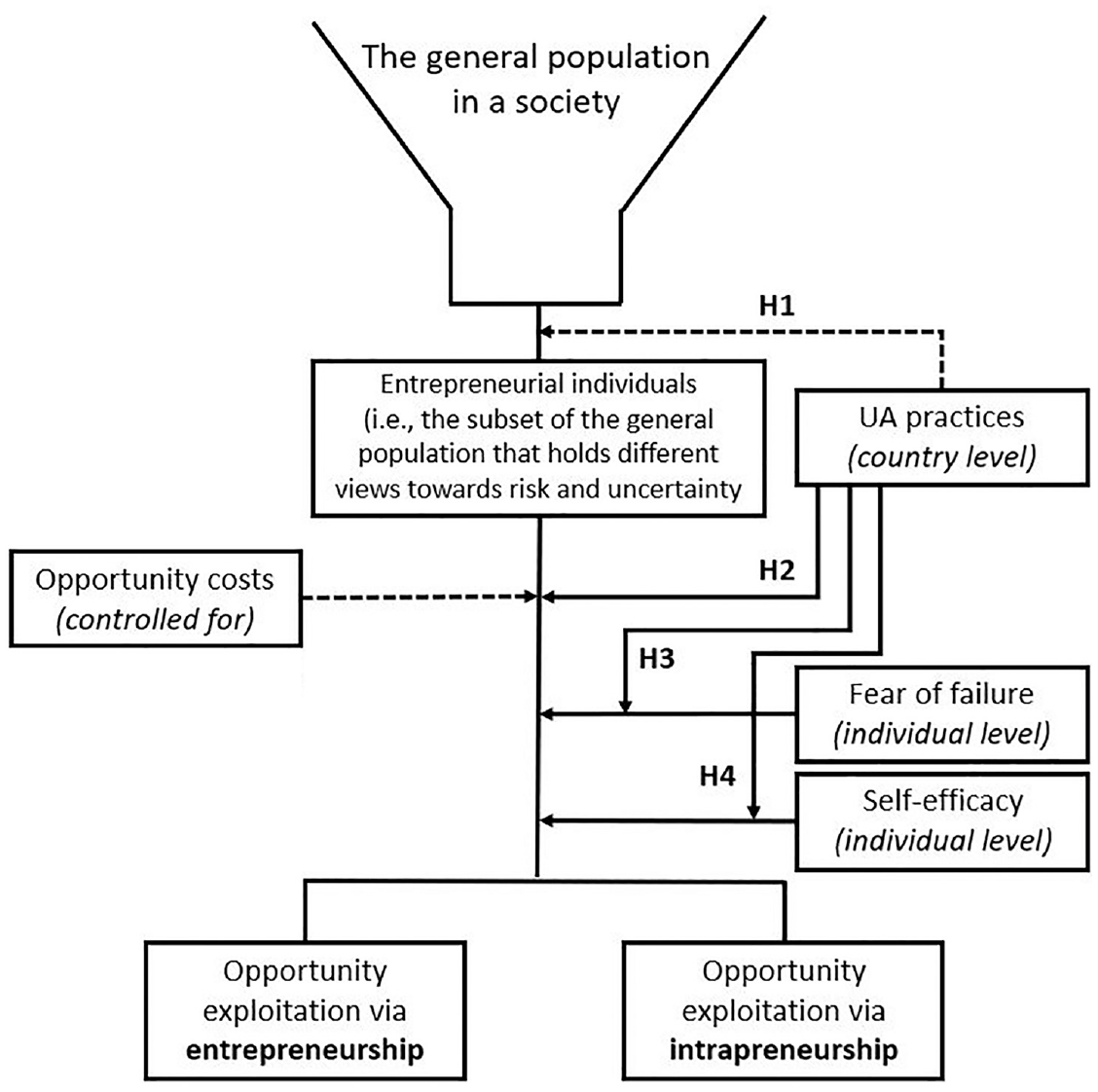
Conceptual framework.
In Shane and Venkataraman’s (2000) framework, opportunity costs (e.g., economies of scale, loss of stable income) determine if opportunities are exploited through an entrepreneurial or intrapreneurial mode. We extend this by also considering individual differences among the entrepreneurial individuals in society. Two key elements that affect opportunity evaluation are desirability and feasibility (Wennberg et al., 2013). In line with Wennberg et al. (2013), we see desirability as linked with an entrepreneur’s fear of failure and feasibility with their entrepreneurial self-efficacy. That entrepreneurial individuals have different dispositions toward risk does not mean that they are not afraid of failure. On the contrary, fear of failure is a well-documented cognitive trait among entrepreneurs and intrapreneurs (Cacciotti, Hayton, Mitchell, et al., 2016). Similarly, entrepreneurial individuals may display different levels of entrepreneurial self-efficacy, defined as a person’s belief in their ability to successfully launch an entrepreneurial initiative (McGee et al., 2009). Circumstances that are external to the individual play a central role in determining how cognitive traits translate into behavior (Bandura, 1997; Baum, 2017). In our theorization, we consider how UA moderates the effects of fear of failure and entrepreneurial self-efficacy on opportunity exploitation via an entrepreneurial or intrapreneurial mode. We visualize this idea in Figure 1 and explore it in more depth below.
Hypotheses Development
We start by discussing the effect of countries’ UA practices on entrepreneurial activity in general. Thereafter, we focus on how UA affects the allocation of individuals across entrepreneurship and intrapreneurship. In the final step, we focus on the cognitive traits of entrepreneurial individuals and consider how UA moderates the effects of an individual’s fear of failure and entrepreneurial self-efficacy on the preferred mode of opportunity exploitation.
Uncertainty avoidance practices refer to the extent to which society and organizations use specific practices to promote order and consistency (at the expense of experimentation), have rules and laws to cover uncertain situations, and the extent to which individuals live structured lives (Autio et al., 2013; House et al., 2004). Within a society with strong UA practices, order and rules that minimize risk-taking behaviors are reinforced by other members of a society, such that it becomes common for societal members to avoid exposing themselves to risky situations, even if they have a predisposition for risk-taking (Baum, 2017). Given that entry into both entrepreneurship and intrapreneurship is commonly associated with uncertainty and risk (Autio et al., 2013), UA practices may thus reduce the subset of entrepreneurial individuals within countries. This leads to our first hypothesis:
We argue that country-level UA practices orient individuals toward opportunity exploitation via the intrapreneurial mode, conditional on being involved in entrepreneurial activity. “Not all opportunities are brought to fruition” and entrepreneurial individuals are expected to only exploit those opportunities that yield high subjective expected value (Shane & Venkataraman, 2000, p. 222). In countries with strong UA practices, it is more likely that these opportunities are intrapreneurial, or that the subjective expected value that an entrepreneurial individual assigns to exploitation via the intrapreneurial mode is higher than exploitation via the entrepreneurial mode. First, UA practices change the human capital conditions in a country in favor of intrapreneurship. Because UA practices orient individuals toward safe alternatives (Sully de Luque & Javidan, 2004), students are more likely to postpone entrepreneurship and seek steady employment. The vast majority of opportunities that are discovered are based on work/industry experience (Bhidé, 1994). When large groups of entrepreneurially inclined students first seek steady employment, this ensures a steady influx of potential intrapreneurs into established organizations (Van Wetten et al., 2020). Second, joint expectations, behavioral norms, and societal legitimacy affect subjective expected value assessments and make intrapreneurship an attractive alternative to entrepreneurship in uncertainty-avoidant countries. Individuals in countries with strong UA practices place themselves outside the existing order when exploiting opportunities via the entrepreneurial mode (Autio et al., 2013) and thereby become exposed to judgment by relevant others, who are expected to disapprove of actions that deviate from the established norms. Opportunity exploitation via the intrapreneurial mode prevents such a situation, as individuals do not exit paid employment and the security of retaining a steady employment relationship may be particularly appealing to close family members (Autio et al., 2013; Baker et al., 2005). Finally, UA practices shape formal and informal arrangements of firms that operate in that country, such that structures, procedures, and rituals to mitigate uncertainty are likely to emerge (House et al., 2004; Witt & Redding, 2008). Unlike entrepreneurship, engaging in intrapreneurship allows individuals to build on established organizational UA practices. Even though these practices are not necessarily supportive during the venture creation process itself (Kuratko et al., 1990), they provide a stable and predictable environment for venture development (Kacperczyk, 2012). This type of environment is likely to be favored by individuals living in uncertainty-avoidant countries and affects their opportunity assessment in such a way that it likely increases the subjective expected value of opportunity exploitation via the intrapreneurial mode.
In some cases, the nature of the opportunity might favor exploitation via the intrapreneurial mode (e.g., when economies of scale provide substantial benefits to incumbent firms, see Shane & Venkataraman, 2000), but the individual who discovers the opportunity is not in the position to make use of this mode of opportunity exploitation (e.g., because they are employed at an organization that operates in an unrelated industry). In countries with strong UA practices, where individuals assign lower subjective expected value to exploiting opportunities via the entrepreneurial mode, the individual is then likely to abandon the opportunity and to remain nonentrepreneurial until they discover a more suitable one (Shane, 2003; Shane & Venkataraman, 2000). However, the unexploited opportunity can then still be discovered and exploited by another individual who is able to exploit it via the intrapreneurial mode. This leads to our second hypothesis:
Within the realm of entrepreneurship research, fear of failure epitomizes a negative reaction toward the “potential of failure in the uncertain and ambiguous context of entrepreneurship” (Cacciotti et al., 2020, p. 1). We anticipate that an individual’s fear of failure elicits similar mechanisms as a country’s UA practices would. First, fear of failure guides attention to social rewards and punishments and, thereby, affects the subjective expected value that entrepreneurial individuals assign to different modes of opportunity exploitation (Cacciotti et al., 2020; Wennberg et al., 2013). With entrepreneurship being a risky option that places an individual outside the existing order (Autio et al., 2013; Wennberg et al., 2013), intrapreneurship is the preferred option for individuals who fear failure. Second, when entrepreneurial individuals fear failure, they prefer an environment that can alleviate some of the uncertainty that comes with the exploitation of business opportunities. Such an environment is more likely to be found in established organizations (Kacperczyk, 2012). These mechanisms thus imply that when individuals are afraid of failure, their involvement in entrepreneurial activity is more likely to be channeled via intrapreneurship. This is our baseline hypothesis.
Our focus, however, is on how UA practices moderate this relationship. We propose that, given predisposition to entrepreneurial activity, fear of failure is more strongly related to intrapreneurship under high levels of UA practices and vice versa. An individual’s fear of failure is influenced by social norms, joint expectations, and formal institutions (Cacciotti et al., 2020; Conroy et al., 2001). In uncertainty-avoidant countries, social support for individuals who challenge the status quo is limited, and exposing oneself to any type of entrepreneurial risk stands in contrast to behavioral norms. Under such conditions, an individual’s fear of entrepreneurial failure will become more pronounced (Cacciotti et al., 2020; Conroy et al., 2001), orienting the individual to the safest alternative, that is, intrapreneurship. In addition, firms operating in countries with strong UA practices are likely to be more equipped to reduce fear of failure as established ways of mitigating uncertainty have been developed (House et al., 2004; Rigtering et al., 2017). By doing so, these firms provide a relatively desirable environment for exploiting business opportunities for individuals who are afraid of failure. This leads to our third hypothesis:
Whether an entrepreneurial individual considers opportunity exploitation via an entrepreneurial mode also depends on their entrepreneurial self-efficacy. Self-efficacy perceptions work in an anticipatory manner; individuals envision the likely outcomes of potential actions and strive to obtain advantageous outcomes (Bandura, 1989, 1997). In the absence of entrepreneurial self-efficacy, individuals are likely to experience stress and visualize failure scenarios when considering exploiting opportunities via an entrepreneurial mode (Bandura, 1997). This reduces the subjective expected value of exploiting an opportunity by means of entrepreneurship. Individuals with entrepreneurial self-efficacy are inclined to visualize success, to be motivated by a challenge, and to not feel threatened by ambiguity (Bandura, 1989; Wennberg et al., 2013). Thus, our baseline hypothesis is that when individuals possess entrepreneurial self-efficacy, their involvement in entrepreneurial activity is more likely to be channeled via entrepreneurship rather than intrapreneurship.
We again focus on how UA moderates this relationship. We contend that the negative effect of entrepreneurial self-efficacy on intrapreneurship is less strong in countries with higher levels of UA practices, and vice versa. In uncertainty-accepting countries, individuals who lack entrepreneurial self-efficacy may still consider opportunity exploitation via an entrepreneurial mode, as behavioral norms support experimentation and those who venture into unknown domains find social acceptance, even in the face of failure (House et al., 2004). This is different in countries with strong UA practices. Here, failure is more heavily penalized, and entrepreneurs need to be very confident in their ability to successfully exploit business opportunities since failure has both economic and social consequences. This leads to our fourth and final hypothesis:
Data
Data Sources and Sample Construction
Our primary data source is GEM’s Adult Population Survey (APS), a comprehensive questionnaire about individuals’ (lack of) motivations and ambitions for new business activities, their general attitude toward entrepreneurship, and personal characteristics. Every year, GEM surveys at least 2,000 respondents per participating country, drawn from their general population from 18 up to 65 years old. We pool data from eight of GEM’s annual surveys, viz. 2014 up to and including 2021. In its 2011 APS, GEM introduced a module with a set of questions identifying entrepreneurial activities by employees (denoted Entrepreneurial Employee Activity or EEA). This introduction enables comparisons of both entrepreneurship and intrapreneurship rates across a large and heterogeneous set of countries. In 2014 and the years after, GEM reincluded this module on a voluntary basis. Our second data source is the 2004 GLOBE project (House et al., 2004). The overall purpose of this project was to investigate how cultural practices and values are related to leadership and the economic competitiveness of societies (House et al., 2004). GLOBE collected data from 17,370 middle managers in 951 organizations across 62 countries between 1991 and 2004.
Merging the individual-level GEM and country-level GLOBE data and removing the instances with missing values on any of the relevant variables, yields a sample of 668,823 individuals across 49 countries. We refer to Appendix B for an overview of the number of observations for all 49 countries per year as well as additional sample descriptives (in Tables B1 and B2, respectively).
Dependent Variables
We follow Autio et al. (2013) and consider GEM’s Total early-stage Entrepreneurial Activity (TEA) as an appropriate indicator of individual-level entry into entrepreneurship. TEA encompasses both nascent entrepreneurs and owner-managers of new businesses (i.e., businesses operational up to 42 months). For our purposes, it is essential to also include the phase just preceding the birth of the firm, the more since we also identify a similar phase in our intrapreneurship variable. GEM measures Entrepreneurial Employee Activity (EEA) by identifying employees who are currently involved in the development of new business activities for their main employer. Workers are considered entrepreneurial employees if they have a leading role in at least one of the two phases of the developmental process, that is, the idea development phase and the preparation and implementation phase (Bosma et al., 2013). Examples of new business activities include setting up a new business unit, establishment or subsidiary, and the development and launch of a new product, service, or product-market combination.
Hereafter, individuals involved in TEA are considered entrepreneurs, and individuals involved in EEA are referred to as intrapreneurs. Hence, these entrepreneurial individuals are involved in entrepreneurship (
Independent Variables
We use GLOBE’s scores for UA societal practices to measure UA. GLOBE measured a total of nine cultural dimensions using a 39-item long questionnaire (Section 1 of GLOBE’s form Beta). Countries’ UA practices scores are calculated by taking the mean of 4 of these 39 questions (reverse-coded). The country scores for UA practices are provided in Table B2 in Appendix B. The questions underlying the UA construct are provided in Appendix C.
To test our third and fourth hypotheses, we use GEM’s individual-level measures of fear of failure and entrepreneurial self-efficacy, respectively. Fear of failure is a dummy variable that reflects “an individual’s lack of confidence in his or her ability to cope with endogenous or exogenous uncertainty associated with new business ventures creation as well as the fear of anticipated consequences of such failure” (Autio et al., 2013, p. 345; Wennberg et al., 2013, p. 764). More specifically, it is based on a single GEM item that reads as follows: “Fear of failure would prevent you from starting a business” (0 = No; 1 = Yes). Self-efficacy is a dummy variable that indicates whether individuals think they “have the knowledge, skills and experience required to start a new business” (0 = No; 1 = Yes). Both fear of failure and self-efficacy used to be dichotomous response variables up to and including GEM’s 2018 APS, but became ordinal as of 2019, using five-point Likert-type scales ranging from 1 = Strongly disagree to 5 = Strongly agree. For consistency reasons we have manually recoded responses 1 to 3 into 0 (=No), and answers 4 to 5 into 1 (=Yes).
Control Variables
Our individual-level control variables are all taken from the GEM surveys and include respondents’age, jointly with age squared, to capture possible curvilinear effects, gender (a dummy variable indicating females; 0 = Male, 1 = Female), education level (dummy variables indicating five different ascending levels of education), household size (dummy variables indicating whether a household consists of one, two, or more than two persons), and household income (dummy variables indicating whether the household income belongs to the lowest, middle, or highest tertile within their respective countries).
Regarding age, the extant literature typically finds evidence that young to middle-aged individuals are most likely to be involved in entrepreneurship (e.g., Lévesque & Minniti, 2006). Those who lack the resources (the younger) or the financial incentives (the older) to develop an independent business might be inclined to develop a new business activity as an intrapreneur instead (Parker, 2011). Gender serves as the exclusion restriction in our sample selection models (see later), and hence, is expected to only affect individuals’ involvement in entrepreneurial activity, not the specific mode of opportunity exploitation, except through selection (Adachi & Hisada, 2017; Klyver et al., 2013). Furthermore, existing studies consistently find that an individual’s education level is positively associated with involvement in entrepreneurial activity (e.g., Van der Sluis et al., 2008). Once engaged in entrepreneurial activity, higher levels of education tend to channel individuals more toward entrepreneurship than intrapreneurship (Parker, 2011). Highly educated individuals tend to have greater knowledge about business opportunities and conditions as well as better skills that are key to successful entrepreneurial endeavors, thereby lowering the opportunity costs of entrepreneurial entry (Amit et al., 1995). The size and income of a household have theoretically ambiguous effects on individuals’ involvement in entrepreneurial activity (Parker, 2011). Similarly, both factors likely affect an individual’s choice between entrepreneurship and intrapreneurship, although the direction of their effects is not unambiguous. Household size and income can be regarded as proxies of an individual’s access to social and financial capital, respectively, which have been shown to influence involvement in entrepreneurship and intrapreneurship in multiple ways (e.g., Aldrich & Cliff, 2003; Fairlie & Krashinsky, 2012; Krasniqi, 2009).
We include seven country-level control variables in our empirical analyses. We include the natural logarithm of a country’s GDP per capita per year (in PPP and constant 2021 international dollars), obtained from the World Bank, to account for variation in countries’ level of economic development. Countries’ total population levels (in millions) are midyear estimates of all residents within a country and are also obtained from the World Bank. The unemployment rates per country per year represent total unemployment as a percentage of the total labor force and are obtained from the International Labor Organization. We opted for GDP per capita and population size to be consistent with Autio et al. (2013) and Wennberg et al. (2013). We additionally control for countries’ unemployment rates over time, since it is known to affect occupational choice and entry decisions. Both GDP per capita and the unemployment rate can also be seen as controls for the opportunity costs of entrepreneurship (Shane & Venkataraman, 2000). After all, wealthier countries and countries with lower unemployment rates generate higher opportunity costs, because they typically offer more and better opportunities for a paid job.
Other cultural practices than UA may also affect individuals’ probability to engage in different forms of entrepreneurial activity (or not). We include four of GLOBE’s cultural practices as country-level controls, namely in-group collectivism, assertiveness, institutional collectivism, and performance orientation (see Appendix C for further details). As in Autio et al. (2013) and Wennberg et al. (2013), GLOBE’s remaining four cultural dimensions—that is, future orientation, gender egalitarianism, humane orientation, and power distance—have not been included for multicollinearity reasons or to avoid overfitting our models.
Descriptive Statistics and Correlations
Table 1 summarizes the descriptive statistics of all variables included. The average age is close to 40 years, about 48% of our sample is female, and all other individual-level controls show a substantial variation across their respective categories. About 45% indicated that fear of failure prevents them from starting a new business, and about 50% confirmed that they have the knowledge, skills, and experience required to start one. The descriptives of the country-level controls show that the sample includes a heterogeneous set of countries in terms of economic welfare, population size, unemployment rates, and cultural practices.
Descriptive Statistics.
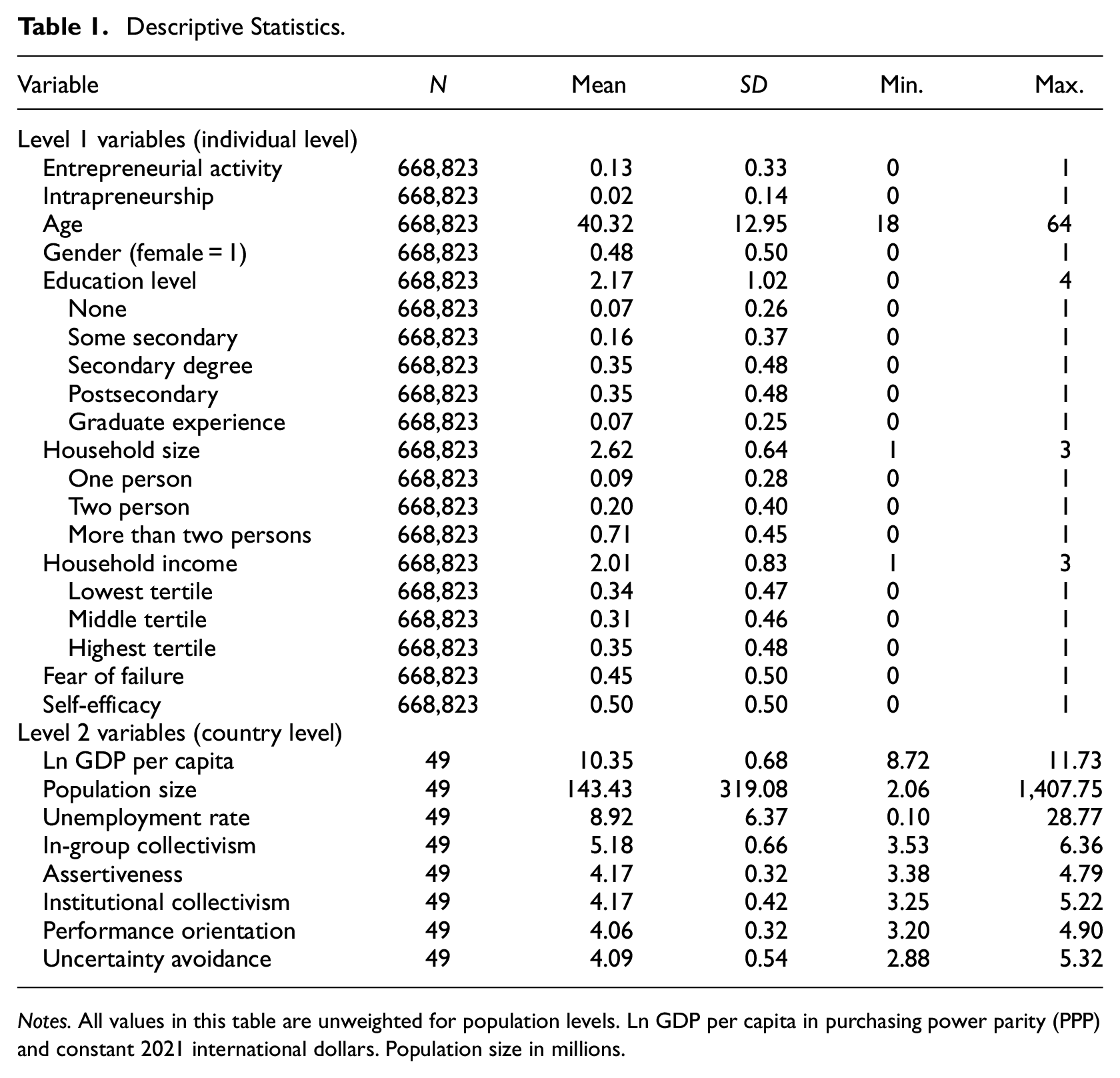
Notes. All values in this table are unweighted for population levels. Ln GDP per capita in purchasing power parity (PPP) and constant 2021 international dollars. Population size in millions.
Table 2 shows the correlation coefficients between all variables. To check for possible multicollinearity issues, we computed the variance inflation factors (VIFs) and only found low-to-moderate values (between 1.03 and 4.39). The moderate-to-high tolerance values (between 0.23 and 0.97) also suggest that our models do not suffer from multicollinearity.
Correlation Matrix.
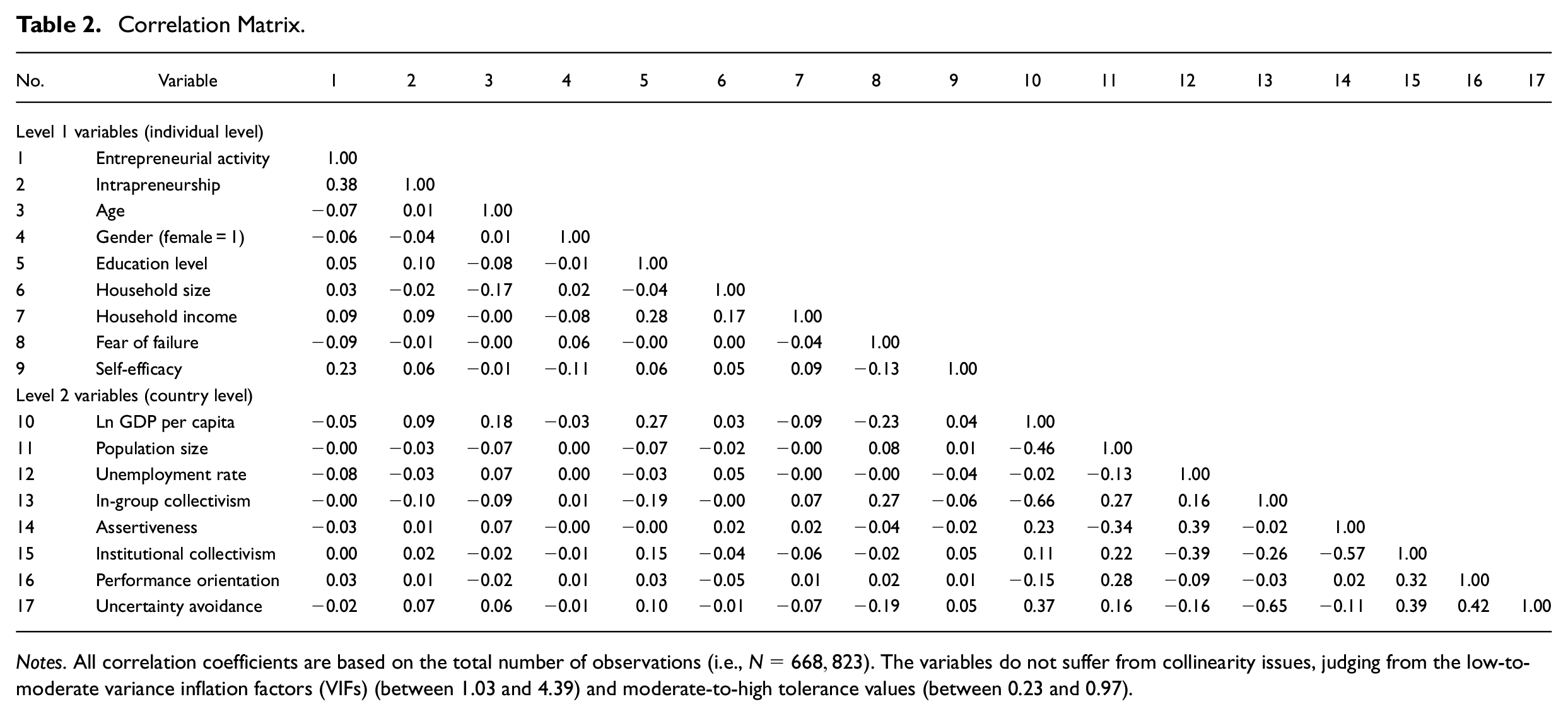
Notes. All correlation coefficients are based on the total number of observations (i.e.,
Methods
To build on previous research, we first replicate the multilevel random-effects logit models in Table 6 of Autio et al. (2013, p. 350) with entrepreneurship (
We move on to test our first hypothesis (H1) by estimating several probit models (without sample selection) with entrepreneurial activity (
For probit models with sample selection to be well-identified, the selection equation should contain at least one independent variable that is not added to the probit equation. Our identification strategy is to use gender as the exclusion restriction in the first stage of the estimation procedure. Previous research has consistently shown that gender is a key factor in explaining individuals’ involvement in entrepreneurial activity. There is a so-called “gender gap,” with women being severely underrepresented (e.g., Klyver et al., 2013). At the same time, gender is not clearly related to someone’s involvement in either entrepreneurship or intrapreneurship; women seem to be in a disadvantageous position regarding both modes of opportunity exploitation (Adachi & Hisada, 2017). Therefore, gender theoretically affects an individual’s probability of being selected, but not the outcome, apart from its effect through selection (Certo et al., 2016).
Results
Results of Probit Models
Table 3 contains the estimation results of our probit models (without sample selection), reporting the coefficients and robust standard errors for country-clustered data of all explanatory variables. Table 4 provides the corresponding average marginal effects (AMEs). When looking at the results of Model 4 in Table 4, we observe that the AME of UA on involvement in entrepreneurial activity is slightly negative (−0.02) and statistically significant at the ten percent level, weakly affirming H1. Hence, countries’ UA practices indeed appear negatively associated with an individual’s involvement in entrepreneurial activity, either as entrepreneur or intrapreneur, but the effect is rather small and only marginally significant.
Probit Regression Models (Dependent Variable: EA).
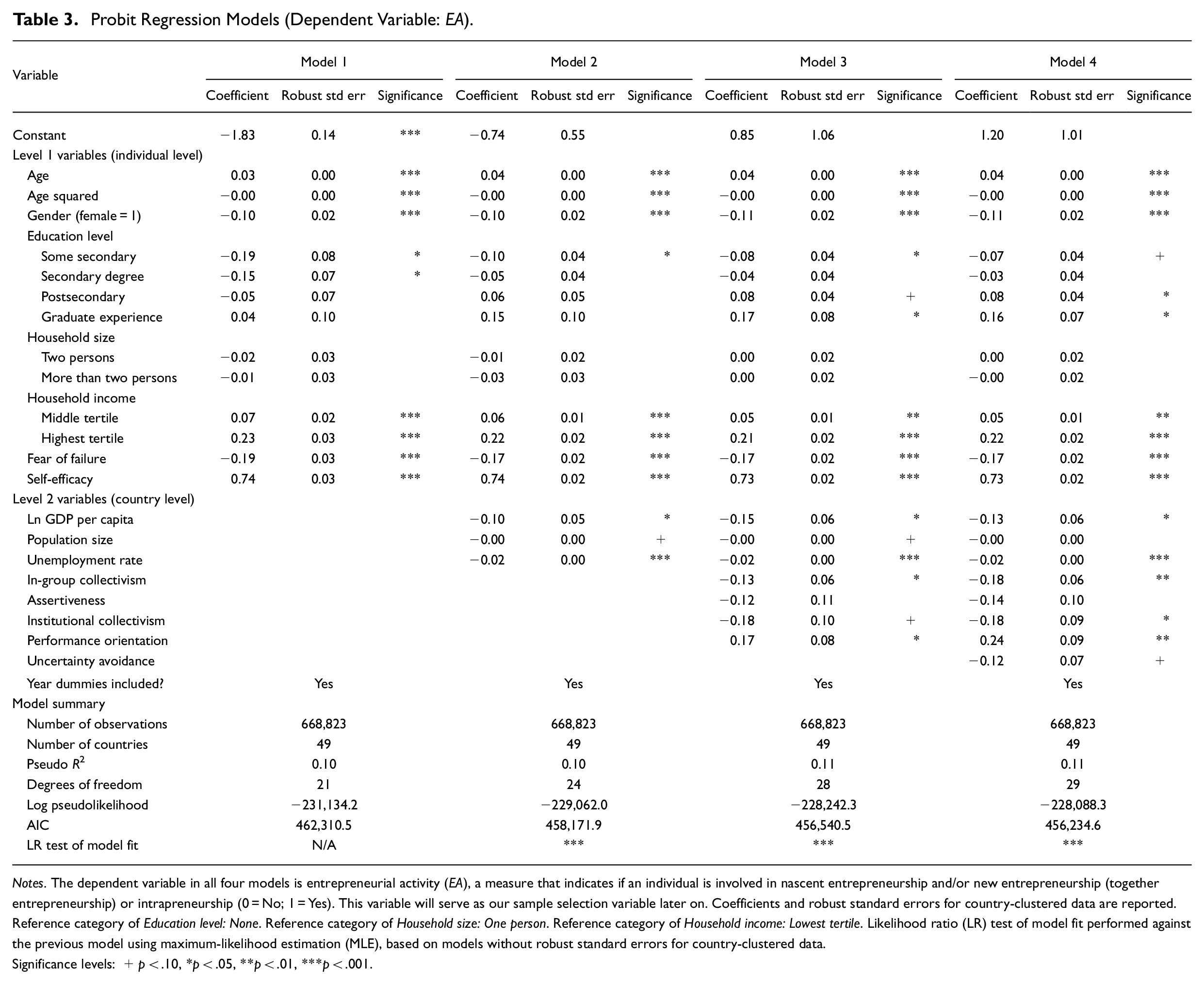
Notes. The dependent variable in all four models is entrepreneurial activity (
Significance levels: +p < .10, *p < .05, **p < .01, ***p < .001.
Average Marginal Effects of the Probit Regression Models (Dependent Variable: EA).
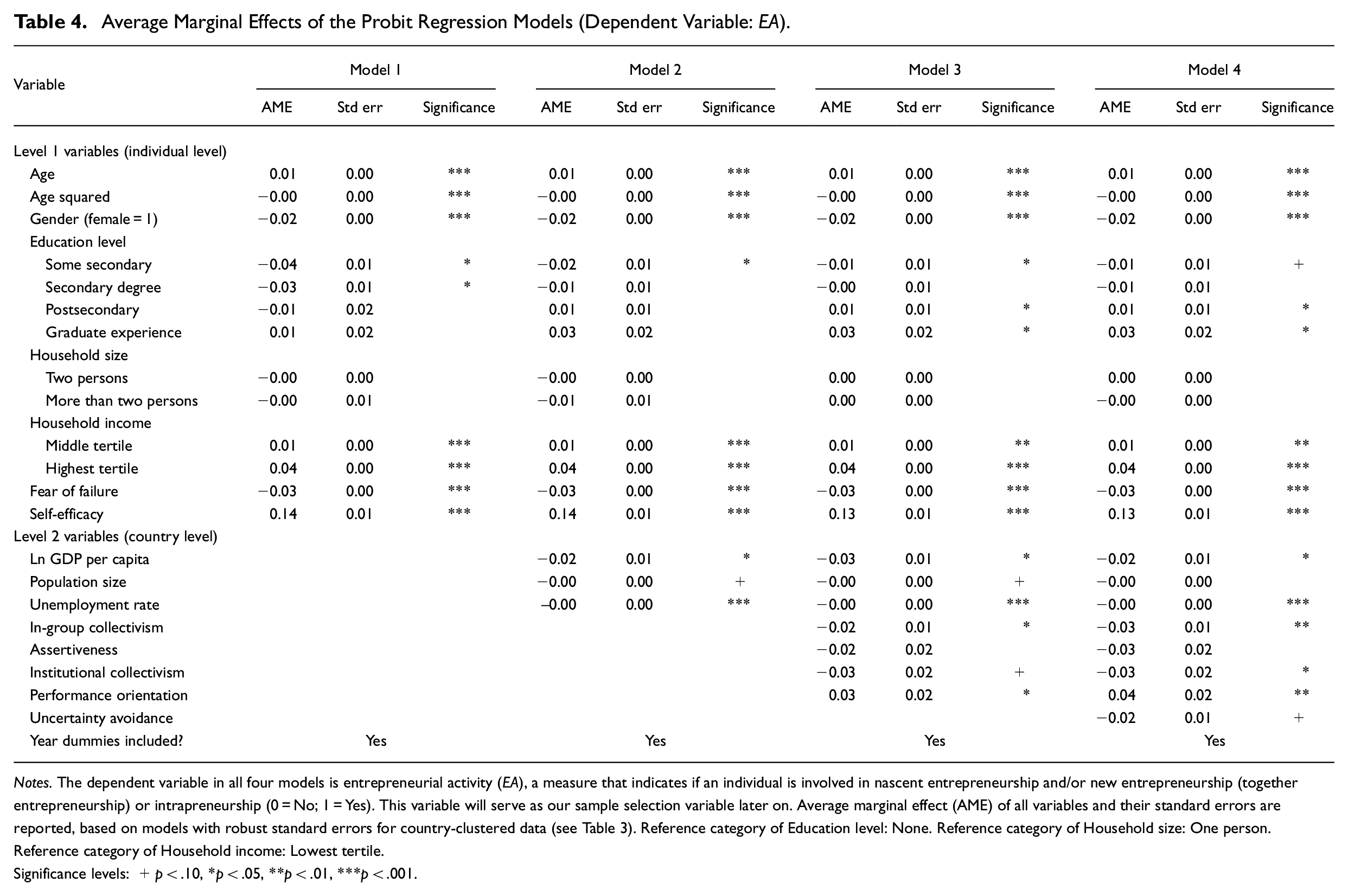
Notes. The dependent variable in all four models is entrepreneurial activity (
Significance levels: +p < .10, *p < .05, **p < .01, ***p < .001.
Identification of the Predictor of Sample Selection
We applied the following procedure to identify our predictor of sample selection (i.e., gender) and to assess its appropriateness as an exclusion restriction. As a first step, we performed significance tests on gender being included directly in the outcome equation of our Heckman selection models. Its coefficient appeared statistically insignificant, no matter the exact model specification, confirming that gender does not directly affect our outcome (and, hence, its exogeneity). Second, we performed tests for the significance of gender in the selection equations of our models. Gender appeared to be an individually significant predictor of selection into entrepreneurial activity (at a 0.1% level) throughout all our Heckman selection models, confirming its relevance. Third, we also performed Wald tests of independent equations, testing whether an individual’s decision to engage in entrepreneurial activity is independent of our outcome of interest, that is, an individual’s choice for the mode of entrepreneurial activity. If we reject the null hypothesis of
Results of Probit Models With Sample Selection
Table 5 shows the descriptive statistics of all variables included in our sample selection models. We distinguish between groups of observations before selection (left-hand side) and after selection (right-hand side) of individuals who are involved in any kind of entrepreneurial activity. Looking at the right-hand side of Table 5, intrapreneurs appear to be older and higher educated than entrepreneurs, and they more often belong to smaller and wealthier households. Furthermore, fear of failure prevents intrapreneurs from starting a new business significantly more often than entrepreneurs, and intrapreneurs have, on average, less entrepreneurial self-efficacy. Also, intrapreneurs are more likely to live in countries with relatively high levels of UA practices.
Descriptive Statistics Before and After Selection.
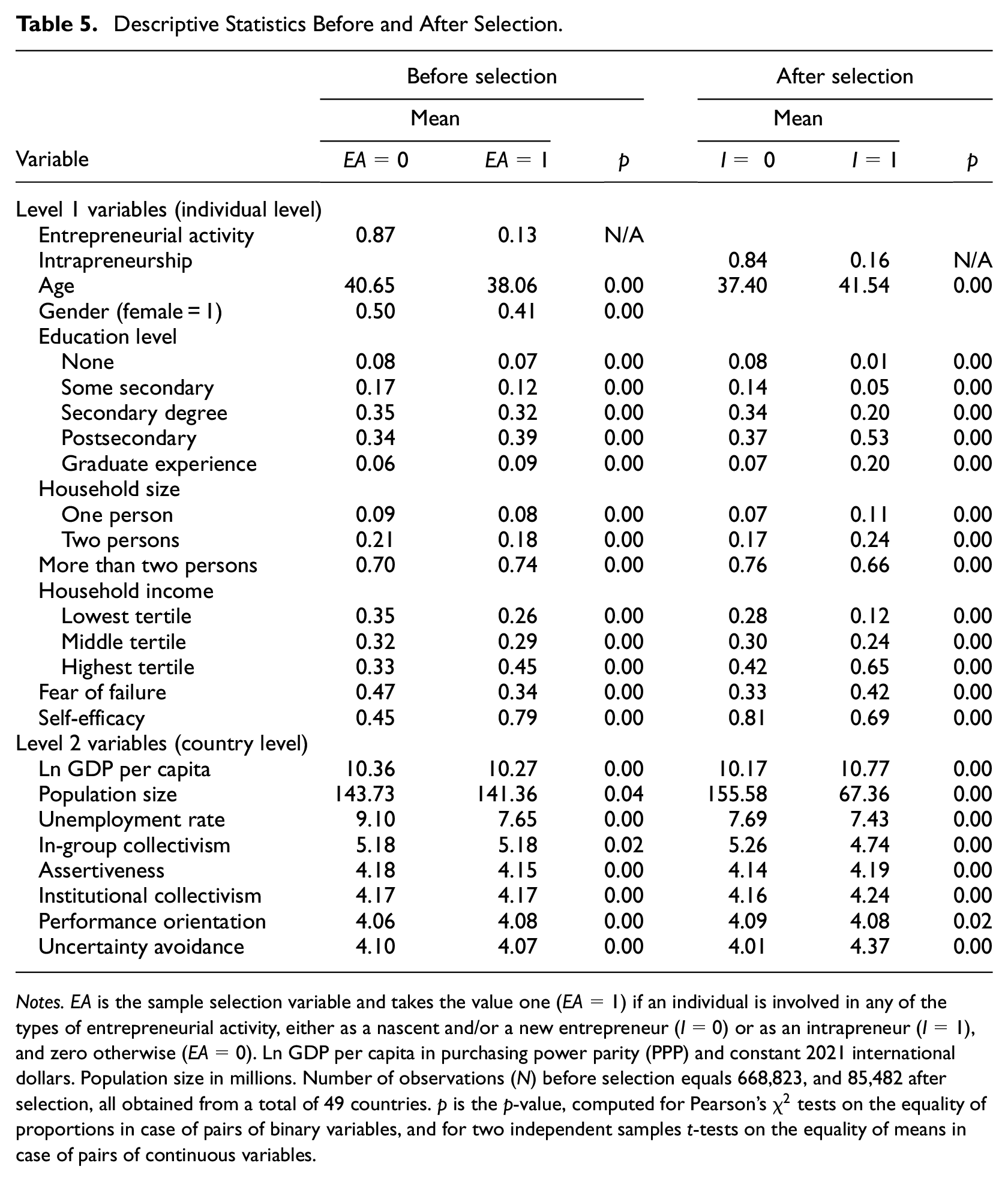
Notes.
The estimation results of our probit models with Heckman sample selection can be found in Tables 6 and 7. Here, we report the coefficients and robust standard errors for country-clustered data of all variables in the second and first stage of the models, respectively. Table 8 includes the AMEs corresponding to the explanatory variables in the second stage of the models. All five models have been estimated using the heckprobit command in Stata. They are based on our sample of 668,823 individuals from 49 countries. Sample selection reduces the number to 85,482 individuals involved in entrepreneurial activity in the second stage of the models. Wald tests of independent equations are highly significant for all models, once more demonstrating the presence of sample selectivity. The outcomes of likelihood ratio tests of model fit, but also the gradually smaller AICs of the models, confirm that our estimation strategy to include (sets of) variables in a stepwise manner makes sense; model fit improves significantly with every step.
Probit Models With Heckman Sample Selection (Second Stage Results—Outcome Equations; Dependent Variable:
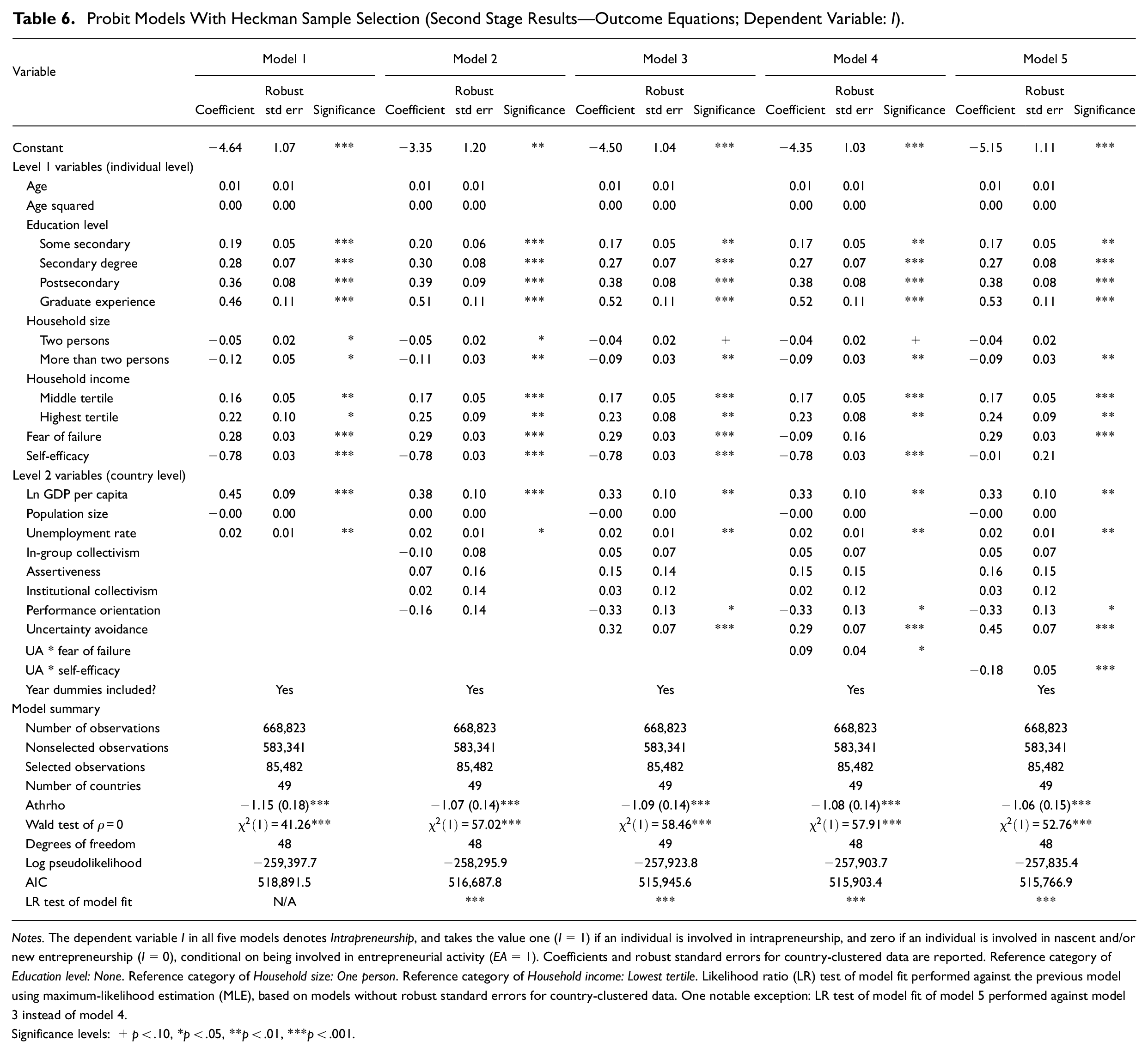
Notes. The dependent variable
Significance levels: +p < .10, *p < .05, **p < .01, ***p < .001.
Probit Models With Heckman Sample Selection (First Stage Results—Selection Equations; Dependent Variable:
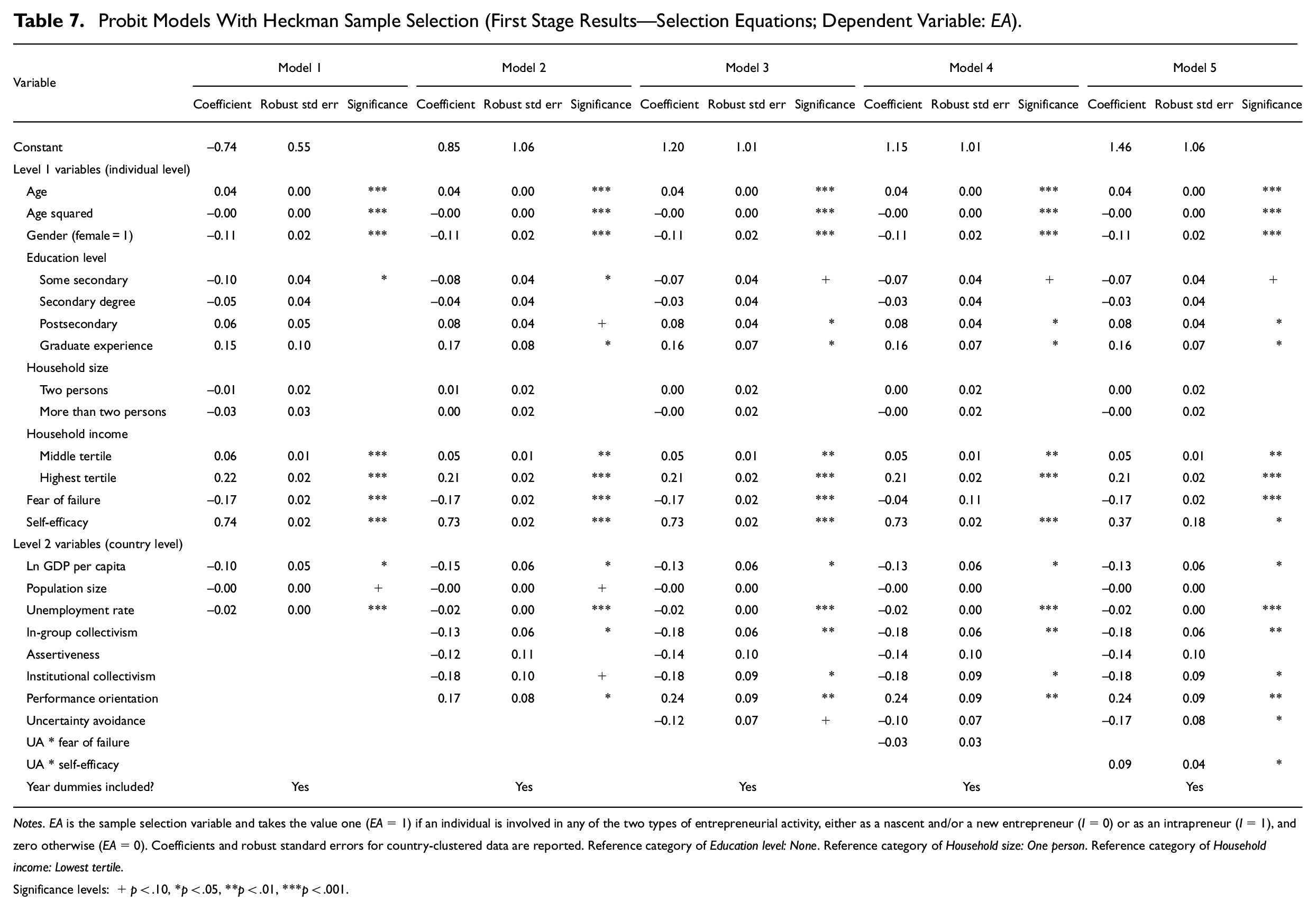
Notes.
Significance levels: +p < .10, *p < .05, **p < .01, ***p < .001.
Average Marginal Effects of the Probit Models With Heckman Sample Selection (Dependent Variable:
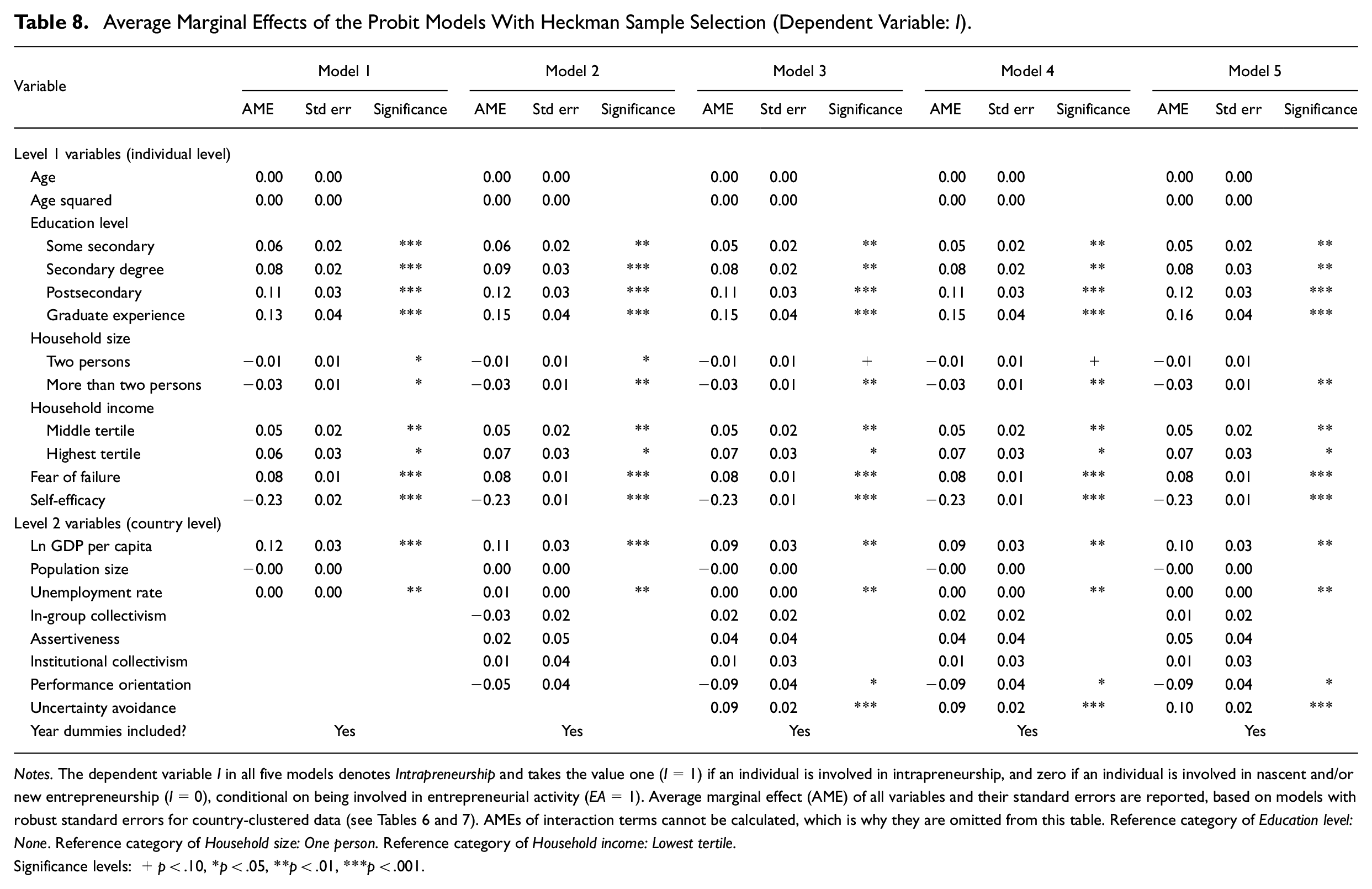
Notes. The dependent variable
Significance levels: +p < .10, *p < .05, **p < .01, ***p < .001.
The estimation results of Model 1 show the expected signs of fear of failure and self-efficacy in both the outcome and selection equation. That is, fear of failure negatively affects selection into entrepreneurial activity, but positively affects involvement in intrapreneurship in the second stage of the models (AME = .08). The effects of self-efficacy are exactly the opposite; it positively affects selection, but once involved in entrepreneurial activity, it negatively affects involvement in intrapreneurship (AME = −.23). While GDP per capita negatively affects selection into entrepreneurial activity, it does have a significantly positive effect on individuals’ involvement in intrapreneurship, conditional on being involved in entrepreneurial activity (AME = .12). The aforementioned findings remain highly stable in Models 2 and 3, that is, when adding cultural practices to the models (including UA).
Adding the country-level control variables reflecting various cultural dimensions (in Model 2) does not alter the estimation results substantially. The same applies to the effects of all individual-level factors and the three noncultural country-level controls when adding UA practices in Model 3. However, the negative effect of performance orientation becomes significant and somewhat larger in size as compared to Model 2 (AME = −.09). In line with our second hypothesis (H2), UA shows a positive and statistically significant association with intrapreneurship (AME = .09). At first sight, the AME seems relatively modest in size. However, low marginal effect sizes are rather common when estimating the impact of country-level cultural practices on individual-level entrepreneurial activity. Cross-level marginal effects should be interpreted with care. For example, a one-unit increase on the GLOBE scale of UA practices leads to an average increase in the probability of being an intrapreneur by 9 percentage points. This relatively modest increase in probability applies to every entrepreneurial individual within a country, which may channel a substantial share toward intrapreneurship, converting into a higher prevalence of intrapreneurship at the aggregate (country) level.
In Models 4 and 5 we include the interaction terms of UA practices with fear of failure and self-efficacy, respectively, to test our remaining two hypotheses (i.e., H3 and H4). The terms are included sequentially, in separate models, to avoid multicollinearity problems. The coefficient of the cross-level interaction between UA practices and fear of failure in Model 4 is positive and significant (at a 5% level), but the effect must be interpreted more carefully before drawing any firm conclusions. Figure 2 therefore visualizes the interaction effect by plotting the AMEs of fear of failure for various levels of UA practices, ranging from two standard deviations below its mean up to two standard deviations above its mean.
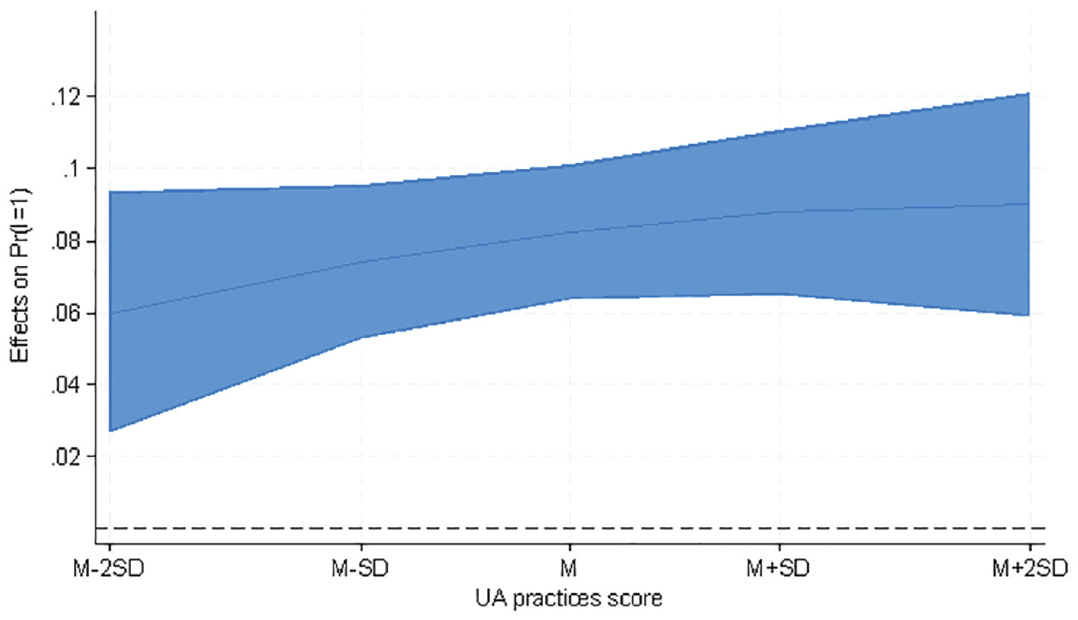
Interaction between uncertainty avoidance and fear of failure.
We observe that fearing failure as an entrepreneur makes someone more likely to exploit opportunities as an intrapreneur; AMEs are positive and significantly different from zero for any level of UA practices. Moreover, we find evidence for a small positive moderating effect of UA practices, affirming H3. Fear of failure leads to an increase of about 6 percentage points in the probability of being involved in intrapreneurship for low levels of UA practices, and this increases to about 9 percentage points for high levels of UA practices in our sample.
The coefficient of the interaction term between UA practices and self-efficacy in Model 5 is negative and significant (at a 0.1% level). For a more careful interpretation we again turn to a plot of the interaction effect. Figure 3 visualizes the cross-level moderation effect by plotting the AMEs of self-efficacy for the same range of UA practices scores as in Figure 2.
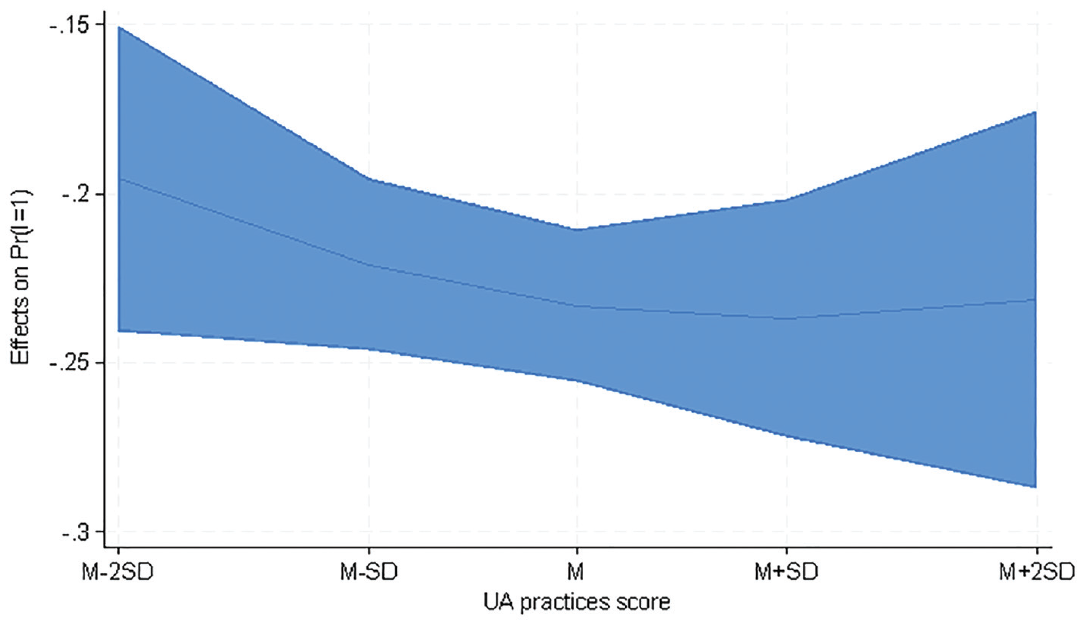
Interaction between uncertainty avoidance and self-efficacy.
We find that the likelihood of being involved in intrapreneurship is lower when possessing entrepreneurial self-efficacy; AMEs are negative and significantly different from zero, regardless of the level of UA practices in a country. However, that likelihood decreases by about 20 percentage points for low levels of UA practices, moving up to about 24 percentage points for UA practices scores one standard deviation above its mean, before moving down again to about 23 percentage points for high levels of UA practices. Therefore, even though the interaction effect is negative and statistically significant in Model 5, we must reject our fourth hypothesis (H4).
Robustness Check
Even though we prefer adopting cluster-robust standard errors in line with Semykina and Wooldridge (2018), we consider the nested structure of the data (individuals residing in countries) by estimating multilevel probit models with sample selection. Here, we adopt the same model specifications and estimation strategy as in Tables 6 and 7. We refer to Appendix E for a brief motivation and for the results that appear to be overwhelmingly consistent with those reported in Tables 6 and 7.
Conclusions and Discussion
This article investigated how and to what extent UA practices shape the prevalence and appearance of entrepreneurial activity across countries. We provide a novel approach by theorizing and empirically testing the effects of UA practices on the allocation of individuals across entrepreneurship and intrapreneurship. We find that (1) UA practices do not significantly affect the level of entrepreneurial activity in a country, (2) UA practices orient entrepreneurially inclined individuals toward intrapreneurship, and (3) UA practices moderate the effect of fear of entrepreneurial failure on intrapreneurship. These results have important implications for our understanding of the UA—entrepreneurial–activity relationship. We encourage entrepreneurship scholars to further explore how national cultures, including other cultural dimensions, affect individuals’ opportunity exploitation.
Theoretical Contributions
We posited that entrepreneurial individuals have a greater predisposition toward risk-taking than the general population but that the subjective expected value that they assign to different modes of opportunity exploitation is shaped and affected by societal UA practices. As a result, UA practices channel opportunity exploitation either via the entrepreneurial or intrapreneurial mode. Although this study is not the first to argue that national cultures affect the allocation of individuals across distinct types of entrepreneurial activity (see, e.g., Baumol, 1990; Elert & Stenkula, 2022), we are the first to theoretically derive hypotheses and to provide empirical support for this conceptual reasoning. Specifically, we find a marginally significant, small negative effect of UA practices on the level of entrepreneurial activity in a country (H1), but a strongly significant and larger effect of UA practices on the allocation across entrepreneurship and intrapreneurship, conditional on being involved in entrepreneurial activity (H2). In addition, we find support for a positive moderating effect of UA practices on the positive relationship between individuals’ fear of failure and opportunity exploitation via an intrapreneurial mode, conditional on selection into entrepreneurial activity (H3). The cross-level moderating effect of UA practices on the relationship between entrepreneurial self-efficacy and opportunity exploitation via an intrapreneurial mode (H4) is also significant but, for most countries in our sample, the effect is different from what we expected. Our expectation was that the negative association between an individual’s entrepreneurial self-efficacy and intrapreneurship would be weaker in countries with higher levels of UA practices. However, this only seems to hold in countries that score relatively high in terms of UA practices (from one standard deviation above its mean onwards). In countries with low-to-moderate levels of UA practices (up to one standard deviation above its mean), UA practices strengthen the negative association between entrepreneurial self-efficacy and intrapreneurship. A possible explanation for this finding is that when UA practices neither strongly enable nor restrain a specific mode of opportunity exploitation, individuals with entrepreneurial self-efficacy choose (a) the mode of opportunity exploitation that is most in line with their self-perceived skills, or (b) the mode of opportunity exploitation that yields the highest subjective expected value. For individuals with entrepreneurial self-efficacy, in both cases, this would imply entrepreneurship.
These findings are crucial for the further development of the individual–opportunity nexus paradigm (Shane, 2003; Shane & Vekataraman, 2000). Even though this paradigm has been frequently used, it has also been criticized for its inability to explain why opportunity exploitation varies across nations and the role of culture herein (see Baker et al., 2005). Our theoretical extension does acknowledge that culture affects opportunity recognition, but not in an isomorphic manner, like previous studies (e.g., Kreiser et al., 2010; Rigtering et al., 2017). Instead, we acknowledge, and empirically show, that cognitive differences between individuals exist, regardless of cultural influences (Baum, 2017; Fischer & Schwartz, 2011). Furthermore, each country hosts a substantial number of entrepreneurial individuals, even in those with the most uncertainty-avoidant cultures. Entrepreneurial individuals in these countries align their behavior with the anticipated consequences, resulting in “culturally supported” modes of opportunity exploitation. We further show that the impact of UA practices on the preferred mode of opportunity exploitation is multifaceted, as it strengthens the tendency of individuals who fear failure (when it comes to starting a business) to exploit opportunities via an intrapreneurial mode but has an asymmetrical effect on the relationship between entrepreneurial self-efficacy and the preferred mode of opportunity exploitation.
This study also provides a deeper understanding of how UA affects competitiveness at the country level. Countries scoring high on UA (e.g., Sweden) have traditionally reported relatively low entrepreneurship rates, while simultaneously scoring high on various indicators of innovation and economic growth. Such findings have been puzzling from an entrepreneurship point of view, given the alleged links between entrepreneurship, innovation, and economic growth (Wennekers & Thurik, 1999). Our findings show, in line with Baumol’s (1990) proposition, that entrepreneurially inclined individuals in uncertainty-avoidant countries will find “a way,” adopting different modes of opportunity exploitation, depending on the cultural setting. Since entrepreneurship and intrapreneurship have been described as alternative paths to new entry (Parker, 2011), which may equally contribute to innovation and economic growth (Elert & Stenkula, 2022), our results provide initial support for the notion that countries with very different cultures can be equally successful in achieving entrepreneurial activity. Such notions of equifinality—that is, that “a system can reach the same final state from different initial conditions” (Katz & Kahn, 1978, p. 30)—have typically been neglected in international comparative entrepreneurship research but help to explain how competitiveness at the country level is achieved through different forms of entrepreneurial activity. Schrijvers et al. (2024) reach a similar conclusion based on a configurations analysis of successful entrepreneurial ecosystems at the regional level, across European countries.
Finally, we contribute by providing a theoretical underpinning of how UA practices make some courses of action more likely than others amongst specific groups of individuals (in our case, entrepreneurial individuals). How macrolevel structures guide individual-level decision-making processes is still not well understood (Bjørnskov & Foss, 2016; Dheer et al., 2019; Hayton & Cacciotti, 2013). Adopting our framework allows future studies to more precisely theorize how culture affects behavior and decision-making, including its cross-level moderation effects on the cognitive properties of specific groups of individuals.
Practical Implications
Our findings show that a one-unit increase in a country’s UA practices score leads to an average increase in the probability of being involved in intrapreneurship by 9 percentage points, given selection into entrepreneurial activity. This effect is nontrivial, as relatively small differences in individual-level decision-making can have a sizable impact on the prevalence and appearance of different forms of entrepreneurial activity at the country level. Likewise, the cross-level interaction effect between UA and fear of failure has a nonnegligible effect on the number of entrepreneurs and intrapreneurs within countries. This leads to important policy implications.
Most notably, neither the number of intrapreneurs nor their contribution to countries’ economic performance should be underestimated, particularly in developed countries. Thus far, intrapreneurs have been largely ignored in policy debates; the emphasis usually lies on new business creation. Being aware of the prevailing UA practices and the corresponding entrepreneurship and intrapreneurship rates helps national governments design appropriate policies aimed at bringing about the most productive forms of entrepreneurial activity (Elert & Stenkula, 2022).
In addition, for governments that seek to improve the level of entrepreneurship, our findings highlight the importance of reducing fear of entrepreneurial failure amongst its population as it is negatively related to exploiting opportunities via an entrepreneurial mode, and even more so in countries with high levels of UA practices. Even though governments cannot directly influence an individual’s fear, they can stimulate an environment in which entrepreneurial failure becomes more socially acceptable via, for example, implementing investment protection policies (Kamal & Daoud, 2020) and stimulating educational approaches that create room for failure and grant adolescents more autonomy (Bartholomew et al., 2018).
Limitations and Future Research
Our study is not without limitations. First, even though our theorization suggests causal mechanisms, the investigated relationships are correlational. This is common for research focusing on the relationship between national culture and entrepreneurship, and we believe there are several reasons why this is not a major threat to the validity of our results. First, we use two separate data sources, eliminating the risk of a common method bias. Second, data on cultural practices that have been gathered in the mid-1990s are regressed on much more recent GEM data (2014–2021) on different types of entrepreneurial activity, preventing any problems associated with temporal ordering. The major time differences between the two data collections do introduce a potential problem in that we follow House et al. (2004) and Hofstede (1980, 2001) in assuming that national cultures remain (relatively) stable over time. Beugelsdijk et al. (2015) empirically tested this assumption. Their primary finding indicated that alterations in a country’s score on cultural dimensions, relative to the scores of other countries, are unlikely to undergo significant changes. We discuss this in more detail in Appendix A. Nevertheless, we invite future research to apply panel data analysis using data that spans a longer period to overcome this limitation. Third, in line with Autio et al. (2013), we include several individual-level, country-level, and cultural controls in our models to rule out alternative explanations for our findings. Again, we invite future research to test the robustness of our results.
The second limitation of our study is that we make use of secondary data sources, so we do not capture real decision dynamics that underlie the hypothesized relationships. The outcome variables in both stages of the sample selection models are static and represent the entrepreneurial status of individuals in the corresponding years. Future studies are encouraged to (also) make use of in-depth interviews with entrepreneurial individuals (or other methods) to evaluate their true considerations and the underlying cognitive processes of people when deciding on the mode of opportunity exploitation.
A third and final limitation relates to the generalizability of our results. Our study includes 49 countries from all major continents (Africa, Asia, Australia, Europe, North America, and South America). However, large and Western countries are overrepresented in our sample, while smaller and African countries are, due to the coverage in both GLOBE and GEM, underrepresented. We, therefore, caution to generalize our results to all countries.
Supplemental Material
sj-pdf-1-etp-10.1177_10422587241302703 – Supplemental material for Uncertainty Avoidance and the Allocation of Entrepreneurial Activity across Entrepreneurship and Intrapreneurship
Supplemental material, sj-pdf-1-etp-10.1177_10422587241302703 for Uncertainty Avoidance and the Allocation of Entrepreneurial Activity across Entrepreneurship and Intrapreneurship by W. J. (Werner) Liebregts, J. P. C. (Coen) Rigtering and N. S. (Niels) Bosma in Entrepreneurship Theory and Practice
Footnotes
Acknowledgements
We thank the editor, Tomasz Mickiewicz, and three anonymous reviewers for their excellent feedback and constructive guidance throughout the review process. We also thank Jeroen de Jong, Samuele Murtinu and Erik Stam for their invaluable comments and suggestions regarding earlier versions of this article.
Declaration of Conflicting Interests
The author(s) declared no potential conflicts of interest with respect to the research, authorship, and/or publication of this article.
Funding
The author(s) received no financial support for the research, authorship, and/or publication of this article.

Supplemental Material
Supplemental material for this article is available online.
Notes
Author Biographies
References
Supplementary Material
Please find the following supplemental material available below.
For Open Access articles published under a Creative Commons License, all supplemental material carries the same license as the article it is associated with.
For non-Open Access articles published, all supplemental material carries a non-exclusive license, and permission requests for re-use of supplemental material or any part of supplemental material shall be sent directly to the copyright owner as specified in the copyright notice associated with the article.
