



Abstract
Strategic human capital literature assumes founders mobilize human resources from the market. Social capital research shows that relying on nonmarket sources, such as ethnic communities, for resources results in distinct ways of organizing business activities in immigrant and nonimmigrant firms. Based on a field study, I found that the impact of sourcing human capital from the market versus the ethnic community on business model designs and evolution can be better understood by examining the nature of control firm owners exert over employees and the network segmentation dynamics of subgroups within a community. The study expands on strategic human and social capital research, identifying two boundary conditions for entrepreneurship literature.
Strategic human capital literature on the new venture creation process (SHNVC) examines how differences in founders’ goals, education, knowledge (Canavati et al., 2021; Unger et al., 2011), and prior work experiences (Hashai & Zahra, 2022; Shane, 2000) condition their perceptions and worldviews, impacting a new firm’s earliest strategic choices including human resource strategies (Campbell et al., 2012; Chadwick, 2017), and business model designs (McDonald & Eisenhardt, 2020; Zuzul & Tripsas, 2020). By business model, I refer to a firm-centric activity system encompassing critical resources and business partners to meet customer needs, aiming to create and capture value (Amit & Zott, 2015; Demil et al., 2015; Massa et al., 2017; Snihur & Zott, 2020).
A commonly held but questionable assumption in SHNVC is that entrepreneurs primarily hire human resources from the market (see Ndofor & Priem, 2011 for an exception) and are at a relative bargaining power disadvantage when acquiring talent due to the venture’s “liability of newness” (e.g., Leung et al., 2006; Moser et al., 2017), which affects nascent firms’ business model designs (Baron et al., 1999; Beckman & Burton, 2008; Delmar & Shane, 2004). Accordingly, this work has overlooked how founders can effectively leverage nonmarket resources, especially talents from their ethnic communities 1 in the home country (Drori et al., 2009; Portes et al., 2002; Saxenian, 2007), creating mutual dependence with co-ethnic employees to overcome career obstacles caused by their foreign qualifications and experience. It also remains unclear how the business models of such ventures, formed at the crossroads of entrepreneurial interaction with their ethnic communities, develop over time.
This omission is particularly striking considering the extensive social capital research on ethnic entrepreneurship (SCEE) indicating that group memberships (Ruef, 2010) often grant entrepreneurs access to community resources through shared geographic location and cultural solidarity, or cooperative arrangements based on shared history, identity, and destiny (Aldrich & Waldinger, 1990; Gedajlovic et al., 2013; Kalnins & Chung, 2006; Portes, 1998). Reliance on ethnic communities, rather than the market, to mobilize human resources creates a bargaining power advantage for firm owners over co-ethnic employees (Forde & MacKenzie, 2010; Hajro et al., 2023; Van den Broek et al., 2016) and manifests in distinct ways of organizing business activities in immigrant and nonimmigrant firms operating in the same market segment (Bailey & Waldinger, 1991; Dana & Light, 2011; Rangaswamy, 2007).
While useful, this work conflates social closure with ethnic group boundaries (Frederking, 2004; Wimmer, 2008). Consequently, it fails to specify how group boundaries can coalesce around nonethnic factors within a geographic community and be consequential for business model evolution during the later stages of the venture development process. Clarifying the dynamic linkages among community types, diverse pathways to entrepreneurial resource mobilization, and business model trajectories is critical for enhancing our theoretical understanding of business model evolution in different types of nascent ventures (Bacq et al., 2022; Clough et al., 2019; Davidsson & Gruenhagen, 2021; Welter et al., 2017; Wiklund et al., 2019). Empirically, such an inquiry can offer a richer multi-level understanding of contemporary ethnic entrepreneurship, a variant of North American entrepreneurship that increasingly plays a vital role in generating employment opportunities and revitalizing host countries’ economies worldwide (Fairlie & Miranda, 2017; Kulchina, 2016; Liu et al., 2014).
Hence, I investigate how variations in foreign-born ethnic (immigrant) entrepreneurs’ early strategic decisions regarding human resource sourcing can affect venture business model designs and evolution within a geographic community. Given limited prior theory and empirical research, I utilized grounded theory methods (Eisenhardt & Graebner, 2007; Yin, 2003). In particular, I used a founder-venture dyad as the unit of analysis that permitted iterative cross-case analysis of data from multiple sources over 3 years, 2008 to 2011, and archival records from 2001 to 2017. My research setting is eight Information Technology (IT) ventures launched by 11 foreign-born entrepreneurs in a US community. Although they originated from the same country, had similar career backgrounds, and migrated to the US in the 1990s or early 2000s for education and/or work, the immigrant founders had diverse ethnic backgrounds due to regional and linguistic differences. To better understand how diverse pathways to human resource sourcing affected ventures’ initial business models and subsequent evolution, I selected cases that shared the antecedents suggested by the existing literature (Hashai & Zahra, 2022; Unger et al., 2011). It helped me control for competing explanations and identify the underlying mechanisms at play.
My core contribution is a two-step framework that extends both SCEE and SHNVC. There are differences in the assumptions of both theories that have constituted the basis for elaboration. The former emphasizes ethnic-community-based resource mobilization and group social capital, while the latter focuses on market-based resource mobilization and founder human capital in explaining variations in new firms’ business models. I demonstrate that to understand better how entrepreneurial human resource sourcing from the market, as opposed to their ethnic communities, affects business models, it is important to consider the nature of control that business owners wield over co-ethnic employees and the network segmentation dynamics of subgroups in a geographic community, enabling entrepreneurs to adapt their business models. Based on these findings, I suggest incorporating boundary conditions into entrepreneurship literature on business model design and evolution. The study’s findings hold significant practical implications for policymakers, entrepreneurship educators, and immigrant-owned ventures seeking to emerge from the shadow of their ethnic communities.
Theoretical Background
Strategic Human Capital Literature on New Venture Creation (SHNVC)
Entrepreneurial founders shape human resource strategies and business models of new ventures through two mechanisms.
First, founders’ personal philosophies, goals, education, including exposure to professional values as well as peer influences, and prior knowledge, such as specific and task-related human capital associated with prior work experience, contribute to distinct ways of organizing business activities in nascent firms (Canavati et al., 2021; Shane, 2000; Unger et al., 2011). Specifically, they often carry the blueprints of established organizations and institute the routines for the structure and organization of work like those in the parent firm because their mental models preclude them from doing otherwise (Frese & Gielnik, 2023; Hashai & Zahra, 2022; Phillips, 2005). For instance, in a study of biotechnology firms based in the US, Ding (2011) reported that companies with a higher proportion of PhD holding entrepreneurs on their founding teams were more inclined to adopt open science, a strategy that enabled a firm’s research personnel to conduct basic science research and share the results through academic journals.
Second, founders actively select and incorporate environmentally available (Davidsson et al., 2020), as well as culturally appropriate, templates into the new organization to overcome the liability of newness (Baron et al., 1999; Beckman & Burton, 2008; Delmar & Shane, 2004; Snihur & Zott, 2020). It can influence the development of different business models with distinct human resource strategies in new ventures (Campbell et al., 2012; Chadwick, 2017; Chadwick & Dabu, 2009). In one, founders raise human capital’s value in use closer to its potential value by creating complementarities with various firm-specific resources such as intellectual properties and data infrastructure (value creation). Conversely, founders widen the gap between human capital value and acquisition or retention costs by improving operational efficiencies (value capture) or exploiting labor market frictions (value appropriation). Thus, founders’ strategic choices regarding talent acquisition and utilization influence a new firm’s business model.
Although insightful, a questionable assumption in SHNVC is that founders primarily obtain human resources from the market, which puts them at a disadvantage when acquiring talent due to the venture’s liability of newness (e.g., Leung et al., 2006; Moser et al., 2017). Consequently, this work has failed to consider how founders can effectively use nonmarket resources, especially human resources from their ethnic communities in the home country (Drori et al., 2009; Portes et al., 2002; Saxenian, 2007). Such an approach can enable founders to jointly create value with their co-ethnic employees, resulting in mutual benefits for all parties.
Social Capital Literature on Ethnic Entrepreneurship (SCEE)
A long-standing line of research in SCEE (see Aldrich & Waldinger, 1990; Gedajlovic et al., 2013; Sinkovics & Reuber, 2021; Zhou, 2004 for reviews) documents that host country contexts can invoke cultural “solidarity,” or cooperation for resource sharing and binding expectations, among immigrant minority groups, due to their foreign qualifications, low social status, and perceived cultural differences from the dominant majority group (Dhingra, 2012; Kalnins & Chung, 2006; Portes, 1998). Furthermore, absent legal safeguards and resources afforded by formal institutions, group members often depend upon the internal sanctioning capacity built into dense networks of the ethnic community that guarantees against wrongdoing and violation of commonly accepted norms (Portes & Sensenbrenner, 1993; Stam et al., 2014). These two processes reinforce each other, promoting entrepreneurship in ethnic communities and allowing advancement opportunities for firm owners and co-ethnic employees.
Recent scholarship questions the notion of co-ethnic solidarity against the backdrop of exponential growth in new migration intermediaries that have been instrumental in recruiting co-ethnics on an international scale to meet the growing demand for temporary skilled workers in professional services and health care (Forde & MacKenzie, 2010; Guevarra, 2010; Hajro et al., 2023; Van den Broek et al., 2016; Xiang, 2007). Mostly, these studies depict power asymmetries and the actions of immigrant founders toward compatriots as opportunistic, thereby shifting the risk of varying pay and insecure jobs to co-ethnic employees without much penalty. In general, however, scholars concur that reliance on ethnic communities instead of the market manifests in distinct business models in immigrant and non-immigrant firms occupying the same sector and market segment (Bailey & Waldinger, 1991; Dana & Light, 2011; Rangaswamy, 2007).
While informative, much of the SCEE literature is based on a questionable assumption that social closure occurs around ethnic group boundaries. Accordingly, this work has not fully examined how group boundaries can coalesce around nonethnic markers within an ethnic community (Frederking, 2004; Wimmer, 2008) and be consequential for entrepreneurial adaptation strategies and business models as the external environment changes. Hence, I inquire how differences in early strategic choices for human capital sourcing impact immigrant entrepreneurs’ business model designs and evolution within a geographic community.
Methods
My research question required finding a culturally diverse group of community participants and tracing their interaction dynamics in real time and longitudinally to understand the world from their perspectives (e.g., Gehman et al., 2018; Pratt et al., 2020). Using an inductive, multi-case founder-venture dyad design, I studied 11 founders and their 8 IT firms in a US community (Eisenhardt, 1989; Yin, 2003). I compiled data from interviews, observations, and company documents over the 2008 to 2011 period, supplemented by archival records from 2001 to 2017 (see Table 1).
Summary of Data Sources.
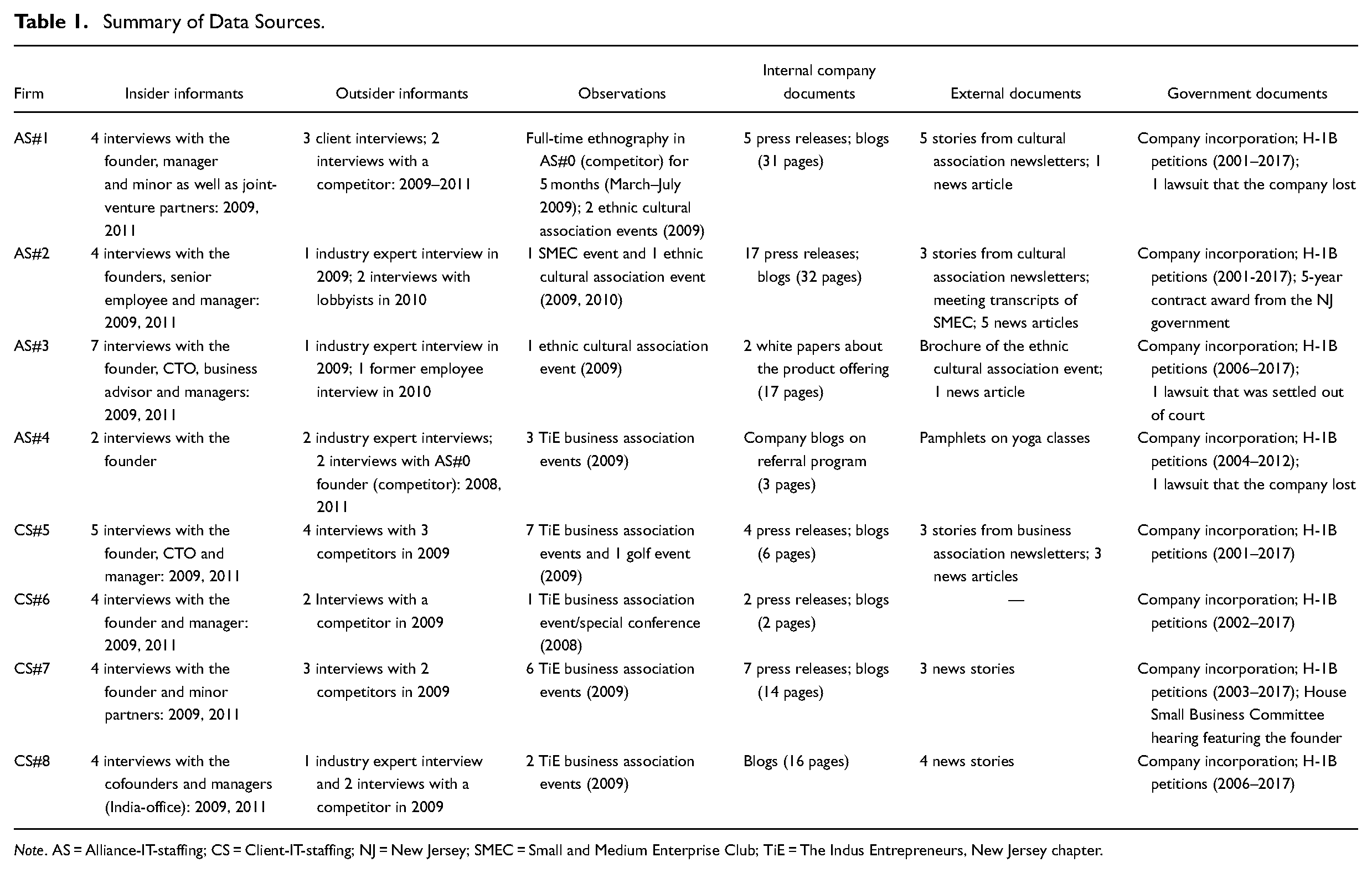
Note. AS = Alliance-IT-staffing; CS = Client-IT-staffing; NJ = New Jersey; SMEC = Small and Medium Enterprise Club; TiE = The Indus Entrepreneurs, New Jersey chapter.
Research Setting
I chose to study Indian-American IT entrepreneurs within the New Jersey (NJ) metro area for two reasons. The first reason is that it allowed me to select prototypical first-generation Indian-American entrepreneurs in a region with high IT service firm founding rates in the last two decades (Fairlie et al., 2016; Wadhwa et al., 2007). This flourishing can be understood as the unintended consequence of two factors: India’s deregulation initiatives in the 1980s to tap into the emerging global demand for IT services (Athreye, 2005; Booth, 2013) and the US government’s liberalization in the early 1990s of its H-1B visa regime for the temporary entry of skilled foreign workers (Hira, 2004; Kerr & Lincoln, 2010; Matloff, 2003).
The H-1B program, capped at 65,000 annually for new admissions and 20,000 foreign nationals holding US graduate degrees, 2 was originally designed to enable US firms to hire skilled foreign workers with a bachelor’s degree for “specialty occupations” (e.g., computer or health science) at the prevailing wage in the location of employment for a temporary period of 3 to 6 years. The program encouraged the sponsoring firm to apply for permanent residency on behalf of the worker to retain the best foreign specialty workers in the US (Teitelbaum, 2014). The move toward relaxing the H-1B visa regime coincided with the US industry’s drive to save costs by outsourcing noncore business functions such as IT and HR to a limited number of “preferred tier-I suppliers” or third-party vendors (e.g., temporary staffing agencies and IT outsourcing firms), resulting in the greater integration of large vendors and clients (Xiang, 2007).
These vendors faced two problems in meeting the growing demand for IT workers. First, they found it challenging to judge the quality of foreign IT professionals. Second, client firms required IT workers for short-term projects on an urgent basis and at competitive rates. However, the third-party vendors could not sponsor an IT worker from overseas on an H-1B visa until a job offer was finalized. Specifically, to hire temporary foreign skilled workers, the petitioning employer was required to submit a Labor Condition Application (LCA) to the Department of Labor (DOL) with the work location and prevailing wage in that location. Once approved, the employer would file a petition with the US Citizenship and Immigration Services (USCS). For foreign workers outside the US, the Department of State would ultimately issue the visa through foreign consular offices (US Government Accountability Office [GAO], 2011). Thus, the H-1B visa process took 6 months to a year to complete and complying with the attendant regulations was costly, while a typical IT project only lasted around 6 months. As a result, large staffing agencies and IT outsourcing firms increasingly relied on subcontractors to provide reliable, high-quality workers from overseas (Xiang, 2007).
A sizable portion of Indian IT professionals who came through the temporary H-1B work and student visa programs, recognizing the demand for IT services and professionals, launched their IT service firms to take advantage of these opportunities. Figure 1a illustrates the percentage of Indian petition holders in the H-1B visa pool from 2001 to 2017. Figure 1b shows the growth of Indian-American IT service companies in the New York-NJ-Delaware-Pennsylvania area from 1994 to 2008.
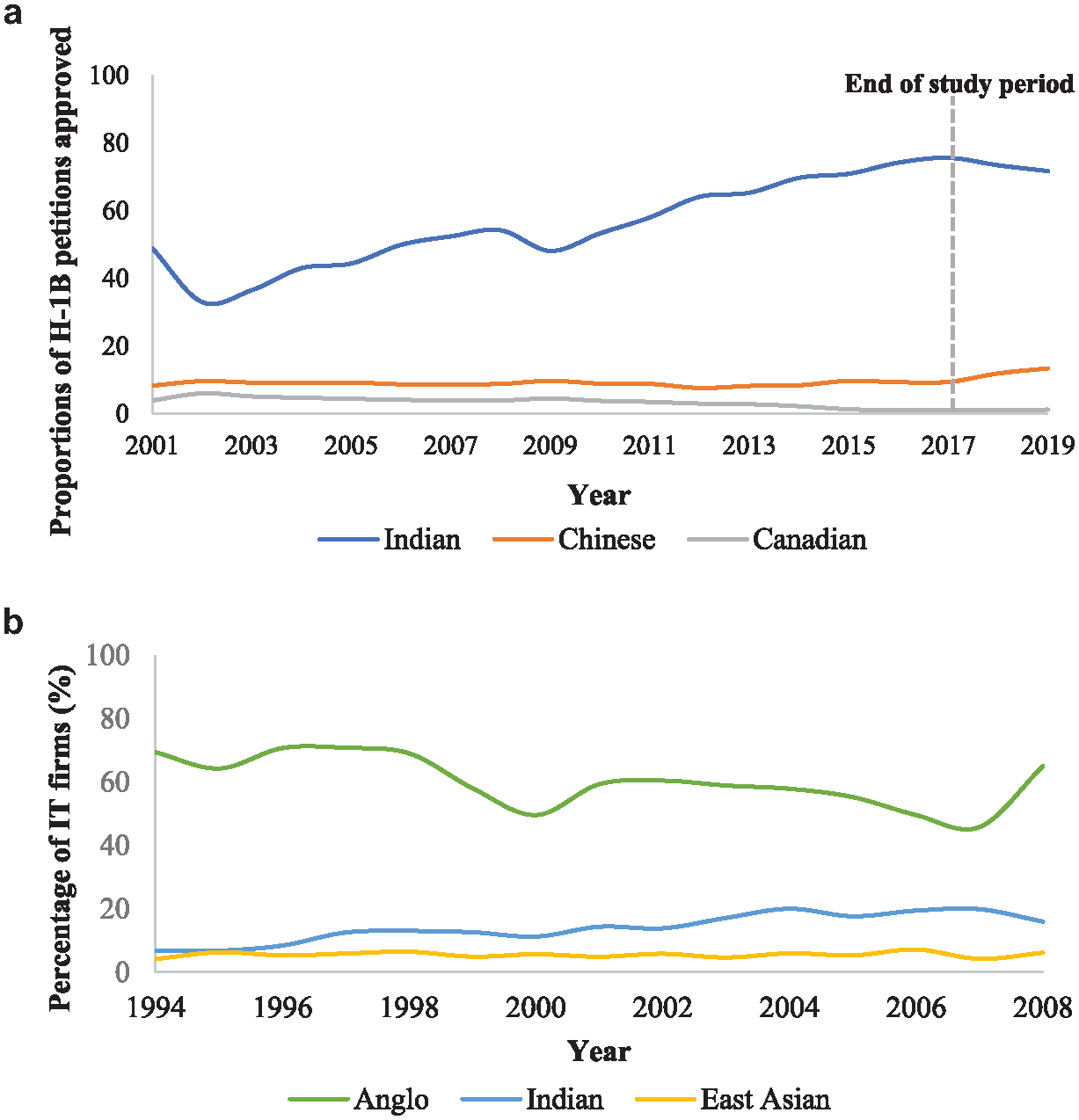
(a) Trends in the proportion of Indian, Chinese, and Canadian H-1B petition approvals, 2001 to 2017. (b) Trends in the founding of IT firms by Anglo-, Indian-, and East-Asian Americans, 1994 to 2008.
The second reason for conducting research in the NJ metro area is that focusing on a single immigrant community marked by high levels of ethnolinguistic diversity deliberately avoided the analytical pitfalls of much existing research, which takes for granted the formation of social boundaries along ethnic lines (Frederking, 2004; Wimmer, 2008). During my fieldwork in NJ, I discovered that businesses categorized under IT services offered diverse services, ranging from providing workers with the expertise necessary to staff a project to being responsible for delivering solutions. However, a significant minority of Indian-American IT entrepreneurs had initially operated as IT staffing agencies before repositioning themselves as IT solutions providers. Nonetheless, there was enormous heterogeneity in their business models and adaptation strategies within and across ethnic lines as the external environment changed. Understanding why the business model designs and their evolution differed so radically in a typical setting was the puzzle I tried to solve when I began this research.
Data Collection: Sample
I selected informants and their firms, or founder-venture pairs for the study, from individuals who had registered for business networking events organized by the Indus Entrepreneurs (TiE), New Jersey chapter, a prominent South Asian business association (Saxenian, 2007), between October 2008 and May 2009. I also employed snowball sampling to purposefully add new informants who, as the study progressed, could provide insightful and differentiated perspectives. In particular, having access to two insider informants with divergent perspectives on sourcing human resources from the market rather than the ethnic community consistently helped me challenge my underlying assumptions. Through conducting interviews with a diverse sample of 26 Indian IT firm owners who migrated to the US in the 1990s and early 2000s, I narrowed down a theoretical sample of 11 founders. These entrepreneurs owned eight IT staffing ventures that began operating between 2001 and 2005. I reached data saturation with eight firms and discovered that adding more firms did not uncover any additional important insights.
I selected these founder-venture dyads to balance the need to exploit differences in venture business models and founder regional background 3 and for similarity among founders in their human capital (e.g., education, prior work experiences), demographic characteristics, migration histories (e.g., year of arrival and type of visa held on arrival), and aspiration to build a thriving IT service firm. All founders opted to self-fund and reinvested profits to bootstrap their ventures. The focus on observationally similar founders in a geographic community allowed me to keep constant key environmental conditions and founders’ education, knowledge and prior work experiences (Beckman & Burton, 2008; Ding, 2011; Hashai & Zahra, 2022; Snihur & Zott, 2020; Unger et al., 2011) that are shown to shape initial organizational strategy and business model. Table 2 overviews the firms and their founders (ENT#1 to ENT#8b).
Description of Sample.
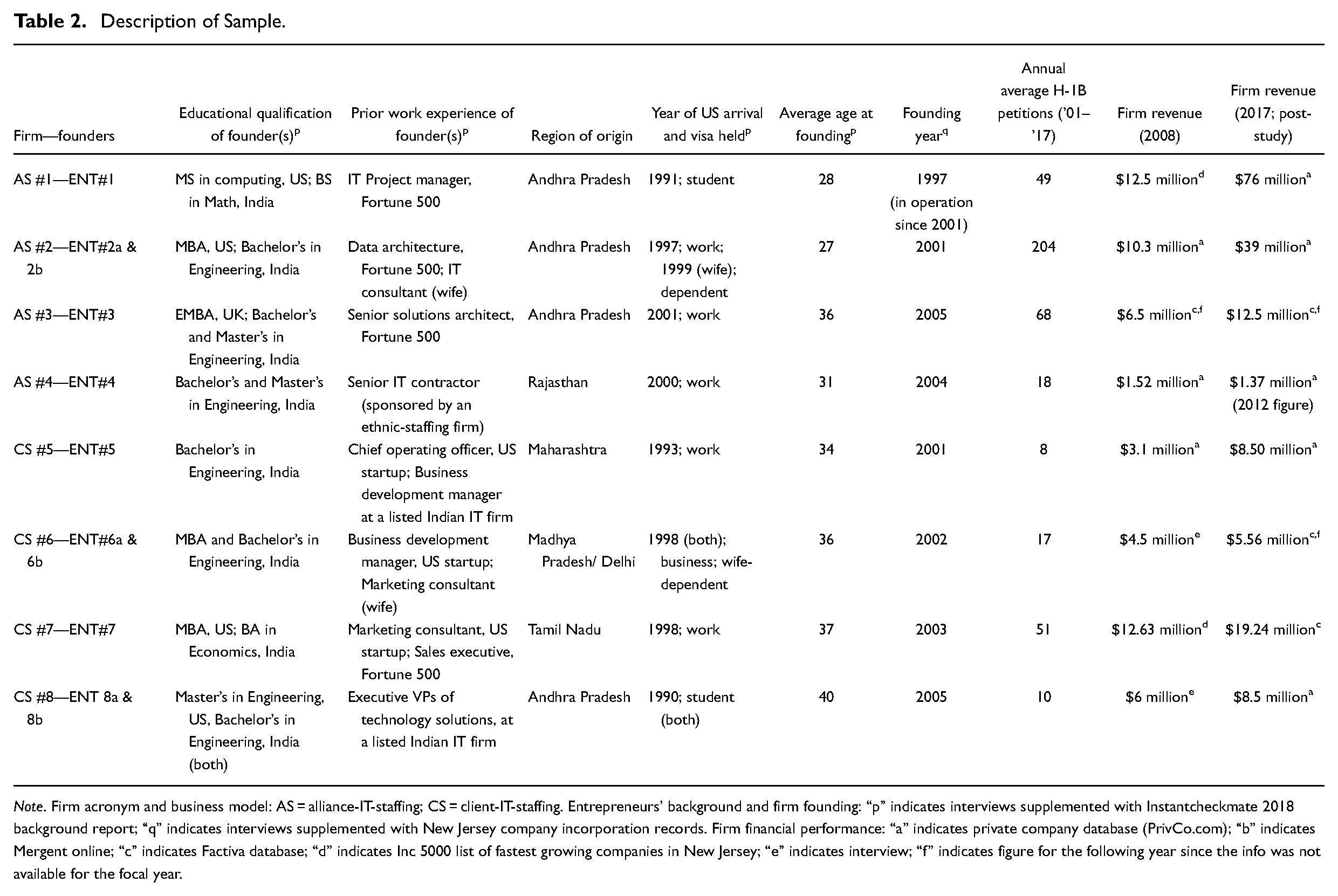
Note. Firm acronym and business model: AS = alliance-IT-staffing; CS = client-IT-staffing. Entrepreneurs’ background and firm founding: “p” indicates interviews supplemented with Instantcheckmate 2018 background report; “q” indicates interviews supplemented with New Jersey company incorporation records. Firm financial performance: “a” indicates private company database (PrivCo.com); “b” indicates Mergent online; “c” indicates Factiva database; “d” indicates Inc 5000 list of fastest growing companies in New Jersey; “e” indicates interview; “f” indicates figure for the following year since the info was not available for the focal year.
The entrepreneurs in my sample ranged from single owners to husband-wife teams to unrelated dyads from northern, western, and southern India. They arrived on student or work visas in the 1990s or early 2000s, although their spouses arrived on dependent visas. They were comparable in age (median age at founding 35 years, with a range from 27 to 40 years), prior industry experience (IT systems integrator or business developer), and education (graduate degrees in engineering, computing, or business). Their cofounder wives had postgraduate diplomas in computing or marketing. Demographically, my respondents were predominantly men in their mid-30s to mid-40s when I contacted them. At the start of my fieldwork in 2008, the median age of firms was 5.5 years, ranging from 3 to 7 years. I assigned labels for business models to group the ventures and used these throughout the study: Alliance-IT-staffing (AS#1–AS#4) and Client-IT-staffing (CS#5–CS #8). I explained these business models below. I followed these founder-venture dyads until 2018 using various real-time sources, government records and third-party materials (see below). The median firm revenues were $6.25 and $10.5 million in 2008 and 2017, respectively.
The immigrant entrepreneurs in my sample generally pursued one of two distinct pathways to launching and growing an IT staffing venture. In one, they attempted to secure job orders and clients—either end users or preferred vendors who would place IT workers with end users—using professional ties before hiring talent from the market. I refer to this type of business as a client-IT-staffing firm. On the other, the founders sponsored many foreign workers on work visas from their home country regions using ethnic ties without any job order from clients. They arranged accommodation for these workers in company guest houses, put them “on the bench”without pay, and relied heavily on immigrant workers and ethnic IT staffing firms to secure their placement. I refer to this type of business as an alliance-IT-staffing firm.
Data Sources
My research design, with the founder-venture pair as the unit of analysis, required multiple data sources, as depicted in Table 1. I conducted 60 semi-structured interviews in two rounds in 2008 to 2009 and 2010 to 2011, ranging from 1 to 3 hr(s) each, with founders, senior managers, prior employees, clients, industry experts, and lobbyists. The first round of semi-structured interviews focused on the respondents’ business goals and aspirations and strategic decisions regarding clientele served, recruitment, marketing, operating costs, revenue generation, and scaling up challenges. Information on founder demographic characteristics, migration and career histories, and participation in community associations was also collected during the interviews. Between 2010 and 2011, I refined the interview protocol to probe how founders diversified in response to regulatory and market conditions to adapt venture business models. In all cases, third-party archival materials (see below) were used extensively to prepare for the interviews and challenge interviewees’ memories. Most interviews took place at the respondents’ work sites, and all were transcribed verbatim (except in two cases where I took notes; refer to Appendix A).
I conducted nonparticipant observations at business networking meetings and cultural association events from August 2008 to July 2009, as well as one event in 2010, to understand the patterns of social connection and community involvement of Indian-American entrepreneurs. Furthermore, I conducted nonparticipant observations full-time in an alliance-IT-staffing firm (AS#0) for 5 months, from March to July 2009. I was at AS#0 during the work week and stayed some nights in the company guest house. The firm owner granted me full access to internal memos, H-1B filing records, payroll slips, and correspondence with the officials from the immigration services. Here, I had encounters and numerous informal conversations with some former and current employees, which helped me understand the day-to-day operations of this type of business, formulate tentative hypotheses, and later support or refute them in my study sample.
I supplemented the interview and observational data with company documents such as web pages, press releases, blogs, and white papers. I also compiled the newsletters, pamphlets, and meeting transcripts of three ethnic associations—two business and one cultural—whose events I attended during the fieldwork. I closely followed the events of these organizations until 2011 to better understand the boundary work tactics (Essers & Benschop, 2009; Gieryn, 1983; Lamont & Molnár, 2002; Langley et al., 2019) or individual and collective strategies utilized by founders to distinguish themselves from others. I ended primary data collection in 2011 and decided to track the ventures’ trajectories using archival data (see below).
I gathered various third-party archival materials using the Factiva database and ethnic news media. These materials included articles from local, regional, Indian, and trade journals and helped me gain valuable insights into various business models prevalent in the IT sector. In addition, I consulted background reports on entrepreneurs (instant checkmate) and tracked (financial) information on the sampled firms until 2018 using proprietary databases (Privco, Factiva, Mergent Online) and regional business magazines. Finally, I compiled NJ company incorporation records, lawsuits, and federal government records on H-1B petitions filed by the sampled firms. The variety of data sources allowed me to triangulate and accurately reconstruct the founders’ early and later-stage strategies against shifts in the environment.
Coding and Data Analysis
My data analysis combined principles of grounded theory (Miles & Huberman, 1994; Strauss & Corbin, 1990) and multi-case, longitudinal theory building (Eisenhardt, 1989; Gehman et al., 2018; Pratt et al., 2020; Yin, 2003). This approach allows grouping the materials by founder-venture pairs (cases) and tracing each founder’s strategic decisions alongside their venture trajectories to develop a theoretical framework. The data structure generated from the first four steps of the data analysis is shown in Figure 2 and described below.
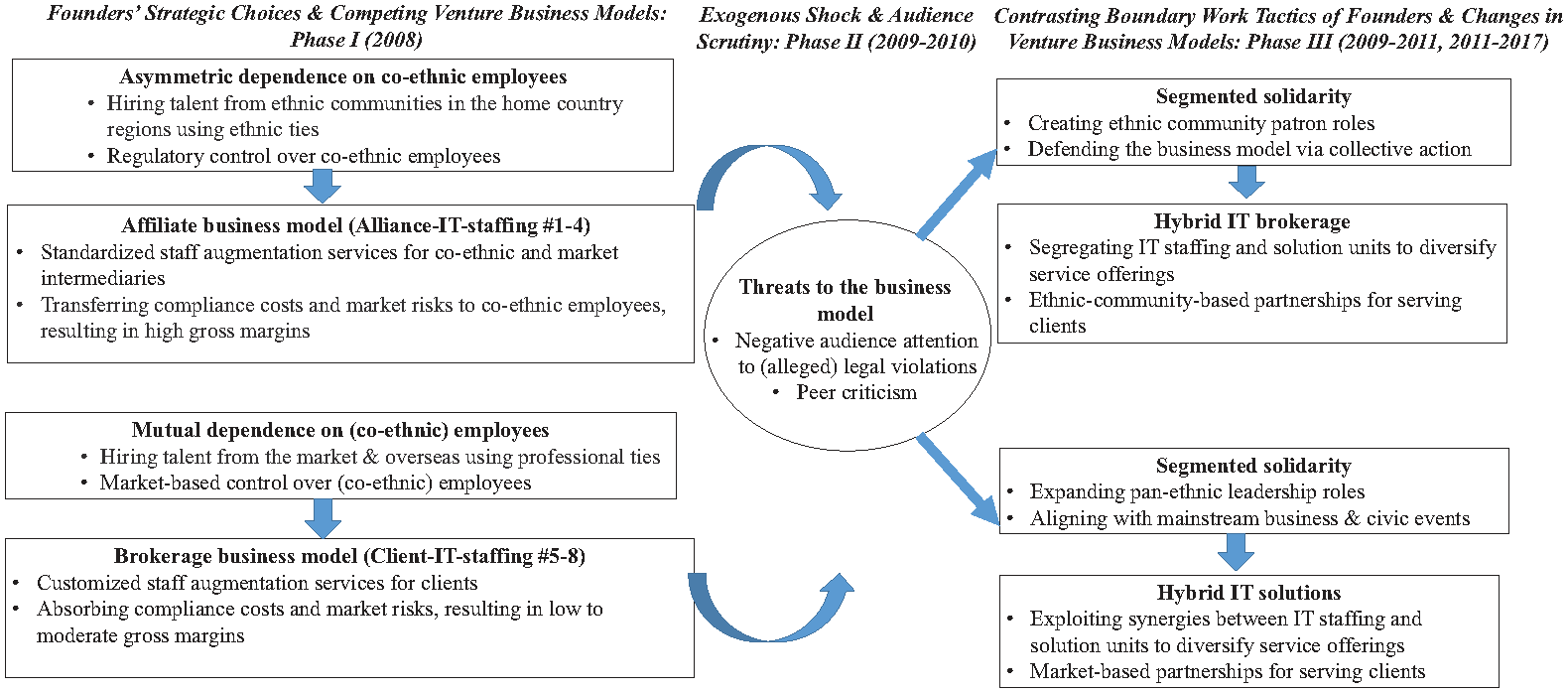
Data structure and cross-case differences.
To provide historical and organizational context for the study, I pieced together the migration and career histories of the founders using interviews as well as proprietary background reports (e.g., instantcheckmate) and venture chronology from various data sources. These included information on the venture’s founding and H-1B visa filing records (available from 2001 onwards) from state and federal government sources, the venture’s financial performance over time from proprietary databases, and the venture’s business models from interviews with the founders. Additionally, I analyzed the interview transcripts to capture participants’ endorsements or aversions to specific business models.
Next, I grouped the interview transcripts according to the informants’ rationales for starting a business. I conducted multiple rounds of open coding to uncover individuals’ venture launch goals and decisions concerning human resource mobilization strategies from the interview transcripts and my field notes. Numerous iterations of this process, combined with my field observations at AS#0 and internal and external archival records, eventually reduced the in-vivo codes to four first-order codes. Noting connections between the first-order codes and a venture’s H-1B filing records, I clustered the entrepreneurs into two subgroups based on their pattern of sourcing human resources from the market versus the ethnic community during and after the venture launch. Later cross-case comparisons across founder-venture pairs (cases) revealed connections between founders’ strategic choices and two distinct venture business models—Affiliate (alliance-IT-staffing) and Brokerage (client-IT-staffing).
Curious about how entrepreneurs sustained their business models facing audience scrutiny and peer criticism during the 2009 to 2010 Great Recession, I closely examined the similarities and differences among venture business models and the nature of entrepreneurial involvement, including roles undertaken, within local community associations. I analyzed the newsletters of the business and cultural associations that the founders were part of. Specifically, I looked at their mission, board membership, and meaningful community initiatives. I also considered interview excerpts, where study participants had referred to themselves as taking on the role, and observations from social events that revealed how the participants behaved. I then systematically charted the relationship among venture business models, founders’ boundary work, and changes in venture business models against shifts in the market and regulatory environment. After the primary data collection ended in 2011, I compiled real-time, government and archival records on the sampled firms for the next 7 years to support or refute my findings regarding the venture’s trajectory. The evidence broadly converged for each firm.
To avoid confirmatory biases, I then hired two independent coders unfamiliar with the original coding and purpose of the study to recode the interview transcripts and ethnic association newsletters. We compared construct assignments to refine our shared understanding of the narratives. Finally, I drew up process flowcharts to link second-order constructs and produce a theoretical framework.
Findings
An Overview of the Framework
Figure 3 illustrates the framework. The first two steps of the framework (Phase I) explain how differences in the founders’ goals for launching the venture and approaches to mobilizing human capital from the ethnic community rather than the market influenced the creation of two distinct venture business models—Affiliate (alliance-IT-staffing) and Brokerage (client-IT-staffing). In one, the founders adopted a strategy of sponsoring or hiring IT workers from their home country regions without client job orders. They took advantage of their regulatory control over co-ethnic employees to profit from the difference between the market value of their skills and the cost of acquiring and retaining that talent. It resulted in significantly higher profits than competitors but adversely affected co-ethic employees’ well-being and drew audience scrutiny in Phase II. Conversely, entrepreneurs aimed to secure clients, invested in developing firm-level processes and built credentials to attract high-quality resources from the local market and overseas. It enabled them to increase the market value of their employees and capture some of that value without compromising the law and (co-ethnic) employee welfare.
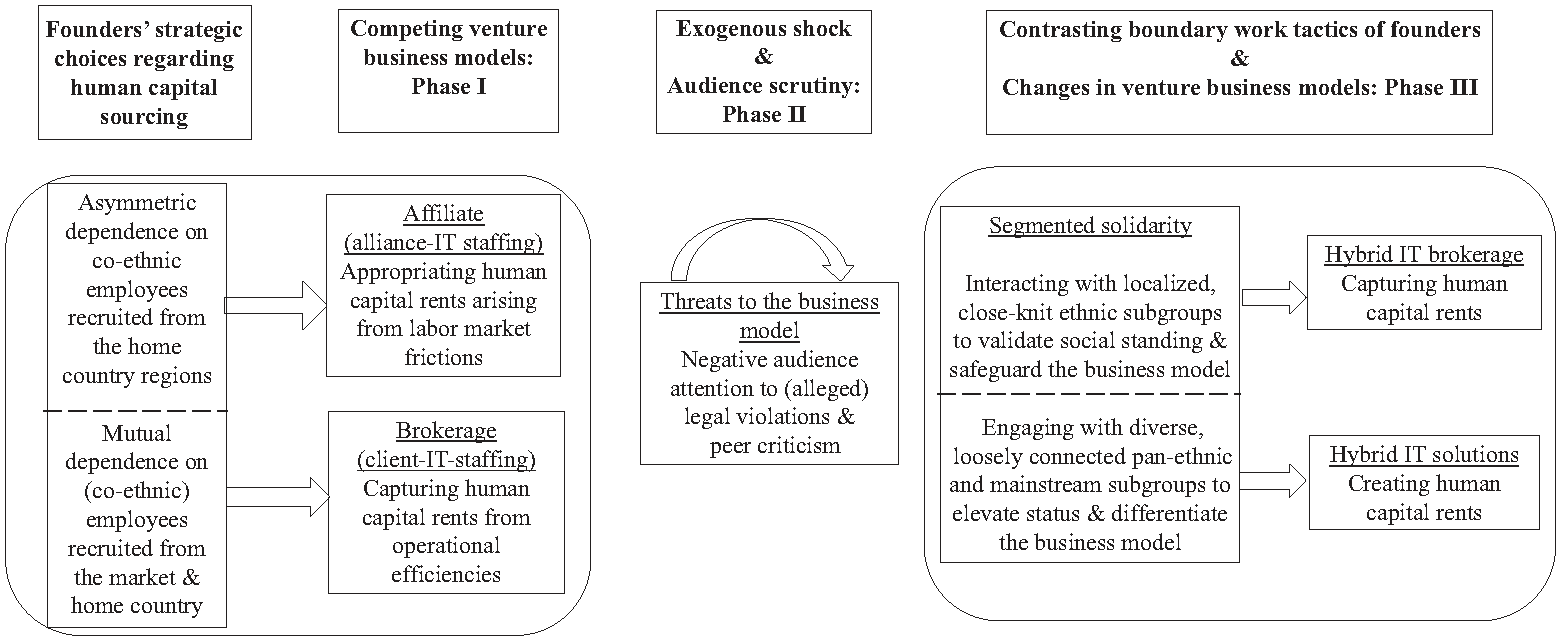
Differences in immigrant founders’ strategic choices, initial business models and subsequent evolution.
The affiliate business model faced audience scrutiny for breaching laws and market norms during the 2009 to 2010 financial crisis, including the nonpayment of wages and unlawful restrictions on employee mobility. Nonetheless, it was often challenging for outsiders to distinguish between the affiliate and brokerage business models. The porous boundary between the two influenced opposing patterns of boundary work among founders through separate cultural and business associations to demarcate their social domains and safeguard or differentiate their business models (segmented solidarity), resulting in the evolution of two business models—Hybrid IT brokerage and Hybrid IT solutions during Phase III.
Founders’ Strategic Choices & Competing Venture Business Models: Phase I
Founders' Strategic Choices: Asymmetric Versus Mutual Dependence on Co-ethnic Employees
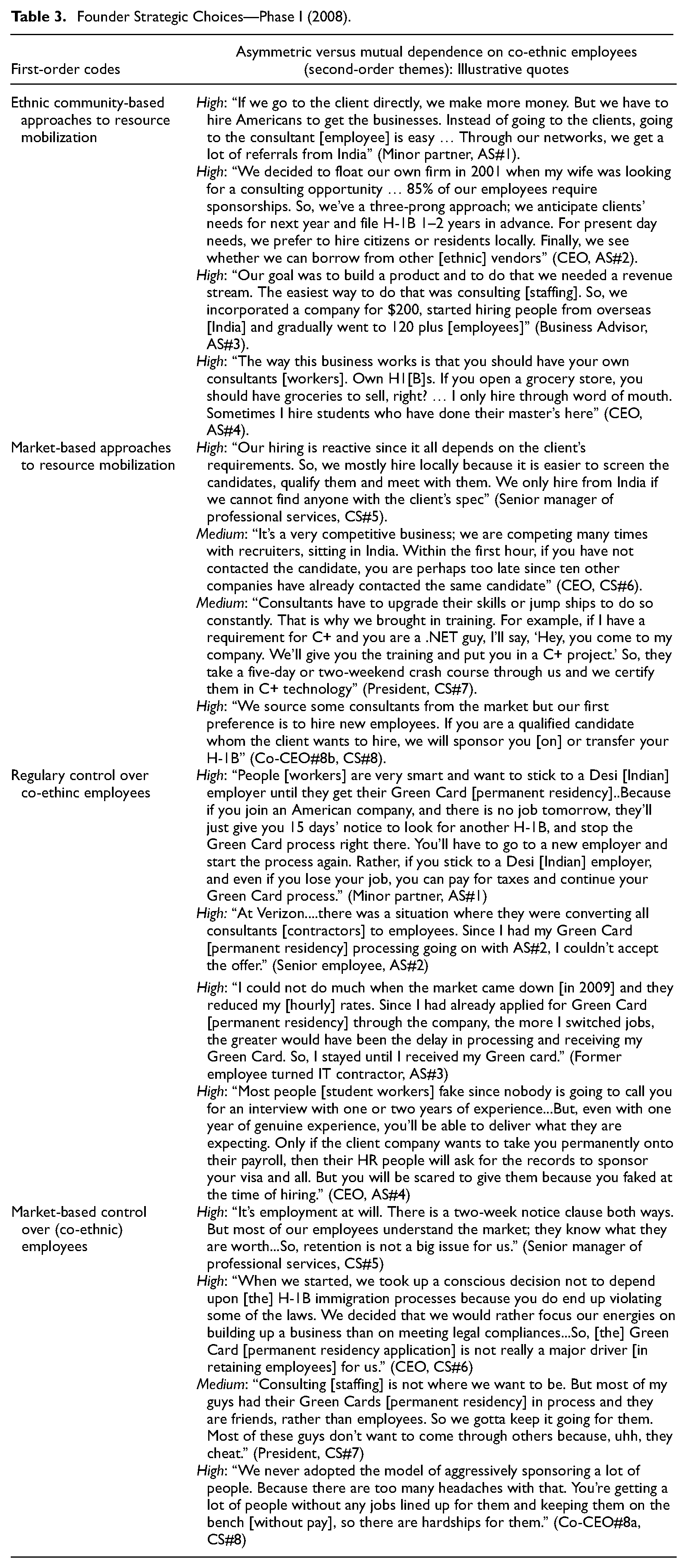
To distinguish between the founders’ initial strategic decisions, I use the term “mutual versus asymmetric dependence on co-ethnic employees.” The first decision reflected a higher reliance on clients and mutual dependence between firm owners and employees. In contrast, the second decision involved a greater dependence on co-ethnic employees, necessitating the founders exerting high control over these workers. Table 3 sets out representative quotations for each dimension of a founder’s strategic decisions in Phase I (2008), which I discuss in detail below.
Founder Strategic Choices—Phase I (2008).
Ethnic-Community-Centered Versus Market-Based Approaches to Resource Mobilization
All four founder-CEOs operating ventures AS#1 to AS#4 were highly ambitious. They advocated exploiting a window of opportunity by sponsoring large numbers of co-ethnics to meet the market demand for temporary skilled workers to quickly accumulate capital and fund higher value-added activities. Some delegated the responsibility of running the IT staffing business to their wives or extended family members, while they worked full-time for large multinationals, only taking the reins when the company amassed sufficient capital. AS#1’s founder noted:
My friend registered this company, but it was not doing much until I hired Ajay in 2001 … We are looking to acquire companies right now to add more capabilities to our company. We want to grow in the next two-three years. And if we grow, my dream is to be an IPO or get acquired!
Consequently, alliance-IT-staffing founders strategically engaged with ethnic communities in their home country regions and sponsored experienced IT professionals from corresponding ethnolinguistic groups without client job orders. They would put these employees “on the bench” without pay until a suitable job became available. Others supplemented their experienced resources by hiring and training inexperienced foreign graduate students on trainee visas. They only filed H-1Bs of this group if they managed to get placement at client sites (see Table 3).
In contrast, the founders of ventures CS#5 to CS#8 had more modest ambitions. They viewed business ownership as a career option to leverage an opportunity aligned with their character, passion, and skills to attain autonomy. CS#5’s CEO noted:
When you put on an entrepreneurial hat, you are the last and the lowest-paid person in the company, especially when things are going bad. So, … if money is the only objective, you better think twice, all right?
Client-IT-staffing founders utilized their professional connections to develop client relationships. They primarily hired high-quality resources locally to fulfill corresponding client job orders and only sponsored experienced immigrant workers with specific skill sets from overseas when IT professionals were unavailable locally (see Table 3). Some founders also strategically sponsored experienced IT professionals from their ethnic communities overseas without corresponding job orders but attempted to comply with immigration and employment laws. The president of CS#7 clarified:
Last six, seven months, we are down around 20–30%. Normally, you will shed 20–30% of your expenses. As of today, not even one dollar pay reduction for anybody. Nor have we taken anybody out. Some guys would laugh at me. But let them laugh because my business is different. For me, money is not everything. Money we can earn if we have credibility and a good team.
Table 2 displays the average yearly rate of H-1B petitions filed by the sampled firms with the US Department of Labor during 2001-2017. It confirms that alliance-IT-staffing founders filed significantly more H-1B visas than the client-staffing firm owners. 4
Regulatory Versus Market-Based Control Over (Co-ethnic) Employees
Being the employer of record for immigrant employees enabled alliance-IT-staffing founders to exercise regulatory control, which includes sponsoring visas, conducting screening, hiring, firing, setting wages, and remitting taxes to the government. In their quest to make sourcing human resources from the home country’s ethnic community economically viable, they conveniently eschewed the issue of upholding laws and employer obligations, including “bench” payment, timely payment of wages and employee rights to switch employers.
5
When probed, some argued they could not compete with larger companies to hire local talent because they were unable to match the salaries of their competitors, while others explicitly downplayed the consequences of noncompliance with the regulations for co-ethnic employee welfare. The AS#2’s president aptly represented this group’s attitude:
This is a business where you don’t need much investment and can make good money. But now the government is dealing with this business. Any business that requires a lot of compliance is tough. You are getting a specialty worker on H-1[B], telling the government you will provide him [sic] with everything you promised. Kind of their expectations, you know, it’s hard. If you fulfill them, you cannot make money. If you don’t make money, you have to close your shop.
In short, from the perspective of alliance-IT-staffing founders, making profits through sponsoring co-ethnics from their home country regions was a standard means of achieving career advancement for both parties, offering co-ethnic employees with foreign qualifications and experience a path to a career in the US.
To retain talent, alliance-IT-staffing founders filed for permanent residency or Green Cards for the experienced workers they hired from overseas. Because the application was not transferable to another employer, once filed, it effectively locked the worker to the firm for an average of 3 to 6 years. They utilized their role as the employer of record somewhat differently to control the student workers. They tended to overstate the experience of student workers in their resumes to place them in jobs. While this strategy helped student workers secure temporary placements, they failed to transition to permanent positions when offered by their employers because they had falsified their resumes at the time of hiring (refer to Table 3).
In contrast, client-IT-staffing founders expressed aversion to sponsoring co-ethnics without any related job orders, which, in their view, compromised honesty and integrity (see Table 3). Consequently, they spent considerable time understanding the business needs of potential clients and strategizing for new customer acquisition. The CEO of CS#5 remarked:
If you see our list of customers, they are all direct customers. That is one of the reasons why our growth in terms of headcount is not that high. Because we are not in the model where we are going and hiring 100 people from overseas and bringing them in and then trying to push them out. It [H-1B] is not a lower cost of labor for us.
Access to clients allowed this group of entrepreneurs to place their workers on medium- to long-term projects at client sites and secure their next placement before the current project ended. CS#6’s senior professional services manager explained:
The advantage [of having clients] is the duration [of projects], ranging from 18 months to 3 years. So, you get the stability, especially for those with families and H-1B candidates. It is also easier for us to get their H-1Bs renewed for a longer period because we can show that this is not just a six-month project for which we need them.
Client-IT-staffing firm owners encouraged employees to apply for permanent residency while also offering career advancement opportunities to retain workers, exerting market-based control over them (see Table 3).
In the following section, I discuss how founders’ divergent strategic choices influenced the constitutive elements of the two opposing business models for generating and extracting human capital rents (Chadwick, 2017; Coff, 2010): affiliate (alliance-IT-staffing) and brokerage (client-IT-staffing), with consequences for employee earnings and welfare. In the affiliate business model, immigrant founders took advantage of the mobility constraints of co-ethnic IT workers to increase the difference between the market value of their skills and the cost of acquiring and retaining that human capital, thus appropriating human capital rents. On the other hand, in the brokerage business model, entrepreneurs enhanced the market value of immigrant workers’ skills by integrating them into firm-level processes such as training programs and customer-specific knowledge, enabling them to capture human capital rents.
Competing Venture Business Models: Affiliate Versus Brokerage
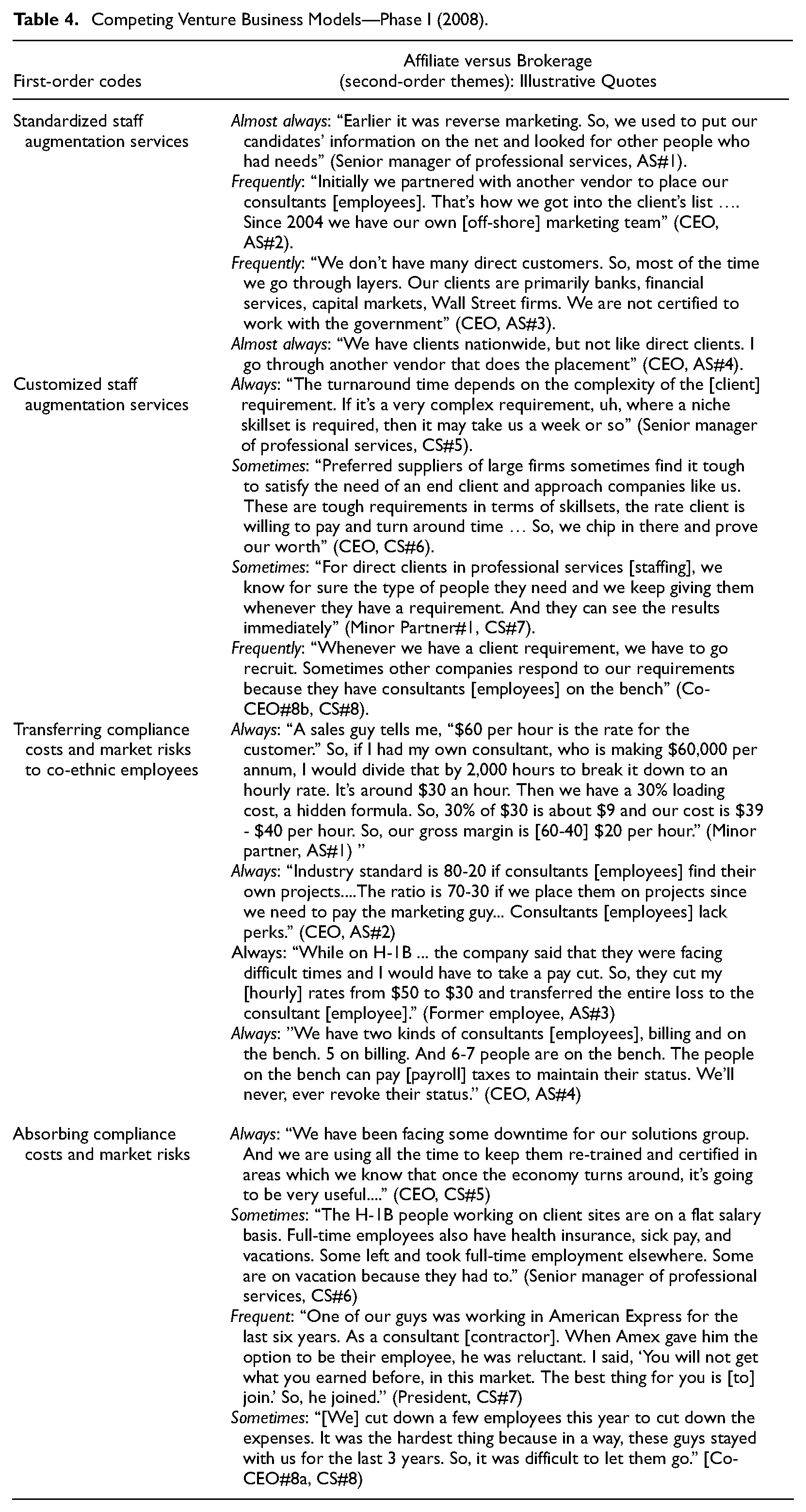
Table 4 compares the constitutive elements of affiliate (alliance-IT-staffing) and brokerage (client-IT-staffing) business models in Phase I (2008) along two dimensions. I discuss them in detail below.
Competing Venture Business Models—Phase I (2008).
Standardized Versus Customized Staff Augmentation Services
Differences in sourcing human resources from the ethnic communities vis-à-vis the market were reflected in the market segments served by each type of firm and the specific clientele needs addressed. Alliance-IT-staffing firms did not have many direct connections with end clients. They mainly acted as subcontractors for co-ethnic and preferred IT (staffing) vendors of Fortune 1000 companies with those direct client relationships. Furthermore, they primarily supplied employees for short-term, on-site client projects that typically lasted 6 months and were geographically spread throughout the US. Under these business-to-business employee-leasing arrangements, accountability for compliance with the H-1B program resided with the alliance-IT-staffing firm, enabling client firms to obtain quality resources quickly and cheaply on demand while relieving them of any legal responsibility for immigrant workers (refer to Table 4). The manager of a primary IT staffing vendor clarified the value proposition succinctly: Our chief concern is to get the right resources from a skillset perspective to our clients. We tell our sub-vendors [alliance-IT-staffing-firms] upfront what’s the best rate we can do given the rate set by the client. So, things that you are mentioning, like visa status or work permit of candidates, are not an element of our qualification process.
In contrast, client-IT-staffing firms served medium- to long-term staff augmentation needs of end users, typically government and nonprofit customers and preferred IT vendors to Fortune 1000 firms. They built operational capabilities to source high-quality resources quickly and more effectively from the local market than their competitors. The CEO of CS#5 clarified: The customers, when they are dealing with us, they are using us as the only vendor to provide them with experienced resources that are more than 80% screened by us in terms of abilities, reliabilities and cultural fit. So, our volume is low, but our profitability is very good.
Most also certified themselves as woman- and/or minority-owned businesses to develop direct relationships with governments. CS#6’s CEO noted: If you use a certification of minority-owned or woman-owned, that can become a door opener. [A] lot of companies have an internal policy to give a percentage of the business directly or indirectly to this type of business. So, if you go to them, they might say, “OK, I’m willing to look at you because you are certified.” Alternatively, they might tell you to go to one of their suppliers, who is mandated to give, let’s say 10% of the business to a woman or minority-owned business.
Transferring Versus Absorbing Compliance Costs and Market Risks to Co-Ethnic Employees
Alliance- and client-IT-staffing founders differed markedly in their approaches to maximizing human capital rents, significantly affecting the earnings and well-being of co-ethnic employees. For instance, lacking ties to customers, alliance-IT-staffing firms heavily relied on immigrant employees to establish client connections, encouraging employees to locate assignments online, apply for them, and secure placements. The firms handled the necessary paperwork once workers were selected for these jobs. The minor partner of AS#1 offered an overview of the process:
Initially, it was very tough to develop vendor relationships. But when we had our own employees, it became easy. They’ll be looking at the job sites and applying for jobs, but at one point, that customer has to talk to the employer to send the paperwork. So, they will contact me. And once we have this master’s service agreement in place, we are authorized to work with them. So, the company will add my email address to their distribution list and send the new requirements.
Alliance-IT-staffing firms rewarded employees a percentage of their billing depending on the individual’s role in the placement process. Employees typically took home a higher percentage of their earnings if they identified their projects. AS#1’s senior manager of professional services noted: Markup is very clear. We have a percentage. We do a 70-30. 70% is theirs, 30% is the company’s. If they are over a year, they do 75-25, and if their rates go up over 80 dollars, then they take 80%.
However, because most alliance-IT-staffing firms served as subcontractors for other vendors, employees bore the intermediary’s commission at least twice and took home a much lower percentage of their earnings. If unemployed, immigrant employees also bore all the costs associated with “bench time” and incurred compliance costs (e.g., remitting payroll taxes through alliance-IT-staffing firms) to maintain their ostensibly legal immigration standing.
In contrast, relationships with end users enabled client-IT-staffing firm owners to anticipate client needs and secure the employee’s subsequent placement before their current assignments ended (see Table 4). The senior manager of professional services at CS#5 explained the process: We typically know a couple of months before the project is over. So, I start checking with other clients to see if they may have an opening. By the time the consultant [employee] finishes the current project, he [sic] is already interviewed for a new position, so there’s a seamless transition to a new project.
Client-IT-staffing firms provided salaries and benefits to their employees, significantly affecting the venture’s cost structure, cash flow, and profitability. CS#5’s CEO stressed: No! No! Our employees are all salaried. We don’t believe in billing percentages. We don’t believe in that, and we don’t want to entertain that. ’Cause as far as everybody is concerned, they are our employees. … Most of the percentage deal companies try to woo them with billing rates, but honestly speaking, our salaries are still a lot more competitive than them, plus it’s salaried, so there’s a lot more security.
Taken together, differences in the founder’s strategic decisions regarding approaches to resource mobilization influenced the development of contrasting business models in immigrant firms with higher revenues for alliance-IT-staffing firms compared to their competitors (refer to Table 1), but lower earnings and well-being for their co-ethnic employees (GAO, 2011).
Exogenous Shock and Audience Scrutiny: Phase II
Threats to the Business Model
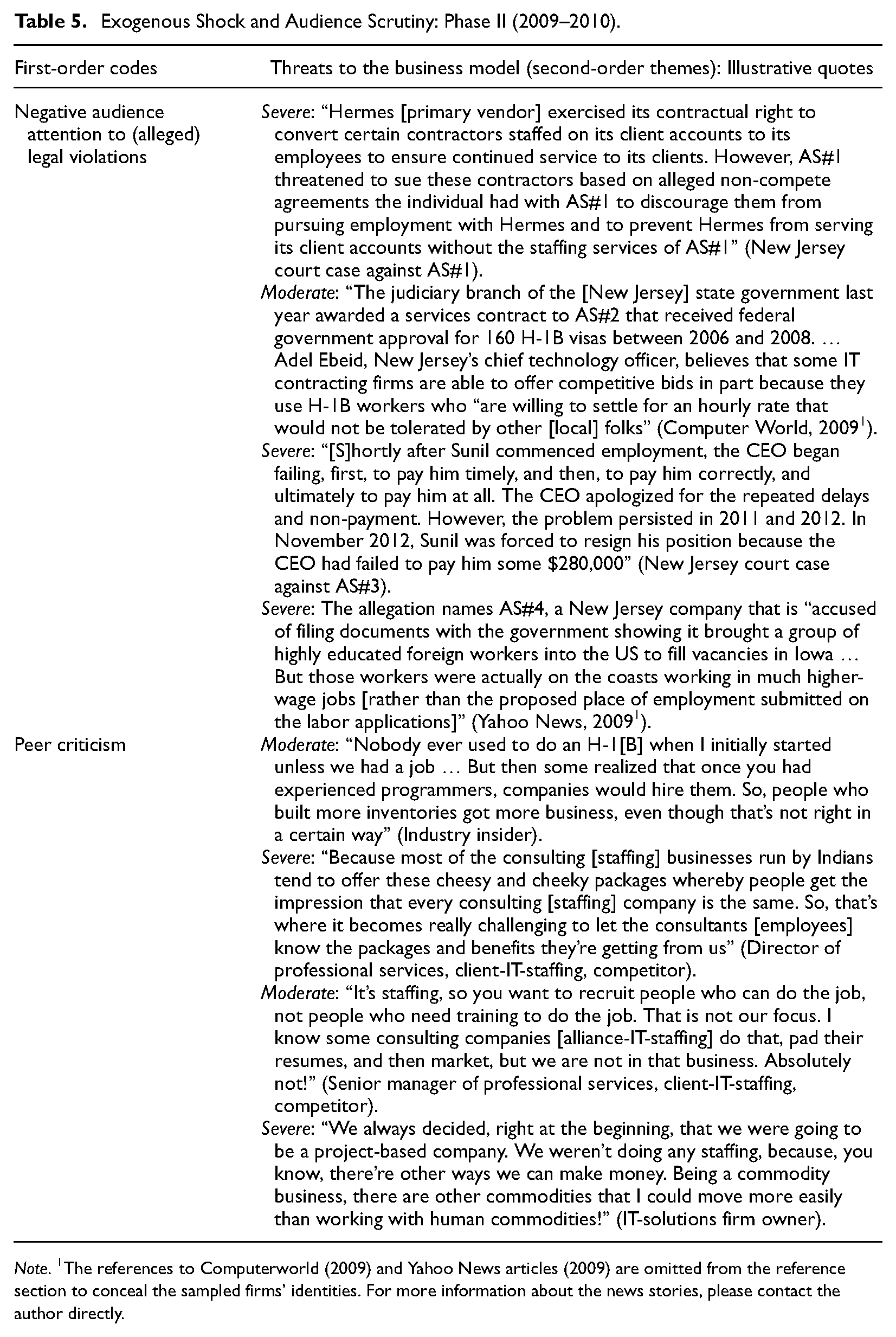
The manipulation of the H-1B program drew scrutiny in trade journals, policy circles, and regulatory agencies and criticism from industry peers, with the onset of the most severe financial crisis in 2009 to 2010 (Phase II). Since alliance- and client-IT-staffing firms both focused on staff augmentation, outsiders often struggled to distinguish between them. As a result, owners of client-IT-staffing firms sought to distance themselves to avoid association with the business model and founders of alliance-IT-staffing. Table 5 offers illustrative quotations for each dimension of threats to the business model, which I discuss in detail below.
Exogenous Shock and Audience Scrutiny: Phase II (2009–2010).
Note. 1The references to Computerworld (2009) and Yahoo News articles (2009) are omitted from the reference section to conceal the sampled firms' identities. For more information about the news stories, please contact the author directly.
Negative Audience Attention to (Alleged) Legal Violations
Arguments against the misuse of the H-1B program by IT staffing subcontractors started surfacing in policy circles as early as 2000 (Hira, 2004; Matloff, 2003), but they only succeeded in gaining traction in the media during Phase II (e.g., Hamm & Herbst, 2009; Johnston, 2009). Detractors contended that companies frequently manipulated the system to hire less expensive foreign workers, exploiting them and disadvantaging American job seekers (Hamm & Herbst, 2009; Johnston, 2009). Critics backed this characterization with the 2008 Department of Labor audits that found a significant minority of H-1B employees were not being paid even the minimum wage their employers had promised on their applications. I plowed through trade journals and news media as well as scoured legal databases and NJ court case records to uncover potential misconduct by the sampled firms. Table 5 displays instances of visa rules and employment contract violations by the sampled alliance-IT-staffing firms.
In particular, my research revealed the negative media response to the NJ government awarding an IT services contract to AS#2 and lawsuits filed against AS#1 by a client firm and against AS#3 and AS#4 by senior employees (see Table 5). The lawsuit accused AS#1 of unlawfully entrapping H-1B employees from joining the client organization to benefit from employee-leasing arrangements. The one against AS#3 was failing to pay a senior employee his wages. Lastly, AS#4 faced a whistleblower lawsuit that accused it of willfully misrepresenting contractor locations and illicitly profiting from the difference in wages between the reported and actual work locations, as reported by the media. Most of the lawsuits were settled out of court.
Peer Criticism
The affiliate business model departed from the ethical business practices upheld by the local Indian immigrant community. Industry insiders often criticized alliance-IT-staffing firm owners for unprofessional conduct, disregarding laws, and obligations to co-ethnic employees. One insider noted:
Staffing is easy money, and a lot of people are used to making easy money. [W]hen a consulting [staffing] company recruits people, it will not start paying them until they get placed. Instead, the consulting company will pay for their boarding, lodging, and training expenses. But sometimes, placing them may take four to five months or six months. So, they are investing a lot of money in these candidates, and sometimes some will run away after six months! A lot of companies are into these things, and this is not legal.
Industry experts usually perceived involvement in the alliance-IT-staffing business as derogatory (see Table 5). A senior executive of a large IT services company aptly portrayed this disdain:
So, these people come in on H-1[B], and they’ve seen the business, and some of the smart ones decide they’ll do the body shopping [alliance-IT-staffing]. I mean, it’s fantastic, but where else can they go? What other choices do they have? They don’t speak very well. And they aren’t from the top colleges, so for their [livelihood], they are limited to either working as a tester or recruiter at $50,000 or $60,000 a year. So, they’ve started this. Very creditable they’ve done that!
The condemnation of alliance-IT-staffing firms was widespread and appeared in my interviews and informal conversations with IT workers and most founders and managers of client-IT-staffing firms. The latter group saw themselves pursuing a business activity distinct from alliance-IT-staffing (see Table 5). However, the blurred line between the two business models caused concern about potential harm to their reputation and difficulty in attracting and retaining workers as well as clients.
Contrasting Boundary Work Tactics of Founders and Changes in Venture Business Models: Phase III
Segmented Solidarity
The founders of alliance- and client-IT-staffing firms had differing approaches to boundary work (Essers & Benschop, 2009; Langley et al., 2019) to minimize threats to their social standing and business activities in Phase III (2009–2011). The first tactic involved creating or expanding roles within ethnic-cultural or pan-ethnic business associations to demarcate their social domains and enhance social standing. The second tactic involved defending their business model through collective action or aligning their founder roles with mainstream business and civic events to shape audience perceptions of their business activities. The different approaches taken by alliance- and client-IT-staffing firm owners in their boundary work, through their participation in separate associations and networking events, resulted in two distinct social worlds within an ethnic community. I refer to this phenomenon as “segmented solidarity.”Table 6 showcases these boundary work tactics with illustrative quotes, and I discuss them in detail below.
Contrasting Boundary Work Tactics of Founders—Phase III (2009–2011).
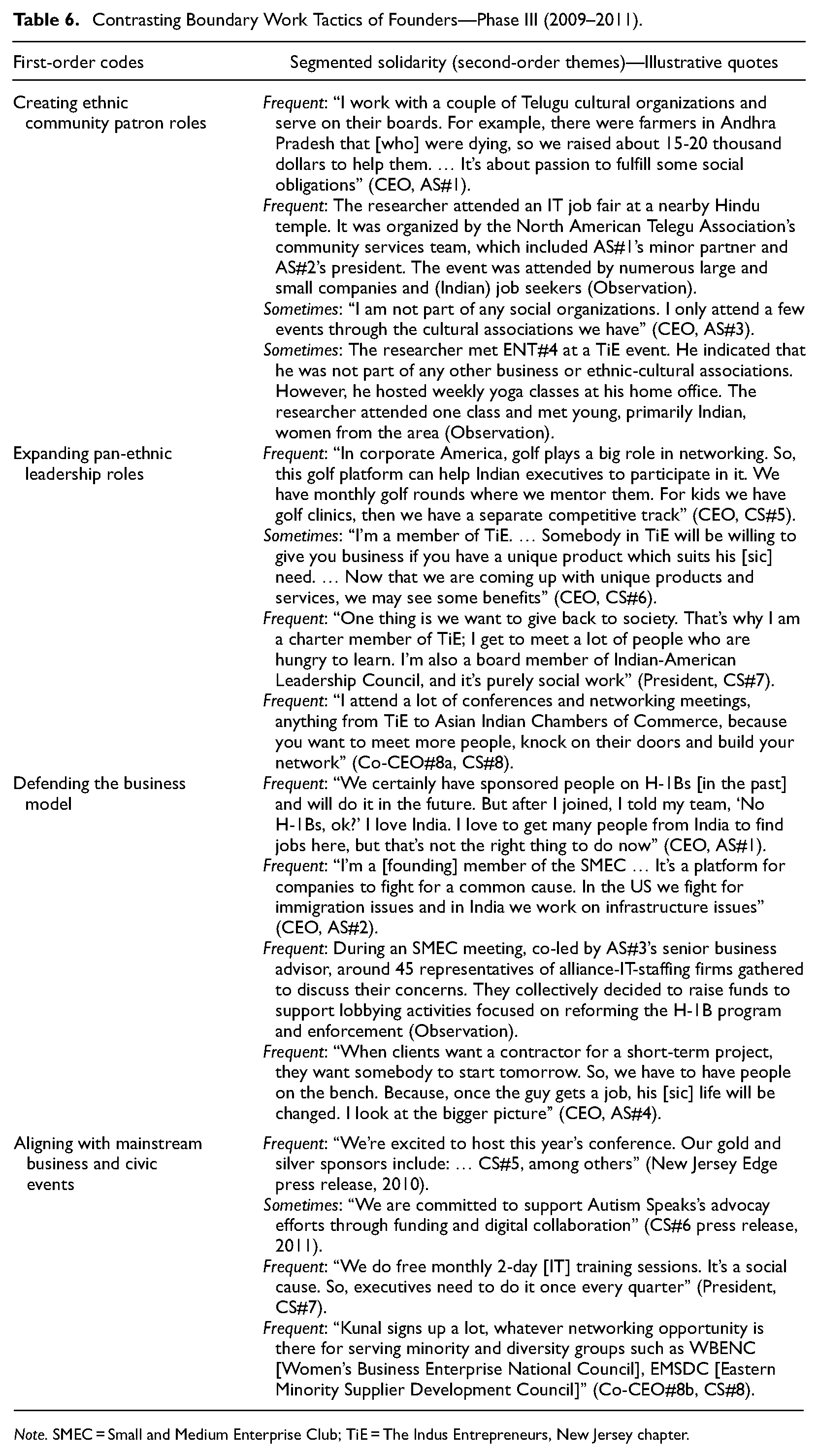
Note. SMEC = Small and Medium Enterprise Club; TiE = The Indus Entrepreneurs, New Jersey chapter.
Creating Ethnic Community Patron Roles Versus Expanding Pan-Ethnic Leadership Roles
Several owners of alliance-IT-staffing firms were aware of their low cultural standing among professionals within the local immigrant community. Accordingly, they largely avoided participating in pan-ethnic IT business associations and connected with like-minded individuals through separate local associations and networking events. Specifically, alliance-IT-staffing firm owners preferred participating in local ethnic-cultural associations to celebrate shared heritage, language, customs, and traditions. Most curved new roles, such as treasurers or board members, within these ethnic associations and were key organizing members or sponsors of cultural activities. AS#2’s president proudly remarked:
There’s an association called the North American Telegu Association (NATA). I’m an active member of that. It helps build contacts with people and meet community members. We offer a lot of help to students coming to the US from India. And we run a charity hospital in India.
The events at ethnic-cultural associations were often conducted in participants’ native languages and revolved around religious festivities, music and dance performances, and fund-raising for charitable work in NJ or specific home country regions. Occasionally, there were workshops on IT job fairs and immigration (see Table 6). My observations of three social events organized by local cultural associations, supplemented by reading their newsletters and reports, confirmed that alliance-IT-staffing firm owners used these events to exchange information and solidify connections with in-group members. The charitable events were often featured in ethnic media and association newsletters, which raised their social profile and increased community members’ awareness and appreciation. My field notes document one such event:
At a dinner party organized in honor of a local Indian-American politician, ENT#3 introduced the researcher to a large group of alliance-IT-staffing firm owners who admired him for his ability and vision to develop software products for Wall Street banks. The kingpins sat together in a designated area; some of their names were featured as event sponsors in the brochure.
Overall, the cultural events fostered collaboration and community development opportunities, which helped to promote a sense of belonging among alliance-IT-staffing firm owners and fortify their social standing. By interacting with in-group members, they also maintained a positive self-image (Swann et al., 2004; Tajfel & Turner, 1979), mitigating accountability pressures.
In contrast, client-IT-staffing firm owners had moderate to high involvement in the NJ chapter of a leading pan-ethnic IT business association, The Indus Entrepreneurs (TiE). Unlike the ethnic associations, TiE had a diverse governance structure representing the Indian subcontinent and organized workshops, networking events, and mentorship programs to foster entrepreneurship (Saxenian, 2007). My fieldwork revealed that participating in TiE events enabled client-IT-staffing firm owners to connect with high-status community members, including successful IT entrepreneurs with a common Indian heritage. Such interactions allowed them to claim a similar position to that of IT service firm owners. Some also used the TiE networking forums and events to expand their leadership roles (see Table 6). For instance, the CEO of CS#5 proudly noted:
I am a charter member of TiE. I organized their golf outing last year. I own something called the South Asian Golf Association … It’s more of an organization for promoting golf as a sport in the Indian community. The whole idea is to build camaraderie in the South Asian community and bring people together not just for business, but that could happen too; that’s part of the deal.
As charter members of TiE, some founders organized workshops to share knowledge and expertise and served as brand ambassadors for the organization. Co-CEO#8a of CS#8 recalled: TiE was getting stronger in the tri-state area when we started our company. After the TiE, New Jersey, was launched, I sometimes got involved as an advisor. You know, the people I met through TiE were highly successful and could be my role models, my friends, my mentors, so that helped.
In other words, client-IT-staffing firm owners utilized local pan-ethnic business associations as platforms to expand their community involvement, assume prominent roles, and position themselves as IT service firm owners. These endeavors enhanced their social standing and distinguished their business activities from those of alliance-IT-staffing firm owners.
Defending the Business Model Versus Aligning with Mainstream Business and Civic Events
The overlapping religious, charitable, and cultural involvement of alliance-IT-staffing firm owners in local ethnic-cultural associations prompted them to recast their roles as job creators for co-ethnics from their home country regions, providing them with career opportunities in the US. AS#2’s president noted:
We decided to start this company to provide jobs to people. We used to bring software consultants [from India] who were experts to find jobs here. So, basically, to provide jobs.
Others had first-hand experience working for alliance-IT-staffing firms, which influenced their perception of the business model. The minor partner of AS#1 proudly noted: With my connections, all my friends are over here. They joined, their wives joined, and their brothers joined. So, it’s like 15, 20 people joined with my connections. It’s a mutual [understanding], it’s not one-sided. So, we are helping them, and we are getting help.
A redefinition of the alliance-IT-staffing business model motivated the founders to form a strategic alliance through a new business association, the Small and Medium Enterprise Club (SMEC), to expand and preserve their business domains (see Table 6). The charter member of SMEC, who served as a senior business advisor to AS#3, explained its mission: SMEC is a platform for networking that we want to take to the next level. Our goal is to build an IT park back in India. The main goal is to provide jobs to about 20,000 people through local [Indian] branches, catering to the needs of over 300 [US-based] member companies. If we come together under one umbrella, we can bid to become a vendor for the big companies. But right now, we are stepping back. More concentrating on US immigration and labor issues.
SMEC provided a forum for alliance-IT-staffing firm owners to openly discuss their business models without facing criticism and judgment. In late 2009, the SMEC joined TechServe Alliance, the national trade association of the IT staffing industry, to lobby for boosting the flow of skilled workers into the US. The coalition opposed a new memorandum from the immigration services, which made it difficult for IT staffing firms without direct client relationships to sponsor foreign workers. The coalition ultimately failed to win its case.
Unlike alliance-IT-staffing founders, most client-IT-staffing owners strived to reach and engage with the broader community by bridging and blending the boundaries between mainstream and pan-ethnic business associations. Hence, some were proactive participants in leading local and regional business associations and councils, allowing them to cultivate relationships with influential local executives and government bureaucrats (see Table 6). The CEO of CS #5 noted: I have been closely involved with the New Jersey Technology Council. Their board is generally about 50, 60 people, but all of them are CEOs or heads of businesses in New Jersey, so that was a good avenue to network and meet other highly successful people.
Additionally, they sometimes sponsored prominent civic events, local associations’ award ceremonies, and workshops to enhance visibility and reach potential clients, partners, and industry influencers. Such patronage garnered positive media attention in local and regional business magazines, fostering goodwill and a positive reputation for the company (see Table 6). For instance, the US Chamber of Commerce nominated CS #7’s president for the annual small business award for showcasing excellence in a challenging business climate. The corresponding 2009 press release from the Chamber of Commerce stated:
Today we honored 56 small businesses with the Blue Ribbon Small Business Award. Winners include: … Arjun Murthy of CS#7 …“It is for businesses committed to supporting their employees, following best business practices, and improving their communities.”
In short, while alliance-IT-staffing founders formed co-ethnic cliques using multiplex ties to safeguard and uphold their business models, client-IT-staffing firm owners developed broader but weaker connections with influential mainstream and pan-ethnic community members to differentiate their business domains.
Changes in Venture Business Models: Hybrid IT Brokerage Versus Hybrid IT Solutions
The founders’ differing boundary work tactics were integrally associated with two contrasting approaches to adapting their business models amid increased audience scrutiny and market downturn. By 2011, all eight firms had a combination of IT staffing and software development work in their US operations. However, based on my interviews, alliance-IT-staffing firms still generated over three-quarters of the revenue from staff augmentation services. In contrast, client-IT-staffing firms generated 40% to 60% of their revenue from software development and systems integration services. I use the terms “Hybrid IT brokerage” and “Hybrid IT solutions” to describe the changes in business models during Phase III (2009–2011, 2011–2017). In one, the founders built operational capabilities and strong relationships with a few ethnic IT firms with complementary human resources or clientele to increase the market value of their employees, capturing human capital rents. Conversely, the founders developed specific knowledge capabilities and market-based partnerships with leading technology firms to enhance employee skills, creating human capital rents. Table 7 displays quotes exemplifying two entrepreneurial actions that led to these differences in the business models. I delineate these actions below.
Changes in Venture Business Models: Phase III (2009–2011, 2011–2017).
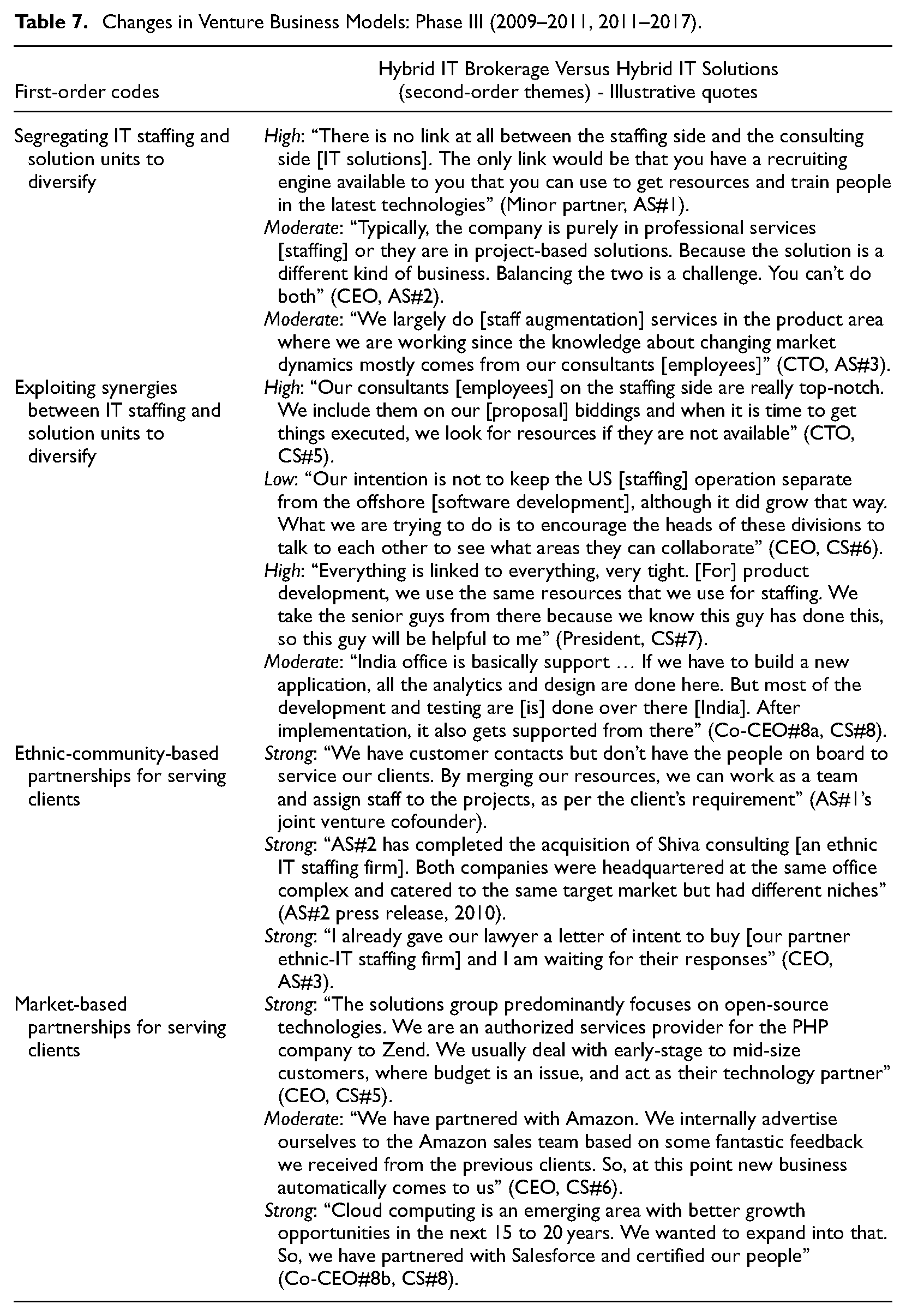
Segregating Versus Exploiting Synergies Between IT Staffing and Solutions Units to Diversify
In a highly regulated and socially scrutinized environment, alliance-IT-staffing founders established new business units to launch consulting services such as data analytics, software integration, or product development. They separated the IT staffing and consulting units physically by housing them in different locations and making personnel changes and/or symbolically through the firm’s rebranding. The rebranding included appointing an external board of advisors, hiring a marketing firm, and relocating to an upscale office space. AS#1 is an archetypical example. When I interviewed the CEO in mid-2009, the firm had recently moved to a chic location and appointed an external advisory board of high-profile experts to signal strategic change. The CEO remarked: We are bringing an advisory board comprising ex-CEOs and CTOs of top firms like Lawson and Hayes. Our goal is to tap those individuals who have seen how mid-market companies can improve quality and reduce costs by implementing network solutions.
Similarly, AS#2 launched its analytics arm as a separate business unit in 2009 and hired a new business development manager to front the business. The CEO explained the reasoning: We are a generalist. To get out of that, we have invested in data analytics. We want to be a business analytics company in the healthcare and financial services domain.
During the market’s decline, AS#3, a young company, encountered financial difficulties. Consequently, the CEO sold the IT staffing firm’s assets to raise funds. Later, he renamed the shell company to continue its staffing operations and launched a new software firm focused on developing products for the financial services sector. The recently hired strategic director noted: We hired Sideways [a marketing firm] to rename the new entity. One former Citibank executive has recently joined as our CTO, and we hired a small team in Tampa [Florida] to enhance the product.
The Princeton, NJ, office handled product development and marketing, while the Tampa office, Florida, primarily focused on staffing services. When I revisited NJ in 2011, unfortunately, ENT#4 was planning to close his business and transition to a salaried job. AS#4 closed in 2013.
Unlike alliance-IT-staffing founders’ compartmentalization strategy, most client-IT-staffing firm owners exploited the connections between IT staffing and solutions to diversify their service offerings (see Table 7). CS#5 is a classic example. On my revisit, CTO clarified: Earlier Raja [senior manager of IT staffing services] and I worked in a silo. But now, it is more proactive. We work tightly together. He acts as a sounding board for the project I’m leading and keeps an eye out for the [human] resources I may need. Similarly, I share contacts of people I meet in technology workshops with him. That way, it works seamlessly.
Others, such as CS#6, expanded their offshore development center and invested in their employees, systems, and processes to certify themselves against industry benchmarks to reposition their service offerings. Similarly, CS#8 co-invested in a niche offshore development center in India to build delivery capabilities and eventually enter the North American market.
CS#7 is an interesting case. The firm became an accredited training provider for Microsoft IT Academy and NJ Department of Workforce Development. This decision turned out to be highly profitable. The minor partner of training services explained:
We got affiliated with the [New Jersey] state government as a certified Project Management Institute training provider. Many Americans lost their jobs but couldn’t get technology jobs. We train and certify them. We make decent money, but we get a lot of attention. Because directors come, they see what we are doing, and these guys say, “Hey, we got a job [order] because of this training!”
Ethnic-Community- Versus Market-Based Partnerships for Serving Clients
After unsuccessful lobbying through the SMEC, the alliance-IT-staffing founders pursued an alternative strategy. They established community-based partnership programs, which included forming strategic alliances with ethnic IT service firms to access new clientele or acquiring ethnic staffing firms to add experienced consultants with specific skill sets to their workforce (see Table 7). AS#1 was a classic example. My revisit to AS#1 in 2011 revealed that it partnered with a New York-based ethnic IT start-up to provide network integration services to the financial services industry. The CEO aptly summarized it: We developed the partner [relationships]—partners who had clients with needs. And then, we went through them to serve their clients.
The joint venture was a huge success and AS#1 acquired its partner company in 2015.
AS#2 was another example. It saw the market downturn as an opportunity to acquire two ethnic IT staffing firms—one on the East Coast and the other on the West Coast. These firms had complementary human resources to aid the expansion of AS#2’s services. Following these acquisitions, AS#2 experienced phenomenal growth when the market picked up. Similarly, upon revisiting AS#3 in 2011, I learned of its ongoing acquisition of an ethnic staffing agency that specialized in serving the financial services industry (see Table 7).
In contrast, client-IT-staffing firm owners established strategic market-based partnerships to complement their capabilities and expand their service offerings. For instance, CS#5 proactively developed capabilities in open-source technologies to act as technology partners for start-ups. Additionally, anticipating a potential tech talent shortage due to the H-1B visa crackdown, the firm focused on developing business process automation solutions capabilities through certifications and subcontracting with leading software vendors. The CTO noted: We are on a multi-project with HP [Hewlett Packard], working for the State of New Jersey. HP is the main vendor executing the project, but we are supporting HP in the status of a partner [subcontractor]. I heard they interviewed close to about 25 or 30 companies. And out of that, they selected 2–3, and we were one of them. So, for a bigger company like HP to give us recognition is great.
Similarly, CS#6 became a certified value-added reseller of Amazon, which enabled the company to integrate Amazon’s back-end systems with the third-party merchant’s website (see Table 7). Meanwhile, CS#8 decided to partner with Salesforce. One of the cofounders explained the rationale:
We identified some niche areas on Salesforce’s platform that were not very aptly skilled. So, by partnering with them, we are building niche applications around those.
CS#8 used its new capabilities to create event-planning tools for minority and women-owned businesses, resulting in its selection as a partner for prominent organizations. However, CS#7 lost its minor partner in the engineering services division in 2010, and its diversification effort stalled.
Discussion
An Elaboration on Ethnic (Immigrant) Entrepreneurship Framework
To investigate the impact of sourcing human capital from the market versus founders’ ethnic communities in the home country on initial business models and their subsequent development, I conducted a study using grounded theory methods. The study included 11 foreign-born entrepreneurs with similar human capital and migration histories and 8 founder-(IT)venture pairs within a US geographic community. The framework, summarized in Figure 3, illustrates that understanding the impact of immigrant founders’ early strategic decisions for human capital sourcing on business model evolution requires a comprehensive theoretical approach that elaborates on the SHNVC and SCEE scholarships to offer boundary conditions for existing entrepreneurship research. I discuss the key concepts from the study and my contributions below.
Contributions to SHNVC
The results extend SHNVC (Baron et al., 1999; Beckman & Burton, 2008; Ding, 2011; Campbell et al., 2012; Chadwick, 2017). The prevailing assumption in SHNVC is that entrepreneurs primarily obtain human resources from the market, which puts them at a disadvantage compared to potential employees due to the venture’s liability of newness (e.g., Leung et al., 2006; Moser et al., 2017). However, this default assumption overlooks that founders may effectively leverage nonmarket resources, such as talents from their ethnic communities in their home country (Drori et al., 2009; Portes et al., 2002; Portes, 1998; Saxenian, 2007) as a bootstrapping strategy. It can give firm owners a bargaining power advantage over their co-ethnic employees due to their role in regulatory oversight (Hajro et al., 2023; Van den Broek et al., 2016; Xiang, 2007).
Specifically, my framework highlights that when founders hire employees from their ethnic communities instead of the market, they create distinctive business models for their ventures operating in the same sector and market segment. These business models differ in how strongly founders embrace regulatory control and wield power imbalances with co-ethnic employees rather than adopting standardized human resource strategies and business practices (e.g., Baron et al., 1999; Chadwick, 2017) to manage their human capital.
While the unorthodox business models of immigrant firms with high regulatory control over co-ethnic employees may generate and capture more human capital rent than rivals, leading to higher profitability and faster growth, their unconventional nature may attract media and audience scrutiny. Accordingly, founders must interact with the community through local subgroups and associations to uphold their reputation and business activities in the later stages of the venturing process. Thus, my two-step process framework extends beyond the agent focus of entrepreneurship research in SHNVC and develops critical linkages with the (sub)group dynamics within a community, a key component of SCEE, presenting a unifying approach.
Contributions to SCEE
The current study elaborates on SCEE (Bailey & Waldinger, 1991; Gedajlovic et al., 2013; Kalnins & Chung, 2006; Portes, 1998; Sinkovics & Reuber, 2021), which often conflates social closure with ethnic group boundaries (Frederking, 2004; Wimmer, 2008). Consequently, SCEE fails to explore how nonethnic factors, such as founders’ strategic decisions to leverage the market vis-à-vis nonmarket resources, can become consequential for subgroup dynamics and business model adaptation within a pan-ethnic community. Importantly, my framework emphasizes the role of localized subgroup clusters to highlight how business models evolve in the later stages of a venture’s growth, a phenomenon that has received little representation in the existing literature (e.g., Davidsson & Gruenhagen, 2021; Shepherd & Williams, 2020).
Specifically, I propose a new concept called “segmented solidarity” to provide valuable insights into the competing boundary work tactics (Gieryn, 1983; Lamont & Molnár, 2002; Langley et al., 2019) entrepreneurs use to demarcate their social domains and manage external stakeholders’ attention when their business models raise legal or cultural scrutiny. These tactics involve purposeful individual effort and strategic collaboration to assess their in-group favorably and distinguish themselves from out-group members using different loci, community associations, and networking events to safeguard or differentiate their business models.
The findings suggest that when solidarity within a community is fragmented, it can support and sustain unlawful business practices, which can harm both internal and external stakeholders. Another implication is that entrepreneurial opportunities may be legally or ethically ambiguous, leading to conflicts between self, interpersonal, and collective interests (Brenkert, 2009; McVea, 2009) within a larger societal context (Clough et al., 2019; Welter et al., 2017; Wiklund et al., 2019).
Boundary Conditions for Extant Entrepreneurship Research
By shedding light on the relative importance of economic and cultural considerations in guiding entrepreneurial decision-making and actions, the study reveals that immigrant founders’ business models may differ from those of nonimmigrant entrepreneurs and among themselves under two specific conditions. First, when founders mainly source human capital from their ethnic communities in home country regions, allowing founders to exert regulatory control over co-ethnic employees, venture business models are less likely to resemble those of nonimmigrant and other immigrant-founded firms that primarily rely on market-based human capital sourcing to organize their business activities.
Second, when the venture business model breaches the expectations and obligations of internal or external stakeholders, founders are more likely to engage in collective rather than individual boundary work through outside associations to demarcate their social domains and adapt their business activities. Such actions can result in variations in business models between nonimmigrant and immigrant enterprises or among immigrant firms over time. Thus, I contribute to an ongoing conversation on business model designs and their evolution (e.g., McDonald & Eisenhardt, 2020; Snihur & Zott, 2020; Zuzul & Tripsas, 2020).
Study Limitations and Avenues for Future Research
My research offers a more nuanced understanding of contemporary immigrant entrepreneurship by integrating cultural processes into the strategic actions of entrepreneurs. While the conclusions are tentative, they highlight opportunities for future research. To fully comprehend the impact of sourcing human resources from the ethnic community on business model designs and evolution, future studies should explore founder-venture dyads in other subcontracting settings and across different ethnic groups outside the US, such as Chinese subcontracting in the fashion and luxury retail industries in Italy. Such an approach can also reveal the generalizability of my framework and identify additional boundary conditions. Furthermore, existing research has yet to investigate how entrepreneurs’ reliance on online communities for resources impacts their business models. The intricate interplay between virtual communities and group dynamics provides a unique opportunity to explore how multiple, at times, conflicting expectations and obligations affect founders’ strategies and business models during venturing.
Practical Implications
My research findings are highly relevant to policymakers and other institutional agents seeking to bolster various entrepreneurial activities within their communities. First, a thorough understanding of key stakeholders’ motivations, experiences, connections, and cultural perspectives can enable policymakers to design and tailor more effective entrepreneurship education programs to help participants mobilize various resources from their communities. Such customized programs can be offered through local associations in targeted geographic communities, offering continuous learning opportunities for aspiring entrepreneurs. They can help participants identify overlooked problems or innovative solutions, providing fodder for new firm creation to address unmet community needs. Furthermore, targeted financial initiatives such as subsidized job support programs can support the growth of promising ethnic businesses, allowing them to expand beyond their communities and contribute to local business ecosystems.
Second, with the continued rise of digital platforms, policymakers may foster cultivating knowledge exchange, collaboration networks, and support for venture development online to build a thriving innovation ecosystem. Additionally, it is crucial to promote sponsored events that enhance the appeal of these online groups and provide a platform for prospective entrepreneurs to interact with potential investors and customers to validate their ideas or receive feedback. Online communities can prove especially beneficial for underrepresented groups, such as women, racial and ethnic minorities. They can utilize these communities to establish connections beyond their local areas, broaden their perspectives and opportunities, and create a professional presence by showcasing their skills, experience, and commitment.
Footnotes
Appendix A
Declaration of Conflicting Interests
The author declared no potential conflicts of interest with respect to the research, authorship, and/or publication of this article.
Funding
The author received no financial support for the research, authorship, and/or publication of this article.
