



Abstract
Recent research introduced and laid the foundation for a new individual-level entrepreneurial orientation conceptualization (Ind.EO) within the entrepreneurial orientation family of constructs. Building directly from this work, this article theoretically defines a measurement model for the construct and develops and validates a scale. We define and measure disposition-based behavior constructs for autonomy, competitiveness, innovativeness, proactiveness, and risk-taking, thus providing psychometrically validated tools that support research in the burgeoning Ind.EO domain. Scale items are generated deductively from our definitions, and then tested through four data collections with academics, the lay population, entrepreneurs, and business managers. Strong validation data across these multiple samples support the utility of the final 17 items and that they can be used to measure Ind.EO. Furthermore, we provide unique theoretical insights regarding the value of the autonomy and competitiveness components of Ind.EO and investigate the core personal values associated with Ind.EO.
Keywords
Introduction
The construct of entrepreneurial orientation (hereafter EO) was originally introduced to the scholarly literature in an article by Miller (1983, p. 771) wherein he described an entrepreneurial firm—that is, a firm with an EO—as “one that engages in product-market innovation, undertakes somewhat risky ventures, and is first to come up with ‘proactive’ innovations, beating competitors to the punch.” Similarly, Covin and Wales (2019, p. 5) defined EO as “an attribute of an organization that exists to the degree to which that organization supports and exhibits a sustained pattern of entrepreneurial behavior reflecting incidents of proactive new entry.” The position that firms can “be entrepreneurial” is now a well-established premise of the entrepreneurship and strategic management literatures.
Whether EO also manifests as an individual-level construct distinct from other individual-level entrepreneurial constructs, such as entrepreneurial mindset (e.g., McGrath & MacMillan, 2000; Pidduck, Clark, & Lumpkin, 2023), entrepreneurial intention (e.g., Adam & Fayolle, 2016; Krueger et al., 2000), entrepreneurial hustle (e.g., Burnell et al., 2024), and entrepreneurial alertness (e.g., Busenitz, 1996; Valliere, 2013), has been an area of intense debate for 30 years, since Smart and Conant (1994). A lack of consensus—both around whether individual EO (hereafter Ind.EO) is appropriate and if so, what it is—has led to a preponderance of conflicting theorizations and operationalizations (e.g., Bolton & Lane 2012; Covin et al., 2020; Mueller & Thomas, 2001). More recently, Clark et al. (2024, p. 351) joined and extended the scholarly conversation on Ind.EO by defining Ind.EO as “autonomous, proactive, innovative, competitive, 1 and risk-taking dispositions and behaviors that individuals exhibit when pursuing value-creating opportunities,” thus basing their EO conceptualization on the five subdimension EO construct initially proposed by Lumpkin and Dess (1996). Notably, the Clark et al. (2024) definition of Ind.EO incorporates the notion of value creation, which Wales et al. (2023) recently posited as the core phenomenon in their formal theory of EO. Clark et al. (2024) concluded that individual-level EO can indeed be conceptualized legitimately as a construct meaningfully distinct from other Ind.EO constructs. Their conceptualization recognizes the codependency of entrepreneurial behaviors arising from entrepreneurial dispositions as a defining element of the Ind.EO construct.
Notably, Clark et al. (2024) are not the first scholars to consider Ind.EO as a distinct individual-level construct. A sizable number of conceptual and empirical articles have appeared over the years (71 were identified in a recent literature review; Clark et al., 2024), many of which have simply taken conceptualizations, definitions, and measures of EO as a firm-level attribute and modified those to “work” at the individual level (see, e.g., Bolton & Lane, 2012; Covin et al., 2020; Goktan & Gupta, 2015; Kollmann, Christofor, & Kuckertz, 2007; Santos et al., 2020). These construct and associated EO scale modification efforts have been variously successful in translating the original firm-level construct of EO to the individual level. Some of the manifestations of EO as a firm-level construct transfer well; for example, the phenomenon of risk-taking as an EO subdimension can be understood to describe both firm- and individual-level dispositions and actions. However, the EO subdimension of autonomy, for example, does not transfer as cleanly or obviously from the firm-level EO construct to a conceptually similar individual-level construct. Indeed, in arguably the most widely employed Ind.EO scale—the Bolton and Lane (2012) measure—both the autonomy and competitive aggressiveness subdimensions were dropped from consideration based on the researchers’ failure to find valid measurement scales for the phenomena. Thus, the nominal meaning of the Ind.EO construct—the purely theoretical meaning offered without reference to data—is often observed to differ from the empirical meaning—what is actually measured—in studies that purport to assess Ind.EO. Collectively, it might be concluded that while the concept of Ind.EO is increasingly embraced, efforts to precisely capture how Ind.EO manifests as a distinct attribute of individuals are still wanting. Arguably, this is the major obstacle to Ind.EO researchers seeking to rigorously capture what it means for a person to be entrepreneurial. Herein, we seek to address this problem and provide a constructive path forward for entrepreneurship scholars.
The purpose of this research, then, is to develop and validate an Ind.EO scale using scale development best practices (e.g., Hinkin, 2005; MacKenzie et al., 2011) and a conceptualization of Ind.EO’s constituent subdimensions that is consistent with the EO-as-a family-of-constructs perspective (see Clark et al., 2024; Wales et al., 2020), but one which is not unduly and inappropriately derivative of traditional firm-level EO conceptualizations and measurement approaches. This scale is offered in support of the measurement needs of future empirical research on Ind.EO—the individual entrepreneurial orientation construct as defined and developed in Clark et al. (2024)—fostering clarified theoretical understanding and enabling appropriate empirical modeling of Ind.EO as an individual-level phenomenon. Our scale is grounded in a disposition-based behavioral perspective of five independent, theoretically robust constructs—the traditional five EO subdimensions (Lumpkin & Pidduck, 2021)—and includes subscale items for each. Ind.EO as herein operationalized represents the shared variance of the five independent subscales. In developing this scale, we seek to advance empirical research and widespread interest in entrepreneurial individuals across a broad range of contexts.
Theory Development: Ind.EO as Disposition-Based Behavior
Following Clark et al. (2024), Ind.EO is expressed through behaviors that originate in dispositions (Figure 1a). It was Gartner (1988) who argued we should not consider a person an entrepreneur unless they engage in entrepreneurial acts. We also adopt this position, but add that entrepreneurial acts alone, when they are not disposition-based, are insufficient to claim that someone exhibits Ind.EO. Entrepreneurial acts occurring in the absence of favorable predispositions toward entrepreneurship may be reactionary and not likely to recur (Figure 1b; e.g., Kadile & Biraglia, 2022; Shah & Tripsas, 2007). Indeed, this perspective is consistent with Bourdieu’s (1977) theoretical position that dispositions are the individual’s durable orientation that influence their context-specific behavioral choices.
2
Similarly, Covin and Lumpkin (2011) observed, regarding firm-level EO, that behavior not emerging from dispositions can reflect pure happenstance and will not be sustained, as is necessary to view EO—or in our case Ind.EO—as a defining attribute of an entity. We also recognize that constructs are, by definition, unobservable latent variables and adopt the perspective that to be entrepreneurial as a defining attribute or quality requires the sustained exhibition of entrepreneurial behavior and an outlook or perspective that disposes an individual to engage in said behavior (Figure 1c). Covin and Lumpkin (2011, pp. 858–859) argue the following: One might justifiably ask what the value is of including disposition-focused items in a measure of a construct that is fundamentally behavioral in nature. From a theoretical purist perspective, the answer may well be that there is no or negative value in assessing the construct through the inclusion of nonbehavioral items. However, as a practical matter, the inclusion of such items helps assure that the behaviors assessed are likely being driven by stable response tendencies (as opposed to chance or other non-systematic stimuli). As such, their presence is consistent with the conceptualization of EO as a firm-level attribute that is recognizable through the exhibition of sustained entrepreneurial behavioral patterns.
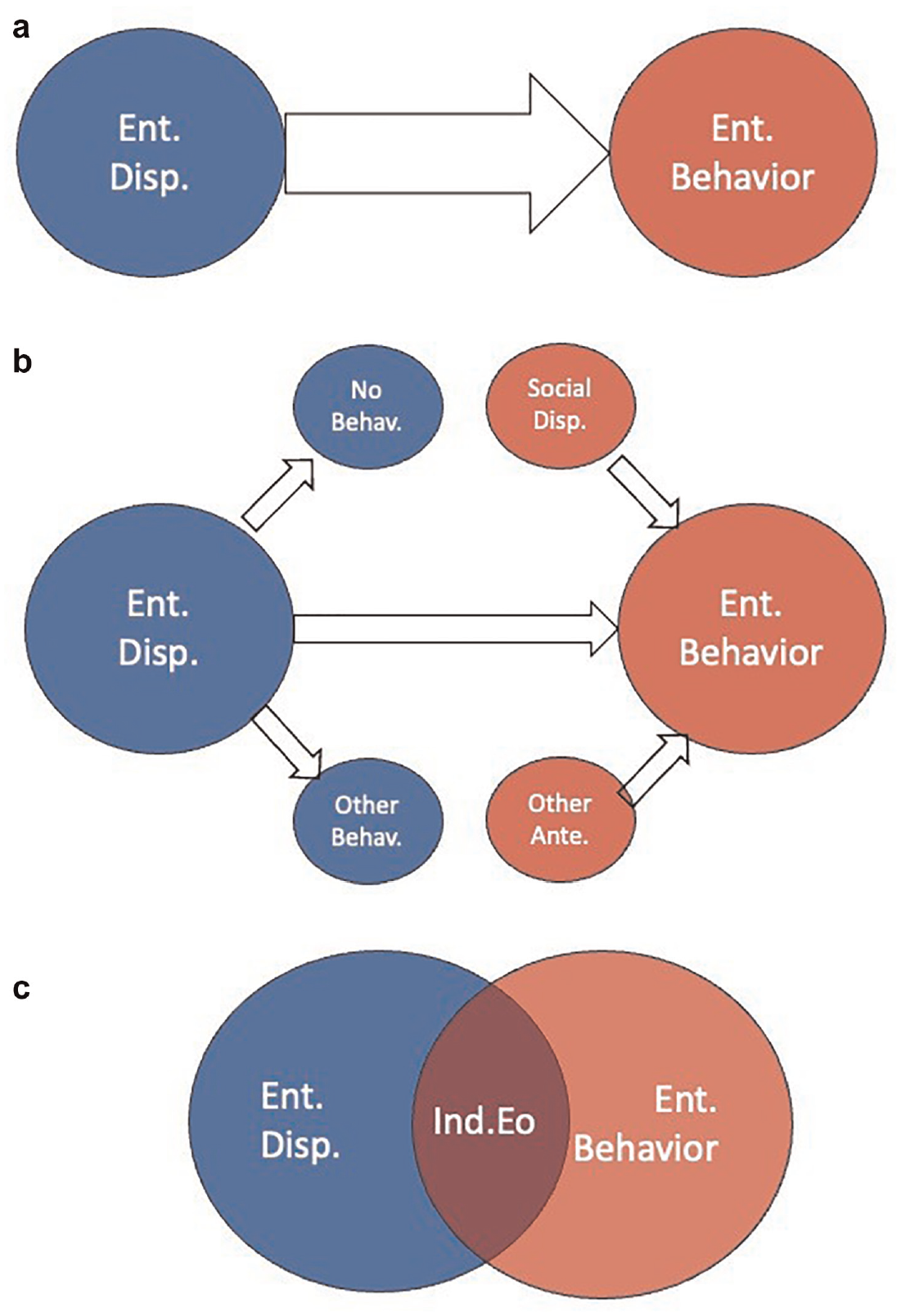
(a) Narrow theoretical view from Clark et al. (2024). (b) Expanded theoretical view. (c) Ind.EO Scale empirical view.
Likewise, we assert that exhibiting entrepreneurship as a personal quality—the essence of Ind.EO—requires that entrepreneurial behavior (manifested through recognized Ind.EO dimensions, see Clark et al., 2024) be rooted in pro-entrepreneurial dispositions (also manifested through these dimensions). As an empirical matter, it is certainly possible that the strength of an individual’s disposition toward entrepreneurial behavior may diverge from the extent to which that individual exhibits said behavior. That is, pro-entrepreneurial dispositions and pro-entrepreneurial behaviors can manifest to different degrees in the same person. Consistent with Miller’s (2011) argument that some evidence of all EO dimensions must be present (and assessed) before one should label firms “entrepreneurial,” we argue that some evidence of both pro-entrepreneurial dispositions and pro-entrepreneurial behaviors—operationalized in terms of the five dimensions—must be present (and assessed) before individuals might be judged as exhibiting Ind.EO. Certainly, persons can hold pro-entrepreneurial dispositions without exhibiting entrepreneurial behaviors, and vice versa. Such individuals whose entrepreneurial dispositions and behaviors greatly diverge should not be regarded as exhibiting high Ind.EO levels, as we are conceptualizing the construct. 3
We also adopt the perspective advanced by Covin and Miller (2014) regarding the value of “mixed measures” as a requirement for adequately capturing EO. This perspective is important to our argument, and it challenges the notion that constructs must be one type (e.g., behavioral) or another (e.g., dispositional). Covin and Miller observe that the most employed firm-level measure of EO—the Miller/Covin and Slevin (1989) scale—has consistently predicted and explained firm level outcome not despite having an assortment of behavioral and non-behavioral items, but because it has this assortment. To quote from Covin and Miller (2014, p. 27): While it is understandable that mixing indicator type might be viewed as problematic, this aspect of the scale may also be the basis for its broad acceptance and the reason it has been empirically linked to a wide variety of organizational, environmental, strategic, and managerial phenomena (see Wales et al., 2011). The M/C&S scale captures multiple aspects of what “being entrepreneurial” means and, as such, triangulates the phenomenon using a diverse assortment of indicators. A triangulation approach to measuring EO is consistent with the reasoning of Lyon et al. (2000) that EO is best understood when assessed from multiple perspectives and with different types of indicators.
Similarly, we adopt the perspective on Ind.EO that to “be entrepreneurial” it is necessary that the individual’s disposition associated with the five traditionally recognized EO dimensions—which have been theoretically justified and demonstrated as meaningful at the individual level (Lumpkin & Pidduck, 2021)—is favorable to and associated with entrepreneurial acts indicative of those dimensions. This pairing of dispositions and behaviors is the essence of Ind.EO and what enables us to conceive of Ind.EO as an enduring personal trait.
As always, there can be room for informed disagreement and debate, but these are our positions on the identified matters. In the end, constructs, as latent variables, are what we define and operationalize them as being (e.g., Bollen, 2002); their usefulness is a product of the extent to which groups of scholars share the same conceptualizations. Accordingly, there can and often will be disagreements about what a particular construct “is” or how it can or should be conceptualized and measured. In our article, we present our chosen theoretical conceptualization of Ind.EO (its nominal meaning—Figure 1a) and a measurement model of Ind.EO (its empirical meaning—Figure 1c) that aligns with that conceptualization. Others might choose to advance alternative answers to the question of what it means for a person to “be entrepreneurial,” and we would strongly encourage such efforts. Our desire is to provide one answer to this question that we hope most scholars will regard as reasonable, recognizing that there will never be a perfect or complete answer that satisfies everyone and reflects all nuance and substance of evolving theory and research.
We now turn to a more granular delineation of each dimension of Ind.EO, where certain entrepreneurial behaviors originate in dispositions, and certain entrepreneurial dispositions result in behaviors. Much research has been conducted on these dimensions; Lumpkin and Pidduck (2021) discuss, summarize, and conceptualize the current understanding, providing the base for the following.
Autonomy
This refers to an individual’s disposition toward taking initiative and acting based on one’s discretion, irrespective of the established rules, norms, or status quo (Lumpkin & Pidduck, 2021). For example, when considering how they might best perform their jobs, sales employees high on the autonomy dimension might regularly identify and be prone to engaging in new sales techniques that deviate from prior practices or expectations. We define Ind.EO Autonomy as: embracing the freedom and flexibility to take independent action, outside of established norms and routines; being willing to assume responsibility and champion new ideas.
Competitiveness
This refers to an individual’s disposition toward being assertive, striving for competitive advantage, and directly measuring outcomes relative to rivals (Lumpkin & Pidduck, 2021). As an example, a research scientist high on the competitiveness dimension might frequently compare their patent citation counts with those of other research scientists, increasing their creative efforts if their perceived relative scientific standing is judged as lacking.
We define Ind.EO competitiveness as: being willing to directly challenge rivals; being assertive in response to threats and changing conditions; being vigorous in efforts to seek advantage.
Innovativeness
This refers to an individual’s disposition toward creating or improving products, services, and processes through some or all of being inventive and innovative, addressing challenges and problems, and employing novel thinking and experimentation (Lumpkin & Pidduck, 2021). To illustrate, a systems engineer high on the innovativeness dimension may be particularly amenable to looking beyond the conventions of current practice when seeking to optimize system performance, using biomimicry, for example, to create new solutions. We define Ind.EO innovativeness as: being inventive and experimental; using fresh insights, novel thinking, and new knowledge to create or improve products, services, and processes.
Proactiveness
This refers to an individual’s disposition toward anticipating and shaping potential future outcomes; looking for and being willing to act on perceived opportunities before they are widely recognized or accepted (Lumpkin & Pidduck, 2021). For example, CEOs high on the proactiveness dimension may be prone to adopt “shaping” postures for their firms whereby they lead their industries in pioneering disruptive technologies or recognizing and entering untapped markets. We define Ind.EO proactiveness as: being alert and scanning for possibilities; anticipating and envisioning the future; being willing to act on opportunities ahead of future demand.
Risk-Taking
This refers to an individual’s disposition toward a willingness to make bold judgments, decisions, commit resources, and take actions when outcomes are uncertain (Lumpkin & Pidduck, 2021). To illustrate, a financial planner high on the risk-taking dimension may favor and build investment portfolios offering the possibility of great returns along with great possibility of loss over those offering more modest, predictable returns. We define Ind.EO risk-taking as: making judgments and decisions and taking action under conditions of uncertainty; some initiatives may involve making substantial resource commitments in the process of venturing forward.
Historical Measurement of Individual-Level Entrepreneurial Orientation
In Table 1, we analyze the extant literature of entrepreneurial orientation at the individual level. We identified 18 different instruments. All but four are first-person survey based. With 14 published survey methods of measuring EO at the individual level, do we really need another? Two considerations motivated the present study, the first being constructivist: there is a new conceptualization of Ind.EO (e.g., Clark et al., 2024) and this conceptualization needs to be measured. But that motivation is insufficient; it is possible that one of the existing methods is adequate to represent the new conceptualization. As such, to ensure the present exercise is needed we, second, explore the sufficiency of the existing instruments against the needs of the new construct: a model of Ind.EO as disposition-based behavior reflected in five dimensions. As presented in Table 1, there are two predominant methods of measuring Ind.EO, six secondary methods, and ten tertiary methods that are largely irrelevant. We will deal with the two primary methods—Bolton and Lane (2012) and M/C&S transposition—independently, and then the secondary and tertiary methods collectively.
Existing Methods for Individual Assessment of Entrepreneurial Orientation.

Note. We categorize this variable as any literature review will be incomplete and reported absolute counts will be wrong almost immediately (likely before the article is in print). Low = 3 or fewer; Moderate 4–10; High more than 10. Citation counts from Google Scholar, citation rate as of July 2024. Mueller and Thomas (2001) use 8 items from the Jackson (1994) Personality Inventory and 10 items from Rotter (1966) I-E scale.
Bolton and Lane
The questionnaire developed by Dawn Langkamp Bolton and Michelle Lane (Bolton & Lane, 2012; Bolton, 2012) would on its face seem to be a reasonable option for Ind.EO. Since its introduction, it has become the single predominant method for measuring Ind.EO (see Clark et al., 2024). The instrument was theorized on Lumpkin and Dess’s five-factor model and developed from the firm-level scale in Lumpkin et al. (2009). The instrument was individualized through rewording (e.g., “my firm” became “I,” and “business objectives” became “project goals”), and the Bolton and Lane (2012) article considers the construct validity of the reworded instrument on a student sample (DeGennaro et al., 2016). However, the instruments for autonomy and competitive aggressiveness—the factors Lumpkin and Dess (1996) added to the existing M/C&S model (e.g., Covin & Slevin, 1989; Miller, 1983)—didn’t work, empirically. The authors pivoted and aligned the more successful components of the instrument that they developed from Lumpkin et al. (2009) against the M/C&S three subdimension EO model.
Whether their validation failed because of the student sample, the translation from firm-level to individual-level, or the sufficiency of the five-factor model cannot be known. Their follow-up study (Bolton, 2012) employed “potential business owners,” but only the ten-item, three-factor instrument. That said, the three-factor instrument has proven to be robust and predictive of entrepreneurial behavior. Authors such as Koe (2016) and DeGennaro et al. (2016) have adapted it to novel contexts, while others such as Santos et al. (2020) have expanded the scale with new dimensions (e.g., passion and perseverance).
The challenges with Bolton and Lane (2012), specifically in light of the Clark et al. (2024) conceptualization of Ind.EO, are three-fold. First, Ind.EO is theorized and needs to be operationalized with all five dimensions; however, it might be possible to resurrect and re-examine the original Bolton and Lane autonomy and competitive aggressiveness items that failed. Second, Ind.EO is theorized as an individual’s “entrepreneurialness,” as indicated through disposition-driven entrepreneurial behaviors; Bolton and Lane (2012) was theorized to extend the firm-level conceptualization of EO to the individual, meaning the items are based on firm-level EO not individual conceptualizations of entrepreneurialness. Third, most of the items in Bolton and Lane (2012) are based on behavior tendencies without considering why these tendencies exist (e.g., “I tend to act “boldly” in situations where risk is involved”), and for Ind.EO the dispositional origin is as important as the behavioral outcome. For these reasons, Bolton and Lane’s (2012) instrument is not appropriate for assessing Ind.EO as herein conceptualized.
M/C&S Transpositioning
The second predominant form of Ind.EO measurement is a large body of studies that reword the M/C&S firm-level instrument for individuals. The transpositions (e.g., Baskaran, 2018) could range from direct (e.g., “A strong proclivity for high-risk projects” to “I am encouraged to undertake high-risk projects”) to imaginative (e.g., “a strong emphasis on R&D, technological, leadership, and innovation” to “I participate in discussions regarding improvements at work”). Many of these M/C&S-based instruments are unvalidated and vary dramatically in their translation accuracy, and most convert M/C&S from a bi-polar semantic differential scale to a unipolar Likert scale (e.g., Taatila & Down, 2012). Simply put, most of these scales associate themselves with and take inspiration from M/C&S, but they are often not precise, theoretically consistent, or well-validated.
Even assuming there is a good M/C&S repositioning scale, there would be considerable challenges employing it in light of the requirements of Ind.EO. First M/C&S is a three-dimension (risk-taking, proactiveness, and innovation) model of EO, as it predates Lumpkin and Dess’s (1996) inclusion of autonomy and competitive aggressiveness. Second, M/C&S is highly specific to firm activities based on manager preferences regarding firm operations and observed firm behaviors; it does not represent the broad range of entrepreneurial behaviors of individuals writ large. Third, M/C&S has no capacity to consider individual-level dispositional antecedents. For these reasons, simple transpositioning of the M/C&S instrument to the individual is not appropriate for measuring Ind.EO.
Secondary and Tertiary Methods
These instruments, whether they have found some utility in the literature (e.g., the secondary methods) or not (i.e., the tertiary methods), have their own challenges that prevent their wide adoption or use as Ind.EO measures. Older models (e.g., Krause et al., 2005; Kropp & Linsay, 2001) are in many cases not consistent with conceptualizations of EO found within the EO family, either adding dimensions (e.g., Krauss et al., 2005; Stone & Good, 2004), or using novel conceptualizations all together (e.g., Kropp & Lindsay, 2001; Mueller & Thomas, 2001). Other models, while not simply transpositioning M/C&S to the individual level, focus only on the three-dimensional structure (e.g., Covin et al., 2020; Kollmann et al., 2017), thus overlooking the broader five-dimension Ind.EO conceptualization and the scholarly conversation taking place therearound (i.e., Clark et al., 2024; Lumpkin & Pidduck, 2021). CATA-based tools (as in Keil et al., 2017) likely have utility and should be considered, but the utility is limited to cases where there is relevant text to be analyzed. Similarly, methods that require interviewer assessment (e.g., Frese et al., 2002; Krauss et al., 2005) are also worth exploring, but are often impractical within the constraints of the research contexts.
In short, despite the efforts of others to assess what it means for individuals to “be entrepreneurial,” none of the existing scales do a particularly good job of empirically capturing the nominal meaning of Ind.EO as conceptualized in Clark et al. (2024). Thus, we have pursued this opportunity and seek to provide a scale that is to Ind.EO research what the Miller/Covin and Slevin (1989) scale has been to firm-level EO research.
Method
Overview
There is no singular set of best practices for scale development, as the degree of variation in scales, compounded with unique contexts and circumstances regarding their development makes a one-size-fits-all approach impossible. A multitude of authors (e.g., DeVellis & Thorpe, 2021; Hinkin, 1998; MacKenzie et al., 2011) have written well-regarded texts on this subject; these texts are not only largely consistent but also provide unique context-relevant perspectives. Our approach is to consistently follow the theme of these works, but when there are differing opinions make informed decisions that serve our theoretical and empirical objectives, and not dogmatically follow one perspective or another.
We have broken our scale development process into three dependent studies: Study 1, Item Generation and Content Analysis; Study 2, Measurement Model Specification; and Study 3, Validity Analysis. Through this research project, the original draft of the scale was changed as items were created and tested and retested. Through this process, the scale has gone from an initial list of 68 items, deductively developed from our theoretical definitions, to the current 17 items, with 3 items each for risk-taking, proactiveness, innovativeness, competitiveness, and 5 items for autonomy. The following sections detail the process that drove the scale’s evolution.
Study 1: Item Generation and Content Analysis
There are many ways to generate items (inductively, deductively, adapting existing measures, etc.), and there are recommendations as to when to use each. As our research involves latent psychological constructs that are not directly observable, we followed the deductive theoretical approach (MacKenzie et al., 2011), from the construct definitions described above. The question as to who (i.e., the research team or external experts) should generate items is largely a matter of experience, perspective, and efficiency. Ensuring that there are sufficient variant items reflecting domain and theoretical expertise is essential. As the three members of the research team collectively have approximately 50 years’ experience in both entrepreneurial orientation and scale development, and 20 years in individual cognition research, the authorship team elected to take on item generation and reserve outside consultation to dispute resolution and supplementary perspective-taking (e.g., when we wanted an informed outside opinion).
Each of the authors worked independently to develop a list of potential items. Collectively the team came together with 68 items across the five dimensions. Notably, consistent with our conceptualization of the Ind.EO construct, the generated items were both dispositional and behavioral in focus as represented within each of the five dimensions. The team considered whether to develop uni- or bi-polar items. Unipolar items with an associated Likert-style agree/disagree rating scale would be most consistent with entrepreneurial cognition scales, while bipolar semantic differential items would be consistent with the Miller/Covin and Slevin (M/C&S) scale (see Covin & Slevin, 1989), the dominant scale in entrepreneurial orientation research. In developing the initial batch of items, the team understood that some of the items carried social desirability risks (DeMaio, 1984); in effect, a respondent might hold inherent normalized attitudes that certain cognitive states were desirable or superior, threatening the reliability and validity of items. Semantic differential methods are ideal when social desirability is a risk and have been shown to provide superior results (Friborg et al., 2006), allowing for quality capture of both direction and extremeness, whereas unipolar scales are best suited to assessing direction (Peabody, 1962). These metric advantages combined with the domain norms of entrepreneurial orientation led the authors to focus on a bipolar semantic differential approach, with the endpoints of the scale items represented by statements.
The 68 items were reconsidered for their suitability toward a bipolar semantic differential scale, as well as examined for their fit to the construct definitions. Through this lens, the authors abandoned 31 items that were deemed unsalvageable or inappropriate. The remaining 37 moving forward to content validation contained 6 items each for risk-taking, proactiveness, innovation, competitiveness, and 13 for autonomy (Table 2). A greater number of draft items was generated for measuring autonomy because, relative to the other four subdimensions of Ind.EO, the matter of how one might best capture autonomy as an individual-level attribute was somewhat equivocal despite the arguable clarity of autonomy’s definition.
BiPolar Item Generation List with Content (Study 1) and Confirmatory Factor Analysis (Study 2) Validations.
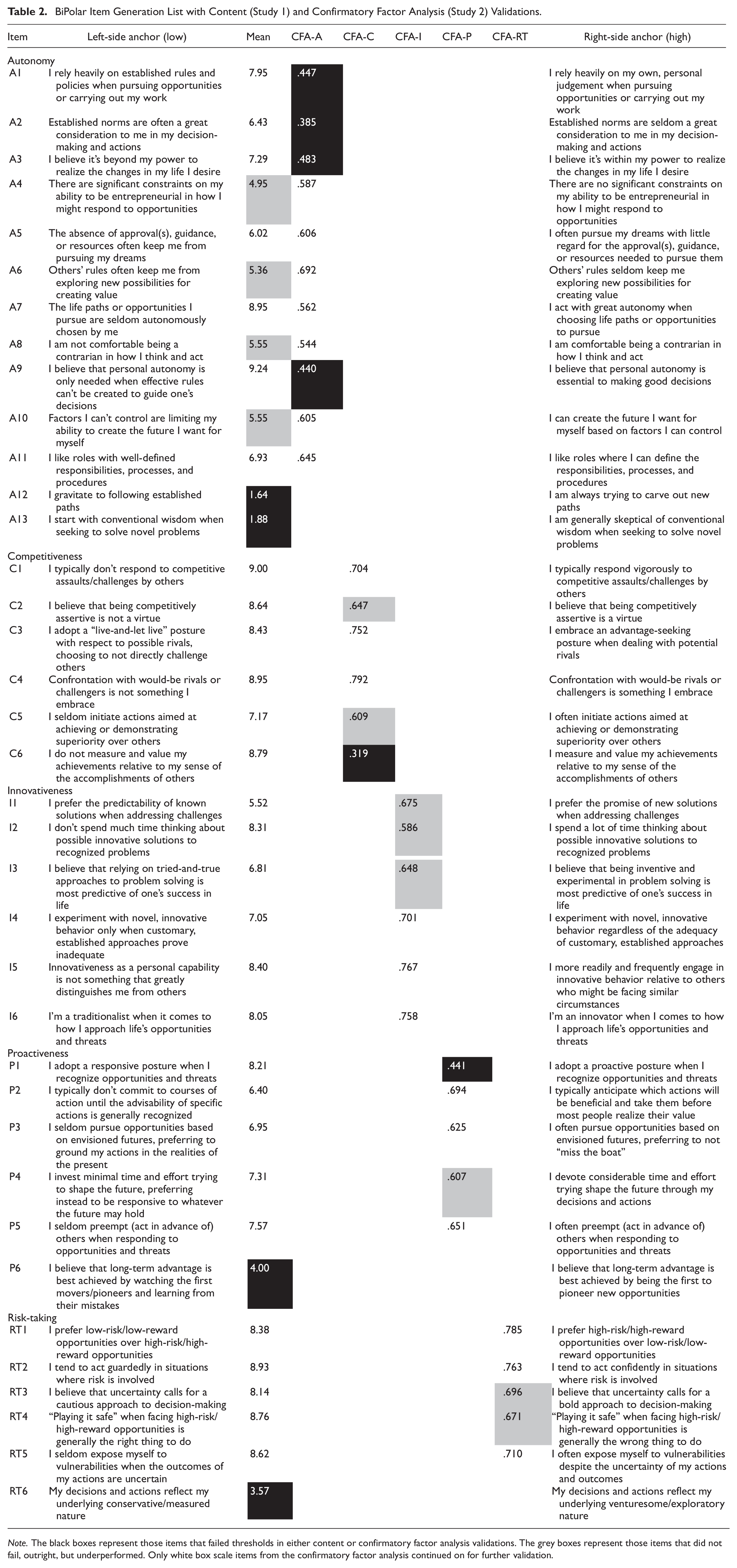
Note. The black boxes represent those items that failed thresholds in either content or confirmatory factor analysis validations. The grey boxes represent those items that did not fail, outright, but underperformed. Only white box scale items from the confirmatory factor analysis continued on for further validation.
For content validation, the research team considered the benefits and risks of approaching an expert panel. Generally, the argument here is that respondents should possess general intellectual ability for the task (Hinkin & Tracey, 1999; Schriesheim et al., 1993) and be a population of interest (Anderson & Gerbing, 1991). However, given the legacy of entrepreneurial orientation research and the complexity of the definitions, the authorship team approached two groups, those with academic research experience (PhD holders and PhD students) but without domain experience, and those with both academic research and domain (entrepreneurial orientation) experience. We approached 65 total academics from the research team’s professional networks representing a diverse sample of scholars; 31 without domain expertise and 12 with domain expertise ultimately participated.
Following the recommendations of Hinkin and Tracey (1999), the participants were asked to compare each scale item to each definition and rate the degree to which the item reflected the definition. The goal of this task is not only to determine and rate the effectiveness of the item for the desired construct, but also consider risks for conceptual confusion between the constructs: specifically, the item is intended to both measure the construct of interest and differentiate between that and associated constructs. Participants were asked to assign 10 total points to each item distributed across the five definitions (0–10) reflecting the degree to which the item aligned with each definition. This technique allows us to disaggregate items that reflect the one intended definition from those that do not, but also disaggregate those that could potentially reflect multiple definitions (two, three, four, or all five definitions), not just the one intended definition.
Recruitment occurred via email, and participants were directed to a Qualtrics survey link. The data were analyzed via means tests (ANOVA) for between-group differentials.
Study 1: Results
Each item was characterized as passing, underperforming, or failing. Failing items (4) were those where the item was not associated primarily and significantly with the intended construct. Underperforming items (5) were those where the item was not only associated primarily and significantly with the intended construct, but also consistently and significantly associated with a separate construct(s). Passing items (28) were only significantly associated with their intended construct. There were significant differences between the expert and non-expert groups on several items, in each case the experts tended to assign greatest intended construct certainty, where non-experts were more likely to assign points to multiple constructs. As such, the experts and non-experts agreed on construct fit direction, but not necessarily extremeness. There was no change in item characterization due to group differentials.
The research team decided to immediately remove the failing items but retain the underperforming items in the next study. This decision was made to reflect the fact that there are two possible explanations for the underperforming items: the item was poorly written or the five constructs part of Ind.EO may have inherent construct confusion; removing the items would not allow us to determine which was the case. Ultimately the underperforming items all failed through measurement model assessment, and the constructs were clearly identified with the remaining items.
Study 2: Measurement Model Specification
The purpose of measurement model specification is to better understand what the items actually (as opposed to are intended to) measure. This requires a dataset of actual responses to the items from a relevant population. The intended population for the Ind.EO scale is general; that is, Ind.EO exists in the general population. While individual researchers are likely to use the scale to better understand contextual behaviors and outcomes, those contexts do not define or restrict the instrument itself. For this purpose, for the initial examination of the instrument we drew from the United States working population at large, aged 18 to 65, having completed at least high school.
We employed Prolific Academic to recruit and provide incentives, and Qualtrics to collect the data. Six hundred and four individuals agreed to the initial solicitation from Prolific. The questionnaires were heavily scrutinized for formulaic, perfunctory, incomplete, or otherwise unreliable answers using a variety of techniques including reverse coding, distractor questions, and attention checks. Four hundred and ninety questionnaires were ultimately accepted for analysis.
The questionnaire consisted of the remaining 33 items (once the four failing items from study 1 were removed), and standard demographic questions. The items were randomized and the bipolar anchors were separated by a 7-point scale.
There is general disagreement about the utility of an exploratory factor analysis in scale development research (Carpenter, 2018; Tabachnick & Fidell, 2007; Thompson, 2004). It has the benefit of allowing researchers to consider alternative factor structures but has the risk that an alternative factor structure might be illusory and not supported by theory (Carpenter, 2018; Flora & Flake, 2017). In essence, when an EFA is supportive of the research hypothesis it is helpful, but when it is not it is likely more confusing than theoretically useful. That said, given the past debates around entrepreneurial orientations’ factor structure, and the potential that the theorized factor structure (Clark et al., 2024) may or may not be upheld by data, it was decided to conduct and report on an exploratory factor analysis. Of course, the more traditional confirmatory factor analysis was also conducted.
Study 2: Results
The exploratory factor analysis was somewhat ambiguous, in that while the five-factor solution had the best fit, two, three, and four factor solutions all had acceptable fit (Table 3), while the six-factor solution did not converge. Examining the change in chi-square between each model showed a significant improvement up to a five-factor solution, which has the best model fit statistics (CFI = .99, RMSEA = .03), supporting the notion that the current items are a good reflection of the theorized five-factor model, and likely covary.
Exploratory Factor Analysis of Study 2.

The confirmatory factor analysis (Table 2) found that most items aligned well with their intended factor. We employed a minimum threshold of .50 standardized factor loading for continuing to the next round of data collection. As a result, one proactiveness, one competitiveness, and four autonomy items were eliminated. From these findings, we have continuing evidence that our scale represents the intended five-factor solution consisting of autonomy, competitiveness, innovativeness, proactiveness, and risk-taking.
As the exploratory factor analysis did not provide strong fit for a one-factor solution, suggesting that a single-order scale was not ideal, we examined the model specifications for a second-order reflective–reflective model (Figure 2). In this model, the individual factors as defined in the confirmatory factor analysis loaded strongly onto a second-order Ind.EO factor, and the model fit statistics (CFI = .93, RMSEA = .07) were acceptable, suggesting measurement through five independent constituent factors coming together into a single Ind.EO was an appropriate model moving forward.
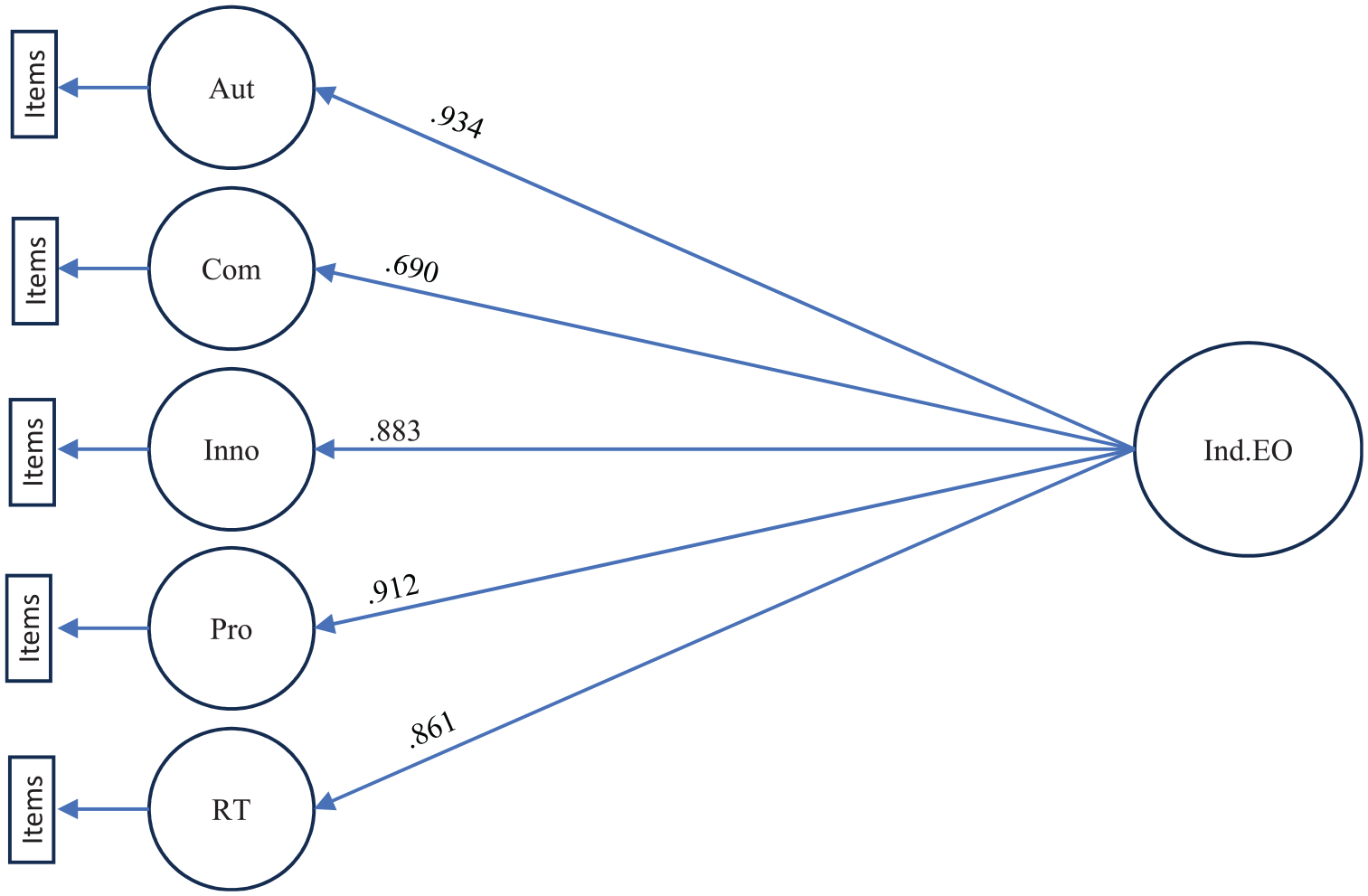
Second-order reflective model for Ind.EO.
In assessing the scale as a whole, the goal is an average variance extracted above .50 for each first-order construct, which requires the indicators to average .710 in their standardized model estimates. Given that respondent fatigue would be a significant issue in the next study, we removed items (see Table 2) where the standardized estimate was below .70 and not among the top three highest estimates for the construct. This left us with three indicators for each of competitiveness, innovativeness, proactiveness, and risk-taking. For autonomy, as there were 11 indicators and all had standardized model estimates below .70, we eliminated those items with standardized estimates below .50, leaving us with 7 autonomy indicators in the next study (Table 4). The final scale as considered for validation is provided in Table 5.
Study 3 Scale Items and Final CFA Model Estimates.
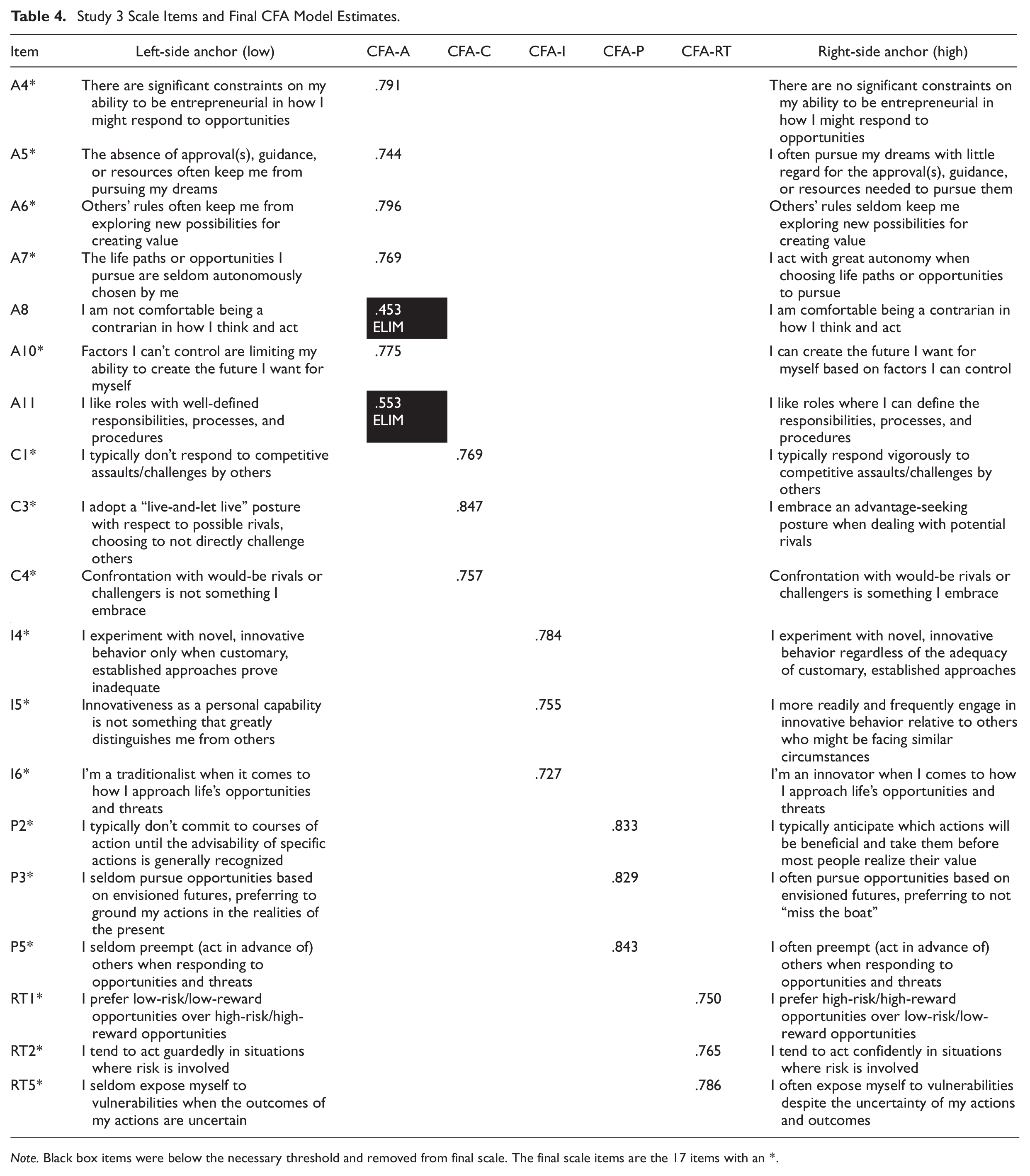
Note. Black box items were below the necessary threshold and removed from final scale. The final scale items are the 17 items with an *.
Final Scale Items.

These items may not all perfectly capture dispositions per se, as this term is formally defined (Oxford Dictionary: “a person’s inherent qualities of mind and character”), but they reflect personal outlooks or perspectives that affect whether individuals will be disposed toward entrepreneurial behavior.
Study 3: Validity Analysis
Critical to the validity of any scale is that it measures a phenomenon appropriately, with related constructs correlating (convergent validity) more closely than unrelated constructs (discriminant validity). To assess these forms of validity for the Ind.EO scale, we collected data from two relevant samples: entrepreneurs and professionals. Again, we used Prolific Academic to recruit respondents, and Qualtrics to capture the data, and we employed the same respondent validity checks. In this case, likely due to the more stratified sample and more generous incentive, 215 initiated surveys yielded 200 responses from entrepreneurs, and 209 initiated surveys yielded 200 responses from business managers. Respondents were recruited from six anglophone countries (the USA, UK, Australia, New Zealand, Ireland, and Canada). We examined the data for between-country differences in Ind.EO; none were observed, consequently the data were analyzed collectively.
There are two primary methods to examine discriminant and convergent validity, one using structural equation modeling (examining the relationships within the model), and the other by comparing the focal scale to other related and unrelated scales (Cheung et al., 2023; Jackson, 1969). Given the multitude of EO and entrepreneurship scales available, and the fact that we were using structural equation modeling to examine the factor structure, we elected to use both methods to confirm validity.
As described above, there were 19 items remaining in our Ind.EO scale. To consider validity, we compare the new scale against three groups of scales: those capturing elements of Ind.EO, those capturing general entrepreneurial tendencies, and those not related to entrepreneurship. Theoretically we expect the strongest correlations to be with the other Ind.EO scales (convergent validity), strong correlations with entrepreneurship scales (convergent and discriminant validity), and the weakest with the non-entrepreneurship scales (discriminant validity).
The scales with elements of Ind.EO were the Bolton and Lane (2012) individual entrepreneurial orientation scale and the Clark and Covin (2021) international entrepreneurial orientation disposition (IEOD) scale. The entrepreneurship scales we employed which were more “general domain” scales measured entrepreneurial self-efficacy (McGee et al., 2009) and entrepreneurial alertness (Tang et al., 2012). The other non-entrepreneurship-specific scales we employed measured locus of control (Mueller & Thomas, 2001), decision-making rationality and intuition (Epstein et al., 1996), social desirability (Strahan & Gerbasi, 1972), and personality (Rammstedt & John, 2007), along with the same demographic variables captured in Study 2.
In our analysis, to assess convergent validity through structural equation modeling, we follow the recommendation of Hair et al. (2021) and consider a construct converging when the average variance extracted for the indicators is greater than 0.5. 4 Due to recognized issues with the Fornell and Larcker (1981) process in assessing discriminant validity among reflective indicators, we employ the heterotrait–monotrait ratio developed by Henseler et al. (2015). This method examines the ratio of the geometric mean of correlations for each indicator with other indicators within the theorized construct to the geometric mean of correlations with other indicators outside the theorized construct; the recommended ratio threshold of (i.e., less than) .85 (Hair et al., 2021) indicates discrimination. To compare the validity across scales (multitrait-multimethod), we compare the AVE of the first-order constructs explaining Ind.EO against the correlations between Ind.EO and the other scales (Kenny & Kashy, 1992).
We also assess construct validity by examining whether Ind.EO aligns with theory. Specifically, Runyan and Covin (2019) proposed that entrepreneurial orientation likely differs from small business orientation (SBO) in the values held by the individual actor. Namely that when considered against the Schwartz value’s wheel, Ind.EO would be aligned with power, achievement, hedonism, stimulation, and self-direction values, while SBO aligns with universalism, benevolence, conformity, tradition, and security values. To test this, we also assessed Schwartz’s values (Lindeman & Verkasalo, 2005) among the respondents.
Study 3: Results
Prior to assessing the validities, we re-examined the confirmatory factor analysis of the 19 items (Table 4). In doing so, we recognized that two of the autonomy variables (A8 and A11) were underperforming (<.60). While they were clearly associated with the theorized construct, further analysis found that their cross-construct correlations were higher than others, suggesting that they were less strongly associated with autonomy than Ind.EO in general. As such, we removed them from further analysis of the Ind.EO scale which has 17 items moving forward, all with model estimates above the .70 threshold. The full 17-item scale has a Cronbach’s alpha of .90, indicating high reliability. However, the simple summation and averaging of the collective 17 items is not the appropriate measurement model for assessing Ind.EO because autonomy items are disproportionately represented within this item set. Instead, the means of the five subscales should be averaged in creating a second-order reflective–reflective scale (a.k.a. a reflective first-order, reflective second-order scale; see Figure 2). We also calculated Cronbach’s alpha separately for each of the five subscales: Autonomy (.88), Competitiveness (.83), Innovativeness (.80), Proactiveness (.87), and Risk-taking (.81); and for the second–order Ind.EO scale using the subscale means (.81). 5 Table 6 shows the correlations, means, and standard deviations for the calculated subscales and the overall Ind.EO scale.
Correlations, Means, and Standard Deviations Final Scale.

Note. Each of the subscales are reported as scale means, Ind.EO is the mean of the five subscales. The Cronbach’s alpha for the subscales and for Ind.EO the mean of the subscales is reported on the diagonal.
In Table 7, we show the heterotrait–monotrait ratios for the remaining indicators. The ratios range from .403 to .631, which are all well below the .85 threshold, providing strong evidence for discriminant validity. In Figure 3, we show the average variance extracted for the indictors on their theorized constructs. All are above the .50 threshold, ranging from .57 to .70, which is evidence of convergent validity (Hair et al., 2021).
Heterotrait–Monotrait Ratios Study 3.

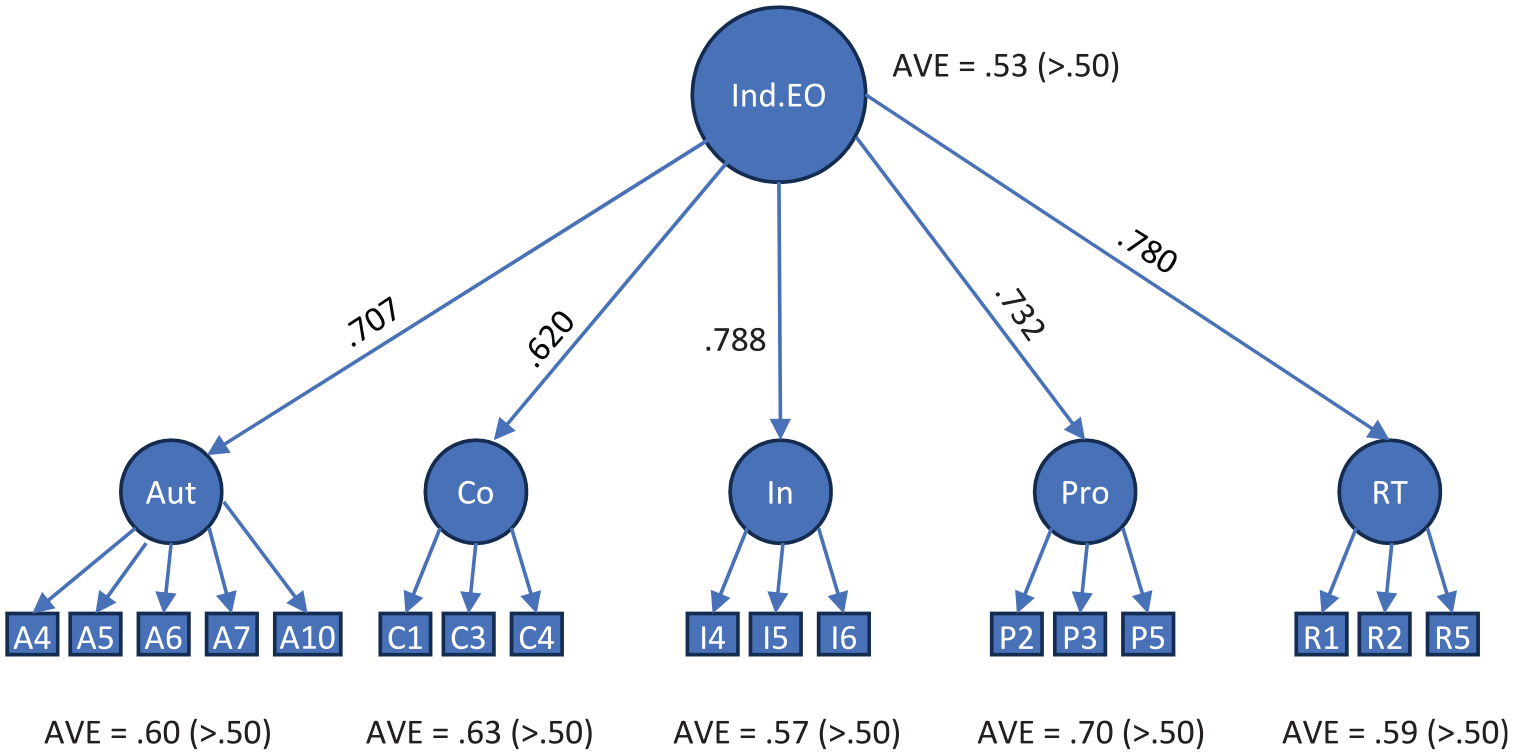
Average variance extracted by indicators and first-order constructs.
In considering Ind.EO with other constructs, we find further evidence of convergent and discriminant validity. In Figure 3, we see the average variance extracted by the first-order constructs of Ind.EO is .53 (which is above the .50 threshold recommended by MacKenzie et al., 2011), evidence of convergent validity. In Figure 4, we see the correlation coefficients of Ind.EO with IEOD (.454), Bolton and Lane (.417), entrepreneurial self-efficacy (.354), entrepreneurial alertness (.229), locus of control (.358), rational decision-making (.391), intuitive decision-making (.233), and social desirability (.077). As expected, Ind.EO is correlated most highly with the EO-specific scales advanced by Clark and Covin (2021)—the IEOD scale—and Bolton and Lane (2012), and less highly correlated with more tangentially related construct scales, which is evidence of discriminant validity.
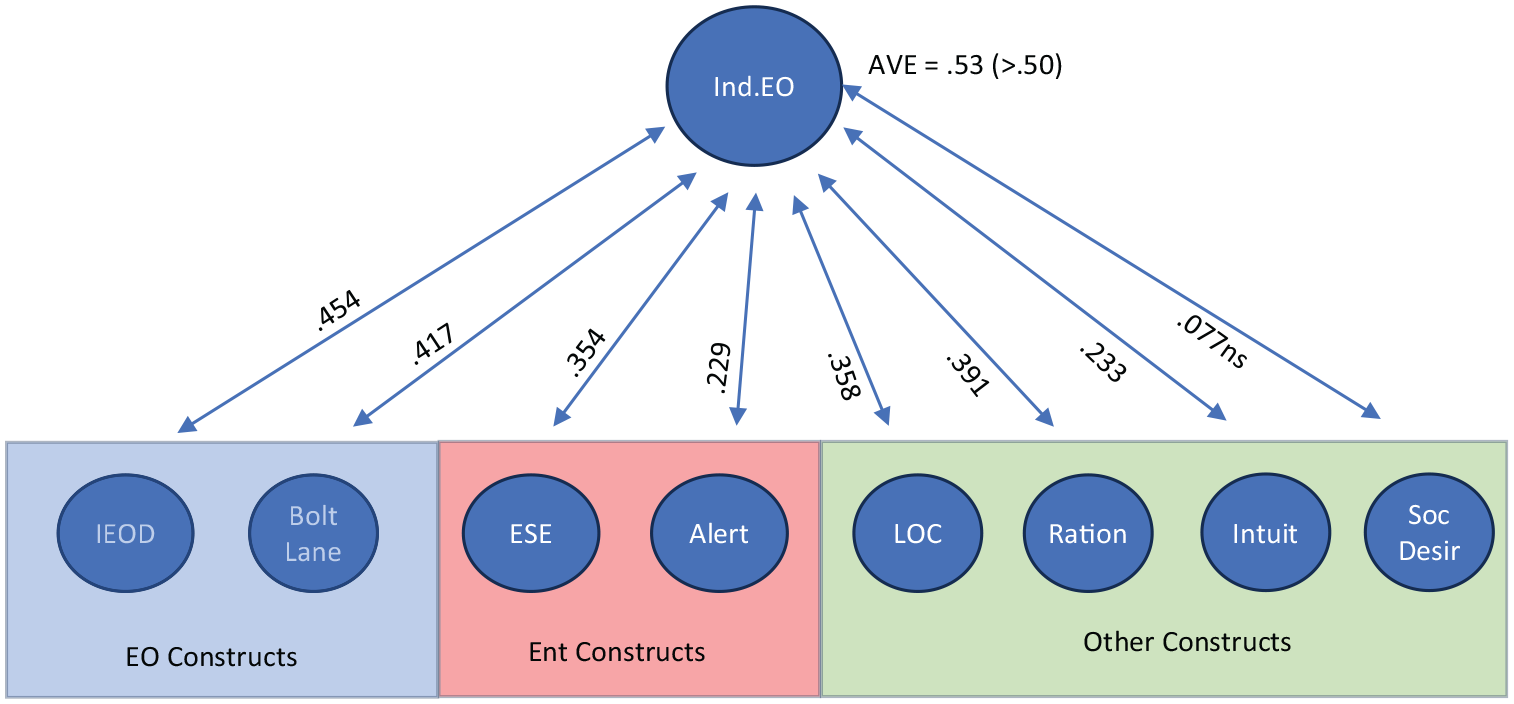
Ind.EO correlation with selected constructs.
In Figure 5, we find support for the theory of Runyan and Covin (2019). Ind.EO significantly aligns with power, achievement, stimulation, and self-determination values and is negatively associated with security. Moreover, the first-order constructs are shown to be associated with unique configurations of human values. In short, Ind.EO behaves as predicted by theory, which is evidence of construct validity.
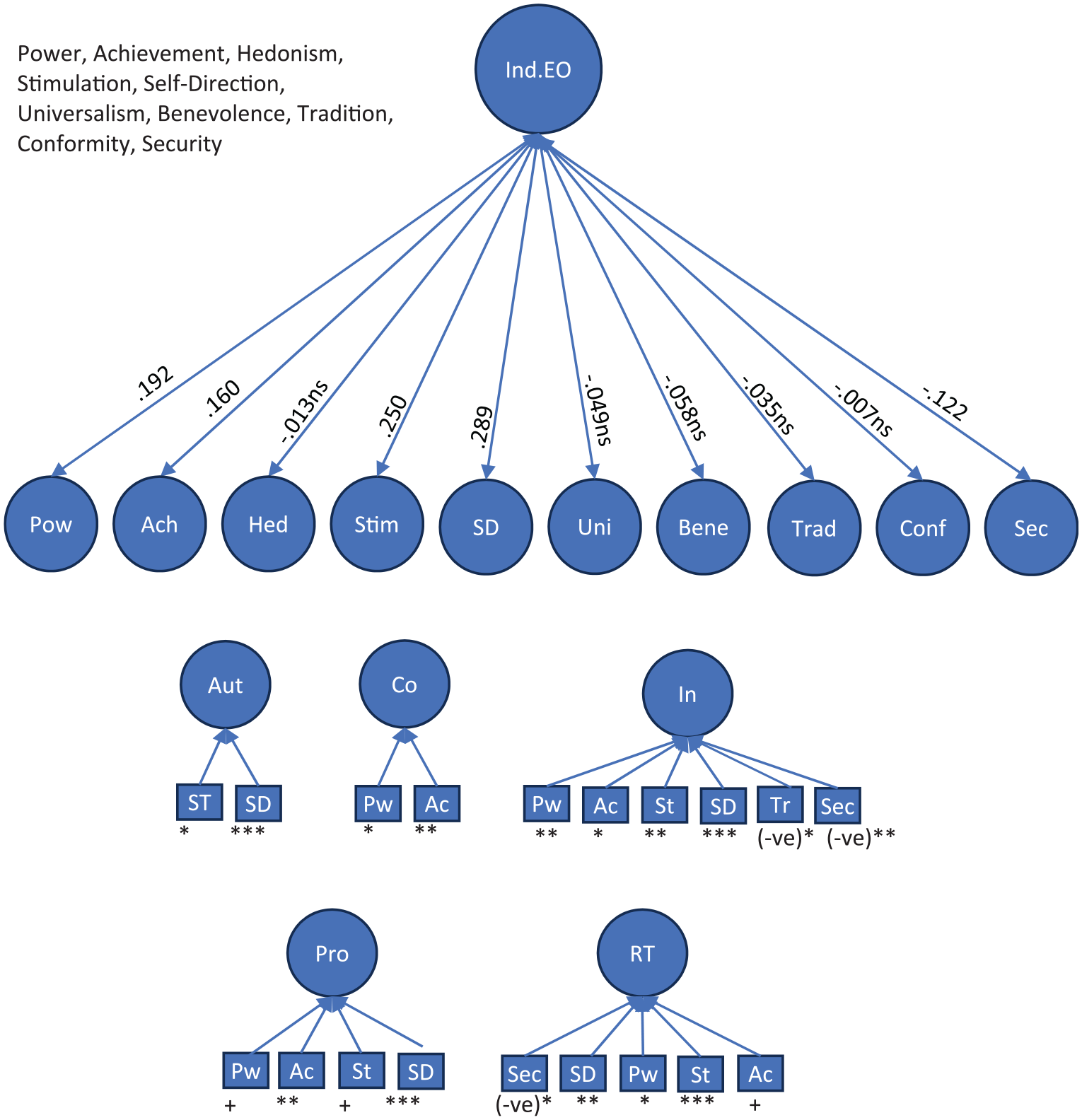
Ind.EO as explained by Schwartz values. ***p < .001, **p < .01, *p < .05, +p < .10.
Discussion
General Observations on the Underlying Theory and Use of the Ind.EO Scale
There are a number of specific measurement models that might be created from our efforts based on the facts that (1) the five EO subdimension scales all have acceptable alphas and might be treated as unique scales (enabling the treatment of Ind.EO as a profile construct [see Polites et al., 2012], as Lumpkin and Dess [1996] initially envisioned the construct of EO) and (2) those five subdimensions share significant variance, which enables them to be combined as a multidimensional construct of the superordinate variety. It is important to recognize that there is not a right or wrong measurement model but, rather, there are different degrees to which measurement models reflect the nominal meanings of constructs. In our manuscript, we adopt the Clark et al. (2024, p. 3) definition of Ind.EO—“autonomous, proactive, innovative, competitive, and risk-taking dispositions and behaviors that individuals exhibit when pursuing value-creating opportunities.” With this definition as the understood nominal meaning of the construct, one could choose to conceive of Ind.EO as a profile construct (emphasizing how individuals differ in terms of their entrepreneurialism as indicated by their scores across the five subdimensions) or as a superordinate construct (emphasizing the shared variance of the five subdimensions and ignoring the “specific” variances of those subdimensions as these are not relevant to a superordinate Ind.EO construct).
Moreover, one might also choose to ignore the identified autonomy and competitiveness subdimensions of Ind.EO and conceptualize this construct as, essentially, the individual-level analog of the “unidimensional/composite” EO construct advanced by Miller (1983) and Covin and Slevin (1989). Notably, this last conceptualization would only consider the shared variance of risk-taking, innovativeness, and proactiveness as representing entrepreneurial orientation at the individual level.
Questions about whether all five subdimensions of the EO conceptualization initially advanced by Lumpkin and Dess (1996) and further supported in reference to individuals (Lumpkin & Pidduck, 2021) are truly core to the EO/Ind.EO construct invariably arise when considering the construct (see, e.g., Morris et al., 2007; Gupta & Gupta, 2015). Our position is that constructs are what we define them to be and that this is, as it were, a “train that has left the station” based on the broad acceptance of Lumpkin and Dess’ (1996) EO conceptualization as one form of the EO construct (for a discussion of the divergent paths the EO conversation has taken, see Covin and Lumpkin [2011]). To this end, we have developed a measure for Ind.EO, but as others have shown there are other conceptualizations of entrepreneurial orientation at the individual level (e.g., Bolton & Lane, 2012). Given the psychometric properties of the scale, our items can be used to construct unique configurations as determined by the researchers. We consider two here.
It might be argued that autonomy can be considered an Ind.EO antecedent while competitiveness is but one way in which Ind.EO might be expressed and not the core of the construct. These can be viewed as legitimate criticisms, depending on the specific conceptualization of Ind.EO one chooses to adopt. More specifically, autonomy can indeed be viewed as an enabler of “being entrepreneurial” and thus modeled as an antecedent to Ind.EO; indeed, Pidduck, Clark, and Zhang (2024) recently found that among employees the individual’s autonomy enabled their entrepreneurial behavior. Nonetheless, autonomy is commonly conceived of as part of the EO construct. Notably, our data suggest that our final measure of autonomy, derived through factor analysis of the initial item set, consists of a subset of items that (1) reflect the nominal meaning of the autonomy construct, (2) hang together in an empirical sense, and (3) share variance with the other Ind.EO subdimensions. 6 Our autonomy subscale does not have to be included in all measurement models purporting to capture Ind.EO, and choosing to simply include measures of the risk-taking, proactiveness, and innovativeness subdimensions in one’s Ind.EO scale is perfectly acceptable if the aim is to seek parallels or relationship with the Miller/Covin and Slevin firm-level scale (see Covin & Wales, 2012) at the individual level.
Furthermore, competitiveness is not the only way in which being entrepreneurial might be expressed in a “strategic posture” sense; being entrepreneurial might also involve, for example, collaboration. Thus, just as one might take autonomy out of the Ind.EO construct and treat it as an antecedent condition, one might also take competitiveness out of the construct and recognize it as but one of several possible strategic postures through which being entrepreneurial is enacted. This insight does not undermine the legitimacy of our efforts aimed at advancing a measurement model that captures the Ind.EO construct as advanced by Clark et al. (2024). To this end, we did adopt Lumpkin and Pidduck’s (2021) reconceptualization of “competitiveness,” dropping the prior “aggressiveness” aspect. We believe this is an important distinction as an individual may be collaborative while also being competitive.
As a final comment on the matter of whether autonomy and competitiveness should be viewed as core to the Ind.EO construct—versus an antecedent and a particular strategic posture reflection, respectively—we note that innovativeness may be the only subdimension that’s truly core to “being entrepreneurial” (see Covin & Miles, 1999; Stevenson & Gumpert, 1985), with risk taking being variously inherent to innovation. The matter of whether proactiveness is also fundamental to being entrepreneurial is part of the EO conversation introduced by Miller (1983), rooted in his specific EO conceptualization. Our central observation is that there is no inherently and universally correct answer to what it means for an individual to be entrepreneurial. There are only understandings that will be variously or widely embraced by the scholarly and practitioner communities. We advance one set of measures that empirically correspond to the Clark et al. (2024) theoretical conceptualization of Ind.EO and that also offer measurement model flexibility to researchers.
Moving Ind.EO Forward: Scale Application
How do I use this scale, as conceived, in my research? Based on our analysis, to capture the disposition-based behavioral construct Ind.EO as described in Clark et al. (2024), respondents would be given all 17 items, but each subscale would have its own arithmetic mean calculated, and then a mean of the means calculated to represent Ind.EO. Ind.EO is offered and appropriately measured as a reflective/reflective second-order construct. The alpha coefficient for the overall Ind.EO scale should be computed using the five subdimension mean values as input (rather than all 17 items considered individually, as previously mentioned).
Notably, Lumpkin and Dess (1996) conceptualize their five subdimensions of EO—those operationalized here at the individual level—as components of EO represented as a profile construct (not a reflective first-order, reflective second-order construct) where high correlations among the subdimensions are not explicitly expected or required. Indeed, in one of the few original studies to measure all five subdimensions of EO as a firm-level construct, Hughes and Morgan (2007) reported minimal correlations among several subdimensions of their EO measure.
We mention this point in recognition that Ind.EO as currently conceptualized and measured is not perfectly analogous to the traditional Lumpkin and Dess (1996) conceptualization of EO, albeit operationalized at the individual level. Rather, we conceptualize Ind.EO as having shared variance across the five subdimensions, and our reflective first-order, reflective second-order measurement model reveals that the five subdimensions, operationalized as we have at the individual level and with the employed set of items, do in fact share variance. This conclusion is consistent with the Cronbach’s alpha of .81 for the second-order Ind.EO construct using the five subscale means as the reflective indicators. Historically, a common challenge of past Ind.EO research has been that the proposed theoretical and empirical meanings of the construct are not always well specified and appropriately aligned, which threatens the reliability of the research and the validity of any implications. We have stressed the importance of demonstrating consistency between the measurement model employed and the nominal meaning of the construct, and we encourage future researchers to do the same.
Can I use the subdimensions independently? Yes. One of the objectives of this article was to theoretically define and validate the scale for each disposition-based behavioral construct sub-dimension. As such, if one wants to research, say, a risk-taking or proactivity proclivity in isolation, those scale items are validated to operate independently of the other scales. That said, the predictive validity of the scales and the theoretical estimations of the subscales are not the same as those for “overall” Ind.EO. Indeed, it would be inappropriate to assume that the theory for Ind.EO can be narrowed to make predictions regarding a single subscale. Each subscale when used independently would require a unique theoretical story. That is, it would be inappropriate to perpetuate the problem observed in prior studies wherein researchers purport to study EO—in the current case, Ind.EO—as a wholistic construct, yet only consider the subdimensions independently and not as part of the larger EO construct (see commentary by Covin and Lumpkin [2011] and Covin and Wales [2012, 2019]).
Can I just use Risk-taking, Proactiveness, & Innovativeness together? Yes. Still, it is critical to note that as theoretically defined in Clark et al. (2024) and restated herein, risk-taking, proactiveness, and innovativeness alone (or collectively) do not fully represent the domain of the Ind.EO construct. That said, it is completely conceivable that one might want to employ only scales for those three subdimensions as they collectively constitute an Ind.EO analog to the Miller/Covin and Slevin firm-level EO conceptualization and measure. Indeed, the current results indicate that risk-taking, proactiveness, and innovativeness as herein defined and operationalized at the individual level do, in fact, share variance just as they are shown to do at the firm level when operationalized using the M/C&S scale. What will be critical in research moving forward is to note which measurement model is being employed and offer theory and definitions consistent with that model.
Is Ind.EO dispositional or behavioral? It is both. Theoretically, Ind.EO is a disposition to engage in certain behaviors which are then exhibited (Figure 1a), not a general disposition independent of the behavior. A purely dispositional scale could have considerable variance from the scale developed here (Figure 1b). However, we have taken the present approach because the essence of entrepreneurship is action (Frese, 2009; Gartner, 1988), and the disposition toward action is necessary and relevant to ensuring that entrepreneurial behavior is driven by the individual’s values and not happenstance (Figure 1c). To this end, the individual items for each subscale have dispositional and/or behavioral components with both being reflected within each subscale (Table 5).
As dispositions are defined as tendencies in waiting, we cannot divorce the disposition from the context. Individuals actualize their dispositions as behaviors rationally, but like any rational behavior the individual’s preferences (i.e., their dispositions) are the finger on the scale influencing both rational and intuitive decision-making. The individual can and will override their dispositional influences, when necessary, likely absorbing some cognitive stress in the process. It should be noted that the high alphas and covariances observed here suggest that divergences are a minor occurrence statistically. Furthermore, our scale’s computation (i.e., the scale or subscale mean item scores are used to create the overall scale value) guarantees that only individuals who have high scores on both the dispositional and behavioral items will be rated as exhibiting high Ind.EO levels, with lower Ind.EO scores being assigned to those individuals indicating moderate or mixed values (high on the dispositional items and low on the behavioral items, or vice versa) on the scale items.
Can I use more items? Yes. As we were developing the scale for Ind.EO, we were conscious of the value of being both parsimonious (minimizing respondent fatigue) while having a robust structural model. That said, there were “good” items from the initial set under consideration that were factorially sound, but that did not make our final threshold. Those items, however, could capture elements of the relevant construct that are theoretically meaningful yet underrepresented. To that end, it would not be irresponsible to use more items (see Table 2), particularly if the researcher is using only one subscale.
Can I use single items to represent the subdimension constructs when assessing Ind.EO? Some scholars may wish to routinize the collection of Ind.EO in their survey efforts (whether the focal constructs in a given study are about Ind.EO or not) as it represents a concise catchall instrument for “being entrepreneurial.” In light of this, it is conceivable that scholars may wish to simply include shorter versions of the scale to, perhaps, serve as a control variable (e.g., similar to the short form versions of the “Big-5’; Rammstedt & John, 2007). However, we would not recommend using single items from each subdimension to construct a “short form” version of the Ind.EO scale. In doing so, one would be assuming that the single item represents all the variance in the construct. The factor analysis performed here demonstrates that while each indicator is well-aligned with the intended construct, the maximum variance extracted by a single item is 71.7% (the minimum is 52%). Simply put, even with the most representative item, a lot of variance is being left on the table; meaning the degree to which the construct is captured by any one single item is limited.
Does the focal actor always have to be the respondent to the survey instrument? Yes. The present study has only validated this instrument for first-person self-assessment. That said, a third-person assessment would be a valuable tool for corroborating a person’s Ind.EO score. Scholars might develop third-person Ind.EO measures to assess the perceived EO levels of others, such as coworkers or inaccessible individuals. Indeed, constructing a scale to complement the present scale, perhaps by modifying some of the present scale items, could be a useful endeavor. Of course, such adjustments would need to be validated both internally and externally against the present first-person Ind.EO assessment (i.e., an individual self-evaluates and others conduct third-person evaluations, which are then compared) prior to deployment in formal research.
Research Implications and Theoretical Considerations
The M/C&S scale has played a vital role in establishing the existence, structural model, and importance of Entrepreneurial Orientation (Wales, Gupta, & Mousa, 2013; Wales, 2016). The present scale is aimed at providing similar validation for Ind.EO. More validation research is needed to confirm the psychometric qualities of the scale in diverse populations: across genders, ethnicities, countries, languages, religions, socio-economic backgrounds, etc. The present research was deliberately constrained to developed English-speaking countries, a fact that not only reinforces its validity and utility within that focal population but also raises the specter that its predictive utility is unknown beyond that population. A strong case can be made that Ind.EO is universal. However, it is plausible that cultural foundations may result in Ind.EO manifesting in different configurations and to differing degrees across societies (e.g., Kollmann et al., 2007). While a comprehensive discussion of these possibilities lies outside the scope of this article, it is worth noting some examples. Masculine-centric cultures (e.g., Japan, Germany) value competitiveness, achievement, and success, which aligns directly with Ind.EO competitiveness as conceptualized here. Conversely, feminine-centric cultures (e.g., Norway, Netherlands) prioritize quality of life and cooperation, potentially cultivating a less combative social milieu for all competition contexts (whether commercial or not). Thus, it is entirely possible that these national cultural values or norms permeate the ways in which certain groups of people approach being entrepreneurial (Pidduck et al., 2022) and exhibit an Ind.EO. It is also worth noting that much of the early individual EO work was done in Africa (Kropp & Lindsay, 2001; Frese et al., 2002; Krauss et al., 2005; Kropp et al., 2008), where results are reported that variously diverge from those found in subsequent Ind.EO research. The present validation work was conducted solely in anglophone developed countries. The necessity of assessing the possible existence and effects of Ind.EO cross-cultural measurement variance cannot be overstated—indeed as Pidduck and Clark (2024) highlight, cross-cultural psychology research suggests both values and norms can meaningfully shape forms of entrepreneurial cognition and behavior in pronounced ways.
The Ind.EO scale herein developed is based on a theoretical conceptualization and an empirical approach that differ from those adopted in the extant Ind.EO literature (i.e., the 71 studies described in Clark et al., 2024), such as the commonly employed Bolton and Lane (2012) scale. Future researchers are, of course, free to choose whichever Ind.EO scale best suits their purposes, with the Ind.EO scale being offered as a potentially appropriate option. Still, we advise caution and stress that other similar scales (see Table 1) do not explicitly link entrepreneurial dispositions with corresponding behaviors, as is essential to what the current research presents as “being entrepreneurial.” Thus, despite apparent similarities with certain pre-existing scales, the Ind.EO instrument might yield significantly different findings than those resulting from alternative, variously similar measures. In all cases, researchers should be explicit in their theory and the methodological choices they adopt.
Notably, the proposed five-dimension measure of Ind.EO is consistent with Lumpkin and Pidduck’s (2021) advocacy of a beliefs-behaviors five-dimension EO framework. Still, our research goes beyond this prior work by recognizing that the dimensions can be operationalized in ways that demonstrate their empirical relatedness (vs independence). Lumpkin and Dess (1996) introduced the five-dimension EO construct with an eye toward demonstrating how entrepreneurial firms can be different from one another, emphasizing that the five dimensions need not covary in unison. With our Ind.EO scale, we empirically demonstrate that these five dimensions can also be highly related, at least at the individual level.
Clark et al. (2024) outlined a future research agenda for Ind.EO, and we will not repeat that here. However, the role of specific individuals as actors for entrepreneurship has long been a controversial topic (e.g., Gartner, 1988; Ramoglou et al., 2020), with some arguing that entrepreneurially minded individuals are critical (Kuratko, 2017), others saying anyone with a basic level of intelligence and knowledge can be entrepreneurial (Shane & Venkataraman, 2000). Ind.EO possesses tremendous potential to clarify and even resolve this debate, but not until researchers establish what Ind.EO predicts and under what contextual and boundary conditions. Uniquely, Ind.EO was conceptualized by Clark et al. (2024) to be useful in understanding behavior within firms, establishment behaviors, and individual behaviors. These three contexts, potentially sharing the same actor, will generally require independent study: likely tripling the research agenda relative to other single context new constructs. It is only through that research across contexts that we will understand the benefits, risks, and unique endowments of Ind.EO, and consequently of the individual within entrepreneurial action.
Ind.EO was theoretically proposed as a member of the EO family of constructs (Clark et al., 2024). That said, best practices as to how to study Ind.EO alongside EO and other family members have not yet been defined, but future research exploring the relationship between Ind.EO and these constructs is particularly fertile ground. We note that Ind.EO is likely useful as an agent-level variable, either as a participant-level control or a hierarchically nested variable within firm-level EO research. Sorting out the interdependent and potentially confounding individual- and firm-level EO manifestations should be a top priority among researchers seeking to understand EO as a multi-level phenomenon. However, measuring Ind.EO and EO from the same respondent has peril, and should be done with theory-based direction, methodological caution (e.g., time-lagged data collection), and reporting transparency (i.e., over-report individual-level analysis comparing Ind.EO to EO). On this matter, we caution researchers to not conflate the Ind.EO levels of top managers with, for example, those individuals’ entrepreneurial top management style levels (see Covin and Slevin, 1988) or with pioneering-innovative management (see Khandwalla, 1985, 1987), as these latter constructs and their associated measures ground entrepreneurship specifically in a managerial context. Ind.EO, on the other hand, is conceptualized as a context-free construct. While high Ind.EO levels may be associated with the employment of entrepreneurial top management styles and high pioneering-innovative management levels, these are not equivalent constructs. Investigations of the extent to which Ind.EO is associated with particular management styles as well as with EO as a firm-level phenomenon are warranted.
As argued by Wales et al. (2020), our understanding of entrepreneurial firms is dependent upon being able to assess entrepreneurship as a multi-level phenomenon. We encourage scholars probing the nuances of EO within firms to ideally capture both the firm’s EO and the Ind.EO of focal actors within the organization (e.g., founders, CEOs, executives, other employees, etc.). There may be circumstances where access to organizations provides opportunities to gather both primary survey data at the individual EO level and archival text data from which to measure firm-level EO (implying a research design that would circumvent common source bias). As such, the currently proposed Ind.EO scale and existing CATA-based measures of EO (see, e.g., McKenny et al., 2018; Short et al., 2010) might serve as useful complements when studying EO as a multi-level phenomenon and using hierarchical modeling approaches.
Along this same line of thought, traditional survey-based measures of firm-level EO—such as the Miller/Covin and Slevin (1989) and Hughes and Morgan (2007) scales—might be used to complement possible CATA-based measures of Ind.EO. On this matter, we encourage researchers to develop and employ CATA-based measures of Ind.EO that include both dispositions and behaviors, employ a theoretically relevant and consistent factor structure, and explicitly target the individual (rather than the firm) as the relevant unit of analysis. While many of the specific words in current CATA measures of firm-level EO may also be relevant to assessing Ind.EO, we caution the use of these same words without careful consideration of whether they are applicable at the individual level. Moreover, narrative texts are likely rare that are both readily available and detailed enough to meaningfully employ CATA for Ind.EO measurement purposes. Nonetheless, it is possible that “about me” pages on entrepreneur websites, LinkedIn bios, or even published work written by the individual could be fruitful for such assessments.
As a final discussion point, it is likely that “being entrepreneurial” means something slightly different for people versus organizations. That said, the ways in which competitiveness and autonomy are manifested among individuals may have no direct or substantively equivalent analog in the context of organizations. This inequivalence may account for the ease and appropriateness with which one might conceptualize the five dimensions as reflecting one (superordinate) construct or a five-dimension profile construct in the contexts of individuals versus organizations. A deeper exploration of these two components of Ind.EO and their relationship to the traditional three dimensions may be interesting and produce unique insights about possible contextual differences for Ind.EO. For example, do varying levels of autonomy or competitiveness have relevance for those working within versus outside of traditional firms, or among those in leadership versus team member roles (e.g., Tjosvold et al., 1983)?
In conclusion, we argue that prior literature has yet to offer a widely agreed-upon definition and closely corresponding measure what “being entrepreneurial” means in an operational sense at the individual level. Certainly, there can be diverse perspectives on this matter, with no single perspective ever being “right” in an objective sense. We enter this conversation with an eye toward building from the Clark et al. (2024) conceptualization of Ind.EO, which itself strongly leverages past work in the area. Our intended contribution is to add what we hope will be seen as a theoretically unique, defensible, and useful measure to the toolbox of entrepreneurship researchers, thereby enabling new and important advancements to EO knowledge.
Footnotes
Acknowledgements
The authors would like to acknowledge the invaluable feedback of our editor William Wales and the three anonymous reviewers; they substantially improved this article, and we are thankful. We would also like to thank our many colleagues who were kind enough to help us evaluate the content validity of our scale, their support and friendship is cherished. We are also grateful for the help of Lauren Pastor during the early scale development work. Finally, Tom Lumpkin, our coauthor on the first paper, has remained a supporter, friend, and informal contributor to this present work, we appreciate his involvement.
Declaration of Conflicting Interests
The author(s) declared no potential conflicts of interest with respect to the research, authorship, and/or publication of this article.
Funding
The author(s) disclosed receipt of the following financial support for the research, authorship, and/or publication of this article: This research was supported through a Social Sciences and Humanities Research Council (SSHRC) grant, 435-2023-0240.
