



Abstract
Entrepreneurial orientation (EO) is an important construct in the fields of management and entrepreneurship research. Interest in EO knowledge continues to thrive with a burgeoning research agenda in multiple contexts and with diverse implications. However, a subset of this research, which endeavors to apply the EO construct to explain or predict individuals’ entrepreneurial beliefs and behaviors, has met with resistance. This paper examines the case for EO at the individual level (Ind.EO). We consider the EO legacy concerns, and the various theoretical implications and benefits of doing so. Drawing upon an “EO as a family of constructs” framework, we propose paths forward for studying Ind.EO credibly, consistent with, but distinct from, traditional firm-level EO. Finally, we outline a research agenda and discuss the contributions and potential implications for Ind.EO research across the wider entrepreneurship discipline.
Keywords
EO is a firm-level construct. End of story. Any application at a higher or lower level of analysis is just sloppy science (Anonymous reviewer comment)
Introduction
Entrepreneurial orientation (EO) is one of the most widely studied constructs in management, with a recent review counting almost a thousand articles to date (Wales et al., 2021). Central to its growth and appeal is EO’s relevance for understanding firm behavior (Wales, 2016). Indeed, the EO lens has been applied in a wide array of organizational contexts including, but not limited to, new ventures, social enterprises, NGOs, schools, government departments, indigenous tribes, and churches (Corrêa et al., 2022; Lumpkin & Pidduck, 2021). Rooted in the work of Miller (1983; Miller & Friesen, 1982; 1983), who introduced the concept of an entrepreneurial strategic orientation, EO has been embraced by both the strategic management and entrepreneurship literatures. The development of a scale (Covin & Slevin, 1986; 1988; 1989) and an Academy of Management Review article (Lumpkin & Dess, 1996) contributed to its popularity. With these conceptual and empirical works widely embraced, researchers the world over were comprehensively equipped to study entrepreneurial behavior.
Or were they? Within a few years of the publication of the Miller (1983)-inspired Covin and Slevin (1989) scale (hereafter M/CS scale), researchers—noting the individual-level connections to EO (i.e., founders as key decision makers, individual executives as firm strategists, etc.)—were extending EO to individuals (e.g., Becherer & Maurer, 1997; Smart & Conant, 1994). These efforts attracted considerable pushback from organizational researchers concerned that individual-level EO research weakened the construct by “muddying the waters” of an organization-level construct (e.g., Covin & Wales, 2019; George & Marino, 2011). Despite this resistance, the importance of the individual to firm-level outcomes and the utility of considering multilevel manifestations of EO have been part of the EO conversation since its earliest history (e.g., Covin & Slevin, 1991). Moreover, multilevel conceptualizations of EO that include the individual level have continued to find traction among researchers (e.g., Wales et al., 2011; Wales et al., 2020; Wiklund & Shepherd, 2011). Some prominent authors have taken issue with specific individual-level EO (hereafter Ind.EO 1 ) studies (e.g., Covin & Miller, 2014) while others have lamented that such studies are engaging in construct stretching (e.g., George & Marino, 2011).
Despite these influential critiques, the extent of interest, reflected by the prevalence of Ind.EO research in quality journals, is burgeoning (e.g., Keil et al., 2017; Kraus et al., 2019; Martins & Perez, 2020; Santos et al., 2020; Shirokova et al., 2022). Perhaps most telling, EO research has now reached a critical mass such that scholars from psychology (DeGennaro et al., 2016), education (Bolton & Lane, 2012), anthropology (Holmes et al., 2019), public policy (Meynhardt & Diefenbach, 2012), and elsewhere are also making valuable advancements to EO scholarship at the individual level. Indeed, in a concise review of the Ind.EO literature herein, we found 71 articles published since 1994 across a range of disciplinary journals conceptually applying and/or measuring EO within the context of individuals, not firms.
These insights, if they are to be regarded as legitimate contributions to the broader EO body of knowledge, bring us to our central question: Is it both legitimate and value adding to study EO at the individual level? This is especially relevant considering the proliferation of individual-level constructs in the entrepreneurship literature that, in some shape or form, contribute to our understanding of how entrepreneurship is expressed among individuals. The concern is that any newly proposed individual-level manifestation of the EO construct be substantially unique to meaningfully advance conversations for both EO and entrepreneurship research writ large. The purpose of this paper, therefore, is, in part, to tackle longstanding tensions and objections in Ind.EO conversations. To do this, we consider five core topics central to delineating the future credibility and scientific utility of this persistently growing area of EO research. First, The Case for Ind.EO: A Brief Historical Primer—we probe the appropriateness of studying EO at the individual level from the perspective of prior EO research and theory. Second, The EO Family—we examine Ind.EO as shared “genetic material” with common beliefs and behaviors in specific contexts and across levels of analysis. Third, A Dispositional Beliefs–Behaviors Basis for the Ind.EO Construct—we delineate the theoretical implications of what an Ind.EO construct might look like including a definition of Ind.EO: Autonomous, proactive, innovative, competitive, and risk-taking dispositions and behaviors that individuals exhibit when pursuing value-creating opportunities. Fourth, The Boundary Constraints of EO and Intersections of Ind.EO is investigated—an examination of four types of individuals—independent individual, top manager, structural participant, and strategic-initiative leader—including how they could potentially add new value, both independently and to other EO family members. Fifth, Key Research Areas—a future research agenda with the goal of helping future scholars in the Ind.EO stream avoid theoretical and empirical pitfalls and create new EO knowledge.
This work stands to make several important contributions to the entrepreneurship and EO literatures. First, we articulate a path for researchers, using the above nominal definition, to study entrepreneurial individuals independent from, yet consistent with, the study of the firm. As such, we consider the individual within the traditional realm of EO (e.g., Wales et al., 2011) and identify four distinct and critical entrepreneurially-minded roles. Second, we identify and fill a unique need for a new individual-level construct, explaining what it means for a person to be entrepreneurial irrespective of how or where it manifests (Clark & Covin, 2021; Pidduck et al., 2023). Third, to build a comprehensive foundation for future Ind.EO research, we construct a “past, present, and future” perspective of Ind.EO. With 1 in 15 EO papers, to date, being at the individual level, we comprehensively detail the extant body of Ind.EO research, to allow future scholars to examine the work to date and provide the tools to critically consider the questions that have been asked, and which have indeed been answered.
The Case for Ind.EO: A Brief Historical Primer
Understanding the mechanisms and motivations underlying entrepreneurial behavior has challenged the entrepreneurship research community for decades. The EO construct emerged as an important contributor to the development and evolution of that research conversation because it offered both a conceptual tool for describing what it means to be entrepreneurial and an empirical framework for making predictions about performance (Lumpkin & Pidduck, 2021). EO was developed to portray the phenomenon of firms “being entrepreneurial” (Covin & Wales, 2019; Lumpkin, 2011, p. 4)—attitudinally, behaviorally, or both (cf. Anderson et al., 2015). Miller (1983) recognized that some organizations adopt an entrepreneurial strategic orientation: they exhibit risk-taking, proactiveness, and innovation to greater degrees than their rivals. This perspective was further developed and codified by Covin and Slevin (1988, 1989), via the widely used unidimensional M/CS EO scale. Lumpkin and Dess (1996) subsequently introduced two additional elements to EO: autonomy and competitiveness (originally competitive aggressiveness). The discussions around the Covin and Slevin and Lumpkin and Dess conceptualizations of EO were enormously informative in defining and drawing explicit attention to what EO is and the source actors that manifest it, namely, individuals (e.g., Wales et al., 2011).
The crux of the ongoing controversy for studying a form of EO at the individual level is about the appropriateness of drawing on a construct originally modeled and theoretically defined on the strategic attributes of firms and applying it “back” to individuals. However, this “back application” critique is typically made against the backdrop of the history and development of the firm-level EO construct—a strategic, macro-centric frame of reference (e.g., Mintzberg, 1973). Conversely, scholars who focus primarily on individuals see entrepreneurs as individual actors and entrepreneurial traits as originating in them—a more eclectic, micro-centric frame of reference. With this lens, extending from individual- to firm-level attributes is not only plausible but preferable as the individual is viewed as the source of firm-level EO; thus, studying the source to understand EO emergence is logical. From this latter perspective, the idea that there is a controversy about using EO at the individual level can seem both confusing and a somewhat artificial obstacle to have to overcome and justify foundationally with every additional Ind.EO research effort. Despite this, a body of research, within and beyond management studies, emerged and spread across a wide variety of journals (see Lumpkin & Pidduck, 2021) that used an EO framing to pursue questions about people “being entrepreneurial.”
Multiple attempts have been made to extend the EO construct to individual entrepreneurs employing a variety of methodological approaches, including adapting the M/CS scale for entrepreneurs (e.g., Becherer & Maurer, 1997); creating new individual assessments of risk-taking, proactiveness, and innovation (e.g., Bolton & Lane, 2012); employing M/CS on a single top management team (TMT)-member respondent (e.g., Shirokova et al., 2022); generating surveys based on Lumpkin and Dess’s (1996) five dimensions (e.g., Hughes & Morgan, 2007 2 ); developing entirely original conceptualizations of individual EO (e.g., Smart & Conant, 1994); and, most recently, embracing an upper-echelon perspective and suggesting firm EO and CEO’s Ind.EO are effectively equivalent (e.g., Keil et al., 2017). These attempts have been largely derided as “concept traveling” by some in the EO community (e.g., George & Marino, 2011). Others, however, recognize that while EO in its original formulation is a firm-level construct, it exists in a multilevel ecosystem influenced by both individual and environmental forces (Krieser et al., 2002). As such, it is understandable that researchers would believe that considering the individual-level antecedents to, and repercussions from, firm-level EO would enrich our understanding of EO generally.
Herein lies our argument that it is indeed “okay” to study Ind.EO: the need is not for a construct to study individuals per se, but to study individuals within the EO framework and as part of the EO family so that insights can be understood in relation to past, present, and future firm-level EO research. Yet, questions remain: “Is it really EO?” or “Why call it EO?” We submit that the EO label—sometimes attached to more specific phenomena such as Ind.EO (herein), institutional EO (Cowden & Tang, 2022), international EO (Covin & Miller, 2014), social EO (Gali et al., 2020), etc.—is generally and appropriately applied when studying the nature of “being entrepreneurial” in a cohesive way. Our argument acknowledges that being entrepreneurial can occur among diverse actors and at multiple levels of analysis, including individuals, within as well as outside of firms.
Indeed, along these lines, two of the EO literature’s most prominent contributors have both recently and independently explored individual-level manifestations of EO. The two research “camps” these researchers represent, like their historical perspectives on EO, have taken different yet complementary approaches, making two different sets of assumptions conceptualizing and actualizing Ind.EO. Covin and colleagues developed two new scales, one for individuals and teams (Covin et al., 2020) and another for international entrepreneurship (Clark & Covin, 2021), exploring individual-level precursors to EO. Lumpkin and colleagues have extended the view that EO can be used to conceptualize the methods, practices, and decision-making styles used to act entrepreneurially to the individual level (Lumpkin & Dess, 1996) including the pre-organizational phase of entrepreneurship which involves individuals being entrepreneurial prior to firm founding (Lumpkin & Pidduck, 2021). Both approaches are similar in two critical perspectives: they are closely aligned with and seek to explain how EO might manifest in individuals; and they recognize the necessity of bridging cognition and behavior—regardless of the distal outcomes of eventual interest (such as firm performance).
That said, the approaches have produced different results and collectively contribute confusion about what Ind.EO might be. The new Covin and colleagues’ scales capture a pattern of individual disposition and tendencies that specifically align with the most widely used model of firm EO. Lumpkin and Pidduck (2021) have described a bifurcated model of entrepreneurial beliefs resulting in entrepreneurial behaviors that can manifest within individuals as well as within an existing firm, a new venture, or at other levels of analysis. Both approaches do, to some degree, draw from the original conceptualization of EO, as with all Ind.EO research to date 3 : they seek to account for the effect of individuals who are embodying entrepreneurial attributes. The implicit assumption here is that in both firms and individuals, “being entrepreneurial” is synonymous and roughly equivalent. The Ind.EO that we propose, both conceptually and in nomenclature, allows for conceptual alignment as well as maintains the clarity and distinctions between EO’s origins (i.e., an organization) and manifestations of Ind.EO. As such, Ind.EO manifests when individuals think and behave entrepreneurially.
Despite the progress made to date, there is still considerable ambiguity regarding Ind.EO and its theoretical origins. Ind.EO has the challenge of representing the beliefs and behaviors of the individual actor independently and explaining their configurations within the context of the firm. Toward reconciling these distinct perspectives, studies have begun efforts to conceptualize Ind.EO as consisting of entrepreneurial beliefs and behaviors that vary independently (Pidduck et al., 2023). To enhance understanding, in the following section, we seek to reconcile this perspective with the notion of EO as a family of constructs.
The EO Family
In a 2011 Entrepreneurship Theory and Practice special issue on entrepreneurial orientation, George and Marino argued that “the field would be better served by considering EO as a conceptual family of constructs” (2011, p. 995). This is a critical insight and serves as a core premise of the present work. Although George and Marino were somewhat vague what the conceptual commonalities uniting the family might be, their comment sparked a conversation among EO researchers that continues today. In their reaffirmation of this notion, Covin and Wales interpreted the EO family primarily within the firm level of analysis, respecting multiple conceptualizations of “what it means in an operational or behavioral sense for a firm to exhibit entrepreneurship as an organizational attribute” (2019, p. 11). Later, Wales (2016, p. 6) introduced the metaphor of EO as a “tree,” with a conceptualization of EO as “various ‘branches’ within the EO ‘family’, where all ‘branches’ stem from the same conceptual dimensional ‘trunk’.”
While the EO family clearly includes Ind.EO, what is less clear is what role it plays in the family, with everything ranging from parent to distant cousin, in play. Rather than continue and try to harmonize this discussion, we pose a different question: What is the “genetic material” that unites the family? George and Marino seem to suggest that the “genes” can be found in the M/CS scale and consist of risk-taking, proactiveness, and innovativeness. But what does that mean? Miller (2011) argues that as originally conceptualized EO is a combination of beliefs or attitudes held by individuals and behaviors exhibited by firms. Lumpkin and Pidduck (2021) extend this idea arguing that individuals possess beliefs which influence their patterns of behaviors. This suggests that the genetic material that members of the EO family share is the relationship of beliefs and behaviors that results in “being entrepreneurial.” In other words, at any and all levels—branches, stems, or however it is conceptualized—EO, at whatever level it is studied, manifests in entrepreneurial beliefs and entrepreneurial behaviors linked in an interactive nexus. According to this view, beliefs, attitudes, or intentions alone (e.g., entrepreneurial intention; Krueger & Carsrud, 1993) are insufficient to account for EO, as those with entrepreneurial orientation indeed act. Likewise, behavior alone is insufficient to explain EO because those with entrepreneurial orientation are not “accidental entrepreneurs” (Shah & Tripsas, 2007) but base their actions on beliefs. Consequently, as we elaborate later, when deciding how to extend the EO family, a beliefs→behavior nexus is critical.
In Figure 1, we integrate Ind.EO into an interactive framework of the EO family, where Ind.EO can stand alone (as in the case of individual venturing) or interact with firms or teams to influence collective behaviors. We build on the image of nesting found in Wales et al. (2020) who proposed a multilevel framework with a TMT nested within an organization nested within a market—suggesting that firm EO originates from the Ind.EO level. Collectively, entrepreneurial behaviors exist within the contextual influences of institutions, cultures, and industries. All actors influence the environments in which they exist; however, the proportional giving and taking of EO influence is likely variable based on a host of factors (e.g., number of actors, relative competitive position, resources, etc.); as such, while individuals likely influence their teams and firms significantly, firms usually have a greater influence on the environment than an individual. Similarly, for the individual the relative exterior influence of their Ind.EO will vary based on whether they are within a firm (and their position) or acting alone, the degree of social standing or notoriety, and/or their resources; as such, firms are more likely to be constrained by industry norms than individuals, which is why individual entrepreneurs are more likely to be “rule-breakers” (Arend, 2016). As such, the framework is highly dynamic and idiosyncratic with the directionality and strength of the influences variable, contingent on the actors.
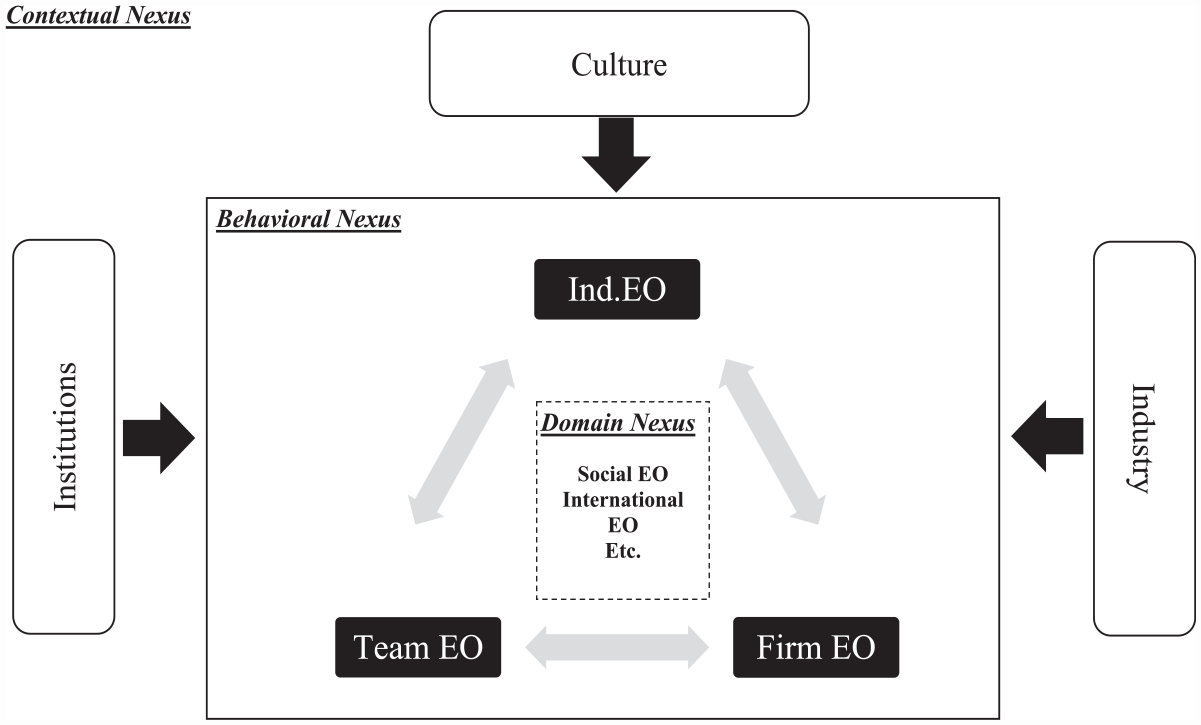
Conceptual framework of the EO family.
A Dispositional Beliefs–Behaviors Basis for the Ind.EO Construct
To better understand the need for utility and form of a systematic Ind.EO construct we conduct a literature review of papers explicitly studying EO at the individual level. While a comprehensive review lies beyond the scope and intention of this work, 4 our aim was to gain insights into the types of individuals who are being studied and how Ind.EO is conceptualized. Our findings illustrate Ind.EO research has gained popularity and there is considerable (and growing) research interest in an individual-level conceptualization of EO. But also, across the various studies, there is a lack of conceptual consistency. Thus, there is a clear need and utility in incorporating Ind.EO within a single EO framework such as the proposed EO family of constructs.
In this section we articulate a conceptualization of Ind.EO and why it is a distinct individual construct belonging in the EO family of constructs. To begin, it is useful to consider the evolution of the EO concept generally. Its current status is informed by two early views of EO. On one hand, EO consists of beliefs and attitudes that are dispositional—that perspective dominated Lumpkin and Dess’s formulation of EO as a mindset (Lumpkin & Dess, 2001) or “frame of mind” (Dess & Lumpkin, 2005). On the other hand, Covin and colleagues have consistently emphasized the behavioral nature of EO arguing “behaviors rather than attributes are what give meaning to the entrepreneurial process” (Covin & Slevin, 1991, p. 8) and defining EO in terms of “a sustained pattern of entrepreneurial behavior” (Covin & Wales, 2019, p. 5). These views were reconciled in a 2011 article by Covin and Lumpkin which argued that EO is both dispositional and behavioral (Covin & Lumpkin, 2011). They suggested, in essence, that a beliefs-based dispositional view of EO is akin to an entrepreneurial mindset but that is insufficient to explain how EO operates, and also acknowledge that, even though actions are driven by the beliefs and values that ensure consistency, those cognitions alone do not constitute EO unless they are reflected in patterns of entrepreneurial behavior. Thus, what separates EO from an entrepreneurial mindset (e.g., Davis et al., 2016) on one hand and entrepreneurial action (e.g., Alvarez & Barney, 2005) on the other hand is that it combines beliefs and behaviors; however, unlike other approaches that attempt to bridge beliefs and behaviors (e.g., the Theory of Planned Behavior, Ajzen, 1991; or the Theory of Reasoned Action, Fishbein & Ajzen, 1975), EO beliefs are dispositional and thus durable, where other beliefs are more transitory (David & Strang, 2006).
We submit that EO, in both of its seminal iterations, is the best way our field has embodied—comprehensively and cohesively—what it means to “be entrepreneurial.” It follows that EO is the ideal basis for an individual-level construct aiming to also encapsulate “being entrepreneurial.” As with EO generally, it is instructive to examine Ind.EO from an outcomes perspective, given that Ind.EO tends to activate individuals attempting to create a new value that enhances outcomes, resulting in entrepreneurial behaviors, regardless of context. That is, EO behaviors originate from superordinate “entrepreneurial” beliefs and values which are dispositional. This perspective is rooted in Gollwitzer’s (1993; Gollwitzer & Brandstätter, 1997) implementation intentions perspective, where the individual’s beliefs relate to how a problem is solved, and how objectives are achieved. In other words, beliefs about entrepreneurial behaviors lead individuals to form situational cognitions that are then combined with entrepreneurial behaviors that are perceived to be the path to achieving objectives. Thus, Ind.EO not only reflects the most current conceptualization underlying EO, it also has a unique position among other individual-level entrepreneurship constructs. The beliefs–behaviors combination makes it distinctive compared to other entrepreneurship constructs; the level of analysis makes it distinct within the EO family of constructs. As such, we define Ind.EO as autonomous, proactive, innovative, competitive, and risk-taking dispositions and behaviors that individuals exhibit when pursuing value-creating opportunities.
It is important to note that Ind.EO will not likely be a strong predictor of who will start a business. That is because business venturing is just one possible entrepreneurial behavior that can result from entrepreneurial beliefs, and also, some entrepreneurs are indeed accidental entrepreneurs (Shah & Tripsas, 2007). Opportunities, writ large, may appear in many different forms and Ind.EO may implicitly or explicitly involve “living out” such beliefs and behaviors in a plethora of pursuits from hobbies to family life, or personal goals to spiritual journeys. As such, we propose that Ind.EO is unique, filling a critical gap among other individual-level constructs because, to our knowledge, it is the only construct that bridges the beliefs→behaviors dichotomy into a single construct linking the why and what of entrepreneurship while avoiding the intention–behavior gap (Adam & Fayolle, 2016), without being venturing specific (see Table 1). Of course, when contextualized by other behaviors associated with entrepreneurial action (e.g., opportunity recognition, customer discovery, business modeling, etc.), Ind.EO will allow researchers, practitioners, individuals, and firms to gain insights linked to entrepreneurial venturing. This broader view of Ind.EO will enable researchers to investigate situations such as the reasons underlying “spoiled” entrepreneurial resources whereby individuals constrained by lack of resources (e.g., Panda, 2018) or a perceived lack of agency (Foss et al., 2007) do not act as entrepreneurially as they otherwise might, but could with support and mentorship (Kuratko et al., 2021).
Ind.EO Unique Features Against Existing Individual-Level Entrepreneurship Constructs.
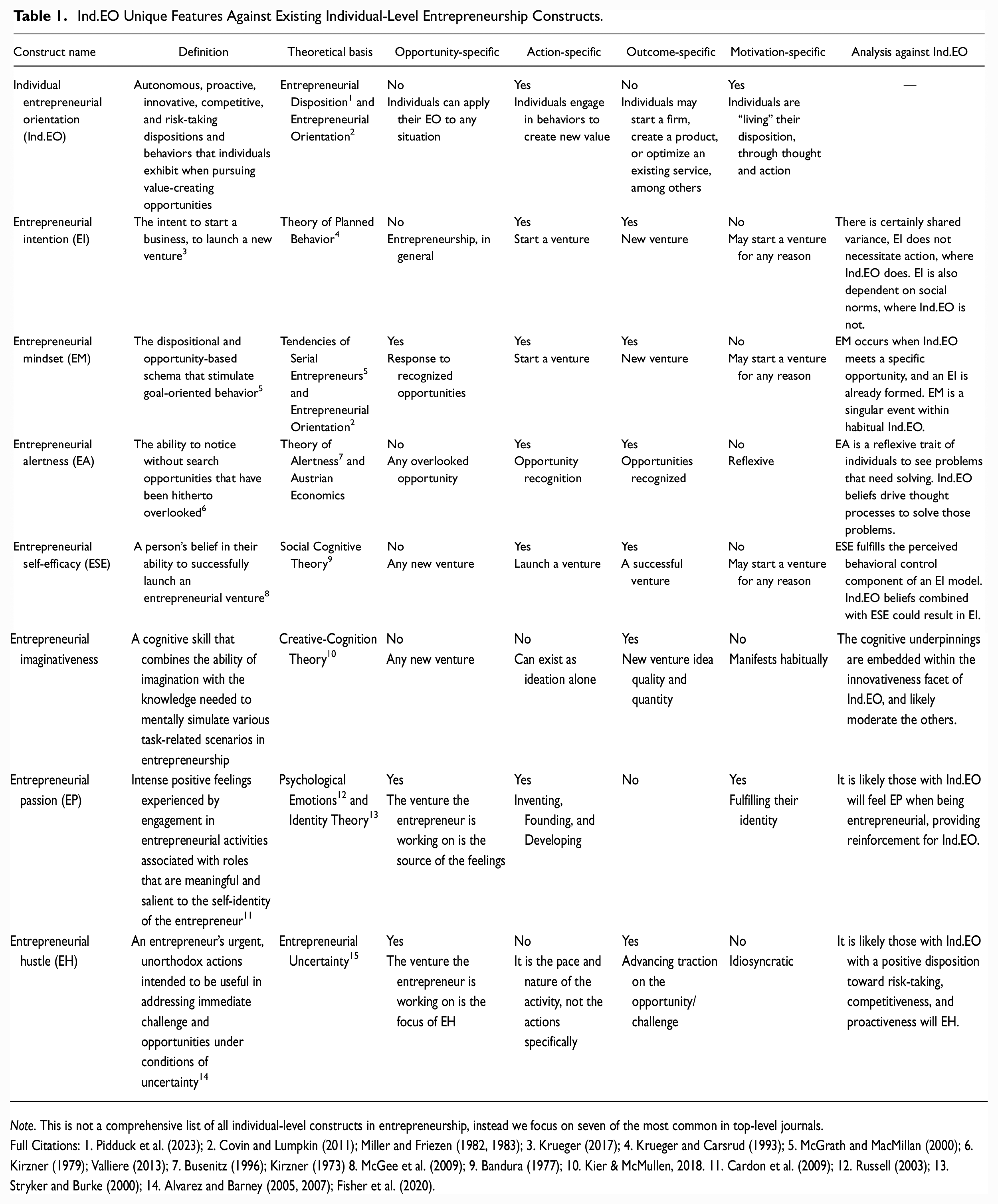
Note. This is not a comprehensive list of all individual-level constructs in entrepreneurship, instead we focus on seven of the most common in top-level journals.
Full Citations: 1. Pidduck et al. (2023); 2. Covin and Lumpkin (2011); Miller and Friezen (1982, 1983); 3. Krueger (2017); 4. Krueger and Carsrud (1993); 5. McGrath and MacMillan (2000); 6. Kirzner (1979); Valliere (2013); 7. Busenitz (1996); Kirzner (1973) 8. McGee et al. (2009); 9. Bandura (1977); 10. Kier & McMullen, 2018. 11. Cardon et al. (2009); 12. Russell (2003); 13. Stryker and Burke (2000); 14. Alvarez and Barney (2005, 2007); Fisher et al. (2020).
The Boundary Constraints of EO and Intersections of Ind.EO
The notion of EO as a family of constructs employing a multilevel architecture is not new (see George & Marino, 2011; Wales et al., 2011; Wiklund & Shepherd, 2011). However, as illustrated earlier, the multilevel perspective was largely in aid of better understanding why firms behave the way they do. Wales et al. (2020) set forth a three-level conceptualization of EO including (a) EO as top management style focused on individual entrepreneurial leadership; (b) EO as organizational configuration focused on adapting EO to meet situational demands; and (c) EO as new entry initiatives focused on pursuing market opportunities. This perspective emerged from the need to clarify and distinguish between the EO beliefs and decisions of TMTs; understand how EO beliefs manifest in the processes and structural organizing needed to be entrepreneurial in a given context; and identify the externally focused EO behaviors and market actions taken to meet goals and achieve performance outcomes.
To contribute to this conversation and enhance the utility of Ind.EO for EO researchers, we consider how individual actors might relate to this conceptualization. Consequently, we consider the individual in two specific contexts and three firm roles. In the first context, the entrepreneurially-oriented individual is a person with agency, acting for themselves, who uses entrepreneurial skills and talents to pursue goals and opportunities independently. The second context is within a firm where employees function as unique entrepreneurial resources but with constrained agency by acting for the firm in one of three roles: the entrepreneurially-oriented top manager, the entrepreneurially-oriented employee, and the entrepreneurially-oriented strategic-initiative leader (regardless of whether the individual is filling a top-, middle-, or non-management role). Note that Table 2 identifies which of these four types of individuals are analyzed in prior individual-level EO research: we found 42 studies of EO individuals, 13 studies of EO top managers, 12 studies of EO structural participants, and 4 studies of EO strategic-initiative leaders.
Review of Extant Individual Entrepreneurial Orientation Research.

Note. The above was compiled from a restrictive Google Scholar search of “CEO entrepreneurial orientation,”“individual entrepreneurial orientation,” and “employee entrepreneurial orientation.” Studies looking at any or all EO subdimensions in individuals but not calling it EO (e.g., Tan, 2002) are not included. This review is not presented as a comprehensive account of studies where an Ind.EO construct is needed. Rather, we review those studies where Ind.EO is presumed. CATA = computer-aided content analysis; EO = entrepreneurial orientation; EOI = entrepreneurially-oriented individual; EOTM = entrepreneurially-oriented top manager; EOSP = entrepreneurially-oriented structural participant; EOSIL = entrepreneurially-oriented strategic-initiative leader.
Four additional studies using this same dataset.
One additional study using this same dataset.
Journal is Chartered Association of Business Schools (ABS) Academic Journal Guide Ranked.
Journal is ABS Ranked 3+.
Each role represents an important resource that has unique implications and consequences for EO theory and practice. Although prior EO research has used resource-based arguments, noting in particular how firms “orchestrate, configure, and put their resources to work in new combinations” (Wales et al., 2021, p. 571) is centrally important for understanding the EO-performance relationship, one of the resources that has received little-to-no attention is entrepreneurial people. Yet, it is important to recognize that for firms, individuals represent a critical but replaceable resource: behavior-producing Ind.EO represents a unique capability that can be acquired or lost by the firm. As such, firms achieve an EO strategic posture through attracting leaders, managers, and employees with Ind.EO. Given that a critical variance-enhancing mechanism of the EO firm (Wiklund & Shepherd, 2011) may be its people (Wales et al., 2011), its ability to attract, actualize, and preserve Ind.EO within the firm is critical for linking Ind.EO beliefs and behaviors to firm outcomes.
The entrepreneurially-oriented individual
First, there are many individuals who exhibit entrepreneurial beliefs and behaviors apart from any current or future roles. They are independent, self-reliant people possessing entrepreneurial beliefs expressed in their everyday life (Pidduck et al., 2023). Indeed, entrepreneurship research is founded in part on such individuals recognizing an opportunity for themselves (McMullen & Shepherd, 2006) and acting on it. Although Ind.EO is not a requirement to start a venture, it is probably a benefit to those who do. There is an extensive literature on how individual-level traits and dispositions influence entrepreneurial activity, and in Table 1 we illustrate Ind.EO’s unique position relative to other constructs.
As previously discussed, much of the impetus for an Ind.EO construct comes from those seeking to extend EO outside the firm, to better understand traditional entrepreneurial outcomes (e.g., Lumpkin & Pidduck, 2021). Given the persistent need to understand the origins of entrepreneurial behavior, both within and outside of established firms, an Ind.EO construct could facilitate generating new insights about processes and activities separate from traditional entrepreneurial outcomes such as learning, goal accomplishment, and the pursuit of opportunities with noneconomic objectives. As such, taking into account an entrepreneurial-oriented individual as a discrete resource could inform conversations in psychology, sociology, leadership, organizational behavior, and other fields by addressing what it means to be entrepreneurial outside the traditional realm of organizing for economic value creation.
The entrepreneurially-oriented top manager
The individual who brings an Ind.EO to the role of top manager is likely to implement firm-level initiatives that reflect their disposition (i.e., upper-echelon theory; Hambrick & Mason, 1984). Such an individual is in a position to imbue the firm with EO beliefs and behaviors and contribute an EO perspective to the firm’s dominant logic (Bettis & Prahalad, 1995). This corresponds to the traditional conceptualization of the individual within the EO literature and perhaps the source of the greatest overlap with firm-level EO. By expressing their EO disposition through firm behaviors, “individual managers can have a strong and direct impact on the entrepreneurial potential, behavior, and effectiveness of firms” (Covin & Slevin, 1991, p. 9). The critical difference between the individual as entrepreneur and the individual as top manager is that the top manager’s behavioral output is their direct influence on the firm, as opposed to any other form of entrepreneurial expression (e.g., pre-launch, “initiating endeavor” outcomes—Shepherd et al., 2019).
In considering and theorizing this role within the EO family, it becomes critical to map individual beliefs onto firm behaviors. However, the intersecting contribution of individual top managers to firm EO is complicating; the M/CS scale is potentially confounded by the fact that three items ask the participant to report on beliefs and actions of top managers, and a fourth about how decisions are made—presumably by top managers (Covin & Slevin, 1988, 1989). Indeed, because many EO studies are conducted with individual top managers existing within a team of top managers, it is not always easy to disaggregate whether the individuals reported their own beliefs and behaviors or those of the collective TMT. Indeed, there is a small but growing body of literature, nominally studying CEO-EO (e.g., Keil et al., 2017; Liu et al., 2021), that blurs the line by making firm and individual EO synonymous and linking them to firm-level outcomes.
Empirically parsing Ind.EO could help disaggregate firm EO from CEO or TMT EO. Conceptualizing and measuring Ind.EO as a unique individual-level mechanism separate from firm EO would facilitate removing “pseudo-science” concerns (George & Marino, 2011, p. 1015) with respect to the assumption that one senior individual’s beliefs and behaviors accurately represent the organization’s EO 5 . Wales et al. (2020) proposed an entrepreneurial top management style as the intersection between the individual leadership and firm EO, and Ind.EO could be the source of that management style.
The entrepreneurially-oriented structural participant
The individual as structural participant—that is, an employee or other actor within an organizational system—reflects the fact that EO flows through a firm through two avenues: its processes and its people (e.g., generally employees, but also consultants, contract-workers, etc.). The processes reflect the firm’s imperative to behave entrepreneurially—both by explicitly directing actors to varying degrees of entrepreneurial behavior (e.g., searching for, recognizing, and acting upon opportunities), and by implicitly facilitating or constraining entrepreneurial behavior. The people are “structural participants” of the firm’s entrepreneurial processes and culture because, by virtue of working at the firm, they are encouraged and socialized into adopting the firm’s perspectives toward entrepreneurial behavior in their own roles (Haugh & McKee, 2004). As such, they “take on” firm EO (Wales et al., 2011), regardless of how the firm’s perspective aligns with their own behavioral inclinations or views. 6 Indeed, it is natural that firm EO, within the constraints and allowances of hierarchical erosion (i.e., Gibson et al., 2019), will influence the individual both in their own beliefs and in their job-related activities. However, it is these individual structural participants that will both be attracted to the entrepreneurial values of the firm (e.g., Clark & Skousen, 2023) and will help provide self-regulation regarding those values (Clark, 2023). The role of individual employees is a growing focus of corporate entrepreneurship research (Biniari, 2012; Gawke et al., 2019; Kang et al., 2016; Tietz & Parker, 2018), and the individual employee plays a vital role as recipient, throughput, and guardian for firm EO. An Ind.EO construct would facilitate research into that conceptualization.
The entrepreneurially-oriented strategic-initiative leader
The individual as strategic-initiative leader is the ultimate intersection of firm EO and Ind.EO. The corporate entrepreneurship literature has long recognized the focal role of key individuals responsible for both the activation of corporate venturing activities and their outcomes (Burgelman, 1983a). These individuals are initiative leaders, such as new product champions, but not necessarily in a formal sense like firm leaders. Sitting at the intersection of corporate entrepreneurship (Floyd & Lane, 2000; Ireland et al., 2002) and the star performer literature (Aguinis & O’Boyle, 2014), these individuals are influenced by TMT directives regarding new entry and other opportunity-seizing activities, and their own competencies to act as agents. 7 Their role is unique in that they are responsible for achieving specific strategic goals for the firm separate from general leadership responsibilities. However, firm outcomes often become disproportionately reliant on key individuals achieving strategic goals, the same way a sports team can be lifted or sunk by the performance of its star player. An Ind.EO construct would likely be helpful in identifying, quantifying, and theorizing about these individuals and their effect on firm outcomes.
Integration With Existing Literature
The four types of individuals presented here not only highlight potential manifestations of Ind.EO but also suggest avenues for integrating an Ind.EO perspective with existing literature. There is a rich history, dating back to the earliest entrepreneurship writing, about individual entrepreneurs acting on their own accord to seize opportunities. As the extensive Table 2 indicates, it is reasonable to assume that the qualities these individuals exhibit reflect an EO. As such, there are numerous ways that an Ind.EO construct could link to and inform individual-level entrepreneurship studies and phenomena such as pre-founding beliefs and behaviors and small business ownership and management. Recently, for example, Pidduck et al. (2023) introduced an EO-based model linking Ind.EO beliefs with firm founding behaviors. A clearly elaborated Ind.EO construct could enhance understanding of those individual entrepreneurs who act prior to or outside of firm contexts.
Research by Wales and colleagues has opened the door on the role of Ind.EO within the firm. In the nested framework introduced in Wales et al. (2020), the TMT contributes an entrepreneurial top management style, the organization takes on entrepreneurial configurations, and together they organize into the market entrepreneurial new entries. This model is well reflective of the three within-firm roles discussed above. The entrepreneurially-oriented top managers contribute their Ind.EO to create the entrepreneurial top management style, setting entrepreneurial goals, infusing entrepreneurial beliefs, decision-making, opportunity recognition, and priorities throughout the firm. The entrepreneurially-oriented structural participant will form and execute the organizational configurations, including processes, routines, and fostering the climate for entry initiatives. The entrepreneurially-oriented strategic-initiative leader is the focal point for the organization and execution of entrepreneurial new entry initiatives. In each case the individual is influenced by the firm’s existing EO and their own Ind.EO, to assist and contribute to firm-level efforts to be entrepreneurial. In a previous analysis, Wales et al. (2011) addressed the pervasiveness of EO and how entrepreneurship flows through an organization from the top managers through the structural participants to strategic-initiative leaders and, potentially, back again; and when, how, and why entrepreneurial processes and initiatives are or are not effective. Adding the analysis of Ind.EO at each of these levels has the potential to help better communicate when firms are and are not entrepreneurial. There is also an important temporal component to EO that could potentially be understood more precisely through Ind.EO level research.
In summary, Ind.EO is not a replacement or substitute for firm EO, it is a complement. The family of constructs perspective asserts that one cannot understand the “being entrepreneurial” phenomenon without understanding the firm along with the individual actors and the environment (Wales et al., 2020). As such, it is important that EO and Ind.EO are both positioned to share the goal of explaining this phenomenon and can be used conjointly (as well as independently) to model entrepreneurial behavior. Employing EO and Ind.EO together could enable researchers to conceptualize and understand the origins of firm EO; the influences and actualization of firm EO; the path of firm EO from TMT to behavior; and the outcomes of EO. Ind.EO facilitates a better understanding of individuals and their role in entrepreneurial firms.
Key Research Areas and Considerations for Ind.EO Research
There is a potentially limitless stream of future research stemming from a beliefs–behaviors perspective of Ind.EO that can inform literatures including, but not limited to, entrepreneurship, strategic management, leadership, and organizational behavior. It is beyond the scope of this article to explicate all the possible research avenues; however, we outline some critical first steps we believe will allow this research to advance quickly and purposefully. In Figure 2, we identify future research directions using three types of questions: formational, concurrent, and consequential. The formational questions, many of which have been implicit in the discussion so far, consider where Ind.EO comes from, why some people have it and others do not, and how the environment might influence the formation of entrepreneurial dispositions and behaviors.
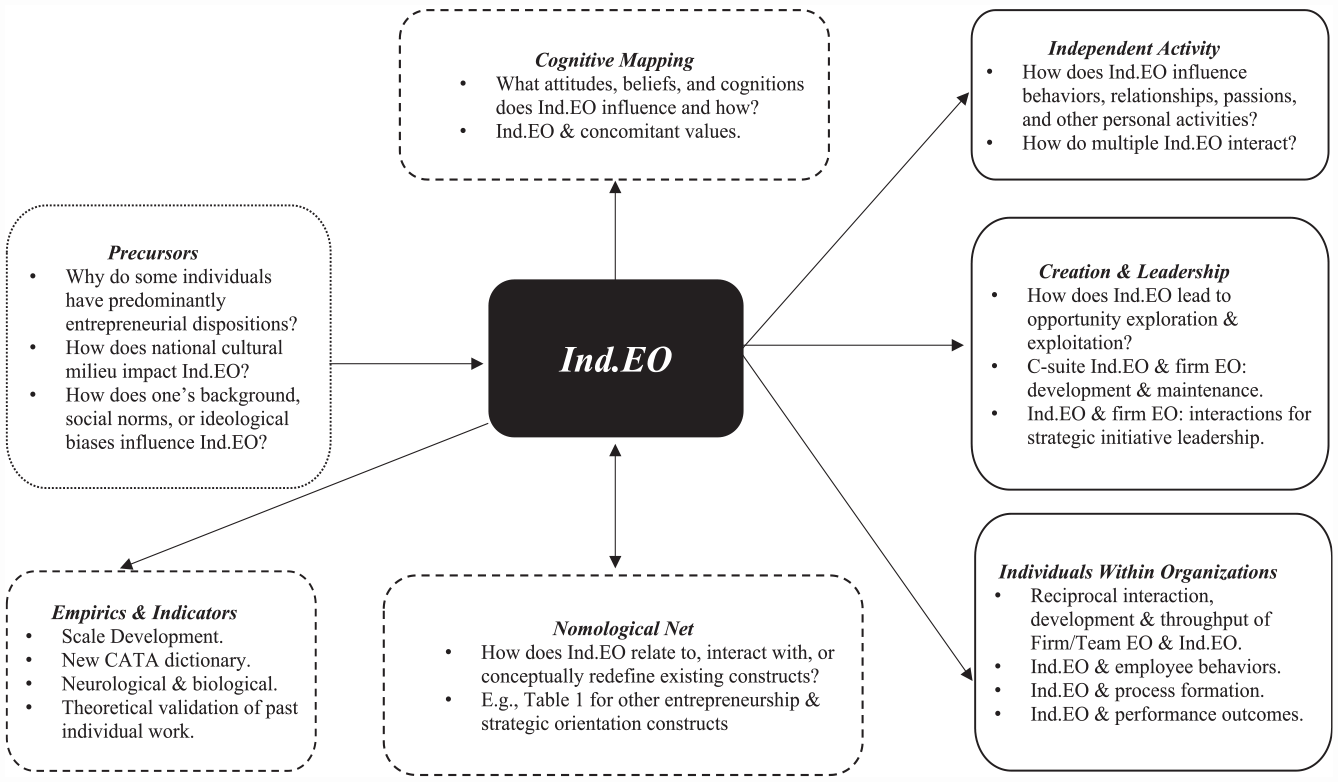
Future research directions for Ind.EO.
The concurrent questions cover research topics that are essential for more deeply understanding Ind.EO by addressing empirical issues and contextualizing Ind.EO in terms of cognitive processes and interactions with other constructs. As with any new construct, the empirical agenda for Ind.EO will likely be extensive. A key priority for assessing Ind.EO empirically will be developing appropriate and effective measures. New forms of measurement will need to be based on the core definition of Ind.EO and its theoretical boundaries. In our review of the extent literature (Table 2) we identify at least 27 different methods of capturing individual level, and while the Bolton and Lane (2012) was the most frequently employed, since its development new methods have continued to propagate. Furthermore, given our novel definition of Ind.EO, and the need for an Ind.EO measure to be applicable to individuals both with and outside the firm, and across four different roles; we have not found a scale that is consistent with our definition of Ind.EO, usable across settings, and exhibiting strong psychometric properties. Because Ind.EO is an individual-level construct, a rigorously developed scale is a critical step for Ind.EO to facilitate adoption and use and to achieve coherent scientific knowledge accumulation. While we stop short of specifying the content of Ind.EO empirics, to be adopted, any such efforts are well advised to follow the latest psychometric validity methods and diligently focus on entrepreneurial beliefs and behaviors (i.e., Lumpkin & Pidduck, 2021). The development of new measures has come a long way since the original M/CS scale was developed, and it goes without saying that best practices (e.g., MacKenzie et al., 2011) will ensure that these measurements are valid and respected in the literature.
As with EO, Ind.EO will benefit from methodological approaches that go beyond survey-based self-assessments. For example, the EO literature has benefited from non-self-report archival methodologies such as computer-aided content analysis (CATA) supported by a widely used EO CATA dictionary (Short et al., 2010). As with historical attempts to extend EO to the individual, it will likely be very tempting to reapply the existing dictionaries to Ind.EO (e.g., Zhang et al., 2021). But, in fact, new dictionaries may be needed to accurately reflect an individual-level theory that focuses on the Ind.EO beliefs and behaviors. Furthermore, as shown in Table 1, we position Ind.EO near the source of the individual cognitive-behavior chain. Note that these observations do not marginalize or render irrelevant 30 years of individual-level research into downstream constructs. Quite the opposite: Some of these related constructs originate in Ind.EO, others will interact with Ind.EO, and some are likely independent. To this end and to help set the agenda for future empirical endeavors, in Table 1 we theoretically assess the main individual-level constructs in entrepreneurship research and consider how those constructs likely relate to and differ from Ind.EO.
Finally, there are consequential questions. We conceptualize some primary loci for these questions. The entrepreneurial individual, alone and with others, offers fertile ground for many future studies. The creation and/or initiation endeavors relating to venturing, and leading ventures are another obvious domain that our Ind.EO construct speaks to in potentially insightful ways. Furthermore, the consequences, processes, and outcomes of the entrepreneurial individual within the firm provide another critical stream of research enquiry.
An important research priority related to our integration with the Wales et al. (2020) framework above will be to use Ind.EO to better characterize and understand firms and firm EO. For some, there will likely be a temptation to simply substitute Ind.EO for EO in existing EO research, or replace EO with Ind.EO. In some cases, that may be appropriate. However, for others Ind.EO makes possible new lines of questioning about firms. As we suggest above, there is no reason to believe that Ind.EO only flows in one direction. Our perspective suggests that Ind.EO is a durable individual trait originating in dispositions, with beliefs and behaviors iterating interactively. That is not to say Ind.EO is unalterable: indeed, a disposition can be malleable to some degree (Clark et al., 2022), both over time by environmental immersion (i.e., working at an entrepreneurial firm) or through disruptive shocks (i.e., getting fired or hired). Notwithstanding, much more Ind.EO research is needed to understand how beliefs and behaviors influence firm outcomes.
For example, individuals can influence firm EO, and firm EO likely influences individual Ind.EO; however, individuals also likely influence other individuals. A strategic-initiative leader could influence the top management style, and ultimately the Ind.EO, of the top manager by developing an internal consensus for new entry, establishing routines and procedures to enable new entry, and ultimately the results of the new entry. Consequently, there are a lot of questions about what happens within the firm as the Ind.EO of individuals, teams, and entire firms come together (e.g., Covin et al., 2020), and future research will be needed using unique methodologies to better understand what happens: to the individual, the firm, and to entrepreneurial initiatives because of Ind.EO interactions.
Another potentially important and interesting avenue is research into entrepreneurial top management style (Covin & Slevin, 1988) including investigating the goals, beliefs, mindsets, and communications of those individuals leading firms to be entrepreneurial (Wales et al., 2020). It is important to note that a top management style is consciously changeable and reflects outward individual behavior; while it is a likely manifestation of an Ind.EO, the two are neither dependent not interchangeable. Ind.EO could be very useful in understanding how it influences both the presence of and variations within the entrepreneurial management and leadership styles. Interestingly, there has been a recent trend of those seeking to blur the line between firm EO and the Ind.EO of the CEO (Liu et al., 2021; Wang, Jiang, et al., 2021). Deeper study into this is inevitable and it will be especially useful for understanding Ind.EO research inside the C-suite, particularly with the CEO.
To the extent that Ind.EO is deemed a necessary construct, the most interesting work will likely come from those who seek to better understand entrepreneurial people, who they are, and how they exist as fundamental entrepreneurial resources, both within organizations and in their own lives. A fundamental pillar of this paper’s contribution is that scholars can continue to examine entrepreneurial people in all their diverse and “non-traditional” contexts (i.e., outside of the corporate, commercial context) without the burden of having to justify the application and/or appropriateness of Ind.EO against a backdrop of strategic management history when the foci might be entrepreneurs, social workers, nurses, teachers, tribes, or clergy.
Discussion
The centrality of the individual decision-maker in the management and entrepreneurship literature is unquestionable (e.g., Burgelman, 1983a; Lyon et al., 2000). Firms are complex organisms with system dynamics that, in many situations, can override the contributions of any one individual (e.g., Burgelman, 1983b; Cyert & March, 1963). Yet, firm-level orientation constructs often serve as important mediators between individual-level antecedents and firm behaviors and outcomes (Covin & Slevin, 1991). Indeed, the classic upper-echelon case made in Hambrick and Mason (1984) articulates this clearly and overtly in their title “the organization as a reflection of its top managers,” implying that individuals are the central actors and architects of a firm. Simply put, researchers frequently integrate individual-level variables and firm-level outcomes (e.g., Keil et al., 2017; Shirokova et al. 2022). Consequently, a point of view that considers only firms without any explicit regard for the individuals within and around them seems unduly limited. Put differently, because the individual and the firm are inexorably linked, it is untenable to either assume-away the role of individual entrepreneurial actors or to subsume them completely within broader entrepreneurial phenomena. However, the question remains: to effectively account for these influences, does the individual-level contribution need to be Ind.EO (as opposed to another individual-level construct)? Our intention with this paper has been to respect these historically competing views about the need for Ind.EO and facilitate a multilevel perspective for integrating them, consistent with recent research insights (e.g., Lumpkin & Pidduck, 2021; Runyan & Covin, 2019; Wales et al., 2020).
To this end, in this paper, we have posited that there is a dual need for an Ind.EO construct that can be used independently, relative to firm-level EO, to understand individual outcomes—one that can also be used in harmony with firm-level EO to appreciate individual-level variance toward firm outcomes. In pursuing this path, we are cognizant of the concerns expressed by Covin and Wales (2019, p. 11), that a proliferation of EO constructs should not “hinder the accumulation of knowledge within the broader EO domain.” However, it is now demonstrably evident that researchers continue to see value in individual-level research using the EO theoretical framework (e.g., Pidduck et al., 2023). Indeed, a recent volume of advances in EO research, edited by some of the leading scholars on EO (Corbett et al., 2021), dedicated 25% of its content to papers considering individual-level research (i.e., Clark & Covin, 2021; Lumpkin & Pidduck, 2021).
In this paper we have employed a current perspective to reconsider the historically controversial notion of an individual-level entrepreneurial orientation construct. We examine the EO legacy concerns as they relate to firm-level entrepreneurial orientation considering recent developments in the EO literature, namely, EO as a family of constructs. In light of this expanded EO conceptualization, we identify the unique utility of Ind.EO to reflect the self-reliant independent entrepreneur; the individual as a contributor to firm EO, consequently increasing or decreasing firm EO by joining or leaving the firm; the disaggregated contribution of top agents; the individual-level impact of firm EO on individuals within the firm; and the key role of certain individuals to assume star roles for corporate venturing. Taken together, we find that these Ind.EO lines of inquiry have tremendous potential to advance our understanding of firm EO and EO as a family of constructs.
This work stands to make several important contributions to the entrepreneurship and EO literatures. First, we have articulated a path for researchers, using our proposed nominal definition of Ind.EO, to study entrepreneurial individuals independent from, yet consistent with, the study of the firm. As such, we consider the individual within the traditional realm of EO (e.g., Wales et al., 2011) through the lens of four distinct and critical entrepreneurially-minded roles. Each of these roles intersects with and/or contributes to EO-related outcomes. In doing so, we build from and help advance a rich body of EO literature discussing the multilevel manifestations of EO phenomena, from its role in middle management, to team dynamics, and ultimately a range of individual and organizational performance outcomes (e.g., Hornsby et al., 2009; Kuratko et al., 2005; Monsen & Boss, 2009; Wales et al. 2011, 2020, 2021). Moreover, we situate this conversation in the context of EO as a family of constructs, a perspective that acknowledges the extensive proliferation of EO research.
Second, we tackle why another individual-level construct is needed to help explain and predict what it means to be fundamentally entrepreneurial—a beliefs–behavior-centered perspective explaining why certain individuals are “entrepreneurial” irrespective of how or where it manifests (Clark & Covin, 2021; Pidduck et al., 2023). We build our arguments cognizant and respectful of George and Marino’s (2011) concerns regarding “concept stretching” and “concept traveling.” As such, the value and appropriateness of Ind.EO depends on its direct relatedness to the constituent elements of traditional EO (i.e., autonomy, proactiveness, innovativeness, competitiveness, and risk-taking in varying combinations and degrees). Yet it also reflects the unique phenomenon of people being guided cognitively and behaviorally in a relatively stable, patterned way as thus a type of orientation. With Ind.EO clearly positioned as a unique individual-level construct in entrepreneurship, we illustrate (see Table 1) its distinctive merits in line with other core (and emergent) individual-level constructs in entrepreneurship research. In doing so, beyond the needed research tool development—for example, scales and dictionaries, an important next step for Ind.EO research—Ind.EO can add substantive value to ongoing conversations in entrepreneurial cognition and action research. Integrating new Ind.EO tools with experimental methodologies (e.g., Grégoire et al., 2019; Stevenson & Josefy, 2019; Williams et al., 2019), Ind.EO likely offers considerable utility for researchers as a comprehensive “what it means to be entrepreneurial” construct. As such, we envision Ind.EO not only joining but also becoming a central construct for traditional entrepreneurship scholars seeking to understand new venture ideation, entrepreneurial imaginativeness, entrepreneurial passion, entrepreneurial alertness, and entrepreneurial mindset, among others, without the legacy concerns of construct misappropriation.
Third, in order to build a foundation for future Ind.EO research, we construct a “past, present, and future” perspective of Ind.EO. To allow future scholars to examine the questions that have been asked and critically consider questions that have been answered, we comprehensively detail the work in Ind.EO to date. As our review here suggests, there is no shortage of Ind.EO papers from the past decades, and researchers looking to draw on past knowledge will need to do so with care. For the present, we reconceptualize Ind.EO and place it in relation to other manifestations of the construct and consider how Ind.EO will relate and contribute to other EO forms. For future research on Ind.EO, we lay out a study agenda that will both facilitate understanding of Ind.EO and confirm that research can meaningfully and effectively make contributions to the larger EO domain, to ensure the continuity, stability, and forward progression of knowledge in this domain.
Opportunities for Ind.EO in Non-Traditional Settings
Non-traditional comprises the study of EO outside of the primary strategic management, large firm context. The following paragraphs seek to shed some light on how an Ind.EO construct may advance research in non-traditional yet business-related settings. Specifically, we focus on intercultural entrepreneurship research, social entrepreneurship, and the nascent yet burgeoning research on neuroscience and biological perspectives on entrepreneurship.
A recent EO special issue (Wales et al., 2019) was dedicated to examining international and cross-cultural issues and suggested that the family of EO constructs offered considerable value for understanding both how to stimulate new venture activity (Lee et al., 2019) and for enhancing firm performance in line with key cultural dimensions (Yu et al., 2021). Intercultural dynamics in entrepreneurship, distinct from national cross-cultural comparisons, unveil how and when parts of the entrepreneurial process might change through the interactions of entrepreneurial actors between or within cultural boundaries (Pidduck et al., 2022). Ind.EO research, then, will be especially helpful in advancing knowledge on the specific components of EO beliefs and/or behaviors, and their most effective configurations between sociocultural contexts. This may include probing how individuals may develop Ind.EO from intercultural experiences, which configurations tend to manifest across distinctive cultural contexts (Glavas et al., 2023; Franczak et al., 2023), or the extent to which Ind.EO helps or hinders the functioning of new ventures in highly culturally diverse teams.
Furthermore, despite studies suggesting that firm EO is robust cross-nationally due to its grounding in strategic postures known to enhance economic performance (Tang et al., 2008), Ind.EO examinations can be an especially helpful supplement for teasing out specifically how facets of EO among top managers or lead entrepreneurs take on different meanings across cultural lines. To facilitate this study, Lumpkin and Pidduck (2021) recently suggested that competitive aggressiveness, from Lumpkin and Dess (1996), be renamed simply “competitiveness” moving forward; partially due to contextual and sociocultural variation in how “being competitive” is perceived normatively such that “competitiveness retains the essential fervor behind being entrepreneurial but discards the ferocity” (Lumpkin & Pidduck, 2021, p. 24). As such, while all entrepreneurs must possess some degree of competitiveness beliefs and behaviors reflecting “the assertive posturing and willingness to take a stand in opposition to rivals or engage in a vigorous challenge,” this may fluctuate when people move between or spend considerable time venturing in highly distinctive cultures (p. 23). Indeed, culturally nuanced manifestations of each facet of Ind.EO and their various implications hold valuable potential for future research. To that end, emic and etic nuances in what it means to be entrepreneurial are better advanced by explicitly considering Ind.EO than assuming it away or ignoring the individual foci entirely.
Social entrepreneurship research has bloomed in recent years, with much dedicated to unpacking social, community, and civic dynamics amid entrepreneurial activity (e.g., Bailey & Lumpkin, 2023; Lumpkin & Bacq, 2019). Valuable research streams are probing the role of firm-level EO in social entrepreneurship contexts (Alarifi et al., 2019; Morris et al., 2021) and developing explicitly socially-oriented EO constructs (Kraus et al., 2017). Beyond noneconomic outcomes, social entrepreneurship research also focuses on key differences in antecedents to both venture formation and development. For example, studies suggest that entrepreneurial motivations (McMullen & Bergman, 2017; Tucker & Croom, 2021), self-efficacy (Bacq & Alt, 2018), and resilience can fundamentally change when the mission is predominantly social over commercial (Krueger et al., 2008). To that end, Ind.EO is likely especially useful to understand when entrepreneurs embark on ideating, raising funds, assembling teams, or developing new ventures that are social in nature. While a social venture’s (firm) EO may be similar to a commercial venture’s EO after it is established in the marketplace, the founder’s Ind.EO composition may offer key insights into how social entrepreneurs (vs. commercial) imbue their firms with an entrepreneurial ethos in unique ways.
Neuroscience research in entrepreneurship applies techniques that probe the neuro-linkages in individuals to better understand key cognitive dynamics in the new venture development process (Massaro et al., 2020); for example, by examining the brains of investors with EEG technology to predict their decision-making heuristics in the judgment entrepreneurial ideas (Shane et al., 2020). Entrepreneurship scholars, integrating biological perspectives, use similarly innovative techniques, such as conducting experiments on twins to tease apart nature versus nurture in becoming entrepreneurs (Nicolaou et al., 2008), or by assessing cortisol levels to advance understanding on the role of stress and other related emotions in self-employment and venture development (Patel et al., 2021; Wolfe et al., 2020). Traditional EO focus on the firm has almost entirely cut the field off from extending these boundary-pushing research streams when the individual entrepreneur is removed—even though some recent studies on Attention-deficit/Hyperactivity Disorder (ADHD) and EO provide promise (Yu et al., 2021). Ind.EO, therefore, can foster greater research synergies between EO and these natural science disciplines by providing a credible means of “getting inside” entrepreneurs’ beliefs and behaviors.
Conclusion
All constructs are narrative and conceptual conveniences; they exist in the human mind and become meaningful only to the extent that they are recognized and agreed upon. In this paper, we have argued that research trends have been facilitating recognition of a gap in our understanding of what it means for individuals to be entrepreneurial, and we are formally proposing the construct of Ind.EO as a uniquely useful conceptual device for addressing this gap. Moreover, we argue that the specific phenomena to which the construct of Ind.EO applies are empirically observable (i.e., the nominal meaning of the construct has empirical referents) and not well captured or embedded within the theoretical and empirical domains of other individual-level, entrepreneurship-related constructs.
That said, we outline a conservative path forward for Ind.EO that respects the legacy concern of EO researchers. First, we maintain that the Ind.EO construct as herein proposed is not an example of inappropriate construct stretching. Rather, to realize its ultimate value within the EO family of constructs, an Ind.EO construct is needed to identify the cognitive origins of individual entrepreneurial outcomes; we expect it to also potentially contribute to and co-vary with firm-level EO. Second, embracing Ind.EO does not and should not “reopen” the debates around the form of EO (e.g., Covin & Lumpkin, 2011) but, instead, focus on modeling individual beliefs toward new value creation, and the processes and behaviors that result. Third, the individual-level research conducted to date must be considered judiciously in light of the forthcoming theoretical and empirical work in Ind.EO. Some of it is likely an excellent fit, requiring only some interpretive caution with regard to construct specificity, while other work may not be relevant to the new conceptualization of Ind.EO. Finally, we suggest several areas of potential Ind.EO study for future research. These areas are not exhaustive but are designed to, respectively, embed Ind.EO in an already crowded entrepreneurship field (see Table 1). We fully acknowledge that there is risk in advocating for the consideration of an Ind.EO construct, but as EO researchers, we realize there is no reward without risk; risk is our business.
Footnotes
Declaration of Conflicting Interests
The author(s) declared no potential conflicts of interest with respect to the research, authorship, and/or publication of this article.
Funding
This research was funded in part through a grant from the Canadian Social Sciences and Humanities Research Council.
