



Abstract
Entrepreneurial energy, the level of energetic activation that a founder feels for building their venture, is an important indicator of a founder’s well-being. Changes in entrepreneurial energy have wide-ranging consequences for both founders and their ventures, yet much remains to be learned about how and why such fluctuations might occur, as well as the role of social dynamics in influencing fluctuations in entrepreneurial energy. To investigate these questions, we draw on longitudinal data from 38 founders, developing a dynamic model of entrepreneurial energy. Our study contributes to research on entrepreneurial energy and well-being, as well as energetic activation more generally.
Keywords
Introduction
Entrepreneurial energy, the level of energetic activation that a founder feels for building their venture, is a central indicator of a founder feeling psychologically well (Hahn et al., 2012; Quinn et al., 2012; Ryan & Deci, 2001). Energetic activation is essential for founders, since building a venture is often a deeply personal, even existential experience (Gish et al., 2022; Shir & Ryff, 2021; Stephan et al., 2020). Entrepreneurial energy also has implications for founder- and venture-level performance outcomes (Stephan, 2018). For example, entrepreneurial energy can positively influence founders’ innovative behavior (Williamson et al., 2019), proactivity (Hahn et al., 2012), and opportunity identification (Foo et al., 2015), as well as venture performance (Gorgievski et al., 2014; Stephan, 2018). Clearly, understanding the drivers of entrepreneurial energy is important. Extant literature suggests founding involves both energizing elements, such as opportunities for fulfilling basic psychological needs and doing meaningful work (Shir & Ryff, 2021; Stephan et al., 2020), as well as de-energizing elements, such as high work intensity and significant uncertainty (Rauch et al., 2018; Uy et al., 2013).
However, although these insights suggest entrepreneurial energy fluctuates over time, much remains to be learned about the underlying mechanisms explaining these fluctuations, particularly the role of recovery and social dynamics. Extant literature has tended to focus on linear relationships explaining changes in entrepreneurial energy, despite energy likely being more dynamic, developing in balancing and feedback loops (Gorgievski et al., 2010; Murnieks et al., 2019; Stephan, 2018). Founders’ energy can fluctuate contingent on the tasks that they tackle. For example, product development can be energy-draining when customer feedback is negative and energy-fueling when customer feedback is positive. Moreover, a vicious cycle of entrepreneurial energy depletion may arise when difficulties securing funding drains a founder’s energy, which in turn negatively influences renewed attempts to secure funding and further drains energy. The underlying mechanisms driving such potential energy dynamics have yet to be integrated into a dynamic theory that explains how various experiences over the course of building the venture influence a founder’s energy levels (Shir & Ryff, 2021; Stephan et al., 2020).
The entrepreneurship (Wach et al., 2021; Williamson et al., 2021) and positive organizational scholarship (POS) literature (Quinn et al., 2012; Quinn & Dutton, 2005) suggests that recovery mechanisms and social dynamics play an important role for understanding a founder’s fluctuating energy levels. Much of the focus on recovery thus far has been on diversionary strategies, such as psychological detachment and mastery experiences, which take place outside of the venture (Sonnentag & Fritz, 2007; Wach et al., 2021; Williamson et al., 2019). Meanwhile, less is known about engagement strategies, that is, how energy can be refueled within the venture itself, despite their high degree of relevance for founders, who are intensely cognitively and emotionally attached to the venture (Wach et al., 2021; Williamson et al., 2021). Moreover, the highly social process of building a venture (Gartner et al., 1994; Klotz et al., 2014) suggests social dynamics, such as founders’ interactions with others, are crucial for studying entrepreneurial energy dynamics (Quinn & Dutton, 2005; Walsh et al., 2020). Thus, our study investigates the primary research question: How and why does entrepreneurial energy fluctuate over time? In doing so, we also address the secondary research question: How do social dynamics influence this fluctuation in entrepreneurial energy?
Studying fluctuations in entrepreneurial energy with a focus on recovery mechanisms and social dynamics can advance research in multiple important ways. First, studies on well-being have tended to focus more on its hedonic aspects, such as satisfaction and contentment, and less on its eudaimonic aspects, such as energetic activation for engaging in self-determined activities (Hahn et al., 2012; Ryan & Deci, 2001), which are integral to building a new venture (Ryff, 2019; Stephan, 2018; Wiklund et al., 2019). Investigating fluctuations in founders’ energetic activation (Quinn et al., 2012) could help to reconcile the energizing aspects of founding with its exhausting aspects to build a more holistic, dynamic theory of entrepreneurial well-being (Lerman et al., 2020; Shepherd, 2019; Wiklund et al., 2019). Second, understanding the mechanisms underlying severe fluctuations in entrepreneurial energy can reveal how founders may prevent prolonged declines in energy or recover from them when typical recovery interventions, such as rest and respite (Williamson et al., 2021), are impossible. Third, uncovering the relationship between social dynamics and energy fluctuations can extend existing well-being theories (Shir & Ryff, 2021), building bridges to literature on various entrepreneurial social structures, such as founding teams (Patzelt et al., 2021).
Given the paucity of existing work on entrepreneurial energy dynamics, we took an inductive, qualitative approach (Edmondson & McManus, 2007) informed by a POS view of energetic activation (Quinn et al., 2012). We drew on rich, longitudinal data collected over a 16-month timeframe from 38 founders from 14 early-stage ventures. We observed that all founders experienced fluctuations in energy over the course of exchanging and delivering on entrepreneurial promises, that is, assurances founders make to and receive from stakeholders, their co-founders, and themselves in the context of building the venture. As long as they retained at least a low level of entrepreneurial energy, founders could regain energy consumed in entrepreneurial promises by recovering outside of the venture. However, eight founders experienced entrepreneurial fatigue, a persistent lack of energetic activation for building the venture. In severe cases of entrepreneurial fatigue, founders redirected their energy into alternative endeavors, ultimately exiting from the venture. Interestingly, although recovery outside of the venture was not possible for founders suffering from entrepreneurial fatigue, recovery within the venture was possible: Empowering social dynamics could help founders to refuel their energy. We consolidate our findings in a dynamic model of entrepreneurial energy and discuss our study’s implications for work on entrepreneurial energy and well-being, as well as energetic activation more generally.
Theoretical Background
A POS View on Energetic Activation
Human energy is a key construct in the POS literature (Spreitzer et al., 2011). POS focuses on the generative dynamics that promote positive outcomes, such as sustained human strength and resilience, through which organizations and their members can prosper (Bernstein, 2003; Cameron & Dutton, 2003). Within the POS tradition, human energy is conceptualized as a fundamental resource, subdivided into physical energy, that is, “the capacity to do work” (Quinn et al., 2012, p. 341), and energetic activation, which refers to “the subjective component of a bio-behavioral system of activation experienced as vitality, vigor, enthusiasm, zest” (Quinn et al., 2012, p. 341). Importantly, POS integrates key concepts from other literatures, such as the conceptualization of energetic activation as a resource that is depleted by job demands (e.g., workload, time pressure) and replenished by job resources (e.g., job control, feedback) (Quinn et al., 2012; Schaufeli & Bakker, 2004). Resources are defined based on their use rather than their innate value, such that resources allow people to act upon their understanding of a situation (Feldman & Worline, 2011). Energetic activation is reciprocally linked to other resources, since having the relevant potential resources (e.g., in the form of physical energy, time, money) for doing their work makes individuals feel more enthusiastic and able to put those resources to use, thereby raising their energetic activation (Quinn et al., 2012; Quinn & Dutton, 2005). Moreover, energetic activation itself converts potential resources, such as unused physical energy, into a resource-in-use, that is, action enabled by kinetic energy (Quinn et al., 2012; Spreitzer et al., 2011). Energetic activation is crucial for putting other resources to use. Even when individuals have a high level of physical energy, they are unlikely to invest it into work for which they feel little energetic activation. Relatedly, energetic activation can be created even as physical energy is expended when individuals do work that intrinsically promotes their enthusiasm and vigor (Quinn et al., 2012).
Energetic activation should be differentiated from related concepts, such as motivation, which captures an individual’s decisions on the direction in which to expend physical energy, as well as the intensity and persistence with which to do so (Quinn et al., 2012). Similarly, though energy is a sub-dimension of engagement (which also includes the cognitive components attention and absorption), POS scholars conceptualize this dimension of engagement as the physical energy individuals invest, rather than their energetic activation (Rothbard & Patil, 2011). Meanwhile other related concepts are antecedents or outcomes of energetic activation. For example, meaningfulness or the personal significance and positive meaning that work can hold for an individual (Rosso et al., 2010) can be an antecedent of energetic activation (Stephan et al., 2020), whereas proactiveness, a behavior characterized by a long-term focus and acting in advance of being prompted by an explicit demand, can be an outcome of energetic activation (Frese et al., 1996; Hahn et al., 2012). All in all, the dynamics of energetic activation offer crucial insights into how well an individual feels their overall system of demands and resources to be operating over time (Quinn et al., 2012; Spreitzer et al., 2011).
Indeed, entrepreneurial well-being scholars have recently begun to call for a deeper understanding of energetic activation, particularly within the context of providing deeper insights into founders’ eudaimonic well-being (Stephan et al., 2020; Wiklund et al., 2019). Thus far, much of the work on entrepreneurial well-being has been dominated by a focus on hedonic well-being (i.e., positive affect and life satisfaction) rather than eudaimonic well-being, which emphasizes meaning and self-realization stemming from engagement in self-determined, purposeful activities (Ryan & Deci, 2001; Ryff, 2019) and is arguably more relevant to entrepreneurial endeavors (Stephan, 2018). Founders’ energetic activation is a central indicator of eudaimonic well-being (Hahn et al., 2012; Ryan & Deci, 2001). Indeed, Hahn et al. (2012) found that vigor (i.e., energetic activation), rather than hedonic well-being, predicted founder proactivity. As such, energetic activation, which is commonly used to operationalize eudaimonic well-being (Hahn et al., 2012; Ryan & Deci, 2001), can help to better incorporate the important and underutilized eudaimonic approach to exploring entrepreneurial well-being (Stephan et al., 2020; Wiklund et al., 2019).
Entrepreneurial Energy
In studying energetic activation in founders, it is important to consider the nature of the entrepreneurial context. Like other demanding jobs, founding a venture requires sustained energetic activation for solving complex problems in uncertain, resource-constrained environments (Kollmann et al., 2019; Rauch et al., 2018; Wach et al., 2021). However, unique to the entrepreneurial context is that founders build their own ventures, giving meaning to both themselves and others (e.g., employees, investors, business partners etc.) (Shir & Ryff, 2021; Stephan et al., 2020). Employees derive meaning from their organizations by interpreting what their given work signifies in the context of their lives (Rosso et al., 2010), connect their individual activities with overarching organizational ambitions (Carton, 2018), and can be supported in their energy development by leaders who help build a collective identity within their team (Kunze & Bruch, 2010). In contrast, founders first create meaning by building and nurturing their venture; indeed, it is the meaningfulness of their work rather than their autonomy that explains why founders experience higher energetic activation than employees (Stephan et al., 2020). Energetic activation for being the founder of a venture is a much more personal, even existential experience than being an employee (Gish et al., 2022; Shir & Ryff, 2021; Stephan et al., 2020). We therefore consider it worthwhile to define entrepreneurial energy more precisely than the general concept of energy as applied to employees. In particular, we define entrepreneurial energy as the level of energetic activation that a founder feels for building their venture. A founder’s entrepreneurial energy is specific to building a particular venture rather than general entrepreneurial role identities, as is the case with concepts such as entrepreneurial passion (Cardon et al., 2009). Consistent with newer conceptualizations of passion in the entrepreneurial context (Cardon et al., 2017; Warnick et al., 2018) that include entrepreneurial activities as well as other “activities relevant to their venture's domain and the product or service it provides” (Warnick et al., 2018, p. 318), entrepreneurial energy can also be conceptually broad in that “building their venture” refers to all the aspects associated with the founder being the “brains behind the venture” to create, nurture, and shape the venture. For example, this covers aspects such as the venture’s product, the customer needs they address, and the entrepreneurial team.
Although entrepreneurial work can be meaningful for founders (Ryff, 2019; Stephan et al., 2020) and thus fuel energetic activation for building the venture, entrepreneurial energy can fluctuate (Shir & Ryff, 2021; Walsh et al., 2020). Entrepreneurial work allows founders to fulfill basic psychological needs for autonomy, competence, and relatedness, which are strongly associated with energetic activation (Nikolaev et al., 2020; Shir et al., 2019). Yet founding a venture is inherently uncertain and stressful (Rauch et al., 2018), and adversities, such as financial difficulties, can deplete entrepreneurial energy (Kollmann et al., 2019). Because of their over-optimistic tendencies (Dushnitsky, 2010; Hmieleski & Baron, 2009) and autonomy (Knight et al., 2020), founders may justify the energy invested into their venture to themselves and invest more energy than is sustainable or even beneficial for themselves and the venture (Stephan, 2018). Persistent efforts can generate mental and physical strain (Patel et al., 2019), reducing energy by creating a downward spiral of further exhaustion and reduced well-being (Örtqvist & Wincent, 2010). Thus, it is conceivable that a founder’s entrepreneurial energy may not only rise and fall, but also that these energy cycles may be irregular, involving feedback loops. Yet it remains unclear how such fluctuations may be reconciled into a dynamic theory of entrepreneurial energy (Shir & Ryff, 2021; Stephan et al., 2020).
Entrepreneurial Energy Dynamics: The Importance of Recovery and Social Processes
Two understudied areas in extant literature—recovery mechanisms and social dynamics—are especially relevant to studying entrepreneurial energy dynamics. Recovery mechanisms are crucial for sustaining entrepreneurial energy in the long term, yet remain underexplored (Stephan, 2018; Wach et al., 2021; Williamson et al., 2021). The few exceptions suggest founders may be able to replenish entrepreneurial energy through recovery measures, such as regular respite from work and a healthy sleep schedule (Wach et al., 2021; Williamson et al., 2019; Williamson et al., 2021). Indeed, the recovery literature in both entrepreneurship and general management focuses predominantly on diversionary strategies, which involve stressor avoidance or seeking distractions to replenish energetic activation outside of work, rather than engagement strategies, which involve confronting or accepting stressors at work (Parkinson & Totterdell, 1999; Sonnentag & Fritz, 2007; Spreitzer et al., 2011; Williamson et al., 2021). However, given founders’ personal attachment to their venture (Cardon et al., 2005), diversionary strategies may be difficult to apply in practice (Williamson et al., 2021). Additionally, the POS conceptualization of energetic activation as a resource, which can be created and depleted at work (Quinn et al., 2012), suggests that recovery at work is entirely possible and potentially even vital for sustaining entrepreneurial energy over time. Indeed, entrepreneurial work has even been described as particularly energizing (Shir et al., 2019; Stephan et al., 2020). Clearly, extant literature can be enriched by insights on the dynamic development of entrepreneurial energy and the role played by recovery mechanisms inside and outside of the venture.
Further, entrepreneurship is a fundamentally social process (Gartner et al., 1994), making social dynamics essential for understanding how entrepreneurial energy fluctuates over time. From identifying and refining an entrepreneurial idea together with potential co-founders to iteratively developing the product through customer feedback to convincing investors and business partners of the venture’s potential, building a venture involves interacting with lots of stakeholders (Patzelt et al., 2021; Zott & Huy, 2007). Interactions can both energize and de-energize their participants, depending on the extent to which they enhance participants’ basic need for autonomy, competence, and relatedness (Quinn et al., 2012; Ryan & Deci, 2000). For example, a customer interaction may increase a founder’s entrepreneurial energy, if the customer’s feedback reveals new opportunities for offering the venture’s product (increasing autonomy), suggests the founder is capable of addressing the customer’s needs (increasing competence), or perceives the customer to be genuinely supportive (increasing relatedness) (Quinn & Dutton, 2005). Conversely, if the founder perceives the customer’s feedback to be limiting, difficult to address, or hostile, this interaction would be de-energizing (Quinn & Dutton, 2005; Wach et al., 2021). One particularly important social structure through which a founder builds their venture is the entrepreneurial team (Klotz et al., 2014; Patzelt et al., 2021; Uy et al., 2015). As with other social interactions, we would expect that a founder can find team interactions to be both energizing and de-energizing, consistent with the idea that the founding teammates’ effort can be contagious for founders under certain conditions (Breugst et al., 2020). Formerly energizing co-founder relationships could also become de-energizing over time as fundamental conflicts emerge (Breugst & Shepherd, 2017; Powell & Baker, 2017). Despite the importance of social dynamics for sustaining energetic activation for building the venture, much remains to be learned about how social dynamics influence the development of entrepreneurial energy.
Taken together, the POS literature on energetic activation and extant literature related to entrepreneurial energy suggest the following research questions to be particularly relevant and fruitful avenues for inquiry: How and why does entrepreneurial energy fluctuate over time? How do social dynamics influence this fluctuation in entrepreneurial energy?
Method
Given the nascent state of extant literature on entrepreneurial energy (Stephan et al., 2020), as well as our interest in building a deep, dynamic understanding of the development of entrepreneurial energy over the course of the founding process, we apply an inductive, qualitative methodology to analyze rich, longitudinal data (Edmondson & McManus, 2007; Gioia et al., 2013). Specifically, we aim to disentangle the dynamics and underlying mechanisms of founders’ fluctuations in entrepreneurial energy, with a particular focus on causal links and temporal feedback loops that might explain transitions between energy states.
Sample Selection and Data Collection
Our data collection effort was part of a larger research project on entrepreneurial team dynamics and well-being. We began the current study with a broad interest in studying founders’ experiences of stress and recovery, with the focus on energy emerging from analyzing the first two rounds of data collection. This type of refinement of study focus over the course of data collection is common in inductive, qualitative studies (Gioia et al., 2013; Powell & Baker, 2014). We sampled ventures within Germany that had two or more co-founders, were less than six years old, and in the early stages of development (Amason et al., 2006). The sampling approach was well-suited to our eventual focus on entrepreneurial energy. Early-stage ventures typically have few resources, face high uncertainty, and their survival is highly dependent on the founders. Thus, it is especially important for founders to effectively manage their energy in early-stage ventures. Moreover, although entrepreneurial energy is conceptualized at the individual level, a key dimension of eudaimonic well-being involves positive relations with others (Ryff, 2019) and energetic activation has long been understood to affect and be affected by coordination with others (Quinn & Dutton, 2005). Studying founders situated within teams therefore gave us valuable insights into the social dynamics of entrepreneurial energy (Shir & Ryff, 2021) and also allowed us to compare different co-founders’ energy dynamics within the same venture context, thereby minimizing the impact of venture-level factors on our findings.
We identified co-founders for inclusion in the study by following the definition of new venture teams proposed by Klotz et al. (2014, p. 227), that is, “the group of individuals that is chiefly responsible for the strategic decision making and ongoing operations of a new venture.” Using these sampling criteria, we identified potential study participants through filtered searches on online national databases of new ventures. We also attended various local entrepreneurship events (e.g., startup fairs, pitch nights, activities at incubators and accelerators) to meet founders and personally speak to them about our study. Although we systematically recruited our sample via these databases and events, building up personal contact to founders enhanced their willingness to participate and provide honest insights into their experiences. This was important not only because our study demanded significant time investment, but also since talking about personal ups and downs along the entrepreneurial journey can be a sensitive issue. Building rapport with participants is also consistent with recommendations for qualitative studies (Jonsen et al., 2018).
In sum, we made contact with founders from 285 ventures. Although the founders of 145 ventures were unable to participate due to time constraints, we conducted a first round of semi-structured interviews with the founders from the remaining 140 ventures. For 77 ventures, we were able to interview the complete entrepreneurial team. We accompanied these 77 ventures for around half a year and reached out to them for another round of interviews. On average six months after the first interview, we could conduct a further semi-structured interview with all the founders of 44 of these ventures 1 (see Appendix B for an example data collection timeline). Altogether, we conducted at least two interviews with 112 founders from 44 ventures covering a variety of industries, team sizes, and individual backgrounds. In order to encourage founders to speak as openly and honestly as possible, we guaranteed data confidentiality and each founder was interviewed individually, rather than in a team setting. We conducted interviews in German or English, depending on which language each founder was most comfortable speaking. We created an interview guide for each interview round for both languages (English version in Appendix A) using back-and-forth translation to ensure translation quality. We iteratively updated during early phases of the data collection in order to obtain richer insights from the founders, as is crucial for inductive, qualitative research (Gioia et al., 2013). In each interview, we asked a series of open-ended questions designed to elicit stories from the founders on key events over the course of building their venture, as well as their personal perceptions of these experiences. For instance, consistent with our initial focus on well-being and guided by extant literature emphasizing the role of recovery outside of the work context (Williamson et al., 2021), we asked founders about their experiences of non-work time. As with all the questions we asked, we probed for specific examples to gain richer insights. In the case of recovery, interestingly, we found that while some founders said they regularly recovered outside of the venture, they could not offer specific examples of having done so recently and ultimately reflected that perhaps they spent less time outside of the venture to recover than they had initially thought. Thus, we gained a richer understanding of founders’ experiences of (attempted) recovery outside of the venture.
Despite not explicitly asking about energy, as we iterated between responses in these first two interview rounds and extant literature (e.g., Quinn et al., 2012), we became increasingly alert to founders’ accounts of energy within our data collection. Consistent with our initial broad interest in studying founders’ well-being, we asked questions in both interviews on stressful situations and challenges faced by the founders, as well as how they dealt with these. The responses contain important insights on entrepreneurial energy as we discovered during the data analysis. For instance, we elicited stories on energetic lows and highs via questions in Interview 1, such as “Have you ever been on the verge of quitting and throwing everything away?” and “Please describe the best, most memorable moment for you since (operationally) founding.” Meanwhile in Interview 2, our questions on founders’ perceptions of their venture (e.g., successes/challenges for the venture) and experiences within their team (e.g., founding team changes) enriched our understanding of energy dynamics and their social aspects. Exit-related questions in Interview 2 also helped us to capture how founders’ belief in their venture changed. Overall, both interviews enabled a detailed and socially situated understanding of how founders’ entrepreneurial energy developed.
Consistent with generally accepted qualitative techniques for studying multiple cases (Gehman et al., 2018; Glaser & Strauss, 1967), we used theoretical sampling to narrow down our original sample to a final sample of 38 founders from 14 ventures, which provided rich information on different energy states, as well as transitions between these states. During our data collection, for eight founders from six of these ventures we observed a persistent and extreme lack of energy for building their venture that, through our later analysis and theorizing, we came to refer to as entrepreneurial fatigue. Interestingly, these eight founders all had at least one co-founder who did not experience entrepreneurial fatigue. That is, our final sample included all eight founders who experienced entrepreneurial fatigue, as well as their ten co-founders who did not experience entrepreneurial fatigue. The remaining 20 founders in our final sample came from comparable ventures and also faced significant challenges, but were more effective in balancing fluctuations in entrepreneurial energy. Our final sample included founders from the same venture who varied in their experience of changes in entrepreneurial energy. Thus, in line with the typical aims of theoretical sampling (Glaser & Strauss, 1967), the composition of our final sample allowed us to build a theoretical model applicable across founders. Table 1 provides an overview of the 38 founders and 14 ventures, including an approximation of fluctuations in entrepreneurial energy. We use fictitious names to preserve the anonymity promised to our participants.
Background Information on Founders and their Ventures.
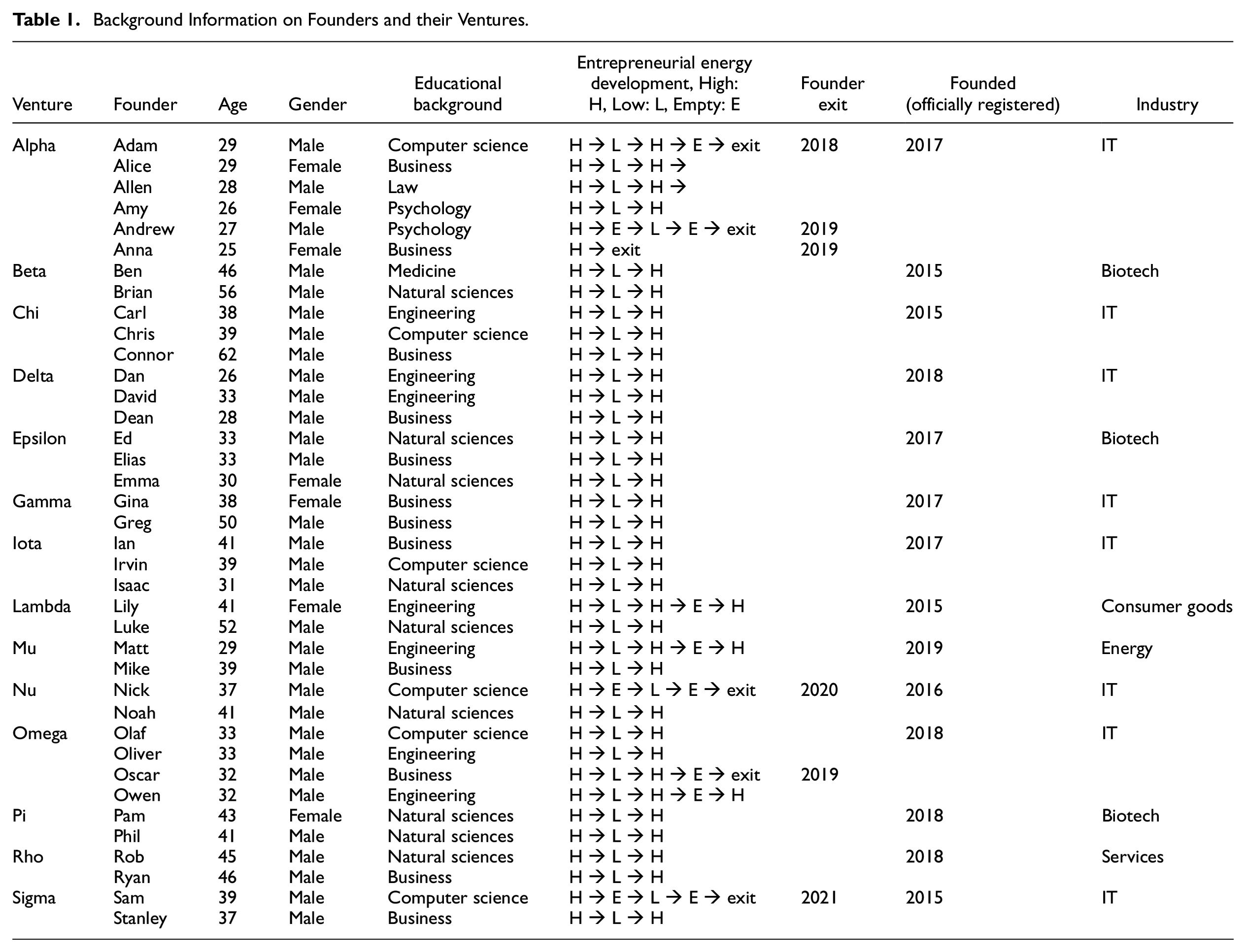
As is common in inductive research, we iterated between collecting and analyzing data (Gioia et al., 2013). Although the first two rounds of interviews had already provided us rich insights into founders’ fluctuations in entrepreneurial energy to further explore how entrepreneurial fatigue might develop, we decided to conduct a third interview with the eight founders who experienced entrepreneurial fatigue. For this third round, we developed a shorter, more focused interview guide. Of the eight founders we contacted for the third interview, two founders had left the venture, and we were unable to reach them, one founder (who appeared to have the most extreme case of entrepreneurial fatigue) was unresponsive, and one founder (who had started a new venture with a different set of co-founders) was also unresponsive. We thus conducted interviews with the remaining four founders, which greatly enriched our theorizing on the development of entrepreneurial fatigue. Specifically, two founders seemed to have recovered from entrepreneurial fatigue, one founder seemed to have partially recovered, and one founder appeared to experience more extreme entrepreneurial fatigue. Altogether, our theorizing draws on 78 interviews from 38 founders, between November 2018 and February 2020. After we finished the interviews (4,288 minutes in total), we transcribed them, yielding 1,186 pages of single-spaced text. We transcribed the interviews exactly as they had been conducted, that is, in German for the 36 German-speaking founders in our sample and in English for the two English-speaking founders. Since all members of the author (and coding) team were bilingual, the data were analyzed in its original language, with the first author translating data presented in the current article. There was no systematic difference between originally English and translated interviews in terms of the frequency or nature of energy-related responses.
To supplement the interviews and allow for data triangulation (Jick, 1979), we collected observational notes from our on-site visits, as well as secondary data on the ventures and their founders (e.g., via newspaper articles and LinkedIn profiles). The supplementary data amounted to 172 pages of single-spaced text. The data were particularly helpful in gaining a richer understanding of when and how key events progressed over the course of our study period, which was vital in developing detailed timelines for each of the founders, a common technique for studying dynamic phenomena (Langley, 1999; Lerman et al., 2022). In creating the timelines, we tracked events at the team and venture levels as well as events external to the team and the venture. The timelines also captured the founder’s entrepreneurial energy at each point in time based on their interview statements, helping us to trace temporal patterns (Langley, 1999). Specifically, the timelines mapped changes in energy to events taking place within the founder’s environment, as well as the founder’s reactions to these events. Appendix C shows an excerpt from one such timeline. Although we also drew on our interview data for developing the timelines, our supplementary data sources were especially helpful in filling in the gaps left by the interview data. For example, we used founders’ LinkedIn profiles to check whether they remained involved in (or had exited from) the venture. Overall, the data provided us with the rich insights needed for building a dynamic model of entrepreneurial energy.
Data Analysis
Although we describe our data analysis in the following text as a series of steps for ease of explication, these steps were not linear in practice; we iterated frequently between the different data analysis steps as demanded by the changes in our theory building (Gioia et al., 2013; Grodal et al., 2021). From our early analysis of the first rounds of data collection, we recognized the centrality of energy in founders’ accounts of various key events and experiences in building their venture. For example, we observed that founders spoke about energy in terms of “burning for the [venture] idea, standing behind [the venture], […] being personally convinced of […] its value” (Andrew from Alpha, Interview 1), as well as energy dynamics such as “refueling” (Luke from Lambda, Interview 1) through non-work time and the “roller coaster […] of ups and downs” (David from Delta, Interview 1) in building the venture. Iterating between such statements and extant literature on energetic activation (Hahn et al., 2012; Quinn et al., 2012) gave us theoretical support for the conceptualization of entrepreneurial energy we derived from our data.
We then engaged in open coding, immersing ourselves into each founder’s account and staying close to the founder’s own words to derive first-order concepts (Gioia et al., 2013; Strauss & Corbin, 1998). For instance, Mike from Mu (Interview 1) said, “I believe in the business idea and I am very happy to be here. […] The current team is 100% trustworthy.” Based on such statements, we created the first-order concept “Fully believing in the venture (incl. team).” In this way, we accumulated several initial codes, before grouping together codes that seemed to converge on the same concept. For instance, we initially had multiple first-order concepts covering the different recreational ways in which founders would spend non-work time, for example, “Doing recreational activities (e.g., sports, films)” and “Recreation without thinking about the venture,” which we later merged into a single first-order concept: “Refueling via doing recreational activities (e.g., sports) without thinking about the venture.” The adapted code more precisely captured the mechanism of recovering outside of the venture. We also reflexively adapted first-order concepts as our emergent theoretical model evolved. For example, as we increasingly recognized the importance of balancing and reinforcing loops in explaining how founders recovered or failed to recover from entrepreneurial fatigue, we revisited our data to code new first-order concepts (e.g., “Task-related support from co-founder(s)” and “Repeatedly falling behind plans/goals”). Through approximately six rounds of such iterations, we arrived at our final 38 first-order concepts.
In the next step, in a process similar to axial coding (Gioia et al., 2013; Strauss & Corbin, 1998), we clustered first-order concepts on the basis of commonalities and differences to abstract them into second-order themes. For example, we combined the first-order concepts “Standing behind/burning for the venture,” “Feeling active, engaged, and productive in relation to being the venture’s founder,” and “Fully believing in the venture (incl. team)” into the second-order theme “Entrepreneurial energy reservoir full.” We use the term entrepreneurial energy reservoir to refer to the total store of entrepreneurial energy that a founder has at any given point in time, taking inspiration from the POS literature to recognize the dynamic and nuanced nature of changes in energy levels (Quinn et al., 2012). In particular, when deriving second-order themes, we especially paid attention to nuances distinguishing first-order concepts; although “Difficulty in giving full effort/potential” and “Persistent, extreme lack of energy for standing behind venture as its founder” both indicated some decline in entrepreneurial energy, the latter suggested a more severe drop. We therefore created two clusters of first-order concepts: one for the second-order theme “Entrepreneurial energy reservoir low” and another for “Entrepreneurial fatigue.” The distinction was crucial for understanding the dynamics involved in transitioning between the three levels of entrepreneurial energy. This led us to revisit our first-order concepts and recode our data to reflect differences between low entrepreneurial energy and entrepreneurial fatigue. Although first-order concepts within a second-order theme were typically not mutually exclusive (e.g., a founder could recover outside of the venture by switching off their computer/phone and taking time for rest), the codes did exhaustively cover founders’ experiences of the second-order theme. Through multiple such iterations, our final clustering of first-order concepts yielded eleven second-order themes.
We could then further abstract and group second-order themes into aggregate dimensions. In particular, we grouped together the different states of the entrepreneurial energy reservoir into the aggregate dimension of Entrepreneurial Energy. The rest of the second-order themes covered the dynamics underlying a founder’s movements between energy states. We therefore categorized the remaining second-order themes into aggregate dimensions based on which energy state they culminated in. For example, “Becoming disillusioned with the venture” and “Negatively spiraling belief in venture” were second-order themes underlying a founder’s development of entrepreneurial fatigue; accordingly, we grouped these second-order themes into the aggregate dimension Destructive Phase. In this way, we derived four aggregate dimensions: Entrepreneurial Energy, Eudaimonic Phase, Destructive Phase, and Diverting Phase.
Using the emergent set of first-order codes, second-order themes, and aggregate dimensions, the first author and a second coder (who was unaware of the aims of the current study) coded the data for all founders. Once the first author and second coder had independently conducted an initial coding of the data, they compared each other’s assessments. Interrater agreement was very high (interrater agreement: 92%, Cohen’s kappa = 0.91) and all discrepancies in the coding were discussed and resolved (Bernard et al., 2016). This coding process culminated in the data structure shown in Figure 1. Drawing on our emergent coding of the data, we iteratively developed a dynamic model of entrepreneurial energy. We circled between our model, the data, and extant literature to refine and update our theory building (Gioia et al., 2013), continuing the iterations until we had reached theoretical saturation (Glaser & Strauss, 1967).
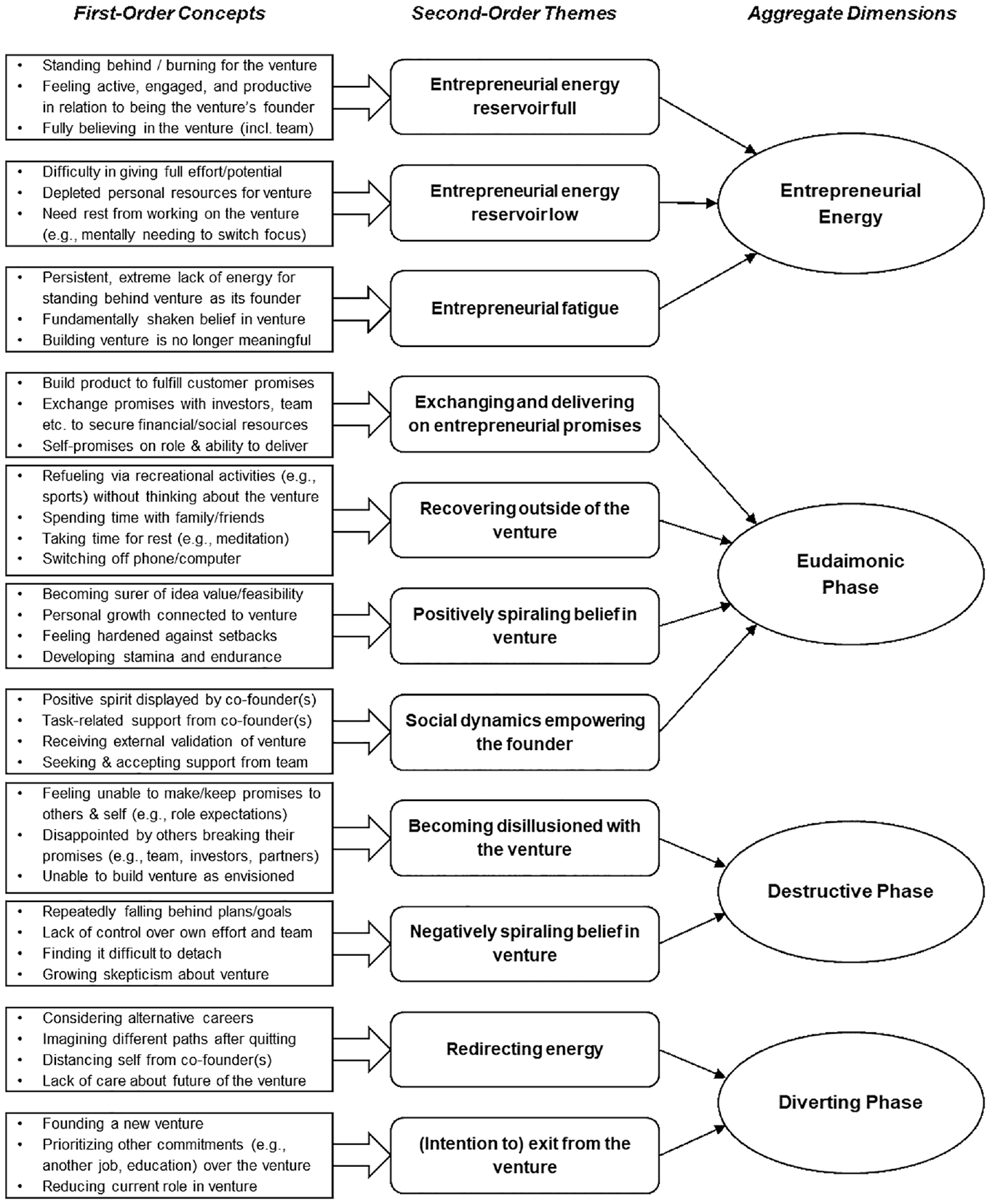
Data structure.
Findings
By synthesizing our findings, we build a dynamic model of entrepreneurial energy consisting of three phases: eudaimonic, destructive, and diverting (Figure 2).
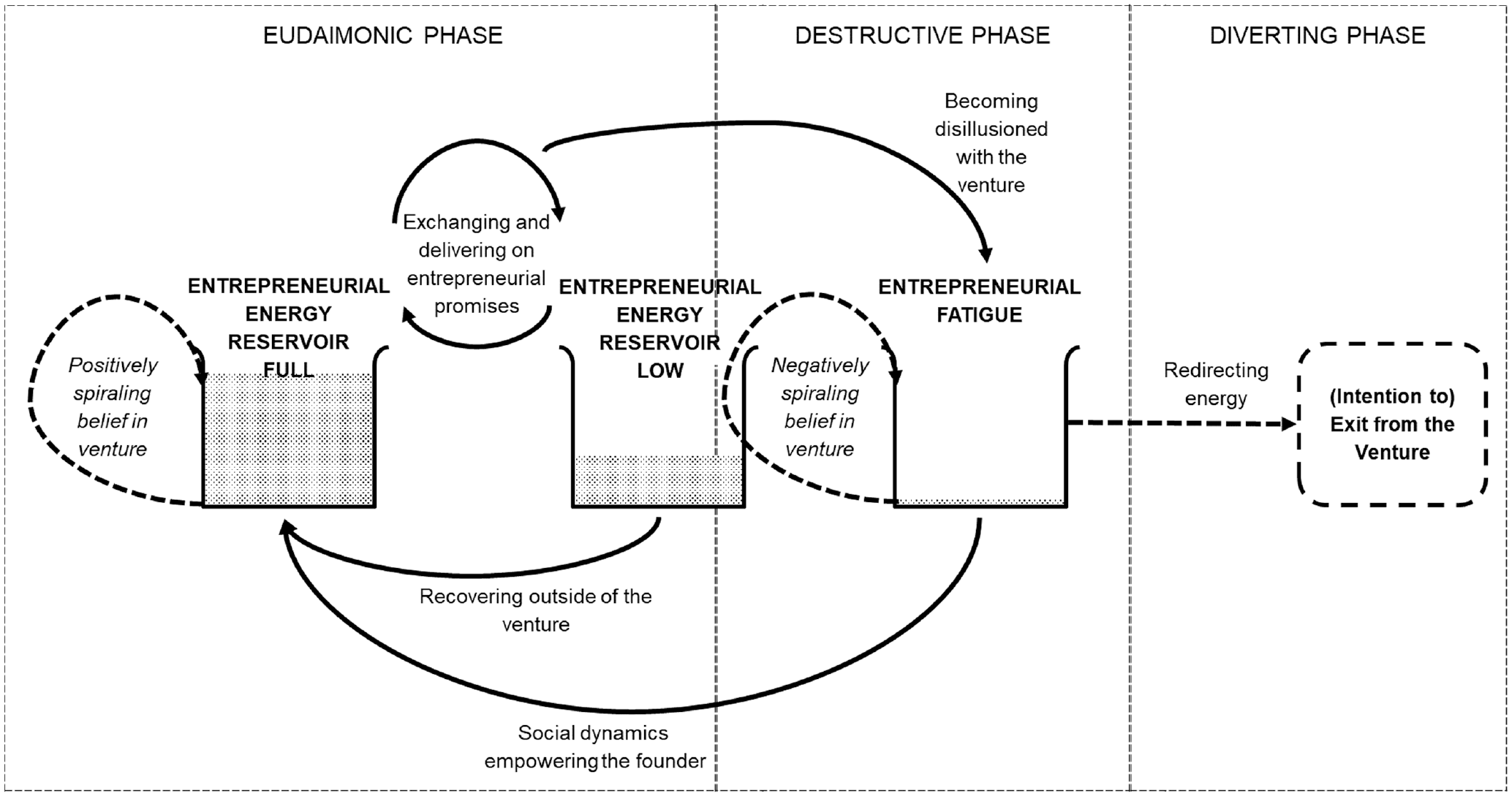
A dynamic model of entrepreneurial energy.
Eudaimonic Phase
In the eudaimonic phase, founders balanced energy consumed while building their venture by recovering outside of the venture, such that the entrepreneurial energy reservoir remained at or above the low level. We label this the eudaimonic phase given its strong connections with the eudaimonic perspective on understanding well-being, which emphasizes meaning and self-realization in the pursuit of self-determined, effortful activities (Ryan & Deci, 2001). We observed that for all the founders in our sample these activities involved investing considerable entrepreneurial energy into exchanging and delivering on entrepreneurial promises. This concept of entrepreneurial promises, which emerged from our data, refers to the assurances that founders make and receive in the context of building their venture. Entrepreneurial promises are particularly important since entrepreneurship is often a deeply personal (Shir & Ryff, 2021; Wiklund et al., 2019) and social process with uncertain future outcomes (Gartner et al., 1994; Huang & Knight, 2017) in which founders “create something out of nothing” (Baker & Nelson, 2005, p. 330). Entrepreneurial promises are both intra- and interpersonal. Founders make promises about what they and their venture can do. They make these promises to themselves, co-founders, employees, and external stakeholders, such as customers and investors. Our data suggested the term “exchanging entrepreneurial promises” to be appropriate, since founders also receive promises from themselves, co-founders, and other stakeholders. For example, speaking about Lambda’s entrepreneurial promise to customers, Luke (Interview 1) said, “Whether it’s through language, the message [behind our product], or the quality, which we try to keep very high, […] customers see the value-add, see what they get in exchange for their money.”
Crucially, the exchange of entrepreneurial promises needed to be followed by delivering on those promises. As Elias from Epsilon (Interview 1) said, “We sell ourselves through our actions and not through snazzy slides – we have snazzy slides too, but when we make our offer to the customers and they say yes, we very quickly deliver on [the promise].” Although established organizations also exchange promises with various stakeholders, exchanging entrepreneurial promises can be particularly difficult given the uncertainty surrounding a founder’s ability to deliver on such promises. As Noah from Nu (Interview 1) put it, “the fundamentally difficult thing in the startup phase [is] convincing people that you won’t be gone next year. If everyone thought that, then we would definitely not survive.”
Indeed, exchanging and delivering on entrepreneurial promises seemed to drive fluctuations between high and low levels of entrepreneurial energy for all the founders in the eudaimonic phase. As Ian from Iota (Interview 2) said, “It’s always a challenge for us to even get the attention of potential customers. It simply takes a lot [of energy] out of us still.” Yet Ian continued, “Right now I’m still calm about it […] because when customers do start to come to us with various wants, we will be prepared.” Thus, while Ian’s energy was consumed in convincing customers of Iota’s promise, due to his conviction of Iota’s ability to deliver on such promises, his entrepreneurial energy was only partially depleted. Our data showed that entrepreneurial promises were not only exchanged with others, but could also be personal. For example, Ben from Beta said:
There were always phases when talks with investors went badly […] and there was no energy going into [building the venture] but [I] have to put these things behind [me], or [I] won’t get anywhere. […] I am not just [building the venture] for the money after all; it should also help patients in the end. (Interview 1)
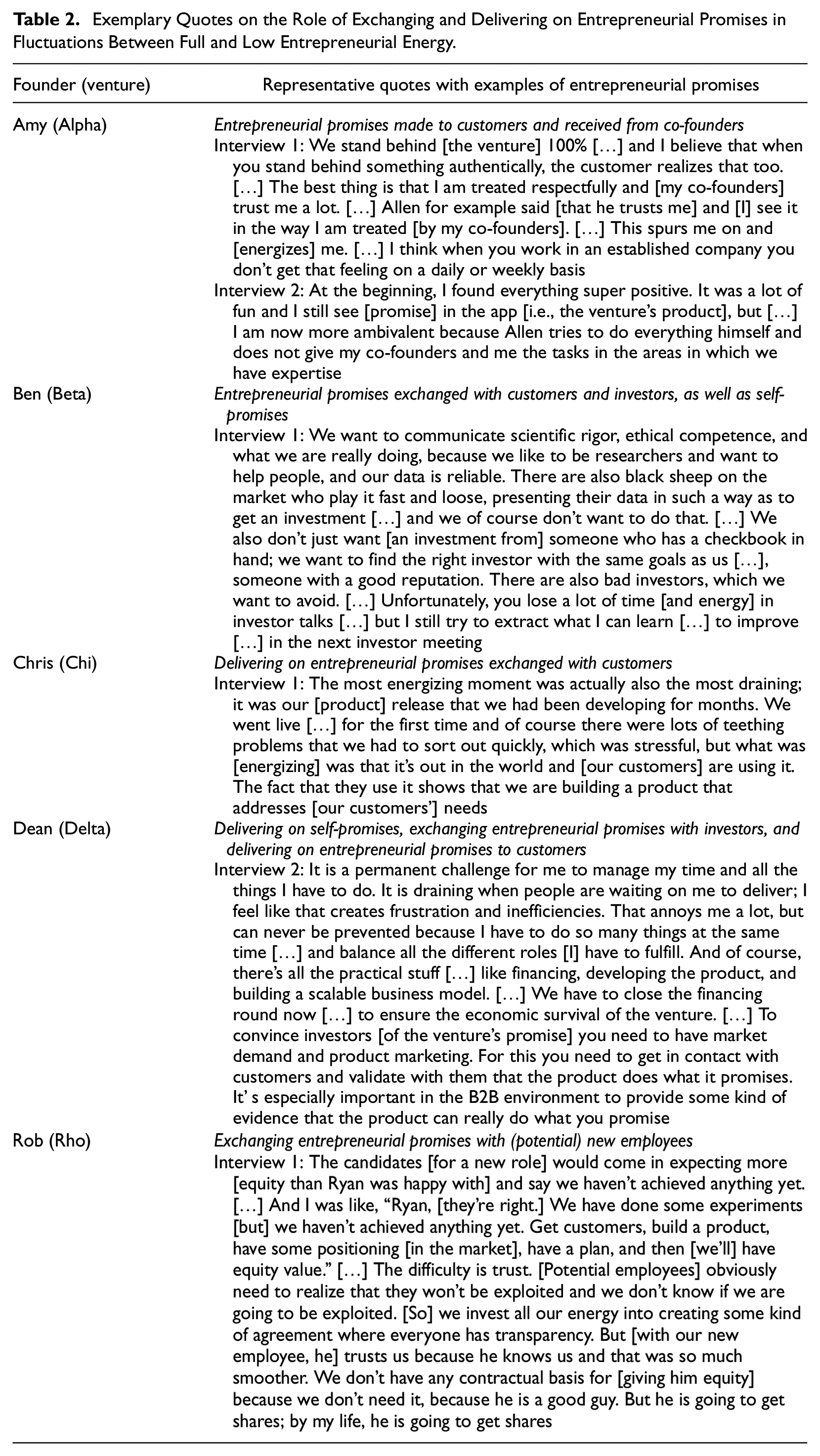
Despite losing energy in securing funding promises from investors, Ben remained convinced of Beta’s promise for helping patients (the biotech venture’s end-users). The importance of delivering on this promise bolstered Ben’s energetic activation for building the venture. We provide additional examples of various entrepreneurial promises and the associated energy fluctuations that founders in our sample experienced in Table 2.
Exemplary Quotes on the Role of Exchanging and Delivering on Entrepreneurial Promises in Fluctuations Between Full and Low Entrepreneurial Energy.
Our data especially underscored the personal nature of entrepreneurial promises, as we found that founders in the same venture differed in how their entrepreneurial energy fluctuated in the context of similar difficulties exchanging and delivering on promises. In the case of promises broken by a (former) co-founder who started a fight directly after returning from an unexpected vacation and quit soon after, Matt and Mike from Mu reacted differently. Mike (Interview 1) said:
This co-founder came back from a vacation that he did not coordinate with us in advance […], which already dampened the energy. […] We were still in this optimistic spirit of needing to step on the gas, now that we were complete […] and then [this co-founder] immediately started a fight, saying that he would have done everything we did in the last six months differently. We were a little shocked because every week we had [all] sat together to talk strategies and procedures and he never said we should have been [building the venture] differently.
Mike implicitly described that this co-founder broke multiple promises to the founding team (e.g., not coordinating his vacation with them, making sudden accusations). Similarly, Matt (Interview 1) was struck by the “demoralizing” nature of the co-founder’s speech, especially given Mu’s difficulties in delivering on external entrepreneurial promises surrounding product development and financing. Although Matt developed entrepreneurial fatigue, Mike said, these experiences “have not weighed down on me too much” (Interview 1). Thus, navigating entrepreneurial promises can be draining, but it does not by itself empty a founder’s entrepreneurial energy reservoir.
In addition to the venture-internal mechanisms of exchanging and delivering on entrepreneurial promises for explaining entrepreneurial energy fluctuations, our data also highlighted the importance of recovering outside of the venture for recharging founders’ energy. In particular, recovering outside of the venture consists of deploying diversionary strategies (Sonnentag & Fritz, 2007) to regain energy through recovery experiences such as psychological detachment, “disengaging oneself psychologically from work” (Sonnentag & Bayer, 2005, p. 395), relaxation, and mastery, challenging experiences outside of work that offer learning opportunities (e.g., sports) (Sonnentag & Fritz, 2007). For instance, Brian from Beta said: I am someone who takes a bit of active time off with also some rest in between. […] Then I can recover very quickly and regain […] energy. I don’t just do this through vacations, I try to do it on a weekly basis. I really do take a day where I do nothing [for the venture]. […] Just occupying myself with other things is enormously helpful. (Interview 1)
As this and other examples in our data (see Table 3) indicate, founders needed to make an active effort to recover entrepreneurial energy outside of the venture. Brian added that he likes to “meet with friends […] who have no idea about [the venture’s industry].” Thus, recovering outside of the venture also had a social component, in that recovery experiences were enhanced by cultivating positive relationships outside of the venture. Taken together, our data suggested that founders remained in the eudaimonic phase by balancing energy used up in exchanging and delivering on entrepreneurial promises by recovering outside of the venture.
Exemplary Quotes for How Recovering Outside of the Venture can Allow a Founder to Move from a Low to Full Entrepreneurial Energy Reservoir.
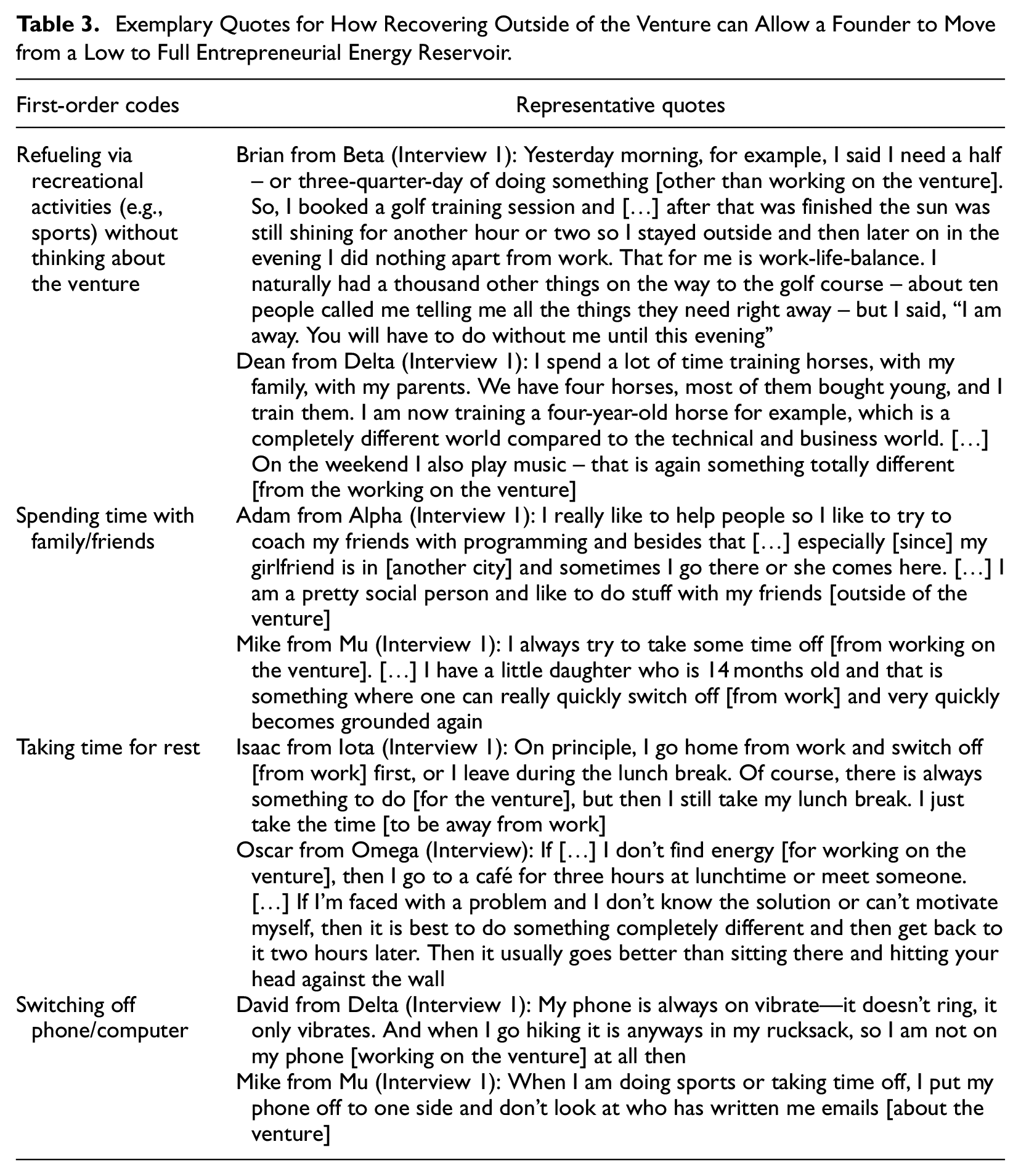
However, echoing the entrepreneurship literature on recovery (Stephan, 2018; Wach et al., 2021; Williamson et al., 2021), our data revealed that recovering outside of the venture was difficult to do in practice. For example, Andrew from Alpha (Interview 1) said, psychologically detaching from the venture is “relatively hard because in my head there are always lots of things whirling around at the same time.” Similarly, despite sensing her need to recover outside of the venture via mastery experiences of hiking in the mountains, Lily from Lambda said: When my ego is loud and thinks something needs to be done, I find [detaching] hard […]. For example, I know that my energy level is very low today and I want to take a few days to switch to going into the mountains […] but I also know about everything lying on my desk right now. (Interview 3)
As these quotes illustrate, founders could not always exert sufficient control over their own energy to be able to recover outside of the venture and remain in the eudaimonic phase.
Destructive Phase
Consistent with our expectations, the majority of founders in our sample experienced fluctuations in entrepreneurial energy, moving between a full and low entrepreneurial energy reservoir. However, some founders entered a destructive phase in which they experienced a persistent and extreme lack of energetic activation for building their venture—a state we refer to as entrepreneurial fatigue. Specifically, out of the 38 founders we interviewed, eight experienced entrepreneurial fatigue during our study: Adam and Andrew from Alpha, Lily from Lambda, Matt from Mu, Nick from Nu, Oscar and Owen from Omega, and Sam from Sigma. In the following, we elaborate on the concept and development of entrepreneurial fatigue, as observed in our data.
Conceptualizing Entrepreneurial Fatigue
In Matt’s case, entrepreneurial fatigue seemed to emerge around the time of Interview 1 when the venture was struggling to secure entrepreneurial promises of funding from investors and two co-founders had just decided to quit: “When such a demoralizing speech was made [by the now ex-co-founder], then I had to say, ‘I am done for today. I don’t want to see you anymore, and I can’t work right now.’” Matt’s energy for building the venture remained severely depleted, with him remarking in Interview 2 that it was still “an extremely difficult time, that really put a lot of pressure on me, and I was in the office and thinking to myself: what the hell am I doing here? I could also have taken the day off and been just as productive.” He continued, “I completely lost faith that we would be able to pull this thing together somehow.” As Matt’s case illustrates, entrepreneurial fatigue persists over a longer period of time and goes beyond feeling a high level of stress or temporary exhaustion; rather, Matt was fundamentally shaken in his belief in the venture’s ability to successfully exchange and deliver on entrepreneurial promises. Entrepreneurial fatigue constituted a particularly severe blow to a founder’s well-being—as Matt noted, “you give everything for [founding the venture] and also deal with it much more intensively than you perhaps might with another job [as an employee]” (Interview 2).
Moreover, in contrast to other experiences of ill-being in which individuals feel their lives to be empty or stagnating, such as languishing and depression (Keyes, 2002), entrepreneurial fatigue in our sample was restricted to the context of energetic activation for building the current venture. Founders experiencing entrepreneurial fatigue did not necessarily lack energetic activation for entrepreneurial work generally. For example, despite experiencing entrepreneurial fatigue in building his current venture, Omega, Oscar said, “if [this venture] doesn’t work out, then I will definitely found a new venture, and I will keep doing that until I manage to build a successful [venture]” (Interview 1). Furthermore, founders affected by entrepreneurial fatigue also described their enjoyment of activities outside of the venture. For instance, Nick from Nu (Interview 1) said, “Last month […] on the weekends I said I’d do nothing [for the venture] and […] just played video games […], watched films with my wife, […] went out again today to the Christmas market, [and] visited friends who live further away.” 2 Entrepreneurial fatigue should also be distinguished from burnout, a specific stress response syndrome commonly understood as a process of emotional exhaustion, depersonalization, and diminished personal accomplishment (Maslach et al., 2001). In contrast to burnout, which captures a clinical diagnosis (Schaufeli et al., 2001) and has substantial implications on an individual’s private life and their health (Ahola et al., 2014), entrepreneurial fatigue in our sample was specific to the context of building the venture. Entrepreneurial fatigue might appear similar to the emotional exhaustion dimension of burnout. However, individuals experiencing emotional exhaustion lack energetic activation and feel unable to regain it (Maslach et al., 2001; Quinn et al., 2012), whereas founders experiencing entrepreneurial fatigue can feel capable of regaining energetic activation—if not in the current venture/team, then in another one.
Developing Entrepreneurial Fatigue
Consistent with the importance of personal perceptions in explaining fluctuations in entrepreneurial energy in the eudaimonic phase, the development of entrepreneurial fatigue seemed to depend on a founder’s personal perceptions of exchanging and delivering on entrepreneurial promises. Interestingly, all of the founders who developed entrepreneurial fatigue had co-founders working in the same venture and thus under comparable conditions but who did not show signs of such fatigue. For example, both Sam and Stanley spoke of Sigma’s difficulties in progressing from entrepreneurial promises with customers on pilot projects to actual product rollouts. Stanley (Interview 2) said, “our biggest challenge is transferring our customers from pilot projects to rollouts […] We also had [an employee] working on this […] but that didn’t work, and we had to let them go.” Similarly, Sam (Interview 2) said, “Making the transfer from the pure conclusion of a contract to actual use [on the customer-side] is still very difficult for us.” Clearly, both co-founders perceived the same difficulties in entrepreneurial promises to customers. However, only Sam seemed to be experiencing entrepreneurial fatigue: “Since [the employee] left […] the topics are becoming more numerous again, there are already […] deadlines being communicated, which I personally consider impossible.” Sam felt entrepreneurial promises were being exchanged that Sigma would be unable to deliver on. Meanwhile, Stanley felt more confident of the venture’s ability to exchange and deliver on promises to customers, saying “certainly these have been some low points, but we have learned what is necessary or how we can adapt” (Interview 2). Taken together, these quotes show that despite the overlap in entrepreneurial promises made by co-founders of the same venture, the co-founders could still differ in their perception of these promises—with crucial consequences for their entrepreneurial energy.
Specifically, for the founders who developed entrepreneurial fatigue, over time, (perceived) failures to exchange and deliver on entrepreneurial promises triggered disillusionment with the venture, resulting in entrepreneurial fatigue. Disillusionment refers to the experience of realizing one’s prior beliefs or expectations to be illusory or overly optimistic (Heath & Jourden, 1997; Janoff-Bulman, 1989). In our study, founders became disillusioned with the venture in that they felt unable to exchange or deliver on entrepreneurial promises. For instance, describing the process of securing entrepreneurial promises from investors in raising a financing round in the aftermath of Interview 1, Oscar from Omega said: Our investor meetings very quickly became about investors dismantling our business model and everything and then Owen would just nod saying yes, […] we still need to work on this and we have to do better there […] and yes, that’s right, we can talk again in a couple of months. We are still not far enough. (Interview 2)
Rather than agreeing with the investors’ objections, Oscar believed, “Investors are always very critical […] and you have to show them a certain amount of strength – with investors, you have to hit the table and say, ‘but I am firmly convinced that this works’” (Interview 2). There appeared to be a significant social aspect to Oscar’s disillusionment with investor meetings, as he described multiple events where he repeatedly felt that his co-founder, Owen, was unable to challenge the investors and convince them of the venture’s current value. Oscar summarized, “In the beginning I told [Owen] more directly that he should sell our offering more strongly [to the investors], but then conflicts arose […]. Owen did not believe me when I made suggestions […]. And that basically motivated me less and less to participate in my tasks [as a co-founder]” (Interview 2). Oscar’s attempt to raise his concerns with Owen only created conflicts, resulting in a social dynamic that deepened his disillusionment and further sapped his energy for building the venture.
Further underscoring the individual-specific nature of entrepreneurial promises, founders might also become disillusioned about self-promises, such as personal role expectations; this severely depleted their energy for continuing to stand behind the venture as its founder. Reflecting on the past few months of building her venture, Lily from Lambda said: It was somehow not clear whether the content of the venture was something I could still [stand behind] ever since we began to sell [the product] as an advertising article. […] At some point I felt empty because I realized this is not at all what I started this venture for. This is silly. […] And with time came clarity […] that this was like energy lost to the void and then the energy definitely goes. (Interview 3)
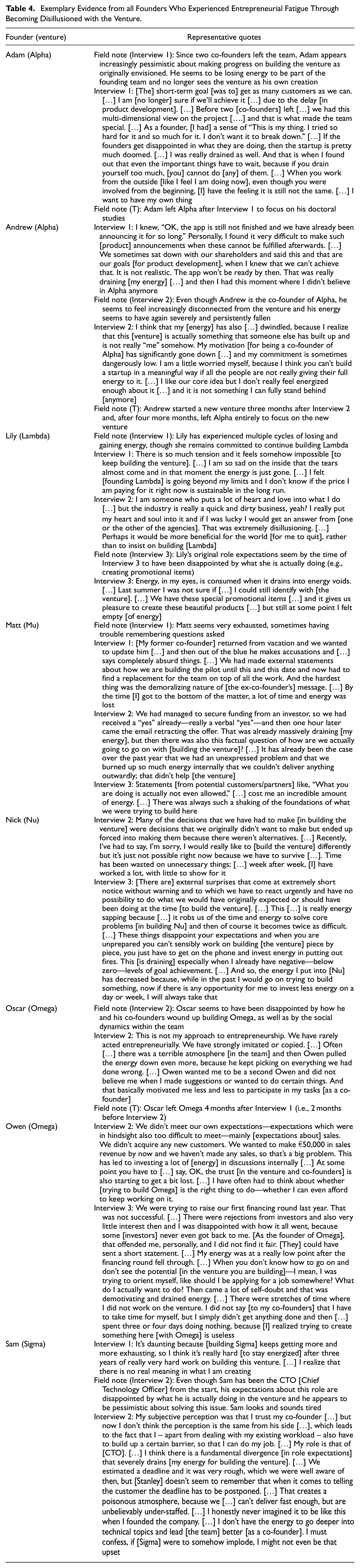
In exchanging entrepreneurial promises with customers by positioning her product in the market as an advertising article, Lily felt unable to deliver on self-promises on her role as the venture’s founder. Over time, this drained her energy for building the venture and led to entrepreneurial fatigue towards the end of our study period. As these and other quotes in Table 4 suggest, through becoming disillusioned with the venture over time, founders could experience a state of entrepreneurial fatigue in which their entrepreneurial energy reservoir was empty (i.e., move from the eudaimonic phase to the destructive phase of our model in Figure 2).
Exemplary Evidence from all Founders Who Experienced Entrepreneurial Fatigue Through Becoming Disillusioned with the Venture.
Within the destructive phase, some founders were only temporarily able to transition from an empty entrepreneurial energy reservoir to a low one before once again falling back into a state of entrepreneurial fatigue. Eventually, this could result in a self-reinforcing decrease of entrepreneurial energy with a negatively spiraling belief in the venture. Here, the founder was likely to increasingly lose conviction in the value of the venture over time and could feel unable to control their entrepreneurial energy for the venture. For instance, in speaking about his entrepreneurial fatigue and the tasks he needed to work on, during our two interview rounds, Sam from Sigma experienced a severe drop in energy. Referring to the experiences during this time period, he said in Interview 2, “I [now don’t have the energy anymore to] push back to stop so many [tasks] coming in. […] I can only say that the day has 24 hours and what can be implemented within that time will be.” As the quote illustrates, because of his lack of entrepreneurial energy, Sam felt unable to negotiate more feasible entrepreneurial promises and the venture seemed to demand more energy than he felt able to invest. Reflecting on the past months, Nick from Nu also said “I see that regardless of how much energy I put in, […] there is only headwind and no tailwind, so to speak” (Interview 3). He continued, “[my energy for the venture] is a curve going up and down but the general trend is definitely downward […] Maybe a battery is the best [metaphor] because with batteries the chemical composition inside them can change over time so that the capacity decreases. There is definitely less capacity than before.” This memory effect in batteries seemed to us an apt metaphor for illustrating Nick’s negatively spiraling belief in the venture.
In dealing with a negatively spiraling belief in the venture, founders found it impossible to return to the eudaimonic phase by recovering outside of the venture. For instance, in speaking on the difficulty of taking a few days off to spend time outside of the venture on recovery, Nick said toward the end of our study when he was still stuck in a state of entrepreneurial fatigue, “I currently have to invest lots of energy just to keep things halfway on track. If I took a few days off, it wouldn’t work. […] Even if I try to switch off, unless I am doing something active, I find myself immediately thinking about [the venture]” (Interview 3). Meanwhile, right from the start of our study period, Sam from Sigma (Interview 1) said, “The workload is too high. [Recovering outside of the venture] is just not possible.” These quotes illustrate how difficult recovering outside of the venture is for founders in the destructive phase.
Our data suggested that even if founders felt drained of entrepreneurial energy, that is, lacked energetic activation for building the venture, they could still continue to work on the venture because they felt they had already invested so much in the venture or because enough minor positive experiences continued to bolster their entrepreneurial energy. For instance, Sam from Sigma said (Interview 2), “One asks oneself, to what extent is one really free to exit? […] If I don’t want to throw away what I have worked for, then I am not free [to exit]”. In a similar vein, and highlighting the role of small, positive experiences over the past couple of months, Nick (Interview 3) said, “I don’t actually understand why I do it […], probably because we have invested so much time in it […] and there is actually always some external event that again motivates one’s self”. However, Nick admitted that unlike his co-founder, who “at least tries to keep searching for possibilities to turn things around, I am more inclined to say that if we can’t at least achieve this and this, it makes no sense to keep going” (Interview 3). While sunk costs and small positive events kept a founder in the venture, the founder’s belief in the venture remained in a negative spiral that prevented their entrepreneurial energy from recovering.
In searching for potential alternative explanations for how and why founders developed entrepreneurial fatigue, we considered multiple factors. Checking our data for individual-level antecedents yielded no clear pattern between factors such as individual personality traits, level of prior entrepreneurial experience, or the number of hours a founder worked on the venture and the development of entrepreneurial fatigue. Since all of the ventures in our sample were founded by entrepreneurial teams, we also considered the extent to which entrepreneurial fatigue might be driven by team dynamics. Co-founders formed an important component of the internal venture environment and could contribute to disillusioning some founders (e.g., Oscar from Omega) and draining their energy. Yet, our data also suggested co-founders were not always contributors—or at least not the only contributors—to a founder developing entrepreneurial fatigue (e.g., Lily’s disillusioning experience around selling Lambda’s product as an advertising article).
Diverting Phase
The final phase in our model, the diverting phase, involved the founder redirecting energy into alternative endeavors, as well as beginning to feel increasingly driven to exit from the venture and indeed, ultimately leaving the venture. For example, founders considered alternative options to continuing with the current venture and described a lack of care about the future of the venture. For example, Andrew from Alpha (Interview 2) rather unenthusiastically said, “So it would in some ways hurt me if from 1 day to the next the venture was to fail, but I nevertheless feel like my commitment is now dangerously low.” Redirecting energy could also involve taking up other side projects. For instance, having become disillusioned about his venture, Oscar from Omega said in Interview 2, “I have had a consulting business since a few years now and already [three months prior to leaving Omega] I started a consulting project; there is now also a follow-on project that I am working on.” Therefore, over time a founder was likely to feel more disconnected from the venture and to redirect energy into other pursuits. Interestingly, this finding highlights the double-edged nature of diversionary recovery strategies, dependent upon a founder’s entrepreneurial energy level. Although recovering outside of the venture enabled a founder to transition from a low-to-full entrepreneurial energy reservoir, in the case of an empty reservoir (i.e., entrepreneurial fatigue), disengaging from the venture made founder exits more likely.
Importantly, the founders in our sample were generally already aware of their personal opportunity costs in building the venture, as well as the feasibility of alternative endeavors even before engaging in them. For example, Nick from Nu (Interview 3) said, “I have always known it would be no problem to find something else to do […] as I already receive [job] offers without asking for them.” Yet, the relevance of these personal opportunity costs for redirecting their energy into other endeavors only started to emerge after they had already lost energy for building the current venture. For instance, following his disillusionment with the venture and lack of energy since our first interview, Andrew from Alpha remarked: I started thinking, my God, does it really make sense [to keep building Alpha], limiting myself career-wise […] or is this thing really going to go through the roof so that I won’t need a full-time job afterwards? […] I still have a research stay planned [abroad]. [Without Alpha] I would be able to fly there with a completely free head. (Interview 2)
Thus, the awareness of his personal opportunity costs began to become more relevant to Andrew’s perceptions about whether building the venture was still worth it.
Redirecting energy into alternative endeavors could lead founders to feel increasingly inclined to exit the venture or in some cases actually result in the founder’s exit. For example, Oscar from Omega talked in Interview 2 about how his lack of energy for the venture and negative perceptions of his co-founders’ competencies ultimately led to him “becoming emotional,” saying “I felt daily that there was this [tension] in the air, no matter what [my co-founder and I] spoke about.” As a result, Oscar left the venture soon afterwards, reflecting, “I was really just waiting to say that I’m out. So, basically, if Owen and the others hadn’t spoken then, I probably would have left a week later of my own accord” (Interview 2). Similarly, Andrew from Alpha explained in Interview 2 that he had spoken to a close friend about his lack of energy for the venture, saying, “I recently told her that I am at a point now where I somehow can’t and don’t want to continue anymore.” Indeed, three months later, Andrew had scaled back his involvement in Alpha and started a new venture with different co-founders. Four months later, Andrew exited from Alpha entirely. Thus, entrepreneurial fatigue could develop into founders feeling so disconnected from their venture that they directed energy into other endeavors and eventually exited from the venture.
Interestingly, all these founders who left the venture still retained belief in the viability of the entrepreneurial opportunity, but lacked the energy to make the necessary changes in the venture or their own role to continue their work. For instance, Oscar (Interview 3) said: I did think about how it might be possible to still successfully build [the venture] […]. I had too little energy to make the changes though […] I tried once or twice to give a motivational speech in order to energize the team. And that’s the kind of thing that Owen never does—he can’t do it or he also absolutely doesn’t want to do it.
Due to the negative social dynamic with his co-founder Owen, Oscar found it difficult to believe that exploiting the entrepreneurial opportunity within the current venture was still possible.
Transitioning from the Destructive to the Eudaimonic Phase
Importantly, our data suggested that founders could also return from the destructive phase to the eudaimonic phase. These founders showed signs of recovering from entrepreneurial fatigue and were able to completely refill their entrepreneurial energy reservoir. We found that social dynamics empowering the founder facilitated transitioning from an empty reservoir to a full one. Empowering refers to the process by which individuals gain intrinsic motivation for their task or work role (Spreitzer, 1995). In our study, empowering feelings were elicited by positive social dynamics, such as a founder receiving positive validation of their efforts in building the venture from external stakeholders and/or the founder being able to rely on co-founders for task-related or emotional support. For example, Matt from Mu was able to recover from entrepreneurial fatigue by benefitting from empowering social dynamics with external stakeholders: I was invited to give a speech at a large corporation in front of 120 managing directors—that was quite an honor […] and gave me an incredible amount of energy, especially when people came to speak to me afterwards who were at the end of their professional career and had achieved a lot and showed their appreciation for our idea. (Interview 3)
Matt also felt able to rely on his co-founder to understand him and provide task-related support: “Mike is there and you notice that he fully supports you. […] If I wrote to him yesterday night at like 11:00 [saying], ‘Hey, I need this and this number until tomorrow’, then I know that tomorrow morning the number will be there” (Interview 1). Later, in Interview 2 Matt further reflected: Mike’s perceptions during the time when things were going really bad for us [were really important]. We went skiing and snowboarding one weekend and I didn’t have much to smile about, but […] I saw Mike is sitting in the same boat and he still takes the weekend to enjoy skiing or whatever. I think that was a very important moment […] and since then I am definitely alert, committed, motivated, and I notice this in the results of my work.
He added, “If you had asked me in March if I believe in my idea, I would have said ‘Meh…’, but in the meantime I am fully convinced of it again.” These quotes illustrate how the positive spirit shown by his co-founder made Matt feel empowered and, over time, helped to refuel his energy.
The empowering social dynamics between Matt and Mike were likely helped by their friendship, which enabled Matt to benefit from Mike’s more positive outlook on the venture. However, we note that friendship was not always a helpful social dynamic for empowering a founder. For example, Andrew from Alpha (Interview 2) said, “I find it difficult to tell [my co-founder] Allen the things that bother me […], which makes me worry whether it is good to have close friends on the team.” His inability to separate his professional relationship with Allen from their friendship prevented him from voicing his concerns and potentially benefitting from empowering social dynamics.
Interestingly, whereas in the eudaimonic phase founders employed the diversionary strategy of recovering outside of the venture, fully regaining energy in the destructive phase required the engagement strategy of empowering social dynamics. Refueling through empowering social dynamics involved active engagement on the part of the affected founder, such as by accepting others’ support. As of Interview 1, Owen from Omega was responsible for “product design, […] including user stories and how they should be implemented.” Delivering on the entrepreneurial promises inherent in this role created energy-draining conflicts: We recently discussed what our product should be able to do. Olaf, [my co-founder] who is responsible for the technical implementation, did not understand. I often communicated it to him and assumed he understood what I meant. […] Two weeks later we […] realized [the product] is not working properly and I said, “Well, I told you so.” That kind of thing just leads to conflict. […] It was definitely a stressful situation. (Interview 1)
Speaking about product development, Owen said, “I do it satisfactorily […] but that’s where I reach my limits and it takes too long” (Interview 1). In Interview 2, Owen acknowledged that he felt unable to deliver on his entrepreneurial promise: “We have not gained any new customers since [Interview 1] […] and one of the main reasons was of course that the product [development] took longer.” Consequently, as Olaf (Interview 2) said, they realized “Owen was unable to carry out the role […] he just didn’t have time to define [user] stories, so I have now taken it over.” Reflecting on the empowering social dynamics created by this role change, which enabled his recovery from entrepreneurial fatigue, Owen (Interview 3) said: I used to always decide everything about product planning and say exactly what features should come next. […] These conflicts robbed me of energy […]. I thought about how to make this work better […] and now that I have left [product planning] a bit more to [Owen] […] it is no longer such a conflict situation and much less energy is drained. […] Successfully working together [like this] as a team is what gives me energy.
Thus, while social dynamics could empower a founder and refuel energy, crucially, the founder needed to actively make the necessary changes to allow these dynamics to take place.
Moreover, after returning to the eudaimonic phase, a recovered founder could even experience a positively spiraling belief in the venture, such that their entrepreneurial energy reservoir itself effectively grew. Comparing his energy level at the time of Interview 3 to earlier in the founding process, Owen from Omega said: “When you really see that customers are willing to pay money, that brings a whole new level of energy. Then there are also these feelings of success. That really contributes to [my energy]. [The venture] is no longer just a concept.” This implies positive, validating feedback could strengthen a founder’s conviction of their ability to deliver on entrepreneurial promises, thus growing entrepreneurial energy over time. Moreover, a positively spiraling belief in the venture could also involve the founder feeling more prepared to tackle future difficulties in exchanging and delivering on entrepreneurial promises. For example, Matt from Mu (Interview 3) reflected he no longer lost significant energy to challenges, saying “if I don’t get to the expected solution today, but only in three weeks, that’s OK. […] I think I’m kind of hardened to [challenges] now. […] I no longer have such massive drains on my energy.”
In summary, our findings suggest that founders’ entrepreneurial energy may fluctuate over the course of exchanging and delivering on entrepreneurial promises. In the eudaimonic phase, founders can offset energy consumed by entrepreneurial promises by recovering outside of the venture. Founders transition from eudaimonic to the destructive phase, when feelings of disillusionment with the venture arise, resulting in a severe and sustained drop in their entrepreneurial energy—that is, entrepreneurial fatigue. Founders that remain in the destructive phase are stuck in a negative spiral of losing their belief in the venture. However, founders can also return to the eudaimonic phase, refueling energy through empowering social dynamics, or enter the diverting phase by redirecting energy into alternative pursuits, ultimately escaping entrepreneurial fatigue by exiting from the venture altogether.
Discussion
We build a dynamic model of entrepreneurial energy which captures how founders’ energy for building their venture fluctuates over time. Interestingly, our data also reveal that some founders experience a persistent lack of energy for building the venture and our model helps explain why some founders experience this entrepreneurial fatigue while others do not. Our work has important implications for studying entrepreneurial energy and entrepreneurial well-being, as well as for advancing research on energetic activation in POS more broadly.
Theoretical Implications
Advancing the Understanding of Founders’ Entrepreneurial Energy
Despite the importance of entrepreneurial energy as a key indicator of founders’ well-being and driver of founder- and venture-level performance (Hahn et al., 2012; Stephan, 2018), the theoretical development of this concept including its dynamic fluctuations has received limited attention (Stephan et al., 2020). By integrating POS literature on energetic activation (Quinn et al., 2012) with what is uniquely “entrepreneurial” about the entrepreneurial context (Stephan et al., 2020), we bring clarity to the concept of entrepreneurial energy. In defining entrepreneurial energy in terms of a founder’s energetic activation for building their venture, our conceptualization is broad enough to invite further exploration by other scholars, while still being entrepreneurship-specific. Like conceptualizations of entrepreneurial passion (Cardon et al., 2017; Warnick et al., 2018), which incorporate various entrepreneurial activities a founder might feel passionate about, building the venture involves all the aspects of a founder creating, nurturing, and shaping the venture to give meaning to both themselves and others. Our conceptualization of entrepreneurial energy encourages scholars to explore these various aspects and their interrelations. For example, as our findings show, a founder may be de-energized by one aspect of building the venture, such as trying to secure funding promises, while being energized by another aspect, such as the promise of the venture’s product for addressing customer needs.
By building theory on the dynamics of entrepreneurial energy, we show how the energizing and de-energizing aspects of founding a new venture may be reconciled. Prior studies have revealed relationships between various entrepreneurial experiences and energy, such as the energizing role of personal and social psychological functioning (Nikolaev et al., 2020), as well as the de-energizing role of threats to a founder’s goals, such as role ambiguity and interpersonal conflict (Lerman et al., 2020). However, these divergent aspects of the entrepreneurial experience have yet to be reconciled into a dynamic theory of entrepreneurial energy that accounts for how it develops in reciprocal ways, rather than in one-directional, linear relationships (Murnieks et al., 2019; Rauch et al., 2018). The theoretical model we induct from our data directly addresses this important gap by showing how entrepreneurial energy is a dynamic resource that fluctuates in both balancing and feedback loops over the course of founders exchanging and delivering on entrepreneurial promises to build their venture.
Adapting the POS perspective of energetic activation (Quinn et al., 2012) to the entrepreneurial context, our model also shows how entrepreneurial energy can be a scarce or abundant resource, depending on which phase of the model founders are in. In the destructive phase, when a founder has been disillusioned by (perceived) failures to exchange and deliver on entrepreneurial promises, their entrepreneurial energy reservoir is empty and may even shrink as they experience a negatively spiraling belief in their venture. Conversely, in the eudaimonic phase, when a founder manages to successfully balance energy consumed by entrepreneurial promises with energy refueled through recovery outside of the venture, founders can sustain a full entrepreneurial energy reservoir and potentially even grow the reservoir as they experience a positively spiraling belief in their venture. This conceptualization of entrepreneurial energy dynamics extends current theorizing on founders’ energy-building (Shir & Ryff, 2021; Stephan et al., 2020) and energy-depleting experiences (Rauch et al., 2018; Uy et al., 2013) by providing insights into when entrepreneurial energy is a scarce resource, as conservation of resources theory would suggest (Hobfoll, 1989; Sonnentag et al., 2010), as well as when it is an abundant resource, as self-determination theory (Ryan & Deci, 2000) would suggest (Quinn et al., 2012).
Our theoretical model of entrepreneurial energy dynamics especially highlights the importance of intrapersonal and social dynamics as captured by the role of entrepreneurial promises in explaining founders’ energy fluctuations. In doing so, we combine ideas from extant literature on uncertainty (Rauch et al., 2018) and meaning-making (Stephan et al., 2020) being central to entrepreneurship and especially influential for a founder’s energy. Founding a venture is a personal and social process associated with a variety of uncertain outcomes, such as whether founders will manage to create value and meaning for themselves, customers, and investors (Huang & Knight, 2017; Shir & Ryff, 2021). Entrepreneurial promises address the uncertainty inherent in the founding process, since by exchanging and delivering on such promises—that is, arguably acts of meaning-making (Rousseau, 2001)—founders can increase others’ and their own belief in the venture. However, our work also shows the flip-side of promises for a founder, namely that exchanging and delivering on entrepreneurial promises is often energy-draining. Promises also play an important role in the literature on hype, which involves founders making promises “of a possible future, around which attention, excitement, and expectations increase over time” (Logue & Grimes, 2022, p. 1056)—not all of which can be fulfilled (Garud et al., 2023). Future studies on hype may explore how it relates to entrepreneurial energy, distinguishing between the energy fueling and energy draining aspects of hype.
Implications for Research on Entrepreneurial Well-Being
Since entrepreneurship is a purposeful and potentially meaningful activity for founders, energetic activation is a key indicator of founders’ well-being (Hahn et al., 2012; Stephan, 2018). By introducing the concept of entrepreneurial energy, we hope to shift the entrepreneurial well-being conversation towards more holistic theorizing. Our study highlights the importance of considering the hitherto underexplored eudaimonic aspects of well-being (Stephan et al., 2020; Wiklund et al., 2019), as this can provide valuable insights into how founders can continue to build their ventures and recover from the exhausting parts of their journey.
Uncovering the experience of entrepreneurial fatigue enables us to extend the existing understanding of how obstacles along the entrepreneurial journey affect founders’ energy to stand behind the venture as its creator (Kollmann et al., 2019; Lerman et al., 2020). This deeply personal, even existential, experience goes beyond merely feeling strained as prior research on entrepreneurial well-being has described (Gish et al., 2019; Kollmann et al., 2019; Murnieks et al., 2019). Interestingly, while the strenuous nature of entrepreneurial activities is a commonly cited drain on a founder’s energy (Kollmann et al., 2019; Murnieks et al., 2019), our study suggests that such features of entrepreneurial work are likely not a direct trigger for a persistent lack of entrepreneurial energy. For example, although difficulties exchanging and delivering entrepreneurial promises can drain a founder’s energy, this may be counterbalanced by recovery experiences outside of the venture. Importantly, only the founders’ subjective perception of broken or infeasible entrepreneurial promises seem to trigger disillusionment and a sustained drop in energy—even when comparing founders within the same venture. In the entrepreneurial context, it may therefore be problematic to apply the challenge-hindrance stressor framework from general organizational stress research with its attendant assumption that “individuals appraise stressors in common ways because of homogenous work environments” (Lerman et al., 2020, p. 3). Our findings instead call for deepening our understanding of individual-level reactions to broken entrepreneurial promises.
We also extend entrepreneurial well-being literature by informing the conversation around how recovery experiences can improve founders’ well-being (Stephan, 2018; Williamson et al., 2021). Consistent with the recovery literature (Sonnentag et al., 2017), our findings show that diversionary strategies for recovery could help founders to refuel entrepreneurial energy consumed by exchanging and delivering on entrepreneurial promises. In our model, recovery outside of the venture involves activities that enable recovery experiences such as psychological detachment, relaxation, mastery, and control (Sonnentag & Fritz, 2007). Yet, counterintuitively, we found that recovery outside of the venture only helped founders in the eudaimonic phase of our model. Outside of this phase, when founders experience entrepreneurial fatigue, activities that would normally constitute recovery outside of the venture (e.g., mastery experiences in pursuing further education or starting to develop ideas for new ventures) manifested in the form of a founder redirecting energy, ultimately driving the founder towards exit. This offers important insights about how diversionary recovery mechanisms, which extant literature has so far advocated for founders (Wach et al., 2021; Williamson et al., 2019, 2021), might actually have very different effects contingent upon a founder’s energy state. Our work especially draws attention to the importance of engagement mechanisms for founders in the destructive phase of our model. Specifically, founders in the destructive phase are only able to refill their energy reservoir if they experience social dynamics empowering them while working on their ventures. Thus, engaging with their work on the venture might have advantages for the founders experiencing entrepreneurial fatigue compared to (temporarily) taking a break from the venture. This challenges prior work that would suggest that recovery happens outside of work and can enable more effective recovery interventions (Williamson et al., 2021).
Extending the POS Perspective of Energetic Activation
In studying energetic activation within the domain of entrepreneurship, we also inform more general POS theories of energetic activation (Quinn et al., 2012; Spreitzer et al., 2011). Our findings on entrepreneurial energy dynamics and our concept of entrepreneurial promises can help extend existing understandings of the role played by job demands and resources in influencing fluctuations in energetic activation (Bakker & Demerouti, 2017; Quinn et al., 2012). Recent work taking a new proactive perspective on individuals’ work behaviors highlights that they may not only increase their job resources but may also optimize their job demands, for example, by engaging in job crafting (Bakker et al., 2023; Demerouti & Peeters, 2018). Quinn et al. (2012) argue that this type of demand-seeking behavior is increased by intrinsic motivation, which in turn is increased by energetic activation; meanwhile, demand-seeking itself reduces energetic activation. Entrepreneurship is an extreme context for demand-seeking behavior, which allows us to identify some of the challenges involved in optimizing demand-seeking. In particular, we suggest that (some) entrepreneurial promises might be difficult to secure, that is, demand-seeking may itself drain energy. The implications of perceiving failure to exchange and deliver on entrepreneurial promises can be especially detrimental for sustaining energetic activation, since it can trigger disillusionment and fatigue. These processes we observe in the entrepreneurial context may generalize to employees who are intrinsically motivated by their work or encouraged by their organizations to seek demands. Indeed, promises as a concept are also features of employed work (e.g., the psychological contract between employees and their organizations) (Johnson & O’Leary-Kelly, 2003; Soares & Mosquera, 2019) and may help to more explicitly theorize about the influence of social dynamics on energetic activation. Understanding how employees navigate promises can generate novel insights into the role of social dynamics in driving energy fluctuations in the context of established organizations. These relationships can also be explored at higher levels of analysis (Cole et al., 2012; Vogel et al., 2022); for example, work teams in organizations may exchange promises and energize/de-energize each other.
Additionally, our work provides nuance and valuable extensions to the existing theory on how a lack of work-related energy may be mitigated through the job resource of social support –widely acknowledged to be an important buffering mechanism (Bavik et al., 2020; Guthier et al., 2020; Karasek, 1979). As a recent review by Bavik et al. (2020) points out, much remains to be learned about the dynamic role of social support through different phases of an individual’s experience of a stressful situation. Our study offers insights into this underexplored area of research by showing that positive social dynamics can play different roles when a founder’s energy is low versus when they experience entrepreneurial fatigue. When a founder’s energy is low, social support may encourage a founder to positively appraise their ability to successfully exchange and deliver on entrepreneurial promises. However, when a founder experiences entrepreneurial fatigue, having become disillusioned about their venture, recovery requires the founder to become open to and accepting of empowering social dynamics. Here, the founder’s agency is directed outwards to get help from other people in their social context, such as task or emotional support from co-founders and positive validation from mentors. Not only do these findings underscore the importance of taking into account the changing energy level of an individual for understanding the role of social support as a means of regaining energy, they also highlight the agency of the affected individual in enabling such recovery mechanisms.
Limitations
Although our methodological approach gave us access to rich, empirical insights that were crucial for building theory on the development of entrepreneurial energy over time, we acknowledge the limits to the generalizability of our results. For example, while we rely on data of ventures in Germany, in other countries where well-being is more (or less) prioritized, founders may have different experiences of entrepreneurial energy. Most of our interviews being conducted in German with native German-speaking founders may have also influenced our findings, as Germans tend to address topics using more direct language than other cultures (Lewis, 2006). A further limitation relates to our findings drawing on founders’ self-reported perceptions of their venture and entrepreneurial energy levels at various points prior to the time of the interview. Although this is a common limitation for studies relying on interview data (Zott & Huy, 2007) and one we tried to alleviate through, for instance, triangulating founders’ accounts with data from their co-founders, our findings may be influenced by some self-report and recall bias.
Opportunities for Future Work
Future studies can conduct cross-country comparisons to investigate to what extent our dynamic model of entrepreneurial energy reflects founders’ experiences in other cultures. More broadly, future studies can develop our concepts of entrepreneurial energy and entrepreneurial fatigue further through scale development (Clark & Watson, 2016) to pave the way for larger-scale quantitative studies of antecedents and outcomes. Diary studies may be especially well-suited to quantitatively measure fluctuations in entrepreneurial energy and well-being over time (Wach et al., 2021). While our study relies upon founders’ self-reported, retrospective perceptions of energy, scholars could explore alternative measures, for example, using apps and wearables to track changes in activation and physical energy (Eatough et al., 2016). It would be especially interesting to understand how biological measures of physical energy might relate to perceptual measures of energetic activation. Future studies can also track activity-based measures of energy-in-use (Quinn et al., 2012), such as how long founders are logged into their computers, as well as the volume/frequency of their venture-related communication (e.g., calls, emails).
Additionally, the dynamic study of entrepreneurial energy may be enriched by investigating the longer-term effects of particular kinds of fluctuations. For example, extant literature suggests experienced entrepreneurs may be better at accepting the need to take a break from work to refuel than novice entrepreneurs (Uy et al., 2013). Similarly, developing and recovering from a persistent decline in entrepreneurial energy through empowering social dynamics, may help founders to become better at seeking out such social dynamics (e.g., asking co-founders for support, seeking out external validation from mentors) in the future, as needed. Future studies could offer valuable extensions to our work and related literature on energy recovery mechanisms by providing insights into such long-term learning behaviors. Moreover, such studies might uncover curvilinear effects in the relationships between entrepreneurial energy and important outcomes, such as founders’ well-being and venture performance. As in the case of dispositional positive affect (Baron et al., 2011), overly high levels of entrepreneurial energy could have negative consequences for founders and their ventures.
Finally, although our study focuses on founders embedded in entrepreneurial teams, our insights can also inform future studies on lone founders. For example, employees within the venture may play a similar role to co-founders in influencing a founder’s entrepreneurial energy fluctuations and being able to empower the founders consistent with the idea that employees’ activities shape founders’ activities (van Lancker et al., 2023). Scholars could also explore the extent to which lone founders rely more on venture-external support, such as from family members (Cogan et al., 2022; Mathias & Wang, 2023).
Practical Implications
Since we analyzed dynamic data on founders who experienced different kinds of fluctuations in entrepreneurial energy (even within the same venture), our work offers valuable insights on how founders can better apply recovery interventions to manage their energy for building their venture (Williamson et al., 2021). For instance, founders can engage in mindfulness exercises to become better at recognizing their need to recover outside of the venture (Chong et al., 2020). This improves an individual’s ability to psychologically detach from work during breaks, so that founders can more successfully recharge energy through non-work activities (Chong et al., 2020; Murnieks et al., 2019). Importantly, our model suggests that diversionary recovery interventions like psychological detachment and mastery may help when a founder is in a state of low entrepreneurial energy, but not when the founder is suffering from entrepreneurial fatigue. For founders affected by entrepreneurial fatigue, engagement strategies may be more effective. In particular, the empowering social dynamics provided by co-founders’ task and emotional support, as well as positive validation from business partners and mentors, can help to refuel energy. Finally, the role of disillusionment in developing persistent, severe declines in energy may be influenced by overly positive portrayals of entrepreneurship as a career and the glamorization of entrepreneurial success stories in the media (Nicholson & Anderson, 2005). Moreover, founders may be inclined to be unrealistically optimistic about the ventures (Dushnitsky, 2010; Hmieleski & Baron, 2009; Sharot et al., 2011), potentially setting themselves up for future disillusionment and eventual entrepreneurial fatigue. Entrepreneurship educators could have an especially important role to play in making potential founders aware of the negative psychological and emotional reactions they may have to engaging in entrepreneurship (Bandera et al., 2020; Shepherd, 2004) and entrepreneurial fatigue in particular.
Conclusion
By studying how entrepreneurial energy develops over time, we build a dynamic model of the process through which founders may lose and recover their energy for building the venture while exchanging and delivering on entrepreneurial promises. Moreover, by highlighting the role of disillusionment in the development of entrepreneurial fatigue, our work points to the importance of social dynamics and a founder’s subjective interpretations. Finally, our findings reveal when different recovery mechanisms may be more or less relevant for founders, contingent upon the state of their entrepreneurial energy reservoir. We contribute to research on entrepreneurial energy and well-being, as well as energetic activation.
Footnotes
Appendix A: Interview Guides
In all interview rounds, we asked additional follow-up questions, depending on each interviewee’s answers. At the end of each interview, we invited founders to say anything that they felt important to add.
Appendix B
Appendix C
Acknowledgements
The authors would like to thank Carolin Feldmeier, Friedrich Tacke, and Max Haase for their help in the data collection, as well as the Joachim Herz Foundation for funding this study. The authors also thank Ute Stephan and three anonymous reviewers for their highly constructive and helpful guidance on our manuscript. Holger Patzelt thanks the Lazaridis Institute for the Management of Technology Enterprises for generous support.
Declaration of Conflicting Interests
The authors declared no potential conflicts of interest with respect to the research, authorship, and/or publication of this article.
Funding
The authors received financial support from the Joachim Herz Foundation for the research and authorship of this article.
