




Abstract
As a self-organizing act, entrepreneurship is a significant feature of and force within modern life that is intimately related to individuals’ growth, development, and well-being. We present a dynamic perspective on entrepreneurship and eudaimonic well-being, anchored in philosophical and psychological views on the essence of well-being as well as the essence of entrepreneurship as a value-driven form of agency. Drawing on the action-phase model, which we adapt to the venture creation phases of deliberation, planning, implementation, and reflection, key propositions are developed regarding how, and under what conditions, core aspects of psychological well-being come into play along the enterprising process.
Keywords
Man is a creature who makes pictures of himself and then comes to resemble the picture.
(Iris Murdoch, Metaphysics as a Guide to Morals)
Introduction
The realization that new venture creation and the subjectively rewarding life are connected has become increasingly evident in recent years (Wiklund et al., 2019). Although several perspectives and assessments of well-being have been proposed (e.g., Hahn et al., 2012; Kautonen et al., 2017; Shir et al., 2019), the perspective and conceptualization of entrepreneurial well-being as a eudaimonic and dynamically evolving phenomenon has received comparatively little attention despite decades of research on the unfolding nature of well-being in life and work (Avey et al., 2010; Blanchflower & Oswald, 2004; Sheldon & Kasser, 2001; Warr, 1992).
Previous studies have also followed a predominately time-invariant or static approach (Lévesque & Stephan, 2019; McMullen & Dimov, 2013; Wood et al., 2021) and relied largely on hedonic measures of well-being (e.g., measures of affect and life satisfaction) in assessing differences in well-being between entrepreneurs and non-entrepreneurs (mostly understood as self-employed; e.g., Benz & Frey, 2008; Binder & Coad, 2013; Nikolaev et al., 2020; Stephan et al., 2020). However, the relation between well-being and the entrepreneurial life in the process of launching a venture might look very different to people who are deliberating, planning, or struggling to start up their ventures.
Specifically, the dynamic nature of the enterprising process and its links to core states of eudaimonic well-being remains largely unexplored (cf. Kimmitt et al., 2020; Shir, 2015). The life of enterprising—from deliberating over and setting the goal of starting a new venture to initiating first actions and striving for its realization—is dynamic and multifaceted, and probably linked to accompanying dynamics in individuals’ self-understanding and well-being.
The overarching aim of this study is thus to present a dynamic perspective on entrepreneurship and eudaimonic well-being anchored in deeper philosophical views on the self-organizing essence of entrepreneurship as a value-driven agency. Drawing on the action-phase model (Gollwitzer, 1990; Heckhausen & Gollwitzer, 1987), key propositions are developed regarding how, and under what conditions, core aspects of psychological well-being (Ryff, 1989, 2019) come into play as the enterprising process plays out. Specifically, we conceptualize four core action phases as characterized by distinctive sets of self-organized processes, activities, and behaviors that may each in turn be associated with distinct aspects of psychological well-being that serve as both outcomes of and resources in the enterprising process.
Entrepreneurship and Well-Being: Conceptual Foundations
Before developing core propositions to examine in future studies, we present the conceptual foundations of our perspective, starting with our view of entrepreneurship as a self-organizing act.
Entrepreneurship as a Self-Organizing Act
Referring to entrepreneurship as a self-organizing act emphasizes the active stance that individuals take in pursuing new business activities and the exploration of order through personal resonance (Taylor, 1989) that these activities permit. The term “self-organization” first appears in the second part of Immanuel Kant’s Critique of Judgment (1790), in which he gave one of the first modern definitions of an organism as an entity in which every part is reciprocally both end and means. Kant argued that teleology is a meaningful concept only if there exists such an entity whose parts or “organs” are simultaneously ends and means: “such a system of organs must be able to behave as if it has a mind of its own, that is, it is capable of governing itself.”
In the same spirit, we conceive of self-organization in entrepreneurship not only as the active enactment of decisional rights, but as involving decisions that aim to explore and fulfill the entrepreneur’s values and life aspirations in pursuit of a rewarding, dignified, and purposeful life. In other words, we define self-organization in entrepreneurship as the autonomous act of organizing goals, activities, and behaviors in pursuit of a personal vision, and further as the process of translating that vision (i.e., one’s vision of an ideal life and self, the way one wishes to live and exist in the world) into specific entrepreneurial goals and actions. In their self-organization, entrepreneurs thus both translate their values into entrepreneurial actions and fit their entrepreneurial goals and actions to their moral standards. The first process mainly concerns questions of “what ought to be done?” while the second concerns questions of “how ought things be done?” More generally, both invoke questions of what it is good to do or be—for oneself and for others. 1
On the self-organizational view, entrepreneurship provides what Hägglund (2020) calls “spiritual freedom”: the ability to ask which imperatives to follow in light of our ends, as well as the ability to call into question, challenge, and transform our ends themselves. Surely, variations among entrepreneurs are expected regarding the extent of such positive freedom (Berlin, 1969; Fromm, 1969) to self-organize, embark on goal-directed activities, and engage in meaningful behaviors. Yet, as an occupational engagement, entrepreneurship provides the conditions for personal commitment and self-realization to a much greater degree than non-entrepreneurial work. Entrepreneurs must ask themselves not just what they need to do, but also what they ought to do, and what it is good to do and be, at every step of the way, to a greater extent than most employees, because that is what is demanded of them by the very nature of the entrepreneurial act. While that can be a great burden, it also brings abundant opportunities to achieve a greater integration and unification of the self—a creative and authentic moral personality—and an increased sense of fullness and well-being.
A conceptualization of entrepreneurship as a self-organized act thus complements and extends self-regulatory and goal-directed approaches to entrepreneurship previously developed by entrepreneurship psychologists (e.g., Bird, 1988; Frese, 2009; Gielnik et al., 2015; Krueger et al., 2000; Nambisan & Baron, 2013). It also constitutes a crucial step toward the development of our dynamic eudaimonic view on entrepreneurial well-being, given that it takes entrepreneurship not to be simply the goal-directed process of creating new business activities, driven by explicit preferences and profit motives, but rather the vehicle by and through which one may fulfill core values and aspirations that contribute to well-being. Thus, understanding the self-organized nature of the enterprising process will be very helpful in exploring how and why entrepreneurial well-being evolves along the various phases of the venture creation process.
From a deeper historical perspective, limited visions of rationality in line with Cartesian–Lockenian ideas led to narrow notions of rationality focused on the maximization of interests, pleasure, and preferences, as reflected in hedonistic and utilitarian positions on entrepreneurship. These accounts are unlikely to provide a broader and more comprehensive understanding of entrepreneurship, its implications, and the possibilities it offers both individuals and society (Clarke & Holt, 2010). They are also rooted in a static view of entrepreneurs’ well-being, correlating it to a singular choice of occupation (employment vs. self-employment) rather than to an evolving personal sense of commitment and dedication.
In contrast, we view the enterprising person in the light of the Aristotelian and idealistic traditions, invoking ideas of positive liberty (Berlin, 1969; Fromm, 1969; Hägglund, 2020), and eudaimonia, and the related notion of self-organization, which Kant (1987) connected to the essence of human spontaneity responsible for the perception and unification of the world and the self. This approach enables us to regard entrepreneurship as a purposeful movement toward the realization of freedom through unique and rational self-expression, making entrepreneurship a crucial feature of modern life and engagement. What separates entrepreneurs from regular employees, then, is not simply that they are self-employed at a given point in time, but rather that they enact decisional rights in the continuous making and pursuit of a vision (Ashkenazy, 2019; Murdoch, 1994).
The unique quality of entrepreneurship underscored by the self-organizing view is thus not the existence of opportunities to create profit (Alvarez et al., 2013; Ardichvili et al., 2003; Davidsson, 2015; Shane & Venkataraman, 2000), but rather that of opportunities for individuals to explore and exercise their agency—to set and strive for what they envision to be meaningful ends. Entrepreneurship, in other words, serves as a unique and crucial force of engagement that grants individuals the freedom to align their moral vision with the actions they take in the material world of the market. Given the increasing emphasis in modernity on individual authenticity, self-expression, and originality (Taylor, 1989), entrepreneurship is uniquely positioned to fulfill peoples’ values and aspirations, expand their world, and provide opportunities to cultivate a unique and original personality.
An Entrepreneurial Action-Phase Model
A basic action-phase framework that adequately captures the significance of self-organization and well-being in the context of entrepreneurial striving is Heckhausen and Gollwitzer’s Rubicon model of self-regulatory action phases (Gollwitzer, 1990; Heckhausen & Gollwitzer, 1987). Figure 1 presents a basic entrepreneurial action phase model (Shir, 2015) that incorporates entrepreneurs’ goal-setting (Krueger et al., 2000) and goal-striving (Van Gelderen et al., 2015) processes, and further allows for a systematic examination of how these processes are related to the evolution of entrepreneurial well-being throughout the venture creation process.
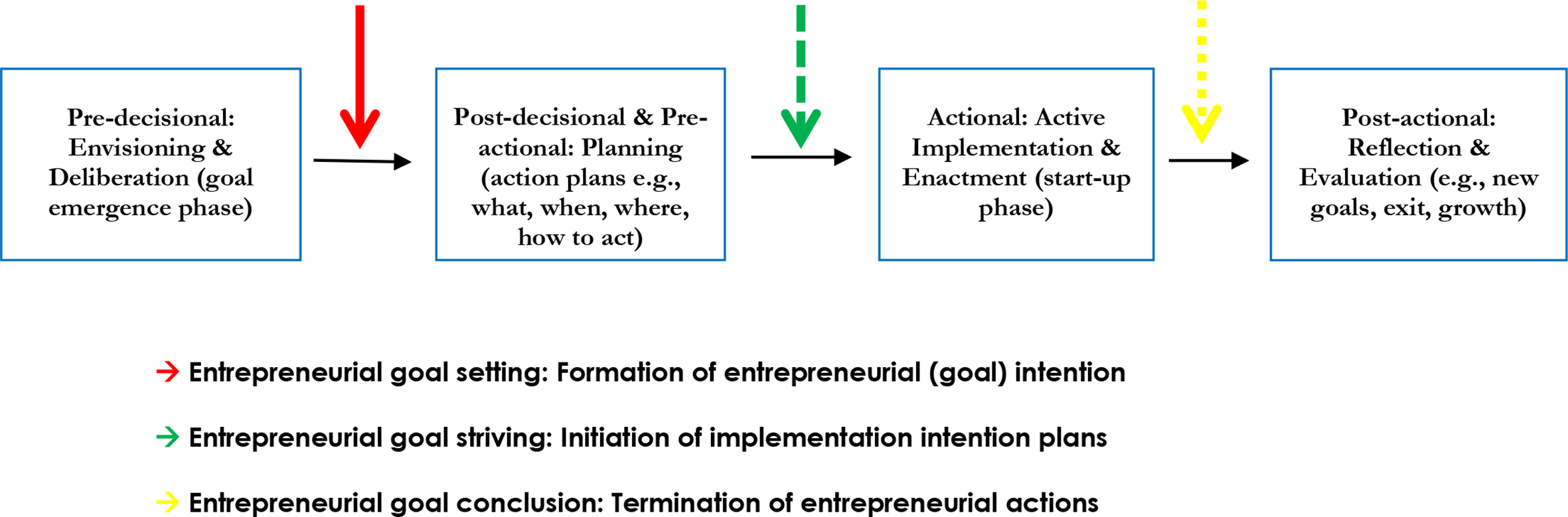
An action phase model of venture creation (Shir, 2015).
The model construes entrepreneurship as a relatively autonomous goal-directed process in which a diverse array of individual motives and actions are explored and organized through the process of creating new economic and business transactions. On this view, entrepreneurship may be either a self-selected personal goal, and in that sense self-started or self-chosen (Frese, 2009), or an externally assigned objective (e.g., Parker, 2011; Sharma & Chrisman, 2007). 2 In both cases, however, the process of entrepreneurship implies a self-motivated, organizational approach to the psychological and behavioral processes of goal setting (e.g., envisioning and commitment) and goal striving (e.g., implementation and persistence) in pursuit of a personal vision. We embed this entrepreneurial vision in a person’s identity and moral outlook (Taylor, 1989), that is, in the superordinate values and standards that they hold and seek to promote by engaging in the enterprising process.
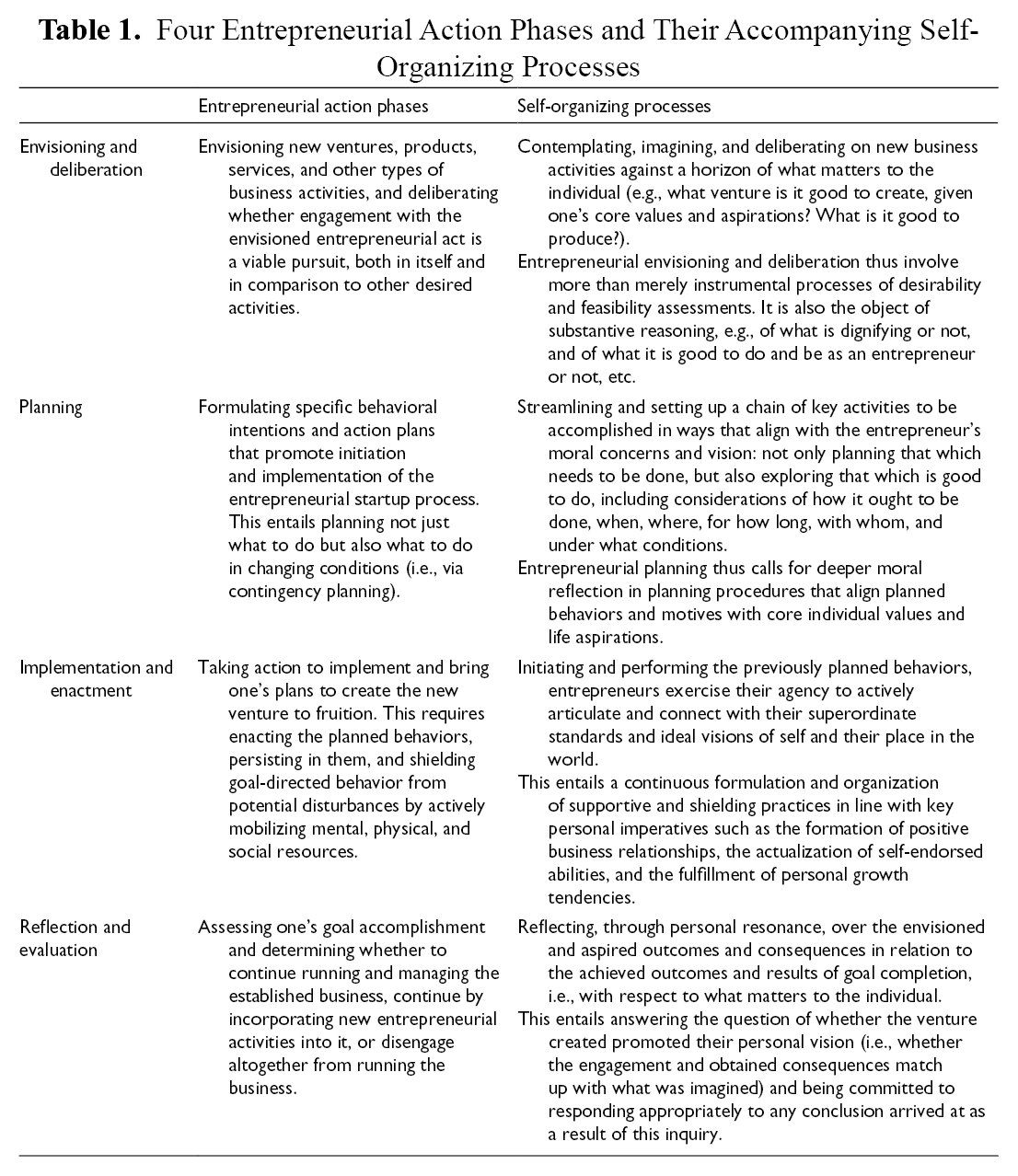
In short, the model describes entrepreneurship as proceeding through four core action phases: exploration and deliberation, in which the entrepreneurial goal emerges and is adopted; planning, in which decisions are made about what, when, where, with whom, how, and for how long to act; implementation and enactment, in which gestation and startup activities occur, along with strategy formation and maintenance of important practices; and evaluation and reflection, in which the entrepreneur, after completing the establishment of the new venture, decides to either disengage, continue engagement, or reengage in pursuit of a new set of entrepreneurial goals. Each of these action phases in turn comprises action-specific and self-organizing processes, which are presented more broadly in Table 1.
Four Entrepreneurial Action Phases and Their Accompanying Self-Organizing Processes
Although the process of venture creation is to be understood as temporal and goal directed in nature, it is not necessarily linear. For example, a venture idea (and the extent of its synthesis with one’s values and life aspirations) could occur before the process of deliberation does, and thus guide that process, or follow it when the process involves planning for the exploration and creation of new ideas. Changes occurring during planning and execution might also bring the process back to the phase of early deliberation, for example, by invoking new self-understanding, and thereby the beginning of potential new engagements. 3 Either way, viewing entrepreneurship as a self-organizing act emphasizes the need to consider broader and deeper moral considerations, and to what extent these are explored and woven into the process of venture creation.
The model’s focus on a self-organized and goal-directed pursuit invites a more focused investigation into well-being states as evolved psychological outcomes and inputs of entrepreneurial goal progression, and as vital mental resources of continuous entrepreneurial action. In line with existing theory on the action phase model (Achtziger et al., 2008; Gollwitzer & Bayer, 1999; Gollwitzer, 1990; Oettingen & Gollwitzer, 2007; Taylor & Gollwitzer, 1995), each of the four phases involves different tasks and cognitive-behavioral orientations (mindsets), and hence different goals and self-organizing processes. In the next section, we propose that these variations are associated with distinct aspects of eudaimonic well-being. We argue that involvement in each phase has the potential to generate context-specific expressions of entrepreneurial well-being that further support individuals in their pursuit of venture creation.
Entrepreneurship and Eudaimonic Well-Being
As recently highlighted (Stephan, 2018), previous work on the link between entrepreneurship and well-being has focused mainly on its hedonic constituents—specifically, positive affect and life satisfaction (e.g., Benz & Frey, 2008; Binder & Coad, 2013)—rather than on its eudaimonic dimensions (Ryff, 2019). The latter are critical for assessing the self-organizing dynamics of entrepreneurship and well-being over time, that is, the striving, self-realization, and personal growth aspects of entrepreneurial pursuits. Hence, our approach goes beyond the hedonic approach, and thus allows us to illustrate the various paths through which entrepreneurs attain greater value and well-being from their work.
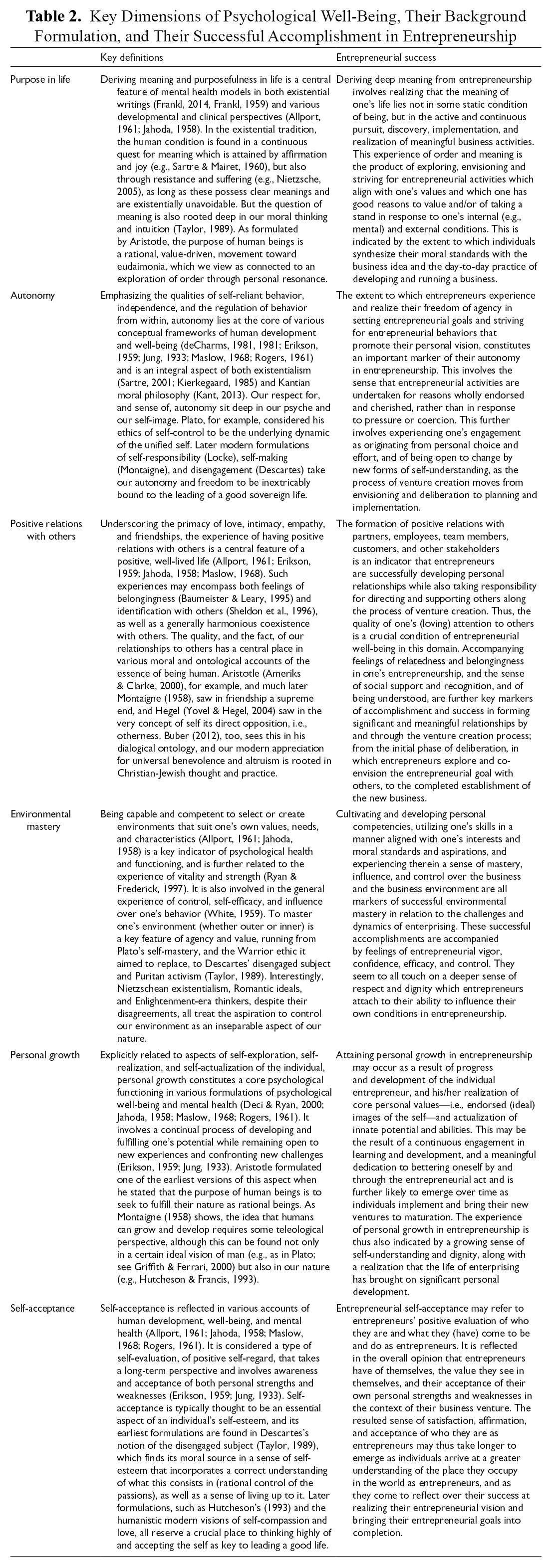
Specifically, we embrace the full model of psychological well-being (Ryff, 2019), which identifies and validates six predefined dimensions of eudaimonic well-being: autonomy, self-acceptance, purpose in life, environmental mastery, positive relations with others, and personal growth. The conceptual foundation for the model (Ryff, 1989; Ryff & Singer, 2008) emerged from previous formulations of mental health and positive functioning in clinical (Jahoda, 1958; Jung, 1933), developmental (Bühler, 1935; Erikson, 1959; Neugarten & Datan, 1973), existential (Frankl, 1959), humanistic (Maslow, 1968; Rogers, 1961), and social (Allport, 1961) psychology. Aristotle’s formulation of eudaimonia as activity of the soul in accordance with virtue, which held to be the highest of all human goods, was also central to the formulation of the model.
Table 2 provides a distilled summary of these dimensions, the background to their formulations, and how they can successfully come to expression through entrepreneurship.
Key Dimensions of Psychological Well-Being, Their Background Formulation, and Their Successful Accomplishment in Entrepreneurship
We thus define entrepreneurial psychological well-being (henceforth EPWB) as the experience of psychological well-being in relation to developing, starting, growing, and running an entrepreneurial venture. In so doing, we expand significantly on the discussion initiated in Ryff (2019) and Wiklund et al. (2019) by elaborating on the ways that each of the six dimensions is relevant along the process of venture creation. While personal autonomy seems to take center stage in entrepreneurial pursuits, because of their self-organizational character (Shir, 2015), we hypothesize that entrepreneurship promotes and is sometimes promoted by each of these six aspects of psychological well-being during the course of business creation. We submit that some aspects are key in the early stages of the entrepreneurial journey, while others may emerge later, and possibly become vital psychological resources for individuals who persist in their entrepreneurial pursuits.
Notably, our approach thus goes beyond Shir’s (2015) earlier formulation, which investigated the unfolding pay-off structure of entrepreneurship from an action-phase perspective, and mainly covered affective well-being measures (i.e., life satisfaction, happiness, and subjective vitality). Our view also complements recent studies based on the self-determination theory (e.g., Benz & Frey, 2008; Shir et al., 2019; Stephan et al., 2020), which also emphasized the self-organizational benefits of entrepreneurship. Whereas we embrace a dynamic eudaimonic view, these studies assumed a time-invariant perspective and considered only limited aspects of eudaimonic well-being, placing a greater emphasis on hedonic and affective outcomes. Our approach aligns with Ryff’s theory, which formulates the core dimensions of a person’s overall psychological wellness, not as motivational states (i.e., as needs and motives) or as means to specific ends, but rather as evolved and achieved aspects of psychological well-being.
Parenthetically, we note that both utilitarian-hedonic consequentialism (e.g., Nikolaev et al., 2020) and recent humanistic-organismic formulations (e.g., Stephan et al., 2020) take an instrumental stance on these fundamental aspects of the human condition. That is, purpose, autonomy, and good relationships with others are thought to matter because they contribute to life satisfaction or an increased sense of vitality. Sense of purpose thus becomes a means to the attainment of well-being.
In contrast, our eudaimonic view construes purposeful engagement as committing and dedicating oneself over time to personally meaningful pursuits aligned with one’s personal values and virtues. From early envisioning and deliberation to planning and later implementation of the new venture, entrepreneurial engagement, as we see it, is not so much a search for the sensation of purpose but rather a deliberation over and dedication to what is purposeful to do and/or good to do and be in entrepreneurship.
We thus blend Aristotle’s conception of eudaimonia with a Kantian view of entrepreneurship as a self-organizing act in seeing agents as pursuing multiple goods in their lives as entrepreneurs, such as wealth, fame, benevolence, social responsibility, and creative fulfillment, to name but few. To the extent that the goods pursued are aligned with their personal vision and sources of value-driven agency is, on our view, a marker of greater integration and psychological well-being. A good entrepreneurial life, the self-realization of an authentic and original personality, ought to thus include multiple facets of well-being. The central question is how life as an entrepreneur cultivate these fundamentally positive aspects of what makes us human.
Entrepreneurial Well-Being: A Dynamic Eudaimonic Perspective
Drawing on the self-organizational view and existing research on the action-phase model in psychology and entrepreneurship (Bindl et al., 2012; Gollwitzer & Sheeran, 2006; Gollwitzer & Bayer, 1999; Taylor & Gollwitzer, 1995), we now propose ways of associating the various action phases of the venture creation process with the six identified eudaimonic dimensions of psychological well-being.
Figure 2 presents the entrepreneurial action phase model, incorporating the different aspects of EPWB that are hypothesized to take prominence during various action phases.
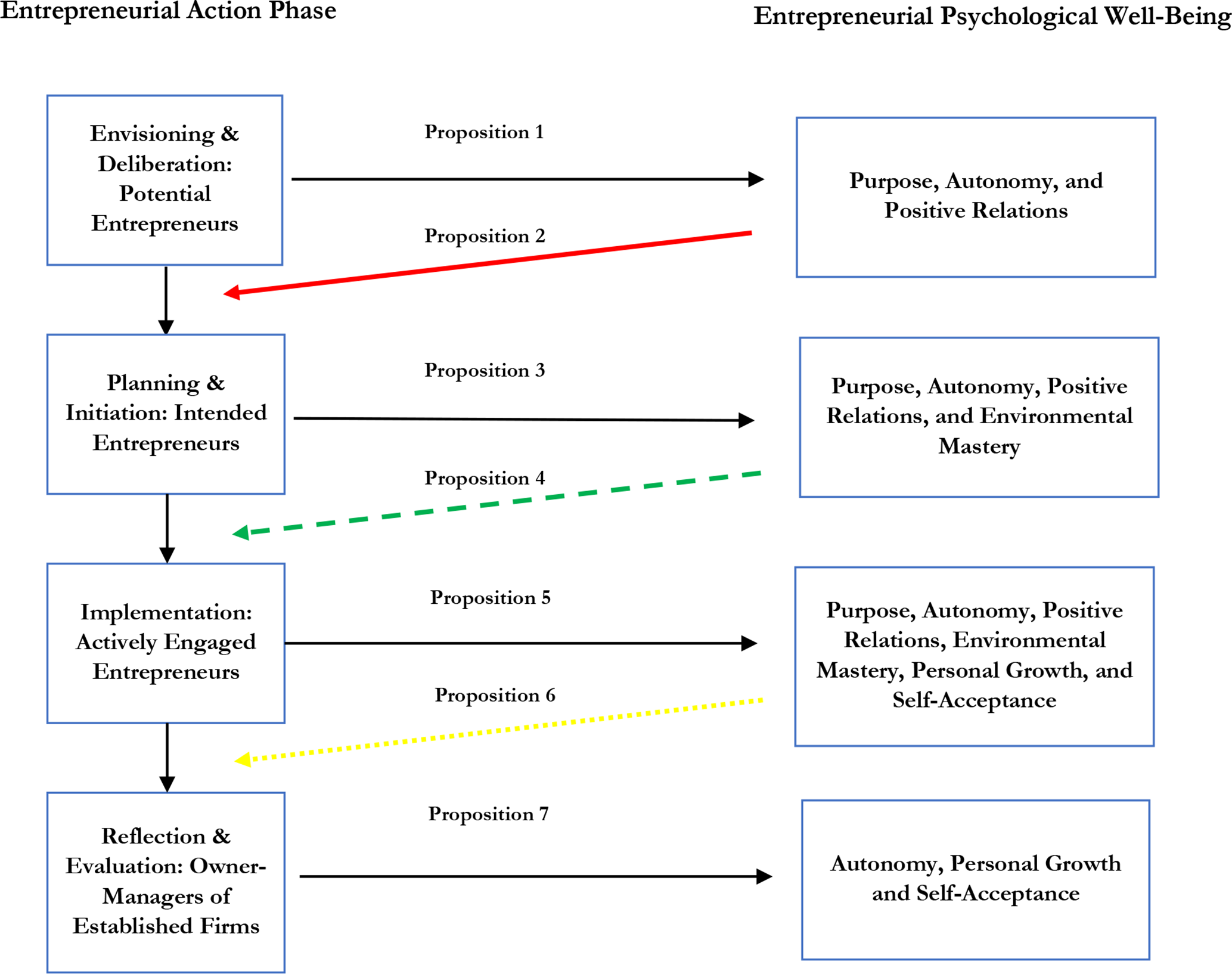
EPWB during the venture creation process
Aside from proposing mechanisms relating engagement in each action phase to different aspects of EPWB, we posit feedback mechanisms that reintroduce these action-related expressions of psychological well-being to the entrepreneurial process, further moderating the transition between the phases.
The Pre-Decisional Phase: Envisioning and Deliberation
According to the action phase model, entrepreneurship can either start with a broad (i.e., no concrete venture idea) or narrow (i.e., more concrete venture idea) wish or desire (Dimov, 2007; Krueger & Carsrud, 1993; Sarasvathy, 2001) to start a venture, based not only on an assessment of the prospects of this desire in relation to one’s resources and super-ordinate standards, but also on a comparison with one’s other desires and wishes. The tasks to be accomplished in this phase include envisioning the outcome and the consequences desired from entrepreneurial engagement and forming the entrepreneurial goal intention by assessing its feasibility and desirability. Thus, to be deliberated upon, entrepreneurship must be deemed worthy of consideration, on either procedural or substantive grounds (see Hooker & Streumer, 2004). Then, whether the entrepreneur believes the end is in her power, and whether this is integrated with her sense of self, is a further matter of both procedural and substantive reasoning.
Early on in the development of the action phase model, Heckhausen and Gollwitzer (1987) found that intense deliberation over a task chosen freely from a few major options gives rise to unique cognitive procedures (mindsets) necessary for successful completion of the task. They showed that engaging in active deliberation prior to making the selection promotes open-mindedness and receptiveness to a diverse array of ideas and thoughts, which in turn permit agents to process information about the feasibility and desirability of a given action more objectively and impartially. They named this cognitive orientation the deliberative mindset.
We posit that entrepreneurial envisioning and deliberation—imagining and considering the starting up of a new venture—also excite a positive sense of freedom and possibility (autonomy), authenticity and meaning (purpose), and a sense of relatedness (positive relations to others). Since the entrepreneurial process is inherently self-organizational, we thus posit that the mere act of envisioning and deliberating over engagement in entrepreneurial activities can have some positive effects on these aspects of psychological well-being.
Specifically, deliberation over entrepreneurial engagements is essentially different from deliberation over more conventional (i.e., non-entrepreneurial) employment engagements (or other types of non-self-organizing goal engagements) because the self-organizing nature of entrepreneurship requires broader and deeper envisioning of one’s ideal vision of self and one’s place in the world. Deliberation over entrepreneurial engagements may thus excite moral imagination (purpose) and invigorate individual agency (autonomy). Also, since most enterprises are collaborative endeavors, deliberating over a potential venture is often a shared activity conducive to experiences of positive relations to others.
We believe that such well-being effects are particularly likely to arise from conscious and serious deliberation over an entrepreneurial pursuit when motivated by a sense of calling (Bloom et al., 2020; Bunderson & Thompson, 2009) or passion (Cardon et al., 2009; Vallerand, 2012), rather than by necessity or desperation. The basis of these callings can vary broadly, as indicated by the diversity of reported entrepreneurial motives, which range from creative expression and recognition to community contribution, carrying on a family tradition, or acquiring great wealth and status, and so on (e.g., Carsrud & Brännback, 2011; Carter et al., 2003). 4
Proposition 1
In envisioning and deliberating over the startup of a new venture, potential entrepreneurs will experience increasing sense of autonomy, purpose, and positive relations with others. These effects will be especially prominent in individuals motivated by a sense of calling or passion as opposed to necessity or desperation.
We expect these early experiences to further heighten the perceived attractiveness of engagement in entrepreneurship. They may also signal that things are manageable, especially when others are involved, and hence raise one’s expectations of success. A heightened sense of autonomy, meaning, and relatedness derived internally from the process of envisioning and deliberation may thus impact both feasibility and desirability assessments, which may, in turn, result in a stronger motivation to form the entrepreneurial goal intention and move on to the planning phase.
Proposition 2
The experiences of autonomy, purpose, and positive relations with others, expressed through entrepreneurial envisioning and deliberation, make progression from the pre-decisional phase to the post-decisional phase of planning more likely by positively influencing goal setting (i.e., by impacting feasibility and desirability evaluations and the formation of entrepreneurial goal intentions).
All in all, we propose that several aspects of EPWB may thus already be manifest during the early phase of deliberation, before any action plan or activity takes place, and that these early expressions may in turn be involved in helping the venture creation process cross the line to the post-decisional phase of planning. We note that many who set the goal to start up a venture never progress from planning to action (the intention–behavior gap problem in entrepreneurship) and that positive illusions and optimism are common among intended entrepreneurs (Lowe & Ziedonis, 2006). The issue, we submit, is not (merely) a matter of self-selection, but rather a consequence of the self-organizing nature of entrepreneurship, which comes to expression even during the initial phase of deliberation.
In other words, even if the entrepreneurial venture has not yet materialized, the imaginary project still aids its owners in focusing their attention and elevating their social, creative, and moral thinking and imagination. This may also stimulate the early formation of an entrepreneurial goal intention, even before the deliberative mindset has fully delivered its impact on risk sensitivity and non-illusory estimations (Taylor & Gollwitzer, 1995).
The Post-Decisional Pre-Actional Phase: Planning for Implementation
Once the intention to enter entrepreneurship and create a venture has been formed, intended entrepreneurs start making implementation plans (Gielnik et al., 2014). The purpose is to promote the initiation of the startup process by producing relevant action plans. Unlike the deliberative mindset of the pre-decisional phase, Gollwitzer and colleagues found that the planning phase of personal goal engagements is typically characterized by a supportive implemental mindset. The implemental mindset differs from the deliberative mindset in that it is associated with a cognitive bias toward information that is relevant to and favors initiation of action (Achtziger et al., 2008; Gollwitzer & Bayer, 1999; Taylor & Gollwitzer, 1995).
In contrast with the deliberative mindset, Gollwitzer and colleagues found that making action plans and entering the implemental mindset fostered positive affectivity and self-evaluations. Some of the more notable observations made include effects on individuals’ self-assessments of invulnerability to risk, self-esteem, and positive feelings of control, which were in turn all associated with heightened positive affect. Arguably, these effects help people focus on their goal, which makes them less receptive to irrelevant information, and more attuned to information that favors action initiation and discourages postponement, thus assisting the individual in coping with the high-risk environment of late modernity (see Giddens, 1991).
The entrepreneurial process, however, is an unusually complex and demanding endeavor, which demands great responsibility and dynamic decision-making, including responding to unforeseen events and demands. The resources and/or the venture idea might not yet be available or sufficiently developed, and further, one is very likely to be already engaged in activities that must be completed before such development is possible. Moreover, whereas any personal goal planning tends to involve fundamental concerns about when, where, how, and how long to carry on for, the entrepreneurial planning process may be tied to ethically infused questions, such as what services and products to offer, where to find resources, how to assemble them, and what it is good to do about each of these questions. The self-organizing nature of entrepreneurship thus demands moral reflection in planning procedures that must be aligned with planned behaviors, values, and life aspirations.
In these circumstances, stress, angst, and high cognitive overload may occur, all of which can prey on hedonic experiences. As noted in Shir (2015), intended entrepreneurs planning to start up a business incur costs to subjective and affective well-being (e.g., levels of life satisfaction, overall happiness, and subjective vitality), even after the exclusion of potential alternative explanations (e.g., unemployment, work, and income satisfaction, etc.). In fact, intended entrepreneurs were found to have even lower levels of affective well-being than unemployed individuals. Similarly, Van Gelderen et al. (2015) observed that impeding negative affective outcomes (fear, doubt, and aversion) occur at this entrepreneurial phase of pre-engagement, and that these responses hinder initiative and progress. Planning a business—unlike planning other personal goals—can thus weigh heavily on individuals, because of the existential self-organizing demands and the complexities of the entrepreneurial goal system.
Despite these documented effects, the self-organizing nature of entrepreneurial planning can have positive effects on several aspects of psychological well-being that may coexist with or even counteract the negative affective outcomes documented in prior research (Shir, 2015; Van Gelderen et al., 2015). Specifically, we posit that making the decision to create a venture and planning for its realization can both excite a sense of autonomy, purpose, and positive relations to others, but that this phase, unlike the deliberative one, can also be expected to produce an increased sense of environmental mastery.
Because of its inherent freedom to self-organize, entrepreneurship thus allows for a broader and deeper alignment between one’s moral concerns and plans to take action on the new venture, which may activate purposeful engagement and a greater sense of autonomy and control. The greater awareness of where things stand as the planning process unfolds can yield a heightened sense of environmental mastery and freedom to initiate actions in pursuit of one’s entrepreneurial vision. In general, as one gains familiarity with the nature of the venture establishment process through planning, both individual ability and agency seem likely to result (e.g., Frese et al., 2016). Given that entrepreneurial planning is done in collaboration with other partners whom one has chosen to work with, planning may further result in positive relations with others through learning together and jointly assessing risks, while also helping one another face the anxieties and fears that accompany planning the new venture.
Not all individuals will succeed, however. Some may be motivated by false images, phantasies, and self-aggrandizing illusions (Hmieleski & Lerner, 2016; Liu et al., 2019), or even anti-social concerns (Baumol, 1996; Ryff, 2019). Thus, we continue to argue that positive effects on well-being are expected for those intended entrepreneurs who wholly endorse the planned action, as opposed to engaging in it as a result of coercion and pressure. In turn, such action plans are likely to lead to greater well-being, as they do not depend on the evaluations and control of other parties (Ryan et al., 1996), but rather help direct attention and effort to relevant information and activities supportive of individuals’ vision and moral concerns in their entrepreneurship.
Proposition 3
In planning the startup of a new venture, intended entrepreneurs are hypothesized to experience increasing autonomy, purpose, environmental mastery, and positive relations to others, particularly among those motivated by a sense of calling or passion rather than by necessity or desperation.
Importantly, we argue that key aspects of psychological well-being (i.e., autonomy, purpose, mastery, positive relations to others) can also feed back into the process, thereby encouraging intended entrepreneurs to transition to the actional phase. In line with the action phase model, whether a given goal intention leads to the initiation of relevant action plans depends on its volitional strength and the extent to which conditions favor initiation of the implementation plans. Improved senses of meaning, autonomy, environmental mastery, and positive relations to others have long been documented to have positive effects on volitional strength and one’s sense of efficacy and control, which supports putting implementation plans into actions (Bauer & Baumeister, 2011; Baumeister & Vohs, 2007; Gielnik et al., 2020; Nix et al., 1999). Consequently, these early expressions of entrepreneurial well-being may help moderate experiences of negative affect arising from the entrepreneurial planning phase by increasing individuals’ capacity to initiate the planned activities and regulate their behavior—resolving to some degree the problem of moving from planning to actual initiation of implemented activities as previously documented in entrepreneurship.
Proposition 4
Intended entrepreneurs’ experiences of autonomy, purpose, environmental mastery, and positive relations to others, as fueled by entrepreneurial planning, increase the likelihood of their transitioning from the post-decisional phase of planning to the actional phase of implementation by positively influencing action initiation.
The Actional Phase: Implementation and Enactment
Progressing from the planning phase to the active undertaking of building a venture involves a radical shift of context, and thus of psychological and behavioral processes. Enactment is the phenomenon associated with this phase of the process, and its purpose is to implement and bring one’s action plans to completion. To do this, actively engaged entrepreneurs must not only be proactive in mobilizing their resources, but also persistent, and prepared to shield the progress they’ve made toward their goal against a variety of disruptions that threaten to postpone goal achievement. Due to the long-term nature of venture establishment, the individual will have to navigate repeated interruptions and potential setbacks.
According to Gollwitzer (1990) and Achtziger et al. (2008), shifting to active enactment of planned activities elicits an actional mindset that is associated with Csikszentmihalyi’s “flow experience” and Wicklund’s “dynamic orientation”—ideas which have been conceptually linked to intrinsic motivation and to feelings of vitality and environmental mastery (Ryan & Frederick, 1997). As demonstrated by the early works of Lewin (1926) and colleagues (e.g., Mahler, 1933; Ovsiankina, 1928), once an intended goal pursuit has been initiated, interruptions tend to lead not to withdrawal but to a resumption of the behavior in question, indicative of the involvement of the actional mindset and of volitional strength. This aligns with recent research on proactive goal regulation, which has linked self-initiated activities and subjective vitality, both generally (Bindl et al., 2012) and more specifically within the context of entrepreneurship (Hahn et al., 2012). It is possible, then, that the entrepreneurial implementation phase itself energizes the entrepreneur and increases his/her volitional strength to regulate goal achievement effectively.
Previous entrepreneurship research lends support to this notion by highlighting the passion that is involved in venture creation (Cardon et al., 2009). More direct support comes from Shir (2015) in which it was found that actively engaged entrepreneurs, relative to both intended entrepreneurs and established business owners, as well as non-entrepreneurial employees, experienced markedly higher levels of subjective vitality. Based on the theory of self-determination (SDT: Deci & Ryan, 2000), active involvement in starting up a venture was found to lead to greater satisfaction of the three basic psychological needs of autonomy, competence, and relatedness, and this was argued to result in greater vitality and a sense of energization.
On our view here, rather than taking subjective vitality to be an overall measure of psychological well-being, we consider a broader and deeper view on psychological wellness in line with Ryff’s approach. What interests us here are thus the contextual effects of active entrepreneurial engagement and progress on actual experiences of EPWB. In this regard, the active implementational phase, perhaps more than any other phase of the enterprising process, sees entrepreneurs progressively take a stance and explore their personal resonance by exercising their self-organizational freedom.
As entrepreneurship provides the conditions for aligning one’s superordinate concerns with goals and actions in the material world of the market, and as it grants individuals the freedom to form relationships and utilize their skills in a manner they value and endorse, the implementation phase has the potential to be a more deeply rewarding experience in terms of EPWB, particularly in terms of purposeful engagement and growth. It offers, in other words, supportive conditions to actively articulate and connect with one’s vision of the good life that entrepreneurs who are still deliberating or planning cannot yet exploit.
Hence, alongside stimulating a person’s agency (autonomy), environmental mastery, and formation of positive meaningful relationships (experiences which can in turn be need satisfying in terms of SDT), active engagement in entrepreneurship is likely to result in greater experiences of personal growth and meaning, and a heightened sense of self-acceptance, as one makes progress toward the enacted vision.
These experiences, we maintain, accrue particularly for individuals who manage to synthesize their moral standards with the business idea and the day-to-day practice of developing and running a business. That is, these positive effects will be especially evident for active entrepreneurs who engage in entrepreneurial pursuits out of a sense of calling (Bloom et al., 2020; Bunderson & Thompson, 2009) or passion (Cardon et al., 2009; Vallerand, 2012), rather than out of necessity or desperation. Accordingly, such entrepreneurs are more likely to realize their core personal values during venture creation because deeply endorsing their pursuit of business activities as meaningful facilitates an active and continuous engagement in learning and development, and a dedication to bettering oneself by and through the entrepreneurial act which further integrates the entrepreneurial role and the activities associated with entrepreneurship into the self.
Proposition 5
In implementing their vision and action plans, actively engaged entrepreneurs experience increasing purpose, autonomy, environmental mastery, and positive relations to others, as well as heightened sense of self-acceptance and accelerated personal growth—particularly those individuals who are motivated by a sense of calling or passion, rather than by necessity or desperation.
In turn, such context-specific expressions of psychological well-being are likely to feed back to and facilitate progress toward the maturing enacted vision, accelerating the development of the startup toward final establishment of the business. Increasing experiences of self-acceptance (positive self-evaluation), purpose, growth, autonomy, environmental mastery, and positive relations to others have all been shown to have strong effects on people’s capacity to block out distractions during goal pursuit, which makes successful completion of the task more likely (Ryan et al., 1996; Sheldon & Houser-Marko, 2001). Thus, expressions of EPWB arising from the very process of engagement intrinsically support the actualization of implementation plans and help shield the entrepreneur against disturbances along the way to venture establishment.
Proposition 6
The increase in psychological well-being that comes to expression through entrepreneurial enactments positively influence entrepreneurs’ capacity to maintain action and shield off disturbances, improving the likelihood of successful termination of goal engagement.
Finally, it should be noted that active establishment requires a great investment of time and effort from any entrepreneur, which can result in stress and jeopardize leisure and family time. Early studies on the experiences and feelings of entrepreneurs also revealed the costs of engagement in the early stages of entrepreneurial undertakings in terms of loneliness, social isolation, and remoteness (Akande, 1994; Gumpert & Boyd, 1984; Hannafey, 2003). Thus, we speculate that while this phase is associated with higher levels of psychological well-being, it may nonetheless result in lower measures of subjective well-being (satisfaction) compared to equivalent phases in the management of more established ventures.
The Post-Actional Phase: Reflection and Evaluation
When the venture has become established, entrepreneurs gradually move on to the reflective phase. The phenomenon associated with this phase of the process is evaluation, and its purpose is to assess the individual’s achievements and determine if further action is called for. To do this, established business owners compare the intended outcomes and expected consequences with what was obtained (e.g., Carver & Scheier, 1990), while casting their thoughts to the future. The evaluative mindset facilitates these demands by initiating a cognitive tuning toward relevant, accurate, and impartial processing of information (Achtziger et al., 2008).
Thus, in adopting the evaluative mindset, entrepreneurs who conclude the establishment of their once envisioned businesses carry out the evaluation process by reflecting on questions such as the following: were the standards envisioned successfully achieved? Did the obtained consequences align with the intentions and aspirations held when the entrepreneurial goal intention was formed? Is continuing to run and manage the business a good thing to do, or not? Is it an attractive and viable option, or not? Should we disengage altogether from running the business? Should we start up new entrepreneurial activities as a way of growing the business?
On the self-organizing view, reflecting on the entrepreneurial journey while directing one’s thoughts to the continuous running of the business may, even when things are less than fully satisfying, result in specific experiences of entrepreneurial maturity (Clarke & Holt, 2010) and well-being. Particularly, we posit, one’s sense of personal growth and self-acceptance in relation to one’s entrepreneurship are likely to culminate in this final phase of engagement. We believe that personal autonomy is a key part of these longer-term reflective aspects of well-being that may be particularly salient as a longer-term well-being outcome; it may of course be undermined along the way (Van Gelderen, 2016; Williams et al., 2020), but for entrepreneurs who persist and prevail, it should be a notable outcome, along with personal growth and self-acceptance.
From these reflections, entrepreneurship emerges as a personal journey involving the organization of long-term processes, activities, and behaviors aimed at the creation of new economic activities that bring more than just economic rewards to those entrepreneurs and individuals who share in the endeavors. Entrepreneurship, from the point of view of the business owner, is thus revealed as the discovery, realization and integration of abilities that contribute to personal growth and the growth of relationships within which individuals achieve a meaningful life orientation. It is associated with the personal vision and self-understanding of the entrepreneur no less than with her financial aspirations.
In this respect, successfully establishing a new venture would seem to be very important to entrepreneurs’ sense of personal autonomy, growth, and self-acceptance. By taking a stance and overcoming the challenges involved in establishing their ventures as they strive to fulfill their vision, successful entrepreneurs realize their freedom and broaden their capabilities and acquire new skills—including interpersonal skills which enable the development of their unique personality with and through their interaction with others—while also enjoying greater affirmation to accept themselves and their roles as entrepreneurs in their broader social environments (Putnam, 1993; Ruef et al., 2003). Fundamentally, it is a matter of learning to overcome challenges and obstacles in different situations, as well as to critically evaluate one’s own strengths and limitations or successes and failures in implementing and bringing the entrepreneurial vision to fruition. No one gets everything right every day, but thoughtful, reflective business owners are likely to acquire a deeper sense of personal autonomy, growth and self-acceptance over time than others.
Proposition 7
In reflecting over and evaluating their entrepreneurial journey, owners of established firms experience greater autonomy, personal growth, and self-acceptance as a result of successfully realizing their ideas and visions by and through the venture creation process.
Personal growth and self-acceptance are particularly likely to be supportive of the evaluative mindset because they entail greater acknowledgment of one’s weaknesses and strengths, leading to more objective and less optimistic assessments of the feasibility and desirability of continuing to manage the business or embark on a new entrepreneurial project.
For those who remain in business, having established the business and overseeing its continuation can generate a great sense of purpose and well-being (Nikolaev et al., 2020; Stephan et al., 2020). Although, once the business is created, agents are more disposed to organizing the established venture by managing and generally being more constrained by the routines of established organizations (Williams et al., 2020), running an established business still involves being free from day-to-day supervision, control, and strict employment hierarchies. Owners of established firms are thus also likely to enjoy activity-based experiences and continuous process-engagement, which can support other aspects of EPWB, from autonomy, environmental mastery, and a sense of purpose to meaningful and positive relations to others, achieved acceptance, and personal growth.
Why We Need a Dynamic Eudaimonic View
Our articulation of a dynamic relationship between entrepreneurship and well-being reveals not only why some dimensions of eudaimonic well-being emerge, persist, or disappear over time, but also underscores the effects these internal dynamics have on entrepreneurs as they move from thought to action. In other words, this more detailed examination of the phases of entrepreneurial pursuit and the fluctuations of EPWB along the way promises to shed further light on why some entrepreneurs quit along the way while others persist.
Knowledge of how these differing facets of eudaimonia arise as the process unfolds will help us draw better conclusions from the success or failure of various ventures. A central prediction is that these indicators of entrepreneurial well-being will be more predictive of entrepreneurial effort, persistence, and long-term success than subjective reports of life satisfaction or happiness at some given moment. The dynamic eudaimonic view thus helps us make sense of both what successful entrepreneurship depends upon and what it actually means in terms of targeted life pursuits (e.g., Berglund, 2007; Welter et al., 2017).
We will return to the meaning of entrepreneurial success more broadly in the concluding section of this study, but here we highlight some aspects of the entrepreneurial process itself and its links to psychological well-being that are not fully captured by static, time-invariant investigations, and why this is so.
Empirically, for example, states of psychological well-being may change along the process of venture creation. As shown by previous research, the well-being of intended and actively engaged entrepreneurs differs substantially (e.g., Kimmitt et al., 2020; Shir, 2015), and conclusions about the well-being of those who attempt to start up new ventures cannot be automatically extrapolated from findings based on self-employment. Alternatively, some aspects of psychological well-being (e.g., meaning and autonomy) may come to expression from the very beginning and persist to the end, although their intensity may vary over time—from the fleeting moments of early deliberation to the more substantiated, deeper experiences of active engagement and reflection.
Conclusions based on general hedonic measures of the self-employed do not do justice to these empirical nuances, and resulting interpretations of the actual links between entrepreneurship and psychological well-being during the process of launching new ventures will therefore tend toward over-simplification. As individuals experience and achieve varying degrees of alignment between their moral standards and their entrepreneurial goals and actions along the way, their rate of progress and success will also vary accordingly. A dynamic eudaimonic view is needed to illuminate the richness of this process.
Theoretically, what is critical is to conceive of entrepreneurship, not simplistically as self-employment or business ownership, but as a complex and rich exercise in self-organization. The static view, in contrast, does not acknowledge that value and well-being can be also produced by the acts of deliberation and planning, which may take place before self-employment occurs and before any venture is established. Our view, however, can account for such early expressions of well-being, which play a critical role in producing the excitement and internal momentum needed to propel the entrepreneurial movement forward.
As our dynamic approach underscores, self-responsibility, attention, and love are required to bring an early vision to fruition. However, these considerations rarely arise in the context of time-invariant views, precisely because such views do not conceive of entrepreneurship as a dynamic, eudaimonic process (Kimmitt et al., 2020). Policies and recommendations about entrepreneurial activities based on insufficiently informed formulations of entrepreneurship may well prove to be misguided, and individuals, organizations, and educators of entrepreneurship will surely benefit from knowing that the enterprising life involves more than simply finding the most lucrative business opportunity and exploiting it.
Future Scientific Directions
Whereas the theoretical and empirical work on well-being in entrepreneurship is advancing rapidly (Wiklund et al., 2019), the perspective and conceptualization of entrepreneurial well-being as a dynamically evolving phenomenon has received little attention in prior scholarship. We argue that a more temporal and dynamic understanding of well-being in entrepreneurship will result in a more complete picture of the evolving entrepreneurial life, which will in turn aid in developing a broader view of the significance of well-being in the enterprising project. In the spirit of growing the field, we thus encourage future theoretical and empirical efforts to develop the basic framework and core propositions that we put forth.
For example, future empirical research needs to embrace both action- and context-specific longitudinal frameworks in which potential entrepreneurs are followed from early deliberation and thinking to planning, active implementation, and conclusion of the venture. This means longer-term data collection pursuits will be needed if an understanding of the impact of entrepreneurial engagement on personal growth and well-being long after venture establishment is to be achieved.
The interplay of entrepreneurship and eudaimonic well-being also needs to be further articulated and empirically examined across a variety of contextual and other personal and inter-personal circumstances. These include, but are not limited to, personality and individual factors (e.g., gender), team dynamics and composition, and external circumstances (e.g., institutional environment). In all these new inquiries, researchers, organizations, and policy makers alike should adopt a long-term, dynamic approach to collecting and evaluating data on entrepreneurship and psychological well-being, in contrast to the widespread reliance on measures of self-employment and assessments of hedonic and affective outcomes.
A closer view of what entrepreneurship is and how it is experienced in relation to various states of psychological well-being during the venture creation process will also be useful in formulating more appropriate supportive tools to help individuals and organizations resolve the ongoing tensions and pressures in the life of entrepreneurship (Williams et al., 2020; Wry & York, 2017; Zahra et al., 2009). For example, intended entrepreneurs who are not motivated by a sense of calling or passion may find the process overwhelming, and their transition to the active stage of implementation thus be impeded, however great the potential value of their enterprising project might be.
New institutions and educational initiatives emphasizing and addressing these aspects will be key (e.g., Gielnik et al., 2014; Pokidko et al., 2020), assuming they are informed by more accurate and relevant data. This translates to examining the trajectories of EPWB during the entrepreneurial journey with a careful attention to fluctuations encountered at various points of the process in response to new entrepreneurial tasks and challenges. The question of whether other phases or stages might merit investigation is also important (e.g., Baron & Markman, 2018; Frese, 2009; Moroz & Hindle, 2012), and consideration of the concepts of self-organization and eudaimonic well-being promises to be of vital importance to such new inquiries.
Hence, alongside action- and context-specific longitudinal data collection, we advocate mixed methodological approaches, in which in-depth interviews (e.g., Hellström et al., 2002), analysis of narrative construction and hermeneutics (e.g., Berglund, 2007; Bloom et al., 2020; Clarke & Holt, 2010; Williams et al., 2020), and on-the-scene observations (e.g., Down & Warren, 2008) complement periodic surveys in the performance of close-up studies of how entrepreneurship and well-being relate to one another over time.
Importantly, we strongly encourage future theoretical and empirical research to extend or challenge our perspective to account more fully for outcomes where the entrepreneurial journey fails to proceed as hoped, planned, and anticipated. For instance, many intended entrepreneurs neglect planning, and fail to move from thought to action altogether or, instead, move ahead too quickly (Van Gelderen et al., 2015; Wiklund et al., 2018), whereas some face tremendous difficulties staying on track after initial implementation, and others still fail to disengage from a failing course of action (McCarthy et al., 1993; McMullen & Kier, 2016).
Clearly, the task of formulating the context-specific links to EPWB when things do not go well will be challenging, as one can expect dramatic variations depending on whether the entrepreneurial vision is taking shape or being undone by unexpected obstacles. We thus acknowledge that departures from our perspective are likely to be worthy of further study, and that no comprehensive account of such possibilities has been given herein.
Conclusion: Rethinking the Meaning of Entrepreneurial Success
The ideas developed in this study point ahead to broader questions about the true meaning of entrepreneurial success. Given its self-organized dynamics, entrepreneurship ought, crucially, to be seen not only as a process of business making, but also as a political, ethical, and communitarian force. It can and does change the lives and characters of societies and individuals alike. When it is successful, it results in greater eudaimonia, for oneself and for others, and contributes to our shared sense of security, that is, to the fundamental trust we have toward each other and the world.
This realization promises to shift our focus from defining the successful pursuit of the venture creation process in relation to a fixed, and general, set of motives and indicators to a deeper, broader, and longer-term consideration of how entrepreneurs merge their own moral horizons (Gadamer, 2008) with that of the broader community, allowing us to reach new areas of existence that expand our lives and well-being. As Murdoch maintains, the good life does not result from the mere application of a set of actions and learned rules, but rather from an effort of love along with the maturation of a “vision” that seeks to understand people and one’s place in the world (Murdoch, 2013).
Such a personal vision is thus ideally rooted in, and enabled by, the very fabric of living with others in the world. Hence, entrepreneurship is more than a source of personal dignity and emancipation (Laine & Kibler, 2020; Rindova et al., 2009; Sutter et al., 2019; Verduijn et al., 2014; Williams et al., 2020); it is an engine of personal and social change and transformation through which individuals can potentially realize their dreams and do something about them. By analogy, as one of our students put it, “entrepreneurship provides individuals with the clay needed to explore and shape their personal myths and visions.”
We cannot allow this background picture (Taylor, 1989)—this vision that people make and are made by—to be obscured from view. It is that which informs the actual practice, values, and broader ends envisioned and explored by entrepreneurs as they move from thought to action. Some of these visions, as manifested by great business ideas, may be noble and socially legitimate, while others may instead be self-serving, detached, or even harmful. We need to expand our understanding of these variations and their impact on the lives and well-being of entrepreneurs, and of those who are in turn impacted by them. Entrepreneurial success, in the longer term, depends on individual and social needs, wants, and aspirations, as well as on how these are understood, negotiated, and set in motion.
Historically, there was no place for most forms of entrepreneurship, whether commercial or social. The majority of entrepreneurial pursuits were related to military or trading activities or necessary for mere survival (Landes et al., 2012). Thanks to large infrastructures and modern means of transportation and digitalization, along with accompanying changes to our sense of agency and visions of the good life (Taylor, 1989), entrepreneurship has become democratized, and thereby more closely integrated into people’s and societies’ aspirations and well-being.
As the COVID-19 crisis has demonstrated, however, entrepreneurship is too dependent on political, social, and global agreements and collaborations to be taken for granted. This is the first time in contemporary history when markets all over the world, as well as the global market system, have been widely compromised. As evidenced by numerous reports from entrepreneurs and business owners across the globe, the impact of the crisis has reached far beyond the financial. As many people experience their entrepreneurship as fundamentally linked to their eudaimonia, being deprived of it has deeply impacted their psychological and moral lives—but it has also had far-reaching consequences for social life and well-being more broadly.
Our hope is that this work will usher in a more dynamic and eudaimonic approach to assessing and optimizing entrepreneurial performance and well-being, as well as offer insights into the critical role that entrepreneurs—as self-organizing agents—play in relation to our shared way of living, and the social and global challenges and opportunities that lie ahead.
Footnotes
Acknowledgements
We are grateful for invaluable comments and discussions with Jan Salomosson and Dr. Yoav Ashkenazy and for the suggestions and comments we received from Dr. Joakim Wincent on an earlier version of this manuscript. We also acknowledge constructive comments provided by three anonymous reviewers and the Journal Editor Johan Wiklund. Their valuable guidance greatly improved the manuscript.
Declaration of Conflicting Interests
The author(s) declared no potential conflicts of interest with respect to the research, authorship, and/or publication of this article.
Funding
The author(s) received no financial support for the research, authorship, and/or publication of this article.

Notes
Author Biographies