



Abstract
This research note critically extends Audretsch and Moog’s work on the relationship between democracy and entrepreneurship. While Audretsch and Moog present a positive relationship between democracy and entrepreneurship, we find that key measures of entrepreneurship are frequently negatively, not positively, associated with democracy and its various determinants. However, we do find some evidence to support Audretsch and Moog’s theorizing that democracy is learned in start-ups and small businesses by showing that entrepreneurs in advanced economies are more democratic in their attitudes or behaviors than their employee counterparts. But the evidence on whether the transition from regular employment to entrepreneurship increases political engagement and democratic orientation remains inconclusive.
Introduction
In a very thought-provoking article in this journal, Audretsch and Moog (2022) discuss the relationship between democracy and entrepreneurship and, given the recent decline of liberal democracy worldwide, ask how entrepreneurship contributes to a functioning democracy. The authors (Audretsch & Moog, 2022, p. 385) claim that “democracy and entrepreneurship are inextricably linked” as they are both “manifestations of the same underlying force—freedom of thought, decision-making and action.”Audretsch and Moog (2022), who substantiate their argument with three case studies, assert that their research can only serve as a starting point for a new discussion on democracy and entrepreneurship, highlighting the limitations of their own contribution and pointing out the anomalies within the assumed positive association between democracy and entrepreneurship, as there are countries with low levels of entrepreneurship that are also democratic, on the one hand, and democratic countries with low levels of entrepreneurship, on the other.
Our research note seeks to extend this preliminary discussion and clarify certain aspects of the entrepreneurship-democracy linkage through pragmatic empirical theorizing (Shepherd & Suddaby, 2017). Specifically, we add nuance to the debate by highlighting that, using different measures of entrepreneurship available to us, the direction of the relationship between entrepreneurship and democracy at the country level is more negative than positive, contrary to what Audretsch and Moog claim. Additionally, we demonstrate that important socio-economic, cultural, and institutional determinants of democracy negatively correlate with entrepreneurship, further substantiating a negative relationship between entrepreneurship and democracy. However, we do find some support for Audretsch and Moog’s (2022) proposition that an individual’s entrepreneurial activity potentially shapes a democratic mindset. Our analyses using cross-sectional as well as panel data reveal that entrepreneurs are generally more politically engaged and democratic than employees, particularly in advanced economies. Whether the transition from regular employment to entrepreneurship causes this increased political engagement and democratic orientation, however, we find mixed evidence.
Entrepreneurship and Democracy: Compatible or Incompatible?
The Case for Compatibility
Audretsch and Moog’s (2022) argumentation is straightforward: freedoms are the foundation of both democracy and entrepreneurship, as in democracies freedoms allow people to exercise their free will and share their thoughts, while they are also conducive to entrepreneurship because they allow people to seek and take advantage of economic opportunities. This idea that freedoms underlie both democracy and entrepreneurship is not new. Democracies are characterized by so-called “open access orders,” in which a state enforces rights and laws impersonally and universally and allows people to form economic and political organizations, including private businesses, in order to compete. As people are allowed to form new political parties or create new ventures, open access orders guarantee a form of institutional competition that maintains and reinforces openness and freedoms (Reckendrees, 2015). At the same time, open access orders enforce creative destruction in the Schumpeterian sense as both political entities and economic actors compete and take risks to innovate in order to serve their constituents or consumers (North et al., 2009).
Similarly, the classic “Hayek-Friedman Hypothesis” suggests that a state cannot be politically free and not have economic freedoms (Hayek, 1944; Lawson & Clark, 2010; Lawson et al., 2020). According to Hayek and Friedman, individuals with economic freedoms are able to cooperate voluntarily through means like entrepreneurship, which allows them to acquire the power and control necessary to resist political coercion or central direction. In other words, economic freedom strengthens democracy through entrepreneurship.
What Audretsch and Moog’s (2022) investigation neglects is that the link between democracy and entrepreneurship is not limited to small businesses and individual entrepreneurs but also extends to large-scale corporate entrepreneurship by incumbent firms. Since democracies tend to provide a more favorable business environment for firms to grow and innovate, we should also expect entrepreneurship within larger firms, which should translate into a positive relationship between democracy and entrepreneurship in large companies.
The Case for Incompatibility
There are also several reasons why entrepreneurship and democracy may conflict. Weak democracies are defined by “limited access orders” characterized by restricted rule of law, weak property rights protection, higher corruption, and the absence of independent courts (Reckendrees, 2015). These limited access orders, combined with the greater political instability and various restrictions on investment, trade, labor, and market access in such contexts, do not provide an ideal environment for business growth and investment (Acemoglu et al., 2005; Yasar et al., 2011). As a result, weak democracies frequently sustain subsistence, agrarian economies marked by stand-alone business activity and small-scale production, driven by a lack of regular employment opportunities (Dencker et al., 2021). By contrast, in strong democracies, regular employment opportunities are not only widespread but also come with many benefits, from often higher, more predictable wages to health, pension, and legal benefits, as well as a better work-life balance for their employees (Blanchflower, 2004; Fields, 2019). This motivates individuals to move from running their own farms, shops, and small production facilities to salaried employment, which should result in a lower rate of business ownership in democracies.
Also, one may argue that Audretsch and Moog (2022) seem to idealize the democratizing influence of entrepreneurship through stand-alone and small businesses business activity. In line with Tocqueville (1835), who saw the many entrepreneurs and small firms in the 18th-century United States as vital to democracy, Audretsch and Moog (2022) posit that entrepreneurs who make decisions independently, take responsibility for themselves and others (e.g., employees), and acquire critical skills and attitudes in the workplace are well suited to a functioning democracy. While this viewpoint may have been valid in the past, when manual labor was more prevalent, it may fail to recognize the freedoms and discretion that workers enjoy in today’s knowledge-based economies, raising the question of whether entrepreneurs really develop a more democratic mind and skillset than employees. One could also contend that Audretsch and Moog (2022) neglect how the inherent risks of entrepreneurship might not always foster pro-democratic results. Financial instability and vulnerabilities have been identified as notable barriers to individual democratic attitudes and behaviors, as well as to broader democratic decline at the societal level (Welzel, 2013). In addition, the work-life imbalance, work stress, and long hours that entrepreneurs often face can discourage their political involvement (Newman & Barney, 2023). Hence, business ownership’s alignment with democratic views and behaviors is not set in stone. There are good reasons to believe that entrepreneurship can be positively, but also negatively, associated with democracy. Therefore, we examine this relationship empirically using country-level and individual-level data.
Empirical Evidence at the Country Level
Data and Approach
Entrepreneurship, which is defined as any “attempt at new business or new venture creation, such as self-employment, a new business organization, or the expansion of an existing business, by an individual, a team of individuals, or an established business” (Reynolds et al., 2005, p. 223), is typically measured via self-employment, business ownership or business creation efforts (Hsieh et al., 2017). For our endeavor, we use two established entrepreneurship measures: World Bank’s measure of self-employment and GEM’s measure of early-stage entrepreneurial activity. 1 To account for the fact that entrepreneurship takes many forms (e.g., everyday entrepreneurship vs. Schumpeterian entrepreneurship) (Aldrich & Ruef, 2018; Reynolds, 2022), we also conduct additional analyses using alternative measures, including opportunity-based, necessity-based, innovative, technological, and high-growth entrepreneurship, established business ownership (excluding agriculture), corporate entrepreneurship, and innovation output (e.g., patents). To provide a comprehensive view, we also examine the proportions of opportunity-driven, necessity-driven, innovative, technological, and high-growth entrepreneurship within the overall entrepreneurial activity, as this approach allows us to understand how democracy is related not only to the volume but also to the quality of entrepreneurship. All entrepreneurship measures and results are described in detail in our Supplemental Online Material (SOM).
Democracy can be defined as a political structure that is ruled by the people. The two prominent theoretical dimensions of democratization are (1) public participation, wherein a democratic government is elected by the people and is exercised either directly or through elected representatives as well as the right of citizens to participate in both elections and political office, and (2) contestation in the elections, wherein the elections are competitive with options for the public to choose from in the election (Dahl, 1971). 2 For our analysis, we utilize three established measures of democracy: (1) the Liberal Democracy Index from the Varieties of Democracy (V-Dem) project, a leading benchmark for measuring democracy (Lindberg et al., 2014); (2) Freedom House/Policy’s Level of Democracy Index; and (3) Vanhanen’s Index of Democracy (Freedom House, 2021; Marshall et al., 2019; Vanhanen, 2004). All three indicators, also introduced in the SOM, employ a multidimensional approach, thereby capturing the quality or “performance” of democracy.
In our analysis, we purposefully include both developed and developing countries (in a full-sample analysis as well as separated into distinct sub-samples for the OECD, a club of mostly rich countries, and less developed countries to unpack the relationship between democracy and entrepreneurship across multiple development stages, including countries typically characterized by necessity-based rather than opportunity-based entrepreneurship. 3
Findings
Are Democratic Countries More Entrepreneurial?
Table 1 shows the correlations between our two entrepreneurship and the three democracy measures. The results reveal clear negative and significant correlations between entrepreneurship and democracy measures for the full and the OECD samples. Based on these correlations, more democratic societies tend to be less entrepreneurial. Only in the less developed country sub-sample is the relationship between entrepreneurship and democracy positive, but it is not statistically significant. Our robustness checks with alternative entrepreneurship measures partly confirm this picture: opportunity-driven and necessity-driven entrepreneurship, high-growth entrepreneurship, and established ownership (excluding agriculture) tend to exhibit negative correlations with democracy for the full and the OECD samples. However, corporate entrepreneurship and innovative output show a positive relationship with democracy, supporting our proposition that such activities are more prevalent in democracies where large firms find it easier to invest and innovate. In addition, we find positive correlations between democracy and technological entrepreneurship as well as the ratios of innovative-to-overall as well as technological-to-overall entrepreneurship (i.e., the share of total entrepreneurship that is innovative or technological, respectively). Only in the sample of less developed countries is the relationship between entrepreneurship and democracy is more ambiguous and often not significant (see detailed results in the SOM; for a quick overview, see Table A1 in the Appendix).
Correlations of Entrepreneurship and Democracy.
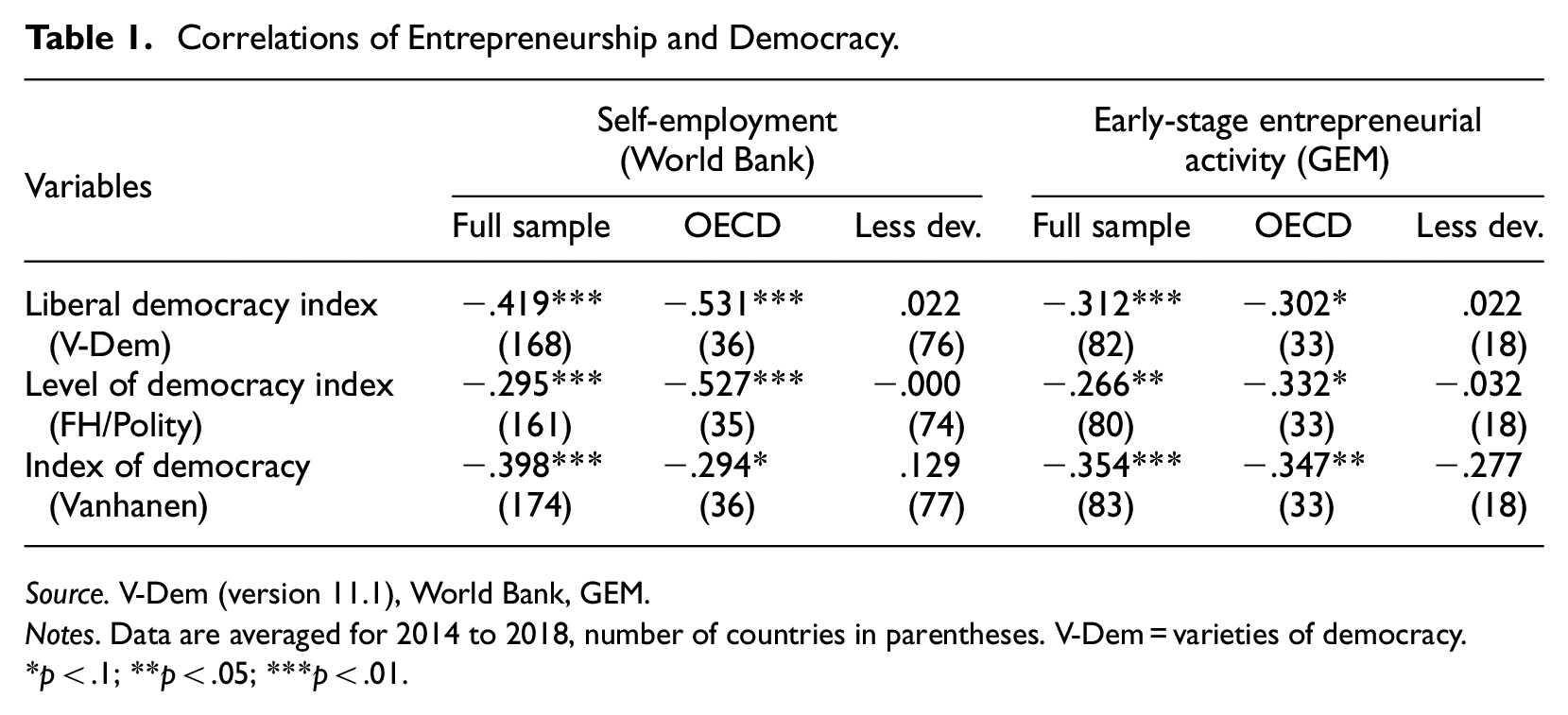
Source. V-Dem (version 11.1), World Bank, GEM.
Notes. Data are averaged for 2014 to 2018, number of countries in parentheses. V-Dem = varieties of democracy.
p < .1; **p < .05; ***p < .01.
As Countries Become More Democratic Over Time, Do They Foster Entrepreneurship?
As Audretsch and Moog (2022) see the recent decline in entrepreneurship and democracy as evidence of their linkage, we also explore the long-term trend between the two. While we agree that the decline in entrepreneurship is consistent with the decline in democratic quality in recent years, a long-term perspective contradicts the notion that entrepreneurship and democracy go hand in hand. Using the measure of self-employment for which we have longer and more complete time trend data, Figure 1a depicts a consistent fall in entrepreneurship over the past 60 years for a sample of 13 high-income nations, whereas democracy has steadily improved, with a particular gain in democracy between 1990 and 2010. Figure 1b further illustrates, for the full sample of 168 countries, that a decline in entrepreneurship (using the World Bank’s self-employment measure for which we have complete statistical information going back to 1991) has been accompanied by an increase in democracy (or the other way around) over time. Only recently has the tide turned, with both measures declining in tandem since around 2011.
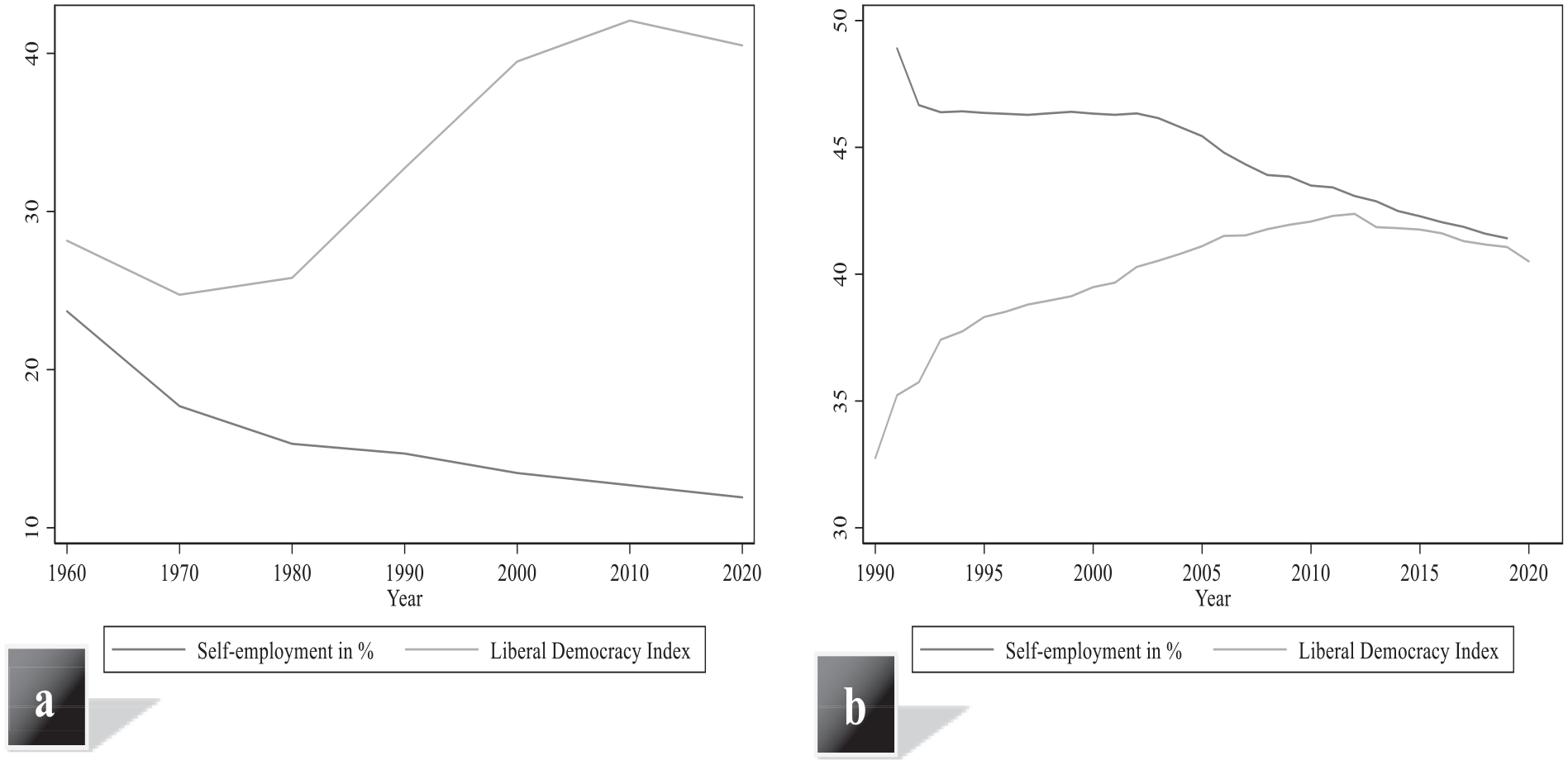
Long-term relationship between entrepreneurship and democracy.
This negative relationship between entrepreneurship and democracy over time is further corroborated through panel regression with additional covariates (World Bank’s GDP per capita [PPP], trade in percent of GDP, percent gross secondary school enrollment, and the Fraser Institute’s Economic Freedom Index) (for detailed variable descriptions, see the SOM). Table 2 presents the panel fixed-effects model coefficients, detailing the effects of democracy on entrepreneurship over time. In the full sample and the sub-sample of less developed countries, the significant negative relationship for the effect of self-employment on democracy persists, suggesting that as countries progress toward greater democracy over time, they experience a corresponding decline in self-employment. In our robustness check for the full sample, we also find a similar pattern for non-agricultural business ownership, corporate entrepreneurship, and necessity entrepreneurship, indicating that entrepreneurship decreases as democracy strengthens in a country (see Table A2 in the Appendix). For the OECD sample, we find contradictory results. On the one hand, those countries that can strengthen their level of democracy (as measured by the Liberal Democracy Index and the Index of Democracy) experience an increase in self-employment over time, very similar to Farè et al.’s (2023) finding for the OECD. Supplemental analysis shows that the positive link between 1991 and 2018 is largely driven by ex-communist countries besides Greece and Turkey (see Table S2 and Figure S4 of the SOM). Ex-communist countries were characterized by low levels of democratic and economic freedom prior to the collapse of the Eastern bloc, leading to a significant catch-up effect since the 1990s, while Greece and Turkey experienced both a decline in entrepreneurship and democracy over time. Many of these countries faced substantial challenges in the 1990s, so self-employment and small-scale entrepreneurship increased during this period, often as a survival strategy. The findings presented in Table A2 further substantiate this trend for the OECD sample, as overall necessity entrepreneurship and the ratio of necessity-to-overall entrepreneurship increased over time.
Longitudinal Panel Fixed-Effects Regression Results (Effect of Democracy on Entrepreneurship).
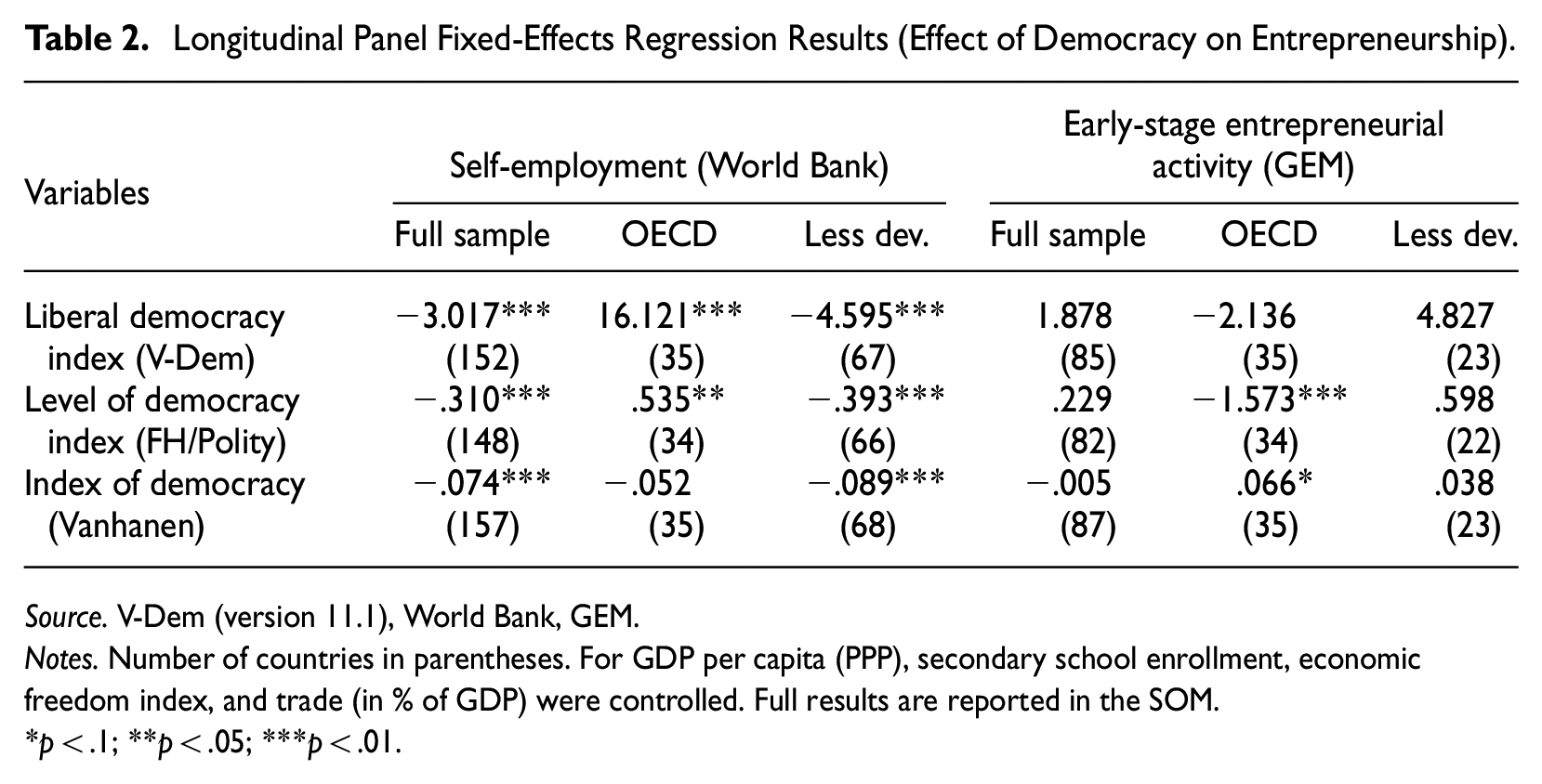
Source. V-Dem (version 11.1), World Bank, GEM.
Notes. Number of countries in parentheses. For GDP per capita (PPP), secondary school enrollment, economic freedom index, and trade (in % of GDP) were controlled. Full results are reported in the SOM.
p < .1; **p < .05; ***p < .01.
On the other hand, however, we find that a strengthening of democracy (using FH/Polity’s Level of Democracy Index) can also correspond with a decline in early-stage entrepreneurial activity, opportunity entrepreneurship, high-growth entrepreneurship, business ownership excluding agriculture, and corporate entrepreneurship (see Table A2 in the Appendix). Remarkable findings emerge in less developed countries, showing that increases in democracy over time correspond to notable increases in innovative, technological, and high-growth entrepreneurship. This pattern also extends to the shares of innovative, technological, and high-growth entrepreneurship within broader entrepreneurial activity.
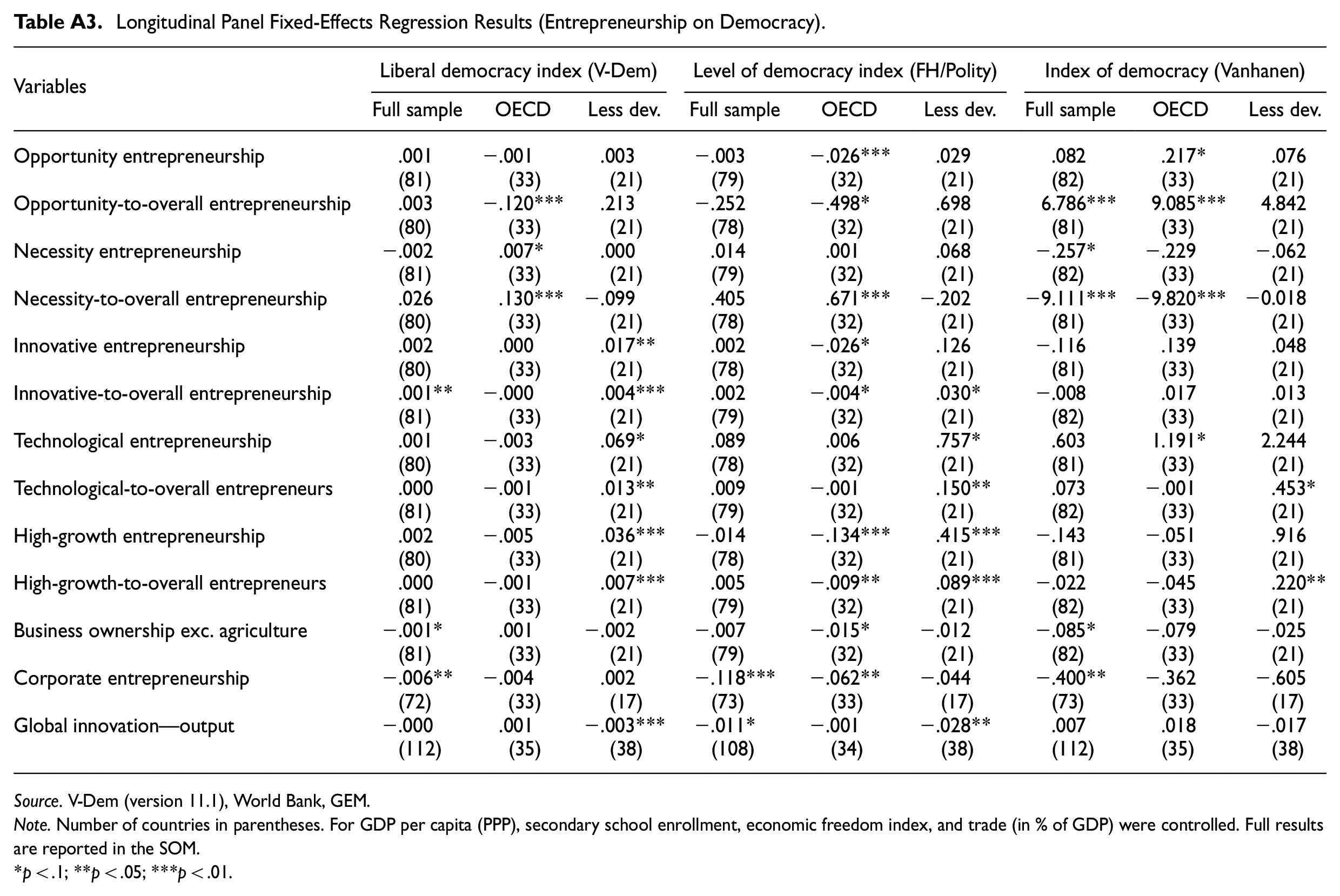
Since the causal direction can run in both directions, Table 3 also reports the estimation results of panel fixed-effects models for the effects of entrepreneurship on democracy over time. Here, we find largely the same results: In both the full sample and the less developed countries, increasing entrepreneurship is linked with decreasing democracy. The OECD sub-sample shows mixed evidence, with self-employment having a positive impact on some indices of democracy, while other entrepreneurship measures show a negative effect. In developing countries, certain types of entrepreneurship strengthen democracy, but innovation performance is negatively correlated with democratic progress (see Table A3 in the Appendix).
Longitudinal Panel Fixed-Effects Regression Results (Effect of Entrepreneurship on Democracy).
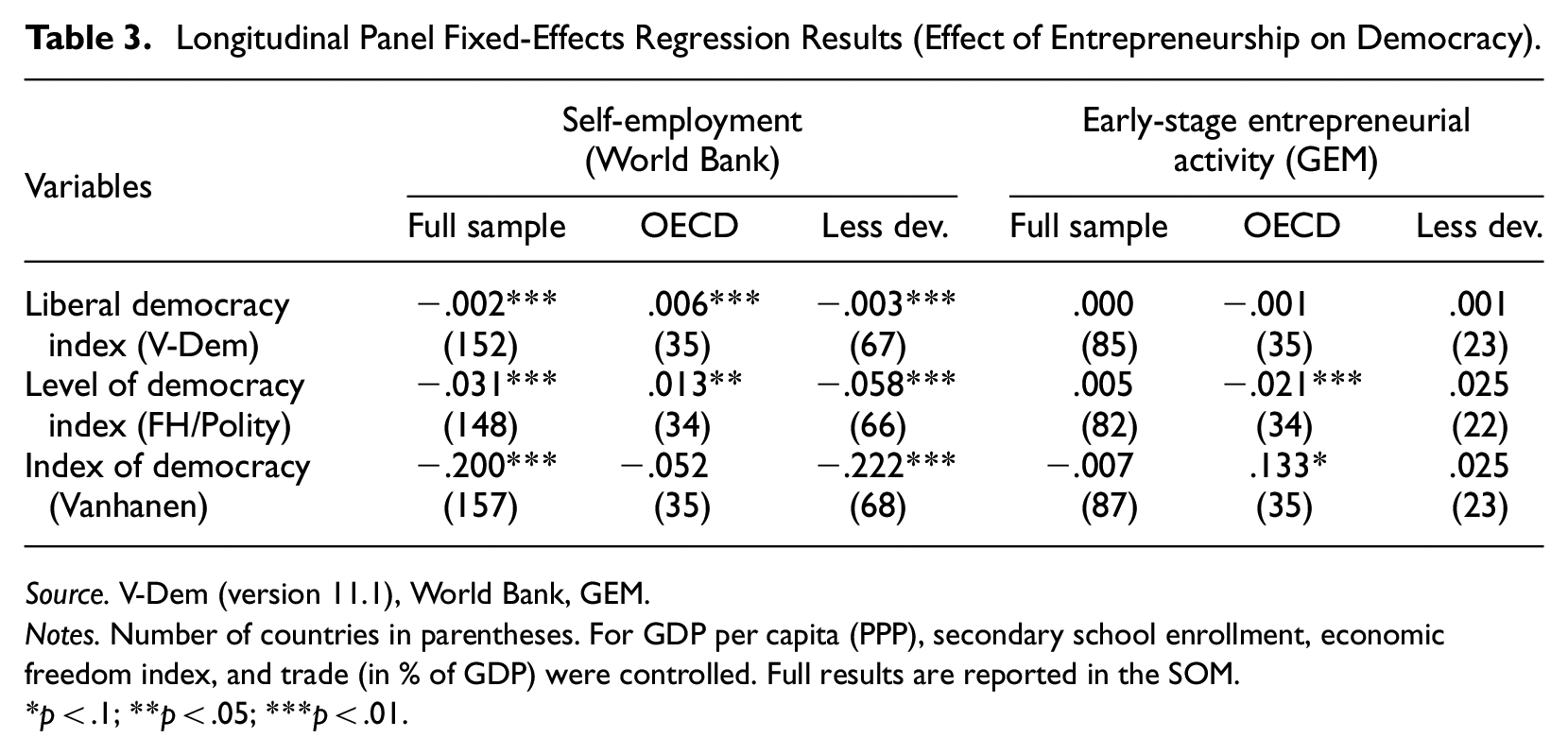
Source. V-Dem (version 11.1), World Bank, GEM.
Notes. Number of countries in parentheses. For GDP per capita (PPP), secondary school enrollment, economic freedom index, and trade (in % of GDP) were controlled. Full results are reported in the SOM.
*p < .1; **p < .05; ***p < .01.
How is Entrepreneurship Linked to the Determinants of Democracy?
Next, we explore how entrepreneurship is related to factors that promote democracy and its stability. Following the political science literature, we distinguish between socio-economic, cultural, and institutional factors that are linked to the quality of democracy (Rød et al., 2020).
Research documents a positive relationship between a country’s level of socio-economic development and democracy (Burkhart & Lewis-Beck, 1994; Robinson, 2006; Welzel, 2013). The correlations between the socio-economic determinants of democracy, as Table 4 shows, are predominantly negative with entrepreneurship in the full sample, the OECD, and less developed country sub-samples. The Human Development Index (which combines GDP per capita, education, and health), GDP per capita, and secondary education are negatively correlated with entrepreneurship. Since political science research confirms that less developed, agricultural-based economies are least likely to be democracies, while post-industrial, service-based economies are more likely democracies (Acemoglu & Robinson, 2012; Inglehart & Welzel, 2005), we also show the correlations across three economic development stages. The results reveal that entrepreneurship is positively correlated to agriculture-based economies (e.g., less developed) and negatively correlated to service-based economies (e.g., OECD).
Correlations of Entrepreneurship and Socio-Economic Determinants of Democracy.
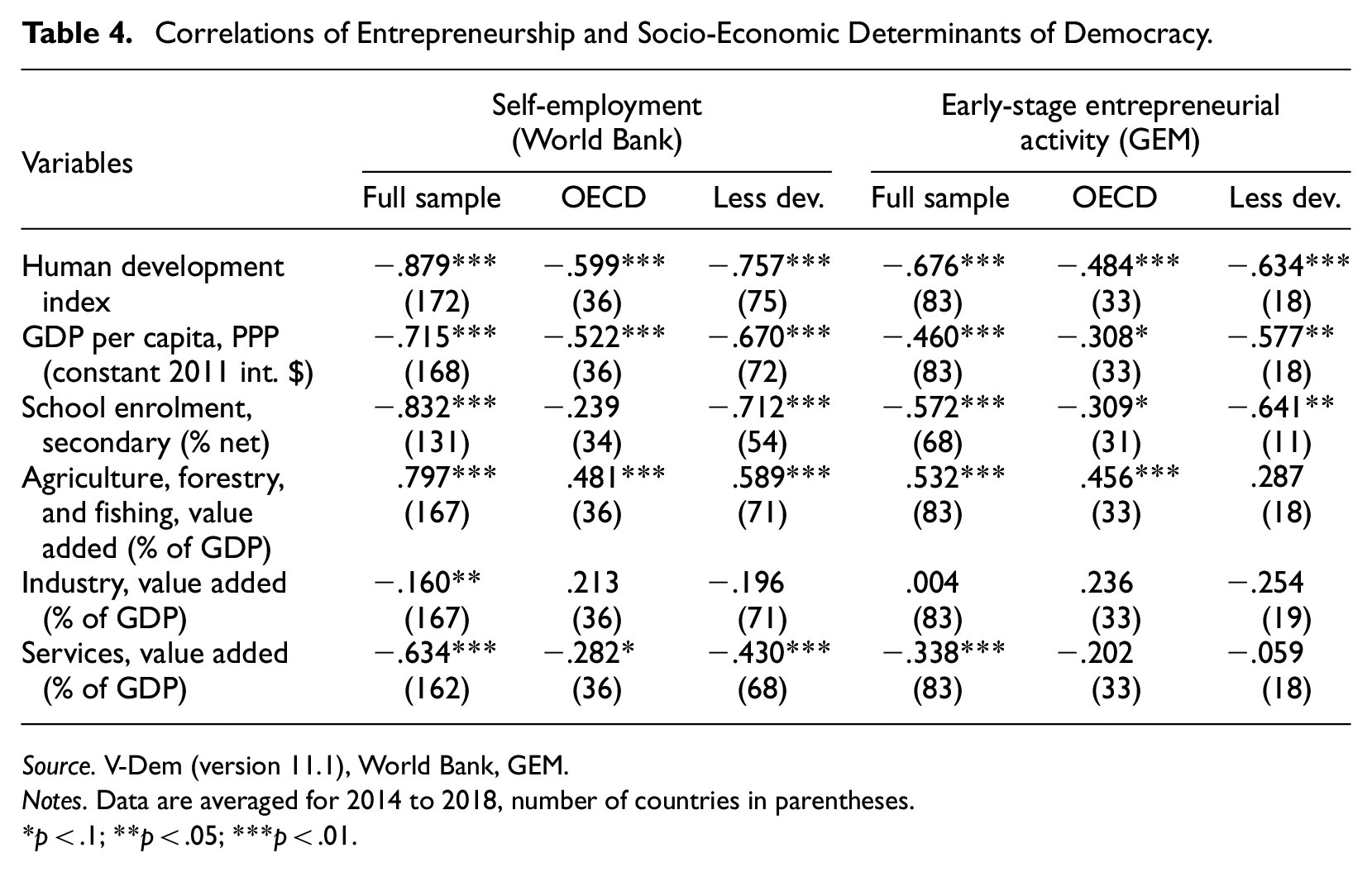
Source. V-Dem (version 11.1), World Bank, GEM.
Notes. Data are averaged for 2014 to 2018, number of countries in parentheses.
*p < .1; **p < .05; ***p < .01.
Table 5 shows the correlations between entrepreneurship and the cultural determinants of functioning democracies. Political science literature suggests that pro-democratic attitudes, which are crucial for democratizing movements and political involvement, are commonly associated with individualism and low in-group collectivism, generalized trust, and secularization/low religiousness (Burkhart & Lewis-Beck, 1994; Inglehart & Welzel, 2005; Lipset, 1959; Welzel, 2013). Our results reveal, however, that entrepreneurship is significantly and negatively related to individualism and generalized trust and positively related to religiosity, nepotism, and cousin marriage (nepotism and cousin marriage reflect the stronger cultural in-group collectivism; see Henrich (2020), for a more detailed discussion).
Correlations of Entrepreneurship and Cultural Determinants of Democracy.
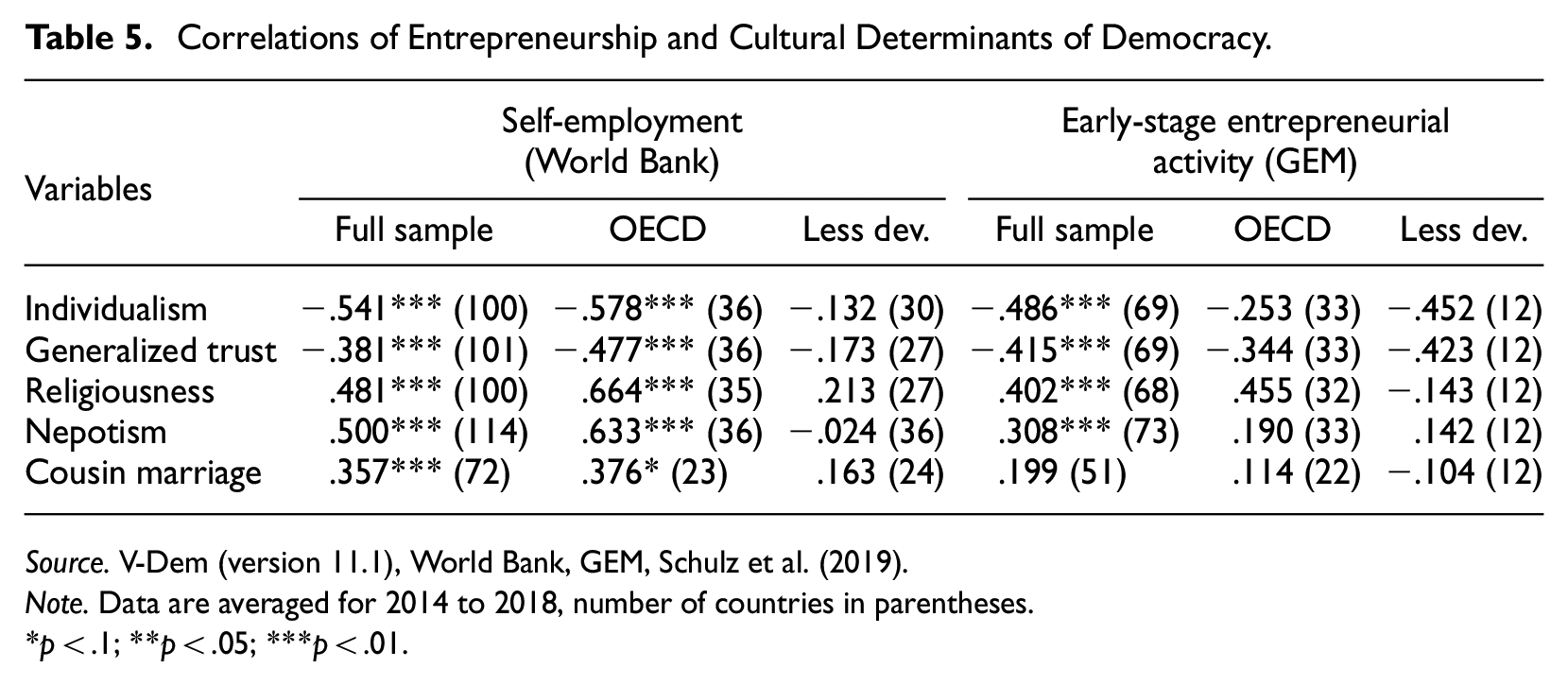
Source. V-Dem (version 11.1), World Bank, GEM, Schulz et al. (2019).
Note. Data are averaged for 2014 to 2018, number of countries in parentheses.
*p < .1; **p < .05; ***p < .01.
Finally, we report on the correlations between entrepreneurship and the institutional determinants that are typically associated with democracy in Table 6. Several studies conclude that democracy is associated with institutional quality, such as government effectiveness, political stability, low corruption, and strong property rights (Acemoglu & Robinson, 2012; Robinson, 2006). Prior literature exploring the relationship between economic development and institutional quality postulates that higher levels of political freedom are highly correlated with higher levels of economic freedom, the so-called “Hayek-Friedman Hypothesis” mentioned above (Lawson & Clark, 2010). Empirical evidence suggests that politically free states oscillate toward economic freedom (see Farrant & McPhail, 2009, for an overview of the “inevitability thesis”). Yet, Table 6 shows that the correlations between entrepreneurship and institutional quality are significant and negatively correlated.
Correlations of Entrepreneurship and Institutional Determinants of Democracy.
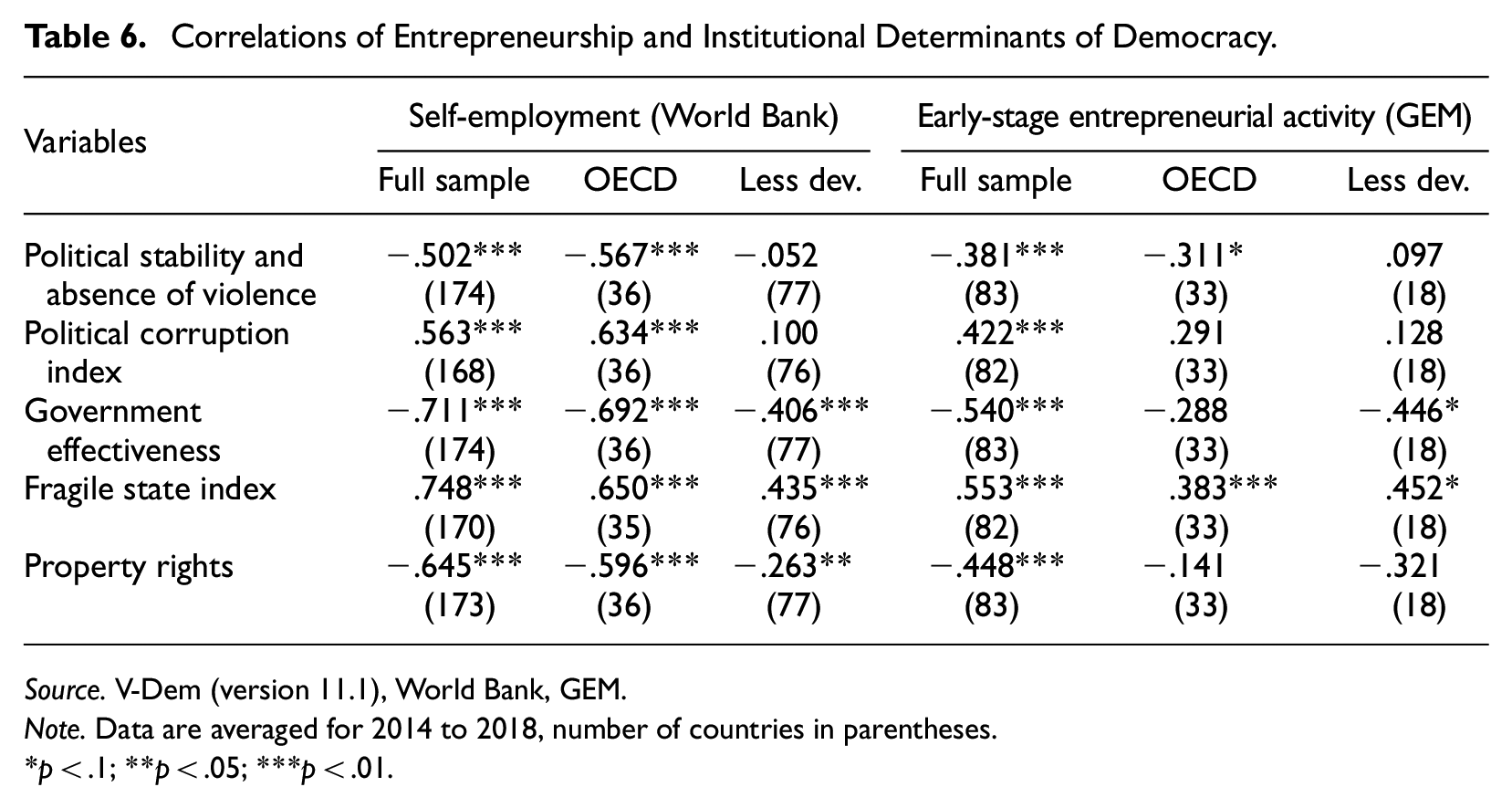
Source. V-Dem (version 11.1), World Bank, GEM.
Note. Data are averaged for 2014 to 2018, number of countries in parentheses.
p < .1; **p < .05; ***p < .01.
In summary, we can conclude that entrepreneurship, defined as self-employment or early-stage entrepreneurial activity, is negatively linked with the determinants of democracy. After this discussion of the relationship at the macro level, we will now turn to the individual level to examine if entrepreneurs are more democratic in their mindset.
Empirical Evidence at the Individual Level
Data and Approach
In the spirit of Tocqueville, who saw the presence of small businesses as an important contribution to democracy, Audretsch and Moog (2022) assert that a loss of independent and autonomous decision-making due to the absence of small business activity or entrepreneurship can lead to the erosion of democracy. According to this logic, entrepreneurs contribute to a functioning democracy because they have a more democratic mentality and are more politically engaged than regular employees. We examine this empirically by using cross-sectional data from the World Values Survey (WVS), complemented by panel data from the Netherlands (LISS), Germany (SOEP), and the UK (UKHLS) (see SOM’s section 2 for detailed descriptions of data sources and variable operationalizations). To analyze our data, we use pooled logit, random-effects, and fixed-effects models to compare entrepreneurs and employees, as well as the effects of transitioning from regular employment to entrepreneurship. Pooled logit and random-effects models focus on between-individual differences (i.e., are entrepreneurs more politically engaged than employees?), but random effects also account for within-individual variation. Fixed-effects models, on the other hand, focus on within-individual differences over time (i.e., does an individual’s political engagement change as he or she transitions from employment to entrepreneurship?), taking into account time-invariant personal characteristics while controlling for constant, unobserved characteristics.
Findings
Are Entrepreneurs More Democratic than Employees?
We first seek to answer the question of whether entrepreneurs are indeed more democratic than their salaried counterparts. The results are reported in Table 7. Drawing on cross-country data from the WVS, which allows us to report differences in political attitudes and behaviors for a full sample of developed and less developed countries, OECD countries, and less developed countries separately, as above, we find that entrepreneurs are more politically active than their salaried counterparts, with specific voting patterns and political attitudes that vary across the development status of the countries studied. However, differences in political attitudes and behaviors tend to be marginal, with somewhat greater differences in richer societies (see Tables S15a–fof the SOM). Specifically, we find that being an entrepreneur significantly increases the likelihood of having a strong interest in politics, political party membership, signing a petition, joining boycotts, always voting in national elections, and always voting in local elections, depending on the development stage of the economy. However, entrepreneurial status can also be associated with less democratic perspectives. Specifically, in less developed countries, entrepreneurs are more likely than their salaried counterparts to endorse the idea that having a strong leader could be an effective model to run a country, while they are less likely to endorse democratic systems as a viable model to run a country. Entrepreneurs in less developed countries are also less likely than employees to believe that people choosing their leaders in free elections is a characteristic of democracy. These findings suggest that contextual factors appear to play a role in the observed differences in political attitudes and behaviors between entrepreneurs and employees.
Logit Results of the Effect of Being an Entrepreneur (vs. Employee) on Political Attitudes and Behaviors.
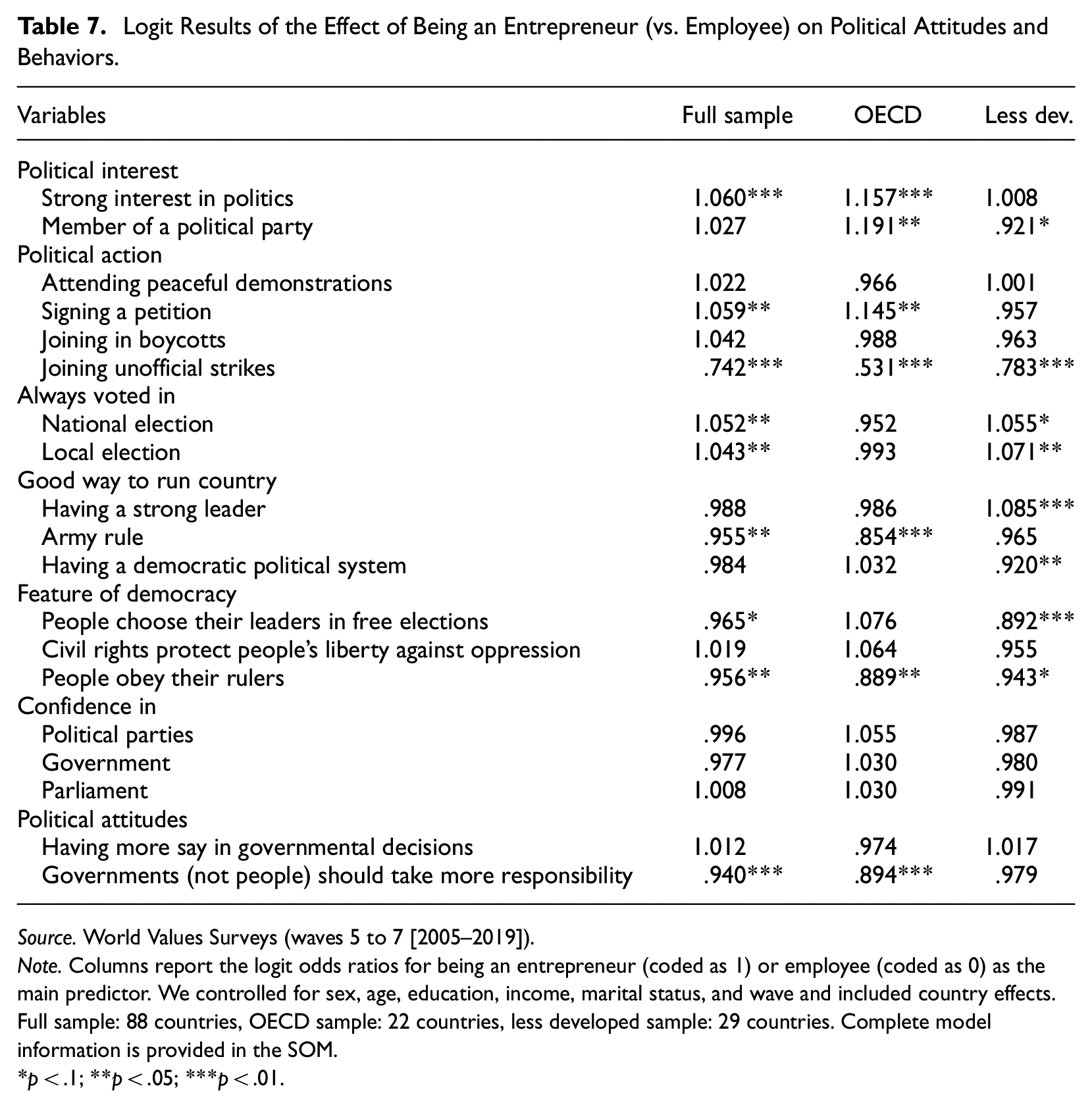
Source. World Values Surveys (waves 5 to 7 [2005–2019]).
Note. Columns report the logit odds ratios for being an entrepreneur (coded as 1) or employee (coded as 0) as the main predictor. We controlled for sex, age, education, income, marital status, and wave and included country effects. Full sample: 88 countries, OECD sample: 22 countries, less developed sample: 29 countries. Complete model information is provided in the SOM.
p < .1; **p < .05; ***p < .01.
A clearer picture emerges from our panel data from highly developed countries, as Tables 8–10 show. In the Netherlands, Germany, and the United Kingdom, the pooled logit and random-effects models reveal a tendency for entrepreneurs to be generally more politically engaged than their salaried counterparts. In the Netherlands, entrepreneurs are more likely to have strong political interests, follow political news, and contact political organizations. Voting and participating in protests are also correlated with entrepreneurship in the pooled logit model. In Germany, entrepreneurs are more interested in politics and active in local politics than employees. However, the intention to vote is not significantly influenced by their entrepreneur status. In the UK, the data show that entrepreneurs are not only more interested in politics but also more likely to be active in political parties. In addition, UK entrepreneurs feel more qualified to participate in political activities. Overall, while the level of engagement varies across countries, the general trend suggests that entrepreneurs tend to be more politically oriented and engaged than employees, particularly in advanced economies, consistent with the claims of Audretsch and Moog (2022).
Logit Panel Results of the Effect of Being an Entrepreneur (vs. Employee) on Political Attitudes and Behaviors (Dutch Panel).
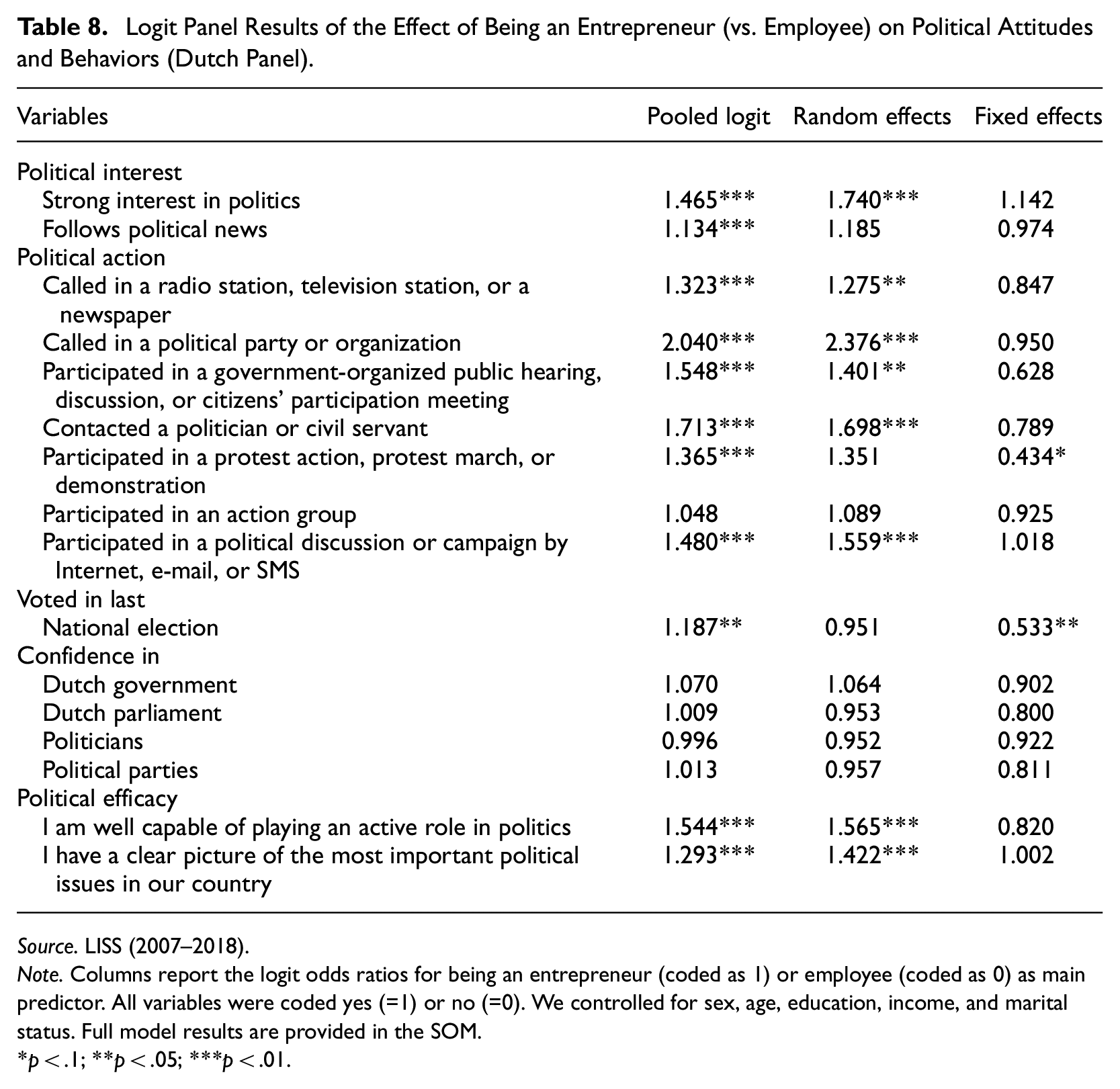
Source. LISS (2007–2018).
Note. Columns report the logit odds ratios for being an entrepreneur (coded as 1) or employee (coded as 0) as main predictor. All variables were coded yes (=1) or no (=0). We controlled for sex, age, education, income, and marital status. Full model results are provided in the SOM.
p < .1; **p < .05; ***p < .01.
Logit Panel Results of the Effect of Being an Entrepreneur (vs. Employee) on Political Attitudes and Behaviors (German Panel).
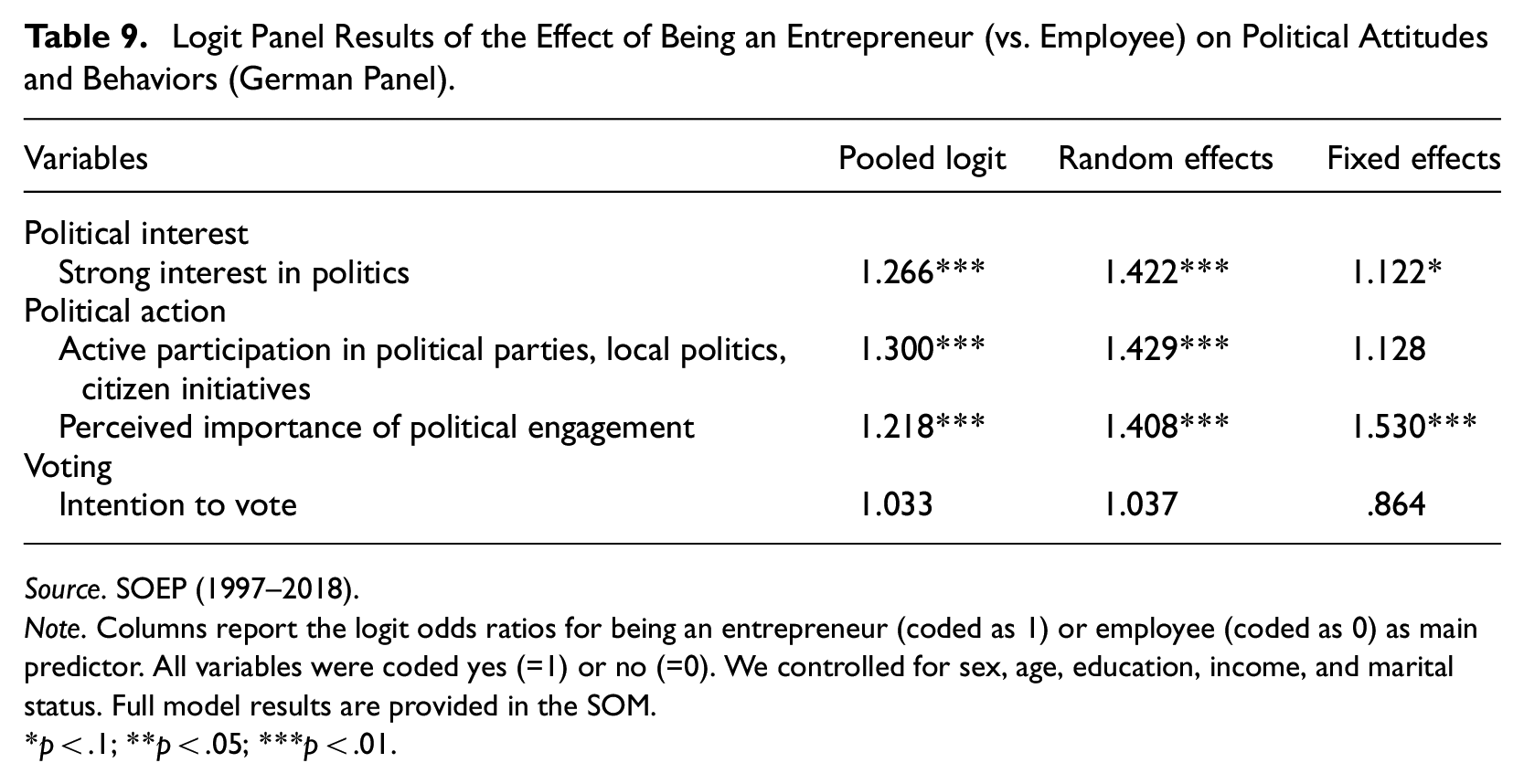
Source. SOEP (1997–2018).
Note. Columns report the logit odds ratios for being an entrepreneur (coded as 1) or employee (coded as 0) as main predictor. All variables were coded yes (=1) or no (=0). We controlled for sex, age, education, income, and marital status. Full model results are provided in the SOM.
p < .1; **p < .05; ***p < .01.
Logit Panel Results of the Effect of Being an Entrepreneur (vs. Employee) on Political Attitudes and Behaviors (British Panel).
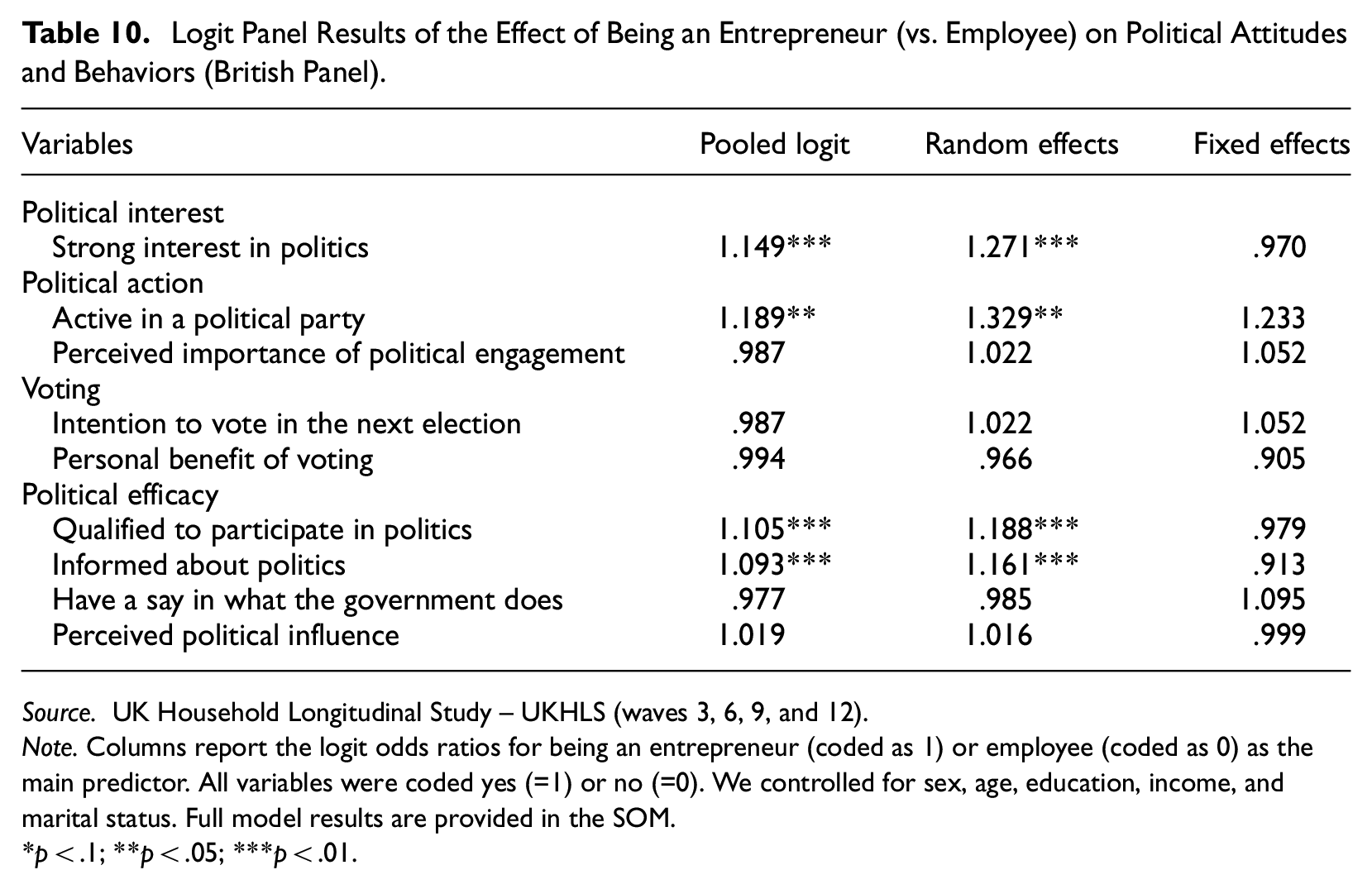
Source. UK Household Longitudinal Study – UKHLS (waves 3, 6, 9, and 12).
Note. Columns report the logit odds ratios for being an entrepreneur (coded as 1) or employee (coded as 0) as the main predictor. All variables were coded yes (=1) or no (=0). We controlled for sex, age, education, income, and marital status. Full model results are provided in the SOM.
p < .1; **p < .05; ***p < .01.
Does the Shift from Employment to Entrepreneurial Activity Influence an Individual’s Democratic Engagement?
Tables 8–10 also report the results of the fixed-effects models, essentially asking what happens to a person’s political engagement if they transition from being an employee to being an entrepreneur. Examining fixed-effects models for the Netherlands, Germany, and the United Kingdom provides nuanced insights that are not as straightforward as those found in pooled logit and random-effects models. In the Netherlands, while entrepreneurs generally show higher political engagement according to pooled logit and random-effects models, the fixed-effects model suggests that transitioning from employment to entrepreneurship does not increase this engagement. Moreover, the likelihood of voting and participating in protests actually decreases upon such a transition. In Germany, the fixed-effects model largely corroborates the findings of the pooled logit and random-effects models, suggesting not only that entrepreneurs are more politically engaged than employees but also that an individual’s level of political engagement increases after the transition from employment to entrepreneurship. Notably, the perceived importance of political engagement rises upon transitioning to entrepreneurship. However, the intention to vote does not follow this trend and may even diminish. In the UK, fixed-effects models produce more mixed results. While they confirm increased activity in political parties among those transitioning from employment to entrepreneurship, they do not indicate significant changes in voting intention or perceptions of political qualification and influence. Overall, the fixed-effects models indicate that while entrepreneurs may be more politically engaged than employees, this engagement often does not increase—and may even decline—in certain political aspects upon transitioning to entrepreneurship. These findings add a layer of complexity to our understanding of the entrepreneurial role in democratic societies.
Discussion
What can we take from our evidence? First, we have argued that there are also good reasons to expect a negative relationship between entrepreneurship and democracy. Our empirical evidence shows that the relationship between both constructs is in fact much more puzzling than the work of Audretsch and Moog’s (2022) as well as Farè et al.’s (2023) suggests. As shown, several metrics of entrepreneurship are rather negatively, not positively, correlated with democracy, a pattern that holds for a full sample as well as a sub-sample with OECD countries; in the subset of less developed economies, we did not observe a negative association, probably due to limited variability in the data, as these countries uniformly exhibited high levels of stand-alone business activity alongside low levels of democracy. Further in-depth research is warranted in future academic studies to elucidate these findings.
Long-term trend data further confirmed the negative entrepreneurship-democracy link, as over the past 60 years, entrepreneurship declined in 13 high-income nations as democracy increased. Across 168 nations, increasing democracy has been associated with declining entrepreneurship since 1991, with only a recent joint decline since 2011 (see Figures 1a and b). This evidence reflects a modernization process that links entrepreneurship and democracy inversely, as in societies that are not yet economically and institutionally developed, small businesses and stand-alone business activity are widespread (due to a lack of alternatives), while at the same time, democracy tends to be weak. Hence, consistent with (revised) modernization theory, societies typically overcome high stand-alone business activity (everyday entrepreneurship) and small-scale, often subsistence-based, production to become both more prosperous and more democratic (Inglehart & Welzel, 2005; Welzel, 2013). Autocratic regimes often intentionally and unintentionally circumvent this transition by restricting trade, capital investment, and migration and by enacting laws that limit individual mobility, self-determination, and personal freedoms. The latter point calls for additional research, focusing on how entrepreneurial activity itself differs across political environments in aspects like opportunities, political dependence, infrastructure, and institutional support.
But if we emphasize the negative link between conventional entrepreneurship and democracy, why does our panel analysis from 1991 to 2018 partially corroborate Farè et al.’s (2023) study, which found a positive relationship between democracy and entrepreneurship over time, especially in OECD countries? First, it is important to note that OECD countries with higher levels of democracy tend to be less entrepreneurial (negative links with self-employment, early-stage, opportunity, necessity, and high-growth entrepreneurship were found), confirming the negative link. We believe the upward trend over time is largely due to a specific phenomenon: the collapse of communism. Consistent with the “Hayek-Friedman hypothesis,” ex-communist countries were characterized by low levels of democratic and economic freedom before the collapse of the Eastern bloc, leading to a significant catch-up effect since the 1990s, as the time trends for single countries also confirm (see Table S2 and Figure S4 of the SOM). The extent to which the transition to democratic and market-oriented systems, or the increasing instability of labor markets characterized by job scarcity and weaker social protection (which may encourage necessity entrepreneurship), may explain the positive relationship between entrepreneurship and democracy needs to be further explored in future studies.
Second, even if democracy is more likely negatively associated with the volume of entrepreneurship, our results reveal that starting a business in a democracy is often linked to higher-quality entrepreneurship. Specifically, we found that businesses in democratic countries are more likely to be innovative, technological, and driven by opportunity. For instance, a significant positive correlation exists between the proportion of innovative-to-overall entrepreneurship across all measures of democracy (see Table A1 in the Appendix). This relationship is particularly striking in the analysis over time (see Table A2 in the Appendix), where there is a 15% in innovative-to-overall entrepreneurship for every one unit increase in democracy (i.e., Liberal Democracy Index) in the full sample and about 44% increase in innovative-to-overall entrepreneurship for the less developed country sub-sample for every one unit increase in democracy (i.e., Liberal Democracy Index). This evidence of a positive linkage can be explained by Baumol’s (1996) entrepreneurial allocation argument, which claims that political and legal institutions of society channel entrepreneurial activity into productive, unproductive, and destructive forms. 4 Democracy, as a political institution, should facilitate the allocation of resources more efficiently. This coincides with Popper’s (2005, 2012) hypothesis that democratic social structures facilitate innovation, as well as Schumpeter’s (1947) assertion that technological progress is more important for understanding democracy than entrepreneurship (broadly understood as self-employment). Therefore, it might not be the case that democracy increases overall engagement in entrepreneurship, but it might positively shift the proportion of unproductive and destructive to productive kinds of entrepreneurship. The latter is also supported by the fact that Schumpeterian forms of entrepreneurship (e.g., innovative, technological, high-growth) improve significantly in less developed countries as they become stronger democracies over time.
Third, our empirical evidence at the individual level further shows the complexity of the entrepreneurship-democracy nexus. While entrepreneurs are, on average, more politically active and have more democratic attitudes than employees across the datasets, the results show that context matters, as differences between entrepreneurs and employees are somewhat smaller in the less developed countries; for some political variables, we even find that entrepreneurs are less democratic in their attitudes and behaviors than employees, which challenges the claims of Audretsch and Moog (2022). For instance, we found in less developed countries that entrepreneurs are more likely than employees to endorse the idea that having a strong leader could be a good model to run a country, while they are less likely to endorse democratic systems as a viable model to run a country. This might be explained by the heightened vulnerabilities many entrepreneurs face in less developed, typically agricultural, economies. In these settings, entrepreneurship often takes the form of unregistered, subsistence-based self-employment, which is fraught with serious economic uncertainties (Reynolds, 2022; Weber et al., 2022; Yessoufou et al., 2018). Individuals facing economic insecurity prioritize immediate survival needs over the need for political self-expression and participation (Welzel, 2013).
Finally, the observation that entrepreneurs are generally more democratic than employees but do not show increased political engagement upon transitioning from employment to entrepreneurship presents an intriguing puzzle that warrants further study. There are several reasons that may explain the lack of spillover from work to the political sphere. One reason may be that individuals with a heightened desire to be involved in decision-making may gravitate toward entrepreneurship while simultaneously engaging in the political system. Another reason may be that the spillover effect takes time, as individuals need several years of experience in their position before they become more politically involved. Further research could investigate this aspect more closely.
Limitations and Future Research Directions
While our theoretical note provides a springboard for understanding the relationship between entrepreneurship and democracy, it has its limitations that provide ample opportunities for future research. First, although we have mitigated the limitations of using only self-employment as a measure of entrepreneurship by exploring alternative measures at the country level, the data quality of the GEM makes within-country analyses challenging due to missing data, which needs to be addressed in future research. Moreover, current metrics of entrepreneurship—including self-employment, early stage, and opportunity entrepreneurship—primarily proxy for economic backwardness, raising the question of how entrepreneurship could be better measured in the future (Henrekson & Sanandaji, 2014). Additionally, for our individual-level analysis, we were not able to capture different definitions of entrepreneurship. Future individual-level studies should seek to effectively explore the nuances of entrepreneurial quality (e.g., productive entrepreneurship) and its relationship to democratic attitudes. A good starting point might be to look at whether the entrepreneur has employees or not. Entrepreneurs with employees tend to be less vulnerable than so-called solo entrepreneurs, which may influence political attitudes and behavior.
Second, this study is limited not only by the data on “entrepreneurship” but also by the measurement of democracy, as critical attention could also be paid to the variety of democracy measures. Our longitudinal analysis at the country level shows partly contradictory results for Vanhanen’s Index of Democracy compared to the other two democracy metrics. The Index of Democracy, which includes political participation by voter turnout in elections, includes a component that is not necessarily indicative of successful democracies. In well-functioning democracies, lower voter turnout may reflect confidence in the system, reducing the perceived need for individual participation. Conversely, in less effective democratic contexts, people may feel more compelled to vote in national elections. Thus, our findings highlight the complexity of the issue and underscore the need to use a variety of metrics to validate the robustness of empirical conclusions.
Third, even if our fixed-effects analysis already accounts for unobserved, time-invariant characteristics that may influence both entrepreneurship and democracy, other approaches may help to further disentangle their causal relationship. For instance, future research could employ methods such as instrumental variables, lagged variables, or difference-in-difference analysis. Interesting instrumental variables for examining the effect of democracy on entrepreneurship could include geographic characteristics like distance to the equator, historical institutions such as legal origin, or the language family of a country’s official language. A difference-in-differences analysis could examine the impact of democratic reforms or revolutions on entrepreneurship by comparing countries that have undergone such changes with those that have not.
Fourth and finally, given the absence of moderating or further control variables in our analysis, one may ask whether the inclusion of further variables could bring to light more nuances. Factors such as culture, institutions, demographics, economic conditions, and geopolitical factors could serve as important moderating or control variables. Analyses separated for sub-groups (e.g., gender, class, migrant background) could also provide new insights.
Conclusion
Our research note expands on Audretsch and Moog’s (2022) excellent discussion of the democracy-entrepreneurship nexus through empirical theorizing (Shepherd & Suddaby, 2017). Using available empirical data at the individual and country levels, we are able to demonstrate the complex nature of the democracy-entrepreneurship nexus. We hope this research note inspires more work at the intersection of entrepreneurship and democracy guided by our insights.
Supplemental Material
sj-pdf-1-etp-10.1177_10422587231221797 – Supplemental material for Entrepreneurship and Democracy: A Complex Relationship
Supplemental material, sj-pdf-1-etp-10.1177_10422587231221797 for Entrepreneurship and Democracy: A Complex Relationship by Steven A. Brieger, Diana M. Hechavarría and Arielle Newman in Entrepreneurship Theory and Practice
Footnotes
Appendix
Longitudinal Panel Fixed-Effects Regression Results (Entrepreneurship on Democracy).
| Variables | Liberal democracy index (V-Dem) | Level of democracy index (FH/Polity) | Index of democracy (Vanhanen) | ||||||
|---|---|---|---|---|---|---|---|---|---|
| Full sample | OECD | Less dev. | Full sample | OECD | Less dev. | Full sample | OECD | Less dev. | |
| Opportunity entrepreneurship | .001 (81) | −.001 (33) | .003 (21) | −.003 (79) | −.026***(32) | .029 (21) | .082 (82) | .217*(33) | .076 (21) |
| Opportunity-to-overall entrepreneurship | .003 (80) | −.120***(33) | .213 (21) | −.252 (78) | −.498*(32) | .698 (21) | 6.786***(81) | 9.085***(33) | 4.842 (21) |
| Necessity entrepreneurship | −.002 (81) | .007*(33) | .000 (21) | .014 (79) | .001 (32) | .068 (21) | −.257*(82) | −.229 (33) | −.062 (21) |
| Necessity-to-overall entrepreneurship | .026 (80) | .130***(33) | −.099 (21) | .405 (78) | .671***(32) | −.202 (21) | −9.111***(81) | −9.820***(33) | −0.018 (21) |
| Innovative entrepreneurship | .002 (80) | .000 (33) | .017**(21) | .002 (78) | −.026*(32) | .126 (21) | −.116 (81) | .139 (33) | .048 (21) |
| Innovative-to-overall entrepreneurship | .001**(81) | −.000 (33) | .004***(21) | .002 (79) | −.004*(32) | .030*(21) | −.008 (82) | .017 (33) | .013 (21) |
| Technological entrepreneurship | .001 (80) | −.003 (33) | .069*(21) | .089 (78) | .006 (32) | .757*(21) | .603 (81) | 1.191*(33) | 2.244 (21) |
| Technological-to-overall entrepreneurs | .000 (81) | −.001 (33) | .013**(21) | .009 (79) | −.001 (32) | .150**(21) | .073 (82) | −.001 (33) | .453*(21) |
| High-growth entrepreneurship | .002 (80) | −.005 (33) | .036***(21) | −.014 (78) | −.134***(32) | .415***(21) | −.143 (81) | −.051 (33) | .916 (21) |
| High-growth-to-overall entrepreneurs | .000 (81) | −.001 (33) | .007***(21) | .005 (79) | −.009**(32) | .089***(21) | −.022 (82) | −.045 (33) | .220**(21) |
| Business ownership exc. agriculture | −.001*(81) | .001 (33) | −.002 (21) | −.007 (79) | −.015*(32) | −.012 (21) | −.085*(82) | −.079 (33) | −.025 (21) |
| Corporate entrepreneurship | −.006**(72) | −.004 (33) | .002 (17) | −.118***(73) | −.062**(33) | −.044 (17) | −.400**(73) | −.362 (33) | −.605 (17) |
| Global innovation—output | −.000 (112) | .001 (35) | −.003***(38) | −.011*(108) | −.001 (34) | −.028**(38) | .007 (112) | .018 (35) | −.017 (38) |
Source. V-Dem (version 11.1), World Bank, GEM.
Note. Number of countries in parentheses. For GDP per capita (PPP), secondary school enrollment, economic freedom index, and trade (in % of GDP) were controlled. Full results are reported in the SOM.
p < .1; **p < .05; ***p < .01.
Declaration of Conflicting Interests
The author(s) declared no potential conflicts of interest with respect to the research, authorship, and/or publication of this article.
Funding
The author(s) received no financial support for the research, authorship, and/or publication of this article.

Supplemental Material
Supplemental material for this article is available online.
Notes
Author Biographies
References
Supplementary Material
Please find the following supplemental material available below.
For Open Access articles published under a Creative Commons License, all supplemental material carries the same license as the article it is associated with.
For non-Open Access articles published, all supplemental material carries a non-exclusive license, and permission requests for re-use of supplemental material or any part of supplemental material shall be sent directly to the copyright owner as specified in the copyright notice associated with the article.
