




Abstract
We investigate how self-employment in East Germany was impacted by 40 years of Soviet-style communism and the subsequent shock transition to a market economic system. To this end, we compare self-employment in East and West Germany after reunification with self-employment before the separation of Germany after World War II. Our results show that the strict anti-entrepreneurial policies prevalent during the Soviet regime do not have a long-run negative effect on self-employment in East Germany. Quite to the contrary, self-employment in East Germany today is higher than before German separation. This finding cannot be explained by necessity self-employment. Our analysis suggests that current differences in self-employment between East and West Germany are pre-dominantly a result of the sudden shock transformation that occurred with reunification, rather than the outcome of four decades of anti-entrepreneurial policies and ideology.
Introduction
It is widely acknowledged that formal and informal institutions can significantly shape individual behavior and can have long-term consequences for an economy (North, 1994; Williamson, 2000). The case of Germany provides a good opportunity to study such effects empirically. After the country was divided for more than 40 years into a Soviet-style communist state (the German Democratic Republic, GDR) in the East and a well-developed market economy in the West (the Federal Republic of Germany, FRG), the sudden and unexpected reunification in 1990 led to an adoption of the West German system of formal institutions virtually overnight (Brezinski & Fritsch, 1995; Sinn & Sinn, 1992). 1 A particularly important feature of the German case is that both parts of the country shared the same institutions before the communist period. In this setting, West Germany can be taken as a benchmark for assessing the effect of four decades of communism characterized by strict anti-entrepreneurial policies.
This paper investigates the effect of formal and informal communist institutions on self-employment in the GDR and post-transition East Germany by using West Germany as a comparison. How did the entrepreneurship-hostile communist regime affect self-employment after reunification? What are the effects in the short and in the long run? In order to answer these questions, we apply a difference-in-difference (DiD) estimation approach at the level of East and West German regions that examines self-employment before separation and in the post-reunification period. Thus, we analyze how historical and institutional shocks affect the long-term trajectories of entrepreneurship as measured by the share of people opting for self-employment. 2
Our analysis contributes to research investigating institutional and political contexts in entrepreneurship (Baker & Welter, 2020; Welter & Baker, 2020). In particular, we investigate the effects of institutions on entrepreneurship, especially of communism and transition to a market economic system (Becker et al., 2020; Fuchs-Schuendeln & Schuendeln, 2020; Roland, 2012). Furthermore, our paper adds to the literature on the economic consequences of historical shocks and resilience to such shocks (Fritsch & Wyrwich, 2019). Our research also contributes to the debate on the persistence of entrepreneurship (e.g., Fritsch & Wyrwich, 2014; Fotopoulos & Storey, 2017). To be more precise, while previous research has identified persistence of regional differences in entrepreneurship in settings with significant historical ruptures, no assessment has yet been offered on how historical shocks affect the absolute level of self-employment in regions that were exposed to a shock as compared to non-affected regions.
Despite its distinctiveness, the case of East Germany has a lot in common with other former communist countries, and the insights presented in this paper may—to a degree—be generalized. In particular, the restrictive policy toward entrepreneurship is comparable to other Eastern European countries (e.g., Åslund, 1985; Pickel, 1992). Moreover, as in most of these countries that were not part of the Soviet Union, exposure to communism lasted about four decades.
Our analysis shows a significantly negative DiD coefficient for self-employment in East Germany in the first years after German unification. This indicates that exposure to a communist regime had a negative effect on the level of self-employment in the early stages of the transition process. Interestingly, this negative “GDR effect” completely fades out in the late 1990s, about 10 years after the transition began. After this first decade after reunification, we find a positive long-run treatment effect on the level of self-employment in post-reunification East Germany. Further analyses reveal that this pattern indicates specific “second round” effects of the transition of East German regions to a market economy that left an imprint on current self-employment levels, while four decades of an anti-entrepreneurial communist regime did not.
The empirical regularities that we find have several implications. First, if communism truly had a long-term negative effect on the willingness to be a business owner, or to embrace entrepreneurship-prone values and preferences, as suggested in the literature (e.g., Alesina & Fuchs-Schündeln, 2007; Bauernschuster et al., 2012; Falck et al., 2017), then this potential effect on self-employment is more than compensated for by other factors, such as the transformation strategy and privatization policies adopted after 1990. This casts doubt on the argument that the level of self-employment in East Germany today mirrors a communist legacy. Rather, it seems to represent a result of the transition process. Furthermore, our findings suggest that deeply rooted historical development trajectories might be relatively less important in certain contexts. If the impact of four decades of communism on the structure and organization of economic activity (particularly collectivization and low levels of self-employment) had affected regional trajectories, one should not observe comparatively high self-employment rates in East Germany so soon after the dismantling of the communist regime.
It is also interesting that the current level of self-employment in East Germany (relative to West Germany) does not follow the same trajectory or path observed prior to the communist experiment. Quite to the contrary, the level of self-employment in East Germany before World War II was significantly lower. This quite surprising pattern may have encouraging policy implications, namely, that it is possible to reverse historical trends and trajectories in a relatively short period of time. It should, however, be mentioned that the small firms that were created in East Germany after 1990 are, on average, not very successful, which may signify a relatively underdeveloped skill set among the entrepreneurs managing these firms. It is remarkable that historical economic shocks such as the transition can leave a stronger imprint on the regional share of people selecting into self-employment as compared to longer exposure to certain ideologies.
The paper is organized as follows: First, we review related literature that focuses on the potential effects of communism on entrepreneurship and the role of long-term development trajectories, and derive relevant hypotheses in the next chapter. We then present the empirical strategy and the results. The following chapter discusses the results and implications of the empirical analysis, and draws conclusions for further research. The final chapter concludes.
Historical Shocks and Regional Trajectories of Entrepreneurship: The Case of the Grand Communist Experiment in the 20th Century
Disentangling the Effect of Communism and Transition
The case of East Germany has two important advantages for analyzing the effect of the communist regime and subsequent transition to a market system. The first of these advantages is that reunification with West Germany was exogenous and occurred as a “natural experiment” where the ready-made institutional framework of the West was transferred to the East virtually overnight (e.g., Brezinski & Fritsch, 1995; Sinn & Sinn, 1992). Hence, in contrast to most other former communist countries, the mode of transition and privatization processes in East Germany did not evolve endogenously, that is, the new rules and their implementation were not significantly shaped by the communist past. For this reason, the effects of communism and transition can be clearly separated.
The second advantage is that East and West Germany shared a common history and institutions before separation, and now share the same post-reunification institutional framework, making the West an excellent counterfactual for the East. Hence, it is possible to make a comparative assessment of the effects of communism and transition on self-employment by comparing the distinct parts of the country. These advantages become even clearer when reviewing the country’s economic history since WWII.
A Brief Overview of German Economic History Since WWII
After World War II, Germany was occupied by the Allied Powers. While the Western Allies began the process of building a modern market economic system in Western Germany, the Eastern part of the country was occupied by the Soviet army and took a completely different developmental path. The Soviets quickly installed a communist regime with a centrally planned economic system. In 1949, an East German State, the German Democratic Republic (GDR), was founded and absorbed into the Soviet Bloc. As a consequence of political pressure and severe economic problems, there was massive migration of East Germans to the West that continued until the GDR border was closed and the Berlin Wall was constructed in 1961. 3 The GDR era was characterized by a reshaping of regional structures instigated by a variety of industrialization policy campaigns initiated by the communist regime (Berentsen, 1992; Steiner, 2010).
The post-WWII GDR communist regime implemented a number of policies intended to eradicate entrepreneurship. Collectivist values were strongly favored and entrepreneurship was perceived as a bourgeois anachronism (e.g., Pickel, 1992; Thomas, 1996). The implementation of a rigorous anti-entrepreneurship policy strategy included massive socialization of private enterprises and the suppression of any remaining private sector activity (for details, see Pickel, 1992). However, in spite of this extensive anti-entrepreneurship policy, 1.8% of the population between the ages of 18 and 64 were self-employed at the end of the communist period in September 1989 (Statistik der Deutschen Demokratischen Republik, 1990). At the same moment in history, 9% of West Germans between the ages of 18 and 64 were self-employed (Fritsch & Wyrwich, 2019).
The GDR collapsed in late 1989, and East and West Germany were reunified in 1990. The subsequent transformation process of the East German economy to a market economic system was a “shock treatment” where the ready-made formal institutional framework of West Germany was adopted practically overnight (e.g., Brezinski & Fritsch, 1995; Hall & Ludwig, 1995; Sinn & Sinn, 1992). This development induced a massive and swift structural change, accompanied by an almost complete replacement of the incumbent firms. Between 1989 and 1991, the share of manufacturing employment in East Germany dropped from 48.7% percent to 16.0% (Hall & Ludwig, 1995), and unemployment rose from virtually zero in 1989 to more than 15% in 1992 (Burda & Hunt, 2001). In the course of the transformation process, a huge number of mostly young and qualified workers migrated from East to West Germany (Hunt, 2006). Today, more than 30 years after this transformation process began, Eastern Germany still lags far behind the economy of Western Germany (IWH, 2019).
The Negative Effect of Communism on Entrepreneurship
Communism is regarded as one of the most entrepreneurship-inhibiting economic systems in human history (Earle & Sakova, 2000). Communist countries typically experienced a rigorous collectivization of most industries soon after the introduction of the regime. In some countries (e.g., Russia), private sector firms were completely illegal. Other communist systems allowed for certain types of small-scale private ventures, with the caveat of implementing strict controls and placing high financial burdens on running a private firm (Åslund, 1985; Pickel, 1992). In the case of the GDR, the enactment of communist policies induced many entrepreneurs and firms to migrate to West Germany (e.g., Falck et al., 2013), leading to a massive loss of entrepreneurial capacity and talent.
Apart from collectivization campaigns, far-reaching communist indoctrination attempted to crowd out value priorities for autonomy and mastery (Schwartz & Bardi, 1997; Sztompka, 1996), both of which are crucial antecedents for developing entrepreneurial intentions (Ryan & Deci, 2017). In addition to the direct effects of communism on entrepreneurship during the regime’s tenure, there is also abundant evidence that legacy effects inhibit entrepreneurship after a regime switch. Communism’s negative impact on the valuation of entrepreneurship in people’s mindset is well-documented. 4 There is also evidence that the type of human capital acquired under communism inhibits involvement in entrepreneurial activities after the regime switch (e.g., Bird et al., 1994; Fritsch & Rusakova, 2012; Gathmann, 2005; Wyrwich, 2013). In any case, during 40 years of communism, East Germans were working in a planned economy, not a market economy, and they had fewer incentives and opportunities to acquire entrepreneurial skills to engage in entrepreneurial activities. Another reality that worked against East German entrepreneurs is that, on average, they had far fewer financial resources than their West German counterparts because there were fewer opportunities to accumulate financial capital in the GDR.
The collectivization of small and medium-sized enterprises and the anti-entrepreneurial policies of the communist regime in the former GDR (similar to other communist countries in Central and Eastern Europe), basically destroyed entrepreneurial initiative. Being exposed to communism shaped an anti-entrepreneurial mindset among the population and induced a massive migration of firms and entrepreneurial talent. This entrepreneurial bloodletting probably left a scar on entrepreneurial activity which should be reflected, for example, in the level of self-employment even today. Thus, we hypothesize:
There is a negative treatment effect of communism on the level of entrepreneurship (e.g., level of self-employment) that also shapes development after the transition to a market economy.
Economic Transition as a Driver of Entrepreneurship
Not surprisingly, economic liberalization in transition economies led to a significant increase in private sector firms. McMillan and Woodruff (2002) vividly describe the central role played by entrepreneurs in mastering the restructuring and renewal of post-communist economies. East Germany was no exception and also saw a significant surge in start-up activity after the introduction of a market economy in the 1990s (Fritsch, 2004).
There are several explanations for the positive impact of transition on start-up activities. One key factor was obviously the change of the institutional framework, particularly the much lower level of legal restrictions for starting and running an own business. Another factor that could explain the rise of self-employment is the enormous backlog of demand for services and high-quality products that were in short supply under the communist planned economy. It was, therefore, relatively easy for individuals to find a market niche (Fritsch, 2004; Smallbone & Welter, 2001). In East Germany, for example, the low number of suppliers in the first years of the transition led to a relatively large ‘window of opportunity’ for starting a firm, which was also reflected in relatively high survival chances and growth rates of firms that were set up in the early 1990s (e.g., Brixy & Kohaut, 1999; Fritsch, 2004). A further explanation for the upsurge of start-up activity was the skyrocketing unemployment in the first years of transition that may have induced necessity self-employment (Estrin et al., 2018; Lechner & Pfeiffer, 1993).
Empirical studies for a number of countries have documented a long-run persistence of entrepreneurship at the regional level (Fritsch & Wyrwich, 2014; Fritsch et al., 2019; Fotopoulos & Storey, 2017). Germany provides an impressive example for such persistence of regional entrepreneurship. The empirical evidence suggests that start-up activity today is significantly affected by historical levels of self-employment that existed prior to a number of disruptive events that occurred in Germany during the 20th century, for example, two World Wars, and four decades of communism in the eastern part of the country (Fritsch & Wyrwich, 2014, 2019).
One likely candidate explaining this long-run effect despite significant structural changes is the stability of informal institutions over longer periods of time (North, 1994; Williamson, 2000). Accordingly, the persistence of entrepreneurship may indicate the endurance of an entrepreneurial “culture” (e.g., Andersson & Koster, 2011; Fritsch & Wyrwich, 2014). The endurance of a culture that favors entrepreneurship is driven by feedback mechanisms in the form of externalities (e.g., learning by example) that harness a self-perpetuation of the existing modes of economic exchange. One can think of entrepreneurial role models that provide opportunities to learn about entrepreneurship and facilitate social acceptance and legitimacy of entrepreneurship via peer effects.
Previous studies find that the presence of a historical tradition of entrepreneurship that may indicate an entrepreneurial culture is positively linked to the re-emergence of entrepreneurship after the collapse of communism in diverse transition contexts such as East Germany, the Russian region of Kaliningrad, and Poland (Fritsch et al., 2014, 2019, 2021). Hence, an entrepreneurial culture is deeply rooted and not necessarily eradicated by decades of anti-entrepreneurial policies and ideology. The re-emergence of entrepreneurship along historical lines also implies a persistence in interregional differences of entrepreneurship levels. Hence, we expect that regions will resume their pre-communist trajectory with respect to entrepreneurial activities. This implies that the negative communist treatment effect on entrepreneurship that we discussed above will fade out in the course of the transition process. Hence, we hypothesize:
The negative treatment effect of communism on entrepreneurship (e.g., level of self-employment) will become less significant over the course of transition and finally disappear (i.e., regions return to their pre-communist trajectory).
We have, however, no reasonable expectation about the time period required to resume a pre-communist trajectory. Although entrepreneurial activities (e.g., level of self-employment) in East Germany may, according to Hypothesis 2, converge toward the pre-communist trajectory, the type of firms may differ. At the end of the communist regime, the average East German had relatively few financial resources available and was, therefore, hardly in a position to set up firm that required a large investment. This was particularly true for those who became unemployed. Hence, one may expect that start-ups in East Germany in the first years of the transition were mainly small-scale entries in industries with a low minimum efficient size such as retailing, hospitality and catering (Lofstrom et al., 2014; van Stel et al., 2007).
Empirical Strategy
Data and Measurement
We analyze how historical and institutional shocks affect the long-term trajectories of entrepreneurship as measured by the share of people opting for self-employment. 5 Communism’s direct effect on self-employment can be measured by comparing historical data reflecting levels of self-employment in East and West Germany prior to separation with data for both parts of the country that are specific to the time when the country was reunified. Post-reunification data can be used to measure the transition effect. We conduct the empirical analysis at a regional level in order to account for the pronounced effect of geographic characteristics on self-employment such as: industry structure, the knowledge stock, a historical tradition of entrepreneurship and the overall level of economic development (Fritsch & Wyrwich, 2019).
The pre-separation data is based on population censuses that were conducted in the years 1925 and 1939, only a few months before World War II. The 1939 census contains the last available information on self-employment before the separation of Germany and the initiation of a communist regime in the eastern part of the country in 1945. Including the 1925 census in our analysis allows us to determine if there are any pre-separation trends in the development of self-employment in both parts of Germany.
Post-separation data on self-employment is obtained from the Federal German Statistical Office (Arbeitskreis Erwerbstätigenrechnung) and is available for the years 1991–2015. This allows us to test the long-run treatment effects of German separation and communism. We also include information for the year 1989, just before reunification and transition. This allows us to estimate the direct impact of communism on self-employment. Self-employment data for the GDR stems from GDR Statistical Offices (see Rudolph, 1990, for details). 6
Our main outcome variable of interest is the self-employment rate. We define the regional self-employment rate as the number of self-employed persons divided by the regional workforce. Our measure across all years completely excludes self-employment in agriculture because self-employment in this sector is rather specific. 7
In order to work with consistent spatial units, it was necessary to overlay digitized maps of regions in 1925 and 1939 with a map including the boundaries of current regions. 8 The historical regions are split into parts along the borderlines of current regions and assigned to planning regions (Raumordnungsregionen). Planning regions represent functionally integrated spatial units that consist of at least one core city. 9
Methodology
Our study uses a difference-in-difference (DiD) approach to measure the treatment effect on self-employment rates

Several general characteristics of the regions and their labor markets are included in the vector of control variables. These characteristics may determine regional self-employment rates that are rooted in industry structure, local knowledge, and agglomeration externalities (for an extensive literature review, see for example Sternberg, 2009). Since entry conditions differ across industries, we include the local employment share in manufacturing.
Agglomeration economies and diseconomies may also affect entrepreneurial opportunities and self-employment rates. While diversity and availability of specialized inputs as well as access to larger markets may have a positive effect on entrepreneurship, fierce competition for scarce resources that imply relatively high input prices can have a negative impact. We include a measure for population density to capture such effects. The local knowledge base can also play an important role in entrepreneurial development (Acs et al., 2009). Since differences in local knowledge stocks tend to be highly persistent (Fritsch & Wyrwich, 2019), we account for such effects and capture historical differences in the regional knowledge stock by including the distance to a technical university (Technische Hochschule) that already existed in the year 1900. We include income per capita in the baseline specification to account for a potential effect of local demand and the state of regional economic development.
The Impact of Communism and Transition on Self-Employment in Germany: Three Scenarios
There are three alternative outcomes for the values of the estimated DiD coefficient that indicates the effect of communism and the transition process on the levels of self-employment in East Germany. 10 A significantly negative value of the DiD coefficient would mean that the introduction of the communist regime and the transition process to a market economy four decades later had a negative effect on current levels of self-employment. Such a result would be in line with studies that show a lasting negative effect of the communist regime in the GDR on start-up intentions and pro-market attitudes in eastern regions of modern Germany (Alesina & Fuchs-Schündeln, 2007; Bauernschuster et al., 2012). It would also imply that negative direct and indirect effects of communism and transition on self-employment overrule any positive impacts of the transition process on self-employment. If such a negative effect is persistent over the post-reunification period, this would indicate that the anti-entrepreneurial policies in place during the communist era disrupted the historical pre-shock trajectory of entrepreneurial development in East Germany. This scenario is in line with our Hypothesis 1.
A non-significant DiD coefficient would indicate that the negative impact of the communist regime in East Germany and any positive effects of the subsequent shock transition to a market economy on self-employment cancel each other out. It would also imply that East German regions returned to their historical regional development trajectories despite four decades of communism and more than two decades of transitional processes. Such a result would be in line with Hypothesis 2 and with studies that show long-run persistence of population levels and economic structures despite disruptive shocks such as the destruction caused by strategic bombing during WWII (e.g., Davis & Weinstein, 2002). These studies do not, however, explore the organization of economic activities as reflected in the development of new firms, small or large.
A significantly positive DiD coefficient would mean that positive effects of the shock transition on self-employment experienced in East Germany dominate the negative effects of four decades of communist anti-entrepreneurship policies. If this effect is persistent, it challenges the conclusions of earlier studies that both economic development and entrepreneurship in East Germany suffer from a communist legacy (Alesina & Fuchs-Schündeln, 2007; Bauernschuster et al., 2012). It would also mean that the shock transition has a stronger effect on entrepreneurship (e.g., level of self-employment) than four decades of communism. Such a result would also contradict Hypothesis 2, according to which regions tend to return to their pre-war trajectory.
Results
The General Effect of Communism
The average level of self-employment across West German regions in the year 1939 prior to WWII amounted to 9.5%, whereas it was around 8.3% across East German regions. This compares to 2% in East Germany and 7.8% in West Germany in 1989, just before the communist regime collapsed. 11 During the 1990s, the gap between the two parts of Germany narrowed considerably and around the year 2000, this difference was no longer statistically significant. By the year 2003, the self-employment level was significantly higher in East Germany (for an overview, see Table A5 in the Supplementary Appendix).
Hypothesis 1 suggests that there is a negative treatment effect of communism on self-employment, not only during the communist period, but also directly after the economic transformation. The estimated DiD coefficients of the baseline model with control variables are presented in Figure 1.
12
The reference year is 1939. All estimated models show insignificant coefficients for the interaction between the treatment dummy and the level of self-employment in the year 1925 indicating parallel pre-treatment trends.
13
In the following discussion, we focus on the results of Model II. Difference-in-Difference (DiD) coefficients. Notes: The Figure shows coefficients for the full baseline model including all controls (Model II of Supplementary Appendix Table A4). 1939 is the reference year. Grey dashed lines represent the 95% confidence interval.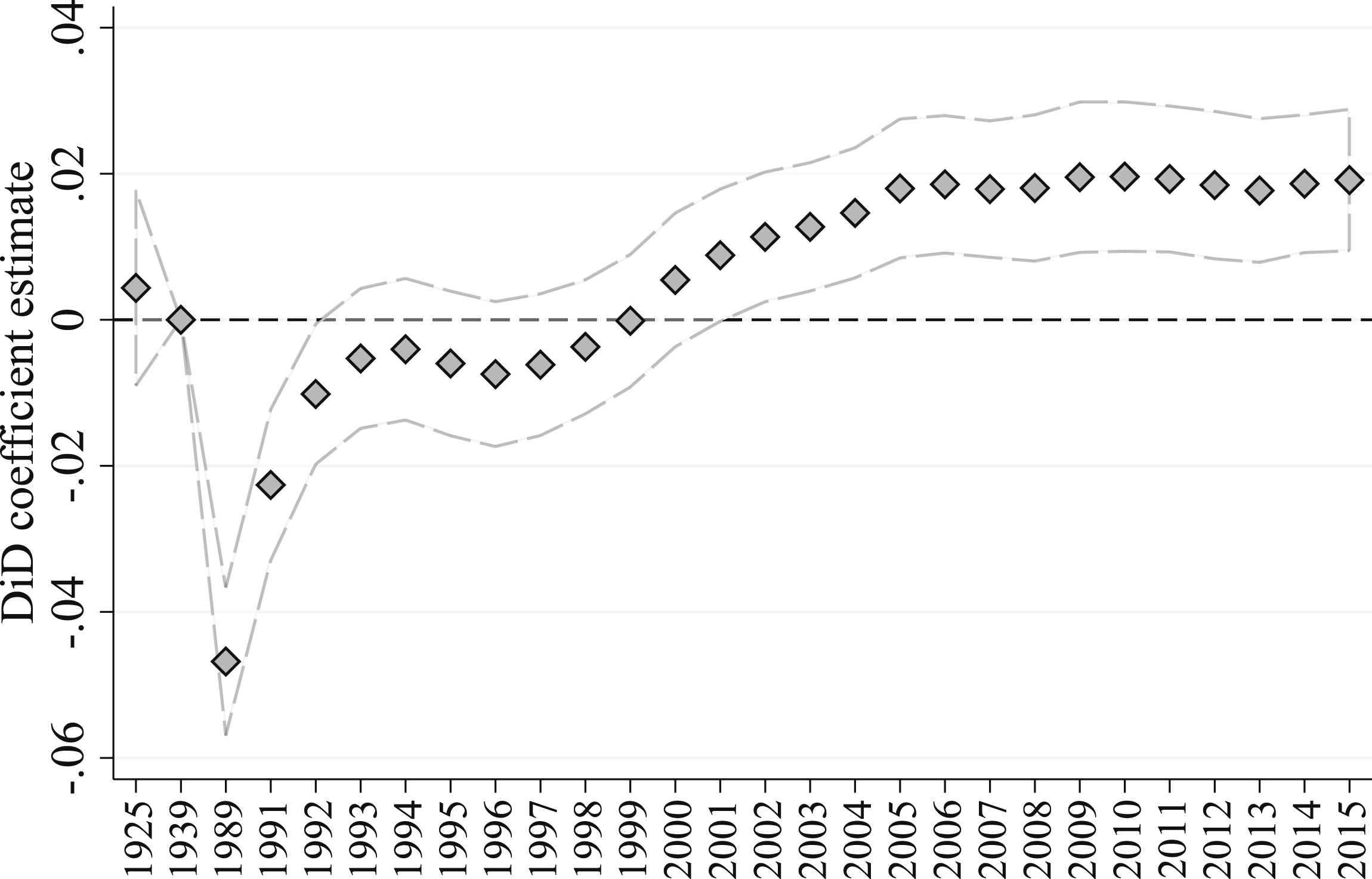
The DiD coefficient for the year 1989 indicates that the communist treatment reduced the self-employment rate by about 4.8% points. This is a substantial effect as the total difference in the self-employment rate between East and West Germany was about 5.8% points in 1989 (see Table A5 in the Supplementary Appendix). Hence, the communist treatment effect explains almost the total East-West difference in self-employment in 1989. This result supports Hypothesis 1 suggesting a negative treatment effect on the eve of reunification and immediately afterwards.
Hypothesis 2 states that the negative treatment effect of the communist regime fades out some time after the economic and political transformation. The DiD coefficients for the first years after reunification support Hypothesis 2, and suggest that the effect of the communist treatment on the level of self-employment weakened relatively quickly. For the first available post-reunification year in 1991, the negative treatment effect of communism is about 2% points. This is a remarkable drop compared to the treatment effect in 1989, which was 4.8% points. In 1993, the treatment effect is no longer statistically significant. The insignificance of the treatment effect in later years of the 1990s (Figure 1) suggests that the effect of four decades of anti-entrepreneurial policies and the crowding out of private initiatives during the GDR did not leave any long-term traces on self-employment rates. In fact, around the year 2000, about 10 years after reunification, the treatment effect becomes significantly positive. The values of the DiD coefficients first increase to a level of 1.8% in 2005 and then remain stable. This finding for the long-term development contradict Hypothesis 2. 14
Figure 2 shows the predicted self-employment rate for East and West Germany according to the baseline model throughout the period under consideration. According to Figure 2 self-employment in East Germany started to catch up with West Germany immediately after reunification and overtook West German regions by the beginning of the 2000s. Predicted self-employment rate in each period for the control and treatment group. Note: The prediction is shown for the full baseline model including all controls (Model II of Supplementary Appendix Table A4). Shaded areas around the lines represent the 95% confidence interval.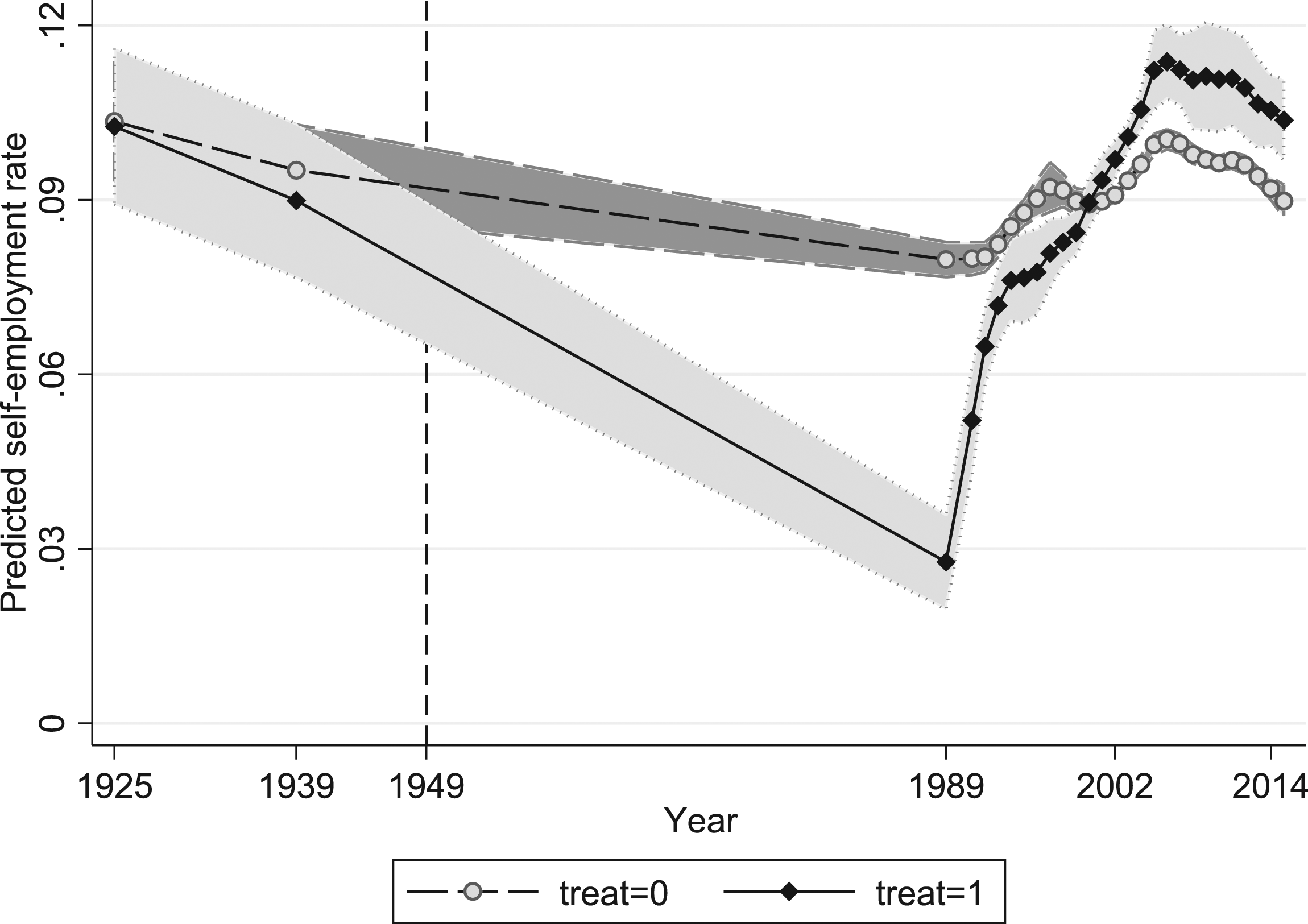
It could be the case that our results are affected by the pronounced migration of the working population (the denominator in the calculation of the self-employment rate) from East to West, that reached especially high levels during the first decade after reunification (Brücker & Trübswetter, 2007). Since self-employed people are less inclined to move (Giambra & McKenzie, 2021), this could have led to increasing self-employment rates in the East. To address this issue, we include the migration rate in the baseline specification (see Model IV in Supplementary Appendix Table A4). Since the DiD coefficients in Model IV remain more or less unchanged, we can rule out that a migration effect drives our results.
The Transition Effect Across Sectors
To explore whether our baseline findings are driven by the sectoral composition of self-employment before and after German separation we consider self-employment in different sectors. To this end, we divide the number of self-employed in a sector by the total regional employment. As a starting point, we distinguish between services and manufacturing over the entire period of analysis. Since separate data for the construction sector are not available for 1939 as well as for the post-unification period until 1995, the information on self-employment in construction 1925 is subsumed under the manufacturing sector. We also perform separate analyses for manufacturing and construction starting in the year 1996, using the level of self-employment in 1925 as a reference. We do not have any self-employment data that can be distinguished by sector for 1989.
In East and West Germany, the rate of self-employment in manufacturing and construction over the total workforce declined between 1939 and 1991 (Figure A1 in the Appendix). This pattern reflects the general sectoral shift from manufacturing to services over the course of the 20th century (see Figure A2 in the Supplementary Appendix). In East Germany, the nationalization of private firms and limited tolerance of private activity during the communist period add to the decrease in self-employment in manufacturing. At the same time, the East German rates in 1991 are affected by privatization and start-up activities after the fall of the Berlin Wall.
Between 1991 and 2015, the self-employment rate in manufacturing and construction in East Germany more than doubled from 1.2% to 2.7%, while the rate in West Germany only changed slightly from 1.75% to 1.77% (Table A6 and Figure A1 in the Supplementary Appendix). During the same period, the employment share in manufacturing in East Germany decreased from 37.75% to 25.2%, while it dropped from 37.2% to 27% in West Germany (Table A6 and Figure A2 in the Supplementary Appendix). Hence, deindustrialization was slightly more pronounced in East Germany, while the share of self-employed in manufacturing in total regional employment was higher as compared to West Germany. This implies that the average firm size in manufacturing is much smaller in East Germany as compared to West Germany. This can be confirmed when assessing the share of self-employed within manufacturing employment (see Table A6 and Figure A3 in the Supplementary Appendix).
The self-employment rate in the service sector increased in both East and West Germany (Figure A1 in the Supplementary Appendix). Again, in West Germany this is certainly an outcome of the sectoral shift from manufacturing to services (see Supplementary Appendix Figure A2). The increased level in East Germany is somewhat surprising as self-employment was hardly tolerated in the GDR. This means that the self-employment rates in 1991 are heavily influenced by start-up activity after the fall of the Berlin Wall. Between 1991 and 2015 the self-employment rate in East Germany increased at a much more rapid pace (from 3.44% to 7.55%) than in West Germany (6.1%–7.4%). Beginning in 2005, there are virtually no differences in self-employment rates in the service sector between East and West Germany. The change in service sector employment was relatively similar in both parts of Germany: from 58.2% to 71% in the West, and from 54% to 72% in the East. There are also hardly any differences with respect to the share of self-employment within service employment (Table A6 and Figure A4 in the Supplementary Appendix).
The sectoral decomposition informs us about the channels behind the main effects (see Section “Economic transition as a driver of entrepreneurship”, for details). If our baseline results can be replicated for services but not for manufacturing and construction, this is an indication that the baseline results are mainly driven by necessity-based self-employment that typically takes place in sectors with low entry barriers and, therefore, predominantly in services.
The DiD coefficient for self-employment in manufacturing including construction in the year 1991 is positive and statistically significant (see Figure 3; Table A7, Column I in the Supplementary Appendix, and Supplementary Appendix Figures A5 and A6 for predicted self-employment rates). This result indicates a positive relationship between being treated by four decades of a communist regime with its anti-entrepreneurship policies and transition into self-employment immediately after the dissolution of the regime. This stunning positive treatment effect increases over the subsequent years and remains at the level of approximately 2% points since the early 2000s until the end of the observation period. Difference-in-Difference (DiD) coefficients for manufacturing (left) and services (right). Notes: The figures show coefficients for the full baseline models including all controls for manufacturing including construction (Model I of Supplementary Appendix Table A7) and services (Model II of Supplementary Appendix Table A7). Year 1939 is the reference category. Grey dashed lines represent the 95% confidence interval.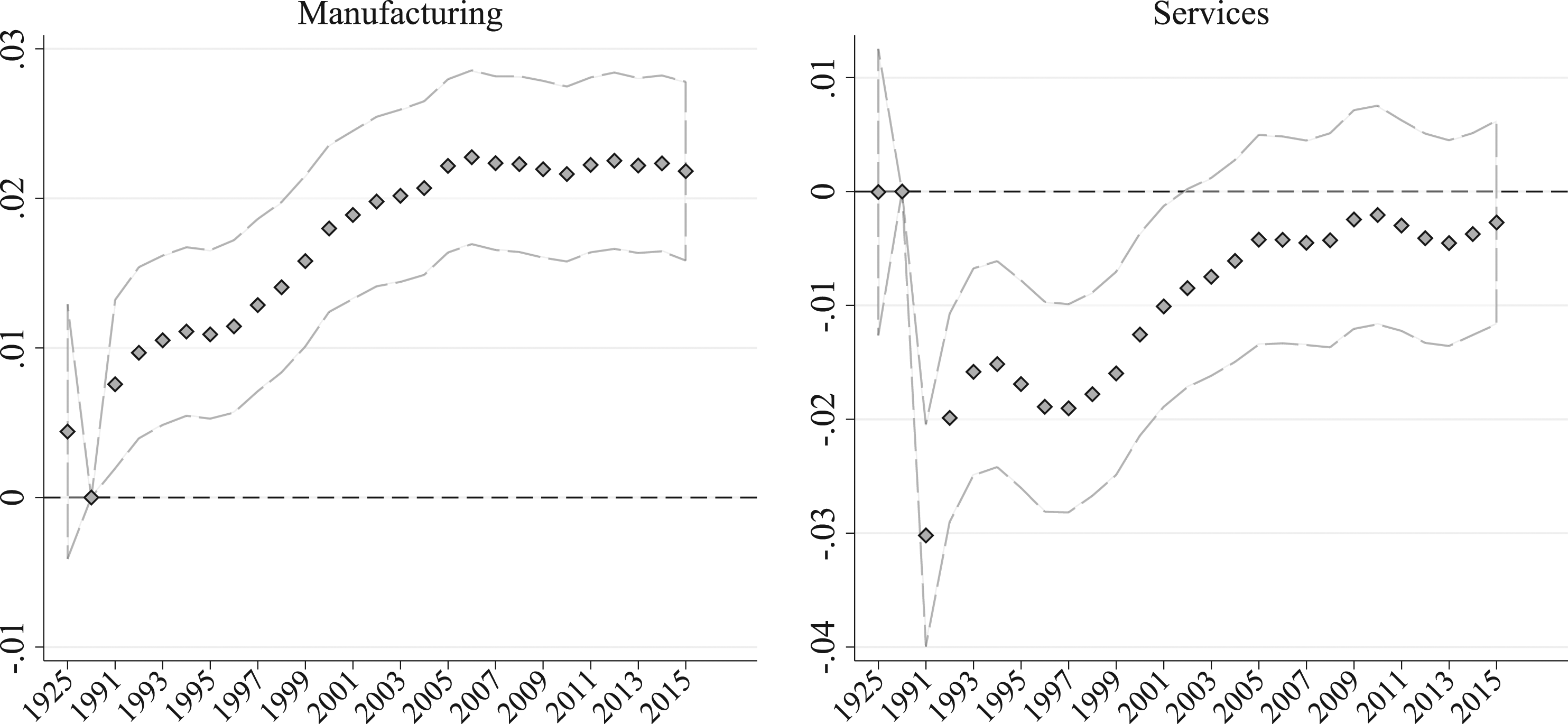
Considering the relatively low overall level of manufacturing self-employment, the treatment effect is quite substantial. For example, in the year 2015, the self-employment rate in manufacturing in West Germany is about 0.94%, while it is 2.7% in East Germany. The positive treatment effect is about 2.2% points. 15 The results are similar when separating manufacturing and construction. This is possible for the year 1925 and the years from 1996 onward. For both sectors, there are persisting treatment effects beginning in the late 1990s that are relatively similar in size (Supplementary Appendix Table A7, Columns III to V).
There are several reasons for the positive treatment effect in manufacturing rooted partly in the privatization policy of the early 1990s (for an overview, see Brussig, 1997). Most state-owned manufacturing enterprises were closed down because they were not profitable. Hence, the bulk share of manufacturing firms in East Germany consists of new firms started after 1989. A smaller share of these newly started firms are spin-offs from former state-owned enterprises. Furthermore, most of the few surviving state-owned enterprises were split into rather small units that were, for example, subject to management-buyouts (MBO) eventually contributing to the rise of self-employment (IWH, 2019). A reason for a positive treatment effect in the East German construction industry could be the massive public investments into re-constructing the physical infrastructure that began in the early 1990s and spurred a construction boom accompanied by many start-ups in this sector (e.g., Bellmann et al., 2003).
Over the 1990s there is also a rapid increase in service sector self-employment until the West German level was attained in the early 2000s (see Figure 3 and Table A7, Column II in the Supplementary Appendix). However, in the following years, the levels of service sector self-employment remained quite similar in both parts of the country. Accordingly, there are no positive treatment effects for the service sector. These results make it unlikely that any positive general treatment effects are driven by (necessity) self-employment in the service sector. 16
Discussion
Contributions to the Literature
East Germany adopted West Germany’s ready-made institutional and political framework conditions virtually overnight. Unlike other countries of the former Soviet Bloc where the transition process was more drawn out, the swift transition experienced in East Germany allows us to disentangle the effects of the communist regime from post-transition effects. By investigating how 40 years of communism and the subsequent transition to a market economy affect self-employment in East Germany, we present a methodological contribution for measuring the impact of political regimes, institutional frameworks, and historical shocks on entrepreneurship (Baker & Welter, 2020; Patriotta & Siegel, 2019). By narrowing our investigation to the regional level, we show the importance of examining temporal and historical contexts in order to gain a deeper understanding of entrepreneurial phenomena (Fritsch & Storey, 2014; Wadhwani et al., 2020; Welter & Baker, 2020). By discussing and disentangling sectors, we also contribute to research that examines industrial contexts in entrepreneurship (e.g., Lofstrom et al., 2014; Zahra et al., 2014).
Our analysis extends previous knowledge on the impact of communism and transition on entrepreneurship and particularly the level of self-employment in East Germany (see Fritsch et al., 2014). 17 Furthermore, our results are partly in conflict with a number of studies arguing that there is a pronounced communist legacy in East Germany that has negative effects on the level of self-employment (Alesina & Fuchs-Schündeln, 2007; Bauernschuster et al., 2012; Falck et al., 2017; Wyrwich, 2013). While it is true that we find such a negative communist treatment effect on self-employment during the initial post-transition years, our analyses show a positive transition effect on self-employment that appears about a decade after the regime switch. The fact that East Germany’s level of self-employment is now higher than in West Germany indicates a remarkable shift from a long-term trend.
Our analyses at the sector level reveal that the positive long-run treatment effects on self-employment occurs mostly in manufacturing and construction rather than services. Given that East Germans under communism had few incentives or opportunities to accumulate personal wealth, it is quite remarkable that the positive treatment effect that we find is driven by self-employment in manufacturing. Capital requirements and other entry barriers tend to be considerably higher in manufacturing than in services (Geroski, 1995). This sector-specific pattern suggests that the positive treatment effect of the transition on self-employment is not due to necessity-based self-employment although a lot of self-employment in East Germany clearly was necessity-based (e.g., Lechner & Pfeiffer, 1993).
Our difference-in-difference (DiD) estimation approach compares two different political and institutional regimes over time, and we add an econometric assessment of the communist treatment effect on self-employment that includes pre-separation data to account for respective East-West differences that existed before WWII (see also Becker et al., 2020, for a discussion). Such empirical approaches are still relatively rare in (regional) entrepreneurship research. This is somewhat surprising as this method is particularly well suited to measure the effect size of specific treatments affecting entrepreneurial choice. With our empirical approach, we can also rule out that the impact of economic cycles on the level of self-employment (Konon et al., 2018) is driving the results since the treatment effect measures the specific impact of communism and transition on self-employment in East Germany and goes deeper than macroeconomic effects at the country level.
Implications for Other Transition Contexts
Although East Germany’s transition processes are rather unique, there are certain similarities with other Central and Eastern European countries that were a part of the former Soviet Bloc that may allow us to generalize our results. For example, anti-entrepreneurial policies were enacted in all former Soviet Bloc countries although these policies varied in their severity (Åslund, 1985; Parker, 2018). The private sector was relatively small in East Germany (8.5% of GDP) and Czechoslovakia (1.5%) as compared to Hungary (14%) and Poland (26%), whereas it was non-existent in Bulgaria or Romania (Klaus, 2014; Offe, 1996). These numbers illustrate that there were communist countries with stricter and softer policies on self-employment relative to East Germany.
The negative impact of transition on production and employment is another feature shared with other former Soviet Bloc countries. The impact of transition on structural change (i.e., the decline of state-owned enterprises and re-emergence of private firms) was even more severe in East Germany when compared to other Eastern European countries. 18 The prevalence of necessity self-employment is yet another feature of the transition process shared by many former Soviet Bloc countries (Estrin et al., 2018; Lechner & Pfeiffer, 1993).
The size of the transition effect on necessity start-ups may have been more pronounced in East Germany because of the rapid installation of West German institutions, and increased international competition after the currency union in July 1990, leading to a dramatic economic decline unparalleled in the latter half of the 20th century (e.g., Brezinski & Fritsch, 1995; Burda & Hunt, 2001). The more gradual transition processes of other Soviet Bloc countries may have better shielded their economies from negative transition effects.
The lower institutional stability and quality of other Soviet Bloc countries may have lessened the transition effect on non-necessity based start-ups (e.g., Smallbone & Welter, 2001). Stability and quality in institutional framework conditions are important drivers of start-up activity and self-employment (Chowdhury et al., 2019; Elert & Henrekson, 2017; Stenholm et al., 2013).
The idea that the existence of a pre-communist entrepreneurial culture is an important driver of the re-emergence of entrepreneurship after the collapse of communism has been presented in a number of studies (Fritsch et al., 2019, 2021). A strong pre-communist culture of entrepreneurship in some regions may have influenced the rise of start-up activity after reunification. The level of non-agricultural self-employment before WWII was relatively high in many regions of East Germany, especially when compared to other Central and Eastern European countries that were absorbed into the Soviet Bloc after the war. Fritsch et al. (2021) document this pattern for Poland when comparing pre-WWII German areas with the areas of contemporaneous Poland. Therefore, the re-emergence of self-employment in East Germany may have been more pronounced as compared to other Soviet Bloc countries.
In sum, it is likely that the effects of communism and transition on self-employment in other former Soviet Bloc countries are weaker when compared to East Germany. Thus, the case of Germany may represent the upper boundaries of the effects of communism and transition on self-employment. Our empirical set-up provides the rare opportunity to credibly estimate the effects of communism and transition, but also makes clear that future research needs to find creative designs to replicate the analysis for other transition contexts.
Avenues for Further Research
A promising avenue for further research is to apply our empirical approach at the country level to determine the effect of communism and transition on self-employment. A broad comparison between Western European and Eastern European countries using a longitudinal dataset on self-employment might reveal distinct trajectories. The transformation of Central and Eastern European countries from communism to a market economic system provides rich opportunities for studying the effects of institutional and political change on economic development. The wide variation of historical contexts and transformation strategies may lead to important insights. It would be particularly interesting to know if and to what extent the developments in these countries lead to significant shifts in long-term trajectories as we found for East Germany.
An exploration of possible shifts in entrepreneurial attitudes at the individual level might help to a finer tuned understanding of the effects of the transformation. So, the strong increase in the level of East German self-employment over time may also be the result of an aging East German population. Those individuals that were exposed to communist indoctrination over a relatively long time period may have retired, while the younger generation that was less influenced by communist dogma is possibly more open to entrepreneurial choices. Indeed, there is some empirical evidence suggesting that members of the younger generation in East Germany and Eastern Europe are more likely to become self-employed (Estrin & Mickiewicz, 2011; Wyrwich, 2013). There is also indication that individuals from the youngest age groups adapted more quickly and easily to new norms and cultural influences after transition (Schwartz & Bardi, 1997). Therefore, it is not surprising that younger generations who received their education after the transition have more pro-entrepreneurial attitudes than their parents or older generations exposed to socialist ideology, not only in schools and universities, but in all walks of life (Estrin & Mickiewicz, 2011; Falck et al., 2017; Fritsch & Rusakova, 2012).
It would also be of interest to explore how entrepreneurial attitudes that are transmitted from parent to child are influenced by different institutional contexts. There is evidence that communism affected the mechanisms by which intergenerational values are transmitted (e.g., Fritsch & Rusakova, 2012; Wyrwich, 2015). We also know that cultural norms affect the degree of the intergenerational transmission of entrepreneurial values. For example, Laspita et al. (2012) show that transmission is stronger in societies that are marked by collectivism with strong family structures. As family systems and cultural values in Western societies (including East and West Germany) are quite different compared to other regions in the world such as Eastern Europe and Asia (e.g., Henrich, 2020), the interplay of cultural norms, intergenerational transmission of (entrepreneurial) values, and political and institutional contexts (e.g., communism) deserves more attention in future research.
Vietnam provides us with excellent opportunities to explore the influences of varying levels of exposure to communism. There is evidence that North Vietnam’s longer exposure to communism (Fisch et al., 2022) left a significant imprint on entrepreneurial attitudes calling for a more detailed assessment of the impact of the duration of exposure. North and South Korea offer another interesting case study. While Vietnam is now a single nation, the Korean peninsula is still divided. Recent evidence shows that there is entrepreneurial activity in some North Korean regions, despite more than seven decades of communism (Kibler et al., 2021). Another example is the different histories and path developments of China, Hong Kong, Macao, and Taiwan. It is also worth exploring whether there are legacy effects on self-employment in countries in Latin America and Africa that were exposed to socialist regimes for a short period only.
An investigation of whether geographical proximity between countries with and without a communist history influences development trajectories might yield other insights. For example, cooperative ties and learning opportunities between neighboring countries might lead to the transmission of unique cultural values. 19 In the case of Germany, cultural similarity certainly played a role in the diffusion and persistence of Western entrepreneurial values (for an example, see Slavtchev & Wyrwich, 2021). Applying our approach to a cross-country analysis requires finding appropriate control variables for historical, cultural and institutional heterogeneity across countries.
A limitation of our study is that it focused on the level of self-employment, but largely neglected the quality and the performance of newly emerging firms. Given the fact that the East German economy lags behind West Germany’s economy and has few larger firms (IWH, 2019) questions the overall quality of East German self-employment. This calls for an assessment of communist legacy effects on the characteristics, quality, and performance of East German start-ups.
Although we conclude that the rise of East German entrepreneurship, which we capture by the level of self-employment, was shaped by transformation processes, we do not disentangle these processes. We cannot say which process had the strongest effect: liberalization of entry, the strategy of privatization, or the rising levels of unemployment during the first years after reunification. Comparisons with other transition economies of Central and Eastern Europe that followed different transformation strategies could be helpful in finding answers to such questions.
General Policy and Practical Implications
The results of our study challenge the wide-spread belief that a communist regime has a long-term negative effect on the desire to be self-employed (Alesina & Fuchs-Schündeln, 2007; Bauernschuster et al., 2012; Falck et al., 2017). Hence, our study suggests that increasing the amount of entrepreneurial activity is less important than improving the quality of the start-ups, and it is in this area that policy makers may want to focus their attention. As discussed earlier, the long-term impact of communism may depend to a large degree on the transition strategy. An assessment of countries with different transition processes might shed light on context-specific effects of communism, and allow for the development of tailor-made policy solutions.
We find that the negative effects of communism on self-employment vanished rather quickly when the institutional framework of the West German market economic system was introduced. This insight is possible because of the difference-in-difference (DiD) estimation approach we use where some observations received the communist treatment while others did not. Hence, our method allows us to identify treatment effects of previous political regimes. The approach can be applied to a wide range of policies promoting start-up activities. Policy makers should give more weight to research results that use methodological approaches that credibly quantify the effect of treatments. In the context of East Germany, for example, it is important to determine if the level of self-employment is still affected by communist legacies. Certain policy measures currently being applied in East Germany are based on the rationale that such legacies still influence development. Our results show that this may be true for the quality of self-employment, but not for the actual level of self-employment.
Conclusions
The separation of Germany into a communist East and capitalist West after WWII and the sudden reunification in 1990 offers rich opportunities to study entrepreneurship in different and changing institutional and political contexts (Welter & Baker, 2020). A unique feature of the German case is that both parts of the country shared the same institutions before WWII, but followed very different paths after separation. The rapid implementation of West German institutions after reunification allows us to use West Germany as a benchmark to assess the effect of four decades of communism with strict anti-entrepreneurial policies on entrepreneurial activities in East Germany. Although the formal institutions of the former GDR were rapidly abandoned in the reunification process, these institutions may have left a discernable imprint on East Germans.
Our analyses show that communism had an initial negative impact on self-employment in the early transition period. Since about 15 years after reunification, the level of self-employment in East Germany is higher than that in West Germany. We rule out that this pattern is driven by necessity self-employment. It is remarkable that after 40 years of anti-entrepreneurial and initiative-inhibiting indoctrination, so many East Germans chose to become self-employed.
Supplemental Material
Supplemental Material - The Long-Run Effects of Communism and Transition to a Market System on Self-Employment: The Case of Germany
Supplemental material for The Long-Run Effects of Communism and Transition to a Market System on Self-Employment: The Case of Germany by Michael Fritsch, Maria Greve, and Michael Wyrwich in Entrepreneurship Theory and Practice
Footnotes
Acknowledgments
We are indebted to Udo Brixy and Rolf Sternberg for information on opportunity and necessity entrepreneurship in East and West Germany. Financial support provided by the German Federal Ministry of Education and Research in the framework of a joint research project Modernisierungsblockaden in Wirtschaft und Wissenschaft der DDR (Obstacles to Modernization in the Economy and Science of the GDR) (project number 01UJ1806DY) is gratefully acknowledged.
Declaration of Conflicting Interests
The author(s) declared no potential conflicts of interest with respect to the research, authorship, and/or publication of this article.
Funding
The author(s) disclosed receipt of the following financial support for the research, authorship, and/or publication of this article: Financial support provided by the German Federal Ministry of Education and Research in the framework of a joint research project Modernisierungsblockaden in Wirtschaft und Wissenschaft der DDR (Obstacles to Modernization in the Economy and Science of the GDR) (project number 01UJ1806DY).

Supplemental Material
Supplemental material for this article is available online.
Notes
Author Biographies
References
Supplementary Material
Please find the following supplemental material available below.
For Open Access articles published under a Creative Commons License, all supplemental material carries the same license as the article it is associated with.
For non-Open Access articles published, all supplemental material carries a non-exclusive license, and permission requests for re-use of supplemental material or any part of supplemental material shall be sent directly to the copyright owner as specified in the copyright notice associated with the article.
