



Abstract
Women face unique challenges in their quest to achieve business success relative to men. Applying the theories of epistemic injustice and intersectionality, this study collectively analyzes the overlapping impacts of identities that complement gender at multiple levels in the context of the oppressive, interconnected power structures of occupation and patriarchy. Our findings explain how the impact of institutional oppressors, through structural and normative discrimination, may cause some Palestinian women entrepreneurs to internalize and accept injustice while others tap into available resources to engage in epistemic resistance.
Keywords
Introduction
Entrepreneurship is a multidimensional concept that encompasses context, entrepreneur, and environment (Welter et al., 2017). The heroic view of entrepreneurship as a meritocratic field asserts that entrepreneurs can succeed through hard work and ingenuity, but the typically masculine discourse on entrepreneurship dismisses the embedded injustices that marginalized entrepreneurs face (Ahl & Marlow, 2012). In contexts with sparse resources, the vigor of social contract theory, which emphasizes the moral obligation to ensure equal access to resources, may be challenged, leading to the “othering” of marginalized entrepreneurs as underperformers and inhibiting support, thereby perpetuating a cycle of constraints (Forrester & Neville, 2021).
Epistemic injustice, the discrimination and disadvantage endured by those who belong to nondominant identity groups (Fricker, 2007), is explained through hermeneutical and testimonial injustice. Hermeneutical injustice is the degree to which societal prejudice is normalized, thus creating a culture of injustice that may leave an epistemic subject unable to comprehend and convey having endured injustice (Fricker, 2017; Medina, 2017). Testimonial injustice is enacted by trivializing claims made by epistemic subjects based on credibility deficits attributed to stereotypical perceptions of their identities (Fricker & Jenkins, 2017). Martinez Dy (2020) criticizes an overemphasis on individuals and the injustices they face without considering the context or institutional sources of injustice.
In response to calls in extant research (Grandy et al., 2020; Martinez Dy et al., 2017), our aim is to collectively analyze the overlapping impacts of identities that complement gender at multiple levels, and within a context of oppressive, interconnected power structures. Guided by postcolonial feminist thought, our first contribution is in exploring the entrepreneurial experiences of women operating in contexts that do not quite fall in line with “Western” feminist theory. We do so by centering the voices of 40 internally displaced Palestinian women entrepreneurs within a context of occupation and patriarchy. Resonating with criticism of research that overlooks the disadvantageous contexts of marginalized groups (Grasswick, 2017), we challenge the existing paradigms that normalize unjust environments. This is in line with Said’s (1982) skepticism regarding the integrity of knowledge production, emphasizing the importance of multiple perspectives, including theory, history, ideology, and geopolitical context. Our analysis, therefore, offers a departure from the conventional by centering voices usually relegated to the status of subaltern (Mohanty, 2015), enriching the discourse with a diversity of lived experiences. In doing so, we sidestep the traps of Western feminism that emphasize mainstream perspectives of privileged communities and normalize unjust environments (Abdelnour & Abu Moghli, 2021). Such normalization effectively dismantles the justice-oriented potential and intent of intersectionality and warrants an imminent need for reflexivity for several reasons. First, the predominance of academics researching contexts unfamiliar and disconnected from the peculiarities of the field inadvertently perpetuates misrepresentation and subjugation of marginalized groups (Abu-Lughod, 2013). Second, the implicit advantageous positioning of Western researchers has discouraged reflexivity of non-Western researchers, contributing to the tacit “whitening” and colonization of intersectionality (Bilge, 2013). Finally, academic feminism’s engaging in a depoliticized, “ornamental intersectionality” (Bilge, 2011, p. 3) to challenge marginalization has only stifled intersectionality’s power in championing social justice reform (Harris & Patton, 2019).
The second facet of our contribution addresses an overlooked complexity in intersectional studies: the lack of hierarchization and the oversight of the intricate web of systemic injustices facing women entrepreneurs (Lassalle & Shaw, 2021; Qureshi et al., 2023). Through a lens combining epistemic injustice with intersectionality, we not only recognize but also dissect the layers of gendered structural inequalities (Crenshaw, 1991). In doing so, we break new ground by illustrating how these complex interplays of injustice are deeply embedded within institutional practices, thereby offering a broadened, contextualized perspective (Knight, 2016).
Our third contribution extends Lassalle and Shaw’s (2021) work by exploring uncharted contextual variations of epistemic injustice, particularly those arising from occupation and patriarchy in entrepreneurship research (Fricker, 2007; Medina, 2017). We do this by explaining layers of epistemic injustice as a theoretical prelude to describing its origins and nature, delving into the core of injustice, and providing insights into its antecedents and consequences that are ingrained in the entrepreneurial environment that shapes women entrepreneurs’ experiences. In applying intersectionality and exploring injustice’s layers in combination, rather than in silos (Marlow & Martinez Dy, 2018), we heed Carter et al.’s (2015) caution against underestimating the complex nature of injustice. In doing so, we acknowledge the embedded nature and manifestation of injustice that results from institutional practices and provide a broad perspective on how an individual at the intersection of a “matrix of domination” (Collins, 2000, p. 18) endures injustices that correspond to her multiple identities. We draw attention to the layers of injustice beneath the surface and beyond the tangents of gender, using in-depth insights into the undertones of engaging in entrepreneurship as internally displaced persons who are also Palestinian women. Our fourth contribution is in presenting a counter perspective of epistemic resistance by explaining how some women entrepreneurs navigate and combat systemic injustices. While epistemic injustice explores the backstory and plotline of injustice, epistemic resistance illustrates how women entrepreneurs may tap into rather scarce resources to reduce and reform the institutional sources and individual iterations of injustice (Medina, 2017; Pohlhaus, 2017).
Finally, through this study, we cast a critical eye on our own research method and approach, introducing reflexivity into entrepreneurship studies. This fosters ethical engagement with intersectionality, offering a more authentic representation of our participants’ experiences. We believe that failure to do so would only drown out the narratives of the marginalized entrepreneurs even further and reiterate the prevalence of Western-centered, White discourse as the default (Bilge, 2013).
Our Article thus sets the stage for a compelling exploration of these intersecting issues, providing valuable academic and practical implications. We begin with a review of dominant discourses on intersectionality and epistemic injustice, followed by a discussion of our methods and context. Findings are then presented and discussed, concluding with implications for both research and policy.
Theoretical Background
Entrepreneurship and Intersectionality
Entrepreneurs operate in complex environments that encompass multiple social contexts tied to multiple social hierarchies that impact their identities and their entrepreneurial experiences in different ways in different times and spaces, commonly leading to an imbalance of power and discriminatory access to resources (Wang, 2018). In recent years, research on women and migrant entrepreneurship has highlighted the importance of giving attention to the multiple contexts that influence entrepreneurship and acknowledge the gendered and socially constructed nature of entrepreneurial activity (Welter, 2020; Yousafzai et al., 2015). For example, studies show that gendered roles and gender-based stereotypes disadvantage women entrepreneurs by lowering growth prospects, internationalization, and agency, meanwhile increasing exit rates (Jayawarna et al., 2021; Lassalle & Shaw, 2021; Webster & Haandrikman, 2020).
Western colonial discourse has contributed to power imbalances and their ensuing inequalities, inspiring feminist approaches to research in addressing (and being ambitious to disrupt) oppressive hierarchies that further disadvantage marginalized groups (Llewellyn, 2022). Midst the call for moving beyond the postfeminist debates and neoliberal assumptions in policymaking that fail to recognize the influence of multiple structures of oppression, intersectionality first appeared in entrepreneurship research as a theory for studying the gendered and socially embedded nature of women’s entrepreneurship (Ahl & Marlow, 2012, 2021). Since the seminal work of Crenshaw (1991), intersectionality has gained momentum as a useful transdisciplinary framework for exploring the diversity and complexity inherent in social inequalities and identities, yet its use in entrepreneurship research remains limited (Marlow & Martinez Dy, 2018).
Using intersectionality to explore the complexity of oppressive structures simultaneously facilitates stronger, engaged academic scholarship on equality, diversity, and inclusive practices in entrepreneurship and in society. In doing so, intersectionality places the responsibility on oppressive structures rather than on individuals, thus, challenging the myth of underperforming women entrepreneurs and the dominant masculine discourse (Ahl & Marlow, 2021). Nevertheless, Lassalle and Shaw (2021) criticize prevalent research by pointing out the lack of hierarchization in intersectional studies that do not fully consider the overlapping intricacies involved in the presence of multiple institutions, their interactions, and their relationships to each other that lead to injustice for women entrepreneurs. By emphasizing any of these elements and leaving out others, intersectionality may substantiate the very norms it seeks to dispute (Knight, 2016). By addressing hierarchization, Lassalle and Shaw (2021) go beyond analyzing unidimensional dichotomies in entrepreneurship research to acknowledge the gendered nature of the structural injustices that collectively constrain women entrepreneurs’ agency. In the following section, we extend Lassalle and Shaw’s (2021) work by looking at the epistemic injustices of occupation and patriarchy (Fricker, 2007; Medina, 2017), which have yet to be documented in women’s entrepreneurship research. Our discussion on layers of epistemic injustice provides a theoretical prelude to describing its origins and nature, delves into the core of injustice, and provides insights into its antecedents and consequences that are ingrained in the entrepreneurial environment that shapes women entrepreneurs’ experiences.
Epistemic Injustice
Fricker (2007, p. 12) refers to two ethical aspects of one’s “everyday epistemic practices”: making sense of one’s social experiences and conveying this knowledge to others. With respect to understanding injustice as it relates to individuals’ and institutions’ identities, Fricker (2017, p. 1) defines epistemic injustice as that which results from stereotypes and prejudices into “a form of direct or indirect discrimination in which someone is downgraded and/or disadvantaged as an epistemic subject.”Fricker (2007) breaks the foundational concept of epistemic injustice into two forms of wrongdoing: hermeneutical injustice and testimonial injustice.
This study explores two institutions, occupation and patriarchy, and their impact on IDP Palestinian women entrepreneurs, which has created a systematic, interconnected, and reiterative dynamic of traditions and discriminatory laws that constrict these entrepreneurs’ progress (Chaban et al., 2010). These oppressive institutions and the built-in injustices through which they manifest have normalized injustice, making its occurrence both commonplace and challenging for the disadvantaged to articulate and report (Hamamra, 2020). They have also created a culture in which choosing to confront norms, tradition, and the ensuing injustices can lead to actions like slander and degradation, increasing the disadvantaged person’s subjugation (Baxter, 2007).
Hermeneutical Injustice
Hermeneutical injustice explains the embedded prejudices in society that can lead to epistemic subjects’ inability to recognize having endured injustice, leaving them vulnerable to further injustice (Fricker, 2006; Medina, 2017) and perhaps unknowingly complicit in unjust practices. Hermeneutical injustice can also be understood as a reflection of the discriminatory influence of institutional power in which “someone is wronged as a subject of social understanding, but the wrong is then not traced back to an individual” (Fricker, 2007, p. 18). This may explain why injustice occurs as often as it does but goes unreported. Research also plays a role in creating an atmosphere of hermeneutical injustice by systematically focusing on the needs of the historically privileged, thus creating structural gaps that overlook the contextual embeddedness of the disadvantaged, making their experiences difficult to identify, articulate, and address (Grasswick, 2017). Acknowledging the presence of hermeneutical injustice can help to create awareness of its impact on communicative practices. Medina (2017) warns against underestimating the harm caused by hermeneutical injustice and its ability to rob someone of human dignity. Excessive exposure to unjust encounters can result in hermeneutical death, that is, extreme constraint of an individual’s agency, leading to “the loss (or radical curtailment) of one’s voice, interpretative capacities, or status as a participant in meaning-making and meaning-sharing practices” (Medina, 2017, p. 1).
Testimonial Injustice
Testimonial injustice is epistemic injustice in action through discriminatory exchanges that trivialize or invalidate one’s claim of epistemic injustice, because their identity coincides with dominant, prejudiced suppositions that attribute disadvantageous characteristics or an unjust deficit of credibility (Fricker & Jenkins, 2017). Feminist epistemological theory discusses the conventional marginalization of women from mainstream conceptualizations of power and authority under the presumption that women are flawed epistemic agents who can offer no real testimonial value (Scully, 2018). In patriarchal societies, women’s knowledge is commonly estimated as less rational and more emotional than men’s knowledge, leaving women to prove themselves to be credible if they want to be taken seriously (Karam & Affiouni, 2021). Medina (2011), extends this discourse with the notion of epistemic privilege, that is, an attribution of credibility based on an arbitrary advantageous positioning of stereotypical societal beliefs about one’s identity. The contemporary androcentric image of the entrepreneur has led to stakeholders’ negative perceptions of women’s entrepreneurial integrity and credibility (Ahl, 2006). As a result, women’s entrepreneurial ventures have more difficulty accessing financial support, increasing the chances that their ventures will fail, and reinforcing the assumptions that led to their failure (Forrester & Neville, 2021).
In this study, underpinned by the theory of epistemic injustice, we incorporate intersectionality for its potential to contribute to social justice and human rights (Handl et al., 2022). In the following section, we explain how we aim to center the voices of an overlooked segment of entrepreneurs, by illustrating their narratives of the epistemic injustices they endure in terms of their multiple identities as IDPs, as women, and as Palestinians at the hands of the oppressive institutions of occupation and patriarchy. In using intersectionality in an ethical and responsible manner, in line with its liberatory nature, we first explain the context of our study and then discuss the importance of reflexivity and our reflexive stance as researchers.
Methodology
The Context of IDP Palestinian Women Entrepreneurs
To understand injustice in terms of the social causes and consequences of human behavior and its impact on social change, its institutional context must be acknowledged (Sweet, 2019). Among segments of forcibly displaced migrants, IDPs are the most vulnerable (World Bank, 2022). Unlike refugees, who are protected under international law, IDPs remain within the borders of the countries whose perils they seek to flee and at the mercy of a government that is either unable or unwilling to support them. As of May 2022, nearly 60 million people were IDPs, half of whom are reported to be women, although this figure may be higher, as women are less likely than men to register their displacement with the Office of the United Nations High Commissioner for Human Rights (OHCHR, 2022). Our participants are from the West Bank, where more than a third of the 3.2 million people are IDPs. Approximately 30% of these IDPs live in 19 IDP camps, 10% live in area C (summoned as an Israeli-controlled area), and 60% live in other areas (i.e., cities, villages, Bedouin communities) (United Nations Office for the Coordination of Humanitarian Affairs [OCHA], 2019).
Occupation created a situation where Palestinians were forcibly displaced after the Nakba catastrophe in 1948, leaving those who remained in Palestine as IDPs. While including IDPs in intersectionality research is increasing (Agustin & Lombardo, 2019), there is little acknowledgment of IDPs as productive contributors, particularly as entrepreneurs. The circumstance of Palestine is one of striking poignancy, with an international community watching an entire population living—or, rather, surviving—under an occupation that has led to “one of the largest and longest-standing cases of displacement in the world today” (BADIL, 2015). Media complicity, exacerbated by deep-seated Eurocentric rhetoric, has engulfed public opinion, leaving a distorted mainstream perspective of Palestinians as subalterns (Said, 1982). While the injustices of occupation restrict daily life for Palestinians in general, for Palestinian entrepreneurs, awareness of the many ways that the restrictions imposed by their occupiers will impact their businesses is key. Such injustices impact their ability to conduct business by severely curtailing their prospects (Albotmeh & Irsheid, 2013), strangling investment in entrepreneurship, and plaguing economic potential (Sultan & Tsoukatos, 2019).
As for patriarchy, its invasiveness leaves women reliant on men to access resources (Khatib et al., 2020) while also being expected to support androcentric norms. For many Palestinian women, putting up with injustice earns them the title asila (Arabic for genuine, authentic) for carrying the obligation to support the household by teaching children history, politics, and resistance with minimal support. The difficulty IDP women face in finding employment opportunities Internal Displacement Monitoring Center (IDMC, 2019) makes entrepreneurship a viable long-term solution. Thus, occupation and patriarchy together pose a multitude of obstacles for entrepreneurs who happen to be both Palestinian and women, while the additional identity marker of IDP status presents other implications within Palestinian society.
Reflexivity and the “Permission to Narrate”
The atypical context of this study is an oppressive amalgam of patriarchal norms, political instability, military occupation, and displacement of our participants’ geopolitical positioning, warranting attention from several angles. To strike a balance in centering their voices objectively, we must consider our reflexivity as researchers and how it shapes knowledge production and impacts social and political struggles (Abdelnour & Abu Moghli, 2021; Adams, 2021). Reflexivity entails a candid, ongoing awareness of one’s social position as a researcher (Grey & Sinclair, 2006) as well as their own intersecting identities in relation to those of their participants (Locke, 2015).
The complementary nature of the authors’ multicultural, Eastern/Western backgrounds has been instrumental in allowing for a more acute sense of understanding our participants’ entrepreneurial experiences based on their perspectives and in presenting a contextual representation and analysis of their narratives. The first author’s positionality in relation to the participants was particularly compelling as a Palestinian by blood and heritage and an American by birth and upbringing, with experience living, working, and studying in the United States, the United Kingdom, and Palestine. The coauthor, a British citizen of over 2 decades and of South Asian descent, brought the necessary guidance, insights, and questioning of the first author’s suppositions so as to maintain a balance between objectivity and subjectivity in handling the data (AlKhaled, 2021; Jamjoom, 2022). Our intersectional identities and positionalities provide us with distinct insider/outsider status (Adams, 2021): insiders in terms of our position as fellow “others” (e.g., women of Eastern descent) who are familiar with the study’s context and its embedded cultural subtleties, and outsiders in terms of our position as Western-based researchers who were external to the participants’ local communities at the time of the study. The insider dimension of our position and identities allowed us to build the rapport with participants that would encourage them to engage and contribute rich data. The outsider aspect of our positions required effort in terms of gaining participants’ trust so as to secure interviews, but it was also perceived by many participants as presenting an opportunity to voice their stories.
For both authors, a paradox lingered, as they found multiple commonalities with and points of distinction from the participants. This study was by no means a mechanical reporting chore (Said, 1984); as women researchers conducting a study that provided the opportunity to center the voice of a marginalized segment of entrepreneurs in a context of patriarchy and occupation, our mixed backgrounds complemented each other while also contributing a resonant, nuanced perspective of our sample’s entrepreneurial experiences. Combined with an intersectional, qualitative approach to interviewing, our backgrounds foster enriched understanding of how power dynamics and oppressive institutions coincide with and shape our participants’ entrepreneurial experiences. This approach helped to generate novel insights and a more human, rather than stereotypical, depiction and representation of their perspectives.
Field Access
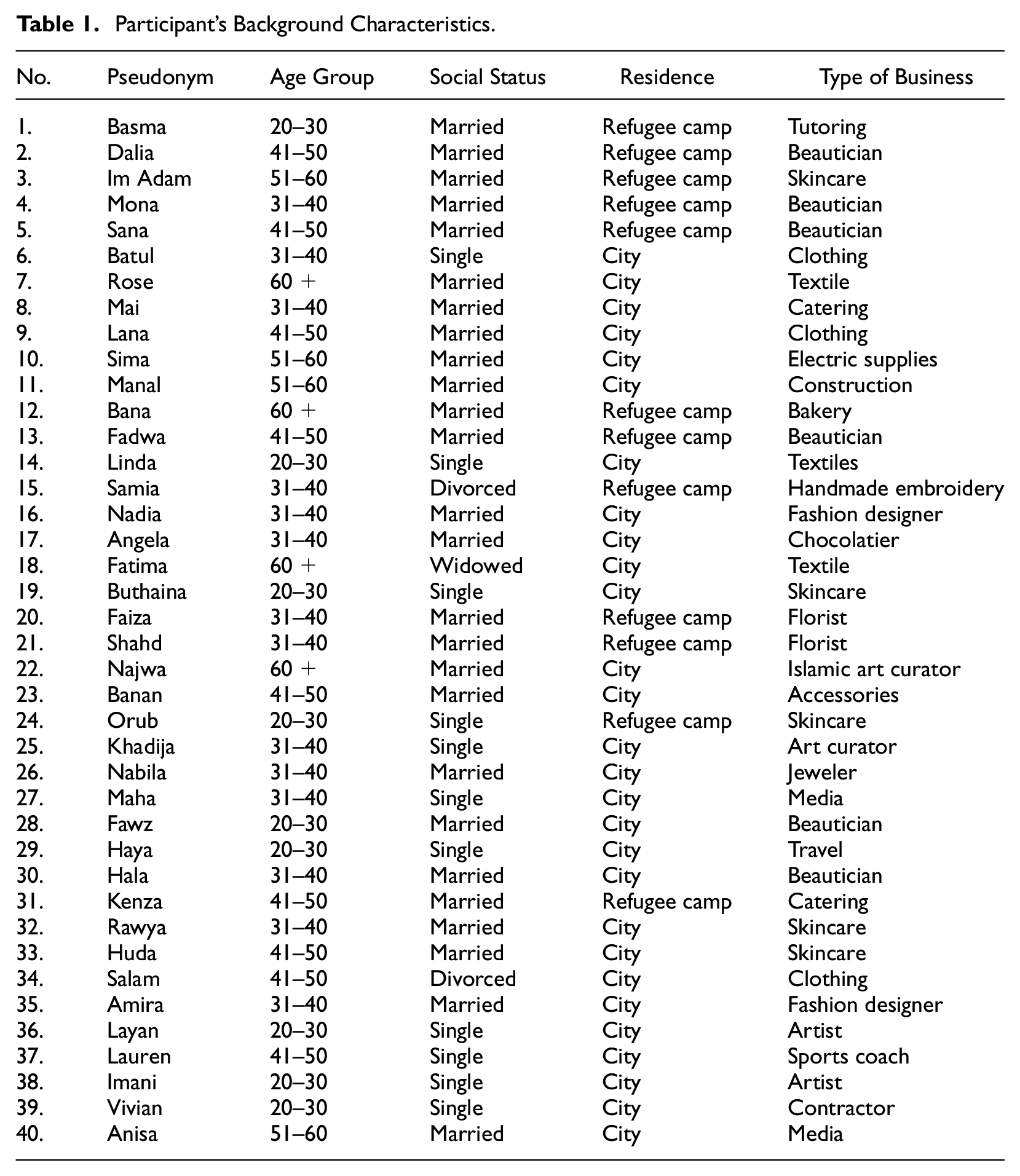
Initially, four participants were selected via referrals from a women’s support center in Ramallah that provides training, financial assistance, and access to markets to current and aspiring women business owners. Our final participant pool was comprised through snowball sampling. By interview 35, data saturation was reached, and by interview 40, no new, noteworthy insights emerged. City participants agreed to interview scheduling directly with the first author, but IDP camp participants usually required liaising with administrators from the United Nations Relief and Works Agency for Palestinian Refugees in the Near East (UNRWA). Some of the interviews with IDP participants were conducted in UNRWA Women’s Program Centers, whereas the rest took place at the participants’ business locations in Ramallah or in the homes of participants who lived and ran businesses in the neighboring IDP camps of Jalazone, Am’ari, and Qalandia. Table 1 presents the participants’ profile.
Participant’s Background Characteristics.
Interview Process
The first author, a resident of the West Bank, conducted the interviews in Arabic. Each interview lasted between 30 and 90 minutes followed by informal conversations that sometimes lasted up to 3 hours. An external, bilingual researcher transcribed and translated the interviews into English and back-translated them into Arabic. Culturally specific Arabic terms and phrases were transliterated into English. Participants were briefed before each interview on the study’s goals and assured of our obligation to preserve their anonymity and their right to confidentiality and withdrawal from the project. All participants signed a consent form. The first author’s university’s ethics committee approved the research protocol.
Participants were asked open-ended questions regarding their entrepreneurial experiences, particularly about the aspects of their environment that they perceive as obstacles. They were encouraged to reflect on the roles played by their identities in their everyday experiences of entrepreneurship. In describing obstacles, some participants related discriminatory encounters as consequences of operating under occupation and patriarchy. Subsequent questions were asked to gain deeper insights into these discriminatory interactions and how they impacted them. Each interview’s sequence and substance of questions were adapted and incorporated to help our participants convey their sensemaking and views.
Coding and the Corresponding Layers of Epistemic Injustice
In this section, we explain our thought process in structuring our coding. Inductive reasoning entails deriving themes from groups of individual narratives to gain better understanding of our participants’ entrepreneurial experiences. The geopolitical context of our sample calls for a qualitative approach in handling emergent, empirical data to build perpetual understanding. Throughout the process, codes evolve and reorganize in sync with researcher knowledge, perspective, and sensemaking. Figure 1 presents the coding structure and Figure 2 presents the corresponding layers of epistemic injustices.
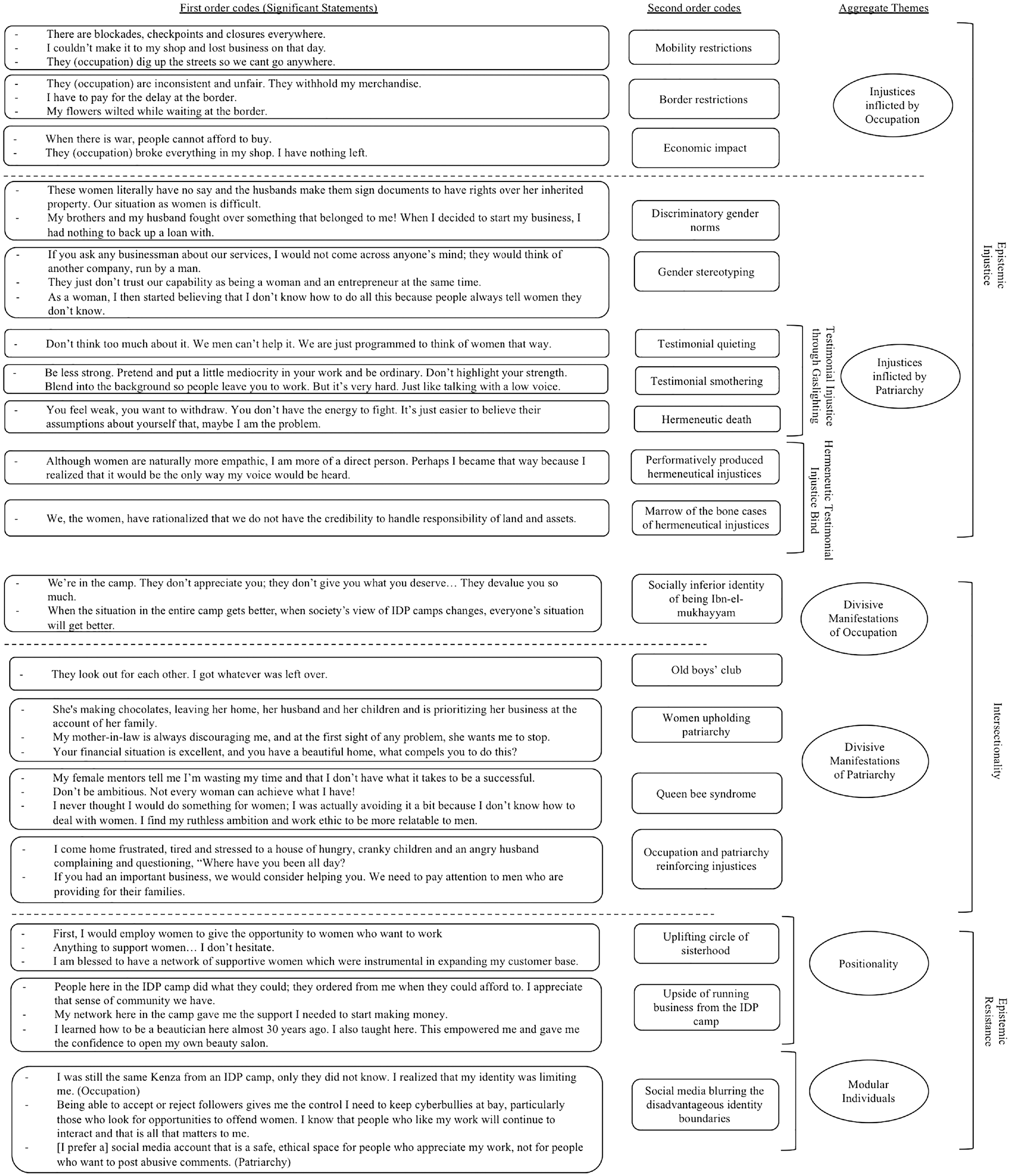
Coding structure.
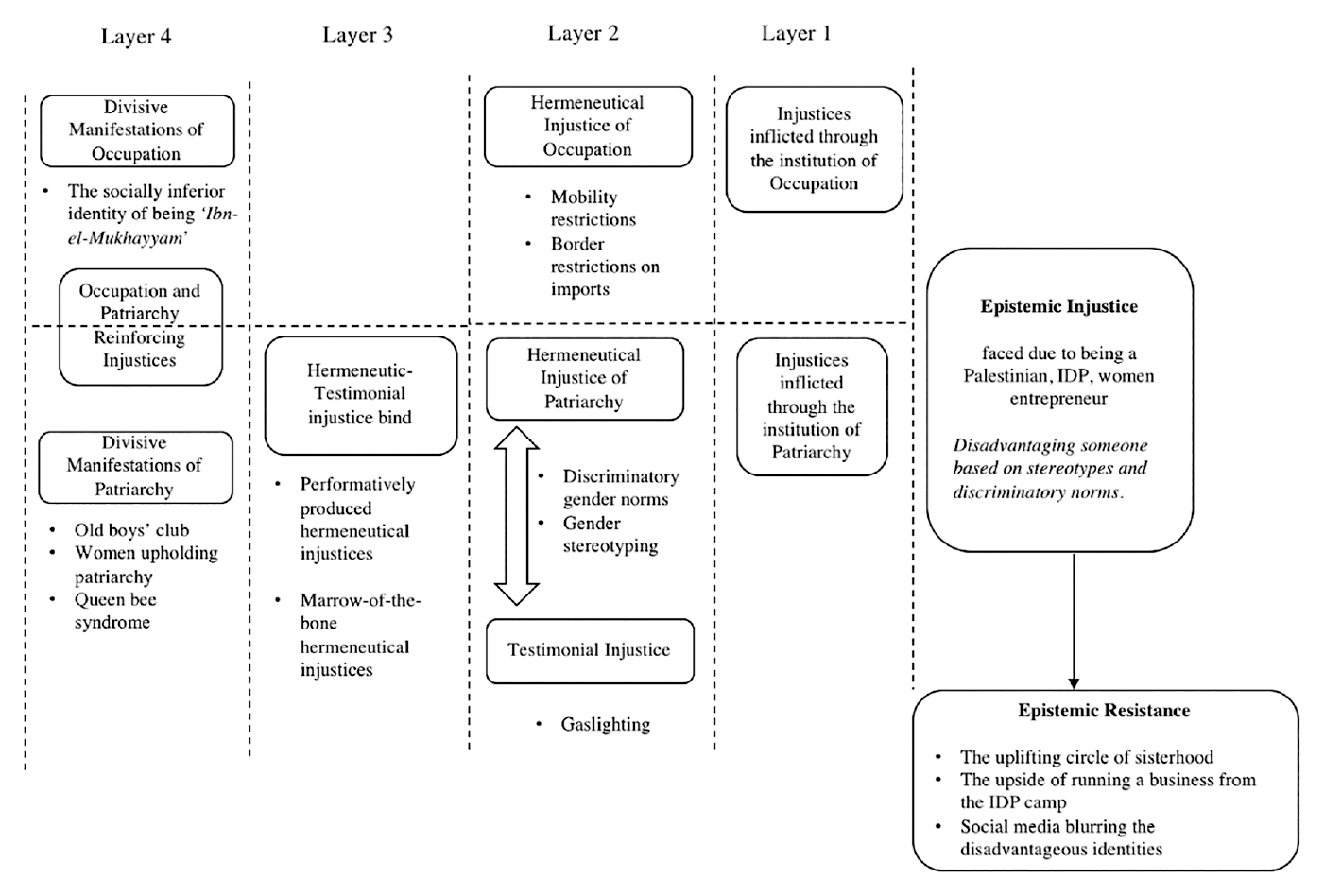
Layers of epistemic injustices and the resulting epistemic resistance.
An initial reading of the interview transcripts gave us an overall sense of the injustices that the participants faced while running businesses under occupation and patriarchy (Layer 1). A second reading focused on the patterns that underlie these injustices. For instance, participants emphasize how the occupation’s discriminatory measures (e.g., mobility and border restrictions) pose overarching obstacles severely constricting their businesses’ potential. The injustices of patriarchy explain how discriminatory gender norms and gender stereotyping created an environment of injustice leading to discriminatory encounters. We found examples of testimonial injustice to emerge more emphatically in accounts of patriarchal injustices, some of which alluded to gaslighting. Thus, a corresponding Layer 2 is composed of the subthemes of epistemic injustice: representing the environment, or culture of injustice (hermeneutical injustice) and its enactment on the individual level (testimonial injustice). A third reading revealed that participants who were frequently exposed to injustice tended to normalize it, which reinforced the power of oppressive institutions and the environment of injustice. For example, some experienced performatively produced hermeneutical injustice by changing their behavior to match that of dominant groups, even though such conformity tends to confirm the premise that they are flawed and must change, thus reinforcing identity stereotypes. We also found narratives that reflected marrow-of-the-bone hermeneutical injustice, that is, injustices so pervasive that they impaired participants’ ability to comprehend and communicate having endured injustice. This dynamic illustrated a highly interrelated, cyclical bind of the constituents of epistemic injustice, which we refer to as a hermeneutic-testimonial injustice bind (Layer 3).
A fourth reading emerged with divisive manifestations, emphasizing how the injustices of occupation and patriarchy corresponded to our participants’ identity markers at the intersections of gender, ethnicity, and migrant status (Layer 4). Our IDP camp participants expressed a divisive manifestation of civil hostilities by fellow Palestinians because of reluctance to do business with residents of IDP camps and because, when they do, IDP camp products and services are devalued (ibn-el-mukhayyam). As for patriarchy, divisive manifestations emerged through accounts of exclusion because of male-dominated networks (the old boys’ club), women in power who distance themselves from and ostracize other women (Queen Bee syndrome), and women who support male dominance by discouraging other women (women upholding patriarchy). Our final reading identified resilience coinciding with the notion of epistemic resistance. Perhaps the most active enactment of epistemic resistance we identified was the entrepreneurs’ use of social media to mask their identity markers that usually lead to the injustices they endure as entrepreneurs.
Findings
We present our findings in light of Fricker’s (2017) and Medina’s (2017) interpretations of the breadth and depth of epistemic injustice. Breadth refers to “how far the injustice reaches across the social fabric,” and depth refers to “how deep the harm goes in undermining or destroying meaning-making and meaning-sharing capacities” (Medina, 2017, pp. 46–47). In theme 1, the accounts presented in relation to occupation describe the breadth of epistemic injustices, illustrating the hermeneutic or environmental aspects. As accounts of patriarchy emerge, the scope leans toward depth in providing insights into the testimonial or practiced aspects of epistemic injustice, showing how some women entrepreneurs internalize injustice, creating an alternate reality where injustice is the norm. Our findings indicate a cyclical relationship between the components of epistemic injustice, which we refer to as a hermeneutic-testimonial injustice bind. They illustrate a precursory and concurrent understanding of injustice and add perspective as to why epistemic subjects could be incapable of comprehending and/or expressing the injustices they endure. Theme 2 presents cumulative and intersecting injustices, along with divisive manifestations. Theme 3 presents a counter perspective explaining epistemic resistance.
Theme 1: The Environmental and Practiced Manifestations of Epistemic Injustice
Our first set of contributions provides insights into the manifestations of epistemic injustice that begin in the entrepreneurial environment and shape the experiences of women entrepreneurs.
Epistemic Injustices of Occupation: Business as (Un)usual
Mobility Restrictions
Our findings in the framing of hermeneutical injustice illustrate the conditioning of entrepreneurial experiences through decades of occupation, entailing blockades, and movement constraints. Fadwa’s work suffered when clients’ appointments were canceled because of military checkpoints: “Any incident happens, and they close the streets with roadblocks. What’s worse is when they dig up and damage the streets, leaving no access to supplies and no way to make deliveries or for customers to reach us. How are you supposed to run a business like this? There is no stability.” Dalia also mentioned how her customers would cancel at the last minute because they were stopped by the occupation forces on their way.
Huda outlined the consequences: “The occupation has ruined our businesses. People often hesitate to leave home.” Lana, whose customers are mainly from Northern Palestine and Jerusalem, discussed how occupation seeps into her business: “I have lost a lot of customers. Checkpoints and closures—customers can’t come to Ramallah.” Similarly, Haya explained how security checks at Tel Aviv Airport have discouraged her solidarity tourists from joining her activism tours: “My clients were denied entry when the immigration officer realized they came to join my solidarity tours. Some are even banned from coming again. Now people hesitate to even try because of the time, money, and effort involved in traveling, just to be sent back.”
Some participants emphasized how businesses were hurt because of their inability to reach their premises. Fadwa shared her anxiety: “I shudder to think how much business I lost when I couldn’t make it to my shop in Ramallah because of a roadblock.” Similarly, Rawya explained how the stressful commute to Jerusalem to get supplies and having to deal with checkpoints affected her mental health. The route from Ramallah to Jerusalem on a segregated road usually takes about 20 minutes, but for Palestinians, the same commute can take up to 3 hours because of detours to off-roads and back roads and because military checkpoints and security checks run at the discretion of the occupation forces (PIPD, 2018).
Border Restrictions on Imports
Participants explained challenges due to border restrictions. Sima mentioned: “We cannot ignore the obstacles of occupation. There are things you can overcome and others you cannot. You have no control over border restrictions and importing costs. If they choose not to do your paperwork at the seaports, you’re stuck.” The closure of the Gaza Strip added additional import costs, which can change significantly depending on the level of political instability. Agricultural products from Gaza are often damaged while waiting at the borders. Shahd recounted many times when her imported flowers wilted at the border. Raya also explained that, when her skincare merchandize is held at the border, she is made to pay for the delay. She finds the whole process and the custom fees “inconsistent and unfair,” as they “vary based on the mood of the customs officer on duty.” As a result, planning, budgeting, and keeping promises to customers is difficult. Batul discussed the contagion effect of injustice: “Every other day the city closes down; economic well-being is hostage to the occupation. Income declines, which drags down overall purchasing power, leaving people less able to buy.” Likewise, Najwa explained how, because of nonpayment or delay of salaries, her customers are cutting down their spending: “When there is a war, people save their money for essentials.”
Epistemic Injustices of Patriarchy
Participants described an overall palpable sense of patriarchal influence in an environment of hermeneutic injustice, which they characterized as condescending and restrictive. Their accounts illustrate how hermeneutic and testimonial injustices are not mutually exclusive but interconnected and corresponding components of a serpentine dynamic.
Discriminatory Gender Norms
Participants indicated that discriminatory inheritance practices and social customs drastically limit their ownership of land and other assets. Orub saw these practices as a hindrance to women entrepreneurs who seek autonomy and influence midst patriarchy: “While both Shari’a (religious) and civil law in Palestine allow women to inherit and own property legally, it’s generally the men that decide how and when to sell, which leaves us with no collateral to get a loan.” Manal explained how less than 2% of members of the Chamber of Commerce are women, a percentage that she describes as “a facade” comprised of women whose husbands have written 1% of their businesses in their wives’ names so the husbands can have private corporations: “These women literally have no say.” The husbands make them sign documents to control their inheritance: “My brothers and husband fought over something that belonged to me! When I decided to start my business, I had nothing to back up a loan with.” She explained that being stripped of their rights is accepted by women themselves.
Gender Stereotyping
Participants described gender-activated stereotypes. Maha related how her male peers in media perceived her as incapable: “You can’t do this. Let me help you. Move away from this section. You shouldn’t be on the front line; it’s not a place for a woman.” Participants noted that people question their entrepreneurial skills simply because of their gender. Samia is being questioned: “What are you doing? Enough nonsense!” Such words are very off-putting. Mohbata [Arabic for “I am frustrated”]! Dalia explained feeling patronized: “No matter what a woman does for a living, at the end of the day, her work is not important.” Angela recalled being met with condescending questions that undermined her credibility and agency when she negotiated prices and quantities with suppliers: “Where is your husband? We will negotiate with him.” When it came to registering her business or opening a business bank account, she was asked for her husband’s permission. Khadija’s experience in applying for a business loan included having to convince the bank manager to take her seriously: “They just don’t trust our capability as women and entrepreneurs at the same time. I had to prove myself and work ten times harder to convince them to trust me with a loan.” Salam described her frustration with how society assumes she doesn’t “have the power to negotiate or the skills to sit equally with men, or to defend, market, generate income for, and grow a business.” It affected her perception of herself as a woman, “and then I started believing that I really didn’t know how to do all this.”
Testimonial Injustice Through Gaslighting
Gaslighting can undermine a person’s or an entire group’s reality by denying their experience until they begin to doubt themselves (Sweet, 2019). When they voiced their concerns or questioned injustices, some participants described instances that indicated gaslighting, a testimonial aspect of epistemic injustice, which led them to question their own entrepreneurial capabilities and agency. Participants’ narratives indicated how gaslighting can be conveyed implicitly via insidious body language or claims of giving advice. For instance, when Maha spoke to her mentor about her male colleagues’ condescending behavior, her mentor brushed off her concerns: “Don’t think too much about it. We men are just programmed to think of women that way.” Najwa’s experience in reaching out to higher authority in pursuit of justice falls in line with Stern’s (2018) three-stage model of gaslighting, as the blame was shifted onto her in the first stage (Stern’s disbelief stage); she searched for evidence to prove that she was wronged in the second stage (Stern’s defense stage), which she described as “a very weak place when you try to exonerate yourself from something you didn’t do,” and Najwa’s acceptance of the injustice as normal in the third stage (Stern’s withdrawal stage). As Najwa described the third stage, “Adi [This is normal]. You don’t have the energy to fight any more. It’s easier to withdraw and believe their assumptions that I am the problem.”Stern’s (2009)“gaslight tango” explains this dynamic as the systematic psychological manipulation of insisting that a gaslightee’s reality is fundamentally flawed. For instance, Angela described how she perceived gender discrimination in price negotiation interactions with her suppliers (“I know they are annoyed because I’m a woman”), followed by shifting the blame onto herself (“I probably overdo it. Alhaq alai [It’s my fault]. Actually, I think I’m annoying in these situations. I don’t know when to stop”). The resulting self-doubt and self-blame may coerce a gaslightee into believing that they somehow deserve this and should therefore cease common business activities (e.g., negotiating, attending meetings, speaking up) to avoid further gaslighting, which alludes to hermeneutic death (Medina, 2017).
The Hermeneutic-Testimonial Injustice Bind
Making injustices and their underlying causes clear cannot be done by treating them as mutually exclusive and clearly defined linear concepts—because they are not. Rather, just as any atmosphere and its inhabitants compose an ecosystem that thrives on interdependent actions and reactions, so do the epistemic wrongs of hermeneutic and testimonial injustice. Thus, we find illustrations of one type of injustice leading to another: those that begin from the environment and extend to its individuals, those that begin with one individual and extend to another, and those that are self-inflicted. Participants’ accounts describe the verbal transgressions a woman entrepreneur may endure and how the psychological toll of this testimonial injustice may lead to testimonial smothering (Dotson, 2011), where an epistemic subject silences herself on the premise that she has, perhaps begrudgingly, given in, thus attesting to the hermeneutic-testimonial injustice bind. Maha reflects how an unjust environment coerces women to internalize injustice to the point at which they feel that anything they say is to no avail and may choose silence: “We, the women, have rationalized that we do not have the credibility to handle the responsibility of land and other assets.” This reflects injustices so pervasive that one’s capacity to comprehend and communicate their trials is impaired. Medina (2017, p. 47) refers to this as marrow-of-the-bone cases of hermeneutic injustice.
Performatively produced hermeneutical injustice refers to situations in which epistemic subjects are deemed incoherent because of their communicative performance (Medina, 2017). Batul suggests that, if women are loud, they get what they want, whereas a calm demeanor leads to their exclusion. This example taps into the cyclical nature of injustice: hermeneutic injustice affects a woman’s perception of herself in relation to her environment, while testimonial injustice can lead to smothering of her personality and instincts. Nadia endured a string of injustices at a training session for entrepreneurs and found her predicament difficult to process: “How is it that my colleagues were openly throwing sexist insults, and women in attendance were telling me to calm down because that’s just how men are, and the officials were defending them rather than upholding justice?” As a result, Nadia adapted her communication style to match her perception of assertive masculine norms by “talking loudly and interrupting conversations.” Ironically, this reinforces negative, gendered stereotypes, fostering discrimination. Nadia eventually gave in: “Why bother arguing? They will not take me seriously and will just reject anything I say.”
Theme 2: Intersectionality and Divisive Manifestations of Epistemic Injustice
This section emphasizes the theory of intersectionality, demonstrating how the whole of epistemic injustice is greater than the sum of its parts, as the interaction between oppressive institutions and intersecting identities can lead to divisive projections.
The Divisive Manifestations of Occupation: Being “Ibn-el-Mukhayyam.”
While all of our participants shared IDP status (in Arabic, Laji’), a stigma-infused term (in Arabic, Ibn-el-Mukhayyam), which implies social inferiority, refers only to those who live in IDP camps. Our participants’ accounts provide insights into the contextual injustices endured by those who operate their businesses from IDP camps, rather than the city. As Sana explained, “they devalue your worth when your business is here in the camp. The same customers from the camp come to my salon in Ramallah and pay whatever I ask with no negotiation, but when they come to my home [in the camp], they bargain relentlessly.” It was apparent that this treatment was not only from society at large, but also from fellow IDP camp residents. When Mona, an IDP camp participant, turned to a friend to vent her frustration when her application for a business loan was denied, her friend responded: “Of course banks aren’t going to trust you or your business. You’re from a refugee camp. They don’t expect that you will repay the loan.” Samia conveyed a sense of despair: “When the situation in the entire camp gets better, when society’s view of IDP camps changes, everyone’s situation will get better.”
While all of our IDP camp entrepreneurs responded negatively to how they were regarded in Palestinian society, participants based in the city expressed positive, familial sentiment. However, the stigma associated with those in IDP camps emerged when Sima was asked whether she felt any sort of discrimination as an IDP living in the city. Her body language spoke volumes, as she defensively retorted, “No, not for my generation. No, I never experienced displacement. Don’t forget I was born and I live in the city.”
The Divisive Manifestations of Patriarchy
While occupation presents an overarching unjust environment, patriarchy creates a culture of norms that etch gender-based discrimination into the cornerstones of societal interactions, and entrepreneurship is no exception.
The Old Boys’ Club
A manifestation of epistemic injustice of patriarchy was through the notion of the “old boys’ club” where women were excluded from resources and opportunities through obscured information about and access to exclusive networks. Linda described how “deals occur through handshakes in male-dominated spaces, most commonly over a drink at a local café.” She recalled having trouble getting supplies for her tote bag business and thought it was because of the unrest in Palestine. However, after repeated shortages, she found that her male competitors had ample supplies of what she needed. When she questioned why she was left out or sent poor-quality materials, she realized that it was because she was not part of the men’s networks and connections: “They look out for each other, and I get the leftovers.” Sima discussed how women in Eastern societies do not commonly meet or travel as frequently as men do, limiting their access to networks and knowledge: “I’m sure that, today, if you ask any businessman about our services, I would not cross anyone’s mind; he would think of another man.”
Women Upholding Patriarchy
Our participants highlighted a prevalent perception of Palestinian women who support the patriarchal notion that women should stay at home because they will not be able to meet their family’s expectations if they work, especially if they run a business in which they have to deal with men. For example, Angela recalled other women gossiping about her: “she’s leaving her home and putting her business before her family.” This compelled participants like Vivian to run smaller, more flexible, home-based businesses that can be reconciled with household duties, rather than seeking opportunities for growth. Similarly, despite increased demand for her products, Bana refused to expand her bakery because of social pressure to give time to her home. Likewise, Basma said, “I want to have a proper tutoring center outside of my home and hire bright college students from the camp, but my mother-in-law always discourages me, and at the first sight of any problem, she wants me to stop tutoring altogether. Ya’sana [Arabic for despair]!” This led her to question whether what she was doing was “worth anything.” Amira’s friends could not understand how financial independence and ambition above and beyond having a family makes her accomplished: “I do not want to be dependent on my husband. It is good to have children and family, but this is not the only goal in my life.” The women who support patriarchal norms demonstrate hermeneutic injustice manifested through testimonial injustice inflicted by women onto other women who have entrepreneurial ambition.
Queen Bee Syndrome
Participants also gave examples of “queen bees” in their social networks and workspaces and recounted the lasting negative effects of destructive criticism and toxic attitudes on their business’ growth. Queen bees are women in positions of power who are critical of other women, see them as competitors for their positions, and hinder the growth of other women’s careers while helping men (Derks et al., 2016). Angela shared her disappointment: “Surprisingly, I have found some men to be more supportive, as they tell me ‘Bravo! Great work!’ whereas my female mentors tell me that I don’t have what it takes to be a successful entrepreneur.” Nadia explained, “When a customer saw my designs online and asked if I could facilitate international orders, I asked a prominent businesswoman for help and, to my dismay, she said, ‘You’re doing well enough here. Don’t be ambitious. I don’t think you will make it outside of Palestine. Not every woman can achieve what I have.’ I was completely blindsided by her reaction!” Manal, a successful restaurateur, gave further insight: “I never thought I could do anything for women; I was actually avoiding it because I don’t know how to deal with women. I find my ruthless ambition and work ethic to be more relatable to men.” Thus, women in positions of power may associate their success with the masculinity that is entrenched in the culture.
Occupation and Patriarchy Reinforcing Injustices
In large part, because of the othering of women in a patriarchal society and because of informal and mostly unregistered businesses, women entrepreneurs have little recourse in seeking justice. Imani, a home-based porcelain artist, described how “the occupation forces violently walked into my workspace and broke my porcelain! How could I recover this loss? The government won’t help my unregistered business.” Imani explained her reluctance to register her businesses because of the patriarchal norms of Palestinian society, which curtail women’s mobility from villages and IDP camps to the city to carry out the required registration procedures. Thus, while mobility restrictions are indiscriminately inflicted on all Palestinians, regardless of their sex, Imani’s account illustrates the overlapping and reinforcing nature of patriarchy and occupation. Hala described the difficulties she faced in getting through and back from security checkpoint(s) to get her supplies to her shop inside the IDP camp: “I come home frustrated, tired, and stressed to an angry husband questioning where I have been all day.” She despaired at her inability to expand her business and create jobs for her fellow IDP camp residents and went on to explain how her husband is always discouraging, wanting her to close her business at the first sign of any problem. Thus, aside from having to endure an exhausting experience because of an occupation-enforced obstacle course, she is also met with negative patriarchal rhetoric at home. Huda described being told by Palestinian authorities in requesting compensation for her damaged supplies during an occupation-led search at a checkpoint: “If you had an important business, we would consider helping you. We need to help men providing for their families.”
These narratives demonstrate the reinforcing nature of injustice for Palestinian women entrepreneurs caught in the crossfire of patriarchy and occupation. They not only have to brave the wrath of occupation but must also rise above when their society mocks their entrepreneurial efforts as trivial. As emphasized through intersectionality, the impact of these oppressive institutions as a double bind is an understatement; the collective impact is far greater than the sum of its parts.
Theme 3: Epistemic Resistance
Some participants were worn down and greatly disheartened from the losses they incurred as entrepreneurs, describing themselves as “ya’sana” (Arabic for “feeling despair”) and “mohbata,” (Arabic for “frustrated”). Others expressed strength to persevere, describing themselves as “samidoun,” (Arabic for “steadfast”), a concept in the Palestinian context that contends that the inequities of epistemic injustice can be met with epistemic resistance (Medina, 2017; Pohlhaus, 2017). Our findings present a resourcefulness of the mind through matters of perspective.
Social Media Blurring the Disadvantageous Identities
Social media gave our participants the power to resist discrimination by blurring the identities of gender and displaced status, allowing for greater emphasis on the business itself. Kenza explained: “social media gave me a space where my customers appreciate my business without discrimination. I am still the same Kenza from an IDP camp, only they don’t know.” Departing from Fricker’s (2007) interpretation of the hermeneutic injustice of an epistemic subject’s inability to articulate that she has been wronged, Kenza’s awareness and understanding of injustice motivated her to enact resistance, using social media as a safe space in which to navigate injustice. Layan limited whom she allowed in her social media space to those “who have a genuine appreciation for my art and can engage in a respectful and meaningful discussion. Being able to accept or reject followers gives me the control I need to keep cyberbullies at bay, particularly those who look for opportunities to offend women. People who like my work will continue to interact.” Similarly, Fawz emphasized her prioritization of a “social media account that is a safe space for people who appreciate my work, not for posting abusive comments.” Although these tactics may seem minor in the face of lifetimes of institutional injustice, they reflect an aspect of epistemic resistance.
The Uplifting Circle of Sisterhood and IDP Solidarity
Some participants identified and took comfort in a network of encouraging and supportive women. Belonging to women-only or IDP camp groups created strong ties and opportunities. Fadwa expressed that she was “blessed to have a network of supportive women who expanded my customer base,” while Buthaina observed that “who you know can make or break you. My modest business would never have made it without the supportive women who referred their contacts to me.” Maha attributed her successful media presence to: “the women I was surrounded with whose unwavering support made me who I am today.” Similarly, Kenza reflected, “While the financial circumstances of people here in the IDP camp did not allow for much spending, they ordered from me whenever they needed something or when they could afford to,” while Dalia said, “My network here in the camp gave me the support I needed to start taking appointments and making money.”
Discussion, Implications, and Future Research
We respond to criticism of contextual research that focuses on oppressed individuals without accounting for sources of oppression, as this can ultimately reinforce injustice by failing to alleviate its impact (Al-Dajani et al., 2019; Martinez Dy, 2020). In applying both epistemic injustice and intersectionality, we extend Lassalle and Shaw’s (2021) work by providing insight into the layers of injustice that ground the entrepreneurial environment and shape the experiences of women entrepreneurs (Fricker, 2017; Medina, 2017). Rather than reiterating the embedded hegemony in extant research, our reflexive approach acknowledges the distinctiveness of our 40 participants and the collective impact of injustice on their entrepreneurial experiences as IDP Palestinian women operating in a context of occupation and patriarchy (Abdelnour & Abu Moghli, 2021; Abu-Lughod, 2013). We also address research gaps in entrepreneurship by accounting for context, centering “non-mainstream” voices, and emphasizing the impact of institutional oppressors through a postcolonial feminist perspective to deescalate the problematic “othering” of non-Western women (Mohanty, 2015). In addition, we present a counter perspective, where participants respond to injustice through epistemic resistance (Medina, 2017).
We begin our discussion by presenting a continuum of contextual variants of epistemic injustice that coincide with Arabic expressions our participants used in describing their feelings in relation to the injustices of occupation and patriarchy they experienced as entrepreneurs.
“Adi,” (Arabic for “This is Normal”)—Marrow-of-the-Bone Injustice
Injustices that are inflicted at institutional levels are more damaging than those that occur in individual interactions (Jones, 2022). The injustices of occupation and patriarchy have forged their way into the Palestinian mindset, contributing to an overall environment of injustice, making it difficult for women entrepreneurs to acknowledge and understand the occurrence of injustice, resulting in their internalizing and accepting it (Hamamra, 2020). Epistemic injustice explains these phenomena through hermeneutic injustice. Some participants were numb to injustice, as although their narratives indicated that they were impacted by the difficulties they faced, their responses were along the lines of the Arabic expression “Adi.” Some participants were convinced of their inability to handle land and other assets, just as the pervasiveness of patriarchy has conditioned them to believe. This reflects Medina’s (2017) marrow-of-the-bone cases and Fricker’s (2007) interpretation of hermeneutic injustice of how, for example, discriminatory inheritance norms can render individuals unable to comprehend and articulate injustice. When injustice is normalized to the point at which people’s awareness of their rights is hermeneutically dead-on arrival, oppressive institutions grow more influential (Creech, 2020).
“Mohbata,” (Arabic for “Frustrated”)—Performatively Produced Hermeneutic Injustice
In line with previous intersectional studies on women’s entrepreneurship in patriarchal societies (Al-Dajani et al., 2019), our participants described the hermeneutic aspect of epistemic injustice as being composed of discriminatory gender norms and gender stereotyping, providing a comme il faut transition in which testimonial injustice emerges emphatically, demonstrating performatively produced hermeneutical injustice (Medina, 2017). In such narratives, our participants expressed being disheartened by the injustices they endured, despite the effort they exerted as entrepreneurs, and described themselves as “mohbata.” As a coping mechanism or because of fear of retribution, some altered their communication style to show assertiveness per masculine norms, but such behaviors, which are perceived as leader-like for men, worked against our participants, further perpetuating gender stereotypes, reinforcing the environment for injustice (Maloney & Moore, 2020), and inadvertently empowering oppressors (Creech, 2020). Performatively produced hermeneutical injustice increases the occurrence of injustice in various forms, such as testimonial smothering (Dotson, 2011) and testimonial injustice inflicted onto others through gaslighting. Prolonged testimonial smothering can lead to a sense of surreality (Adi) and eventually to hermeneutic death (Medina, 2017), as the broad impact of testimonial injustice creates a disadvantageous image, denying their recognition as a credible source of knowledge (Hookway, 2010). Over time, testimonial injustices may cement the environment of hermeneutical injustice. Future research could use the theory of cognitive dissonance (Festinger, 1957) to explore how women entrepreneurs process injustice and whether they decide to depart from their personas as entrepreneurs.
“Ibn-el-Mukhayyam” (Camp Dweller) and “Othering”
By acknowledging the evolving nature of individual and contextual circumstances, we go from an individual level to include broader social locations and processes that are context-, meaning-, and time-specific and are tied to both the material and cultural distribution of resources (Martinez Dy, 2020; Welter et al., 2017). Through intersectionality, we draw attention to how layers of identity can influence how one experiences injustice, depending on the context of their situation. Neither gender, ethnicity, or displaced status alone, but the collective, cumulative impact of these and other identities will impact a woman entrepreneur’s experiences. Intersectionality helps to explain how identities may socially position individuals as either insiders or outsiders (Collins, 1998). Thus, in addition to the “othering” of women entrepreneurs in patriarchal societies, the within-group discrimination aspect of social identity theory explains how IDP camp participants are perceived as outsiders within their own society (Ibn-el-Mukhayyam) (Tajfel & Turner, 1979). Within-group discrimination relates to social similarity, a spatial or locational dimension of positionality, which contends that people prefer to interact with those in familiar spaces and to ostracize others (Anderson & Miller, 2003).
Positionality explains how injustice extends to resource distribution bias in underprivileged social spaces (Webster & Haandrikman, 2020). This perspective posits that women entrepreneurs’ experiences are fluid and relative, as they depend on the social hierarchies in which power relationships unfold and the roles they enact (Martinez Dy et al., 2017). Similarly, subgroups of individuals personify the divisive manifestations of patriarchy. Coinciding with male-to-male advantage (Cullen & Perez-Truglia, 2019), the old boys’ club excluded participants from resources and opportunities by obscuring information and denying access to their exclusive networks. Another subgroup is made up of women who support patriarchy and perpetuate gender stereotypes by censuring women’s entrepreneurial efforts (Hunnicutt, 2009). In line with social identity theory, “queen bees” project the gender discrimination they once endured onto other women and inhibit their advancement. This kind of injustice occurs when members of a disadvantaged group try to disassociate themselves from their identity group and identify with the dominant group (Derks et al., 2011). The ensuing discussion on how injustice manifests from an individual to a societal level can inspire future research in organizational behavior to explore the role of culture in the recurrence of injustices at the individual and societal levels and the measures that organizations have in place to address it. Studies can also explore the impact of the old boys’ club and queen bees on restricting access to resource distribution.
“Samidoun” (Arabic for “Steadfast”)—Epistemic Resistance
Where epistemic injustice occurs, a reaction also occurs. Some of our participants, whose frustration was matched by determination to persevere, described themselves as “samidoun.” While epistemic injustice explores the backstory and plotline of injustice, positionality illustrates shifting social positions, where participants tap into their resources and abilities to reduce and reform the institutional sources and individual iterations of injustice (Medina, 2017; Pohlhaus, 2017). Modular individuals further explain how participants use their adaptive nature to enact roles demonstrating epistemic resistance by using social media as a vehicle to maneuver institutional boundaries and take control of their entrepreneurial experience (Abdelnour et al., 2017). Participants exercised a form of epistemic survival, demonstrating resourcefulness through intra-/intergroup mechanics by leveraging supportive networks of sisterhood and IDP camp community (Kunz, 2018). Coping with injustice through solidarity networks also demonstrates “bonds of affection” as a response to patriarchal social formations to ward off oppression and exploitation (Bell et al., 2019, p. 5). Similarly, infrapolitics refers to tactics used by marginalized groups to resist subordination in an organized, yet unassuming manner, attempting to disrupt the unjust imbalance of power (Scott, 1990). This further coincides with incremental entrepreneurship theory on how women entrepreneurs face adversity and address injustice by acting within their locus of control (Pollack, 2012) and resonates with the notion of positive deviance, which refers to remarkable performance in adverse environments (Bradley et al., 2009). Recognizing positive deviance as a starting point for social change (Durkheim, 1964) can direct future research to exploring how women entrepreneurs in adverse contexts contribute to the well-being of their communities through their businesses.
Future research may also explore the institutional aspect of modular individuals to understand how organizations can maneuver within the confines of oppressive institutions to counter injustice toward women entrepreneurs. Alluding to Said (1995), but in the context of entrepreneurship, while the roles and tactics Palestinian women entrepreneurs enact as social actors signify a form of sumud (Arabic for steadfastness), representing epistemic resistance in the Palestinian context, future research could also look into the role of organizations in moving past acknowledgment of and accountability for injustice to “something resembling an actual victory” by institutionalizing justice through legislation (Said & Rabbani, 1995, p. 70).
Implications for Research and Policy
Occupation and patriarchy have propagated breeds of injustice for Palestinian women in personal and professional arenas. An outdated, partial legal system that has been regulated by an illegal occupier for nearly a century holds weak potential for serving justice in the face of a deep-seated culture of patriarchy (Human Rights Watch, 2023). Said (1984, p. 4) points out how occupation maintains “adherence to racial classification which pervades official policy and discourse.” However, unlike hermeneutic injustice which contends that this would lead to an inability to acknowledge and articulate injustice (Fricker, 2017), our participants demonstrated a keen sense of awareness as to the occupation’s influence on their businesses describing themselves as “samidoun” (steadfast). Nevertheless, in an environment where a society is conditioned to live under occupation and women are conditioned to uphold masculine norms, multiple variants of inequality thrive. Our findings demonstrate how enduring injustice can infiltrate a society and unravel as divisive manifestations among Palestinians through the Ibn-el-Mukhayyam subaltern status. Resonating with the notion of violence breeding violence (Widom, 1989), future research could explore civil perceptions of other groupings of Palestinians, such as in villages and Bedouin communities.
Our study addresses the call by Forrester and Neville (2021) to examine the influence of institutional forces on women’s internalization, attenuation, or transformation of gendered, self-limiting beliefs. They specifically focus on the gendered perspective of borrowing discouragement among women entrepreneurs, highlighting their tendency to avoid seeking external financing despite the need for support. This borrowing discouragement is linked to fear of rejection (Brown et al., 2022) and aligns with the concept of testimonial smothering, which explores how the expectation of rejection hinders individuals from speaking up (Dotson, 2011). While previous research attributes borrower discouragement to factors such as gender (Moro et al., 2017), age (Cole & Sokolyk, 2016), and education (Nguyen et al., 2021), we find that displaced status (Ibn-el-Mukhayyam) also influences borrower discouragement. Additionally, participants emphasized the significance of supportive networks in mitigating borrower discouragement, aligning with the findings that strong networks are associated with reduced tendencies of borrower discouragement (Nguyen et al., 2021). We refer to these adaptive strategies as inventive outcomes resulting from the mindset of our participants, which resonates with the existing literature on how women entrepreneurs often rely on bootstrapping, leveraging their social and family networks to acquire the necessary resources and funding to establish and sustain their businesses (Naegels et al., 2018).
Our study helps refine the understanding of intersectionality in entrepreneurship by acknowledging sources from which injustices emanate through the combined lens of epistemic injustice and intersectionality, providing an informed contextualized and theoretical perspective. In doing so we acknowledge the complexities of gendered structural injustices that inhibit women entrepreneurs’ agency, we also avoid inadvertently perpetuating the suppressive norms prevalent in extant literature (Knight, 2016). Our blended approach explains layers of epistemic injustice, delves into its core, and provides insights into its antecedents and consequences that are ingrained in the entrepreneurial environment that shapes women entrepreneurs’ experiences. In doing so, we acknowledge the inherent nature and manifestation of injustice that results from institutional practices and provide a broad perspective on how an individual at the intersection of a “matrix of domination” (Collins, 2000, p. 18) endures injustices that correspond to her multiple identities.
Our findings have policy implications for equitable and inclusive entrepreneurship. Institutional leaders should acknowledge discriminatory practices in the entrepreneurial ecosystem and establish an accountability mechanism to address them (OECD, 2021). Creating safe spaces for women entrepreneurs to report injustices without fear of retribution is crucial. Gender-inclusive policies, including government funding programs, can enhance women’s entrepreneurial social capital and institutional credibility (OECD, 2021). Training sessions should incorporate awareness of gendered injustice, and campaigns should promote accountability measures for officials and policymakers. Collective efforts are needed to help women identify and report injustice, ensuring their businesses’ survival. Supporting IDPs in entrepreneurship can create jobs, improve their public image, and foster integration and well-being (IDMC, 2019; UNHCR, 2021).
Conclusion
The appeal of entrepreneurship for women often lies in its promise of emancipation from the constraints of gender bias, yet women entrepreneurs still face unique challenges in their quest to achieve business success (Forrester & Neville, 2021). For Palestinian women, entrepreneurship is far more than an economic or social activity but one of independence and resistance to patriarchy and occupation (Khoury & Prasad, 2016). Our participants’ narratives reflected that, rather than a neutral or leveling space, the entrepreneurial experience for IDP women in Palestine is rife with societal and institutional inequalities. The spatial element of displaced status shows how individuals reproduce and redirect institutional injustices among themselves. Guided by postcolonial feminist thought, our study contributes to the understanding of the structural and normative injustices, by collectively analyzing the overlapping impacts of identities that complement gender at multiple levels, and within a context of oppressive, interconnected power structures. We do this by acknowledging sources from which these injustices emanate through the lens of epistemic injustice in tandem with intersectionality, providing an informed contextualized and theoretical perspective. While epistemic injustice explores the backstory and plotline of injustice, we also present a counter perspective to enduring injustice by explaining how some of our participants respond to injustice through epistemic resistance.
Footnotes
Declaration of Conflicting Interests
The author(s) declared no potential conflicts of interest with respect to the research, authorship, and/or publication of this article.
Funding
The author(s) disclosed receipt of the following financial support for the research, authorship, and/or publication of this article: This project is supported by the Collaborative Research Grant from Nazarbayev University Grant No. 11022021CRP1510.
