



Abstract
What exactly is gaslighting and how does it play out in the gendered context of women’s entrepreneurship? We contribute to Stern’s three-stage model of gaslighting by presenting a contextualised perspective through a ‘twisted path’ of gaslighting that maps out gaslighting interactions and consequences, reflecting how our findings coincide with, depart from and enrich this model; meanwhile identifying primary and subsequent (secondary and tertiary) gaslighting interactions. By examining gaslighting through the lens of epistemic injustice and testimonial injustice, we explain why some women entrepreneurs succumb to gaslighting, while others strategically employ testimonial smothering and infrapolitics as an empowered agential strategy rather than a disenfranchised consequence. Considering the lack of research on gaslighting in entrepreneurship, our geopolitical context emphasises the role of spatial position and identity within multiple systems of injustice, such as occupation and patriarchy, adding novel insights theorised and grounded in lived experiences. In doing so, we disrupt the influence of western feminism by embracing a postcolonial feminist perspective and promoting social justice through centring the voices of 40 internally displaced Palestinian women entrepreneurs. Policy implications underscore the need to raise awareness of gaslighting, facilitate its identification and promote preventive measures to hold gaslighters accountable.
Keywords
Introduction
While the economic potential of women’s entrepreneurship is widely acknowledged, systemic barriers to achieving that potential are not (Dy and Marlow, 2017). The prevailing neoclassical paradigm in entrepreneurship perpetuates an agential and meritocratic image that ignores the socio-cultural embeddedness and individual factors, resulting in marginalisation of certain groups, including women entrepreneurs, and questioning their credibility, contributions and potential (Marlow, 2020; Welter, 2020; Yousafzai et al., 2019). Discrimination against working women, though not always explicit, is ingrained in their everyday reality, resulting in significant psychological and professional consequences, perpetuated by prejudiced suppositions and unjust treatment (Bailey, 2020; Greenwald and Pettigrew, 2014; Ozkazanc-Pan and Muntean, 2018). When women speak up about injustices, gender bias often undermines their experiences, leading them to doubt their reality and causing harm to their agency, mobility and identity (Balachandra et al., 2019; Sweet, 2019). While women entrepreneurs are fed promises of equal opportunity, their entrepreneurial encounters reflect Neolithic patriarchy (Mutch, 2019).
Fricker (2007: 1) defines epistemic injustice as ‘a form of direct or indirect discrimination . . . in which someone is downgraded and/or disadvantaged as an epistemic subject’ and refers to two aspects of ‘everyday epistemic practices’: hermeneutical injustice and testimonial injustice. Hermeneutical injustice explains the embedded societal prejudices that can lead to an epistemic subject’s inability to comprehend and convey having endured an injustice, leaving them vulnerable to further injustice (Fricker, 2017; Medina, 2017). Testimonial injustice is epistemic injustice embedded in discriminatory exchanges that trivialise or invalidate claims of epistemic injustice (Fricker, 2007). It labels the claimant unreliable, not because they are or have proven to be so, but because their identity coincides with dominant suppositions about deficits in credibility (Carter and Meehan, 2023; Fricker and Jenkins, 2017). This study examines gaslighting as a form of epistemic injustice in entrepreneurship. Gaslighting is a manipulative communication tactic that distorts reality by denying facts, experiences and feelings while undermining the true nature of the environment (Sarkis, 2017; Stark, 2019; Stern, 2018; Sweet, 2019). It exposes the vulnerability of marginalised groups as knowers, shedding light on the structural and institutional inequalities that perpetuate such patterns (Bailey, 2020).
Churchwell (2018) describes the gendered nature of gaslighting as psychological warfare, systematically trivialising women’s concerns and creating a disoriented hostile social environment, leading them to question their own reality (Kivak, 2017; Richie, 2018). Women’s limited access to epistemic resources perpetuates hermeneutical injustice and gaslighting, rendering it a gendered phenomenon (Fricker, 2006; Sweet, 2019). Gaslighting spans personal and professional life, reflecting a pervasive ‘gaslight culture’ where individuals are encouraged to believe in false ideas (Stern, 2018: 28). Marginalised groups such as women, racial, ethnic and religious minorities, LGBTQIA+ and those with mental illnesses regularly experience gaslighting (Johnson et al., 2021) that denies and trivialises their experiences and labels them as the problem, leading to an array of detrimental consequences (Siad and Rabi, 2021; Sweet, 2019). Gaslighting was officially recognised as an abusive power tactic in the UK in 2015 and incorporated into criminal domestic violence (Mikhailova, 2018).
In response to calls in extant research (Myhill, 2015; Stark, 2010), this study aims to address the undertheorised construct of gaslighting as psychological abuse. We explore its occurrence, its social dynamics and its consequences in women’s entrepreneurship by drawing upon foundational work in sociology (Sweet, 2019), psychology (e.g. Johnson et al., 2021; Stern, 2018), philosophy (e.g. Abramson, 2014) and gender studies (e.g. Jones, 2023). Our first contribution highlights the gendered nature of gaslighting in the entrepreneurship literature through Stern’s (2007) three-stage model by providing a contextualised perspective theorised through epistemic injustice. We present a ‘twisted path’ that maps out gaslighting interactions and consequences, coinciding with, departing from and enriching Stern’s model. In doing so, we extend upon instances of primary gaslighting by distinguishing subsequent gaslighting activity into secondary and tertiary gaslighting. Second, utilising the hermeneutical aspect of epistemic injustice (Fricker, 2007), we examine why some women entrepreneurs succumb to gaslighting, reinforcing negative stereotypes. Additionally, we present a blended perspective of testimonial injustice (Fricker, 2007) and infrapolitics (Scott, 1990; Vachhani and Pullen, 2019) to expand the notion of testimonial smothering (Miller, 2019; Warman, 2023), highlighting that women entrepreneurs may strategically employ these tactics as an empowered agential strategy rather than a disenfranchised consequence. Third, our sample’s geopolitical context addresses the role of spatial position and identity amid multiple systems of injustice as occupation and patriarchy, adding novel insights that are theorised and grounded in lived experiences (Sultana, 2022). In doing so, we disrupt the influence of western feminism by centring the voices of 40 internally displaced Palestinian women entrepreneurs operating in an environment of occupation and patriarchy (Abdelnour and Abu Moghli, 2021; Mohanty, 2003; Said, 1982). This approach embraces postcolonial feminist thought through a reflexive stance to promote social justice reform by challenging the limitations of western feminism and the subaltern image it creates (Abu-Lughod, 2013; Bailey, 2020; Bilge, 2013; Harris and Patton, 2019). It further acknowledges the transformative power of research and the need to avoid misrepresentation, subjugation and depoliticised approaches (Abu-Lughod, 2013; Bilge, 2013; Harris and Patton, 2019). Finally, our findings carry policy implications regarding the need to raise awareness of gaslighting to make it more easily identifiable and to promote policies that prevent gaslighting and hold gaslighters accountable.
We start with a review of discourses on epistemic injustice, women’s entrepreneurship and gaslighting. This is followed by a discussion on methods, context and data analysis. Findings are then presented and discussed, and we conclude with implications for research and policymaking.
Literature review of epistemic injustice and women’s entrepreneurship
Entrepreneurs navigate diverse social contexts with intertwined hierarchies, influencing their identities and entrepreneurial experiences (Chasserio et al., 2014; Wang, 2019). However, a sole focus on individuals and their businesses in entrepreneurship research may hinder understanding of contextual factors impacting agency and outcomes (Welter, 2020). Women face various forms of injustice in professional spheres, often driven by baseless stereotypes perpetuating inequity (Bailey, 2020; Greenwald and Pettigrew, 2014). Women entrepreneurs may encounter not one, but two second glass ceilings, leaving jobs to escape injustice but facing further challenges in entrepreneurship (Nsengimana and Naicker, 2022; Salahuddin et al., 2021). Gatekeeper bias and the cultivation of unjust organisational cultures contribute to ongoing systemic inequities, including resource allocation (Bauges and Fordyce-Ruff, 2019; Eddleston et al., 2016). Such gatekeeping undermines support for women entrepreneurs and perceptions of their capabilities (Ozkazanc-Pan and Muntean, 2018). Incessant exposure to injustices incites emotional labour, with gendered expectations suppressing and dehumanising women (Romero, 2016). These inequalities reflect a broader context of epistemic injustice towards women (Fricker, 2017).
Research on women entrepreneurship emphasises the impact of multiple contexts on entrepreneurial activity by acknowledging its gendered and socially constructed nature (Welter, 2020; Yousafzai et al., 2015). Cultural stereotyping associating entrepreneurship with masculinity in patriarchal societies harms the well-being of women entrepreneurs, leading to business closures (Chatterjee et al., 2022; Jaim, 2022). Patriarchy restricts women’s agency, resulting in gender differences in self-efficacy and fear of business failure, hindering women entrepreneurs’ empowerment and potential (Shahriar, 2018). Women entrepreneurs face credibility challenges, often requiring extra effort for acknowledgement and equitable treatment (Salahuddin et al., 2021; Singh and Singh, 2022). When already suppressive patriarchal contexts are situated in resource-scarce environments, women entrepreneurs are further disadvantaged owing to dependency on husbands and families, making them vulnerable to exploitation and control (Wolf and Frese, 2018) as will be illustrated by our study in the resource-scarce Palestinian context.
Epistemic injustice
In explaining how injustice relates to one’s identity, Fricker (2007: 44) describes epistemic injustice: ‘To be wronged in one’s capacity as a knower is to be wronged in a capacity essential to human value. When one is undermined or otherwise wronged in a capacity essential to human value, one suffers an intrinsic injustice.’ The grounds for epistemic injustices may be based on a knower’s or speaker’s gender, race, ethnicity, sexuality, social background or the like (Byskov, 2021). While epistemic injustice has been explored in fields like distributive justice, feminism, healthcare and law, it remains undertheorised in the entrepreneurship literature (Medina, 2013; Sullivan, 2017). Forrester and Neville (2021) call for research to shed light on the institutional forces influencing women entrepreneurs and their experiences of gendered, self-limiting beliefs. Responding to Imas and Garcia-Lorenzo’s (2023) call to challenge dominant western discourse that distorts the realities of women entrepreneurs from diverse, marginalised backgrounds beyond Eurocentric norms, this study provides insights into the epistemic injustices faced by Palestinian women entrepreneurs. Expanding entrepreneurial discourse to embrace the theory of epistemic injustice allows for a more comprehensive understanding of the intersecting dynamics of power, identity and knowledge in entrepreneurship.
Hermeneutical injustice
Fricker (2007: 7) presents two forms of epistemic injustice: hermeneutical and testimonial. Hermeneutical injustice reflects the discriminatory influence of institutional power, where ‘someone is wronged as a subject of social understanding’, such that the wrong is not traced back to an individual per se. It illustrates ‘how far injustice reaches across the social fabric’ and ‘undermines or destroys meaning-making and meaning-sharing capacities’ (Medina, 2017: 46–47). It acts as a catalyst for injustice, disadvantaging marginalised groups and diminishing the quality of their interactions (Medina, 2013). Fricker (2006: 99) further describes hermeneutical injustice as ‘having some significant area of one’s social experience obscured from collective understanding owing to hermeneutical marginalisation’ as a result of belonging ‘to a group which does not have access to equal participation in the generation of social meanings’. Hermeneutical injustice is both an antecedent and an outcome in relation to communicative activity. Its tendency to occur before communication sets the tone for communicative interactions, but it is sequential in terms of whether one can coherently discern and express having experienced injustice as a result of belonging to a marginalised group (Fricker, 2006, 2013; Medina, 2013). In line with this logic, Medina (2013) attributes Fricker’s articulation of hermeneutical injustice to her access to the intellectual resources that facilitate her ability to identify and voice her thoughts on injustice. Awareness of hermeneutical injustice is vital in understanding its impact on communicative practices and human dignity (Medina, 2017). Excessive exposure to unjust encounters can result in hermeneutical death, that is, extreme constraint of an individual’s agency, leading to ‘the loss (or radical curtailment) of one’s voice, interpretative capacities, or status as a participant in meaning-making and meaning-sharing practices’ (Medina, 2017: 41). In oppressive environments, hermeneutical injustice underpins the normalisation of other kinds of injustice, leading to the occurrence of testimonial injustice that often undermines the credibility of women (Fricker, 2007).
In this study, Palestinian women entrepreneurs face compounded challenges owing to the intersection of occupation and patriarchy. The political instability brought by the occupation serves as a significant obstacle, restricting movement through checkpoints, settler roads and the Separation Wall, exposing women to various injustices (Al-Botmeh, 2015; Kanafani, 2014). Additionally, the imposition of Israeli goods in Palestinian markets further hinders fair competition for Palestinian women entrepreneurs (Abdelnour, 2013; Albotmeh and Irsheid, 2013; Al-Botmeh, 2015). These oppressive conditions not only discourage women’s entrepreneurial aspirations but also coerce them to internalise imposed identities and reinforce suppressive patriarchal norms (Mupotsa, 2008). Such injustices fundamentally discourage and stigmatise women’s entrepreneurial aspirations (Imas and Garcia-Lorenzo, 2023).
Testimonial injustice
Testimonial injustice refers to the way in which a person may be deemed unreliable as a knower because they fall into negatively perceived identity categories (Byskov, 2021; Carter and Meehan, 2023; Fricker and Jenkins, 2017). Feminist epistemology discusses the conventional marginalisation of women from conceptualisations of power and authority, under the presumption that women are flawed epistemic agents who can offer no real testimonial value (Scully, 2018). In patriarchal societies, women’s knowledge is commonly assumed to be less rational and more emotional than that of men (Karam and Afiouni, 2021). The epistemically privileged are favourably positioned in public and political discourse, which amplifies their voices, perpetuates unjust communicative practices and reinforces inequalities (Byskov, 2021). Testimonial injustice excludes marginalised identities, eroding their trust in their own realities and agency (Scully, 2018).
Although Medina’s and Fricker’s work on epistemic injustice coincides, their theorisations differ with respect to testimonial injustice. Fricker (2007) focuses upon credibility deficit and not credibility excess, while Medina emphasises the harm of credibility excess that privileges some through advantageous positioning and attribution of credibility based on identity stereotypes. In patriarchal societies, credibility excess is a feature of male privilege, negatively impacting women’s entrepreneurial integrity and their access to financial support (Ahl, 2006; Flood and Pease, 2005). Perpetuated through gendered stereotypes, institutionalised injustice across spaces like banks, support organisations and chambers of commerce have created disproportionate inequalities that translate into multiple levels of discrimination against women entrepreneurs (Dy et al., 2017; Scott and Hussain, 2019).
Gaslighting as a manifestation of epistemic injustice
The term ‘gaslighting’ was coined in Patrick Hamilton’s 1938 play, Angel Street, which was adapted into the film Gaslight in 1944 and most recently appeared in a 2022 political thriller, Gaslit. Set against the background of the profound changes in women’s roles after the Second World War, Gaslight features powerful men deceiving strong but vulnerable women into doubting their own perspectives, and therefore, realities. The concept carried over into the medical literature (Barton and Whitehead, 1969; Kutcher, 1982) and entered 1980s pop-culture vernacular referring to emotional abuse in intimate partnerships (Gass and Nichols, 1988). With the objective of destabilising the gaslightee’s reality, gaslighting latches onto prevailing negative stereotypes to wield them against marginalised groups (Sweet, 2019).
Drawing from this historical context, Stern (2007) revives the term within psychotherapy, questioning why gaslighting entraps smart, strong women in debilitating relationships. Stern (2007) introduces a three-stage model of gaslighting: stage 1 involves disbelief, stage 2, defence and stage 3, withdrawal. In stage 1, a gaslighter may cause a gaslightee to feel confused, frustrated and anxious (disbelief). When this frustration persists, in stage 2, the gaslightee may seek evidence to disprove their gaslighter or get them to see things their way (defence). Eventually, in stage 3, exhaustion may lead the gaslightee to succumb and accept the gaslighter’s negative claims (withdrawal).
Sweet’s (2019) sociological extension of gaslighting highlights its gendered nature, embedded in a larger system of intersecting discriminations based on gender, class, race, ability and age, and exercised in power-laden interpersonal communications. Gaslighting is understood as a gendered form of emotional manipulation primarily targeting women (Field, 2017; Jones, 2023). Long-standing gender discrimination and ensuing stereotypes characterise women as inferior, thus validating the everyday occurrence of gaslighting and other injustices towards them (Field, 2017). This portrayal is reinforced by medical and psychological research traditions that frequently dismiss women’s physical and emotional pain as non-credible (Kempner, 2019; Shields, 2007). Femininity itself has long been cast as lacking reason, with descriptors like ‘emotional’, ‘irrational’ and ‘incapable’ (Barker, 2009; Rothenberg, 2002; Schur, 1984) often used against women. This coincides with Littlejohn’s (2013: 847) notion that ‘men have historically been seen as rational with the ability to control their emotions, but women’s emotions are “dangerously unregulated”’. Although men can also experience epistemic injustice, women’s susceptibility to gaslighting is aggravated by gender inequality and tendencies towards lesser political, cultural and economic capital as compared with men (Anderson, 2010; Richie, 2018; Stark, 2019).
Whether inflicted overtly or covertly, gaslighting can have a detrimental impact on the personal and professional aspects of one’s life, distorting their sense of reality, and core identity (Stern, 2018). Unfortunately, understanding and recognition of gaslighting as an epistemic injustice remain limited. This scarcity can, in part, be explained by it being perpetrated by those perceived to be allies, thus disguising the abuse as advice or concern (McKinnon, 2017). Gaslighting can be subtle, appearing as microaggressions or dismissive behaviour, interpreted as merely impolite or inadvertent (Cooke, 2019; Creech, 2020). This subtlety, coupled with inherent power dynamics, can inhibit recourse to preventative mechanisms or appeals to appropriate processes and structure, resulting in debilitating consequences (Hoel et al., 2010; Stern, 2018). McKinnon (2017: 169) draws attention to the oscillating nature with which gaslighting may be carried out, calling it an ‘epistemic injustice circle (of hell)’. Despite the severity of its impact, there is a dearth of scholarly work addressing gaslighting in the context of entrepreneurship, a phenomenon dependent upon one’s ability to persuade others of potential opportunities and future realities. Recognising this gap, this study carries the discussion forward by exploring gaslighting as an epistemic injustice encountered by women entrepreneurs.
Bridging epistemic injustice and gaslighting through a postcolonial feminist lens
Western colonial discourse perpetuates epistemic injustice by inherently prioritising the needs of the historically privileged and creating structural gaps that overlook marginalised groups and inhibits their ability to identify, articulate and address their experiences (Banerjee 2022; Pitts, 2017). The influence of Anglophonic academia further marginalises already vulnerable communities, reinforcing neoliberal narratives deeply rooted in the perspective of the Global North (Walsh, 2010). To counter this, a decolonial approach can shift marginalised perspectives from the periphery to the centre, challenging biased scholarly discourse and amplifying the voice of those who have long been silenced (Abdelnour and Abu Moghli, 2021; Hooks, 2000). However, research on marginalised groups tends to treat them homogeneously, perpetuating the coloniality of knowledge and the dehumanisation of their images (Al-Amoudi et al., 2017; Mohanty, 2003; Said, 1978; Spivak, 2015). This approach normalises environments of injustice and marginalises ‘non-mainstream’ voices further, effectively dismantling the justice-oriented potential of research (Varman and Al-Amoudi, 2016).
While the rise of feminist theory seemingly held promise for equitable representation of women in scientific study, problematic generalisations have exacerbated the subconscious bias towards ‘othering’ non-western women (Ozkazanc-Pan, 2014). By adopting a postcolonial feminist lens, our study addresses the limitations of western feminism through explicitly centring Palestinian women’s entrepreneurial experiences (Abu-Lughod, 2013). By situating the narrative within the framework of postcolonial feminism, we are provided with a contextualised perspective of the circumstances shaping entrepreneurial experiences. This approach allows us to narrate stories that depart from the conventional and centre the voices of those whose status has been disadvantageously positioned as subaltern (Mohanty, 2003; Pitts, 2017; Varman and Al-Amoudi, 2016). Beyond merely amplifying these narratives, postcolonial feminism offers a means to substantiate and enrich research on marginalised communities. It does this by drawing attention to the interlocking systems of oppression from which these injustices emanate (Racine, 2009).
Defining gaslighting in the context of internally displaced Palestinian women entrepreneurs
In applying a postcolonial feminist lens, this study defines gaslighting in the Palestinian context as an insidious form of emotional manipulation and psychological abuse inflicted by someone in power to (further) isolate, undermine and control marginalised groups through determined efforts aimed at inducing a sense of surreality to alter their perception of self, their environments and history and to discredit them as knowers. Gaslighters perniciously shift the responsibility onto the gaslightee, provoking self-doubt and confusion to maintain their claim to authority and ‘truth’. While this definition of gaslighting spans social, cultural, professional and political spaces and encompasses the essence of prevalent descriptions of gaslighting, it also highlights the distinct elements of further isolation and control, marginalisation and history in the Palestinian context under occupation and patriarchy. First, the term further underscores the dual challenges faced by Palestinian people living under occupation and Palestinian women entrepreneurs navigating the constraints of patriarchal culture. By employing the term marginalised groups, this study denotes how Palestinians and other marginalised groups have yet to see their narratives centred and amply represented in research as productive, successful entrepreneurs. We use marginalised groups as a more inclusive term to highlight the enduring injustices faced by Palestinian people, particularly women, living under occupation, as well as the wilful hermeneutical ignorance enacted by ‘dominantly situated knowers’ or ‘resistant knowers’ in perpetuating epistemic injustices (Medina, 2017: 43; Pohlhaus, 2012: 716). A further connection between gaslighting and epistemic injustice in the context of the Palestinian condition is Medina’s (2017) elaboration of how oppressed subjects suffer epistemic harms, through their meanings and contributions being dismissed, distorted and disrespected. This explains how Palestinians as an occupied people, as well as nations and communities showing their solidarity, are gaslit by the occupation and other privileged groups, in keeping with the occupation’s methodical resistance to the historical record (Cheung, 2021; Sinha, 2020); hence, the inclusion of the term history in this contextualised definition.
Methodology
The Palestinian context
To understand gaslighting in terms of the social causes and consequences of human behaviour and how it impacts social change, the cultural and institutional context in which it occurs must be acknowledged (Sweet, 2019). Gender inequality renders women increasingly susceptible to gaslighting, particularly in patriarchal societies (Anderson, 2012; Stark, 2010). In Palestinian society, occupation and patriarchal structures together limit access to markets and perpetuate the injustices faced by women entrepreneurs (Albotmeh and Irsheid, 2013). The toxic intersection of gender oppression, occupation colonialism, Eurocentrism and power dynamics further exacerbates these challenges (Tuana, 2017). Inequity in different contexts has a distinct impact on how people interact and cope with adversity (Sultana, 2022). Feminist theories have clearly delineated the role of politics in knowledge production, the distinctive nature of women’s identities and geopolitical positionalities, and the relevance of women’s activities in political struggle aimed at enriching aspects of social life (Collins, 1990; Hartsock, 1983; Tuana, 2017). Feminist epistemologists aim to curb systematic distortion and generalisations about the lives of the oppressed, their oppressors and their ensuing social relations by advocating for epistemic justice (Harding, 2004).
Within the Palestinian context, the double jeopardy of patriarchy and occupation create fertile ground for injustice. Nevertheless, Palestinian women entrepreneurs are not merely preoccupied by the overwhelming weight of political and social challenges to overlook the discrimination they so frequently endure; their acute awareness of this discrimination is evident. However, it is important to note that, owing to their inundation with the atrocities around them, these women often enact coping mechanisms – such as internalising blame or even justifying the injustices. These coping strategies inadvertently contribute to perpetuating the hermeneutical environment that allows such injustices to occur in the first place, thereby perpetuating the conditions leading to their marginalisation.
In this study, patriarchy refers to the systemic, interconnected and reiterative dynamic of traditions and discriminatory laws that curb the potential of women entrepreneurs. The normalised nature of patriarchy reproduces hermeneutical injustice and makes it challenging for women to articulate and report injustices, and confronting norms can lead to repercussions like slander (Baxter, 2007; Hamamra et al., 2020). The emotional strain caused by injustice discourages victims from calling it out (Sue et al., 2019; Williams and Williams-Morris, 2000). Thus, its normalised nature, along with the magnitude of adversity in the Palestinian context, may discourage women from speaking out against perceived trivial incidents, so, in effect, internalising the injustices of patriarchy in combination with those of occupation.
Living as unequal members of society and subject to discriminatory laws, Palestinian women encounter multiple challenges in proving their value and contribution to society. Entrepreneurship is particularly difficult, as it is synonymised with masculinity, resulting in diminishing potential for women to take steps towards starting their own businesses (Ahl, 2006; Morrar et al., 2022; Sultan, 2016; Walker and Webster, 2007). Nevertheless, entrepreneurship may still present women with a promising solution to the negative outcomes of patriarchy, occupation and displacement (Internal Displacement Monitoring Centre (IDMC), 2019). Despite their challenges and underrepresentation in research, Palestinian women entrepreneurs contribute to their communities and to national employment (Abdullah and Hattawy, 2014; Al-Botmeh, 2013; Al-Mahaidi et al., 2019; IDMC, 2019; UNHCR, 2021).
Selection and recruitment of participants
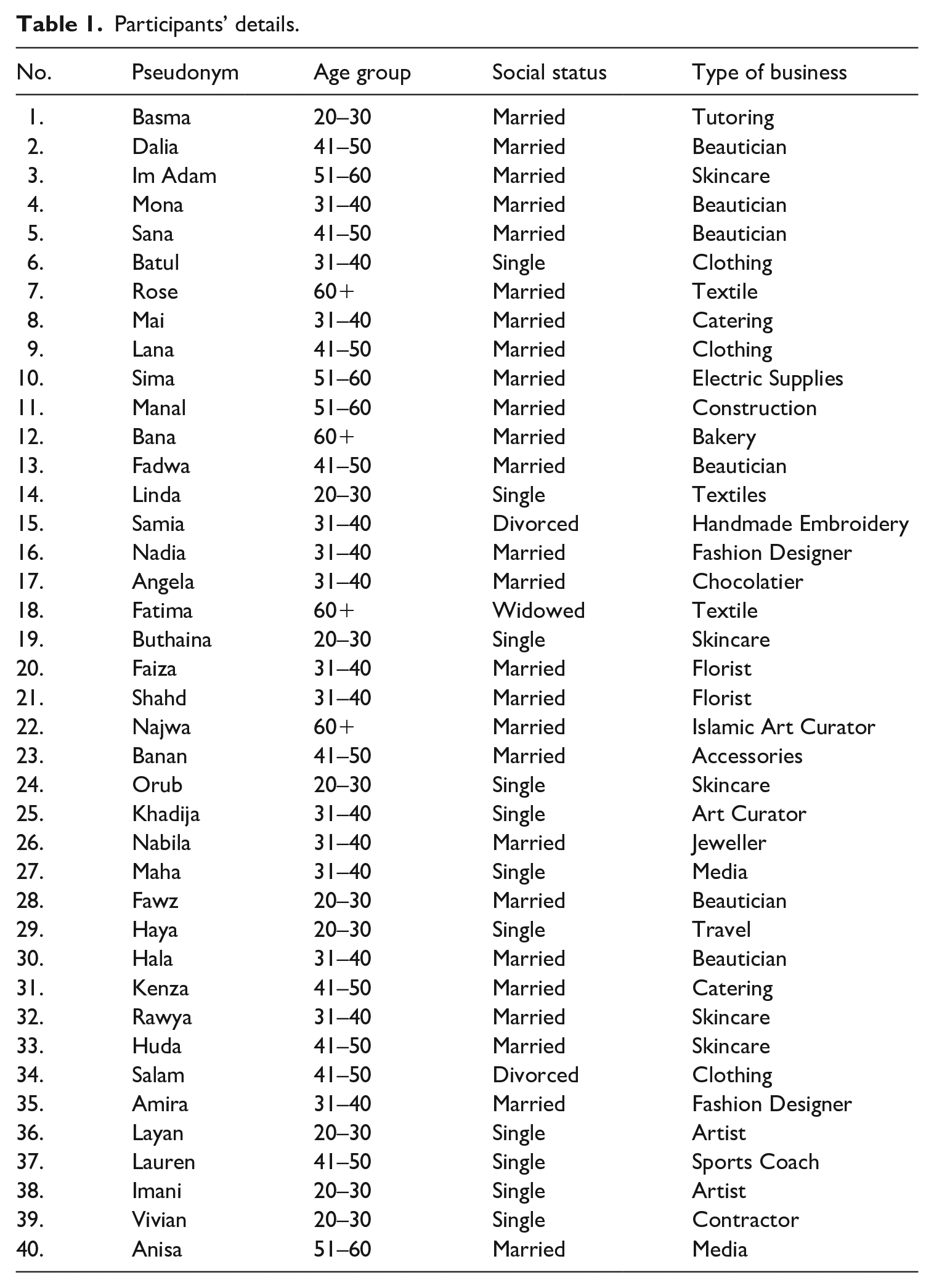
We interviewed 40 internally displaced Palestinian women entrepreneurs, aged 21–68, operating businesses in Ramallah and neighbouring internally displaced people (IDP) camps during the fall/winter season of 2021. Purposive, chain-referral and snowball sampling techniques were used to identify participants and ensure we had a sufficient sample (Heckathorn, 2011; Ritchie et al., 2013). Initially, four participants were chosen via referrals from a national non-profit women’s support centre in Ramallah. The centre provides current and aspiring women business owners with training, financial assistance and access to markets. Our final pool consisted of participants referred by initial and subsequent participants. By the 35th interview, data saturation was reached (Baker and Edwards, 2012; Bryman, 2007). For IDP camp participants, additional measures were taken to establish trust, such as liaising with acquaintances, customers and the United Nations Relief and Works Agency (UNRWA) administrators. Some interviews were conducted in UNRWA Women’s Programme Centres, while others took place at participants’ business locations or homes in Ramallah and nearby IDP camps (Jalazone, Am’ari and Qalandia). Table 1 shows the participants’ profiles.
Participants’ details.
The interview protocol
All of the interviews were conducted in Arabic, lasting between 30 and 90 minutes. We followed a formal ethical review process with informed consent obtained from all participants to ensure their anonymity, confidentiality and right to withdraw from the study. Participants were initially asked open-ended questions about their entrepreneurial experiences and perceived obstacles. Although the term ‘gaslighting’ was not explicitly mentioned, participants frequently discussed discriminatory encounters and their negative effects, including impacts on their sense of reality, self-efficacy and entrepreneurial performance. Subsequent questions outlined in an interview guide (online Appendix I) sought deeper insights into these discriminatory interactions and their consequences. We adapted the sequence and substance for each interview to help the participants convey their sense making and views. After iterative and reflective reading of initial transcripts, we realised that the frequency and emphasis of the keywords coincided with the literature on gaslighting.
Data analysis
Our data comprises the voices of participants sharing their entrepreneurial experiences. The Arabic interviews were transcribed and translated into English and back-translated into Arabic through an external bilingual researcher. In vivo codes, including culturally specific Arabic phrases, were transliterated into English. To avoid glossing over the lived realities of the participants’ context, we approached our data in line with postcolonial feminist thought, treating it as the emergent, inductive and dynamic data that it is through an iterative process of revisiting interview audio recordings and transcripts for interpretive insights and understanding (Alkhaled, 2021; Jamjoom and Mills, 2023). The initial reading of interviews helped us gain an overall sense of the women’s entrepreneurial experiences, which produced a preliminary list of broad codes that illustrated discriminatory encounters with the women’s entrepreneurial ecosystem with reference to core notions like gender stereotypes, self-doubt, defensiveness, disbelief, insult, trivialisation, confrontation and demand for clarification. A second reading provided a deeper understanding of the particular nature, frequency and levels at which the participants experienced discriminatory encounters. In the process, keywords and phrases frequently mentioned by the participants emerged, such as being told that they were too sensitive, overreacting and imagining things, that they need to let it go and that you’re the problem. Hearing these phases left some participants feeling that they had lost confidence in their recollections and interpretations of events, such that some no longer have the energy to argue because it could be my fault. We found these claims and their consequences to form a tangency between the literature on gaslighting and epistemic injustice, which led to additional iterations of analysis. A third reading focused on understanding two main themes. First, we organised the data into codes that fall in line with the literature on classifications of gaslighters’ types of communication as countering, withholding, denial, trivialising and diverting (Stern, 2007; Sarkis, 2018). Countering questions a gaslightee’s memory; withholding is the refusal to engage in conversation; denial is refusal to take responsibility for a gaslighting encounter, usually by pretending to have forgotten; trivialising refers to belittlement or disregard for a gaslightee’s feelings; diverting refers changing the focus of discussion or shifting the blame onto the gaslightee by questioning their credibility. Additionally, we examined how participants responded to and were affected by these gaslighting tactics, aligning with Johnson et al.’s (2021) classification of gaslightees’ responses including confrontation, clarification, sarcastic protection, inaction and avoidance.
Various kinds of negative consequences (e.g. self-doubt, helplessness, worthlessness and hopelessness) captured themes related to the aftermath of gaslighting. Participants’ narratives revealed patterns similar to Stern (2018), where the gaslightee initially experiences disbelief, leading to confusion, frustration and anxiety, followed by a need to defend and seek support, but often face invalidation or trivialisation (secondary gaslighting). When seeking help from those in power, blame is shifted onto the gaslightee (tertiary gaslighting). These themes and a review of the literature directed our attention in a fourth reading, to epistemic injustice, specifically hermeneutical and testimonial injustice. We entered the interviews into a qualitative data analysis program (MaxQDA, 2020), which helped classify and identify recurring themes. The results coincided with our readings and drew out statements that represented the roles of gaslighter and gaslightee, as well as forms of gaslighting, such as questioning memory, refusing conversation, denying injustice, changing focus to question credibility and belittling or disregarding feelings, experiences and capabilities. Figure 1 presents the coding structure.
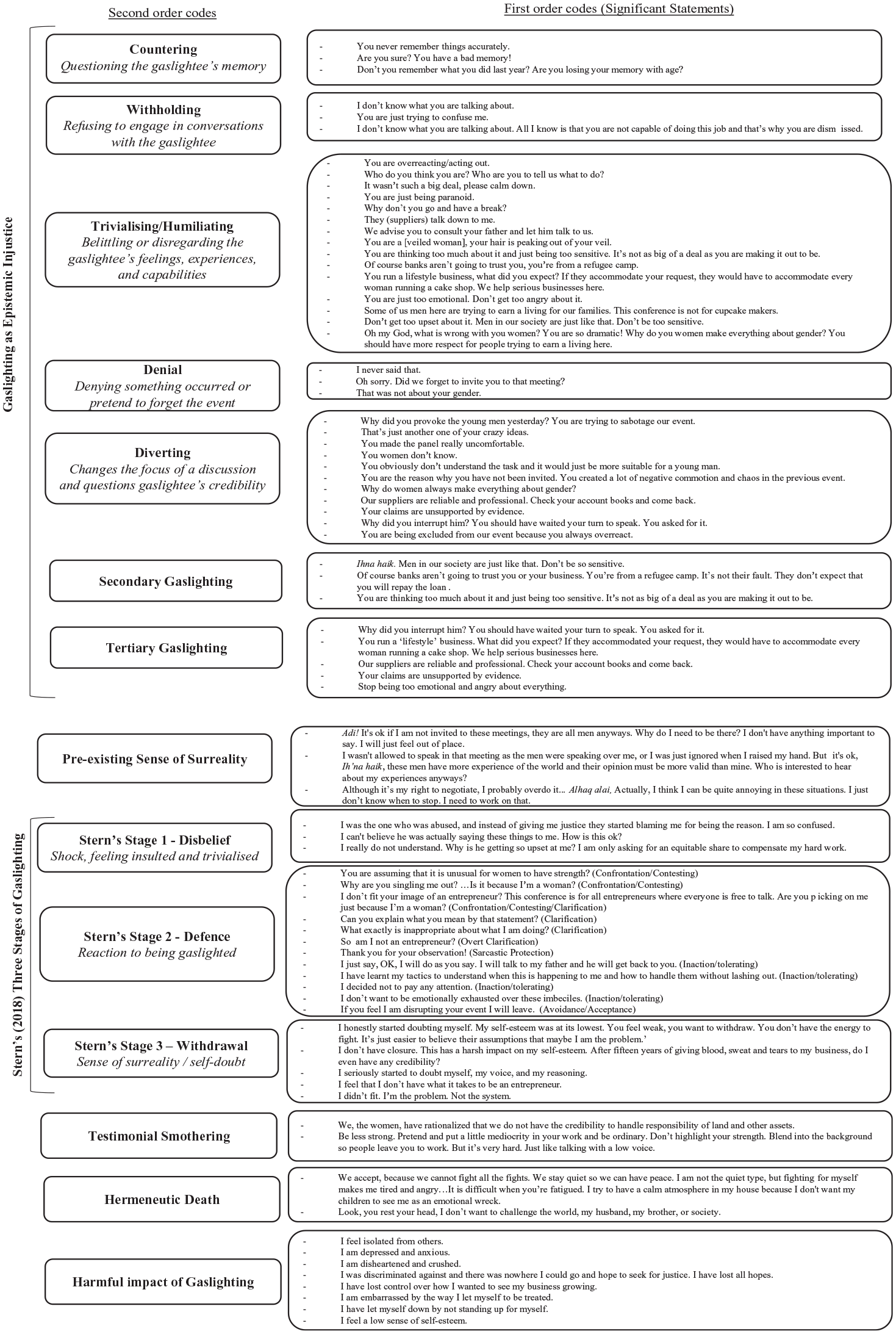
Coding structure.
Findings
The gaslight tango: A twisted path of gaslighting for women entrepreneurs
Our analysis illustrates a ‘twisted path’ of gaslighting that maps out gaslighting interactions and consequences based on the participants’ accounts and the literature on gaslighting and epistemic injustice (Figure 2). Our findings coincide with, depart from and contribute to Stern’s (2007) three-stage model of gaslighting. While some participants articulated feelings of shock and disbelief after being gaslit (stage 1: disbelief), others found such interactions normal and acceptable (e.g. hermeneutical injustice, pre-existing sense of surreality). In addition, while some participants moved from disbelief (stage 1) to defence (stage 2) as in Stern’s model, others exited the ‘twisted path’ using strategic tactics and ending the ‘gaslight tango’ at stage 2. Contributing to Stern’s model, secondary gaslighting (invalidation by friends and bystanders) and tertiary gaslighting (invalidation by institutional bodies) emerge in stage 2 as consequences faced by participants seeking empathy and support. This represents a testimonial aspect of epistemic injustice that led them to question their own entrepreneurial capabilities and agency. For instance, when they pointed out their gaslighters’ insults, they were deemed oversensitive, aggressive and lacking credibility, yet another layer of discrimination that undermined the gaslightee’s credibility based on gender stereotypes (Fricker and Jenkins, 2017).
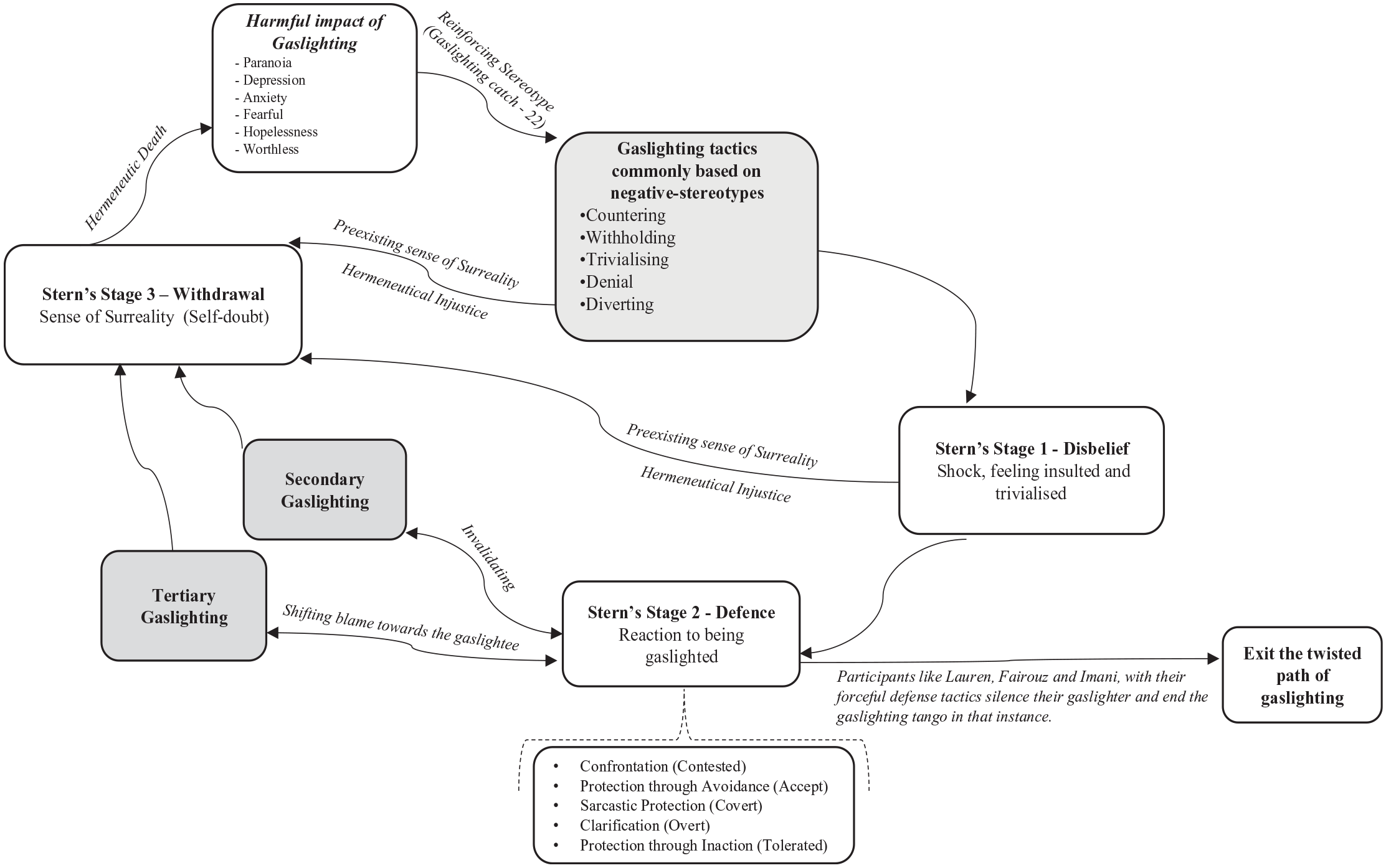
The twisted path of gaslighting.
Our findings further demonstrate how the different stages of Stern’s model of gaslighting correspond to different forms of epistemic injustice. For instance, testimonial smothering refers to a gaslightee’s decision to silence, ignore or constrict herself because she expects that what she has to say would be doubted, rejected or even used against her (Miller, 2019; Warman, 2023). This coincides with and is explained through stage 2 of Stern’s model (defence), which emerges with inductive themes such as cognitive dissonance and performatively produced testimonial injustice, which provide deeper understanding of how gaslightees interact with gaslighting encounters. In stage 3 (withdrawal), the ‘twisted path’ indicates how exposure to gaslighting can lead to a sense of surreality and perhaps hermeneutical death, reflecting the internalisation of abuse and reinforcement of negative stereotypes. Self-doubt, a consequential outcome of gaslighting, surfaces in each stage and helps in understanding why some participants internalised injustice, creating an alternative reality where injustice is the norm (ergo: hermeneutical injustice). Participants described the harmful consequences of gaslighting as ‘having a very harsh impact on self-esteem’ (Sue et al., 2019), resulting in ‘seriously doubting myself, my voice, and my reasoning’, ‘self-blaming’ and internalising negative emotions like guilt, embarrassment, shame, anger, regret, remorse and incapability, which had a long-term impact on business performance, self-confidence and well-being (Holder et al., 2015). Excessive testimonial smothering can potentially lead to hermeneutical death, coinciding with stage 3 of Stern’s model (withdrawal). In the following section, we explain these findings in detail.
Stage 1: Disbelief
Stern’s stage 1 is usually characterised by disbelief: I seriously question my reality when I experience discrimination. I call it out, and the blame is put back on me. I then ask myself, ‘Is all this actually happening? Did I miss something? Am I wildly off?’ and it takes every bit of my strength to take a deep breath and ground and trust myself, my emotions and my experiences. (Haya)
However, as Stern (2007) points out as likely, not all participants initially sensed disbelief. Some participants demonstrated a normalisation of the discriminatory environment, leading them to accept or internalise the injustice as the norm, indicating a pre-existing sense of surreality. Arabic terms used by the participants, such as Ih’na haik (This is us), Adi (This is normal) and Alhaq alai (It’s my fault), reflected this acceptance. For instance, Hala’s response to not being invited to Chamber of Commerce meetings showed her normalisation of exclusionary injustice: ‘Adi! It’s okay if I am not invited to these meetings. They are all men anyway. Why do I need to be there? I don’t have anything important to say. I will just feel out of place.’ Similarly, Maha stated: I wasn’t allowed to speak, men were speaking over me or I was ignored when I raised my hand. But it’s okay – Ih’na haik – these men have more experience of the world, and their opinion is more valid than mine. Who is interested in hearing about my experiences anyway?
These accounts show how patriarchy perpetuates hermeneutical injustice, leading to a loss of comprehension of experiencing injustice. Some participants, although aware of these injustices, tried to normalise them by defending their gaslighters and blaming themselves, further perpetuating hermeneutical injustice. For instance, Angela initially provided a rather modest description of discrimination: The only time I’m discriminated against is when I negotiate with suppliers. ‘Why do you always haggle for prices?’ they ask. I mean, isn’t that the nature of the relationship between buyer and seller? But I know they are annoyed because I’m a woman.
However, as she continued, she transitioned into rationalising their behaviour and appeared to defend their offences, saying, ‘Although it’s my right to negotiate, I probably overdo it.’ Her account also allocated blame to herself: ‘Alhaq alai. Actually, I think I can be quite annoying in these situations. I just don’t know when to stop. I need to work on that.’
Najwa recalled when she first took part in an exposition. While traffic was low on the first day, her stall attracted attention because of her ‘outgoing, confident personality and selling skills’. Other stallholders grew hostile and asked her why people were buying from her, to which she replied, ‘Tomorrow may be a better day for you.’ The next day, the expo manager confronted her, asking, ‘Why did you provoke the other stallholders and sabotage our event? Did you say that the event will be better tomorrow?’ (diverting). At that moment, Najwa felt that the manager was putting words in her mouth to shift the blame. The manager proceeded to gaslight her with gender and age-based insults, saying, ‘What are you doing here anyway? An old woman like you should be at home entertaining her grandchildren. Your time has passed. Give the young people a chance to succeed’ (humiliating). This psychological manipulation made her doubt herself and think that perhaps the space was just for young people and that she, an older woman, did not fit in. Feeling dejected, her self-esteem low, unlike her confident persona, she responded, ‘I guess you are right. I am the reason for the disruption of your event, so I should leave.’ However, Najwa explained, ‘I let myself down. Alhaq alai for not listening to my instinct in dealing with these bullies.’ After not receiving an invitation for the following year’s expo, Najwa sought clarification from the organisers, who initially refused to engage in conversation with her (withholding), but she persisted until she got an appointment. During the meeting, the gaslighting escalated as the organisers questioned her memory: ‘Don’t you remember what you did last year? Are you losing your memory with age?’ (countering). Then they changed the focus of discussion to attacking her emotional and professional credibility (diverting): ‘You are the reason why you were not invited. You created negative commotion and chaos last year.’ Thus, the gaslighters assumed control of the debate by invalidating her reality and shifting the blame onto her, leaving her in disbelief and feeling ‘confused, frustrated and anxious’. Najwa’s accounts coincide with Rietdijk’s (2018) notion of rational disagreement, highlighting a particularly malign feature of gaslighting in which gaslighters shift the blame onto the gaslightee. This is consistent with Stark’s (2019) model, describing gaslighters’ rhetorical strategies in response to being called out as defending themselves through tu quoque (blame shifting) to undermine the gaslightee’s credibility.
Stage 2: Defence
Stern’s stage 2 entails an impulse for self-defence, when a gaslightee tries to prove her gaslighter wrong. Najwa tried to protect herself by looking for evidence to prove the expo manager wrong, forgetting the insults and exclusion and instead defending her character at the institutional level from the very people from whom she sought justice: I tried to look for evidence and witnesses to say that I didn’t do these things, but it’s a very weak place to be eliciting help from others to exonerate yourself from something you didn’t do in the first place (acceptance).
Some participants were bold and outspoken, as when Lauren (a sports coach) invited some young people in for a workout class and she heard the men mocking, ‘This is a woman; surely this is going to be a dance class.’ Lauren explained societal misconceptions about female sports coaches being incapable of strength training and her defence to being gaslit was to confront her gaslighters. She recalled a lot of distractions in her first class. She stopped the music and challenged the men to a push-up competition, to which they responded, ‘We’re not doing a push-up challenge with a woman!’ (trivialising). Lauren maintained her tough demeanour, ‘I’m the coach here and you will follow my instructions. You assume that women aren’t strong enough? Let’s compete and see’ (confrontation). She explained: When a man sees you in a position of power and being strong like he is, he might find his masculinity threatened. When he sees that you are strong, he will either leave or face you. Either way, you win.
Fatima explained how the neighbours stared when she dropped materials off at the homes of the women who did embroidery for her. One day, an elderly man said, ‘Don’t you think that walking around from house to house like this is unbecoming of a woman, let alone an old woman of your age?’ (humiliating). She felt insulted, and in her defence, asked for clarification, making the gaslighter explain himself: ‘What exactly is inappropriate about what I’m doing? I am a businesswoman, and this is how I run my business’ (clarification). Imani also touched on male privilege, recounting how a man once entered her shop and felt entitled to assess how she wore her veil, saying, ‘You are muhajjabeh (a veiled woman), and some of your hair is peeking out of your veil.’ She responded sarcastically, ‘Thank you for your observation. Is there anything specific you are looking to buy?’ (sarcastic protection).
Vivian, a self-proclaimed confrontational woman, described how she handled gaslighting by responding to her gaslighter using sarcastic protection, a covert defence tactic, and tolerated the gaslighter to avoid ‘emotional exhaustion’. She decided it would be better to comply with, rather than challenge, the gaslighter. She adjusted her tone and chose her words carefully when faced with dismissive and belittling comments from her suppliers: I know what I’m doing, but people won’t take me seriously. They talk down to me, saying things like ‘You women don’t know’ (diverting), ‘You should do this and that’ and ‘We advise you to consult your father. Let him talk to us!’ (trivialising).
Instead of arguing, which she described as ‘a waste of time’, she would respond, ‘Okay, I’ll do as you say. I’ll talk to my father and he will get back to you’, as she believed that alone she could not change her gaslighters’ mentality about a young woman’s capability: ‘It’s like a dead end. Ih’na haik.’ While she makes the final decisions in her business, feigning compliance makes her feel that she is denying her real self: I have learnt my tactics and understand how to handle them without lashing out and getting emotionally exhausted over these imbeciles. I don’t like it because, in my personal life, I hold my ground and defend myself, but in my business life, I don’t have a choice.
Nevertheless, this approach causes her internal conflict, as she is unhappy about not accessing her true confrontational self as she would have liked to. Similarly, Sima, a strong-willed woman, also departed from her identity to feign a sense of consistency between her attitude and behaviour. She blamed herself for being gaslit and pondered trading in her trademark tenacity for a ‘less strong’, ‘ordinary’ character who should just ‘blend into the background’ so she would be left alone to run her business. Sima struggled with the need to change her behaviour to protect her business and well-being. Despite her internal struggle, she believed this change was necessary to avoid the negative impact of gaslighting, even though it perpetuated its occurrence (Creech, 2020).
Infrapolitics
Participants such as Vivian and Sima strategically diverging from their outspoken personas by responding to their gaslighters in a calculated manner presents an individual-level spin on the practice of infrapolitics as a strategic response to avoid further exposure to patriarchal injustices (Vachhani and Pullen, 2019). Infrapolitics refers to inconspicuous tactics used by marginalised groups to resist subordination, considering their disadvantageous positions within power dynamics (Scott, 1990). This enactment of agency shows how some of the participants astutely tapped into a scarce endowment of epistemic resources to navigate injustice. Their testimonial smothering, rather than implying disenfranchisement, reflects an inventive ruse of their testimonial savvy. While Vivian described arguing as a ‘dead end’, Najwa translated this strategic use of testimonial smothering into an act of resilience and resistance in overcoming injustice, albeit painfully slow: The solution starts with you. You have to start acting in a just way. Slowly, people start admiring your just ways. When they start admiring, they start imitating. It’s a long, long, long, frustrating process, but you have to start from somewhere. It starts with the individual and then it goes on.
She continues, describing a bitter consequence of the perpetual imbalance of power between marginalised groups and oppressive institutions: It starts from the small things, never, never from the top. There doesn’t seem to be any interest in the upper echelons [to establish justice] because, when justice prevails, then equality prevails and superiority disappears. When justice prevails, then hierarchy – all of this – disappears. Then we’re all equal and there’s so much to lose for the powers that be, so much to lose in family, in job situations. There’s always somebody who wants to be the master. The word master disappears.
Secondary and tertiary gaslighting
Another finding from our analysis that falls into stage 2 refers to instances in which the participants looked to others for empathy or recourse as a subsequent defence and experienced what we refer to as secondary and tertiary gaslighting. Secondary gaslighting, a kind of compounded gaslighting, occurred when bystanders intentionally or unintentionally invalidated the participants’ accounts of gaslighting, thus further abusing and discouraging them from accessing social support (Johnson et al., 2021). In doing so, these bystanders contributed to confirming the participants’ sense of surreality, such that they started asking themselves, ‘Am I the problem?’ (Figure 2). When Maha complained to her mentor about her male colleagues’ condescending behaviour, he invalidated her concerns by telling her, ‘You are thinking too much about it and being too sensitive. It’s not as big of a deal as you are making it out to be’ (trivialising). Similarly, when Mona saw that she was ‘going in circles’ with loan officers in an effort to expand her business, she turned to a friend for empathy. Instead, she was further gaslit, as the friend replied, ‘Of course banks aren’t going to trust you or your business. You’re from a refugee camp. It’s not their fault. They don’t expect that you will repay the loan’ (diverting). Mona was ‘disheartened and crushed’.
As for tertiary gaslighting, our findings show participants being further gaslighted when they turned for help or sought justice from people with professional credibility or in positions of power. These discriminatory encounters, on behalf of the institution, were perpetrated by the very people who should have been helping. When gaslighting came from an institutional body, it had the potential to cause much more harm than secondary gaslighting from a friend. Similar to Harber et al.’s (2015) findings, a main theme in our data was that of tertiary gaslighters’ diverting blame back onto the gaslightee. Fairouz explained how she was ostracised at the institutional level for asking for help in exporting her products: I tried to contact an entrepreneurship support organisation, but they dismissed me, saying they were ‘too busy helping real businesses’, so I went to the Chamber of Commerce to file a complaint. There, I was told, ‘You run a “lifestyle” business. What did you expect? If they accommodated your request, they would have to accommodate every woman running a cake shop. We help serious businesses here’ (trivialising).
Fairouz found the double standard demeaning and questioned whether there was ‘any point in doing a lifestyle business’. Similarly, after confronting her supplier several times about being sent poor-quality materials and not getting a satisfactory answer, Linda approached the supply chain’s main distributor. To her dismay, the distributor validated her gaslighters and shifted the blame onto her, asking her for evidence and advising her to keep up with her payments: ‘Our suppliers are reliable and professional. Check your accounts and come back’ (diverting). Therefore, instead of getting clarification, she was met with an underhanded attack on her credibility, leading her to doubt herself. Similarly, Nabila’s complaints to authorities about unfair practices are often dismissed as ‘unsupported by evidence’ and she is told to ‘stop being too emotional and angry about everything’ (trivialising).
Stage 3: Withdrawal
In the twisted path of gaslighting are some participants who normalised discriminatory encounters, and others who felt insulted, but remained silent and withdrew. Those who confronted their gaslighters were either further gaslit or silenced. Those who reach stage 3 may have reached a point of withdrawal and are too exhausted to argue further (Stern, 2007). Najwa recalled, ‘I honestly started doubting myself. My self-esteem was at its lowest. You feel weak; you want to withdraw. You don’t have the energy to fight. It’s just easier to believe their assumptions that maybe I am the problem.’ These feelings, classic examples of Stern’s stage 3, confirm Calef and Weinshel’s (1981: 52) definition of gaslighting as ‘behaviour in which one individual attempts to influence the judgement of a second individual by causing the latter to doubt the validity of his or her own judgement’. The strong, confident, outspoken Najwa yielded, too exhausted to access her true self, and succumbed to the incapable identity her gaslighters gave her (Figure 2: reinforcing the stereotypes). Giving in and agreeing that the expo manager’s claims were right (and invalidating her own claims) was more fathomable than further calling out the gaslighter, an argument she felt she had no hope of winning. Haya questioned her own credibility and blamed herself for being gaslit. She explained that the tourism sector is dominated by men over age 50, as ‘they’re doing the guiding, the driving, the meetings, the orientation’. She recalled trying to contribute to the meetings and being rebuffed: ‘You’re a woman who is far too young to understand the magnitude of this business; you cannot possibly know what you’re talking about. Just leave it to the men’ (diverting). As she explained, ‘I seriously started to doubt myself, my voice, and my reasoning.’ Banan recalled how her potential business partner became hostile simply because Banan asked if they were equal partners. He responded, ‘I know more people, I got the project and I am your boss.’ She was puzzled about why he was offended. Finally, he dismissed her entirely from the business, saying, ‘You obviously don’t understand the task, and it would just be a more suitable job for a man’ (diverting). Banan went to great lengths to save the partnership, yet he refused to discuss it, saying, ‘I do not know what you are talking about. You are not capable and that’s why you were dismissed’ (withholding). She described the impact: ‘I don’t have closure. This has had a harsh impact on my self-esteem. After 15 years of giving blood, sweat and tears to my business, do I even have any credibility?’
Gaslight tango and hermeneutical death
We noticed that, in some instances, the emotionally taxing impact of gaslighting led the participants to hesitate, resist or refrain from calling attention to it, leaving them vulnerable to further harm (Sue et al., 2019; Williams and Williams-Morris, 2000) and to internalising negative emotions like anger, self-blame, humiliation, shame and regret, all of which result in long-term harm to their self-confidence, business performance and overall well-being (Holder et al., 2015; Lewis et al., 2016). In addition to the cognitive and emotional energy the participants expended in recognising, confronting and disrupting gaslighting, their attempts left them vulnerable to further harm, exemplifying the ‘gaslight tango’ (Stern, 2007), the systematic psychological manipulation of insisting that a gaslightee’s reality is fundamentally flawed. Despite whatever confidence and forcefulness the participants may have displayed, they may remain vulnerable to their gaslighters, as the systemic oppression of women through gender-based stereotypes, patriarchy, living under occupation and being displaced may have exacerbated vulnerabilities (Sharma, 2020). Excessive and repetitive exposure to such unjust encounters as gaslighting can result in hermeneutical death, that is, extreme constraint of an individual’s agency, leading to ‘the loss (or radical curtailment) of one’s voice, interpretative capacities, or status as a participant in meaning-making and meaning-sharing practices’ (Medina, 2017: 41). Sima conveyed her feelings after being gaslit time and again: ‘Be less strong. Pretend and put a little mediocrity in your work, be ordinary. Don’t highlight your strength. Blend into the background so people leave you to work. But it’s very hard, like speaking with a low voice.’ Hala reflects, ‘Look, you rest your head, I don’t want to challenge the world, my husband, my brother, or society.’ Rawya echoed: We accept it because we cannot fight all the fights. We stay quiet, so we can have peace. I am not the quiet type, but fighting for myself makes me tired and angry . . . It is difficult when you’re fatigued. I try to have a calm atmosphere in my house because I don’t want my children to see me as an emotional wreck.
The closing case of Nadia
Primary, secondary and tertiary gaslighting can coalesce into a sense of disorientation and surreality, particularly when they are manifested through broad gender discrimination. Nadia relates being yelled at during a trade conference when she tried to suggest policies that would address obstacles that women entrepreneurs face: ‘People would talk over me, assuming I had nothing of substance to say.’ When Nadia found a chance to speak, the gaslighter seated across from her put his hand in her face and yelled, ‘Some of the men here are trying to earn a living for our families!’ By insinuating that Nadia could not have been a serious entrepreneur, her gaslighter revealed his prejudiced beliefs about women entrepreneurs (e.g. their incapability and running trivial businesses). When the woman seated next to Nadia noticed her fury, she trivialised her feelings, advising her, ‘Ih’na haik. Men in our society are just like that. Don’t be so sensitive’ (secondary gaslighting). Nadia spoke to the organisers, demanding an apology for this man’s insult to her, but was met with yet another insult and had the blame shifted onto her: ‘Why did you interrupt him?’ the organiser demanded. ‘You should have waited your turn to speak. You asked for it’ (tertiary gaslighting). In these exchanges, stereotypical notions of gender-appropriate behaviour (e.g. women running ‘lifestyle businesses’, the normalcy of men’s being ‘aggressive’, the idea that women should ‘wait their turn’ to talk) are used to make the target believe that her version of reality is distorted (i.e. women entrepreneurs do not have ‘real’ problems and, if they do, they are not important). Despite feeling insulted, invalidated and dejected, Nadia decided to come back to the room. She wanted to believe that she was in a non-discriminatory environment that was equally open to all entrepreneurs who wanted to raise concerns. Nadia confronted the gaslighter, saying, ‘I don’t fit your image of an entrepreneur? This conference is for all entrepreneurs and everyone is free to talk. Are you picking on me just because I’m a woman?’ The gaslighter laughed, ‘Oh, my God, what is wrong with you women? You are so dramatic! Why do you women make everything about gender? You should have more respect for people who are trying to earn a living!’ (trivialising/humiliating). By outrightly denying any discriminatory foul play and asserting his own perspective as correct, the gaslighter demonstrated trademark gaslighting behaviour, complete with hostile delivery of shrewdly phrased sexist insults. His comments took the focus from him and perpetuated stereotypes about Nadia (e.g. too sensitive, too dramatic, cursed with a negative disposition). Such perspectives are not limited in scope but are a product of a larger discriminatory environment that has made such exchanges a common occurrence. Gaslighting tactics like these, which prey on women entrepreneurs’ institutional inequities, work to exclude them perpetually by making them seem incapable, diminishing their realities and humiliating, excluding and controlling them. In an effort to break these negative stereotypes about women by showing confidence, Nadia changed her own communication style to emulate masculine norms. She thought she had to ‘fix herself’ by talking loudly and interrupting others to show assertiveness. Ironically, this ‘fixing’ led to reinforcing the negative gendered stereotypes she had experienced, as she fell into the trap of being seen as ‘too emotional’ and ‘irrational’, thereby reproducing the gaslighting, inequality and discrimination she had initially faced. Nadia’s narrative highlights how feminine communication styles are perceived to be in deficit in relation to masculine styles (Sue et al., 2008).
Discussion, implications and future research
Our study addresses the absence of scholarly attention to the common but largely unacknowledged notion of gaslighting in the context of women’s entrepreneurship. By applying the lens of epistemic injustice, our research adds to the body of knowledge regarding gaslighting as psychological abuse. Our study has demonstrated gaslighting as a manifestation of epistemic injustice, as our findings illuminate its occurrence, social dynamics and consequences for women entrepreneurs operating in an environment of occupation and patriarchy. We elaborate for the entrepreneurship literature the gendered nature of gaslighting through Stern’s (2007) three-stage model, providing a contextualised perspective theorised through epistemic injustice. We present a ‘twisted path’ that maps out gaslighting interactions and consequences, coinciding with, departing from and enriching Stern’s model. In doing so, we extend extant theories of primary gaslighting by distinguishing subsequent gaslighting activity into secondary and tertiary. Further to this, through the hermeneutical aspect of epistemic injustice, we explained how and why some women entrepreneurs succumbed to gaslighting, ultimately reinforcing negative stereotypes (and the discriminatory hermeneutical environment of injustice towards women). We also presented a blended perspective of testimonial injustice (Fricker, 2007) and infrapolitics (Scott, 1990; Vachhani and Pullen, 2019) to expand the notion of testimonial smothering (Miller, 2019; Warman, 2023), highlighting that women entrepreneurs may strategically employ these tactics as an empowered agential strategy rather than a disenfranchised consequence. Another contribution of our study emanates from drawing upon a postcolonial feminist lens, as in doing so, we disrupt the influence of western feminism by centring the voices of 40 internally displaced Palestinian women entrepreneurs operating in an environment of occupation and patriarchy (Abdelnour and Abu Moghli, 2021; Mohanty, 2003; Said, 1982). This approach embraces a reflexive stance to promote social justice reform by challenging the limitations of western feminism and the subaltern image it creates (Abu-Lughod, 2013; Bailey, 2020; Bilge, 2013; Harris and Patton, 2019). Our study reveals their character in the face of compound adversities and how they are affected by them, further acknowledging the transformative power of research and the need to avoid misrepresentation, subjugation and depoliticised approaches (Abu-Lughod, 2013; Bilge, 2013; Harris and Patton, 2019). Considering the lack of research on injustice in an entrepreneurial context, particularly on women entrepreneurs who operate in environments of occupation and patriarchy, the geopolitical context of our sample addresses the role of spatial position and identity amid multiple systems of injustice and adds novel theoretical insights grounded in lived experiences (Sultana, 2022). Finally, our findings carry policy implications regarding the need to raise awareness of gaslighting to make it more easily identifiable, and promote policies that prevent gaslighting and hold gaslighters accountable.
Stern’s three-stage model: A twisted path of gaslighting
Our contribution to Stern’s (2007) three-stage model of gaslighting suggests a ‘twisted path’ of gaslighting reflects and shows how our findings coincide with, depart from and contribute to this model. Our contribution demonstrates how the different stages of Stern’s model of gaslighting represent different degrees of epistemic injustice in relation to Fricker’s (2017) and Medina’s (2017) corresponding interpretations of a highly interrelated, cyclical bind of hermeneutical and testimonial injustice that reflects the participants’ discriminatory encounters, a concept that the entrepreneurship literature does not address. This creates what we call the ‘Gaslighting Catch-22’, a toxic cycle that coincides with what we theorise as the hermeneutical–testimonial injustice bind, perpetuating hermeneutical injustice, robbing participants of their ability to comprehend and leaving them unaware or incapable of expressing the injustices they have experienced. Consequently, some participants blamed themselves for being gaslit. This behavioural pattern may involve psychological tactics in which the gaslighter projects anxieties onto the gaslightee, which may lead to her succumbing to the reality the gaslighter projects (Calef and Weinshel, 1981). Meanwhile, hermeneutical death is explained as the extreme constraint of an individual’s agency, leading to ‘the loss (or radical curtailment) of one’s voice, interpretative capacities, or status as a participant in meaning-making and meaning-sharing practices’ (Medina, 2017: 41).
Secondary and tertiary gaslighting
We further contribute to the gaslighting literature and Stern’s (2007) model by distinguishing gaslighting activity into secondary and tertiary gaslighting. Secondary gaslighting (gaslighting claims that are invalidated by friends and bystanders) and tertiary gaslighting (gaslighting claims that are invalidated by institutional bodies) emerge in stage 2 of our findings as consequences faced by some of the participants who sought empathy for or recourse from primary gaslighting. This represents a testimonial aspect of epistemic injustice that led them to question their own entrepreneurial capabilities and agency. For instance, when they pointed out their gaslighters’ insults, they were deemed oversensitive, aggressive and lacking credibility, yet another layer of discrimination that undermined the gaslightee’s credibility based on gender stereotypes (Fricker and Jenkins, 2017).
The theme of secondary gaslighting sheds light on an additional layer of injustice faced by the participants situated in IDP camps. Mona, an IDP camp participant, sought empathy from a friend after being refused a business loan, only to be trivialised and discredited owing to her status as a ‘refugee camp woman’. This enactment of testimonial injustice, resonates with the notion of ‘allies behaving badly’ where marginalised individuals are gaslit by those they turn to for support (McKinnon, 2017). This also highlights a divisive manifestation of the injustices of occupation, which creates within-group discrimination (Tajfel and Turner, 1979), an internal dynamic of civil hostilities among Palestinians themselves, where IDP camp Palestinians are treated as subalterns in relation to Palestinians situated in other areas (e.g. cities). This form of isolation translates to the loss of epistemic and moral support by already marginalised people through an elevated level of exclusion for Palestinian women who live in IDP camps. Our participants’ narratives also revealed instances of secondary gaslighting, resulting in internal dissent when bystanders in gaslighting encounters normalised the abuse they witnessed, and Palestinians reinforce a disparaging image of IDP camp residents’ credibility. Bailey (2020) refers to this dimension of gaslighting as structural gaslighting, wherein oppressive institutions attribute perceived character flaws and indiscretion to marginalised groups as a reason to legitimise the injustice. To uphold structural gaslighting, institutional oppressors use tactics such as orchestrated forgetting and collective forgetting, distorting knowledge to perpetuate confusion among epistemic subjects and sustain a legacy of injustice in hermeneutically corrupt environments (Bailey, 2020).
Our observation of an all-too-common, yet seemingly anonymous, aspect of gaslighting at the institutional level, where the cultural norms intersect with institutional practices, for us constitutes hermeneutical injustice. Building on previous work by Jones (2023), we identify this phenomenon as tertiary gaslighting, highlighting how public officials exploit gendered power imbalances through their network connections. Our study advances the understanding of institutional gaslighting by examining its role in perpetuating epistemic injustice. Participants explained how institutional gaslighters were consciously choosing to ignore their claims’ validity, knowingly and wilfully misinterpreting their assertions; behaviour termed by Pohlhaus (2012) as wilful hermeneutical ignorance. This kind of behaviour exacerbates not only an environment of injustice but also undermines gaslightees’ confidence, leading to a sense of surreality and an unjust deficit of credibility where marginalised persons’ credibility is diminished while privileged groups’ credibility is assumed (regardless of credentials) (Carter and Meehan, 2023; Fricker and Jenkins, 2017). This coincides with Medina’s (2011) notion of epistemic privilege, which arbitrarily attributes credibility to dominant groups at the expense of the marginalised. Medina (2017) warns against underestimating the harm caused by hermeneutical injustice, emphasising its potential to rob individuals of their human dignity. Excessive exposure to gaslighting can result in hermeneutical death, where a person’s agency and ability to participate in meaning making and sharing practices are profoundly constrained (Medina, 2017: 41). Participants described the harmful impact of injustice, especially when perpetrated by those in positions of power. The occurrence of tertiary gaslighting within institutions underscores the need for policymakers to address this issue. Our findings raise awareness to establish mechanisms for accountability and minimise institutional gaslighting. Our study lends itself as a point of reference for future studies on gaslighting across primary, secondary and tertiary levels in entrepreneurship and in other contexts.
Hermeneutical–testimonial injustice bind
Our findings enrich our understanding of gaslighting and inform directions for future research. We found the synergistic utilisation of the theory of epistemic injustice and Stern’s three-stage model of gaslighting to facilitate heightened awareness and understanding of the occurrence of discriminatory encounters like gaslighting. This approach allowed us to uncover and explain how hermeneutical injustice can leave an epistemic subject unaware of having been exposed to an injustice. In Stern’s terms, some of the participants’ accounts indicated a pre-existing sense of surreality, as they already lived in a state of stage 3 (withdrawal/surreality). This surreality was narrated through the participants’ frequent use of the terms Adi (This is normal), Ih’na haik (This is us) and Alhaq alai (It’s my fault). This finding resonates with Stark’s (2019) study on how gaslighting epitomises psychological oppression, leaving women in perpetual self-doubt and leading them to internalise the inferiority inherited from a culture of patriarchy, many having been conditioned to even uphold it by discouraging and criticising women who call out injustice. Thus, not only does patriarchy see women’s claims quieted by men but we also found evidence of women upholding patriarchy, potentially leading them to smother their own testimony (Miller, 2019; Warman, 2023). This dynamic illustrates a highly interrelated, cyclical bind of the constituents of epistemic injustice, which we refer to as a hermeneutical–testimonial injustice bind, with patriarchy setting the environmental tone for injustice to occur and gaslighting its manifestation.
Cognitive dissonance, testimonial smothering and testimonial quieting
Cognitive dissonance refers to the feeling of mental discomfort caused by a sense of inconsistency among one’s beliefs, values and attitudes, leading an individual to alter her attitudes, beliefs or behaviours to seek consistency and reduce that discomfort (Festinger, 1957; Harmon-Jones and Mills, 2019). The theory of cognitive dissonance is helpful in understanding how the participants were influenced by their interactions with gaslighters, particularly when the participants responded in ways that conflicted with their perceptions of their true identities. Davis and Ernst (2019) refer to the internal conflict caused by this self-imposed change in behaviour a gaslightee uses to avoid subsequent gaslighting as tone policing, which often leads to hypervigilance and self-policing (Corbin et al., 2018; Dotson, 2011).
Analysing the narratives through the lens of testimonial injustice reveals how gaslighting is a manifestation of epistemic injustice. Testimonial injustice, the communication component of epistemic injustice, explains how participants’ thoughts, ideas, feelings and claims were trivialised, deemed less credible or outright rejected because of the discriminatory prejudice. We refer to this rejection as testimonial quieting (Miller, 2019; Warman, 2023). Lauren spoke up for herself, while Vivian went through a cognitive assessment process choosing to silence, ignore or constrict herself because she expected that what she had to say would be doubted, rejected or even used against her, referred to as testimonial smothering (Miller, 2019; Warman, 2023) or tone policing. This occurs when strong-willed women depart from their courageous personas in an attempt to alleviate cognitive dissonance by simulating consistency between their attitude and behaviour through self-blame for allowing themselves to be gaslit. In such cases, women who have been gaslit may consider swapping their valour and ambition for timidity and mediocracy; a smothering, or even suicide of the character in order to continue functioning as entrepreneurs by effectively manoeuvring within the confines of patriarchy. Nevertheless, this conformity only reinforces negative gender stereotypes and perpetuates the occurrence of gaslighting further (Creech, 2020; Sue et al., 2008).
In choosing to tolerate her gaslighters, Vivian explained how she knew they would not be convinced of her capabilities and that reasoning with them would be a ‘dead end’. She silenced herself to avoid lashing out or getting mad, a dimension of testimonial injustice that Corbin et al. (2018) refer to as filtering communication style and Dotson (2011) refers to as self-silencing. Vivian made this choice to avoid being perceived as overreacting and emotional and to avoid further gaslighting. In doing so, she tolerates one stereotype, incapability, to avoid being accused of other stereotypes. Thus, in Vivian’s case, filtering her communication style and self-silencing to avoid being perceived as too emotional only gets her so far, as both stereotyping and subsequent gaslighting are inevitable when she settles for being perceived as incapable.
Infrapolitics and performatively produced hermeneutical injustice
Aside from testimonial smothering, another outcome of cognitive dissonance is a change in one’s normal behaviour. We interpret some participants’ departure from their outspoken personas from an agential perspective, extending upon and blending the notions of testimonial smothering and infrapolitics. Here, we drew upon the work of Scott (1990) who refers to infrapolitics as a low-key mechanism used to resist insubordination used by marginalised groups, as well as that of Vachhani and Pullen (2019), who draw attention to how marginalised people cope with injustice through supportive networks showing their solidarity. We found some of our participants demonstrated infrapolitics through strategic use of testimonial smothering in response to gaslighting encounters, knowing that while they cannot change the unjust environment instantly on their own, by demonstrating just and equitable treatment they showed hope of eventually having an impact in the long term.
In terms of epistemic injustice and gaslighting, this is explained through the concept of performatively produced hermeneutical injustice. In such situations, epistemic subjects are deemed incoherent because of their communicative performance (Medina, 2017). This may lead a gaslightee to alter their behaviour to coincide with what they believe a situation calls for based on what institutional, in this case, patriarchal, norms may require. Batul suggested that, if women are loud, they get what they want, whereas a calm demeanour leads to their exclusion: ‘I am more of a calm person, but I have become aggressive because it is the only way to get my voice heard.’ Her explanation taps into the cyclical nature of injustice, where hermeneutical injustice affects an individual’s perception of herself in relation to her environment, while testimonial injustice leads to potential smothering of her personality and instincts. Nadia’s account presents another perspective. After experiencing a string of injustices at an entrepreneurship training session, Nadia found her predicament difficult to process and described her experience as infuriating and bewildering: ‘How is it that my colleagues were openly throwing sexist insults, and women in attendance were telling me to calm down because that’s just how men are, and the officials were defending them rather than upholding equality and justice?’ In response, she adapted her communication style to her perception of assertive masculine norms by ‘talking loudly and interrupting conversations’. Ironically, this response often leads to reinforcing negative gendered stereotypes, fostering the discriminatory environment and its practices within which they must navigate (Zheng et al., 2018). Nadia eventually gave in and decided, ‘Why bother arguing? They will not listen, and if they do, they will not take me seriously and will just reject anything I say.’
Implications for research and policy
The institutions of patriarchy and occupation have generated multiple strains of injustice for Palestinian women in public, private and professional spaces. Biased, obsolete laws have obstructed the potential for accountability, giving offenders free rein while victims of injustice bear the stigma that comes with reporting injustice (UN Women, 2019; UNESCO, 2019). When women are expected to tolerate injustice in support of a twisted understanding of a greater good, an environment of gender inequality lingers (UN Women, 2021), perpetuating norms that promote implicitly and explicitly offensive acts and setting the tone for injustices like gaslighting. Gaslighting that happens at the institutional level has consequences that are particularly unjust, damaging and potentially more harmful than primary gaslighting (Jones, 2023). While the entrepreneurship literature mentions women’s struggle to access the institutional power that could protect them from injustice (Warshaw et al., 2014), the literature does not address the concept itself, which we introduce here as tertiary gaslighting. We present this concept in a theoretical light to be expanded on in future studies. Future studies can also explore Bailey’s (2020) suggestion that resisting and overcoming injustice requires strong communities to tap into or develop a reflex of epistemic survival. Research can also shed light on Vachhani and Pullen’s (2019) ‘bonds of affection’ that may assemble in solidarity as a response to ‘patriarchal social formations’ to ward off oppression and exploitation (Bell et al., 2019: 5). Evidence of strategic testimonial smothering also requires further research to clarify how individual-level behaviours can extend to broader-level infrapolitics. While we touch upon the individual-level implications of cognitive dissonance theory in processing gaslighting experiences, future research can study the manifestation of the ‘Gaslighting Catch-22’ at both the individual and societal levels. These theories and their ensuing discussion can inspire future research in organisational behaviour, exploring cultural factors in the recurrence of gaslighting and the accountability measures that organisations have in place to address it.
Gaslighting can distort a gaslightee’s reality, self-worth and self-efficacy. While offering the type of practical advice that would guide women entrepreneurs in how they should respond to gaslighting is beyond the scope of this article, we call for researchers, policymakers and the trained professionals from whom women seek guidance in navigating such situations to attend to gaslighting and its consequences. Quantitative research can provide valuable insight into the frequency and impact of gaslighting, informing effective measures and coping mechanisms for policymakers and trained professionals with which to raise awareness, thereby making gaslighting more easily identifiable and accountable. The frequent occurrence and harmful impact of gaslighting prompts the question of whether gaslighting is a factor in women entrepreneurs’ decision to exit entrepreneurship. Because of the lack of research and policy attention, these women may not have been able to identify and communicate their gaslighting experiences or know where to seek help. They may have simply inferred such hostilities as norms and decided they no longer wanted to live with it. Research has yet to explore this issue.
Our results have policy implications in terms of the need for institutional leaders to acknowledge and address gaslighting and the impact it has on women entrepreneurs, thus promoting equity and inclusion. Women entrepreneurs’ needs are essentially neglected in existing policies, as reflected in the lack of gender-sensitive criteria in government funding programmes for entrepreneurs (OECD, 2021). Unchecked systematic enactment of epistemic injustice by individuals and institutions can create a cycle of perpetual inequality, reproducing and cementing injustice as the norm rather than as the deviant. Awareness and accountability measures are necessary to curb the habitual nature of such offences. A necessary first step in this direction is to establish a foundation on which measures can be devised to create a safe space for women entrepreneurs to report gaslighting without fear of subsequent gaslighting or compromising their dignity. Anti-gaslighting policies should also invest in increasing women entrepreneurs’ social capital, which could play a role in enhancing women’s institutional credibility. For instance, organisations like the women’s support centre in Ramallah and UNRWA women’s centres in the IDP camps can expand their roles by amplifying women’s voices and by providing training to raise awareness and accountability for discriminatory interactions and other injustices, including gaslighting. Gaslighters are sometimes unaware that their actions inflict injustice, so these organisations can target not only those who experience injustice but also offenders and potential offenders. Training programmes can include gaslighting as a component of their curriculum that is directed at government officials and policymakers.
While policy implications are a common staple of research, sincere efforts are necessary for effective outcomes to materialise (Jones, 2023). In light of our observations and to avoid providing little more than lip service, we acknowledge our role, as researchers engaging with participants in a context of injustice, in contributing solutions and policy recommendations. We intend to share our findings with women’s support centres in Palestine and through leveraging their resources, to propose informed awareness training to draw attention to gaslighting and its impact on a larger scale. We will assess how we can support them in these efforts, perhaps by developing training materials and co-conducting these programmes with them.
Conclusion
The power imbalances inherent in social, political and economic structures have created an environment where stereotypes associating femininity with irrationality and incapability render women entrepreneurs vulnerable to gaslighting. Women entrepreneurs face negative institutional scrutiny and credibility deficit, limiting their chances of validation and justice. Fearing further resource loss and subsequent gaslighting, some women entrepreneurs may accept injustice, perpetuating gender-based stereotypes and reinforcing gaslighting dynamics. In shedding light on gaslighting as a form of epistemic injustice, this study emphasises the need for a comprehensive approach to dismantle systemic barriers and discriminatory practices to foster a more just and supportive entrepreneurial landscape. Considering that gaslighting strategies commonly entail blaming gaslightees for being gaslit and/or undermining their credibility (testimonial injustice), it is imperative that policy measures are established at an institutional level and followed through when gaslighting is reported. In addition, because patriarchy and occupation are embedded in the socio-cultural norms of Palestinian society (hermeneutical injustice), policymakers must be conscious of the influence of these social and institutional inequalities on their own perspectives, so they avoid inadvertently exposing a gaslightee who seeks their help to subsequent (secondary and/or tertiary) gaslighting. As for the magnitude of influence possessed by those at the helm of knowledge production, academics can more frequently engage perspectives such as postcolonial feminism and avoid depoliticising emancipatory theories such as intersectionality in future research to alleviate the mainstream injustice culture in prevalent research. Collectively, these efforts can contribute to institutionalising epistemic justice to help establish the hermeneutical conditions necessary to create an equitable and inclusive environment for women entrepreneurs.
Supplemental Material
sj-pdf-1-hum-10.1177_00187267231203531 – Supplemental material for Navigating the twisted path of gaslighting: A manifestation of epistemic injustice for Palestinian women entrepreneurs
Supplemental material, sj-pdf-1-hum-10.1177_00187267231203531 for Navigating the twisted path of gaslighting: A manifestation of epistemic injustice for Palestinian women entrepreneurs by Wojdan Omran and Shumaila Yousafzai in Human Relations
Footnotes
Acknowledgements
The authors are thankful to the anonymous reviewers and editor for their constructive feedback, which was crucial in the improvement of this article.
Funding
The authors disclosed receipt of the following financial support for the research, authorship and/or publication of this article: this project is supported by Faculty Development Grant from Nazarbayev University [11022021FD2913].

Supplemental material
Supplemental material for this article is available online.
References
Supplementary Material
Please find the following supplemental material available below.
For Open Access articles published under a Creative Commons License, all supplemental material carries the same license as the article it is associated with.
For non-Open Access articles published, all supplemental material carries a non-exclusive license, and permission requests for re-use of supplemental material or any part of supplemental material shall be sent directly to the copyright owner as specified in the copyright notice associated with the article.
