



Abstract
Across two studies, we apply self-regulation theory to test nonlinear relationships between founder Machiavellianism, narcissism, and psychopathy and new venture performance. Our hypotheses are supported for Machiavellianism and psychopathy, but contrary to our theorizing, we find a positive relationship between narcissism and performance. Furthermore, we identify an important explanatory mechanism in knowledge sharing, which mediates the curvilinear relationships at moderate and high levels. Our research has implications for how we understand the influence of problematic founder personality traits and how behavioral differences at varying levels of these traits can explain relationships with performance, and it presents a nuanced perspective to trait-based explanations for destructive entrepreneurial actions.
Introduction
While personality research in the domain of entrepreneurship has a checkered past, over the last decade scholars have acknowledged personality traits as enduring, distal forces that influence entrepreneurial behaviors (Rauch & Frese, 2014). Academic interest in the entrepreneurial personality is mirrored by an increasing enthusiasm for the antics of well-known entrepreneurs in the popular press, whereby visionary geniuses are glorified for their successes—despite or even perhaps due to their socially aversive personalities. Elon Musk, a serial entrepreneur described as a “vainglorious villain” (Bilton, 2020), is more often discussed for his eccentric and impulsive behaviors, such as laying off half of the workforce within a week of completing his blockbuster buyout of Twitter, rather than his professional accomplishments. Very few debate his success as an entrepreneur, but whether his personality is a detriment or an important part of what drives it is not simple to discern. This question aligns with a growing stream of research by entrepreneurship scholars evaluating the effects of an array of traits traditionally viewed as undesirable—Machiavellianism, narcissism, and psychopathy (e.g., Brownell et al., 2021; Creek et al., 2019; Kraus et al., 2020; Zhang et al., 2017). 1
Empirical exploration into the relationship between these traits and new venture performance has yielded conflicting but equally plausible findings. Some argue that unemotional pragmatism and strategic tenacity associated with the triad positively influence performance, while others contend that traits linked to selfish and exploitive behaviors have negative consequences (c.f., Creek et al., 2019; Haynes et al., 2015; Kollmann et al., 2019; Kraus et al., 2017; Liu et al., 2019). But research in other domains suggests that dichotomizing personality traits as either wholly beneficial or entirely damaging tends to be an oversimplification (Smith et al., 2018). Organizational behavior scholars have questioned whether the association between personality and performance-related outcomes is appropriately represented by a continuous linear model (Le et al., 2011). Instead, alternative models have been theorized and tested, wherein ordinarily beneficial traits are no longer advantageous when taken too far (e.g., Curşeu et al., 2019, Vergauwe et al., 2018; Zhang et al., 2021). An implication of these findings is that traits purported to be detrimental could have favorable effects at moderate levels despite harmful effects at extreme levels. However, with a few notable exceptions (Anglin et al., 2018, Grijalva et al., 2015), little management research has considered alternatives to linear models for traits presumed to be negative, specifically Machiavellianism, narcissism, and psychopathy, even though multiple systematic reviews show substantial variance in the relationships with performance-related outcomes (Brownell et al., 2021; O’Boyle et al., 2012).
We propose that the association between founder Machiavellianism, narcissism, and psychopathy and new venture performance varies substantially at different levels due to the ability of these entrepreneurs to self-regulate. Self-regulation theory explains how individuals manage their thoughts, emotions, and behaviors (Baumeister & Vohs, 2004). It is well established that personality influences trait-specific behaviors and the ability to self-regulate (Hoyle & Gallagher, 2015). Human capacity for self-regulation is limited, and once drained, behavioral tendencies rooted in personality are expressed more freely (Mitchell et al., 2019). While strategic benefits have been associated with the triad in the context of entrepreneurship (e.g., political skill, adept navigation of uncertainty; Kraus et al., 2020), the capacity to regulate aversive inclinations is likely to become exhausted as each trait strengthens, resulting in unrestrained expression of malevolent behaviors (Baumeister et al., 2000; Jones & Paulhus, 2011). At low to moderate levels of each trait, we suggest that entrepreneurs are better able to regulate harmful impulses, but at moderate to high levels, entrepreneurs will struggle and eventually fail to self-regulate, resulting in destructive behaviors that harm performance.
In seeking explanations for why varying levels of each trait relate to performance, we explore a mediator, knowledge sharing (i.e., the asynchronous exchange of expertise, skills, and information; van den Hooff & van Weenen, 2004), which is a critical tool utilized by entrepreneurs to lay the relational foundations necessary for profitability and growth (De Clercq & Sapienza, 2001). We argue that at low to moderate levels of each trait, entrepreneurs will be able to acknowledge the strategic benefits of knowledge sharing in support of performance. But once regulatory resources become drained, entrepreneurs are less likely to grasp the tactical advantages of engaging in cooperative exchanges, making knowledge sharing an unlikely choice for those with higher levels of these traits. Across two studies of technology entrepreneurs (N = 264, N = 307), we apply quadratic regression to test for curvilinear relationships between Machiavellianism, narcissism, and psychopathy and performance, and nonlinear mediation modeling (Hayes & Preacher, 2010) to estimate the indirect effects of knowledge sharing.
We offer several contributions to theory and practice. First, we move beyond diametric framing and “upsides of the dark and downsides of the bright” explanations of the impact of personality in entrepreneurship (DeNisi, 2015; Klotz & Neubaum, 2016; Miller, 2015; Smith et al., 2018). Our studies detect previously unobserved curvilinear relationships between Machiavellianism and psychopathy and performance, which have implications for how we understand the influence of ordinarily detrimental antecedents on performance-related outcomes not only for entrepreneurs, but also for CEOs, managers, and others in leadership positions. No support is found for a curvilinear relationship between narcissism and performance, but post hoc analyses reveal a positive linear relationship. In interpreting these findings, we develop theory on the role of narcissism in the unique context of entrepreneurship and inform current discourse regarding composition of the “triad” (Dinić et al., 2020; Trahair et al., 2020). Second, we contribute to research at the intersection of entrepreneurship and organizational behavior (e.g., Baumeister et al., 2006; Hoyle, 2006; Hoyle & Davisson, 2016; Hoyle & Gallagher, 2015; Inzlicht et al., 2021; Malanchini et al., 2019; McCrae & Löckenhoff, 2010; O’Shea et al., 2017) by offering insight into an explanatory mechanism linking personality to performance. Our studies reveal that knowledge sharing mediates the curvilinear relationships at moderate levels of Machiavellianism and psychopathy. For these entrepreneurs, knowledge sharing is an important behavioral choice that reflects the ability to better regulate destructive impulses and instead engage in cooperative behaviors in pursuit of success, unlike those with higher levels of these traits. Finally, we inform recent conversations concerning destructive entrepreneurial actions (Brownell et al., 2021; De Sordi et al., 2022; Shepherd, 2019; Shepherd et al., 2022). We suggest that entrepreneurs with high levels of Machiavellianism and psychopathy might choose to engage in destructive entrepreneurial actions (i.e., behaviors that cause more harm than benefit to society; Minniti, 2008), but entrepreneurs with more moderate levels are better able to regulate these tendencies and instead leverage the strategic benefits of each trait.
Theory and Hypotheses Development
Self-regulation
Self-regulation refers to a systematic process of individual behavior that involves overriding natural, habitual, or learned responses by altering behaviors, thoughts, or emotions with the conscious or unconscious goal of producing a desired outcome (Baumeister & Vohs, 2004; Lord et al., 2010; Zeidner et al., 2000). The core components of self-regulation are (1) activation, or determining the goal; (2) motivation, or engaging in appropriate behaviors to reach said goal; and (3) monitoring progress toward the goal (Baumeister & Vohs, 2004). When individuals succeed at self-regulation, they effectively manage their perceptions of themselves and their social surroundings, but when individuals struggle or fail at self-regulation, they lose control of their personal and social experiences by behaving in ways that are inconsistent with their goals (Baumeister et al., 2000; Hoyle, 2006). Individuals possess a finite amount of regulatory resources to suppress impulsive behaviors that might derail goal pursuit (Mitchell et al., 2019; Muraven & Baumeister, 2000). The ability to self-regulate can become fatigued or impaired because the act of controlling one’s behavior requires the expenditure of significant cognitive resources (Baumeister & Vohs, 2004).
Self-regulation is enabled by a set of mental structures and processes which are directly influenced by personality (Hoyle & Gallagher, 2015). Personality traits are understood as specific enduring patterns of thoughts, emotions, and actions that are stable over time and explain differences in individual behaviors (Costa & McCrae, 1992; Funder, 2001). An individual’s standing on basic personality dimensions influences self-regulatory behaviors through the set of processes that follow, which may enable or constrain goal pursuit (Hoyle & Gallagher, 2015). Individual personality traits shape behavioral impulses, and the activation, motivation, and self-monitoring components of self-regulation stem directly from personality (McCrae & Löckenhoff, 2010). Certain traits decrease or increase the challenge to self-regulate, in that instances of success or failure at self-regulation can be understood fully only by accounting for relevant personality traits (Hoyle & Gallagher, 2015).
Scholars have adopted a self-regulation perspective to explore relevant areas of entrepreneurship scholarship, such as intentions (Bergner et al., 2021), persistence (Kier et al., 2022), and passion (Lex et al., 2022). Self-regulation is critical to the entrepreneurial process because entrepreneurs face extreme decision-making demands in uncertain contexts, which requires sustained emotional regulation (John & Gross, 2004). Entrepreneurs with moderate to high levels of Machiavellianism, narcissism, and psychopathy are more susceptible to impaired regulation, which refers to an entrepreneur’s inability to “resist temptations, regulate emotions, control cognitions, and adjust behavior” (Uziel & Baumeister, 2017, p. 693). The increasingly frequent need to self-regulate is likely to exhaust cognitive resources which would otherwise be used for engagement in crucial venture decisions and tasks (O’Shea et al., 2017). Consequently, these entrepreneurs are likely to engage in behaviors that might be effective in the short term but costly in the long term (e.g., exploitation, aggression). As the ability of an entrepreneur to establish and maintain relationships with co-founders, investors, and resource providers is essential for profitability and growth (Batjargal & Liu, 2004; Elfring & Hulsink, 2003), the failure to regulate damaging behaviors in social interactions can undermine new venture performance (Ivanova et al., 2022).
Importantly, a desire to manipulate and control others reflects the common core of these three traits (Paulhus & Williams, 2002). Scholars have questioned whether conceptual overlap exists, particularly between psychopathy and Machiavellianism, while others submit that these traits manifest in distinctly different ways (O’Boyle et al., 2012). For instance, Machiavellianism is characterized by covert manipulation or sabotage, but psychopathy is linked to overtly aggressive behaviors (Furnham et al., 2013; Paulhus & Williams, 2002). With these differences in mind, we theorize relationships with performance separately. We present a general theoretical framework that specifies how Machiavellianism, narcissism, and psychopathy shape performance via the entrepreneur’s ability to regulate harmful impulses. Specifically, we argue that benefits of each trait are exceeded by costs at the point where trait-based impulses exceed the entrepreneur’s ability to self-regulate, which becomes exhausted as each trait strengthens.
Machiavellianism
Machiavellianism is associated with intelligence and strong adaptability, a desire for status and control, and a willingness to engage in amoral exploitation of others (Christie & Geis, 1970; Dahling et al., 2009). It is reasonable to expect that some degree of founder Machiavellianism will have a positive relationship with new venture performance. These individuals tend to be master manipulators who possess at least a modicum of self-control and can be assertive and self-confident in social situations requiring negotiation and promotion, such as resource acquisition and attracting financing (Dahling et al., 2009; Jones & Paulhus, 2009). The ability to remain calm and rational in social exchanges while subtly manipulating the situation is a central feature of Machiavellianism (Christie & Geis, 1970; Hurley, 2005), and these entrepreneurs are likely to regulate damaging tendencies and instead display strategic in-role behaviors (i.e., behaviors that are required or expected as part of performing the responsibilities of an assigned role; Vandyne et al., 1995) to appear in a good light (Zettler & Solga, 2013). For instance, Aliko Dangote, named the richest man in Africa for more than 10 years in a row, is described as possessing many characteristics typical of Machiavellian leaders (Belschak et al., 2018; Jones & Paulhus, 2009): motivated and manipulative, diplomatic yet devious (Cassell, 2022). At low to moderate levels of Machiavellianism, we expect that entrepreneurs will be better able to regulate unethical tendencies.
Nevertheless, entrepreneurs with moderate to high levels of Machiavellianism may no longer contribute positively to performance because as the trait strengthens, entrepreneurs are more likely to struggle or fail to regulate deviant or amoral impulses (Dahling et al., 2009; Jones & Paulhus, 2009). “High Machs” are described as cynical and unstable (Pilch, 2020), and they tend to sabotage, cheat, lie, and betray others in pursuit of personal goals (Jones & Paulhus, 2009). As Machiavellianism increases, it is likely that these entrepreneurs will not restrain destructive behaviors and will instead engage in overt manipulation and exploitation, even if it comes at the expense of new venture performance. We propose that entrepreneurs with moderate to high levels of Machiavellianism will fail in their attempts to self-regulate due to exhausted regulatory resources, but entrepreneurs with low to moderate levels will effectively regulate hostile impulses and can leverage their self-confidence and proclivity for strategic risk-taking to positively influence new venture performance. More formally stated as follows:
Narcissism
Narcissism is characterized by self-aggrandizement, an obsession with success and grandiosity, and a magnified yet fragile sense of self-importance (Raskin & Hall, 1979). It is reasonable to expect that some degree of founder narcissism will have a positive relationship with performance. These individuals tend to be motivational and disciplined (O’Boyle et al., 2012; Raskin & Terry, 1988), and they excel at generating the resource acquisition necessary for new venture growth and profitability. Emotional tenacity and self-possession are central to narcissism (Miller & Campbell, 2008) and reflect some ability to control undesirable impulses. Narcissistic leaders encourage creativity and innovation in others to support their desire for recognition (Edwards-Schachter et al., 2015; Heunks, 1998; Maccoby, 2004; Paulhus & Williams, 2002). For example, Steve Jobs was widely known for his narcissism, but also celebrated for his creative genius and given credit for fueling radical innovation that has revolutionized multiple industries—characteristics often ascribed to narcissistic CEOs (Chatterjee & Hambrick, 2007). At low to moderate levels of narcissism, we expect that entrepreneurs will be better able to regulate self-aggrandizing behaviors.
Nevertheless, entrepreneurs with moderate to high levels of narcissism may no longer contribute positively to performance because as the trait strengthens, individuals are likely to engage in overtly egotistical behaviors characterized by poor self-control (Foster & Trimm, 2008; Paulhus, 1998). High narcissism is associated with a heightened sensitivity to social comparison threats and a fragile sense of vanity which leads to self-interested behaviors (Morf & Rhodewalt, 2001). As narcissism increases, it is likely that these entrepreneurs will drain cognitive resources in maintaining their positive self-image, leading to engagement in aggressive social interactions by way of self-perceived entitlement (Paulhus, 1998; Paulhus & Williams, 2002), even if this comes at the expense of venture performance. We propose that entrepreneurs with moderate to high levels of narcissism will fail in their attempts to self-regulate due to exhausted regulatory resources, but entrepreneurs with low to moderate levels will effectively regulate grandiose and egotistical tendencies, and instead can leverage their charismatic and extraverted natures to positively influence new venture performance. More formally stated as follows:
Psychopathy
Psychopathy is characterized by difficulty perceiving, understanding, or responding to the emotions of others, such that these individuals are inclined to succeed by taking advantage of others (Hare & Neumann, 2009; Jonason & Krause, 2013). It is reasonable to expect that some degree of founder psychopathy will have a positive relationship with performance. These individuals appear interesting, intelligent, and confident, and they can balance impulsive and antisocial behaviors with responsibility and dedication to goal pursuit (Boddy, 2015; Fennimore & Sementelli, 2016). Low emotional reactivity and the ability to remain focused and calm in stressful situations are at the core of psychopathy (Hare, 1991; Hogan & Kaiser, 2005) and reflect some capacity for self-regulation. These individuals are often linked to risk-taking and confidence, factors that can encourage successful performance (Boddy et al., 2010; DeConinck, 2010). At low to moderate levels of psychopathy, we expect that entrepreneurs will be better able to self-regulate explosive and aggressive behaviors.
Nevertheless, entrepreneurs with moderate to high levels of psychopathy may no longer contribute positively to performance because as the trait strengthens, individuals are likely to fail to regulate destructive impulses (e.g., hostility and aggression; Hare, 1991). High psychopathy has been associated with dysfunctional impulsivity stemming from a low capacity for self-control (Jones & Paulhus, 2011), as these individuals do not suppress antisocial behaviors even when doing so violates social norms (Diekmann & Voss, 2003; Hogan & Kaiser, 2005). Elizabeth Holmes, the Silicon Valley, CA entrepreneur who built Theranos on a foundation of fabricated results, was described as an impulsive leader without concern for the repercussions of her actions (Lepore, 2021), characteristics typical of CEOs high in psychopathy (Babiak et al., 2010). We propose that entrepreneurs with moderate to high levels of psychopathy will fail in their attempts to self-regulate due to exhausted regulatory resources, but entrepreneurs with low to moderate levels will effectively regulate aggressive impulses and can leverage their intelligence and charm to positively influence new venture performance. More formally stated as follows:
Knowledge Sharing
Knowledge sharing is a relational act involving asynchronous exchanges of expertise, skills, and information that is based on trust and cooperation (van den Hooff & van Weenen, 2004; Wang & Noe, 2010). It is well established that the best way to understand how different levels of personality traits are linked with self-regulation is through trait-specific behaviors (Hoyle, 2006), which subsequently impact goal attainment. Prior work suggests that Machiavellianism, narcissism, and psychopathy negatively relate to knowledge sharing, as helping others runs counter to the socially aversive tendencies associated with these traits (Liu, 2008; Pan et al., 2018). This aggressive, short-term strategy likely stems from the innate desire for power and control underlying these traits (Paulhus & Williams, 2002), as knowledge is often used as a source of power over others (Emerson, 1962; Pfeffer, 2010). Although viewed as a cooperative act, knowledge sharing can be driven by self-interested motives (Bartol & Srivastava, 2002) or encouraged by monetary incentives (Wolfe & Loraas, 2008).
For entrepreneurs, knowledge sharing is an essential tool that creates competitive advantages for new ventures, as venture progress relies on the ability of an entrepreneur to create and maintain relationships for resource acquisition, innovation, and effective knowledge management (De Clercq & Sapienza, 2001; Riege, 2005). Specifically, knowledge sharing triggers reciprocal exchange and sustains ongoing social contracts with investors and resource providers, which positively impacts new venture outcomes (Ahmad & Karim, 2019; De Clercq et al., 2013). Knowledge sharing is an ideal mechanism to explain how different levels of Machiavellianism, narcissism, and psychopathy impact new venture performance, because it represents those entrepreneurs who are able to override destructive impulses in the service of long-term strategic planning. We expect that entrepreneurs with low to moderate levels of these traits will be better able to regulate harmful inclinations for behaviors that offer immediate gratification, such as knowledge hiding or sabotage, therefore recognizing the value of engaging in knowledge sharing to support venture profitability and growth. However, at higher levels, we argue that knowledge sharing is unlikely due to exhausted regulatory resources that give rise to uncooperative behaviors and a short-sighted aversion to “giving away” knowledge (Paulhus & Williams, 2002), explaining negative relationships with new venture performance.
Machiavellianism
We expect Machiavellianism to have a curvilinear relationship with knowledge sharing. Individuals with low to moderate levels of Machiavellianism are likely to view knowledge sharing as a deliberate strategic tool to generate or maintain control in social interactions (Barbuto & Moss, 2006; Jonason & Webster, 2010). They exhibit the flexible ability to cooperate when opportunities for gain arise and act in ways that will minimize the extent to which others have power (Dahling et al., 2009), making it plausible that these entrepreneurs will recognize the importance of engaging in knowledge sharing to influence the obligations felt by others to reciprocate. Higher levels of knowledge sharing increase access to the knowledge, skills, and resources required to support venture growth and profitability (Chiu et al., 2006; Hansen et al., 1999), explaining the positive relationship with performance.
Conversely, individuals with higher levels of Machiavellianism tend to pursue self-interests at the expense of others and display a reduced willingness to engage in equitable social exchanges (Liu, 2008; Paulhus & Williams, 2002). These individuals often assume that peers or employees are trying to deceive them through social interactions and are likely to withhold critical information (Dahling et al., 2009; O’Boyle et al., 2012). As manipulative individuals with a strong desire to exert control over others, entrepreneurs with moderate to high levels of Machiavellianism are less likely to share knowledge due to exhausted regulatory resources that give rise to destructive tendencies, driven by an overarching goal of attaining status and power. The reduction in knowledge sharing suppresses idea development, creative output, and/or reciprocal exchange (Černe et al., 2014; Evans et al., 2015), thus explaining the negative relationship with performance at high levels of Machiavellianism. More formally stated as follows:
Narcissism
We expect narcissism to have a curvilinear relationship with knowledge sharing. Individuals with low to moderate levels of narcissism display extraverted behaviors; are motivational to peers and employees (Raskin & Terry, 1988); and will be likely to regulate their entitled, self-aggrandizing behaviors. We expect these entrepreneurs will selectively leverage knowledge sharing to subtly remind others of their status and generosity, therefore reinforcing their magnified ego and sense of self-importance (Raskin & Hall, 1979), while also presenting themselves as benevolent, explaining the positive relationship with performance.
Conversely, individuals with higher levels of narcissism have fragile egos and hold grudges following interpersonal conflicts or perceived slights (Brunell & Davis, 2016), and prioritize behaviors that fulfill the need for self-promotion and to gain control. As narcissism increases, entrepreneurs will likely operate under the assumption that they are entitled to service from others but exempt from reciprocity and social norms, likely to recklessly cause harm to others as a way of reinforcing their distorted self-perceptions (O’Boyle et al., 2012). We propose that entrepreneurs with moderate to high levels of narcissism will not have the regulatory resources to suppress self-interested behaviors (Chatterjee & Hambrick, 2007) and consequently will fail to see the long-term benefits of knowledge sharing. These entrepreneurs will instead hoard knowledge to maintain a sense of superiority or retaliate against others, therefore explaining the negative relationship with performance at high levels of narcissism. More formally stated as follows:
Psychopathy
We expect psychopathy to have a curvilinear relationship with knowledge sharing. Individuals with low to moderate levels of psychopathy might be inclined to share knowledge as a strategic tactic to support their consistent focus on achieving power (Hogan & Kaiser, 2005). Similar to Machiavellianism, higher levels of available regulatory resources at lower levels of psychopathy are likely to result in a greater propensity to share knowledge. The desire to do “whatever it takes” to achieve success makes it plausible that these entrepreneurs will recognize the importance of engaging in knowledge sharing to manipulate others into reciprocal behaviors, even if that means regulating impulsive and antisocial tendencies (Boddy, 2015; Fennimore & Sementelli, 2016), explaining the positive relationship with performance.
Conversely, individuals with higher levels of psychopathy tend to be uncooperative and disregard conventional social norms (Babiak & Hare, 2006; McHoskey et al., 1998). Due to a propensity for interpersonal conflict, entrepreneurs with moderate to high levels of psychopathy are unlikely to regulate instincts to enact abuse and dominance over others (Boddy et al., 2010; Mathieu & Babiak, 2016) and recognize the potential benefits of sharing knowledge. Instead, these entrepreneurs are likely to withhold or sabotage knowledge to cause harm, explaining the negative relationship with performance at high levels of psychopathy. More formally stated as follows:
The full theoretical model is displayed in Figure 1.
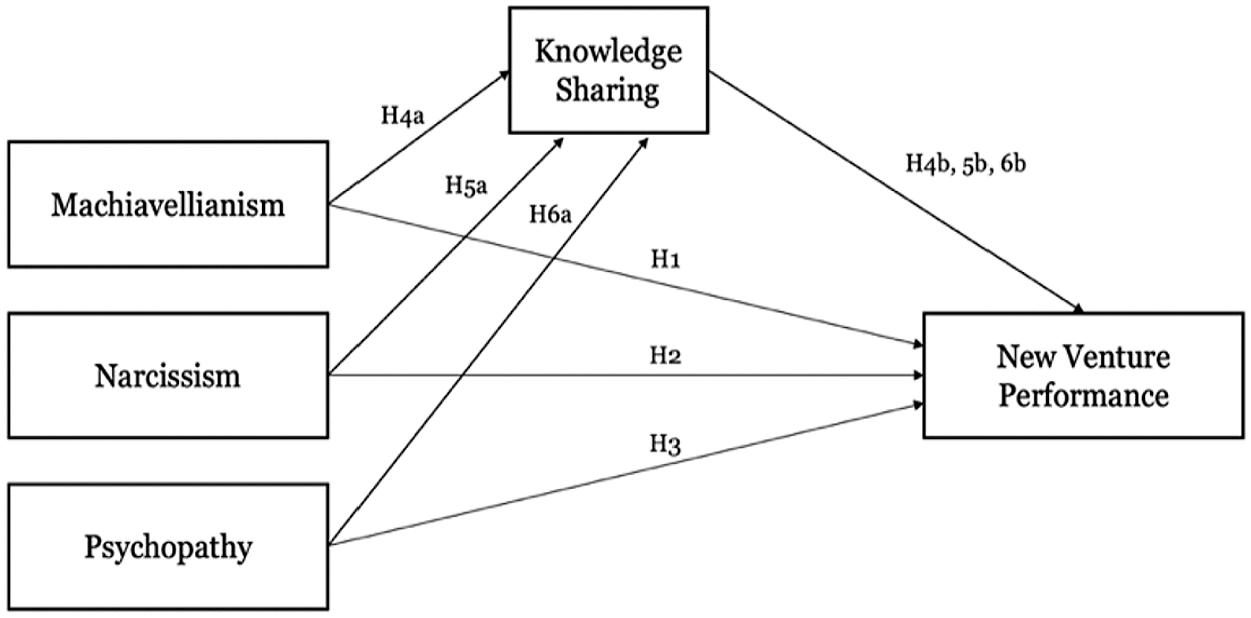
Theoretical model.
Methods
A survey questionnaire approach was used across two studies. The primary objective of a two-study approach was to provide a multifaceted perspective of the association between these traits and new venture performance, using both subjective (study one) and objective (study two) performance measures, as described below.
Study One
Sample
The dataset for the first study consists of 264 technology entrepreneurs. The inclusion criterion to participate in the study was status as a current entrepreneur in the technology industry located within the United States. Participants were recruited via social media, email, and through personal networks of the author team, and research assistants were involved in the data collection. We applied established procedures for snowball sampling, as used by recent studies in leading entrepreneurship journals (e.g., Bullough et al., 2014; Kelly & McAdam, 2022; Lascaux & Kolesnikova, 2021; Williams et al., 2022), where participants were asked to refer friends and/or colleagues who met the selection criteria to complete the survey (Kirchherr & Charles, 2018; Morgeson & Humphrey, 2006). This approach resulted in 293 respondents. Incomplete surveys and/or respondents outside of technology industries were excluded, leaving 264 responses remaining. These entrepreneurs were an average age of 31.08, had 71 months of experience, the average size of their venture was 7.96 individuals, and 51% were male. 2
Measures
Dependent Variable
New venture performance is conceptualized in this research as a multidimensional construct in terms of two sub-dimensions: profitability and growth, consistent with well-established best practices for measurement of new venture performance (Murphy et al., 1996; Stam & Elfring, 2008; Wang et al., 2017). In accordance with current entrepreneurship research (Dai et al., 2019; Martin et al., 2020; Peng et al., 2020; Smolka et al., 2018), the dependent variable, new venture performance, was assessed using the Stam and Elfring (2008) five-item scale. A sample item is, “Compared to competitors, our company achieves higher sales growth,” measured on a five-point Likert scale. Mean reliability was calculated, α = .84.
Independent Variables
We employed the Dirty Dozen scale (Jonason & Webster, 2010), which has been used extensively to measure Machiavellianism, narcissism, and psychopathy not only in current entrepreneurship research but also robustly across multiple domains and publication outlets (see Appendix B). The Dirty Dozen scale consists of 12 items, with each trait being measured by 4 items on a five-point Likert scale. Some scholars have questioned the content validity of the Dirty Dozen (Smith et al., 2018) and suggest longer single-trait measures (e.g., MACH-IV, Christie & Geis, 1970; SRP-III, Paulhus et al., 2015; NPI, Raskin & Terry, 1988). However, these lengthy measures create issues of feasibility and fatigue, which tend to result in poor data quality and low response rates (Nguyen, 2017). Furthermore, the Dirty Dozen performs appropriately when compared to long-form measures of each trait (Jonason & Luévano, 2013; Rammstedt & Beierlein, 2014). A sample item for Machiavellianism is, “I tend to manipulate others to get my way,” for narcissism is, “I tend to want others to admire me,” and for psychopathy is, “I tend to lack remorse.” Mean reliabilities were calculated for Machiavellianism, narcissism, and psychopathy, respectively, α = .80, α = .83, and α = .79.
Knowledge sharing was measured using a five-item, five-point Likert scale based on the instrument developed by van den Hooff and van Weenen (2004). A sample item is, “I intend to share my knowledge with colleagues who ask.” Mean reliability was calculated, α = .81.
Control Variables
To control for the possibility of alternative explanations for the hypothesized relationships, several relevant control variables were included in the analysis. First, Rose et al. (2006) find that the age of an entrepreneur positively relates to venture performance, while other research shows that these three traits tend to weaken over time (Barlett & Barlett, 2015). Second, biological sex is found to be an important predictor of differences in key entrepreneurial outcomes (Jennings & Brush, 2013; Langowitz & Minniti, 2007), and men tend to score higher than women on all three of these traits (Jonason & Davis, 2018). Prior entrepreneurial experience tends to positively relate to venture performance because entrepreneurs have acquired knowledge and skills that directly relate to the venture creation process (Burton et al., 2002). As such, we controlled for age, sex (coded as male = 1, female = 0), and entrepreneurial experience (reported in months).
Study Two
In study two, new venture performance data were collected through objective measurement of performance to account for reliability concerns that are sometimes associated with subjective performance measures (Wiklund & Shepherd, 2005).
Sample
The dataset consists of 307 technology entrepreneurs. To generate the sample, multiple publicly available databases listing active entrepreneurs in the technology industry in the Western United States were accessed to compile a large pool. Following standard procedures for random stratified sampling (Neyman, 1992), 1,000 respondents were randomly selected from this pool. Four waves of invitations to complete the questionnaire were sent via email, one initial request, and three follow-up reminders. Participants received a small financial incentive for completion of the survey. This approach resulted in 381 completed responses, with identical selection criteria to study one (currently active U.S. entrepreneurs within the technology industry). After excluding incomplete and unusable surveys, 307 responses remained, a response rate of 30.7%, which is considered typical of random sampling (Cycyota & Harrison, 2006). Respondents were an average age of 35.02 years, had 63.19 months of prior work experience, and 7.21 years of post-high school education; 46% were married, and 58% were male. These entrepreneurs reported an average of $8,924.07 of initial funding, primarily funded from savings.
Measures
Dependent Variable
Consistent with the conceptualization of the dependent variable in study one, new venture performance was measured using indicators reflecting profitability and growth, but in contrast to study one, data were collected through objective measurement of financial performance. As part of the data collection effort, we requested the most recent year-over-year accounting statement, specifically including financial information reporting return on assets (ROA), return on equity (ROE), employee growth, and sales growth, as described in greater detail below.
Profitability
Organizational profitability can be measured by ROA and ROE (Combs et al., 2005; Sidik, 2012). ROA is commonly used to assess financial results and is one of the most frequently used firm performance measures in management research (e.g., Berry, 2015). Furthermore, research suggests that ROE indicates the financial outcome of new ventures and demonstrates the managerial and operational effectiveness of new ventures (Robinson, 1999). Scholars utilize ROA and ROE as two indicators of profitability (Hsu et al., 2013). Consistent with this framework and current empirical research, we employed ROA and ROE (calculated as a year-over-year percentage) as the profitability dimension of performance.
Growth
Entrepreneurship research indicates that new venture growth is a critical indicator of new venture performance (Baum et al., 2001, Li & Zhang, 2007). Systematic reviews of venture performance instruments demonstrate that the most important indicators of growth are in terms of sales, employees, and market share (Zou et al., 2010). Based on the limitations of capturing market share data in the entrepreneurial context, scholars tend to focus on indicators based on sales and employee growth (Murphy et al., 1996; Weinzimmer et al., 1998). Consistent with this conceptualization and current research (Adomako, 2020; Ruiz-Jiménez et al., 2021; Wang et al., 2017), we employed employee growth and sales growth (calculated as a year-over-year percentage) as the growth dimension of performance.
Independent Variables
As in study one, the Dirty Dozen scale (Jonason & Webster, 2010) was used to measure the independent variables, Machiavellianism, narcissism, and psychopathy, with mean reliabilities of α = .81, α = .79, and α = .82. Knowledge sharing was measured using the scale developed by van den Hooff and van Weenen (2004), with mean reliability α = .86.
Control Variables
To increase the precision of our analyses, several control variables were added to the analysis, along with the inclusion of the variables in study one: age, sex, and entrepreneurial experience. Education is positively related to entrepreneurial activity and venture performance, such that an increase in education is associated with superior performance (Bergmann & Sternberg, 2007; Ritsilä & Tervo, 2002). Furthermore, some scholars find moderate relations between an individual’s education level and the strength of these three traits (Kardum et al., 2017). Therefore, we controlled for education, captured as years of post-high school education (Foster et al., 2003). Marital status could conceal the effects of another income source on new venture performance (Byrne et al., 2016), such that we controlled for marital status. Social desirability refers to the individual’s tendency to respond in a more socially desirable manner in certain situations (Richman et al., 1999) and reflects what one believes will lead to approval from others or avoid disapproval (Crowne & Marlowe, 1960). Consistent with best practices (e.g., Larson, 2019; Owens et al., 2019), we included seven items, measured on a five-point Likert scale, from the social desirability instrument (Crowne & Marlowe, 1960; Forgeard et al., 2011). A sample item is, “I’m always willing to admit it when I make a mistake.” Mean reliability was calculated, α = .79. In consideration of venture-level variables, research consistently offers that the amount and source of funding are linked to performance (Florin, 2005). Therefore, we controlled for the amount of initial venture funding, reported in dollars, and funding source (e.g., bank loan, savings). All predictors were standardized prior to analysis, and all survey items are available in Appendix A.
Analysis
The curvilinear relationships were tested using quadratic regression in which the independent variable was squared to represent the hypothesized curvilinear effect (Cucina & Vasilopoulos, 2005). To test mediators of a curvilinear relationship requires nonlinear mediation modeling. We applied the methodology described by Hayes and Preacher (2010) to estimate the instantaneous indirect effect, which is the effect of the predictor through the mediator at varying levels of the predictor. The mediation effect depends on the value of the predictor, which means that the effect of personality on new venture performance depends on the level of knowledge sharing at different values of the personality trait. These effects were tested using nonparametric bootstrapping (N = 5,000) by applying the MEDCURVE macro code (Hayes & Preacher, 2010) in SPSS, in which instantaneous indirect effects are provided at the mean of the independent variable, as well as one standard deviation above and below the mean.
We conducted several additional analyses to validate the robustness of our study. To confirm the structural validity of the Dirty Dozen, we performed a confirmatory factor analysis. However, as χ2 is sensitive to sample size, we elected to rely on robust versions of the comparative fit index (CFI; Bentler, 1990), and root mean square error of approximation (RMSEA; Steiger, 1998). Traditional cut-offs for good model fit are CFI >0.95; RMSEA values <0.06 (Hu & Bentler, 1999). Our results suggest good fit (CFI = 0.96, 0.95; RMSEA = 0.04, 0.03), and we found no significant cross-loadings between traits. Additionally, while there have been concerns related to high intercorrelations between the traits (i.e., poor discriminant validity; Smith et al., 2018), we did not find this occurring in our studies (Tables 1 and 5). To test for differences between respondents and non-respondents, we conducted two-tailed t-tests comparing the full and final sample for both studies. Results proved nonsignificant for all variables, showing that the groups do not differ significantly (age, t = 1.195, 2.114; sex, t = 1.071, 1.212; education, t = 2.044, 1.992; experience, t = 1.329, 3.179; marital status, t = 1.914, 2.090; new venture performance, t = 2.559, 3.092).
Finally, as the dataset for the first study uses self-report data from a single source, there is potential for common method bias (Podsakoff, 2003). Common method variance (CMV) might inflate observed relationships among measures, which could cause scholars to falsely conclude that a relationship exists (type I error; Fuller et al., 2016). We assessed for common method bias using the correlation-based marker variable technique (Simmering et al., 2015; Williams et al., 2010), which can control for measurement errors despite not having identified their nature. The process is first to select a marker variable that is not strongly correlated with any predictors. Within our data, this variable was created from a set of four indicators asking respondents about international business development. To exclude the effects of CMV, the minimum correlation between the marker variable and the variables measured was removed from all correlations (r = .0083), which partials out CMV from the results (Fuller et al., 2016). The correlations between the marker and predictor variables were low (r = .01 or less), and the marker variable had a nonsignificant correlation with any predictor variables, supporting the discriminant validity of the marker variable (Lindell & Whitney, 2001). We can conclude that the correlations of the predictor and the dependent variable cannot reasonably be accounted for by CMV, and that these variables retain their practical significance in terms of a meaningful amount of variance.
Results
Study One
Table 1 reports descriptive statistics for all variables in study one, and Table 2 presents the results of testing the association between personality and new venture performance in study one. The quadratic effect of Machiavellianism on performance was statistically significant in support of an inverse U-shaped curvilinear relationship (β = −.28, p = .001), supporting hypothesis 1. The quadratic effect of narcissism on performance was not statistically significant, offering no support for hypothesis 2. Finally, the quadratic effect of psychopathy on performance was statistically significant in support of an inverse U-shaped curvilinear relationship (β = −.19, p = .003), supporting hypothesis 3. Likelihood-ratio tests were conducted; they offer evidence that the models including the quadratic terms for Machiavellianism (p = .003) and psychopathy (p = .001) demonstrate improved model fit over the corresponding linear models.
Study One Descriptive Statistics.
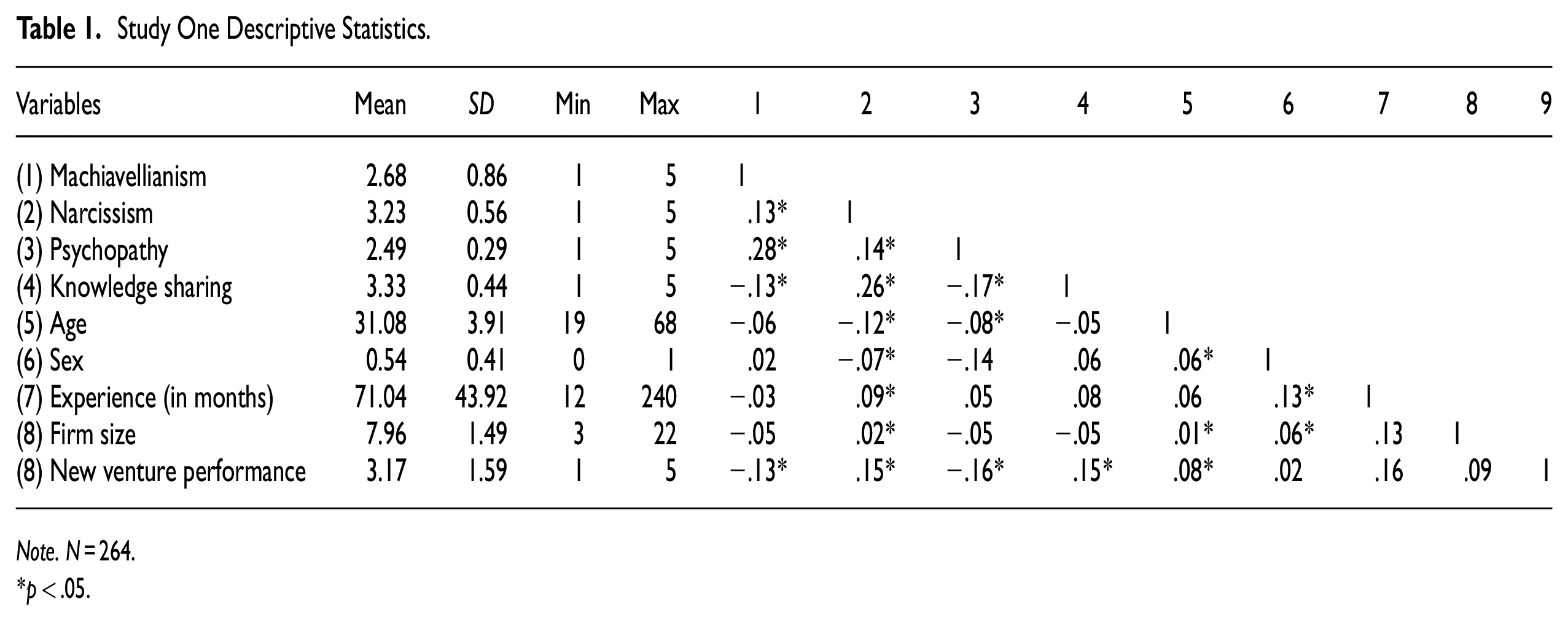
Note. N = 264.
p < .05.
Study One Regression Analysis of Personality and New Venture Performance.
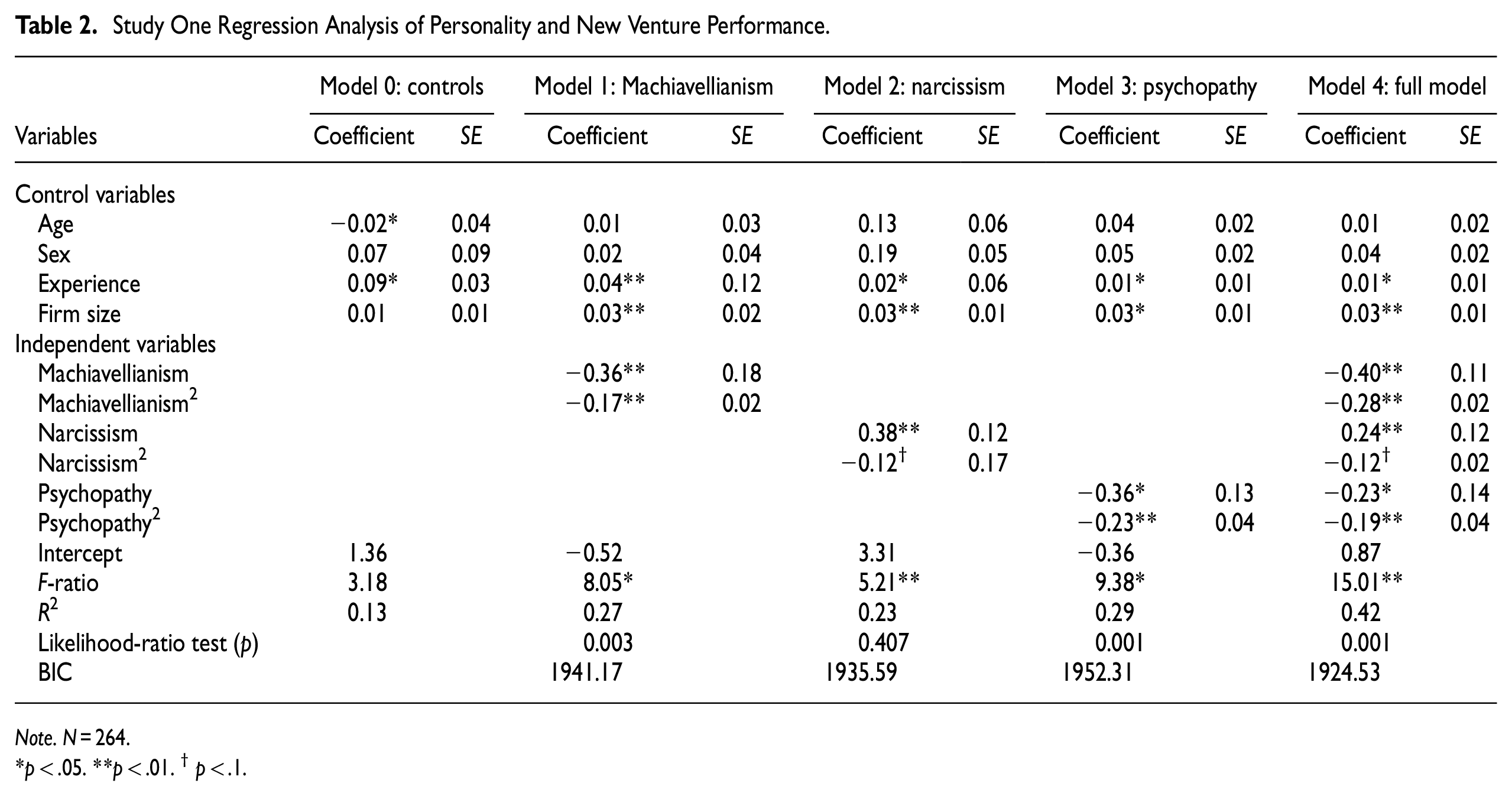
Note. N = 264.
p < .05. **p < .01. †p < .1.
Table 3 presents the results of the relationships between personality and knowledge sharing. The quadratic effect of Machiavellianism on knowledge sharing was statistically significant in support of an inverse U-shaped curvilinear relationship (β = −.13, p = .001) supporting hypothesis 4a. The quadratic effect of narcissism on knowledge sharing was not statistically significant, offering no support for hypothesis 5a. The quadratic effect of psychopathy on knowledge sharing was statistically significant in support of an inverse U-shaped curvilinear relationship (β = −.29, p = .001) supporting hypothesis 6a.
Study One Regression Analysis of Personality and Knowledge Sharing.
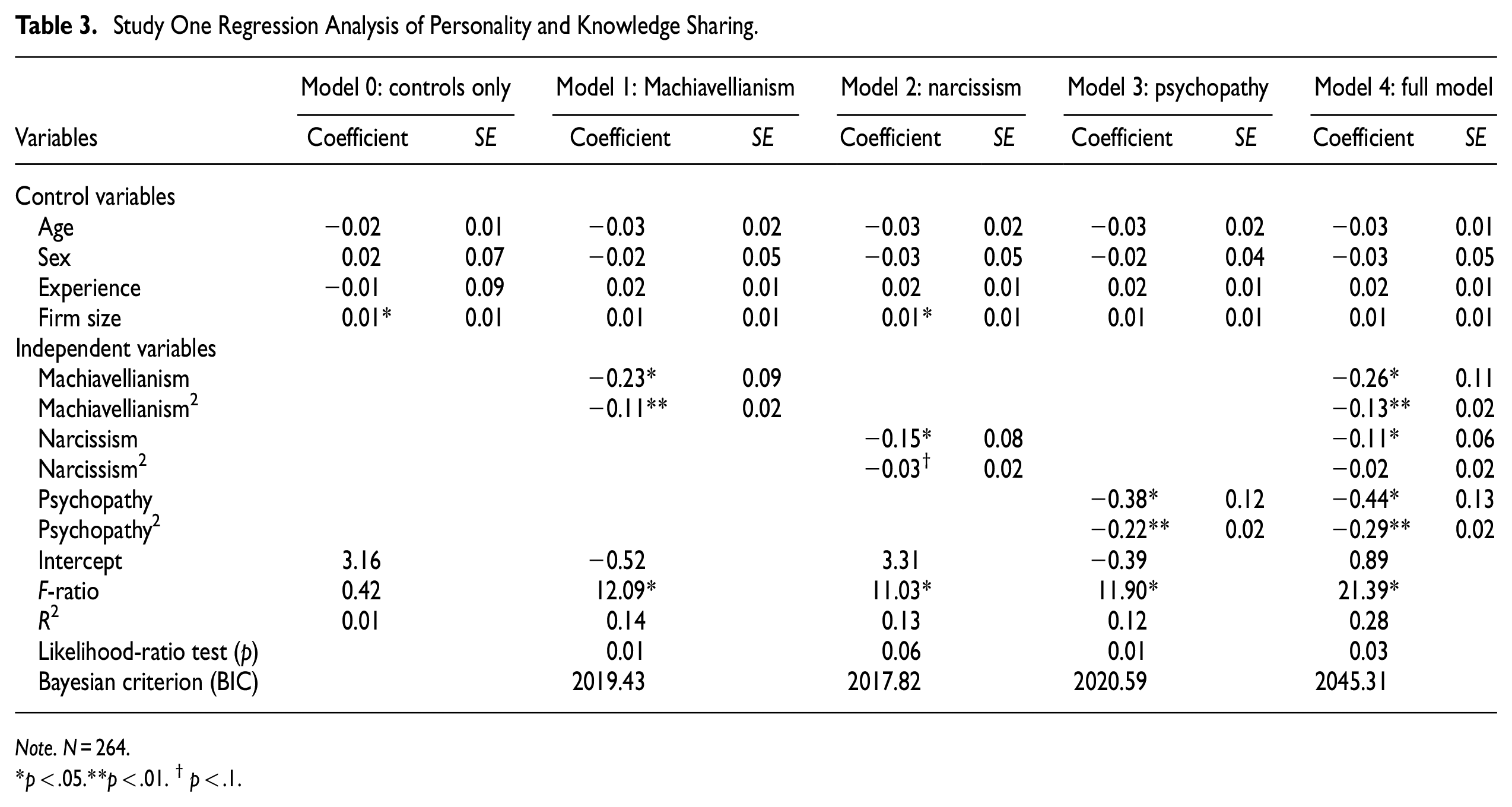
Note. N = 264.
p < .05.**p < .01. †p < .1.
Table 4 presents the results of the bootstrapped instantaneous indirect effect analysis for Machiavellianism and psychopathy. The instantaneous indirect effect of knowledge sharing was significant at moderate (β = .16, p < .01) and high levels (β = −.13, p < .05) of Machiavellianism, providing support for hypothesis 4b. The instantaneous indirect effect of knowledge sharing was significant at moderate (β = .04, p < .04) and high levels (β = −.11, p < .05) of psychopathy, providing support for hypothesis 6b.
Study One Mediating Effects of Knowledge Sharing.
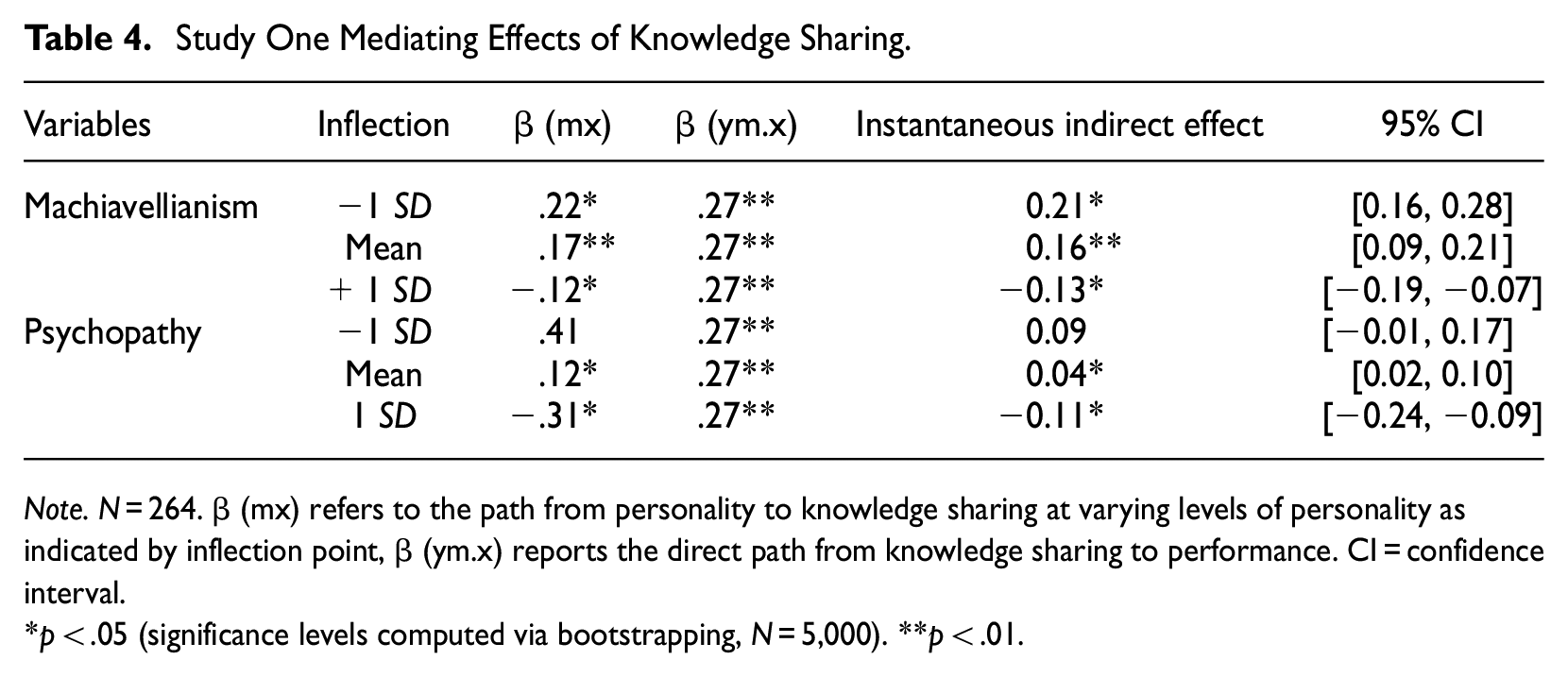
Note. N = 264. β (mx) refers to the path from personality to knowledge sharing at varying levels of personality as indicated by inflection point, β (ym.x) reports the direct path from knowledge sharing to performance. CI = confidence interval.
*p < .05 (significance levels computed via bootstrapping, N = 5,000). **p < .01.
Because no statistical support was found for a curvilinear association between narcissism and performance, the instantaneous indirect effects were not tested. However, in post hoc analysis a statistically significant positive relationship was found between narcissism and performance (β = .19, p = .002). Knowledge sharing was tested as a mediator and statistical support was found, such that knowledge sharing has a significant indirect effect on the positive relationship between narcissism and new venture performance (β = .13, p < .05).
Study Two
Table 5 reports descriptive statistics for all variables in study two, and Table 6 presents the results testing the association between personality and new venture performance in study two. The quadratic effect of Machiavellianism on performance was statistically significant in support of an inverse U-shaped curvilinear relationship (β = −9.64, p = .003), supporting hypothesis 1. The quadratic effect of narcissism on performance was not statistically significant, offering no support for hypothesis 2. Finally, the quadratic effect of psychopathy on performance was statistically significant in support of an inverse U-shaped curvilinear relationship (β = −14.57, p = .001), supporting hypothesis 3. Likelihood-ratio tests were conducted and offer evidence that the models including the quadratic term for Machiavellianism (p = .006) and psychopathy (p = .010) demonstrate improved model fit over the linear models.
Study Two Descriptive Statistics.
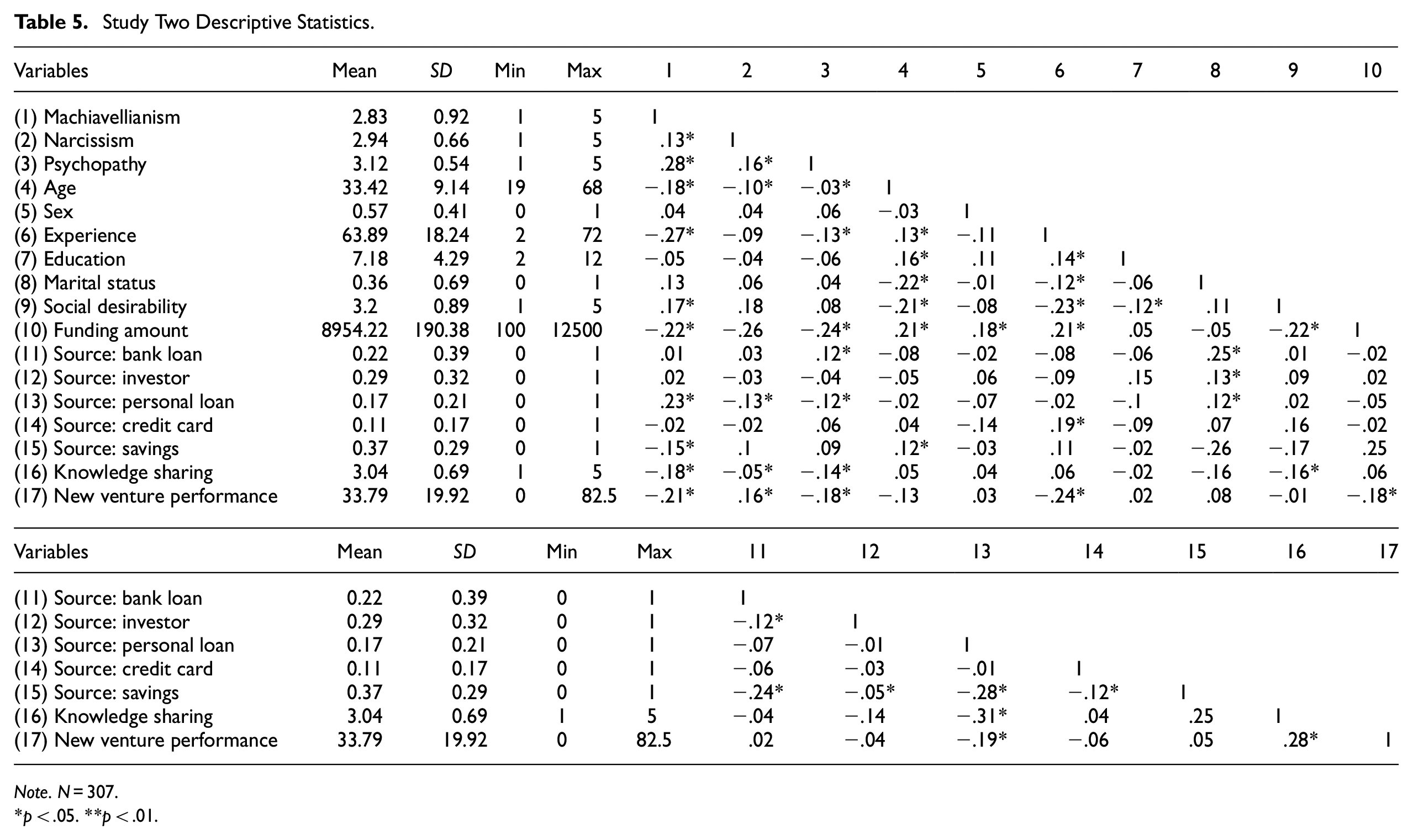
Note. N = 307.
p < .05. **p < .01.
Study Two Regression Analysis of Personality and New Venture Performance.
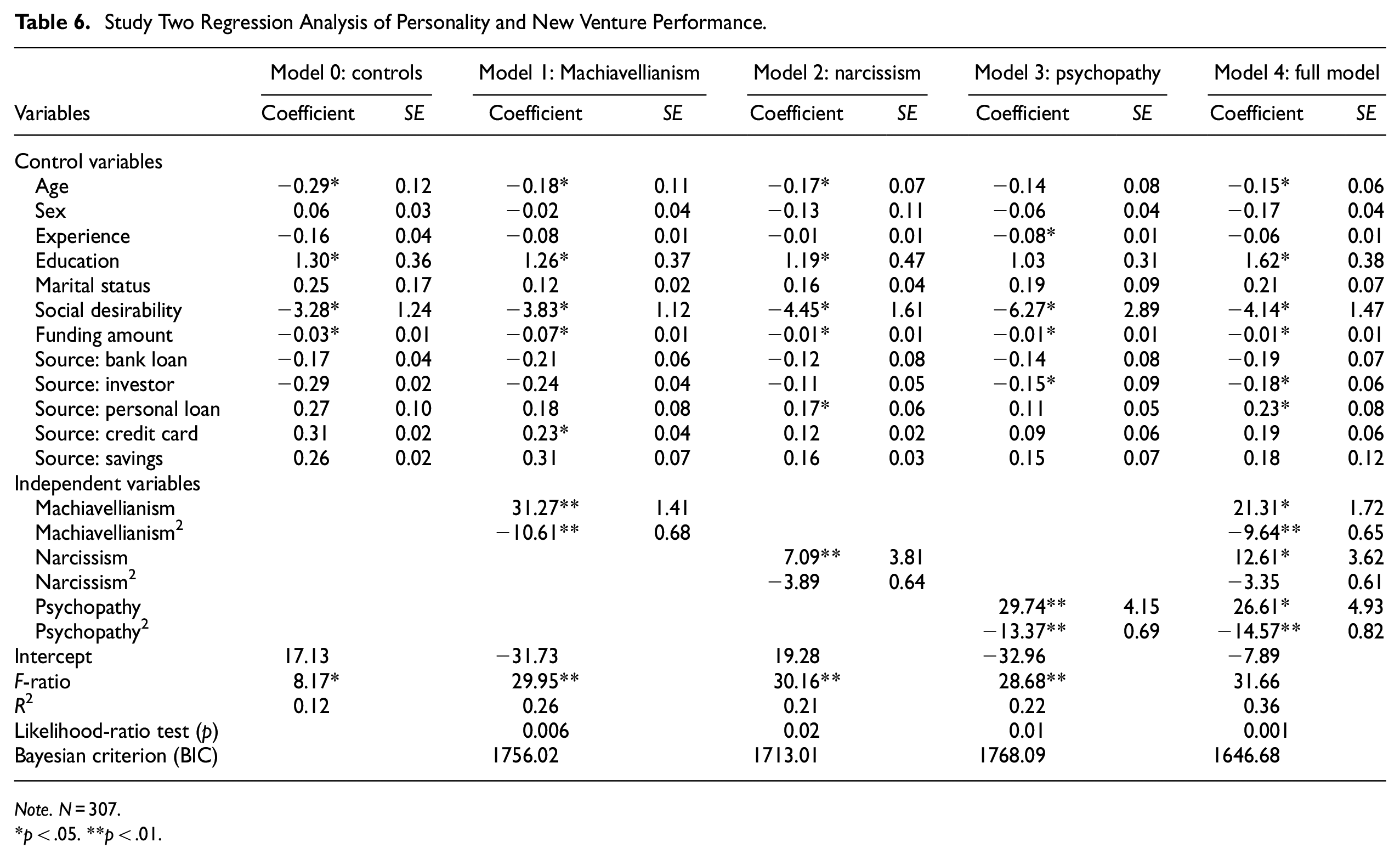
Note. N = 307.
p < .05. **p < .01.
Table 7 presents the results of the relationships between personality and knowledge sharing. The quadratic effect of Machiavellianism on knowledge sharing was statistically significant in support of an inverse U-shaped curvilinear relationship (β = −.41, p = .03) supporting hypothesis 4a. The quadratic effect of narcissism on knowledge sharing was not statistically significant, offering no support for hypothesis 5a. The quadratic effect of psychopathy on knowledge sharing was statistically significant in support of an inverse U-shaped curvilinear relationship (β = −.91, p = .001) supporting hypothesis 6a.
Study Two Regression Analysis of Personality and Knowledge Sharing.
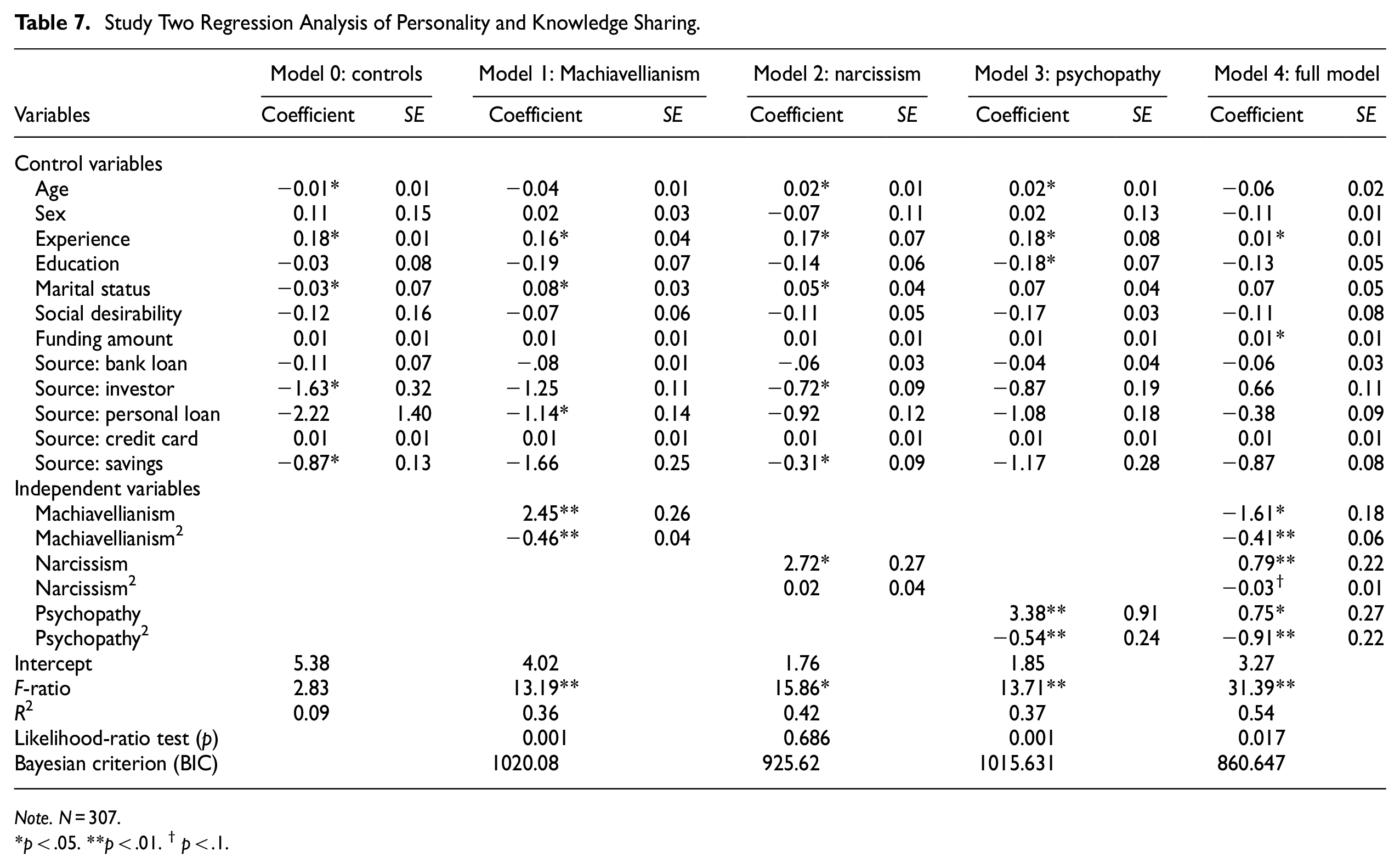
Note. N = 307.
p < .05. **p < .01. †p < .1.
Table 8 presents the results of the bootstrapped instantaneous indirect effect analysis for Machiavellianism and psychopathy. The instantaneous indirect effect of knowledge sharing was significant at moderate (β = .11, p < .01) and high levels (β = −.14, p < .01) of Machiavellianism, providing support for hypothesis 4b. The instantaneous indirect effect of knowledge sharing was significant at moderate (β = .06, p < .05) and high levels (β = −.08, p < .01) of psychopathy, providing support for hypothesis 6b.
Study Two Mediating Effects of Knowledge Sharing.
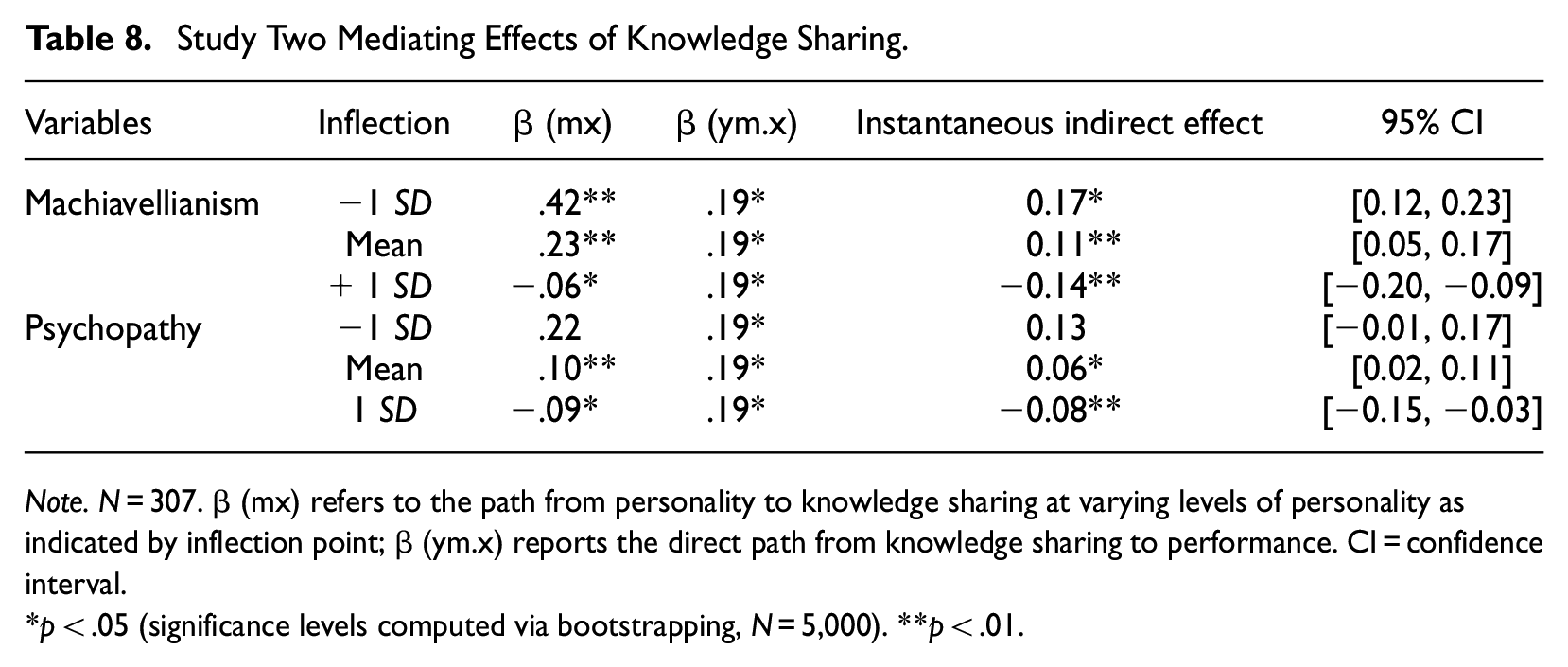
Note. N = 307. β (mx) refers to the path from personality to knowledge sharing at varying levels of personality as indicated by inflection point; β (ym.x) reports the direct path from knowledge sharing to performance. CI = confidence interval.
p < .05 (significance levels computed via bootstrapping, N = 5,000). **p < .01.
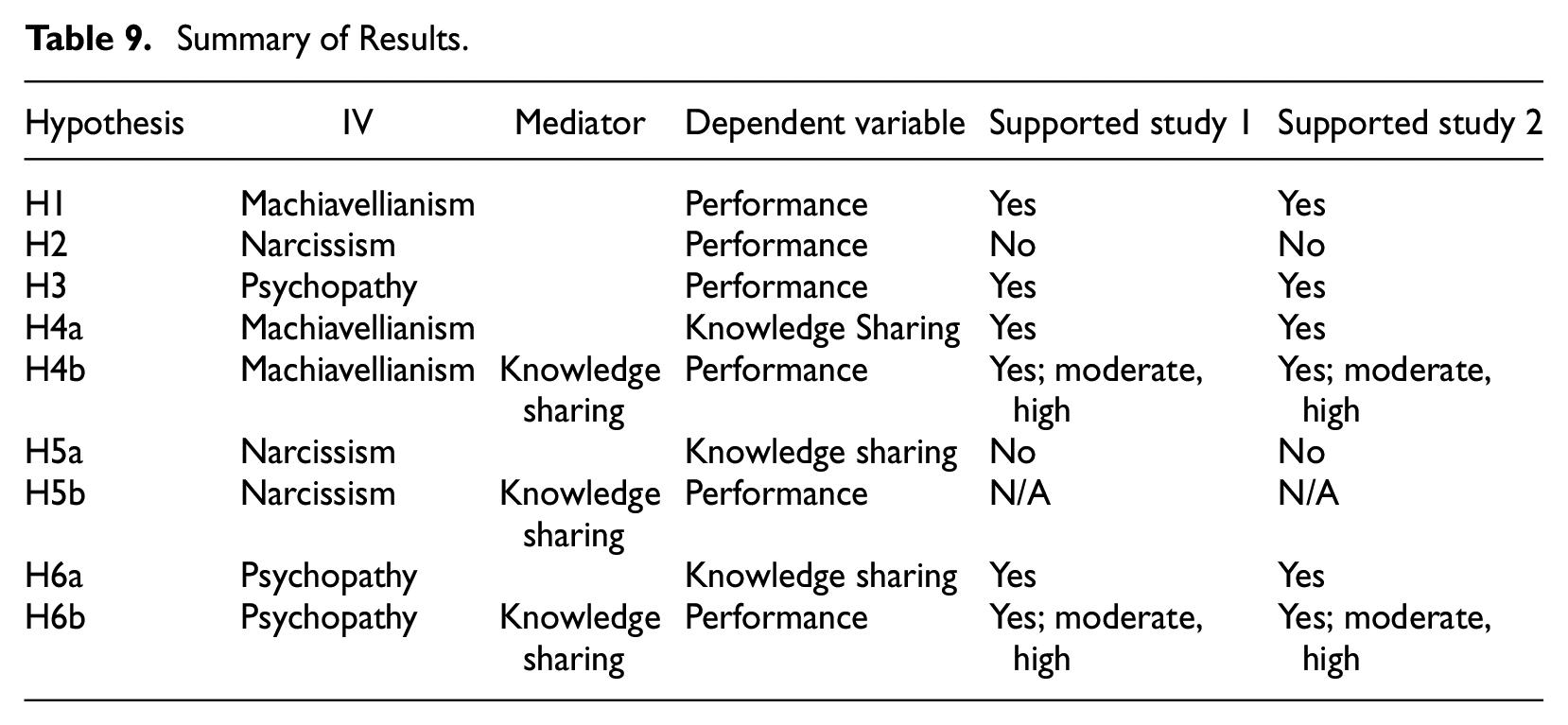
Because no statistical support was found for a curvilinear association between narcissism and performance, the instantaneous indirect effects were not tested. However, in post hoc analysis a statistically significant positive relationship was found between narcissism and performance (β = 10.28, p = .001). Knowledge sharing was tested as a mediator and statistical support was found, such that knowledge sharing has a significant indirect effect on the positive relationship between narcissism and performance (β = .38, p < .05). We include plots of the curvilinear relationships in Appendix C, and a summary of the results is presented in Table 9.
Summary of Results.
Discussion
The purpose of this research was to apply self-regulation theory to theorize and test for curvilinear relationships between founder Machiavellianism, narcissism, and psychopathy and new venture performance, with consideration of a mediator, knowledge sharing. The results have implications for how scholars understand the influence of personality on performance-related outcomes, identify knowledge sharing as a key behavioral choice that offers insight into the association between varying levels of certain traits and performance differentials, and extend recent investigations into trait-based explanations for destructive entrepreneurial actions.
Implications for Theory
First, one of the most thought-provoking findings is the detection of previously unobserved curvilinear associations between Machiavellianism and psychopathy, and new venture performance. The implication of this finding is that the costs and benefits of these traits can be directly associated with the strength of each trait. This complements recent research on the “too much of a good thing” effect (Busse et al., 2016; Pierce & Aguinis, 2013), which first challenged the assumption that more of a desirable personality trait is better by theorizing curvilinear relationships, such that ordinarily beneficial traits are no longer advantageous when taken too far. We contribute to this conversation by demonstrating that traits presumed to be predominantly negative (Machiavellianism, psychopathy; Creek et al., 2019; Wales et al., 2013) can be beneficial at more moderate levels. Furthermore, these findings extend the results of a recent systematic review, which established that Machiavellianism and psychopathy have negative associations with performance, but revealed substantial variance in these relationships (Brownell et al., 2021). As the first study within the broader literature to show support for curvilinear relationships between Machiavellianism and psychopathy and performance-related outcomes, we offer an explanation for both the heterogeneity found in the review and the conflicting results in prior research. This has implications for other traits traditionally classified as negative, which could similarly be beneficial at moderate amounts but damaging at excessive levels for entrepreneurs, CEOs, and others in leadership positions.
However, these principles do not broadly apply to all traits considered problematic. Contrary to our theorizing and prior research (e.g., Anglin et al., 2018), we found a significant positive linear relationship between narcissism and performance in post hoc analyses. A possible explanation for this finding is that narcissists are often perceived less negatively (Rauthmann & Kolar, 2012) and can channel impulsivity in more functional ways (Jones & Paulhus, 2011). Even at higher levels, this suggests that narcissistic entrepreneurs are less likely to exhaust the regulatory resources required to maintain focus on facilitating venture growth and profitability. Furthermore, a defining characteristic of narcissism is an inflated but fragile sense of self-importance (Chatterjee & Hambrick, 2007), and a key reason that narcissists are attracted to positions of power is their desire to leave behind an admirable legacy (Maccoby, 2004). It is plausible that narcissistic entrepreneurs might develop an intense attachment of their self-concept to their new venture, therefore avoiding destructive behaviors in protection of the new venture. An individual’s self-concept consists of three principal elements: “the imagination of our appearance to the other person; the imagination of his judgment of that appearance (i.e., cognitively knowing), and some sort of self-feeling, such as pride or mortification” (Cooley, 1922, p. 184). Once the new venture becomes “enclosed” within the self-concept, a process which we describe as narcissistic encapsulation, these entrepreneurs are likely to become singularly focused on performance as an instrument and extension of their self-worth and expend considerable resources on achieving new venture growth and profitability. This pursuit is often valorized and viewed as selfless, and the positive feedback and reinforcement that follows will further bolster all three elements of the self-concept in which the narcissist’s new venture is embedded. This makes narcissism particularly compelling in the entrepreneurial context, where entrepreneurs like Steve Jobs are often glorified as master strategists for their contributions to creativity and innovation within their ventures, yet rarely held accountable for their flaws.
Second, we identify knowledge sharing as a mediator of the curvilinear relationships between Machiavellianism, psychopathy, and performance. This contributes to research at the intersection of entrepreneurship and organizational behavior (e.g., Baumeister et al., 2006; Hoyle, 2006; Hoyle & Davisson, 2016; Hoyle & Gallagher, 2015; Inzlicht et al., 2021; Malanchini et al., 2019; McCrae & Löckenhoff, 2010) by offering insight into an explanatory mechanism connecting founder personality to new venture performance. Hoyle (2006, p. 1515) notes, “Consideration of a self-regulation-behavior link at different levels of a trait might reveal an association not evident when the link is evaluated in an unconditional model.” Prior work demonstrates that Machiavellianism and psychopathy negatively relate to knowledge sharing (Liu, 2008; Pan et al., 2018) and have even been associated with “knowledge sabotage,” wherein critical information is intentionally concealed or falsified (Serenko & Choo, 2020). In contrast, we find support for the indirect effects of knowledge sharing at moderate levels of founder Machiavellianism and psychopathy. This identifies knowledge sharing as an important behavioral choice made by these entrepreneurs, who are better able to regulate damaging impulses and engage in cooperative behaviors in pursuit of success, unlike those with higher levels of these traits, and it is only through investigation of these relationships at varying levels of personality that this unique association is revealed.
Notably, the regulatory resources argument is rapidly becoming an important theoretical perspective leveraged to explain the association between individual characteristics and new venture performance (Shepherd et al., 2022). Self-regulation is critical to the entrepreneurial process because entrepreneurs face extreme decision-making demands in uncertain contexts, requiring emotional regulation and sustained motivation (John & Gross, 2004). Our work showcases knowledge sharing as a critical strategic behavior with the potential to explain performance differentials for entrepreneurs. The knowledge-based view describes the power of intangible knowledge-based resources to confer competitive advantage (Bogner & Bansal, 2007; Grant, 1996), which is increasingly important for entrepreneurs competing in a knowledge-based economy. In parallel, our findings underscore the importance of maintaining adequate cognitive resources for entrepreneurs to engage in essential venture decisions and tasks, such as participating in cooperative behaviors like knowledge sharing.
A third implication of our findings offers insight into recent conversations regarding the three traits of the triad. Scholars have recently developed a successor to the “Dark Triad,” the “Dark Tetrad,” which includes sadism (Jain et al., 2022; Johnson et al., 2019), while others query whether these traits should be mapped onto a single “Dark Core” (Bertl et al., 2017) or aggregated with the five-factor model (FFM) and HEXACO dimensions into a single model of personality (Schreiber & Marcus, 2020). Within this dialog is discourse about whether narcissism should be replaced or removed from the triad/tetrad due to its dissimilarity from the other traits (e.g., Dinić et al., 2020; Rogoza et al., 2019; Trahair et al., 2020). We show that the relationship between narcissism and new venture performance differs substantially from the other two traits, and our factor analysis did not show high intercorrelations between the three traits. In post hoc analysis, we conducted tests of dependent correlations, which evaluate whether correlations between each trait and performance differ from one another (i.e., test of dependent r’s; Meng et al., 1992; Miller et al., 2019). We determined that the correlations of each trait with performance are substantially dissimilar (z-tests for Machiavellianism, narcissism, psychopathy in study one = 2.062, in study two = 3.343; Lenhard & Lenhard, 2014). These divergent results confirm that the triad should not be grouped into a single latent trait. Furthermore, the beneficial aspects of these traits found by our studies offer additional evidence that the “Dark Triad” label is an inappropriate naming convention which scholars should perhaps consider dispensing with entirely—not only in the context of entrepreneurship, but broadly across applied personality research. In support of recent calls to divest scholarship of language that can be interpreted as having racialized connotations, that is, “pinning lightness to goodness and darkness to badness” (Bergman, 2019, p. 414; Gluck et al., 2020), we suggest dismantling the “Dark Triad” and fully discarding dark/light labeling conventions to describe the impact of personality.
Finally, we present a nuanced perspective to recent conversations concerning destructive entrepreneurial actions (e.g., Brownell et al., 2021; De Sordi et al., 2022; Shepherd, 2019; Shepherd et al., 2022). Our research contributes to this line of inquiry by isolating how constructive versus destructive actions might manifest differently at varying levels of each trait, based on the ability to self-regulate. The literature defines destructive actions as attempts to identify, explore, and exploit opportunities that cause more harm than benefit to society (Minniti, 2008), and offers individual-level explanations through binary assessment of traits traditionally considered to be “negative” (Klotz & Neubaum, 2016). However, these curvilinear relationships suggest that there is greater nuance to be understood. If entrepreneurs with any amount of Machiavellianism and psychopathy were only associated with destructive entrepreneurial actions, it is unlikely that we would find a positive relationship with performance at low to moderate levels. Self-regulation theory is rooted in control of the self, but entrepreneurs with high levels of these traits are fundamentally motivated by a desire to control others (Baumeister & Vohs, 2004; Paulhus & Williams, 2002). We add to these conversations by suggesting a paradox of control—such that entrepreneurs with high levels of Machiavellianism and psychopathy might choose to engage in destructive entrepreneurial actions by way of their desire for control over others, but entrepreneurs who can control themselves (e.g., those at more moderate levels) can instead leverage the strategic benefits of each trait.
Implications for Practice
The results of this research offer useful insights for entrepreneurs, venture capitalists, and incubator/accelerator programs with an interest in the success of new ventures. First, these relationships suggest that current or aspiring entrepreneurs could benefit from careful self-analysis to consider how they might harness the potential benefits of certain traits traditionally considered only to have negative connotations, while considering the potential downsides and the importance of maintaining their regulatory resources. This also translates into the classroom. Personality self-assessments might shed light on areas where students with entrepreneurial intentions are advised to seek feedback, self-regulate, or partner with others to take advantage of the benefits of their personality while simultaneously addressing potential weaknesses. For example, while personality traits tend to be somewhat stable (Ardelt, 2000), an entrepreneur scoring extremely low on any of these traits might reflect on how they could adopt the beneficial behaviors of moderate levels of these traits—to be more strategic, less emotional, and/or more confident, or seek a partner with these complementary skills—in pursuit of new venture success.
Second, this research underscores the power of knowledge sharing as it enables positive social influence and signals self-regulation. Knowledge sharing on publicly visible platforms can signal to potential investors and employees that the entrepreneur not only possesses valuable knowledge, but also the generosity and goodwill to share it. Investors, incubators, accelerators, and other programs interested in the success of entrepreneurs could include knowledge sharing as a selection criterion and/or encourage the development of strategic knowledge-sharing plans. Even if knowledge sharing is rooted in unproductive motives, it still could represent a win-win scenario for both the recipient, in that they stand to gain valuable knowledge, and the entrepreneur, in garnering the relationships necessary for new venture growth and profitability.
Limitations and Future Research Directions
This work should be considered in light of its limitations. First, while the preponderance of research on these three traits—and broadly within the domain of personality—relies exclusively on self-report questionnaires (Smith et al., 2018), self-report measurement does offer significant challenges to scholars. The best method of mitigating these concerns is through inclusion of a social desirability scale as a control variable (Larson, 2019), as was done in this research, as a well-established best practice (e.g., Dunkel & Van der Linden, 2014; Franzen & Wöhner, 2021; Kowalski et al., 2016; Owens et al., 2019; Satornino et al., 2022; Wismans et al., 2021). However, self-report measures can be unreliable for individuals that might have misguided notions of their tendencies and behaviors, such as those high in Machiavellianism, narcissism, and psychopathy. Future scholars might consider triangulation of measurement of each trait by including both self- and other-report measures. Second, while snowball sampling has become quite popular due to the flexibility of the approach (e.g., Kelly & McAdam, 2022; Lascaux & Kolesnikova, 2021; Williams et al., 2022), it can add cause for potential selection bias and generalizability concerns, and we suggest that future scholars continue to pursue greater precision in sampling approaches.
Third, the items measuring narcissism in the Dirty Dozen scale (Jonason & Webster, 2010) are based on Raskin and Hall’s (1979) work creating a subclinical version of the Narcissistic Personality Disorder instrument, which treats narcissism as a single trait. Scholars have recently argued that there are two separate facets of narcissism: grandiosity and vulnerability (Weiss & Miller, 2018). Both types share common features, such as self-centeredness and entitlement (Miller et al., 2011), but differ substantially in other respects. For instance, research shows that grandiose narcissism, characterized by high self-esteem and a persistent need for admiration, correlates positively with extraversion and negatively with neuroticism, but vulnerable narcissism, characterized by defensiveness and hostility, has a negative association with extraversion and a positive association with neuroticism (Zajenkowski & Szymaniak, 2021). It is plausible that entrepreneurs with high levels of grandiose narcissism are those with positively linked to performance, but entrepreneurs with high levels of vulnerable narcissism are negatively affecting their ability to acquire the resources necessary for success. Future studies might consider potentially significant subpopulations in examination of founder narcissism. Finally, we suggest that scholars at the intersection of mental health and entrepreneurship (e.g., Stephan, 2018; Wiklund et al., 2018, 2020) examine nonlinear relationships for other traits presumed negative, such as those associated with impulsivity. As with psychopathy and Machiavellianism, there is an increasing awareness that these conditions lie on a spectrum and dichotomizing them as good or bad is likely to limit our understanding.
Conclusion
Personality is ubiquitous in that it affects individual actions, group behaviors, and organizational dynamics. Through the lens of individual self-regulation, our work reveals that the relationships between personality and performance can differ substantially at moderate and high levels of certain traits, and with greater complexity than has been indicated by prior research. We explore the implications for personality theories of entrepreneurship, self-regulation, and how venture performance might be both driven by desires for control of others, but negatively impacted by failures in self-control.
Footnotes
Appendix
Declaration of Conflicting Interests
The author(s) declared no potential conflicts of interest with respect to the research, authorship, and/or publication of this article.
Funding
The author(s) received no financial support for the research, authorship, and/or publication of this article.
