



Abstract
Integrating the family embeddedness perspective with research on commensality and family meals, we develop a framework that explains why some families are more likely to fuel entrepreneurship than others. Inspired by the diversity literature and the role of the Chinese Confucian culture in shaping family dynamics, we explore how two demographic (i.e., age and gender) and two knowledge-based (i.e., education and industry) sources of diversity within family households predict a family member starting a business. We further theorize that these relationships are contingent on the frequency of family meals, as family meals serve as a conduit for how family diversity affects entrepreneurship by providing the setting where socialization and interaction take place. Using data from a representative sample of 8,162 individuals via the China Family Panel Studies in the 2014 to 2018 period, our findings demonstrate that although greater age and gender diversity hamper entrepreneurship, family meals “feed the fire” of entrepreneurship for families with greater industry and education diversity.
Since the beginning of the entrepreneurship field of study, scholars have sought to understand what fuels an individual’s desire to start a business. This pursuit remains central to the field due to the importance of entrepreneurship to economies around the world and the growing interest in how entrepreneurship can be nurtured (Chlosta et al., 2012). Because of the fundamental role the family plays in shaping individuals’ education, values, and experience, the family has been described as the “oxygen that feeds the fire of entrepreneurship” (Rogoff & Heck, 2003). Based on shared values pertaining to how things ought to be, families exert normative influence on individuals’ attitudes and prescribe the bounds of acceptable behavior (Arregle et al., 2019). Through social learning, knowledge is also transferred among family members as individuals learn to model professional interests (Chlosta et al., 2012). As explained by the family embeddedness perspective, “people are not atomized decision-makers, but rather, are implicated in networks of social relations” with the family being the closest and possibly strongest network to influence entrepreneurship (Aldrich & Cliff, 2003, p. 577). The family may therefore be key to understanding why some individuals are more likely to start a business than others.
However, while research applying the family embeddedness perspective acknowledges the central role families play in the creation of new businesses, findings have been mixed. For example, although some studies show that entrepreneurial parents encourage their children to start a new business, other studies show that they often dissuade their children from entrepreneurship (e.g., Carr & Sequeira, 2007; Chlosta et al., 2012; P. H. Kim et al., 2006). On one hand, looking at the advantages a family bestows an aspiring entrepreneur, scholars have argued that the family can offer knowledge, resources, and feedback that support the launch of a new business (Edelman et al., 2016; Hatak & Zhou, 2021; F. Xu et al., 2020). Yet, on the other hand, research has shown that families can decrease individuals’ interest in entrepreneurship (Sieger & Minola, 2017; Z. Zhang & Reay, 2018) and undermine the success of a family member’s new business (Au & Kwan, 2009; Coppens & Knockaert, 2022).
Thus, to move research on the family embeddedness perspective of entrepreneurship forward, it is necessary to take a more complex view of families whereby their heterogeneity is considered. Indeed, researchers drawing from family science theories have called for studies to acknowledge the diversity that occurs within families (Jaskiewicz & Dyer, 2017; Jaskiewicz et al., 2017; Tsai et al., 2018). In line with research demonstrating that different types of team diversity (i.e., gender, age, industry, education) can promote or discourage entrepreneurial activities (Chowdhury, 2005; Dai et al., 2019; Tuggle et al., 2010), such sources of diversity may also explain why families vary in their support for entrepreneurship. Additionally, because the time families spend together is likely important to the socialization process of entrepreneurs (Edelman et al., 2016; Pearson et al., 2008), we consider how family meals matter in fueling entrepreneurship. Family meals serve as an important bond that embeds and holds family members together (H. C. Ho et al., 2017; Yu et al., 2015). In particular, research on socialization within families views family meals as “cultural sites where members of different generations and genders come to learn, reinforce, undermine or transform each other’s ways of acting, thinking and feeling in the world” (Ochs & Shohet, 2006, p. 47). Accordingly, diversity within families may either ignite or extinguish entrepreneurship depending on the frequency of family meals.
In the present study, we integrate the family embeddedness perspective (Aldrich & Cliff, 2003) with research on commensality and family meals (e.g., H. C. Ho et al., 2017; Ochs & Shohet, 2006) to develop a framework that explains why some families are more likely to fuel entrepreneurship than others. Our unit of analysis is the individual and our theory and related empirics focus on the family household (co-habiting unit of relatives; Stewart, 2014) to which s/he belongs. We test our theoretical model using data from 8,162 individuals from the China Family Panel Studies (CFPS) in the 2014 to 2018 period. China offers an ideal setting for our study because of the particularly important role of family relationships in launching and operating new ventures in the country (Au & Kwan, 2009; F. Xu et al., 2020). Chinese culture is deeply rooted in Confucianism which emphasizes the collective needs of the family and filial piety (Zhou et al., 2019). The system of social and ethical values espoused by Confucianism has a significant influence on China’s economic development (Du, 2016; Y. Yan et al., 2021), as it encourages individuals to honor the family through career ambition and occupational success (D. Y. F. Ho, 1996; Lang, 2010). Additionally, because it is common for multiple generations to co-habit in China (F. Zhang & Wu, 2021), this setting offers a unique context to apply the family embeddedness perspective to entrepreneurship.
Our study offers several contributions to the entrepreneurship literature. First, we contribute to the family embeddedness perspective of entrepreneurship by highlighting how sources of diversity within a family explain why some families are more likely to nurture entrepreneurship than others. Thus, in contrast to the vast majority of research that portrays the family as a homogenous unit (Jaskiewicz & Dyer, 2017; Jaskiewicz et al., 2017), we emphasize their heterogeneity by focusing on the diversity that can occur within families. Taking inspiration from the diversity literature, we focus on two key demographic (i.e., age and gender) and two key knowledge-based (i.e., education and industry) sources of diversity (e.g., Bolli et al., 2018; Chowdhury, 2005; García-Granero et al., 2018; Tuggle et al., 2010; K. Wang et al., 2022). Importantly, our work deviates from the predominant literature that studies diversity of groups within existing firms in general (e.g., Horwitz & Horwitz, 2007) and family firms in particular (e.g., Ling & Kellermanns, 2010; Sciascia et al., 2013) by studying the diversity within family households. Relatedly, our research demonstrates the applicability of diversity research to groups outside of a business, and specifically to family households.
Second, because the influence of these sources of diversity is shaped by China’s Confucian values, we offer a more contextualized view of family embeddedness that emphasizes the importance of the cultural context in understanding how a family can ignite or extinguish entrepreneurship. In this way, we answer calls for research to apply the family embeddedness perspective of entrepreneurship beyond North America and Europe, thus considering how culture shapes family relationships and the influence of the family on entrepreneurship (Aldrich & Cliff, 2003; J. Yan & Sorenson, 2006). Additionally, by focusing on entrepreneurship in China, we contribute to research that recognizes entrepreneurship as a driving force of sustained economic development and thus, aim to understand how entrepreneurship can be further encouraged and facilitated in China (He et al., 2019; Huang et al., 2016) via family support and interactions (Ge et al., 2019). Our study demonstrates that while Chinese families with greater industry diversity encourage entrepreneurship, those with greater age and gender diversity appear to stifle it. Additionally, education level diversity was found to benefit entrepreneurship among families who frequently share meals together.
Third, because social bonds and time spent interacting appear to alter the effect of diversity on team effectiveness and performance (Gimenez-Jimenez et al., 2021; Harrison et al., 2002; Ling & Kellermanns, 2010), regularly spending time together as a family may alter how sources of diversity affect family members’ willingness to start a business. For families, the family meal is particularly important in forging social bonds and developing communal identity and values (Ochs & Shohet, 2006). Commensality, or the practice of sharing food and eating together, is central to defining and sustaining the family as a social unit (Ochs & Shohet, 2006). Family meals are therefore likely to serve as a conduit for how family diversity affects entrepreneurship by providing a setting where socialization takes place. As such, for those families who more frequently share meals, greater diversity is likely to have a more profound impact on entrepreneurship than for those who rarely share a meal together. Therefore, this study contributes to research on family embeddedness and entrepreneurship by identifying an important setting where families commonly share values and ideas that, in turn, serves as a conduit for sources of diversity to either ignite or extinguish entrepreneurship. Furthermore, our focus on the frequency of family meals as a moderator allows us to explain why the influence of diversity on entrepreneurship varies among families, thereby contributing to our understanding of why some families are more likely to create homes that produce entrepreneurs than others.
Theoretical Background
Family Embeddedness Perspective of Entrepreneurship
Entrepreneurship research has long recognized that entrepreneurs do not act in isolation, but instead, their behaviors and ability to identify opportunities are contingent on the environment in which they are embedded (Jack & Anderson, 2002; Wigren-Kristoferson et al., 2022). This research builds on the embeddedness literature which aims to understand the process through which individuals’ social relationships influence economic action (Granovetter, 1985; Uzzi, 1996), and the family is recognized as a fundamental social institution that shapes individuals’ view of entrepreneurship (Rogoff & Heck, 2003). In focusing specifically on the significance of the family to entrepreneurship, the family embeddedness perspective views the family and business as inextricably intertwined (Aldrich & Cliff, 2003). Family embeddedness “emphasizes how the characteristics of entrepreneurs’ family systems (i.e., transitions, resources, and norms, attitudes and values) can influence the processes involved in venture creation (i.e., opportunity recognition, the launch decision, resource mobilization, and the implementation of founding strategies, processes, and structures)” (Aldrich & Cliff, 2003, p. 574).
Research applying the family embeddedness perspective often focuses on the resources a family can bestow an entrepreneur to assist with the launch of a business, including the family’s financial, human, and social capital (Edelman et al., 2016; Eesley & Wang, 2017; Hatak & Zhou, 2021; Weimann et al., 2021). Additionally, it often focuses on the socialization and learning that occur within a family to spur entrepreneurship; for example, the impact of entrepreneurial parents on children’s intentions to start a business (Chlosta et al., 2012; Greenberg, 2014; Hopp et al., 2019; Sorenson, 2007). However, because findings have been inconsistent, researchers have called for a more comprehensive view of family embeddedness that better highlights family heterogeneity and social dynamics (Edelman et al., 2016; F. Xu et al., 2020). As Aldrich and Cliff (2003) explained: “[w]e need to learn more about the role that family characteristics and dynamics play in why, when and how some people, but not others, identify entrepreneurial opportunities and decide to start business enterprises” (p. 593).
Indeed, despite discussing the need to consider the time spent as a family interacting and who is in the family’s household, such as women, children, and/or multiple generations (Aldrich & Cliff, 2003), little research has studied diversity in such characteristics. Such an omission in the literature is surprising given the preponderance of research that demonstrates the significant impact of team diversity and team member interaction on entrepreneurial behavior (Chowdhury, 2005; Dai et al., 2019; Sciascia et al., 2013; Tuggle et al., 2010). For example, team diversity is commonly seen as a “double-edged sword” (Cummings, 2004; Milliken & Martins, 1996). Although diversity has the potential to improve innovation and problem-solving due to the combination of diverse perspectives (M. Li, 2019; Tuggle et al., 2010), it can also lead to inferior decisions and delayed strategic action due to communication problems and biases (Faems & Subramanian, 2013; Sciascia et al., 2013). Therefore, similar to how research on teams, including top management teams (TMTs) and boards of directors, views diversity as both an advantage and disadvantage in promoting entrepreneurial behavior and innovation (Dai et al., 2019; Talke et al., 2011; Tuggle et al., 2010), it is necessary for research to explore how different sources of diversity within a family household can either ignite or extinguish entrepreneurship.
Below, we integrate the family embeddedness perspective with research on diversity to explore how two key sources of demographic diversity (age and gender) and two key sources of knowledge diversity (industry and education level) in a family influence entrepreneurship (i.e., the start of a business). Given our Chinese context, we also take into account the role of Confucian principles in explaining how family members’ behavior is shaped by different sources and levels of diversity. We then introduce the concept of family meals to our theoretical framework to explore how the frequency of shared time as a family via commensality affects how sources of diversity influence entrepreneurship.
How Diversity in Family Households Influences Entrepreneurship
Before starting a business, individuals are likely to seek opinions about their idea from family members (Greve & Salaff, 2003) and turn to their families for help in assessing the necessary resources that would make their business idea a reality (Elston et al., 2016). Yet, no two families are the same (Ling & Kellermanns, 2010). As research drawing from family science and the family embeddedness perspective have acknowledged, families vary in a multitude of ways which is likely to affect how members of a family view economic activities and opportunities (Aldrich & Cliff, 2003; Jaskiewicz et al., 2017). Although some studies have considered how diversity among a TMT or board of directors affects family firm outcomes (e.g., Ling & Kellermanns, 2010; Sciascia et al., 2013), research has yet to focus on different sources of diversity within a family household. In line with much of the diversity literature, we argue that greater demographic diversity in terms of age and gender is likely to inhibit entrepreneurship because it leads to social categorization and the development of ingroups and outgroups that impede communication, consensus-building, and cooperation (Faems & Subramanian, 2013; García-Granero et al., 2018; Joshi & Roh, 2009). Conversely, sources of knowledge-based diversity in terms of industry and education level are expected to be beneficial in accordance with previous studies that indicate that they contribute to idea generation and problem-solving due to the richer and more diverse sources of knowledge and experience shared (e.g., M. Li, 2019; Tuggle et al., 2010).
Age Diversity Within a Family Household
Whether an individual is embedded in a family with high or low age diversity is expected to affect entrepreneurship because of divergent views of risk and Confucian pressures of filial piety in Chinese families. Age diversity refers to the heterogeneity of adult family members’ ages in a household. For example, a multi-generational household would have a higher age diversity than a household with two similarly aged spouses. Age diversity is expected to affect entrepreneurship because older family members tend to resist change and avoid risk (Lévesque & Minniti, 2011; Ling & Kellermanns, 2010), while younger family members prefer making changes and engaging in risky behavior (Hoskisson et al., 2017; Kellermanns & Eddleston, 2006; Kellermanns et al., 2008). Research on family firms suggests that the involvement of multiple generations on a TMT inhibits knowledge exchange and understanding, thereby undermining the firm’s entrepreneurial orientation (Sciascia et al., 2013). It also appears that greater age diversity can make individuals less receptive to and tolerant of ideas from those of a different age, thus hurting an age-diverse team’s ability to pursue explorative and exploitative entrepreneurial activities (García-Granero et al., 2018). As such, extending this logic to family households suggests that due to different views of change and risk, greater age diversity is likely to inhibit entrepreneurship.
Additionally, the importance of filial piety (i.e., respect and obedience to elders) in guiding the behavior of many Chinese families suggests that greater age diversity will lessen the likelihood of entrepreneurship due to the need for younger family members to show submission to their elders and to suppress ideas that conflict with those of the older generation (Du, 2016; Tu, 1998; X. Xu et al., 2022). In such households, family members are likely to refrain from seeking feedback on business ideas for fear of instigating conflict or appearing to place individual needs before those of elders. Furthermore, for households with greater age diversity, such as those with grandparents or much older parents, the principle of filial piety compels young family members to make risk-averse career choices and to prioritize the needs of elders over their personal career desires so that they can provide stable care and security to them in their old age (Y. J. Chen et al., 2019; Ma et al., 2022). In contrast, the demands of filial piety are less salient when family members are closer in age, thus making it more likely that an individual will be willing to take the risk of starting a business. These arguments lead to the following hypothesis:
Gender Diversity Within a Family Household
Due to gender socialization within families (Campopiano et al., 2017; Madison et al., 2021) and Confucian principles that encourage traditional gender roles and stereotypes (Deutsch, 2006; H. O. Kim & Hoppe-Graff, 2001), the gender diversity of a family household is expected to affect the likelihood that a family member will start a business. Gender diversity refers to the distribution of men and women in a family household. Those with low gender diversity comprise more males or females (one gender dominates). Conversely, high gender diversity refers to households where males and females are more equal in numbers.
Although some research in corporate settings suggests that greater gender diversity in leadership benefits firm outcomes (e.g., Dai et al., 2019), most research, including meta-analyses, has found that greater gender diversity hampers entrepreneurial activities and firm performance due to problems with communication, knowledge sharing, and risk preferences (Chowdhury, 2005; Schwab et al., 2016; K. Wang et al., 2022). Greater gender diversity tends to generate negative behaviors such as decreased communication, stereotype-based role expectations, and increased conflict (Ali et al., 2015). It can also deter coordinated action and information exchange (Fernández, 2015; Sastre, 2015). Such patterns of behavior are often attributed to gender socialization, with the family being the primary institution responsible for developing and maintaining gender role expectations (Eagly & Wood, 2012; Ferree, 1990). Starting at a young age, females are socialized to foster family unity and to subordinate their interests for the sake of the family (Gupta et al., 2009; Madison et al., 2021). Males, on the other hand, are socialized to protect and provide for their family (Eagly & Wood, 2012; Gupta et al., 2009) and to display their autonomy and dominance to family members (Madison et al., 2021). As such, greater gender diversity in a household will likely discourage entrepreneurship because of women’s and men’s diverse approaches to evaluating the needs of the family and their willingness to take risk.
Confucian principles that guide men’s and women’s behavior also suggest that greater gender diversity in a household will impede entrepreneurship. Family roles in China tend to be highly gendered as the family is seen as a social enterprise that is patriarchal, patrilineal, and patrilocal (Hwang, 2012). Although women’s status is improving, for example, almost one third of family businesses in China have a female successor, traditional gender roles and stereotypes continue to influence family interactions because they are seen as promoting social order and family harmony (S. Chen et al., 2018; J. Yan & Sorenson, 2006). Women’s roles are complementary to those of men and they are expected to follow the decisions of their fathers, husbands, and adult sons (Deutsch, 2006). However, while the “man of the house” is in charge of economic issues and major decisions, the “woman of the house” is the “inner master” with authority over daily household issues and family relations (H. O. Kim & Hoppe-Graff, 2001). Problems therefore arise as gender parity is reached and both men and women in the household are faced with discussing entrepreneurial opportunities and the resources required to start a business.
In contrast, low gender diversity in a household should encourage entrepreneurship because the family will experience less conflict resulting from gender biases and social categorization. For example, recent entrepreneurship research shows that women gain strength in numbers whereby they are more innovative and better able to overcome gender biases when they are in the majority (Madison et al., 2022). Additionally, Confucian principles suggest that men are freer to pursue risky career ambitions when they are not pressured to protect and provide for female family members (Cheraghi et al., 2019; X. Li et al., 2022). Therefore:
Industry Diversity Within a Family Household
Whether an individual is embedded in a family with high or low industry diversity is likely to affect entrepreneurship because of the level of diverse knowledge that they can combine and consider. Industry diversity refers to the heterogeneity of adult family members’ industry background in a household. Whereas households with low industry diversity comprise family members who share the same industry background, those with high industry diversity comprise family members from different industries. Although the potential benefits of diversity can be difficult to attain because of problems with conflict, research shows that industry diversity is the most promising because it permits a more comprehensive search and analysis of strategic alternatives and leads to greater creativity (Pitcher & Smith, 2001). Greater industry diversity is associated with richer knowledge, perspectives, and resource networks (Geletkanycz & Hambrick, 1997; Tuggle et al., 2010). It exposes members to different sources of task information, know-how, and feedback (Cummings, 2004) as well as innovations and opportunities from a disparate industry that could be applied to one’s own, thus facilitating the exploration and exploitation of entrepreneurial opportunities (Dyer et al., 2008; Tuggle et al., 2010). Li (2019) argued that industry diversity enables boards to “consider different issues, ask different questions, and see altogether different worlds related to technology and innovation” which helps a firm to explore new business opportunities. Indeed, in comparison to those that lack industry diversity, boards with greater industry diversity are more devoted to the consideration of entrepreneurial opportunities (Tuggle et al., 2010). Given that deviation from industry norms is a typical characteristic of new ventures (Dyer et al., 2008), we therefore reason that individuals in households with high industry diversity will be more likely to start a business than those in households with low industry diversity.
Furthermore, because “Confucianism teaches that social and economic activities are not based on competition, but on the collectivist principles of cooperation, coexistence, and mutual support” (J. Yan & Sorenson, 2006, p. 239), greater industry diversity should help spark collaboration and fruitful discussions within a family about business opportunities. In contrast, because Confucian families tend to avoid open discussion when members share identical attitudes, experiences, and beliefs (Sison et al., 2020), family households with low industry diversity should be less likely to discuss business ideas related to their industry. Additionally, Confucianism’s emphasis on harmony and the importance of avoiding direct confrontation (J. Yan & Sorenson, 2006) may limit discussions about entrepreneurship in family households with low industry diversity as family members refrain from pointing out gaps and problems in their shared industry. Taken together, we therefore hypothesize:
Education Level Diversity Within a Family Household
Education level diversity in a family household is likely to affect entrepreneurship because it is a knowledge-based source of diversity that influences how individuals approach problems and whether a group of people focus on familiar issues within their comfort zone or explore divergent ideas and solutions (Laursen, 2012; Mahadeo et al., 2012). Education level diversity refers to the heterogeneity of adult family members’ education level in a household. Whereas households with low education level diversity comprise family members with the same or similar education level, those with high education level diversity comprise family members with various levels of educational attainment. Individuals with different levels of education have a different knowledge base, mental models, and cognitive structures (Smith et al., 2005). When working together, individuals with diverse education levels are more likely to identify problems, interpret problems differently, and develop a range of solutions, thus increasing innovation and the development of new products (Bolli et al., 2018; McGuirk & Jordan, 2012). It appears that diverse education levels provide different types of expertise that help firms to develop new products (Bolli et al., 2018) because greater informational variety allows teams to create more valuable solutions by combining distant, yet complementary, information sources (Fleming, 2001; Schubert & Tavassoli, 2020). In contrast, when education level diversity is low, individuals inherently focus on familiar aspects and ignore issues that are not in their “comfort zone” (Mahadeo et al., 2012). Therefore, households with greater education level diversity should be more likely to have a family member start a business than those with lower education level diversity.
The Confucian emphasis on education and “collective enhancement” of the family (Reagan, 2000; J. Yan & Sorenson, 2006) further suggests that family households with greater education level diversity will be more likely to produce an entrepreneur. Chinese families tend to place high value on education, with parents showing much interest and support for their children’s educational development as many gain degrees beyond their parents’ education level (Archer & Francis, 2006). In turn, educational achievements are seen as enhancing the family as a collective (D. Y. F. Ho, 1996; Yang, 2007), suggesting that family members are expected to share their diverse knowledge and information with the family. Additionally, it is hoped that educational achievements will improve the status and social class of the family unit (Choi & Nieminen, 2013), which should encourage the family to support entrepreneurship. Therefore:
The Moderating Role of the Family Meal
The family embeddedness perspective recognizes the intertwined nature of the family and business and emphasizes the fundamental role families play in supporting entrepreneurship (Aldrich & Cliff, 2003). However, as studies aim to explain inconsistent findings related to family embeddedness and understand why some families are more likely to ignite entrepreneurship than others, the importance of family interactions and time spent together are proving to be key (Edelman et al., 2016; F. Xu et al., 2020). Such research highlights how “families differ in terms of the strength of emotional bonding and closeness among members” (Sieger & Minola, 2017, p. 183) and thus, the impact of the family system on entrepreneurship seems to depend on the closeness of family relations (F. Xu et al., 2020). The time a family spends together is also likely important to the socialization of entrepreneurs (Edelman et al., 2016; Pearson et al., 2008). For example, family members who frequently share meals together have greater emotional resilience (Jargon & Petersen, 2022) and communication that centers on problem-solving (Yu et al., 2015). It is therefore surprising that previous family embeddedness research has not considered the frequency of family meals since research on child development and family functioning portrays family meals as the cultural site for the socialization of individuals and the establishment of social order and bonds within the family (H. C. Ho et al., 2017; Ochs & Shohet, 2006; Yu et al., 2015).
Family meals represent a salient activity that both signals and nurtures family relationship bonds (H. C. Ho et al., 2017; Veeck et al., 2018; Yu et al., 2015) while offering an opportunity for social interaction to facilitate a sense of belonging (Gilmore & Harding, 2022). Family meals are viewed in the family literature as “one of the most important—or even the most important—ritual for developing family identity” (Veeck et al., 2018, p. 2359; see also Charles & Kerr, 1988; Epp & Price, 2008) because family identity is “constructed from day to day activities like eating together” (DeVault, 1991, p. 39). Indeed, family meals, in many cultures, play the role “of family bonding and knowledge transfer between generations” (H. C. Ho et al., 2017, p. 2826). For instance, family meals have been found to enhance family connectedness in the United States (Neumark-Sztainer et al., 2010), Europe (Cappellini & Parsons, 2012), and Asia (H. C. Ho et al., 2017). In particular, the role of family meals in socializing family members and creating family unity is central to the Chinese culture due to the celebrated position of commensality that can be traced back at least 3,000 years (Yu et al., 2015, p. 508). Particularly in modern life, the family dinner has become the most important meal for the Chinese family because in the daytime, family members are often away at work (H. C. Ho et al., 2017; Veeck et al., 2018). As a cultural site for socialization, family meals are embedded in the practices and ideologies of the family and serve to reinforce social order, values, and moral perspectives. As explained by Ochs and Shohet (2006): “socialization into commensality is also socialization into sociocultural embodiments of generations, gender, and other positionings” (p. 39). Accordingly, the frequency of family meals is expected to act as a conduit for sources of diversity to either ignite or extinguish entrepreneurship. The negative effect of demographic sources of diversity (age, gender) and the positive effect of knowledge-based sources of diversity (industry, education level) on entrepreneurship should therefore be amplified (diminished) with more (less) frequent family meals.
In the Chinese culture, the family meal is often a time when Confucian principles are instilled and displayed, such as children learning to display deference by not showing a strong preference for certain foods over others (Cooper, 1986), women being in charge of preparing meals (Lin & Rantalaiho, 2003; Yu et al., 2015), and elders being served first (Yu et al., 2015). Commensality helps families to define “who we are” and serves as regularly scheduled meetings for family members to receive advice on how to avoid and solve problems (Yu et al., 2015). As such, families that share meals together more frequently have a stronger platform for socialization and communication. In turn, more frequently sharing meals suggests that norms related to age and gender within the family will be more prominent. For example, family members will be required to display filial piety and respect for traditional gender roles and stereotypes within the household during the more frequent dinners. Displays of social categorization and biases stemming from age and gender diversity should therefore be more common in households with more frequent family meals, strengthening the negative relationships of age diversity and gender diversity on entrepreneurship. In contrast, for those families that infrequently share meals together, the negative effects of age and gender diversity on entrepreneurship should lessen since the family will have fewer occasions to enact behaviors related to age and gender diversity. Thus, aspiring entrepreneurs should feel freer to start a business in such households. In formal terms, we therefore predict:
However, regarding knowledge-based sources of diversity, more frequent family meals should further ignite entrepreneurship as the family has greater opportunity to share knowledge and expertise stemming from industry and education level diversity. As a family household more often enjoys commensality, the family members are more likely to share advice and work collaboratively to solve problems (Yu et al., 2015). By frequently sharing meals, the family is able to regularly revisit discussions about start-up ideas and collaboratively work to identify the necessary resources to overcome potential problems associated with the start-up by drawing from their diverse industry and education level backgrounds. Conversely, for households that rarely share meals, the benefits of industry and education level diversity are less likely to support entrepreneurship because such families will have fewer opportunities to share knowledge and experiences, and to collaborate. These arguments lead to the following prediction:
Methods
Sample
We tested our hypotheses by using data from the CFPS, which is a nationally representative longitudinal survey of the adult population sampled every 2 years from 2010 to 2018 by the Institute of Social Science Survey of Peking University (Y. Chen et al., 2020; Xiao & Wu, 2021; Y. Xie & Hu, 2014; X. Xie et al., 2022). The sample of nationally representative adults in the CFPS was drawn from 25 provincial regions, which covered 95% of the population in China. The CFPS dataset is suitable for investigating our research question for several reasons. First, entrepreneurship is widespread in China, the second-largest economy in the world, and an important context for the literature on entrepreneurship and, in particular, on business start-ups (He et al., 2019). Second, like many cultures, the traditional Chinese culture values families as a long-lasting and crucial source of input to individuals’ decision-making, including the setup of a new business (Liu et al., 2015). Third, the CFPS survey, specifically its longitudinal representative design on individuals’ occupational status, makes it relevant and reliable for testing our model (Barnett et al., 2019; W. Wang et al., 2020). Lastly, the CFPS dataset contains information on each individual’s family members, that is, all the immediate relatives or non-immediate blood, marital, or adoptive relatives who live in the same household (Chirico et al., 2020; Wiklund et al., 2013). In China, the most prevalent family structure is composed of grandparents, parents, and children. Given that the CFPS study accurately tracks all participating adults’ family and occupational status since 2014, we used CFPS data for the period 2014 to 2018. Based on the full data available, we have a final sample of 8,162 adults. 1
Variables
To better infer causality and alleviate endogeneity issues, we temporally separated the independent variables (data from the year 2014) and the dependent variable on business start-ups (data in the following years) (see Kennedy, 2008; Wooldridge, 2012).
Business Start-Up
Following previous research (Barnett et al., 2019; George et al., 2016; Su et al., 2022), we measured business start-up through an individual’s change in occupational status from employee or “not working” to self-employed.
Family Diversity
We calculated the diversities of individual family members’age, gender, industry, and education. First, we calculated age diversity by the standardized coefficient of variation in age following prior research (García-Granero et al., 2018; Zhu & Shen, 2016). We also followed prior studies (Ali et al., 2015; Faems & Subramanian, 2013; Zhu & Shen, 2016) to calculate the diversity of the categorical attributes of gender, industry, and education with Blau’s index of heterogeneity—the most common approach to measure diversity for categorical attributes (Blau, 1977). The Blau’s index of heterogeneity is calculated as 1 − ∑(Pi)2, where Pi is the proportion of a category for a categorical variable. We computed the index based on gender (male or female), industry (in 22 categories of industrial classification, e.g., agriculture, mining, manufacturing, production, finance, education), and education (1 = high school or below; 2 = college; 3 = bachelor’s degree; 4 = master’s degree or above).
Family Meals
The CFPS survey measured the frequency of family meals (Veeck et al., 2018) based on the following question: “In general, how many times per week do you usually have dinner with your family (including eating outside together)?” The question focuses on dinner because individuals differ in their number of daily meals, yet dinner is culturally the most salient meal for family members to sit and gather together (H. C. Ho et al., 2017; Veeck et al., 2018; Yu et al., 2015).
Control Variables
First, we control for individuals’ age, gender, and education, which have been found to predict entrepreneurship (Elston et al., 2016). Relatedly, following previous research that revealed age has nonlinear effects on business start-up (T. Zhang & Acs, 2018), we control for age squared to account for any possible nonlinear effect of age. Second, we control for individuals’ personal income (logged) and family income (logged) as they are key antecedents of starting a business (Pittino et al., 2020). Third, we control for individuals’ number of children and family size (adults only), given their potential effects on deciding to establish a new business (Arregle et al., 2015; P. H. Kim & Longest, 2014; Pittino et al., 2020). Fourth, prior research suggests that entrepreneurial intentions pass from parents to children (Criaco et al., 2017; P. H. Kim et al., 2006). Thus, we consider whether an individual had at least one parent who had an entrepreneurial activity. 2 Finally, we controlled for urban residence dummy, which is whether the family resided in urban areas or rural areas, since the context in which a family is embedded may lead to different strategic outcomes (Baù et al., 2019).
Results
Table 1 shows the descriptive statistics and correlations of the studied variables. The variance inflation factors (VIF) (mean VIF = 1.5, highest VIF = 2.7) indicate multicollinearity issues are unlikely to pose a concern. To test our hypotheses, we used an event history survival analysis (Allison, 1984; Cleves et al., 2010; Criaco et al., 2022). The dependent variable in a continuous time event history model is the hazard rate, which is the likelihood of a given event occurring at time t. In our case, the dependent variable is dummy coded to indicate whether an individual started a business. To determine the model to use in an event history survival analysis, we examined the proportional hazard assumption (Cleves et al., 2010) through the Stata command “stphtest” (
Descriptive Statistics and Pearson Correlations (N = 8,162).
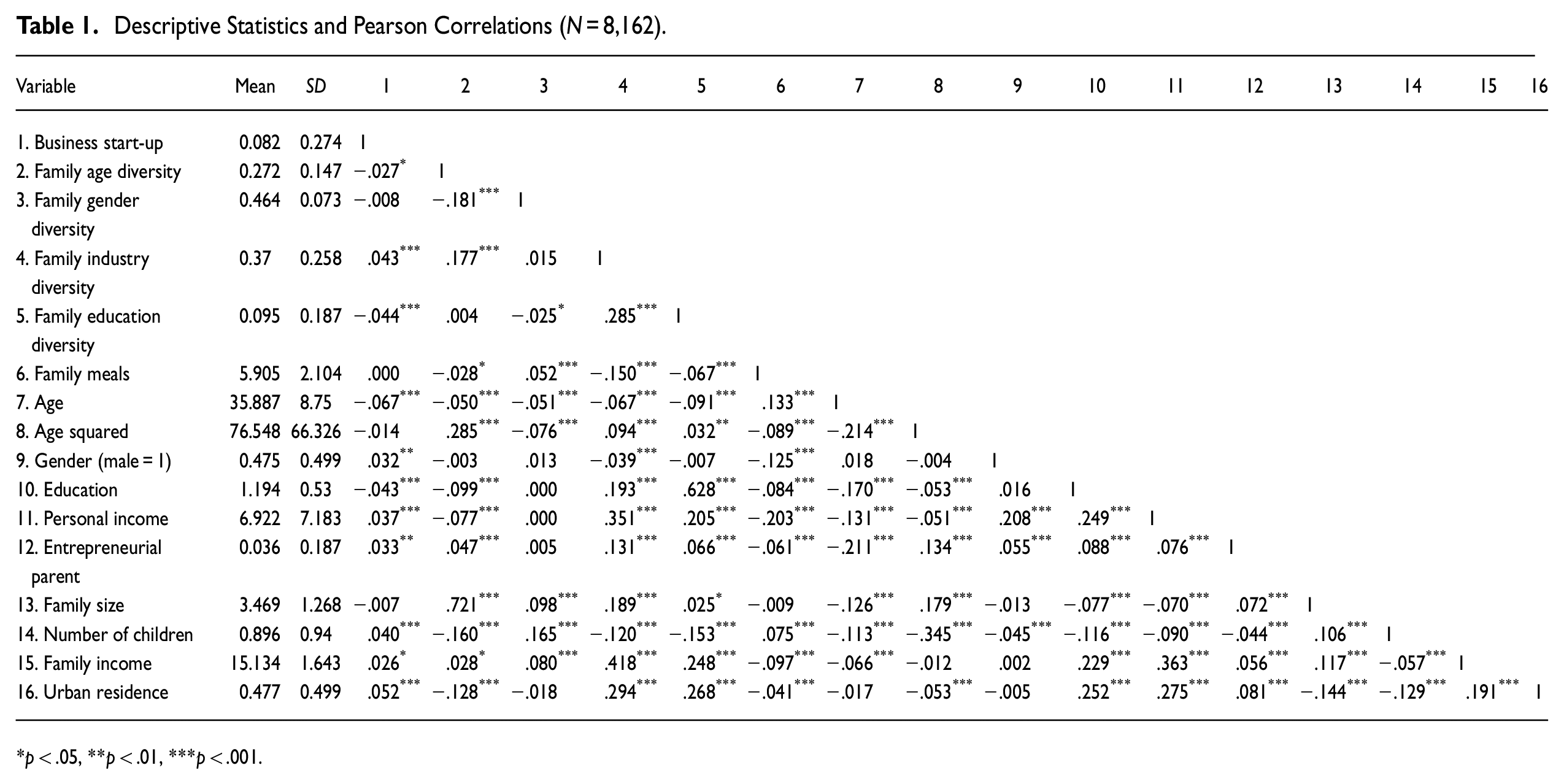
p < .05, **p < .01, ***p < .001.
Hypotheses Testing
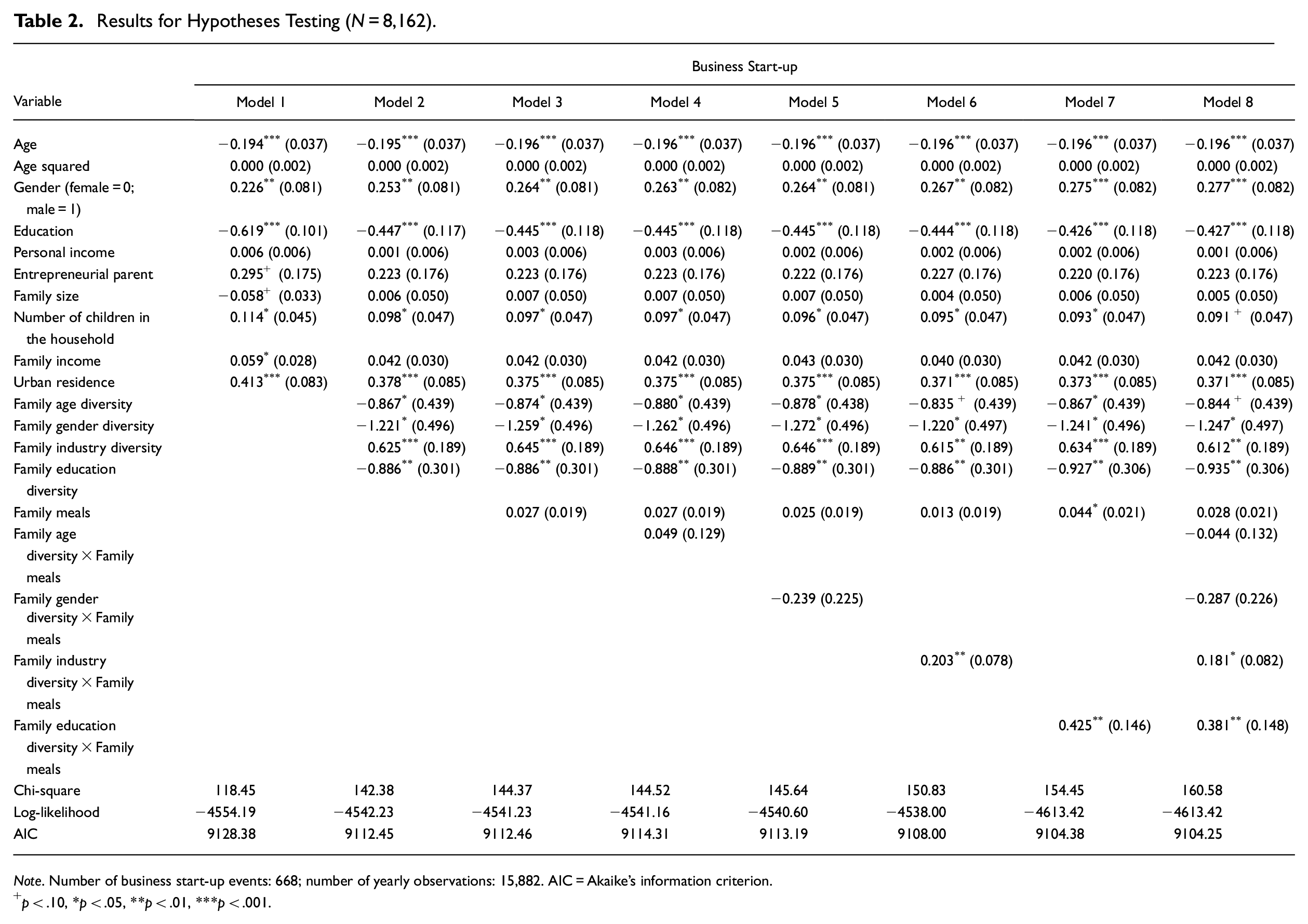
Table 2 shows the results of testing Hypotheses 1 to 3. Model 1 includes all of the control variables. While males are more likely than females to start a business (β = .226, p = .005), individuals who are older (β = −.194, p = .000) and more educated (β = −.619, p = .000) are less likely to do so. Individuals who have an entrepreneurial parent are more likely to also become entrepreneurs (β = .295, p = .092), while those in a big family are less likely to start a business (β = −.058, p = .074). Individuals having more children in the household (β = .113, p = .011), having more family income (β = .059, p = .038), and residing in urban areas (β = .413, p = .000) are more likely to start a business.
Results for Hypotheses Testing (N = 8,162).
Note. Number of business start-up events: 668; number of yearly observations: 15,882. AIC = Akaike’s information criterion.
p < .10, *p < .05, **p < .01, ***p < .001.
Model 2 adds the family diversity variables as predictors without the interaction terms. In line with Hypotheses 1 and 2, Model 2 shows that both family age diversity (β = −.867, p = .048) and gender diversity (β = −1.221, p = .014) have negative relationships with starting a business. In support of Hypothesis 3, family industry diversity has a positive relationship with starting a business (β = .625, p = .001). However, contrary to Hypothesis 4, Model 2 shows that family education diversity has a negative effect on starting a business (β = −.886, p = .003).
Models 4, 5, 6, and 7, respectively, add the interaction terms individually. Model 8 presents the full model with all of the moderating terms of family meals. The results show that individuals’ frequency of family meals does not moderate the effect of family age diversity or gender diversity on business start-up. Thus, Hypothesis 5a and 5b are not confirmed. However, individuals’ frequency of family meals positively moderates the effects of family industry diversity (β = .181, p = .026) and education level diversity (β = .381, p = .010) on starting a business, supporting Hypothesis 6a and 6b.
The magnitude of the effects confirms the size effects of our results. Family age and gender diversity both have significant, estimated effects: a 13% and 9% decrease in the hazard of entry can be estimated for one standard deviation increase in family age diversity and gender diversity, respectively. Also, a one standard deviation increase in family industry diversity increases the hazard of entry by 18%. In relation to the moderation effects, one standard deviation increase in family meals leads to a 0.381 and 0.802 unit increase in the direct effects of family industry diversity and education diversity on starting a business.
To further illustrate our findings and the effect sizes of the interaction effects, we plotted the significant interaction effects in Figure 1A (Hypothesis 6a) and Figure 1B (Hypothesis 6b). We also relied on the average marginal effects (AME) in Figure 2A and B, which show the relationship between the independent variable and the dependent variable at varying levels of the moderator with 95% confidence intervals (Ai & Norton, 2003; Berry et al., 2012). The graphical representations of the interaction effects are in line with our predictions. Specifically, Figure 1A shows that the relationship between family industry diversity and business start-up is positive (negative) when the frequency of family meals is high (low). Similarly, the relationship between family education diversity and business start-up is positive (negative) when the frequency of family meals is high (low).
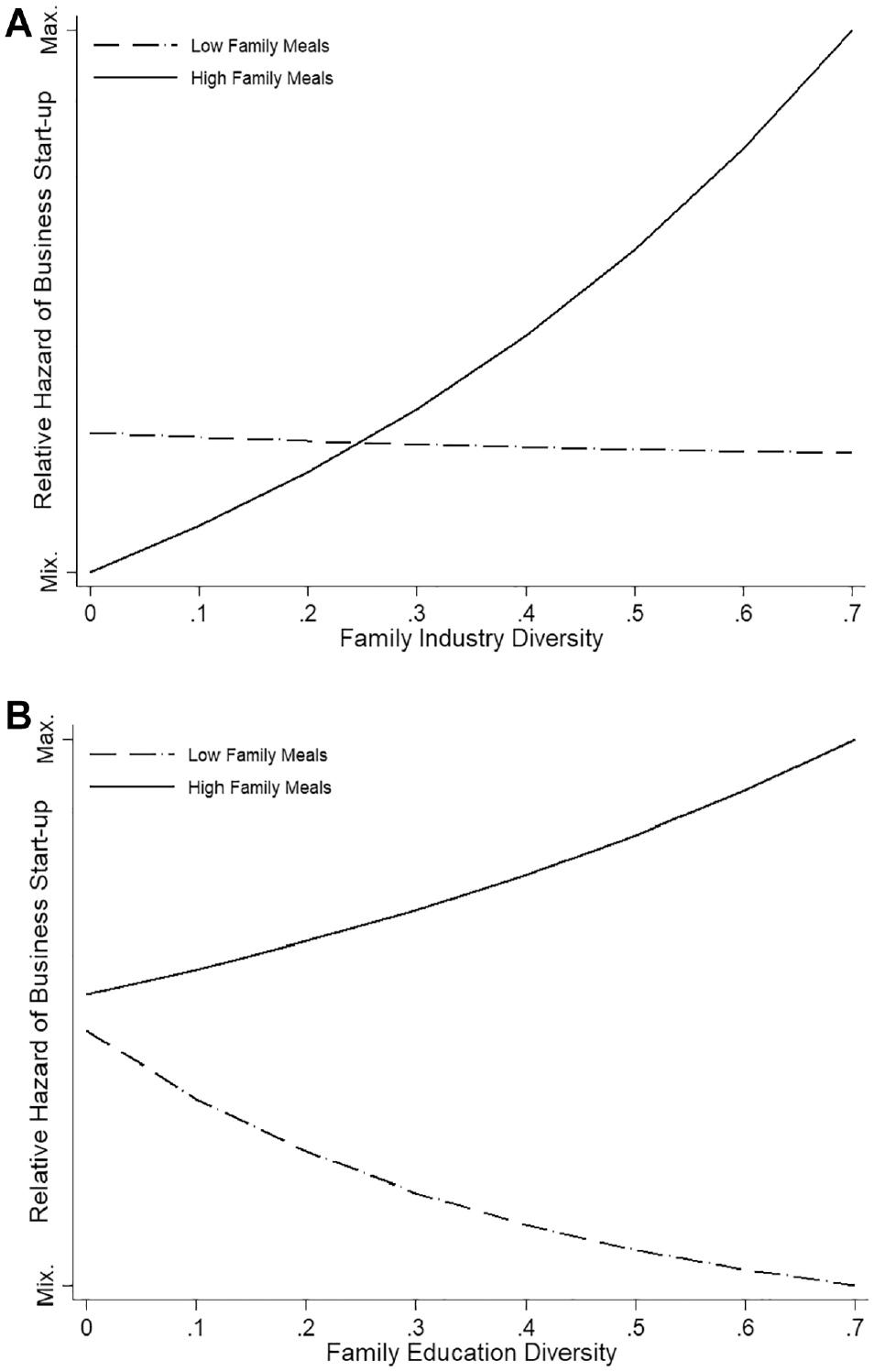
The graphical representations of the moderating effects.
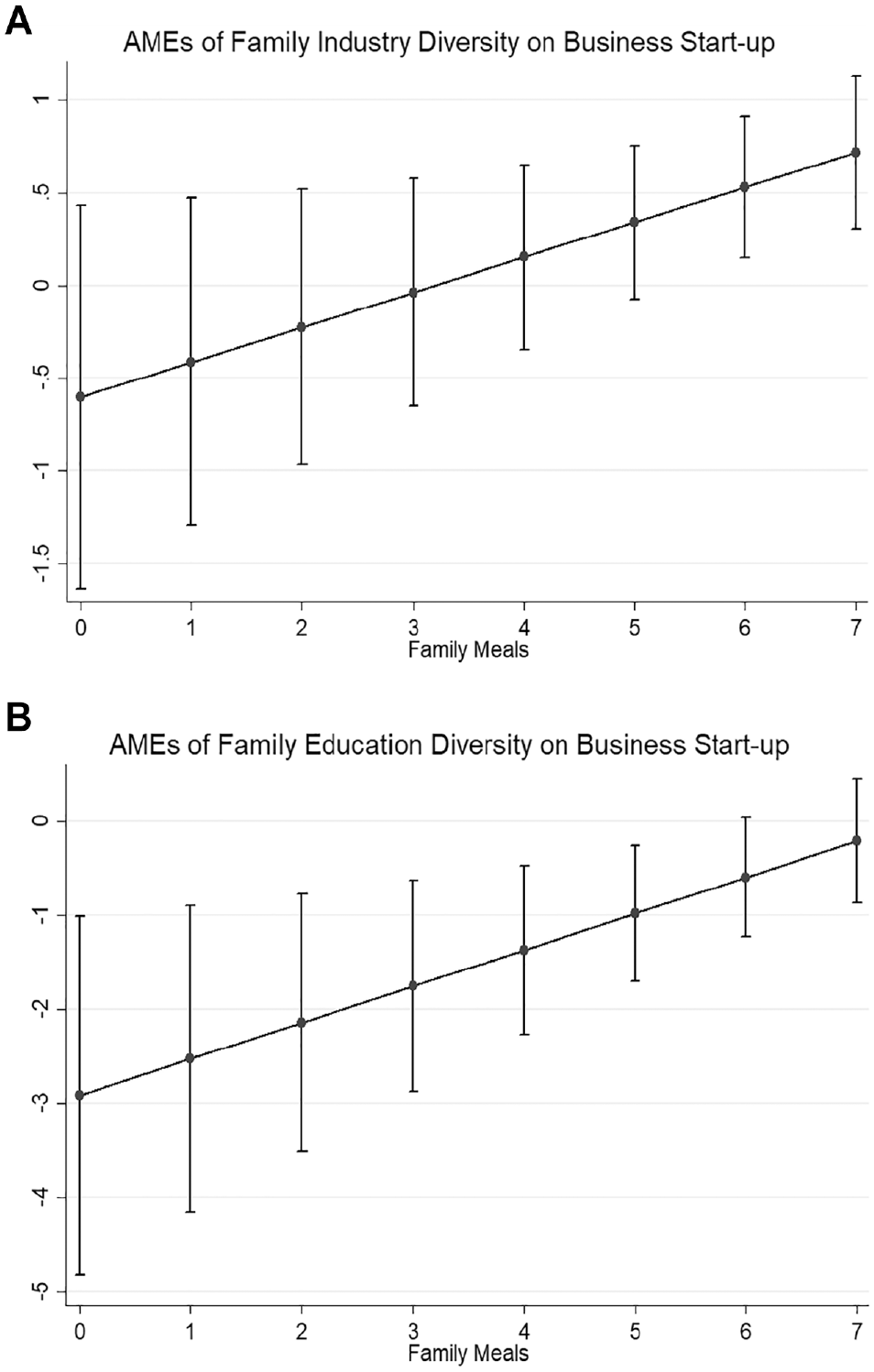
Average marginal effects (AME) plot on the moderating effects.
Robustness Test
We performed a series of robustness tests. We reran the analyses by relaxing the proportionality assumption using other popular hazard models, including exponential, Gompertz, and Weibull models (Cleves et al., 2010), and found the results to be consistent. We also tested the hypotheses using alternative analytical models, including complementary log-log regressions, logit regressions, and probit regressions (Hilbe, 1996; Kennedy, 2008; Wooldridge, 2012). The results were again consistent, providing further support to the main results based on a Cox model. We also controlled for regional differences by adding a number of indices from yearbooks at the province level, such as the economic and employment indices, including GDP (per capita), average family size, unemployment rate, education level, degree of urbanization, marketization index, and an index on entrepreneurship rate. 3 The results with these additional controls remain in line with the main findings. Additionally, we controlled for the average family age and average family education level, neither of which altered the main findings. These two variables are not included in the main models due to their high correlations with other variables, such as family age diversity and education diversity. We also reran our analyses to compare nuclear- and extended-family households. The results were in line with our main findings, although the results were not significant for Hypothesis 1 and Hypothesis 6a for the nuclear-family households.
Endogeneity Tests
Although we temporally separated the independent variables from the dependent variable (start-up of a business) to infer causality and mitigate endogeneity concerns (Kennedy, 2008; Wooldridge, 2012), we further employed a two-stage residual inclusion (2SRI) model (Patel et al., 2016; Terza et al., 2008) to control for endogeneity. The 2SRI method reduces biased estimates of the population average treatment effect (Basu et al., 2018; Terza et al., 2008). The 2SRI estimator is similar to a linear two-stage least squares; the exception is that in the second-stage regression, endogenous variables are not replaced by first-stage predictors. In addition, first-stage residuals are included as regressors added. Starting a business may be endogenous to the individual’s family industry and education diversity and the frequency of the meals in the family. That is, factors that might influence business start-up could also influence these independent variables.
First, to test the potential endogeneity between business start-up and family industry diversity, we identified two instrumental variables: the number of firms in the individual’s province and the number of generations in a family. The number of firms in the province captures the amount of job opportunities in the regions, and the more job opportunities, the more likely individuals can work in those industries. The number of generations can influence family industry diversity because older family members tend to exit the labor market or can be clustered in a small set of industries (Hutchens, 1988). Yet, these two factors may not directly affect our dependent variable (Hoskisson et al., 2017). Empirically, both variables correlate with family industry diversity but not with the dependent variable (business start-up). Second, we tested the endogeneity of family education diversity with an instrumental variable measuring the ratio of the individuals with a college degree and above in their province, which is likely to be related to the education diversity of families in the province (Bird & Wennberg, 2014). As expected, the variable correlates with family education diversity but not with the dependent variable of starting a business. Third, we tested the endogeneity of the family meal moderator with two instrumental variables—individuals’ workplace attendance and car ownership in their province—both of which may affect the individuals’ likelihood of attending family meals since family activities are subject to individuals’ work attendance (Yu et al., 2015) and the availability of cars and transportation options (Zhao & Bai, 2019). Both variables correlate with family meals but not with the dependent variable of starting a business. Furthermore, we ran weak instrumental variable tests (CLR-test, K-test, AR-test, and Wald-test; Mikusheva, 2013) and an over identification test (the Amemiya-Lee-Newey minimum chi-squared statistic; Amemiya, 1978; Lee, 1992; Newey, 1987), and the results confirmed the effectiveness and exogeneity of our instrumental variables. The results after controlling for the endogeneity scores 1, 2, and 3 remain robust (see Appendix I).
Discussion
Integrating the family embeddedness perspective with research on commensality and family meals, this study sought to explain why some families are more likely to fuel entrepreneurship than others. In line with research that recognizes the inconsistent findings related to family embeddedness (Edelman et al., 2016; F. Xu et al., 2020), we contend that the impact of the family on entrepreneurship depends on the diversity of family members in a household and the frequency with which they share meals. As such, our study investigates how heterogeneity among families can either ignite or extinguish entrepreneurship (e.g., Jaskiewicz & Dyer, 2017; F. Xu et al., 2020) by focusing on family characteristics and dynamics (Aldrich & Cliff, 2003). Additionally, in recognizing how Confucian values shape family members’ roles and responsibilities, our work offers a more contextual view of family embeddedness that emphasizes the importance of the cultural context in promoting entrepreneurship (Aldrich & Cliff, 2003; F. Xu et al., 2020; J. Yan & Sorenson, 2006).
Our study makes three key contributions to the literature. First, we contribute to the family embeddedness perspective of entrepreneurship by demonstrating how sources of demographic (age, gender) and knowledge-based (industry, education level) diversity explain why some families are more likely to ignite entrepreneurship than others. Whereas previous research tends to portray the family as a homogeneous unit (Jaskiewicz & Dyer, 2017; Jaskiewicz et al., 2017), we emphasize their heterogeneity by focusing on the diversity that can occur within family households. In so doing, we add to Aldrich and Cliff’s (2003) framework by challenging the monolithic view of families and demonstrating the importance of studying diversity within family households when applying the family embeddedness perspective to entrepreneurship.
Our study highlights how family household diversity serves as a “double-edge sword” in nurturing entrepreneurship; whereas family age and gender diversity decrease entrepreneurship, industry-based diversity increases it. Due to social categorization and biases related to age and gender (Joshi & Roh, 2009), and reinforced by Confucian norms of filial piety and traditional gender roles and stereotypes (Deutsch, 2006; H. O. Kim & Hoppe-Graff, 2001), family households with greater age and gender diversity were less likely to have a family member start a business than those that lacked such demographic diversity. In contrast, knowledge-based diversity based on industry experience had a positive effect on entrepreneurship. It therefore appears that greater industry diversity within a household encourages entrepreneurship because the diverse knowledge exchanged assists with opportunity recognition and problem-solving (Dyer et al., 2008; Tuggle et al., 2010). Furthermore, communication norms within Confucian families that support collaboration, mutual support, and the sharing of diverse information (J. Yan & Sorenson, 2006) help explain why family industry diversity fosters entrepreneurship in China.
The effect of education diversity, on the other hand, was more complex than expected. Contrary to our expectations, greater family education diversity was found to have a negative direct effect on entrepreneurship. Perhaps education diversity induces differences that affect individuals’ ability or receptivity to process information and absorb new ideas (Smith et al., 2005), thus lowering a family member’s chance of starting a business. Given that studies applying the family embeddedness perspective to entrepreneurship have produced inconsistent results (Edelman et al., 2016; F. Xu et al., 2020), our work calls for more attention on diversity stemming from family member characteristics. Thus, our theory and framework suggest further opportunities for applying the diversity literature to the family embeddedness perspective of entrepreneurship. Relatedly, our study deviates from the predominant literature that studies diversity of groups within existing firms (Horwitz and Horwitz, 2007; Ling & Kellermanns, 2010) by extending research on diversity to family households. In so doing, we demonstrate the applicability of diversity research to the family embeddedness perspective of entrepreneurship, which we hope inspires future studies on household diversity.
Second, in studying entrepreneurship in China and recognizing the influence of Confucian values on family roles and dynamics, we offer a more contextualized view of the family embeddedness perspective of entrepreneurship. We therefore recognize the importance of culture in shaping how the family influences entrepreneurship, thus contributing to the growing body of family embeddedness research that acknowledges how the family is embedded in a country’s cultural context (Ge et al., 2019; F. Xu et al., 2020; J. Yan & Sorenson, 2006). Because China has moved from one of the poorest to the world’s largest economy, greatly due to its growth in entrepreneurship, it is important to gain understanding on how entrepreneurship has been nurtured (Bruton et al., 2018). In extending theories and frameworks developed in North America and Europe to China, it is also important to consider China’s unique culture (Bruton et al., 2018). For example, a defining element of China’s Confucian culture is its view of the basic unit of society as the family, and not the individual (Lang, 2010; Yu et al., 2015). As such, the family embeddedness perspective of entrepreneurship appears to offer much promise in explaining China’s immense growth in entrepreneurship and the importance of family household diversity and family meals in explaining why individuals differ in their propensity to start a business. Future research should extend our framework to other countries with the aim of understanding differences in how the family fuels the fire of entrepreneurship across cultures.
Finally, by introducing family meals to the family embeddedness perspective of entrepreneurship, we highlight the need for research to identify the specific conduits that provide a family with the opportunity to influence entrepreneurship. Research on commensality explains how the family meal is important in forging social bonds and developing family values and identity (Ochs & Shohet, 2006; Yu et al., 2015). Family meals also serve to socialize family members and to maintain a sense of unity (Yu et al., 2015). In particular, although our hypothesis on education level diversity was not confirmed, when the frequency of family meals was considered, the results aligned with our hypothesis. That is, for family households who frequently share meals, greater education level diversity increased entrepreneurship. In contrast, greater education level diversity decreased entrepreneurship when the family rarely shared meals together (see Figure 1B). Additionally, in line with our prediction, our findings revealed that frequent family meals amplify the positive effect of family industry diversity on entrepreneurship (see Figure 1A). Taken together, these findings highlight the importance of family meals in acting as a conduit for the family embeddedness perspective of entrepreneurship. Our research suggests that frequent family meals provide the channel where knowledge from diverse industry and education level can be shared and leveraged to “feed the fire” of entrepreneurship.
Interestingly, we did not find the frequency of family meals to amplify the influence of age and gender diversity on entrepreneurship. This suggests that the negative effects of age and gender diversity on entrepreneurship are present regardless of the frequency of family meals. Perhaps the strong Confucian norms associated with filial piety and traditional gender roles and stereotypes make the influence of family meals irrelevant. Therefore, it appears that while family meals foster collaboration and sharing of information stemming from knowledge-based sources of diversity, the meals likely perpetuate norms and values related to demographic diversity. Our framework therefore helps to explain why some family households are more likely to produce entrepreneurs than others. Future research should explore these effects in other Confucian countries and cultural contexts. Such research will help identify how the Confucian context is shaping the relationships and whether the effects of age and gender diversity vary in more egalitarian and low power distance cultures.
Our study also has important implications for practice. Our framework and related findings warn potential entrepreneurs in China of the constraining pressures that can arise in households with high age and gender diversity. It may therefore be beneficial for aspiring entrepreneurs from such households to seek advice and resources from outside of their immediate family. On the contrary, aspiring entrepreneurs from households with high industry diversity may benefit from using the family as an important source of information and resources. Education level diversity within one’s household also appears to support aspiring entrepreneurs if the family frequently shares meals together. In fact, both sources of knowledge-based diversity (industry, education level) are most beneficial in encouraging entrepreneurship when the household frequently shares meals. As such, for both families and policy makers hoping to develop entrepreneurs, it is important to recognize that family meals often serve as the conduit for the sharing of information, resources, and advice that ignite entrepreneurship.
Limitations and Future Research Directions
Before concluding, several limitations which can serve as a foundation for future research should be noted. First, we studied several key sources of diversity (age, gender, industry, education) based on the team literature and research on family business TMTs and boards (Horwitz, 2005; Talke et al., 2011). However, because diversity may vary depending on a family’s stage of development (Sciascia et al., 2013), there are other important sources of diversity that we did not study (e.g., race, gender identity, nationality, religion) that may influence entrepreneurship, and are thus worth exploring in future studies.
Second, our study is limited by the quantitative method adopted which does not offer fine-grained information about family meals and the specific mechanisms leading to entrepreneurship. Future qualitative research should build on our study by exploring how family meals serve as a conduit in supporting entrepreneurship. For example, are sources of knowledge-based diversity in a family more effective in assisting entrepreneurs with resource acquisition, innovation, and problem-solving when the family shares meals more frequently? Additionally, it would be interesting to explore how frequent family meals that include family members from outside the household can foster entrepreneurship. Such research should also be applied to the family business setting. For example, frequent family meals among family members involved in the business may be key to understanding why business-owning families differ in their identity and bonds as well as their support for growth and innovation. Also, besides family meals, future research should investigate other types of family activities that can be studied from a family embeddedness perspective, such as festival gatherings, weddings, and vacations. Similarly, future research should consider how our framework applies to different types of start-ups and the willingness of family members to join an existing family business (Block et al., 2013).
Third, the empirical testing was conducted in a single country and therefore, the results may not apply to other contexts, particularly countries not influenced by Confucian values and/or with larger families. Finer-grained measures, information on the typology of firm created (e.g., family firm) and qualitative data across countries would have been helpful. In sum, our theorizing hopefully offers a stepping-stone to be expanded and tested in other cultures and countries.
Footnotes
Appendix
Two-Stage Residual Inclusion (2SRI) Models With Endogeneity Scores (N = 8,162).
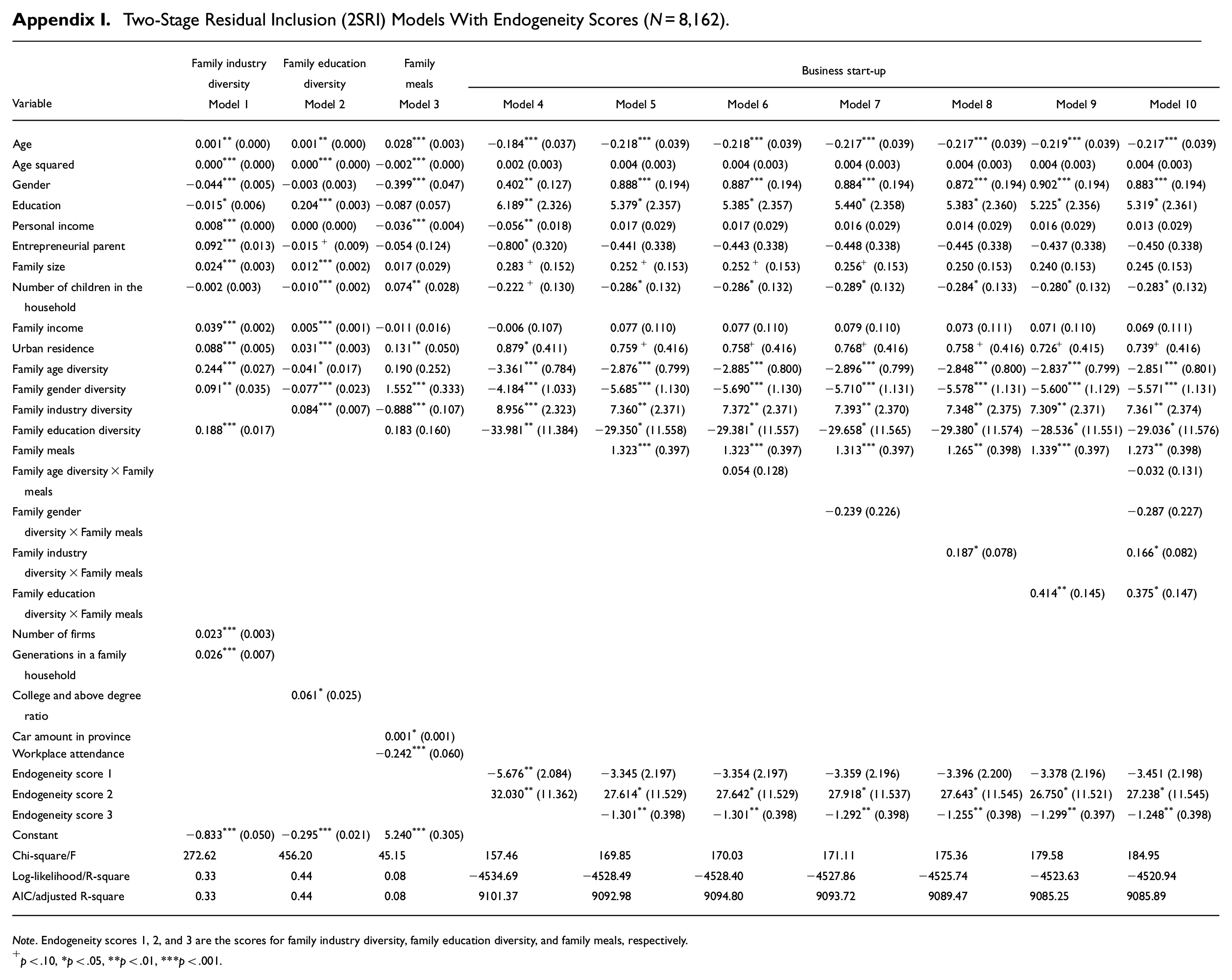
| Variable | Family industry diversity | Family education diversity | Family meals | Business start-up | ||||||
|---|---|---|---|---|---|---|---|---|---|---|
| Model 1 | Model 2 | Model 3 | Model 4 | Model 5 | Model 6 | Model 7 | Model 8 | Model 9 | Model 10 | |
| Age | 0.001 ** (0.000) | 0.001 ** (0.000) | 0.028 *** (0.003) | −0.184 *** (0.037) | −0.218 *** (0.039) | −0.218 *** (0.039) | −0.217 *** (0.039) | −0.217 *** (0.039) | −0.219 *** (0.039) | −0.217 *** (0.039) |
| Age squared | 0.000 *** (0.000) | 0.000 *** (0.000) | −0.002 *** (0.000) | 0.002 (0.003) | 0.004 (0.003) | 0.004 (0.003) | 0.004 (0.003) | 0.004 (0.003) | 0.004 (0.003) | 0.004 (0.003) |
| Gender | −0.044 *** (0.005) | −0.003 (0.003) | −0.399 *** (0.047) | 0.402 ** (0.127) | 0.888 *** (0.194) | 0.887 *** (0.194) | 0.884 *** (0.194) | 0.872 *** (0.194) | 0.902 *** (0.194) | 0.883 *** (0.194) |
| Education | −0.015 * (0.006) | 0.204 *** (0.003) | −0.087 (0.057) | 6.189 ** (2.326) | 5.379 * (2.357) | 5.385 * (2.357) | 5.440 * (2.358) | 5.383 * (2.360) | 5.225 * (2.356) | 5.319 * (2.361) |
| Personal income | 0.008 *** (0.000) | 0.000 (0.000) | −0.036 *** (0.004) | −0.056 ** (0.018) | 0.017 (0.029) | 0.017 (0.029) | 0.016 (0.029) | 0.014 (0.029) | 0.016 (0.029) | 0.013 (0.029) |
| Entrepreneurial parent | 0.092 *** (0.013) | −0.015 + (0.009) | −0.054 (0.124) | −0.800 * (0.320) | −0.441 (0.338) | −0.443 (0.338) | −0.448 (0.338) | −0.445 (0.338) | −0.437 (0.338) | −0.450 (0.338) |
| Family size | 0.024 *** (0.003) | 0.012 *** (0.002) | 0.017 (0.029) | 0.283 + (0.152) | 0.252 + (0.153) | 0.252 + (0.153) | 0.256 + (0.153) | 0.250 (0.153) | 0.240 (0.153) | 0.245 (0.153) |
| Number of children in the household | −0.002 (0.003) | −0.010 *** (0.002) | 0.074 ** (0.028) | −0.222 + (0.130) | −0.286 * (0.132) | −0.286 * (0.132) | −0.289 * (0.132) | −0.284 * (0.133) | −0.280 * (0.132) | −0.283 * (0.132) |
| Family income | 0.039 *** (0.002) | 0.005 *** (0.001) | −0.011 (0.016) | −0.006 (0.107) | 0.077 (0.110) | 0.077 (0.110) | 0.079 (0.110) | 0.073 (0.111) | 0.071 (0.110) | 0.069 (0.111) |
| Urban residence | 0.088 *** (0.005) | 0.031 *** (0.003) | 0.131 ** (0.050) | 0.879 * (0.411) | 0.759 + (0.416) | 0.758 + (0.416) | 0.768 + (0.416) | 0.758 + (0.416) | 0.726 + (0.415) | 0.739 + (0.416) |
| Family age diversity | 0.244 *** (0.027) | −0.041 * (0.017) | 0.190 (0.252) | −3.361 *** (0.784) | −2.876 *** (0.799) | −2.885 *** (0.800) | −2.896 *** (0.799) | −2.848 *** (0.800) | −2.837 *** (0.799) | −2.851 *** (0.801) |
| Family gender diversity | 0.091 ** (0.035) | −0.077 *** (0.023) | 1.552 *** (0.333) | −4.184 *** (1.033) | −5.685 *** (1.130) | −5.690 *** (1.130) | −5.710 *** (1.131) | −5.578 *** (1.131) | −5.600 *** (1.129) | −5.571 *** (1.131) |
| Family industry diversity | 0.084 *** (0.007) | −0.888 *** (0.107) | 8.956 *** (2.323) | 7.360 ** (2.371) | 7.372 ** (2.371) | 7.393 ** (2.370) | 7.348 ** (2.375) | 7.309 ** (2.371) | 7.361 ** (2.374) | |
| Family education diversity | 0.188 *** (0.017) | 0.183 (0.160) | −33.981 ** (11.384) | −29.350 * (11.558) | −29.381 * (11.557) | −29.658 * (11.565) | −29.380 * (11.574) | −28.536 * (11.551) | −29.036 * (11.576) | |
| Family meals | 1.323 *** (0.397) | 1.323 *** (0.397) | 1.313 *** (0.397) | 1.265 ** (0.398) | 1.339 *** (0.397) | 1.273 ** (0.398) | ||||
| Family age diversity × Family meals | 0.054 (0.128) | −0.032 (0.131) | ||||||||
| Family gender diversity × Family meals | −0.239 (0.226) | −0.287 (0.227) | ||||||||
| Family industry diversity × Family meals | 0.187 * (0.078) | 0.166 * (0.082) | ||||||||
| Family education diversity × Family meals | 0.414 ** (0.145) | 0.375 * (0.147) | ||||||||
| Number of firms | 0.023 *** (0.003) | |||||||||
| Generations in a family household | 0.026 *** (0.007) | |||||||||
| College and above degree ratio | 0.061 * (0.025) | |||||||||
| Car amount in province | 0.001 * (0.001) | |||||||||
| Workplace attendance | −0.242 *** (0.060) | |||||||||
| Endogeneity score 1 | −5.676 ** (2.084) | −3.345 (2.197) | −3.354 (2.197) | −3.359 (2.196) | −3.396 (2.200) | −3.378 (2.196) | −3.451 (2.198) | |||
| Endogeneity score 2 | 32.030 ** (11.362) | 27.614 * (11.529) | 27.642 * (11.529) | 27.918 * (11.537) | 27.643 * (11.545) | 26.750 * (11.521) | 27.238 * (11.545) | |||
| Endogeneity score 3 | −1.301 ** (0.398) | −1.301 ** (0.398) | −1.292 ** (0.398) | −1.255 ** (0.398) | −1.299 ** (0.397) | −1.248 ** (0.398) | ||||
| Constant | −0.833 *** (0.050) | −0.295 *** (0.021) | 5.240 *** (0.305) | |||||||
| Chi-square/F | 272.62 | 456.20 | 45.15 | 157.46 | 169.85 | 170.03 | 171.11 | 175.36 | 179.58 | 184.95 |
| Log-likelihood/R-square | 0.33 | 0.44 | 0.08 | −4534.69 | −4528.49 | −4528.40 | −4527.86 | −4525.74 | −4523.63 | −4520.94 |
| AIC/adjusted R-square | 0.33 | 0.44 | 0.08 | 9101.37 | 9092.98 | 9094.80 | 9093.72 | 9089.47 | 9085.25 | 9085.89 |
Note. Endogeneity scores 1, 2, and 3 are the scores for family industry diversity, family education diversity, and family meals, respectively.
p < .10, *p < .05, **p < .01, ***p < .001.
Declaration of Conflicting Interests
The author(s) declared no potential conflicts of interest with respect to the research, authorship, and/or publication of this article.
Funding
The author(s) disclosed the receipt of the following financial support for the research, authorship, and/or publication of this article: This research was supported by funding of the National Natural Science Foundation of China (72202179), and the Fundamental Research Funds for the Central Universities (D5000220132).
