




Abstract
While resourcing their ventures, entrepreneurs and stakeholders face and deal with unexpected situations, permeating the entrepreneurship process. Drawing on an entrepreneurship as practice approach, we explore how an entrepreneurial resourcing practice is collectively enacted, reconfigured, and repaired after a sudden practice collapse. Through a longitudinal case study of a social venture–public collaboration process, we reveal the collective repair work of a collapsing entrepreneurial resourcing practice and the role of emotions as a hidden element in the resourcing practice and the repair work enacted.
Introduction
When resourcing their ventures, social entrepreneurs engage with diverse external resource providers, such as local authorities, (social) investors, beneficiaries, philanthropists, and other stakeholders (Clough et al., 2019; Meyskens et al., 2010; Vedula et al., 2022). Entrepreneurial resourcing research has primarily focused on when and how social entrepreneurs use specific approaches to access and repurpose external resources (Bacq & Eddleston, 2018; Desa & Basu, 2013; Kwong et al., 2017). Entrepreneurship scholars have also sought to better understand, for example, how social entrepreneurs mobilize resources while advocating for different types of causes (e.g., McNamara et al., 2018), which discursive appeals they pursue (Fisher et al., 2021; Ruebottom, 2013), and how resource providers’ psychological distance from their social issue might influence the resource mobilization process (e.g., Drencheva et al., 2022).
Despite insightful contributions, this stream of research has two important limitations. First, much of the literature draws on the resource-based view (RBV), which is agnostic to the nature of resources and context, and rarely zooms in on the rich detail of social interactions. Much research largely underplays and fails to capture the dynamic, relational, and collaborative accomplishment of entrepreneurial resourcing enacted in context (Chalmers & Shaw, 2017; Keating et al., 2014). For example, Keating et al. (2014) advance a practice perspective on resourcing by arguing that resources only exist “in and through the connections made in socio-material networks,” thus proposing that resourcing practice has an ontological primacy over resources (Thompson & Byrne, 2020, p. 36). Hence, the extant literature has yet to provide insights on how entrepreneurs and stakeholders interact, feel, and think when they mutually engage in resourcing (Kimmitt & Muñoz, 2018; Wigren-Kristoferson et al., 2022; Zietsma & Toubiana, 2019). Second, when entrepreneurs and stakeholders “do” resourcing, they are faced with an ambiguous environment that constantly brings unexpected situations, events, and surprises (Dimov, 2020; Fisher & Neubert, 2022; Johannisson, 2018a), which in turn can lead to collapse in resourcing. In turn, resourcing is emotionally demanding, as entrepreneurs and stakeholders have to navigate a constantly changing interactive environment while acting with creativity and spontaneity to keep resourcing on track (Busch & Barkema, 2020; Gross & Geiger, 2017; Johannisson, 2018a). However, the existing research has neglected how entrepreneurial resourcing is carried forward in times of crisis through the enacted relational work (Johannisson, 2018b).
To address these gaps, we adopt an entrepreneurship as practice (EaP) lens (Champenois et al., 2019; Thompson & Byrne, 2020; Thompson et al., 2020). We conceptualize entrepreneurial resourcing as a social practice (Schatzki, 2012), carried out by entrepreneurs and stakeholders through everyday activities and interactions. While investigating the entrepreneurial resourcing practice through a longitudinal case study of the collaboration process between the Norwegian social venture Betz and the municipality of Fjord, an unexpected situation arose. Fjord and two other neighboring municipalities merged, resulting in serious budget cuts, which threatened to cause the discontinuation of the collaboration process and jeopardize the entrepreneurial resourcing practice. Our empirical material led to an unexpected discovery, revealing the collective repair work of an entrepreneurial resourcing practice following collapse, which the entrepreneurship literature has not addressed so far. This also drew our attention to the affective dimensions of resourcing at play and the emotional involvement of the practitioners. While previous research has clearly demonstrated the importance of emotions to (social) entrepreneurship, both in attracting prospective resource providers and facilitation of resource mobilization (Fisher et al., 2021; Huy & Zott, 2019), and getting them to act in support of the cause (Barberá-Tomás et al., 2019), the nuanced and intricate intermingling of emotions and the entrepreneurial resourcing practice is largely unexplored (Gross & Geiger, 2017; Keating et al., 2014). On the basis of these inductive findings, which emerged through analysis of our case study, we ask: How is an entrepreneurial resourcing practice collectively repaired when an unexpected situation occurs and jeopardizes the practice?
To theorize about the collective repair work and the role of emotions 1 in both resourcing practice and repair, we adopt the perspective articulated by Schatzki (1996, 2002), where practices are organized human activities, “[a] temporally unfolding and spatially dispersed nexus of doings and sayings” (Schatzki, 1996, p. 89). Importantly for our theoretical purposes, this perspective views practices as deeply social and relational; a practice like entrepreneurial resourcing is always situated in a field of shared understandings and is collectively accomplished (Champenois et al., 2019; Keating et al., 2014). Following his notion on teleoaffectivity with its emotional dimension of “how things matter” also enables us to position emotions vis-à-vis practices (Thompson & Byrne, 2020).
Our work makes two important contributions. First, we extend the emerging EaP literature (Champenois et al., 2019; Thompson et al., 2020) by theorizing how collective repair work is enacted to reconfigure an entrepreneurial resourcing practice and keep resourcing on track. This is important, as prior work has primarily looked at entrepreneurial resource mobilization at the earliest stages of social venture creation and development (Drencheva et al., 2022; Renko, 2013). We argue that repairing an entrepreneurial resourcing practice after collapse is crucial for the survival and growth of ventures. In particular, we demonstrate that shared emotions not only sustain the practice but also exercise an important role that enables practitioners to collectively repair and reconfigure the practice and its components. Relatedly, we unpack how the affective dimensions of the resourcing practice are repaired (Baker & Welter, 2015), thus extending our understanding of how the rebuilding, re-activation, and transformation of the relationships play out after collapse.
Second, we extend the literature on entrepreneurial resourcing (Keating et al., 2014; McNamara et al., 2018) and address calls for practice theories to study emotional aspects of entrepreneurial practices (Thompson & Byrne, 2020; Wigren-Kristoferson et al., 2022; Zietsma et al., 2019). We respond to Keating et al.’s (2014) call to explore “the nexus between actions, accountability, and affectivity” in resourcing by unpacking the intricate practice–emotion link in entrepreneurial resourcing. We reveal the importance of emotions in changes to entrepreneurial resourcing practice. Specifically, adopting an EaP as our lens, our findings suggest that emotions are neither strategically employed to facilitate resource mobilization nor a result of resourcing (Huy & Zott, 2019; McNamara et al., 2018), but lie at the heart of the practice itself. Our case demonstrates that emotions are collectively invested in the entrepreneurial resourcing practice and that the practice is sustained by emotions.
Below, we present the theoretical background of our study.
Theoretical Grounding
We initially framed our study within the EaP and resourcing in social entrepreneurship literature. However, as our analysis progressed, the collective repair work and role of emotions became apparent. Therefore, we had to integrate theoretical insights and accounts on emotions from practice ontology. This led to refinement of our research question and allowed us to provide novel insights about how an entrepreneurial resourcing practice is collectively repaired, when an unexpected situation arises to put it in jeopardy.
Entrepreneurial Resourcing as a Social Practice
Most of the previous research on social entrepreneurial resource mobilization has been significantly influenced by the RBV (Bacq & Eddleston, 2018, Desa & Basu, 2013; Liu et al., 2021; McNamara et al., 2018). This research implies that entrepreneurs know what kinds of goals they want to accomplish, the value imbued in the resources they need to achieve these goals, and what objectives could emerge for them based on ongoing social interactions (Busch & Barkema, 2020; Engel et al., 2017). Prior research has made much progress and provided valuable insights into when and how social entrepreneurs deliberately use social ties, bricolage (Di Domenico et al., 2010; Janssen et al., 2018), optimization (Desa & Basu, 2013), and socially oriented bootstrapping (Jayawarna et al., 2020) approaches. Similarly, several authors have theorized that different discursive appeals, such as rhetorical strategy (Ruebottom, 2013) and resourcefulness narratives (Fisher et al., 2021), are critical for social venture resourcing, largely considering the characteristics of successful communication. These studies mostly assume that social entrepreneurs act as strategic actors who have a high degree of control over their resource strategies. In sum, this stream of research implicitly or explicitly implies an over-reliance on an agency-driven conceptualization of entrepreneurial resourcing as a strategic and goal-directed behavior, where entrepreneurs work in a “knowledgeable, reflexive and strategic” fashion (Williams et al., 2021).
Although it makes insightful contributions to the extant literature, this strand of research obscures and largely underplays the dynamic, relational, and collaborative accomplishment of entrepreneurial resourcing enacted in rich contexts (Anderson et al., 2012; Chalmers & Shaw, 2017). This limited focus on deliberate and strategic entrepreneurial activities often neglects the roles of a multiplicity of actors engaged in resourcing and the ways of coping and acting when not fully knowing what the environment and future may hold in store (Johannisson, 2018a; Keating et al., 2014). Furthermore, many of these studies are agnostic to the context, and rarely zoom in on the rich detail of social interactions, interactive dynamics, and emotions at play. Recent entrepreneurship research, however, has made gains by challenging the assumptions that entrepreneurs know a priori with whom to connect, what kinds of resources and ties they need (Johannisson, 2011; Ramírez-Pasillas et al., 2020), and act as “heroic architects who strategically search, plan, and pursue their pre-defined goals” (Engel et al., 2017, p. 36). Consistent with the resourcing literature (Feldman & Worline, 2011) and practice lens (Schatzki, 2002, 2005), Keating et al. (2014, p. 2) made progress in this direction by shifting perspective to understanding entrepreneurial resourcing as a social practice, thereby demonstrating that “there is no ‘out there’ of social resources waiting to be identified and acquired by entrepreneurs over time.” Instead, these resources emerge as they are engaged with, in real time and over time, and are both a consequence of entrepreneurs’ and stakeholders’ ongoing resourcing efforts. Therefore, resources such as social networks, social ties, and institutional benefits are not objective things that the entrepreneur possesses or that exist “out there”; rather, resources come into play in the entrepreneurs’ and stakeholders’ actions, activities, and interactions. A practice such as entrepreneurial resourcing always takes place in a field of shared understandings (Reckwitz, 2002; Schatzki, 2002).
This emerging stream of research is guided by the EaP perspective (Champenois et al., 2019; Gartner & Teague, 2020; Gross & Geiger, 2017), which often conceptualizes practices as a set of interconnected “doings and sayings,” activities, and forms of communication. The literature that adopts an EaP lens focuses on the relational and processual nature of entrepreneurial activities (“doings and sayings”) as they are performed by individuals in interactions and through practices in specific entrepreneurial contexts, as well as in the constitution and consequences of entrepreneurial practices (Johannisson, 2011; Thompson & Byrne, 2020; Thompson et al., 2020). This lens neither reduces properties of practices to individual behaviors, cognitions, or motivations nor overemphasizes the structuring power of contextual factors. Thus, building on the EaP literature and Keating et al.’s work (2014), we conceptualize entrepreneurial resourcing as an important entrepreneurial practice that is collectively enacted and accomplished in context.
Entrepreneurs and stakeholders are faced with an ambiguous environment that constantly brings unexpected situations, events, and surprises (Fisher & Neubert, 2022; Johannisson, 2018b), which in turn can lead to the collapse of entrepreneurial resourcing practice. Previous research has highlighted that entrepreneurial practices can be disrupted and reconfigured in various ways (Gross & Geiger, 2017; Keating et al., 2014). Research has further revealed the major events as having a greater impact on the entrepreneurial practices by disrupting the status quo and causing a state of ambiguity (Gross & Geiger, 2017). Keating et al. (2014) demonstrated how an entrepreneurial firm moved through processes of resourcing the venture during new venture development by adapting their social resourcing practices to changing relevant contexts, and, in turn, enacted new contexts. Indeed, given that practices are not static, reified, and rule-based patterns (Thompson & Byrne, 2020), they might adjust to changing environments, transform, or die out (Gross & Geiger, 2017; Keating et al., 2014). Although there have been calls to study entrepreneurial practice dynamics (Champenois et al., 2019; Johannisson, 2018a; Thompson & Byrne, 2020), the entrepreneurship research has little to say about how entrepreneurial practices, for example, resourcing, are reconfigured and repaired in response to unexpected situations and disruptions. Therefore, the ways that entrepreneurial practices are collectively repaired in times of crisis remain a black box.
As our study led us to discover the crucial role of emotions in entrepreneurial resourcing practice and in the repair work enacted, in the following, we integrate theoretical insights about the emotion–entrepreneurial practice link from a practice theoretical ontology of emotions.
Emotions and Entrepreneurial Practices
Emotions are recognized as playing a significant role in the entrepreneurial process (Cardon et al., 2012; de Cock et al., 2020; Jennings et al., 2015; Williamson et al., 2022). Most entrepreneurship research in this area has focused, for example, on the relationship between psychological entities (such as joy, passion, compassion, empathy, grief, and envy) and cognitive processes and actions in the entrepreneurial context (Bacq & Alt, 2018; Cardon et al., 2005, 2009; Goss et al., 2011; Miller et al., 2012). Taken together, this line of research views emotions as individually experienced states.
More recent work has shown that entrepreneurs need to generate interest in their venture by evoking positive emotions in resource providers (Li et al., 2017). For example, Fisher et al. (2021) pointed out that discursive appeals, such as resourcefulness narratives, generate positive emotional and cognitive reactions from external resource providers, thus prompting them to look at the entrepreneur and the venture more favorably. In the context of social entrepreneurship, Barberá-Tomás et al. (2019) found that social entrepreneurs can use “emotion-symbolic work” through the use of visuals and words to evoke negative emotions, which they transform into emotional energy for enactment. This more recent research enables scholars to better understand how entrepreneurs can evoke others’ emotions and use emotions to influence target actors (Zietsma et al., 2019).
A practice theoretical lens and its alternative ontological stance offer different views on emotions. They foreground a dynamic, relational, and situated understanding of affective phenomena and focus on embodied yet mobile repertoires of emotion and performativity (Slaby & von Scheve, 2019). In our everyday life, we often become engaged in a particular activity because we are guided by particular emotions, and in turn, these doings and activities can create and alter emotions (Molander & Hartmann, 2018). Emotions are experienced individually, but belong to practices (Weenink & Spaargaren, 2016). In the context of entrepreneurship, an example is expressing delight and joy over a successful entrepreneurial pitch in certain contexts. In this vein, what matters to people and creates a meaningful difference—moods, emotions, affects, and passions—plays a crucial role in any activity, structuring the stream of behavior (Schatzki, 2010; Wiesse, 2019). Exploring the affective dimensions of entrepreneurial practices thus implies highlighting how practices incorporate affectivity, delineating the role of emotions in practices.
Few entrepreneurship studies have addressed the affective dimensions of entrepreneurial practices. Research in the context of commercial, art, and social entrepreneurship has provided some valuable insights into the emotional underpinnings of entrepreneurial practices. For example, Elias et al. (2017) employed a relational perspective to explore the relational, emotional, and embodied entrepreneurial cocreation process of aesthetic value among art entrepreneurs and their customers. They moved beyond the current focus on entrepreneurial cognition to illuminate entrepreneurs’ and customers’ imaginations, relationality, sensory, and emotional experience. Focusing on the practices of networking and production of small craft-food businesses, Tuitjer (2022) showed how the practices are interlinked and held together by shared general understandings and teleoaffective structures, such as pride in the product, the valuation of craftsmanship, the joy of cooperation, and “start[ing] something together,” which, in turn, generate business growth. In their study of the enactment of care ethics between social entrepreneurs and communities, Sengupta and Lehtimäki (2022, p. 27) demonstrated that the care ethics of social entrepreneurship are a “relational practice in which social entrepreneurs engage in embodied relations with emotion, cognition, analytical thinking, lived experience, and acting on others’ behalf.” Furthermore, several studies (van Wijk et al., 2018; Zietsma & Toubiana, 2019) have shown that emotions can both fuel and impede social entrepreneurial activities and efforts.
Although there have been calls to include more practice theories by focusing on emotional aspects of entrepreneurial practices and the ongoing features and patterns of social activities (Gross & Geiger, 2017; Thompson & Byrne, 2020; Wigren-Kristoferson et al., 2022), as well as emotionally infused microlevel interactions (Goss et al., 2011; Zietsma et al., 2019), such studies are rare. How emotions are intertwined with an entrepreneurial resourcing practice has yet to be examined in the entrepreneurship research (Keating et al., 2014).
In order to shed light on these issues, we adopt the perspective articulated by Schatzki (2002, 2005, 2012), which underlines the importance of hands-on interactions (Cucchi et al., 2021; Johannisson et al., 2016) and foregrounds that emotions matter for practices. Practices are organized by rules (formulated directives, instructions), practical understandings (how things are done), and general understandings, which are “ethoses or general senses of things” (Schatzki, 2019, p. 30). Furthermore, practices are shaped by their teleoaffective structure, combining the sense of orientation toward particular goals and ends with the emotions, moods, and motivational engagements (affects) enjoined by such orientations. Schatzki’s notion of “teleoaffective structure” underscores its emotional dimension–emotions matter for and are deeply inscribed in the structural blueprints of practices. From this vantage, his notion of “teleoaffective structure” provides a fruitful way to position emotions vis-à-vis practices instead of categorizing emotions as individual content and the property of entrepreneurs (Thompson & Byrne, 2020). Hence, by adopting Schatzki’s practice lens, we focus our analysis on the level of practice rather than on the individual entrepreneur, which still remains the central unit of analysis in much of the literature. We will now outline our research design and methodology.
Methods
Research Setting
We studied entrepreneurial resourcing practice in the context of a social venture–public collaboration. It took place in Norway, where the government has increasingly supported and promoted collaboration between social ventures and local authorities (municipalities). As a Nordic welfare state, Norway has an extensive public supply of social services, most of which are produced and provided by public bodies at different levels: municipalities, counties, and governmental entities (Trætteberg & Fladmoe, 2020). The Norwegian welfare model is sometimes described as a number of “welfare municipalities” (Borzaga et al., 2020, p. 9), because the needs of its citizens emerge at the municipal level and it is at this level that the services need to be produced and provided (Kobro et al., 2018). Norway is organized in 356 municipalities and has a population of approximately 5.5 million.
Even though the public sector has been the dominant service provider, nongovernmental organizations have for several decades provided welfare services, such as old people’s homes (e.g., The Salvation Army), services for drug addicts (e.g., The Church’s Social Service), and kindergartens (e.g., Women’s National Health Association and the Red Cross). However, over the last 20 years, there has been an increasing tendency to accept both for-profit and non-profit social entrepreneurs. In addition, the public sector has experienced major structural reforms, such as the implementation of new public management governance, the merger of county administrations and municipalities, and the centralization of public tasks (Kobro et al., 2018). This was accelerated by the conservative coalition cabinet that was in office 2013 to 2021. Notably, there is a political divide in Norway on the privatization of welfare, in that the conservative parties are pro-privatization, whereas the social democratic and left-wing parties take a more ambivalent view.
The Case
As a part of a larger project, we conducted a longitudinal case study (2012–2020) of the collaboration process between the social venture Betz (pseudonym) and the municipality of Fjord (pseudonym), initially driven by our aim of understanding how social entrepreneurs enact resourcing through public collaboration. Our selection was based on theoretical sampling that warranted both real-time and retrospective investigation (Van Burg et al., 2020) of the entrepreneurial resourcing practice in a collaborative setting. In-depth access was obtained through direct requests to the founder of Betz and representatives of Fjord who were deemed potentially interested.
Helena (pseudonym) is a portfolio entrepreneur who started Betz, operating in the health sector, in 2009. The business idea is based on her own experiences of her family’s encounters with the health services provided by a municipality. Betz provides innovative services to vulnerable groups of people with substance abuse problems and also recruits people who have been out of the labor market as part-time assistants (service providers). At the time of the data collection, Betz employed three full-time management staff, 42 part-time assistants, and had an ongoing collaboration with Fjord. Fjord has a conservative political leadership and promotes itself as “a pioneering municipality, being innovative and focused on problem-solving.” In 2012, Fjord launched a major plan to improve the health and care services of the municipality. According to the plan, Fjord was to ensure the provision of high-quality services to vulnerable groups of people with substance abuse problems (anonymized) by engaging in collaborations with external actors. In 2012, Helena and two Fjord employees, Jennifer and Bertha (pseudonyms), met at a conference and established a contact. After 5 years of relationship-building, Betz and Fjord started a collaboration project in 2017. The collaboration implied that Betz, in close cooperation with Fjord, would adapt Betz’s services, or cocreate services, to fit the municipality’s resources and needs. However, during the data collection period, it was announced that Fjord and two other neighboring municipalities would merge in January 2020, resulting in serious budget cuts, which came as a surprise to all the stakeholders and jeopardized the entrepreneurial resourcing practice. Figure 1 shows the chronology of resourcing and the major events.
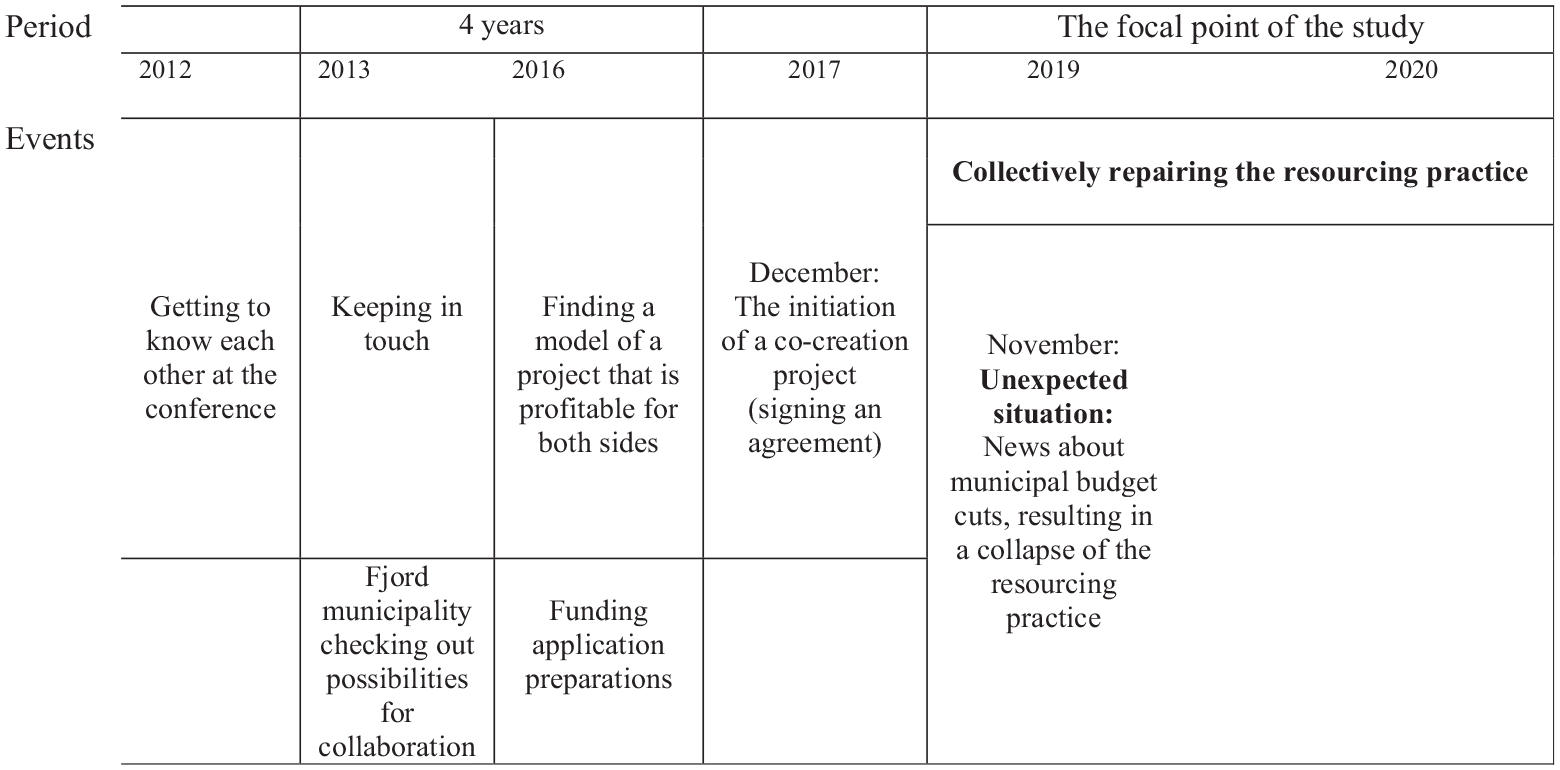
Overview of unfolding major events in the resourcing.
Empirical Material
The lead author engaged with the field site from Fall 2019 to Spring 2020. The nature and extent of access provided an exceptional opportunity to “follow the practice” as it unfolded (Johannisson, 2011) and capture its complexity and idiosyncrasies (Chalmers & Shaw, 2017; Gartner & Teague, 2020). Following a case study method (Stake, 2005), field research entailed generating data through interviews, shadowing, observation, real-time email correspondence, informal conversations, and documents. A summary of data sources is provided in Table 1. The second author joined the research project in 2020 as an “outsider” researcher who was given access to the data and participated in analysis (Tillmar, 2020).
A Detailed Summary of the Data Collected and Its Use in the Analysis.
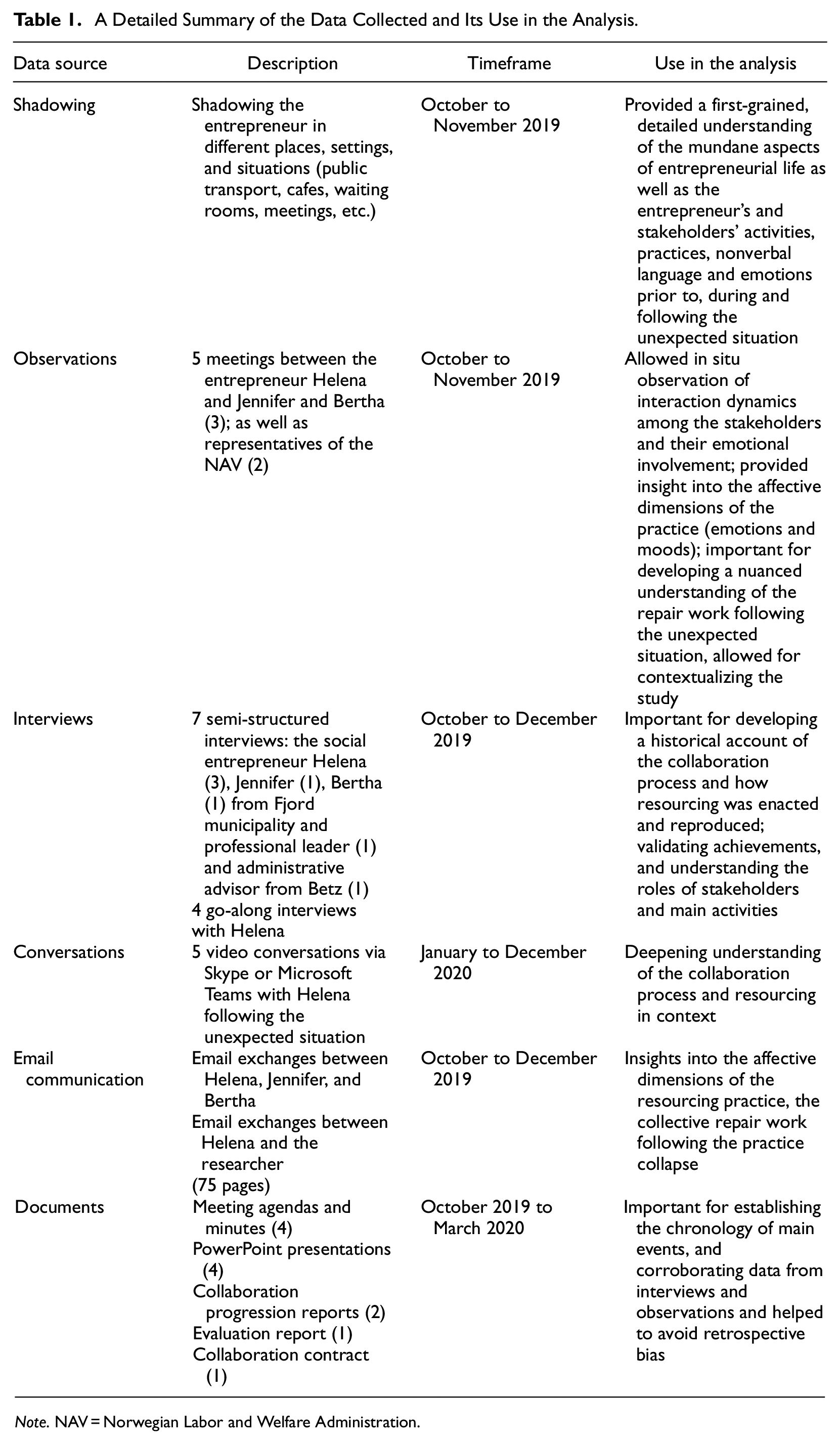
Note. NAV = Norwegian Labor and Welfare Administration.
Semi-Structured Interviews
We interviewed all important stakeholders involved in the collaboration process. First, during a field visit to Betz, the field researcher sought to understand the organizational context and conducted interviews with the administrative leader and professional advisor engaged in the collaboration process. The emerging themes provided further context for the study and made subsequent questions more focused. Second, the lead author conducted three rounds of interviews with Helena over the course of 4 months (one prior to, and two following the unexpected situation). The author also interviewed the representatives of Fjord, Bertha prior to the unexpected situation and Jennifer after. The respondents were asked about activities and daily routines and retrospective accounts related to resourcing. Face-to-face interviews helped to build trust with the respondents (Baker et al., 2017), which proved crucial in gaining privileged access to their life worlds (Dodd et al., 2021; Pratt et al., 2019). As a result, we gained access to sensitive information such as real-time emails, collaboration contracts, internal reports, and so on. In total, the lead author conducted seven interviews, varying from 30 minutes to 3hours in length. All interviews were digitally recorded and transcribed.
Shadowing
Shadowing (Czarniawska, 2007; Gill, 2011) allows for close engagement with the social setting of the resourcing practice and the practitioners involved (Dodd et al., 2021). Shadowing was used to capture entrepreneuring constructed through daily routines and took place in Fall 2019 when the lead author closely followed Helena over an extended period of time. The researcher engaged in “deep hanging up” by accompanying Helena on three long-distance journeys to Fjord and during visits to the local Norwegian Labor and Welfare Administration office (NAV). The shadowing took the researcher into many different places, settings, and situations: engaging with Helena on the public transport to Fjord and its premises, joining her for lunches and evening meals, and gaining valuable data on entrepreneurial everyday activities. Prior to, during, and following the unexpected situation, shadowing also involved go-along interviews with Helena, asking specific questions to further clarify things that had been either said or observed during interactions. During each day of shadowing, the researcher wrote field notes.
Observations
The author was given permission to attend project meetings between Helena and Fjord employees Jennifer and Bertha in October 2019 and November 2019 as well as meetings between Helena and representatives of the local NAV office in Fjord. The author attended five meetings in total, each held at Fjord’s facilities and lasting 1 to 3 hours. An observation guide was used. One advantage of our data is that the lead author was able to audio-record the observed meetings for later transcription, which provided detailed accounts of the micro-processes at play and allowed us to capture the narratives in vivo (Tillmar, 2020) and return to the data for repeated, fine-grained analysis (Fenton & Langley, 2011). The audio recordings were particularly important for capturing not only the interpersonal interaction dynamics but also the emotional dynamic and involvement. These were transcribed verbatim and complemented by field notes. Observation data were collected during meetings, and also during more informal interactions among the participants at lunch or in coffee breaks. These informal conversations helped to capture all the stakeholders’ immediate reactions to the meetings. The field notes documented the resourcing doings and sayings and the partners’ micro-behaviors during their interactions, along with their personal impressions, reactions, and emotional expressions as well as the researcher’s feelings.
Documents
We gained access to Helena’s PowerPoint (PPT) presentations, which included the material representations of practices. All PPTs were used and accompanied by Helena’s verbal presentation during the meetings with Jennifer and Bertha, the head of the local NAV office, and representatives of the main NAV office in the county where Fjord is located. Over 150 pages of documentation were used in the analysis (observation notes, field notes, meeting agendas and minutes, PowerPoint presentations, monitoring progress reports, and collaboration contracts).
Email Correspondence
In addition, these data were supplemented by real-time email communications between Helena, Jennifer, and Bertha, which provided rich information allowing us to see what was going on in a similar to observation (Neergaard & Ulhøi, 2007). The lead author was copied into the email exchanges (Baker et al., 2017; Parris, 2008) (using the “cc” function). Having access to real-time email interaction data provided an opportunity to follow how the practice unfolded prior to and following the unexpected situation. As emails were not created for the purpose of this research, we were able to observe how key stakeholders perceived what happened as well as how they negotiated constraints as they emerged over time. This resulted in 75 pages of email correspondence. Furthermore, after the researcher lost access to real-time email communications in late December 2019, due to the unexpected situation jeopardizing the practice, Helena suggested having regular weekly or monthly video conversations via Skype or Microsoft Teams to keep the researcher updated, totaling five conversations that varied from 20 to 40 minutes between January and March 2020. The field study was completed in April 2020, when the stakeholders decided to continue collaboration and resourcing.
Reflecting on our Research Practices
Reflexivity took place throughout the research process (Alvesson & Sköldberg, 2018). During the shadowing process, the lead researcher endeavored to make (their) presence nonintrusive (Ruebottom & Toubiana, 2020) by zooming in on the doings and sayings from a distance to make it easier to “keep the activities and conversations directed toward the practice of interest” (Johnson, 2014) and to build trust with participants. However, the dynamics experienced in the field, in particular, during the unexpected situation that jeopardized the practice, were encountered as emotionally challenging and distressing not only for the stakeholders but also for the first author as well, making it impossible to be immune to the circumstances. The first author felt sympathetic to the situation, which also could affect the future of the research, in particular, the opportunity to continue to follow the unfolding of resourcing. The researcher felt that it was important to communicate a feeling of genuine empathy in order to make Helena feel at ease and have her open up about her feelings and intentions after the unexpected event. Writing field notes from the very start which outlined the involvement of the researcher’s emotional reactions and feelings during the research process deemed to be important. This enabled us to look more closely and reflexively at the role the lead author’s experience, emotions, and feelings had to play within the research process (Alvesson & Sköldberg, 2018). In addition, the choice made to audio-record the meetings during the longitudinal process, especially the meetings that took place after the unexpected situation, and gaining consent for this turned out to be advantageous for scrutinizing the micro-processes at play and interpretation of the results. Our study benefitted from getting further access to the field as Helena showed her support for our research and found it important that an external observer (the lead author) followed how the situation unfolded after the practice collapse.
Data Analysis
The audio-recorded interviews and meetings were transcribed and imported into MAXQDA software to assist with coding, along with handwritten field notes and email correspondence. We engaged in theorizing starting from empirical data and iteratively moving toward theory. We carried out several rounds of data analysis. This iteration involved the following stages.
First, as we were making sense of the data in context, we decided to zoom in on an entrepreneurial resourcing practice as our unit of analysis. We started by developing a timeline of the main events permeating resourcing, starting from the conference in 2012, where Helena, Jennifer, and Bertha met. This timeline provided insight into events that occurred prior to entry into the field and a general understanding how specific events were linked together, about the actors involved at various points in time, their roles and activities.
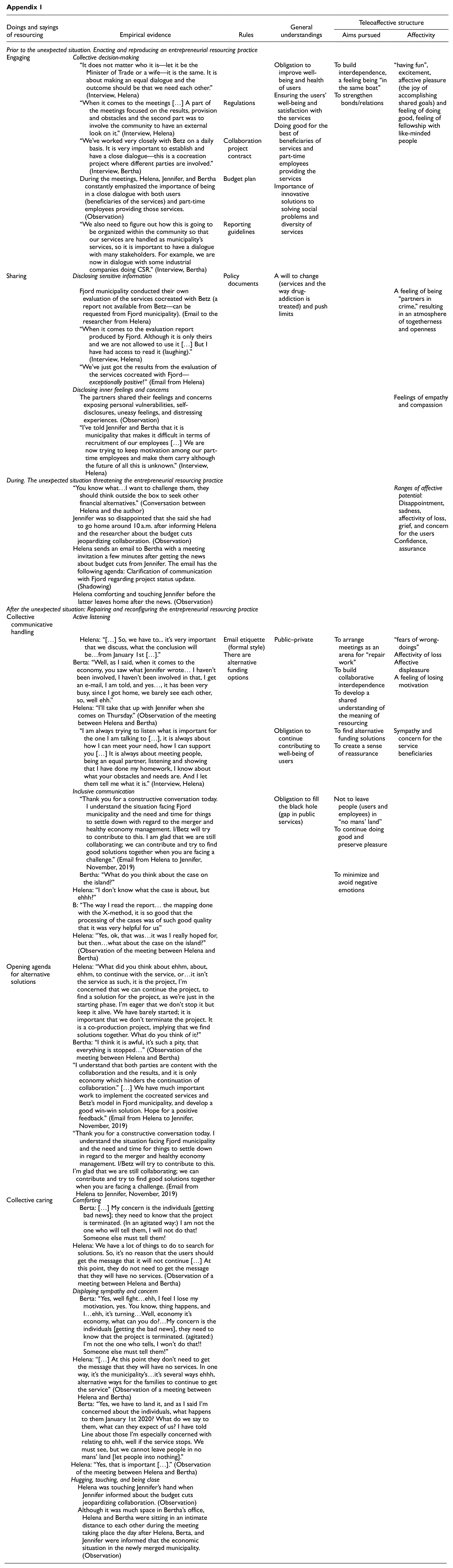
Second, we zoomed in at the micro level of the resourcing practice and identified a list of the recurring resourcing doings and sayings—mundane and repetitive patterns of activity that were deemed central to the reproduction of the entrepreneurial resourcing practice. Following Schatzki (1996, 2005), we also coded the elements constituting and structuring the entrepreneurial resourcing practice, including rules (i.e., explicit formulations that prescribe or instruct an action that needs to be done), practical and general understandings, and particular goals and ends pursued by the stakeholders. We organized these recurring resourcing doings and sayings and the elements of the practice into a practice template. This analytical process required a period of intensive reading and rereading of transcripts, field notes, observation guides, emails, regular weekly discussions between the authors, and iterations between theory and empirical observations. This particular cooperation—with one researcher “inside” the empirical field and the other “outside”—enhanced the analytical process. As Berglund and Schwartz (2013, p. 9) note, “this acts as a second shadowing process, in which the ‘outside’ researcher becomes another observer revealing the blind spots in the ‘inside researcher’s’ observations.” The second author’s perspective was useful to balance, and occasionally challenge, the views of the lead author and was key to our reflexive considerations.
As data analysis progressed, we noticed that the interactions between Helena, Jennifer, and Bertha were emotionally very laden, giving a sense of the emotional dynamics and making it possible to provide a detailed account of the micro-processes at play. Encouraged by the comments of the reviewers, we zoomed in on emotions and how the emotional dynamics evolved over time by returning to the original audio recordings, field notes, and emails for a more detailed analysis of the interactions. This inductive insight led us to delve into prior literature on the role of emotion in (social) entrepreneurship, particularly in resource mobilization, and to engage in a more refined coding. Drawing on a practice theoretical ontology of emotions, in particular Schatzki’s notion of “teleoaffective structure” that integrates emotions into practices, we paid attention to desired outcomes that Helena, Jennifer, and Bertha pursued in performing their activities and the emotional dimensions attached to these. As a result, we recoded our data to shed light on teleology and affectivity that were shared by the entrepreneur and stakeholders. When zooming out, we also came to realize that our data was particularly informative for understanding how Helena, Jennifer, and Bertha collectively tried to stitch the practice back together after the unexpected situation and the role of emotions in their attempts. As a result, other interesting and unexpected findings emerged from several rounds of reiterative data analysis—collective repair work to resourcing doings and sayings after the practice collapse. Based on the literature available at the time, we narrowed our research question to focus more precisely on the repair work of an entrepreneurial resourcing practice. We proceeded inductively, starting by organizing our findings around three vignettes (prior to, during, and following the unexpected situation). Finally, we organized the recurring resourcing doings and sayings and their structural dimensions in Appendix 1. To help ensure that our theorizing was valid, we did two things. First, we delved into the entrepreneurship studies that have addressed the affective dimensions of entrepreneurial practices either implicitly or explicitly, and research in other fields, such as consumption. Second, we discussed our findings with practice theory and entrepreneurship scholars, which encouraged further reflexivity.
Findings
This section is organized as follows. We provide three contextualized vignettes that describe how the entrepreneurial resourcing practice unfolded prior to, during, and following the unexpected situation. The vignettes detail the crucial activity patterns that constitute resourcing and its repair. Our understanding of activity patterns is broadly consistent with Schatzki’s formulation in which “a practice embraces […] the activities and states of existence for the sake of which people act, the project, i.e., actions they carry out for their ends, and the basic doings and sayings through which they implement these projects” (Schatzki, 2012, p. 15). Hence, the first vignette provides an understanding of how resourcing was enacted and reproduced prior to the collapse of the practice. In the second vignette, we present the unexpected situation that led to the practice collapse. Through multiple rounds of data analysis we uncovered the story of the collective repair work. Furthermore, our analysis revealed the powerful role emotions played in both entrepreneurial resourcing practice and repair work. Thus, the collective repair work is fleshed out in the third vignette.
Vignette 1. Prior to. Enacting and Reproducing an Entrepreneurial Resourcing Practice
The first step toward resourcing through collaboration dates back to 2012, when Helena was presenting Betz and its solution to a social problem at a conference in which Jennifer and Bertha participated as representatives of Fjord. Helena recalled that “the story started occasionally during the innovation conference, and [Jennifer and Bertha] liked what they heard about what we are doing.” Jennifer and Bertha became very interested and were inspired to form bonds with Helena to explore new ways of improving the lives of Fjord’s citizens. They were open to new ideas and solutions, despite Betz being a private company and given the political debates about the role of the private sector in welfare provision. During the conference, Jennifer and Bertha joined Helena at the lunch table, “where all this started” (Helena). They stayed in touch by “emailing, making phone calls, and SMSing all the time […] after the conference just checking out possibilities” (Helena).
After 5 years of regular contact, the three women had established strong ties and emotional bonds and finally managed to develop a collaboration contract for a 2-year project. The project implied that Betz, in close collaboration with Fjord, would “co-create services that fit the municipality’s resources and needs and were in line with their major plan” (Helena). Hence, the conference cultivated conditions enabling unexpected encounters to emerge, in which Helena met and formed connections with Fjord employees even if the value of the relationship as a potential resource was yet unknown (Busch & Barkema, 2020; Johannisson, 2011). By investing in long-lasting relationships (Ostertag et al., 2021; Weber et al., 2017), the partners turned initially serendipitous encounters into meaningful connections, which became important to achieving the desired outcome (Engel et al., 2017)—the initiation of resourcing. As Helena recalled, “Now, looking back, I understand what happened; because they were in a long-lasting process establishing a major political plan, the plan how to tackle the drug abuse problem […], they had just started in 2012 and were checking out the possibilities.”
Engaging
Among the numerous resourcing activity patterns, our analysis shows that Helena, Jennifer, and Bertha employed engaging, that is, the purposive act of involving someone in a given activity, process, or concerted action. This was particularly important in building interdependence and reproducing strong ties over the course of resourcing. For example, it emerged from our data that engaging was enacted by collective decision-making. We observed that this activity strongly permeated the interactions in both email communications and live interactions.
Over the course of the resourcing, engaging was also aimed at ensuring that all the parties had a feeling of being “in the same boat,” facing the same challenges, and having the same shared goals and rules. By engaging, the entrepreneur and partners created and energized a collaborative environment to ensure collaboration progress and results: “It does not matter who it is—whether it’s the Minister of Trade or a spouse—it is the same. It is about making an equal dialogue and the outcome should be that we need each other” (interview, Helena). Thus, engaging was a crucial activity that resulted in the formation and strengthening of strong ties between the entrepreneur and Fjord employees as meaningful social resources.
Sharing
Our empirical material shows that interactions between Helena, Bertha, and Jennifer were constantly permeated by sharing. This was particularly important in resourcing as it strengthened emotional bonds and relations, enabling the development of a stronger sense of togetherness and bonding. For example, sharing was enacted by disclosing and framing sensitive information as exclusive and “for your eyes only.” Jennifer provided Helena access to an internal report that revealed Fjord’s evaluation of the services cocreated with Betz. The shared report was collectively transformed into a meaningful resource for strengthening bonds and collaborative efforts: “We’ve just got the results from the evaluation of the co-created services with Fjord—exceptionally positive!” (email from Helena). This extract demonstrates vividly the affective dimensions prescribed by the resourcing practice that were prevalent throughout the partners’ engagements and interactions. Resourcing was connected with strong emotional experiences, such as “having fun,” excitement, and affective pleasure (the joy of accomplishing shared goals). This was guided by the general understanding of “doing good” shared by partners. Indeed, this affective state of pleasure was also demonstrated by laughter and positive emotions during conversations and daily interactions:
When it comes to the evaluation report produced by Fjord. Although it is only theirs and we are not allowed to use it […] But I have had access and read it [laughing]. (Researcher’s field notes.)
These affective dimensions were a part of a teleoaffective structuring of the resourcing practice, providing stability and social order (Schatzki, 2005). The experience of disclosing sensitive and confidential information triggered a feeling of being “partners in crime,” resulting in an atmosphere of togetherness and openness, which exemplifies shared teleoaffective structure. Such activities and continued interactions further enabled the development of connection and bonding between Helena, Jennifer, and Bertha.
Our observations further suggest that the partners disclosed their inner feelings and concerns, exposing personal vulnerabilities, self-disclosures, uneasy feelings, and distressing experiences. Giving each other the space to share and understand those feelings, such disclosures produced the deepening of personal attachments and bonds and established more intimacy between Helena, Bertha, and Jennifer. Our material demonstrates that the resourcing practice was driven by feelings of empathy and compassion as the social entrepreneur and stakeholders felt they were doing good as they helped users in need: “The services we’ve co-created with Betz are unique and we’re proud as a municipality to have such an offer for our citizens” (interview, Jennifer). Here, the partners were rendered accountable for ensuring the users’ well-being and satisfaction with the services, which can be equated to general understandings (Schatzki, 2002). This range of emotions guided the partners’ actions and structured the resourcing practice in a collaborative context, helping practitioners to envision and project desired outcomes of the practice that mattered to all of them in various ways.
The shared general understandings and teleoaffective structures guiding the resourcing practice led to interdependence and a stronger sense of togetherness, resulting in the formation of strong ties. It is intriguing and surprising that Jennifer and Bertha disclosed their emotions while they representing a public institution. This could be considered taboo in relationships between entrepreneurs and public employees, where the latter are normally expected to be objective. In other words, general understandings guiding municipal employees could be in tension with those of the social entrepreneur, what Welch and Yates (2018) term “contrasting general understandings.” Furthermore, teleoaffective structures are rendered invisible in bureaucratic organizations, such as municipalities. We suggest that the entrepreneurial resourcing practice in a collaborative context is likely to be guided by a general understanding, such as a private–public divide. However, in our case we demonstrate that the teleoaffective structure guiding the resourcing practice aligned the general understandings of both parties toward shared plans, activities, and desired outcomes. While navigating the emotional bonds of attachment, other types of shared general understandings—such as doing good for the beneficiaries of services and part-time employees and a will to change and push limits—became institutionalized, dismantling the private–private divide.
In sum, this vignette demonstrates how the reproduction of the resourcing practice was continually perpetuated by engaging and sharing between the social entrepreneur and the partners. Engaging and sharing are also shaped by the institutional discourses about the role of the private sector in welfare provision that take place at national and municipal levels. In the following vignette, we present the unexpected situation, triggering the collapse of the resourcing practice.
Vignette 2. During. An Unexpected Situation Threatening the Entrepreneurial Resourcing Practice
In January 2020, Fjord officially merged with the neighboring Island and Hill municipalities and became the municipality of Headlands. The new municipality still had conservative political leadership and promoted itself as a pioneering, innovative, and problem-solving organization. However, as with all mergers, it was a struggle to get the new organization to become one unit and, according to Helena, “many municipalities had intentions to collaborate, but when the merger is about to take place, they say we do not have time, we have to focus on the merging process.”
In November 2019, when the lead author shadowed Helena on one of her trips to Fjord to renegotiate the continuation of the collaboration, unexpected news arrived. Helena was to meet Jennifer and Bertha at 9:00 a.m. Helena and the author were waiting in the main hall of the municipality premises to be accompanied to the meeting room. Helena seemed surprised that neither Jennifer nor Bertha had showed up by 9:15 a.m., as they were both punctual. She decided not to call either of them. After a while, Jennifer arrived and appeared to be very concerned (author’s notes). Jennifer informed Helena and the field researcher that she had received bad news: the new Headlands municipality had been obliged to reduce its budget to the extent that it was no longer able to continue the collaboration. This threatened the resourcing practice with collapse. Jennifer apologized and said that the meeting had to be canceled. Helena listened carefully, standing very close to Jennifer, and acknowledged that she understood the situation. Jennifer was so disappointed that she had to go home. The difference in their emotional reactions was striking, as noted in the field notes: while Jennifer expressed disappointment, sadness, grief, and concern for the users, Helena displayed confidence and calmness. Our analysis showed how the collapse of the practice elicited frustration, disappointment, and feelings of displeasure, as their desired outcomes moved further and further out of reach and control, affecting the performance of the resourcing practice. When Helena and the researcher left after hearing the bad news, Helena smiled and reflected on the situation as follows:
You know what…[smiling]. I want to challenge them, they should think outside the box to seek other financial alternatives. (Author’s field notes)
This episode demonstrates the emotions and affectivity structuring both the entrepreneur’s and stakeholders’ doings and sayings, playing the role of guiding future performances in a way that inspired experimentation and creativity (Johannisson, 2018b). It also points to the complexity of how affectivity guides practice performances. Our data demonstrates that the teleoaffective structure is dynamic and prescribes a number of emotions that can run counter to each other, as in the case of Helena and Jennifer. According to Schatzki (1997, p. 303), “there is no particular type or set of conditions that a given action must express and thus no particular form that the teleoaffectivity governing it must take.”
Just a few minutes later, on the bus returning from Fjord, Helena decided to schedule a meeting with Bertha the next morning to clarify the status of the collaboration. She emailed Bertha, sending an invitation that the latter accepted, despite her feeling of loss. Scheduling a meeting was important because, as Helena said to the author, “there were plenty of ways to continue the collaboration regardless of the budget cuts.” Interestingly, while Helena immediately wanted to find out possible solutions how the resourcing practice could be repaired and carried forward, our data suggest that Bertha did so too, since she accepted and attended the important meeting, despite disappointment, sadness, grief, and feeling of loss initially. This demonstrates a sort of mutual defiance that propels them to look for solutions together in the wake of practice collapse as both Helena and Bertha were willing to meet. The following morning, Helena and the researcher returned to Fjord. The meeting took place at 8:00 a.m. in Bertha’s office. In Schatzkian language, the unexpected situation—the budget cuts—was triggered by clashes of shared understandings, rules, and teleoaffectivity, leading to the termination of relationships and, consequently, a collapse of the entrepreneurial resourcing practice.
Vignette 3. After. Repairing and Reconfiguring the Entrepreneurial Resourcing Practice
The third vignette demonstrates the collective repair work of the collapsing resourcing practice following the unexpected situation, detailing how the social entrepreneur and partners renegotiated, reconfigured, and remedied the practice and its affective components.
Collective Communicative Handling
The field researcher observed one important activity pattern aimed at repairing the resourcing practice, collaborative communicative activity, a discursive practice. The activity builds and strengthens collaborative interdependence and nurtures relationships. Observing the meetings between Helena, Jennifer, and Bertha, we noted that they continuously engaged in active listening. Active listening or “active-empathetic listening” (Busch & Barkema, 2020; Jonsdottir & Fridriksdottir, 2020) is an important practice in organizational communication (Barbour, 2016). Our data demonstrate that this activity is particularly salient in the entrepreneurial context, in which the entrepreneur’s and partners’ key activity was to signal their deep involvement in the interaction and understanding of each other’s point of view, expressing the will to continue resourcing. Active listening strongly permeated the interactions between Helena and the two Fjord employees after the unexpected situation, representing the collective communicative handling of the incident. For example, through active listening, Helena, Jennifer, and Bertha transformed their anxieties and concerns connected with the unexpected situation into resources enabling a better understanding of how to act:
[…] So, we have to… it’s very important that we discuss, what the conclusion will be…from January 1st […].
Well, as I said, when it comes to the economy, you saw what Jennifer wrote… I haven’t been involved, I haven’t been involved in that, I get an e-mail, I am told, and yes…, it has been very busy, since I got home, we barely see each other, so, well, er.
I’ll take that up with Jennifer when she comes on Thursday. (Author’s observation)
Their active listening involved several actions, such as different verbal affirmations, facial expressions, verbal sounds, expressing understanding, and asking questions, such as “What do you think about it?” This was captured in the field notes during the Helena’s and Bertha’s conversation: “What do you think about erm, about, erm, to continue with the service, or…it isn’t the service as such—it is the collaboration?” (field notes). Thus, by listening to each other, the partners engaged in a process of dialogue and became aware of a wide range of opinions, possibilities, and feedback, which allowed for reconfigurations of the affective dimensions.
The collaborative communicative activities were achieved through inclusive communication. We observed this activity in both email and live interactions. It is exemplified in the extract from Helena’s email sent to Jennifer 3 days after the unexpected situation:
Thank you for a constructive conversation today. I understand the situation facing Fjord municipality and the need and time for things to settle down with regard to the merger and healthy economy management. I/Betz will try to contribute to this. I am glad we are still collaborating. We can contribute and try to find good solutions together when you are ready for that. (Email from Helena to Jennifer, November, 2019)
Opening an Agenda for Alternative Solutions
Furthermore, the partners opened an agenda for alternative solutions linking the goals of both the municipality and Betz. This was very prominent after the unexpected situation. For example, the value of the collaboration process for both parties was shown in the digital space, where the collective repair work also took place:
[…] To the point: I understand that both parties are content with the collaboration and the results, and it is the economy that hinders the continuation of collaboration. I mean it is possible to keep the collaboration alive. I have been in contact with [consulting firm], and it seems that the collaboration can continue without being an economic burden for Fjord municipality.If you are interested in this suggestion, I would like to have a deadline for presenting it. We can, for example, arrange a meeting December 7.
Let’s go for it [smiley face emoji].
This excerpt shows that the unexpected situation gave rise to opposite affects and moods, which resulted in a distinctive change of communication style in the interactions. In particular, this was revealed in the email correspondence between Helena, Jennifer, and Bertha. The affective state of pleasure (joy at accomplishing shared goals) and feeling of doing good, which permeated conversations through laughter, emojis, and informal communication (daily sms, etc.) before the unexpected situation was transformed into affective displeasure, feelings of loss, and the fear of doing bad, which made the communication style more formal. Our case demonstrates that the collapse of the resourcing practice was reinforced by clashes of contrasting general understandings, and a turn back to the public–private divide, which resulted in a change back to a more formal communication style. Thus, the emotions involved in the collapse of the practice implied stepping back in relationships and the need to reconfigure relationships after the collapse by repairing the teleoaffective structure of the resourcing practice. Although the affective displeasure and feeling of loss can be accounted for by the collapse of the resourcing practice, we argue that this also paved the way for future doings, channeling and guiding future performances in a way that inspired experimentation and creativity.
Collective Caring
We find that collective caring is a compassionate and collaborative resourcing activity for social good (Sengupta & Lehtimäki, 2022), strengthening emotional attachments between the partners. Caring was enacted through comforting, displays of sympathy, and physical closeness, including hugging and touching. This was particularly important for the development of shared understandings (commonalities) of the meaning of the resourcing practice after the unexpected situation arose.
Through their actions and interactions, the partners engaged in comforting each other, showed their commitment and dedication, and voiced their shared concerns. The excerpt below from an interaction between Helena and Bertha shows how Helena comforted Bertha the day after the unexpected situation, reassuring her that they would continue the collaboration and inspiring her by providing alternative funding options:
Yes, well fight … er, I feel I lose my motivation, yes. You know, things happen, and I… er, it’s turning… Well, economy it’s economy, what can you do?… […].
[…] We have not yet looked at the funding model, we have a lot to do there which can contribute to a solution. Considering all of it, it will be more reasonable for the municipality [that we run the project] than you doing it yourselves. We have a lot of things to do to search for solutions … So, there are a lot of ways the municipality can, er, contribute so that the continuation of the collaboration becomes possible. It is important that we discuss the alternatives […] (Observation of a meeting between Helena and Bertha)
While Bertha voiced the day-to-day struggles related to economy cuts, resulting in a loss of motivation, Helena emphasized the importance of finding alternative options for resourcing. Through these interactions the partners were able to reinterpret the unexpected situation—the budget cuts jeopardizing resourcing—thus reshaping the context and producing new structures and opportunities.
Furthermore, through their interactions and engagements, emotional bonds were strengthened as the partners displayed sympathy and concern for the service beneficiaries as well as Betz employees. They expressed their sense of responsibility and shared concerns about responding to social needs. For example, Helena and Bertha displayed sympathy and concern with vulnerable groups of end users and employees sympathy and concern with vulnerable groups of end users and employees:
I think it is awful, it’s such a pity, that everything is stopped… I had a parent from [name of a place] who says “We would not have coped without your help.” What should we tell them before Christmas? I said to Line… that I am extremely worried, we have started something and then opted out before… and then we will be back to scratch.We are facing a risk that we will have more work to do if we cannot work with prevention.
[…] We need to have a closer look at the funding model. One thing is NAV, and… [in a compassionate/worried tone] You seem exhausted, Bertha? Are you tired of fighting? (Observation of a meeting between Helena and Bertha)
By comforting each other and displaying sympathy, the partners repaired and reconfigured the resourcing practice. This excerpt also shows how they looked for alternative solutions. By referring to past practice meanings as well as anticipating the future of their practice, the feelings of concern and disappointment evidenced through the partners’ interactions were transformed into positive emotions, serving as a platform for experimentation with the resourcing practice and its repair work.
While observing the meetings after the collapse of the practice, the field researcher also noticed that partners were actively hugging, touching, and staying close to each other, touching an elbow, or patting someone’s back. Although there was plenty of space in Bertha’s office, Helena and Bertha sat in intimate proximity to each other during the meeting organized the day after Helena, Bertha, and Jennifer were informed about the economic situation (author’s field notes). Nonverbal communication, or body language (Cornelissen et al., 2012), is a potent way to demonstrate care. Allowing close physical and intimate proximity, especially between adults, is an indication of strong emotional bonds in the Norwegian context.
Discussion
We began this study with an important, yet under-examined, question How is an entrepreneurial resourcing practice collectively repaired when an unexpected situation occurs and jeopardizes the practice? We suggest that theorizing the repair work of an entrepreneurial resourcing practice and unpacking the role of emotions in this work enriches our understanding of entrepreneurial resourcing (Keating et al., 2014). In particular, our study provides a more nuanced, contextually informed understanding of how entrepreneurs and partners “do” resourcing together, in which shared emotions not only sustain the entrepreneurial resourcing practice but also enable practitioners to collectively repair and reconfigure the practice and its components after the unexpected disruption. Taken together, our findings advance the emerging EaP and entrepreneurial resourcing literatures in a number of ways, which we discuss below.
Contributions to the Emerging EaP Literature
Approaching entrepreneurial resourcing from the ontology of EaP brings attention to the dynamic, relational, and mutual accomplishment of entrepreneurial resourcing enacted in context (Champenois et al., 2019; Ramírez-Pasillas et al., 2020; Thompson et al., 2020). First, and most importantly, our theorizing provides novel and important insights into the repair work of an entrepreneurial resourcing practice after unexpected collapse. Our primary finding is how the collective repair work is enacted and plays out—the collaborative ways to repair and reconfigure the practice to keep resourcing on track (Johannisson, 2018b, Keating et al., 2014).
There is an increasing interest in studying resource mobilization at the earliest stages of social venture creation and development, even though resourcing is always present in the flux of any entrepreneurial journey. Prior research has provided rich insights into when and how social entrepreneurs use specific approaches to access and repurpose external resources (Desa & Basu, 2013; Drencheva et al., 2022; Renko, 2013). This stream of research is largely grounded in (methodological) individualism, particularly in terms of privileging the entrepreneur as a locus of explanation (Dimov & Pistrui, 2020). Our starting point is that entrepreneurship is a process, where relationality, ambiguity, and dynamism gain prominence (Thompson & Byrne, 2020), a process that unfolds over time and in unpredictable ways, and in which unexpected situations surrounding resourcing constantly emerge (Dimov, 2020; Johannisson, 2018a). Following this, our study suggests that when a resourcing practice collapse occurs, enacting collective repair is particularly critical for the survival and growth of social ventures. Viewing entrepreneurial resourcing as a social practice, we demonstrate that repair is a relational outcome, where both entrepreneurs and stakeholders act with creativity, experimentation, and spontaneity to keep resourcing on track. This is important, as the entrepreneurship literature has not yet specified how entrepreneurial practices are repaired, renegotiated, and reconfigured in times of crisis. We thus offer new insights when compared to existing research (Clough et al., 2019; McNamara et al., 2018) as we show that disruptions to practices necessitate collective repair work to enable a continuation of resourcing. We argue that repairing the affective dimensions of the practice is particularly important as emotions matter for the way in which entrepreneurial practices, such as resourcing are kept on track because they tie practitioners and the practice together (Zietsma et al., 2019).
Specifically, we demonstrate how the collapse of a resourcing practice is triggered by clashes in the “normativized and hierarchically ordered ends, projects and tasks, [. . .] emotions and even moods” (Schatzki, 2005, p. 480). In our study, in their attempts to stitch the practice and its components back together, practitioners collectively repaired its affective dimensions. For example, they resolved the negative emotions caused by the practice collapse, reestablishing the former emotions that guided resourcing. In particular, they transformed the affective displeasure, feelings of loss, and fear of not succeeding caused by the collapse back to the joy of accomplishing shared goals and feeling of doing good that had guided the resourcing before the collapse. Furthermore, we illustrate how the practice collapse refined the general understanding of resourcing by reintroducing the public–private divide, which had been dismantled before the unexpected situation. This is crucial, as the practitioners in our case had to repair both the teleoaffective structure and the ambiguity in the general understanding, which required them to take a step back in their relationships and reexperience them as they had been when they met at the very beginning.
Considering the need for alignment of the teleoaffective structure and general understanding in such repair work, our data show that practitioners engaged in collective communicative handling of the incident, collective caring, and opened an agenda for alternative solutions to repair and carry the resourcing practice forward. Collective caring is as an important compassionate and collaborative activity in repair work, which aligns with and extends Sengupta and Lehtimäki’s study (2022), in which they argue that social entrepreneurs produce new structures and opportunities in their enactment of caring. Hence, context is not something that exists on its own, but is instead enacted in the caring practices. We offer more refined insights by demonstrating how caring is dispersed among the stakeholders, which is important for developing shared understanding of the meaning of the practice and for reconfiguring its affective dimensions. In this way, through the detailed scrutiny of collective affectual activities, we highlight affective statements and questions through which the stakeholders communicated their feelings and emotions, which enabled changes in affectivity and re-engagement. Our study thus demonstrates that shared emotions are essential in enabling practitioners to jointly repair and reconfigure a practice and its components though alignment of shared understandings and teleoaffective structures.
Relatedly, and while not our explicit focus, another insight from our study is that unexpected situations act as turning points in social relationships, requiring partners to rebuild them. We show how the falling-apart affective dimensions of the resourcing practice are collectively remedied (Baker & Welter, 2015; Engel et al., 2017), thus contributing to our understanding of how the rebuilding, re-activation, and transformation of connections and relationships play out after disruption to an entrepreneurial resourcing practice (Elfring et al., 2021).
Contributions to the Entrepreneurial Resourcing Literature
Our study has theoretical implications for the entrepreneurial resourcing literature. We extend recent research (Jayawarna et al., 2020; Keating et al., 2014; McNamara et al., 2018) by providing insights into a hidden element of the entrepreneurial resourcing practice—its emotional dimensions and the role of emotions in repair work, which have remained largely unexplored in previous studies (Elias et al., 2017; Thompson & Byrne, 2020; Wigren-Kristoferson et al., 2022). Recent research has made gains by shifting understanding of (social) resources as tangible and intangible assets “out there” toward something that emerges when entrepreneurs and stakeholders engage in a resourcing practice that entails messy, practical, improvisational, and collective work (Johannisson, 2018b; Keating et al., 2014; Papazu, 2021). Yet the literature tends to black-box the notion of emotions and how they are intertwined with entrepreneurial resourcing practice (Wigren-Kristoferson et al., 2022).
Our study demonstrates that emotions are invested in the entrepreneurial resourcing practice and that the practice is sustained and structured by emotions (Schatzki, 2002, 2005). With the help of Schatzki’s notion of “teleoaffective structure,” we are able to unpack the complex intermingling of emotional commitment and motivational orientation toward resourcing goals. Our findings show that emotions have a major bearing on the resourcing practice and structure the stream of behavior (Schatzki, 2010; Wiesse, 2019), thereby keeping practice and entrepreneuring practitioners together. Importantly, emotions may align contrasting general understandings, as our case demonstrates, thus enabling repair following unexpected collapse. Accordingly, we build on and extend Keating et al.’s (2014) work by taking a step forward and exploring the resourcing practice–emotion link, in particular, the nexus between resourcing activities and emotions, thus enriching the knowledge base with the collective emotional dynamics of resourcing (Brundin et al., 2021).
By changing the unit of analysis from the entrepreneur to the practice enabled us to highlight the significance of emotions in changes to entrepreneurial resourcing practice and demonstrate how changes in its emotional content alter the practice (Thompson & Byrne, 2020; Zietsma et al., 2019). Prior research emphasizes that entrepreneurs strategically “use” emotion as a tool, and consciously and deliberately enact various types of emotion regulation behaviors to create emotional experiences for themselves and their stakeholders for resource mobilization purposes (Huy & Zott, 2019; McNamara et al., 2018). Our study provides a more nuanced view. We show that emotions are neither strategically employed by entrepreneurs to facilitate resource mobilization nor a result of resourcing (Huy & Zott, 2019; Li et al., 2017), but is at the heart of the practice itself, as the resourcing practice is deeply shaped by underlying affective dynamics that unfold in social interactions. As we have shown, Helena, Jennifer, and Bertha collectively attempted to influence and recraft the emotional component of resourcing to stitch the practice back. Hence, our study challenges an individual-centric approach that emphasizes entrepreneurs’ strategic management of emotions. We thus contribute to theory by offering an EaP-based interpretation to complement the view (Champenois et al., 2019; Zietsma et al., 2019).
An opportunity to follow how the resourcing practice unfolded in real time and over time, in particular, after the practice was disrupted is a unique aspect of our study. Our findings suggest that unexpected situations and events have a significant impact on the entrepreneurial practices by “disrupting the status quo, causing a state of ambiguity” (Gross & Geiger, 2017, p. 200) and triggering collective repair to carry a practice forward. We see this crisis point as an important facilitator in collective repair work. It enabled us to gain insights into the detailed accounts of microactivities through which repair work was enacted and to capture the emotional dynamics in context across multiple meetings and interactions over time (Zietsma et al., 2019), thereby contextualizing the affective dimensions of resourcing (Brundin et al., 2021). Capturing collective emotions and how they travel when they occur in real time is a challenging task methodologically. Thus it is hardly surprising that emotion as a hidden element in entrepreneurial resourcing practice and in repair work has been largely neglected until now. Hence, we suggest that focusing on unexpected situations and approaching them with an EaP lens behooves researchers to attend to changes to entrepreneurial practices and advance theorization about their repair.
Limitations and Directions for Future Research
Our study has some limitations as well as providing opportunities for future research. First, we recognize the methodological limitations of relying on a single, albeit in-depth, case study in a particular context for analytical generalization. Our study was carried out in the specific context of a social venture–public collaboration. We encourage future studies adopting an EaP lens to extend our findings by investigating the repair work of entrepreneurial resourcing practice in other settings. There is reason to believe that such repair work takes a diversity of shapes, as it is context-dependent. In the case we studied, the stakeholders were close and limited in number, and they were able to stitch the entrepreneurial resourcing practice back together and influence its emotional components after the practice collapse. However, we believe repair work will be somewhat different in different settings, for example, in a more mass-market setting where resource holders are numerous and anonymous. Helena, Bertha, and Jennifer benefitted from close relationships, nurtured over many years; however, repair work might be enacted differently when resourcing takes place across different cultural and spatial contexts. We hope that future research will build on these ideas to further develop studies of the repair work of entrepreneurial practices in different contexts.
Finally, an important aspect that Schatzki’s practice theory does not address is gender, thus making it challenging to unpack the gendering of an entrepreneurial resourcing practice and repair work. Previous studies have given valuable insights into gender issues related to venture financing (Alsos & Ljunggren, 2017; Balachandra et al., 2017; Orser et al., 2006), business incubation, and high tech entrepreneurship (Marlow & McAdam, 2012). West and Zimmermann (1987) suggested “doing gender” as an approach to study gender issues. They imply that gender is constructed and co-constructed through interhuman actions. Therefore, we envision future research unpacking the gendering of entrepreneurship by adopting an EaP lens to study both the affective dimensions of resourcing and gendered practices of entrepreneuring (Champenois et al., 2019).
Conclusion
Our study brings attention to repair work of resourcing, which is crucial for the survival and growth of social ventures in an unknowable and ambiguous world (Johannisson, 2018b). We offer insight into how the entrepreneurial resourcing practice and its components are collectively reconfigured and repaired following the collapse. In our study, emotions surfaced as a collectively shared aspect of an entrepreneurial resourcing practice as well as playing a crucial role in the repair work enacted to stitch the practice back. We encourage entrepreneurship scholars to explore further the repair of entrepreneurial resourcing practices in other settings and to expand the theorization and empirical investigation of such repair work.
Footnotes
Appendix
| Doings and sayings of resourcing | Empirical evidence | Rules | General understandings | Teleoaffective structure | |
|---|---|---|---|---|---|
| Aims pursued | Affectivity | ||||
| Prior to the unexpected situation. Enacting and reproducing an entrepreneurial resourcing practice | |||||
| Engaging | Collective decision-making | ||||
| “It does not matter who it is—let it be the Minister of Trade or a wife—it is the same. It is about making an equal dialogue and the outcome should be that we need each other.” (Interview, Helena) | Obligation to improve well-being and health of users |
To build interdependence, a feeling being “in the same boat” |
“having fun”, excitement, affective pleasure (the joy of accomplishing shared goals) and feeling of doing good, feeling of fellowship with like-minded people | ||
| “When it comes to the meetings […] A part of the meetings focused on the results, provision and obstacles and the second part was to involve the community to have an external look on it.” (Interview, Helena) | Regulations | ||||
| “We’ve worked very closely with Betz on a daily basis. It is very important to establish and have a close dialogue—this is a cocreation project where different parties are involved.” (Interview, Bertha) | Collaboration project contract | ||||
| During the meetings, Helena, Jennifer, and Bertha constantly emphasized the importance of being in a close dialogue with both users (beneficiaries of the services) and part-time employees providing those services. (Observation) | Budget plan | ||||
| “We also need to figure out how this is going to be organized within the community so that our services are handled as municipality’s services, so it is important to have a dialogue with many stakeholders. For example, we are now in dialogue with some industrial companies doing CSR.” (Interview, Bertha) | Reporting guidelines | ||||
| Sharing | Disclosing sensitive information | Policy documents | A will to change (services and the way drug-addiction is treated) and push limits | ||
| Fjord municipality conducted their own evaluation of the services cocreated with Betz (a report not available from Betz—can be requested from Fjord municipality). (Email to the researcher from Helena) | A feeling of being “partners in crime,” resulting in an atmosphere of togetherness and openness | ||||
| “When it comes to the evaluation report produced by Fjord. Although it is only theirs and we are not allowed to use it […] But I have had access to read it (laughing).” (Interview, Helena) | |||||
| “We’ve just got the results from the evaluation of the services cocreated with Fjord—exceptionally positive!” (Email from Helena) | |||||
| Disclosing inner feelings and concerns | |||||
| The partners shared their feelings and concerns exposing personal vulnerabilities, self-disclosures, uneasy feelings, and distressing experiences. (Observation) | Feelings of empathy and compassion | ||||
| “I’ve told Jennifer and Bertha that it is municipality that makes it difficult in terms of recruitment of our employees […] We are now trying to keep motivation among our part-time employees and make them carry although the future of all this is unknown.” (Interview, Helena) | |||||
| During. The unexpected situation threatening the entrepreneurial resourcing practice | |||||
| “You know what…I want to challenge them, they should think outside the box to seek other financial alternatives.” (Conversation between Helena and the author) | Ranges of affective potential: Disappointment, sadness, affectivity of loss, grief, and concern for the users |
||||
| Jennifer was so disappointed that she said she had to go home around 10 a.m. after informing Helena and the researcher about the budget cuts jeopardizing collaboration. (Observation) | |||||
| Helena sends an email to Bertha with a meeting invitation a few minutes after getting the news about budget cuts from Jennifer. The email has the following agenda: Clarification of communication with Fjord regarding project status update. (Shadowing) |
|||||
| After the unexpected situation: Repairing and reconfiguring the entrepreneurial resourcing practice | |||||
| Collective communicative handling | Active listening | ||||
| Helena: “[…] So, we have to… it’s very important that we discuss, what the conclusion will be…from January 1st […].” |
Email etiquette (formal style) |
Public–private | To arrange meetings as an arena for “repair work” |
“fears of wrong-doings” |
|
| “I am always trying to listen what is important for the one I am talking to […], it is always about how I can meet your need, how I can support you […] It is always about meeting people, being an equal partner, listening and showing that I have done my homework, I know about what your obstacles and needs are. And I let them tell me what it is.” (Interview, Helena) | Obligation to continue contributing to well-being of users | To find alternative funding solutions |
Sympathy and concern for the service beneficiaries | ||
| Inclusive communication | |||||
| “Thank you for a constructive conversation today. I understand the situation facing Fjord municipality and the need and time for things to settle down with regard to the merger and healthy economy management. I/Betz will try to contribute to this. I am glad that we are still collaborating; we can contribute and try to find good solutions together when you are facing a challenge.” (Email from Helena to Jennifer, November, 2019) | Obligation to fill the black hole (gap in public services) | Not to leave people (users and employees) in “no mans’ land” |
|||
| Bertha: “What do you think about the case on the island?” |
To minimize and avoid negative emotions | ||||
| Opening agenda for alternative solutions | Helena: “What did you think about ehhm, about, ehhm, to continue with the service, or…it isn’t the service as such, it is the project, I’m concerned that we can continue the project, to find a solution for the project, as we’re just in the starting phase. I’m eager that we don’t stop it but keep it alive. We have barely started; it is important that we don’t terminate the project. It is a co-production project, implying that we find solutions together. What do you think of it?” |
||||
| “I understand that both parties are content with the collaboration and the results, and it is only economy which hinders the continuation of collaboration.” […] We have much important work to implement the cocreated services and Betz’s model in Fjord municipality, and develop a good win-win solution. Hope for a positive feedback.” (Email from Helena to Jennifer, November, 2019) | |||||
| “Thank you for a constructive conversation today. I understand the situation facing Fjord municipality and the need and time for things to settle down in regard to the merger and healthy economy management. I/Betz will try to contribute to this. |
|||||
| Collective caring | Comforting | ||||
| Berta: […] My concern is the individuals [getting bad news]; they need to know that the project is terminated. (In an agitated way:) I am not the one who will tell them, I will not do that! Someone else must tell them! |
|||||
| Displaying sympathy and concern | |||||
| Berta: “Yes, well fight…ehh, I feel I lose my motivation, yes. You know, thing happens, and I…ehh, it’s turning…Well, economy it’s economy, what can you do?…My concern is the individuals [getting the bad news], they need to know that the project is terminated. (agitated:) I’m not the one who tells, I won’t do that!! Someone else must tell them!” |
|||||
| Berta: “Yes, we have to land it, and as I said I’m concerned about the individuals, what happens to them January 1st 2020? What do we say to them, what can they expect of us? I have told Line about those I’m especially concerned with relating to ehh, well if the service stops. We must see, but we cannot leave people in no mans’ land [let people into nothing].” |
|||||
| Hugging, touching, and being close | |||||
| Helena was touching Jennifer’s hand when Jennifer informed about the budget cuts jeopardizing collaboration. (Observation) | |||||
| Although it was much space in Bertha’s office, Helena and Bertha were sitting in an intimate distance to each other during the meeting taking place the day after Helena, Berta, and Jennifer were informed that the economic situation in the newly merged municipality. (Observation) | |||||
Acknowledgements
The authors want to warmly thank Maija Renko, for expert editorial guidance, as well as three anonymous reviewers for their professionalism and constructive comments throughout the review process. We would like to thank Bengt Johannisson for his insights on the manuscript. We also would like to thank William Gartner, Claire Champenois, Malin Tillmar, and Karin Berglund, as well as the Entrepreneurship as Practice 5th (EAP5) conference participants who provided valuable feedback during the early-development stages of this manuscript.
Declaration of Conflicting Interests
The author(s) declared no potential conflicts of interest with respect to the research, authorship, and/or publication of this article.
Funding
The author(s) received no financial support for the research, authorship, and/or publication of this article.
