



Abstract
Our study contributes a contextual perspective on entrepreneurs’ networking, shifting focus from individual-level network structure and networking activities toward understanding networking as a multilevel process involving individual and contextual mechanisms. Through a multiple case study of entrepreneurs in Silicon Valley and Berlin, we introduce networking temperature as novel concept that captures context-bound templates for how entrepreneurs should network, ranging from colder to warmer. As core implications, networking temperature enables a contextualized understanding of tie quality, to explain why networking takes different forms in different contexts, and why entrepreneurs gain more cumulative advantage from their existing relationships in warmer than colder contexts.
Keywords
Introduction
Entrepreneurs’ networking—or their “social interactions with others to develop and maintain relationships” (Klyver & Arenius, 2020, p. 2)—enables access to critical resources, such as financial capital, knowledge, or information (Hallen, 2008; Stam et al., 2014; Vissa, 2012). Not surprisingly, a rich literature on entrepreneurs’ networking provides insights into this core entrepreneurial activity (see Hallen et al., 2020; van Burg et al., 2021 for recent reviews). This literature informs us about how the structure (e.g., strength, directness, and size) of entrepreneurs’ existing networks shapes their networking (e.g., Batjargal & Liu, 2004; Elfring & Hulsink, 2007; Jack et al., 2008), as well as what activities or skills propel networking, such as catalyzing strategies (Hallen & Eisenhardt, 2012), network broadening and deepening (Vissa, 2012), or social skills (e.g., Kaandorp et al., 2020; Klyver & Arenius, 2020).
Despite rich insights, however, most of these studies harbor a blind spot: they do not sufficiently consider how networking is shaped by social context, that is, social rules and taken-for-granted assumptions that pertain to the space within which entrepreneurs network. The implicit assumption is that networking emerges from the entrepreneurs’ individual-level contacts, activities, and skills—but is unrelated to contextual conditions.
This is problematic because a few recent studies point to social context as a discrete contingency for networking. For example, they indicate that entrepreneurs in rural versus urban contexts in South Africa differ in which relationships they nurture and dissolve (Rooks et al., 2016); that cultural expectations shape how entrepreneurs react to the support they receive from close others (Klyver et al., 2020); and that contextual norms impact how male versus female entrepreneurs harness their networks (Batjargal et al., 2019). Context, however, is more than a contingency that can either be highlighted or controlled away. Context also provides actors with socially constructed rules and taken-for-granted assumptions, rules and assumptions that shape how things are done (Brattström, 2022, Scheidgen, 2019). In other words, social context shapes how, where, when, and why entrepreneurial activities unfold (Welter, 2011; Welter & Baker, 2021; Brattström & Wennberg, 2022). Therefore, not only can we expect that entrepreneurs who network similarly will get different results in different contexts. In addition, we expect that entrepreneurs network differently in different contexts. To date, however, we still lack a more profound understanding of how entrepreneurs’ networking unfolds through context.
Addressing this need for theory development, we ask: how do the social rules and taken-for-granted assumptions that pertain to a particular context shape entrepreneurs’ networking? To answer this question, we leverage unique data from a comparative case study of 39 entrepreneurs situated in two different entrepreneurial ecosystems: Silicon Valley and Berlin. These contexts were purposefully selected as they are comparable in structure (i.e., capital-rich, urban, knowledge-intensive, entrepreneurial hotspots in Western democracies) yet different regarding social rules and taken-for-granted assumptions. Through interviews (n = 71) with these entrepreneurs and other relevant actors, as well as participant observations (n = 25) of networking events, we capture entrepreneurs’ networking practices in both contexts, embedding our observations in Giddens’ (1984) conceptual repertoire of how context structures action.
As our core contribution, we introduce a new concept—networking temperature, that is, context-bound templates regarding (1) which relationships are available for networking, (2) how relationships should be formed and maintained, and (3) what constitutes a relationship in the first place. We conceptualize networking temperature as a continuum, ranging from colder to warmer. Colder networking temperatures legitimize open-ended networking activities across diverse spaces and situations. This means that entrepreneurs see almost any contact as a potential resource they can call upon, even if the connection is colder, such as being distant or indirect. Warmer networking temperatures legitimize focused networking activities in specific spaces and situations. This means that entrepreneurs make an effort to nurture long-term, close contacts to “keep relationships warm.” Although the entrepreneur’s network structure and networking activities are essential in all contexts, our central insight is that networking temperature offers a more precise conceptualization of how entrepreneurs’ networking unfolds through context.
Our analysis of networking temperature offers three core implications. First, it extends established notions of network quality, captured in terms like tie strength (Granovetter, 1973) or tie directness (Burt, 1992). While tie strength and directness describe the quality of ties in a generic way, networking temperature offers a contextualized understanding. For example, networking temperature enables us to understand why a tie that is “strong enough” or “direct enough” to network from in one context might not be “strong enough” or “direct enough” in another context. Second, networking temperature extends established insights into networking activities and skills, showing why networking activities and skills that are socially appropriate in one context might be inappropriate in another. For example, through networking temperature, we can explain why catalyzing strategies (Hallen & Eisenhardt, 2012) or network broadening and deepening (Vissa, 2012) can mean very different things in different contexts. Third, our analysis informs the debate on networking trajectories—the patterns through which entrepreneurs’ networking unfolds in relation to their prior ties, networking activities, and skills (see Engel et al., 2017; Hallen et al., 2020). We propose that under colder networking temperatures, entrepreneurs have more room for agentic networking, shaping the network they need, despite starting from a disadvantageous position. Under warmer networking temperatures, networking is more constrained by pre-existing ties.
Overall, our insights add a contextual perspective that shifts the focus of analysis in research on entrepreneurs’ networking: from a focus on how networking is shaped by the individual entrepreneurs’ existing network structure, networking activities, or networking skills—toward understanding entrepreneurs’ networking as a multilevel process involving both individual and contextual mechanisms.
Theoretical Background
Entrepreneurs’ Networking: A Summary of Prior Insights and Debates
Entrepreneurs’ networking represents a rich research field, which can be divided into two broad research streams, taking either a structural or an agentic perspective (see Hallen et al., 2020; van Burg et al., 2021).
The structural perspective on entrepreneurs’ networking focuses on how the size and quality of an entrepreneur’s existing network shapes subsequent networking (e.g., Batjargal & Liu, 2004; Hsu, 2007; Maurer & Ebers, 2006; Shane & Cable, 2002). Two concepts are core to this perspective: tie strength (Granovetter, 1973) and tie directness (Burt, 1992). Tie strength captures the amount of time, emotional intensity, intimacy, and reciprocal services exchanged between two contacts (Granovetter, 1973), whereas tie directness captures the number of steps between contacts (Burt, 1992). For example, entrepreneurs can select weak ties and intensify them into strong ties (Elfring & Hulsink, 2007) or mobilize strong ties for introductions to unknown partners (Jack et al., 2008).
A central debate within the structural perspective is whether a few strong or many weak ties provide a better basis for networking (Elfring & Hulsink, 2007; Martinez & Aldrich, 2011; Stam et al., 2014). An extensive network encompassing many weak and indirect ties is beneficial as it enables entrepreneurs to reach many diverse partners (Hallen, 2008; Lechner & Dowling, 2003; Renzulli & Aldrich, 2005; Vissa & Bhagavatula, 2012). However, a smaller network consisting of strong ties is easier to leverage yet requires more effort to maintain (Mariotti & Delbridge, 2012; Steier & Greenwood, 2000).
The agentic perspective focuses on the entrepreneurs’ actual activities and skills when forming ties to others (e.g., Hallen & Eisenhardt, 2012; Kaandorp et al., 2020; Klyver & Arenius, 2020; Rasmussen et al., 2015; Vissa, 2012). For example, Hallen and Eisenhardt (2012) outline catalyzing strategies, that is, “network actions that advantageously shape tie opportunities or signaling actions that amplify the inducements of potential partners” (p. 36) as a core activity in entrepreneurs’ networking. Similarly, Vissa (2012) demonstrates how engaging in network-broadening activities, that is, activities that aim to add new ties, can initiate more economic exchange than network-deepening activities, that is, activities that aim to intensify the existing ties (Vissa, 2012). Building on these insights, Zheng et al. (2020) recently demonstrated that experienced entrepreneurs are more likely to rely on network-broadening activities, forming plenty of ties that might become important in the future. Others have identified particular skills, such as social competence (Klyver & Arenius, 2020; Lans et al., 2015), proactive networking styles (Ebbers, 2014; Kaandorp et al., 2020), or political skills (Fang et al., 2015; Tocher et al., 2012), as central for successful networking.
Recently, Hallen et al. (2020) brought the structural and agentic perspectives together to forward a debate on networking trajectories—the distinct patterns through which entrepreneurs’ networking unfolds in relation to their prior ties, networking activities, and skills. Research taking a structural perspective tends to portray entrepreneurs’ networking trajectories as path dependent, with the creation of new ties being inherently constrained by the entrepreneur’s existing network position. Research taking an agentic perspective instead suggests a more dynamic and path-creating pattern, whereby the entrepreneur can improve a disadvantageous network position through networking activities and skills. Akin to Engel et al.’s (2017) proposition of networking as “agency on a leash” (p. 42), whereby entrepreneurs both work with the contacts they have at hand and can create new paths, Hallen et al. (2020) call for research that takes into account both the role of an entrepreneur’s pre-existing network structure and her agentic activities and skills in shaping networking trajectories.
The Need for a Contextualized Perspective on Entrepreneurs’ Networking
What neither the structural nor the agentic perspective on entrepreneurs’ networking sufficiently acknowledges is that networking is also contextual, meaning that it unfolds in relation to social rules and taken-for-granted assumptions that pertain to the context within which it occurs. 1 Developing a contextualized understanding of entrepreneurs’ networking is essential because it offers a shift in focus in our theorizing: from the role of individuals (their network structure, networking activities, and skills) to the role of context. Our current understanding centers on the individual, explaining how networking unfolds due to individual entrepreneurs’ existing network structure and individual networking activities or skills. At best, context is treated as a control variable (e.g., Hallen & Eisenhardt, 2012). However, since context is not considered more profoundly, there is a risk that extant research has overemphasized the role of individual-level mechanisms and underestimated the influence of context-level mechanisms when explaining entrepreneurs’ networking.
This is problematic, as a few recent studies indicate discrete contextual contingencies for entrepreneurs’ networking, for example, the degree of collectivism in a society (Burt & Batjargal, 2019; Rooks et al., 2016), contextual norms (Batjargal et al., 2019), cultural expectations (Klyver et al., 2020; Light & Dana, 2013), and institutional conditions (Burt, 2019; Burt & Opper, 2020; Ge et al., 2019) have been identified as conditions that determine the efficiency of specific network structures.
However, context can be more than a discrete contingency that impacts what activities are efficient in different contexts. Context also sets boundaries and provides opportunities for entrepreneurial activities in a way that more profoundly changes how things are done (Welter, 2011; Welter & Baker, 2021). For example, early studies indicate that the amount of time that entrepreneurs spend networking differs across countries (Aldrich et al., 1989; Greve & Salaff, 2003), where Italians spent about 12 more hours per week developing and maintaining their business contacts than entrepreneurs in the United States—even though the resulting networks were similar (Aldrich et al., 1989). Still, we lack a more profound understanding of how entrepreneurs’ networking unfolds through context. Hence, our study asks: how do the social rules and taken-for-granted assumptions that pertain to a particular social context shape entrepreneurs’ networking?
Contextualizing Entrepreneurs’ Networking: The Role of Networking Scripts
To contextualize networking, we need a theoretical frame that captures the relationship between structure (social rules) and agency (the actual networking activities entrepreneurs engage in). For this, structuration theory offers a relevant conceptual repertoir and framework (Giddens, 1984). For our study, we leverage one particular analytical level within structuration theory, focusing on how abstract rules and resources of a social system enable and constrain activities of reflexive actors within that social system, namely scripts and practices as the concepts that link structure and agency.
Scripts—more precise templates for how to act and interact in a particular setting (Barley, 1986; Barley & Tolbert, 1997)—encode the broader rules and resources of the social system. In Giddens’ (1984) framework, this link between social rules and actual activities is mediated by three modalities of structuration: (1) facilities, (2) norms, and (3) interpretative schemes. This means that when actors put a script into action—that is, “structuring” their action—they do so in relation to (1) the facilities they perceive as being available to them, (2) the norms that inform those ongoing actions, and (3) their interpretations of prior action and the situation at hand. Practices refer to the actual repeated patterns of activities observable across different individual actors (Giddens, 1984). In short, scripts encode social rules and are enacted in practices; hence, scripts shape practices.
Applying these conceptualizations of scripts and practices from structuration theory, we posit that entrepreneurs’ networking occurs in relation to their understanding of the scripts that pertain to their particular social context. Thus, we let the notion of networking scripts capture context-bound templates for how entrepreneurs should network, comprising (1) relational facilities (i.e., which pre-existing relationships an entrepreneur can utilize for networking), (2) relational norms (i.e., entrepreneurs’ shared values and ideas about rights and obligations in relation to other actors in their network), and (3) relational interpretative schemes (i.e., entrepreneurs’ understandings of what constitutes a relationship). We let the notion of networking practices capture repeated patterns of networking activities observable among entrepreneurs operating within a particular social context. In this way, we use the concepts of scripts and practices to study networking in and through context. This enables us to explain how social rules shape which relationships in an entrepreneur’s network are used for creating or maintaining relationships and, most importantly, how social rules shape an entrepreneur’s activities and strategies to network.
Methods and Data
Sampling Strategy
Empirical Context
To analyze how social rules shape entrepreneurs’ networking practices, we conducted an embedded multiple case study (Yin, 1994) and sampled entrepreneurs from two different social contexts that provide dynamic, urban environments for entrepreneurial activities: the entrepreneurial ecosystems in Silicon Valley and Berlin. The entrepreneurial ecosystem in Silicon Valley, California, grew over several decades, making the area one of the most innovative regions in the world (Bosma et al., 2021; Dutta et al., 2021). Dating back to the 1930s, the strong entrepreneurial orientation of Stanford University and the founding of Hewlett-Packard prepared the ground for transforming a regional agricultural community into a global hub for innovation and entrepreneurship (Bahrami & Evans, 1995; Saxenian, 1996). Over the following decades, firms based in Silicon Valley took the lead in every significant advance in computing technology (Lee et al., 2000). Today, the entire region is characterized by innovation and entrepreneurship. The entrepreneurial ecosystem in Berlin is younger (Scheidgen, 2021), yet shows a solid upward trajectory (Kuebart, 2021). Today, Berlin ranks among the top three entrepreneurial regions in Europe (Lennartz, 2019), but innovative entrepreneurship was largely absent from the city until the 1990s (Auschra et al., 2019).
Sampling of Cases Within Each Social Context
Because multiple cases enable building a more generalizable theory than single cases (Eisenhardt & Graebner, 2007), we sampled several entrepreneurs within both settings. We used three sampling strategies to identify relevant informants. First, we conducted a comprehensive web search and gathered information on the new ventures’ web pages and media coverage. Second, we attended entrepreneurship events and identified entrepreneurs. Third, we asked informants, for example, angel investors or coaches, to nominate suitable entrepreneurs.
To ensure comparability across contexts, we sampled entrepreneurs who were similar in that they founded knowledge-intensive new ventures, and all founded their ventures with the intention of growth. To ensure that the observed patterns are particular to the context, not to the individual attributes of the entrepreneur or her venture, we sampled a breadth of entrepreneurs within each context. 2 We sampled entrepreneurs from different industries pursuing different business models, serial and novice entrepreneurs, as well as entrepreneurs who founded independent start-ups and academic spin-offs.
All informants had decision-making authority over the new venture as either chief executive officer or chief technology officer. The ventures they headed were in their early funding stages, that is, pre-seed and seed round. Ventures in the pre-seed stage had a valuation of up to 4 million USD, looking for investments of up to 1 million USD. Ventures in the seed stage had a 5–20 million USD valuation, seeking investments from 1 to 4 million USD.
Table 1 provides an overview of our sample of entrepreneurs; all informants are pseudonymized. The table also includes an overview of the core characteristics of their venture, as well as what networking practices we observed for each entrepreneur—a theme we elaborate on below. Table 2 provides an overview of the interviews with those entrepreneurs and their individual-level characteristics.
Characteristics of the Sampled Cases and Identified Networking Practices.
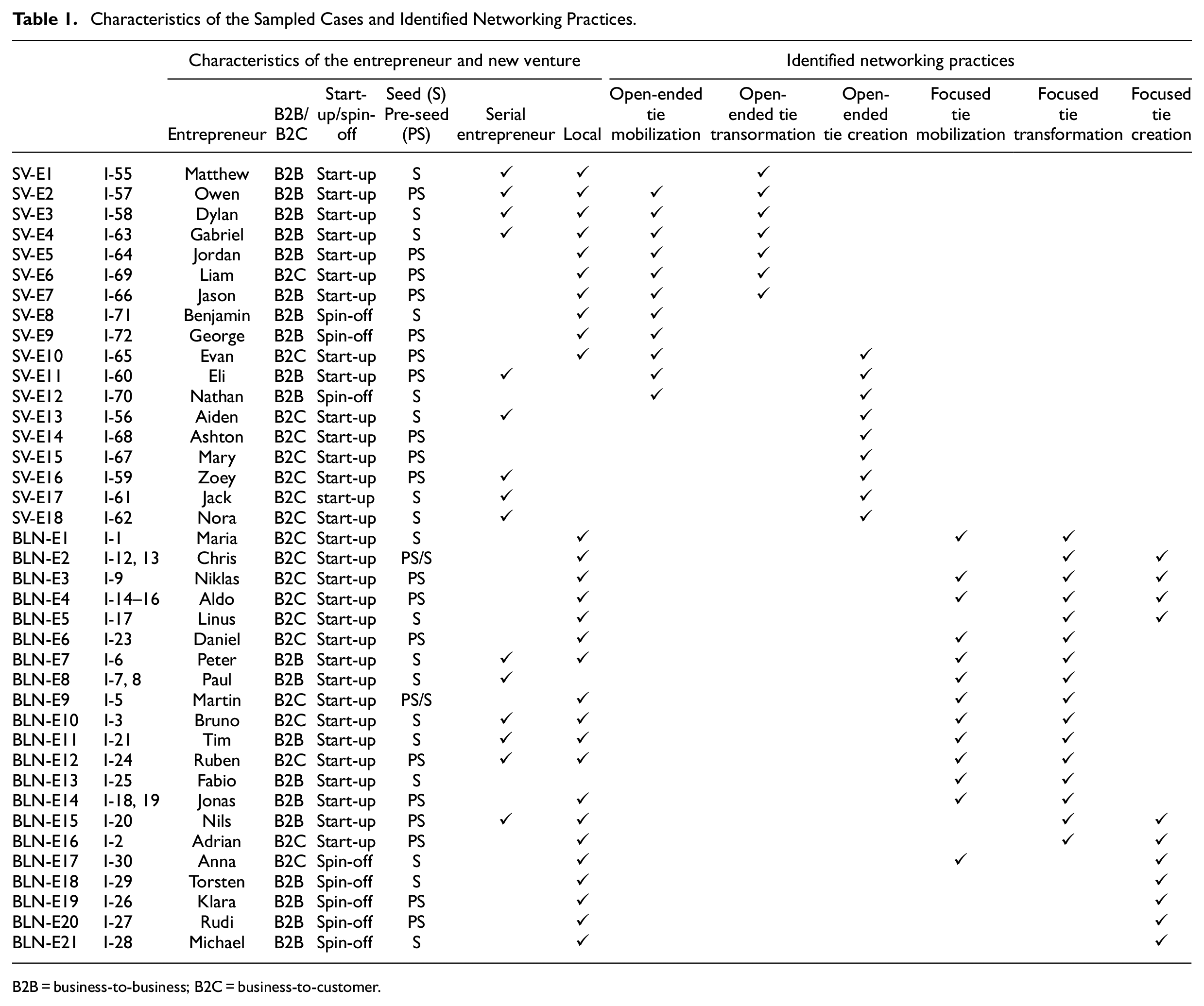
B2B = business-to-business; B2C = business-to-customer.
List of Networking Interviews.
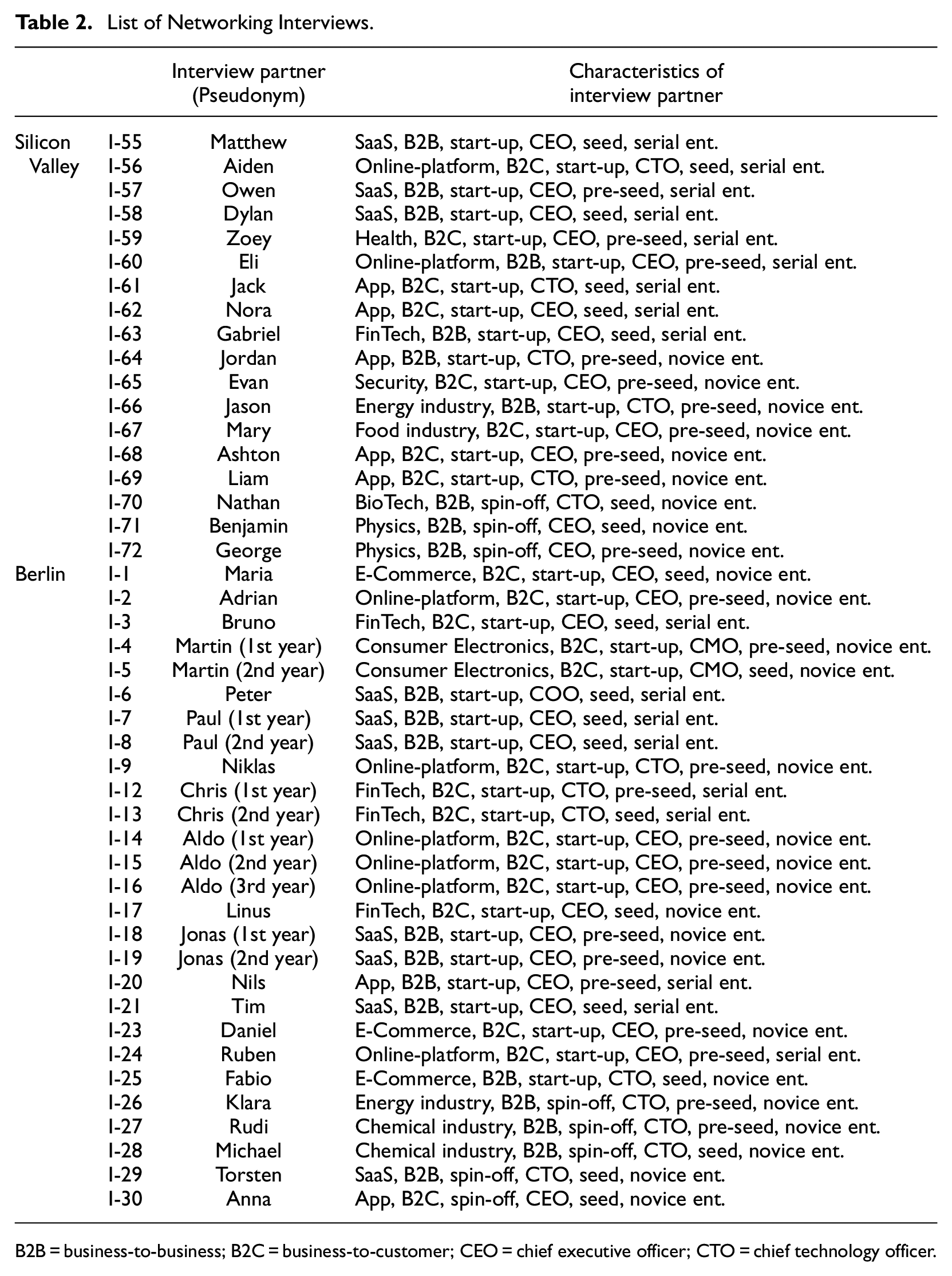
B2B = business-to-business; B2C = business-to-customer; CEO = chief executive officer; CTO = chief technology officer.
Furthermore, we sampled a set of informants who could provide relevant information about the two different ecosystems, such as investors or entrepreneurship coaches, listed in Table 3.
List of Context Interviews.
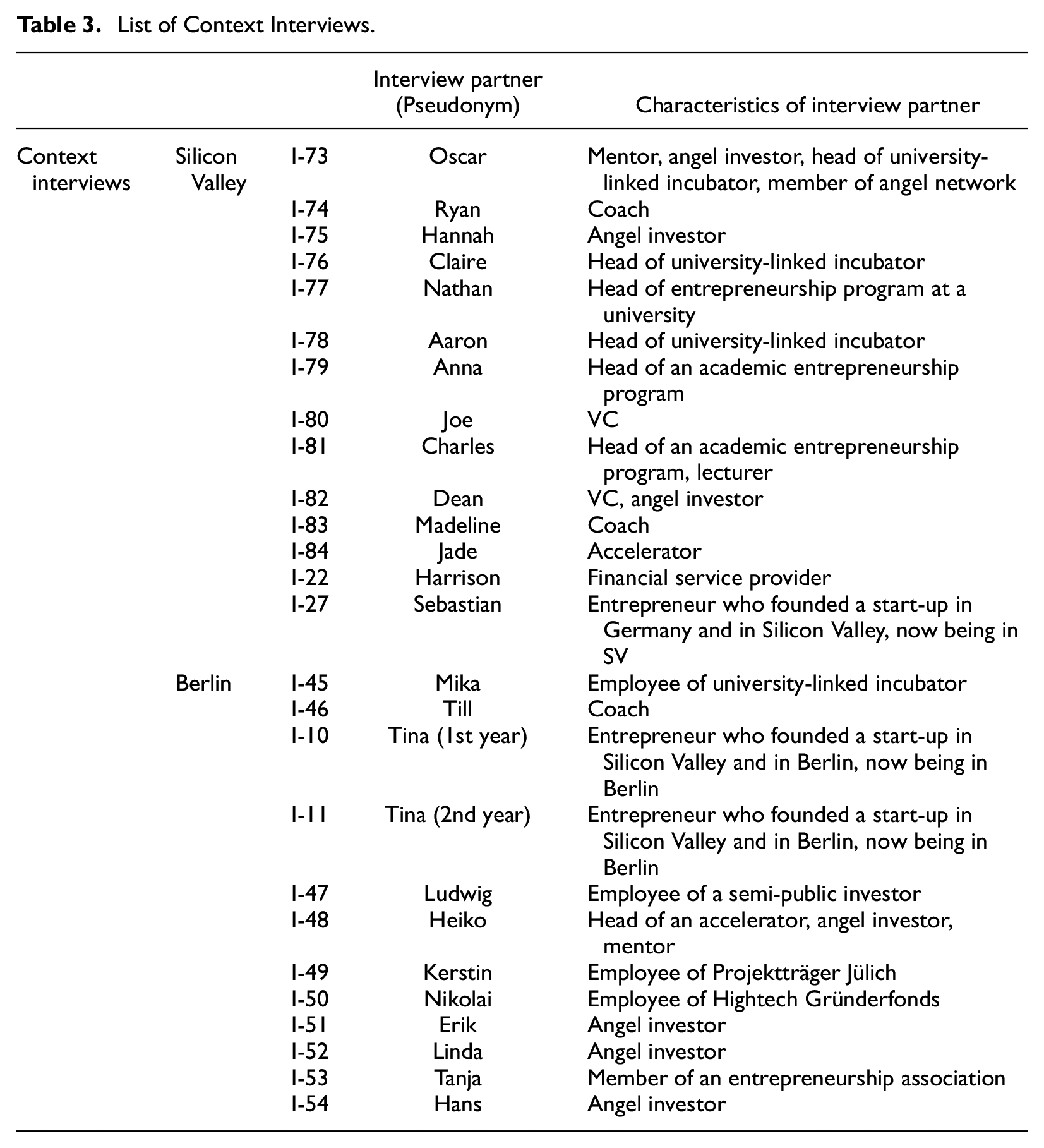
Data Collection
We collected data on entrepreneurs’ networking practices more broadly and focused our analysis on networking aimed at gaining external investments for their new ventures. We used several data sources, allowing for triangulation: (1) semi-structured interviews, (2) unstructured network maps, and (3) observations of entrepreneurship events.
Interviews
We developed two interview guidelines. The first guideline was designed for networking interviews, that is, interviews with entrepreneurs (see Table 2), starting with open questions about the founding process and diving deeper into networking for investment. The second guideline was designed for context interviews (see Table 3), focusing on the interviewee’s role within the entrepreneurial ecosystem in either Silicon Valley or Berlin, particularly their interactions with entrepreneurs.
Interviews were conducted in English or German (the native language of one of the authors and most Berlin-based entrepreneurs). Data collection lasted from spring 2016 until spring 2018; most interviews lasted about 1 hour and were conducted from mid-2017 until early 2018. Some entrepreneurs were interviewed twice or three times, with 1-year gaps between the interviews (see Table 2). All interviews were transcribed and entered into the qualitative data analysis software MaxQDA. Our interview data comprised 71 interviews (45 networking interviews and 26 context interviews).
Unstructured Network Maps
To gather deep insights into how entrepreneurs network, we used unstructured network maps, that is, visual representations of an entrepreneur’s network that do not follow a given scheme, as a narration trigger (McCarty et al., 2007) . We asked entrepreneurs to draw their network at the end of each networking interview. We asked, “Which partners were and are important for you?” followed by more precise questions such as “Who gave you funding?” Once partners had been drawn on the network map, we asked in-depth questions regarding how this relationship was formed or maintained—for example, “How did you meet this partner? How did you get in touch?” While elaborating on particular relationships, entrepreneurs usually extended their network map substantially, recalling several partners whom others had introduced. Figure 1 provides illustrative examples of such unstructured network maps.
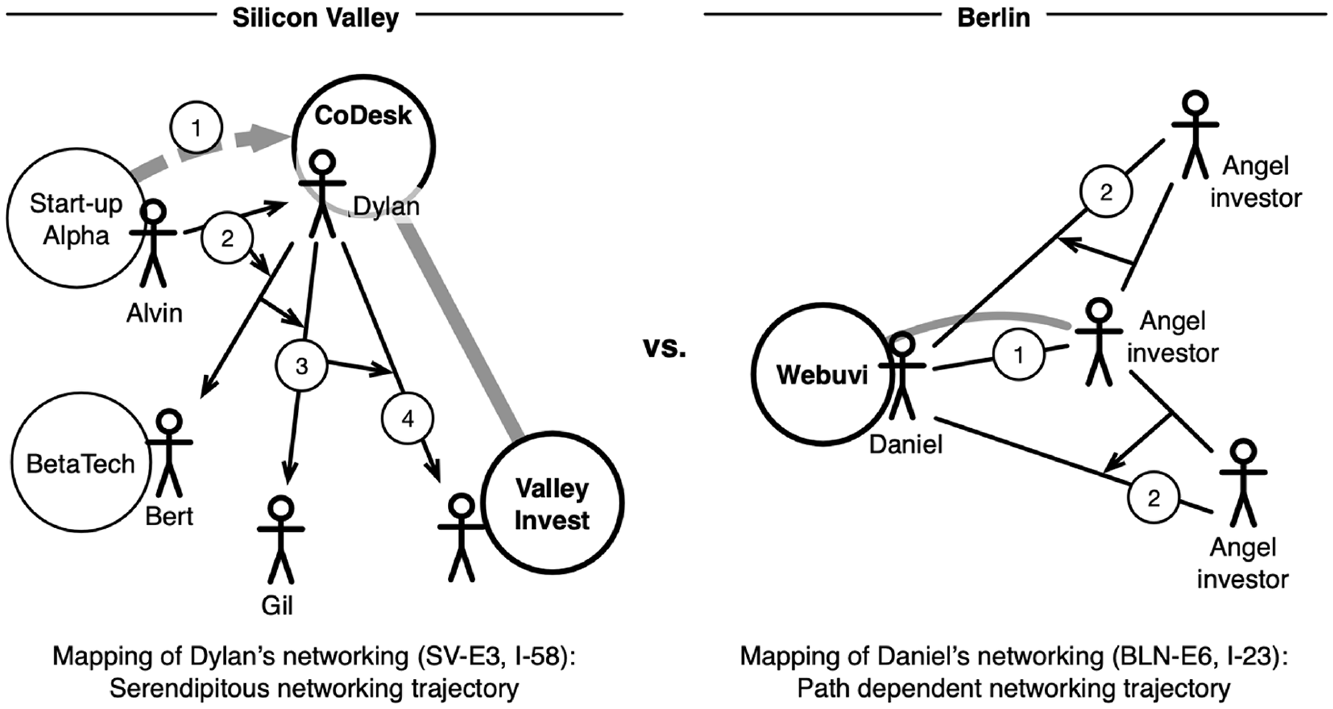
Exemplary mappings of networking trajectories.
Observations
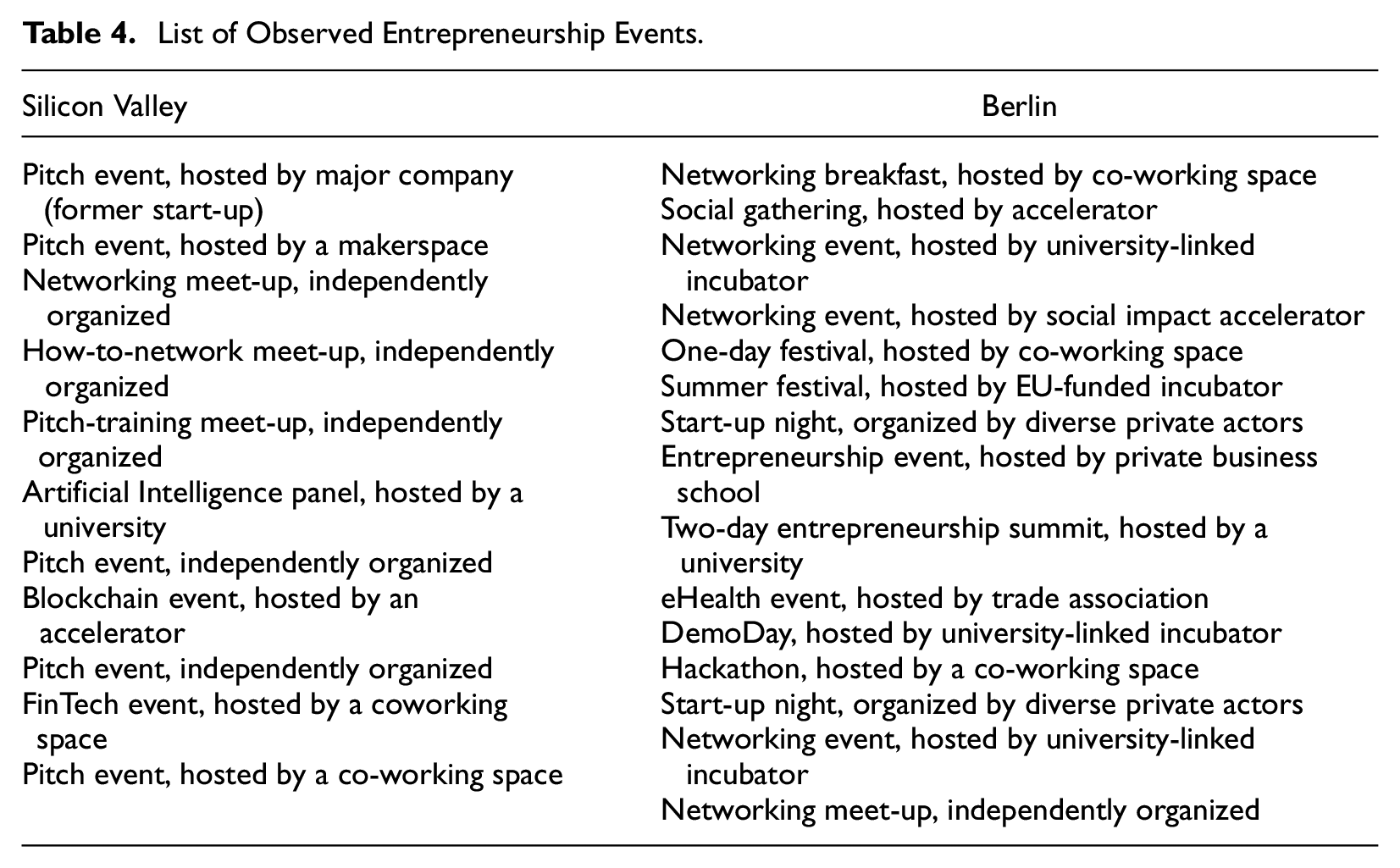
To complement our interview data, we observed 11 entrepreneurship events in Silicon Valley and 15 in Berlin, as Table 4 illustrates. We observed different kinds of entrepreneurship events, including networking and pitch events organized by university-linked incubators, corporate and independent accelerators, or initiatives of entrepreneurs. We took field notes on how entrepreneurs interacted, insights into networking from informal conversations, and information given by invited speakers.
List of Observed Entrepreneurship Events.
Data Analysis
We engaged in both within- and cross-case comparisons to look for patterns in our data (Eisenhardt, 1989; Eisenhardt & Graebner, 2007). Our data analysis evolved around three broad themes: identifying scripts relevant for networking, networking practices, and networking trajectories. As a final step, we integrated this thematic analysis into a theoretical model of how the social rules and taken-for-granted assumptions that pertain to a particular context shape entrepreneurs’ networking. Even though this process was highly iterative, we present them as three separate themes to facilitate reading.
Scripted Networking Temperature: Context-Bound Templates for How an Entrepreneur Should Network
As described in Section “Contextualizing Entrepreneurs’ networking: the role of networking scripts,” we used Giddens’ idea of scripts and the modalities of structuration (facilities, norms, and interpretative schemes) in a sensitizing way (Miles et al., 2014). First, in a process of pattern coding (Miles et al., 2014), we coded and clustered statements where informants described their assumptions about how entrepreneurs should network. We continued with further comparisons within and across the different contexts, seeking to specify the modalities of each context’s script, respectively. This means that we coded and clustered informant statements about (1) relational facilities (i.e., which pre-existing relationships an entrepreneur can utilize for networking), (2) relational norms (i.e., entrepreneurs’ shared values and ideas about rights and obligations in relation to other actors in their network), and (3) relational interpretative schemes (i.e., entrepreneurs’ understandings of what constitutes a relationship). In this continued process of pattern coding, we discovered important differences between Silicon Valley and Berlin, illustrated in Figure 2.
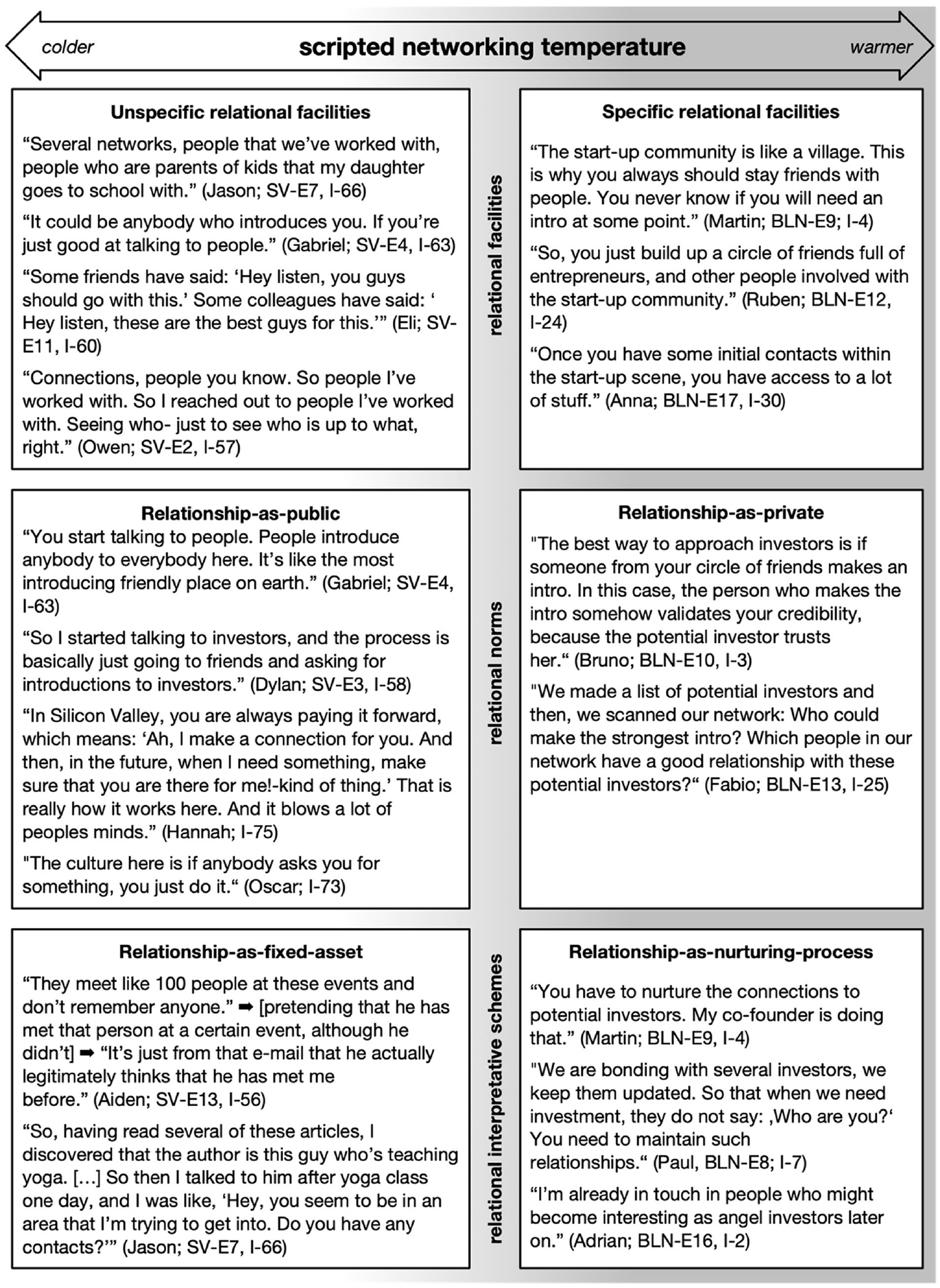
Identifying nuances of the scripted assumptions and developing the concept of networking temperature.
As Figure 2 illustrates, the modalities of networking scripts took different forms in different ecosystems. For example, we noted that a weak or distant tie—which would have been considered legitimate to mobilize in Silicon Valley—was not regarded as legitimate in Berlin. We also noted that informants in Berlin emphasized the importance of “keeping relationships warm.” This was not at all as salient among entrepreneurs in Silicon Valley. Thus, we concluded that even though entrepreneurs in both contexts adhered to scripted assumptions about networking (meaning they saw networking as a critical activity for their venture), their understandings of which relationships are valuable, where such relationships could be formed, how they should be formed, and what constitutes a relationship differed. It was also quite clear that these differences could not be explained based on individual-level network structure, activities, or skills but at the level of social rules and taken-for-granted assumptions regarding how to interact with others. We found these observations interesting, given that prior research has explained networking at the level of the individual entrepreneur. However, we found that the networking practices an entrepreneur engaged in were also shaped by their scripted assumptions regarding relational facilities, norms, and interpretative schemes.
Against this observation, we saw the need to develop a concept that could capture such differences at the level of the social context, not at the individual level. Going back-and-forth between data and emergent theory, we eventually settled for networking temperature: context-bound templates regarding (1) which relationships are available for networking, (2) how relationships should be formed and maintained, and (3) what constitutes a relationship in the first place. As common in grounded theorizing (Glaser & Strauss, 1967), the term “temperature” emerged from in vivo coding. Entrepreneurs in both contexts referred to “warm intros” and “warm ties” as opposed to “cold calling.” Yet, it was also clear that what was considered a “warm tie” or “cold call” varied between Silicon Valley and Berlin. Figure 2 illustrates the links between empirical observations and the more abstract conceptualizations of colder and warmer networking temperatures.
Networking Practices: How Entrepreneurs Form and Maintain Ties
To identify networking practices in our data, we followed Miles et al.’s (2014) recommendations for coding cycles. In the first coding cycle, that is, process coding, we coded the actual networking activities of entrepreneurs. In the second coding cycle, that is, pattern coding, we searched for patterns in these networking activities to identify networking practices, that is, networking activities performed repeatedly and across different entrepreneurs.
We identified three networking archetypes. (1) Tie mobilization, that is, the act of calling on pre-existing ties for action, for example, by contacting existing personal ties for introductions to new, unfamiliar ties. (2) Tie transformation, that is, fundamentally changing the nature of a pre-existing tie, for example, when a friendship tie is transformed into an investor tie. (3) Tie creation, that is, creating a new tie without using any prior contacts.
Comparing observations between entrepreneurs in Silicon Valley (characterized by a colder networking temperature) and Berlin (characterized by a warmer networking temperature), we observed substantial differences in how entrepreneurs practiced these different networking archetypes. An overview of these different patterns is provided in Table 1. As this table illustrates, we did not observe systematic differences in whether companies were business-to-business or business-to-consumer, the investment phase, or the individual entrepreneurs’ prior entrepreneurial experiences. Instead, the systematic differences occurred across the different social contexts.
Figure 3 shows linkages between empirical observations and abstract conceptualizations of networking practices. As illustrated in Figure 3, networking practices under the colder networking temperature in Silicon Valley were open ended. This means that entrepreneurs fired off a wide range of tie mobilization, transformation, and creation attempts, hoping that some would succeed. In comparison, networking practices under the warmer networking temperature in Berlin were focused. This means that entrepreneurs were much more deliberate and specific in their attempts to mobilize, transform, or create ties. In Berlin, entrepreneurs knew precisely who they were targeting, why, and how.

Comparing open-ended and focused networking practices—exemplary data parts.
Networking Trajectories: How Networking Temperature Shapes How Networking Unfolds
For this theme in our analysis, we used the unstructured network maps described in Section “Data Collection” and illustrated in Figure 1. Comparing different network maps, we created pattern codes to capture the trajectories of entrepreneurs’ networking. This analysis indicated high serendipity in how the entrepreneurs’ networking unfolded in relation to their prior ties and networking activities in Silicon Valley. In contrast, maps for entrepreneurs in Berlin showed that the first investor’s network had a strong imprinting effect on subsequent networking, reflecting path dependence in entrepreneurs’ networking trajectories.
Integrating the Thematic Analysis Into a Theoretical Model
As described above, the core insight emerging from our research is a novel concept—networking temperature—and a detailed understanding of how different networking temperatures lead to different networking practices and different networking trajectories across different social contexts. As the final step in our data analysis, we integrated this analysis into a theoretical model—see Figure 4. This model illustrates how different networking temperatures shape different networking practices and networking trajectories.
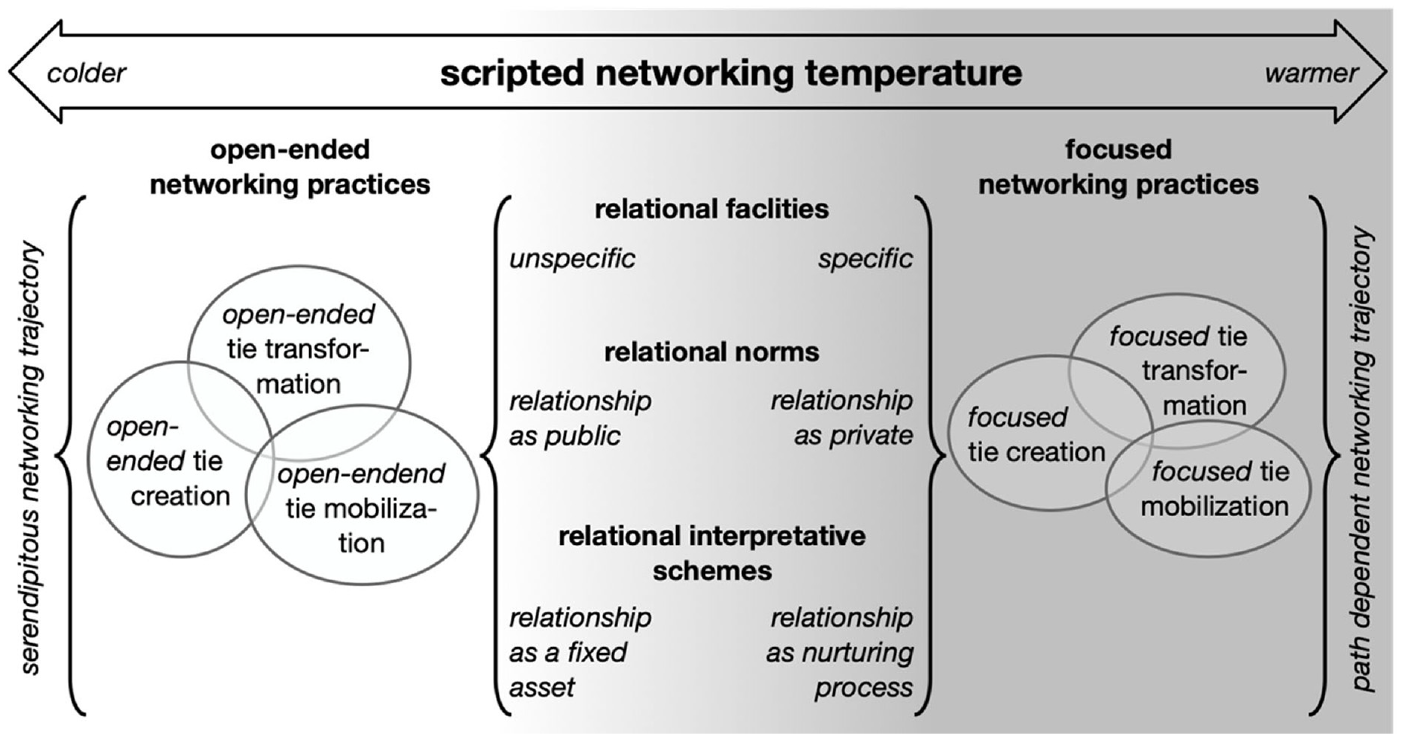
Theoretical model—linking scripted networking temperature to networking practices and networking trajectories.
Findings
As illustrated in Figure 4, our findings offer a novel understanding of how the social rules and taken-for-granted assumptions that pertain to a particular context shape entrepreneurs’ networking. To account for these observations, we start in Section “Networking Temperature: Capturing Contextual Nuances of How Entrepreneurs Should Network,” by describing networking temperature—a novel concept that emerged from our data. Section “How Networking Temperature Shapes Networking Practices” describes how networking temperature shapes networking practices, and Section “How Networking Temperature Shapes Networking Trajectories” its implications for networking trajectories.
Networking Temperature: Capturing Contextual Nuances of How Entrepreneurs Should Network
In Silicon Valley and Berlin, entrepreneurs portrayed networking as central for resource acquisition. For example, in Silicon Valley, Liam articulated that “you need referrals” (SV-E6, I-69), and Jordan explained that “you have to start from a place where you get referred to an investor” (SV-E5, I-64). In Berlin, Peter similarly said, “the best way to raise money is via your personal network” (BLN-E7, I-6), and Bruno explained, “the best way to contact investors is if you get introduced by a mutual contact” (BLN-E10, I-3). Yet, their understandings of how you should network differed across the two ecosystems.
To conceptualize this core observation, we introduce a novel concept termed networking temperature, that is, context-bound templates regarding (1) which relationships are available for networking, (2) how relationships should be formed and maintained, and (3) what constitutes a relationship in the first place. We conceive networking temperature as a continuum, ranging from colder to warmer temperatures, whereby the relational norms, relational facilities, and relational interpretative schemes differ with varying temperature, as Figure 2 illustrates.
Relational Facilities: Unspecific Under Colder Networking Temperatures, Specific Under Warmer Networking Temperatures
Relational facilities describe which pre-existing relationships an entrepreneur can utilize for networking. As Figure 2 illustrates, under the colder networking temperature in Silicon Valley, relational facilities were unspecific, meaning that entrepreneurs considered any relationship potentially useful for investor networking. For example, informants described how the parents of children’s pre-school friends, colleagues, and acquaintances—basically any relationship—were considered a proper facility. As entrepreneur Gabriel mentions, “It could be anybody who introduces you. If you’re just good at talking to people” (SV-E4, I-63).
In contrast, the warmer networking temperature in Berlin implied that relational facilities were specific. As illustrated in Figure 2, entrepreneurs in this context described the entrepreneurial community as a village—based on trust, prior connections, and a close circle of friends. For example, entrepreneur Anna emphasizes that you need contacts “within the start-up scene”: “Once you have some initial contacts within the start-up scene, you have access to a lot of stuff” (BLN-E17, I-30).
Relational Norms: Public Under Colder Networking Temperatures, Private Under Warmer Networking Temperatures
By relational norms, we mean entrepreneurs’ shared values and ideas about rights and obligations in relation to other actors in their network. Under the colder networking temperature in Silicon Valley, the norm was relationships-as-public. As the quotes in Figure 2 illustrate, entrepreneurs thought of themselves as having the right to share their existing relationships with others. Analogously, they also considered it a moral obligation of others to share their relationships with them. For example, Oscar explains, “The culture here is if anybody asks you for something, you just do it” (Oscar, I-73). Similarly, Gabriel explained, “You start talking to people. People introduce anybody to everybody here. It’s like the most introducing-friendly place on earth” (SV-E4, I-63).
This norm contrasts with the one directed by the warmer networking temperature in Berlin. Here, relationships were considered private, meaning something one would keep to oneself and a close circle of trusted friends. As illustrated by the quotes in Figure 2, a relationship would not be shared unless you had profound trust in the person you shared it with. Analogously, you would not ask someone to share their connections unless they trust you well. For example, entrepreneur Bruno underscored the importance of trust within the relationship to be used as a resource for subsequent networking: “The best way to approach investors is if someone from your circle of friends makes an intro. In this case, the person who makes the intro somehow validates your credibility because the potential investor trusts her” (BLN-E10, I-3).
Relational Interpretative Schemes: Relationships as Fixed Assets Under Colder Networking Temperatures, as Nurturing Processes Under Warmer Networking Temperatures
By relational interpretative schemes, we mean entrepreneurs’ understandings of what constitutes a relationship, applied reflexively in the context of networking activities. Under the colder networking temperature in Silicon Valley, we observed an understanding of relationships-as-fixed-assets. This means that entrepreneurs thought of relationships as something they have and can use as an asset without putting any particular effort into their maintenance. For example, entrepreneur Jason perceived his yoga teacher as a legitimate asset to ask for introductions to investors and did not perceive any preceding trust-building activities as necessary: “So, having read several of these articles, I discovered that the author is this guy who’s teaching yoga. […] So, then I talked to him after yoga class one day, and I was like, ‘Hey, you seem to be in an area that I’m trying to get into. Do you have any contacts?’” (SV-E7, I-66).
In Berlin, the warmer networking temperature made such an interpretation impossible. Instead, entrepreneurs here thought of relationships as a nurturing process that must be maintained continuously and actively. If a relationship had not been maintained, it could no longer be considered useful. As the quotes in Figure 2 illustrate, relational nurturing was thus an essential activity for entrepreneurs to maintain trust with people they knew. As Paul explained, “We are bonding with several investors, we keep them updated. So that when we need investment, they do not say, Who are you?’ You need to maintain such relationships” (BLN-E8, I-7). Along similar lines, Martin identified the friendship dimension of a relationship as key; otherwise, you cannot utilize that relationship: “…you always should stay friends with people. You never know if you will need an intro at some point” (BLN-E9, I-4).
How Networking Temperature Shapes Networking Practices
As detailed in Section “Networking Practices: How Entrepreneurs Form and Maintain Ties,” we identified three generic networking archetypes: tie mobilization, tie transformation, and tie creation, and we observed how these archetypes were practiced differently, depending on the networking temperature of the context in which they occurred. This is described below, Figure 3 provides additional empirical illustrations, and Table 1 shows the distribution of the different practices across our sample of entrepreneurs.
Open-Ended Networking Practices Under the Colder Networking Temperature in Silicon Valley
Open-ended tie mobilization implied that entrepreneurs asked multiple contacts if they could spread the word about the entrepreneur’s need for investment. Those contacts could be of various types, such as friends, acquaintances, or colleagues. This often led to parallel referrals in multiple steps until the entrepreneur eventually reached a potential investor. As Table 1 shows, 11 entrepreneurs in Silicon Valley engaged in this practice.
For example, entrepreneur Dylan described his approach to tie mobilization: “Start-up Alpha approached us. And then I looked, ‘Who is this Alpha company?’ And I was like, ‘Oh! Bert is an investor and an advisor there!’ I really want to talk to Bert because he started a company called BetaTech that is kind of like us and might invest in us. ‘Can I communicate with Bert?’” (SV-E3, I-58). Dylan anticipated that even this very brief contact with start-up Alpha would be sufficient for him to mobilize it to approach Bert. Bert then referred Dylan to another entrepreneur, and she, in turn, referred Dylan to a friend working at a VC company. This type of open-ended referral in several steps is legitimized by the colder networking temperature in Silicon Valley. As also directed by the colder networking temperature, Silicon Valley-based entrepreneurs could approach almost anyone for contacts when engaging in open-ended tie mobilization—like their yoga teacher or other parents from their children’s pre-school.
Open-ended tie transformation implied that the entrepreneur approached a broad range of contacts, such as friends, acquaintances, or colleagues, and asked them to invest. As Table 1 shows, we observed this practice among seven entrepreneurs in Silicon Valley. Open-ended tie transformation required extensive pre-existing contacts in Silicon Valley. However, these pre-existing contacts could be relatively weak, if not almost dormant, in line with the colder networking temperature. For example, Dylan asked someone he had met once or twice a couple of years ago: “[The investor] is someone I had met at one or two events when I was running my previous company. And I knew that he led an AngelList Syndicate in the space that we were in, so I came to him and pitched him, and he agreed to lead a syndicate to investment in us” (SV-E3, I-58).
Open-ended tie creation implied that entrepreneurs made an effort to create new ties that they could subsequently mobilize to be introduced to an investor. As Table 1 shows, we observed this practice among nine entrepreneurs in Silicon Valley. For example, entrepreneur Liam attended entrepreneurship events not to find investors there and then but to create personal relations with people who could introduce him to investors in the future (SV-E6, I-69). Similarly, Nora put great effort into creating numerous ties, hoping that some of them could eventually be mobilized at a later point: “We are getting to know more and more people who don’t actually invest, but start to connect us with other people” (SV-E18, I-62).
Which of these networking practices a particular entrepreneur engaged in depended partly on their initial network position. An entrepreneur with an established network had more ties that could be mobilized or transformed, whereas an entrepreneur who lacked prior ties needed to rely on tie creation. As Table 1 illustrates, for example, all but one entrepreneur who engaged in open-ended tie creation recently came to Silicon Valley. They were often serial entrepreneurs (SV-E11, SV-E13, SV-E59, SV-E61, and SV-E62), but they had founded their previous companies elsewhere. Table 1 also illustrates that entrepreneurs often relied on more than one practice, implying that scripted networking temperature did not entirely determine the entrepreneurs’ activities. Instead, the script offered a template for understanding this context’s particular relational facilities, norms, and interpretative schemes. Based on this understanding, entrepreneurs reflexively engaged in networking practices in line with the script.
Entrepreneur Aiden (SV-E13) showed a particular way of such a reflexive interpretation. Recognizing that entrepreneurship networking events were a good starting point for creating relationships that could subsequently be mobilized to form ties, Aiden continuously identified relevant events. However, he never bothered to attend them. Instead, he pretended he had been there and approached attendees. He explained, “What I did is: I looked at a lot of investors. I looked at their Twitter feeds. I looked at what events they were going to, and I just sent them an e-mail saying, ‘Hey, I saw you at X event very briefly. You said, “Send me your deck.” So, let’s have a chat. Let’s grab a coffee.’ I’ve never met them, never seen them, never done anything. I just said that because it was an easy way to make a warm intro” (SV-E13, I-56). Explaining this, Aiden said, “It was a warm enough intro for a cold intro,” and emphasized that he had “figure[d] out a formula of how to do it effectively” (SV-E13, I-56). He was well aware of the colder networking temperature, knowing that even encounters that were so brief that people could hardly remember whether or not they happened could be “warm enough” to initiate an interaction: “They meet like 100 people at these events and don’t remember anyone” (SV-E13, I-56). So he pretended to have met them, and “they actually tricked themselves into believing that they have met me before” (SV-E13, I-56). Although Aiden’s networking activities were a somewhat extreme example, they illustrate that entrepreneurs can be well aware of the networking temperature of their particular context and utilize it creatively. This shows how entrepreneurs reflexively interpret networking temperatures and how extremely weak ties are warm enough to be mobilized in a context with a colder networking temperature.
Focused Networking Practices Under the Warmer Networking Temperature in Berlin
Focused tie mobilization implied that the entrepreneur approached a limited number of contacts, asking for a direct referral to a specific investor. Compared to the open-ended tie mobilization that we observed in Silicon Valley, focused tie mobilization implies that fewer contacts were approached, that those contacts were members of the entrepreneurial community, and that there were only one or two steps between the initial contact and the intended investor. As Table 1 shows, 13 entrepreneurs in Berlin engaged in this practice.
When mobilizing ties, entrepreneurs in Berlin stayed firmly within the context of the entrepreneurial community. They did not consider whether or how mobilizing ties outside that community could be useful. Berlin-based entrepreneurs asked angel investors or mentors for referrals or befriended entrepreneurs. However, they never went to their friends, acquaintances, parents from their children’s school—nor yoga teachers. Moreover, they emphasized that referrals could only be requested within one or two steps. For example, Fabio and his co-founder strategically searched for connections within their networks who could make “warm-enough” intros to investors: “We made a list of potential investors, and then we looked within our personal networks: ‘Who could make the strongest intro?’” (BLN-E13, I-25).
Focused tie transformation implied that entrepreneurs approached a few contacts within the entrepreneurial community, asking them directly for investment. This practice was observed among 16 entrepreneurs in Berlin, as Table 1 shows. Entrepreneurs often had a particular idea about which ties would be transformed. In comparison, entrepreneurs in Silicon Valley approached a more significant number of contacts, both inside and outside the entrepreneurial community, to ask for investments. Moreover, entrepreneurs in Berlin emphasized that they only transformed ties they had met relatively recently. Once a tie was created within the entrepreneurial community, entrepreneurs stayed in contact, in line with the interpretative scheme of relationships as a nurturing process. For example, Tim stayed in touch with Karl and transformed that tie when he was looking for investment: “The first investor I approached was Karl. I met Karl when I was founding my previous company, and then we stayed in touch” (BLN-E11, I-21).
Focused tie creation implied that entrepreneurs made an effort to create specific new ties to be able to transform them into investment ties directly. We observed this practice among 11 entrepreneurs in Berlin, as Table 1 illustrates. Because of the warmer networking temperature in Berlin, focused tie creation implied the need to form sufficiently close and strong ties. This stands in stark contrast to Silicon Valley where pretending to have met could be sufficient, as described above in the example of Aiden (SV-E13). For instance, entrepreneur Adrian initiated a network for nascent entrepreneurs with monthly meetings within the group. The purpose of this network was to enable himself and other entrepreneurs to create close personal ties within the entrepreneurial community (BLN-E16, I-2).
In the focused tie-creation practice, it was also common for entrepreneurs to target investors directly. For example, Berlin-based entrepreneurs attended entrepreneurship events to forge ties to potential investors there and then. As Nils explained, “I attend meet-ups where the organizers say, ‘You can present your start-up; there will be investors attending’” (BLN-E15, I-20). This contrasts with the colder networking temperature in Silicon Valley, where entrepreneurs attended events to create ties they could use to get referrals to potential investors.
As Table 1 indicates, Berlin-based entrepreneurs often relied on multiple practices, just as Silicon Valley-based entrepreneurs did. Again, it thus becomes apparent that networking temperature is interpreted reflexively. The warmer networking temperature does not force entrepreneurs to behave in a certain way but provides a recipe, bringing about three focused networking practices.
How Networking Temperature Shapes Networking Trajectories
As illustrated at the left- and right-hand outer edge of Figure 4, our analysis shows that networking temperature also shapes networking trajectories. A colder networking temperature (as observed in Silicon Valley) leads to networking serendipity, meaning that ties were formed seemingly by chance, beyond what the entrepreneur was planning or looking for when engaging in a particular practice. A warmer networking temperature (as observed in Berlin) leads to networking path dependence, meaning that entrepreneurs’ future ties were shaped by their initial point of contact. Figure 1 provides empirical examples of two networking trajectory mappings. These specific examples are elaborated on below.
Networking Serendipity Under a Colder Networking Temperature
The left side of Figure 1 illustrates networking serendipity, showing how Dylan’s networking unfolded (SV-E3). (1) Entrepreneur Alvin approached Dylan regarding a technology-related cooperation. Dylan recognized that Bert was an investor and advisor in Alvin’s start-up. Dylan wanted to get in touch with Bert because Bert had also founded a start-up that could invest in Dylan’s start-up. (2) Dylan started interacting with Alvin primarily because he wanted to be introduced to Bert. (3) Bert did not want to invest but introduced Dylan to entrepreneur Gil. (4) Gil introduced Dylan to a friend of hers who was working for the VC ValleyInvest. As Dylan put it: “… and [ValleyInvest] got introduced to us, it’s a bunch of different connections that came together. I had talked to someone [Alvin] about a partnership, and then they introduced me to their investor advisor [Bert], and then that person introduced me to another entrepreneur [Gil]. Then that person [Gil] introduced me to the investor at ValleyInvest, and ValleyInvest invested. So it was this big like serendipitous chain of events that ended up with 1.8 million [USD] investment from ValleyInvest” (SV-E3, I-58).
As this example illustrates, the colder networking temperature shaped open-ended networking practices, leading to high networking serendipity. This link between the networking temperature and networking trajectories was consistent in our data. Silicon Valley entrepreneurs could not wholly control the trajectories of their networking activities. Instead, they created specific opportunities and tried maneuvering them in a particular direction.
Networking Path Dependence Under a Warmer Networking Temperature
The right side of Figure 1 illustrates networking path dependence, showing how Berlin-based entrepreneur Daniel’s networking unfolded (BLN-E6). (1) Daniel acquired his first angel investment from his former boss, the founder of the start-up for which Daniel and his co-founder had worked before founding their start-up. (2) This first angel investor subsequently introduced Daniel to a few potential angel investors, two of whom invested. Introductions ended after the second step.
As this example illustrates, the warmer networking temperature implied more focused networking practices, shaping a path-dependent process where the first point of contact significantly influenced networking trajectories. This was echoed by several Berlin-based entrepreneurs, who emphasized how their first angel investor(s) introduced subsequent ones. For example, Martin explained, “Our first two angel investors know other angel investors, and some of them joined the round and said, ‘Yes, sure, we are in!’” (BLN-E9, I-4). As Maria explained, all her company’s subsequent investors can be attributed to their first angel investor’s connections and introductions (BLN-E1, I-1). None of our interviewed entrepreneurs in Silicon Valley described a comparable effect of a single person’s network on their networking trajectories.
Discussion
Our study contributes a contextualization of entrepreneurs’ networking: a starting point to theorize how entrepreneurs’ networking practices are shaped by the social rules pertaining to the context in which they are embedded. As our primary outcome, we introduce a novel concept—networking temperature, that is, context-bound templates regarding (1) which relationships are available for networking (relational facilities), (2) how relationships should be formed and maintained (relational norms), and (3) what constitutes a relationship in the first place (relational interpretative schemes). Based on our observations, we have detailed the meaning of networking temperature in colder versus warmer contexts and how it shapes how, where, and with whom entrepreneurs network to acquire resources for their ventures.
We propose networking temperature as a defining element of how context-bound social rules and taken-for-granted assumptions shape entrepreneurs’ networking. Put simply, without considering networking temperature, we cannot understand what constitutes a beneficial network structure and size, nor what constitutes efficient networking activities or skills in a particular social context. In this way, we open a new angle on entrepreneurs’ networking. In addition to being stipulated by the individual entrepreneur’s prior network structure or networking activities, networking is also a practice situated in and unfolding through social context. With this view, we challenge and extend both the structural and agentic perspective on entrepreneurs’ networking and inform the unfolding debate on how entrepreneurs’ networking trajectories are inhibited by their pre-existing ties or shaped by their networking activities and skills.
Contributions to the Structural Perspective on Entrepreneurs’ Networking
Networking temperature helps to understand the value and effects of an entrepreneur’s network ties in a social context, extending prior conceptualizations of tie strength (Granovetter, 1973) and directness (Burt, 1992). For example, it captures why a tie that would be considered “strong enough” or “direct enough” to mobilize, maintain, or transform under colder networking temperatures would not be “strong enough” or “direct enough” under warmer networking temperatures. Such an contextualization is important as prior research puts much value into tie strength and tie directness to explain subsequent networking (e.g., Hallen, 2008; Lechner & Dowling, 2003; Renzulli & Aldrich, 2005; Vissa & Bhagavatula, 2012; Elfring & Hulsink 2007), in particular when theorizing what constitutes a beneficial network size and structure for entrepreneurs’ networking (Elfring & Hulsink, 2007; Martinez & Aldrich, 2011; Stam et al., 2014; van Burg et al., 2021).
Many studies found that an extensive network, consisting of many weak ties, enables an entrepreneur to access actors who can bring valuable capital or knowledge that the entrepreneur does not possess (Jack, 2005) or does not initially know will be needed (Engel et al., 2017). Others, however, have argued that having many ties can be problematic if the entrepreneur cannot manage them all (Mariotti & Delbridge, 2012), and entrepreneurs might benefit more from a few strong ties (Martinez & Aldrich, 2011; Steier & Greenwood, 2000). We propose that this debate needs to consider the social context in which the entrepreneur is embedded, and more precisely, its networking temperature—as different answers might hold true in colder versus warmer contexts.
For example, a relevant avenue for future research is to explore whether entrepreneurs are more likely to benefit from weak and indirect ties under colder networking temperatures because they can be mobilized or transformed to create new ties. In contrast, they might benefit more from strong or direct ties under warmer networking temperatures. Our findings imply that the relational norm stipulates relationships-as-public under a colder networking temperature. Thus, it suggests that entrepreneurs would benefit from having an extensive network encompassing many weak and indirect ties because these ties can easily be leveraged for resource acquisition. Under a warmer networking temperature, however, the relational norm stipulates relationships as private. We propose that this makes weak and indirect ties less valuable. Yet, because of the interpretative scheme of relationships-as-nurturing-process, having an extensive network in a warm context might more likely cause network overload (Mariotti & Delbridge, 2012; van Burg et al., 2021). Under warmer networking temperatures, relationships need continuous nurturing to matter, limiting the number of connections an entrepreneur can potentially maintain. Thus, the value of an extensive network encompassing weak and distant ties is likely lower the warmer the networking temperature of a particular social context.
Our analysis opens relevant avenues for future research to contextualize the role of pre-existing ties for networking. It broadens the research focus from the entrepreneurs’ individual-level ties to their embeddedness in social rules and taken-for-granted assumptions. In particular, it prompts us to ask, “What constitutes an appropriate network size and structure in this social context and under its particular networking temperature?”
Contributions to the Agentic Perspective on Entrepreneurs’ Networking
Networking temperature enables us to understand how efficient networking, or attempts to form or maintain ties to desired partners with relatively little time and effort (Hallen & Eisenhardt, 2012), is shaped by contextual-level rules, not only individual-level activities. Two core implications emerge from our analysis. First, what can be considered “efficient” is likely to differ across contexts, meaning that entrepreneurs can engage in similar activities but get different outcomes in different contexts. For example, we propose that activities such as network broadening (Vissa, 2012) or proactive networking (Ebbers, 2014; Kaandorp et al., 2020) are more beneficial under colder networking temperatures. With such open-ended practices, entrepreneurs “fire off” a high number of networking activities in many directions, hoping that a few of them will “hit their target.” Ultimately, this allows the entrepreneur to create many ties and to do so swiftly. Under warmer networking temperatures, however, such proactive networking styles are likely to be considered pushy and inappropriate. They would lead the entrepreneur to create a too large and dispersed network to be “kept sufficiently warm.” Instead, we propose that entrepreneurs under warmer networking temperatures benefit from network-deepening activities (Vissa, 2012), whereby they nurture stronger but fewer ties. As such, networking temperature is considered a core contingency to networking, similar to other cultural expectations or norms identified in recent research (e.g., Batjargal et al., 2019; Klyver et al., 2020).
Second, our framework allows more profound theorizing of how networking unfolds through context. Networking temperature structures entrepreneurs’ understandings of relational facilities, norms, and interpretative schemes. This implies that entrepreneurs will engage in different networking activities in different contexts. In other words, they will do things differently in different contexts, not only do the same thing and get different outcomes.
These insights are essential for future research on catalyzing strategies, or “network actions that advantageously shape tie opportunities or signaling actions that amplify the inducements of potential partners” (Hallen & Eisenhardt, 2012, p. 36). In their influential study, Hallen and Eisenhardt (2012) identified four sequential paths through which entrepreneurs can engage in catalyzing strategies: casual dating, timing around proof points, scrutinizing interest, and crafting alternatives. Considering networking temperature, the quality and order of these paths may differ across different temperatures. For example, studying two different contexts in the United States, Hallen and Eisenhardt (2012) identified “casual dating” as an essential catalyzing strategy. Our analysis proposes that this strategy is less available to entrepreneurs under warmer networking temperatures. Given their understanding of relational facilities, norms, and interpretative schemes, they are not likely to think about casual dating as a potential strategy. Instead, their catalyzing strategies might better be captured in other metaphors—such as “arranged marriages” or “swift engagements.” We hope our analysis will inspire future research to identify novel and underexamined catalyzing strategies that might work in warmer contexts. For future research, our study thus suggests a slight but relevant reframing of research questions—from “How can entrepreneurs network efficiently?” to “What constitutes efficient networking in this particular context?”
Similarly, our model offers a starting point to re-direct how we theorize the link between networking skills and outcomes. For example, prior research shows that social competence is essential for entrepreneurs’ networking (Lans et al., 2015), although more critical for building and maintaining strong ties than weak ties (Klyver & Arenius, 2020). In the light of our conceptual model, we encourage future research to explore how such individual-level characteristics interact with networking temperature. A skill such as “social competence” might take a different form under warmer networking temperatures than colder ones. For example, confidently navigating a cocktail party and swiftly building many relationships with new acquaintances might be considered a critical social skill in a colder context. In a warmer context, however, the necessary social skill might enable someone to maintain long dinner conversations or deep friendships over time. Thus, what is considered socially competent in one context would be too blunt or pushy in another.
Contributions to Research on Networking Trajectories
Our model also informs the debate on how networking trajectories unfold in relation to pre-existing ties versus networking activities and skills (Engel et al., 2017; Hallen et al., 2020). Hallen et al. (2020) recently summarized this debate into two stylized patterns of networking trajectories. In the first pattern, entrepreneurs gain a cumulative advantage or disadvantage from their initial network position. Our observations of path-depended networking trajectories under warmer networking temperatures align with this pattern. In the second pattern, entrepreneurs create path-creating improvements in their network position through networking activities, with occasional missteps. Our observation of serendipitous networking trajectories under colder networking temperatures aligns with this pattern.
As Hallen et al. (2020) argue, there is a need to build a more integrative understanding of networking trajectories that considers both individual-level network structure and individual-level agency. Our insights extend this research agenda with a contextual perspective. We propose that the impact of individual-level network structure and individual-level agency on networking trajectories is structured by the context-level social rules and taken-for-granted assumptions that pertain to different networking temperatures.
Under colder networking temperatures, we expect the entrepreneur’s activities to have a more pronounced effect on networking trajectories (Hallen & Eisenhardt, 2012; Kaandorp et al., 2020; Vissa, 2012), as there is more room for agentic action, such as “generating contingencies to harvest serendipity” (Engel et al., 2017, p. 45). Such activities do not require a strong basis of pre-existing ties. They can thus help entrepreneurs to expand their network, enabling them to navigate further away from their initial network position. Therefore, colder networking temperatures facilitate serendipity rather than path dependence. They open up opportunities to create and shape the paths along which future networking can flow. Hence, network momentum, that is, “the entrepreneur’s perception that the network starts to exist without the immediate effort of the entrepreneur” (Kaandorp et al., 2020, p. 527), might thrive better under colder networking temperatures and enable entrepreneurs to “go with the flow,” while also being able to steer this flow in specific directions.
Under warmer networking temperatures, we expect that prior ties have a more substantial imprinting effect on subsequent networking. This implies a process where “the rich get richer” as entrepreneurs build cumulative advantages (or disadvantages) from their initial network positions (Batjargal & Liu, 2004; Hallen, 2008; Maurer & Ebers, 2006; Shane & Cable, 2002). Because strong tie networking requires nurturing of already existent ties, entrepreneurs might face more severe challenges to leave disadvantageous network positions.
Our framework’s significance is realizing that networking trajectories are shaped not only by initial network positions and networking activities but also through context. Therefore, the extent to which agentic actions can compensate for disadvantaged structural positions differs across different contexts. In this way, our model points us to rethink how we theorize the interplay between the entrepreneurs’ pre-existing network structure and her networking activities and skills. For example, by extending the relevant research questions from “How does the interplay of pre-existing ties and networking activities and skills shape networking trajectories?” to “How much room for agentic action does an entrepreneur have under this particular networking temperature, and to what extent is her networking constrained by her pre-existing ties?”
Methodological and Practical Implications
Our insights add a contextual perspective that shifts the focus of analysis in research on entrepreneurs’ networking: from how an individual entrepreneur’s existing network structure, individual-level activities, and individual-level skills propel networking—to entrepreneurs’ networking as a multilevel process that involves both individual- and contextual-level mechanisms. From a methodological perspective, this implies that future research should identify and specify contextual settings in which networking temperature is pertinent and capture information at both the individual and contextual levels. For example, if data are collected about individual-level network positions, networking activities, or skills, researchers should consider asking for information about the social context in which those structures are embedded (such as entrepreneurial ecosystems, regions, countries, industries, or social classes) in ways that could be analyzed with qualitative or quantitative multilevel methods.
For entrepreneurship practice, our analysis shows why simply transferring a best practice developed in one context (e.g., Silicon Valley) to others might be challenging or even counterproductive. Instead of looking at Silicon Valley for inspiration, entrepreneurs as well as policymakers might be better off developing and promoting practices that fit with their local rules of the game. Furthermore, our research implies that entrepreneurs who try to move from one context to another might face particular challenges when they develop, maintain, and build relationships with others. To network, they need to learn the networking temperature in their new context, a process likely to require substantial introspection and reflection.
Limitations
In the section above, we have outlined several theoretical propositions and research questions that we hope future research will develop, test, and address—using methods and research designs that complement ours. In addition to this, it is also essential to recognize the boundaries of our research scope.
Our study focuses on how networking temperature—context-bound templates for how entrepreneurs should network—shape networking practices. Thus, it falls outside the scope of our analysis to explain how a particular networking temperature emerges in the first place and how it might travel across social contexts. We encourage future research to address this limitation and explore how networking temperatures occur and develop over time. For example, if older ecosystems have colder networking temperatures than younger ones or if networking temperature changes with the degree of individualism/collectivism in a particular country, culture, or ecosystem (Rooks et al., 2016; Xiao & Tsui, 2007). Furthermore, whereas our focus has been on theorizing how context structures practices, it is essential to recognize that scripted assumptions are neither static nor fully deterministic (Giddens, 1984). We encourage future research to extend our model with a bottom-up perspective on how networking temperature emerges and changes over time.
Conclusions
We offer a contextual perspective for theorizing entrepreneurs’ networking. We have captured entrepreneurs’ shared assumptions about the social rules and taken-for-granted assumptions that pertain to the social context within which they operate and compared these observations across different contexts. In so doing, we have developed an understanding of entrepreneurs’ networking as shaped by the context in which it is situated, not only by individual-level network structures, activities, or skills. In this way, our study contributes a contextual perspective on research on entrepreneurs’ networking and underscores the need to contextualize entrepreneurship research more generally.
Footnotes
Acknowledgements
We are grateful to Arnold Windeler, Jörg Sydow, Jochen Gläser, Grit Laudel and Isabell Stamm for their invaluable guidance throughout the entire research process. We thank Michalea Hruskova, Franziska Günzel-Jensen, Yuval Engel, Blagoy Blagoyev and Joris Ebbers for comments on earlier versions of this manuscript; and our editor Sarah Jack and reviewers for a helpful review process. We are particularly thankful to all the entrepreneurs and related actors who participated in our study–without whom this research would not have been possible.
Declaration of Conflicting Interests
The author(s) declared no potential conflicts of interest with respect to the research, authorship, and/or publication of this article.
Funding
The author(s) disclosed receipt of the following financial support for the research, authorship, and/or publication of this article: The author recieved funding from Ragnar Söderbergs Stiftelse.
