



Abstract
Sustainability discourses are dominated by Western, educated, industrialized, rich and democratic (WEIRD) perspectives. Critics call for remedies to patriarchy, capitalism, and colonialism; and for work that is inclusive of women, non-market influences, and epistemologies of the global South. Focusing on women's work, this paper interrogates the epistemic and practical injustices of geography and gender. The empirical domain is a middle-income economy, offering insight from the space between WEIRD and subsistence extremes. 15 case studies of Malay female micro-entrepreneurs draw on interview, observational and secondary data, tracing the effects of market formalization on market actors. Despite subordinate social status, the women provide reliable income streams for their families. However, their livelihoods are threatened by rapidly formalizing markets. Market formalization crowds out the small and diverse in favor of the large and multinational. To address that problem, a pro-social systems view is required, based on pluralistic conceptions of economies and markets. Drawing on Gibson-Graham's diverse economies perspective we derive 12 propositions supporting sustainable livelihoods. Sustainable livelihoods support quality of life and wellbeing, are embedded in less damaging and more inclusive (vs patriarchal, colonial and capitalistic) provisioning systems, in turn embedded in epistemologies that are reflexively conscious of power dynamics and the WEIRD hegemony. In line with the paradoxes and tensions in sustainability thinking we call for pluralism: Conscious acceptance of all economic approaches, formal and informal, state and non-state, global and local, capitalist and planned; with an emphasis on physical, emotional and social well-being, self-determination, diversity, health, and happiness for the many rather than wealth for the few.
Keywords
Introduction
The sustainability discourse is dominated by the perspectives of Western, educated, industrialized, rich, democratic (WEIRD) stakeholders from the industrialized global North; drawing on initiatives such as Brundtland (World Commission on Economic Development 1987), the Club of Rome (1967) and the UN Sustainable Development Goals (United Nations 2021). However, the intersectional literatures addressing the grand challenges of climate change and social inequality have taken issue with the dominant WEIRD perspective (Henrich, Heine, and Norenzayan 2010; Natarajan et al. 2022; Saatcioglu and Corus 2014; Tao and Wall 2009). In particular, critique has focused on neoliberal, patriarchal ideologies that reify capitalism, colonialism, competition, markets and individual choice; and that render women and people of color invisible (Kravets, Preece, and Maclaran 2020; Perez 2019; Rosiek, Lee, and Pratt 2020, Santos 2018). Critics argue that non-WEIRD and critical epistemologies offer important correctives, and that women must be an integral part of the journey to social and environmental sustainability (e.g., Klein 2015; Santos 2007, 2018). Supporting that argument, evidence suggests that when women have access to capability-building assets, quality of life (QoL) improves for themselves, their families, and their communities (Glavee-Geo, Burki, and Buvik 2020; Lindeman 2014). This paper further examines that proposition, considering the epistemic and practical challenges of redressing injustices in geography and gender.
Responding to Steinfield and Holt's (2020) call for scholars to identify and address power dynamics, the authors are reflexively (and uncomfortably) conscious of our positionality as members of a hegemonic technocratic elite. However, we are motivated to draw on that positionality to make constructive contributions, and in particular, to broaden empirical and theoretical possibilities. Empirically, at one extreme, macromarketing studies focus on ‘first world’ problems such as overconsumption (e.g., Martin et al. 2019) and antisocial behaviors (e.g., Peattie, Peattie, and Newcombe 2016). At the other extreme, subsistence studies focus on the challenges of survival (e.g., Lindeman 2014; Steinfield and Holt 2020; Viswanathan et al. 2014). Work in the middle ground is sparse, and as Dholakia (2012) points out, few studies offer the open, eclectic, critical perspective we advocate in this paper. Theoretically, inspired by Santos’ (2007) ideas of epistemological justice and ecologies of knowledge), we build on Glavee-Geo, Burki, and Buvik (2020), and Varey's (2010, 2012, 2013) ideas about welfare marketing. Drawing on evidence from the rich liminal space between subsistence and affluence found in the transitional economies of Asia (e.g., Shultz 2012), we contribute insight into the effects of formalizing market structures on market actors and their communities. We introduce the diverse economies perspective (Gibson-Graham, 2006; Gibson-Graham, Cameron, and Healy 2013) in order to highlight the interplay between actors and market forces, and the implications for social and epistemological justice. Our empirical domain is Kuala Lumpur, Malaysia, a vibrant multicultural city in a transitioning middle-income economy in South-East Asia. We focus on a largely unnoticed group; the women providing cheap, traditional street food from unlicensed roadside stalls. Drawing on a case study of 15 Malay female micro-entrepreneurs (MFEPs) we asked “How do women's micro-entrepreneurship activities contribute to social sustainability?” and “What does a sustainable livelihood look like?” We found that despite subordinate social status and increasingly hostile operating conditions, the MFEPs provide a modest but reliable income stream for their families. However, the forces of market formalization threaten their livelihoods and QoL. Their experience highlights the damage traditional conceptions of economy inflict on women and families, and thus civil society.
The paper makes three important contributions. First, we challenge traditional WEIRD epistemic approaches resting on the three pillars of patriarchy, colonialism and capitalism (Dholakia 2012; Santos 2018). We take a critical-radical approach (i.e., one oriented towards societal transformation), scarce in marketing, and anomalous in an Asian context (Dholakia 2012; Eckhardt and Dholakia 2013). We highlight threats to civil society and pro-social change deriving from what Santos (2007) terms ‘abyssal thinking’. Such thinking emphasizes gulfs between, rather than commonalities of human experiences, privileging the rational and technical over the communal and relational. Second, building on important work celebrating the role of marketing as society's provisioning mechanism (Fisk 1967; Layton 2015; Mittelstaedt, Kilbourne, and Mittelstaedt 2006) and on emerging discourses of sufficiency (Gossen et al., 2019), we propose a new theorization of sustainable livelihood delivering QoL for the many rather than wealth for the few. Finally, we contribute empirical evidence from a non-WEIRD, multi-cultural, transitioning economy, currently scarce in marketing (Jafari, Aly, and Doherty 2022). Thus, this paper responds to three imperatives: This special issue's timely call for work that challenges the WEIRD-centric epistemologies underpinning the established order (Santos 2018; Wooliscroft 2021), calls for work recognizing the social and economic contribution of women (Beninger 2019; Kravets, Preece, and Maclaren 2020; Krishna 2012), and the ethical imperative to challenge economy-centric approaches that immiserate communities (Figueiredo et al. 2015; Varey 2010, 2012, 2013). We characterize the ‘pluralistic’ economy; and call for more inclusive approaches in order to support a better world.
The paper proceeds as follows. First, we review current debates about livelihood, highlighting issues of epistemological justice, sustainability, markets and gender. Discussion of our research approach follows. Next, we present findings, showing how the MFEPs generate important family livelihoods in the rich context of Kuala Lumpur street life. Drawing from these findings, we propose a set of attributes for sustainable livelihoods, highlighting the interconnections between institutions, individuals and communities. Finally, we revisit the imperatives for epistemological and social justice, and the implications for macromarketing scholarship.
Sustainable Livelihoods: Need for More Inclusive Approaches
The global pandemic shone a spotlight on social life and the nature of supporting healthcare and food provisioning systems essential to us. It also reminded us of what is intolerable both as individuals (i.e., insufficient livelihood, lack of social connection, toil for purely material ends (Sheth and Parvatiyar 2021)) and as communities (i.e., the unequally felt effects of systems shocks on essential workers and those in the precariat). The issue of livelihood received particular attention. While work provides necessary resources, insufficiency and excess cause harms. In the aftermath of the pandemic, the tensions between capital and labor are playing out in ‘the great resignation’ and ‘lying flat’ movements and in strike action as workers push back against exploitative jobs (Hopke 2022; Inman 2022; Leighton 2022). While the poor and precarious suffer most, hyper-materialism and burnout can also immiserate the rich, while overconsumption-induced climate change will eventually immiserate us all (Kadirov 2011; Varey, 2010). Successfully navigating extremes is important, as macromarketers (e.g., Layton 2015, Layton 2009, 2019; Varey 2010, 2012, 2013) and sustainability transitions scholars (e.g., Geels and Turnheim 2022) point out. However, the path towards a fairer, more equitable society is replete with ideological and structural roadblocks.
Towards Greater Epistemological Justice
Macromarketing has long critiqued the damaging assumptions of the dominant social paradigm (DSP) i.e., that nature is subordinate to humans and technology will save us all (Kilbourne, Beckmann, and Thelen 2002; Milbrath 1989). The DSP rests on the three pillars of patriarchy, capitalism and colonialism; in a world dominated by the global North (see Perez 2019; Santos 2018; York and Mancus 2007). Historically, WEIRD societies evolved through imperialist traditions of resource appropriation and violent conquest, and have been maintained through discourses of difference – north vs south, rich vs poor, black vs white (Santos 2007; York and Mancus 2007). However, violence, inequality and injustice suggest a Hobbesian hellscape of “No arts; no letters; no society … continual fear, and danger of violent death; and the life of man, solitary, poor, nasty, brutish, and short,” (Hobbes 1947 in Orbell and Rutherford 1973, p. 383), as opposed to a flourishing society (Shultz, Rahtz, and Sirgy 2017; Varey 2013). While social cohesion is vital, it is currently under attack from discourses of difference and social apartheid (e.g., partisanship and gated communities), by workforce precarity, and through resource appropriation by non-state actors including transnational corporations and drug cartels (Santos 2007). Vulnerable and indigenous communities have been disproportionately impacted by colonialism, unmoderated global capitalism and climate change (Boström, Lidskog, and Uggla 2017; Dholakia, Ozgun, and Atik 2020; Santos 2018), resulting in mass migration (Bendell 2018; Shultz and Holbrook 1999; Stern and Stiglitz 2022), in turn resulting in neo-colonial pressures on Western civil society in the form of terrorists, undocumented migrants and refugees (Santos 2007). The issues created by history and the DSP are a consistent theme in macromarketing, however, more work is needed to challenge dominant (WEIRD) perspectives.
Challenging dominant perspectives requires attention to what knowledge is valuable (i.e., fundable, publishable and transmissible), how it is produced, and who produces it (Dholakia 2012; Shove 2010). Criticism of current epistemologies rests on three major imbalances: A focus on economy and technology rather than broader social, cultural and political well-being (Boström et al. 2017; Lewis et al. 2021); on gap spotting rather than problematizing current ways of knowing (Dholakia 2012; Sandberg and Alvesson 2011); and on proceduralism based on muscular masculine methodologies emphasizing disembodied variables, linear cause and effect relationships, rationality and individuals rather than systems, communities and authentic situated experiences (Cunliffe 2022; Eckhardt and Dholakia 2013; Plakoyiannaki, Wei, and Prashantham 2019). All three imbalances are characteristic of WEIRD-dominant approaches, whereby asymmetrical power and knowledge relationships result in exploitative and extractive approaches to knowledge generation (Santos 2007, 2018; Wooliscroft 2021). Critics call for less technocratic (i.e., economic, credulous and atomistic) enquiry, and more research that includes the voices of communities (Potnis and Gala 2020), and women (Cunliffe 2022; Prothero and Tadajewski 2021); that interrogate the interplay of agency and structure in complex systems (Mason, Easton, and Lenney 2013; Wooliscroft 2021), that recognize the positionality of business researchers as members of a privileged social and economic elite (Kilkauer and Young 2021; Maton 2003; Santos 2018) and that broaden epistemic approaches towards multiplicity (Santos 2018). Such a broadening could result in flowering and flourishing as “… understanding of the world by far exceeds the Western understanding of the world … [the potential of] hybrid understandings, mixing Western and non-Western components, [is] virtually infinite” (Santos 2007, p.56). In short, we need scholarship that creates a diverse pluriverse rather than a problematic universe. To address this need, we argue for ‘intercultural imaginaries of the ideal’ (Dutton 2010, p. 224), derived from pluralistic theoretical and epistemological approaches (Mingers 2001; Nicholson et al. 2014; Saren, Pels, and Brodie 2006). We need to build on Santos' (2007) calls for a collective ‘epistemology of the South’ (p.6) and ‘alternative thinking about alternatives’ (p.8); celebrating cross-cultural differences and indigenous understandings; and acknowledging the limitations of Western and conventional scientific conceptions of the world. However, such work is scarce, as Western training permeates global business schools (Eckhardt and Dholakia 2013), and access to non-Western perspectives is hampered by language barriers.
Towards More Sustainable Livelihoods
Epistemological challenges aside, a better and more inclusive world would reliably and equitably enable individuals and families to meet their needs relative to their circumstances and according to their capabilities i.e., facilitate generation of a ‘sustainable’ livelihood. Multiple literatures inform understanding of what that might look like. The dominant body of work derives from traditional development economic perspectives (e.g., Banerjee, Niehaus, and Tavneet 2019; Hoynes and Rothstein 2019; Scoones 1998); focusing on pragmatic concerns such as resilience to shocks and stresses (Burgess et al., 2003; Chambers 1995); and balancing economic, social and environmental outcomes (Chambers 1995; De Haan 2000; Tao and Wall 2009). Scoones’ (1998) conceptualization is regarded as seminal (Figure 1):
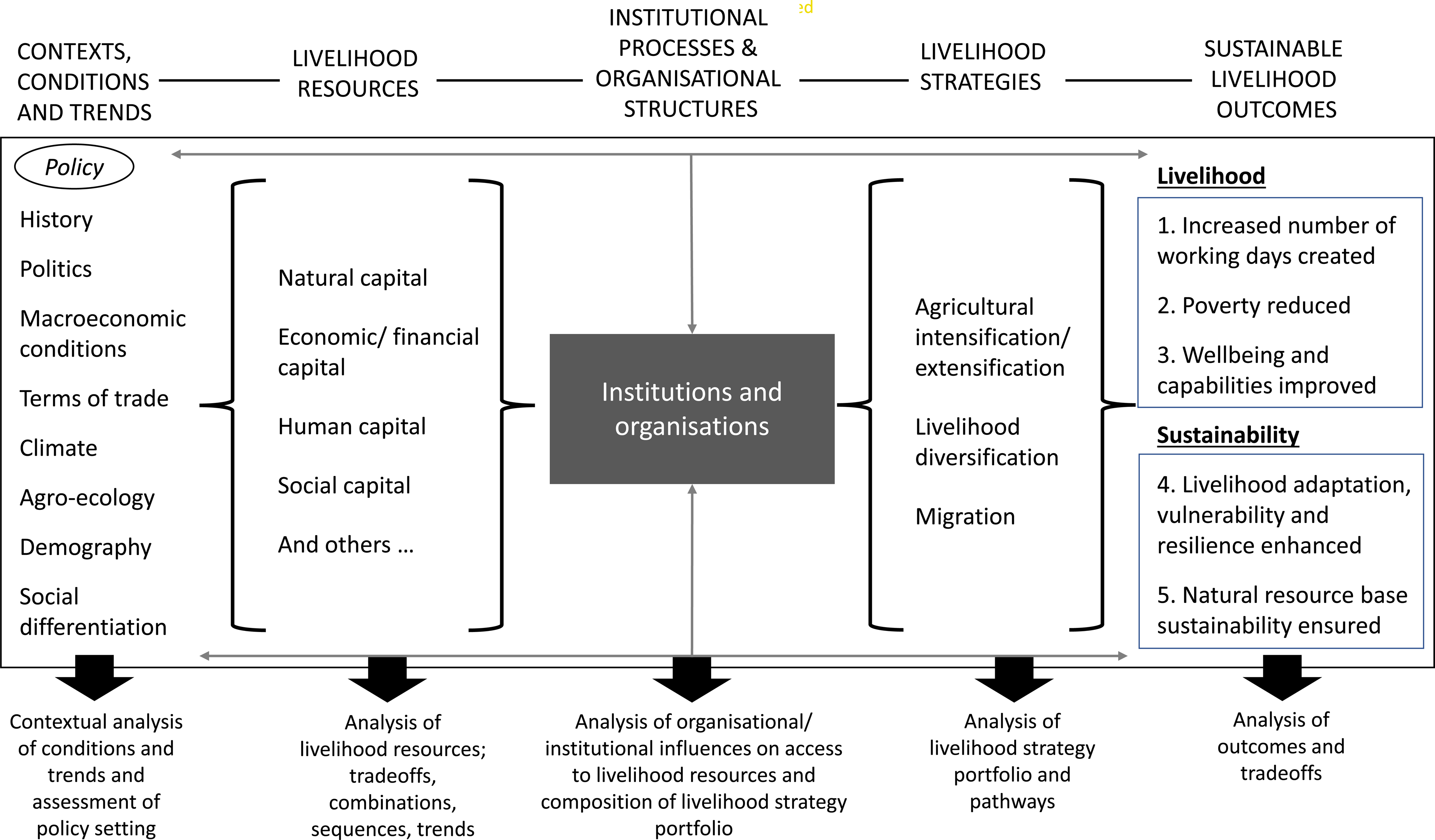
Traditional sustainable livelihoods framework (source: Scoones 1998).
Rational homo economicus uncritically evaluates social, economic and physical conditions, integrates livelihood resources, and draws on various forms of capital, co-constituted by organizational and institutional actors (Chambers 1995; Scoones 1998). ‘Done right’, livelihood strategies improve QoL as working days, capabilities and resilience increases, poverty reduces, and the natural resource base is sustained. However, recent work in feminist economic geography and critical development has challenged these neoclassical assumptions (Gibson-Graham, Cameron, and Healy 2013; Natarajan et al., 2022). Development can negatively affect livelihoods and QoL for three reasons: (1) Industry concentration compromises the viability of small-scale, diverse agriculture, and hollows out rural communities (Fuchs et al. 2011); (2) Primogeniture creates equity issues within and between generations and genders (Belz and Binder 2017); and (3) Globalization and climate change disproportionately impact rural communities and agrarian economies (IPCC 2022). The notion of a sustainable livelihood has expanded beyond economics, recognizing wider structural and relational issues including gender equity, wealth distribution, and power relationships (Natarajan et al. 2022). Gathering the strands of this necessarily brief review of diverse literatures, we therefore define a sustainable livelihood as “A means of necessary resource generation that is equitably produced and distributed, and that reliably, sufficiently and acceptably meets individual, family and community needs relative to context and situation; without damaging the physical or social resources required to produce it, or causing damage to those resources as a result of its prosecution.” Developing holistic understanding of how actors might generate such livelihoods, how market structures might influence the generation process, and how policy makers might create conducive structural conditions for individuals and communities is crucial to the sustainability project overall (Kilbourne, McDonagh, and Prothero 1997; Sheth and Parvatiyar 2021). However, the nature and effects of transforming structures and processes on livelihood remain under-theorized. In particular, attention to the dynamic role markets play in livelihoods, is lacking.
Towards More Supportive Market Structures
Market formalization adds a dynamic temporal change dimension to livelihood generation, with particular implications for women. Unregulated, informal markets, are flexible, resilient and adaptable, organized through norms, values, and understandings rather than laws and regulations (Gibson-Graham and Dombroski, 2020; Gibson-Graham, Cameron, and Healy 2013; Sutter et al. 2017). Such conditions give free rein to cultural traditions of bartering, in-kind payment, gift-giving and pro bono work; allowing women to multi-task as micro-entrepreneurs and care-givers (Williams and Windebank 2002; Xheneti, Madden, and Karki 2019). The informal economy is both separate and integral to the formal economy. In emerging and transitional economies, modest livelihoods can be generated by marginalized and vulnerable individuals, in aggregate constituting a significant portion of GDP (Horodnic et al. 2017). However, modernization motivates governments to exert greater control of economic and social activity (Carter 2019; Xheneti, Madden, and Kharki 2019). “Development rests on the idea that certain actors and institutions can and should intervene, organize, and shape the economies and societies of a target (poor) population, with the ostensible aim of improving a particular aspect of economic and social life of the target group.” (Figueirdo et al. 2015, p. 258). The notion of ‘improvement’ is problematic, as target groups are not created equal, or treated equitably. Furthermore, far from ‘transparent institutional fields where rules of the game are visible to all actors’ (Jafari et al. 2022, p. 1262), in formal markets, more-powerful players run the playbook. The ‘Walmart effect’ allows bigger actors access to previously unserved market segments and to a reserve army of the unemployed, crowding out small business, and bargaining wages down (Shapiro 2008). In the food and beverage sector, for example, transnational food franchises erode local food cultures and create obesogenic environments (Conroy, Smith, and Frethey-Bentham 2018; Kemper and Ballantine 2017). Surplus value is enjoyed by shareholders, whilst the costs are borne by low-income families and women (Figueiredo et al. 2015), further exacerbating social inequality.
Despite the challenges that accompany market development, entrepreneurial women play an important role in generating incomes that alleviate household poverty and reduce social inequity. They do so with less resources, more demands on their time and despite greater threats of violence than their male counterparts (Allende 1989, Cardella, Hernández-Sánchez, and Sánchez-García 2020; Kjellberg and Helgesson 2006). However, in traditional views of livelihood the contributions of women are under-accounted for, under-valued and under-theorized (Cameron and Gibson-Graham 2003; Feola 2020; Gururani 2002). Where women are included, an actor perspective dominates, focusing on issues such as microfinance usage (e.g., Verrest 2013), entrepreneurial motivations (e.g., Williams and Youssef 2013) or buyer-seller relationships (e.g., Glavee-Geo, Burki, and Buvik 2020). Systems perspectives acknowledging the effects of structural conditions on market actors are lacking, particularly with respect to market dynamics, fluidity or plasticity (Jafari, Aly, and Doherty 2022, Nenonen et al., 2014, Soini and Birkeland 2014). What is known, however, is that market formalization disadvantages women through compliance costs and restrictions, loss of traditional cultural assets (Beninger and Shapiro 2019), loss of confidence in their capabilities (Sutter et al. 2017; Xheneti, Madden, and Thapa Karki 2022), family-unfriendly working hours, and the need for costly and inconvenient childcare (Shen and Jiang 2020; Stockman, Bonney, and Xuewen 2016; Xie 2021). Women generate livelihoods in spite of markets, rather than because of them.
Critiques of market reification are nothing new (e.g., Benton 2021 and Carter's 2019 historical overviews; Fisk 1974; Handy 1998; Hart 2007). Macromarketers offer relatively gentle admonishments (e.g., Varey 2010) and stronger talk of ‘neoliberal beasts unleashed’ (Dholakia, Ozgun, and Atik, 2020, p. 868). However, one of the critiques of critique is that better alternatives to market capitalism have not yet been identified. We propose that a diverse economies perspective (DEP) may offer a way forward in this respect (Gibson-Graham 2006). The DEP offers a constructive, pluralistic view embracing both market and non-market practices (Table 1):
Non-Market, Informal and Formal Market Practices (Adapted from Gibson-Graham 2006).
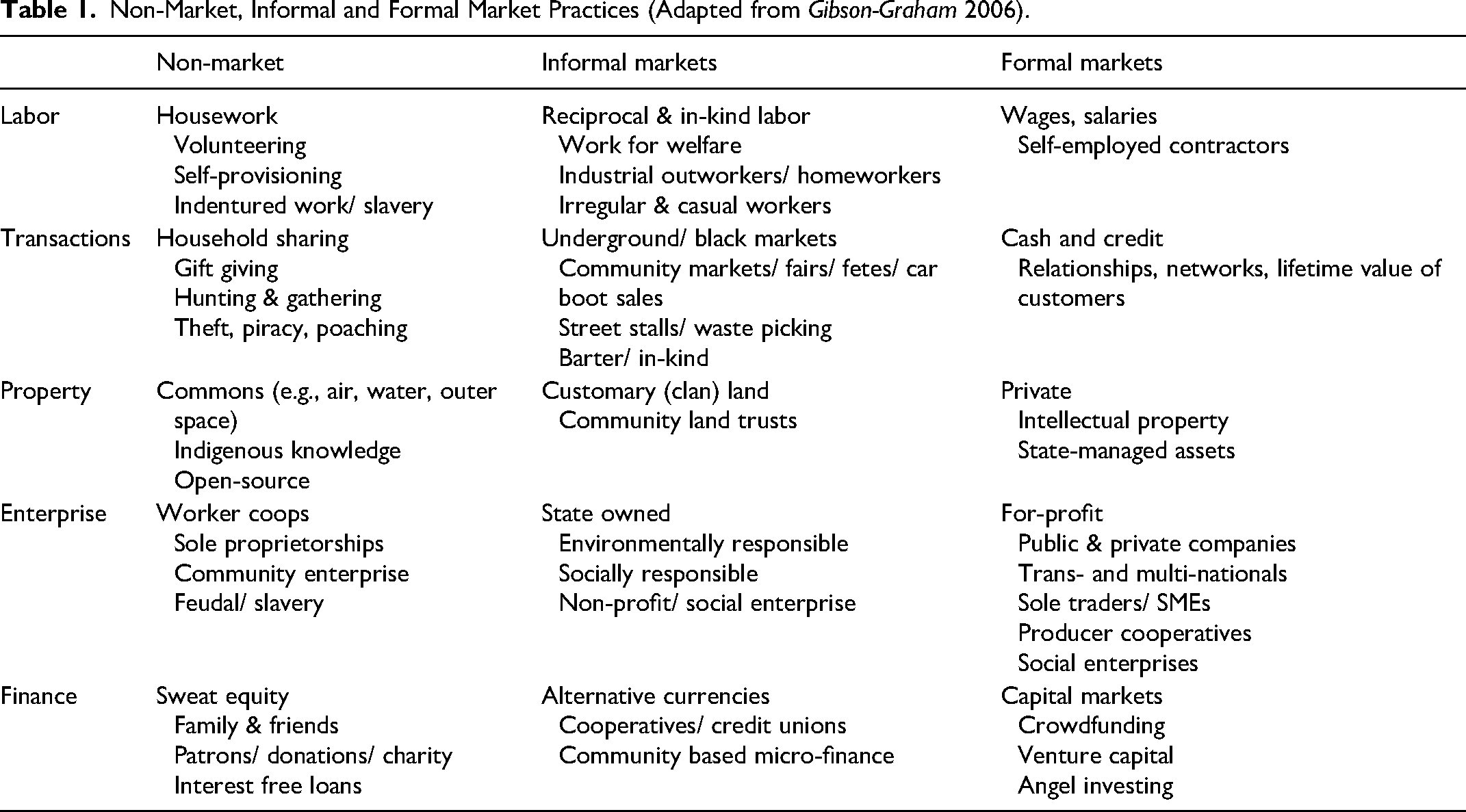
The DEP challenges market reification myths, accepting non-market, informal and formal market practices and players alike, acknowledging “… the interdependence of all who produce, appropriate, distribute and consume in society” (Cameron and Gibson-Graham 2003 p. 153). Informal and non-market practices (e.g., unpaid labor, unsecured family loans, reciprocal exchanges and gift-giving) are acceptable provisioning and livelihood strategies. Collective actions are regulated by norms, values, and understandings (i.e., trust and relationships) rather than legalized and financialized exchanges (Fisker 2022; Gibson-Graham and Dombroski 2020). The DEP is complementary to views of marketing as an adaptive societal provisioning system, acknowledging that economies are complex systems of resource flows and social relations, embedded in institutions and society (Benton 2021; Jafari et al. 2022; Layton 2009). The DEP also challenges the hegemonic power of capital centrism, reinforcing macromarketing critique. The DEP thus embraces the formal and informal, legitimate and illegitimate, inclusively. A DEP approach is particularly important in the global South, the context of this study. In this context, non-market and informal practices are important to generating livelihoods, and formal social support systems are limited. We proceed by describing our approach.
Research Methods
As highly trained instruments of knowledge generation (Holbrook 2005), researchers are inseparable from the research. Our explanations of the social world “… are enmeshed in our struggles with one another to define truth in accordance with our interests” (Powell and Depelteau 2013, p. 11). In the modern university, those interests are currently dominated by patriarchal, colonial and capitalist mindsets as we adapt to and operationalize dominant knowledge systems, usually unconsciously (Parker 2019, Santos 2018). We depart from that tradition by consciously acknowledging our positionality within the wider socio-cultural landscape, and interrogating the assumptions driving our research practice (Boström et al. 2017; Dholakia et al. 2020; Susur and Karakaya 2021) (Table 2):
Summary of Factors Relevant to Researcher Positionality.
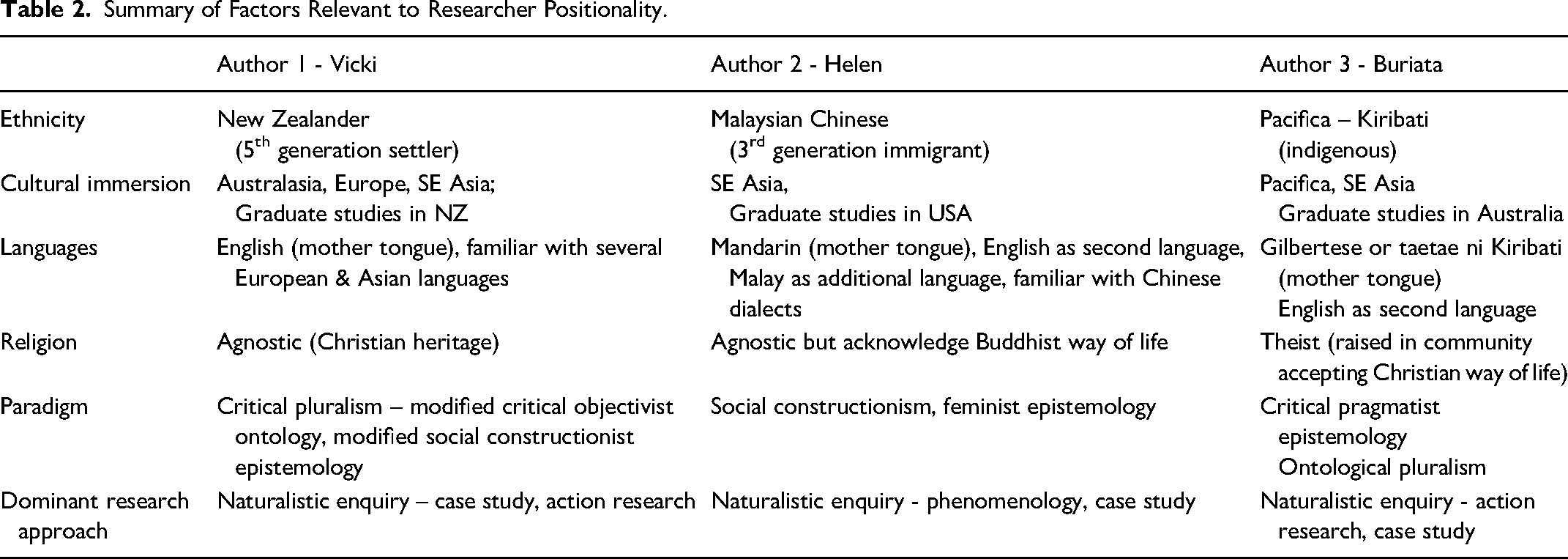
We are cisgender women; trained in extractive Eurocentric traditions at business schools in international universities. We are thus members of a technocratic elite, occupying positions of power, prestige and privilege relative to the MFEPs (albeit not to the extent of male colleagues e.g., see Cunliffe 2022; Gurrieri et al. 2022; Prothero and Tadajewski 2021). Author 1 is a member of a dominant colonizing population in her home country, and has lived and worked in (previously colonized) SE Asian countries for over 10 years. Author 2 is a member of a diasporic immigrant population in her (previously colonized) home country, forming part of a politically (if not economically) disadvantaged minority. Author 3 is a member of an indigenous population in her (previously colonized) home country, and has lived and worked in SE Asia for three years. As a group we bring an ethnically diverse yet (owing to our common training), similarly socialized approach to sensemaking; adding richness to discussions and at the same time allowing us to recognize how academic practices constitute and co-constitute prevailing, legitimate, logics (Powell and DiMaggio 2012). In the business school, the dominant logic is extractive (Santos 2018), as disengaged researchers subject the researched to ‘the gaze’ (Guertler, Kriz, and Sick 2020; Kock 2001). Such research is anti-emancipatory, as the logic reinforces the status quo; empowering producers without benefitting the marginalized and vulnerable. We acknowledge this imbalance. With respect to this project, while our initial framing was conformist, our sensemaking forced us to reflect more deeply on our own positionality and the situatedness of this work in the business school, and in the wider cultural context.
In taking a DEP (Gibson-Graham, Cameron, and Healy 2013), our focus is the interaction between institutional structures and agentic action; dynamic, complex phenomena, with multiple participants, embedded in a contemporary real-world situation. We therefore adopted an ethnographic case study approach (Stake 1995), focusing on 15 Malay female micro-entrepreneurs (MFEPs). Following case study best practice (Goffin et al. 2019), fieldwork was in two stages. The initial pilot stage developed pre-understanding (Gummesson 2005) of our context and research questions ““How do women's micro-entrepreneurship activities contribute to social sustainability?” and “What does a sustainable livelihood look like?” We engaged in participant observation as we scoped media coverage, purchased food and beverage items during our daily routines, and more formally observed a street market (Figure 2).
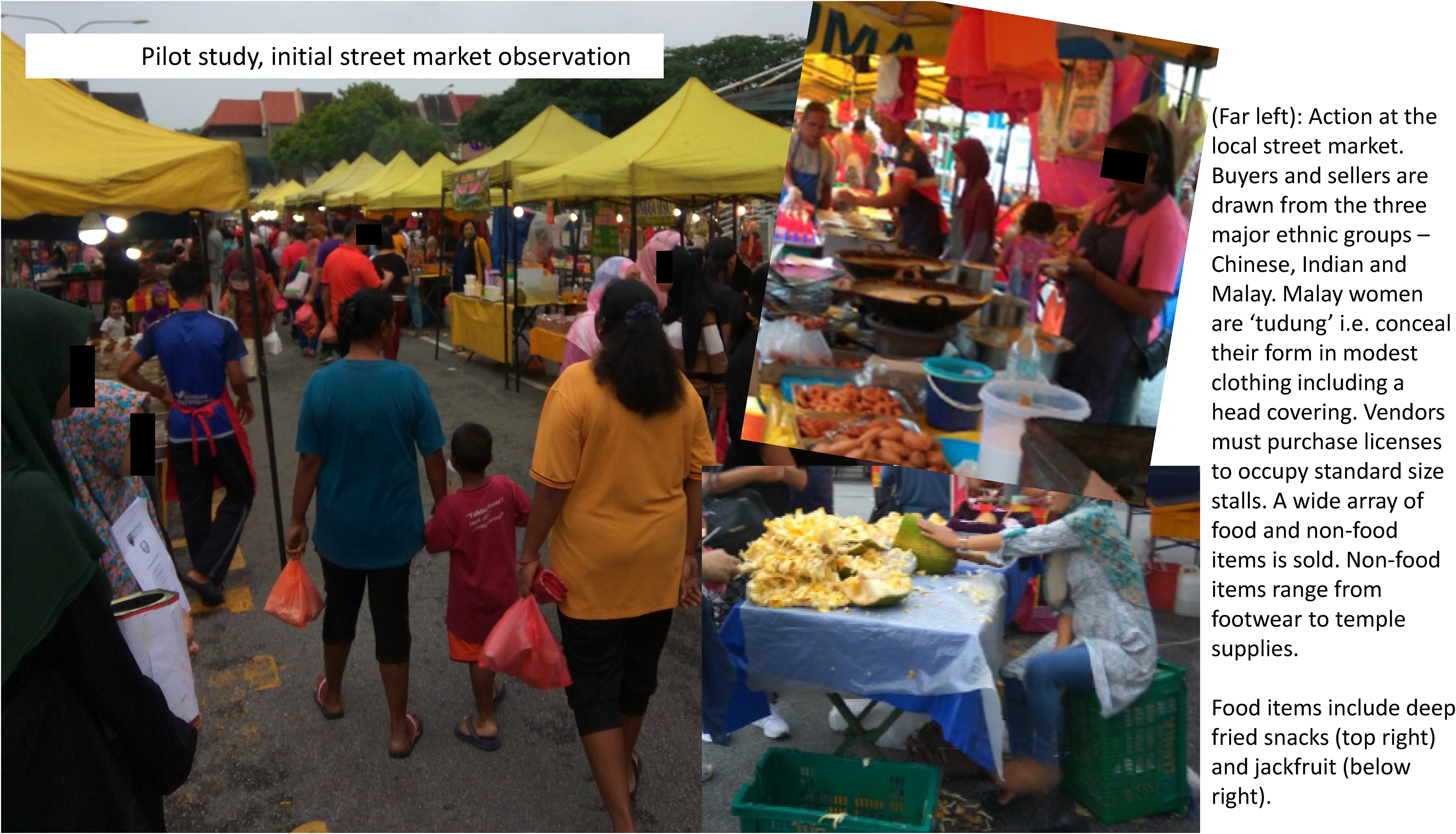
Pilot study, initial street market observation.
The pilot study delivered three important insights. First, it drew attention to the differences between unlicensed street stalls run by individual women and licensed vendors at the pasar malam (market). While some were smaller operators (e.g., the woman breaking down the jackfruit), others were franchisees for larger national chains. Second, the effects of market formalization (e.g., having to pay for licenses), affected all actors. Finally, rather than grapple with Malaysia's complex cultural mix (three ethnic groups, Malays, Chinese and Indian, with very different values and outlooks), we should focus on one group, Malays. Malays are the dominant group in Malaysia politically and numerically, practicing the dominant religion (Islam) and speaking Bahasa Melayu. We therefore focused on Malay female micro-entrepreneurs (MFEPs) in unlicensed street stalls; a relatively homogeneous group of women who were most exposed to the vicissitudes of the market.
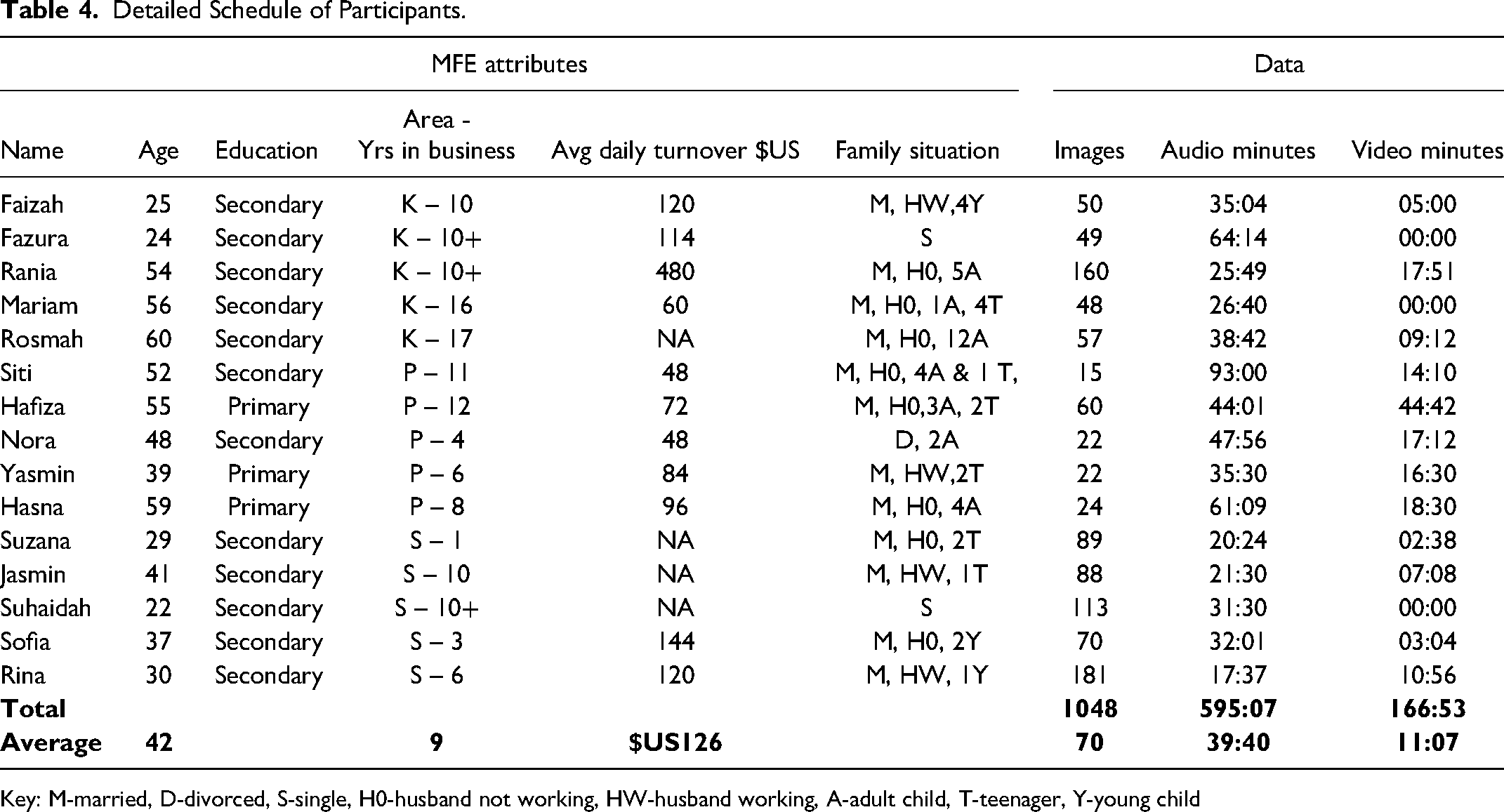
In the main study, we theoretically sampled five MFEPs in three different areas, seeking maximum variation in the competitive environment (low, medium and high intensity) (Patton 2014). Inclusion criteria were (1) Malay woman as main stall operator or sole operator, (2) operating on the roadside, and (3) willing to talk about their lives and businesses. We identified an initial participant in each of the three areas, then used a snowballing technique to gain further introductions; 15 in total (five participants in three areas). At that point we reached both sample adequacy and saturation (Bowen 2008) (Table 3 and Table 4).
Overview of Case Database by Area and Methods.
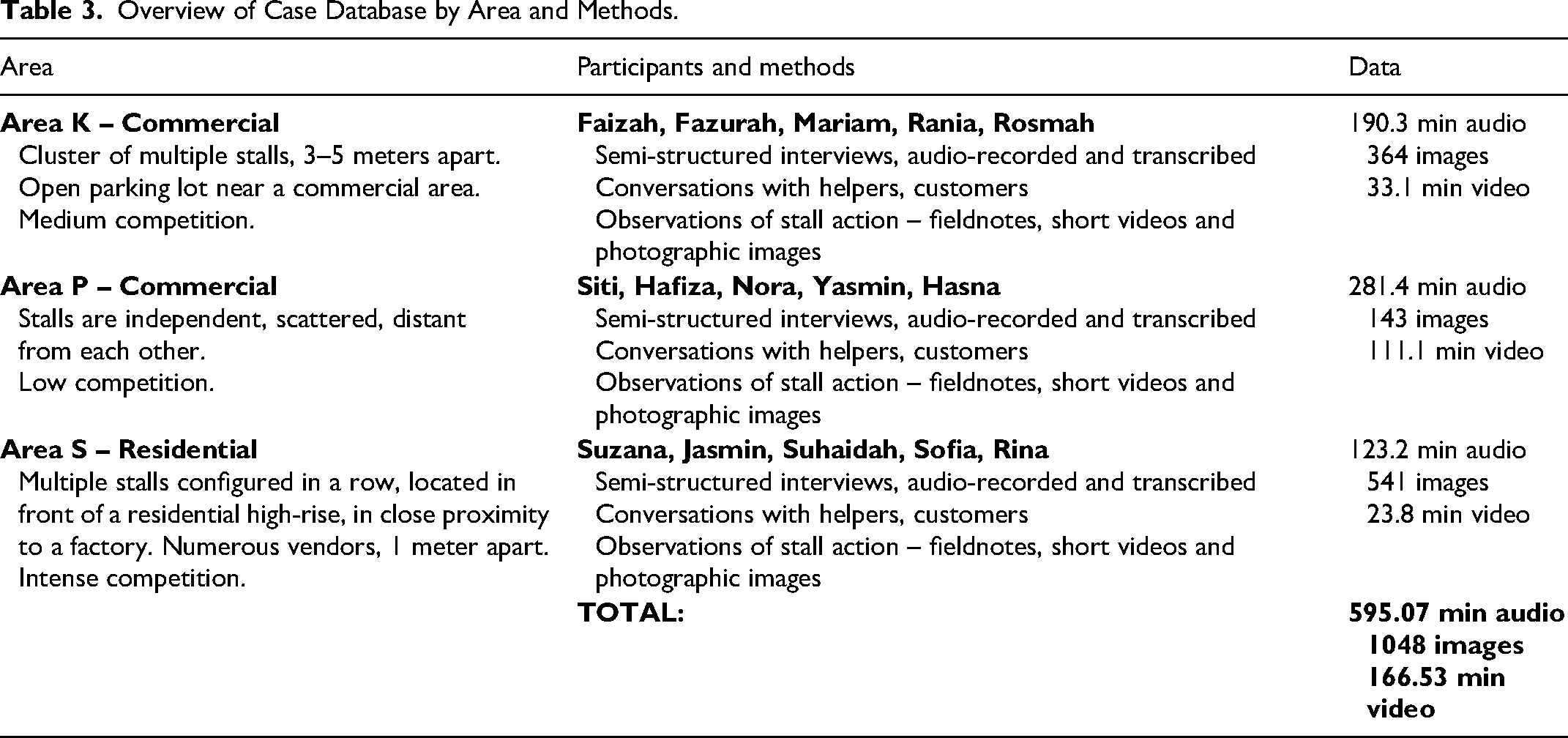
Detailed Schedule of Participants.
Key: M-married, D-divorced, S-single, H0-husband not working, HW-husband working, A-adult child, T-teenager, Y-young child
Authors 2 and 3 conducted the fieldwork. Author 2 interviewed the stall owner, while Author 3 recorded fieldnotes, short videos and images of the stallholders, stalls, selling process and surrounding area. Interviews were conducted on the roadside, in Bahasa Melayu, audio-recorded and simultaneously translated and transcribed into English. When local events were mentioned (e.g., changing regulations), we consulted news sources and official web pages to corroborate and provide detail.
Data Analysis
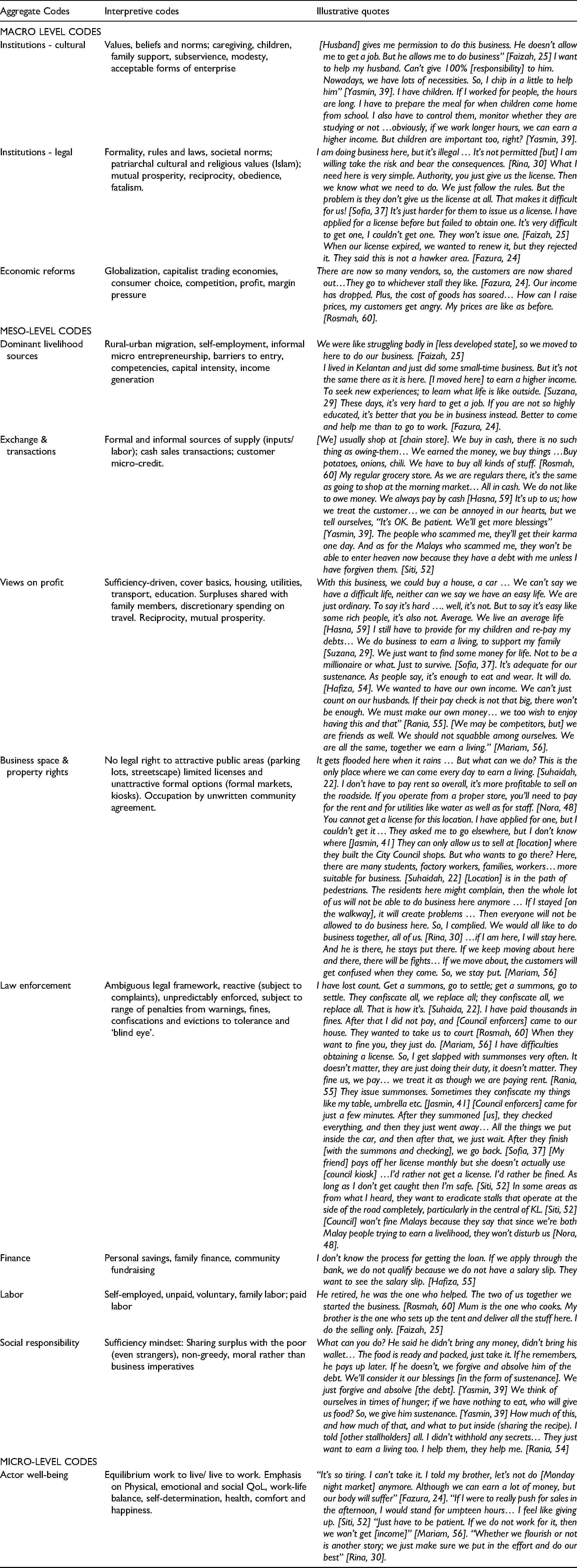
Data analysis proceeded in four stages. First, individual review and re-review of transcripts, field notes and visual data. We produced detailed case summaries for each MFEP; memoing and discussing initial interpretations. Second, we followed a modified grounded theory coding approach (Charmaz 2006; Tracy 2019). Two authors used NVivo12, and one a manual approach. Descriptive codes were produced through open coding, then axial coding compared within-case and between-case codes to identify categories (Appendix). Following Lindeman (2014), the codes are consistent with the idea of homology in multilevel theorizing, i.e., the codes reflect meaning at several levels of analysis (Klein and Kozlowski 2000). Third, we collaboratively engaged in between-case analysis. We co-produced interpretive categories, sub-themes, themes and relationships between themes (Charmaz 2006). Throughout the analytic process we used systematic combining, and abductive logic (Alvesson and Kärreman 2007; Dubois and Gadde 2002); engaging in constant comparison, tacking between the literature and the data to assess the relevance of the codes, categories, themes and sub-themes at micro, meso and macro levels (Klein and Kozlowski 2000).
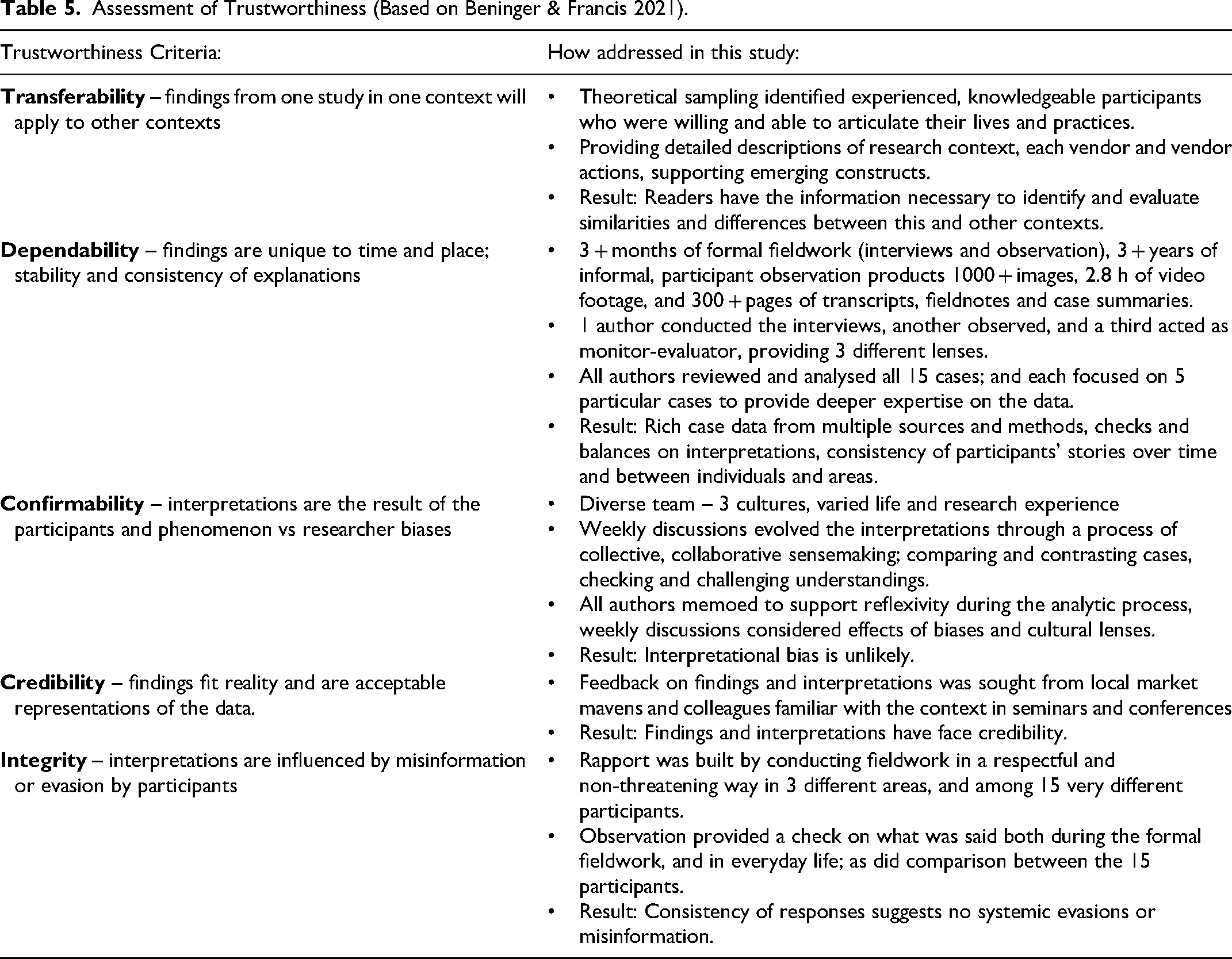
The research was approved by the university's human participants ethics committee, and complies with generally accepted guidelines for high quality naturalistic, interpretive enquiry (Lincoln and Guba 1985; Wallendorf and Belk 1989) (Table 5).
Assessment of Trustworthiness (Based on Beninger & Francis 2021).
Study Context
Malaysia is a middle-income, middle-sized transitional economy in South East Asia. Of a total population of 32 million, around eight million live in the main city, Kuala Lumpur (KL) (The World Bank 2022). While openness to trade and investment has steadily increased along with levels of formal employment and per capita income, income inequality is acute (Economic Planning Unit 2022). The poorest 40% (B40) are well represented in informal economic activities, estimated to contribute around 6% of GDP (Thambiah and Tan 2018; Tumin 2021). Many of these jobs are in food and beverage, the focus of this research. The middle-income context adds to insights deriving from the extremes of WEIRD or subsistence economies. With the notable exception of the 2012 special issue on Vietnam (Shultz, 2012), macromarketing perspectives of sustainability and QoL in transitional contexts are scarce. At one extreme, WEIRD studies focus on citizen QoL and wellbeing (Kilbourne, McDonagh, and Prothero 1997; Layton, 2009; Varey, 2012), quality of work life (Shultz, Rahtz, and Sirgy 2017; Sirgy 1996), alternative currencies (Papaoikonomou and Valor 2017), and discourses of sufficiency (Gossen, Ziesemer, and Schrader 2019); while at the other studies focus on community empowerment (Lindeman 2014), entrepreneurship in poverty (Kumar, Kumra, and Singh 2022), fair trade (Geiger-Oneto and Arnould 2011), and power inequalities (Figueiredo et al., 2015).
Our focus is Malay female entrepreneurs (MFEPs), a taken-for-granted feature of the KL streetscape (Figure 3).
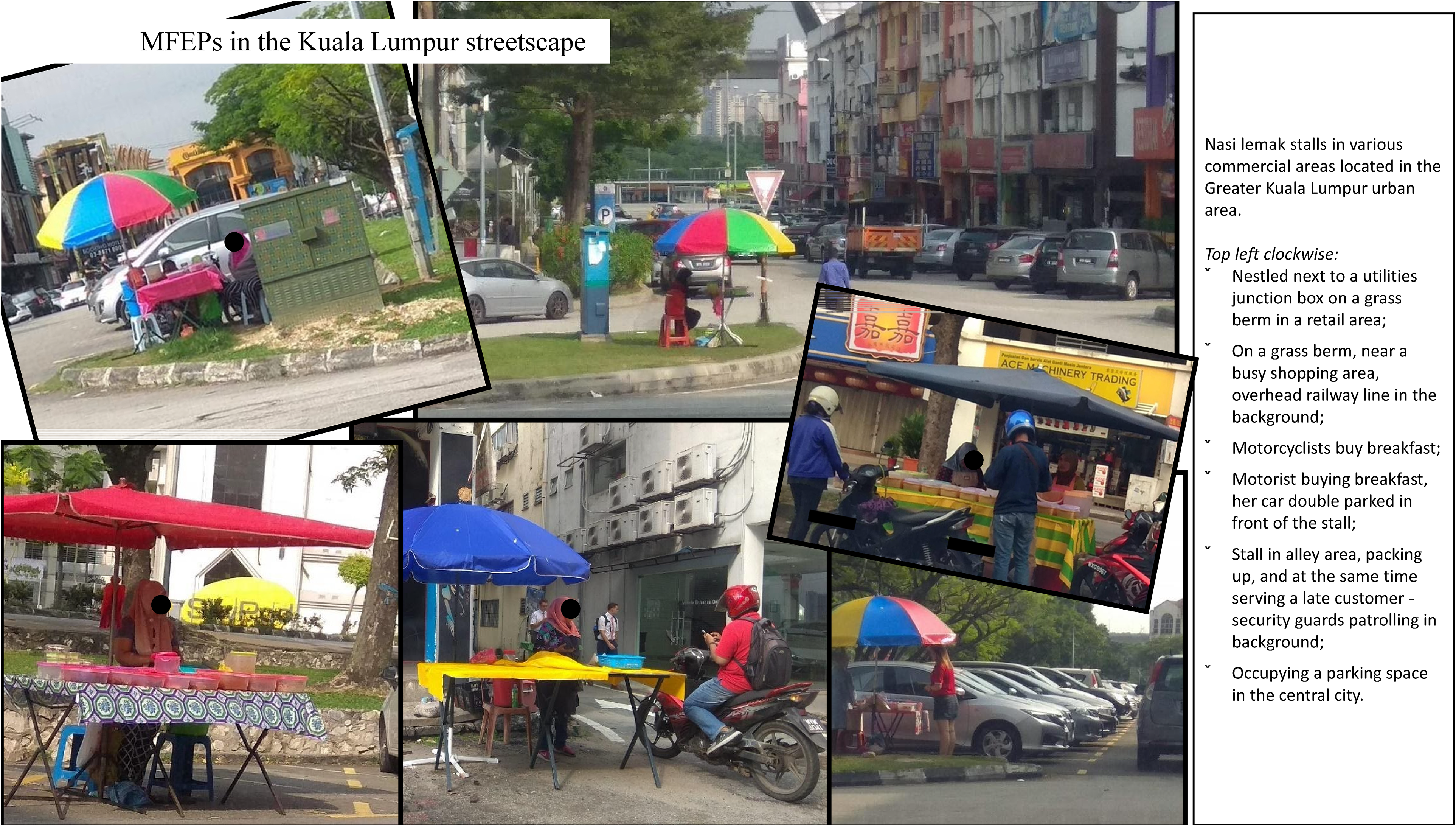
MFEPs' stalls in situ in the Kuala Lumpur streetscape.
The stalls are simple, a light trestle table, chair, and market umbrella; scant protection from tropical heat, torrential rain, insects, traffic pollution and noise. While some MFEPs are licensed, most are part of the informal economy. Each local council enforces different regulations governing competitive density, stall location, size, operating hours, waste management; licensing requirements, and penalties. Enforcers are teams of (male) council officers, who patrol the streets in cars and motorcycles. The women arrive in their cars in the early morning at their regular spots, dispensing Malaysian breakfast staples such as nasi lemak (a rich coconut rice dish), rendang (a traditional spicy meat dish), fried chicken, noodles and rice until their wares or time runs out. Customers arrive on foot, or more commonly motorcycles or cars, spending $US1-3, depending on the type and quantity of food purchased. Some view the stalls as a public nuisance, creating garbage, vermin and congestion (Wahab 2020). However, they are a long-standing Malaysian tradition, serving people from all walks of life, including the enforcement officers.
The stalls are a family concern, often passed down from mother to daughter, sister to sister. Barriers to entry are low: A vehicle for transport and storage, equipment (stall, containers and implements) and raw materials (food inputs). The MFEPs cook from traditional family recipes. Low overheads (no leases, taxes, utilities (apart from home gas and electricity costs), wages and salaries), mean the women can keep prices low. Each customer's order is created in a brown paper cone; rice, curries, sambals (sauces) are added, and cash is handed over. The process takes around one minute per customer. Therefore at 100% capacity with an average order of (say) $US2, the MFEPs could notionally generate US$120/hour, or US$600 for a five-hour day, tax free, before selling expenses. However, most stallholders earn much less, around US$10/hour (US$50/day). By Malaysian standards that is a respectable gross income, as median household income in the greater KL area is approximately US$12/hour (US$98/day) (Department of Statistics Malaysia 2020). While most are generating only enough to feed their families, one enterprising MFEP (Rania, 55) generated over RM2000 (US$480) a day through multiple stalls.
In the wider picture, while policy makers acknowledge the contribution of Malaysian women to social well-being, women's businesses are regarded as less important, innovative and successful (Kelley et al. 2017). The Ministry of Women, Family and Community Development offers home-based business skills training including tailoring, beauty therapy, commercial cooking, crafts, childcare, hairdressing and hosting. However men receive training in technical and business skills (DeMartino and Barbato 2002; Laure Humbert and Drew 2010). Malaysian women such as these are thus constrained by social expectations and by resources.
We found the MFEP's practices were characterized by 12 attributes at macro, meso and micro levels of analysis (see Appendix for coding detail and illustrative quotes).
Macro-Level Attributes (Cultural, Economic, and Legal)
Three macro-attributes of change characterized this transitioning economy and formalizing market:
Cultural institutions: For B40 Malay women, operating micro-enterprises is appropriate and acceptable according to norms and expectations about their social roles and capabilities. Malay society is regulated by Islamic patriarchal values (family, shared prosperity, reciprocity, obedience, and fatalism); what will be will be, actions have consequences, justice will be done, what is given will be returned, hard work will bring reward, and bad deeds will be punished (Frisk 2009). Women can legitimately engage in entrepreneurial activities, however formal employment is problematic owing to limited agency: “[Husband] gives me the permission to do this business. He doesn't allow me to get a job. But he allows me to do business.” [Faizah, 25] We speculate that husbands feel comfortable with a continuation of rural tradition, whereas formal employment deviates from that norm and compromises family life. Men were seen as the main breadwinners: “I want to help my husband. Can't give 100% [responsibility] to him. Nowadays, we have lots of necessities. So, I chip in a little to help him.” [Yasmin, 39]. While younger husbands were engaged in full time employment, many older husbands (i.e. 50+) were retired, unemployed, or disabled. Likewise, while some contributed through playing a supporting role (e.g., pounding chili, stall setup or breakdown, childcare), others required additional caregiving from the MFEPs as a result of strokes, heart disease and diabetes. Legal and regulatory institutions: Defined as formal regulations and laws, and the enforcement of those laws. We found legitimacy was under pressure from increasing regulation. “I have applied for a license before but … I couldn’t get one. [Council] won’t issue one.” [Faizah, 25] “When our license expired, we wanted to renew it, but [council] rejected it. They said “This is not a hawker area”.” [Fazura, 24]. Licenses were not being granted by local councils, and without a license, the women were vulnerable to fines and harassment. The fatalistic belief that justice will ultimately be done beyond the reach of formal legal systems enabled the women to come to terms with their changing circumstances, which included enforcer harassment and anti-social behaviors from emboldened customers. Economic reforms: Defined as economic activity along a spectrum; from subsistence to fully developed according to the Western model of open trading economies with capitalist values privileging consumer choice, competition and profit. The women reported negative outcomes of recent economic pressures, in particular, input cost increases and more price sensitive customers. These changes resulted in margin pressures, as the MFEPs felt unable to pass on rising costs as they wished to retain customer good will. Furthermore, they faced growing competition from transnational chains (in particular KFC), as consumer preferences changed in favor of cheap, convenient, mass produced industrial fast food; available 24/7 and heavily promoted.
Meso-Level Attributes (Practices)
Eight attributes characterize the MFEPs and their practices: livelihood sources, exchanges and transactions, attitudes towards profits, business space and property rights, law enforcement, finance, labor and social responsibility.
Dominant livelihood sources: Livelihood sources refer to productive activities undertaken by rural migrants and urban dwellers in order to support their way of life; in this case informal and self-employment through micro-entrepreneurship activities in the food and beverage service sector. Food related enterprises are a popular choice for women, parleying traditional skillsets (cooking) into an income producing business. Some of the MFEPs had migrated from rural villages, however found city employment opportunities both limited and limiting. “These days, it's very hard to get a job. If you are not so highly educated, it's better that you be in business instead. Better to come and help [my mother] than to go to work.” Fazura [24]. The businesses provided a modest but reliable living, compared with the limited opportunities offered by formal employment. Exchange and transactions: Practices supporting cash flows in the enterprise. On the supply side, transactions relate to the purchase of raw materials and labor. On the demand side, the customer value proposition is traditional, cheap, homemade food, conveniently located and speedily dispensed, in exchange for cash. In addition to cash transactions, the women extended credit, at times not repaid. “It's up to us; how we treat the customer… we can be annoyed in our hearts, but we tell ourselves, “It's OK. Be patient. We'll get more blessings” [Yasmin, 39]. This sentiment reflects fatalistic Islamic values. Views on profit: Defined as attitudes towards surplus cash flows. MFEP attitudes were sufficiency-driven, based on values of reciprocity, mutual prosperity and family first; a ‘good’ cash flow covered household basics (housing, utilities, transport, education). Attitudes translated to practices including sharing of surpluses with family members, and discretionary spending on family travel. However, the notion of ‘sufficiency’ varied widely within the group. For one, sufficiency was extensive travel: “[Husband] retired at 55 years old. We had children in London, in Egypt. All require money, use up money…” [Rosmah, 60]. This mother of 12 adult children reported traveling to nearly 20 European, middle Eastern and Asian destinations. Notably, she was one of the few unwilling to disclose her weekly earnings. For the remaining MFEPs, however, sufficiency meant education, vehicles and household essentials. Some of the younger MFEPs were more ambitious: “We do business in order to expand… I would like my business to grow; to realize the many plans for our future” [Suzana, 29]. The range of views reflects diverse family life stages, from childfree, younger women to grandmothers with dependent husbands. All, however expressed a wish for sufficiency, rather than surplus, and for QoL rather than pure financial outcomes. Sufficiency was reflected in cooperative behaviors, despite competing for the same customers with similar wares. Looking after each other and not encroaching into each other's space is an unspoken mutual understanding. For example, during Ramadan (the Malaysian festive season), one of the other vendors offered Siti their accustomed spot. However, Siti felt that would disrupt harmony [fieldnotes]. Hafiza and Nora share their spot, one on weekdays, the other during weekends [fieldnotes]. The women view their customers and each other with compassion, allowing customers to buy on credit, and giving food away to the needy. Business space and property rights: Defined as the legal or customary ability (or inability) to occupy public areas (parking lots, pedestrian areas, streetscape); availability and attractiveness of licenses and formal locations (council-run markets, kiosks). Challenges to their occupation status resulted in conflict avoidance strategies including hiding from council officers, and timing set up and shut down to avoid creating nuisance for surrounding residents and commercial tenants. The MFEPs were motivated to prevent complaints that enforcement agencies are obliged to act upon. In short, the women deliberately operate ‘below the radar’. Law enforcement: Defined as practices directed at applying laws and regulations, undertaken by official representatives of federal, state and local governments council officers and police. Enforcement was complicated by an ambiguous legal framework and unpredictability as officers reacted to complaints. The women suffered from a range of penalties including tolerance (‘a blind eye’), warnings, confiscations, fines (formal and informal), and evictions. Depending on the area, there was a tacit understanding between the women and the enforcement officers: “That car, it's permanently parked here for us to keep the tents and stuff. [Council] knows that it belongs to us, so they do not issue a parking ticket”. [Faizah, 25]. “Council] won’t fine Malays because they say that since we’re both Malay people trying to earn a livelihood, they won’t disturb us.” [Nora, 48]. Finance: Defined as the availability of monetary resources to support the establishment and operation of micro-enterprises; with resources including personal savings, family finance and community fundraising. Lack of access to finance presents a barrier to entry, growth and expansion, as banks do not recognize business income from unregistered businesses: “Sometimes, I think of making this space of mine into a bigger place. But our capital is low, so our [stall] is small too … But I don't know the process for getting the loan. If we apply through the bank, we do not qualify because we do not have a salary slip.” [Hafiza, 55] Labor: Defined as support for the various stages in the micro-enterprise value chain (raw materials procurement, food production, food service) from the MFEPs and their network of supporters (unpaid and voluntary, family and non-family, formal and paid). Succession is problematic. While some businesses were run by several generations, social mobility is reflected in younger, educated women opting for formal rather than informal employment. Social responsibility: Ethical framework underpinning attitudes towards others in in-group and out-groups, voluntarily assumed practices and actions directed at the best interests of others, levels of benevolence and sharing. A sufficiency mindset results in the women sharing their surplus food with the needy, “We think of ourselves in times of hunger; if we have nothing to eat, who will give us food? So, we give [beggar] sustenance.” [Yasmin, 39].
Micro-Level Attributes (Actor Well-Being)
We define actor wellbeing as physical, emotional and social QoL, determined by work-life balance, self-efficacy, health, and happiness. For some MFEPs, QoL suffered owing to multiple physical and social pressures. The women kept unsocial hours. Morning stallholders typically rose in the early hours (1–5am) to prepare and cook, then drove to their established location to sell approximately 7–11am. They broke down their stalls and either shopped for supplies, or returned home to rest and look after husbands and children. Some reported physical exhaustion. “It's so tiring. I can't take it. I told my brother, let's not do [Monday night market] anymore. Although we can earn a lot of money, our body will suffer” [Fazura, 24]. “If I were to really push for sales in the afternoon, I would stand for umpteen hours… I feel like giving up.” [Siti, 52] The women reported these challenges with stoic forbearance. “Whether we flourish or not is another story, we just make sure we put in the effort and do our best.” [Rina, 30].
Summary of Findings
The MFEPs are a valuable social asset. They generate incomes for families, provide affordable meals for workers, and preserve Malaysia's rich culinary and community traditions; a foil to the globalized, impersonal, industrial fast-food model. However, their situation is unsustainable. Diminishing incomes and tightening regulation will force these women to either formalize or retire. The streetscape will lose diversity and vibrancy, the community will lose a useful provisioning asset, and families will lose their livelihood. At macro-level, the women endure increasing pressure from regulations, competition and changing consumer tastes. Despite social license to operate, their businesses are illegal, resulting in a ‘cat and mouse’ game with enforcement authorities, affecting their peace of mind and ability to generate income. Their ability to formalize and grow is constrained by societal expectations and lack of access to capital. The MFEPs work within these constraints, reconciling conflicts by drawing on Islamic values of fatalism, cooperation and benevolence. While they give the appearance of submission, they resist in ways that both protect their interests and those of their community, and the sensibilities of ostensibly more-powerful male actors (council enforcers, police and husbands). The authorities both harass and ignore the women, while the women give the appearance of compliance without complying. Both parties continue in their daily routines, honor satisfied.
Discussion
This research set out to answer the research questions: “How do women's micro-entrepreneurship activities contribute to social sustainability?” and “What does a sustainable livelihood look like?” We discuss the findings relating to these questions empirically, contributing important theoretical insight into the relationships between sustainable livelihood and QoL. However, perhaps more importantly, we address the epistemological issues raised by this research as we confront our positionality, and the problems patriarchal, colonial and capitalist worldviews pose for a flourishing society.
Empirical Insights
While female micro-entrepreneurs are generally framed as poor, marginalized and with limited agency (e.g., Marlow 2020; Sen 2005), our findings suggest that view is simplistic. Supporting previous work in development economics, the MFEPs were breadwinners, meeting family needs, including those of their husbands (Williams and Windebank 2002; Williams and Youssef 2013). Their businesses were successful over multiple years, and in some cases funded discretionary activities such as overseas travel. The MFEPs were unassuming, however, weathered multiple social, physical and emotional affronts to their agency. Reinforcing Yurdakul and Atik (2016), their coping strategies were based on collectivist beliefs; deploying their capabilities to pursue desired outcomes in spite of structural constraints. Supporting recent work (Layton, Domegan, and Duffy 2022; Tang and Blocker, 2022), the women adapted to environmental hostility by drawing on their communities of practice, social ties and kinship networks, highlighting the importance of communal resilience and collective action (Beninger and Francis 2021; Carter 2019; Lindeman 2014; Sen 2005). The MFEPs demonstrated attributes of successful group functioning i.e., strong identity and purpose, inclusive decision-making, fast and fair conflict resolution mechanisms, local autonomy, and agreed on behaviors (Layton, Domegan, and Duffy 2022). Tensions between social regulation and emancipation played out in acts of reactance and subversion, despite significant power asymmetries (Little, Lee, and Nair 2019). Overall, the findings reinforce Jafari et al.'s (2022) contention that far from transparency, marketplaces are opaque environments shaped by politics, ideologies, and power regimes; a point we take up in more depth shortly.
Our definition of a sustainable livelihood as one that reliably, sufficiently and acceptably meets individual and family needs relative to context and situation was supported. The notion of ‘reliability’ came into stark focus, as the MFEPs’ livelihoods were demonstrably under threat, even before the pandemic. Typical of complex adaptive systems, our data reflected non-linear actor relationships and unintended consequences (Layton 2015; Mittelstaedt, Kilbourne, and Mittelstaedt 2006). For example, regulation directed at improving community health and safety resulted in harassment for the MFEPs, and less income for low-income families. Overall, extending previous work in both subsistence (Beninger and Shapiro 2019; Figueiredo et al., 2015) and WEIRD settings (Feola 2020; Hart 2007; Varey 2013) we found that market formalization compromises community and individual well-being.
To address those issues, we propose a pluralistic approach, inspired by the DEP (Gibson-Graham and Dombroski 2020) (Table 6):
Macro, Meso and Micro Level Livelihood Attributes for Four Types of Economies.
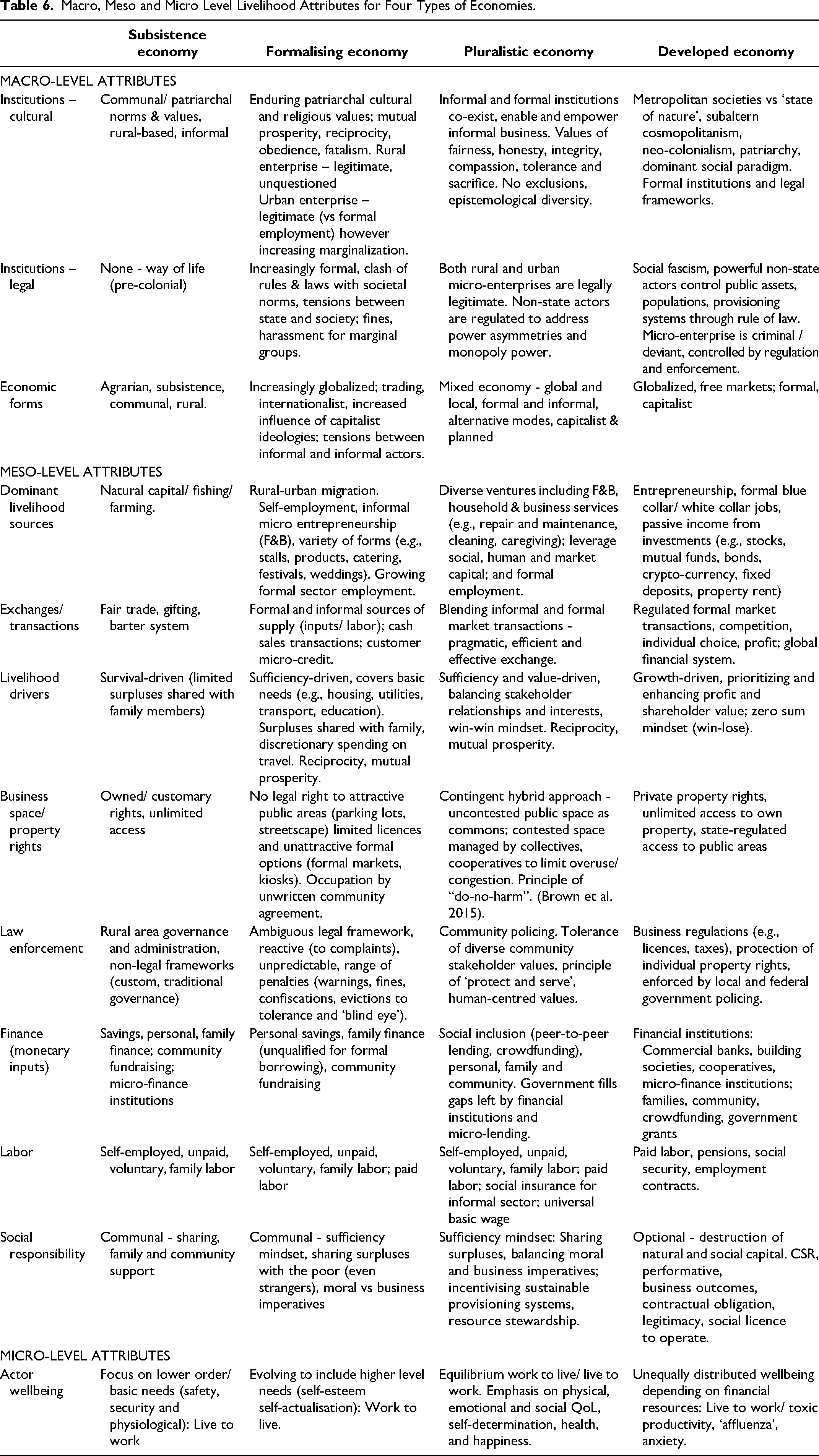
Key attributes at the extremes (subsistence and developed economies) are drawn from the literature. Post-subsistence attributes (formalizing economy) are drawn from our data, noting that Islamic values are not universal. We additionally propose a fourth economic form, a pluralistic economy, incorporating attributes from the extremes. Subsistence livelihoods emphasize sufficiency as a means of survival (e.g., Scoones 1998). Small scale provisioning systems feature informal, dispersed forms of livelihood based on natural capital. Family structures are largely patriarchal. At the other extreme, WEIRD livelihoods emphasize wealth accumulation and surplus. Formal is normal, informal enterprises are seen as deviant. Between the subsistence and WEIRD extremes, micro-enterprises flourish, but are crowded out as markets formalize. We propose that a pluralistic economy offers the framework for sustainable livelihoods; whereby a diverse portfolio of formal and informal business options offer a range of livelihood choices. The key attribute is diversity. A balance between society and state derives from co-existence of multiple forms of livelihood. Rather than fewer, larger producers, the emphasis is on many, smaller producers. Supporting previous calls (e.g., Banerjee et al. 2019; Hoynes and Rothstein 2019) the most important policy implications are a universal basic wage to protect the vulnerable, and regulation of non-state actors. Ideological change is required to privilege sufficiency rather than surplus, and families rather than fortunes; contravening current mindsets and power structures (Brown, Msoka, and Dankoco 2015). A sustainable society requires livelihoods that are embedded in communities, enabled by benevolent mindsets, underpinned by notions of sufficiency, and directed at QoL & well-being rather than power and wealth.
We summarize this research in 12 propositions for a pluralistic ideal (Table 7):
12 Propositions for a Pluralistic Ideal.
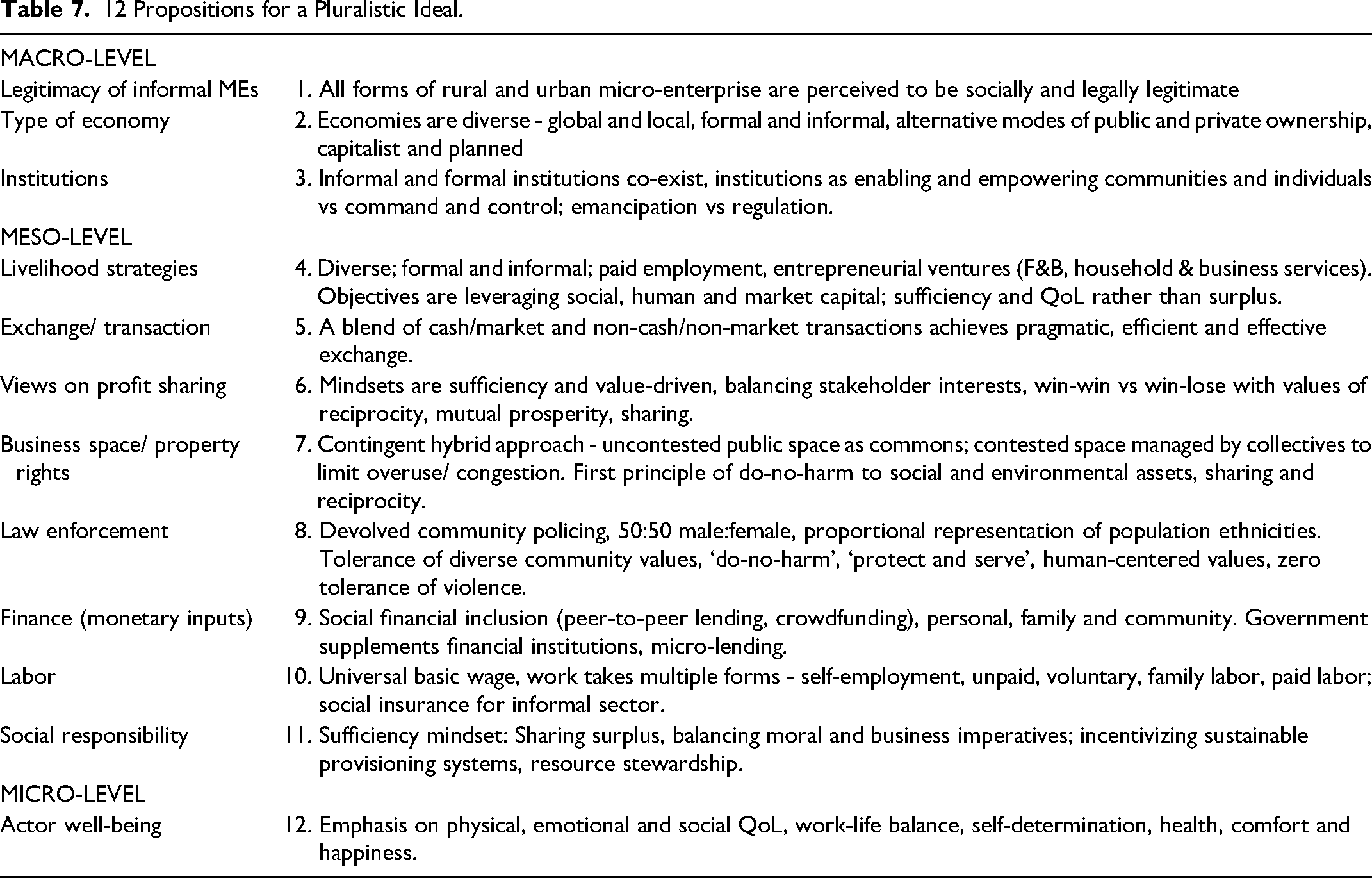
Following on from these propositions, a sustainable livelihood would have five characteristics:
A truly sustainable livelihood must therefore be grounded in a pluralistic ideal embracing the full diversity of human endeavor and within benign state and society power relationships. Rather than “each straining to gain the upper hand, resulting in shifting, often unpredictable, governance patterns, rules, customs, and cultures” (Layton and Domegan 2021, p. 9) wealth, power and mastery must be balanced with sufficiency, community, diversity, and sharing. The key requirement is to ensure the best interests of women at every level, which would in turn support the best interests of children, families and communities, and thus, support a flourishing society.
Epistemological Issues
The notion of sustainable livelihood gives rise to two epistemological challenges: (1) The philosophical issue of what an ‘ideal’ life might look like (and therefore how a sustainable livelihood might contribute to that); and (2) the role of current approaches to knowing in developing that understanding. First, with respect to an ideal life, livelihood contributes at all the Maslow (1943) hierarchy of need levels – physiological, safety, social, esteem and self-actualization. However, the Maslow hierarchy is a WEIRD conceptualization. Safety, for example, is defined as personal security, employment, resources, health, and property. For those with a nonmaterial orientation, for example indigenous people, property and employment is irrelevant. A Buddhist monk or a voluntary simplifier (e.g., Alexander and Ussher 2012) would regard Kardashian lifestyles with horror, and vice versa. An ‘ideal’ life is therefore subjective, depending on context and actor. We do not consider the MFEPs as disadvantaged in comparison with low income people in New Zealand, for example; where 300,000 children live in poverty, replete with homelessness, communicable diseases, drug use and family violence (Child Poverty Action Group 2022; Mcfie 2022), they are not. Quite the reverse, the MFEPs own their own homes, enjoy affordable healthcare, education, transport and accommodation; and are embedded in loving multi-generational households in strong communities. Our findings therefore challenge materialist assumptions about QoL, and the perception that those in developed economies enjoy superior lifestyles (e.g., Lindeman 2014).
Second, with respect to how we build understanding of the world, Santos (2007) calls for ‘subaltern cosmopolitanism’ (p6) i.e., work that moves beyond invisible divides, that redresses the injustices perpetuated by violent appropriation of resources, and that transcends the Eurocentric materialist logics of patriarchy and capitalism. Confronting our own positionality as individuals and as a community of scholars is critical in this project, however reflexivity is the exception rather than the rule. In Asian business schools, despite (or perhaps because of) wider social values of harmony, respect, filial piety and consensus, researchers are largely unquestioning of the status quo (Eckhardt & Dholakia 2013). A culture of positivistic enquiry prevails. Critical work is limited, and informed by Eurocentric modernist traditions rather than local or indigenous perspectives, which are difficult to access owing to language, among other things. The final point we must make is the persistent unreflexive masculinity of the business school. As Cunliffe (2022) points out, a divide prevails between ‘masculinized rationality that privileges abstraction, a logic of objectivity and proceduralization [and work that focuses on] who we are as human beings and how we experience self, life and work’ (p.1). She points out that the literature is beset with ‘ontological blindness, epistemological defensiveness, hegemonic masculinity and myopic self-referentiality’ (p.1), and calls for more human, imaginative and reflexive perspectives, a call that we support wholeheartedly.
What, then, is the social value of extractive academic research based on WEIRD masculine materialist logics deriving from a colonial past? In this research, we like to think we contribute to Cunliffe's (2022) ‘more human, imaginative and reflexive perspectives’ (p.1). However, what are the practical outcomes? This project, for example, will not directly improve MFEPs’ lives. Nor will it directly influence policy (see Shove 2010). Although respectful and reciprocal, our approach was undeniably extractive (Santos 2018). However, non-extractive approaches are also problematic. Micro-entrepreneurs resist training that takes time away from their enterprises (Verrest 2013). Therefore, projects using, for example, participatory action research would have a high opportunity cost, and would need to offer direct benefit to participants, e.g., commensurate income generation or cost reduction. Perhaps a more constructive way to evaluate academic work is through first, second and third order effects. With respect to first order effects, extractive research benefits authors (human capital, KPIs, career), their universities (KPIs, rankings) and the publishing industry (Santos 2018). At best, if ethically conducted, participants are no worse off. Second order effects are changes in systems discourse as we influence other actors (colleagues, students, policy makers) through scholarship and teaching. We argue that this is where the real social value of academic research lies. These effects are critical, relating to the larger problem of perpetuating (or challenging) a damaging status quo. Therefore, consciousness raising work directed at challenging and changing problematic approaches is valuable in and of itself, supporting Meadows’ (2006) argument that the system paradigm (goals, power structure, rules and culture) is the most effective systems lever. Third order effects are wider systems change, a long-term project; likely subtle, emergent and cumulative as a result of multiple thoughtful projects. Overall, we argue that social research such as this project has value for social stakeholders beyond the immediate and the apparent.
Conclusions and Implications
We set out to answer ostensibly simple questions based on observation of KL street life. However, the sensemaking journey led us in unanticipated directions, leading to important empirical, theoretical and epistemological contributions. First, drawing from empirical work in a transitional economy, currently scarce in marketing, we define sustainable livelihood, and show how market formalization can undermine the wellbeing of low-income communities, women and families. Second, we introduce the Gibson-Graham diverse economies perspective to macromarketing, adding a feminist economic perspective. We propose a pluralistic economy and offer 12 propositions that challenge damaging power relationships and gender inequalities, addressing the structural and individual contributors to livelihood vulnerability. We urge policymakers to approach market formalization measures with caution, and to support entrepreneurial women in ways that recognize a plurality of mindsets and values, and that embrace local culture. To enable that work, consciousness raising about the issues of power relationships and gender inequalities, and equal representation from women would be useful first steps. To build on these contributions, further empirical work in both WEIRD and non-WEIRD contexts focusing on different groups of consumers, entrepreneurs, households, ethnicities, and social classes would provide a broader view of the wider social effects of market formalization. With respect to this particular group of women, further exploration of the interconnections of home life and work life would add depth and nuance. Researchers could consider emancipatory and participatory approaches, engaging all stakeholders (MFEPs, local and central government in particular) in joint problem-solving exercises. However, caution is needed owing to the high opportunity cost of time spent away from business and families for the MFEPs. Finally, work exploring the effects of the pandemic would inform understanding of external shocks on vulnerable and marginalized communities.
Epistemologically, this research contributes insight into the problems and challenges of WEIRD research in general and WEIRD sustainability research in particular. We wanted to address the relationship between markets and livelihoods. However, the answers to our questions were far from simple, being both philosophical and practical. An ‘ideal’ life, like beauty and truth, defies definition and measurement. Heroic rationalist efforts (e.g., McKinsey 2023) highlight increasing global prosperity, as measured by GDP. However, individual ideals are subjective and relative to circumstances. Averages and their means of calculation disguise injustices, inequalities and inequities. Eight billion people hold equally valid views of an ideal life, in the context of a monolithic WEIRD neoliberal global ideal. As we have shown, that ideal is not ideal for women, families and civil society. We argue for its counterpoint, a diverse, messy, pluralist ecology of markets and livelihoods. However, achieving that outcome requires a change of perspective among social stakeholders, including ourselves. We must willingly and collectively embrace the paradoxes and tensions of sustainability thinking; tolerating disagreeable ideas (but not violence or hate); we must compromise and relinquish attachment. We must accept the material, the individual and the immediate, and the relational, the communal and the long term. We must build an open, pluralistic knowledge ecosystem embracing inclusiveness/ equality and domination/ mastery; yin and yang, point and counterpoint. In short, we must ‘feel the paradigm incommensurability and do it anyway’. These ideas are not new. Nor is the idea of eschewing damaging dichotomies. However, in practice, we have not yet accommodated pluralism equitably and harmoniously.
As ethical researchers, thought leaders, and responsible citizens, most macromarketers are part of the WEIRD hegemony and aware of the issues confronting us. This work highlights that we must jointly and severally confront three troubling questions relating to our academic practice. First, what does our positionality as individual scholars imply? For the authors, team gender commonality and cultural diversity was key. Gentle disclosure and respectful discussion helped us understand our respective ignorances and privileges, facilitated by trusting team relationships, time and space. Like early feminist consciousness-raising, this step is crucial. Second, how might we move towards pluralism in our teaching and research? This question needs to be addressed as a community of scholars, as in a precarious employment environment choices affect livelihoods. The authors’ hope is to influence disciplinary sensibilities and the wider zeitgeist through our teaching and outreach. Finally, as sustainability researchers, how can we ‘think different’? Even for (or perhaps particularly for) highly educated, self-aware individuals, reflexivity, and conscious change is a challenge. For men, as Cunliffe (2022) points out, the challenge may be even greater.
In 2012 Dholakia considered that “the circuits for legitimation and propagation of knowledge will continue to pass through the gateways of the West.” (p.223). 10 years on, this contention looks less certain. The dominance of Western business schools is under pressure from Asia, both in global rankings, and in competition for globally mobile students. Despite (or perhaps because of) colonial legacies, Asian scholarship is well placed to draw on the best of both worlds. The rich epistemological and empirical possibilities of cross-cultural collaborative work such as this could place non-WEIRD scholars at the vanguard of transformative change. It is also worth noting that despite the ongoing legacies of patriarchy, colonialism and capitalism playing out in climate anxiety, increasing wealth inequality and territorial conflict, we live in a time of unparalleled peace and abundance (Kenny 2011; McKinsey 2023; Rosling et al. 2018). The material and social sciences have underwritten human progress. We have collectively done well. However, imagine what could have been achieved had the contributions of women and the non-WEIRD been celebrated rather than stifled.
Finally, macromarketing teaching and scholarship, eventually and in aggregate, makes important contributions to pro-social systems change. As Layton, Domegan, and Duffy 2022, point out: “Creating positive social impact and societal evolution is easier said than done. Nevertheless, that is the very work, the change, the radical, urgent transformation demanded of macromarketing and indeed marketing … “ (p.12). That is our inspiration.
Footnotes
APPENDIX: Summary of aggregate and interpretive codes with selected illustrative quotes
| Aggregate Codes | Interpretive codes | Illustrative quotes |
|---|---|---|
| MACRO LEVEL CODES | ||
| Institutions - cultural | Values, beliefs and norms; caregiving, children, family support, subservience, modesty, acceptable forms of enterprise | [Husband] gives me permission to do this business. He doesn't allow me to get a job. But he allows me to do business” [Faizah, 25] I want to help my husband. Can't give 100% [responsibility] to him. Nowadays, we have lots of necessities. So, I chip in a little to help him” [Yasmin, 39]. I have children. If I worked for people, the hours are long. I have to prepare the meal for when children come home from school. I also have to control them, monitor whether they are studying or not …obviously, if we work longer hours, we can earn a higher income. But children are important too, right? [Yasmin, 39]. |
| Institutions - legal | Formality, rules and laws, societal norms; patriarchal cultural and religious values (Islam); mutual prosperity, reciprocity, obedience, fatalism. | I am doing business here, but it's illegal … It's not permitted [but] I am willing take the risk and bear the consequences. [Rina, 30] What I need here is very simple. Authority, you just give us the license. Then we know what we need to do. We just follow the rules. But the problem is they don’t give us the license at all. That makes it difficult for us! [Sofia, 37] It's just harder for them to issue us a license. I have applied for a license before but failed to obtain one. It's very difficult to get one, I couldn’t get one. They won’t issue one. [Faizah, 25] When our license expired, we wanted to renew it, but they rejected it. They said this is not a hawker area. [Fazura, 24] |
| Economic reforms | Globalization, capitalist trading economies, consumer choice, competition, profit, margin pressure | There are now so many vendors, so, the customers are now shared out…They go to whichever stall they like. [Fazura, 24]. Our income has dropped. Plus, the cost of goods has soared… How can I raise prices, my customers get angry. My prices are like as before. [Rosmah, 60]. |
| MESO-LEVEL CODES | ||
| Dominant livelihood sources | Rural-urban migration, self-employment, informal micro entrepreneurship, barriers to entry, competencies, capital intensity, income generation |
We were like struggling badly in [less developed state], so we moved to here to do our business. [Faizah, 25]
I lived in Kelantan and just did some small-time business. But it's not the same there as it is here. [I moved here] to earn a higher income. To seek new experiences; to learn what life is like outside. [Suzana, 29] These days, it's very hard to get a job. If you are not so highly educated, it's better that you be in business instead. Better to come and help me than to go to work. [Fazura, 24]. |
| Exchange & transactions | Formal and informal sources of supply (inputs/ labor); cash sales transactions; customer micro-credit. | [We] usually shop at [chain store]. We buy in cash, there is no such thing as owing-them… We earned the money, we buy things …Buy potatoes, onions, chili. We have to buy all kinds of stuff. [Rosmah, 60] My regular grocery store. As we are regulars there, it's the same as going to shop at the morning market… All in cash. We do not like to owe money. We always pay by cash [Hasna, 59] It's up to us; how we treat the customer… we can be annoyed in our hearts, but we tell ourselves, “It's OK. Be patient. We'll get more blessings” [Yasmin, 39]. The people who scammed me, they’ll get their karma one day. And as for the Malays who scammed me, they won’t be able to enter heaven now because they have a debt with me unless I have forgiven them. [Siti, 52] |
| Views on profit | Sufficiency-driven, cover basics, housing, utilities, transport, education. Surpluses shared with family members, discretionary spending on travel. Reciprocity, mutual prosperity. | With this business, we could buy a house, a car … We can't say we have a difficult life, neither can we say we have an easy life. We are just ordinary. To say it's hard …. well, it's not. But to say it's easy like some rich people, it's also not. Average. We live an average life [Hasna, 59] I still have to provide for my children and re-pay my debts… We do business to earn a living, to support my family [Suzana, 29]. We just want to find some money for life. Not to be a millionaire or what. Just to survive. [Sofia, 37]. It's adequate for our sustenance. As people say, it's enough to eat and wear. It will do. [Hafiza, 54]. We wanted to have our own income. We can't just count on our husbands. If their pay check is not that big, there won't be enough. We must make our own money… we too wish to enjoy having this and that” [Rania, 55]. [We may be competitors, but] we are friends as well. We should not squabble among ourselves. We are all the same, together we earn a living.” [Mariam, 56]. |
| Business space & property rights | No legal right to attractive public areas (parking lots, streetscape) limited licenses and unattractive formal options (formal markets, kiosks). Occupation by unwritten community agreement. | It gets flooded here when it rains … But what can we do? This is the only place where we can come every day to earn a living. [Suhaidah, 22]. I don’t have to pay rent so overall, it's more profitable to sell on the roadside. If you operate from a proper store, you’ll need to pay for the rent and for utilities like water as well as for staff. [Nora, 48] You cannot get a license for this location. I have applied for one, but I couldn't get it … They asked me to go elsewhere, but I don't know where [Jasmin, 41] They can only allow us to sell at [location] where they built the City Council shops. But who wants to go there? Here, there are many students, factory workers, families, workers… more suitable for business. [Suhaidah, 22] [Location] is in the path of pedestrians. The residents here might complain, then the whole lot of us will not be able to do business here anymore … If I stayed [on the walkway], it will create problems … Then everyone will not be allowed to do business here. So, I complied. We would all like to do business together, all of us. [Rina, 30] …if I am here, I will stay here. And he is there, he stays put there. If we keep moving about here and there, there will be fights… If we move about, the customers will get confused when they come. So, we stay put. [Mariam, 56] |
| Law enforcement | Ambiguous legal framework, reactive (subject to complaints), unpredictably enforced, subject to range of penalties from warnings, fines, confiscations and evictions to tolerance and ‘blind eye’. | I have lost count. Get a summons, go to settle; get a summons, go to settle. They confiscate all, we replace all; they confiscate all, we replace all. That is how it's. [Suhaida, 22]. I have paid thousands in fines. After that I did not pay, and [Council enforcers] came to our house. They wanted to take us to court [Rosmah, 60] When they want to fine you, they just do. [Mariam, 56] I have difficulties obtaining a license. So, I get slapped with summonses very often. It doesn't matter, they are just doing their duty, it doesn't matter. They fine us, we pay… we treat it as though we are paying rent. [Rania, 55] They issue summonses. Sometimes they confiscate my things like my table, umbrella etc. [Jasmin, 41] [Council enforcers] came for just a few minutes. After they summoned [us], they checked everything, and then they just went away… All the things we put inside the car, and then after that, we just wait. After they finish [with the summons and checking], we go back. [Sofia, 37] [My friend] pays off her license monthly but she doesn’t actually use [council kiosk] …I’d rather not get a license. I’d rather be fined. As long as I don’t get caught then I’m safe. [Siti, 52] In some areas as from what I heard, they want to eradicate stalls that operate at the side of the road completely, particularly in the central of KL. [Siti, 52] [Council] won’t fine Malays because they say that since we’re both Malay people trying to earn a livelihood, they won’t disturb us [Nora, 48]. |
| Finance | Personal savings, family finance, community fundraising | I don't know the process for getting the loan. If we apply through the bank, we do not qualify because we do not have a salary slip. They want to see the salary slip. [Hafiza, 55] |
| Labor | Self-employed, unpaid, voluntary, family labor; paid labor | He retired, he was the one who helped. The two of us together we started the business. [Rosmah, 60] Mum is the one who cooks. My brother is the one who sets up the tent and deliver all the stuff here. I do the selling only. [Faizah, 25] |
| Social responsibility | Sufficiency mindset: Sharing surplus with the poor (even strangers), non-greedy, moral rather than business imperatives | What can you do? He said he didn't bring any money, didn't bring his wallet… The food is ready and packed, just take it. If he remembers, he pays up later. If he doesn’t, we forgive and absolve him of the debt. We'll consider it our blessings [in the form of sustenance]. We just forgive and absolve [the debt]. [Yasmin, 39] We think of ourselves in times of hunger; if we have nothing to eat, who will give us food? So, we give him sustenance. [Yasmin, 39] How much of this, and how much of that, and what to put inside (sharing the recipe). I told [other stallholders] all. I didn't withhold any secrets… They just want to earn a living too. I help them, they help me. [Rania, 54] |
| MICRO-LEVEL CODES | ||
| Actor well-being | Equilibrium work to live/ live to work. Emphasis on Physical, emotional and social QoL, work-life balance, self-determination, health, comfort and happiness. | “It's so tiring. I can't take it. I told my brother, let's not do [Monday night market] anymore. Although we can earn a lot of money, but our body will suffer” [Fazura, 24]. “If I were to really push for sales in the afternoon, I would stand for umpteen hours… I feel like giving up. [Siti, 52] “Just have to be patient. If we do not work for it, then we won't get [income]” [Mariam, 56]. “Whether we flourish or not is another story; we just make sure we put in the effort and do our best” [Rina, 30]. |
Acknowledgements
We gratefully thank the anonymous reviewers and the Associate Editors for their constructive, expert support. We also thank the School of Business, Monash University Malaysia, for the resources, time and space to complete this project over several years. Finally, although they are unlikely to read this paper, and if they did, would likely be astonished at what we have to say; we want to say a warm terima kasih (thank you) to the women who graciously allowed us to hover around their stalls and ask questions. They taught us a lot.
Associate Editor
Ben Wooliscroft.
Declaration of Conflicting Interests
The author(s) declared no potential conflicts of interest with respect to the research, authorship, and/or publication of this article.
Funding
The author(s) disclosed receipt of the following financial support for the research, authorship, and/or publication of this article: The initial stage of this research was supported by a Monash University Malaysia School of Business seed grant.
