



Abstract
Research is still scarce regarding how cognitive appraisals of multiple service failure cues combine to generate customer anger in a service failure context, and the role of emotional regulation strategies (suppression and reappraisal) in mitigating this emotion. Using a vignette experimental method of a service failure situation with 971 participants, we show that appraisals of goal-blocking, other responsibility, and low control act jointly in an undifferentiated way to increase anger in a non-linear fashion and find that emotional suppression is beneficial for coping with anger in situations with multiple anger-evoking cues. Conversely, reappraisal is more effective when there are fewer anger-triggering cues. This result challenges the dominant view that reappraisal is preferable to suppression in coping with negative emotions.
Introduction
According to a recent customer rage study (Customer Care Measurement and Consulting [CCMC], 2020), businesses in the United States are risking $494 billion through insufficient care of their customers. The study reports that approximately two-thirds of customers with problems experienced the strongest form of anger, that is, rage. The academic literature concurs, suggesting that anger is one of the most widespread emotional responses to service failure (Antonetti et al., 2020; González-Gómez et al., 2021; Harrison-Walker, 2019; Kalamas et al., 2008; Valentini et al., 2020). Anger is of central importance to marketers because of its negative effects on customer attitudes and behavior, with detrimental effects on customer loyalty (Biraglia et al., 2021), satisfaction (González-Gómez et al., 2021), word of mouth (Grégoire et al., 2010), complaining (Su et al., 2018), or revenge (Antonetti et al., 2020; Bonifield and Cole, 2007). Using appraisal theory, González-Gómez et al. (2021) suggest that anger is a negative, highly activated emotion occurring because customers perceive they are unable to control the service experience, their goals are blocked, and they blame a human agent for the service failure. Due to the ubiquity of anger, recent services research has begun to delve deeper into understanding its triggers (Antonetti et al., 2020; González-Gómez et al., 2021). However, research so far has studied the relationships between customers’ appraisals and anger during service encounters either along one appraisal dimension, for example, goal-blocking (Bonifield and Cole, 2007) or along several dimensions without considering their cumulative effects (Antonetti et al., 2020; Su et al., 2018). Nevertheless, service experiences are complex (Patricio et al., 2011) and may generate multiple anger-eliciting cues alerting the customer that something is awry. For example, combinations of appraisal cues are possible – the service employee may seem incompetent (responsibility), the automated system might not be easy to use (control) and the customer issue is not resolved (goal-blocking).
In general, the intensity of an emotion is known to depend on the appraisals of the emotion-eliciting situation and to increase until it reaches a peak (Sonnemans and Frijda, 1994). In other words, emotions cannot increase indefinitely and must reach a maximum, or “boiling point.” However, research is silent concerning how a multiplicity of different cognitive appraisals relates to an increase in anger, and linear relationships are generally assumed. This article, therefore, investigates how different cognitive appraisals of a service failure situation can combine to increase anger, and whether a “saturation point” exists where anger reaches a maximum in response to appraisal cues. Valentini et al. (2020) call for research into non-linear relationships between emotions and other constructs, and our results respond to this call by providing initial evidence for this.
Additionally, when anger increases, customers may attempt to regulate their emotions (Grandey, 2003; Gross, 1998; Gross et al., 2011). Prior studies (Gross and John, 2003) explore the way individuals use reappraisal and suppression as emotional regulation strategies to regulate their feelings in general. However, no extant studies have examined the effect of different regulation strategies on anger at different levels of anger-eliciting appraisal cues.
Our findings make three contributions to the academic literature. First, we contribute to the literature on consumer emotions and service failure by demonstrating the cumulative contributions of different appraisal components to anger in a service failure context. We thus show that not only the type of appraisal (Antonetti et al., 2020; González-Gómez et al., 2021; Harrison and Walker, 2012) but also the number of service failure appraisal cues will influence anger.
Second, we demonstrate that beyond a certain number of cognitive appraisals, customers reach a plateau in the intensity of anger experienced. In other words, anger has a non-linear relationship with the number of appraisal cues perceived in the service failure experience. We, therefore, respond to calls in the marketing literature (Taylor et al., 2016), for a more nuanced examination of the emotional experience, particularly of discrete emotions following service failure (Valentini et al., 2020).
Finally, we provide a first test of emotional regulation as one of the individual-level boundary conditions shaping the effects of appraisal stimuli on anger. In so doing, we reveal that emotional regulation does not always act in the same manner (Gross and John, 2003) but is contingent on the number of anger appraisal stimuli perceived in the service environment. In a counter-intuitive fashion, we show that anger suppression is more effective than reappraisal in situations where multiple cues of service failure are appraised. These regulation effects are reversed when fewer cues are present. This previously undetected phenomenon has important implications for customer emotion regulation theory (Grandey et al., 2004; Whelan et al., 2016) and provides insights for service providers regarding when and how to intervene when dealing with angry customers in a service failure context.
Conceptual background
Appraisals and the emotion of anger
Anger is an unpleasant, high arousal emotion (Russell, 1980) typically occurring when a person is unable to control a situation (Harrison-Walker, 2012), blames another (Antonetti et al., 2020) and encounters obstacles to their goals (González-Gómez et al., 2021). These three elements, namely, control, goal-blocking, and responsibility, constitute the underlying appraisal dimensions (Frijda et al., 1989; Smith and Ellsworth, 1985) of anger. The three dimensions are pillars of both appraisal theory and attribution theory (Stephens and Gwinner, 1998) used in the service failure literature (Folkes, 1984; Folkes et al., 1987), where anger is known to be a result of attributing responsibility to another and where a customer is unable to express their volition during the interaction with a provider.
However, while much attention has been paid to examining the effects of single appraisals of anger in separate studies, research considering and modeling the effects of multiple appraisal cues of anger is yet to be developed.
This is surprising given that the services literature points to the fact that there are many antecedents to anger. For example, failure type and magnitude (Smith et al., 1999), or blame, unfairness, negative motives, and perceived severity of a service failure are all antecedents of anger (Antonetti et al., 2020; Grégoire et al., 2010). We build on these observations through the prism of appraisal theory and propose that anger is a joint function of the number of appraisals of service failure. Therefore, if the customer does not reach their goals, perceives and attributes incompetence in the service provider, and cannot control the service experience, the number of appraisals of service failure and therefore anger is higher than if all these aspects go smoothly. This is in line with the literature in emotions, which suggests that the overall felt intensity of an emotion is the result of a joint function of underlying appraisal dimensions (Sonnemans and Frijda, 1994). However, we suggest that a linear cumulative relationship between anger and the number of appraisals is not necessarily the most satisfactory to describe the effects of appraisals on anger. Recent studies in the marketing literature have hinted that more research is necessary to investigate whether non-linear effects can better explain emotions in the context of service failure (Valentini et al., 2020). Similarly, the emotions literature has suggested that emotions do not increase indefinitely, but rather have a peak of intensity (Sonnemans and Frijda, 1994). We therefore propose that
The moderating effect of emotional regulation on the appraisal–anger link
While there is extensive research examining anger in customer service settings (e.g. Antonetti et al., 2020; González-Gómez et al., 2021; Harrison-Walker, 2019), less is known about the individual boundary conditions shaping the anger experience. An evolving stream of research in the psychology literature studies the role of emotional regulation strategies in determining the outcomes of emotions in a variety of settings (Gelbrich, 2010; González-Gómez and Richter, 2015; cf. Whelan et al., 2016). The literature on emotional regulation (Grandey et al., 2004; Gross and John, 2003) suggests that individuals differ in the use of emotional regulation strategies (Lacoste-Badie et al., 2013), and that this has subsequent implications for various outcomes, including emotions or anger itself.
We investigate reappraisal and suppression, two emotional regulation strategies that act differently in the emotional process and that have often been associated with contrasting emotional consequences (Gross and John, 2003). Reappraisal involves modifying one’s perspective of an emotion-eliciting situation and changing one’s thinking about it to alter the emotion. In turn, suppression refers to an emotional regulation strategy directed at repressing the ongoing emotion-expressive behavior (Gross, 1998). Drawing on arguments from cognitive depletion (Baumeister et al., 1998), research in emotional regulation has mostly linked reappraisal with lower levels of subsequent negative emotions (Grandey and Melloy, 2017; Gross and John, 2003). Suppression intervenes differently in the emotional process, and the common assumption has been that it modifies the display of the negative emotion, creating dissonance between the inner experience and its external expression, therefore increasing levels of negative emotions (Baumeister et al., 2007; Grandey and Melloy, 2017; Gross and John, 2003). In contrast, because suppression is emotionally taxing due to the incongruence between the feeling and the action of hiding it, this increases emotional labor (Grandey and Melloy, 2017; Gross and John, 2003) and subsequent negative emotions. Extending these ideas to the discrete emotion of anger, we therefore expect
However, when the appraisal stimuli received from the environment increase in number (e.g. not only is one’s goal blocked, but there is also no control over the process), the increased complexity of the environment means that individuals are required to engage in higher cognitive efforts to appraise the event (Mauss et al., 2007). This increased effort combined with the resources expended in trying to reappraise the emotional event (Gross and John, 2003) mean that individuals suffer from a higher number of stressors (both the failure and the reappraisal stressors) leading to higher anger levels (DeCelles et al., 2019). Therefore,
Empirical evidence shows that suppression is used as a defense mechanism and interrupts negative emotion escalation (Paulhus et al., 1997), but leads to detrimental physical and psychological consequences. Notwithstanding, some research (Mauss et al., 2007) proposes that suppression can act successfully to regulate anger while avoiding its negative outcomes if suppression occurs automatically. However, research has not explored the effects of suppression in environments that vary regarding the number of anger-eliciting cues present. We suggest that suppression may be effective in situations where multiple, complex cues are perceived, when individuals are more likely to use previously learned automatic regulation responses (Mauss et al., 2007). Through suppression, they thus conserve their emotional and cognitive resources for use in coping rather than emotionally reacting to a complex event. We thus hypothesize
Method
Sample and procedures
Following the vignette-based experimental approach of González-Gómez et al. (2021), we adapted their scenario of a call-center billing address change encounter between the customer (participant) and the service (see Appendix 1) in the context of a service failure. We manipulated the appraisals via the vignette in a 2 (goal blocking: yes = 1, no = 0; the billing address was either not changed or changed respectively) × 2 (low control: yes = 1, no = 0; the call center representative did not aid the customer to complete the process vs. helped) × 2 (responsibility: yes = 1, no = 0; the call center employee was incompetent or competent) between-subjects design (see Appendix 2). Respondents were randomly assigned via an online link, to one of the eight conditions. Thus, respondents saw one of the eight combined appraisal conditions with no anger appraisal cues (000), one appraisal cue (010, 100, 001), two appraisal cues (011, 101, 011) or all appraisal cues (111), after which they were all presented with the same measurement questions. We pilot tested the vignettes and scale reliabilities and pre-tested our hypotheses using Master’s-level students from a European Business School (N = 261) using the same procedure as described above. We then administered the study to a sample provided by Qualtrics (N = 971) of paid respondents from a working population in the United States. We eliminated all responses from an initial sample of 1058 in which there was failure to complete or correctly respond to the attention check question. The average age was 48 (SD = 16.71) years, and 52% were female. All respondents were over 18 years old and confirmed that they were familiar with the services provided by call centers. In all cases, participants were assured of the anonymity and confidentiality of their answers and provided full consent to participating in the study.
Measures
Using a similar response format (1 = “strongly disagree,” 7 = “strongly agree”) for all scales (see Appendix 3), we measured anger with the four-item scale developed by Fuqua et al. (1991) (α = 0.94). We adapted the scales developed by González-Gómez et al. (2021) for the manipulation checks for the appraisals of control (α = 0.73), responsibility (α = 0.91), and goal-blocking (α = 0.93). We also controlled for gender and age in the analyses. The measurement of emotional regulation used the scale developed by Gross and John (2003) comprising five items (α = 0.86) for emotional reappraisal and four items (α = 0.71) for emotional suppression. To measure the level of appraisal, we created a variable that represented the number of appraisal stimuli the respondent received, starting at “low number of appraisal cues” (code = 1), where control was high, the goal was achieved, and responsibility was low (i.e. the only appraisal cues came from the baseline scenario (000)). When only one of the manipulated appraisals (goal blocked, control low, or responsibility high (100, 010, 001)) was present, the variable was coded as 2; when two of the appraisals were present (110, 011, 101), we coded it as 3. The scenario in which all three appraisal cues were present (i.e. control low, goal not achieved, and responsibility high (111)) was coded as 4. 1
Results
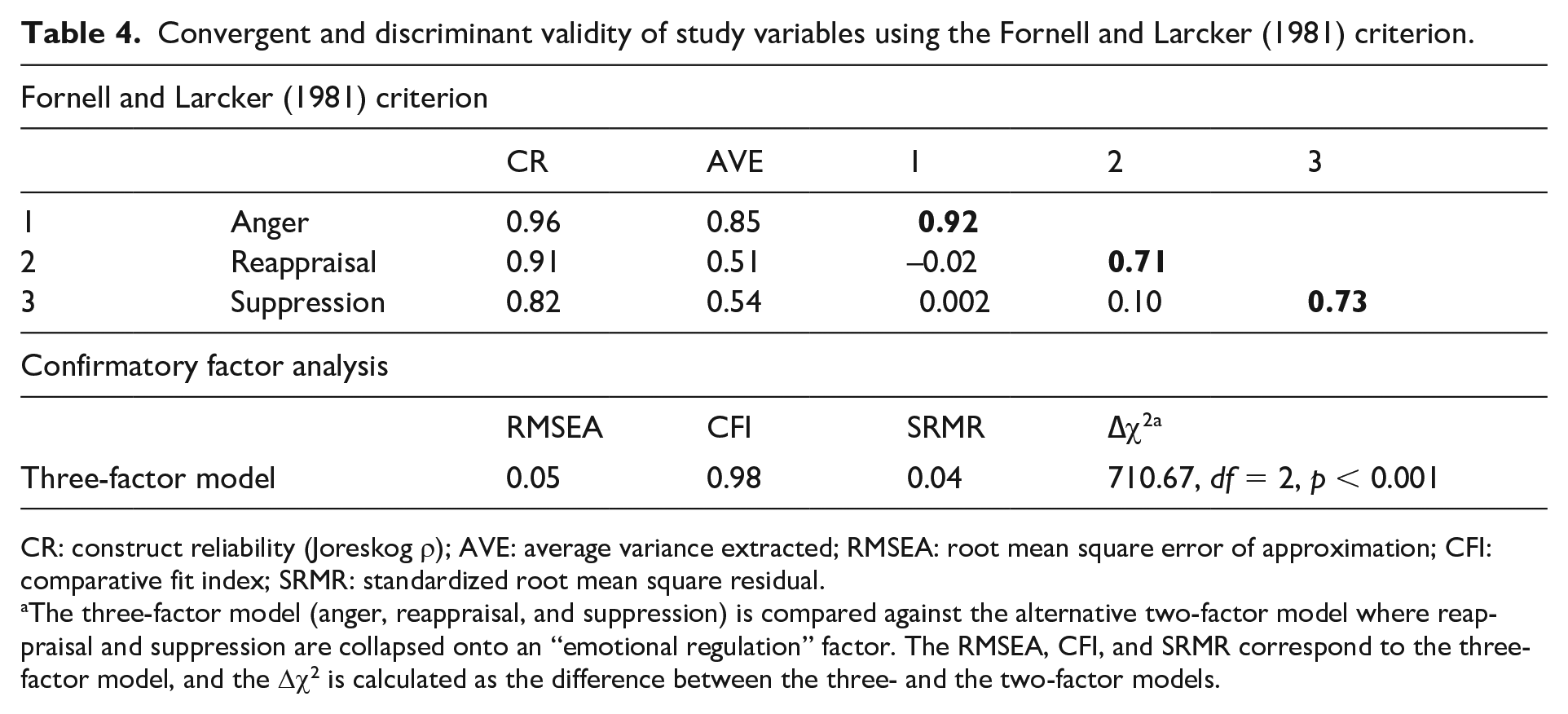
Correlations between variables and detailed results (hypothesis tests, discriminant validity) can be found in Tables 1 to 4 in Appendix 4.
We first checked the robustness of the manipulations of appraisals. Results show that they were effective for goal-blocking (Mgoalblock-no = 4.20, SD = 1.72 vs Mgoalblock-yes = 1.93, SD = 1.27; t(969) = −23.41, p < 0.001), control (Mlowcont-no = 3.10, SD = 1.21 vs Mlowcont-yes = 2.54, SD = 0.97; t(969) = 8.04, p < 0.001), and responsibility (Mresp-yes = 5.48, SD = 1.08 vs Mresp-no = 4.36, SD =1.43; t(969) = 13.82, p < 0.001).
To test H1 proposing that the intensity of anger is related to the number of appraisal cues, we carried out linear regression, entering the number of appraisals as the independent variable and anger as the dependent variable, controlling for gender and age. We find support for H1 (b = 0.43; F(1,967) = 75.59; R2 = 0.19, p < 0.001). To further explore the nature of the relationship between the number of appraisals and anger, we plotted anger against the number of appraisal stimuli. Anger rose rapidly between the baseline scenario and the appearance of one stimulus, and further with the addition of a second appraisal stimulus, but to a much lesser degree. When all three appraisal stimuli were present, there was no further rise. Post hoc curve estimation analysis showed that a non-linear logarithmic relationship showed better fit (R2 = 0.20, F(1,969) = 244.33, p < 0.001) than a linear relationship (R2 = 0.15, F(1,969) = 167.75, p < 0.001) or a quadratic curvilinear relationship (R2 = 0.20, F(2,968) = 118.35, p < 0.001), indicating that anger reaches a boiling point.
For the moderation analysis, we therefore used a logarithmic relationship for our calculations. To investigate H2, we used Hayes’ (2017) PROCESS Model 1 with 5000 bootstrap samples and 95% bias-corrected confidence intervals. We entered the log of the number of appraisal stimuli as the predictor, anger as the outcome, and emotional reappraisal as the moderating variable, controlling for gender and age. The effect of the interaction term between number of appraisal stimuli and emotional reappraisal on anger was significant (b = 0.73, t = 2.90, 95% CI = 0.23 to 1.22), providing initial support for H2. Similarly, the interaction between number of appraisal stimuli and emotional suppression had a significant effect on anger (b = −0.70, t = −3.34, 95% CI = − −3. to −to .). Thus, H2 was fully supported. To examine H3 and H4, we conducted simple slopes analysis (Aiken and West, 1991; Dawson, 2014). Findings showed that emotional reappraisal strengthened the effect of the number of appraisal stimuli on anger more strongly for people with high reappraisal strategies than those with low reappraisal (γlowreappraisal = 3.91, t = 35.66, p < 0.001; γhighreappraisal = 8.47, t = 17.28, p < 0.001). This result confirms H3 that at a high number of appraisal stimuli, anger was more intense at high reappraisal levels. Conversely, at a low number of appraisal stimuli, anger was lower for high-reappraisal strategies. These results are depicted in Figure 1. In line with H4, the findings demonstrate that emotional suppression weakened the effect of the number of appraisal stimuli on anger more strongly for high levels of suppression than for low levels of suppression (γlowsuppression = 2.43, t = 22.16, p < 0.001; γhighsuppression = 1.89, t = –3.86, p < 0.001). These results are depicted in Figure 2. Further spotlight analyses with the Johnson–Neyman procedure (Aiken and West, 1991) showed that both emotional regulation strategies have significant effects on the entire observed range. In the case of emotional suppression, there are no statistical transition points. For emotional reappraisal, the defining significance region at which this strategy mitigates the effect of number of appraisal cues on customer’s anger is 1.59 (99.59% of the sample). These results confirm that both emotional regulation strategies act throughout the entire customer experience to shape the effects of number of appraisals on anger.
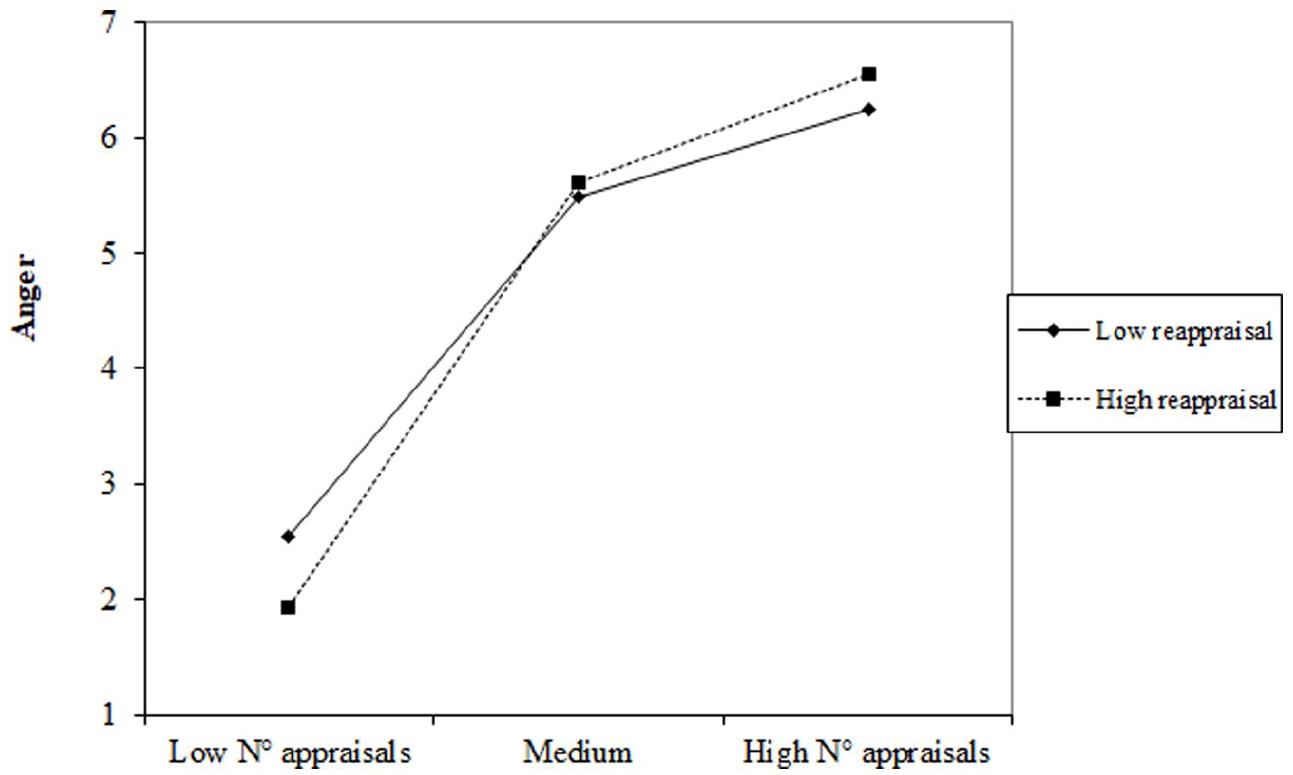
Moderation effect of reappraisal on appraisal stimuli–anger relationship.
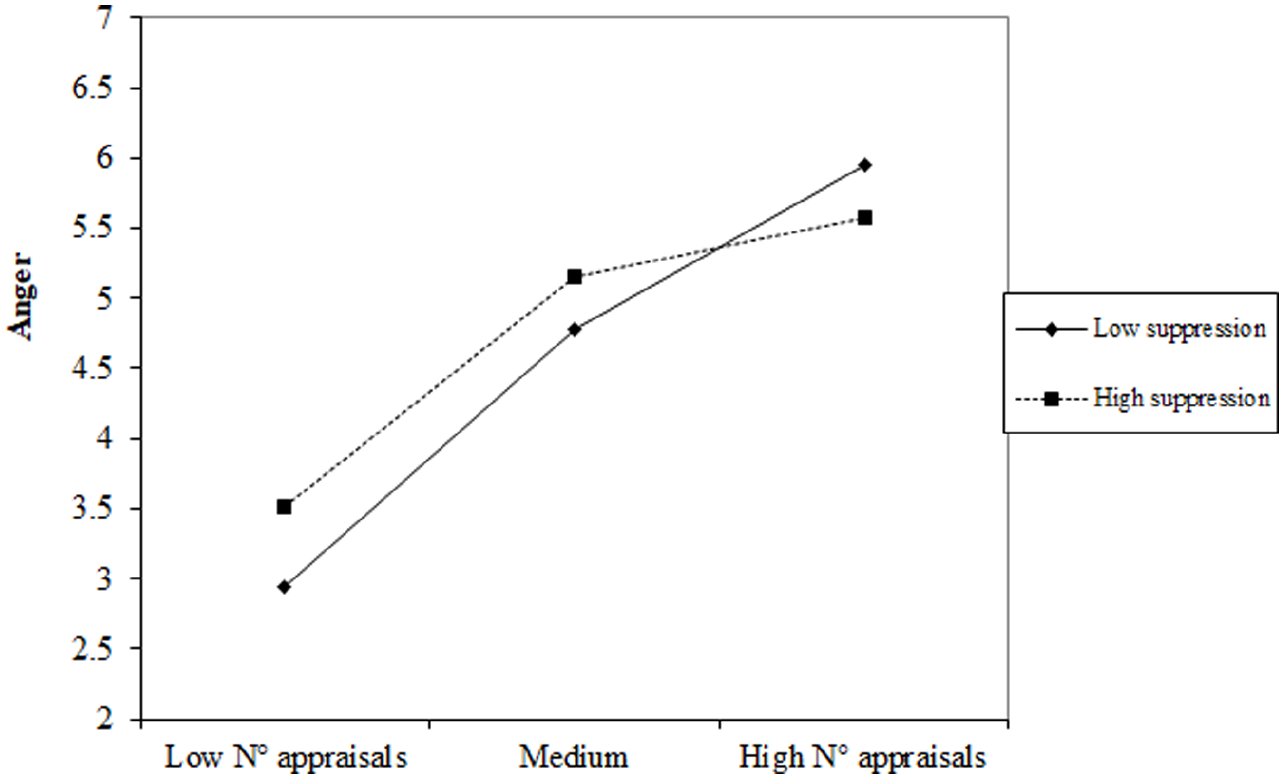
Moderation effect of suppression on appraisal stimuli–anger relationship.
Discussion
Theoretical implications
Our study offers three main contributions to the service failure and emotions literature. First, it shows that cognitive appraisals of an unsatisfactory service encounter combine to generate anger. In other words, more appraisals of service failure lead to higher intensity of customer anger. Our results confirm previous suggestions that anger arises because of appraisals of goal-blocking, attribution of responsibility, and lack of personal control over the situation (González-Gómez et al., 2021) and extend this idea to show that not only the nature but also the quantity of appraisal cues are important in determining anger.
Second, we show a non-linear relationship between the number of appraisals and the degree of anger felt, whereby anger reaches a maximum point after two cues are appraised – for example, an incompetent agent plus a goal not achieved. The perception of further appraisals makes no difference to anger levels beyond this point. This result speaks to recent calls for understanding non-linear relationships between emotions and other constructs (Valentini et al., 2020). It also provides food for thought for appraisal theorists, where linear relationships between appraisals (implicitly or explicitly measured) and emotions are commonly assumed (Antonetti et al., 2020; Biraglia et al., 2021; Smith and Ellsworth, 1985).
Third, our study addresses the moderating role of emotional regulation in the appraisal–anger link. Recent enquiry into the role of emotional regulation has begun to challenge the widespread dichotomous view characterizing reappraisal as beneficial and suppression as detrimental to individual outcomes (for a recent review, see Grandey and Melloy, 2017). Our findings support the emerging notion that contextual elements play a role in shaping the moderation effects of reappraisal and suppression on anger specifically. We find that reappraisal and suppression effects are contingent on the level of anger-evoking stimuli in the environment. When a person appraises the environment as relatively low in anger stimuli, the usual patterns of emotional regulation apply, and reappraisal diminishes, whereas suppression increases, anger. Emotional reappraisal allows individuals to take a wider perspective – a step back from the emotion-evoking event – thus reducing the intensity of anger (Grandey, 2003; Grandey and Melloy, 2017; Gross and John, 2003). However, this does not occur when the number of appraisal stimuli is high; that is, more elements of the environment are alerting the individual to a troublesome situation (in terms of control, goals, or responsibility attribution). Once the environment sends more signals of anger appraisal stimuli, our findings indicate that reappraisal of the situation no longer serves its purpose and does not decrease anger. In such circumstances, the additional effort required in reappraisal increases the individual’s cognitive depletion (Baumeister et al., 2007) as they attend to the situation, and thus anger rises. In contrast, emotional suppression, traditionally thought to increase negative emotions (Grandey et al., 2004; Gross, 1998), shows the expected effect of increasing anger only in environments low in anger appraisal stimuli. When multiple signals from the environment appear, however, the suppression effect reverses and actually dampens the escalation of anger. We suggest that this is in line with the functional view of emotions (Frijda, 1986; Keltner and Gross, 1999), which conceives of emotions as alert systems causing the person to direct their cognitive resources to dealing with the risk or danger posed by the environment. Our results add to the literature on emotional suppression and reappraisal (Gross, 2001; Gross and John, 2003) by incorporating the notion that the effectiveness of these two strategies is contingent on the environment (Butler and Gross, 2004) in terms of its emotion-evoking stimuli.
Managerial implications
Our results concerning the rapid escalation of anger mean that service providers should be able to identify and benefit from quick intervention strategies when customers begin to express low levels of anger. As such, preventing anger escalation early on would avoid the costs and resources involved in service recovery for angry customers. Training staff (communication skills, simulation, conflict management, active listening) to recognize initial signs of anger would enable companies to avoid the rise of anger and its subsequent negative effects (Antonetti et al., 2020; Biraglia et al., 2021; Su et al., 2018). In addition, the finding that anger reaches a peak, and does not increase indefinitely, suggests that strategies allowing a cooling off period for customers may help them come down from the anger “boiling point” (Sonnemans and Frijda, 1994) at which point further service efforts may be more effective. Another way to manage customer anger during service failure is to use the increasingly available data from multiple sources to develop hyper personalization. Access and analysis of such data could help employees to know the customer better and to understand or anticipate his/her preferences. Employees could thus adapt their wording and behavior leading to interactions less likely to trigger anger in that specific customer.
Finally, this study reveals that at low levels of anger, the customer will respond better to appeals to reason. At this stage, we suggest that service providers may activate perspective-taking by providing information and explanation for the service failure to the customer. In this way, customers can engage in reappraisal and can regulate their anger effectively. However, in an escalated anger situation, facts and information are unlikely to be effective, and we propose that in this phase, service employees should focus on activating customer anger suppression by displaying empathy and understanding. By aiding the customer to engage in the right emotional regulation strategy, these interventions, applied at the appropriate stage, will reduce the likelihood of customer dissatisfaction and negative behaviors, thus decreasing the necessity for costly subsequent service recovery. Training staff to recognize the emotional state of the customer is, therefore, of prime importance for enabling them to intervene at the right time in an adapted manner.
Limitations and future research
While this study has attempted to reflect the complexity of real service encounters in its examination of multiple appraisals, it focuses on the micro-level processes in a service-failure context and the use of experimental vignettes is a limitation. Drawing on Grégoire and Mattila’s (2021) analysis, it would be useful to extend from the dyadic encounter between customers and company employees by integrating a third party such as employees’ supervisors or technology (e.g. chatbot, e-mails). It could also be interesting to move from the scenario-based experiment and use real data and/or bigger data leading to more advanced analysis. Moreover, we only focused on the service encounter step, whereas in a real setting understanding how emotions and their regulation change over time, both after the service and during a service recovery phase, is important in determining final customer outcomes.
Second, our study focuses on the three appraisals of goal-blocking, responsibility, and control. While previous research has highlighted these three as the fundamental to anger (González-Gómez et al., 2021), other appraisals such as uncertainty, and importantly, fairness are known to underlie an emotional experience (Harrison-Walker, 2012). For example, understanding customer uncertainty in service encounters about the cause of failure, the procedures in place to deal with it, and its potential consequences are all important (Hudson et al., 2017), but little research has examined uncertainty at all steps of the service encounter. Similarly, customers might feel that they have been treated unfairly during a service failure, and experience negative emotions (Antonetti et al., 2020). While there have been various studies on the justice–anger link (Grégoire et al., 2010; McColl-Kennedy et al., 2011), increased social media use may alter justice perceptions and emotions because of the augmented potential for social comparison in service management. Understanding fairness and emotions in this changing context will therefore offer a useful contribution to the service failure-emotions literature. Relatedly, because we focused on a service failure phase, the level of control in the high control condition in our experiment was lower than what might be expected for a customer who feels in control of a situation, even though both conditions were statistically different (Mlowcont-no = 3.10 vs Mlowcont-yes = 2.54, p < 0.001). Thus, our results should not be extended to situations of non-failure service context.
Third, we find some unexpected effects of emotional regulation in relation to anger during a service failure. Future research could usefully extend this finding and study the impact of emotional regulation on other emotions previously examined in relation to consumer behavior such as frustration, shame, fear, or guilt (Becheur and Valette-Florence, 2014). Emotional regulation will not necessarily have the same effects on emotions characterized by different appraisals and thus may lead to distinct outcomes in terms of customer behavior and attitudes.
Fourth, our study focuses on an instance of service failure. Future research may find it useful to examine a more holistic model of emotional experience, including regulation at different points of the service journey (Valentini et al., 2020). Our findings that anger reaches a maximum after a relatively low number of triggers, and that regulation has different effects depending on the number of failure appraisals indicate a complex interplay of factors at this specific point of service failure. Research can usefully incorporate pre-service factors, for example, how past service experience (Maxham and Netemeyer, 2002) influences the relationships between appraisals, emotions and emotional regulation in the present. Post-failure recovery strategies and the emotions experienced and regulated at this stage may also be distinct from the failure phase. Similarly, understanding the influences of customer emotions and how they are regulated on more embedded, long-term attitudes (Elfenbein, 2007) will be of prime importance to service providers in their strategies for customer retention and loyalty.
Footnotes
Appendix 1
Appendix 2
Appendix 3
Appendix 4
Convergent and discriminant validity of study variables using the Fornell and Larcker (1981) criterion.
| Fornell and Larcker (1981) criterion | ||||||
|---|---|---|---|---|---|---|
| CR | AVE | 1 | 2 | 3 | ||
| 1 | Anger | 0.96 | 0.85 |
|
||
| 2 | Reappraisal | 0.91 | 0.51 | –0.02 |
|
|
| 3 | Suppression | 0.82 | 0.54 | 0.002 | 0.10 |
|
| Confirmatory factor analysis | ||||||
| RMSEA | CFI | SRMR | ∆χ2a | |||
| Three-factor model | 0.05 | 0.98 | 0.04 | 710.67, df = 2, p < 0.001 | ||
CR: construct reliability (Joreskog ρ); AVE: average variance extracted; RMSEA: root mean square error of approximation; CFI: comparative fit index; SRMR: standardized root mean square residual.
The three-factor model (anger, reappraisal, and suppression) is compared against the alternative two-factor model where reappraisal and suppression are collapsed onto an “emotional regulation” factor. The RMSEA, CFI, and SRMR correspond to the three-factor model, and the Δχ2 is calculated as the difference between the three- and the two-factor models.
Statements and declarations
All authors contributed equally to this manuscript. Their names are noted in strict alphabetical order. Material preparation, data collection and analysis as well as writing and commenting on all versions of this manuscript were performed by HVG-G, SH, and AR. All authors read and approved the final manuscript.