




Abstract
This article applies an intersectional lens to analyze the lived experience of 11 women migrant entrepreneurs based in the UK. We adopt structuration as our ontology to analyze intersectionality in entrepreneurship at the interplay of macro-level structures and micro-level agency, addressing tensions between determinism and subjectivism. Findings show that women migrant entrepreneurs are trailing wives who experience constrained agency which influences their entrepreneurial activities. By highlighting the specific issues faced by entrepreneurs situated at the intersection of the oppressive structures of patriarchy and outsidership, we advance the intersectional agenda in entrepreneurship research and policymaking.
Keywords
Recognizing the specific issues that diverse and vulnerable entrepreneurial populations encounter is important if these populations are to receive adequate support, including for their entrepreneurial activities and experiences. Understanding these issues requires both empirical and theoretical analysis (Hancock, 2007; Hankivsky & Cormier, 2011). In a context of increasing transnational migration flows and increasing diversification of societies (Vertovec, 2007), intersectionality is an appropriate lens through which to consider the complexity of situations faced by individuals from diverse backgrounds situated at the intersection of different complex and oppressive structures, including gender, race, migration, age, sexual orientation, legal status, and class (Bilge, 2014; Hancock, 2007; McCall, 2005). As an activity undertaken by a diverse range of individuals (Ram et al., 2013; Yamamura & Lassalle, 2019), intersectionality is recognized as a suitable theoretical framework for the analysis of entrepreneurship (Essers et al., 2010; Martinez Dy et al., 2017). Despite this, studies of intersectionality are relatively rare within entrepreneurship (Marlow & Martinez Dy, 2018). Our work contributes to addressing this gap by applying an intersectional lens to explore the experiences of women migrant entrepreneurs at the intersection of their household and migration contexts. Policy support has mostly focused on helping male migrants. Less is thus known about the specific experience of being both a migrant and a woman and about structural influences on the entrepreneurial endeavors of migrant women. Based on original intersectional findings and informed by structuration as an ontological lens, this article contributes to the theoretical advancement of intersectionality in the field of entrepreneurship.
The intersection of multiple attributes and contexts create specific barriers for individuals influencing their agency and entrepreneurial behaviors (Martinez Dy et al., 2017; Ozasir Kacar & Essers, 2019). Such barriers cannot be captured by analysis of single dimensions (Bowleg, 2008; Cole, 2009). Particular to women migrant entrepreneurs, recent studies have identified that populations of both women entrepreneurs and migrant entrepreneurs face specific issues when engaging in entrepreneurship (Bullough et al., 2019; Carter et al., 2015; Foss et al., 2019). We argue that using an intersectional lens to explore the structures of gender and migration offers an opportunity to better understand the experiences of women migrant entrepreneurs and to contribute to theorization about the impact of intersectionality on entrepreneurship. By exploring the experiences of women migrant entrepreneurs, we are able to reveal the specific issues faced by agents situated at the intersection of complex and oppressive structures, so demonstrating the value of applying intersectionality to studies of entrepreneurs.
Further, we analyze intersectionality through the lens of structuration; this recognizes the interplay between individual agency and social structures (Giddens, 1986b), to account for the complex interaction between contextual dimensions and entrepreneurship. While intersectionality is deeply embedded in existing structures of society (Bilge, 2015; Crenshaw, 1991; Gawlewicz, 2016), intersectionality also finds expression in the subjective identities of individuals situated at the intersection of different structures of gender, class, disability, sexual identities and religion (Bilge, 2014; Staunæs, 2003). We propose that, as an ontological lens, structuration can resolve the tension between macro and micro sociological levels of intersectionality, between structures and individual agents. Structuration considers the interdependence of structures and individual agency as a duality (Giddens, 1979), and can help analyze how different structures intersect and how these affect the lives and experiences of individuals. We thus, identify structuration as an appropriate lens for our study of intersectionality within entrepreneurship.
The article opens by defining intersectionality and reviewing dominant discourses about its use. Following this, we provide details on the qualitative methodology used, the analytical process followed and the empirical cases developed. Findings are then presented before discussing the relevance of structuration as an ontology for intersectional research in entrepreneurship. We conclude with recommendations for research and policymaking.
Intersectionality and Entrepreneurship
Defining Intersectionality
Intersectionality has become a useful transdisciplinary theoretical framework for scholars exploring the diversity and complexity of social inequalities and identities (Bilge, 2014; Hancock, 2007; McCall, 2005). By recognizing that individuals situated at the intersection of multiple structures experience unique disadvantages, intersectionality has enabled researchers to center the voice of the marginalized and the excluded (Hankivsky & Cormier, 2011; Smith et al., 2019). Its application has also enabled scholars to acquire a deeper, more nuanced understanding of the combination, rather than the sum, of multiple, inseparable and simultaneously experienced oppressions and identities (Bilge, 2014; Bose, 2012; Bowleg, 2012) and of the influence of oppressive structures on individual agency (Kynsilehto, 2011; Staunæs, 2003). Building on Crenshaw’s (1991) seminal analysis of the specific discriminations and lack of legal protection faced by Black women in the United States, intersectional research has extended its analytical and political scope to study the collective impacts of a diversity of attributes including—inter alia—gender, race, migration, age, sexual orientation, legal status, or class (Bowleg, 2008; Collins, 2000; Tapia & Alberti, 2019). When combined, these structures impact upon individual experiences in unique ways which would otherwise not be understood (Hancock, 2007; Hankivsky & Cormier, 2011).
Intersectionality in Entrepreneurship: An Opportunity for Theory
Intersectionality has been described as “the most important theoretical contribution that women’s studies, in conjunction with related fields, have made so far” (McCall, 2005, p. 1171) and has been widely applied across social sciences (Bilge, 2015; Bowleg, 2012; Cole, 2009; Hancock, 2007; Hankivsky & Christoffersen, 2008). Within entrepreneurship, intersectionality has been articulated in studies of women entrepreneurs, as a contribution to the advancement of post-structuralist feminist debates (Ahl & Marlow, 2012, 2021; Martinez Dy et al., 2017). In such studies, intersectionality provides a lens for analyzing the entrepreneurial behaviors and experiences of women (Ahl & Marlow, 2012; Bourne & Calás, 2013), and for uncovering the complexity of different dimensions, including gender, in entrepreneurship (Marlow et al., 2018). Intersectionality has contributed to “challenging the myths” of women’s (under)-performance in entrepreneurship (Marlow & McAdam, 2013) and to questioning the masculine discourse which has dominated the field. It has also been used to inform critiques of postfeminist and neo-liberal assumptions in policymaking that fail to recognize the influence of multiple structures of oppression on women entrepreneurs (Ahl & Marlow, 2021).
Intersectional research has particularly caught the attention of entrepreneurship scholars critical of heroic and heteronormative views of entrepreneurship (Marlow & Martinez Dy, 2018; Ozasir Kacar & Essers, 2019; Verduijn & Essers, 2013). In a context of increasing transnational migration flows and increasing diversification of societies (Vertovec, 2007), intersectionality is an appropriate lens through which to consider the complexity of situations faced by entrepreneurs from diverse backgrounds. In this context, calls to consider a wider diversity of attributes has led to a wealth of research on different ethnic minority groups’ experiences of entrepreneurship (Ram et al., 2013; Yamamura & Lassalle, 2019). Such studies have considered the impact of the intersectionality arising from dimensions of gender, religion and ethnicity (Al-Dajani et al., 2019; Barrett & Vershinina, 2017; Ozasir Kacar & Essers, 2019; Valdez, 2016).
The critical contribution of intersectionality is its recognition of the influence of multiple, simultaneously experienced social structures on individual agency and the interaction between these (Collins, 2000). This emphasis on the impact of overlapping social structures requires entrepreneurship to be contextualized as an activity undertaken by individuals within the historical, social, institutional and spatial contexts in which they are embedded.
Contextualized Entrepreneurship and Intersectionality
That our understanding of entrepreneurship cannot be divorced from the multiple contexts and the social structures in which entrepreneurs are embedded is now widely recognized (Drakopoulou Dodd & Anderson, 2007; McKeever et al., 2014; Welter, 2011; Zahra et al., 2014). For example, studies have shown that gendered roles and division of labor within households disadvantage women in their entrepreneurial endeavors (Byrne et al., 2019; Elam et al., 2019). They also reveal that due to gendered perceptions, women entrepreneurs routinely face obstacles when accessing finance and other forms of capital located within networks (Alsos et al., 2014; Brush et al., 2019; Elam et al., 2019). Such studies recognize gender as a social construct that is built through individual actions and responses to social norms and categories (Harrison et al., 2020; Jayawarna et al., 2020). Despite advances made to better understanding women’s experiences of entrepreneurship, researchers caution against the assumptions of post-feminism in policymaking, and call for consideration of the systemic and oppressive nature of gender as a social structure (Ahl & Marlow, 2021; Byrne et al., 2019).
Research interested in diversity in entrepreneurship has also explored the combined influence of social and institutional structures on the entrepreneurial activities of ethnic minority and migrant entrepreneurs (Jones et al., 2014; Kloosterman & Rath, 2001; Portes & Sensenbrenner, 1993; Zhou, 2004). The disadvantage and discriminations faced by individuals from oppressed groups can lead to lower growth prospects, higher exit rates, lower levels of internationalization and limited agency despite a strong engagement in entrepreneurship (Al-Dajani et al., 2019; Carter et al., 2015; Elam et al., 2019; Jayawarna et al., 2020; Mwaura et al., 2018). Such populations face the risk that their experiences can be “invisibilised” or ignored by policymakers (Högberg et al., 2016).
Recently, researchers have focused on studying the combined dimensions of gender and migration and gender and ethnicity, contributing to a better understanding of the actions and experiences of entrepreneurs from specific excluded and disadvantaged groups in different national contexts (Al-Dajani et al., 2019; Ozasir Kacar & Essers, 2019; Villares-Varela, 2018). Our article aligns itself with these studies by exploring the intersectional effects of different oppressive structures on women migrant entrepreneurs in a UK context. Intersectional effects can be difficult to identify when using quantitative studies which cannot reveal the lived experiences of individuals situated at the intersection of multiple oppressive structures (Barrett & Vershinina, 2017; Martinez Dy et al., 2014). Explorations of the relationship between social structures and individual agency requires an approach that can capture the dynamic interplay between such structures and agency.
The Tension of Intersectional Research Between Subjectivism and Determinism
Intersectionality lends itself to exploring dimensions of oppression faced by individuals situated at the intersection of different oppressive structures of gender (patriarchy), race (racism), disability (ableism), and other dimensions related to discrimination based on ethnicity, non-national statuses, sexual orientation or religion (Bilge, 2014; Hankivsky & Christoffersen, 2008; Valentine, 2007). Since the work of Crenshaw (1991), intersectionality has considered further dimensions and brought nuances to the analysis of gender and race (Bilge, 2015; Gillborn, 2015; Nash, 2011).
A Lack of Hierarchization?
Intersectionality is not without its theoretical tensions. On the one hand, it has been criticized as being too subjective and failing to recognize—or refusing—hierarchizations between attributes and oppressive structures (Acker, 2006; Skeggs, 1997; Yuval-Davis, 2006), while on the other, it has been cited as being too deterministic by placing too much emphasis on imposed attributes (Bilge, 2014; Bose, 2012). Intersectional research, we argue, has found a range of solutions to address both “relativism” (Anthias, 2009, p. 12) and the absence of hierarchical categorizations of attributes (Bilge, 2014). By considering the interplay between different social structures, individuals’ multiple identities and their behaviors, intersectionality is able to analyze the lived experiences of those encountering the impact of intersectionality (Collins, 2000). As such, intersectionality is concerned both with individual experiences and their position within multiple intersecting oppressive structures of domination (Bowleg, 2012; Collins, 2000; Hancock, 2007; Valentine & Sadgrove, 2012). Collins (2000) discusses the “matrix of domination” to refer to multiple systems of oppression and power which simultaneously impact on individuals situated on the wrong side of the system of domination. Intersecting dimensions should be understood collectively, in terms of their interactions and relationships to each other (Valentine, 2007). These dimensions constitute a set of structures in which individuals are embedded and suffer from disadvantages at their intersection (Bilge, 2015; Chaponnière et al., 2017; Collins, 2000; Staunæs, 2003). The choice of focussing on specific intersecting dimensions means that intersectional research can explore the experiences of a specific group of individuals (Bose, 2012). This is best illustrated by the seminal work of Crenshaw (1991), who used intersectionality to focus on the specific problems and oppressions faced by Black women in the United States. Thus, intersectionality can be seen a sociology of the specifics, as it focuses on multidimensional oppressions rather than focusing on dichotomic struggles such as class or gender considered in isolation.
Intersectionality and Positionality
Anthias (2009, 2012a) proposes to adopt a stronger theoretical focus on intersecting processes, leading to different forms of positionality. Rather than considering dimensions as attributes, the focus is on the dynamic processes (positioning/agency) and outcomes (position/structure) of intersectionality (Anthias, 2009) therefore, articulating agency and structures (Anthias, 2013; Martinez Dy et al., 2014). Indeed, intersecting processes can be seen as non-additive interplays between structures and disadvantaged groups (Bilge, 2014; Bowleg, 2008). Social processes may occur across different locations (as social spaces), leading to the idea of translocational-positionality (Anthias, 2009). Applied, for example, in the work of Villares-Varela and Essers (2019), through consideration of broader processes of social formation, translocational-positionality helps understand the simultaneously experienced complexities of social structures and their processes of becoming (Anthias, 2009).
Beyond the consideration of historical social hierarchies, intersectionality has also considered processes of gender, ethnic subjectification and identity at the micro level of the discursive practices of individuals situated in intersecting structures of oppression (Staunæs, 2003). The analysis of differences is concerned with a broad diversity of identities, attributes, or unique intersecting positions within structures, where categories equally matter (Hancock, 2007). By considering both processes of social formation and the individual level of identities, intersectional research can emphasize other processes of categorization that lead to “othering” or “minoring” for instance, making women a minority. Affected individuals and groups face specific issues (Bilge, 2014), which can be captured through the analysis of the interplay of structures and individual experience.
Solving the Tension Between Determinism and Subjectivism
The tension between the processes of subjectification, the focus on the individual and their multiple identities, and the structuralist/determinist analysis of inequalities in intersectionality echoes with perennial debates in social sciences about the interplay between micro and macro levels of analysis, between agency and structures (Crozier & Friedberg, 1977; Lazarsfeld, 1993; Mouzelis, 1997). Intersectional analysis supposes an integrated rather than additive approach (Hancock, 2007), in which social formations can be analyzed simultaneously at different levels, including macro (societal) and micro (experiential/individual) levels (Yuval-Davis, 2006). Both structures and agency participate in the formation of social inequalities and the intersection of different structures of oppression lead to unique configurations that influence individual experiences and behaviors (Bilge, 2014; Hankivsky & Christoffersen, 2008). We propose that Giddens (1986b) structuration theory and its consideration of the duality of agency and structure is an appropriate ontological lens through which to solve the tension between subjective and deterministic approaches in intersectional research.
Structuration as an Ontology for Intersectional Research in Entrepreneurship
Debates of the duality of micro–macro approaches are a highly contested field within sociology (Archer, 2010; Cherkaoui, 2003; Coleman, 1987; Crozier & Friedberg, 1977; Lazarsfeld, 1993). As intersectionality explicitly builds on socially constructed categories (such as race, gender identity, or class), there is a risk of placing an excessive emphasis on structure, leading to a lack of consideration of the subjective aspects of agency (Collins, 2000; Staunæs, 2003). In this sense, structuration provides useful tools for the analysis of intersectionality, both theoretically and methodologically, to analyze agent actions within the set of structures in which they are embedded and operate. For structuration, the analysis of individual actions cannot be separated from the analysis of the contexts, in which they are embedded. Structuration is an ontological framework in which structure and agency are irreducible to each other and interdependent. Such duality enables and necessitates the analysis of both elements recursively (Giddens, 1986b). As such, it requires an integrated methodological stance which recognizes the duality between agents and structures (Giddens, 1979). Specifically, Giddens (1979) argues that activities are situated in time, space and society, and that time and locations of social interactions are constitutive moments of social systems, allowing for a study of subjective accounts of agents and on the analysis of action (Giddens, 1986a). Such identification of patterns of actions and behaviors requires the use of more interpretive stances such as hermeneutics (Crozier & Friedberg, 1977; Giddens, 1976).
According to Van Burg et al. (2020), entrepreneurship research needs to go beyond ontological individualism by situating the entrepreneur within the context in which they operate. In structurationist terms (Giddens, 1986b), the contexts of social interaction and intersubjectivity are constitutive moments of social systems, therefore highlighting the role of situated, or contextualized, actions based on sensemaking of individual entrepreneurs (Garud et al., 2014; Suddaby et al., 2015). Given the importance of multiple contexts on entrepreneurship, an understanding of the interplay between structure and agency can be analyzed through the narratives of agents, a constructed and retrospective account of their own experience, with a reflective component, or double hermeneutics in Giddens’ sense, based on the ability of the researcher to interpret the data (Crozier & Friedberg, 1977; Giddens, 1986a). This methodological approach allows for the capture of how agents understand the world and how such understanding shapes their actions (Giddens, 1984).
Structuration has been applied to different research fields (Barley & Tolbert, 1997), including in entrepreneurship, where it allows emphasis on the dynamic nature of the nexus of structures and actions at the level of the individual (Johnston et al., 2016; Sarason et al., 2006). This, we argue, provides a strong rationale for using structuration to analyze entrepreneurial actions. Importantly, the structure-agent nexus is systemic in nature, as an understanding of either side is only possible through understanding the interplay between both. Simply put, understanding agency is only possible through an understanding of agent action situated in different structures (Barley & Tolbert, 1997; Giddens, 1984). As such, structuration is a suitable lens through which to explore intersectionality in entrepreneurship as it allows for an in-depth understanding of agency (here for the entrepreneur) within the structures of oppressive power such as gender and migration, in which they act.
Methods
Methodology
Recent developments in entrepreneurship research have highlighted the heterogenous nature and the importance of mundane forms of entrepreneurship (Van Burg et al., 2020; Verduijn & Essers, 2013; Welter et al., 2017). We propose to center the voice of women migrant entrepreneurs, by focusing on their everyday lived experiences (Bourne & Calás, 2013; Harrison et al., 2020). 1 Using an interpretive stance and hermeneutics (Giddens, 1976, Giddens, 1986a), we captured and analyzed the contextualized narratives of individuals, situated in specific intersecting structures that influence their entrepreneurial actions. For the analysis, we adopted the coding approach proposed by Gioia et al. (2013) to structure our data and engage with theoretical elaboration (Klag & Langley, 2013; Welch et al., 2011).
Research Design
This article builds on narrative-based cases to generate a theoretically informed understanding of the entrepreneurial experiences of women migrant entrepreneurs, considering the intersection of the different contexts and structures in which they are embedded and act. As presented in Table 1, 11 women migrant entrepreneurs from Poland agreed to participate. The selection criteria for this study included: (1) the businesses should be solely owned by a woman entrepreneur (in one case, joint ownership with another woman), (2) the entrepreneur should be a migrant herself (excluding second generation), and (3) we chose to focus on women entrepreneurs coming from Poland and who settled in the greater Glasgow area of Scotland, UK.
Participants.
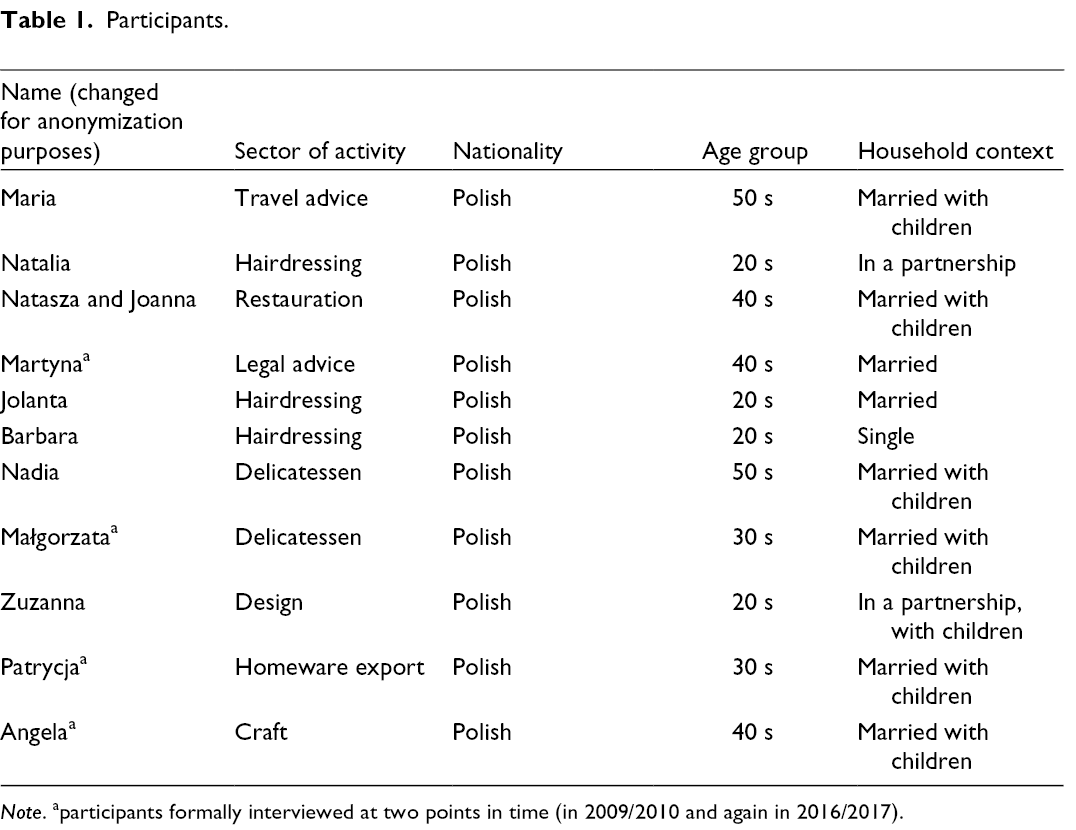
Note. aparticipants formally interviewed at two points in time (in 2009/2010 and again in 2016/2017).
The migration of Polish nationals to the UK after 2004 has constituted the most important transnational flows of migration to the UK and presents an interesting social phenomenon to research (Drinkwater et al., 2009; White & Ryan, 2008). Between 2004 and 2007, over one million workers and their families entered the UK (Home Office, 2009). After the EU-enlargement of 2004, while other EU member states were enforcing a transition period, the UK was one of the few countries to open its border to citizens from the new member states. 2 Migration flows from A8 countries (with a majority from Poland) have had a strong and positive influence in the UK, in terms of economic contributions and diversity (Mwaura et al., 2018). In general, the UK is characterized by its “superdiverse” society (Vertovec, 2007), at least in major urban centers, a diversity that is also visible in entrepreneurial activity (Ram et al., 2013; Yamamura & Lassalle, 2019). In this national context of diversity and transnational migration, Glasgow is an interesting location to explore. As Scotland’s largest city and main economic center, Glasgow is more diverse in terms of migration than other Scottish cities. More than 5,000 Polish workers have migrated to Glasgow between 2006 and 2007 and and later followed by their families (General Register Office for Scotland, 2010; Office of National Statistics, 2019). Lead migrants and their spouses have engaged in a variety of work including what is referred to as “3-D jobs”—dirty, dangerous, and degrading—in slaughterhouses, factories, cleaning jobs, and construction works. Polish migrants, including women, to the UK have also created businesses.
Policy support in the UK and Scotland has mostly focused on helping male migrants, not specifically women, wives, and mothers, therefore, risking making such women invisible migrants in policymaking (Hankivsky & Cormier, 2011; Smith et al., 2019). Little is known about the specific experience of being both a migrant and a woman and about structural influences the entrepreneurial endeavors as migrant women. Polish women migrants have been categorized as “Other White” in official policy documents, including Census and different policy reports. 3 However, Polish migrants, both men and women, face a range of barriers including a lack of recognition of their qualifications and a lack of language proficiency (Drinkwater et al., 2009; White & Ryan, 2008). This research proposes to precisely explore these challenges for women migrants who become entrepreneurs.
Of our participants, nine migrated to the UK after the EU enlargement to the A8 countries in 2004. The remaining two, respectively, arrived in 1995 and in 2001. All participants reside in the greater Glasgow area and operate in different service sectors of the economy (Table 1). All started their business in Glasgow a few years after their arrival. They are from different age groups and have different household situations. According to Vershinina and Rodionova (2011), who emphasize the difficulty of accessing participants in migrant entrepreneurship research, our sample is considered cohesive for the purpose of our research (Morse et al., 2002). Data were collected in Glasgow, Scotland, as part of a larger project on migration and entrepreneurship. 4 Participants were identified and approached until data reached saturation (Denzin & Lincoln, 2011).
Data Collection
We collected qualitative data from 15 interviews, with 11 women migrant entrepreneurs, who we identified and met within Polish community networks. These interviews were complemented with research notes taken from observations and informal conversations with participants and sometimes their husband/partners, ethnographic observations and interactions with the migrant community, providing a large breadth of data for this study. Research notes allowed contextualization of participants’ narratives in their different social, household and migration contexts (Bruni et al., 2004; Denzin & Lincoln, 2011) and helped capture the interplay between structures and agency.
Our analysis mostly uses data collected during semistructured interviews. Research notes and informal discussions provided insightful elements for analysis but could not be used as verbatim quotes. We conducted in-person interviews with participants choosing the location; at their workplace, their homes or in public places. To capture nuances, interviews were conducted in the participant’s preferred language (Crozier & Friedberg, 1977). Given the lead researcher’s ability to speak Polish, French and English, these three languages were offered (having lived in Rennes, one respondent preferred to have the interview partly in French). Interviews were conducted using a narrative interpretive approach (Denzin & Lincoln, 2011) and hermeneutics (Giddens, 1976), based on sensemaking of subjective accounts of agents, in which they were encouraged to develop their own lines of thought and to reflect on their experiences of entrepreneurship (Bruni et al., 2004). Interviews extended beyond consideration of entrepreneurial activities to other aspects of their life as women, migrants and entrepreneurs. Participants discussed their personal and family lives, their migration experiences, their household, and their socialization. Using open-ended questions, the researcher encouraged reflections on the role played by their migration experiences, their household, and other contextual dimensions on their everyday experiences of entrepreneurship. Thus, data were the product of active perceptual constructions of actions captured in the interplay of the multiple structures in which agents are embedded (Crozier & Friedberg, 1977; Giddens, 1986a).
Interviews lasted 45–90 min and were followed by informal conversations (lasting sometimes up to 4 hr). Members of staff or husbands/partners were encouraged to join the discussions after formal interviews had taken place. For example, the informal discussion with Nadia and her husband revealed their different conceptions of gender roles. It highlighted the unequal sharing of mental load and the prioritization of Nadia’s husband’s career and their children’s’ education over Nadia’s own activities. 5 Interviews were conducted at different periods in time and later transcribed by the lead author. Interview transcripts were compiled and coded thereafter (as discussed below).
Data Analysis
After fieldwork, a coding template was created and developed, for which we built on the process of qualitative data analysis elaborated by Gioia et al. (2013) (Figure 1). We used cross-case analysis to allow insight (understanding) to stem from the analysis (Klag & Langley, 2013), leading to theoretical elaboration 6 (Gioia et al., 2013, an Van Burg et al., 2020). Analysis highlighted the specific nature of their experiences as women migrant entrepreneurs and the interplay between structures and agency (Crozier & Friedberg, 1977; Giddens, 1986a).
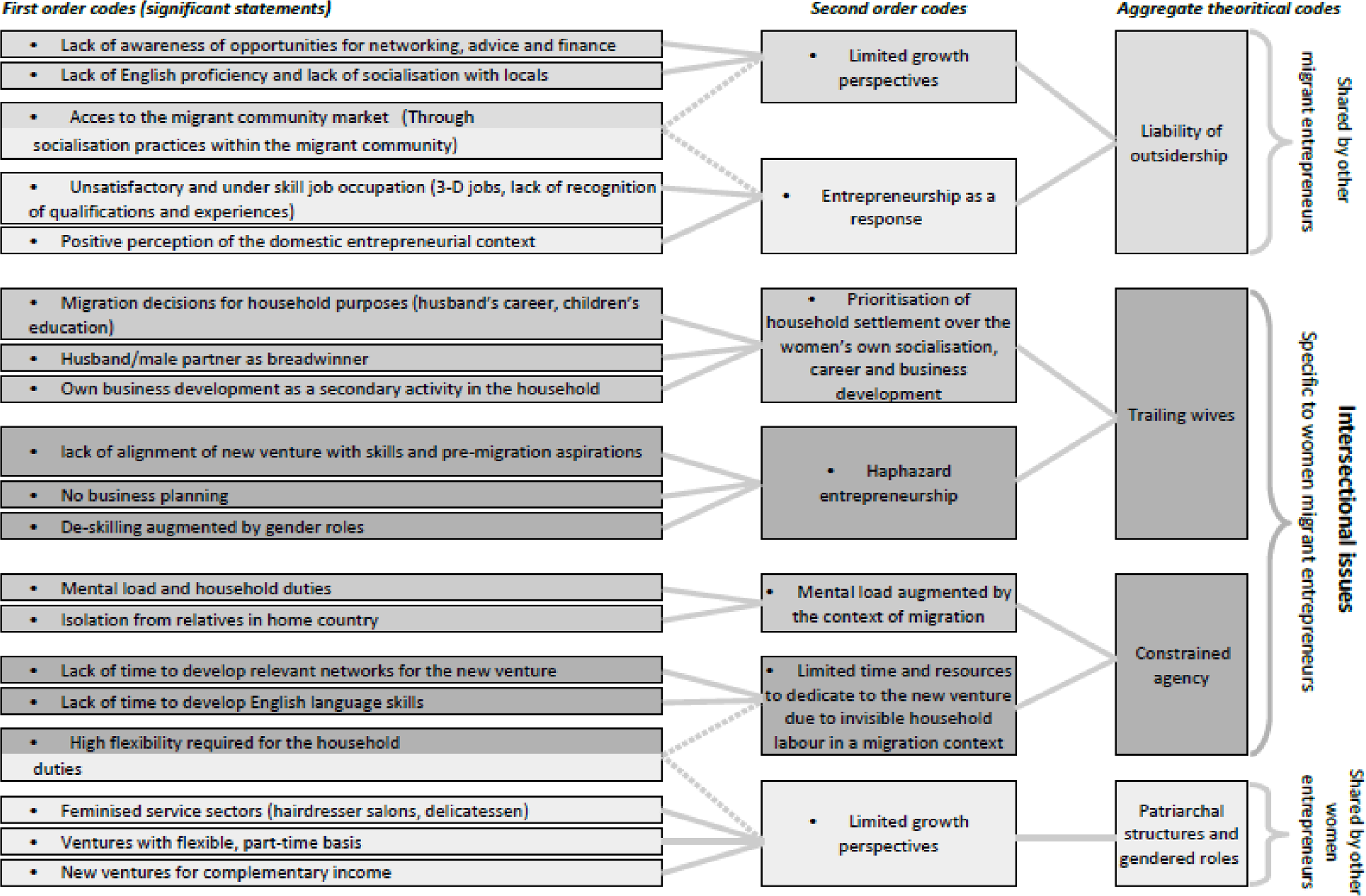
Coding.
Initial interviews were conducted with a list of topics, informed by pre-fieldwork readings and by the socialization of the lead researcher with the Polish community migrant community. These starting themes related to entrepreneurial and migration experiences, with a particular focus on the role of the social context on their experiences of entrepreneurship. 7 The fieldwork—especially the first interviews—enabled a revision of these starting themes and the emergence of new themes and findings. Coding was first done by hand. In a second iteration, the rigor of the analysis was increased by using a qualitative data analysis programme (MaxQDA). This led to better contextualisation and the emergence new codes (Gioia et al., 2013; Klag & Langley, 2013; Larty & Hamilton, 2011): for example, the migration decision for household purposes, de-skilling, or the social isolation of women migrant entrepreneurs were significant statements or first order codes (as displayed in Figure 1).
This ongoing process of data analysis went under several iterations. We then organized findings and themes into second order codes (Gioia et al., 2013; Klag & Langley, 2013). It eventually appeared that while some findings illuminated the experiences of agents in a migration context, others related to social gendered roles. Importantly, it emerged that specific findings were simultaneous, inseparable and imbricated, in other words, intersecting (see coding in Figure 1). These findings are specific to women migrant entrepreneurs, whereby the effects of both oppressive structures of gender (patriarchy) and migration (outsidership) were intersecting and reinforcing each other. Guided by Gioia et al. (2013), we finally developed aggregate theoretical dimensions. This led to the emergence of our two intersectional findings (aggregate theoretical dimensions) of trailing wives and constrained agency presented in the contextualized narratives of the women migrant entrepreneur, who participated in our study. Using a structurationist lens, we explore the interplay of these oppressive structures with agency and their role on entrepreneurship, thus providing a contextual and intersectional understanding of entrepreneurial action. We argue that by exploring two intersecting dimensions as a starting point for intersectional research on diversity and migration in women entrepreneurship, our research can contribute to theoretical elaborations of intersectionality in entrepreneurship research and provide a basis for future studies of intersectionality in entrepreneurship.
Narratives of Intersectional Dimensions
Our study reveals the intersectional nature of the lived experiences of women migrant entrepreneurs in Glasgow. Findings show how intersecting dimensions of oppressive structures (patriarchy/gender and outsidership/migration) lead to specific issues faced by women migrants as agents in the development of their new venture. In addition to experiences shared with other migrant entrepreneurs or with other women entrepreneurs, women migrant entrepreneurs also experience specific oppressions that are not experienced either by male migrant entrepreneurs or by non-migrant women entrepreneurs (Figure 1). 8
Our findings reveal that intersectionality is manifest in two ways: women migrants are trailing wives, following their husband or male partner into migration, at the expense of their career, relegating their new venture to the background of household’s migration and settlement priorities. Moreover, the mental load of women migrant entrepreneurs is augmented by the context of migration and further constrains their agency.
Trailing Wives and Entrepreneurs
Our findings first show that women migrant entrepreneurs are trailing wives, revealing the specific intersectional effects of being situated at the intersection of outsidership, as migrants and patriarchy, as women. While well-researched in the migration literature (Cooke, 2001; Mayes & Koshy, 2017), the experiences of trailing wives have not yet been studied in relation to their entrepreneurial activities. As trailing wives, women migrant entrepreneurs follow the lead migrants (their husband) 9 into migration and prioritize their household’s settlement including children’s education and husband’s career at the expense of their own career prospects, and subsequently, at the expense of their entrepreneurial activities. For these migrant female entrepreneurs, starting-up a business is a decision by default, a response to a lack of prioritization of their own careers within the migrant household. As Patrycja explains:
“We came for Marcin. He was in Glasgow already and I just joined him here with the children. It was 6 months after he came for his second contract. I did not speak English but you know, this is how it goes. I needed to follow. The opportunity for a better life was here, in Scotland. I left my job and organised the move. When we arrived in Motherwell [note: near Glasgow], I registered Adam, my eldest son, to school and to Church. I had to do my best for the family. I was working as a waitress in a restaurant. Actually, I had to change to another one soon, when we moved to Glasgow. I organised the move again. Same things again; registering to school, going to Church. I did not find a job this time and I looked after Ewa [note: the youngest daughter] and Adam. Ewa was at home. Marcin was working late. He had to travel far, so he would leave home early too. When Ewa started school, I thought I could start a business. Something I could do from home. But something small, something that would not cost too much to start” (Patrycja).
The prioritization of household settlement strongly limits the scope of their venture’s development and, from inception, their growth potential and aspirations. As women migrants operating under the structures of patriarchy and outsidership, our participants present entrepreneurship as a complementary activity for the household, something that “would not be too risky” (Natasza), rather than a career plan in the host country. Likewise, the development of a new venture is only a secondary objective in the migrants’ household. For example, Zuzanna sacrificed several opportunities to grow her business to follow her husband into migration. Moreover, he was still perceived as the breadwinner although she had a higher income. Consequently, Zuzanna had to re-build her networks while prioritizing his career. Likewise, although her venture was based on innovative tailoring processes that could enable opportunities for growth and development, Angela’s entrepreneurial activity was not prioritized and “came after whichever was more important, like schooling or supporting him into his career” (Angela). As trailing wives facing both the liability of outsidership and patriarchal expectations, women migrant entrepreneurs see entrepreneurship as a secondary and temporary activity. 10
Because of the prioritization of household settlement in the migration decision, women migrants had little foresight of their activities when they arrived in the UK. Consequently, there was no preparation or business planning prior to migration, highlighting the haphazard nature of these entrepreneurial activities. As Malgorzata expresses “I had no intention or not even an idea that I would start a business.” After migrating, her focus was on her husband’s career and her children’s settlement. The idea to start a new venture emerged with contingencies, as a response to the household’s situation in a migration context. As a consequence of being trailing wives, Polish women migrant entrepreneurs had little prior knowledge of the industrial and institutional contexts, in which they were going to operate. They also experienced a lack of language proficiency due to a lack of consideration of their own needs within the household prior to migrating.
“When I look back at my first few years in Scotland, something amazes me. I knew nothing about Glasgow, about hairdressing. I had no idea how taxes work, nor how to register a business. Really, I knew nothing, it was all new. I had learned a bit of English at school “Hello, my name is Jolanta” [laughter], but I knew nothing. […] I thought I could do something and I started exploring opportunities. Something I could do easily and drop if needed (Jolanta).
While male migrants also face language issues, in all cases in our fieldwork, husbands had secured their job prior to migration, while their wives followed without a clear perspective on their own career. As trailing wives, they face the intersectional disadvantage of being women migrants. The prioritization of their household in the context of migration (“I just follow and do the best for them” said Patrycja) affects their aspirations as entrepreneurs and limits their growth expectations. Having followed their husband in migration, women migrants lost their networks and were not embedded in relevant social networks in their host country. This reduced access to opportunities in the labor market and in entrepreneurship. With limited language skills, they also lost confidence in their abilities, experiencing discouragement and a lack of self-esteem. They struggled to valorize their work experiences and faced a lack of recognition of their qualifications. It was “frustrating when people would ask ‘what is a magister?’ [note: comparable but not similar to Honours year]” (Natalia). Consequently, they engaged in new ventures (hairdressing, delicatessen, craft) that did not align with their pre-migration qualifications and experiences.
Critically, trailing wives experienced loss of human capital (i.e., de-skilling). De-skilling among women migrant entrepreneurs is an intersecting effect of the outsidership and patriarchal norms that prioritize the men’s careers in migrants’ households. For example, despite being a qualified teacher in Poland, Angela faced the discrimination of being a migrant (non-native) “housewife” (i.e., considered “unemployed”), which reduced her prospect in the domestic labor market as a woman migrant:
“My value was going down. Who would recruit me in local schools? I was unemployed for a few years. Yes, I was factually a housewife, but this is the same for employers don’t you think? A migrant housewife who can barely speak English” (Angela).
Entrepreneurship thus appeared as a viable ex post solution once they arrived and settled in Glasgow. As Nadia puts it:
“I was the head of a large [post] office back in Poland. I was managing around 200 people on a daily basis, from mail reception, dispatching, human resources, shop and services […]. Dariusz [note: her husband] was retired from the army forces. This was not so easy for him at home to be inactive, we took the decision to move […]. I was a queen, now I was a cleaner [prior to establishing her own business]” (Nadia).
In this context, the prioritization of household settlement objectives reduced the development prospects of their new venture. Zuzanna regrets that “I would want to grow it. There is potential, I am having more clients and my offering is extending to new listings. I could make it grow but I need to be ready to move.” Maria and Maƚgorzata acknowledge the lack of focus on their business. They started-up with their own savings to limit potential losses for the household in the context of migration:
“I do not want to spend anything on the business. It is self-funded, I do not want to have a weight on the family’s budget” (Maria).
“I do it with care, with passion even some days but this is not meant to grow or stay. He has his own business too, and this is our priority” (Maƚgorzata).
Thus, as trailing wives and entrepreneurs, participants face the intersecting disadvantage of being women migrants. Situated at the intersection of patriarchal norms and outsidership in the host country, household settlement objectives relegate the agents’ business to the background. The migration decision was made for the husband’s career therefore, matching their human capital with opportunities available in the host country, whereas the trailing wife would follow and try to adapt once in the UK.
Women Migrant Entrepreneurship: Constrained Agency
Women migrant entrepreneurs, as agents, are constrained by the gendered distribution of roles in their household and in society due to structural and systemic oppressions. The disadvantages and barriers faced by women migrant entrepreneurs as trailing wives are reinforced by gendered roles and the flexibility required for household duties. These aspects are augmented in the context of migration, revealing a specific issue faced by women migrant entrepreneurs as agents situated at the intersection of structures of patriarchy and outsidership compared to male migrant entrepreneurs or women entrepreneurs. Women migrant entrepreneurs experience “mental load,” a term used to describe the extra burden that women face in the household context (Croizet et al., 2004). The mental load is even heavier in a context of migration. As other women, women migrant entrepreneurs are in charge of their household’s domestic duties. However, being abroad, they are far away from relatives, who would have often helped with childcare or housework in Poland. This required flexibility for household duties augmented by the migration context limits the time and energy that women migrant entrepreneurs can dedicate to their entrepreneurial activities and limits the scope of their business: “At the restaurant, we only offer lunch service so I have the time to clean the restaurant before I pick up the children from school.” (Joanna). Likewise,
“9am to 3pm [note: school times], this is my day. […]. There are many things to sort out for the children: school letters, school meals, uniforms, homework and all the rest. They are busy! And they keep me active too.” (Zuzanna).
As migrants, women migrants have to navigate an unfamiliar educational and institutional system. In a context of patriarchal structures, the duties related to children’s education and household’s paperwork fall on them as women, augmenting their mental load. Operating under the structures of outsidership as migrants and patriarchy as women, women migrant entrepreneurs thus, lack the time for conducting market research, planning, marketing, applying for finance and securing available support required for venture development. They lack awareness of the local institutional, social and business-relevant networks needed to develop their venture outside of the Polish migrant community market. This requires networking in relevant social groups. However, because of gendered distribution of roles within the household, trailing wives have “no time for meeting Scottish people” (Maƚgorzata). This also affects the agents’ ability to develop necessary language skills. They consequently often feel uncomfortable socializing with locals due to a lack of time and lack of confidence in speaking English which they see as impeding their business:
“This would be good for me to join some sort of groups. But I do not know where to start. I would just arrive and say: Hi! And then what? (Patrycja).
“I have been to some events, I just sat there. They were nice people but I was not sure that this was for me” (Natalia).
Networking is more difficult due to the entrepreneurs’ position as agents at the intersection of two structures. The time and energy required to engage in relevant networking is augmented by both migration (lack of awareness and embeddedness in those relevant networks as migrants) and gender (lack of embeddedness and household responsibilities as women, which limits their brain space). In this context, women migrant entrepreneurs face constrained agency and experience further difficulties to develop and grow their venture.
Finally, they experience the barrier of lack of identification and lack of appropriate role-models within the local support available. They perceive existing support as being “not really for me. I went there but this was for big businesses. I have a small business” (Jolanta), or (showing a leaflet from a support agency with a middle-aged man in suit):
“You see, I do not think I could get support from them. I am just trying to make my business work. Would they really give me some money? I am a hairdresser [note: using the feminine noun in Polish], not a businessman [using the masculine noun in Polish]” (Natalia).
As their migration decisions were made for their husband’s career and involved matching their partners’ human capital with opportunities available in the host country, women migrant entrepreneurs face specific barriers at the intersection of outsidership and patriarchy. Unlike male migrant counterparts, women migrant entrepreneurs are constrained in their entrepreneurial activities due to their situated position at the intersection of structural and systemic oppressions. Networking activities are constrained by the burden of household duties, augmented by the context of migration. Unlike non-migrant women entrepreneurs, women migrants lack language proficiency. In addition, they lack social embeddedness in the host country, and, because of household’s gender roles, they lack opportunities and the confidence to socialize and engage in networking activities with the local business communities. This constrains their efforts to access existing support and networks outside of their migrant community niche market. Combined with their mental load this leads to social isolation, women migrant entrepreneurs thus face specific blocked opportunities due to constrained agency 11 (i.e., a lack of choice due to structural constrains). The agency of Polish women migrant entrepreneurs in Glasgow is constrained by their simultaneously experienced oppression and situated positions within the structures of migration, as migrants and patriarchy, as women.
Discussion
Bringing Intersectionality Into Entrepreneurship Research
While the intersectional lens has gained momentum since the seminal work of Crenshaw (1991), its use in entrepreneurship remains rare (Marlow & Martinez Dy, 2018). Intersectionality provides an appropriate lens through which to analyze the specific issues faced by individuals situated at the intersection of different structures in their entrepreneurial activities. Both research on women entrepreneurship and migrant entrepreneurship have drawn growing attention to the multiple contexts influencing entrepreneurship and acknowledged their gendered and socially constructed nature (Díaz-García et al., 2016; Vershinina et al., 2019; Welter, 2020). Adopting an intersectional perspective not only allows researchers to capture the multiple and complex intersecting structures that can influence individual agency, it helps uncover the specific disadvantages faced by agents situated at the intersection of different oppressive structures, highlighting their specific issues and the multiple disadvantages they experience.
In a context of diversification of societies, the intersection of different oppressive structures of gender, migration, class, age and sexual orientation requires a lens that considers the specificities of the individual experiences of invisibilized populations (Smith et al., 2019). Intersectionality, despite its intrinsic tensions between structural and subjective approaches (Collins, 2000; Staunæs, 2003), provides such a lens to centering the voice of women, migrant, gender minority, older or disabled entrepreneurs by revealing and combatting the multiple oppressions they face. The intersectional lens is not necessarily subjective; it accounts for the effects of structures on individual experiences. We argue that while intersectionality has primarily been concerned with structures, recent research has placed individuals and their specificities at the center of analysis (Bilge, 2014, 2015; Collins, 2000). Such approaches focus on multidimensions of oppression rather than dichotomic struggles and calls for the consideration of a diversity of oppressive structures (Hancock, 2007). Indeed, the aim is not only to look for power struggles but also to explore and understand the multiple and complex intersecting structures affecting specific populations and individuals which constrain their agency in different contexts and affects their lives, and their activities (Hancock, 2007). Thus, an intersectional lens is a sociology of the specifics and provides avenues for theoretical development in the study of entrepreneurship situated at the intersection of multiple oppressive structures.
Intersectional research in entrepreneurship has emerged as a development of theoretical approaches to gender in entrepreneurship (Ahl & Marlow, 2012). There is a call for further feminist theories to be considered and advanced in entrepreneurship research (Ahl & Marlow, 2021; Marlow & Martinez Dy, 2018). Intersectionality also provides a lens through which to analyze other social hierarchies which have been studied individually in entrepreneurship research, such as religion or outsidership (in a context of migration). Overall, intersectionality is not a unified theory and therefore, could also be developed in relation to empirical and theoretical foci of entrepreneurship research interested in the diversity of entrepreneurial experiences and of entrepreneurs, and in the reality of mundane and “everyday” entrepreneurship (Imas et al., 2012; Van Burg et al., 2020; Welter et al., 2017). These include contextualized understanding of entrepreneurship in terms of (inter alia) gender, migration or ethnicity (Welter, 2020).
In addition to gendered approaches to contexts and entrepreneurial ecosystems (Brush et al., 2019; Welter, 2020), migration is an interesting dimension of entrepreneurship particularly in an era of large transnational flows of people, ideas or capital that affects the identity of individuals who become migrants and outsiders to the host society. The challenges faced by migrant entrepreneurs in the structure of outsidership, also happen to reveal the intersectional-specific issues faced by agents and the limitation to their agency. Our findings concur with the findings of previous studies of women migrant entrepreneurs (Ozasir Kacar & Essers, 2019; Villares-Varela & Essers, 2019) and with them, challenge the notion of empowerment for women migrant through entrepreneurship. They are still oppressed by patriarchal structures, outsidership, and the intersection between these structures. An intersectional lens reveals the multiplying effects of many intersecting oppressions on the practices and experiences of women migrants. These oppressive structures are simultaneously experienced by individuals situated at their intersection.
The intersectional disadvantages faced by women migrant entrepreneurs are more than the sum of the different dimensions of women + migrant (Bowleg, 2008). Rather, these can only be captured as a part of a multidimensional understanding of the interplay between oppressive structures and agency, which considers the intersection of these oppressive structures and their interplay with the experience of individual agents (Hancock, 2007; McCall, 2005). This means that these dimensions cannot be analytically separated but require to be analyzed as a whole.
Thus, in addition to providing an appropriate theoretical lens to understanding entrepreneurship for disadvantaged populations situated at the intersection of multiple structures, the intersectional lens calls for stronger, engaged academic scholarship and for research on equality and diversity in entrepreneurship and in society. It is also a call for entrepreneurship researchers interested in diversity, equality and inclusive practices to critically inform policymaking beyond the “false promises” (Ahl & Marlow, 2021) of a post-feminist society that places the responsibility on the individuals while oppressive structures are still prevalent. There is indeed still evidence of oppression and specific structure-dependent constraints on individual action, such as the constrained agency of trailing wives in entrepreneurship. This is why, by exploring the complexity of oppressive structures, an intersectional lens can illuminate deeper, more nuanced understanding of the situation of agents and their action, which would not be fully captured with the sole analysis of either/or the dimension of gender or migration. Such intersectional analysis therefore complements existing studies by highlighting the specific, that is the distinctive, unique subjective experiences of agents positioned at the intersection of different structures.
Intersectionality and the Interplay of Structures and Agency: A Structurationist View
Our main theoretical contribution lies in the use of structuration as an ontological framework through which to analyze the effect of intersectional dimensions in entrepreneurship. We argue that a structurationist lens, and not a structuralist lens, can help resolve the underlying tension between determinism and subjectivism in intersectional research, can analyze the interrelations between micro and macro levels, and contributes to the understanding of the intersection between class, gender, and other intersectional attributes by applying a robust sociological analysis.
Through the concept of duality, structuration as an ontology posits for the interdependence of structures and agents, which are irreducible to each other (Giddens, 1984). Therefore, this enables an exploration of agency in its interplay with wider structures. It is this interplay that underpins the practices of agents and their action (Crozier & Friedberg, 1977; Willmott, 1981). Action is at the core of structuration theory (Giddens, 1979) and agents are actors in the sense that their actions do matter and influence (as much as they are an outcome of) the interplay of structures and agency. This fits well with entrepreneurship as an act performed by individual agents that is collectively co-constructed and contextualized (Baker & Welter, 2020; Garud et al., 2014; Welter, 2011). Moreover, agency depends on crucial instantiated resources (Giddens, 1986a), including what is known by agents. Such resources are mostly lacking to women migrant entrepreneurs due to structural disadvantages.
Furthermore, the proposed structurationist approach allows for an analysis of multiple structures considered in combination and in their interplay with agents (Mouzelis, 1997). From an intersectional perspective, oppressions are lived and experienced simultaneously by individuals and cannot be dissociated one from another. The systems of oppressions constitute a whole at the macro level. The interplay of these structures with the individual agents’ subjective perceptions and their lived experiences at the micro level, influence their actions (Staunæs, 2003; Valentine & Sadgrove, 2012). In entrepreneurship, gender, religion or class and their intersection do indeed influence the action of individual agent entrepreneurs and their identities (Ozasir Kacar & Essers, 2019; Vershinina et al., 2019; Villares-Varela & Essers, 2019). Because of its primary focus on the interplay between structure and agency, a structurationist approach can also account for changing structures, such as in the context of transnational migration, as this interplay is situated and instantiated in action (Giddens, 1986b), what Giddens (1979) refers to as the “constitution of social systems” is the simultaneous instantiation of structures and of the agents and their social practices.
Use of a structurationist approach has revealed a more fine-grained understanding of agency, and through its interdependence with structures, a refined view of agentic (entrepreneurial) action. Structuration replaces agents action at the center of the analysis, in their interplay with structural forces (Crozier & Friedberg, 1977; Giddens, 1986a). As developed in this article, women migrant entrepreneurs engage in entrepreneurship because of and/or despite the different structures of oppression in which they operate such as gender roles in the household in the context of migration, lack of career prioritization as trailing wives. However, an intersectional lens to entrepreneurship could not solely focus on the structures, in order to capture the lived experience of individuals as everyday entrepreneurs (Cope, 2005; Staunæs, 2003; Valentine & Sadgrove, 2012). A structurationist approach also uncovers the subjective accounts of lived experiences by women migrant entrepreneurs, captures how their agency is constrained by structures, and how, ultimately this interplay affects the development and the sustainability of their new venture.
In presenting an application of intersectionality to entrepreneurship research from a structurationist perspective, we view the different contextual dimensions and entrepreneurship as being co-constructed and constantly re-interpreted by the agents, where structures and agency interact, leading to specific entrepreneurial actions and behavior. The proposed structurationist approach to intersectionality in entrepreneurship complements and contributes to the exploration of different ontologies and perspectives in entrepreneurship research (Ahl & Marlow, 2021; Henry et al., 2016), including research interested in intersectional issues (Martinez Dy et al., 2014, 2017). A structurationist ontology could indeed provide a framework through which analyzing the interplay of different structures of oppression and the individual agency of entrepreneurs and their entrepreneurial action and endeavors.
Limitations and Research Agenda
As with any study, the chosen methodological approach, grounded in interpretive research and hermeneutics, comes with intrinsic limitations (Denzin & Lincoln, 2011; Morse et al., 2002). First, our empirical evidence relies on participant accounts and their re-interpretation of past experiences, of which the participants are making sense at the time of the interview (Giddens, 1986a). Moreover, subjective perceptions are also re-interpreted by the researcher with their own understanding, adding another layer of interpretation to the analysis of the data (Denzin & Lincoln, 2011). Yet, this approach does not hinder theoretical elaboration and development, which is achieved through the analytical coding process adopted in this study aligning with the work of Gioia et al. (2013) and Klag and Langley (2013).
Second, our findings uncover the specific issues of Polish women migrant entrepreneurs in Glasgow at the intersection of outsidership and patriarchy. Our analysis did not however reveal intersectional findings on the oppressive dimensions of race and class in their lived experiences. Future research could thus be designed to explore the role of such additional intersectional dimensions in entrepreneurship, by considering diverse and understudied populations in their entrepreneurial endeavors. For example, further research could explore the migrant entrepreneurs from gender and sexual minority groups, or engage with women migrant entrepreneurs from working class background. Such research could also further explore the role of different institutional frameworks and policies on the experiences of intersectional entrepreneurs in different contexts.
Recommendations for Policymakers
Based on discussion of our findings, we identify a number of recommendations for policymakers interested in supporting diversity in entrepreneurship. Our study reveals the importance of the specific issues faced by individuals situated at the intersection of oppressive structures and the effect of these on their entrepreneurial activities. In an effort to center the voice of women migrant entrepreneurs, we recommend that policymakers should first create opportunities to directly listen to the voice of those concerned. We further recommend that policymakers should provide opportunities for intersectional groups of entrepreneurs to emerge. Policy initiatives should subsequently build on the feedback provided by these groups to formulate targeted and specific propositions to support them through inclusive measures. Our analysis suggests three areas for policy response: knowledge sharing between support agencies on intersectional practices, inclusive skills development opportunities, and mentoring.
We base our practical recommendations on specific suggestions mentioned by women migrant entrepreneurs in the course of the study. First, practical measures can be initiated by sharing experiences between community groups and with other departments who have already implemented intersectionality in their practices such as health departments in different contexts. Second, regarding skills development for Polish women migrant entrepreneurs, entrepreneurship support agencies should offer language courses and business/accountancy literacy courses with childcare facilities. This would help women migrant entrepreneurs addressing the intersectional issues that they face as women migrants; reducing the household burden augmented by migration, freeing time to acquire key skills, including language, gaining confidence in their project and starting networking with different locally-based business communities. Third, we recommend that entrepreneurial support agencies create opportunities to co-design mentoring programmes with women migrant entrepreneurs, aiming toward the sustainability and the development of their venture. Mentoring for women migrants should be flexible—online and during school hours—specific-addressing a technical aspect of the business environment requested by them, as for instance, getting support with access to finance—and could be delivered by women migrant entrepreneurs who share comparable experiences. Such measures could help women migrant overcome some of the intersectional challenges that they face. It would also help them envisage entrepreneurship not only as a solution to unemployment but as a sustainable option for their settlement in the host country.
Conclusion
This article reveals the intersectional nature of the lived experiences of women migrant entrepreneurs in Glasgow by showing how multiple dimensions of oppressive structures (here patriarchy/gender and outsidership/migration) lead to specific issues faced by women migrants (as agents) in the development of their new venture. In so doing, we highlight the relevance of intersectionality in entrepreneurship research and demonstrate how the intersectional lens used is particularly well-suited to capturing diversity and complexity in contemporary societies, going beyond the analysis of uni-dimensional dichotomies in entrepreneurship (Marlow & Martinez Dy, 2018; Verduijn & Essers, 2013). Moreover, by highlighting the role of multiple contexts, structures and their intersections on the daily entrepreneurial activities of women migrant entrepreneurs, our study contributes to debates on everyday and mundane forms of entrepreneurship considered within their contextual settings (Van Burg et al., 2020; Welter, 2011; Welter et al., 2017).
Further, by proposing structuration as the ontological approach through which analyzing intersectional issues in entrepreneurship, this article also participates in debates on the development of feminist theories in the field of entrepreneurship (Martinez Dy et al., 2014, 2017), and complements studies looking at refining intersectionality theory within the field (Ahl & Marlow, 2021; Barrett & Vershinina, 2017; Villares-Varela & Essers, 2019). We also create a theoretical basis for further research on diverse and vulnerable populations. Structuration resolves theoretical tensions between macro level structures and micro level of subjectification of experiences of agents. As such, a structurationist approach allows for a deeper, more nuanced understanding of the complex web of oppressive structures and multiple dimensions, at the intersection of which an individual is situated and the restriction on their agency which they experience.
Footnotes
Acknowledgments
We want to warmly thank the editor, Professor Susan Marlow, whose clear guidance helped steer our paper into its final form. We also want to thank the anonymous reviewers for their engagement with the paper in our discussions during the revision process. Their comments were valuable and helped enhance the quality of the paper. We appreciate insight offered by Cyrile Mateo, and we are grateful to women migrant entrepreneurs who took part in the study.
Declaration of Conflicting Interests
The author(s) declared no potential conflicts of interest with respect to the research, authorship, and/or publication of this article.
Funding
The author(s) received no financial support for the research, authorship, and/or publication of this article.
