



Abstract
In times of crisis, interactions and structures can change, eradicating prevailing norms and rules, with enduring unfavorable effects, and existing conceptual frameworks may fail to explain the effects of radical contextual change. In such contexts, the meaning of the customer experience is also likely to change, and touchpoints, cues, and the concept of the customer journey may prove insufficient to theorize the formation of those experiences. Adopting an agency-structure perspective, the article explores how crisis disrupts and alters structuration modalities, including space-time perception, access to resources, and institutional arrangements. To conceptualize how these contextual changes affect customer experience, we contend that it is necessary to understand the complex set of interactions among multiple actors and the structures and modalities that together shape the customer experience. Drawing on structuration theories to elucidate how disruptive contexts and crisis modalities affect the customer experience, the proposed conceptual framework identifies crisis modalities (discontinuities, accessibility, and fragmentability) that explain customer experiences in disruptive contexts as meaningful patterns of interaction informed by structure and agency. These findings can help firms to understand and manage customer experiences in disruptive contexts. In conclusion, we discuss how future research might contextualize and test the proposed framework.
Introduction
Firms generally view the customer experience as an opportunity to provide strategic, experience-oriented support (Homburg et al., 2017; Verhoef et al., 2009) as a basis for competitive advantage (Pine and Gilmore, 1998). Customer experience has commonly been conceptualized in terms of the customer journey and touchpoints before, during, and after the purchase of products and services (Lemon and Verhoef, 2016; Siebert et al., 2020). While research suggests that firms should make customer journeys as “consistent and predictable” as possible (Kuehnl et al., 2019), this can pose significant challenges in times of crisis, when “streamlining” techniques commonly used to ensure favorable experiences, such as simplification, personalization, and contextualization (Edelman and Singer, 2016), may no longer work. Instead, emphasis must be placed on practices like improvisation, prioritizing, and creating alternatives to handle the crisis situation (Oscarsson and Danielsson, 2018).
In these turbulent times, customers and firms face challenges at different levels and orders of magnitude, and no customer journey can be designed to cope with the breadth and complexity of crises that include climate change, rising economic inequality, pandemics, and natural disasters (Patrício et al., 2011). The initial shock of a crisis forces firms to respond promptly to the disruptive context by reviewing their business continuity plans and rethinking service and care provisions to protect the customer experience (Keiningham et al., 2020). According to Lemon and Verhoef (2016, Table 2), “extreme crisis can have a strong, negative and enduring effect on the customer experience,” and the usual touchpoints and cues suddenly seem inadequate. For example, on entering a restaurant, the customer is commonly greeted by a waiter, perhaps with a handshake as they are guided to a table and handed a menu. During the Covid-19 pandemic, however, the rules were changed; customers had to avoid close contact, often sitting outside and using a QR code to order by mobile phone. In short, all the touchpoints and cues previously associated with a favorable customer experience may no longer be appropriate for good customer care. In these circumstances, every business must grasp the emerging modalities that redefine customer experiences and relationships, but current conceptual frameworks fall short in this regard.
In business contexts, a crisis can be understood as an abnormal situation that poses extraordinary challenges for a firm in managing its relationship with customers, with immediate and often enduring impacts. This is especially true of customer experience, which is an iterative and dynamic process involving interactions with other actors and multiple contextual factors framed by the structure of the customer relationship (Patrício et al., 2018; Varnali, 2019). Given the uniqueness of service features, an understanding of context and structure is an essential and challenging aspect of managing the customer experience (Voss et al., 2016). Framed by multiple touchpoints and contextual cues (Edvardsson et al., 2014; Tronvoll, 2017; Vargo et al., 2008), these challenges become still more pressing in times of crisis, as the customer experience is likely to take on new meanings. It then becomes crucial for firms to understand and respond to this changed context by creating seamless, convenient, and engaging customer journeys. Like all relationships and contexts, a favorable customer experience depends on a reliable, responsible, and empathic firm that provides individualized care even in uncertain times.
To meet this requirement, firms must address a fundamental question: what drives the customer experience in a crisis situation? In their recent review of the relevant literature, Becker and Jaakkola (2020) emphasized that customer experience is subjective and context-specific and that evaluative outcomes depend on customer, situational, and sociocultural contingencies. They argue that, despite increasing research interest in customer experience, existing studies have created significant conceptual fragmentation, and they could find no meaningful account of the consequences of disruptive and radical contextual change in times of crisis. These challenges and their impacts on customer experiences can of course be analyzed in terms of touchpoints and the customer journey. An alternative approach would be to step back from the contextual challenges to develop a new conceptual framework that looks beyond our existing understanding. The present study challenges some prevailing assumptions about customer experience (see, for example, Alvesson and Sandberg, 2011) by seeking to identify crisis modalities that can explain customer experiences in disruptive contexts as meaningful patterns of interaction formed by structure and agency. This agency-structure approach is informed by Jaakkola's (2020) modeling approach, which builds a theoretical framework by emphasizing relationships between constructs. In so doing, we also follow Brodie (2014) suggestions for theory development.
Looking beyond a narrow focus on touchpoints and cues in the customer journey, the article draws on three earlier attempts to resolve the agency-structure relationship: Giddens’ (1984) structuration approach, Bhaskar’s (1989) transformational model of social action, and Archer’s (1995) morphogenetic theory. The article also contributes to the conceptualization of customer experience in dynamic contexts (Akaka and Vargo, 2015) by responding to calls for service research on “enhancing the service experience” (Ostrom et al., 2015: 139) in the context of disruptive change.
The paper is organized as follows. After outlining existing theoretical accounts of customer experience and the modalities of agency-structure relationships, we introduce structuration theories and extend it to crisis modalities. We go on to examine how customer experiences are shaped by relationships that change in crisis contexts. The concluding section discusses the article’s main contributions and limitations, along with managerial implications and directions for future research.
Theoretical background to customer experience
Crises can occur at any level—individual, group, or societal—creating ripple effects in the service ecosystem that may be short and clear-cut or more extended and complex (Barnes et al., 2020), affecting actors in different ways. Whether the crisis in question is a global pandemic, a regional earthquake, or a key actor bankruptcy that impacts a supply chain or local businesses, the context changes suddenly and radically in every case, for example causing destruction (e.g., earthquake and hurricane), failing demand (e.g., financial crisis), or isolation (e.g., social distancing and lockdown). How customers perceive and respond to these disruptive contexts will depend on how they experience the radical changes they precipitate. In this regard, the journey model can be understood as a “cultural mindset” that coordinates activities and touchpoints for all organizational stakeholders (Homburg et al., 2017: 385). During a crisis, actors make sense of what is happening by internalizing the new contextual conditions.
Customer experience
Practitioners and marketing scholars agree that customer experience is central to firm competitiveness as the basis for marketing management (Homburg et al., 2017; Lemon and Verhoef, 2016). Characterized as both mundane (Carù and Cova, 2003) and extraordinary (Arnould and Price, 1993), the concept of customer experience has been defined as “a multidimensional construct focusing on a customer’s cognitive, emotional, behavioral, sensorial, and social responses” to a firm’s offerings and actions (Lemon and Verhoef, 2016: 71), delimited by the scope of the service encounter (Kumar et al., 2014) and by the industry setting (Verhoef et al., 2009). Traditionally, customer experience has been viewed in terms of customers’ cognitive, emotional, and behavioral responses to firm-related interactions (Homburg et al., 2017) and as something that firms stage and manages (Pine and Gilmore, 1998), broadly emphasizing responses and reactions to managerial stimuli. However, recent research has moved toward a subjective and experiential view and broadened the scope by incorporating contextual factors to understand how value emerges during service provision (Helkkula and Kelleher, 2010) or in the context of the customer’s own life (Chandler and Lusch, 2015; Heinonen et al., 2010).
Accounts of customer experience that focus on responses to the processes of purchasing and consumption (Schau et al., 2009) seek to comprehend how the entire range of stimuli during the customer journey, potentially involving multiple actors and interactions, contribute to the customer experience. The scholarly literature presents stimuli as cues at multiple levels of aggregation, where the smallest stimulus unit (anything that can be perceived or sensed by the customer as the smallest stimulus unit, Bolton et al., 2014; Brakus et al., 2009) and touchpoints are embedded in the context as a series of interfaces. These cues and touchpoints inform the customer’s experiences before, during, and after service provision (Lemon and Verhoef, 2016; Teixeira et al., 2012).
The customer experience journey
The customer journey model takes a broad view of customer experience as a set of interactions with multiple actors beyond the touchpoints associated with a single firm (Epp and Price, 2011; Heinonen et al., 2010). This dynamic and systemic view of customer experience entails an evolving evaluation of contextual cues and linked touchpoints (Kranzbühler et al., 2018) with multiplier effects (Bolton et al., 2014) as connectivity across touchpoints drives positive customer outcomes (Kuehnl et al., 2019). Recent studies advise customer journey researchers to look beyond the short-term customer experience to long-term journey patterns in customer relationships (Følstad and Kvale, 2018), and this can also be applied to customer experiences and relationships in crisis contexts.
To enhance the customer experience, firms seek to improve unfavorable instances by understanding how more favorable experiences are cocreated and realized, generating a large body of literature on collaboration in value cocreation (e.g., Prahalad and Ramaswamy, 2004; Vargo and Lusch, 2008). However, the focus on customer evaluations of market offerings per se (Holbrook, 1999) has diminished the importance of contextual factors, which are especially relevant when the environment changes rapidly, as in times of crisis. As this requires innovative responses (e.g., Edvardsson et al., 2018), evaluation of the customer experience must be grounded in the ongoing relationship, collective values (Peñaloza and Mish, 2011), and the broader social context in which those values are formed (Chandler and Vargo, 2011; Edvardsson et al., 2011):
To understand the customer experience as a holistic multidimensional response to a complex set of interactions with various actors (Bitner et al., 2008; Tax et al., 2013), the firm must understand the context in which the experience emerges, including institutional arrangements (Verleye et al., 2017). As a complex set of interactions between customers, other actors, and embedded structures, customer experiences are necessarily phenomenological and context-specific. Contextual mechanisms shaped by the social system and the wider environment influence customer experience and evaluative outcomes (Akaka and Vargo, 2015; Becker and Jaakkola, 2020), and any meaningful conceptual framework must take into account the customer’s purposeful adaptive response to change and disruption. On that basis, we explore these experiences as abnormal interactions among multiple actors in the ongoing firm-customer relationship. In contrast to traditional definitions of customer experience that do not explicitly refer to context or radical change, we contend that customer experience must be understood as the result of a complex set of interactions among multiple actors, shaped by the related structures and the modalities that arise throughout the customer journey.
Structuration theories and application to crisis
Agency-structure relationships
In disrupting everyday routines, a crisis imposes additional pressures on the firm and its relationship with the customer. Understanding the effects of crisis situations on the customer experience requires a form of analysis that links that experience to the social reality of the surrounding turbulence in terms of agency and relationship structures. Established theoretical approaches can help to elucidate the interdependency of agency and structure, including Bourdieu’s (1977) objectivism and subjectivism; Bernstein's (1983) objectivism and relativism; Bhaskar's (1989) positivism and postmodernism; and Fay (1996) discussion of science versus hermeneutics. However, changes in the social system are more often explained in terms of structuration (Ellis and Mayer, 2001; Nicholson et al., 2013; Peters et al., 2009) and critical realism (Easton, 2002; Ehret, 2013; Peters et al., 2013). Both critical realism (Bhaskar, 1989) and structuration (Giddens, 1984) conceive reality as recursive and emergent by appealing to the key dichotomy of agency-structure.
Structuration theories explain how actors’ relations are influenced by and influence the structures that underpin the social order and human behavior. Giddens (1984) argued that actors always have a purpose, which is enabled or constrained by the resources and structures of a specific context. This interplay between structure and interaction is at the heart of Giddens’ “duality of structure.” For Giddens, agency and structure are mutually constitutive; that is, structures are a set of repeatedly reproduced, deeply sedimented rules and resources that constrain and facilitate social action. Structuration theory explains how social uncertainty is manifested in changing interactions and structures in terms of the underlying social dynamics (Giddens, 1984), emphasizing that action is strongly routinized: conditioned by existing cultural structures and creating and recreating those structures through enactment (Walsham, 1993). Giddens and Pierson (1998) subsequently argued that while the structural properties of societies and social systems are real, they have no physical existence but depend on the regularities of social reproduction.
According to Hitlin and Elder (2007), agency is “embedded” within the individual and refers to the flow or pattern of the actor’s actions rather than to their intentions. Structuration explains those actions and the recursive interaction between structure and agency by conceptualizing humans as “knowledge agents” whose reflexive interpretation of the world through thinking and action is informed and constrained by structure. Both critical realism and structuration, acknowledge the relevance of actors’ knowledgeability (Nicholson et al., 2014) in understanding how institutions change over time to form new structures (Orlikowski, 1992). Because this knowledgeability is incorporated in the activities of daily life, it constitutes social reality. However, according to (Bhaskar (1978: 39), “knowledge follows existence, in logic and in time.” Giddens argues for the importance of choice in agents’ actions because they are knowledgeable and are not passively embedded in social systems but actively engaged in their creation (Whittington, 1994). According to Giddens, all actors have an irreducible power of agency, and their actions are situated in the (largely) unintended consequences of past actions. Through reflexivity, actors can change the knowledge they use to guide their actions, which presents some problems for structuration theory in explaining temporally ordered phenomena like relationships. In response, Giddens maintains that while time is irreversible in terms of lifespan, it may have some reversible qualities, in that normally routinized practices that are habitual and taken for granted can be stopped or changed. When events and routines are disrupted in times of crisis, the self-reflexive actor experiences a sense of insecurity and may question the routinized actions and the emotions and desires that spur them to action (Archer, 2007).
Structures delimit both the rules guiding action and the resources that empower action. However, while structural properties make action possible, structures themselves have no reality except as instantiated in activity or as remembered codes of conduct (Whittington, 1992). To examine the dualism of structure and agency, proceeded from the idea of structure as something that “gives form and shapes social life,” which in the present context includes customer experiences. At any given time, the fact that structures are isolated from action implies that a given structure is equally constraining and/or enabling for all actors and all actions, serving only as a prevailing set of rules and resources. Similarly, action is at any given time isolated from these governing structures and so cannot contain the memory trace of contextual change, including how a changing context influences customer experience during a crisis. In reality, structure’s existence may only be detectable through causal efficacy (Mingers, 2004)—that is, as a reaction to something discernible through its effect. To that extent, social structures may embody a soft form of determinism (DeSanctis and Poole, 1994) grounded in the knowledgeability of actors (Stones, 2005).
Bhaskar (1989) argued that society is a complex ensemble of perishable structures, practices, and conventions transformed by actors’ practices. Bhaskar initially treated the structure-agency dualism as an ontological distinction between “society” and “people,” in which individuals create society and society produces individuals in a continuous dialectic (Archer, 1998). This creates a dynamic relationship between structure and agency and constitutes a transformation model as the basis for social investigation. On this view, actors must be differentiated from structures, and actors can therefore reflect on and transform those structures. Bhaskar (1998) initially envisaged the transformation model in terms of Gidden’s work on the duality of structures but later accepted Archer’s critique of Gidden’s conflation of structure and agency as problematic (Bhaskar and Hartwig, 2010). Archer’s (1995) morphogenetic cycle and Bhaskar’s transformative model both acknowledge the interdependence of structure and agency, which unites them under the banner of critical realism and supports the exploration of this changing relationship and its forms and effects over time.
While structuration and critical realism are similar in some respects, Archer (1995) argued that one key difference is that structuration maintains a synchrony between agency and structure, creating a flat ontology. Archer (1996) claimed that this conflates agency and structure to such an extent that structures appear to exist only in the “here and now” as a mere product of contemporary practices and asserted that this ignores the effect of past practices on present actions. In contrast, critical realism emphasizes the tension between agency and structure; as Archer (1995: 15) argued, structure necessarily pre-dates any action that leads to its reproduction or transformation, and structural elaboration necessarily postdates the action sequences that caused it. According to Archer (1995), human agents either reproduce or transform social structures through morphostasis (processes that preserve existing structures) or morphogenesis (processes that transform a given structure). This account incorporates temporal aspects of change by arguing that structures are relatively enduring over time and that their transformation is a function of actors’ purposeful actions. Critical realism rejects the flat ontology of structuration, and we support this view in recognizing the analytical utility of conceptualizing the service ecosystem in terms of micro, meso, and macro levels of aggregation. This approach allowed us to shift our attention to focus on different levels of the target phenomenon—in this case, customer experiences in crisis contexts (Chandler and Vargo, 2011). This is especially important when contextual factors play a causal role in ecosystem disruption. The use of causal language to describe the world is a fundamental tenet of critical realism (Easton, 2010), and this can also be applied to crises and disrupted contexts. In this regard, critical realism characterizes the world as differentiated and stratified (Sayer, 1992), and institutions can therefore be understood as context-dependent.
Dimensions of structuration
Structures constrain and enable agency in terms of the social system’s underlying structural conditions (Giddens, 1984)—the structural dimensions and properties that guide actors’ actions. These structures exhibit causal efficacy and constantly shape and reshape the social system through signification, legitimation, and domination (Giddens, 1984). Actors draw on structures of signification to inform understanding and communicate meaning. Simultaneously, they draw on structures of domination to exercise power and exert influence, where an imbalance of resources determines the power differences reflected in the asymmetry of actors’ positions (Edvardsson et al., 2011). Relationships facilitate access to resources for the actors involved, and the relationship structure frames the customer’s experience. Finally, legitimation involves recognizing a specific behavior within an accepted code of norms based on shared values, ideals, and rules that define the limits of acceptable conduct or sanction a given behavior.
Modalities of structuration
According to structuration theory, structures are translated into actions by modalities. Modalities explain why and how interactions (including customer experiences) are affected and continue to be so affected. It follows that actors do not have complete control but are constrained by the structure’s modalities. Giddens (1984) identified three modalities of structuration used in everyday activities, which Jessop (2005) characterized as free-floating mediators between structure and agency: interpretive schemas to communicate a frame of mutual meanings and shared understandings (signification); norms and moral codes to institutionalize reciprocal rights and obligations (legitimation); and facility is the power-related ability to get things done or control one’s surroundings (domination). While experiences and relationships are always context-dependent, resources and norms are linked to a set of sanctions against anyone who violates the rules. Again, as applied by other actors, these sanctions can affect the customer experience. More generally, the structuration framework supports a socially constructed order achieved through mutual communication, in which authority and power are established along with a recognized moral code.
Customers and other actors employ interpretative schemas to create meaning and make sense of reality. This set of shared assumptions, values, and reference points assigns meaning to everyday activities and guides how actors think and act (Rerup and Feldman, 2011). Actors’ practices embody interpretative schemas for communicating meaning and understanding within a structure of signification that shapes their experience, including the customer experience. The contextual ties of institutionalized patterns are grounded in an understanding of social practices and their inseparability from social change. Interpretative schemas are formed by the social milieu and the intersection of different contexts in space and time. To explain how social systems change, it is necessary to understand how actors conceptualize and organize themselves in time and space (Giddens and Pierson, 1998). It follows that the customer experience has both temporal and spatial dimensions; the former relates to past, future, or current situational factors (Belk, 1975) while the latter refers to individual and social contexts and the actor’s stock of knowledge (Schütz, 1967).
Facility refers to control of resources as the basis of power and how this is applied and exercised. In a broad sense, power can be understood as “the ability to get things done and make a difference” (Macintosh and Scapens, 1990: 461); its narrower meaning implies domination or the ability to act purposefully. Roberts and Scapens (1985) noted that agency involves the use of power, in which resources act as facilities; by drawing on resources, actors can exercise facility to dominate structures. The exercise of power may be related to asymmetries in the distribution of resources in space-time, and an actor can use these resources to improve a system’s viability (Lusch and Vargo, 2014). Resources are in a state of becoming (Zimmermann, 1951), and their potential value is realized when actors use them for specific purposes.
Norms (and more broadly institutions) are higher-order social structures that specify rules, values, and meanings as the basis for coordination and collaboration among human actors (Vargo and Lusch, 2016). By regulating standards for socially acceptable behavior, norms establish a moral order, which is embodied in enduring institutions that guide and constrain social action over time (e.g., Berger and Luckmann, 1967; Scott, 2008; Sewell, 1992). These embedded norms provide the moral underpinnings for a system’s signification structure, enabling actors to communicate a set of values and ideas about approved and disapproved actions and associated rewards and penalties or sanctions. To that extent, the system is not objective or neutral; instead, social meanings are deeply implicated in the reproduction of values for the legitimation of social behavior and interaction.
As a prerequisite for interaction, shared institutions are enduring social features that actors have internalized, including beliefs, norms, rules, and laws (Vargo and Lusch, 2016). It follows that actors cannot cocreate a favorable customer experience without a shared understanding of the relevant actors and institutionalized norms and scripts. As these arrangements are embedded in the system, context necessarily extends beyond purely environmental factors because it is shaped by “a unique set of actors and the unique reciprocal links among them” (Chandler and Vargo, 2011: 40).
Structuration and crisis
According to Durham (2005), a crisis presents customers with both an opportunity (action afforded) and a threat (action constrained). In a crisis, social structures and embedded institutional arrangements are disrupted, and the web of interacting social forces becomes even more challenging to understand and oversee. As structures serve as both “medium and outcome of the practices they recursively organize” (Giddens, 1984: 25), actors’ interactions are both enabled and constrained by structure (as medium), leading to the creation and recreation of the same structures (as outcome) over time (see Figure 1). In the case of customer relationships, the customer experience as medium facilitates development of the customer relationship as outcome. As crisis alters societal structures (Buckley, 2008), actors shape and are shaped by the crisis context and ensuing interactions. From a firm’s perspective, changing contexts present both challenges and opportunities in continuing to serve the customer (Niemimaa et al., 2019). Crisis modalities.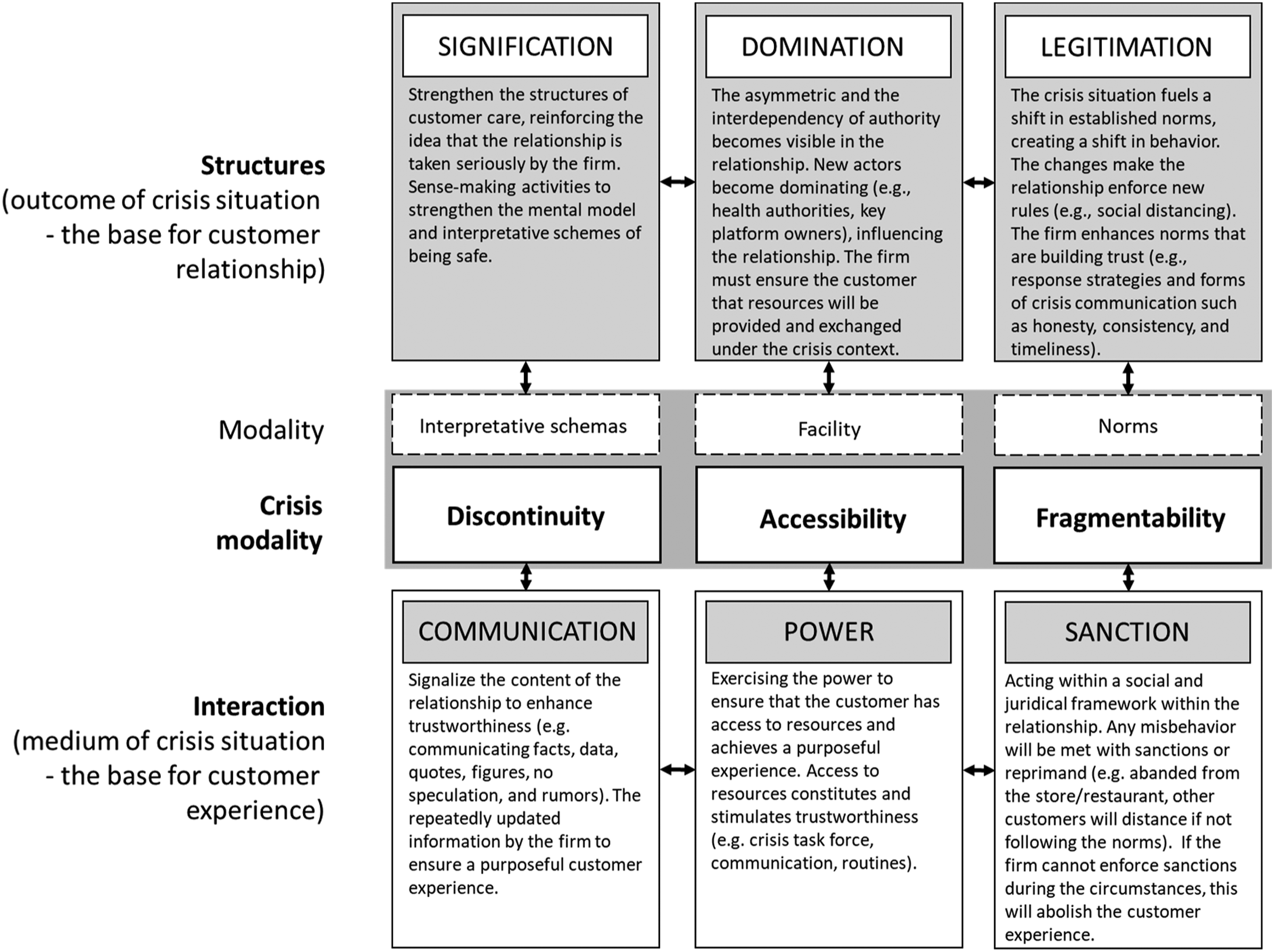
To engage with the complexity of what constitutes care-driven service and a favorable customer experience in crisis contexts, firms need to understand the underlying modalities of structuration. By explaining outcomes and interactions, these modalities can deepen our understanding of customer experience in crisis contexts. Giddens (1981) argued that crisis fosters a novel space-time edge, driving often rapid social transformation and subsequent changes in interactions and structures. In a crisis context, new structures emerge from “the often-unstable intersections between different modes of societal organization” (Giddens, 1981: 23). On this view, a crisis can be understood as a non-governing social process that entails uncertainty, changing the structures and modalities that enable or constrain experiences and relationships. More broadly, Giddens (1984) suggests that knowledgeable actors respond reflexively to the crisis context, establishing a new perception of the form and content of customer experiences and relationships.
The proposed conceptual framework explains customer experiences in crisis situations in terms of structuring modalities that influence the customer’s behaviors, interactions, and relationship with the firm. The framework challenges existing literature (see e.g., Alvesson and Sandberg, 2011) on customer experience by clarifying the modalities that influence the customer experience beyond the cues and touchpoints usually associated with the customer journey. A crisis context unfolds through mutually reinforcing practices centered on three characteristics of that context: perceived changes in time-space discontinuity (condensed or extended), reduced accessibility of resources, and fragmentation (fragmentability) of institutional arrangements (see Figure 1).
Discontinuity: In a crisis, altered perception or gaps in time-space dominate the interpretive schema as temporal elements are foregrounded, and time is seen as an enabler or medium for change (Suddaby and Foster, 2017). According to Nenonen et al. (2018), the process of radical change is best understood in temporal terms, as the time interval in which change is initiated and implemented. This becomes especially clear during a crisis, as the available time is hard to assess and seen to change and condense. This perceived increase or decrease in the speed of change and the associated uncertainty reflects an ever-changing context (Sagarin, 2011) in drastic and rapid flux, where increasing speed means greater entropy (Allen et al., 2011) and further complexity. A crisis makes it more challenging to understand the context and foundation of the customer’s experience and likely responses, given their narrowed focus on just getting on with life. The crisis modality foregrounds perceived changes in the temporal pace and spatial area of most activities, creating challenges for both customers and firms in adjusting their responses and frames of reference to cope with new priorities. To strengthen the customer-care mindset, firms must focus on reconfiguring signification to ensure that customers continue to find them useful and meaningful, emphasizing safety and predictability to facilitate interaction and so reinforce the customer relationship during the crisis.
These changes often alter the sense-making process, reshaping mental models of what it means to be a customer and what constitutes a favorable service experience. To show they care and to make customers feel safe, firms must address their customers’ fears, uncertainties, and concerns as the basis for new ways of interacting within the ongoing relationship. In creating this new mindset and understanding new cues and touchpoints, one key issue is how best to communicate reliability, responsiveness, and empathy—focusing, for instance, on new standards to determine what is safe or not. Based on insight into the existing relationship and customer concerns, this communication must provide understandable, up-to-date, and meaningful information. Despite the disruption, the firm must reinforce the sense of a purposeful customer experience, bolstering trust through honesty, consistency, and timeliness.
The accessibility of resources is challenged when a crisis reduces or blocks the customer’s usual facility. For example, customers may worry whether key products will be available in stores as usual or whether their favorite restaurant is closed or safe. By facilitating access to resources, firms exercise power and recreate the structure of domination. This asymmetry and interdependency between actors become more visible during a crisis and shape the customer relationship and experience. Each actor is likely to perceive the context differently according to the resources they can access or deploy by some or all available means. Accessibility may vary for multiple reasons, including reorganization of opportunities, changes in service or infrastructure allocation, or individual preferences (Haugen et al., 2012). Reduced access to affordable information needed to navigate a crisis is usually a key driver of contextual change.
The Covid-19 pandemic showed how new or less well-known actors can become dominant by providing access to sought-after resources, so influencing a wide range of interactions and relationships; examples include health authorities, firms selling face masks or sanitizers, key platform owners like Zoom or Amazon, and transportation and logistics firms that deliver online orders. The power to ensure ongoing access is crucial in maintaining the relationships that underpin a meaningful customer experience. In general, that power resides in a firm’s ability to act in the customer’s best interests—for instance, by procuring resources on time and providing required products and services, perhaps employing digital platforms as an alternative to visiting the bank, office, grocery store, or pharmacy. During the pandemic, access to the Internet, transportation, healthcare, and basic food products have been crucial, as have restaurant home deliveries or takeaways.
Fragmentability: The fragmented institutional arrangements that shape crisis contexts emerge as a consequence of disrupted norms and the need to maintain established institutions while creating new ones more appropriate to the immediate context. While institutions remain largely unchanged in everyday life, some are broken and are replaced by something new (Koskela-Huotari et al., 2016). In rapidly changing contexts, the balance between maintained, broken, and newly created institutions is fundamentally altered. New institutions gain prominence, making it more difficult for customers to understand the new rules or to be certain about the experience and care they can expect. As actors are shaped by their everyday context, any change in that context will affect their interactions. In many instances, institutional arrangements that are nested, overlapping, and occasionally contradictory enable actors to adapt to situational contingencies. This space between legitimation and sanction is bridged by normative perspectives embedded in societal norms and values.
Rule interpretation is a key activity of the “active agent” in making sense of a complex social order. This is especially difficult in the rapidly changing context of a crisis, and knowledgeability is essential in how the customer perceives their experience. Interactions shape and are shaped by norms and weighed against the moral rules of the relationship structure, which determines whether or not an action is considered legitimate in the context. During the pandemic, social distancing has shifted at least some established norms and behaviors; for example, during the pandemic, it is no longer socially or legally acceptable to hug when meeting friends or travel unnecessarily for work or pleasure.
In crisis contexts, one critical issue is the nature of sanctions—penalties for not following legal rules, regulations, or norms—and how these are imposed. During the pandemic, formal and informal sanctions could be imposed for not wearing a face mask as required or for failing to quarantine after traveling abroad. Sanctions require everyone to act within the specified social and juridical framework, and any misbehavior may be penalized by denying access to stores, restaurants, theaters, or trains. While firms cannot enforce legal sanctions that would adversely affect customer experiences in the absence of state laws and regulations, the disruption of rules and norms can create skepticism and undermine legitimacy in ways that are potentially divisive because of individual differences in beliefs, information, or experience. Various social platforms enable customers and firms to impose their own sanctions or protests, altering acceptance and enactment of domination or power and fragmenting the prevailing understanding and legitimation of institutional arrangements by polarizing signification and interpretive schemas.
To fully understand the nature of customer experience, it is necessary to understand the influence of different levels of aggregation in the service ecosystem. The potential to shift or oscillate the focus of attention through system-level aggregation (Chandler and Vargo, 2011) facilitates exploration of the different institutions that frame and affect the customer experience (see Figure 2). At the macro level, the service ecosystem’s institutional arrangements include signification, domination, and legitimation. In a crisis, these arrangements are disrupted by the transformed context and are displaced by the meso-level crisis modalities of discontinuity, accessibility, and fragmentability. Depending on the location and type of crisis, these macro- and meso-level structures may differ in content and meaning, in turn impacting the customer experience at the micro level. This hierarchy of system-level aggregation is characterized by downward causality (Ellis, 2012). How aggregated system levels affect customer experience.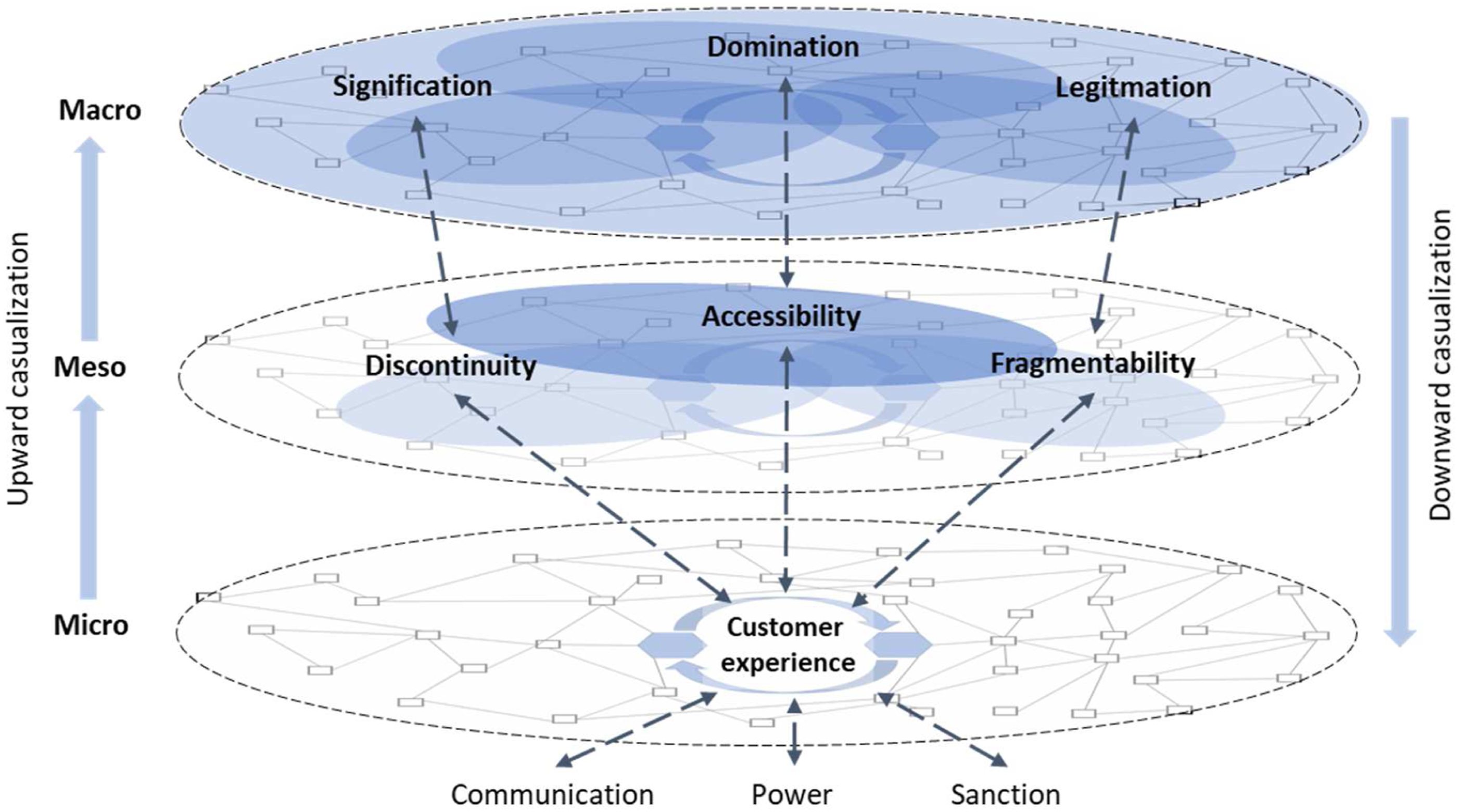
At the same time, interactions with the firm and other actors in the service ecosystem influence the customer experience through communication, power, and sanctions. This changes the customer’s behavior and creates an upward causality that affects the structures of the service ecosystem. As the crisis context changes, the customer experience changes, and the dynamics of downward and upward causation mean that the service ecosystem is in constant flux. These structures and interactions are volatile and adjust to the evolving crisis context, embedding past, present, and future outcomes.
Crisis modalities change with the type of crisis and the challenges of responding, and different crises activate different modalities. For example, there is a difference between seeing an earthquake on television and watching it destroying one’s own house. In the same way, responses to crisis differ according to the context; in wartime, for instance, an air-raid siren demands an immediate behavioral response while other situations such as a financial crisis may involve waiting for further information before taking action. In summary, downward and upward causation in a service ecosystem will differ in terms of tempo and impact, depending on the type of crisis.
Types of crisis and effects on the customer experience
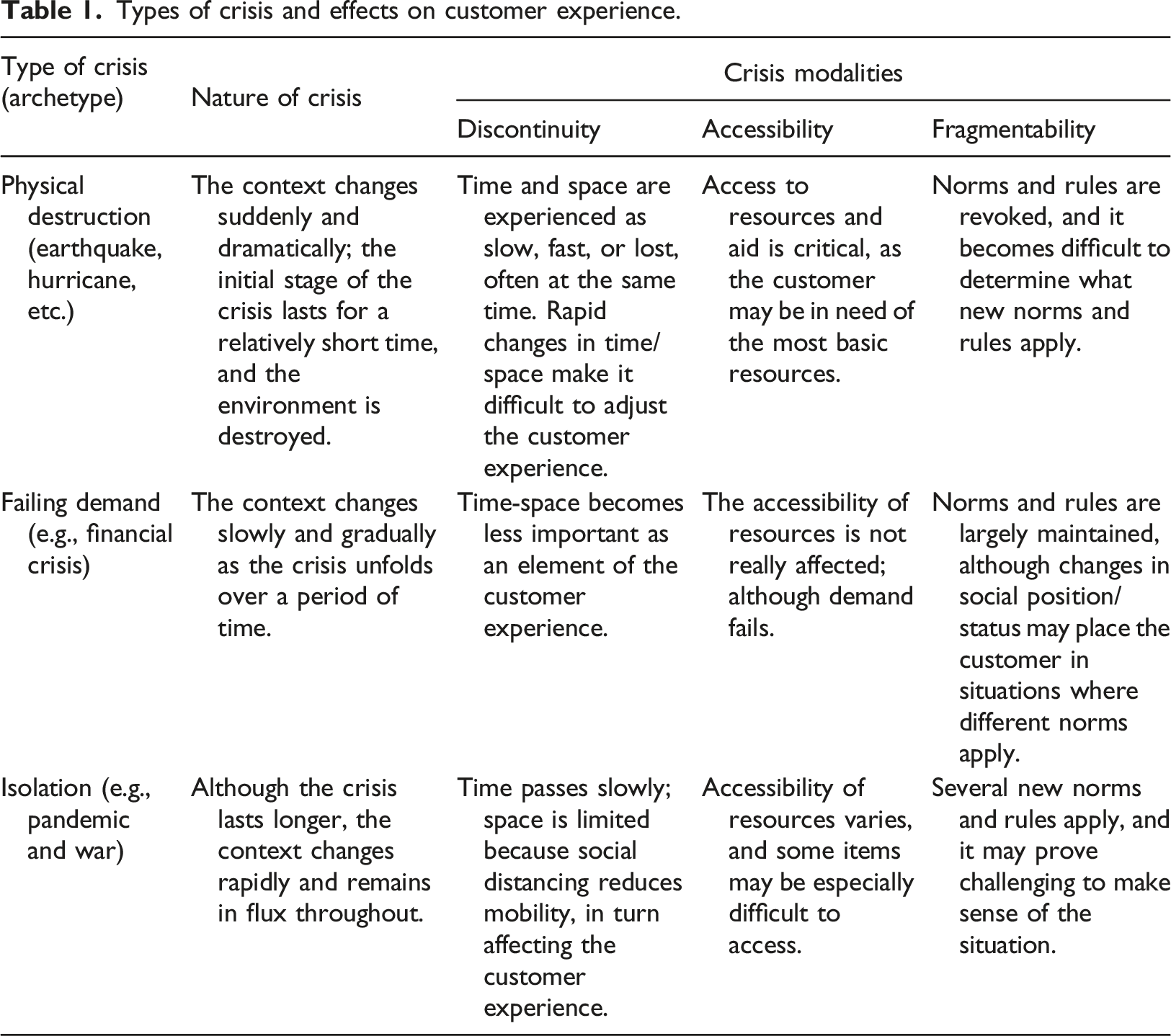
Crises tend to be sudden and unexpected, creating uncertainty or fear, but how they unfold can lead to different outcomes. Although every crisis is in some ways unique, firms must respond in every case to customers’ fear and uncertainty while protecting their own business. Beyond that, different crises lead to specific changes due to different disruptions of the context, generating different modalities. Here, we focus on three broad types of crisis defined by three distinct outcomes: environmental destruction, undermined demand, and social isolation.
Physical destruction of the environment by natural events like an earthquake, tsunami, or hurricane can radically alter the customer’s circumstances, substantially affecting the customer experience as moderated by the crisis modalities. Focusing on safety, the customer switches to survival mode to cope with the surrounding destruction by making sense of the perceived spatiotemporal discontinuity and securing access to basic resources like water, food, and shelter. For example, the Thailand tsunami in 2004 killed about 170,000 people and destroyed buildings and infrastructure within a very short time, disrupting access to necessary resources such as services and medical aid. Time was a significant factor, and efforts to access these resources were urgent. Although the tsunami probably lasted no longer than 1.5 hours, it had drastic and long-term effects. In the circumstances, traditional norms gave way to new priorities—for instance, people opened their homes to tourists without charging a fee.
A failing demand crisis such as a financial crash may evolve more slowly, with no immediate dramatic environmental changes beyond the financial markets. The impact on customers will differ according to their situation; for example, during the financial crisis of 2008–2009, the initial Lehman Brothers bankruptcy happened swiftly, but the ultimate impact on customers emerged much later. In many countries, the social security and welfare systems cushioned some more immediate effects. In this type of crisis, spatiotemporal aspects may be less significant, as most customers will have time to adjust to the new circumstances. Measuring the direct impacts of such a crisis can be challenging, but its consequences are easier to observe and understand. As firms went bankrupt, people were laid off, and many feared they would be unable to pay their mortgage or find somewhere else to live. Firms, governments, and financial institutions struggled to address these financial uncertainties, and people had less money to spend, with significant implications for the retail, entertainment, and travel industries and for customer experiences and relationships. Customers who lost their jobs because of failing market demand were unable to sustain their usual activities because of reduced access to resources, and reduced buying power added to failing demand in a negative loop. As new norms and rules took effect, the ripple effects of changing social circumstances impacted the financial system as a whole and most parts of the global economy. The causality between the different ecosystem levels was essential to understanding the crisis. In the real economy, unemployment, high-interest rates, and devalued shares all shaped new customer experiences.
In the third type of crisis, where a pandemic or a war leads to isolation, the effects will be immediately apparent for at least some customers, as rapid and unexpected changes persist and shift over time, demanding an immediate response. During the Covid-19 pandemic, emerging norms and rules altered customers’ experiences. However, the pandemic was different because it began as a public health crisis, creating fear and uncertainty about individual safety. By way of response, health authorities prescribed social distancing, handwashing, face masks, and social lockdown. These measures impacted significantly on multiple economic sectors, including travel, catering, retail, entertainment, and leisure facilities. This in turn drove changes in customer behavior that included increased online shopping and use of streaming services like Netflix. Universities extended their use of platforms like Zoom and other modes of digital interaction for online teaching. In short, some firms were boosted by the crisis while others struggled to survive.
Types of crisis and effects on customer experience.
Discussion
The conceptual framework developed here seeks to explain how the customer experience changes in crisis contexts. Adopting a structuration approach, the focus on modalities moves beyond traditional descriptions of customer experience formation, which take little or no account of radical change caused by contextual factors. To understand these consequences, it is necessary to look beyond cues and touchpoints during the customer journey to explore how disruptive contexts affect the interactions and firm-customer relationships that influence the customer experience. Drawing on Giddens's (1984) structuration theory, Bhaskar’s (1989) transformational model of social action, and Archer’s (1995) morphogenetic theory, this approach provides a finer-grained understanding of the modalities that inform customer experience in a crisis. In so doing, we contribute to the limited body of marketing research drawing on structuration and critical realism to explore crisis situations.
Several scholars have noted that crisis has a strong and negative effect on customer experience (Bolton et al., 2018; Kandampully et al., 2018; Lemon and Verhoef, 2016; Siebert et al., 2020) and that cues and touchpoints must be continuously developed and modified to reflect contextual changes. While we agree with Lemon and Verhoef's (2016) view that customer journey analysis must incorporate the customer’s perspective, our conceptual framework envisages a broader analysis of contextual dynamics beyond traditional customer blueprinting (Bitner et al., 2008) or a narrow understanding of customer experience. In support of this argument, Siebert et al. (2020) developed a visualization of smooth and sticky journey models that consider several contextual factors, including different forms and channels of communication and delivery, varied use contexts, and service-context sensitivity. However, their framework does not extend to context-driven structural properties or the effects of context disruption.
To explain how crisis situations influence customer experiences, the proposed conceptual framework extends existing customer experience research to incorporate crisis modalities. Our framework challenge existing literature and conceptual approaches on customer experience (see Alvesson and Sandberg, 2011) and contributes by drawing on an agency-structure perspective from structuration theory. Structuration theory explains societal changes (including crises) as intended or unintended consequences of social actions and the interactions and structures that enable or constrain customers’ experiences (Bhaskar, 1989; Giddens, 1984). By addressing this recursive interplay and differentiating the interrelated dimensions of signification, legitimation, and domination (Müller-Seitz and Sydow, 2012), structuration theory’s multilevel analysis (see Figure 2) of the customer journey can help to ensure a favorable customer experience. By acknowledging these dimensions and their modalities, firms, and customers can recreate or transform themselves, their relationships, and the structures of the system.
Beyond this multilevel multidimensional approach, a further advantage of the agency-structures perspective is that it reveals the inherent dynamic nature of the crisis context by analyzing customer relationships as recursive social practices (Sydow et al., 2011). As an ongoing or terminated relationship, the customer experience depends on the connectedness of the medium and the outcome of interactions and structures in the given context. This recursive process informs customers’ experiences and creates a pattern for future relationships based on the modification of institutional structures. Reflexivity or “self-monitoring” (Beck et al., 1994) enables individual actors to reflect on the crisis situation and to alter their perception of the context to avoid unfavorable customer experiences. According to Stones (2005), agency and reflexivity help to differentiate structures, modalities, individual practices, and customer experience outcomes. This is especially important in times of crisis when structures are disrupted, and uncertainty about the future poses challenges for customer care and customer experience management.
The crisis modalities (discontinuity, accessibility, and fragmentability) extend our understanding of the structuration process by incorporating crisis-specific conditions and eliminating or neutralizing existing modalities by reducing their original direction and effect, so avoiding disruption of customer relationships. The crisis context affects the structuration process by altering the framework of relational structures and interactions for different cues and touchpoints. As the overall effect on customer relationships is to disrupt the customer experience, managing that experience effectively depends on understanding the crisis context. While the modalities remain intertwined and interdependent, the dominant property may differ at various stages, as different crisis contexts entail different combinations of modalities. For example, in crises involving sudden or extreme physical damage (such as earthquakes or hurricanes), the customer’s experience is dominated by reduced access to basic resources such as food and water. In emergent contexts such as a financial crisis or a pandemic, issues of failing demand and isolation respectively foreground time-space discontinuities and fragmented norms. As changing perceptions alter attitudes, the crisis becomes transformative, posing challenges for regular business practice and society at large. This variation in scope and severity explains the ensuing, wide range of customer experiences.
By defining the context in terms of interaction situated in time-space that links structures, environment, and actors’ engagement, the proposed conceptual framework explains how customer experiences emerge in a disruptive crisis context. Misalignment between the traditional and the new situation creates the context. This affects how customers think (interpretative schema) by changing the perceived space/time frame (discontinuity); how customers retrieve and use resources (facility) as a result of reduced accessibility; and how customers cope with fragmented institutional arrangements (fragmentability) (see Figure 3). When contextual elements like cues and touchpoints take on new meanings, the customer experience also changes. In times of crisis, these modalities will affect customer experience through interactions with the firm framed by relationship structures. Our conceptual framework (Figures 1 and 2) contributes to the ongoing discussion of customer experience in dynamic contexts (Akaka and Vargo, 2015) and a fuller understanding of crisis management. The customer journey in crisis situations.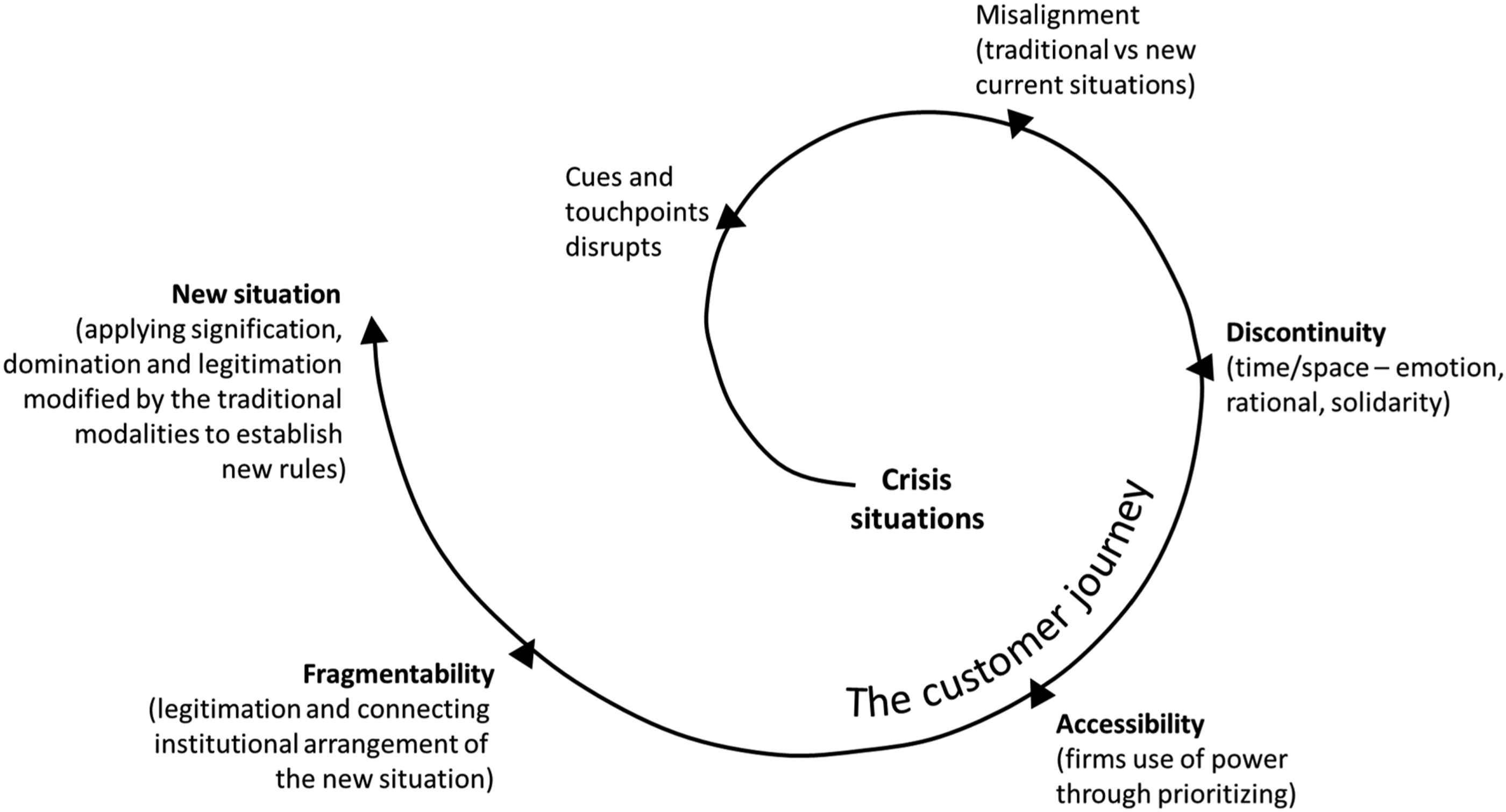
Crisis contexts create situations that affect customers’ experiences differently during their journey, as shown in Figure 3. This became evident during the tsunami when the waves hit the shore of Thailand and how people responded to its effect. Established cues and touchpoints were disrupted, many hotels and cities were torn down, and the people were separated. The crisis situation required an immediate response, but no cues guided the behavior due to misaligning of the existing structures. The damaged context altered people’s interpretative schemas and how they handled such a crisis situation. This discontinuity in space-time caused awareness of where tourists and their families were located. The perception of time either became condensed or extended dependent upon, for example, the need for medical help or the search for family members. In addition, the accessibility to resources such as food, water, and transportation becomes uncertain and requires governmental prioritization. Furthermore, the fragmentability of institutional arrangements abolished the existing rules where locals opened up their homes, providing shelter, food, and medical care without charging money. This new post-tsunami situation, based on customer experiences, entailed several new guidelines for constructing buildings and enhanced collaboration among local, national, and international bodies, such as tsunami warning systems, pushing for changed practices. The example shows that some crisis situations require prompt action; others are less urgent, but the intended outcomes always have degrees of uncertainty.
Managerial issues and tentative implications
Actors who endure a crisis together are more likely to bond, and this can strengthen a firm’s relationships with its customers, who are likely to remember—possibly and negatively for a long time—what the firm did or failed to do for them during the crisis. If managed well, this is an opportunity to create favorable and memorable customer experiences. To exploit such opportunities, firms must implement meaningful changes in their customer care strategies and actions, tailoring the relationship to support a purposeful customer experience according to the nature of the crisis. From the restricted perspective of firm-customer relationships, responding to contextual change is challenging but also offers opportunities for continued customer interaction and show customer care (Niemimaa et al., 2019). However, to engage with the complexity of care-driven service and customer experience in crisis contexts, firms must also strive to understand the underlying social dynamics within the service ecosystem.
In a crisis, established ideas about touchpoints and cues may become less relevant than before. As customers’ expectations change, it may prove more appropriate to focus more narrowly on what really matters, adopting a more forgiving view of service provision. In these circumstances, managers should shift their focus between macro, meso, and micro levels of the ecosystem to identify key downstream and upstream influences and to prioritize what seems important and possible in the crisis situation in question. While it is not inevitable that everything must change, it becomes crucial to understand what changes are possible, urgent, or essential in ensuring that customers’ needs continue to be met. In particular, three issues must be addressed. (i) Discontinuity—how the crisis in question affects customers’ perceptions of time and space and how time/space can be “normalized” so that the customer can more easily adjust to the changing environment. This may include managing longer delivery or waiting times that would previously have been considered unacceptable. (ii) Accessibility—how the firm can manage customers’ reactions to the changed circumstances and continue to meet their needs. For example, some but not all customers will accept alternative available offerings, and customer care must be individualized accordingly. (iii) Fragmentability—the most complex issue, referring to how customers perceive the new situation and how this affects their understanding of the rules that now apply. Overall, the firm must address any uncertainties about what lies ahead and must communicate how it will care for and support the customer to ensure a favorable experience throughout the crisis.
As the greatest threat in crisis contexts is loss or damage to the customer relationship, it is essential to strengthen and renew customer care in pursuit of a favorable customer experience. Crises test a firm’s customer-related activities and interactions, and these experiences may be stored in the customer’s long-term memory and passed on to others. Firms that continue passively to treat customers as before are likely to convey an impression of not caring, engendering negative cognitive and emotional customer responses. These unfavorable experiences may even cause the relationship to end, prompting the customer to seek out a firm that strives more actively to find meaning in the crisis context. In this regard, the firm’s approach to communicating and engaging with customers should take account of the crisis context while remaining personalized and meaningful.
Leading and managing are never easy in a crisis context, but hard times are likely to permanently impact a firm’s identity and customer relationships, interactions, and experiences. To ensure good customer care and a purposeful customer experience that aligns with the firm’s goals, effective management must be grounded in credibility, which is both essential and fragile. This also applies to top management, as the boardroom becomes a war room. Two key principles are critical in shaping an appropriate course of action: strengthen the relationship with the customer and ensure a purposeful customer experience. To that end, it is essential to understand exactly what is at stake for the customer and which customer needs should be prioritized as urgent or rapidly evolving as the crisis unfolds. The proposed framework highlights the relevance of crisis modalities in describing and managing the customer experience in difficult times. While crisis management tends to focus on returning to “the good old” normal (Oscarsson and Danielsson, 2018), the present agency-structure approach articulates how a “new normal” and new best practices could be established. This new normal must be understood as a different context, with different advantages and disadvantages in terms of managing customer journeys, touchpoints, and individualized customer experiences.
Future research
To further understand and explain how crisis contexts influence customer experiences, future research should develop and contextualize the proposed framework in a number of ways. First, it would be useful to evaluate how firms in a given industry respond to crises by comparing the outcomes of differing approaches. To assess the framework’s explanatory power in crisis contexts, researchers should examine the impact of changing structures, interactions, and relationships on customer experiences, including customer journeys. Initial exploratory work might include detailed case studies and critical incident data to examine the relevance of the three crisis modalities (discontinuity, accessibility, and fragmentability). We also recommend the use of case studies across different industries to identify best practices. There is also a need for longitudinal empirical research to capture short- and long-term effects on customer experience as a more solid basis for contextualizing, refining, and validating the framework and testing its explanatory power. These studies can usefully draw on established research on customer relationship dissolution and customer switching (see, e.g., Keaveney and Parthasarathy, 2001; Lemon et al., 2002).
The proposed conceptual framework helps to explain how disruptive contextual changes at times of crisis drive and shape interactions, relationships, and customer experiences, but questions remain regarding how institutional arrangements change in crisis contexts and how these affect “traditional” and crisis modalities. Crisis modalities and their interrelation should also be investigated in more detail, as well as their persistence and long-term effects. In this regard, longitudinal data on pre-crisis, crisis, and post-crisis (or “new normal”) contexts may provide important insights. Detailed studies of contextual change over time can help to clarify how and when customer experiences change and how and why firms respond. Empirical exploration of these issues should include analysis of best practices for managing customer experiences in crisis contexts, drawing on change management studies of institutional disruption (Gidley, 2021; Glynn and Lounsbury, 2005).
The most vulnerable customers—those with limited resources—are often most badly affected in crisis contexts. Individual customer journeys and customer experiences during a crisis should be studied through the lens of transformative service research (Barnes et al., 2020), as emotional contagion is known to be especially significant during times of fear, uncertainty, ambiguity, and stress (Gump and Kulik, 1997) and is therefore highly relevant in crisis contexts like the Covid-19 pandemic or the financial crisis of 2009–2010. Future research should also compare individual in-crisis customer journeys, including personal and collective data, to understand how service encounters result in favorable or unfavorable customer experiences.
Given the complexity of exploring customer experience in disrupted contexts, it seems important to deploy research designs and methods that can capture that complexity, as well as responses and outcomes over time. For example, agent-based models and simulations of contextual changes might further illuminate customer experience and relationships, helping to validate and refine the framework. Amid recent calls for new research methods to capture complexity (Ostrom et al., 2015; Varnali, 2019), qualitative comparative analysis (QCA) is gaining in popularity among marketing researchers (Merrilees, 2017; Plé, 2016), as complex combinations of responses and outcomes can provide multi-causal explanations of customer experience and customer journeys in crisis contexts rather than relying on touchpoints alone.
Finally, future research should analyze how local and national government crisis management approaches enable or inhibit customer care responses, as differing business conditions influence how firms can or must adjust their operations and practices (Heinonen and Strandvik, 2020). This research should address specific crisis situations and post-crisis periods from customer and firm perspectives. As some local and national decisions take longer to be implemented, longitudinal data will be needed, and the critical incident technique (CIT) is one useful means of mapping and analyzing how a crisis develops over time. Some changes or disruptions in a crisis context are more critical for the customer experience than others and may be captured by using the criticality of critical incidents approach (see, e.g., Edvardsson and Roos, 2001). Any such studies should explore in greater depth how the modalities discussed here help to understand and explain customer experiences and how firms show care in their ongoing relationships—for instance, the use of digital technologies and platforms for innovative approaches (Edvardsson and Tronvoll, 2020) to customer experience enhancement.
Footnotes
Declaration of conflicting interests
The author(s) declared no potential conflicts of interest with respect to the research, authorship, and/or publication of this article.
Funding
The author(s) received no financial support for the research, authorship, and/or publication of this article.
