



Abstract
Over generations, decaying family social capital is a primary cause of enterprise wealth loss in enterprise families that share ownership of multiple entities and multiple assets. We answer recent calls to uncover the origins of family social capital by studying seven old, wealthy, and large transgenerational enterprise families. We complement existing research on wealth creation through entrepreneurship by offering a deeper understanding of how family social capital is enhanced in transgenerational enterprise families. Our inductive qualitative study finds that enterprise family social capital appears to be enhanced by family governance, family learning, family identity, and physical grounding.
Successful business entrepreneurial families evolve into enterprise families as the collective activities of the family grow over time beyond the boundaries of the original business to involve much more than financial or business resources alone (Breton-Miller & Miller, 2018; Hamilton, 2018; Jaffe, 2018). The enterprise family refers to the extended family group with a transgenerational intention (Franks et al., 2012; Suess-Reyes, 2017) where group members share ownership in enterprise wealth that can consist of businesses, investments, property, the family office, or a family foundation (Hamilton, 2018; Jaffe, 2018). Enterprise families themselves transform over time from the first generation into sibling partnerships when founders, counted as the first generation, hand the reins of the enterprise to the second generation, their children. Subsequently, a cousin consortium emerges when enterprise ownership is passed down further to the third generation and onward.
The cousin consortium is an ownership stage within a family enterprise (Gersick et al., 1997) that is particularly interesting as it deals with the special challenge of preserving the family enterprise for the next generation in the face of declining family social capital. Family social capital refers to the goodwill between family members (Adler & Kwon, 2002) and to the functionality of a family in terms of the quality of interpersonal relationships, common understandings, and a shared purpose (Adler & Kwon, 2002; Arregle et al., 2007; Kwon & Adler, 2014; Mustakallio et al., 2002; Nahapiet & Ghoshal, 1998). Family social capital tends to decay in transgenerational enterprise family cousin consortiums because cousins share weaker kinship ties (Yu et al., 2020); no longer share similar childhood experiences; are typically dispersed in terms of geography and age; and may possess varying degrees of experience and schooling and differing cultural and ethical values (Gersick et al., 1997). Therefore, while it is recognized that family social capital declines with advancing generations (Mustakallio et al., 2002; Sorenson, 2011; Yu et al., 2020), there is currently a gap in the understanding of how this can be prevented. This gap exists because previous research focused predominantly on the benefits of family social capital to the business (Arregle et al., 2007; Carr et al., 2011; Long, 2011; Pearson et al., 2008) rather than on the mechanisms that families can use to enhance it (De Massis & Foss, 2018; Long, 2011; Schmidts & Shepherd, 2015). However, there is increasing recognition that investigating the antecedents of social capital is important, as managers, entrepreneurs and family businesses (De Massis & Foss, 2018; Gedajlovic et al., 2013; Long, 2011; Schmidts & Shepherd, 2015; Zellweger et al., 2019) as well as families (Zellweger et al., 2019) have agency over how social capital is created (Ahuja et al., 2012). This is a central issue as family social capital affects familiness (Pearson et al., 2008), the development of a transgenerational orientation (Suess-Reyes, 2017), the formation of intra-family entrepreneurial teams (Discua Cruz et al., 2013), and family business performance (Herrero & Hughes, 2019). Entrepreneurship literature has recognized the desire of business families to pass their economic and non-economic wealth on to the next generation in the context of family enterprises (e.g., Carney et al., 2014; Carr et al., 2016; Chandler, 2015; Gilding et al., 2015) and that family social capital plays a key role in transgenerational success (Berent-Braun & Uhlaner, 2012; Suess-Reyes, 2017). Yet, it is not properly understood what transgenerational enterprise families can do to prevent the decay of social capital.
To answer the question of how do transgenerational enterprise families enhance social capital, we conducted research on seven wealthy enterprise family cousin consortiums who were able to maintain and enhance social capital for more than a century. The families who participated in our study were old (between four and eight generations), wealthy (net worth of several hundred million up to many billions of dollars), and large (between 45 and 300 family members). Thus far, the understanding of how transgenerational enterprise families manage social capital is limited due to the difficulty of accessing these families (e.g., Astrachan, 2010; Pearson et al., 2008; Zellweger & Dehlen, 2012). Conducting in-depth interviews with enterprise family leaders and key family office executives managing the enterprise wealth and affairs allowed us to uncover multiple mechanisms that enterprise family cousin consortiums use to enhance social capital.
The study makes several contributions to transgenerational entrepreneurship literature. First, we develop a model that captures how family social capital is enhanced by shifting the level of analysis from the family business to the enterprise family (Chrisman et al., 2016; Michael-Tsabari et al., 2014). Our inductive study acknowledges that family social capital is also created in the family business (Pearson et al., 2008) yet shows that social capital is enhanced through non-business-related activities. In this way, we advance theoretical understanding by capturing the relationships between actors, practices, and tools at the family level (Shepherd & Suddaby, 2017). Second, we uncover the mechanisms that actuate family social capital resources—family governance, family learning, family identity, and physical grounding—thereby helping to unpack the black box of building and maintaining family relationships (Zellweger et al., 2019). Thus, we address the calls for greater focus on the microfoundations of social capital creation (De Massis & Foss, 2018)
In the next section we problematize the fundamentals of enterprise family cousin consortiums and social capital in enterprise families, outline the context and method of our study, develop a conceptual framework for the mechanisms enhancing family social capital, and conclude with a discussion of our theoretical and practical contributions and suggestions for future scholarship.
Enterprise Family Cousin Consortiums
The transgenerational entrepreneurship literature postulates that preserving an enterprise is not possible without wealth creation (Habbershon & Pistrui, 2002) and is achieved through entrepreneurship (e.g., Habbershon & Pistrui, 2002; Habbershon et al., 2010; Nordqvist & Melin, 2010). It is widely recognized in the entrepreneurship literature that families are the generators of entrepreneurial capabilities (e.g., Breton-Miller & Miller, 2018; Habbershon et al., 2010; James et al., 2020; Rogoff & Heck, 2003; Zachary, 2011). To understand the intricate role of the family, it is important to distinguish between (business) entrepreneurial and enterprise families. Business entrepreneurial (or enterprising) families are referred to as business-owning families with a focus on business value creation together, as a group (e.g., Berent-Braun & Uhlaner, 2012; Habbershon & Pistrui, 2002; Nordqvist & Melin, 2010; Zellweger & Sieger, 2012). Those who adopt the business entrepreneurial family angle argue that the family ownership group is the appropriate level of analysis for determining what constitutes business success, failure, and performance (Table 1). Proponents of this view tend to either reject the relevance of non-business-related family activity for wealth creation (Habbershon & Pistrui, 2002; Habbershon et al., 2003) or to see it as important only in terms of supporting entrepreneurial performance through synergistic effects (Habbershon et al., 2010).
Key Characteristics.
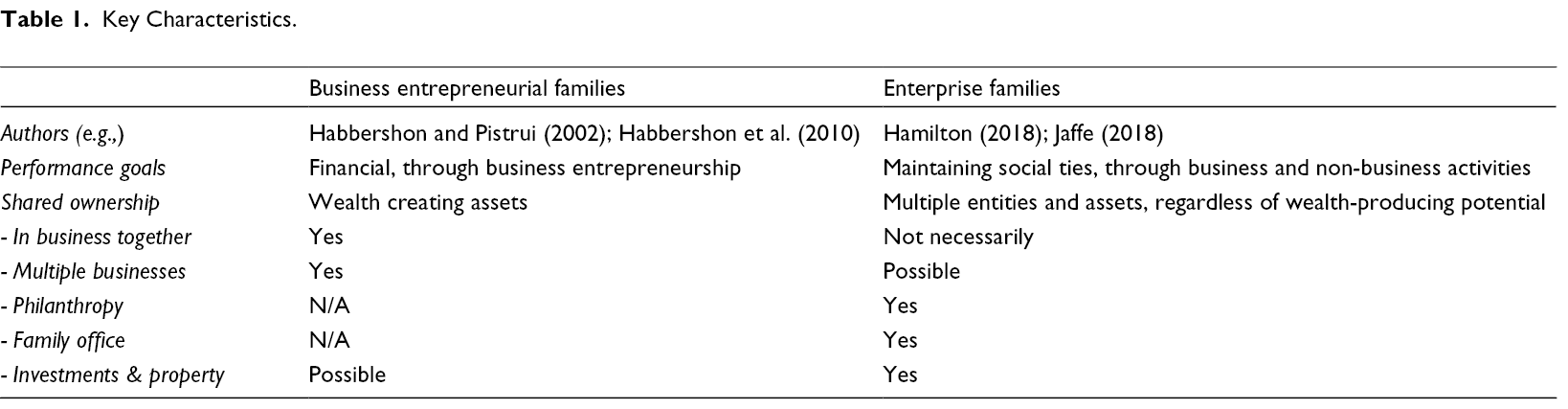
When taking a transgenerational entrepreneurship perspective, as represented by enterprise families, business survival alone is an insufficient measure of value creation by enterprise families across time. To capture long-term value creation the level of analysis should be shifted from family businesses to the families behind the business (Zellweger et al., 2012). That is, one should “follow the money” to the family (Habbershon & Pistrui, 2002, p. 224). The singular focus on business survival means that key dimensions of value creation are neglected. Rather than a focus on the family business, a focus on the family itself is particularly important in transgenerational entrepreneurship as the family enterprise evolves beyond the original business and goes through different stages as new generations become involved.
The ultimate measure of success is the enterprise family’s ability to maintain itself as an ownership group rather than the longevity of a particular business (Zellweger & Kammerlander, 2015; Zellweger et al., 2012). While family business longevity is typically conceptualized at the business level (e.g., in terms of performance), maintaining a transgenerational enterprise family requires the extended family to be intent on pursuing common goals as a group for subsequent generations (e.g., Berent-Braun & Uhlaner, 2012; Suess-Reyes, 2017; Wessel, 2013). As the family is dispersed (in terms of relations, assets, residence) and it has less connection with the founding enterprise, family cohesion decreases and problems of passive ownership arise (Gersick et al., 1997). Passive owners have a greater tendency to see the enterprise as a ‘cash cow’ (Sciascia et al., 2014) and can also be easily taken advantage of by active owners due to family information asymmetries (Siebels & Zu Knyphausen-Aufseß, 2012).
Thus, we explore our research question in the context of wealthy transgenerational enterprise family cousin consortiums because it allows us to consider the role of the family behind the business or portfolio of businesses. Since the concept of an enterprise family captures the entire range of a family’s business and non-business activities, it is better suited to explaining the family’s commitment to transgenerational success. We purposefully focus on enterprise families rather than on family business longevity in order to root our framework firmly in the family rather than the business level of analysis.
Family Social Capital
Social capital is an umbrella concept, covering all the resources that reside within relationships, such as trust, cohesion or shared norms (Kwon & Adler, 2014; Nahapiet & Ghoshal, 1998). According to the literature, these resources facilitate the pursuit of common goals for groups (Adler & Kwon, 2002; Pearson et al., 2008) and better decision making (Mustakallio et al., 2002). Family social capital resources are typically attributed to the kinship ties in the family that are formed from birth and through a common history (Arregle et al., 2007; Herrero, 2018; Zellweger et al., 2019). Extended transgenerational enterprise families with multiple branches and generations (the cousin consortium) have a difficult time building and maintaining social capital and thus require structural support mechanisms to help them do this.
Cousin consortiums are families in the third generation or beyond and represent a dispersed ownership structure of a family enterprise (Gersick et al., 1997). Typically, third-generation families become more dispersed, and family members will no longer be guaranteed to know each other anymore. Social capital in extended kin groups naturally declines, with members exhibiting lower levels of altruism, personalized trust, guaranteed loyalty, and norms of reciprocity (Verver & Koning, 2018; Yu et al., 2020). In a cousin consortium, where within-family relationships are harder to uphold, sustaining the collective will to maintain the family enterprise becomes more difficult. Research suggests that ancestral relations nevertheless retain a certain potency through relatedness in terms of generalized trust and reciprocity (Verver & Koning, 2018). This suggests that transgenerational enterprise families may be able to retain social capital. In such cousin consortium families, the degree of attachment to the business or portfolio of businesses may vary significantly, and some family members may only be involved as investors (Zellweger & Kammerlander, 2015; Zellweger et al., 2012).
In family entrepreneurship research, much attention has been paid to the conceptual properties of social capital (e.g., Arregle et al., 2007; Herrero, 2018; Pearson et al., 2008), its outcomes in terms of performance (e.g., Carr et al., 2011; Herrero & Hughes, 2019), transgenerational orientation (Suess-Reyes, 2017), and intangible resources or family cohesiveness (Salvato & Melin, 2008). Family social capital within the enterprise family is important to support the production and maintenance of unique family resources that allow family members to pursue common goals and develop a shared vision (e.g., Kwon & Adler, 2014; Nahapiet & Ghoshal, 1998; Pearson et al., 2008). However, the general neglect of the family-level of analysis in family business research (Jaskiewicz & Dyer, 2017) means that there is still limited understanding of the family-based origins of social capital. In relation to transgenerational enterprise families, recent studies have highlighted the need for a better understanding of the “black box of within-family relationships (…) and the mechanisms through which norms, values and beliefs are communicated between generations” (Zellweger et al., 2019, p. 211). We address this gap and advance family social capital literature by explaining how transgenerational enterprise families enhance social capital.
Methods
In light of the fact that there is insufficient theory on how enterprise families enhance social capital, we employed an inductive, multiple-case research design (Eisenhardt, 1989). Multiple cases allow the use of replication reasoning, which allows conjectures to be confirmed or dismissed (Yin, 2003). This method typically provides more generalizable, parsimonious and robust theory than single-case research designs (Eisenhardt & Graebner, 2007). Furthermore, our embedded design, in which we use various units of analysis (i.e., the transgenerational enterprise family and its family office), is more likely to generate rich, accurate theory (Yin, 2003).
Research Context and Data Collection
The research setting is enterprise families who have been successful in preserving their enterprise wealth across multiple generations. We focus on enterprise families rooting our framework firmly in the family rather than the business level of analysis. Studying transgenerational enterprise families that have maintained the family enterprise over multiple generations is valuable for several reasons. First, extreme cases, such as successful transgenerational enterprise families, provide insights into the mechanisms and dynamics of our phenomenon of interest (i.e., enhancing family social capital), thus contributing to theory building (Eisenhardt, 1989; Pettigrew, 1990). Second, very little has been written about the highly private but economically important actions and affairs of affluent enterprise family cousin consortiums that are pursuing transgenerational enterprise preservation because gaining access to these families is extremely difficult. Third, transgenerational enterprise families with a family office represent a special case and provide transparency because their financial and non-financial considerations are made visible through the activities of the family office and do not reside solely in the minds of the family members.
We selected our cases on the basis of their “suitability for illuminating and extending relationships and logic among the constructs” (Eisenhardt & Graebner, 2007, p. 27). Data were collected through purposive sampling of multiple cases of successful enterprise family cousin consortiums to elucidate the unusual phenomenon of transgenerational enterprise family preservation over at least four generations. Our criteria included the presence of a family office plus a willingness to grant us interviews with key family member leadership, ideally from different generations, and with those in charge of the family office. The informants in this second group were tasked with managing the wealth and affairs of the family. This further narrowed the selection to the seven transgenerational enterprise families shown in Table 2.
Description of Selected Cases.
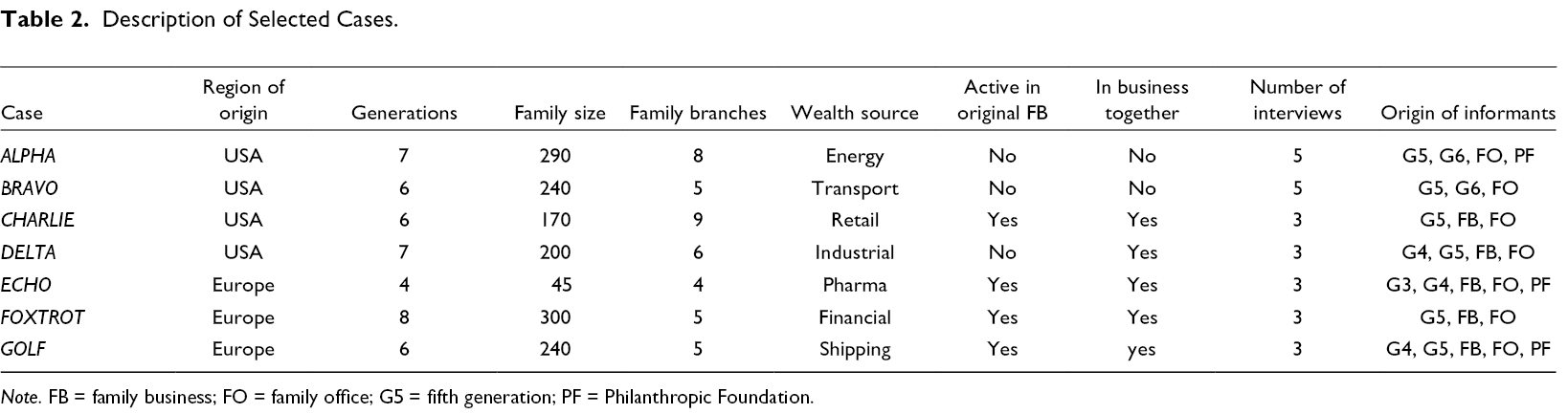
Note. FB = family business; FO = family office; G5 = fifth generation; PF = Philanthropic Foundation.
While the common denominator in the selection of the cases was that the enterprise families maintained shared ownership in the enterprise for more than one hundred years, we purposefully selected as wide a range of cases as we could identify. The enterprise families we studied differ significantly from each other in their characteristics and in how they run their enterprises. Our cases range from ‘novice’ cousin consortiums to ‘expert’ cousin consortiums, as they represent between four and eight generations. Our families have their origins in America and Europe, two industrialized continents with, nevertheless, different institutional environments and cultural contexts. The families in our study range from several dozen to three hundred family members. In some families the family members were living in relative proximity, while in others their progeny had spread to multiple continents around the world. The wealth (i.e., net assets) of the families we analyzed ranged from hundreds of millions to many billions of dollars. Another difference was that not all of the families operated a family business, as two families were not in business; one was focused on impact investing and philanthropy, and the main objective of the other was on preserving the environment and habitat of the vast family estate. Furthermore, the levels of family involvement in the business varied from executive involvement to shareholder participation only. Likely because of this, the family members’ attachment to the business or portfolio of businesses varied significantly. Some enterprise families were living off the annual dividend stream generated by the enterprise, yet others did not distribute the proceeds of the enterprise and reinvested the income.
Gathering data from transgenerational enterprise families and their family offices is difficult (access), intrusive (privacy), and costly (travel). The first author’s 25 years professional experience as strategist, board member, and chief executive officer in the wealth management and ultra-high net worth banking sector enabled him to gain access to successful transgenerational enterprise families via his own network. His position as a researcher and co-chair of a global research institute convinced the informants of his analytical instead of a commercial objective. More importantly, it enabled him to engage with the informants and to evoke open, honest, in-depth responses.
We ascertained that all informants were operating at the core of the family enterprise and had wide and deep understanding of the family dynamics and relationships. We agreed to provide anonymity to all informants and to treat the family information as confidential. In all the cases, the family business (FB) informant is a family member in a controlling position. In the case of enterprises Alpha, Echo and Golf, at least one informant was actively involved with the family philanthropic foundation (PF). In the case of Bravo, Charlie and Delta, the family office (FO) key executive informant was a family member. The 25 interviews were conducted in 15 cities in seven countries, with 22 informants in their late thirties to seventies, half of whom were from the fifth generation of the family (G5). Data collection took place between May 2018 and February 2019 by arranging open-ended semistructured interviews (manual available upon request).
The interviewer asked all the informants a standard set of open questions but kept open the option of exploring particular topics further in order to obtain a richer understanding of the informant’s experience, feelings and knowledge. The primary method for our investigation was one-on-one interviews with the informants, in some cases multiple interviews. The interviews typically ranged from 50 to 100 minutes. All interviews were recorded and transcribed, and observational notes were taken after the meeting. In addition, the first author was provided access to sensitive details and invited to attend family council assemblies, family business meetings, family office meetings, family gatherings and dinners. The roughly 30 hours spent attending family board, office or social gatherings provided further insight into family dynamics and relationships. Use of family archives, including books, private letters, family office documentation and biographies, provided additional background information on each case. We also collected published information and observational data to gain contextual insights, which all helped in interpreting the interviews. Lastly, data from the internet and other public records were used to obtain a broader perspective. The first author also attended several enterprise family conferences in Amsterdam, Chicago, London, and Milan, where various family members exchanged their thoughts on family enterprise developments and wealth preservation.
Data Analysis
Following the guidelines provided by Lincoln et al. (1985), and to reduce the chance of precedent views being projected on to the research material, the authors engaged in comprehensive discussions in which the first author’s knowledge and experience was counterbalanced by the second author’s methodological expertise and an outside perspective. In line with guidance on theory building using multiple cases (Eisenhardt, 1989; Eisenhardt & Graebner, 2007), we employed within-case and cross-case analysis with no a priori hypotheses. To analyze our data, we applied the Gioia methodology, comprising three different levels of abstraction (Gioia et al., 2012). We proceeded in four stages. The first stage involved a thorough reading of the collected material (interview transcripts, field notes, archival data, documentation, and published information) across the seven cases. We wrote down key words and concepts and delved into the social capital literature to understand the emergent themes.
In the second stage, we engaged in open coding of interviews, fragmenting data into specific acts, ideas, or events (Locke, 2003). We searched for portions of text that related to how and why social capital was being enhanced to preserve enterprise wealth. We stayed close to what the informants had told the interviewer and continued to move iteratively between the data and the emerging theory, formulating quotes into first-order codes (ibid). A large number of first-order codes ensued, pointing to relevant factors or mechanisms (e.g., shared purpose; Gioia et al., 2012). We then revisited the data to evaluate the fit of the codes, sometimes leading to a code being revised (e.g., shared property, emotions, legacy) or discarded (e.g., information sharing and conflict avoidance). We then combined some codes to avoid redundancy (e.g., family leadership, family board, family delegates rolled up into family council). We regularly made links between data, both within and across the transgenerational enterprise families (Weiss, 1994) by comparing the separate coding structures and discussing divergence; this was subsequently followed by infrequent recoding of data, which enabled us to establish ratiocinative first-order codes. For instance, quotes around topics such as “representation,” “mandates,” and “inclusion” were recoded to fit the representative bodies’ family council, -committee or generational groups.
In the third stage, we searched for patterns and relationships between and within the first-order categories and the case studies, using second-order coding (Strauss & Corbin, 1998). For example, we summarized first-order codes about family constitution, customs, norms, and informal rules into the second-order code “organizing principles.” We analyzed each case separately with respect to the emergent second-order themes and compared their evaluation across cases. This evaluation of second-order themes fed into the fourth and final stage.
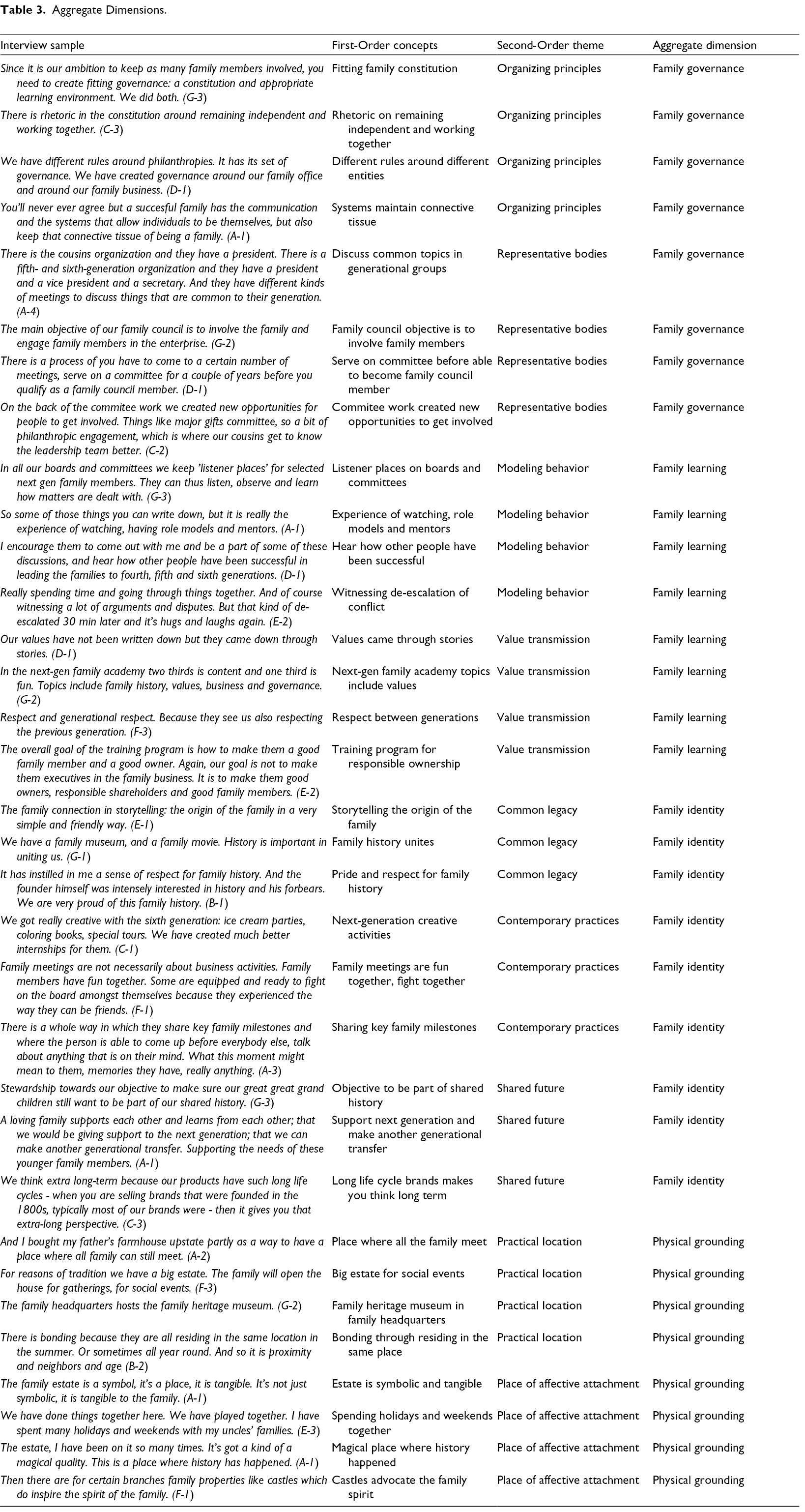
In the fourth stage, we applied the emerging concepts back to our seven cases to determine how enterprise families enhance social capital when striving for transgenerational enterprise preservation. Table 3 shows our process of openly coding and classifying the interview samples into sample codes of a higher aggregate level and the emergent theoretical categories. As further illustration of each theme, we included interview quotes in the tables. The quotes in the tables and text are coded with anonymized interview numbers (e.g., case Alpha, informant 1 = A-1).
Aggregate Dimensions.
Findings
We found several consistent themes showing that enterprise families use various mechanisms to enhance their social capital. For example, family governance helps to create process clarity, while family learning helps in the development of responsible shared ownership. Family identity gives signification to family members, and, lastly, physical grounding provides tangible common experiences. Figure 1 provides a graphic representation of our inductive reasoning process; it shows how we moved from our first-order codes, via second-order themes, to a set of aggregate dimensions that reflect the key factors influencing social capital.
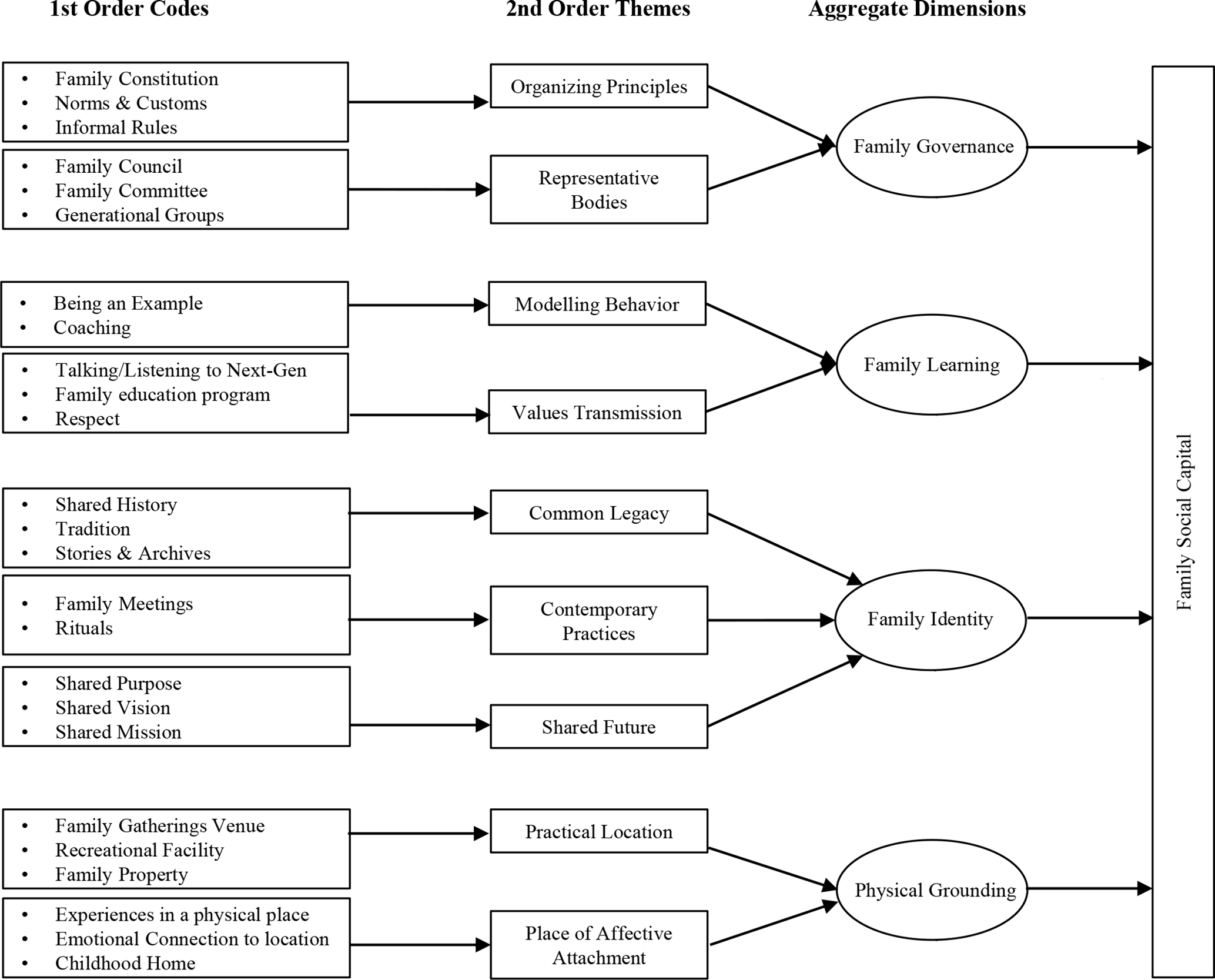
Data structure.
Family Governance
We first describe the family governance mechanisms of transgenerational enterprise families to understand more about why they influence social capital (Table 3). Family governance appears to be a combination of organizing principles, based on informal rules and guidelines, and representative bodies (such as family councils and committees), which are used to coordinate the joint activities of the enterprise family by defining principles and responsibilities as well as by allocating and dividing tasks. The aim is to provide clarity to family members regarding the processes by which the family pursues its collective endeavors.
Organizing Principles
Once the enterprise family reaches a certain size, structures need to be formalized to ensure communication. Informants emphasized the importance of having a family constitution document that outlines fundamental guidelines in a normative manner (Suess-Reyes, 2017). The typical family constitution, that was in use with the enterprise families in our study, included the following key elements 1 : mission, values and guiding principles, governance, communication, family learning, entrepreneurship, remuneration, distribution, succession and exit mechanisms. The family constitution relates to decision making as well as to representation (e.g., family branches or generations) but provides an opportunity for involvement and inclusion if the family members draft it together. As one informant put it:
The family constitution is a very important document for us but mainly because we created it together and it helped us to talk about each of the concepts that are written in there. The most important thing about the constitution is that it has helped us talk about everything. (E-3)
Importantly, there is growing awareness that as many family members as possible should be involved in the drafting of the constitution. Although it may seem hard to reach agreement, the inclusion of family members does create the opportunity for all to stay connected without losing their individuality. When asked why ‘everybody’ needs to be involved, informants talked of “leaving room in the constitution” so that family members are incentivized to connect with one another and cooperate:
We leave room for the cultural aspect, the human aspect; things do not necessarily need to be well defined, because if you define everything, you’ll miss the social interaction. You’ll miss the exchange; you’ll miss the dialogue and the debate. (F-1)
The guiding character of organizing principles became apparent when talking with the informants about the scope of the constitution. The most significant decisions in an enterprise family are not necessarily made by individual leaders but may be driven by ancestral influence. All the families stated that their constitution is revised every few years, but especially around the time of a generational transition. Newer versions will include many components from previous versions. The fifth-generation chairman of a family council clarified how the constitution, which was mainly drafted by his ancestor, still guides the family generations later:
I just don’t think that a big, dispersed group that we have wants to think that somebody is leading them. So, it is easier for me to say “I’m not trying to lead you anywhere. It is our great-grandfather who is leading us. I’m just trying to help us all fulfill his dream and to keep the trains running on time and deal with the issues that have to be dealt with.” (B-1)
We thus introduce the concept of organizing principles in the context of enterprise families and their family governance. We find that organizing principles may enhance interaction and collaboration in these families.
Representative Bodies
Transgenerational enterprise families often set up several entities that perform an internal governance role and help steer the enterprise family toward better and more inclusive behavior. We found the family council, family committee and generational group to be examples of such entities, and each consisted only of family members. One fifth-generation informant described some of the benefits of such entities:
Almost no decisions are made by the whole family because that would imply a kind of hierarchy that we don’t have. Every once in a while, an issue is of such importance from, for instance, a public relations point of view that the family at least discusses the matter. But mostly decisions are made by the entities that have the responsibility for that. (A-2)
Asked about decision making in large families, one informant explained that having roughly 300 family members in five branches across several continents makes it impossible to reach any decision unless there is a formal structure in place:
If you have eight people around the table, or when you have 20 people around the table or 200 people around the table, obviously the process, the decision making process, the communication process, the organization, the definition, the process has to be formalized and has to be defined. (F-3)
Another informant from the same family described the advantage of creating representative bodies in terms of making processes more transparent. Widespread inclusion guarantees that as many ideas and opinions as possible are taken into consideration and ensures that family members are being heard:
The family council is a place where all parties are expressing their points of view and interests. The key is to blend alpha people and beta people, male and female, to blend countries and continents, to blend generations – new and old generations. So, the council is like the yin and the yang. (F-1)
One other observation we could make from talking to these enterprise families was that representative bodies also play an important role in cultivating the rising generation. Inviting younger family members to participate in representative bodies enables them to witness what these entities are about and how they perform their tasks. It also gives the family another opportunity to match potential talent to future positions within the family governance structure. The following informant explains why younger family members, in this case shareholders in the family business, are put to work and to the test:
We try to put the younger members, shareholders, on a committee. See how they do on a committee. So, they learn how to function on a committee and participate on a committee. And if they perform well on the committee and they show up at the meetings, they contribute in a thoughtful way, they produce a work product, then they might chair the committee and be asked to be a board member. (B-2)
So, we present the concept of representative bodies in the context of enterprise families and their family governance. We find that representative bodies may contribute to inclusion and involvement.
Family Governance Enhances Family Social Capital
Family governance mechanisms are set up by the family, voluntarily in nature, and they provide the settings in which interactions can take place (Suess-Reyes, 2017; Sundaramurthy, 2008). These mechanisms play a crucial part in the development of social capital (Ostrom & Ahn, 2003; Schnackenberg & Tomlinson, 2014; Sundaramurthy, 2008). They enable ongoing communication in the family (Suess-Reyes, 2017; Sundaramurthy, 2008), perceptions of process fairness (Sundaramurthy, 2008; Van der Heyden et al., 2005), and relationship building (Mustakallio et al., 2002). In the family business literature, the practices most often referred to are the family constitution (normative outline of family guidelines), family meeting (recurrent gatherings, formal or informal, of family members) and family council (forum of family member representatives; Suess, 2014). Theory suggests that family governance is about procedures and rules that specify different levels of authority (Ranson et al., 1980).
We find various organizing principles, such as the desire to “promote the family’s culture of working together through challenges” and “maintain connections within the family” (A-1). Smart rules, like the non-solicitation rule in the Alpha family constitution that prohibits family members from asking one another for funds to sponsor their personal charities, also help to create process clarity and, in this case, ensure freedom from guilt. We also find that representative bodies are basically assemblies “where cousins get to know each other better” (C-2). These thus prove to be structured avenues for communication and inclusion in the form of intergenerational dialogues, for example, or discussion groups based around people’s interests. In these extended transgenerational families, getting to know each other is a meaningful byproduct that enhances social capital. Transgenerational enterprise families seem to make a concerted effort to include family members in their family governance. As an example, during one of the interviews, we were shown a chart of the Charlie family tree, and all the names on it were of the family members. After practically every name was an asterisk, indicating an active role on one or more boards, committees, or groups.
In other words, family governance can provide process clarity to family members and form a connective tissue, which helps the enterprise family to succeed transgenerationally. This aggregate dimension is more concerned with openness and communication than with determining which particular governance forms will be most efficient. Rather, it is remarkable that these structures exist at all: These are elements by which transgenerational enterprise families strive to enhance their social capital and to achieve a degree of self-organization, which ‘ordinary’ families clearly do not need, and which thus distinguishes them. To summarize:
Family Learning
All our case families recognized the importance of family learning and had decided to establish distinct programs to assist with this. Family learning is founded both on modeling behavior by elder generations being an example and coaching the next generation, and on values transmission through personal engagement and verbal interaction with the rising family members (Table 3). These families make a conscious effort to teach their children to preserve their wealth. It seems their greatest fear is that their offspring might take their wealth for granted and grow up spoiled and arrogant. The family learning dimension refers to the efforts of the family itself to transfer knowledge, skills, and values to the younger generation (e.g., on entrepreneurship, thus not learning acquired at school or university). For example, the Golf ‘family academy’ curriculum included scholarly modules, teaching material and family tutors covering a range of topics, including family values, finance, business, governance, and personal skills development.
Modeling Behavior
The modeling behavior of family members and mentoring are framed as important in the data, particularly regarding older family members counseling younger ones on subjects such as philanthropy or entrepreneurship. Our informants indicated that it is not only the parents’ obligation to educate their descendants, but also the responsibility of other members of the wider family. One informant acknowledged that some issues are better covered outside the parent–child bond, but still within the family:
The family coaching activity is where the existing generation is helping the new generation. Not to be able to take decisions but how the decisions were taken, the style, the culture. And it is something that usually every child learned from his parents but sometimes it is good to have somebody else than your parent telling you things, like an uncle or aunt. (F-1)
This statement is interesting, because it challenges the idea that modeling behavior should be about imitating or replicating. This notion is also contested by other informants who see the focal point of learning as being how to make decisions together, as is corroborated by the personal childhood experience of this fifth-generation family member:
When you are young, coaching can be really helpful to make sure that there is help in working through those different interactions and that you make the right decisions and that you think it through. (C-3)
It appears from the data that these enterprise families model their actions and behaviors on those of their family predecessors. There seems to be a telling exemplary role to be played by older generations. Speaking of his grandfather, and how he was an example for the family and employees alike, this fourth-generation family council chairman explained that the attentive and unassuming disposition that was characteristic of so many family members essentially originated from his grandfather’s behavior:
My grandfather was a man of few words, and when he spoke, people listened. He was always present with his employees. He was never too important. People respected him because he was like everybody else. That always seemed important to me. That is why I said a characteristic of the family is humbleness. (D-2)
We thus introduce the concept of modeling behavior in the context of family learning inside enterprise families. We find that modeling behavior may contribute to a common understanding among family members.
Values Transmission
The importance of values transmission in transgenerational enterprise families became apparent when all cases reflected on the importance of conveying their family’s collective ideals and beliefs across generations. A council leader in a 150-year-old enterprise family, with nine family branches, illustrated the advantage of having shared family values, in light of the inevitable family dilution:
The biology gets cut in half every generation. And the culture can even get morphed by religion. But if you have a powerful founding story, with values that are plain to see, I do think that that can be a bulwark against cultural destruction in later generations. (C-1)
Enterprise families feel strongly about engaging the rising generation, and careful thought goes into how values are communicated and passed on to the next generation. The Echo family informant responsible for the family learning program declared that the youngest generation, the so-called millennials, “do not read any more.” She explained how audiovisual storytelling was used to make the topic of values more tangible for these younger family members.
’Video capsules,’ we call them. Ten-minute videos, and each video is about one of the values of the family; all of the areas. What we create is a repository of information in which we convey particular values and the history of the family to the next generation. (E-2)
Importantly, many informants emphasized the role played by their charitable foundations in values transmission. When those in the rising generation are actively involved in the enterprise family’s charitable work, they are exposed to the family’s values in a way that is both rewarding and informational.
Values are brought to the next generation through the philanthropy. Through the discussions that we have there. (D-2)
Educating and reaching out to the younger generation seemed important to all our case families. The principle aim of making them “good owners and good family members” (E-2) appears to be aligned closely with the universal values of the enterprise families we researched (e.g., honesty, modesty, responsibility, respect, hard work). When talking about shared ownership in an extended family, the following informant emphasized the importance of individual accomplishments within the larger scheme of the family’s ambition:
There will be a twofold purpose for the family education program. One is to get the family together as a family. It is just to create another connection point. So that implies online learning is not enough. And then the other objective is to support family members, again I’ve said that many times, in the goals that the family members wish to achieve individually. (A-3)
So, we present the concept of values transmission in the context of enterprise families and their family learning. We find that values transmission is likely to contribute to common norms.
Family Learning Enhances Social Capital
Our findings indicate that family members place particular emphasis on mentoring younger family members to educate them about the culture of the family and on transmitting family values through interaction. Whereas the relationship between learning and bridging social capital has been explored in literature (Li et al., 2014), the communities of practice framework allows for conceptualizing learning in the context of bonding social capital (Hamilton, 2011). A community of practice is a group of people who share a passion for something they do and learn how to better do it as they interact (Wenger, 2000). Importantly, this literature conceptualizes learning not in terms of the acquisition of ‘hard’ factual knowledge. Rather, learning refers to the acquisition of the social and cultural skills that allow individuals to function as members of a community (Brown & Duguid, 1991). Seen through this lens, learning is based on interaction rather than on top-down acquisition of hard knowledge, and thus it involves the development of common understandings and common norms, as well as of “a shared repertoire of communal resources – language, routines, sensibilities, artefacts, tools, etc.” (Wenger, 2000, p. 227). Learners acquire competence in these implicit cultural aspects of their group through interaction with other community members. This conception of learning is closely related to social capital (Nahapiet & Ghoshal, 1998) and indeed captures the process through which culture is transmitted and social capital enhanced. Thus, the family develops common understandings and common norms through modeling behavior and values transmission.
The transgenerational enterprise families we researched considered it important to engage in values transmission in order to create common norms and shared understanding of what the family is about. It is conceivable from our data that values transmission mitigates the potential for conflict and that a set of common values facilitates collaboration. Really spending time together, being shown how decisions are made, witnessing arguments, disputes, fights and understanding which behaviors are considered appropriate within the family, are all at the core of family learning, and this is particularly true of modeling behavior. This was observed by one of the authors while he was a guest of the Bravo family, during a family meeting at the Bravo office plus dinner at the family’s main residence. Multiple branches and generations from all over the country were actively contributing to the social fabric of the transgenerational enterprise family by sharing viewpoints, listening carefully to each other, and mentoring next-generation family members to do the same, while at the same time weaving family values into their arguments.
In other words, although mentoring requires social capital to be successful, it also strengthens the family social capital. Ultimately our data shows that modeling behavior is associated with the opportunity to be connected and leads to deeper family relationships. These enterprise families seem to demonstrate cross-generational modeling behavior and values transmission in an effort to deal with the potential struggles to collaborate or with the inevitable conflicts. The aim is to enhance family learning and prepare the younger generation for responsible shared ownership. Based on these considerations we develop our second proposition:
Family Identity
Family identity is concerned with individual family members’ perceptions of belonging to the family social group (Ashforth & Mael, 1989). More specifically, it captures a family member’s perception of belonging to an extended family. The dimension is about how family members develop a sense of being part of a unique group through their recollections of a shared past, through undertaking present-day activities together, and through their belief in a common future (Table 3).
Common Legacy
One of the first questions we asked informants in each interview was about their family history. All informants were able to share detailed stories about their common past, including dates, names, places, successes, and failures. It became apparent these families tend to think in generations, not in years. In the following excerpt from a conversation with a Bravo family member, a connection is made between legacy, archival material, stories, and the personal sense of pride in being part of the Bravo family:
We have forbears who were fighting in the revolution and prior to that. And we commissioned the writing of the family genealogy. So, we have a big thick book that traces our roots back to England in the late 1500s and how the family came over to this country in the early 1700s. You had two family members fighting at Bunker Hill, and all those things were important. And then more specifically there is a lot to be proud of about what our founder did in building the company and his foresight and his ethic. So, all those things are part of who we are and there are things that I am proud to be part of. (B-1)
Regarding remembering the past, we found family members preserving old family films, photos and books going back multiple generations. They also treasured the fact that several generations had sat on the board of a family foundation and framed this as an opportunity to be part of the family legacy. One of the interviews was with the Alpha family historian, and several enterprise family museums were visited by the first author. The mere fact that an archive exists, and that a historian is charged with reviewing whether historical documents should be released, suggests a cherishing of the past. This was evident in a statement made by one of our informants:
To us that shared sense of history as family is so powerful. I mean, you have a bond with third cousins. Ninety-nine percent of my friends don’t know a single third cousin but because we are united as family, we are close to our second cousins, our third cousins and different generations. (C-3)
Hence, we explain the concept of common legacy in the context of enterprise families and their identity. We find that common legacy may enhance the sense of historical continuity.
Contemporary Practices
It became clear through our research that rituals and family meetings are popular contemporary practices within transgenerational enterprise families. Although we were unable to observe such family rituals personally, a Foxtrot family informant clearly described a kind of initiation rite for family members on reaching adolescence. This ritual brings the family member into the larger group and provides a jumpstart to ‘full’ membership of the enterprise family:
When a next gen is eighteen, usually there is a little donation, which is done to open an account in the family office. And that is a way for the new member to start entering practically and understanding the system. So, it is an introductory process which is almost a ritual because everybody gives a donation at that moment in time. (F-2)
Family meetings can be formal or informal, but in all cases they are recurring gatherings of enterprise family members at which they have fun together and discuss issues that are relevant to the extended family. Topics could include family business matters (e.g., dividend policy), family constitutional issues (e.g., are unmarried partners “in” or “out” of the family?) or family development (e.g., should we provide financial support for individual family member entrepreneurship?). Having witnessed family meetings of Alpha, Bravo, and Delta, we can relate to the following statement from the Alpha family office senior executive:
Essentially what we do is support family connection, family engagement, family cohesion, and we do that by planning certain events such as the family meetings which have taken place twice a year every year since World War II in some fashion. (A-3)
We thus introduce the concept of contemporary practices in the context of enterprise families and their identity. Practices such as holding regular family meetings and celebratory rituals seem to give a sense of belonging and signification to family members.
Shared Future
Our data suggests that transgenerational enterprise families express a shared future by formulating a common purpose and vision, which is then translated into a shared family mission. An example of a shared vision that is common in our cases is the aim of remaining transgenerational. One informant described this as follows:
It is an obligation to get in one more generation. Well, hopefully many more generations but this was a gift, and by God you better take care of the gift and pass it on in better shape than when you got it. Otherwise, you have failed. (B-2)
Staying together as a family group, not breaking up the wealth and distributing it to different family branches, is regarded as important for these enterprise families. The notion of “family first” (as in placing family interests above the interests of individual members) is apparently a primary purpose. The following fourth-generation family member realized that this message has been disseminated to his generation. If successful, a next generation will preserve the enterprise family transgenerationally:
Whatever the dispute is, regardless of the matter - if it is a matter of business, money, whatever - we will always stay together, and we will always love each other. And I think this is instilled into our generation. And I think that we all believe in that: OK, family first, and sometimes we have to make personal sacrifices for the benefit of the unity and the harmony of the group. (E-2)
So, we present the concept of shared future in the context of enterprise families and their identity. We find that a sense of shared future contributes to a common commitment to maintaining the family group.
Family Identity Enhances Social Capital
In general, the creation of a common identity is critically dependent upon group communication (Suess-Reyes, 2017; Sundaramurthy, 2008). Family identity embeds family members in the transtemporal narrative of the family group and is about a family member’s perception of belonging to an extended family. The notion of family identity draws on a rich literature on the construction of identities. Remembering the past and having a common historical legacy creates signification for an individual in terms of being a member of a group (Hammond et al., 2016; Lowenthal, 2015). Looking to the past creates meaning by situating individuals in a larger historical narrative of the group (Ashworth & Graham, 2016). The purpose of remembrance is to create a bridge between the past and the present (ibid). Storytelling and also traditions are frequent mechanisms by which groups remember and celebrate the past (Fivush et al., 2008; Liu & Hilton, 2005). The belief in a shared future is a defining feature of identities, as is evidenced in the literature. Smith (1992), for example, emphasizes that, in the context of cultural identities, connecting the past to the future serves to create a sense of historical continuity in the group’s existence.
All seven case families were extended families and seem to be highly respected in their communities, regions, or countries. For instance, Foxtrot has five branches of family members, speaking three different languages, and Charlie has nine branches spread around the globe, also speaking multiple languages. In other words, family identity can help to give members of the transgenerational family enterprise a stronger sense of belonging to a distinct group that shares a common legacy, engages in contemporary practices, and believes in a shared future. Family identity may thus lead to “functional closeness,” since “you do not choose your family members to be your friends” (G-2). To summarize:
Physical Grounding
Physical grounding refers to real places or properties that have been in the family for multiple generations and that the family collectively owns. Physical grounding has a practical component, in that these places serve as venues at which the family can meet and enjoy leisure time together; it also has an emotional component, in that family members exhibit an affective attachment to these places or properties (Table 3). Except in the case of Alpha and Bravo, and as far as we were able to ascertain from archival data and conversations, the initial purchase of the estate, place or property seemed disconnected from any physical grounding perspective.
Practical Location
A member of the Bravo family explained in some detail how the family property can be used by families from different generations, branches, or geographical locations. In our research we observed different parts of this family living relatively close to one another, seemingly harmoniously, on a large, wooded estate, where there were multiple family mansions and holiday homes:
The purpose was to provide this property to the family and anybody who’s interested in enjoying it; by being there you had the ability to participate. And participating means leasing a plot, which is allocated according to family branches, and then one would build a home there, pay the dues and then be a part of the heritage. You don’t have to build a home there. I mean, there are enough homes there. I don’t have a home out there… but my parents do, and I feel very connected to the property without having a home. (B-1)
Another family shared ownership of several grounding assets, such as landmark buildings, parks, mansions and also a private family burial ground. However, as one informant explained, the home of the founder was considered the primary property:
So, the House is where the family gathers as a family twice a year. The family is able to use it for recreational purposes. The founder paid for it. He paid for the upkeep; he paid for the grounds, all the staff. It was a costly undertaking, but he did it to keep the family connected. So, during the year they use it as a recreational facility. (A-3)
We thus introduce the concept of practical location in the context of enterprise families and their physical grounding. We find that physical locations may be one of the roots of family connection.
Place of Affective Attachment
Our research revealed that these transgenerational enterprise families have a strong emotional connection to their family properties. Many informants were able to share experiences in a particular place from their childhood, which in itself expressed an affective attachment to place. As one informant recalled:
Geez, I can remember being taught how to swim there and playing golf, and I just loved it as a kid and I want my grandchildren to have the same opportunity and it’s so historic, memories of grandparents and great-grandparents, and etc.,. (A-4)
All three Delta family informants shared a similar story of there being four identical properties on a row, which were built for the use of four siblings directly descended from the founder:
Similar homes were built. This was the 1930s. And they all had the same maple tree in their front yard, and when one got bigger than the rest, she (their grandmother) would go and chop a little piece down so they would all stay similar. I think that place has more meaning for me than that next jump to a much larger estate where my grandfather went thereafter. (D-1)
Another informant spoke with great happiness about his childhood memories visiting the family camp. He referred to this annual family holiday, a tradition which continues, as being a sort of ceremony that brings all the family together:
The family co-owns a kind of a summer fishing camp. And has run that for 60 years or so. And that is a ritualistic summer holiday retreat area that brings all the family together. (C-3)
So, we present the concept of place of affective attachment in the context of enterprise families and their physical grounding. We find that places of affective attachment can become a strong symbol of the family collective.
Physical Grounding Enhances Social Capital
In general, attachment to place has its roots in attachment theory, which stems from psychology and refers to the positive emotional connection of the individual to a particular place (Hildago & Hernandez, 2001). A place can represent an individual’s personal history (Scannell & Gifford, 2010) and can serve as a physical embodiment of the essence of important occurrences (Twigger-Ross & Uzzell, 1996). The affective bond to place thus stems from memory, as well as permanence resulting in an emotional investment in places (Giuliani, 2003). Places associated with positive childhood memories are particularly potent in this respect (ibid). Similarly, places associated with recreation and escape tend to evoke positive affective associations (Patten & Williams, 2008). In the specific context of our analysis, physical grounding thus connects and provides the family with an asset that is potent in creating non-business-related (purely social, exclusively interpersonal) shared experiences, and in its positive resonance with leisure, childhood, and endurance. Our cases reveal whole extended families that experience the physical grounding asset as a place of affective attachment, which brings family members together through shared memories and emotional connections to that place. This is in addition to the functional benefits of holding social gatherings and the recreational use of the physical grounding asset and, in one case, providing the opportunity for the extended family to live close to each other.
Transgenerational enterprise families make a conscious decision and effort to maintain the key family property, which proves to serve a practical purpose as well as being a place of affective attachment for them. It seems likely that this family asset acquired its physical grounding status over time. In the Bravo case, however, the authors had access to a letter written by the founder at the beginning of the last century, instructing the generations to come never to sell the estate but to maintain it for the benefit of the entire family. Not surprisingly, all the Bravo informants mentioned their estate as one of the most important factors in keeping the family together. Such collective responsibilities create an opportunity for “working together” (A-1) and for “mutual learning” (B-3).
In other words, physical grounding relates to family places in which shared experiences occur and which then become tangible symbols of those common experiences. Attachment occurs not because of the place itself but because of the meaningfulness of the interactions that take place at the family property. Over the decades, and in transgenerational enterprise families, the family place becomes a symbolic physical manifestation of the family experiences and relationships. We therefore derive the following proposition:
Overall, our findings suggest that family governance can provide process clarity and may form connective tissue between transgenerational enterprise family members; that family learning can prepare these family members for responsible ownership; that family identity can give signification to family members by enabling them to recognize a common legacy; and that physical grounding can lead to tangible common experiences among family members. We identified these four aggregate dimensions that can enhance family social capital, and our conceptual framework provides a novel perspective on the origins of enterprise family social capital.
Discussion
This study contributes to transgenerational entrepreneurship research by uncovering how wealthy enterprise family cousin consortiums enhance their family social capital. While it is recognized that social capital erodes in cousin consortiums (Mustakallio et al., 2002; Sorenson, 2011; Yu et al., 2020), we lacked understanding of how transgenerational enterprise families prevent this erosion of social capital.
Social capital is important in entrepreneurship literature, and previous research demonstrating various outcomes of family social capital abounds. For instance, social capital helps to generate entrepreneurial teams based on a commitment to the family (Discua Cruz et al., 2013), to gain access to family networks (Sorenson, 2011), to enable entrepreneurial learning (Hamilton, 2011), and to enable the transfer of entrepreneurial legacies (Clinton et al., 2020). If legacies transmit entrepreneurial risk-taking behaviors in later generations, they do not inherently denote a change-resistant, inflexible, path-dependent family culture (ibid). Over time, social capital becomes more valuable to draw on as strong ties gain in value in older family firms (Gudmunson & Danes, 2013).
Our study contributes to entrepreneurship research by complementing this rich body of research on the consequences of family social capital with insights into the drivers of family social capital in the context of enterprise families, a topic largely overlooked in previous research (Breton-Miller & Miller, 2018). We make several theoretical and practical contributions uncovering mechanisms that help cousins consortiums enhance their family social capital. Our qualitative study of seven old and large enterprise families has allowed us to identify family governance, family learning, family identity, and physical grounding and to conceptualize the ways in which these mechanisms enhance family social capital.
Theoretical Implications
This study has three main theoretical implications. First and foremost, we contribute to the social capital literature by opening the black box of relationships in transgenerational enterprise families. We thus respond to the call for further research on how such families form, manage and maintain their social relationships (Zellweger et al., 2019). From our data it emerges that the main driving factors in keeping the family together appear to be collective experiences, which frame the family as a group that is about more than the money itself: “being part of something larger than yourself” (A-1). These can revolve around a common experience of places, a common interest in philanthropic endeavors through various organizations, the opportunity for individuals to be involved in governing a family organization, the common experience of being associated with a name (‘brand’), or the shared experience of traditions and rituals.
In all four of our aggregate dimensions, social capital emerged through concrete mechanisms. In line with the growing conceptual literature on family legacies we find, for example, that objects attain meaning through the social interactions in which they play a part (Hammond et al., 2016). In the context of transgenerational enterprise families, our analysis suggests, however, that legacy objects are particularly potent for creating shared meanings if they serve as a bridge between the past and the present (Ashworth & Graham, 2016). Physical grounding was framed as a key element in transgenerational families, and we found that places owned by the family constituted shared symbols of pride and tangible symbols of a family’s historical legacy. Family estates also functioned as practical meeting places. In this sense, legacy objects constitute both shared symbols of the past while also providing opportunities to participate in activities that will preserve or add to that legacy.
Studies have shown that stories serve as a vehicle for passing on entrepreneurial legacies (Jaskiewicz et al., 2014) and imprinting organizational paths (Kammerlander et al., 2015). We found that they played an important role in transmitting family identity by creating a sense of historical pride. Similarly, they also captured family values (Parada & Viladás, 2010). These values were further transmitted and negotiated by working together on the family constitution (family governance), which allowed families to have a dialogue and develop shared meanings (Habbershon & Astrachan, 1997). Lastly, social capital was enhanced through role modeling (learning dimension) aimed not at telling the younger generation what to do but how to do it in keeping with the family’s culture. We find empirical support for the argument that family members play an important role in educating the younger generation (Breton-Miller & Miller, 2015), both in terms of cultural transmission and of developing personal skills. Family governance such as committees serve not only as organizing devices but also as a way to teach young family members how to function within the family enterprise system.
Second, we find social capital can be developed outside the family business. We expand the discussion to enterprise families and identify other ways in which these families can enhance social capital that are not connected to the business. A family business brings a sense of purpose to the family, but notably a family’s philanthropic activities, for instance, serve a similar function (Feliu & Botero, 2016). The business longevity literature has focused to a very large extent on the firm as the unit of analysis. We advance the dialogue that recommends shifting the unit of analysis to the family behind these enterprises (Zellweger et al., 2012) and more recently the call to distinguish between different types of families (Jaskiewicz & Dyer, 2017; Zellweger et al., 2019). While we concur with the view that this would help capture the multitude of business activities in later-generation families, we suggest broadening the scope to enterprise families to include families of impact that may share interests in businesses, but also in significant assets, philanthropy or perhaps a family office (Wessel, 2013).
In many cases, but not all, it seems that wealth creation through entrepreneurial business venturing is important to sustain wealth (Habbershon & Pistrui, 2002). Nonetheless, one cannot expect the majority of family members to enter the family business, or even to care about it, and to thus share a sense of purpose by pursuing a career or taking on a governing role in that business or businesses. However, we show examples of enterprise families (Alpha and Bravo) that have not been in business together for decades but have nevertheless preserved (and even increased) the family enterprise consisting of other assets. Studying transgenerational enterprise families adds to our understanding of the drivers of social capital as a resource to maintain the family enterprise. More ‘regular’ family firms may engage in similar activities outside of the business to improve the functioning of the family group in support of the family business.
A third theoretical contribution of our study is that it advances understanding of how family governance affects social capital. Family governance is a concept that includes the facilitation of social interaction, communication, involvement and conflict mitigation (Suess, 2014) and an increase in social interactions between family members, leading to higher levels of shared vision (Mustakallio et al., 2002). Our study confirms that family governance is better understood as a communication system (Suess-Reyes, 2017; Sundaramurthy, 2008) rather than a decision making and organizing device (Brenes et al., 2011). Family governance provides a formal structure within which interaction takes place.
Rules are not enough in themselves; they will only work effectively if individuals learn how to use them and ensure that they are understood and accepted by all. Family learning supports this through modeling behavior and values transmission, which is not an automatic process but requires trust and the will to listen to each other (Breton-Miller & Miller, 2015). Stability over time and repeated interaction with regard to the development of trust (Ostrom & Ahn, 2003) can be established by using family governance such as representative bodies and their meetings, plus organizing principles that provide informal rules for assemblies. Family governance mechanisms assist this process; they boost trust both by creating rules and enabling family members to get to know each other better (Sundaramurthy, 2008; Van der Heyden et al., 2005), thus reducing the potential for conflict. In sum, family governance enhances social capital by increasing the predictability of behavior for the future. While rules do not eliminate the possibility of defection, they nevertheless provide a certain level of security to individuals.
Limitations and Future Research
Our study’s findings need to be considered in light of several limitations. Additionally, our findings give rise to multiple important future research directions. First, one limitation of the study is the generalizability of its findings, a limitation commonly associated with qualitative work. While we included a diverse set of cases in terms of age, size, and involvement in family businesses, we encourage scholars to engage in quantitative testing of these propositions. This would allow their generalizability to be confirmed in other geographical or cultural contexts (Eze et al., 2021). Similarly, future family social capital research may explore different enterprise ownership configurations (Nordqvist et al., 2014) since differences in ownership structure between family enterprises can affect how members relate to one another. In addition, future research can try to uncover the role of the family office in stimulating the mechanisms we uncovered in this study. Since the family office manages the affairs of the family, a better understanding of the specific ways in which it can affect family social capital would advance understanding of family functionality and help generalize the applicability of our findings.
Second, much valuable research has been conducted on various facets of social capital. Social capital theory has maintained that while it provides benefits for individual actors, social capital also has some dark sides (e.g., Chirico & Nordqvist, 2010; Herrero & Hughes, 2019; Kidwell et al., 2018; Portes, 1998). It is conceivable that certain traditional family values and principles may limit choices and reduce flexibility for enterprise family members. Furthermore, family governance can be a double-edged sword for enterprise families. For example, centralized mechanisms can increase efficiency but also can create politics and power struggles (Andrews, 2010). We thus encourage future scholars to research the dark side of enterprise family social capital in line with research on the content of family stories as sources of normative legitimacy (Kammerlander et al., 2015) and on imprinting negative cultural practices (Kidwell et al., 2018). This line of future research may investigate the content of family governance mechanisms, such as the family constitution, on its normative and structural effects on social capital.
Third, our analysis illustrates that the past can function as a resource that an actor can draw on to create a sense of legitimacy in the present and of purpose for the future (Suddaby & Jaskiewicz, 2020). This finding conflicts with research that positions traditions as constraints on adaptability and change (Chirico & Nordqvist, 2010) and views the ‘old’ with suspicion and change inherently as progress (Dacin et al., 2019). We have not addressed the conditions under which stories and traditions function as a resource for or a constraint on enterprise preservation. In line with recent calls (Suddaby & Jaskiewicz, 2020), we invite scholars to study how enterprise family history generates congruity between tradition and change (Dacin et al., 2019).
Fourth, our study demonstrates the importance of family councils and committees. The mechanisms of how enterprise families appoint or elect members to these boards would define a metadynamic revealing how the various branches of enterprise families engage in decision making. Our data points toward variance concerning this issue between the different family enterprises (e.g., informal consultation or formal structure, voting versus consensus, ownership or equal representation). Family governance mechanisms are related to improved decision making and commitment in enterprise families (Mustakallio et al., 2002), and they influence decision premises as well (Suess-Reyes, 2017). Similarly, older families tend to have a more participatory structure, while younger families are more centralized (Suess, 2014). Yet we know little about the inception of family-level decision-making modalities and their adaptation over time (Parada et al., 2020). Future research could address the question of how enterprise families comprise family boards and committees, enhancing the understanding of how the families behind the enterprises decide how to decide.
Fifth, families aim to prevent dissolution of the enterprise and preserve their business for the longer term through intra-family teams and entrepreneurship (Discua Cruz et al., 2013). In our cases, we found diverse examples of regenerating entrepreneurial leadership among enterprise family members—for instance, by including entrepreneurship as a guiding principle in the constitution, by making it part of the family learning program, or by entrepreneurial mentoring and committees. Future research might examine how family governance enhances family learning of entrepreneurship and in what way these mechanisms contribute to family enterprise success.
Sixth, we find similarities between wealthy enterprise family cousin consortiums in terms of the mechanisms used to enhance social capital. Institutional theory posits why institutions and organizations tend to become increasingly alike and form organizational fields through mimetic, normative, and coercive forces (DiMaggio & Powell, 1983). By applying institutional theory, future studies could research how these families, with vastly differing situational, familial, and cultural contexts, have solved problems related to the decay of social capital.
Practical Implications
Our study has several practical implications for enterprise families that strive for transgenerational wealth. Holding the family, the assets, and the enterprises together and under family control is an underlying objective for many families that are or have been in business together. Our research identifies four key ways in which families can shape or enhance their family social capital. First, they can develop and maintain family governance that provides process clarity to family members by defining a shared set of organizing principles and they can set up representative bodies. Second, by focusing on family learning they can prepare family members for responsible shared ownership, using modeling behavior and transmission of values. Third, nurturing family identity can be used to give meaning to family members, and this can be done by emphasizing the sharing of a common legacy, participation in current practices, and a commitment to a shared future. Finally, they should also recognize the importance of physical grounding, where particular family locations provide tangible shared experiences for family members by being used both for practical purposes and as places that elicit an affective attachment. Thus, our study contributes to the understanding of how families can mobilize social capital using diverse relational mechanisms.
This study advances understanding of how social capital is enhanced in transgenerational enterprise families by uncovering four underlying mechanisms. We hope that our study and contributions to transgenerational entrepreneurship literature will set the stage for further focused conversation on the provenance of family social capital.
Footnotes
Declaration of Conflicting Interests
The author(s) declared no potential conflicts of interest with respect to the research, authorship, and/or publication of this article.
Funding
The author(s) received no financial support for the research, authorship, and/or publication of this article.
