




Abstract
This paper launches a discussion for using privilege to understand migrant self-employment. Migrants are a heterogeneous and complex group, yet migrant self-employment studies have not yet considered how privilege provides opportunities or gains. Using mixed-methods this paper explores the role of privilege in migrant self-employment. Life course histories are combined with full-population register data to understand migrant self-employment and to provide a sense of privilege in process. Findings reveal theoretically and empirically how privilege shapes self-employment for women migrants in Sweden with certain groups benefitting more from privilege.
Migrant self-employment is a growing topic of interest, especially in countries, like Sweden, that are experiencing rapid in-migration and relatively low levels of migrant labor market integration. Self-employment may offer a pathway for migrants to participate in and contribute to the local economy. With recognition of increasing heterogeneity in migration patterns, the role of privilege is, of late, increasingly a topic of interest in migration studies (Benson, 2014; Leonard & Walsh, 2019; Lundström, 2014; Oommen, 2019). At the same time, the scholarship on migrant entrepreneurship has called for a deeper examination of migrants’ social positionality particularly within the context of gender and ethnicity (Cederberg & Villares-Varela, 2019; Ram et al., 2017; Valdez, 2016). Merluzzi and Burt (2020) identify women entrepreneurs as a highly heterogeneous group and call for deeper study into the diverse factors shaping women’s entrepreneurship. Despite these parallel bodies of work, privilege still has not been explicitly explored within the self-employment literature.
Privilege is commonly defined as unearned and accrued structural benefits ascribed to both groups and individuals (Jensen, 2005). We define privilege, when applied to the migration context, as structural advantages emerging and produced through individual characteristics (gender, social class, and racialization) with and from inter- and intra-group power relations based on structures (characteristics associated with country of origin such as level of development, cultural nearness to the country of destination, and language). Processes of privilege shape social and economic structures; and thus building on the foundation of privilege, we define privilege in the self-employment context as the opportunities and gains arising from asymmetrical power relations in society. By bridging migration, privilege and self-employment, we offer nuanced insights into how women enact, enforce, and engage with privilege in their position of self-employed migrant women.
Crenshaw (1989) and Collins (2000) show the intersections between social meanings and individual experience providing a theoretical foundation for understanding social systems of domination and oppression, with privilege closely aligned with processes of domination. Using this framework, social categories can be understood in combination and in relation to systems of power at both the individual and social group level (Settles, 2006). Although the entrepreneurship literature has not embraced privilege yet, the role of social capital has been firmly established to give insights to inequalities in gender and ethnic entrepreneurship. Social capital is a concept from economic sociology (Farr, 2004) while privilege originates from black feminism (Scarborough & Risman, 2020). Subsequently social capital focuses on invested and embedded resources with expected returns, such as education or training (Lin, 2000) whereas privilege conceptualizes power relations which may be identified through opportunities or obstacles. Privilege and social capital perspectives certainly converge, nevertheless with the concepts rooted in different theoretical traditions, they provide unique insights to the complex social conditions self-employed migrant women face. With privilege’s emphasis on the interplay of power and social relations shaping economic practices, it may initiate further explanations for the social conditions shaping entrepreneurship, for instance the relationships between native and migrant, the role of opportunities, or gaps between formal and informal institutions (Li et al., 2018; Linder et al., 2020; Webb et al., 2020).
All self-employed migrants, especially women, experience challenges and obstacles in establishing their businesses in Sweden. However, unevenness and inequality between migrant groups in the participation in the labor market, and in the mobilization of skills, resources and networks reveals complexities in self-employment. As various studies have shown, the rate of self-employment differs widely among migrant groups (for Sweden Andersson & Wadensjö, 2004; Ohlsson et al., 2012) with gender, country of birth and migrant status being the critical indicators for creating a successful business (Berglund et al., 2013; Bourne & Calás, 2013; Haandrikman & Webster, 2020; Kushnirovich, 2009; Pijpers & Maas, 2014; Rioux, 2015; Roy et al., 2014). Some self-employed migrant groups may possess more privilege, but these groups have remained understudied. Valdez (2016) has called for the migrant entrepreneurship literature to challenge the homogenous characterization of self-employed migrants. Exploring privilege within migrant women’s self-employment addresses these gaps while revealing the diversity of migrant women’s experiences as they integrate and participate in the labor market and, importantly may suggest why underprivileged groups might be having difficulties accessing similar resources. Our aim is to explore the role of privilege in migrant women’s self-employment. Following a feminist economics framework (Agenjo-Calderón & Gálvez-Muñoz, 2019; Spierings, 2012; Strassmann, 2008), we utilize quantitative and qualitative methods to robustly expose from both positivist and interpretivist approaches the complexity of privilege in migrant self-employment in the Swedish context. We ask: How does privilege play a role for migrant women in becoming and being self-employed? 1
By launching a discussion of privilege in the self-employment context, this paper makes the following contributions to the literature. First, we explicitly explore the role that privilege plays in self-employment and thus we initiate further ways to explore the manifestation of inequalities in heterogeneous groups. Second, we use mixed methods to assess the role of privilege in the analysis of processes of social inequalities in self-employment by showing the outcomes of power arrangements. These mixed methods show the correspondence between complex understandings of social categories and patterns of privilege in self-employment. This consists of a quantitative explanatory analysis of the role of privilege in self-employment using unique Swedish full-population register data, as well as qualitative explorations using economic life story interviews with 15 migrant women. By using both methods, we can expose how privilege is found and (re)produced within self-employment patterns. Third, we examine the role of privilege in becoming and being self-employed by including all migrant entrepreneurs in the quantitative analysis and focusing on women with privilege in the qualitative analyses. This allows us to explore in which ways privilege underlies opportunities and obstacles in self-employment. Finally, we empirically explore the complexity of privilege in self-employment by highlighting the ways in which privilege is negotiated, changes over time and experienced differently within privileged groups.
Understanding Privilege and Migration
Privilege, or ‘the breeze on one’s back’ (Kimmel, 2014), denotes the ways in which systems of power and inclusion eases an individual’s life course and, for the privileged, is largely unrecognized (Bonds & Inwood, 2016; McIntosh, 2016). Privilege is the cumulative advantages garnered from normative belonging to social structures of power systems based on practices of inclusion and exclusion. These advantages are unearned as the benefits largely relate to specific forms of domination built in context, namely time and place of a specific social structure (Jensen, 2005). Privilege results from the interplay between conforming normativities of an individual (internal) with social structures (external)—racialization, gender, sexuality, abilities, country of origin, and so forth—to dominant norm systems (Kimmel, 2014; McIntosh, 2016). For example, dominant norms such as heterosexuality, are deeply embedded into systems of advantage rendering many identities invisible in dominant social practices. Conversely, discrimination relates to disadvantages placed upon people for belonging to non-normative identities. Possessing privilege means belonging within systems of power resulting in opportunities or gains. Making privilege visible, by uncovering systems of inclusion, is necessary to understand how inequalities and unevenness in society is produced (Kimmel, 2014).
Crenshaw (1989, 1991) in her ground-breaking works on intersectionality laid out the theoretical foundations to understand systems of advantage and disadvantage. To understand these processes, greater attention to the intersection of social identities is needed to uncover the interplay between individuals’ social identities or positions and the arrangement of power in society. Conforming or dominating normative identities, in particular whiteness and maleness, are normalized, or made invisible, into systems of power that are both explicit and implicit. Thus, identities shape everyday life, as individuals “do” and “have” identities such as racialization, gender, class, and sexuality that serve as markers of advantage or disadvantage. In Sweden, perceptions of immigrants are linked to privileged practices including avoidance or exclusion of non-conforming normative identities. Svensson (2019) finds privilege may be produced through sets of practices and these are performed differently by various class groups. Accordingly, systems of inclusion and exclusion vary and are mutually constructed by social groups. Self-employed women are positioned within systems of oppression and domination based on their own individual characteristics and the meanings attached to these social groups. As some group belongings garner more significance from attached meanings, privilege may be unevenly conferred on individuals with some identities outweighing, muting, or reducing benefits (Coston & Kimmel, 2012). Privilege, while largely unrecognized by dominant groups, results in social inequalities and power relations (Kimmel, 2014; Reeves, 2017).
When privilege is considered with migration a further tension is introduced to characteristics such as class, racialization and gender; as privilege is also found in the benefits given to social groups by the meanings attached to global hierarchies (Benson, 2019). Migrant is a form of “other” (Weiss, 2005) and migrants are a heterogeneous group and so have unequal experiences despite sharing the common category of “migrant.” Kunz (2016) points out the persistent categorization of global elite migrants as expatriates often coincides with other dominant norms. This differentiation between migrant and expatriate demonstrates the alignment of privilege and social groups with conforming norms (Kunz, 2018; Woube, 2014). It becomes useful, then, to understand privilege, not as a relative definition, but as a site of negotiating intersecting identities (Benson, 2019; Leonard & Walsh, 2019). This view of privilege aligns with Valentine (2007) and Anthias (2008) who argue that intersectional identities change across space and time. Examining privilege between migrant groups challenges the idea of homogenous forms of privilege and advances thinking on the complex role of intersectional identities in specific structures and processes, such as self-employment.
Gender, racialization, language, migration status, and other transnational positioning are known to steer self-employment but still require deeper exploration in specific contexts (Hechavarría et al., 2018; Li et al., 2018; Schmutzler et al., 2019; Webb et al., 2020). Racialization is the process of “attributing racial meaning to people’s identity and, in particular, as they relate to social structures and institutional systems” (Yee, 2008, p. 1111) and is used to explore “ongoing practices that attach racial meanings to people” (Gonzalez-Sobrino & Goss, 2019). While Sweden is a diverse and multicultural country, normative forms of belonging are often tied to whiteness (Hübinette & Lundström, 2014; Hübinette et al., 2012; Lundström & Twine, 2011). Pred (2000) highlights the ways racism and racialization are locally produced and in particular to the Swedish context, racialization is constructed by meanings attached to groups shaped from local and global processes. Further, racialization processes in Sweden, argue Mulinari and Neergaard (2017), are deeply tied to exclusionary and exploitative practices of migrants and are often found in what Hervik (2019) calls habitual whiteness. Whiteness is something produced, learned and maintained through social practices (Ferber, 2014; Lipsitz, 2011) and as demonstrated by Crenshaw (1989) and Collins (2000) understanding the role of privilege is key to studying systems of domination. Migrants fitting to positively associated, or inclusionary, categories such as being highly educated, English speaking, male and/or heterosexual may experience little transformation or even gain in their social capital and/or social status with migration (Kunz, 2016; Lundström, 2014). However, scant attention has been paid to these processes in more privileged groups.
Current research on migrant labor market integration in Sweden, and in other Western contexts, generally leaves privilege out of analysis; departing from the assumption that privileged migrants, due to their various forms of social belonging, integrate with minimal difficulties (Holbrow, 2018; Kunz, 2016). A recent study showed Swedes with African heritage experience ongoing discrimination in the Swedish labor market (Wolgast et al., 2018) while other minorities face substantial discrimination in hiring processes in Sweden (Quillian et al., 2019).
Excluding privilege in analyses of labor market integration processes is problematic; firstly, it ignores experiences of many migrants and secondly, it renders invisible the production of inequalities (Dryer, 2016). Given the importance of intersectional categories in self-employment practices, we initiate the discussion of the role privilege may play in women’s migrant self-employment in Sweden. Prior to doing so, the next section outlines findings of previous studies and identifies knowledge gaps on migrant self-employment relating to women, migrant women, and ethnic differences in self-employment.
Migrant Self-Employment: Stylized Facts and Knowledge Gaps
Migrants’ motivations for entering self-employment remains contested in the literature. Migrant self-employment is often viewed as a result of being locked out from local labor markets (Ensign & Robinson, 2011, Verduijn et al., 2014) or as a way to enter these markets (Baycan-Levent & Nijkamp, 2009; Lo, 2016; Stam, 2009). In Europe, non-European migrants have relatively low employment rates, which has been attributed to changes in the labor market, an education and skill mismatch, lacking native language skills, discrimination and lacking access to native networks. In addition, migrants’ human capital tends to be devaluated by employers, especially for non-western migrants, which further decreases their entrance to the labor market (Chiswick, 1978; Kanas et al., 2009; Light, 1984; Tibajev & Hellgren, 2019). A range of studies show that discrimination is one of the chief motives behind immigrant self-employment in Sweden (e.g., Hammarstedt, 2001; Khosravi, 1999). In general, educational attainment, age, family status, and the availability of capital and job-related characteristics are important in explaining differences in self-employment among migrant groups. Migrant women are also more often self-employed when their male partner is also self-employed (Wang, 2009; Webster & Haandrikman, 2017). Studies show gender, ethnicity, and migration status shape start-up patterns and income from self-employment (Abbasian & Yazdanfar, 2013; Berglund et al., 2013; Bourne & Calás, 2013; Kushnirovich, 2009; Pijpers & Maas, 2014; Rioux, 2015; Roy et al., 2014).
Fairlie and Meyer (1996) documented substantial ethnic and racial differences in self-employment for both men and women in the United States. In the European context, self-employment rates are particularly high among non-Western immigrants, especially among Asian migrants (Andersson and Wadensjö (2004) and Andersson et al. (2013) for Sweden; Blume et al. (2009) for migrant men in Denmark; Clark and Drinkwater (2009) for migrant men in the UK). Migrants in Sweden are more likely to be self-employed than natives, and the share of self-employed among migrant women is higher than among native women, with the rate of self-employment differing widely among migrant groups (Andersson & Wadensjö, 2004; Ohlsson et al., 2012; Statistics Sweden, 2015).
Most studies that have examined the association between country of birth and self-employment in host countries are economic in nature, and they show mixed results. Oyelere and Belton (2012) found that migrants from developed countries have higher self-employment rates in the United States, regardless of migrant status. They explain this by the degree of the development in the origin country of the migrants, assuming similar countries share similar economic institutions, therefore creating easier transitions to self-employment in the United States; however, without providing a theoretical justification for this. Maniyalath and Narendran (2016), though not accounting for individual-level variables, find that the human development index is a good predictor for female self-employment, using crude data on 61 countries. Ohlsson et al. (2012) examined effects of country of birth on self-employment in Sweden and found that 10% of female variation in individual differences in self-employment among migrants in Sweden, for the year 2007, may be attributed to country of birth. They assessed that country of birth plays a minor role in self-employment, and that individual factors are decisive. However, they examined individual country groups, without specifying what these countries might have in common that may affect self-employment. Migrants have a higher likelihood to be self-employed when they originate from countries with high rates of entrepreneurship (Clark & Drinkwater, 2000; Light, 1984; Yuengert, 1995). However, when investigating the relationship between home and host country rates of entrepreneurship for Sweden, studies find weak or no support (Hammarstedt & Shukur, 2009; Tibajev, 2019). One reason for this may be that most studies use country of birth aggregated to continents. Such studies are partly based on the idea of ethnic or cultural traditions of entrepreneurship (Fairlie & Meyer, 1996; Light, 1984), without making explicit which structural factors may connect countries, that may influence host country self-employment.
Studies using the concept of mixed embeddedness have suggested that economic, legal, and institutional barriers may hinder certain migrant groups from entering self-employment (Kloosterman, 2010). Such barriers may lead to the exclusion of certain groups from supports, networks, or bank loans. Networks have long been identified in entrepreneurship studies as key to business survival (Aldrich & Zimmer, 1986; Burt & Opper, 2020). Often it is concluded that who becomes self-employed is the result of unobservable factors, such as discrimination and differential access to financial capital (Andersson et al., 2013). Our study intends to further our knowledge on the mechanisms behind (opportunities or obstacles to) access to self-employment, by adding the privilege perspective. Privilege within the migration context, as defined in the introduction, is based on structural characteristics of the home country as well as individual characteristics, and in that sense can either give advantages or disadvantages to migrants starting and developing their businesses.
Many studies focus on men only (such as Blume et al., 2009; Clark & Drinkwater, 2009; Constant & Zimmermann, 2006), which is either not discussed or, for instance, explained by higher self-employment for men, or by Clark and Drinkwater (2009, p. 164) as “there are unresolved issues concerning definitions of women’s self-employment, particularly within family businesses.” Migrant women entrepreneurs find themselves doubly excluded from structures because of their gender and migrant status (Aygören, 2015; Webster & Haandrikman, 2017). Recent studies examining self-employed migrants’ local embeddedness demonstrates access to local knowledge and resources as challenging or even exclusionary (Evansluong, 2016; Munkejord, 2017). Moreover, access and use of different resources by entrepreneurs are increasingly understood as contextual and subjective (Hedberg & Pettersson, 2012; Linder et al., 2020). Attention to women’s categorization and social experience is also growing in self-employment studies. Ladge et al. (2019) argue that women’s socialization and gender norms may contribute to failures in business. Women’s self-employment practices generally remain under-theorized and positioned as the same or as subordinate to men’s self-employment (Henry et al., 2016; Shinnar et al., 2012). Thus, a normalized “neutrality” of who is self-employed is taken for granted in the literature replicating structural racism and sexism (Ensign & Woods, 2016; Knight, 2013; Stead, 2017). Migrant self-employment remains a complex subject whereby migrants are relational subjects (Agenjo-Calderón & Gálvez-Muñoz, 2019; Pettersson & Hedberg, 2013).
Summarizing, there has been little focus on either women or privilege in migrant entrepreneurship. Existing studies indicate that women have different self-employment patterns and processes, and that country of origin is an important factor in accessing resources and markets. By using the concept of privilege, we give a theoretical justification for the intersection of important factors at the individual level with structural characteristics that bind origin countries together. In the next section, we set out our mixed methods approach in how we explore migrant women entrepreneurship in the Swedish context.
Methods
The study employs an embedded mixed methods design (Bryman, 2015; Creswell & Plano Clark, 2011), where quantitative and qualitative research methods are integrated to create a more complete picture of how privilege shapes migrants’ self-employment, to enhance our understanding of these processes, to provide an account of structural factors influencing migrant self-employment, and to provide a sense of process (Bryman, 2006; Spierings, 2012). By combining these methods, we will make visible how asymmetrical power relations manifest in self-employment. The call for mixed methods in this field comes from two sides. First, feminist economists have called for mixed methods as a means to generate meaningful data on economic processes (Berik, 1997; Siegmann & Blin, 2006; Strassmann, 2008). Second, many quantitative studies on self-employment struggle with unobservable factors causing variation in self-employment rates, such as discrimination and differential access to financial capital (Andersson et al., 2013). Recent quantitative studies have highlighted the need for mixed and qualitative methods to delve more deeply into entrepreneurial social processes (Li et al., 2018; Maniyalath & Narendran, 2016; Webb et al., 2020). As privilege consists of both individual experiences and social structures (Kimmel, 2014), complementary levels of analysis of mixed methods working in tandem are required to explore the relationships between individual narratives, and determinants on individual and structural level. Stemming from our definition of privilege in self-employment as opportunities and/or gains arising from asymmetrical power relations, our two approaches are united by a common exploration of the ways in which opportunities materialize: quantitative approaches will show opportunity patterns for migrant women’s self-employment for the whole of Sweden, and will evidence the determinants of migrant self-employment on both individual as well as structural level, whereas qualitative methods will reveal some of the complexity and unevenness of privilege, as opportunities or obstacles, found in migrant self-employment.
Quantitative Approaches
Analysis of register data offers possibilities for examining how privilege is revealed in self-employment patterns. Our research strategy is to test how individual characteristics such as level of education and age, as well as structural factors, such as labor market characteristics and especially the development level of the country of origin, explain the likelihood to become self-employed.
We use a collection of register datasets compiled by Statistics Sweden, including all individuals registered in Sweden with a wide range of demographic, socioeconomic, housing, and migration-related characteristics. We analyzed data for the year 2012 2 and included all women aged 25–65. Data on self-employment comes from the tax agency, which defines a person as self-employed if their largest labor income is from self-employment during the month of November. 3 The self-employment rate is calculated by dividing self-employed women by women who are active in the labor market, as is commonplace in the literature. Migrants are defined as those born outside of Sweden. Methods include descriptive statistics and logistic regression analyses to examine which migrant women are most likely to be self-employed (dependent variable).
Independent variables included are the human development index (see below), household situation, age, highest level of education, wealth, children in the household, citizenship, place of residence as an indication of labor market area, duration of stay in Sweden, and grounds for settlement. For women who have a partner with whom they are married or share children with (cohabiters without shared children cannot be identified in the data), the age of the partner and partner’s labor market status are included. Education is measured as the highest level of completed education as primary, secondary, tertiary and a category for missing educational level. Capital income is an indicator of personal wealth. It catches gains and losses from for instance sales of property, sales of stock, bank account revenues, and mortgage interest. A negative capital income may be the result of losses from housing mortgages and may indicate that the migrant woman was able to secure a mortgage from a bank. A positive capital income captures gains from capital and may indicate that the migrant woman had access to capital. In sum, either positive or negative capital income indicates some kind of investment capability, like being able to secure a bank loan for a house. This has been used in other studies on migrants’ wealth using Swedish register data (Wimark et al., 2019). Citizenship is operationalized as non-Swedish or Swedish. Place of residence is the type of municipality the woman is registered in, following the Swedish Association of Local Authorities and Regions classification which is based on population, commuting and labor market aspects. We regrouped the variable into metropolitan areas, large cities, smaller towns, and countryside. Duration of stay in Sweden is based on first year of immigration to Sweden. The grounds for settlement come from the Swedish Migration Agency and were regrouped into labor migrants, refugees, students, family migrants, EU migrants, and others.
A challenge was appropriately identifying how privilege could be studied empirically. In line with feminist approaches, we needed to complicate the role of origin countries (Nowicka & Cieslik, 2014), while acknowledging the importance of positionality, to be suitable for a quantitative analysis (Ruyssen & Salomone, 2018). As mentioned, previous studies on the effect of country of birth on self-employment in host countries showed mixed effects, which is presumably resulting from how origin country was measurement; either too narrow (individual country) or too crude (continents). We argue that to examine privilege, studies should include indicators that measure structural factors that connect migrants’ origin countries. We used the Human Development Index (HDI) as a proxy for certain forms of privilege. United Nations Development Programme (UNDP, 2013) annually ranks all countries using summary measures on average achievement in life expectancy, education, and standard of living. We acknowledge several weaknesses with this approach such as historical trends and relations in migration flows, diversity in populations and uneven development in sending countries. However, previous studies have evidenced that there is a significant association between HDI index and self-employment in host countries (Maniyalath & Narendran, 2016; Oyelere & Belton, 2012). Notwithstanding the tensions with method and theory, we argue that a grouping of country of origin by level of development can be used as a structural variable indicating asymmetrical power relations in the Swedish context.
We recognize individual differences and important structures such as class and ethnicity, and are aware of possible selection effects among migrants compared to those who do not migrate, but we do think that operationalizing privilege as coming from countries with different levels of development is useful to understand structural differences between migrant groups that play a role post-migration in the context of access to resources and networks for self-employment, while still providing a means to acknowledge complexity to the fixed category of the nation-state. We used the HDI ranking of the year 2012 to classify women’s countries of origin as having very high, high, medium, or low human development, in line with UN regulations that groups countries into these quartiles.
The register data utilized include country of birth grouped into 42 categories. Only for migrant groups that are significant in size in Sweden, the individual country of birth is provided. However, for countries from which there are fewer migrants in Sweden, countries are grouped together geographically. For those regions which contained countries with different ranks, we calculated a weighted HDI index based on population size. 4
Figure 1 shows the classification into four groups of countries by HDI ranking. The areas that are ranked highest include Europe, North America, Japan, Australia, and a few states in South America and the Arabian Peninsula. Areas ranked as highly developed include several countries in Southern and Central America, North Africa, and large parts of Africa. Medium developed areas can be found in southern Africa, south Asia, Indonesia and some parts of South America, while the lowest ranked areas are in sub-Saharan Africa, and include Afghanistan, Pakistan and Yemen. The pie chart demonstrates that of all adult migrant women living in Sweden, three quarters come from countries with high (37%) or very high (39%) development; while a small minority (8%) originates from a low development country, and 16% originate from a medium development context.
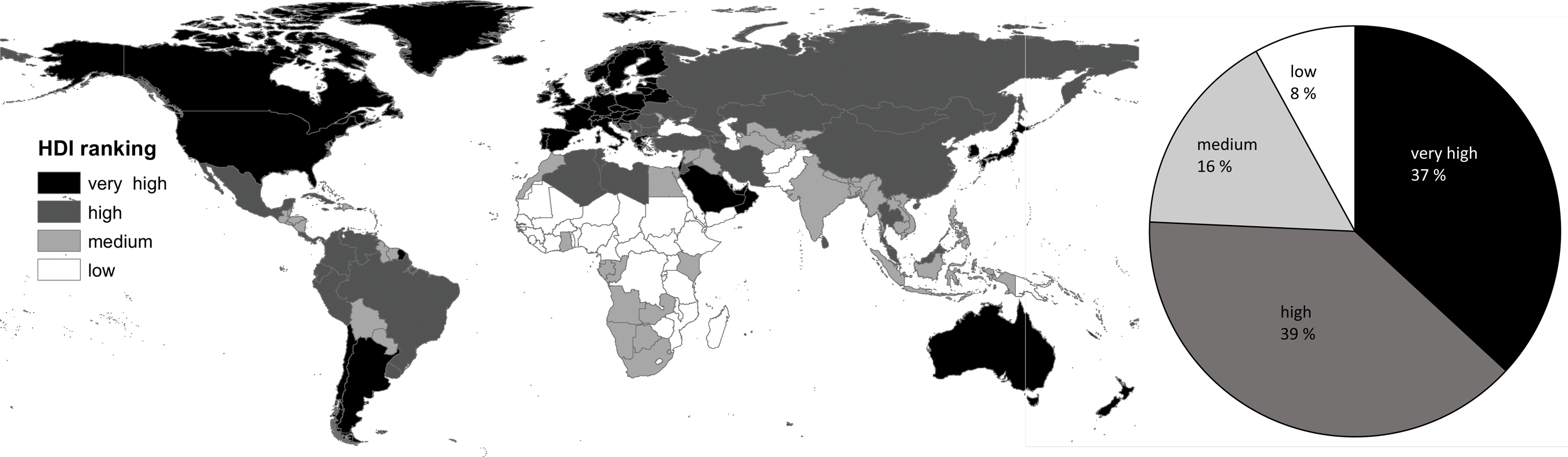
Map of countries of origin (by register data grouping) by HDI 2012 ranking and pie chart of adult migrant women in Sweden in HDI 2012 grouping.
Qualitative Approaches
Fifteen in-depth qualitative interviews, in the form of economic life course narratives, with self-employed migrant women from the top tiers of the HDI rankings, provide the basis of the qualitative analysis. Focus was given to migrants from countries with very high and high rankings, who are most likely to have privileged status conferred on them, in order to explore what role privilege plays in becoming and being self-employed. This study is part of a larger project, where women of all HDI ranking tiers have been interviewed.
Economic life course interviews use the concept of the life course interview (Atkinson, 1998; Halkias et al., 2011), emphasizing the educational and occupational aspects within a woman’s life course. This method is appropriate for exploring privilege as interviews are designed to explore how individual characteristics and social grouping are related to social structures. Focusing interviews on work histories, we can expose the ways self-employment is a social process rather than solely an economic activity (Gherardi & Perrotta, 2014). Interviews ranged in length from 1 to 3 hours with the majority being 2 hours long. Interviews took place in workplaces, homes or in cafes near businesses between 2017 and 2019. Interviewees were given the option to do the interviews in English, Swedish, or Dutch.
Self-employed migrants were found online and/or through entrepreneurial network meetings. Criteria for participating in the study were being a migrant to Sweden, identifying as a woman and as self-employed. Finding women through established networks suggests these women are actively engaging in entrepreneurial activities and could infer we are not accessing women not connected to such networks. Potential positive bias toward established and successful businesses and toward businesses with an online presence may shape the results. Businesses were in different stages of development and tended toward the health and food services, creative industries such as art, import-export, food production, health care, and personal and lifestyle training and coaching. Most were small with one to three permanent employees; only one business had a significant number of employees. Several businesses did use freelancers or short-term contracts. When interviews were not in English, the authors did their own translations. All women have been anonymized and given pseudonyms.
Interviews were transcribed, coded, and analyzed according to grounded theory principles (Corbin & Strauss, 1990). The exploration of privilege in self-employment followed three stages. The first stage used line-by-line manual open coding to understand life course and then to identify key topics, descriptions, or events (Benaquisto, 2008a). Line-by-line open coding across transcripts is appropriate to life course interviews as they tend to be highly complex and unique transcripts which are comprehensive and rich in detail. The second step involved axial codes, which are used to explore the relationships or processes from material found through the open codes (Benaquisto, 2008b; Johnson et al., 2017; Kimmel, 2014). Axial codes emerge from interviewees’ descriptions of their experiences. These coding stages encompass exploratory comparative work moving between the material and concepts. Finally, selective coding was performed to create themes which demonstrate the core variables derived from the open and axial codes. This final stage centers on theoretical development of reconstructing narratives from raw data to conceptual understanding (Price, 2010). The two themes forthcoming in the qualitative results emerged from data analysis using quotes chosen because they exemplified or developed understandings of privilege in self-employment. Following these established steps in qualitative analysis, the experiences and narratives of interviews can theoretically explore complex issues as well as create internal validity in the findings (Vincze, 2010).
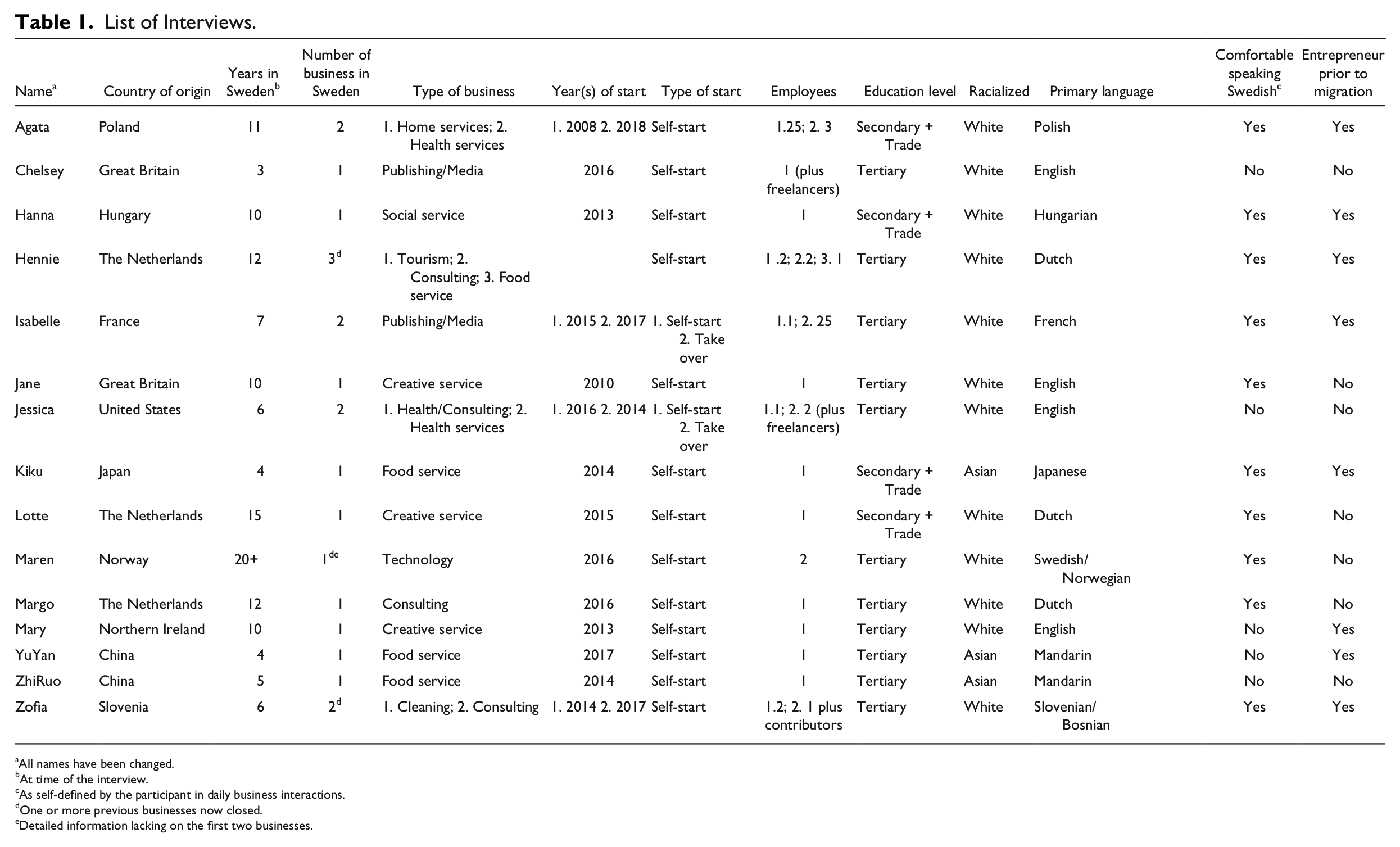
Table 1 gives an overview of the respondents. The sample is highly educated with nearly all having completed higher education, and many are multi-lingual. Most women are racialized as white and many are native English speakers. Women ranged from being in their mid-twenties to late-forties. All the women were in long-term relationships, and with the exception of three women, all had children. One woman is in an LGBTQ + relationship. With the exceptions of five women, all women migrated to Sweden to be with a spouse who either was a Swede or had obtained work in Sweden. Most women were established in Sweden, with an average of 9 years in the country, with the most recent migrant having arrived 3 years ago. They come from a range of professional backgrounds and half of the sample had previous experience as entrepreneurs prior to migration. Several women have or have had more than one business in Sweden.
List of Interviews.
aAll names have been changed.
bAt time of the interview.
cAs self-defined by the participant in daily business interactions.
dOne or more previous businesses now closed.
eDetailed information lacking on the first two businesses.
Quantitative Results on Privilege and Self-Employment
The following section presents the results from the register data analyses. We show that there are substantial differences in self-employment rates by country of origin, with self-employment rates increasing with increasing level of development of the origin country. Multivariate analyses show that even when controlling for individual privilege such as educational level, wealth, and having a Swedish partner, HDI index is significantly and positively related to migrant self-employment. The higher the HDI index of the origin country, the higher the likelihood of self-employment. Even within larger origin regions, women from countries with higher HDI indices are more often self-employed in Sweden.
Appendix 1 contains descriptive statistics on the full population of migrant and native women in Sweden in 2012, while Appendices 2 and 3 displays the accompanying correlation matrices. Figure 2 shows self-employment rates by country of origin. Migrant women born in the Netherlands stand out with a self-employment rate of 18% of all women aged 25–65. High self-employment rates are prominent among migrant women from China, Poland, Great Britain, North America, and Switzerland. Women from the Horn of Africa and former Yugoslavia are least often self-employed.
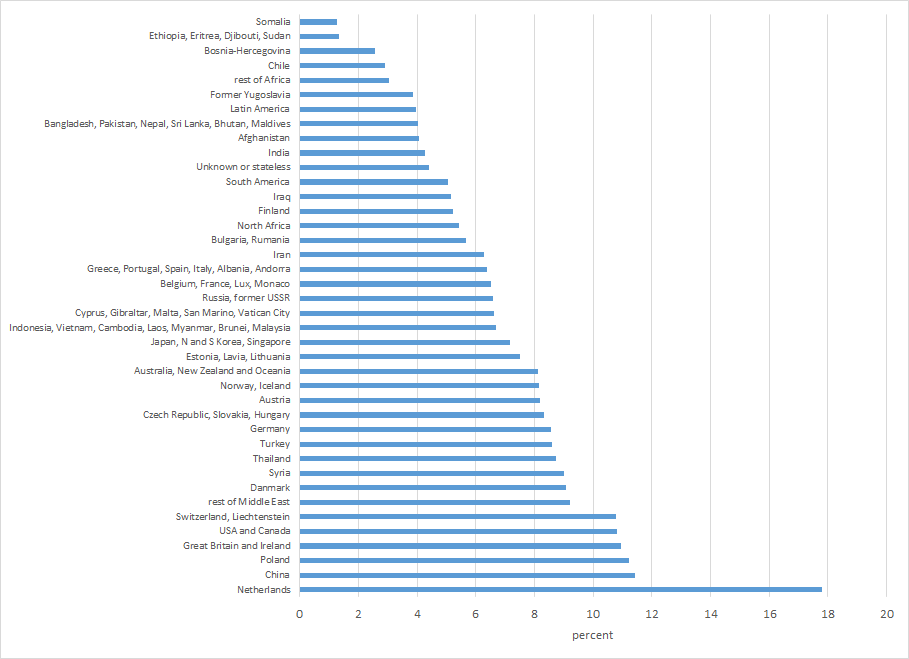
Self-employment rates of migrant women by country of origin. Source: Swedish register data, authors’ calculations.
Figure 3 summarizes self-employment rates for main migrant groups and confirms that privilege is a relevant characteristic when examining self-employment. Swedish born women, with Swedish-born parents, have a self-employment rate of 5.5%. Migrant women have higher self-employment rates: 6.4%. Migrants coming from the most developed and thus most privileged countries have the highest self-employment rate, 7.6%. The lower the HDI ranking, the lower the rate of self-employment, with migrants from the lowest ranked countries having low self-employment rates, only 2.2%.
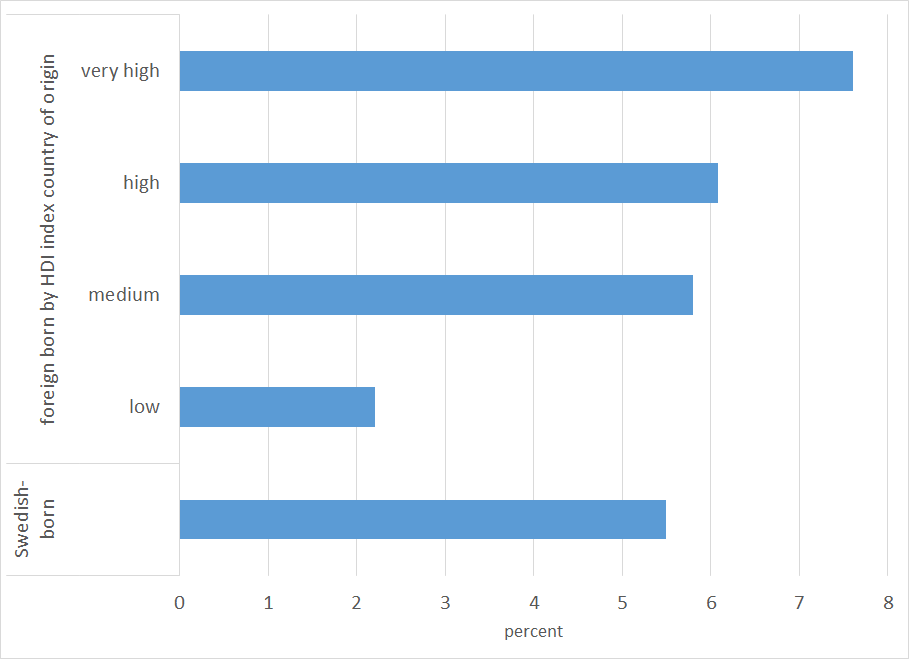
Self-employment rates among women by privilege group. Source: Swedish register data, authors’ calculations.
We performed logistic regression analyses to examine which migrant women are most likely to be self-employed (dependent variable), accounting for a range of variables known to be associated to self-employment. Our main variable of interest is the HDI index, and results show (odds ratios in Table 2) that even when controlling for individual characteristics indicating privilege such as educational level, having a Swedish partner and having Swedish citizenship, privileged origin matters. Women from the most developed countries are 3.9 times as likely as those from nondeveloped contexts to be self-employed, and the likelihood to be self-employed increases with increasing HDI ranking of the country of origin.
Results of Logistic Regression Analysis of Likelihood to Be Self-Employed (Dependent Variable), Migrant Women.
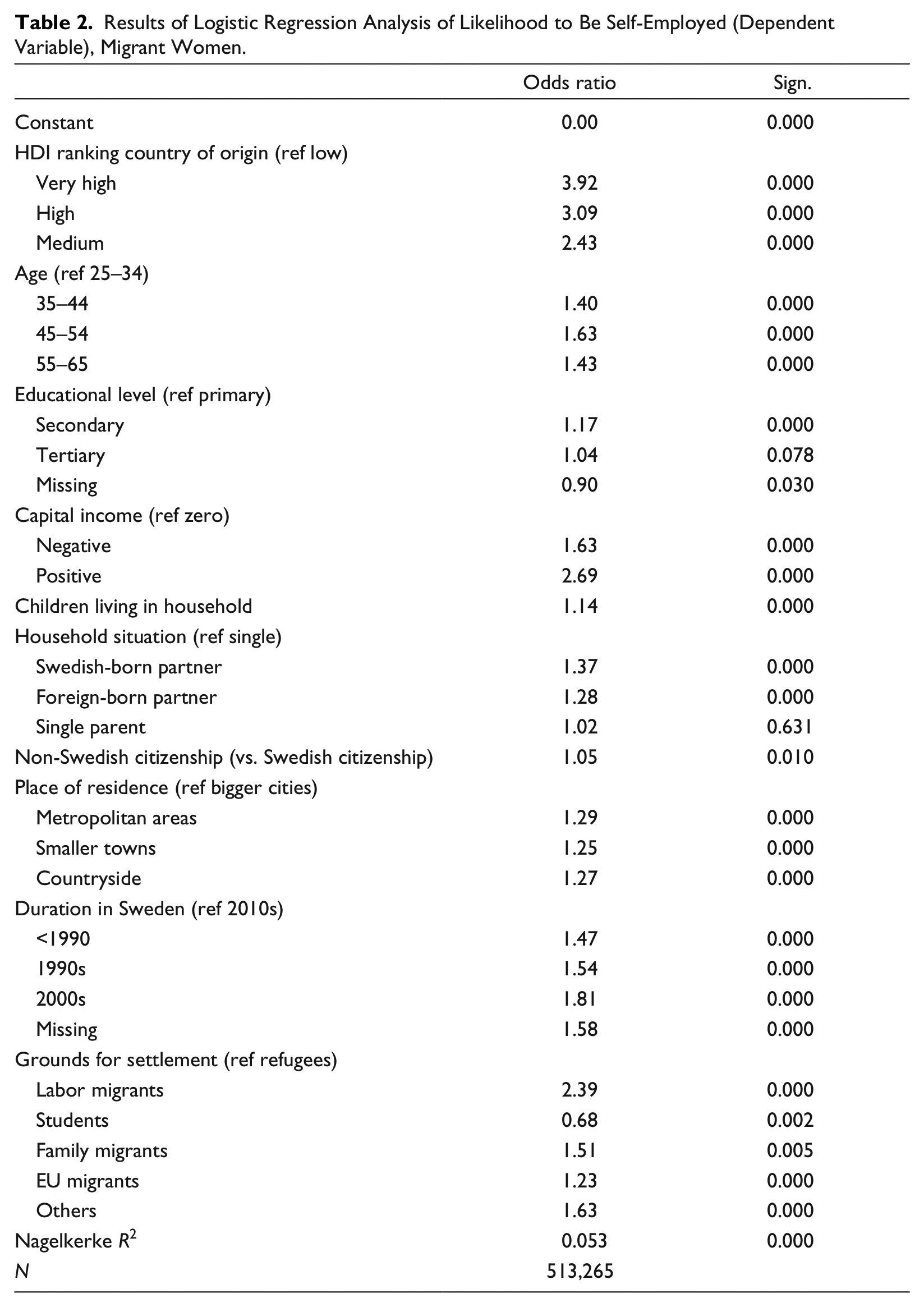
Other results are primarily in line with the literature on immigrant self-employment. Women who are self-employed are more often those possessing some financial wealth as well as have gained some human capital, such as being older and having secondary education. Local social capital plays a role in starting a business, such as having a Swedish-born partner and having stayed in Sweden for a longer period. Foreign-born women with a Swedish-born partner are 1.4 times more likely to be self-employed compared to singles. However, having a foreign-born partner is also associated with an increased likelihood to be a self-employed migrant woman. Being a Swedish citizen is associated with a slightly lower likelihood of becoming self-employed.
The migrant’s reason for coming to Sweden is strongly associated with the likelihood to become self-employed. Women coming as labor migrants are more than twice as likely to be self-employed, compared to refugees, who are, together with women who came as students, least likely to become self-employed. Additionally, family, EU, and other migrants are more likely to be self-employed than refugees. Moreover, geography matters for female self-employment. The results show those in rural and in metropolitan areas are more likely to be self-employed compared to those in bigger cities. Finally, for those women with a partner (Appendix 4) we find an interesting result, namely that women with a self-employed partner, are themselves, six times more likely to be self-employed.
When we compare predicted probabilities based on these findings, migrants from countries with a very high HDI index have, keeping all other variables at their mean values, a predicted increase in the probability of self-employment of 5.1%. This can be compared to a predicted increase of 4.8% for having a Swedish-born partner, 6.7% for having positive capital income, 6.9% for being a labor migrant, and 3.1% for being a refugee migrant. Although these probabilities are relatively low, they show the added and significant value of privilege measured as HDI index.
Sensitivity checks were conducted to examine whether the results hold for different groups of migrant women. As previous studies have indicated that region of origin is associated to self-employment we conducted separate analyses for migrant women by major regions of birth. These show that even within regions of origin, HDI index matters. For women from Europe, those from countries with very high HDI indices are twice as likely to become self-employed compared to women from European countries with high HDI indices. Similarly, within Africa, women from medium HDI countries are twice as likely to become self-employed than women from low HDI countries.
Other results that are noteworthy are that highly educated migrant women from Asia are less likely to be self-employed, while higher educated migrant women from Africa are more likely to be self-employed, both compared to primary educated women. For women from Africa, who may be least privileged, having a Swedish-born partner is associated with being three times as likely to be self-employed, an effect that is much higher than for the other migrant groups. The effects of Swedish citizenship vary by region of origin. For women from Scandinavia and Europe, being a Swedish citizen is associated with lower self-employment, while for other women we find no association between citizenship and self-employment. Finally, place of residence hardly matters for self-employment for women from North America and Africa, while it matters for the other groups.
Separate analyses were also done for migrant women by grounds for settlement, which show that for students, the HDI ranking is not associated with self-employment rate. Refugees who are Swedish citizens have higher odds to be self-employed compared to noncitizen refugees; but the association goes in the opposite direction for labor, family, and other migrants. Refugees may be more often blocked from the labor market, and Swedish citizenship may help this more vulnerable group in getting access to support and networks.
Self-employed immigrants in Sweden on average have lower incomes than immigrants with other employment (Andersson & Wadensjö, 2004). This is in contrast to findings from many other countries. For instance, in Germany and the United States, self-employed migrants earn (much) more than wage-employed migrants (Constant & Zimmermann, 2006; Wang, 2009), although differences among ethnic groups tend to be large. Figure 4 demonstrates how migrant and native women’s income from self-employment compares to that of migrant and native women’s income from wage-employment. We find all migrant groups have lower average incomes than natives, confirming previous studies. However, we also observe differences when distinguishing between levels of privilege. The most privileged migrant women have an average annual income from wage-employment nearest to that of native women. Migrant women from less privileged contexts have much lower average incomes from wage-employment; and there is little difference between those from medium- and low-developed areas. The figure shows that average income is higher for women who are wage-employed versus self-employed, which holds for all five groups examined.
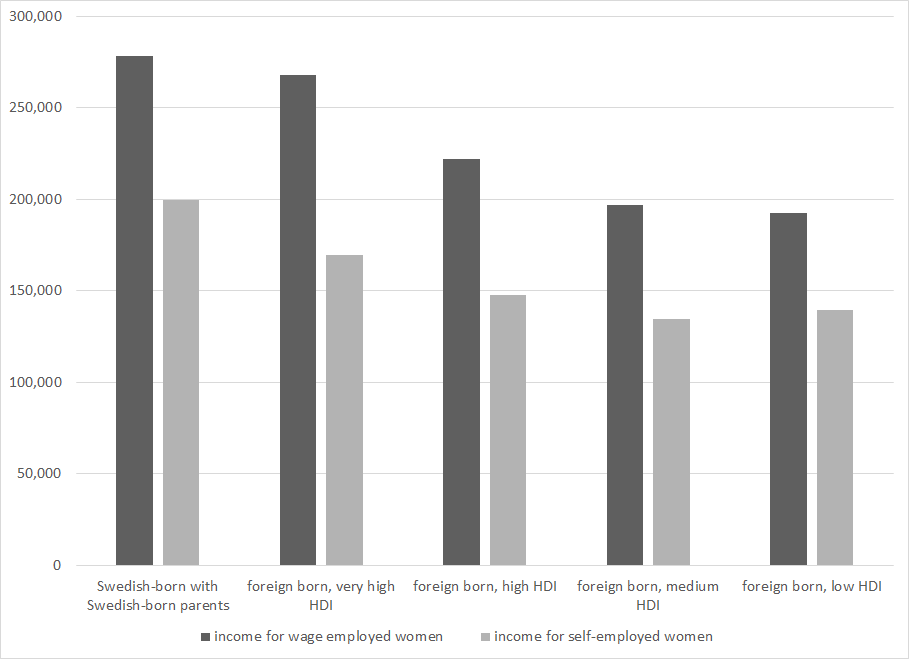
Average annual income, self-employed and wage-employed women by privilege group. Source: Swedish register data, authors’ calculations.
To further enhance our understanding of self-employment among migrants, we examine industry sectors that might be related to income differences between privilege groups. Figure 5 shows the major differences comparing sectors for country of origin by HDI index. Women from the highest developed countries more often have a business working with professional, scientific and technical activities (mostly business and other management consultancy activities), and with administration and support (mostly cleaning), compared to other women. Women from less developed countries more often work with sales and other service activities (mostly hairdressing). Cleaning, hairdressing, and having a restaurant or mobile food service are the most common businesses for all women, especially for women from high- and medium-developed countries.
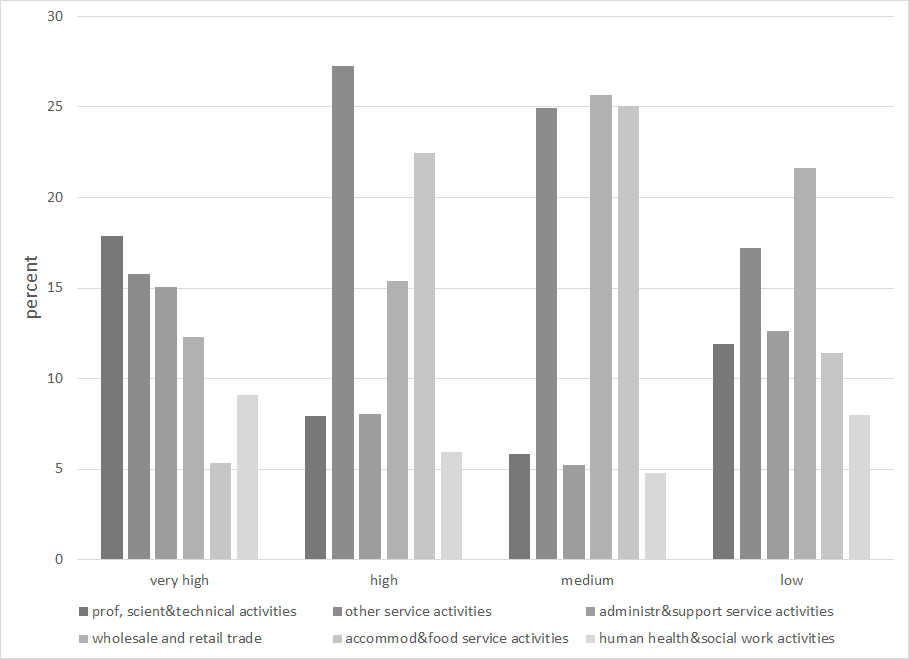
Sector of self-employed women by HDI index of country of origin (A χ2 analysis shows that sector and HDI index are significantly correlated, and that Cramer’s V is 0.225 showing that this pertains a medium association that is statistically significant). Source: Swedish register data, authors’ calculations.
Qualitative Results
To enhance our understanding of self-employment among migrant women and to provide a sense of privilege in process, we used qualitative methods to further explore the role of privilege in becoming and being self-employed. The first theme reveals, by drawing on migrant women’s accounts, the ways in which privilege plays a role in migrant women’s self-employment. In the first half of these results, we show how privilege is tied to forms of inclusion and we highlight how self-employed migrant women are positioned within axes of privilege. In the second theme, we demonstrate how privilege shifts and transforms throughout self-employment activities. Together the qualitative analyses demonstrate that privilege plays a role in self-employment whereby social categories like gender, class, and country of origin do create systems of advantage. We also highlight that these systems of privilege are highly complex and multifaceted. Privilege is a dynamic process, not simply the conferring of advantage, but is constantly navigated and negotiated by self-employed migrant women.
The Role of Privilege and Intersections of Inclusion and Exclusion in Self-Employment
This theme explores the ways in which privilege is formed through societal power relations where inclusion and exclusion to opportunities work in parallel. From the outset, belonging to English speaking communities and other western cultural groups formed strong ties to privileged structures and providing opportunities for self-employed migrant women. Mary (Northern Ireland), working in creative services, noted her first clients were booked due to an online expat forum:
I was lucky, [to have] English Speaking Moms in Sweden [an online forum], a few moms booked me for a session. [It] started with one mom, a lovely Dutch mom and then her two best friends contacted me within a few months. (Mary, Northern Ireland)
Similarly, Jane (Great Britain) initially found many of her clients through expatriate networks at the start of her business. This was intrinsically important before her Swedish reached a level for business; “Language [has been the hardest thing]. In the beginning, I wasn’t fluent in Swedish. I was only able to reach out to the English communities.” The English-speaking community, however, was large enough to build a portfolio and generally affluent enough to pay for these services, even as Jane, by her own description, undercharged early in her business development. Lotte (the Netherlands) speaks Swedish well but still prefers the international networks for gathering information: “People from other countries are just more appealing …it’s easier to… or maybe a kind of community, where it is hard to get access too.” Mary (Northern Ireland) organized her own network, which had people from all over the world sharing their experiences as professionals in Sweden:
It is a really mixed bag as well. There was an English guy, some Swedish people, Australian girls, and I remember feeling quite proud because I was part of the getting together process of that. (Mary, Northern Ireland)
Jane knew she had to learn Swedish and actively sought to do so by engaging with other groups, with shared norms, such as a Swedish organization for skiing and met many Swedes who became her network providing professional opportunities:
Through my skiing club, I got to know a lot of Swedes so I basically didn’t hang out with the English groups. I hung out with the Swedish groups [who] … tipped me on the job[s] (Jane, Great Britain)
These quotes reveal the intersection of normative belonging, in this case highly developed countries from the global North, and language, and expose the links between accessing resources for self-employment and privilege. Other forms of belonging such as participating in formal international networks, played a comparable role in facilitating inclusion for many women during early stages of self-employment. These connections created spaces of shared experience and like the online groups, were essential to finding clients and for gathering information. Hennie (The Netherlands), a member of the Lions Club 5 prior to migration, was able to draw on that network upon arriving in Sweden:
[It is] special when you are coming to another country and you have your network and it is worldwide. So, when you move over here, for me, it was a knock on the door with the Lions, ok! I know how we’re [Lions] working, I am here! (Hennie, The Netherlands)
This role of privileged belonging became apparent in contrast to those without shared social categories when they tried entering similar networks. Isabelle (France), as a non-English speaker, knew finding networks would be difficult beyond the smaller French community and thus focused on developing her language skills to move into Swedish networks and quickly joined a private business network in Stockholm with a significant membership fee.
[I didn’t start my business] because I didn’t have a large network. If you want to do [a creative business], then you need to have a large network already. Otherwise, it is too complicated. So I first learned Swedish, of course. And then I took a regular job, an office job, for 2, maybe 3 years with a [French company] in Sweden. And then, I built my network. (Isabelle, France)
Zofia (Slovenia) argues networks are key: “It is not about really [the] what and how… It is about why you do [it] and who, you do it [for]. Your network is your net-worth!” Agata (Poland) also felt isolated and excluded from networks: “I only met Poles, I didn’t have English or Swedish, it was hard.” Kiku (Japan) found herself in a similar situation as Agata, with an even smaller network to draw upon in Stockholm. Kiku immediately began to meet well-placed Japanese business expatriates but she strategized to expand beyond her co-ethnic community using pop-ups, media presence, and learning Swedish to swiftly engage with Swedish networks and markets:
There aren’t many Japanese in Sweden, just tourists, only like 1000, in all of Sweden. Perhaps 500 in Stockholm? They miss Japanese food and when they move here to Sweden, everyone talks about food. They all know, they all know about me… but now my customers have become mostly Swedish because last year I started doing ‘pop-up cafes’. In the beginning, all of my customers were Japanese but now they are mostly Swedish customers after newspapers and magazines did interviews and were interested in me. Then came the Swedish customers. (Kiku, Japan)
By learning Swedish, Kiku circumvented some exclusion practices and accessed new customers. In contrast, both ZhiRuo and YuYan (China) were engaged in large Chinese communities using WeChat and platforms 6 and platforms to sell their food products. YuYan sells primarily to the Stockholm Chinese community: “I know many Chinese! They all, their husbands, are all working at Ericsson.” The large Chinese expat community sustains their businesses considerably, but both found it difficult to sell their goods elsewhere where they each felt linguistically disadvantaged. Their community shares similar linkages of class and education as the Western groups, but other systems of exclusion remained important. Conversely, Maren (Norway) felt being a migrant played almost no role in her being excluded from opportunities, instead being a woman hindered her a great deal. Maren believes having a male associate, and the privileges he possesses, would be a gain for her business:
I think it would be completely different if [my company] was, like, [comprised of] five guys from Stockholm School of Economics, with their nice haircuts and their nice shirts and the right shoes… I have thought about, like, hiring a front guy. To just have a male representative being in the front face [of company name]. It has crossed my mind a few times. I have said that maybe this is something we need to do. (Maren, Norway)
These contrasting examples highlight that within systems of advantage, privilege is complex and formed and maintained through multiple forms of inclusion and exclusion.
Language acquisition was viewed as important to business growth, while generally considered as an optional or supplementary skill by many of the English speakers; this suggests language is a key category of privilege in the context of self-employment. The privilege of key languages but still needing Swedish is well illustrated by Zofia (Slovenia). “[I speak] five languages and they said to me, ‘you don’t speak Swedish’. That was the obstacle that I needed to overcome.” Jessica (United States) reflected on the power of learning Swedish and the growth of her businesses:
I’m really getting out [in the market] now. So it’s been, it’s been really good. So business just in the last few months has just exploded actually. I think it’s both the Swedish market, me learning Swedish, me getting more comfortable in what I do as well. (Jessica, USA)
Country-to-country linkages similarly played an important role in creating inclusion during the social practices in business. Isabelle described using her French background as a way to build relationships with Swedish clients:
[Clients] like France, because it is a holiday place! The French Rivera, they [customers] go to Nice every year, yes … I speak a bit about wine, what I like with them, so that helps … Everyone must have a way in. This is my way … It is rare that you meet some who has never been to Paris, for example. … They are so proud to say yes, I was in Paris last week or my mother lives in Paris. So, we talk a little. Yes, that’s the way it is, it works! (Isabelle, France)
Isabelle’s description highlights the importance of markers of privilege, in this case class and access to mobility shape shared experiences between clients and the business owner. Kiku had similar experiences with Japanese culture and Jane (Great Britain) confirmed her social position has status with Swedish clients as well and is central to her business relationships:
My clients all really appreciate it. I don’t know if they’re just being kind because you know, I’ve put it [education and background] out in social media, but they notice it and they notice the qualifications and they love to see I’ve been on the newspaper. (Jane, Great Britain)
For self-employed migrants accessing Swedish markets was facilitated by having intersecting identities that aligned with Swedish normativity, as Zofia (Slovenia) explained “[t]he personal story is everything!” meaning that individual positionality matters in self-employment successes.
Kiku, Jane, and Isabelle found privileged positions working to their advantage in the Swedish market. Jane and Isabelle are positioned here as desirable and appreciated as they enter local social spheres by both clients and, as Hennie suggests, by local organizations. Privilege served as a door opener for many women whereas ZhiRuo and YuYan encountered barriers to inclusion despite similar class and education backgrounds indicating that even within categories of privilege, hierarchies do exist in self-employment opportunities. This section illustrated the ways privilege is constantly negotiated and tied to opportunities and gains in self-employment. It has highlighted how privilege relates to dominant power groupings resulting in reciprocal practices of exclusion and inclusion.
Differing Forms of Privilege in Self-Employment
This theme shows the ways privilege is relational and changing and it demonstrates how privilege shifts with self-employment situations and practices. It highlights the ways privilege is experienced in similar ways in some settings and differently in others, depending on migrants’ positionality. Privilege is not homogenous or static and it is necessary to examine the variety of social conditions positioning self-employed migrant women.
As the women entrepreneurs expand and build their businesses beyond migrant groups and enter into the Swedish consumer and business market, the intersection of social categories begin to matter in distinct and different ways. Hanna (Hungary) explained “I felt put down when I saw the door was always closed” being a migrant woman. With time, local belonging exposes how privilege is constituted, maintained, and embedded into self-employment practices. Disadvantaged by belonging to the category of migrants, self-employed migrant women relied on other intersections of privilege. Margo (The Netherlands) summed up that while access to migrant networks was helpful she argued that one still needed access to normative groups:
In the end you always need a Swede or a person that is respected by Swedes … You need Swedish confirmation, that you’re on the right track in order to be successful. (Margo, The Netherlands)
Margo’s “Swedish confirmation” articulates the importance of the power of markers of privilege while also showing the necessity of being aligned with dominant forms of belonging. Moreover, gender conformity in these circles were important to accessing opportunities according to Maren (Norway): “I’ve felt that the investors [have been] mostly male with money from, like, either poker or heavy industry.”
Privilege as a complex structure, especially in migration, must also consider how class and wealth contribute to inclusion or exclusion. Chelsey (Great Britain) describing herself as having a working class background struggled, despite having English language, to find a group she could fit into and mobilize into a network. Many groups she initially met had expensive memberships or were orientated to spouses working for key firms, like YuYan’s experience of being part of Ericsson’s larger community. Chelsey described not only being locked out from Swedish networks as a foreigner, but also not being able to access well-placed expat groups due to class structures:
I think I [was] just kind of blocked out to be honest. . . I come across this group, something like expat, something expat in Stockholm. It was a membership group that you could join. I hadn’t quite figured out that it was an exclusive membership group, you really did have to be an expat. In the old-world sense that your husband worked for a major management financial pharmaceutical company. And the only way you could get membership was through his company. (Chelsey, Great Britain)
Chelsey’s experience highlights how privilege is aligned with social belonging and attached meaning; in this case, class position is the important norm for accessing an opportunity. This draws attention to multiple ways in which self-employed migrant women need to engage with new norms of dominant belonging. This suggests markers of privilege are constantly negotiated throughout the self-employment process. The importance of context becomes apparent as self-employed migrant women made contacts with local officials and gatekeepers. Hennie (The Netherlands), who was interested in starting her business in a rural area, found it was quite easy to make connections with the local government and received extensive help from them:
A lady working at the municipality, she was really interested in our story and somehow maybe impressed by what we were doing. She took us around on our holidays, somewhere in 2008 when we were on holiday camping in [place] that is what, 25 min from here. And we knocked on her door and she said, ok, I have some time, I will come and show you around. And she knew which properties would probably going to be sold in the coming few years so she took us for two WHOLE days and showed us around …And then …she called us and said ok, we have decided that the old school in [town name withheld] will be sold, are you interested? And we said, Oh! …within 3 months we lived here. (Hennie, The Netherlands)
Hennie’s account highlights how the municipality saw her as a desirable migrant possessing skills, qualifications, and forms of belonging highly valued by local officials. However, having desirable qualities, did not promise opportunities. Hanna (Hungary) described her business education from Hungary not being recognized and working as a cleaner before starting her business:
You have to fight! Fight! Fight for your opportunities. It was so tough, and then you begin to think, what can I do? I am cleaning but I have a good education, I am skilled and good at business! (Hanna, Hungary)
The experiences of women accessing and creating networks and services demonstrates privilege plays a role in inclusionary and exclusionary practices. For these self-employed migrant their markers of privilege accrued providing them key opportunities.
Conversely, ZhiRuo and YuYan were disadvantaged as outsiders to the dominant group norms despite education and middle class positioning as Chinese food and culture were not as in demand in the Swedish market. ZhiRuo highlighted this with her experience with a national magazine:
I was asked to write a recipe for [a well-known food] magazine, and I write about my cake in Swedish and they [the editors] said it [is] too, too new, it is too new! … It is too innovative. It is not, it is not like ordinary cakes they normally write [about] or publish. So they didn’t accept [my recipe for publication]. (ZhiRuo, China)
In this example, even when conforming to Swedish language, other social categories converge to create a system of exclusion. ZhiRuo’s products were not valued in the ways that Kiku’s Japanese products were locally even while engaging in similar social spheres as self-employed migrant women from Asia.
This section reveals that privilege is complex in practice. As self-employed migrant women develop their businesses, the role of privilege shifts and changes as women become more embedded in local norms of belonging. By examining the ways migrant women engage in their businesses, it becomes apparent that privilege is not homogenous nor clearly defined by one dominant form of belonging. We show multiple forms of privilege co-exist and are interlocking with different group belonging. This result adds to our understanding of privilege in self-employment by highlighting how opportunities and gains may be tied to societal asymmetrical power relations. Exploring privilege’s complexity indicates the role social structures play in shaping self-employment for migrant women, for example by revealing that resources are positioned and affected by social categories.
Discussion
This study is, to the best of our knowledge, the first that explicitly uses privilege to understand migrant women’s self-employment. Using a mixed method approach, we have addressed the multiple roles that privilege plays in becoming and being a self-employed migrant woman in Sweden. Privilege plays a salient role in migrant women’s self-employment. The quantitative analyses on migrant self-employment, by adding privilege, contribute to the self-employment literature. Compared to two existing studies on human development index and self-employment (Maniyalath & Narendran, 2016; Oyelere & Belton, 2012), we added a more thorough theorization on privilege using a mixed methods perspective. In the quantitative part of the study, using very rich data, privilege was operationalized at structural and individual levels, by including both development linked to origin countries as well as individual-level variables. These analyses showed that self-employment rates increase with increasing level of development of the origin country, even when controlling for individual privilege such as educational level, wealth, and having a Swedish-born partner. The life histories have shown privilege provides opportunities and gains among self-employed women belonging to power structures. Self-employed women maintain and perform privilege through exclusionary practices tied to larger social structures. By bringing together internal (individual characteristics and experiences) with external (structural, aggregate processes) structures; however we show that privilege is more than conferring advantage to conforming groups; privilege is a dynamic negotiated process.
We make evident that privilege is a useful concept to use for understanding self-employment. Privilege builds upon and expands understandings of social capital in self-employment by widening the scope of power relations and even the role of different activities in an effort to understand how some individuals or groups gain opportunities and advantages. For example, while privilege positions may be increased through education or training, the theoretical gain of using privilege lies in revealing how intra-/intergroup relations underpin opportunity or obstacles and reveal the unevenness of opportunities. Alongside social capital, privilege demonstrates how social structure grants benefits and reveals how individual characteristics intersect with social meanings resulting in an uneven set of opportunities for self-employed migrant women. An analysis using privilege reveals processes moulding self-employment are not neutral, but tied to social conditions created through power structures. Further, our study highlights the way opportunities, when viewed from the concept of privilege, are embedded in asymmetrical power relations offering possible explanations for why similar resources yield different outcomes for individuals and groups.
Conforming to key norms in self-employment is diverse and manifests in complex ways in business practices. Our results show how privilege is a dynamic process with some forms of privilege becoming more or less important in self-employment. In the quantitative entrepreneurship literature, women’s entrepreneurship patterns are largely neglected, and the role of privilege in entrepreneurship studies has hardly been examined. In qualitative studies, privilege is found to play a prominent role in migration studies, however, not in the entrepreneurship literature. This paper begins to fill these gaps by using mixed methods to examine the complex concept of privilege from different yet complementary perspectives. Importantly, these findings challenge binary approaches of migrant-native categories and suggest other shared social categories may offer new understandings in women’s self-employment.
The quantitative analysis offers unique insights into large-scale patterns and determinants of migrant women self-employment that are often left out of feminist analyses and are concurrently enhancing the qualitative findings that offer insights into complexity and diversity of privilege processes. Taken in tandem, the methods provide complementary insights (Siegmann & Blin, 2006). For instance, many quantitative studies have argued they cannot measure “unobservable characteristics” such as access to networks, personal motivation, discrimination, language issues, et cetera, in explaining patterns of self-employment; and this is what qualitative methods can contribute, whereas qualitative studies lack statements on generalization to a larger population.
The HDI ranking was used to classify migrant women’s countries of origin by level of development. Privilege is found to be a relevant characteristic when examining self-employment using both methods. The likelihood of self-employment increases with the level of development of the origin country, and this tendency is evident when controlling for other privilege measures such as wealth, having Swedish citizenship and having a Swedish-born partner. Although the HDI ranking is not structured along racial lines nor are countries of origin homogenous in racialization, there is no denying being racialized as non-white is associated with fewer opportunities to become self-employed based on the qualitative and quantitative study, corroborating a recent study finding that African Swedes face discrimination in the Swedish labor market (Wolgast et al., 2018). The quantitative part of the study confirms local context is important in establishing oneself as self-employed; mostly by finding self-employed migrant women have often been in the host country for some time, and have a Swedish-born partner, thus opening up possibilities for help and networks. Having acquired Swedish citizenship is associated with lower self-employment for migrant women from Europe but we do not find an association between citizenship and self-employment for other women. This may be related to the generous rights registered residents enjoy in the Swedish universal welfare regime (Sainsbury, 2006).
Our qualitative findings are in line with other studies which show that privileged groups skilfully make use of their privileged positions (Kunz, 2018; Lundström, 2014). The results from the interviews indicate privilege is actively accessed and mobilized in self-employment activities by migrants. The quantitative results confirm privilege plays a role in self-employment, for instance, it is women from the highest developed countries, with more individual wealth and access to networks via Swedish-born partners who have higher likelihoods of being self-employed demonstrating the importance of understanding the variety of influential resources in entrepreneurial activities. However, the results demonstrate privilege is not universally experienced even by those considered privileged (Coston & Kimmel, 2012). For example, our qualitative results show privilege shapes self-employment through the intersections of racialization, education, cultural norms and language in various ways. Being an English speaker clearly emerges as an advantage overall but the study also suggests non-English speakers, like Kiku, Agata, and Isabelle, adapted to the Swedish market cultures faster by having to learn and engage with Swedish language and Swedish networks earlier in their entrepreneurial processes.
This study exposes the heterogeneity of privilege and highlights the complexity of systems of exclusion and inclusion. Our findings indicate that privilege is driven by local social structures and thus show privilege as a dynamic process. We demonstrate self-employment is part of larger social structures of power relations. Self-employed migrant women possessing privilege simultaneously find themselves included and benefiting from some axes of advantage, being white, while also excluded through other non-dominant belonging, for example class. This confirms calls for deeper understanding of privilege (Benson, 2019; Kimmel, 2014). In parallel to these findings, our quantitative results show these women are not just fortunate in their success, but that privilege is a significant factor in entering self-employment, underscoring the role of advantages brought by privilege in advancing self-employment projects. Their position as migrants has made entry into Swedish networks and markets more difficult, yet for some forms of privilege were this was eased, due to their advantageous positions within systems of power: whiteness, English speaking, high individual wealth or international friendship circles (similar to Benson, 2014; Erel, 2010; Kunz, 2018). However, privilege is uneven and social structures are shaped over time and space (Benson, 2019; Oommen, 2019). Jessica, for instance, at the outset of her business gained advantages through her English but as her business needed to grow found this privilege mattered less. With time and expansion of her business, learning Swedish became necessary. Kiku started her business with many disadvantages, including a small expatriate community and lack of information in Japanese, but with learning Swedish, she was able to grow her business and reposition herself in networks by leveraging her Japanese background. Our study hints at the shifting patterns of privilege over the course of self-employment. Most women needed to access expatriate social networks to start their businesses and find clients indicating they do face disadvantages more largely when engaging with Swedish markets and consumers. The findings from the mixed methods design show privilege plays an important role in migrant self-employment by shaping who becomes self-employed and what kind of resources and strategies migrant women will be able to utilize. Migrants conforming more easily to privileged categories may be more likely to engage in self-employment, however privilege is not static and still needs to be further contextualized and understood.
Other suggestions for further research are to include more diversity when recruiting participants, to examine the cross-sections between for instance racialization and social class, and to zoom in on specific groups such as native English speakers. We encourage more entrepreneurship studies to apply and develop intersectional frameworks to study the heterogeneity of women’s entrepreneurship. Limitations in terms of the register data are the strict income-based definition of entrepreneurship, while it would also be useful to involve those migrants starting businesses on smaller scales and in the gig economy. Policy recommendations include a stronger understanding of diversity of entry pathways to entrepreneurship across sectors, and a sustainable support system with a long-term perspective (for further recommendations, see Haandrikman & Webster, 2020).
Conclusions
This study theorizes on the role of privilege in self-employment, and empirically shows using mixed methods, how privilege shapes self-employment dynamics for women migrants in Sweden. Our study shows that migrant women are building businesses within asymmetrical power relations regardless of their background. We see country of origin, whiteness, and language power relations playing a role in dominating power structures. Migrant women possessing privilege find themselves simultaneously positioned within some inclusionary categories and yet excluded from others. In some instances, self-employed migrant women may be elevated by certain key norms and yet often remain positioned as a migrant “other” and by gender. Privilege is not a static structure nor homogenous in practice; it is constantly changing depending on context. Our study reveals self-employment processes are part of power structures where groups are advantaged or disadvantaged. A challenge for self-employment and migration scholars is to further consider the role of asymmetrical power relations in supporting vulnerable self-employed individuals such as migrant women. Continued study on privilege in self-employment requires deeper exploration of self-employment beyond a binary of native-migrant and emphasizes inter-group heterogeneity with the need to collocate the many ways privilege shapes self-employment among vulnerable groups.
Footnotes
Appendix 1. Descriptive Statistics of Variables Used in the Register Data Analyses (%)
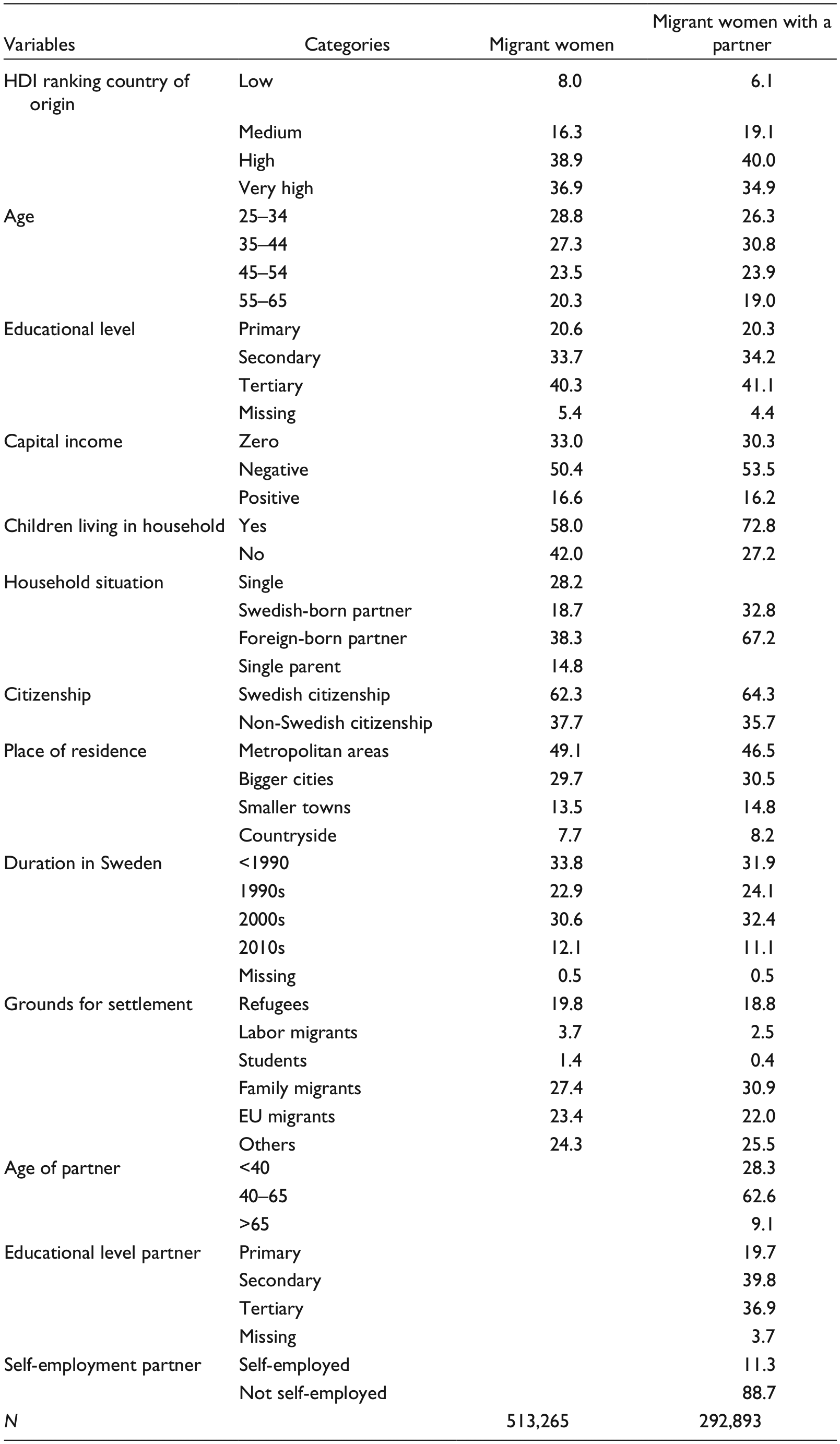
| Variables | Categories | Migrant women | Migrant women with a partner |
|---|---|---|---|
| HDI ranking country of origin | Low | 8.0 | 6.1 |
| Medium | 16.3 | 19.1 | |
| High | 38.9 | 40.0 | |
| Very high | 36.9 | 34.9 | |
| Age | 25–34 | 28.8 | 26.3 |
| 35–44 | 27.3 | 30.8 | |
| 45–54 | 23.5 | 23.9 | |
| 55–65 | 20.3 | 19.0 | |
| Educational level | Primary | 20.6 | 20.3 |
| Secondary | 33.7 | 34.2 | |
| Tertiary | 40.3 | 41.1 | |
| Missing | 5.4 | 4.4 | |
| Capital income | Zero | 33.0 | 30.3 |
| Negative | 50.4 | 53.5 | |
| Positive | 16.6 | 16.2 | |
| Children living in household | Yes | 58.0 | 72.8 |
| No | 42.0 | 27.2 | |
| Household situation | Single | 28.2 | |
| Swedish-born partner | 18.7 | 32.8 | |
| Foreign-born partner | 38.3 | 67.2 | |
| Single parent | 14.8 | ||
| Citizenship | Swedish citizenship | 62.3 | 64.3 |
| Non-Swedish citizenship | 37.7 | 35.7 | |
| Place of residence | Metropolitan areas | 49.1 | 46.5 |
| Bigger cities | 29.7 | 30.5 | |
| Smaller towns | 13.5 | 14.8 | |
| Countryside | 7.7 | 8.2 | |
| Duration in Sweden | <1990 | 33.8 | 31.9 |
| 1990s | 22.9 | 24.1 | |
| 2000s | 30.6 | 32.4 | |
| 2010s | 12.1 | 11.1 | |
| Missing | 0.5 | 0.5 | |
| Grounds for settlement | Refugees | 19.8 | 18.8 |
| Labor migrants | 3.7 | 2.5 | |
| Students | 1.4 | 0.4 | |
| Family migrants | 27.4 | 30.9 | |
| EU migrants | 23.4 | 22.0 | |
| Others | 24.3 | 25.5 | |
| Age of partner | <40 | 28.3 | |
| 40–65 | 62.6 | ||
| >65 | 9.1 | ||
| Educational level partner | Primary | 19.7 | |
| Secondary | 39.8 | ||
| Tertiary | 36.9 | ||
| Missing | 3.7 | ||
| Self-employment partner | Self-employed | 11.3 | |
| Not self-employed | 88.7 | ||
| N | 513,265 | 292,893 |
Appendix 2. Correlation Matrix for Variables Included in Logistic Regression,All Migrant Women ( N = 513,265)
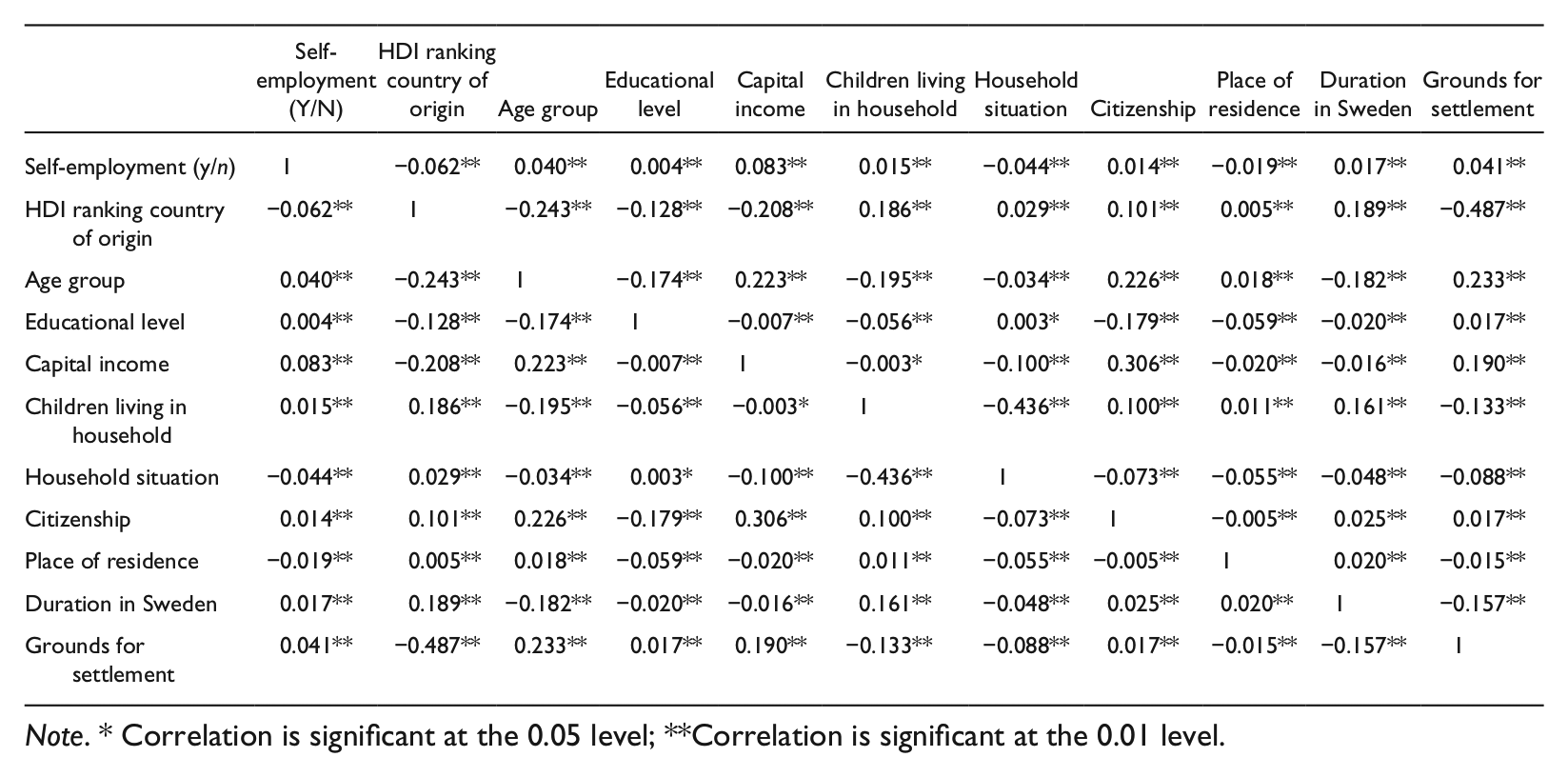
| Self-employment (Y/N) | HDI ranking country of origin | Age group | Educational level | Capital income | Children living in household | Household situation | Citizenship | Place of residence | Duration in Sweden | Grounds for settlement | |
|---|---|---|---|---|---|---|---|---|---|---|---|
| Self-employment (y/n) | 1 | −0.062** | 0.040** | 0.004** | 0.083** | 0.015** | −0.044** | 0.014** | −0.019** | 0.017** | 0.041** |
| HDI ranking country of origin | −0.062** | 1 | −0.243** | −0.128** | −0.208** | 0.186** | 0.029** | 0.101** | 0.005** | 0.189** | −0.487** |
| Age group | 0.040** | −0.243** | 1 | −0.174** | 0.223** | −0.195** | −0.034** | 0.226** | 0.018** | −0.182** | 0.233** |
| Educational level | 0.004** | −0.128** | −0.174** | 1 | −0.007** | −0.056** | 0.003* | −0.179** | −0.059** | −0.020** | 0.017** |
| Capital income | 0.083** | −0.208** | 0.223** | −0.007** | 1 | −0.003* | −0.100** | 0.306** | −0.020** | −0.016** | 0.190** |
| Children living in household | 0.015** | 0.186** | −0.195** | −0.056** | −0.003* | 1 | −0.436** | 0.100** | 0.011** | 0.161** | −0.133** |
| Household situation | −0.044** | 0.029** | −0.034** | 0.003* | −0.100** | −0.436** | 1 | −0.073** | −0.055** | −0.048** | −0.088** |
| Citizenship | 0.014** | 0.101** | 0.226** | −0.179** | 0.306** | 0.100** | −0.073** | 1 | −0.005** | 0.025** | 0.017** |
| Place of residence | −0.019** | 0.005** | 0.018** | −0.059** | −0.020** | 0.011** | −0.055** | −0.005** | 1 | 0.020** | −0.015** |
| Duration in Sweden | 0.017** | 0.189** | −0.182** | −0.020** | −0.016** | 0.161** | −0.048** | 0.025** | 0.020** | 1 | −0.157** |
| Grounds for settlement | 0.041** | −0.487** | 0.233** | 0.017** | 0.190** | −0.133** | −0.088** | 0.017** | −0.015** | −0.157** | 1 |
Note. *Correlation is significant at the 0.05 level; **Correlation is significant at the 0.01 level.
Appendix 3. Correlation Matrix for Variables Included in Logistic Regression,All Migrant Women with a Partner ( N = 292,893)
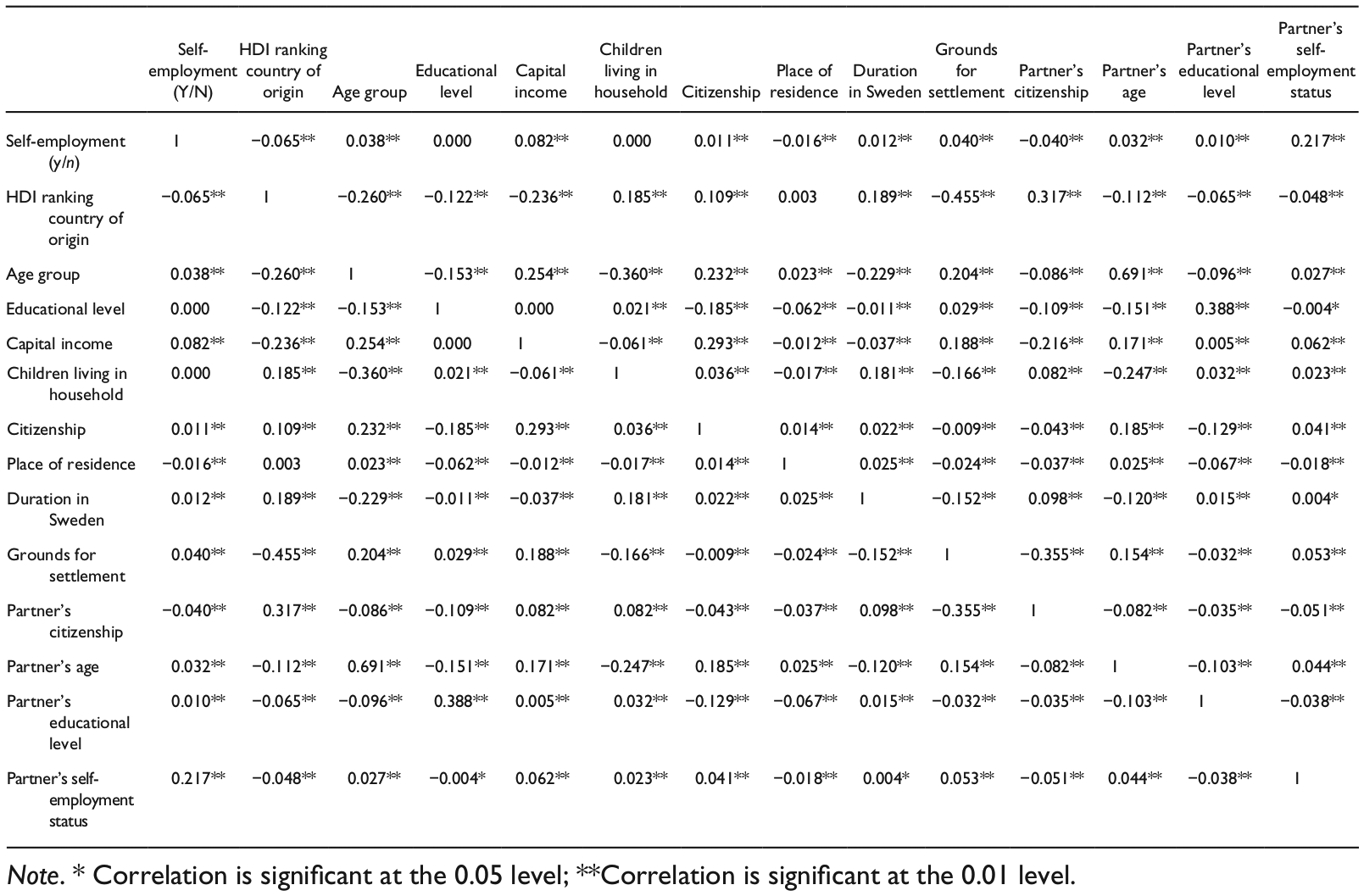
| Self-employment (Y/N) | HDI ranking country of origin | Age group | Educational level | Capital income | Children living in household | Citizenship | Place of residence | Duration in Sweden | Grounds for settlement | Partner’s citizenship | Partner’s age | Partner’s educational level | Partner’s self-employment status | |
|---|---|---|---|---|---|---|---|---|---|---|---|---|---|---|
| Self-employment (y/n) | 1 | −0.065** | 0.038** | 0.000 | 0.082** | 0.000 | 0.011** | −0.016** | 0.012** | 0.040** | −0.040** | 0.032** | 0.010** | 0.217** |
| HDI ranking country of origin | −0.065** | 1 | −0.260** | −0.122** | −0.236** | 0.185** | 0.109** | 0.003 | 0.189** | −0.455** | 0.317** | −0.112** | −0.065** | −0.048** |
| Age group | 0.038** | −0.260** | 1 | −0.153** | 0.254** | −0.360** | 0.232** | 0.023** | −0.229** | 0.204** | −0.086** | 0.691** | −0.096** | 0.027** |
| Educational level | 0.000 | −0.122** | −0.153** | 1 | 0.000 | 0.021** | −0.185** | −0.062** | −0.011** | 0.029** | −0.109** | −0.151** | 0.388** | −0.004* |
| Capital income | 0.082** | −0.236** | 0.254** | 0.000 | 1 | −0.061** | 0.293** | −0.012** | −0.037** | 0.188** | −0.216** | 0.171** | 0.005** | 0.062** |
| Children living in household | 0.000 | 0.185** | −0.360** | 0.021** | −0.061** | 1 | 0.036** | −0.017** | 0.181** | −0.166** | 0.082** | −0.247** | 0.032** | 0.023** |
| Citizenship | 0.011** | 0.109** | 0.232** | −0.185** | 0.293** | 0.036** | 1 | 0.014** | 0.022** | −0.009** | −0.043** | 0.185** | −0.129** | 0.041** |
| Place of residence | −0.016** | 0.003 | 0.023** | −0.062** | −0.012** | −0.017** | 0.014** | 1 | 0.025** | −0.024** | −0.037** | 0.025** | −0.067** | −0.018** |
| Duration in Sweden | 0.012** | 0.189** | −0.229** | −0.011** | −0.037** | 0.181** | 0.022** | 0.025** | 1 | −0.152** | 0.098** | −0.120** | 0.015** | 0.004* |
| Grounds for settlement | 0.040** | −0.455** | 0.204** | 0.029** | 0.188** | −0.166** | −0.009** | −0.024** | −0.152** | 1 | −0.355** | 0.154** | −0.032** | 0.053** |
| Partner’s citizenship | −0.040** | 0.317** | −0.086** | −0.109** | 0.082** | 0.082** | −0.043** | −0.037** | 0.098** | −0.355** | 1 | −0.082** | −0.035** | −0.051** |
| Partner’s age | 0.032** | −0.112** | 0.691** | −0.151** | 0.171** | −0.247** | 0.185** | 0.025** | −0.120** | 0.154** | −0.082** | 1 | −0.103** | 0.044** |
| Partner’s educational level | 0.010** | −0.065** | −0.096** | 0.388** | 0.005** | 0.032** | −0.129** | −0.067** | 0.015** | −0.032** | −0.035** | −0.103** | 1 | −0.038** |
| Partner’s self-employment status | 0.217** | −0.048** | 0.027** | −0.004* | 0.062** | 0.023** | 0.041** | −0.018** | 0.004* | 0.053** | −0.051** | 0.044** | −0.038** | 1 |
Note. *Correlation is significant at the 0.05 level; **Correlation is significant at the 0.01 level.
Appendix 4. Results of Logistic Regression Analysis of Likelihood to Be Self-Employed (Dependent Variable),Migrant Women with a Partner
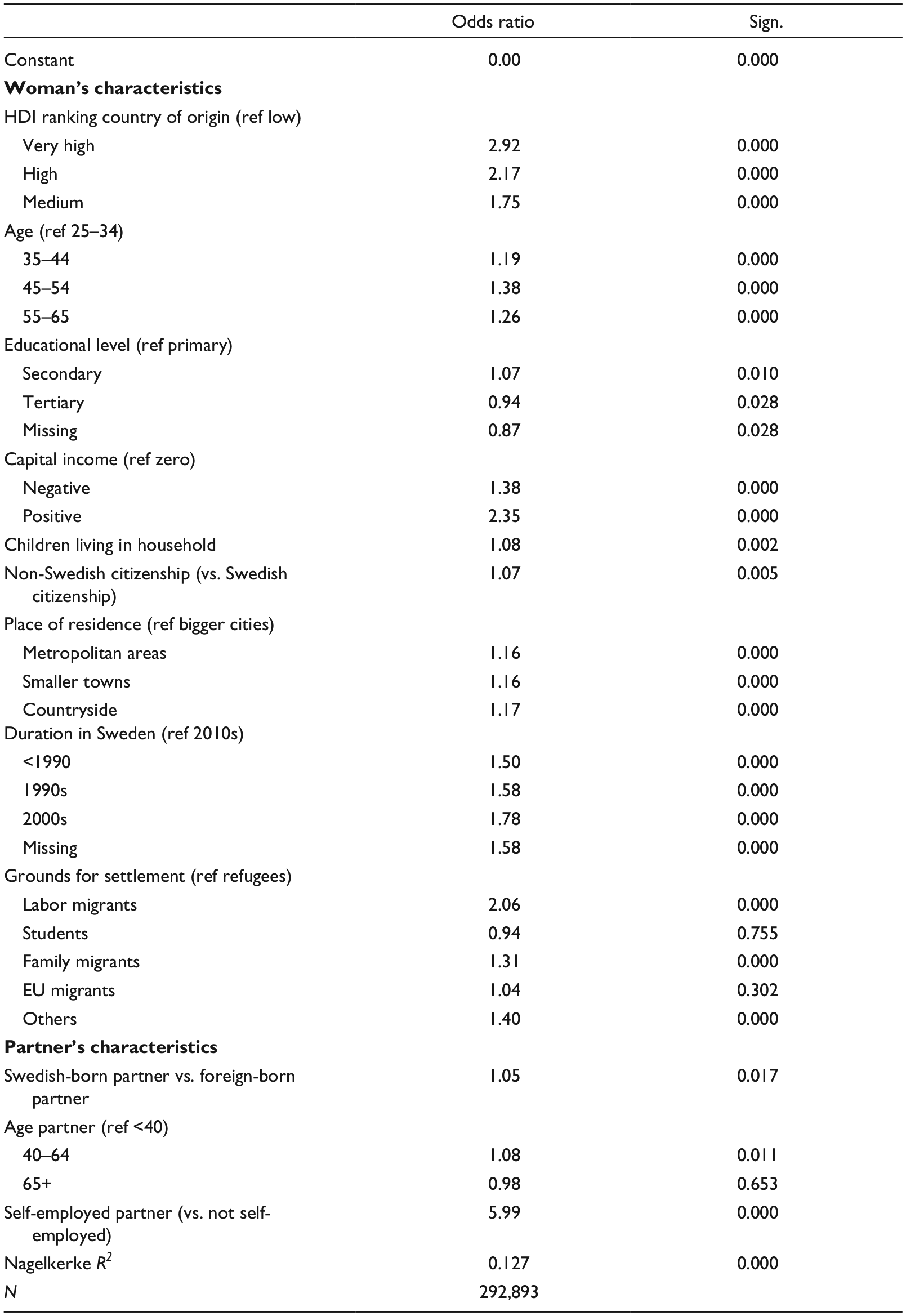
| Odds ratio | Sign. | |
|---|---|---|
| Constant | 0.00 | 0.000 |
|
|
||
| HDI ranking country of origin (ref low) | ||
| Very high | 2.92 | 0.000 |
| High | 2.17 | 0.000 |
| Medium | 1.75 | 0.000 |
| Age (ref 25–34) | ||
| 35–44 | 1.19 | 0.000 |
| 45–54 | 1.38 | 0.000 |
| 55–65 | 1.26 | 0.000 |
| Educational level (ref primary) | ||
| Secondary | 1.07 | 0.010 |
| Tertiary | 0.94 | 0.028 |
| Missing | 0.87 | 0.028 |
| Capital income (ref zero) | ||
| Negative | 1.38 | 0.000 |
| Positive | 2.35 | 0.000 |
| Children living in household | 1.08 | 0.002 |
| Non-Swedish citizenship (vs. Swedish citizenship) | 1.07 | 0.005 |
| Place of residence (ref bigger cities) | ||
| Metropolitan areas | 1.16 | 0.000 |
| Smaller towns | 1.16 | 0.000 |
| Countryside | 1.17 | 0.000 |
| Duration in Sweden (ref 2010s) | ||
| <1990 | 1.50 | 0.000 |
| 1990s | 1.58 | 0.000 |
| 2000s | 1.78 | 0.000 |
| Missing | 1.58 | 0.000 |
| Grounds for settlement (ref refugees) | ||
| Labor migrants | 2.06 | 0.000 |
| Students | 0.94 | 0.755 |
| Family migrants | 1.31 | 0.000 |
| EU migrants | 1.04 | 0.302 |
| Others | 1.40 | 0.000 |
|
|
||
| Swedish-born partner vs. foreign-born partner | 1.05 | 0.017 |
| Age partner (ref <40) | ||
| 40–64 | 1.08 | 0.011 |
| 65+ | 0.98 | 0.653 |
| Self-employed partner (vs. not self-employed) | 5.99 | 0.000 |
| Nagelkerke R2 | 0.127 | 0.000 |
| N | 292,893 |
Acknowledgements
The authors wish to thank the self-employed women for their participation in this study as well as the editor and the three peer-reviewers.
Declaration of Conflicting Interests
The author(s) declared no potential conflicts of interest with respect to the research, authorship, and/or publication of this article.
Funding
The author(s) disclosed receipt of the following financial support for the research, authorship, and/or publication of this article: This study benefited from financial support from The Swedish Research Council Formas grant numbers 942-2015-663 and 2019-00445; the Swedish Research Council for Health, Working life and Welfare (FORTE), grant number 2016-07105; the Swedish Research Council (Vetenskapsrådet) via the Swedish Initiative for Research on Microdata in the Social and Medical Sciences (SIMSAM), Register-based Research in Nordic Demography, grant 839-2008-7495.

Notes
Author Biographies