




Abstract
Employment is critical for refugees’ positive integration into a receiving country. Enabling employment requires cross-sector collaborations, that is, employers collaborating with different stakeholders such as refugees, local employees, other employers, unofficial/official supporters, and authorities. A vital element of cross-sector collaborations is trust, yet the complexity of cross-sector collaborations may challenge the formation and maintenance of trust. Following a theory elaboration approach, this qualitative study with 37 employers and 27 support workers in Germany explores how employers’ experiences in cross-sector collaborations on refugees’ labor market integration affect their trust in other stakeholders in this cross-sector space. Specifically, we explored employers’ perceptions of trust breaches, and how these perceptions affect their further engagement in cross-sector collaborations on refugee integration. Based on our findings, we propose a process model that describes how unmet collaboration expectations and negative assessments of collaborators’ attitudes and behaviors lead to perceived trust breaches which, in turn, lead to employers’ hesitancy to hire refugees and/or to engage in cross-sector collaborations. In doing so, we extend existing theory on trust within organizations to the cross-sector context of refugee integration, uncovering context-specific meanings to trustworthiness dimensions and illustrating how breaches of different trustworthiness dimensions can interact. Moreover, we show how social policies, resources, and trustors’ perceived vulnerability in collaborations shape their risk perceptions. This study highlights the central role of trust for refugee integration and illustrates how missing goals and process clarity endanger sustainable collaborations.
“From your perspective, what are the biggest problems during refugees’ job search?” (Interviewer) “Employers’ prejudices or bad experiences. If an employer has had one [refugee] before and is fed up, it’s difficult. Then, you better look elsewhere. It’s like . . . .” (Emilia, support worker) “Like scorched earth?” (Interviewer) “Exactly, yes.” (Emilia, support worker)
Displaced by war, persecution, and other societal turmoil, millions of refugees 1 seek shelter abroad (United Nations High Commissioner for Refugees [UNHCR], 2022). Integrating refugees into work and society benefits not only refugees but also their employing organizations and society (Strang & Ager, 2010), for instance, by offering a potential remedy for workforce shortages. Yet, many employers hesitate to hire refugees (Garaev, 2016) for reasons not fully understood. Discrimination has been proposed as one potential reason, as employers’ recruitment and employment decisions may be influenced by their biases concerning workers’ individual and social characteristics, immigration status, and perceived cultural differences (Cheung et al., 2022; Derous et al., 2012). Moreover, employing refugees also constitutes a complicated process with bureaucratic hassles and language difficulties (Lundborg & Skedinger, 2016). Resolving such challenges motivates employers to engage in cross-sector collaborations (Austin & Seitanidi, 2012a), (that is to work together not only with refugees but also with various other stakeholders across sectors such as authorities, official and unofficial supporters, employer’s existing workforce and even other employers (Hesse et al., 2019). Although each stakeholder has a unique role to play in refugee integration, their different institutional and professional backgrounds and economic and societal roles often mean mismatching goals and priorities (Babiak & Thibault, 2009; Quayle et al., 2019; Yang et al., 2020). Consequently, stakeholders find it difficult to agree upon clear routines and formal processes (Keast & Mandell, 2014). Thus, forming and sustaining cross-sector collaborations, above all, depends on trust (Getha-Taylor, 2012), that is the willingness to take the risk of making oneself vulnerable given one’s positive expectations of others’ intentions and behaviors (Mayer et al., 1995; Rousseau et al., 1998). Yet, in cross-sector collaborations, trust is particularly difficult because mismatching expectations, goals, and priorities among the different stakeholders increase uncertainties, challenge coordination, and constitute sources of conflict and suspicion (Venn & Berg, 2014).
This study explores trust in cross-sector collaborations, particularly focusing on reasons for trust breaches and the consequences thereof for refugees’ labor market integration. In doing so, we take the perspective of employers. So far, research has begun tapping into trust issues in refugee integration from refugees’ perspective (Strang & Quinn, 2021), but neglects the influence of trust for other stakeholders involved. By focusing on employers’ perceptions of trust breaches, we give voice to a central yet understudied stakeholder group in refugee integration. Research has addressed refugee integration on the micro-level, focusing on how refugees restore their lives and careers after resettlement (Newman et al., 2018), and on the macro-level, focusing on the necessity to re-think social policies to create a sustainable integration system (Collier & Betts, 2017). In contrast, research on the meso-level, examining the actions and reactions of employers to refugee employment, is lacking (Lee et al., 2020). Given these underexplored areas in research, the first research question guiding our analysis is: How do employers’ experiences in cross-sector collaborations on refugee integration breach their trust in other stakeholders? Furthermore, given the potential negative consequences of trust breaches for refugee integration, we pose the second research question: How do employers’ perceived trust breaches affect their engagement in refugee integration? To explore these uncharted topics, we drew on narrative interviews with employers and support workers 2 and used an interpretive methodology well suited to capture participants’ lived experiences in specific contexts (Merriam, 2009; Sandberg, 2005).
Our study makes four contributions to the literature. First, following a theory elaboration approach (Fisher & Aguinis, 2017) and heeding the importance of the context-specific nature of trust (Sitkin & Roth, 1993), we extend existing theories on interpersonal trust within organizations (Mayer et al., 1995) by studying trust in a cross-sector context. We explore the novel meanings that refugee integration renders to existing interpersonal trust constructs and unravel their relationships in a cross-sector context. In doing so, we respond to calls for research on the role of trust in relationships across organizational boundaries (Cooper et al., n.d.; Schoorman et al., 2007) and for insights into trust dynamics (De Jong et al., 2017) and trustworthiness dimension interactions within such contexts (Ramchurn et al., 2004). We also decipher uncertainty sources that shape trustors’ perceived vulnerability (Hermansson, 2019; Krishnan et al., 2006).
Second, we contribute to the cross-sector collaboration literature by addressing how challenges faced by employers in refugee employment can jeopardize their trust in other stakeholders and bring about collaboration failure (Bryson et al., 2006). We offer insights into the central but too little understood role of stakeholder interactions, and the history of those interactions in cross-sector collaborations (Keast, 2016), thus responding to calls (Clarke & MacDonald, 2019) for empirical research into lost resources and untapped potentials within cross-sector collaborations.
Third, we enrich the research-informed practice on refugee integration. Although research has emphasized refugee integration as a multi-stakeholder effort (Knappert et al., 2023), the stakeholders of refugees’ labor market integration tend to co-exist (Lee et al., 2020), following disparate understandings of their missions, roles, and legitimacy (Fehsenfeld & Levinsen, 2019). This study explores how employers’ perceived trust breaches form collaboration barriers that jeopardize a successful refugee integration across stakeholder differences. By this, we respond to calls to consider multi-stakeholder engagement in refugee employment from an organizational perspective (G. C. Guo et al., 2020; Lee et al., 2020) and we highlight the need for true social partnerships in the refugee context (Selsky & Parker, 2005).
Finally, we propose a process model on employers’ trust breaches in cross-sector collaborations that identifies psychological mechanisms that, first, precede employers’ trust breaches and, second, link these trust breaches to behavioral intentions relevant for refugee integration. We outline how employers’ perceived trust breaches provoke their hesitancy to hire refugees and to engage in cross-sector collaborations addressing refugee integration. Furthermore, we argue this ultimately leading to, and reinforcing, a suboptimal refugee integration.
The article is organized as follows: First, we introduce the theoretical framing of this study, addressing scholarship on trust and cross-sector collaborations and connecting this work to refugee integration. As we propose breached trust in other stakeholders within the cross-sector space as a main reason for employers’ hesitancy to employ refugees, we review research on trust breaches and highlight challenges in cross-sector collaboration research. After that, we explain our methods, followed by our findings. We conclude by delineating our process model and by further discussing this study’s theoretical and practical implications and future research avenues.
Theoretical Framing
Grand societal challenges, such as the integration of refugees, overtax single stakeholders’ resources and expertise (G. C. Guo et al., 2020). These challenges require cross-sector collaborations, in which stakeholders from different sectors work together and mutually commit resources to solve them (Quarshie & Leuschner, 2018). Although cross-sector collaborations can take different forms (Mandell & Keast, 2014), they share the need for stakeholders to collaborate in mutually interdependent relationships (Keast & Mandell, 2014). Effective collaborations require shared goals and understanding of the purpose of the collaboration (Bryson et al., 2006) and sufficient interactions and continuous efforts from all stakeholders (Keast, 2016). However, when cross-sector collaborations are not firmly institutionalized, they tend to constitute rather loose networks (cf. Austin & Seitanidi, 2012b; Tennyson, 2011). In addition, cross-sector collaborations are often challenged by competing institutional policies, goal conflicts, membership ambiguities, and high resource demands (Huxham, 2003; Quayle et al., 2019). In the end, stakeholders may recognize these collaborations entailing more costs than benefits, resulting in stakeholders avoiding or stopping collaborating (Park & Ungson, 2001).
Trust among stakeholders has been posited to sustain cross-sector collaborations despite these challenges (Keast & Mandell, 2014). To advance the understanding of employers’ trust in cross-sector collaborations in a systematic way, we follow a theory elaboration approach (Fisher & Aguinis, 2017) and build on Mayer and colleagues’ (1995) seminal model of interindividual trust in organizations. As cross-sector collaborations comprise individuals and their assessments of other’s trustworthiness (Keast & Mandell, 2014), this theoretical framing allows us to acknowledge trust as grounded in the individual perspective. However, we also expand this theory from the individual level to relationships on the cross-sector level. By this, we join the emerging conversation on the role of stakeholders’ motives, attitudes, and behaviors for multi-stakeholder engagement in refugee employment (Knappert et al., 2023).
Trust, Trustworthiness Dimensions, and Trust Breaches
Trust represents a psychological state that includes a trustor’s willingness to be vulnerable because of their positive expectations of a trustee’s intentions or behaviors (Mayer et al., 1995; Rousseau et al., 1998). Trust has been approached in both individual-focused (Mayer et al., 1995) and organization-focused research (Rousseau et al., 1998). Although individual-focused trust research targets trustors’ perceptions of trustees’ trustworthiness (Mayer et al., 1995), organization-focused research traces how the depth of stakeholders’ interactions (i.e., interaction frequency and relationship duration) and stakeholders’ structural and power positions toward each other affect their vulnerability and shape the trusting relationship (Kramer, 1999; Pirson & Malhotra, 2011).
Individual-focused trust research emphasizes that trustors assess trustees’ trustworthiness based on three dimensions (Mayer et al., 1995): Trustees’ ability (i.e., to perform as needed and to have influence), benevolence (i.e., to consider the trustor’s needs rather than pursue egoistic motives), and integrity (i.e., to keep promises and work according to moral principles that align with one’s own values). Furthermore, research has alluded to the relevance of transparency for trust (i.e., sharing trust-relevant information; Breuer et al., 2020; C. C. Williams, 2005), especially in situations characterized by limited interaction possibilities or information asymmetries (Cramton, 2002; Hardin, 2002). To date, studies have primarily focused on the role of transparency in citizens’ trust in government (Grimmelikhuijsen, 2012) and in the context of workplace digitalization and automation (Breuer et al., 2020; Höddinghaus et al., 2021). However, in line with Tennyson (2011), we posit that transparency is equally critical for cross-sector collaborations as the other three trustworthiness dimensions. In cross-sector collaborations, transparent communication is vital because stakeholders may find it difficult to fully comprehend each other given their different goals, priorities, norms, operational possibilities, and barriers. Moreover, both the complexity of refugee integration (Lee et al., 2020) and the fact that transparency can rebuild trust after trust breaches (Jahansoozi, 2006) underscore the relevance of transparency in this context.
Trust breaches arise when a trustee, either through action or inaction, does not meet the trustor’s expectations, and the trustor assesses the trustee falling short on one or more trustworthiness dimensions (Chen et al., 2011). In practice, trust breaches perceived by a trustor may derive from diverging or hidden agendas, competition, inflexibility, lacking accountability, and unfair performance outcomes (Getha-Taylor, 2012; Kramer & Lewicki, 2010). Trust breaches may be intensified by a trustor’s perceived risk in the collaboration and a trustee’s actions exhibiting lacking trustworthiness toward a third stakeholder (Crane, 2020). Breaches in trust damage collaborations, as they create suspicion and foster the withholding of information (S. L. Guo et al., 2017; Venn & Berg, 2014), and they can also initiate downward distrust spirals when stakeholders suspect single instances of breached trust generalizing to future transactions (Nooteboom & Six, 2003). Altogether, trust breaches increase the risk of stakeholders discontinuing mutual engagements (Getha-Taylor et al., 2019). Consequences are lost opportunities of collaboration and high transaction costs (Hardin, 2002).
Trust in Cross-Sector Collaborations
Trust is essential for various kinds of collaborations and secures stakeholders’ collaboration engagement, as it helps reconcile goals and facilitates cooperation, flexibility, performance, and efficiency (Becerra et al., 2008). Trust is particularly important in cross-sector collaborations (Venn & Berg, 2014) given their high uncertainties and risks that emerge from issues such as lacking institutional embeddedness and structures, a possibly low commitment of certain stakeholders, and the potential for changing collaborators during the process (cf. Austin & Seitanidi, 2012b; Tennyson, 2011).
Thus, while critical, trust in cross-sector collaborations is complicated (Kramer & Lewicki, 2010) and often might lead to trust breaches because the different stakeholders might struggle to deliver expected outcomes (Huxham, 2003). As diverse stakeholders from different sectors, policy fields, and institutional positions come together with differences in power, status, or autonomy (Kramer & Lewicki, 2010), stakeholders may have different attitudes toward the collaboration and its goals. They may thus hold different expectations shaping their perceptions of and experiences within collaborations (Babiak & Thibault, 2009). Moreover, many cross-sector collaborations are prompted in crisis situations that require fast collaborative responses by stakeholders without pre-existing contact (Bryson et al., 2006). Thus, the collaboration relationship is untested, and trust has potentially not yet been built, raising uncertainties regarding collaborator commitment (Hermansson, 2019; Krishnan et al., 2006). In such situations, macro processes, such as developing a shared collaboration purpose, process structures, and operational and governance procedures, are vital for forming and maintaining trust (Bryson et al., 2006; Keast & Mandell, 2014), as is the quality of micro processes, such as stakeholder interaction, communication, and interpersonal relationships (Keast, 2016; see also Crane, 2020). Yet, in loose collaboration networks, aspects of macro processes may be missing, and stakeholder diversity may challenge interpersonal relationships (Keast, 2016). As we explore cross-sector collaborations in refugee integration, we gain unique insights into trust breaches as a practical problem for trust formation and maintenance, both on the micro- and macro-level, including concrete examples of how trust breaches emerge in cross-sector collaborations.
To explore employers’ challenges in refugee employment, we address trust breaches in cross-sector collaborations including multiple interrelated stakeholders. Importantly, past research in non-cross-sector contexts has illustrated how trustors’ unfulfilled expectations generate trust breaches that impair the prospects of trusting relationships (Bell et al., 2002; Chen et al., 2011). Specifically in the cross-sector collaboration research, scholars have argued for the relevance of trustworthiness assessments for inter-organizational trust (Schilke & Cook, 2013; Tu & Xu, 2020) but the impact of specific trustworthiness dimensions has rarely been studied in cross-sector collaborations. As an initial study, Getha-Taylor (2012) examined ability and benevolence for building trust in cross-sector collaborations yet did not include the full trustworthiness dimension spectrum (Mayer et al., 1995), or explored the collaboration consequences of trust breaches. In the present study, we specifically target all trustworthiness dimensions in cross-sector trust to understand how trust breaches emerge for employers in the cross-sector space of refugee integration and how they jeopardize employers’ sustained engagement in refugee integration.
Method
Research Setting
Sheltering millions of refugees, Germany is a primary refugee host country in Europe (UNHCR, 2022). It has also been called the best practice example in refugee integration (Szkudlarek et al., 2021) with organized and government-funded integration practices such as job-related language support and work access during the asylum process (Joyce, 2018). Yet, refugees still face employment barriers through the labor market’s high regulation, vocational specificity, and principles for education (Hillmert, 2006), such as the need for good German language skills and formal qualifications (European Commission, 2016).
Germany has a large network of multi-partied institutions and organizations to facilitate refugee integration, such as employment and support agencies, social welfare and non-profit organizations, language schools, the public sector, and a strong refugee volunteer base (Hesse et al., 2019). State organizations incentivize employers to hire refugees, and educational institutions provide refugees with training needed for working in Germany. When requesting asylum, refugees obtain social welfare as long as needed (European Commission, 2016). Asylum applications result in permanent residencies (full asylum), temporary residence permits (e.g., subsidiary protection before the case will be re-decided), or rejections. Rejected applicants are “tolerated” until transported back to either their home or a third country; they can legally dispute the decision. Those granted full asylum receive a work permit, while those whose applications are pending or rejected can receive a work permit depending on various factors (e.g., whether they have children or live in the initial reception facility; Handbook Germany, 2023).
Research Design and Sample
We adopted an interpretive qualitative approach (Merriam, 2009; Sandberg, 2005) based on semi-structured interviews with 37 employers (Table 1) and 27 workers from support agencies (Table 2). Interviews were conducted between 2019 and 2021. Participants were recruited via institutions working with refugees, snowballing, and cold calling. To gain a comprehensive picture, we contacted businesses and public-sector employers of different sizes and industries in rural and urban settings in former East and West Germany. We designed interview protocols addressing each stakeholders’ roles and strategies in refugee integration and their interactions with other stakeholders in refugee employment. 3 To warrant study rigor, that is a trustworthy representation of employers’ perceived trust breaches, we followed Pratt and colleagues’ (2020) qualitative research principles and Sandberg’s (2005) recommendations to fulfill criteria of truth constellations.
Employer Demographics (N = 37).
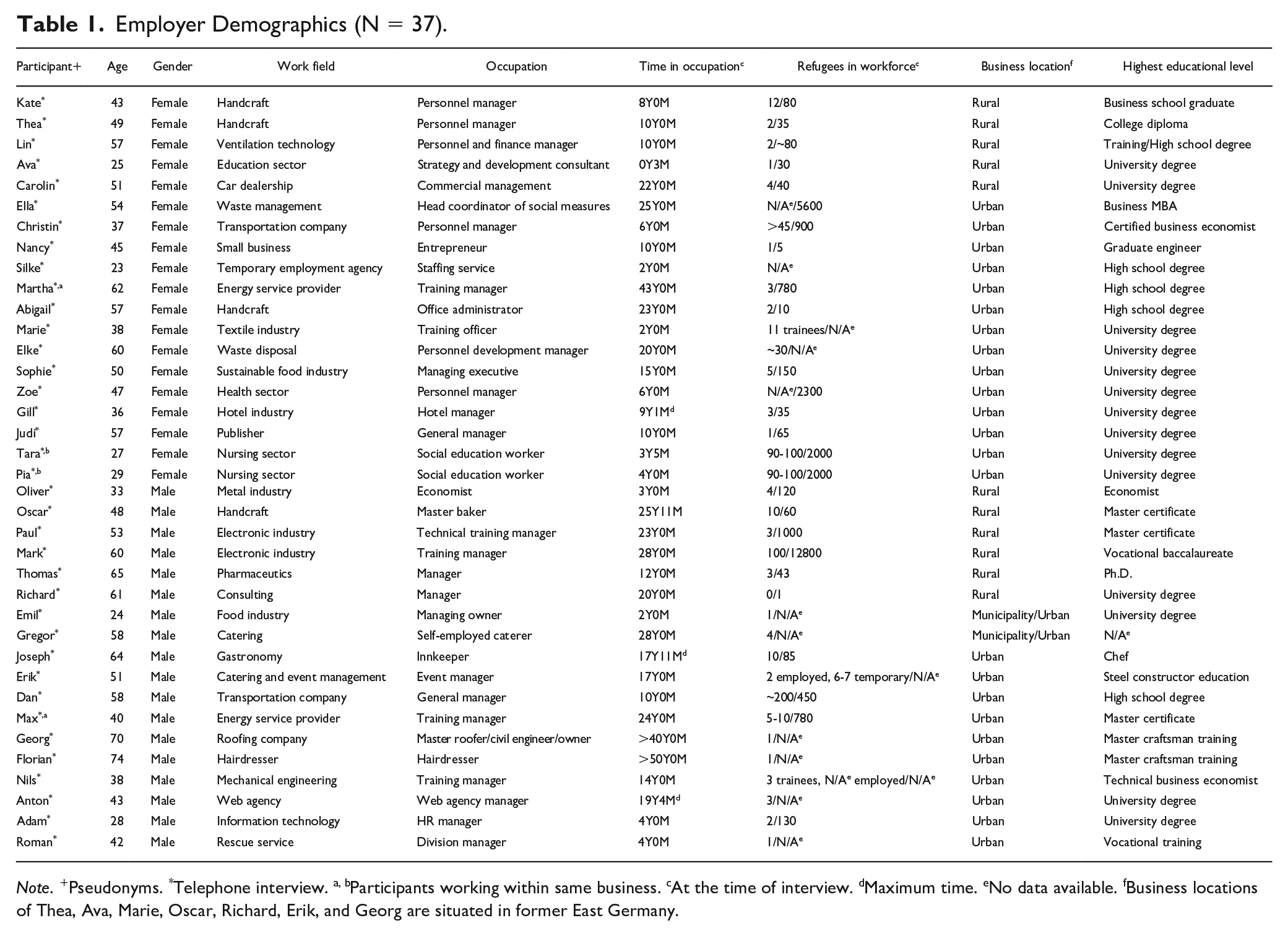
Note. +Pseudonyms. *Telephone interview. a, bParticipants working within same business. cAt the time of interview. dMaximum time. eNo data available. fBusiness locations of Thea, Ava, Marie, Oscar, Richard, Erik, and Georg are situated in former East Germany.
Support Worker Demographics (N = 27).
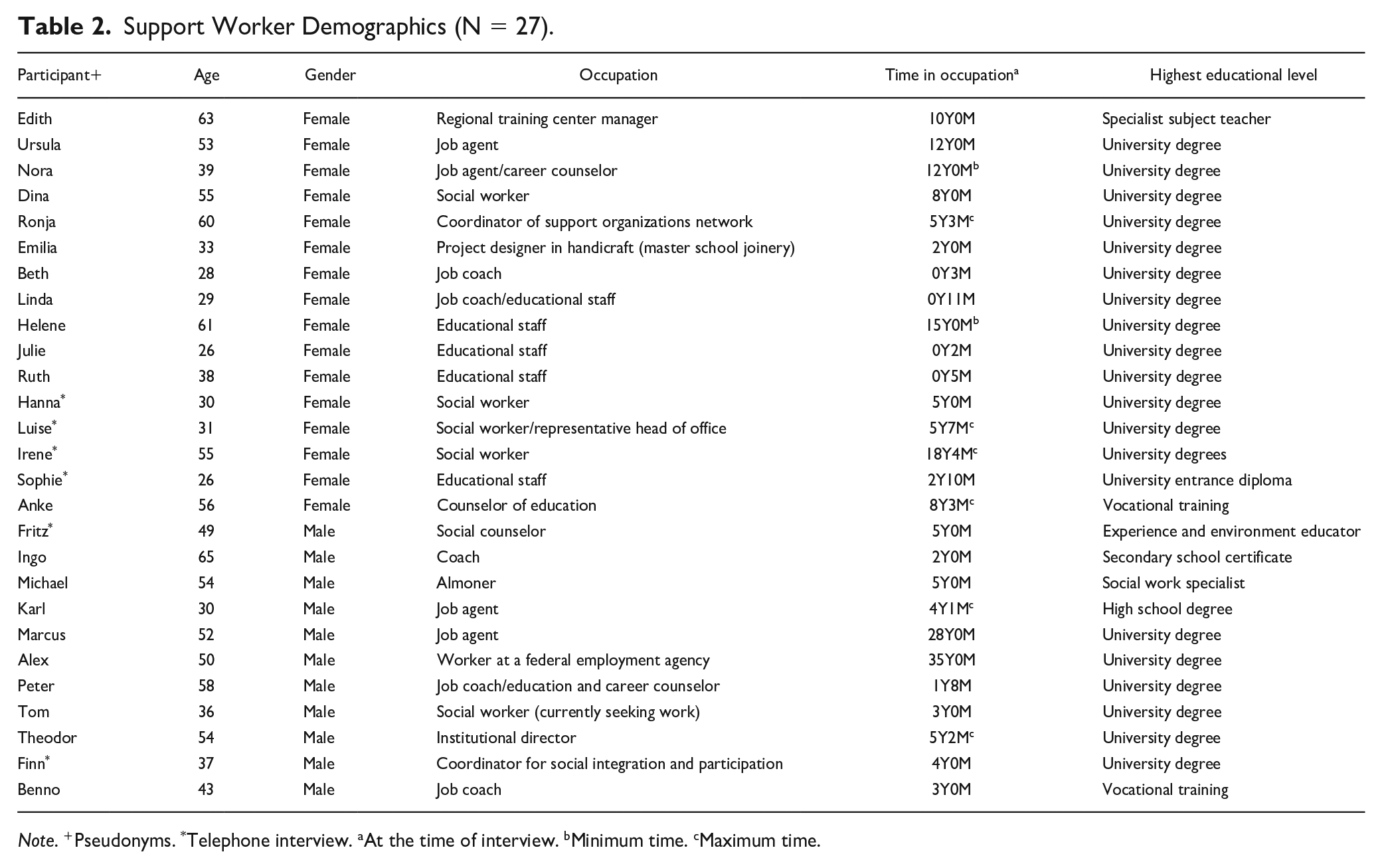
Note. +Pseudonyms. *Telephone interview. aAt the time of interview. bMinimum time. cMaximum time.
We adhered to the ethical standards of the German Psychological Society (2018) to prevent participant distress and protect their anonymity, received participants’ informed consent, and offered a compensation of 10€/h. Participation was voluntary and could be canceled anytime. Interviews were conducted in German, recorded, and transcribed verbatim. On average, they took 67 min for employers and 89 min for support workers. Descriptive quotes were translated into English.
Data Analysis
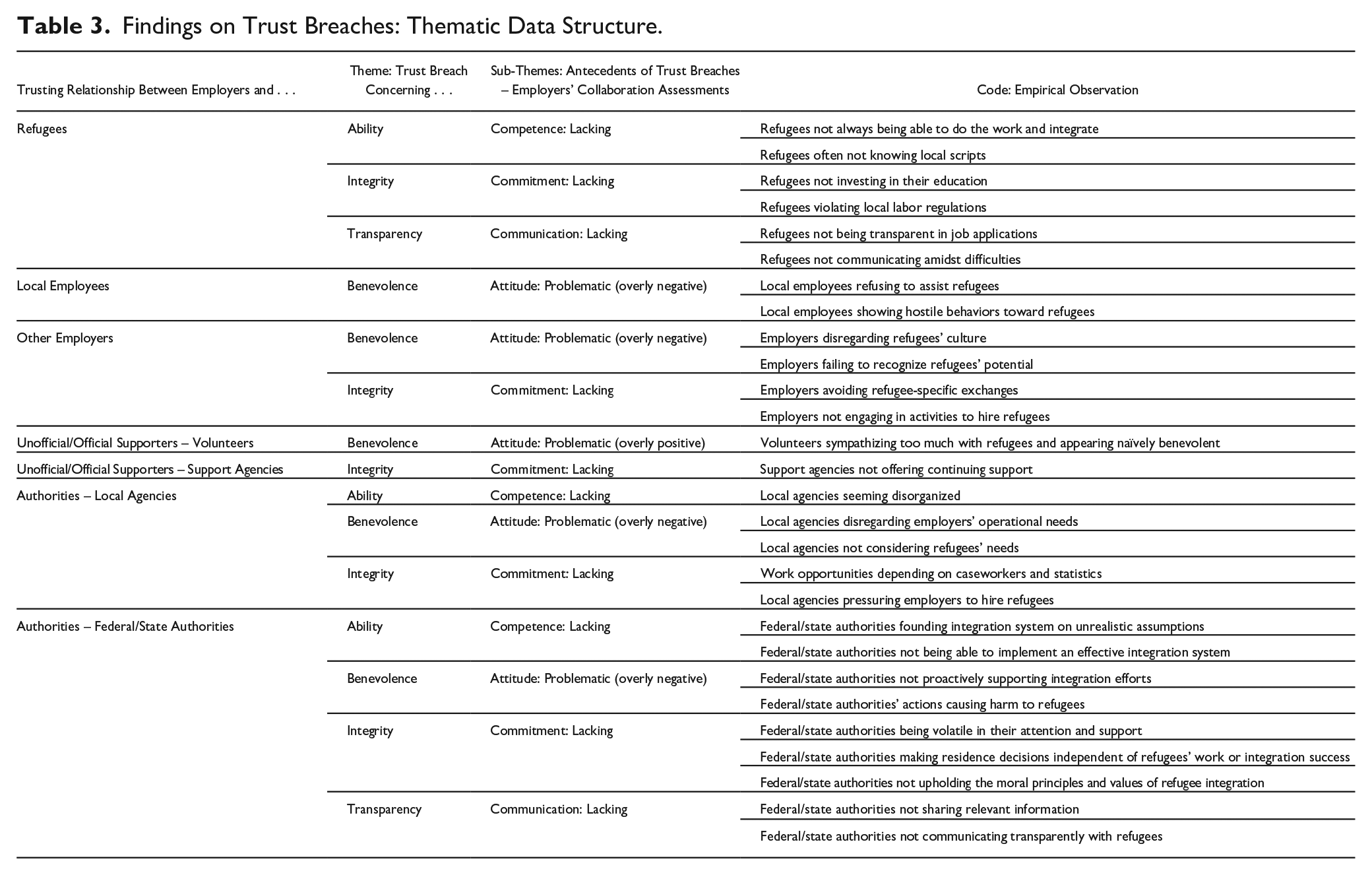
A preliminary reading of our data revealed employers’ lack of trust in key stakeholders in the cross-sector space of refugee integration, and we approached this topic via Braun and Clarke’s (2006) thematic analysis approach. The analysis, coded with Atlas.ti9, proceeded through seven iterative steps: (a) We familiarized ourselves with our data and (b) systematically searched for key dyadic relationships marking employers’ stakeholder system in refugee integration. We identified employers’ relationships with refugees, local employees, other employers, unofficial/official supporters, and authorities as the key dyadic relationships and mapped our findings around them (e.g., “Trust between employers and refugees”). Within these key dyadic relationships, we (c) coded data openly and generated initial codes (e.g., “Refugees not always being able to do the work and integrate”). While the analysis in this step was initially data-driven, we aimed at elaborating trust theory (Fisher & Aguinis, 2017), and so we (d) examined the connections of the codes with trust phenomena identified in research (Breuer et al., 2020; Mayer et al., 1995). Here, we recognized the codes’ relations to trust breaches in specific trustworthiness dimensions and (e) merged the initial codes into themes accounting for employers’ perceived trust breaches (e.g., “Ability-related trust breaches”). (f) We checked that the themes were internally coherent, consistent, and distinctive, with each data extract fitting its theme. Next, we (g) developed a process model (Figure 1) that delineates the psychological mechanisms linking employers’ trust breaches in cross-sector collaborations to refugees’ labor market integration. For this, we further analyzed the data coded in each theme, seeking to understand the reasons for employers’ perceived trust breach in question. This analysis generated our sub-themes (e.g., “Competence: Lacking”; Table 3) that connect codes to our themes by capturing employers’ collaboration assessments preceding trust breaches. The process model that we propose (Figure 1) connects employers’ negative assessments of other stakeholders’ collaboration and engagement (i.e., sub-themes) to themes (i.e., employers’ perceived trust breaches), theorizing also about the consequences of these trust breaches. Throughout the data analysis, we remained open to new discoveries; this enabled us to, for instance, recognize the role of context for trust, (opposing) connections between trustworthiness dimensions, and the need for optimal levels of specific dimensions.
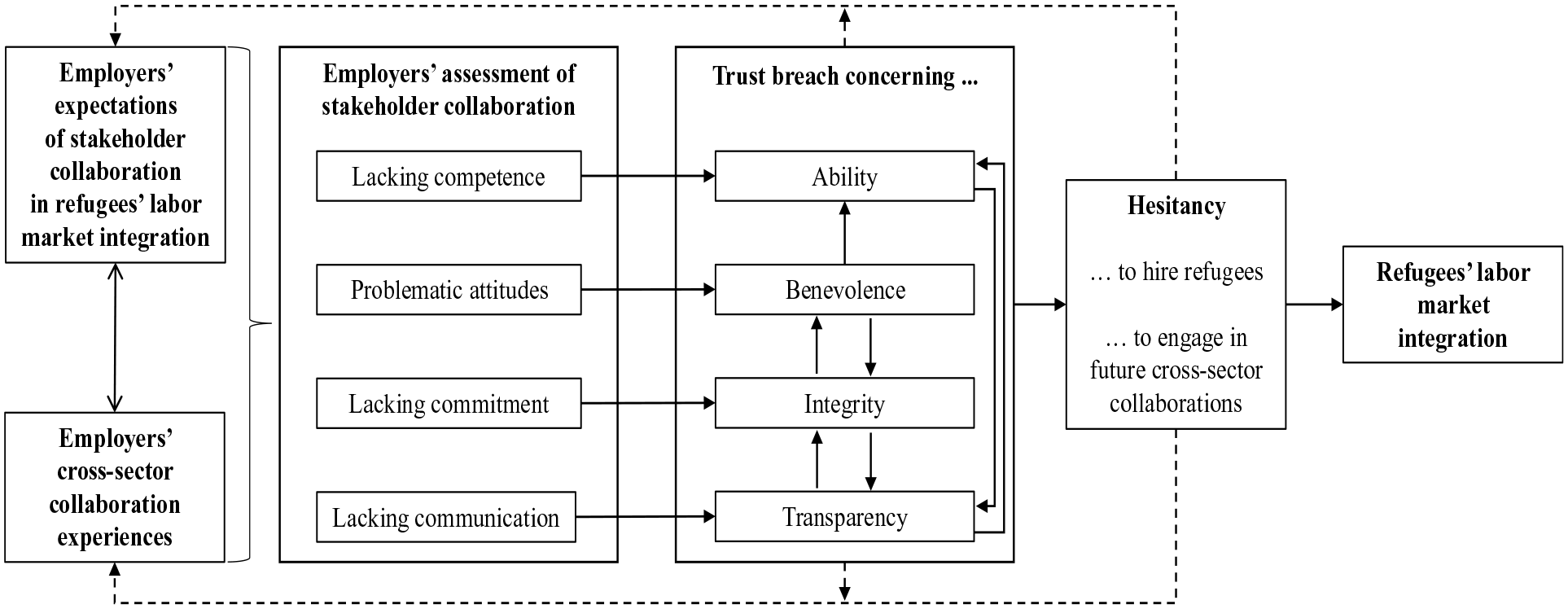
Process Model.
Findings on Trust Breaches: Thematic Data Structure.
We offer a rich description of our findings for study credibility and transferability (Pratt et al., 2020). In the discussion, we relate our findings to the relevant literature. To ensure multiple perspectives and internal validity, the first author coded all interviews, while the research team was included in all analysis phases (Braun & Clarke, 2022). The authors independently went over the data extracts and coding. Minor disagreements were resolved through discussions within the team.
Findings
The refugee influx of 2015/2016 led many employers in Germany consider refugee employment to fill labor shortages and to live up to their social responsibility. Initially, many employers were excited about hiring refugees. Georgemp, 4 noted: “I gave them all [my] card [and] said: ‘You can come to my company, we can do trial work, you can start.’” Carolinemp said: “Initially, I was very optimistic and thought: ‘Just welcome them openly, accept them as they are.’” Yet, many employers grew hesitant to hire refugees or to engage in related cross-sector collaborations. According to our analysis, these hesitations derived from breaches of employers’ trust originating from other stakeholders not meeting their expectations. Specifically, when employers’ collaboration experiences clashed with their expectations of other stakeholders’ attitudes and behaviors, they ended up doubting collaborators’ competence, commitment, attitudes, and communication in the integration process. These doubts resulted in employers’ trust being breached in all trustworthiness dimensions.
In the following, we organize our findings around employers’ trust breaches in their key dyadic relationships identified in our analysis, that is with refugees, local employees, other employers, unofficial/official supporters, and authorities. For each dyadic relationship, we describe the trust breaches relating to trustees’ ability, benevolence, integrity, and/or transparency, as they surfaced in our analysis, and we point to each trust breach emerging from other stakeholders’ attitudes and/or behaviors departing from employers’ expectations. Based on our findings, we theorize in the discussion on the psychological mechanisms underlying employers’ trust breaches in cross-sector collaborations on refugee integration, ultimately harming refugee integration (Figure 1, Table 3).
Trust Between Employers and Refugees
Ability-Related Trust Breaches
Employers’ ability-related trust in refugees was breached when refugees’ competence failed to meet employers’ expectations. Specifically, employers assessed refugees to lack competence in two ways. First, refugees were not always able to do the work and integrate. Over time, Ronjasup realized: “Many have a much lower level of education than we originally thought. . . . It was unrealistic to think excellent language skills can be attained fast.” Oliveremp exemplified the relevance of language skills for refugees’ work safety: “The biggest barrier is the language. . . . Occupational safety and health [law/regulations] are written in German and must be understood.” Kateemp summarized: “There are areas where it doesn’t work without German.”
Second, employers reported that refugees often did not know local social scripts:
“Not all is self-evident to them as it is to us; the rules and behaviors are partly new to them” (Sophieemp). Particularly, when refugees followed career models from home, employers questioned refugees’ ability to understand local scripts. Oscaremp said: “From their countries, they’re used to just jobbing and shimming around. Education is not just about getting a certificate. There’s also content behind it. There are people who don’t understand that.”
Integrity-Related Trust Breaches
Employers expected refugees to be committed to the integration process. Yet, this expectation was unmet when refugees did not invest in their education and violated local labor regulations, breaching employers’ integrity-related trust.
Many employers expected refugees to invest in education, that is, to undergo vocational training
5
toward a skilled job position. For Georgemp, “it works through an attitude to learn and train. . . . I don’t need unskilled workers packing a few boxes for me.” Yet, employers felt refugees lacking commitment when they opted out of training to prioritize quick income in ad hoc employment, letting employers’ training investments go to waste:
The trainee, who was actually almost finished with his training, leaves the company and gets into an unskilled job where he earns more, and that’s, of course, a barrier where you think twice about whether to hire someone and invest the money in the training. (Avaemp)
Relatedly, employers interpreted mismatching work ethics as refugees’ lacking integrity:
Every field has identical principles regarding punctuality, ambition, determination. . . . We have a very rigid understanding of time in Germany; 8am is 8am. A little too late is not so good, and if they come in late once, they don’t need to come in anymore (Karlsup).
Oscaremp lost trust in refugees’ integrity when recognizing refugees violating German labor regulations: “With refugees, there’s always an extra risk of things going sideways, that they say: ‘We get social welfare and work illicitly.’ We notice those things going on in the background. It’s a shame.” Some employers attributed these issues to refugees’ national or cultural backgrounds, displaying biased attitudes. Oliveremp stated: “Refugees from [country A] didn’t have the mentality to . . . gain a foothold in the company. . . . Their reliability is really low.”
Transparency-Related Trust Breaches
Employers expected refugees to communicate openly when applying and, once employed, if there were problems at work. Often these expectations were not met, breaching employers’ transparency-related trust.
Specifically, employers struggled with refugees not being transparent in their job applications. Tomsup stated that refugees’ applications generally offered little insight into their ability: “The CVs are largely rather lean for people in that age.” Employers also felt that refugees did not share relevant, truthful information. Maxemp, for instance, had encountered embellished applications and thus questioned refugees’ integrity: “They have written a top-notch application, every word fits and as soon as we go to the interview, nothing works. We noticed much being embellished.” Nilsemp noted that refugees’ applications were sometimes written by local helpers and were exaggerated: “Guardians try to place refugees, but . . . when refugees can’t write the application themselves and can’t prove an A2-level, there’s no point.”
Once employed, employers bemoaned low transparency when refugees did not communicate amid difficulties. Zoeemp said: “Every work culture is somewhat different, and some dare less to express themselves when something is wrong but say: ‘Everything’s alright.’” A lack of transparency fed into at least three issues. First, it risked refugees’ education and development: “The trainee [has] to realize when he hasn’t understood something . . . and let the company know immediately. It’s critical; only then can the company really support with measures or with tutoring or renewed explanations” (Ankesup).
Second, lacking transparency increased the risk for errors and workflow disruptions:
The[ir] communication is geared toward not showing weakness. . . . It’s a big shortcoming in handicraft; . . . a huge cultural issue we face almost every day. . . . It [communication] is ultimately the main factor whether integration can work, whether workflows ultimately work. (Theaemp)
Third, not being able to express their struggles harmed refugees’ relationships with local employees and created tensions at the workplace:
Coworkers can’t classify it. . . . He [refugee] becomes quiet, withdrawn, defensive, and always looks sad. I know I have to react to it and signal my willingness to talk to him or coworkers, who might say: “What’s wrong with him, and is it our fault?” (Theaemp)
Here, Theaemp could “only mediate and advertise for tolerance.” Sheemp also spoke of: “Psychological problems in the form of depression, frequent sick leave, or spontaneous, sometimes fiery, fits of rage, which weren’t clearly justifiable, where one noticed there’s probably another cause in the background ticking along.”
In part, lacking transparency could arise from refugees’ inability to articulate traumata and fears. Theaemp voiced: “What affects the person; they can’t find the words for it. . . . I think [flight] experiences are being suppressed and just surface.” Consequently, employers could lose refugee employees when failing to recognize mental health or private issues that eventually spilled over into work:
It was his private domain or rather the situation with his residence status. I must say, we didn’t notice it right away and he was unhappy. He didn’t go to [vocational] school and fairly quickly lost track. . . . It took a long time until we understood what was going on. . . . [When we did,] we couldn’t compensate for it anymore [he became unemployed]. (Carolinemp)
Trust Between Employers and Local Employees
Benevolence-Related Trust Breaches
While employers expected local employees to contribute to refugee integration, they noticed problematic and discriminatory attitudes toward refugees at the workplace. This undermined their trust in local employees’ benevolence toward refugees. In practice, local employees could be impatient with refugees and refuse to assist them. Carolinemp described: “Sometimes, coworkers have relatively little patience when [refugee] coworkers aren’t yet that advanced with the German language. [They] simply don’t want to explain things twice or three times, or differently.”
Some employers encountered hostile behaviors toward refugees:
We had employees . . . who initially weren’t thrilled of foreigners suddenly being in the company. . . . When they met, it was very difficult at first, because they [refugees] weren’t accepted. . . . They [local employees] didn’t shake hands with them [refugees] when they [refugees] came in and introduced themselves properly. (Erikemp)
Erikemp saw such behaviors as more prevalent in certain regions: “There’s a huge difference between East and West [Germany]. . . . In the East, . . . they never had contact with foreigners in their lives. That was or is the problem.” This lacking benevolence also made Erikemp question his staff’s integrity, as heemp “then first noticed [local employees’] . . . attitudes and how they talked about them [refugees] behind their backs.” In such instances, Erikemp intervened: “I directly said: ‘Watch out, if you don’t accept them, you can go! . . . I never want to see such a thing again.’”
To nurture mutually benevolent relationships, Erikemp sought to increase contact between his staff and refugees: “I wanted Germans to work together with Syrians. I always gave them work in pairs. . . . It improved relatively well after 3-4 months, and now they have all become good friends. I’d never have imagined this initially.”
Trust Between Employers
All participants spoke of the need for more exchange and networking among employers, calling for “a regional network where companies . . . can simply pick up the phone and exchange ideas” (Theaemp). Yet, such interactions were sparse. Piaemp stated: “Much is still company specific. . . . One often feels somehow like a lone fighter, [one] does what’s best for oneself. . . . Every company must build up its own knowledge.”
Benevolence-Related Trust Breaches
Employers expected other employers to commit to employing refugees; an expectation that was not met when other employers showed overly negative attitudes toward refugees. Thus, employers doubted other employers’ benevolence toward refugees. Erikemp disapproved of how other employers treated refugees when they disregarded refugees’ culture:
With Ramadan: . . . We consider when having lunch breaks . . . what would be better for them [refugees]. They say: “We’d rather work through the day and leave earlier.” The strain is high for them. . . . [At] other companies, that’s not possible. . . . You have to put yourself in the position of not eating or not drinking for 18 hours. . . . Companies don’t consider that. (Erikemp)
Piaemp shared how other employers failed to recognize refugees’ potential. Sheemp called for employers to reconsider their stance and be benevolent toward refugees, emphasizing the inherent value to this: “Many companies could benefit, if they didn’t see refugees primarily as refugees, but as people with refugee experience who have many additional resources.”
Integrity-Related Trust Breaches
Also, employers’ integrity-related trust was breached, as their expectations of other employers’ commitment to refugee integration was not met. Maxemp, a training service provider, noted that the absence of employer networks appeared only in the context of refugee employment. Employers’ commitment to refugee integration was low:
Per se, we’re well connected. . . . However, apart from three or four companies, we have no cooperation whatsoever on refugees, . . . [where] we sat down together and said: “How can we support these people?” Otherwise, it seems as though everyone is doing their own thing. It’s not concentrated and connected, where you see everybody having the same issues [and] seeing to it that we all get into a boat and head in the same direction. (Maxemp)
Employers also perceived other employers not engaging in activities to hire refugees. Carolinemp recognized a difference between employers’ words and deeds and questioned their integrity:
I’m somewhat disappointed. Locally, we organized a job fair last year because we always hear from companies that they’re looking for employees, not only for skilled, but also unskilled workers. And when it comes to actually saying: “Okay, are you willing to get involved there? Are you ready to hire these people, to participate?”, then, their need apparently isn’t so great anymore. (Carolinemp) Also, Theaemp had tried to establish exchange. However, “it didn’t lead to any results.”
Adamemp hoped that other employers would increase their commitment: “We’re a small piece of the puzzle. If many companies thought somewhat more like we do, I think a big contribution would already be made.” To achieve this, Christinemp suggested employers to make positive integratory examples transparent: “Positive cases need to be publicized more, . . . [employers’ focus on negative cases] throws a bad image on the good thing you want to do.”
Trust Between Employers and Unofficial/Official Supporters
Refugees’ unofficial (volunteer) and official (support agencies) supporters offered crucial assistance to employers. Employers stressed the relevance of “volunteers looking for training or jobs for refugees” (Paulemp), and support agencies supported employers both in the process of hiring refugees and working with hired refugees. Yet, employers’ trust in these stakeholders could be breached when they failed to meet employers’ expectations.
Trust Between Employers and Volunteers
Benevolence-Related Trust Breaches
Employers struggled with volunteers’ excessive benevolence toward refugees; these overly positive attitudes clashed with employers’ expectations of a professional basis for collaborative refugee support. Paulemp reported: “It’s often a problem for us when [a volunteer] comes and praises someone [refugee], no matter what.” Norasup stated: “[Volunteers] say: ‘Those poor people. Why don’t you help them?’ . . . The pressure from volunteers is enormous.” Employers considered volunteers to sympathize too much with refugees and appear naïvely benevolent. Consequently, they lost trust in volunteers’ ability and integrity to give proper assistance:
Some people [volunteers] use their expertise and engagement to find a place for the people [refugees] they care about. But you have to see whether that works. We can’t just take everyone into some training program that they ultimately don’t manage. Neither of us gains anything from that. (Markemp)
Participants saw a paradox in volunteer aid. Hannasup explained:
Volunteers can make many mistakes. Particularly regarding matters of residence rights, when they are too eager and simply do things on their own, where you say: “Hey, stop. Watch out, that’s not the way it is”, and we must work together to do something good for the client. (Hannasup)
Yet, shesup highlighted volunteers’ importance:
Much is placed into voluntary work that social work cannot do. . . . It’s indispensable. It provides access to society, especially in rural areas. It’s worth its weight in gold if you know someone who is interested in you, who will give you a chance. And who knows someone who knows someone. (Hannasup)
Thus, Hannasup concluded: “It must be professionally guided”, and Piaemp called for voluntary work to be institutionalized:
[It’d be helpful] if much of this work wouldn’t only happen voluntarily, but if a network was built, which is better supported by authorities. . . . [Here, we have] two part-time positions of volunteer coordinators who maintain a huge pool of volunteers and do the training. . . . We [could] promote such positions better. It’s also a recognition of the[ir] work. (Piaemp)
Trust Between Employers and Support Agencies
Integrity-Related Trust Breaches
According to Bennosup: “[When] employers are in contact with me, know me, that’s very effective; when I’m a buffer between refugees and employers, and they see: ‘Hey, there’s someone who . . . can help us’; . . . it increases [refugees’] chances considerably.” However, Bethsup described such contacts often missing: “It’s very exhausting when I have to find out where they could do trial work and I start making calls. I don’t know the people I call. If it’d be somewhat more regulated, . . . it’d make it much easier.” When lacking contact, employers questioned support agencies’ commitment to stand by their side in refugee integration, making them doubt support agencies’ integrity to offer continuing support. Edithsup learned this when she had looked for employers to provide internships to highly qualified refugees:
It depends much on whether we [support workers] have already had contact with the employer, whether they know and value how we provide support. . . . It was extremely difficult to find someone ready to offer an internship. They said: “No, we know that you’re foisting them on us, and then we have to deal with them and we won’t see anything more from you.” (Edithsup)
Trust Between Employers and Authorities
Finally, trust issues arose between employers and authorities, comprising local employment and immigration agencies (referred to as “local agencies” from here on) and federal and state authorities and governments (referred to as “federal/state authorities” from here on).
Trust Between Employers and Local Agencies
Ability-Related Trust Breaches
Employers recognized local agencies often lacking the competence to plan and implement refugee integration and, consequently, questioned their ability. To employers, local agencies seemed disorganized:
[It’s] a diffusion of responsibilities. One points to the other. . . . You ask one agency: “How is it with this and that person?” “I can’t tell you anything about that, the file isn’t here right now.” “Where is the file? Where can I ask?” “We don’t know.” . . . I fight my way through five agencies, . . . even get contradictory statements, and . . . don’t necessarily know which way is right. (Thomasemp)
Benevolence-Related Trust Breaches
Local agencies scheduled refugees’ mandatory residence and work permit appointments during their office hours, which often collided with refugees’ working hours. To employers, this signaled local agencies’ negative attitudes toward both employers and refugees, breaching their benevolence-based trust. Specifically, local agencies disregarded employers’ operational needs. Nancyemp said: “Formalities usually require him [refugee] appearing personally on site. . . . Companies must be prepared to accept this and that’s a real hurdle.” For Maxemp, these issues indicated local agencies’ lacking benevolence toward refugees; local agencies did not consider refugees’ needs: “[Refugees are required to] run from office to office with deadlines that someone who has started a [fulltime] apprenticeship here can’t keep.”
Integrity-Related Trust Breaches
Employers came to question local agencies’ integrity when these did not seem genuinely committed to refugee integration. Christinemp witnessed work opportunities depending on caseworkers: “Whether you [refugee] can work in a profession or not . . . [should] not depend on whether your caseworker supports it or not,” and Oscaremp criticized:
I’m skeptical of collaborating with the job center and employment office, as they often just want to get rid of people [on welfare]. They say they must improve the statistics and offer them some jobs. There’s no strategy behind picking out the best [jobs] for them [refugees]. (Oscaremp)
Such impressions of lacking integrity further eroded employers’ trust in local agencies’ benevolence. As Judiemp said: “Things don’t work when they’re ordered from above and aren’t run from the heart and soul.”
In addition, employers’ trust in local agencies’ integrity was breached when they felt pressured to hire refugees while having limited control over the processes. Markemp shared: “We were under pressure to train young people [refugees].” Paulemp stated:
It’s important no one is forced upon you. . . . The quota: “You have to now take in so and so many” . . . is counterproductive. . . . If someone applies out of their own commitment, they also deserve it [job]. . . . I can support it with a clear conscience. . . . It doesn’t work for me getting someone imposed upon me. (Paulemp)
Trust Between Employers and Federal/State Authorities
Employers’ trust in federal/state authorities responsible for refugee integration was breached as these failed to support refugee integration.
Ability-Related Trust Breaches
Ability-related trust breaches happened when federal/state authorities did not manage the integration process as competently as expected. Specifically, employers questioned their ability in two ways.
First, employers considered federal/state authorities’ assumptions about refugee integration to be unrealistic. Bethsup disapproved of the unrealistic assumptions of job-search programs:
It’s an extreme timeframe in Germany to find a new job within three months, even for someone who has a good education. . . . For someone who comes from another country, may not have any certificates, can’t prove anything, is supposed to take a recruitment test in another language—to manage this, that’s totally absurd. (Bethsup)
Second, employers questioned the federal/state authorities’ ability to implement an effective integration system. For Silkeemp, their regulations seemed arbitrary: “Problems [are] the work permit and this whole identity card issue, because some people receive it for 3 years, some must renew it every 3 months. There’s absolutely no system recognizable.” Such issues heightened employers’ concerns about losing refugee employees unexpectedly and made employers feel powerless. Piaemp described: “People are simply reallocated when they’re still in the asylum procedure. . . . We just had one person who . . . therefore had to break off the [training’s] preparatory year. As an employer, we simply can’t do anything about it.” As Markemp shared in the quote above, local agencies could pressure employers to hire refugees, but then rules set by federal/state authorities could result in their deportation: “And then, suddenly, they were told they should be returned to their countries of origin” (Markemp).
As refugees’ future in Germany was often uncertain, employers’ investments in refugee employment could go to waste:
Employers [need] to have better planning security, as it’s sometimes forgotten that if people [refugees] are deported, there’s a huge loss for the employers who have . . . put much money into this person, much time, much effort, and have also built an emotional connection, and that is, of course, very demotivating. (Piaemp)
Employers’ trust also eroded as federal/state authorities lacked the ability to create prompt processes. Hannasup said: “Everything moves very slowly. It takes a long time for decisions to be made at the political level.” These slow processes made employers’ hiring processes unpredictable: “The start of work depends on the immigration authorities and the labor market review, which makes it difficult [for refugees] compared to German workers” (Karlsup).
Resulting from these institutional practices and processes, employers’ possibilities to integrate refugees were hampered. Employers felt on unequal footing with federal/state authorities: “The biggest obstacles are the official requirements or . . . laws. So, to a lesser degree something we can influence ourselves” (Piaemp).
Benevolence-Related Trust Breaches
Employers expected federal/state authorities to want to support both employers and refugees in the integration process but, instead, recognized federal/state authorities’ negative attitudes in the collaboration. Adamemp called for federal/state authorities to show interest in refugee integration and support integration efforts and thus be benevolent toward employers:
[We need] some representative approaching employers and saying: . . . “We have someone whom we’d like to integrate into the German labor market, but we also know this means much trouble for you employers, which is why we’ll take care of these and these and these issues for you. You don’t have to worry about them.” All of this would help lower the threshold for employers to take this step. The lower the threshold, the more willing employers are. (Adamemp)
Relatedly, Ronjasup questioned federal/state authorities’ benevolence toward and treatment of refugees: “This bureaucratic discussion [about] who can be deported, how quickly, and where best to, this bureaucratic mess connected with it; I find it cruel, inhumane, and with this small number of people that have come here, ridiculous.” Also, Oscaremp felt federal/state authorities to cause harm to refugees: “That’s how you create second-class people. They’re never really noticed. . . . In this process, something happens to the people. . . . We’re creating a shadow world.” Carolinemp even highlighted: “It [integration practices] doesn’t strengthen the trust in the government, especially of people having fled from countries where a lack of governmental trust was often the reason for their flight.”
Integrity-Related Trust Breaches
Employers expected federal/state authorities to keep their promises regarding refugee integration but reported that federal/state authorities’ focus shifted between different societal issues. This made employers doubt federal/state authorities’ commitment to integrating refugees, breaching their integrity-based trust. Especially, the COVID-19 pandemic diminished federal/state authorities’ attention to refugee integration. Sophieemp said: “We haven’t been a contact partner for a long time. . . . In the exchange with authorities or offices, the topic currently doesn’t exist.” Ellaemp described employers’ issues in hiring workers: “[Federal/state authorities] didn’t issue work permits during the pandemic.” Yet, for Thomasemp, this volatility was a constant issue: “It was also [like this] before [the pandemic]. . . . There’s always something else. . . . The hype in attention is always very jumpy. And, for a while, it was the refugees, but they don’t really play a role anymore.” Theosup missed federal/state authorities assuming responsibility: “No one feels it necessary to do anything. . . . It [integration policies] is smoke and mirrors.”
Employers also lost trust in federal/state authorities when legal residency decisions were made independent of refugees’ work or integration success. Nancyemp said: “There’s no asylum law recognizing integration through work. . . . Having found a job and wanting . . . to integrate is unfortunately not enough.” Employers called for a say in integration matters: “One would need a law that simply recognizes . . . someone who’s been doing a good job. . . . It should also play a role when employers are satisfied” (Nancyemp). Theaemp shared this view: “When you offer a job, a training place, you’d wish for the government to support this. . . . But, as far as I know, there’s no such support. I’d definitely appreciate it as a kind of recognition.” Carolinemp called for federal/state authorities to commit to taking “political action regarding the asylum process and the difficulties many refugees, but also employers, face.”
Moreover, employers doubted federal/state authorities’ integrity when federal/state authorities did not morally commit to refugee integration; they did not uphold the moral principles and values of refugee integration, particularly as their statements and actions harmed locals’ benevolence toward refugees. Piaemp stated: “The tenor of politics rubs off on society.” Participants associated discrimination with the integration system: “Prejudices are everywhere . . ., in part, linked to the refugee problem, where much has gone or is going wrong” (Richardemp).
Transparency-Related Trust Breaches
Federal/state authorities often did not communicate clearly, and this breached employers’ transparency-related trust in two ways. First, federal/state authorities did not transparently share relevant information regarding refugee employment. Thomasemp called integration “an impenetrable jungle. [One] has problems navigating it.” Judiemp called for more transparency to support employers in employing refugees:
If they [authorities] made life easier for employers, they [employers] wouldn’t have to fight through half the asylum law to know if they can hire someone. . . . Helping people is one thing, but wading through bureaucracy is a completely different matter and much more unpleasant. (Judiemp)
Gillemp criticized the federal/state authorities’ ability to communicate transparently: “[Federal/state authorities have] good ideas, but somehow it doesn’t reach employers.” Thomasemp connected lacking transparency to low integrity toward employers: “Authorities certainly network with each other somehow, but we don’t necessarily know what each one is doing. . . . They don’t want to tell you.” To enhance transparency, Oliveremp suggested: “If there was a central contact point, it’d be easier.” Maxemp wanted to “know if I call the person, [s]he’ll help me.” Such central contact points were also absent for refugees: “The Ladies and Gentlemen need a place where they’re really taken care of, . . . warmly welcomed, and given all the support we can give” (Maxemp).
Second, employers criticized federal/state authorities for not transparently communicating the relevance of local education to refugees. Together with the provision of governmental benefits, this intransparency hampered employers in attracting and retaining refugees:
For the start here in Germany, people [refugees] are looked after well. This has made it difficult for us . . . [to say]: “Hey, do an apprenticeship with us. After three years, you’ll have a solid German education. . . . But you only get a training allowance.” . . . They said: “Yes, but here we get much more [money] from the job center.” That didn’t make it easy for us to argue . . . why an education matters in Germany, even with less money. (Christinemp)
Overall, employers felt left alone. Sophieemp said: “You have to tread this path alone for a good part. There’s relatively little systemic support.” Maxemp stated: “It can happen that we need help, but don’t get any.”
Consequences of Trust Breaches
Employers’ unmet expectations concerning other stakeholders’ attitudes and behaviors breached their trust. These trust breaches made employers grow hesitant to hire refugees and to engage in future cross-sector collaborations, both jeopardizing refugee integration.
Hesitancy to Hire Refugees
Employers had to make significant time, money, and effort investments when hiring and integrating refugees. Theaemp said: “It’s very personnel-intensive and time-consuming.” Particularly small-business employers 6 struggled with this: “Small companies have problems . . . training one [refugee] and . . . fully looking after them” (Christinemp). Having their trust breached by other stakeholders on various trustworthiness dimensions placed employers’ investments at risk and made them grow hesitant toward hiring refugees.
Refugees breached employers’ ability- and integrity-based trust by operating against local scripts and regulations and not investing in their education, which threatened the intended results of employers’ investments. Also, refugees’ lacking transparency placed employers’ investments at risk when their job applications did not convey truthful information and when refugees avoided communicating their need for help and thus failed to reap the benefits from the training. Communication problems also created conflicts, difficult work situations, and posed risks to employers’ organizational performance, jeopardizing the resources invested in refugee employment. Therefore, Theaemp explained: “If the work process or coworkers are threatened, . . . I can no longer promote tolerance. I must react and say our company can’t do that [keep the worker on].”
Furthermore, employers’ perceptions of local agencies’ practices in integration processes as disorganized breached employers’ ability-related trust, and employers experienced local agencies sometimes pressuring them to hire refugees, even when refugees could be later deported, resulting in employers’ loss of employees. Such breaches of employers’ integrity-based trust also reduced their willingness to hire refugees. Moreover, perceiving federal/state authorities to run an ineffective integration system and have unrealistic demands made employers feel left alone, powerless, and unmotivated to hire refugees. Furthermore, authorities’ ability breaches in terms of arbitrary regulations could make employers lose refugee employees unexpectedly. Employers also reported lacking systemic support and help from federal/state authorities and, consequently, reduced the number of refugees they hired. Avaemp described: “[Our HR manager] reduced the number of refugees from three to one.”
Hesitancy to Engage in Future Cross-Sector Collaborations
Trust breaches in other stakeholders’ ability, benevolence, integrity, and transparency also resulted in employers hesitating to engage in future cross-sector collaborations. Local employees and other employers breached employers’ benevolence- and integrity-based trust by displaying negative attitudes toward refugees. Local employees’ negative attitudes contributed to workplace tensions, jeopardizing smooth operations at work. Furthermore, employers also felt unsupported, when other employers in their area did not team up to find good practices in integrating refugees. This rendered employers increasingly hesitant to count on and collaborate with these stakeholders in refugee integration. As Erikemp stated above (see “trust between employers and local employees”), he was ready to let go of his local employees if they did not accept working with refugees.
Moreover, volunteers’ excessive positivity toward and unrealistic goals for refugees made Theaemp distance herself from this collaboration: “For a while, my strategy was to work very intensively with volunteer refugee counselors. . . . I’ve now distanced myself somewhat from this cooperation because I miss the professionalism.”
Several employers also decided to stop relying on federal/state authorities as these stakeholders breached their trust on all trustworthiness dimensions. Zoeemp said: “I don’t take anything special from the government.” Also, Carolinemp refrained from collaborating: “[Governmental support is] very volatile. . . . We took care of it on our own”, as did Richardemp: “We act relatively autonomously.”
Discussion
We used a theory elaboration approach (Fisher & Aguinis, 2017) to understand how existing theory of trust within organizations (Mayer et al., 1995) translates to trust in cross-sector collaborations—an approach that is critical given the key role that trust holds for cross-sector collaborations (Venn & Berg, 2014). Indeed, extant literature reports that employers hesitate to hire refugees (Garaev, 2016) and stakeholders involved in refugee integration do not cooperate (Lee et al., 2020). Therefore, our research particularly addresses and offers empirical insights for trust breaches arising as employers’ collaboration experiences diverged from their expectations, jeopardizing cross-sector collaborations in this context.
Elaborating extant theory with our findings from in-depth interviews with 37 employers and 27 support workers, we introduce a new model on the psychological mechanisms that link trust breaches in cross-sector collaborations to refugees’ labor market integration (Figure 1, Table 3). Below, we present our model and discuss this study’s theoretical implications for trust in context, cross-sector collaboration, and refugee integration research and practice.
Theoretical Implications
Toward a Model of Breached Trust in Cross-Sector Collaborations on Refugee Integration
We developed a process model to connect our findings on trust breaches in cross-sector collaborations to refugees’ labor market integration (Figure 1). First, we theorize psychological mechanisms leading to employers’ perceptions of trust breaches within cross-sector collaborations and, second, link trust breaches to adverse outcomes in refugees’ labor market integration. Trustworthiness is not a visible entity to trustors (Mayer et al., 1995). Instead, we suggest that employers have certain expectations about stakeholder collaboration in the integration process, which they compare with their personal experiences in cross-sector collaborations. If these personal experiences do not meet their expectations, employers’ trust is breached, making them more hesitant to engage in refugee employment and future cross-sector collaborations. Ultimately, we suggest this process of breached trust to lead to, and reinforce, a suboptimal refugee labor market integration.
Psychological Mechanisms Evoking Trust Breaches
Our process model explicates employers’ trust breaches to originate from their unmet expectations and negative assessments of other stakeholders’ attitudes and behaviors, which emphasizes the role of trustors’ experiences, expectations, and attributional processes in trust assessments, development, and erosion (Murphy et al., 2015; Tomlinson & Mayer, 2009). Based on our findings, we suggest that employers have certain expectations of how the refugee integration process should run and how each cross-sector collaborator should contribute to its smooth progress. Observing collaborators to not meet or even operate against expectations fosters trust breaches (Table 3). Specifically, we propose that employers can negatively assess other stakeholders in terms of lacking (a) competence in the integration process, (b) commitment to what employers require for a successful integration process, and (c) communication (i.e., the sharing of relevant information). Also, employers’ perceptions of other stakeholders’ (d) problematic attitudes toward themselves or refugees can breach their trust, and these can be either overly negative (discriminatory) or overly positive (unprofessional). According to our data, each of these assessments can be connected with a breach in a specific trustworthiness dimension, which can also spark breaches in other dimensions. Illustrated as arrows in our model (Figure 1), we explain these connections below.
Connections Between Employers’ Collaboration Assessments and Trustworthiness Dimensions
In our model, we suggest (a) employers’ assessments of other stakeholders’ lacking competence (i.e., the skills, knowledge, or understanding of what refugees are going through) to breach their ability-related trust, as they do not trust other stakeholders to have the needed know-how to accomplish an effective integration process. (b) Perceiving other stakeholders to lack commitment, in turn, breaches employers’ integrity-based trust. Employers doubt whether others will reliably and sustainably work for refugee integration; they do not trust them to manage the process correctly and be committed in the long term. Also, a lack of moral commitment can breach employers’ integrity-based trust as stakeholders do not consider how their actions negatively influence other stakeholders’ attitudes. (c) When employers assess others having negative attitudes, their benevolence-based trust is jeopardized; employers do not trust stakeholders to care about them or refugees. Also, we propose that stakeholders who appear too benevolent and thus unprofessional can breach employers’ benevolence-based trust. Finally, (d) employers’ assessments of others not communicating or sharing relevant information breaches their transparency-based trust. These insights reconfirm the relevance of competence, commitment, communication, and attitudes as important features for trusting relationships (Babiak & Thibault, 2009; Getha-Taylor, 2012). However, we also add to current knowledge, as we offer a reason for these features’ relevance by connecting employers’ assessments of stakeholders’ attitudes and behaviors to a specific trustworthiness dimension.
Moreover, by illustrating employers’ assessments of stakeholders’ collaboration as precursors to perceived trust breaches, we untangle the temporal sequence of different constructs considered in trust research. Studies have connected various constructs to trust and the trustworthiness dimensions, yet their sequential connections have remained understudied. For instance, whereas Pirson and Malhotra (2011) considered competence as a trustworthiness dimension in its own, our findings showed assessments of other stakeholders’ lacking competence to precede and lead to employers’ ability-based trust breaches.
Connections Between Trustworthiness Dimensions
Supporting the conceptual notion that breached trust can spread across trustworthiness dimensions (Chen et al., 2011), our findings offered empirical insights into connections between trustworthiness dimensions. To illustrate, in our data, employers questioned most stakeholders’ integrity when seeing them lack benevolence toward refugees. Notably, employers also lost trust in federal/state authorities’ integrity when they perceived them to negatively influence a third stakeholder’s (i.e., locals) benevolence. Also, lacking transparency made employers doubt refugees’ ability and integrity, whereas employers connected federal/state authorities’ lacking transparency to their perceived low integrity, which, in turn, also impaired employers’ and/or refugees’ possibilities to work toward a successful integration. Employers also encouraged specific trustworthiness dimensions to foster other dimensions (e.g., they called for an increased transparency of positive integration examples to foster others’ commitment to the collaboration and thus integrity in refugee integration). We also recognized opposing interrelations, as an excessive benevolence toward refugees breached employers’ trust in volunteers’ ability and integrity.
Based on these findings, in our model, we suggest the trustworthiness dimensions to influence, oppose, and/or feed of one another. Our model, thus, highlights the risks but also potentials inherent to each trustworthiness dimension for overall trustworthiness assessments and enriches the understanding of trust dynamics (De Jong et al., 2017) and trustworthiness dimension interactions in context (Ramchurn et al., 2004). Given the implications of (lacking) transparency for other trustworthiness dimensions, we also suggest that transparency may act as a precondition for trustors to recognize trustees’ ability and integrity, possibly holding a facilitator role for stakeholders’ trustworthiness assessments.
Psychological Mechanisms Following Trust Breaches
Based on our data, we theorize that employers’ hesitancy to hire refugees and engage in related cross-sector collaborations operates as the psychological mechanism connecting trust breaches to suboptimal refugee integration. When engaging in cross-sector collaborations on refugee integration, we suggest employers facing high and uncertain investments that place them in risky positions in the collaboration. To employ refugees, employers have to offer training and continuous support to refugees, adapt their organizational structures and processes, and prepare local employees to work with refugees. These investments become problematic when single counterparts do not deliver and when employers lack planning security and uncertain future assistance and resources. Furthermore, we suggest employers’ hesitancy to be further aggravated by their dependencies on other stakeholders’ decisions, actions, and resources and the power asymmetries that arise from systemic restrictions, confusions, and unclear resource conditions. On this basis, we propose that employers grow hesitant to hire refugees and/or engage in cross-sector collaborations when recognizing their efforts and resources to go to waste, feeling left alone and unsupported, being prevented from acting autonomously, or recognizing their engagement in refugee integration to harm their workplace climate or organizational performance.
By showing the fragility of trust in cross-sector contexts, our model illuminates the understudied role of context and its uncertainty for trustor vulnerability (see calls by Cooper et al., n.d.; Schoorman et al., 2007). Relatedly, we underline the interplay between power and trust (Austin & Seitanidi, 2012a; Kramer, 1999; Venn & Berg, 2014) by illustrating how constraining or cumbersome integration practices make employers feel powerless. We suggest employers to thus withdraw from collaborating and decide to act alone (S. L. Guo et al., 2017).
Negative Spirals Reinforcing Suboptimal Cross-Sector Collaboration Outcomes
Finally, our findings suggest employers’ perceived trust breaches not only shaping their experiences in cross-sector collaborations but also what they likely expect from those. Although employers initially expect other stakeholders to contribute to a competent, committed, and transparent collaboration aiming to serve refugees’ and employers’ best interests, we suggest employers’ expectations to collaborations to drop considerably when having their trust breached. This leads to more negative expectations regarding future collaborations. Similarly, hesitancies in hiring refugees make employers expect less from other stakeholders in future collaborations, which, in turn, produces further negative collaboration experiences, and so on. Our model, thus, resonates with research stressing the negative implications of trust breaches for trusting relationships (Tomlinson & Mayer, 2009). Our model also indicates how trust breaches can act as “shocks” (Chen et al., 2011, p. 95) that make trustors (re-)assess the trusting relationship and circumstances, possibly triggering aftereffects as trustors subsequently decide to change the nature of the relationship (Six & Latusek, 2023). Ultimately, we propose the feedback effects to reinforce a suboptimal refugee integration.
Contextual Features of Trust
Exploring employers’ perceived trust breaches in the context of refugee integration allowed us to unravel additional contextual features of trust. The data revealed context-informed meanings to trustworthiness dimensions, the contextual shaping of trust, and how trust unfolds in cross-sector contexts.
Context-Informed Meanings to Trustworthiness Dimensions
We identified additional context-informed meanings to established trustworthiness dimensions. First, benevolence focuses on the perceived extent to which trustees want to benefit the trustor (Schoorman et al., 2007). Yet, supporting conceptual insights on the relevance of trustees’ perceived treatment of beneficiaries for trust (Crane, 2020), employers lost trust when they witnessed their local employees, other employers, and/or federal/state authorities not considering refugees’ interests and needs. Trust may, thus, decrease not only when trustors perceive their own interests to be harmed but also when trustees disregard others’ (refugees) welfare. Notably, employers never voiced that they doubted refugees’ benevolence. This may be due to various reasons. For example, employers’ power over refugee employees may render refugees’ benevolence from their perspective less pertinent, while refugees may fear to voice concerns and avoid giving signals of not appearing benevolent to secure employers’ benevolence.
Yet, our findings also indicate the possibility of too much benevolence. Employers lost trust in volunteers when volunteers’ strong sympathy toward refugees came at a cost of (perceived) low professionalism. Therefore, trusting relationships may benefit from trustors and trustees being on the same level of benevolence toward the beneficiaries. As benevolence has been linked to people’s emotions (Chen et al., 2011), we propose trustors’ perceptions of an excess in this emotion-based trustworthiness dimension among trustees to reduce trust in other trustworthiness dimensions.
Second, we enrich insights into integrity by illuminating the role of trustors’ assessment of trustees’ commitment as a precursor to integrity-based trust. While trustors pay attention to whether trustees understand and internalize their interests and aims and commit to the collaboration (Lewicki & Bunker, 1996; Pirson & Malhotra, 2011), our findings revealed the relevance for trustors to recognize an active component underlying trustee’s value-based commitment to the collaboration topic. Employers needed to identify that other stakeholders stood up for and actively committed to refugee integration by turning their values into actions. As such, although active collaborations existed on some matters, employers’ trust was breached as they perceived other employers lacking active commitment to refugee integration.
Third, in terms of transparency, breached trust has been traced to stakeholders intentionally withholding relevant information (C. C. Williams, 2005). However, in the case of refugees, low transparency might not originate from (bad) intentions but from refugees’ cultural backgrounds, marginalized status, and uncertain circumstances. Traumatic experiences before, during, or after their forced migration may make the expression of fear and difficulties quite difficult. Afraid or not sharing their struggles at work with employers and local employees, refugees’ silence breached employers’ trust.
Context-Specific Relevance of Particular Trustworthiness Dimensions
Research has suggested trustworthiness dimensions differ in their relevance depending on stakeholders’ structural positions toward each other. Specifically, benevolence has been seen as particularly relevant in close relationships, and integrity and transparency in distant ones (Pirson & Malhotra, 2011). Our findings, however, indicate different dynamics in the refugee context. Specifically, employers wanted both close stakeholders (local employees, support agencies) and distant ones (other employers, federal/state authorities) to be benevolent toward refugees and to focus on refugees’ well-being. When missing, they encouraged others’ benevolence toward refugees. The central role of benevolence for employers’ trust also showed in their reactions to stakeholders’ benevolence-level toward refugees. Although volunteers’ excessive and possibly naïve benevolence breached employers’ trust, employers nevertheless recognized volunteers wanting to do good, respecting the value of their assistance to refugees. In contrast, when employers felt that authorities lacked benevolence toward refugees, some disengaged fully from these interactions. These findings suggest benevolence to be more important than previously thought, particularly for cross-sector trust addressing societal issues (cf. Schoorman et al., 2007).
Moreover, while Schoorman and colleagues (2007) have noted that the most relevant trustworthiness dimension varies depending on the situation, this study’s centrality of benevolence hints at benevolence constituting a decisive trustworthiness dimension; when stakeholders lacked benevolence, this was difficult to compensate. Ability and integrity, instead, seemed to influence the degree of trustees’ perceived trustworthiness. This supports research indicating positive benevolence assessments to foster a positive affect between stakeholders that may create more forgiving trustworthiness assessments (Chen et al., 2011; see also M. Williams, 2001). The potentially different roles of the trustworthiness dimensions for trust assessments warrant future research.
In addition, refugees’ and federal/state authorities’ transparency was critical for employers, highlighting the relevance of transparency irrespective of stakeholders’ structural positioning (cf. Pirson & Malhotra, 2011). For employers, refugees’ transparent communication was crucial when they did not share refugees’ culture-specific values, norms, and customs and, therefore, potential for misunderstandings was pronounced. Furthermore, employers relied on the legislative and policy frameworks determined by federal/state authorities; frameworks that employers could not influence nor necessarily understand. Also here, federal/state authorities’ transparent communication would have been needed but was often missing. In all, the nature of the cross-cultural and cross-sector context and the topic of refugee integration seems to render transparency particular relevant—each stakeholder comes from a different institutional field with a specific set of values, norms, and practices that need to be shared explicitly, so that others can understand and take them into account.
Trust in Cross-Sector Contexts
By moving trust theory from an interpersonal level within organizations (Mayer et al., 1995) to a cross-sector context, we recognized employers’ engagement in refugee integration depending on their interactions with multiple stakeholders, and that these different interactions complicated the grounds for stakeholder trust (Kramer & Lewicki, 2010). Employers’ trust in the cross-sector context could break down when breached by a single stakeholder, and employers also lost trust when they witnessed trust breaches between other stakeholders. Specifically, employers’ trust in federal/state authorities’ integrity eroded when they recognized their regulations harming locals’ benevolence toward refugees. Furthermore, the data indicated employers losing trust in one stakeholder because of demands set on this stakeholder by yet another stakeholder. Employers doubted local agencies’ integrity when these offered refugees jobs, potentially to meet federal/state authorities’ welfare funding policies, rather than to meet refugees’ or employers’ interests. Moreover, given the multiple interactions in the cross-sector space, employers’ trust breaches could accumulate. Employers questioned local agencies’ integrity when these pressured employers to hire refugees. Once having hired refugees, employers could lose them through the actions of federal/state authorities. This further diminished employers’ trust. Also, different stakeholders breached different trustworthiness dimensions. Employers thus perceived a multitude of trust breaches and, ultimately, their trust was breached in all trustworthiness dimensions.
Cross-Sector Collaborations
Although our data showed trust to be critical for cross-sector collaborations, trust could not compensate for all collaboration hurdles. Employers (and likely also other stakeholders) expected that the “issue” of refugee employment could be solved through cross-sector collaborations and that all stakeholders would collaborate, but problems arose when collaborations had no shared and explicit goals, clear contact persons, and lacked a coordinated process (cf. Bryson et al., 2006). Stakeholders’ efforts to create coordinated action remained ineffective or elusive, and stakeholders could end up acting in ways that harmed other stakeholders’ efforts, such as when employers feared to be left alone by support agencies once refugees had been placed or saw their needs disregarded as local agencies scheduled refugees’ mandatory appointments into general working hours. In practice, employers voiced the need for joint stakeholder networks and for authorities to coordinate refugee volunteer networks to facilitate refugee employment.
We also illustrate the roles of collaboration experiences (Murphy et al., 2015) and pre-existing relationships (Bryson et al., 2006; Hermansson, 2019) for stakeholder trust. Stakeholders hold experiences regarding collaborations and certain expectations of how the collaboration process should run and how every collaborator should contribute to its smooth progress. Research has linked earlier collaboration experiences with trust development and value creation in cross-sector collaborations, suggesting experiences to foster a deeper understanding of other stakeholders’ contributions to the collaboration, an increased alignment between stakeholders’ strategies and resources, and a more careful selection of collaborators (Murphy et al., 2015). Supporting this, we demonstrate the detrimental impact of negative collaboration experiences for future cross-sector collaboration engagement. We illustrate how stakeholders disengage from collaborations over time, as they gain deeper insights into lacking or insufficient contributions of other stakeholders (Six & Latusek, 2023).
We also demonstrate how pre-existing contact and established networks in realms outside of refugee integration shape employers’ reactions to perceived trust breaches. While employers recognized other employers’ lack of refugee-specific networks and thus questioned their commitment to this topic, employers still sought collaborations with them—they remained open to collaborations due to pre-existing functioning networks regarding other topics (Venn & Berg, 2014). Being aware of lacking the resources to facilitate change single-handedly, they called for other employers to reconsider their stances and to engage, trying to increase others’ commitment and extend joint stakeholder networks to refugees. In contrast, employers’ relationships to authorities were generally unpredictable. When employers experienced authorities’ volatility, being left alone, and being impeded in integrating refugees as wanted, they disengaged from these relationships and sought to rely on personal resources instead (S. L. Guo et al., 2017). These findings reveal the role of prior ties between stakeholders for collaborations despite a trustee’s presently absent commitment (Krishnan et al., 2006). They also contribute to trust theory by illustrating how distrust emerges when stakeholders feel that actions may generalize to other transactions (Nooteboom & Six, 2003). Furthermore, they show how stakeholders remain open to relationships when trust is low (Getha-Taylor et al., 2019), adding empirical insights to current discussions on the domain-specificity and (non-)pervasiveness of breached trust (Chen et al., 2011; Six & Latusek, 2023).
Finally, research has paid scarce attention to why stakeholders fail to team up, leading to calls for studies addressing negative outcomes and lost resources in cross-sector collaborations (Clarke & MacDonald, 2019). We deciphered breach trust as a reason for harmful outcomes in cross-sector collaborations. Employers’ breached trust impaired refugee integration processes because best practices or positive integratory examples were not disseminated. In the worst case, breached trust resulted in lost resources for the society, as the cross-sector collaborations failed to integrate refugees and their skills to German workplaces.
Refugee Integration
We illustrate the relevance of cross-sector collaborations for refugee integration and highlight the importance of both top-down governmental and agency support and of bottom-up civil engagement (Lee et al., 2020). Research has called for sustainable integratory practices via co-dependent stakeholder relationships (Lee & Szkudlarek, 2021) and has shown how multiple stakeholders can work complementarily to achieve refugees’ positive labor market integration (Knappert et al., 2023). However, our study reveals the influence of trust issues on such relationships, uncovering how employers’ trust was breached because such relationships either did not exist or failed to work out. Employers’ breached trust could result in terminated collaborations, and many employers had too little resources and knowledge to face the integration issues alone. We, thus, highlight the issues faced by employers in refugee employment and offer breached trust as an explanation for employers’ lacking or ceased engagement in refugee integration (G. C. Guo et al., 2020; Naccache & Al Ariss, 2018).
We also identified negative effects of refugees’ silence behavior. Refugees’ silence about their struggles threatened organizational norms and effectiveness, impaired refugees’ social capital, and breached employers’ trust. However, refugees did not deliberately withhold information but found themselves in a vulnerable position or had cultural scripts preventing them from being transparent (Kish-Gephart et al., 2009). Thus, earlier life experiences along with not knowing local norms and practices may influence the use of one’s voice—a finding that may generalize to other structural outsiders seeking to enter foreign contexts.
Practical Implications
Findings showed that employers had to mediate between refugees and their local employees. To promote workers’ cultural sensitivity, positive workplace relations, and mutual support, employers could institute inclusive workplaces via cultural sensitivity training, diversity training, and opportunities for intra-organizational contact. Moreover, our findings demonstrated a vicious cycle of lacking trust. When refugees did not speak out about their struggles and problems (possibly lacking confidence in employers’ benevolence), this could backfire on employers’ breached trust in refugees. We, thus, encourage employers to normalize open communication on struggles and problems at work to facilitate refugees (and local employees) to voice their needs for support (Morrison, 2014). This would also assist refugees to bring their skills and experience to work and enable employers to utilize yet untapped potential. Furthermore, employers could implement transparent onboarding and support programs to establish sustainable recruitment and integration practices (Hirst et al., 2021).
With respect to federal/state authorities, both the existence and absence of certain legal regulations in refugee integration hampered employers’ trust that their investments in refugee employment would work out. This highlights the need for a more refugee-friendly legislative landscape. Authorities could offer a long-term perspective to refugee employment for the benefit of all stakeholders—current support practices were volatile and focused on short-term solutions. Authorities might facilitate and streamline refugees’ residence and accreditation processes, implement measures to recognize refugees’ integration efforts, and provide employers with a say in integration matters, particularly regarding their own staff. Furthermore, authorities need to be mindful of the repercussions that their decisions and actions might have on the country’s sociopolitical climate; generally, a stronger focus could be placed on the dissemination of best practices and positive integratory examples.
By granting refugees employment security, authorities could reduce employers’ investment risks. Particularly employers from small businesses lacked the resources and knowledge needed to manage refugee integration. Authorities could offer accessible information and develop communication networks that cultivate stakeholder exchange and responsiveness. Authorities could create new jobs for, for example, specific caseworkers and central contact points coordinating refugee integration, institute a centralized refugee management system, and institutionalize volunteer work. By constantly educating stakeholders on legal issues, integration structures, and career possibilities, authorities could elevate volunteers’ professionalism and improve stakeholders’ trust in civil engagement.
With respect to cross-sector collaborations, we showed the current stakeholder system of refugee integration as a rather loose network with little coordination, resource allocation, and joint solutions. Stressing the need for stakeholders to engage in true social partnerships (Selsky & Parker, 2005), stakeholders could seek to overcome trust issues and collaborate to enable a sustainable refugee integration. Trust can be rebuilt over time even after being diminished (Getha-Taylor et al., 2019), yet repairing trust requires structural changes in the arrangements that have contributed to its erosion (Kramer & Lewicki, 2010). Thus, authorities and employers could strengthen their networks by building exchange platforms or by establishing a system of paid internship or trial work opportunities. This could solidify contacts, increase employers’ security by, for instance, reducing their risk of being left alone, and secure refugees’ financial needs and opportunity to acquire local work skills. Also, authorities would benefit in terms of successful refugee placements.
Limitations and Future Research Directions
Although this study grounds on cross-sectional data, we established study rigor to understand employers’ perceived trust breaches in refugee integration. We interviewed participants ranging in their motivations, efforts, and perspectives regarding refugee employment to reveal different dimensions influencing employers’ engagement such as their location and size. Given participants’ sincerity in sharing positive and negative experiences, and their willingness to also voice personal biases, we consider their responses genuine. We used interview protocols that did not focus specifically on trust. Yet, instances of breached trust arose—the experiences were salient to participants.
Future research could build on our data to quantitatively study the development and causal links of trust dynamics in the cross-sector space of refugee integration across time and test our proposed process model by exploring the precursors, mechanisms, and outcomes of perceived trust breaches. Research could also examine the (opposing) connections between trustworthiness dimensions and their multi-level interplay in diverse contexts, as stakeholder trustworthiness and risk perceptions may vary according to the integration management system or culture (Wasti et al., 2011). As the data showed that cultural backgrounds shaped trust in cross-sector collaborations, we call for more research on the understudied topic of cross-cultural issues in cross-sector collaborations (see also Murphy & Arenas, 2010; Selsky & Parker, 2005). Moreover, studies could examine how motivational differences among employers and/or environmental conditions such as the local labor market situation might change employers’ risk propensity (see Baer et al., 2022) to engage in refugee integration, leading to more (or less) tolerance of difficult interactions in cross-sector collaborations.
Incorporating employers’ and support workers’ perspectives, we studied employers’ perceived trust breaches. As multiple other stakeholders such as refugees, local employees, or volunteers are relevant for refugee integration, future research could study these stakeholders’ trust concerns and the reciprocal dynamics, trust diffusions, and power issues that may arise. Future studies could also explore how stakeholders can minimize trust issues and restore trust.
Conclusion
This study explored employers’ perceived trust breaches in the cross-sector space of refugee integration. Trust breaches arose concerning other stakeholders’ ability, benevolence, integrity, and/or transparency, both toward employers and refugees. Proposing a process model of breached trust in cross-sector collaborations on refugee integration, we traced the psychological mechanisms preceding and following employers’ trust breaches in cross-sector collaborations, indicating the process to ultimately lead to, and reinforce, a suboptimal integration process. We also deciphered connections between trustworthiness dimensions, the context’s influence on trust, and perceived vulnerability as critical for shaping trustors’ risk perceptions. Overall, this research highlights the relevance of trust for refugees’ sustainable integration.
Footnotes
Acknowledgements
We would like to thank each of our participants for sharing their experiences and insights with us, our Special Issue Editor, the Special Issue and Journal Editorial Teams, and the anonymous Reviewers for their insightful and valuable comments on earlier drafts, and Bernd-Johann Weyer, Jana Altergot, and Sebastian Philipp Boll for their contributions to this study. We would also like to acknowledge and express gratitude for all the people who are committed to realizing and facilitating refugees’ positive resettlement and integration into the receiving country.
Declaration of Conflicting Interests
The authors declared no potential conflicts of interest with respect to the research, authorship, and/or publication of this article.
Funding
The authors disclosed receipt of the following financial support for the research, authorship, and/or publication of this article: For financial support, we thank the Forschungscampus Mittelhessen (FCMH, Research Campus of Central Hessen).
