




Abstract
In this article, we explore connections between entrepreneurship, gender, empowerment and emancipation. Through the lens of entrepreneurship, we investigate the spatial aspects of these interlinked processes and illustrate emancipation through oppressive gender structures. This spatial lens allows us to see how emancipation changes in practice over time, with empowerment being one of these practices. Through ethnographic longitudinal fieldwork that studies an ironworks turned into a tourist garden, we highlight the collective reproduction of established oppressive structures. Our findings prioritise a spatial understanding of how entrepreneurship connects to empowerment and emancipation.
Introduction
In this paper, we apply a spatial lens to investigate how entrepreneurship connects to empowerment and emancipation by building on recent discussions about empowerment and emancipation through entrepreneurship (cf. Alkhaled & Berglund, 2018; Ojediran & Anderson, 2020). In broad terms, empowerment is understood as an individual’s agency to gain power within structures (Inglis, 1997; Koggel, 2013), while emancipation refers to movements towards collective freedom from oppressive structures (Inglis, 1997; Spicer et al., 2009). We understand entrepreneurship here as a context-dependent change process (Anderson & Jack, 2000) and emphasise in particular how entrepreneurial processes influence and are influenced by place (Welter, 2011; McKeever et al., 2015).
Framing the three “Es” (Entrepreneurship, Empowerment and Emancipation) in this way makes them more attractive, and we all strive to have more of them. We desire collective and individual freedom, as well as more entrepreneurship, which is the catalyst to achieve this. However, is this nothing more than wishful thinking – that entrepreneurship will solve yet another modern dilemma? In this paper, we investigate how entrepreneurship is spatially connected to empowerment to arrive at a more emancipated situation.
Previous work in this area both supports and argues against the connections between the three E’s. On the one hand, entrepreneurship can be seen as an empowering tool to promote women’s emancipation, for example, when women start their own businesses (Datta & Gailey, 2012; Alkhaled & Berglund, 2018), and emancipation through entrepreneurship can be seen as a means to achieve gender equality (Verduijn & Essers, 2013; Alkhaled & Berglund, 2018). On the other hand, the links between the three Es can be called into question. Some argue that entrepreneurship has the potential to reinforce rather than abolish constraints, resulting in greater gender inequality (Al-Dajani & Marlow, 2013; McAdam & Marlow, 2013; Jennings et al., 2016). Another argument that casts doubt on this connection points to the slow pace of change when it comes to reaching emancipation through entrepreneurship (Ojediran & Anderson, 2020, Koggel, 2013). Research on gender and entrepreneurship predominantly focuses on individual women in business contexts, thus leaving the spatial context unexplored (Roos & Gaddefors, 2017). We deploy a contextual turn in entrepreneurship research in order to create a better understanding of the interplay between the three Es.
In order to contribute to the three Es discussion, we examine the case of a small town in Sweden. The town is of interest because it has transformed an old ironworks and its mansion into an internationally known garden. As we see it, entrepreneurial processes in and around the garden had the capacity to empower local residents and emancipate people in the municipality. We observed that through a collective effort, the focus changed from male blue-collar workers to female participants and visitors, from iron and forestry to gardening, and from patriarchy to inclusivity. When we examined the dynamics more closely, we determined that spatial aspects were deeply involved in the transformation of the small town, which led us to the main purpose of this paper: to investigate the spatial aspects of the connection between entrepreneurship, empowerment and emancipation. Based on our spatial focus, we pose the research question: How is place interconnected with the three Es in a small case town? We thus develop a perspective on gender and entrepreneurship that applies a spatial lens to determine how empowerment and emancipation function.
Literature
The literature that is relevant to our study looks at the potential for entrepreneurship and empowerment to emancipate women from oppressive structures.
Entrepreneurship and gender
Entrepreneurship theories provide several lenses through which we can examine different aspects of entrepreneurship, with perspectives that may be connected (Anderson, Dodd & Jack, 2012). For the purposes of this article, we allow our empirical work to guide us in the application of two well established perspectives: entrepreneurship as starting and running a small firm (Shane & Venkatraman, 2000) and entrepreneurship as a change process, what Steyaert (2007) refers to as entrepreneuring. In our case, we observed that simply starting and running a small business empowered people, allowing them to gain control over their own economic situation and to subsequently obtain a higher position in the local hierarchy. When women start businesses, governments see this as an untapped resource for economic growth (Pettersson et al., 2017), meaning that growth itself is the focus, and the women are just a means to an end. Entrepreneurship – such as starting a business – is then seen as a saviour for both the individual women and the economy.
Second, we also noted that entrepreneurial change happens outside of the business context, creating value beyond economic value (Korsgaard & Anderson, 2011). With the view of entrepreneurship as a change process, the focus shifts to challenges to gendered assumptions of what entrepreneurship is, for example, that entrepreneurship entails a willingness to take risks (Smith, 2010) or involves individuals with a strong financial orientation (Jernberg et al., 2020). Challenges to these conceptions of entrepreneurship may emerge when women engage in voluntary work or run a business. Research shows that running a business can provide a sense of belonging (Munkejord, 2015), control over one’s daily life (Webster & Haandrikman, 2017) and a way to find fulfilment while pursuing one’s interests (Tillmar, 2009). Thus, we see how the business context can challenge gender structures.
Entrepreneurship is never without context, and since Welter’s seminal contributions in 2011, we have revisited earlier contributions (Johannisson & Nilsson, 1989; Zahra, 2007) and seen more recent contributions emerge (Korsgaard, Müller & Tanvig, 2015; Korsgaard, Müller & Welter, 2021). The common thread in the literature is the intensified interest in not only business and social contexts, but contexts that include spatial and institutional aspects. In our case, spatial aspects featured prominently, and we follow a line of research that gives slightly more priority to the interactions between entrepreneurship and place (Gaddefors & Anderson, 2019; Müller & Korsgaard, 2018). Korsgaard, Müller and Welter (2021) emphasise how local resources are paramount in determining what will be developed. What counts as a resource does not have to be particularly substantial; what is readily available locally will most often manifest in local entrepreneuring. Here we are not only referring to tangible resources. The history of a place or traditions can also be resources in the development of something new (Anderson, 2000).
Emancipation and empowerment
In our discussion of relations between empowerment and emancipation, we consider three aspects: ‘who’, ‘does what’, and ‘with what result’. Firstly, ‘who is the agent’ differs between empowerment and emancipation. Empowerment is most often about the ‘who’, that is, the individual empowering themselves or someone else, such as institutions or organisations empowering an individual (Gandz & Bird, 1996; Maas et al., 2001; Rogerson, 2007). In contrast, emancipation is discussed as collective actions that are beyond the reach of a single individual (Inglis, 1997).
Secondly, empowerment and emancipation can be viewed as processes built on of practices (Alvesson & Willmott, 1992; Gill & Ganesh, 2007). With empowerment, these practices can either concern the individual or group (Koggel, 2013), but the focus is on developing an individual’s practices and capacities to act within the existing power structures (Alkhaled & Berglund, 2018). With emancipation, the desire for collective freedom is crucial and at the heart of collective practices, such as a desire to critically analyse, to resist and to challenge power relations (Inglis, 1997; Alkhaled & Berglund, 2018).
Thirdly, the results differ between empowerment and emancipation because each has a different focus. Empowerment focuses on practices within an existing structure, while emancipation focuses on practices that result in liberation from an oppressive structure (Alkhaled & Berglund, 2018). In turn, this means that empowerment focus on a power to do practices, while emancipation focus on a freedom to do practices. Through emancipation, the collective would move towards freedom from oppressive institutions (Inglis, 1997). Through empowerment, the individual gains the power to act as their true self within the system (Gill & Ganesh, 2007), and empowered individuals are rewarded with enhanced life opportunities, through improved performance and satisfaction (Maas et al., 2001).
Oppressive gender structures look different in different contexts, which also implies that emancipation processes look different. As pointed out by Alkhaled and Berglund (2018), oppressive gender structures are present in both Saudi Arabia and Sweden, two countries that have very different institutional systems but share similarities in the expectation that women will care for the family. In addition, the history surrounding different contexts in Sweden means oppressive gender structures are experienced differently (Forsberg, 1998; Roos, 2021). A dominant image of the (male) employee and (male) employer has characterised post-industrial areas for generations (Hedfeldt, 2008). This kind of masculine labour – manual, strong, traditional, honourable – is still highly valued in these areas.
Empowerment and emancipation through entrepreneurship
Entrepreneurship has helped empower individual women in society by providing access to resources, the agency to make decisions and the ability to realise their own achievements (Datta & Gailey, 2012). Entrepreneurship is thus seen as a mechanism for change through which women, through their own agency, can be involved in a progressive empowerment process. Empowerment shows how women can act and participate in decision making to gain increased control and access to resources (Al-Dajani & Marlow, 2013). As such, empowered women become capable of organizing themselves to achieve independence (Ojediran & Anderson, 2020).
Rather than aiming for complete liberation, challenging the pre-existing gendered social order implies smaller changes in structures of power. Al-Dajani et al. (2015) describe entrepreneurship in terms of its emancipatory potential, meaning that when entrepreneurship is used as a tool for development, it can foster socioeconomic change. Within entrepreneurship, the emancipation process is focused on freedom from the dominance of the male hegemony (Ojediran & Anderson, 2020). As such, entrepreneurship has the potential to loosen the grip of the masculine stronghold over entrepreneurship. Adding to this debate, Essers and Benschop (2009) argue that entrepreneurship can challenge oppressive gender structures by stretching the boundaries of the gendered social order. We therefore do not view emancipation as a completed process, but as an ongoing, evolving process.
When the existing gendered social order is challenged, we move closer to emancipation (Ojediran & Anderson, 2020). With emancipation comes a wish to achieve collective freedom (Alkhaled & Berglund, 2018), not just freedom for one woman but freedom for all women. As such, in order for emancipation to be realised, entrepreneurship must be about change, for example, provoking structures by acknowledging gender in different forms and forces (Alkhaled & Berglund, 2018).
Our theoretical point of departure
We view emancipation as a condition, as well as a process that moves towards liberation. When we understand emancipation as a process, it is about resisting oppressive conditions in order to bring about less oppressive conditions. We have discussed the connection between empowerment and entrepreneurship above (Odebiran & Anderson, 2020), but we have also questioned (Alkhaled & Berglund, 2018) the view that they are mechanisms of agency that may improve situations characterised by oppression. Al-Dajani and Marlow (2013) show that running a small business sometimes empowers women and helps them resist gender inequality. The oppressive conditions women encounter in these situations may be business related, but they may also relate to other contexts, for example, spatial contexts. By adopting a spatial lens, we look more closely at how place shapes and changes the entrepreneurial process and how entrepreneurship shapes and changes place.
Method
To explore connections between entrepreneurship, gender, empowerment and emancipation, we adopted an ethnographic approach. This approach involved a longitudinal case study of a Swedish municipality with a locally and internationally renowned garden. The garden was originally an ironworks that closed and served as the headquarters for a forest company until the development of the garden as a tourist attraction. However, as we will argue in this paper, the scope of this transformation goes well beyond simply drawing tourists to the municipality. We view the development of the garden as a process of empowerment and emancipation.
Our approach
An ethnographic approach, which includes experiences and observations, has the potential to describe what people say they do as well as what they do (Johnstone, 2007). Previous research has shown that the gender process is easier to experience and observe than to verbally describe (Martin, 2003) and that gender aspects are often missing in interviewees’ accounts (Lewis, 2015). We decided to closely scrutinise fragments of gender structures as we believed such fragments would be more comprehensive than what is usually observed in quantitative studies or non-quantitative studies that only include interviews. Our ethnographic work allowed us to construct a situation that avoided the risk that our findings would be dominated by our prior knowledge (Alvesson & Deetz, 2000). This approach allowed us to reflexively and continuously compare and evaluate our finding as they developed.
Our case municipality is situated in a rural area in Sweden with few cities nearby, but with many small towns. One of the authors of this paper became involved in Oakville (a fictitious name for the municipality) in 2002. Initially, the research project was about rural entrepreneurship. The work developed into a longitudinal study, including visits to the municipality and the local garden. In 2015, the first author became involved due to her PhD project. The first author collected the data for this paper between 2015 and 2018. During this period, the garden appointed a woman CEO and underwent a number of economic debates, which we see as key events. During this period, the municipality was engaged with the construction of a new school and working to manage the migration crisis.
The authors’ combined knowledge of Oakville corresponds to a 19-year longitudinal understanding of developments in the municipality. Our knowledge incudes engagement in social situations, which allowed the authors to draw from first-hand experiences in line with the aim of this case study.
Collection of empirical material
In February 2015, the authors reached out to the municipal enterprise developer in Oakville in order to contact residents involved in local development projects. The enterprise developer put us in contact with three groups of local business owners. We participated in the groups’ business meetings between 2015 and 2017, interviewed 21 people (39 interviews) (Spradley, 2016) and had 11 shadowing observation opportunities with people in their daily lives (McDonald, 2005), including business owners, farmers, managers of businesses, municipal politicians and officials, volunteers from organisations in the municipality, and people involved in running the garden. However, the respondents were not exclusively from one of these categories, and some individuals fell into more than one category because of their involvement in multiple activities. These individuals were selected from either the business groups, based on recommendations from our contacts, or through a search in the local newspaper and social media. In this way, we met with interviewees who were involved in the development process in Oakville. Over the course of this study, we personally interacted with and collected quotes and observations from more than 100 individuals (see Table 1). Our study includes empirical material collected from both women and men, as men are also involved in the empowerment and emancipation of women (Ojediran & Anderson, 2020). Our collected material therefore provides us with a broad perspective on the three Es.
Overview of empirical work in the municipality.
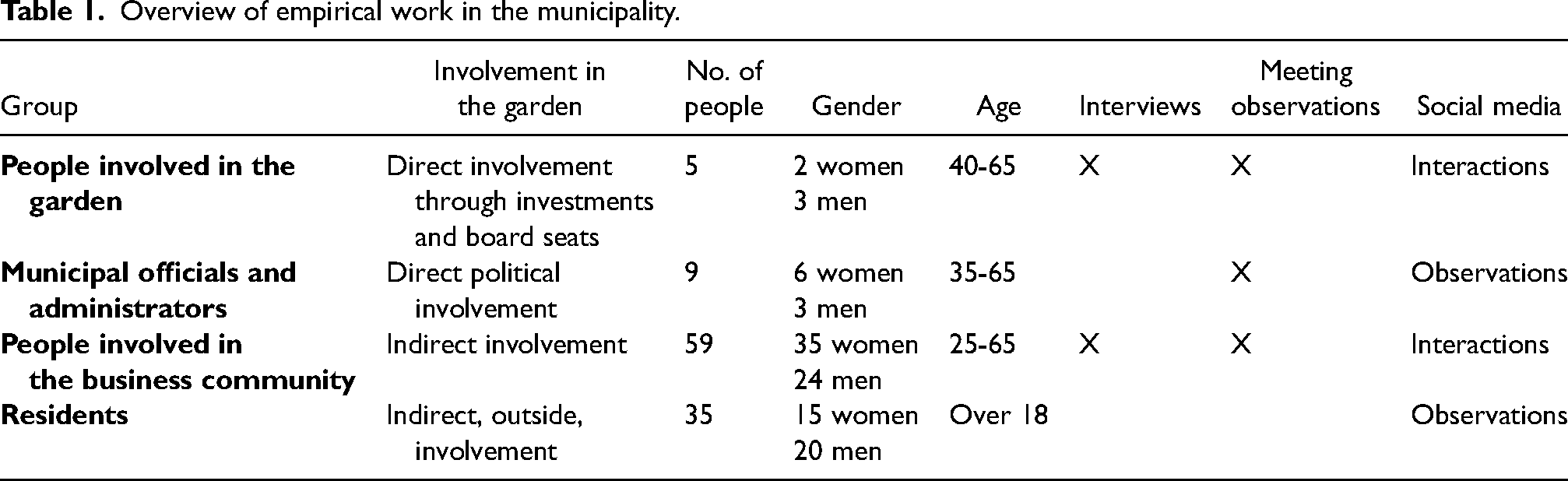
Overview of empirical work in the municipality.
We see our selection as an advantage, since it allows us to focus on influential people in the municipality who drive the garden forward. Nonetheless, we do not claim that we have captured the entirety of the effect that the transformation of the garden has had on the municipality. The focus in the interviews and observations was not on emancipation or empowerment per se, but rather about people’s lives in Oakville and their thoughts on the garden. Notions about emancipation and empowerment emerged after the fieldwork was finished, and as such, we did not let our existing theoretical knowledge influence our fieldwork (Gioia et al., 2013). Instead, we applied the terminology of emancipation and empowerment in one of the analysis steps, as we will present below.
Furthermore, we attended two breakfast meetings held by the municipality, enrolled in e-mail lists, attended fairs, shopped in local stores, monitored events in Oakville through Facebook groups, connected with people through various social media outlets, and read the local newspaper.
In order to get both retrospective and contemporary accounts relevant to our theoretical interest (Gioia et al., 2013), we set out to determine how local residents talked about the transformation of the garden, as we were interested in how empowerment and emancipation took form. As such, the residents’ reflections on Oakville include accounts of both the retrospective and present changes at the garden. Their stories revealed opinions and visions for the future direction of the garden and Oakville. The transcribed interviews and field notes were organised according to the procedure used by, for example, Müller (2013) and Tunberg (2014), using the Nvivo software package. We then analysed the identified codes using temporal bracketing analysis, linking events, sequences and narratives together (Langley, 1999) to form a basis of empowerment and emancipation in Oakville. Temporal bracketing allowed us to simultaneously focus on the mutual linkage among key events (Langley, 1999) and hence focus on the mechanism between these events (Pozzebon & Pinsonneault, 2005). The temporal aspect in the analysis implies a longitudinal perspective, while the bracketing implies sequencing (Bizzi & Langley, 2012). In this overview of the development of the garden (see Figure 1), we focus on the gendered aspects that are relevant to this paper.
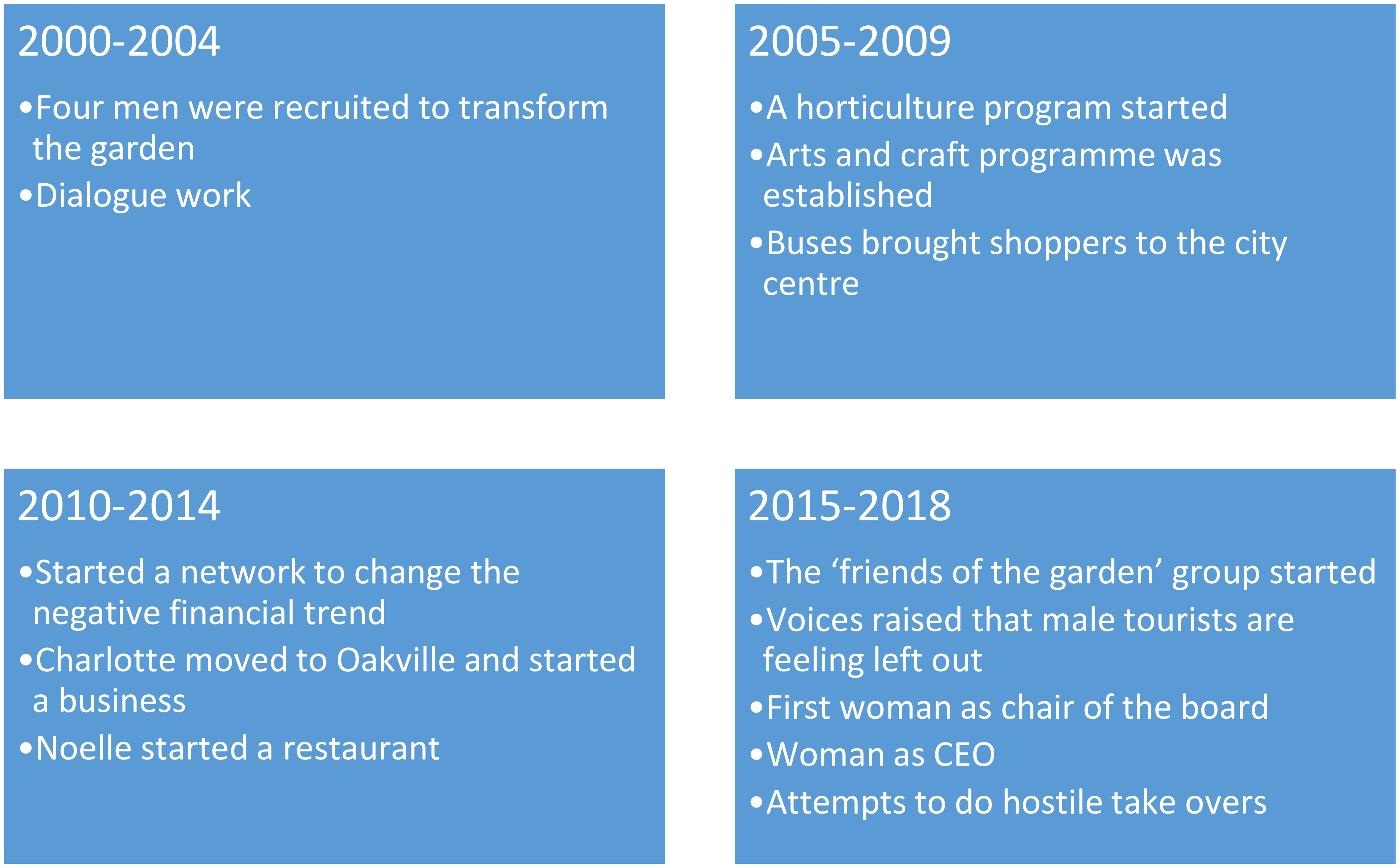
Key events in the development of the garden.
We consider these key events our first order themes (Gioia et al., 2013). These themes are then linked to create second order themes, firstly to identify how they are related to each other and secondly, how they are related to entrepreneurship, gender and spatiality. This analytic step is done once more, and the third order themes emerge. See our data structure in Table 2.
Data structure.
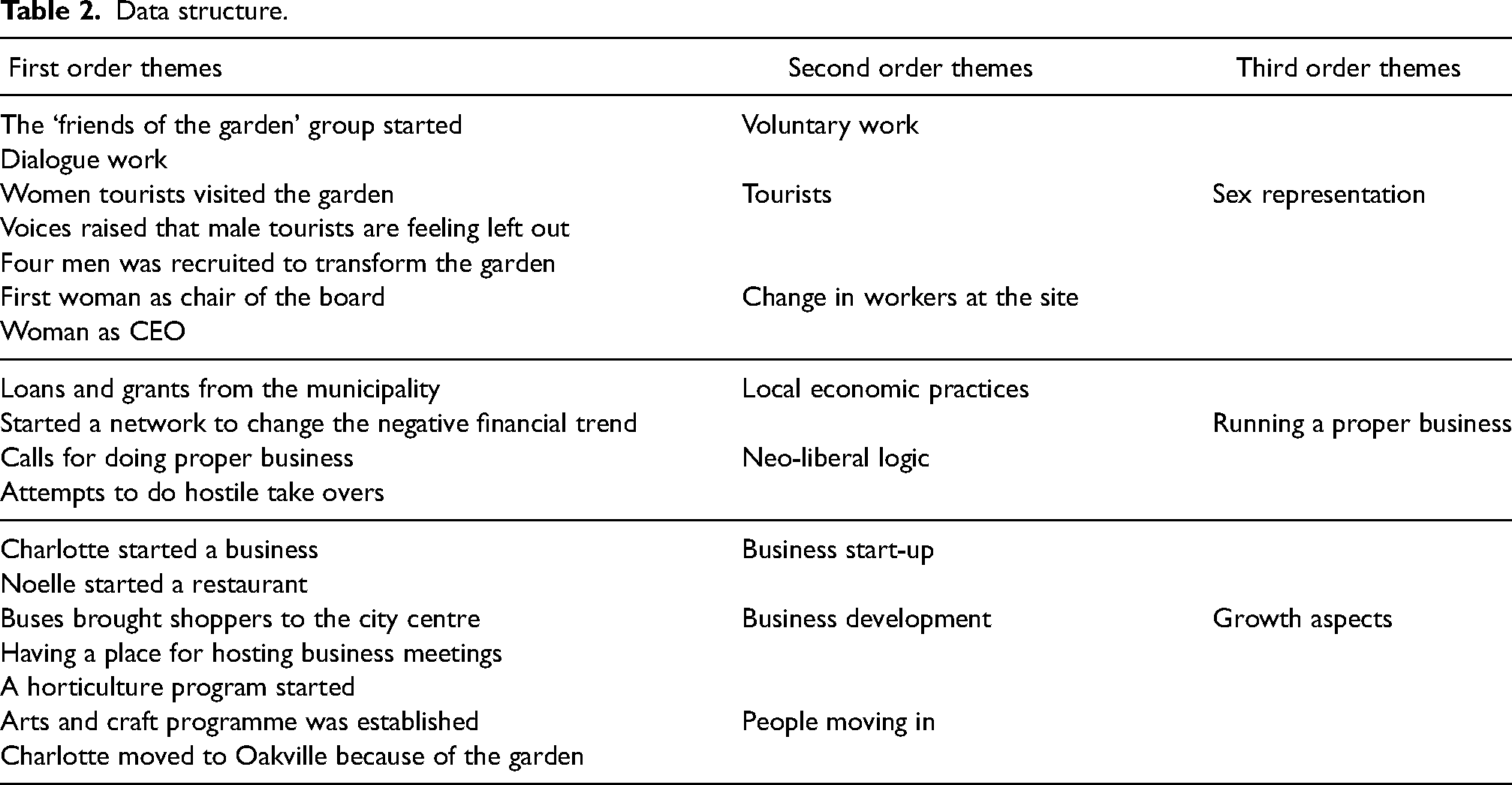
Finally, we revisited the empirical material and extended our key events with more empirical material such as quotes and examples. This is the reason for why some first order themes in Table 2 are missing in the key events in Figure 1, they are added not as a key event but as empirical material adding breadth and depth to our analysis and hence themes.
The small town of Oakville has a long, industrial history dominated by large employers. From the town’s early industrialisation in the 1600s up until the late 1900s, the dominant employers in the area have been heavy industries, such as iron works, forestry and plastic manufacturing. In parallel with industrial development, small businesses and farms filled the gaps in the regional economy. In the late 1990s, large-scale industrial production left the municipality for regions with a more competitive cost structure. After the departure of Oakville’s industrial base, the area turned to the hospitality industry to fill the gap, an industry that is based on small businesses (cf. Bensemann et al., 2018).
Around the turn of the 21st century, municipal officials took the initiative to turn the old ironworks into a garden for both locals and visitors. They assembled a team of locals and returnees, which succeeded in turning the premises into a garden that engaged locals and visitors from around the country. In addition to being a tourist attraction, the garden was also a springboard for other tourist related businesses, such as restaurants and local handicrafts. As in all hospitality-related businesses, the new attraction had ripple effects in other business sectors. Over the years, the development of the garden has occasionally encountered obstacles. Most people in the town have some relationship to the old ironworks or to the new garden, for example, a resident with relatives who worked in the forest industry, a resident who moved to the municipality because of the garden, or a resident who helps care for the roses. The garden has occasionally received funding through local projects and occasionally through regional or national funding. When funding has primarily come from local sources, criticism has emerged, and two camps have developed in the municipality – one camp in favour of the garden and one opposed.
Sex representation
During the first few years, when the garden was being built, volunteer efforts were extensive. Marina, who owns a contracting company and was engaged in the transformation, explains: Many people were involved in the transformation, and there was a lot of dialogue going on; on many different levels, and people felt very involved in the development.
As a result of the dialogue process, it was women in particular who took over the old ironworks. Women engaged in volunteer work and made up a large proportion of the visitors to the developing garden. Over the years, the level of local engagement has oscillated, but no matter how much controversy the garden has caused in the municipality, women still visited the garden. Tourists who visited the garden were almost exclusively women, until some men in the municipality voiced concerns that male tourists were starting to feel left out: “We should have traditional old geezer 1 activities, maybe a tractor show, something like that, so you don't have to follow your wife around”, and “Roses are not enough; we need something more”, implying something other than a garden, not roses per se.
A few years ago, a volunteer group emerged (The Friends of the Garden), which included old and new faces and was formed under the initiative of the governing body of the estate. As one resident expressed it, the group was formed to “invite residents to dance”. Some sixty people attended the first meeting and formed an association to develop the business concept for the garden. They aimed to add diversity to the activities offered at the garden in order to draw more tourists like a ‘proper business’. However, there were also calls to engage local volunteers and bring in help for all kinds of events. The association resolved that the garden was not to be run like a traditional business, but should include voluntary participation. Mary, a former storeowner and now a property owner, talked about her involvement in the group: It means that we will be ambassadors for the garden, and then we will have various events where we can help and yes, support them in the best way possible.
In recent years, the effect on the population of visitors coming to the garden is also reflected in the workforce at the garden. In the beginning, there were four men who were recruited to transform the ironworks into the present day tourist site. However, in 2016, the person elected as the chair of the board was a woman (Paige), an engaged entrepreneur well known in the municipal business community. She owns a company in the public health sector, which is one of the largest two companies in Oakville. Paige talked about the background for the board appointment: My business has become so big, and I started to think that I should have a board that does not only consist of my husband and myself. Since I know very little about board work, I would need to learn and take a lot of courses. Yes, you can do that, but I would probably benefit more from seeing how it can be done. Then that question came at just the right time. So, I thought learn by doing. Then I can hopefully do some good and get some insight into what it can mean to have a board in a limited company.
A year later, in 2017, a woman CEO was recruited. These two events, together with a more gender-balanced work force, meant that the historical all-male domination of the estate was dissolved.
Running a proper business
The financial situation of the garden has been a subject of debate since its start, and locals have had opinions about how the garden should be run in order to make a profit. Veronica, a life coach, elaborated on this by saying it is important in small towns to have something to be either for or against, and in Oakville, it is the garden: It's not that there's anything wrong with being critical. It may a good thing, and to discuss and protect what the taxpayers are going to pay for is not wrong. Because a lot of tax money ends up in the garden. And we are a small town […] so, the garden is like a burden, and we have an ongoing discussion about how to solve it.
Critics said that the garden was not making enough money, which assumes that the garden should be run like a business and be self-sufficient. This debate concerned a number of issues, such as changing the organisational structure of the garden, complementing the direction of the business, the fairs that the garden should be represented at (and not represented), whether cabins should be built in collaboration with municipal businesses, whether cabins should be rented, what kind of food should be served in the restaurant, and what painting contractor the garden should employ. Gregory, who owns a food production facility that is one of the two biggest companies in Oakville, exemplified this view stating, “The way the garden has been run from the start until the summer of 2014, it can no longer be run”. This discussion implied that the people at the garden did not know how to run a ‘proper business’. The discussion around financial stability has been raised frequently as has the question of turning the garden into a city park. One outcome of this debate was the start of a business network, where one of the focuses was changing the negative financial trend at the garden. As one municipal official said, “Via the network, entrepreneurs can provide feedback to the garden; it has been requested”.
Some saw the ‘proper business’ discourse as a measure to support the engine of the municipality’s economy, while others saw it as an oppressive and controlling discourse. This two-sided debate became especially evident in 2016 when the municipality decided on a new grant to lift the garden out of financial difficulties. This was not the first time this had happened. Nevertheless, there were strong opinions in the municipality about providing additional funding to the garden. Debate articles were printed in the local newspaper and there was a heated debate on social media. In our meetings and interviews, those in support of the grant expressed feelings of relief that the garden had survived once again. The following three quotes are examples of this sentiment: It is not possible to run such an endeavour without a grant, hence a very positive message from the municipality, that they will grant the money. – Chris (a former business owner)
This is what I think about what is written in the newspapers, when people send in angry opinion pieces; I think it is primarily aimed at the municipality. They don’t think the municipality should invest in this type of activity. We need healthcare, school and welfare, nothing else. Then you write a lot of opinion pieces and criticism aimed at the municipality, even though you are writing about the garden. – Paige
There are political thoughts that the garden should not cost taxpayers too much money, but it is fantastic to have such a nice facility that can be developed. – Iliana (retired)
These debates culminated in serious conversations among some entrepreneurs to try to take over the garden and its facilities. Gregory had the idea to buy the garden by himself: “When they have failed for 14 years, it is fun to show that it is possible to run it with a profit”. According to Gregory, what stopped the takeover was that “you have to have some money for that. I do not have it now since the sale of my company did not go as planned”. Instead, Gregory and some other entrepreneurs pushed for a renewal of tourism in Oakville, where all tourist activities should be part of the same company.
Growth aspects
One of the goals of the garden was, and still is, to be one of the building blocks in turning around the declining trend in population. The garden was one factor in the municipal strategy to attract new residents: It is a place where we can have events such as midsummer celebrations. If we take care of the place properly so it is nice, and we show it off to people who come here. When we bring relatives and friends here, they may think that this is a nice place, I can live here, and I can imagine living here.
– Paige
One measure the municipality took was the establishment of a horticulture programme, which brought new people to the town. As one municipal official put it when discussing the new people coming to Oakville, “The students there bring new ideas to a fairly small municipality”, and “The students are different people than we are used to”. The people enrolled in the garden education programme were not the same people who had worked at the ironworks. We saw that the new residents changed the human structure of the municipality.
The establishment of the garden led to business start-ups. For example, Charlotte moved to the municipality to be closer to nature. For her, the garden was a very positive factor when choosing where to move. The closeness to nature enabled her to start a beekeeping business. The garden, with its restaurant, served as a place for hosting professional business meetings and was something to be proud of. She started her business in order to be able to focus on something other than her challenging day job. During our fieldwork, she started working part-time to focus on her business and to get products out for sale, such as cosmetics made from honey and beeswax. The garden was one of the places where she sold her products.
Another business start-up with close links to the garden is a restaurant run by Nora and her husband Jack. Nora worked four or five seasons at the restaurant in the garden before she decided to open her own restaurant at a neighbouring site. She said “I wanted a niche, for myself, and to be able to control everything by myself. I wanted to start a business for a long time.” Being part of the work force at the garden meant that she was able to start her own business nearby. As she states, “Because of our history, we don’t see each other as competitors. Instead, we help each other by recommending the other if one of us is closed or fully booked”.
Discussion
A garden is per definition grounded in a particular geographical position. The spot has a history, or rather several histories about what has happened over the years and how this may matter today and in the future. The stories we collected about the garden were discursive in the sense that firstly, they reported on what was happening, secondly, conditioned what the next story was built on, and thirdly, opened up space for what was to come. As Anderson (2000) suggest, local stories are resources to draw from. In Oakville, we saw how the stories worked as breeding ground for growing resistance against the discourses “running a proper business” and “growth”. This neo-liberal discourse advocated for at the garden is a gendered discourse, as it adheres to masculine norms of society (Smith, 2010; Jernberg et al., 2020). We viewed the voluntary work in the garden as entrepreneuring, and from these activities we saw empowered women and processes of emancipation; the historically grounded gender structure was provoked as a result of the developing garden. The spatial setting had a memory and the changes happening around the garden put those old structures under scrutiny. Thus, time was a crucial factor in the empowerment and emancipation process happening in Oakville. In this way, the resistance from the old ironworks became a foothold for testing new solutions and building new arguments. We have illustrated how the old ironworks became a nest for new provoking positions, how entrepreneuring allowed empowered locals to nudge emancipation in a good direction. In our case, this process was manifested in the actual soil of the garden (Gaddefors and Anderson, 2017).
Voluntary work in the garden was a way to resist the proper business discourse and the growth discourse. When the old ironworks was turned to a garden, new people took over and we saw emancipation at work. As such, the people partaking in entrepreneurial practices in Oakville have changed over time. There was a transition we might say, from male iron and forestry workers to women and men gardeners, volunteers and chefs. The sex representation on the site has thus changed, and challenging gender inequalities (emancipation) are more possible now. We are certain the three Es were in motion before the garden was established, or we arrived in Oakville. Nonetheless, the garden increased the magnitude of the three Es, and thus helped us to investigate what was happening. We observed deliberate, collective processes (Al-Dajani et al., 2015; Alkhaled and Berglund, 2018; Ojediran and Anderson, 2020) that developed the estate. However, we also saw how coloured assumptions and prejudices about gender linked to the old ironworks was negotiated. The small everyday actions of emancipation (Ozkazanc-Pan, 2014), what Alvesson and Willmott (1992) phrased micro-emancipation, emerged in the dialogue. In our case, the collective process (Datta and Gailey, 2012; Al-Dajani et al., 2015) released a power in the locals involved that resulted in emancipation.
We observed how the local conflicts between the old structure and a new developing alternative empowered women to accelerate the pace of change and increase the workload (Ojediran and Anderson, 2020). Locals agree that the garden has had a positive effect in the sense that it attracts new people to the small town. This ripple leaves a positive mark in the municipality statistics, for example, in number of residents and increased tax revenue. Furthermore, new residents also open the door to change and contribute a new voice in the authoring of place (Gaddefors & Anderson, 2017).
The idea of the garden as a “proper business” is multifaceted. One cornerstone is that all businesses must make a profit in order to stay in business. However, entrepreneurship produce a number of values, not monetary only (Korsgaard and Anderson, 2011). Second, does the garden want to be “a proper business”? If we acknowledge the emerging garden as a way to emancipate people from dominating structures (e.g. the growth discourse) and a place that promotes the empowerment of women, how are we to categorise this entrepreneuring? If not a proper business, is the garden a municipality concern? In the political sphere, the garden offers a range of services that are difficult to accomplish, such as teaching local schoolchildren about gardening, offering employment opportunities to the long-term unemployed, inviting municipal citizens to Midsummer and Christmas celebrations, thus serving as a garden for all residents.
We have chosen the garden as our unit of investigation and in our story, establishing the garden seems to be the stone that set the ripples in motion. Departing from a particular place helped us to see the local, empowered actions and emancipatory changes. We could identify spaces of autonomy (Spicer et al., 2009) created through entrepreneuring. When we view emancipation from oppressive gender structures as entrepreneuring through a spatial lens, we get a more elaborated view on the gender work in Oakville. The change process of the garden was strongly tied to the spatial factors presented by its location in Oakville.
Conclusion
We have illustrated through a case study, the garden in Oakville, how entrepreneuring empowered women and moved the community closer to emancipation. In this way, our approach aligns with most entrepreneurship researchers in viewing entrepreneurship as social change, both for individual women and for society (Roos, 2019). However, in contrast to other entrepreneurship research, we observed that the pace of change is slow. Over the years, we saw major leaps forward, but also considerable drawbacks. Thirdly, we have integrated the spatial context in discussions about empowerment and emancipation. This helps us present a spatially anchored explanation of how context is part of a form of entrepreneuring that is connected to empowerment and emancipation.
We argue for an understanding of emancipation from oppressive gender structures as an entrepreneurial process strongly influenced by spatial factors. Investigating emancipation as a spatial process highlights spatial aspects of autonomy and change and constrains the collective into a limited place, making change more visible. We uncover connections between empowerment and emancipation by viewing emancipation from oppressive gender structures through entrepreneuring with an emphasis on the spatial context. Overall, these results corroborate the recent work of Alkhaled and Berglund (2018) and Ojediran and Anderson (2020) by illustrating and discussing the connection, and lack of connection, between empowerment and emancipation.
We expand on previous research on entrepreneurship which views it as a context-dependent change process by including empowerment and emancipation. While parts of the garden were organised as a business, we observed local activities that extend beyond the realm of business. The spatial aspects of entrepreneurship invite us to consider a more inclusive view of change, as we focus on processes in Oakville, not only in a business (Roos, 2017).
In our case, men were important players. When discussing gender, both empowerment and emancipation are viewed as women’s empowerment and women’s emancipation, which is especially evident in literature on entrepreneurship. Men are not seen as in need of empowerment or emancipation from oppressive gender structures, because they are usually seen as having the power and freedom they need within the gender structures (Hearn 1998). However, as gender is a construction involving and affecting both women and men (McAdam & Marlow 2013), then empowerment and emancipation is a concern for men as much as it is for women. In future studies, we welcome the incorporation of men and masculinities into the discussion of empowerment and emancipation through entrepreneuring.
Footnotes
Acknowledgements
We would like to thank the editor and reviewers for believing in our initial idea and for giving our paper a chance. It has been a wonderful journey developing the paper together with you. We would also like to thank Prof. Natalia Vershinina, Prof. Jeaneth Johansson, Dr Robert Smith, and Dr Natasha Webster for their comments and encouragement on an early draft of this paper. Lastly, we would like to thank Hina Hashim for her critical questions on the first draft of this paper.
Declaration of conflicting interests
The author(s) declared no potential conflicts of interest with respect to the research, authorship, and/or publication of this article.
Funding
The author(s) received no financial support for the research, authorship, and/or publication of this article.
