




Abstract
Although scaling is a “hot topic” in the practitioner literature, it has largely been ignored (at least explicitly) in the academic literature. This editorial highlights the importance of organizational scaling, which we define as “spreading excellence within an organization as it grows.” Specifically, the entrepreneurship field would benefit greatly from future studies that explain how knowledge management facilitates scaling; how scaling is influenced by founder replacement; and how current scaling influences the drivers of subsequent scaling. We eventually link the scaling of organizations to the scaling of social impact.
Scholars have long been interested in explaining why some firms grow more quickly than others. However, already 10 years ago, McKelvie and Wiklund (2010, p. 261) concluded that the “development of firm growth research has been notably slow. . . . A major reason for this lack of development is the impatience of researchers to prematurely address the question of ‘how much?’ before adequately providing answers to the question ‘how?’” Despite a large number of studies on new venture growth, the “how” is still poorly understood to date. In particular, for ventures that grow organically (i.e., not through external acquisitions), addressing the how is critical because doing so can provide ventures a roadmap of the actions necessary to expand their operations quickly. The challenge of growth is that it creates the “problem of more,” as reflected in the following issue expressed by Google executives: “How will this work when we are ten times or a hundred times bigger? . . . Let’s not decide based on what will be best now, let’s decide on what will be best in two or three years” (Rao & Sutton, 2014, p. 18). Addressing the problem of more requires scaling. Building on Rao and Sutton’s (2014) discussions with practitioners, we define
In this editorial, we offer a framework to organize our thinking about the future of entrepreneurship research on scaling. Specifically, we suggest research on organizational scaling as a way to explain how new ventures grow organically and that this topic is of critical importance for the continued development of the entrepreneurship field (and also in connecting entrepreneurship research with strategic management and other management scholarship that focuses on large, established organizations). Furthermore, because entrepreneurship is more than simply the generation of positive organizational outcomes, we extend our discussion of the scaling of organizations to scaling of social impact—that is, to growing social ventures. By offering this link, we suggest an agenda for future research that explores the interdependencies between organizational scaling and social-impact scaling.
A Framework for Future Research on Scaling
In Figure 1, we present our framework for future research on scaling. In the center of the model is organizational scaling. Because scaling involves the spreading of excellence as the organization grows and excellence is manifest in knowledge (such as schemas, routines, systems, and norms), we propose the drivers of organizational scaling (solid boxes and solid arrows) include accumulating, communicating, relocating, and connecting knowledge. We also note that venture founders may be replaced by professional managers who possess the knowledge required for scaling. Moreover, we explore additional future research opportunities from potential “feedback effects” (the dotted-line arrows). Finally, we explore scaling organizations in the context of a social problem—namely, we link organizational scaling to social-impact scaling as a suggested direction for future research to advance the entrepreneurship field.
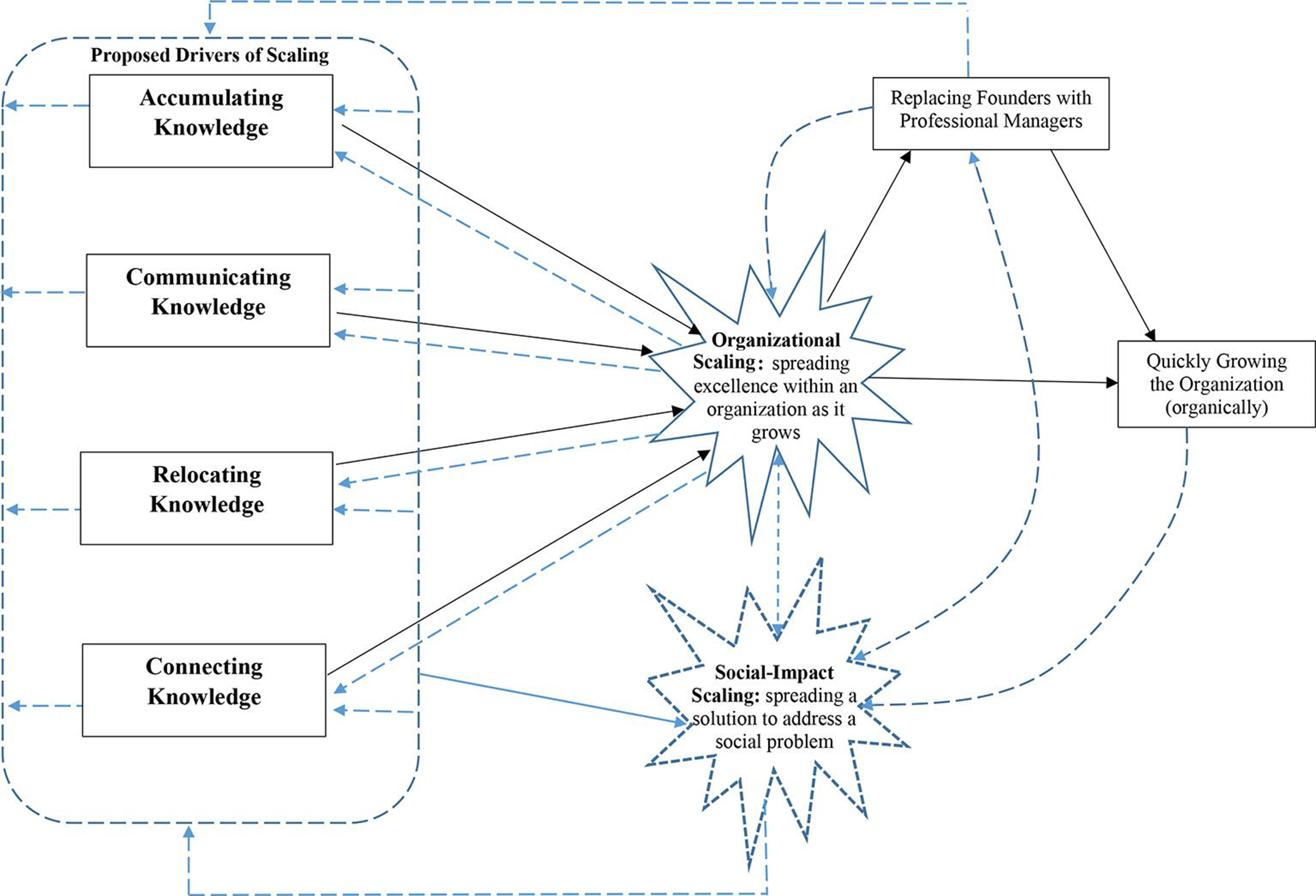
A framework for future research on the scaling of organizations and the scaling of social impact.
Future Research on Accumulating Knowledge and Organizational Scaling
Discussions of organizational learning and knowledge transfer often start with experience, particularly how “organizational experience interacts with context to create knowledge” (Argote & Miron-Spektor, 2011, p. 1123). Organizational learning results in a positive change in this knowledge and often occurs as organizations gain additional experience acquired directly by engaging in tasks (i.e., experiential learning) and indirectly by observing others engaged in tasks (i.e., vicarious learning). Future research can explore the activities that promote the accumulation of experience as well as how these activities are learned (from doing and observing) and how they impact organizational scaling. For example, how does a venture engage members in activities central to its source of excellence in a way that best promotes the members’ learning and then enact these “excellence” activities to achieve rapid growth? That is, how are some ventures able to promote the sort of learning by doing and learning by observing that rapidly transfers the knowledge underlying their key sources of excellence? Perhaps future research can build on theories of deliberate practice (e.g., for entrepreneurs, Baron & Henry, 2010) to explain why some experiences, conditions, and feedback are more effective for transferring knowledge critical to scaling than others. Similarly, scholars can build on research on mentoring (e.g., for entrepreneurs, Sullivan, 2000) to explore how ventures can structure learning experiences to better promote the organizational scaling process. On the flip side, it is important to explore ventures’ failure to offer their members opportunities to engage in or observe the activities central to their excellence and to implement the knowledge transfer necessary for scaling. Therefore, future research can increase our understanding of how ventures promote the accumulation of organizational members’ experience (direct or indirect) as a means of transferring knowledge for scaling.
Future Research on Communicating Knowledge and Organizational Scaling
While learning can be passive based on experience and observation, it can also be a more deliberate cognitive process of both knowledge articulation and codification (Zollo & Winter, 2002). However, only a small fraction of articulated knowledge is codified, and even when knowledge is successfully codified, it appears difficult to transfer (Szulanski, 1996). We suggest that ventures differ in their ability to transfer knowledge for organizational scaling, and we hope that future research explores these differences. Specifically, future research can investigate in which way and under what contextual conditions knowledge articulation and codification promote organizational scaling. For example, given that so few firms can articulate knowledge (and therefore do not codify this knowledge), we encourage scholars to explore why some ventures, even with limited resources, are able to more effectively articulate and codify knowledge such that it more effectively spreads amongst organizational members than other ventures. Such a research stream can increase our understanding of how the activities underlying effective knowledge articulation and codification differ for declarative and procedural knowledge as well as what types of knowledge are particularly important to be articulated and codified to promote scaling and under what environmental conditions. Perhaps an attention-based perspective (Shepherd et al., 2017) can help future studies better understand why some ventures are more effective at articulating and codifying (some types of) knowledge than others. Alternatively, a practice perspective (Sandberg & Tsoukas, 2011) or the literature on organizational routines (Pentland & Feldman, 2005) might help uncover the knowledge-articulation and codification activities and mechanisms that underlie an effective scaling process.
Furthermore, future research on how knowledge is communicated within an emerging organization can make important contributions to our understanding of scaling. For example, what types of communication are most effective for facilitating scaling and for what ventures (e.g., dependent on the ventures’ resource scarcity, technology, industry)? How often and by whom should different types of communication be applied, and what types of knowledge require what types of communication? Furthermore, future research can explore the potential trade-off between internal knowledge transfer for scaling and external knowledge transfer for competitor imitation. Perhaps there are means of communicating a venture’s excellence to internal members without disclosing it to external members (e.g., secrets)—an important topic for future research.
Future Research on Relocating Knowledge and Organizational Scaling
Relocating knowledge repositories (i.e., people, tasks, tools, and templates) appears to be an effective knowledge-transfer mechanism within organizations (Osterloh & Frey, 2000) and therefore may help facilitate organizational scaling. Future research can explore the mechanisms and moderators of the relationship between relocating knowledge and scaling. For example, why does relocating a knowledge repository work for some ventures, some repositories (i.e., people, tasks, tools, and templates), and some knowledge content, and not for others? Perhaps there are differences in the way knowledge repositories are relocated, such as differences in (1) the nature of the relocation (physical, virtual, supported, etc.); (2) the timing of the relocation and the preparation period for the transition; and (3) the relocation destination in terms of, for example, proximal members’ receptivity to the “new” repository and the knowledge being transferred.
While we have some understanding of how people are knowledge repositories and can be relocated, substantially more research is needed on the relocation of the other knowledge repositories (i.e., tools, tasks, and templates) in scaling ventures. Again, future research can build on theories of practice (Sandberg & Tsoukas, 2011) to investigate tools as knowledge repositories to explore their relocation within ventures for scaling. Similarly, scholars can build on studies of mental models (Johnson-Laird, 1980), micro-foundations of routines (Felin et al., 2012), and dynamic capabilities (Helfat & Peteraf, 2003) to investigate the contents of “templates of excellence,” how they can be relocated, and why some relocation efforts are more effective at promoting scaling than others. We also wonder whether theories of task autonomy (Zhou, 1998), complexity (Wood, 1986), and adaptability (Griffin et al., 2007) represent useful theoretical foundations for exploring tasks and their relocation as a means of knowledge transfer for scaling.
Future Research on Connecting Knowledge and Organizational Scaling
As scaling involves spreading excellence within a growing venture, venture members’ ideas, efforts, and work need to be connected with those of other members. The personal connections inherent in social capital provide a basis for transferring knowledge within an organization. Therefore, perhaps scaling is enhanced for ventures with higher intra-organizational social capital (i.e., structural, cognitive, and relational) than ventures with lower social capital. Future research can build on the substantial literatures on social capital (for a review, see Kwon & Adler, 2014) and social networks (for a review, see Burt et al., 2013) to theorize and empirically investigate the social connections that promote knowledge transfer within organizations for scaling. For example, while entrepreneurship research (Lee et al., 2019; Smith et al., 2017) has focused on the social capital and networks outside organizations (to access capital and other resources), we suspect that greater scholarly attention is needed on the social capital and networks inside ventures to better explain how organizations scale and why some are better able to use their internal relationships to do so. We are not suggesting that external relationships are unimportant to scaling but that future research needs to explore (1) how internal relationships foster knowledge transfer for scaling, (2) how the different attributes of ventures’ internal relationships independently and conjointly facilitate scaling, and (3) how external relationships work in concert with internal relationships to facilitate scaling.
As a scaling venture grows to a larger size, formalization becomes an important aspect of designing the organization. Formalization refers to the extent to which organizational tasks are standardized and members’ behaviors are directed by rules and procedures (Mahmoudsalehi et al., 2012). Gittell and Douglass (2012, p. 709) proposed that by introducing formal structures in an organization—for example, in “hiring and training, performance measurement and rewards, job design, conflict resolution, protocols, and meetings”—personal relationships can become embedded into roles and thus facilitate scaling. Therefore, scaling is likely enhanced for ventures that transition from more personal, informal relationships to more formalized relationships to connect organizational members. Even with the benefits of formalization, ventures still face the challenge of formalizing their operations without building an unresponsive bureaucracy, a bureaucracy that obstructs entrepreneurial actions. Although research on formalization has indicated that it may enhance knowledge transfer, it is important for future research to increase our understanding of (1) the limits of formalization’s relationship with scaling (e.g., perhaps an inverted U-shaped relationship); (2) the different forms of formalization and the best time to implement them to enhance venture scaling (e.g., earlier or later, gradual or rapid); and (3) more generally, the reasons formalization might facilitate scaling in some ventures but not (or less so) in others. In exploring these research questions, it is important to explore both the pros and cons of formalization for venture scaling.
Although we have emphasized the importance of relocating knowledge repositories for scaling, the new locations will likely need to adapt to these people, tasks, tools, and templates. Rao and Sutton (2014, p. 52) emphasized the need for adaptation when scaling in the following quote: “While each decision unfolded differently, our analysis always seemed to end up in the same place; the trade-offs and tension between encouraging and forbidding departures for some template, practice or behavior took center stage.” Such trade-offs and tensions are a trigger for improvisation that may facilitate the knowledge transfer necessary for scaling. Therefore, improvisation can represent a mechanism of scaling in that it enables growing ventures to quickly enact change to fit with their changing environments (internal and external). That is, scaling generates internal organizational changes at the intersection of an organization and its external environment—an external environment typically characterized by dynamism and complexity for growing firms. As for formalization, research on the relationship between improvisation and scaling needs to explore the limits, pros and cons, and contingencies of this relationship to gain a deeper understanding of the connections that promote scaling.
Future Research on Organizational Scaling and Founder Replacement
Much has been made of founders’ influence in creating new ventures because founders make the key decisions that influence their organizations’ early development. However, starting a venture and scaling a venture are different tasks requiring different skills, experience, and knowledge. Indeed, investors ask the question of whether a focal founder can perform both tasks—starting and scaling a venture. Conventional wisdom suggests that the answer to this question is often “no”—as an organization transitions from start-up to scale-up, the expectation is that the leadership of the organization needs to transition from creativity/exploration to exploitation, from a single individual and tightly centralized decision making to a team of executives with participation and delegation in decision making, from “passionate commitment” to “dispassionate objectivity,” and from an entrepreneurial management style to a professional management style (Churchill & Lewis, 1983). Paradoxically, Wasserman (2003) found that the more successful the CEO-founder, the more likely it was that he or she would be replaced by a professional manager. Specifically, for CEO-founders, success generally involves raising funds from outside investors, investors who desire (and use ownership power to accomplish) the transition from founder-CEO to professional CEO. We also note that founders can voluntarily exit their ventures. Therefore, future research can further explore the relationship between scaling and founder exit by investigating the mechanisms and moderators of this relationship.
Specifically, we hope future research can explain how the decision makers who push out a founder (1) assess organizational scaling (i.e., speed, efficiency, or some other measure of effectiveness), (2) determine the founder is less capable of subsequent scaling than a professional manager, (3) decide whom to hire as the professional manager and when, and (4) judge some professional managers to be more effective at continuing the scaling effort than other professional managers. Such research can build on the literatures on founder exit (Wennberg et al., 2009), CEO succession (Wasserman, 2003), and investor decision making (Kaplan & Strömberg, 2001) to gain a richer understanding of how scaling progress influences the composition of ventures’ management teams.
Although the effectiveness of scaling likely accelerates founders’ replacement by professional management (which is a form of knowledge relocation), future research is needed to explore the direct and indirect impact of such a change on subsequent scaling. While professional managers are expected to manage the outcome of scaling—a large, established organization—better than founders, we do not yet have a good understanding of the effect of this management change on scaling itself. Only by understanding the influence of founders relative to that of professional managers on scaling efforts we can understand the “best time” to make this shift in venture leadership. Perhaps the choice is a false dichotomy based on the two endpoints without sufficient consideration of the process in between these two anchors. That is, while founders are presumably effective at creating new ventures (e.g., McKelvie et al., 2011) and professional managers are presumably effective at running large, established organizations, perhaps there is a different group of people with knowledge, experience, and skills highly suited for the activities required for scaling organizations. More research is needed into why some scaling efforts are more successful than others, how leaders influence the effectiveness of scaling efforts, and why some leaders are more effective at these efforts than others.
Future Research on the Inter-Relationships and Feedback Mechanisms of Organizational Scaling
Although we realize considerable research is required to explore each (solid) box and its (solid) arrow to scaling (and “from” scaling in the case of founder replacement) in Figure 1, we use this section to highlight the inter-relationships among the proposed drivers of scaling (i.e., the dotted-line arrows) and the relationships between founder replacement and the proposed drivers of scaling, i.e., we speculate on ways in which future research can contribute new knowledge to our limited understanding of organizational scaling.
First, future research can explore how accumulating knowledge relates to communicating knowledge. Indeed, while accumulating knowledge (from learning by doing and learning by observing) can drive scaling, this positive relationship is likely magnified when this knowledge is articulated, codified, or otherwise successfully communicated to other organizational members. Although we recognize that the “tacitness” of experience-based knowledge can obstruct its communication (Nonaka et al., 2009), perhaps the capability of communicating knowledge itself can be enhanced by learning by doing communication activities and observing others engaged in such activities. That is, does observing a founder articulating and codifying his or her knowledge for scaling provide the opportunity for organizational members to learn not only the content of that knowledge (i.e., learn know-what) but also how to articulate and codify their own knowledge (i.e., learn know-how) to further advance scaling? It appears that in scaling an organization, it is highly important that organizational members (and not just the founder[s]) accumulate knowledge on how to articulate, codify, and otherwise communicate their own knowledge to other organizational members.
Second, future research can explore how accumulating knowledge relates to relocating and connecting knowledge. For example, as individuals are relocated to other parts of their organizations, undertake different tasks, use new tools, and engage with new templates, they may learn how to engage in such relocation activities more effectively for the future. Moreover, how do founders (or venture management) learn what knowledge is needed for scaling, where that knowledge resides (e.g., which people, tasks, tools, and templates), and how and where to relocate these knowledge repositories to facilitate scaling? Perhaps founders (or venture teams) know this information from their interactions with people, tasks, tools, and templates and their relocation within organizations. However, perhaps under some circumstances, relocating knowledge diminishes the accumulation of knowledge and decreases the usefulness of this knowledge for scaling. Indeed, relocating to promote scaling may involve discarding knowledge repositories that were useful in the past but no longer are. Rao and Sutton (2014, p. 28) summarized this notion in the following way:
As organizations grow larger and older, as the footprint of a program expands, and as the consequences of past actions accumulate, once useful but now unnecessary roles, rules, rituals, red tape, products and services build up like barnacles on a ship; to make way for excellence to spread, these sources of unnecessary friction must be removed.
Similarly, experience with connecting knowledge can create new knowledge to facilitate scaling through (1) the development of more social capital (role-based and hybrid relationships, Gittell & Douglass, 2012); (2) the development of commonality with other organizational members to create more and richer connections; and (3) the development of skills for improvising new ways of communicating, relocating, and connecting knowledge that promote scaling. By exploring our speculations, future research can generate new knowledge about how to relocate knowledge repositories for effective scaling, the effects of such relocation on the knowledge repositories themselves, and the reasons why some founders and ventures are better than others in doing so.
Third, future research can explore the inter-relationship between communicating and relocating knowledge. If founders’ and ventures’ knowledge are successfully articulated and codified and effective communication channels drawing on repositories (i.e., people, tasks, tools, and templates) are established, is relocating these repositories still necessary for scaling? Perhaps, relocating knowledge repositories facilitates the articulation and codification of knowledge that is useful for scaling. For example, in relocating a tool to another organizational member, the transfer may require at least some articulation of how the tool is to be used and what to do when it breaks down. This articulation is then available to transfer through other communication avenues and to be codified. Indeed, this is where the distinction between the different knowledge repositories may be important—that is, is relocating a tool (as a knowledge repository) more likely to lead to the articulation (and then codification) of knowledge than relocating a person (as a knowledge repository)? Perhaps relocating a tool transfers know-how information through organizational members’ learning by doing, while relocating a person transfers know-what and know-how through other members’ learning by observing. Research exploring the mutual relationship between communicating and relocating knowledge will increase our understanding of organizational scaling.
Fourth, there are many research opportunities to explore the inter-relationship between communicating and connecting knowledge in organizational scaling. For example, communicating knowledge may facilitate the development of connections within organizations for transferring knowledge critical to scaling. In taking the effort to articulate and perhaps codify their knowledge, founders may be making themselves vulnerable to criticism (and perhaps imitation by competitors, Kogut & Zander, 1992), but such vulnerability is often important in increasing audience receptivity to the knowledge being transferred (Curado & Vieira, 2019). Indeed, some of this communication may involve the development of structures such that personal relationships begin to become more role based and transfer social capital from the individual level to the organizational level. In return, connecting organizational members may foster the knowledge articulation and codification and the establishment of communication avenues necessary to promote scaling. For example, how does the transition to greater role-based relationships to connect organizational members influence the way knowledge is communicated in organizations? We hope future research further explores the potential mutual dependence of communicating and connecting knowledge for organizational scaling.
Fifth, there are several potential contributions that can be generated by exploring the nature of the relationship between relocating and connecting knowledge within an organization and the scaling of that organization. While it seems rather obvious that relocating people within an organization helps increase connections through personal relationships and greater shared experiences (Rothman et al., 1985), which likely promotes scaling, it is unclear how relocating the other knowledge repositories—namely, tasks, tools, and templates—impacts connections for scaling. Perhaps relocating tasks helps build role-based relationships that we believe are so important for organizational scaling, and perhaps relocating tools promotes improvisation in the use of those tools for scaling. Indeed, there are ample opportunities to explore how improvisation triggers (or arises from) the relocation of people, tasks, tools, and templates. For example, perhaps improvisation brings together different tools from across an organization to work in concert to enhance scaling. Indeed, research can explore how improvisation may combine (through relocation) (1) different people with different tools, tasks, and templates; (2) different tools with different tasks and templates; and (3) different tasks with different templates. We believe that research into the combinations and re-combinations of knowledge repositories within organizations through improvisation will deepen our understanding of organizational scaling.
Sixth, the change from founder to professional manager can influence scaling through several mechanisms, each worthy of future investigations. (1) Professional managers likely bring a different set of accumulated experience than founders (presumably), engage in management in a different organizational context (as a basis for learning by observing and learning by doing), and serve as a potential source of others’ learning by observing, but they may be less improvisational than replaced founders. Are there trade-offs between replacing a founder with a professional manager and why are some better at managing these trade-offs (if they exist) than others? (2) Not only do professional managers generally have different knowledge than the founders they replace, they may also have greater experience and skills in articulating, codifying, and otherwise communicating excellence to a growing number of organizational members. How do differences in the experiences of professional managers vis-à-vis founders differ in ways that facilitate organizational scaling? (3) Founders relocating out of organizations and professional managers relocating into organizations not only influence the composition and size of organizations’ knowledge repositories but also might encourage new movement of people, tasks, tools, and templates (or the solidification of these knowledge repositories' “locations”). Does replacing the top manager lead to the movements within the organization that promote its effective scaling? (4) Founder loss likely disrupts previous relationships in organizations as professional managers attempt to accelerate the shift to more role-based relationships to connect knowledge; however, professional managers may face some obstacles to scaling due to reduced receptivity of organizational members loyal to founders and to efforts to introduce bureaucracy (for efficient exploitation), which start to drown out exploration (March, 1991). As organizations transition from founder to professional manager, what obstacles to continued scaling do they face and how are these obstacles overcome?
Finally, the drivers of scaling can be influenced by the effectiveness of ventures’ scaling efforts. Scaling provides (1) more and different tasks for organizational members to do and more organizational members performing different tasks to observe (and therefore opportunities to learn); (2) a greater need for tacit knowledge to be articulated, articulated knowledge to be codified, and communication efforts to reach a larger (and perhaps more diverse) set of knowledge recipients; (3) the opportunity not only to relocate people, tasks, tools, and templates within an organization but also to bring in new knowledge repositories from outside the organization and perhaps adapt or “relocate out” people, tasks, tools, and templates holding knowledge that is no longer needed; and (4) the opportunity to connect existing organizational members with new organizational members and with members from different parts of a growing organization. In exploring these feedback effects (and the nature of the mutual relationship), future research can gain a deeper understanding of scaling and also the scaling of accessing, communicating, relocating, and connecting knowledge. These feedback effects are important because they highlight (and have the potential to inform us about) the dynamic nature of the scaling process as new, small ventures become established, large organizations.
Future Research on Scaling Organizations and Scaling Social Impact
We acknowledge that there has been a stream of research explicitly investigating scaling in the (sub)field of social entrepreneurship—scaling social impact (Dees et al., 2004; Smith et al., 2016). Scaling social impact refers to “increasing the impact a social-purpose organization produces” (Dees, 2008, p. 18). While we mainly focus on scaling organizations in this editorial, we want to take the opportunity to link organizational and social-impact scaling to explore additional important research questions. For example, in the social entrepreneurship literature, scholars have noted that while many social ventures have been started, few have successfully experienced scaling, thus making scaling one of the most important yet least understood topics in social entrepreneurship (Smith et al., 2016). To gain a deeper understanding of scaling we believe it is important for scholars to be explicit about what is being scaled. For example, a social venture can be terminated (and thus experience no or “negative” organizational scaling), yet other actors may continue to widely disseminate its social solution such that the social venture was successful in scaling social impact. Therefore, especially in the context of social entrepreneurship, researchers need to be clear in their studies about whether scaling refers to social-impact scaling (i.e., the transfer of social solutions, often to new geographical locations) or to organizational scaling (i.e., the transfer of excellence within social ventures as they grow).
We hope that future research will explore the relationship between scaling organizations and scaling social impact. If we recognize the time and energy required to scale an organization, then perhaps there is less time and effort available to invest in diffusing that organization’s social solution and forming affiliations for others to exploit the solution in new geographic regions. That is, is there a trade-off between scaling an organization and scaling its social impact? Alternatively, perhaps scaling organizations is complementary to scaling social impact. That is, in spreading excellence within an organization as it grows (organizational scaling), perhaps it becomes easier to disseminate, affiliate, and brand its social solution (i.e., strategies for social impact, Dees et al., 2004). Under what conditions—social opportunities, social entrepreneurs, social ventures, beneficiaries, and external environments—are scaling an organization and scaling social impact complementary?
Furthermore, future research on social-impact scaling needs to explain how a social venture promotes the transfer of its knowledge (presumably of a solution to a social problem) to external actors. For example, external actors can learn by observing the focal social venture exploit its social opportunity and then learn by engaging in the tasks of exploiting such a social opportunity. For the social venture, the question then becomes how it can best make its actions (to solve the social problem) observable by external actors. Perhaps the social impact of the social venture generates greater visibility of its actions, making observation more likely and increasing other actors’ motivation to give it a try. In this way, initial social impact begets social impact through the mechanisms of learning by doing and learning by observing.
Second, while commercially focused organizations may be concerned about competitors imitating their articulated and codified knowledge, these very concerns likely increase the usefulness of these mechanisms in scaling social impact. That is, as articulating and codifying knowledge facilitate the transfer of excellence within an organization (organizational scaling), these activities also facilitate the transfer of excellence (e.g., the essence of excellence underlying a social solution) to those external to the social venture. How can social ventures articulate and codify their knowledge of social solutions to maximize this knowledge transfer to external actors? Are articulation and codification different for commercial versus social opportunities, for internal versus external audiences, and for know-what versus know-how? Much future research is needed on social ventures’ communication in promoting social-impact scaling.
Third, while knowledge repositories—people, tasks, tools, and templates—appear to apply to social ventures, there are likely greater challenges in relocating these knowledge repositories for scaling social impact than for scaling organizations (a proposition worthy of further theorizing and empirical testing). For example, while it appears relatively simple to relocate people within an organization, it may not be as simple to relocate a person to another organization. Do social ventures relocate key personnel to other organizations to scale social impact, and if so, how? Perhaps these people (as knowledge repositories) “visit” other organizations as “social solution ambassadors” or spin out (alone or with others) from social ventures to other organizations on a more permanent basis to scale social impact. We hope future research also explores how a focal social venture can relocate tasks, tools, and templates outside the organization to facilitate the knowledge transfer necessary for scaling social impact.
Fourth, research on social impact has already recognized the importance of social capital (e.g., Smith et al., 2016). We offered formalization and improvisation as additional mechanisms for connecting people to facilitate knowledge transfer for organizational scaling, and these mechanisms are likely useful in explaining scaling social impact. For example, while formalizing an organization can be a challenge, adding formalization to a collection of independent actors (e.g., voluteers in social ventures) appears to be a far bigger challenge but is highly important for understanding social-impact scaling. How are rules that create predictability, reduce conflict, and facilitate cooperation between various actors interested in solving a specific social problem formulated, used, and enforced? While we have a good understanding of such formalization in strategic alliances for commercial transactions, there is more to learn about formalization between partners for scaling social impact. Similarly, there is an opportunity to explore improvisation beyond the implications for scaling organizations. For example, social entrepreneurship research has recognized that locally developed social solutions often require modification to be effective in other geographic locations (Corner & Kearins, 2018). Perhaps inter-organizational improvisation can be a source of such modification and therefore facilitate social-impact scaling.
Fifth, although it appears that external stakeholders are responsible for replacing founders with professional managers after rapid scaling of their organizations, what pressures do the stakeholders of social ventures place on founders in terms of ensuring the implementation of professional practices for managing social impact that has grown substantially? Perhaps founders of social ventures are not replaced by professional managers after rapidly scaling social impact but are replaced by activists to correct mission drift, broker managers to bring together multiple divergent actors, culturally intelligent managers to accommodate regional differences, communicators to transfer knowledge of social solutions outside these organizations, specialists (medial professionals, technologists, social workers, psychologists, etc.) to provide legitimacy to the proposed solutions to social problems, and so on. There are numerous research opportunities to explore the effect of scaling social impact on the replacement of social venture founders, the nature of their replacements, and the impact on subsequent social-impact scaling.
Sixth, the outcome of organizational scaling is a large, established organization. If future research focuses on scaling social impact as an independent variable (as we recommend scholars do), what are the important outcomes, how does scaling social impact affect these outcomes (mechanisms and contingencies), and why are some social ventures able to achieve these outcomes while others are not? For example, perhaps a relevant outcome of scaling social impact is the extent of the social problem remaining—the greater the social-impact scaling, the more the problem is solved. Therefore, ultimately, scaling social impact may solve the focal social problem (e.g., smallpox [solved]) such that the respective social venture no longer needs to exist (other than if it pivots to a different social problem). Thus, perhaps the more effective a social venture is in scaling social impact, the more quickly it is terminated as a success. We hope that future research explores different outcomes of scaling social impact in conjunction with scaling organizations.
Finally, entrepreneurship research highlights the benefits of rapid growth—the outcome of effectively scaling the organization—and these benefits are mostly from the perspective of the entrepreneur and other owners. However, rapid growth likely impacts the society in which it is embedded in a multitude of ways—some positive and some negative. What are these implications, how does rapid growth negatively impact society, and how do these negative societal outcomes trigger (or otherwise influence) social impact scaling? Perhaps as entrepreneurs become more aware of their venture’s societal impact, they will scale their organizations in ways to minimize the negative and maximize the positive. That is, maybe the “excellence” of organizational scaling will include a dimension capturing the positive net impact on society.
Conclusion
Practitioners often talk about scaling as a major challenge for developing new ventures. In this editorial, we offered a framework to highlight how future research on scaling can advance knowledge of entrepreneurial phenomena and therefore make important contributions to the development of the entrepreneurship field. We defined scaling as "spreading excellence within an organization as it grows" from a new and small venture to an established, large organization. We hope our research agenda inspires scholars to enhance our understanding of scaling organizations and scaling social impact.
Footnotes
Acknowledgements
We would like to thank editors Johan Wiklund and Karl Wennberg as well as an anonymous reviewer for their helpful comments and recommendations and Ali Ferguson for help in copyediting the manuscript.
Declaration of Conflicting Interests
The author(s) declared no potential conflicts of interest with respect to the research, authorship, and/or publication of this article.
Funding
The author(s) received no financial support for the research, authorship, and/or publication of this article.
