




Abstract
The lean startup framework is one of the most popular contributions in the practitioner-oriented entrepreneurship literature. This study seeks to generate new insights into how new ventures are started by describing the five main building blocks of the lean startup framework (business model, validated learning/customer development, minimum viable product, perseverance vs. pivoting, market-opportunity navigation), enriching the framework with existing research findings, and proposing promising research opportunities in a way that reduces the academic−practitioner divide. In so doing, we hope to enhance researchers’ understanding of the startup process; provide knowledge for educators; and, ultimately, improve the startup process for practitioners.
Much is made of the research-practice gap such that, on one hand, practitioners do not pay attention to academic research (Abrahamson, 1996; Porter & McKibbon, 1998) and, on the other hand, researchers rarely turn to practitioners for inspiration in setting their research questions (Sackett & Larson, 1990) or for insight in interpreting their results (Rynes et al., 1999, 2001). It is likely that this latter observation also applies to entrepreneurship research and that scholars can enhance their academic studies by turning to those engaged in entrepreneurial practice for novel insights. Therefore, in this article, we focus on the new venture creation process and aim to generate new insights into the startup process by focusing on what practitioners pay attention to. Specifically, we turn to the lean startup framework, which is one of the most popular contributions in the practitioner-oriented entrepreneurship literature in the recent past.
The key contributors to the lean startup framework—Blank (2013), Ries (2011), and Osterwalder and Pigneur (2010)—have sold several million copies of their books and have created much discussion among entrepreneurs. This lean startup framework is mobilizing entrepreneurs in many cities around the world in regular meetups to exchange their experiences and learn from each other (Ries, 2011). Next, we briefly discuss the origins of the framework, describe the main building blocks of the lean startup framework (i.e., a practitioner perspective), enrich it with existing research insights, and point out promising new research opportunities in a way that generates new insights. In doing so, we hope to make several contributions.
First, by using a practitioner framework to organize current and future research on startups, we aim to bridge the academic–practice divide. Bridging this divide will help practitioners by providing evidence and nuance from academic research, it will help academics by offering insights that can guide researchers to questions that are of interest to both academics and practitioners, and it will help educators by explaining key aspects underlying new venture startup to inform their students.
Second, while new venture startup does not define the field of entrepreneurship, it is certainly one of the field’s most unique aspects (Gartner, 1988). In essence, startups are important (Fritsch, 1997) but difficult to research, and therein lies a major research opportunity. Startups are difficult to study because it is challenging to identify individuals engaged in entrepreneurial behavior before they form an organization. Further, the startup process does not appear to be simple and linear but is instead complex and dynamic (Eisenhardt & Brown, 1998; Lichtenstein et al., 2007), and a startup may end soon after it was founded or morph into something completely different (Denoo et al., 2018; Wood et al., 2019). Further, beyond its practical importance, research on startups is of broader theoretical significance because such work is the antecedent to the substantial research streams on established organizations in management, organizational behavior, and strategic management.
Finally, substantial research on new ventures has increased our understanding of organizations’ strategies (McDougall et al., 1992; Sandberg & Hofer, 1987), networks (Al-Laham & Souitaris, 2008; Manolova et al., 2010), and performance (Cooper et al., 1994; Jin et al., 2017). To operationalize new ventures, scholars have typically sampled ventures that are 8 years and younger (e.g., McDougall et al., 1992). However, before new venture strategy, there are processes, activities, and outcomes associated with startups, which likely impact (i.e., are anteceded to) aspects of new ventures aged between 1 and 8 years old. Indeed, the practitioner research has referred to scaling as the process of growing a venture after startup. Therefore, in gaining a deeper understanding of startups, we can also generate new connections with and developments in our theorizing on new ventures’ strategies and scaling.
While this study primarily focuses on bridging the research–practice gap by specifying novel research questions that arise from a framework that is highly popular in practice and remains under-researched, we note that our discussion also offers insights on how scholars can make their research more accessible to practitioners (see, in particular, the work by Osterwalder & Pigneur, 2010, and Gruber et al., 2008, 2012, 2013, 2017), and comment on other ways in which research insights can attain greater attention in practice.
The Lean Startup Framework: Its Origins, Core Ideas, and Roots in Research
The lean startup framework originated with the work of Blank, 2013, a successful serial entrepreneur and investor from Silicon Valley who sought to make the firm creation process less risky. Blank criticized the fact that many startups begin with a product idea and then spend significant time, effort, and financial resources on perfecting it without knowing whether they would able to meet customer needs and generate revenues. Instead, he proposed that entrepreneurs should adopt an outward-looking learning mindset—that is, they should develop hypotheses about the key elements of their startup, get out of the building and test their hypotheses, and then adapt their initial concepts until they find a viable business model. Blank offered a first set of tools (customer development, agile engineering, and minimum viable product [MVP]) to help entrepreneurs accomplish their search, learning, and validation activities (Blank, 2013).
Another key contribution to the lean startup framework was provided by Osterwalder and Pigneur (2010). Specifically, in his dissertation research, Osterwalder (2004) positioned the startup in a design science framework (see March & Smith, 1995) based on the (natural) scientific method; such a design science approach has been discussed in management (e.g., Romme, 2003) and entrepreneurship (Berglund et al., 2018; Dimov, 2016). By drawing on this dissertation, Osterwalder and Pigneur (2010) developed the “Business Model Canvas”—a tool that seeks to support entrepreneurs in designing their business model and in developing and testing hypotheses about the business and its overall profitability (and, by implication, viability). In particular, they pointed out that a
business model is a conceptual tool that contains a set of elements and their relationships and allows expressing the business logic of a specific firm. It is a description of the value a company offers to one or several segments of customers and of the architecture of the firm and its network of partners for creating, marketing, and delivering this value and relationship capital, to generate profitable and sustainable revenue streams. (Osterwalder et al., 2005)
The next key development stage of the lean startup framework was proposed by Eric Ries, an entrepreneur and student of Steve Blank’s customer development class at the University of California, Berkeley. He identified key similarities between the goals outlined in the emerging set of startup tools and the Toyota Production System, which had become popularized as a lean manufacturing approach. Ries dubbed the combination of customer development and the iterative agile techniques that he had learned about in Blank’s class as “Lean Startup” and popularized the concept in his 2011 book of the same name. Specifically, he argued that
the Lean Startup method [allows for] constant adjustments with a steering wheel called the Build-Measure-Learn feedback loop. Through this process of steering, we can learn when and if it’s time to make a sharp turn called a pivot or whether we should persevere along our current path. Once we have an engine that’s revved up, the Lean Startup offers methods to scale and grow the business with maximum acceleration. (Ries, 2011, p. 22)
Finally, the most recent addition to the lean startup framework is the “Market Opportunity Navigator” developed by Gruber and Tal (2017). As Blank (2019: n. p.) pointed out, the lean startup tools discussed above (customer development, agile engineering, Business Model Canvas)
tell you how to rapidly find product/market fit inside a market, and how to pivot when your hypotheses are incorrect. However, they don’t help you figure out where to start the search for your new business. A new tool—the Market Opportunity Navigator—helps do just that. It provides a wide-lens perspective to find different potential market domains for your innovation, before you zoom in and design the business model or test your minimal viable products.
Hence, this tool can serve as the front end of the customer-development process as it allows entrepreneurs to identify and choose the most promising starting position for the lean startup process. Most of the insights underlying the Market Opportunity Navigator were derived from a series of research studies on market choice in startups (Gruber et al., 2008, 2010, 2012; 2013; McGrath & MacMillan, 2000; Tal-Itzkovitch et al., 2012).
Building Blocks of the Lean Startup Framework
The lean startup framework has five primary building blocks: (a) finding and prioritizing market opportunities in startups, (b) designing business models, (c) validated learning (including customer development), (d) building minimum viable products (MVPs), (e) learning whether to persevere with or pivot from the current course of action (Blank, 2013, 2019; Gruber & Tal, 2017; Osterwalder & Pigneur, 2010; Ries, 2011). In Figure 1, we depict the framework’s building blocks and how they work in concert to support entrepreneurs in their startup process. In the following, we discuss each of these building blocks, review research themes that (can) inform the building block, and provide ideas for future research that could help to advance our understanding of each building block and the framework in its entirety. In highlighting research themes and offering future research opportunities, we make deliberately suggestions that differ in philosophical and theoretical perspectives and require a range of different methods. Our purpose is not to offer an in-depth investigation of each topic in this article (which would not be possible) but to suggest how scholars can build on a particular research theme to pursue a particular research opportunity to develop a cohesive and plausible account of an aspect of the lead startup process.
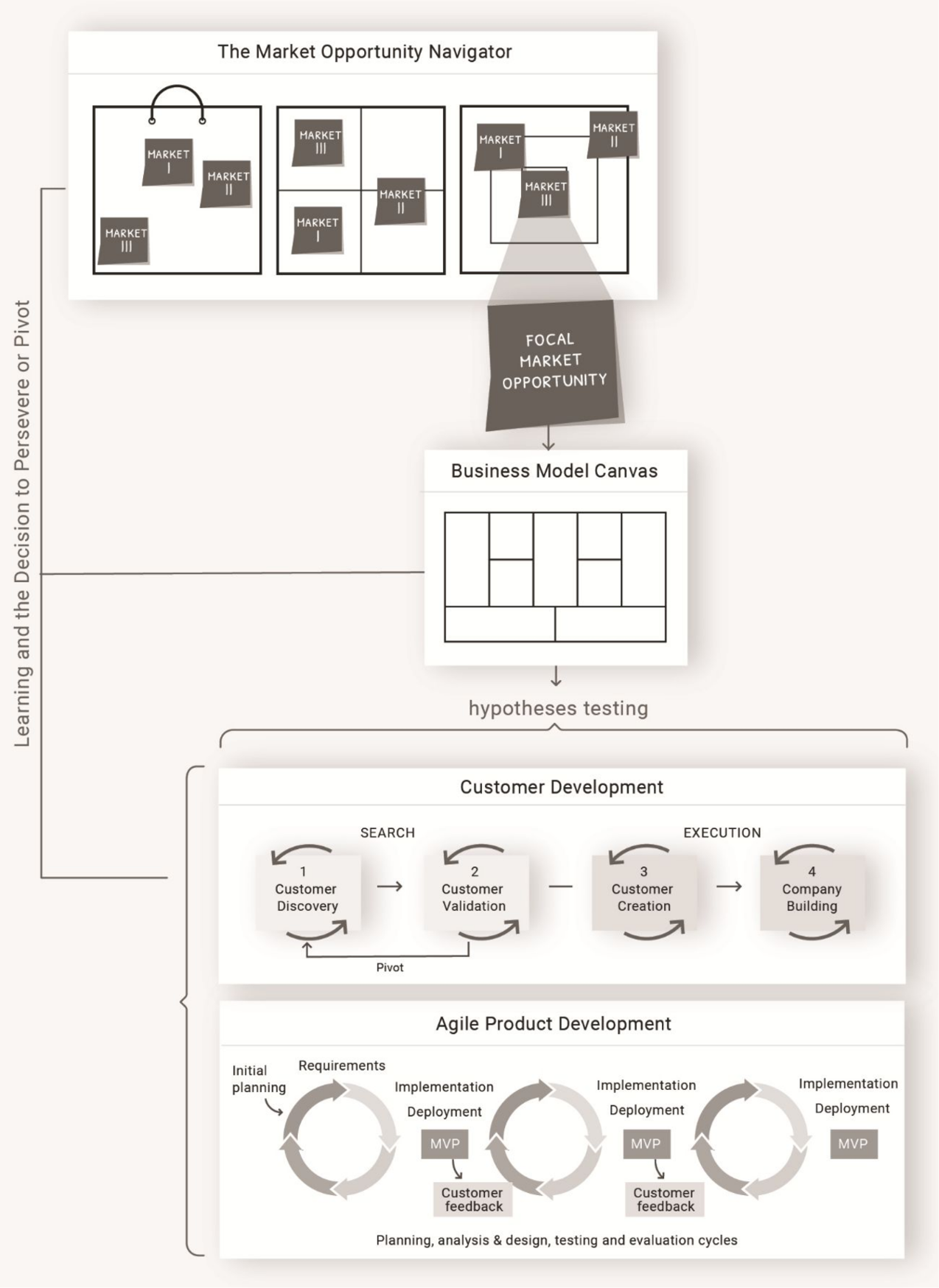
Building blocks of the lean startup framework (adapted from Gruber & Tal, 2017).
Building Block 1: Finding and Prioritizing Market Opportunities
The market opportunity that a startup seeks to exploit defines the domain in which it wants to compete, create value, and achieve viability (Gruber et al., 2013). It thus has a profound effect on the startup and its chances for success. Yet, often entrepreneurs are too optimistic about the potential of their initially identified target market and have to perform a challenging “re-start” in an alternative market domain (Blank, 2019: n.p.). For instance, empirical research in this vein not only indicates that more than 70% of all new ventures have to perform such target market pivots (Tal-Itzkovitch et al., 2012) but also suggests that those startups that had explored multiple market opportunities prior to deciding on their target market lay the groundwork for key performance benefits (Gruber et al., 2008). Thus, while the goal of lean learning is to find out how to play as a startup, entrepreneurs also need a wide-lens perspective that allows them to perform a distant or global search for where to play. By enabling entrepreneurs to identify a portfolio of market opportunities and to choose the most promising starting position for their customer development and business model design, the Market Opportunity Navigator provides an important learning layer within the lean startup framework (Blank, 2019; Gruber & Tal, 2017), as depicted in Figure 1. While many of the insights that led to the creation of the Market Opportunity Navigator stem from academic research (Gruber et al., 2008, 2010, 2012; 2013; Gruber & Thiel, 2009; McGrath & MacMillan, 2000; Tal-Itzkovitch et al., 2012), several intriguing research questions wait to be addressed.
First, whereas prior research has already provided key insights into opportunity identification (e.g., Grégoire & Shepherd, 2012; Shane, 2000), the notion that entrepreneurs identify a portfolio of opportunities, learn in parallel, and select their favorite opportunity from that set gives rise to a number of important questions (Bakker & Shepherd, 2017; Gruber et al., 2008, 2012; McGrath & MacMillan, 2000; Ucbasaran et al., 2009). In particular, it is interesting to note that after identifying multiple opportunities, entrepreneurs may not only seek to understand the relative attractiveness of these opportunities but may also consider the different levels of uncertainty associated with each opportunity. Put differently, we believe it is important for the entrepreneurship field to advance knowledge of how conditions of uncertainty differ between opportunities and what these differences mean for the startup process. In addition, building on the idea that the identification of an opportunity set also affects the likelihood of a venture will diversify and thus the growth paths a venture is likely to exploit (Gruber et al., 2013), how do early-stage decisions in startups influence the agility, flexibility, and growth paths of ventures? For instance, Gruber and Tal (2017) suggested that when entrepreneurs’ understand that they can exploit multiple market opportunities, they often become aware that key early decisions (e.g., picking a brand name that could fit several markets, hiring employees with more flexible human capital, and etc.) will enhance their firm’s agility later on.
Furthermore, identifying a portfolio of opportunities allows entrepreneurs to engage in multiple experiments simultaneously. While above, we focused on a series of experiments in which testing one hypothesis informs the next hypothesis, the real options reasoning perspective suggests that under conditions of high uncertainty, entrepreneurs need to have multiple opportunities as probes into the future (Brown & Eisenhardt, 1997; McGrath, 1999). To conduct simultaneous experiments and learn in parallel (Andries et al., 2013), entrepreneurs have to make many relatively small investments, which have limited downside but provide considerable upside potential. These option investments are staged such that options can be terminated if they show poor potential (from hypothesis testing), and resources are redeployed to those options (i.e., potential opportunities) that show promise (based on hypothesis testing). When hypothesis testing reveals information suggesting a positive future, a founder makes further investments, which is referred to as exercising the option. Important in this perspective is understanding the options in play (McGrath, 1999, 2010). Although it is easier to imagine a real options reasoning approach in established firms engaged in the process of starting up new ventures (de alio), it is important to consider the notion of a portfolio of opportunities (requiring hypothesis testing) for independent startups (de novo). For example, Denoo et al. (2018) found that startups with broader portfolios of customers engage in more business-model changes and changes of a greater degree. Generally, future research can explore the extent to which independent startups have portfolios of potential opportunities; what form the hypotheses take to test these potential opportunities; and how the different hypotheses relate to each other in terms of their formation, information gathered, and analyses of findings. As we build our understanding of real options reasoning in the startup process of experimentation, we may be able to help practitioners better manage the uncertainty they face in starting a new venture.
Second, a key step in the Market Opportunity Navigator is to choose the most promising option. While the real options approach helps entrepreneurs learn about their options in parallel, the decision itself offers important research questions. For instance, prior studies on opportunity choice in startups have found that entrepreneurs’ understanding of opportunity attractiveness depends on their experience background (Gruber et al., 2015). Hence, do founders with different backgrounds create and conduct different types of experiments, and do they make different decisions regarding the composition and management of their portfolio of potential opportunities? For example, in line with Collis’ (2016) observation that perhaps the single best piece of advice for founders is to know what they should not do (as any resource-constrained organization requires a strategy that specifies boundaries), it would be interesting to investigate which options entrepreneurs discard early in the process, and how their background affects these decisions.
Finally, more generally, the logic underlying the Market Opportunity Navigator and the “where to play” question asked by the framework echoes notions found in the “entrepreneurial mindset” (McGrath & MacMillan, 2000) and the domain of “strategic entrepreneurship” (Ireland et al., 2003). Specifically, Hitt et al. (2001, p. 488) explained,
McGrath and MacMillan (2000) integrated the thinking from both fields in developing their entrepreneurial mindset concept. They argued that those with an entrepreneurial mindset passionately seek new opportunities (entrepreneurship). However, they also pursue only the best opportunities and then pursue those with discipline (strategic management).
In other words, by examining how startups apply the Market Opportunity Navigator and link it to lean learning cycles, scholars can advance our knowledge of what constitutes an entrepreneurial mindset and strategic entrepreneurship. For example, future research could improve our understanding of how individuals with an entrepreneurial mindset (e.g., as evidenced by comparing serial and novice entrepreneurs) invest their resources in distant and local learning activities—that is, how they seek to understand the overall opportunity landscape and (perhaps in parallel) how they delve into local opportunities to understand whether they offer (the most) fertile ground for new firm creation. Given that these activities require cognitive flexibility, another important research question is which educational and experience backgrounds are conducive to generating cognitive flexibility, and from a practical perspective, how we can train individuals to become more flexible in these key early steps of the startup process. In turn, the results of these studies will inform the application of the lean startup framework in practice.
Building Block 2: Designing Business Models
While the Market Opportunity Navigator helps entrepreneurs in figuring out “where to play,” entrepreneurs also need to understand “how to play” in a given setting to develop a viable new venture. The design of a business model for the startup is a key stepping stone on this learning journey. Given that many of their features are based on assumptions, business models provide a framework from which hypotheses related to venture creation and venture growth can be formulated. More specifically, the design of a business model presents a “leap of faith” as it requires an entrepreneur to create a set of assumptions regarding whether a (potential) customer problem can be solved by a product or service that delivers value to customers and whether value-generating new business can be established (Osterwalder & Pigneur, 2010). From a leap of faith, entrepreneurs employ the validated learning process of the lean startup framework to rapidly test hypotheses and refine or substantially change their envisioned business models (Blank, 2013).
From an academic perspective, business models and their application to startups have garnered significant scholarly interest. First, scholars have offered several formal representations of business models (e.g., Baden-Fuller & Haefliger, 2013; Chesbrough & Rosenbloom, 2002), with Osterwalder and Pigneur’s (2010) Business Model Canvas being the most widely used framework among startups. Beyond studying their formal representation, however, scholars have investigated business models as a firm attribute (e.g., Birkinshaw & Goddard, 2009; Bocken et al., 2015; Denoo et al., 2018) and as a cognitive or linguistic schema (e.g., Denoo et al., 2018; Lant, 1992; Martins et al., 2015). Although we need construct clarity within and across papers (Suddaby, 2010), these and other perspectives (e.g., philosophical and theoretical approaches) provide an opportunity to shed new light on business models. We recognize that knowledge accumulation under such diverse perspectives becomes more difficult (than across papers with more homogenous perspectives), but that does not mean it is impossible. For example, how and why do firms’ activities to create value (i.e., business model as a firm attribute) impact entrepreneurs’ mental maps in attending to, interpreting, and narrating business models (i.e., business model as a cognitive or linguistic schema) and vice versa? Further, how and why does the formal conceptualization of firms’ proposed value-creating activities (i.e., business model as a formal conceptual representation) reflect entrepreneurs’ cognitive and linguistic schemas and shape the activities reflecting firms? How refined are these conceptualizations, and do they represent configurations (e.g., Gruber et al., 2010) or simply additive elements?
Second, we can develop a practice perspective of business models. From the perspective of business models as a firm attribute (Massa et al., 2017), the focus is on existing firms—not the creation of a new independent firm. Although we have a good understanding of firms that are strategically oriented toward entrepreneurship (Covin & Slevin, 1991; Lumpkin & Dess, 1996; Wiklund & Shepherd, 2005) and why some firms are better at creating corporate new ventures (de alio) than others (Covin et al., 2018), there is an insufficient understanding of the activities associated with the different business-model attributes (Massa et al., 2017; for an exception, see business-model change by Denoo et al., 2018). Indeed, applying the practice term—namely, focusing on what people do—of strategy (McDonald & Eisenhardt, 2014; Snihur & Zott, 2019; Whittington, 2006) and social theory (Brown & Duguid, 2001; Orlikowski, 2002) to firms’ business models will make an important contribution to entrepreneurship. That is, future research can take a more nuanced micro-perspective to focus on what configurations of activities are involved in creating and/or capturing value, who performs these activities within the organization, how these activities are distributed and coordinated, and what organizational and environmental factors facilitate and obstruct these value-creation activities (how and why)? By focusing on the activities, the sequence of activities, and their enablers, we will begin to develop a practice perspective of business models. In addition to filling in a theoretical gap, a practice perspective of business models will have implications for practitioners and students by illustrating what entrepreneurs do.
Third, we can develop a more micro-cognitive perspective of business models. Although we have a good understanding of entrepreneurial cognition related to the identification of opportunities (Grégoire et al., 2010; Haynie et al., 2009; Shepherd et al., 2017), entrepreneurial decision making (for a review, see Shepherd et al., 2015), and the cognitive underpinnings of entrepreneurial action (for a review, see Grégoire et al., 2011), we have not paid sufficient attention to entrepreneurs’ cognitive schema as they develop business models (Denoo & Yli-Renko, 2019). From the cognitive perspective, business models involve the “cognitive structures that consist of concepts and relations among them that organize managerial understanding about the design of activities and exchanges that reflect the critical inter-dependencies and value-creation relations in their firms’ exchange reworks” (Martins et al., 2015; consistent with Zott et al., 2011). Indeed, Snihur and Zott (2019) found that founders’ structural and cognitive imprints explain how business model innovation emerges and persists over time. Therefore, future research can build on the above streams of research to make important contributions to knowledge by investigating the nature of entrepreneurs’ cognitions about their business models, how these cognitive schemas were formed, and their implications for attention allocation (and inattention), decision making, beliefs, and actions toward the enactment of a business model.
Of course, the cognitive perspective of business models is not restricted to the mind of a single entrepreneur but can involve founding teams, early employees, and other stakeholders. Therefore, we can advance the cognitive perspective of business models by investigating the development and nature of founding teams’ shared cognitions about business models and the ways these shared cognitions change as the result of internal and external feedback on business models. For example, how do shared cognitive schemas of business models change over time, and why are some more effective than others at making these changes? This cognitive perspective not only has implications for scholars but also has important implications for practitioners and students by providing information about how founding teams collectively think about business models.
Fourth, we can further develop a narrative perspective of business models. Narratives are stories that offer “temporally sequenced accounts of interrelated events or actions undertaken by characters” (Martens et al., 2007). There have been recent advancements in investigating entrepreneurs’ narratives for acquiring resources (Martens et al., 2007) and making sense of failure (Byrne & Shepherd, 2015) as well as potential customers’ narratives (Nambisan & Zahra, 2016). Analyzing the formal and informal stories of business models will likely provide new insights into the sensemaking process, the identification of potential stakeholders, and the development of potential opportunities tied to business-model co-construction by entrepreneurs and potential stakeholders. This narrative perspective can be of considerable benefit to practitioners and students as they learn about different business-model stories, different elements of those stories, and methods to effectively communicate their own stories.
Finally, we can develop a more innovation-based perspective of business models. Previous research has found that business-model innovation leads to enhanced startup progress (Denoo et al., 2018) and performance (Cucculelli & Bettinelli, 2015; Zott & Amit, 2007). Although there have been recent advancements in business-model innovation at the macro-management level (e.g., Foss & Saebi, 2017; Spieth et al., 2014; Zott et al., 2011), there is a need for a more micro-perspective of business-model innovation. For example, future research can make an important contribution to the startup literature by addressing the following questions.
What activities, cognitions, and narratives do entrepreneurs use throughout the process of business-model innovation? Research to address this question can delve into the inter-relationship between activities, cognitions, and narratives; the role of feedback, events, and other external environmental changes in adapting or refining business models; and the different paths of business-model innovation.
What leads to business-model innovation? Future research can build on the literature on learning and experimentation (Achtenhagen et al., 2013; Denoo et al., 2018; Foss & Saebi, 2017; McGrath, 2010) and structural and cognitive imprints (Snihur & Zott, 2019) to gain a deeper understanding of the antecedents of business-model innovation. Although we delve deeper into the issues of experimentation and learning in the sections that follow, future research can explore the mechanisms of these relationships as they relate specifically to business-model innovation. For example, related to the cognitions and narratives linked to business-model innovation, why are some entrepreneurial actors more effective at engaging these mechanisms for business innovation than others, and do all who perform business-model innovation do so through learning, or are their other causal paths? For example, these activities, cognitions, and narratives may influence business-model innovation by enabling entrepreneurs to acquire the resources necessary to implement their original idea for their business model. Interestingly, from a cognitive perspective, Martins et al. (2015) proposed how analogical reasoning and conceptual combinations can lead to business-model innovation. By understanding the antecedents of different forms of business-model innovation, practitioners and students can begin to understand the steps to developing novel and useful business models.
What are the outcomes of business-model innovation? Not surprisingly, research on the outcomes of business-model innovation has focused on firm performance (Foss & Saebi, 2017; Sohl et al., in press; Wei et al., 2014; Zott & Amit, 2007). However, there are ample opportunities to explore other outcomes. For example, scholars of firm performance typically take a corporate perspective on the creation of business models within existing firms (de alio ventures). When a perspective focused on business-model innovation is applied to the creation of new independent organizations (de novo ventures), the traditional measures of firm performance are less applicable (e.g., they are too distal). Dependent variables that are more proximal include the completion of tasks indicative of organizational emergence (e.g., conducting the first sale, hiring employees, and obtaining outside funding; Tornikoski & Newbert, 2007) and changes to business-model attributes (Denoo et al., 2018). Indeed, by exploring how business-model innovation influences entrepreneurs’ activities, cognitions, and narratives (as both an outcome and an input), we can gain a deeper understanding of the dynamics of the startup process. For example, how does business-model innovation change a startup’s activities, founding team cognitions, and narratives? As we understand the nature of these potentially mutually dependent relationships (between the antecedents and outcomes of business-model innovation), we may be able to detect virtuous (and/or deleterious) spirals. This dynamic perspective of business-model innovation will likely benefit practitioners and students by providing information about potential feedback effects of business-model innovation—that is, the startup process does not stop with business-model innovation.
Building Block 3: Validated Learning
A startup’s initial business model is based on a series of hypotheses that need to be tested and validated (Blank, 2013). From the perspective of the Business Model Canvas, nine key elements of startups are subject to validated learning (Osterwalder & Pigneur, 2010), which is defined by Ries (2011) as “the process of demonstrating empirically that a team has discovered valuable truths about a startup’s present and future prospects.” This notion is in line with the discovery-driven planning approach, in which McGrath and MacMillan (1995) proposed that entrepreneurs acting under conditions of high uncertainty need to convert their assumptions into facts to create viable new ventures. Following the basic logic of hypothesis testing that is germane to the scientific method and thus to the world of academics Blank and Dorf (2012), as well as Ries (2011), argued that entrepreneurs need to explicitly state their business-model hypotheses and then test these hypotheses via experiments as the primary mechanism for validated learning. The scientific process of hypothesis testing requires that experimenters be open to the possibility that their hypotheses will be disconfirmed, in which case, they will need to develop new hypotheses for empirical testing. Of particular importance is the customer development process, in which entrepreneurs examine and test hypotheses related to their market and customers (Blank, 2013). Building on the market-size hypothesis (i.e., how attractive is the target market opportunity; see Blank & Dorf, 2012), learning involves elements like a firm’s value proposition, customer segments, and channels to reach customers (Osterwalder & Pigneur, 2010). The associated tests attempt to address the following four questions: “(1) Do customers recognize that they have a problem you are trying to solve? (2) If there was a solution, would they buy it? (3) Would they buy it [the solution] from us? (4) Can we build a solution for that problem” (Ries, 2011). The validated learning approach through experimentation tests assumptions to ensure that founders will not skip Questions 1–3 to focus immediately on building a solution (Question 4).
These notions of experimenting for validated learning as part of the startup process already have some support in the academic literature (cf. McGrath & MacMillan, 1995), but we need more research. First, founders can form hypotheses and test them, but there are challenges with interpreting the results of these tests, and we believe that an improved understanding of these challenges requires more research. Although entrepreneurship studies have highlighted the formation of entrepreneurial conjectures (Eckhardt & Shane, 2003; Shepherd et al., 2012), there is a well-established literature suggesting that founders (as all people) tend to engage in confirmatory search (Peterson & Wong-On-Wing, 2000; Shepherd et al., 2012). The problem with confirmatory search is that it often leads to poor decision outcomes (Russo & Schoemaker, 1992). Indeed, confirmation bias is supposedly overcome through the use of the scientific method, which requires experimenters to remain skeptical (i.e., hold doubt) about the veracity of a hypothesis until empirical testing either erodes sufficient doubt such that the hypothesis can be accepted or provides information sufficient to reject it. Thus, the scientific method of hypothesis testing (advocated in the lean startup framework) may overcome, or at least minimize, confirmation bias.
An intriguing research opportunity in this regard is whether a more skepticism-oriented approach to hypothesis testing and validated learning (as the scientific method implies) or a more belief-oriented approach (in which entrepreneurs contemplate a hypothesis by initially believing its veracity; Johnson-Laird & Savary, 1999) provides greater promise in learning and under which conditions. Specifically, in the belief model of hypothesis testing (Shepherd et al., 2012), information provided by hypothesis testing allows experimenters to either certify or refute their initial beliefs. There could be (a few) circumstances in which the belief model of hypothesis testing may have advantages, and these circumstances are worthy of investigation. For example, Elkington and Hartigan (2008) proposed that individuals may only be able to achieve revolutionary accomplishments by having faith in their conjectures. In this way, hypothesis testing is more a process of sensemaking than the implementation of the scientific method. Sensemaking involves “the ongoing retrospective development of plausible images that rationalize what people are doing” (Weick et al., 2005), emphasizes interpretation after choice (Blank, 2013; Lant, 1992; Weick, 1993), and allows for the development of a more plausible account of what is happening (Weick et al., 2005). That is, unlike the scientific method, which is focused on revealing the truth or “getting it right,” the belief model of hypothesis testing (for a startup) is about developing an account of one’s experience that informs subsequent actions and hypotheses. Therefore, through this belief model of hypothesis testing, a startup (i.e., its business model) becomes more plausible. Indeed, startups become more plausible when “they tap into an ongoing sense of the current climate, are consistent with other data, facilitate ongoing projects, reduce equivocally, provide an aura of accuracy and offer a potentially exciting future” (Weick et al., 2005).
Our discussion above involves numerous speculations that need to be stated as formal hypotheses and tested using the scientific method (or explored abductively in a theorizing process to develop a more plausible story; Shepherd & Sutcliffe, 2011; Shepherd & Suddaby, 2017). In addition to the question asked above, future research can explore the activities founders engage in when searching, collecting, and analyzing information for testing a hypothesis or a set of hypotheses (e.g., if the overarching logic of a business model is examined). Furthermore, although we already have a good understanding of how narratives impact sensemaking (and vice versa; e.g., Brown et al., 2008; Patriotta, 2003), what role (if any) do narratives play in the formation and subsequent testing of startup hypotheses (including the involvement of others in the formation and communication of narratives)?
Second, founders’ empathetic judgments can inform the formation and testing of hypotheses about startups. Because hypotheses are often based on how others (especially potential customers) respond to problems and solutions that underlie a startup’s business model, founders with greater empathic accuracy are likely more effective at findings solutions to social problems than those with lower empathetic accuracy (McMullen, 2015). Empathetic accuracy refers to entrepreneurs’ capability to “accurately estimate or infer others’ preferences well enough to form expectations of how various stakeholders will respond to the entrepreneurs’ new customer value proposition” (McMullen, 2015). In this way, we expect founders with high empathetic accuracy to generate different hypotheses than those with low empathetic accuracy. Perhaps empathetic accuracy also has implications for the search for information, the use of the belief or skepticism approach to hypothesis testing, and the interpretation of the results of hypothesis testing. Similarly, related to but somewhat distinct from empathetic accuracy is the detection of human suffering or environmental issues that stimulate pro-social motivation—“the desire to benefit other people” (Grant, 2008)—in the formation of a startup’s business model. How do differences in founders’ prosocial motivation (e.g., focused on known vs. unknown others; cf. Fauchart & Gruber, 2011; Gruber & MacMillan, 2017) impact the nature of hypotheses, the testing of hypotheses, and the interpretation of the results of hypothesis testing. It seems that the hypotheses for a hybrid startup (with both an economic and a social logic) are more complex and require a different testing strategy than those for a startup with solely an economic logic.
Third, as implied above, there is likely heterogeneity in the formation of hypotheses that test the veracity of a startup’s business model. Indeed, the formation and testing of hypotheses can vary in the extent to which they derive from disciplined imagination. Scholars have largely explored disciplined imagination in the context of scholars’ theorizing (Shepherd & Sutcliffe, 2011; Weick, 1989), but this concept has potential to clarify heterogeneity in founders’ hypothesis formation and testing. The discipline of disciplined imagination involves the consistent application of selection criteria to test a hypothesis, and the imagination facilitates the “deliberate diversity introduced into problem statements, thought trials, and selection criteria that compile the thinking” (Weick, 1989). Interestingly, while we normally think of hypothesis testing as a means to provide external feedback about the assumptions underlying founders’ hypotheses, hypothesis testing can involve thought trials—abstract hypothetical scenarios (Harggqvist, 1996) that serve as imaginary experiments (Shepherd & Sutcliffe, 2011; Weick, 1989). This notion of thought experiments opens up the possibility of a cheap means of testing hypotheses from a cognitive perspective. Future research can explore the extent to which founders apply imagination and discipline to thought trials to test a hypothesis of their startup’s business model and the effects on their subsequent cognitions (including the formation of subsequent search activities and the development of the startup narrative over time). We assume that nascent entrepreneurs can apply disciplined imagination to hypothesis testing outside their minds, which provides an opportunity to investigate the activities and responses to this external feedback. Practitioners and students stand to benefit from research on the disciplined imagination testing hypotheses about a startup’s veracity. Perhaps eventually, we can offer prescriptions for how to conduct startup hypothesis testing with approaches that are both more disciplined and more imaginative.
Building Block 4: Building Minimum Viable Products
In the lean startup framework, an experiment is “more than just a theoretical inquiry; it is also a first product” (Ries, 2011), which is developed through an agile product-development process (Figure 1). That is, for hypothesis testing, founders may need to build their startup’s first product. The question for founders is how much time, energy, and other resources should they invest in building this product to be used in hypothesis testing. The lean startup perspective proposes the answer in terms of building an MVP—a “version of the product that enables a full turn of the build-measure-learn loop with a minimum amount of effort and the least amount of development time” (Ries, 2011). Therefore, an MVP will contain only the critical features of an envisioned product and is designed to test a specific hypothesis quickly (Blank, 2013), because under conditions of high uncertainty, “no amount of design can anticipate the many complexities of bringing a product to life in the real world” (Ries, 2011). The purpose of an MVP is to learn—to test the assumptions (as hypotheses) underlying a startup’s business model (Blank & Dorf, 2012). As a result, any features added to an MVP that do not contribute to learning are considered a waste of resources. Although there are some challenges with building and using an MVP for hypothesis testing—for example, legal issues, fears about competitors, branding risks, and impact on morale (Ries, 2011)—the overall argument is that MVPs are critical to progress in starting a new venture.
The entrepreneurship literature can inform our understanding of this notion of an MVP, and the entrepreneurship literature can be informed by further consideration of MVPs. First, what is sufficient for an MVP, especially in an environment of high uncertainty (i.e., not below the minimum, not above the minimum, but “just right”)? Although there are claims that MVPs are distinct from prototypes, we believe research on prototyping can provide insights into the “minimum” of MVPs. From a design perspective (Brown, 2008; Luchs, 2015), prototyping refers to “designers’ visualization and materialization skills, which they use to make intangible insights, ideas, and concepts tangible, sharable and understandable” (Calabretta & Kleinsmann, 2017). Therefore, a prototype is below what is considered to be minimum if it fails to make intangible insights, ideas, and concepts tangible, sharable, and understandable to hypothesized stakeholders. If a prototype does make a potential opportunity tangible, sharable, and understandable and stakeholders reject it, then the prototype is an MVP and has served its purpose as a vehicle for learning. However, this only represents a very basic step in our understanding of learning in the startup process. Future research will make an important contribution to our understanding of the startup process by delving more deeply into the attributes of a prototype that make it an MVP. For example, what is the best way (fast, cheap, and informative) to make something intangible seem tangible? Although we often think of MVPs as three-dimensional objects, perhaps they are sketches (e.g., Cross, 1999), simulations, or thought experiments. It is important that we learn more about the tools founders use to create MVPs and why some tools are more effective than others at making the intangible tangible.
The same need for research applies to the dimensions of developing a prototype that is both sharable and understandable. We assume that what is sharable and understandable to one set of stakeholders may be less so for another set of stakeholders—thus, different versions of MVPs are needed depending on the nature of the target audience. Indeed, the sharable dimension may require research from a cognitive perspective related to a common or shared mental model, and the understanding dimension may require research from a narrative perspective in the form of sensegiving from a founder to a focal stakeholder (i.e., using an MVP to tell an audience a plausible story of a potential opportunity). Interestingly, with three dimensions, does each need to reach a minimum level, or can more of one MVP dimension compensate for less of another? Thus, future research will need to look at the combinations of a prototype’s tangibility, sharability, and understandability to determine its effectiveness as an MVP for different audiences.
Second, more specific than laid out above, MVPs are boundary objects that facilitate communication. It can be difficult to transfer knowledge across boundaries like the boundary between an emerging startup and stakeholder groups, such as potential customers (Nonaka, 1994; Polanyi, 1966), because this knowledge is often embedded in practice (Bourdieu, 1977; Lave, 1988). A boundary object is an artifact that “provides a bridge between individuals by triangulating on something in common, by facilitating a flow of information and knowledge (Carlile, 2004) and by reducing the time required for sensemaking” (Grichnik et al., 2016, p. 14). Examples of boundary objects include software programs (Nicolini et al., 2012), strategy tools (Spee & Jarzabkowski, 2009), and narratives (Garud & Giuliani, 2013). There are ample opportunities for future research to explore how an MVP operates as a boundary object in providing (a) a shared language for two parties to represent their knowledge to each other, (b) a means by which both parties can learn about their differences, and (c) a process by which they jointly transform their knowledge (Carlile, 2002) in a way that enhances learning about the focal startup. That is, future research needs to investigate the nature of the borders between a startup and its various communities of inquiry (e.g., potential stakeholders) and how these borders vary across startups. With an increased understanding of the nature of different borders as obstacles to the flow of information and knowledge, we can begin to explore the effectiveness of different boundary objects for bridging different boundaries experienced during start up. Research on MVPs as boundary objects is likely to reveal information to practitioners and students about the development and “best use” of an MVP for testing specific hypotheses, learning, and advancing the startup process.
Finally, just as an MVP can be a boundary object, so too might a business model. That is, rather (or in addition to) than building an MVP as a boundary object for sharing, transferring, and transforming knowledge, a founder can use his or her business model itself as a boundary object. For example, a business model can act as a market device—“the material and discursive assemblage that intervenes in the construction of markets” (Muniesa et al., 2007). In other words, a business model can represent an object that is flexible in its mix of narratives to communicate with heterogeneous stakeholders but sufficiently robust to represent a common source of information and knowledge across boundaries (Latour, 1987; Star & Griesemer, 1989). Indeed, as we consider the perspective of business models as formal conceptual representations describing firms’ activities (Massa et al., 2017), formal statements of plans (Magretta, 2002) provide a boundary object that can act to establish a common language to represent different potential stakeholders’ knowledge (including that of the entrepreneurs), a means to learn about differences between potential stakeholders, and a process by which potential stakeholders can transform their knowledge (consistent with a boundary object; Carlile, 2002) to advance a startup. What forms can these formal conceptual representations of a business model take; why are some formal conceptualizations more effective as boundary objects than others; and does their effectiveness as boundary objects depend on founder characteristics, stakeholder characteristics, the nature of the business model, and/or the dynamism of the external environment? Scholars have an opportunity to explore other boundary objects, such as crowdfunding requests and pitches to potential investors. Does the notion of an MVP apply to a business model as a formal representation? That is, do founders create a minimum viable business plan that represents just enough investment of time, energy, and other resources to provide a mechanism for the exchange of information necessary to test the veracity of their business model? How do founders create a crowdfunding message that offers the best mechanism for the exchange of information to refine their business model (and not necessarily raise the most funds)? How do pitches for raising capital differ from pitches for facilitating exchange with stakeholders for hypothesis testing to learn? As we build knowledge about the formal representation of business models as boundary objects, practitioners and students can benefit from a better understanding of building and using these boundary objects to learn about and refine business models.
Building Block 5: Persevere or Pivot With Course of Action
Entrepreneurs generate validated learning by forming hypotheses, testing those hypotheses using experiments, and using the resulting information to form subsequent hypotheses (in particular, via customer-development and agile product-development processes). This trial-and-error learning is rather local and incremental (Gavetti & Levinthal, 2000). While a founder can persevere with these incremental steps to refine his or her startup’s current business model, the founder may learn that these incremental changes do not generate sufficient progress in the startup, which leads to the decision to pivot (Figure 1). In the lean startup method, a pivot is a “structured course correction designed to test a new fundamental hypothesis about the product, strategy, and engine of growth” (Ries, 2011). A successful pivot will thus allow a startup to move closer to or reach a sustainable, repeatable business model that will allow the venture to grow (Blank & Dorf, 2012). The alternative to a pivot is to persevere with the current solution. The important question facing founders is whether they should pivot or persevere, which is a challenging decision given that it is shrouded in uncertainty.
The lean startup framework proposes that there are benefits to setting learning milestones as triggers for accumulating information to make persevere-or-pivot decisions as these milestones test the assumptions founder made explicit at the beginning of the startup process. These ideas for setting learning milestones are evident in earlier academic work examining milestones as key instances to confront assumptions related to startup with newly collected facts (e.g., feedback received on a first prototype, information collected about competitors’ response at market entry cf. McGrath & MacMillan, 1995). Ries (2011) acknowledged that the greater the investment of creative energy and other resources into a particular business model for a startup, the greater the sunk costs and therefore the more difficult it will be to make the decision to pivot. Indeed, the lean startup method emphasizes that founders need courage when making the decision to pivot and that some founders may be reluctant to pivot as they focus on vanity metrics (i.e., metrics that make them look good but do not reflect startup progress). Thus, they do not engage in sufficient hypothesis formation and testing and/or are afraid that a pivot will result in failure and lower employee morale. Indeed, Ries (2011) argued that the decision to pivot is so difficult that many founders fail to do it to the detriment of their startup. The decision to pivot is informed by hypothesis testing, which requires an objective approach and pivot-or-persevere meetings set up in advance (Ries, 2011). By effectively pivoting, startups become resilient to both entrepreneurs’ mistakes and to changes in the external environment.
Entrepreneurship research (previous and future) can provide additional insights into the pivot-or-persevere decision. First, the information indicating the need for a pivot may simultaneously trigger resistance to the pivot. For example, founders likely develop psychological ownership over the creative ideas behind their startup’s business model (Grimes, 2018). With increasing psychological ownership over their startup’s business model, founders generally become less willing to accept information indicating the need to pivot. In one of the few empirical studies on pivots, Denoo et al. (2018) found that less than 40% of young firms changed their business model over a 10-year period. Overcoming this reluctance to pivot appears to require the reappraisal of psychological ownership, idea work, and identity work (Grimes, 2018). Therefore, it is important for practitioners and students to understand the power of psychological ownership in the startup process and the means by which it can be reappraised (or otherwise “managed”) to lead to a necessary pivot.
Second, perhaps the lean startup method has an antifailure bias (as does much of the entrepreneurship, strategy, and management literatures; McGrath, 1999; Ucbasaran et al., 2013). For example, to the options of preserve or pivot, we could add terminate the venture project. Indeed, “fail fast, fail cheaply” is part of the underlying logic of real options reasoning for managing uncertainty (McGrath, 1999; see also Bakker & Shepherd, 2017). Perhaps if a founder pivots enough using MVPs to test hypotheses with well-designed experiments, he or she will eventually “hit on” a winning business model given a sufficient runway. Here, runway refers to “the amount of time remaining in which a startup must either achieve lift off or fail” (Ries, 2011). In this way, founders do not make the decision to terminate; it is made for them by the length of their startup’s runway. Therefore, the longer the runway, the greater the stakes—a greater likelihood that a pivot will lead to a viable business model, but if it does not, then the cost of failure will likely be greater. We need more research that considers termination as a decision alternative along with the pivot-or-persevere decision. By drawing on research on learning from failure (McGrath, 1999; Sitkin, 1992), on the challenges of coping with the grief over projects lost through failure (Shepherd, 2003; Shepherd & Sutcliffe, 2011), and on organizational cultures that provide psychological safety for their members to fail and learn from the experience (Cannon & Edmondson, 2005; Edmondson, 1999; for a review, see Ucbasaran et al., 2013), there are research opportunities to integrate founders’ termination decisions into the startup process. For practitioners and students, it is important to understand that failure can occur given the high uncertainty involved in starting a firm and that failure typically hurts, but they also need to understand that failure (i.e., fail quickly and cheaply) can be an important means of managing uncertainty. It is important we do not perpetuate the antifailure bias in future founders.
Third, there is heterogeneity in pivots, which has implications for learning (Achtenhagen et al., 2013; Denoo et al., 2018; McDonald & Eisenhardt, 2014) and performance (i.e., growth and survival; Andries et al., 2013). Indeed, Ries (2011) detailed 10 types of pivots, including the zoom-in pivot, the platform pivot, the value-capture pivot, and the engine-of-growth pivot. These different types of pivots provide an interesting starting point to theorize on pivoting. For instance, future research can explore the information signals indicating the need for specific pivots; the activities involved in enacting specific pivots; and the changes pivots cause in startups’ business models and communities of inquiry and in founders’ narratives. Although refinement has been described in terms of “either a change in the business opportunity (value creation), or a change in the exploitation strategy (value delivery) or both” (Wasserman, 2012), future research can explore the extent of refinement in a finer-grained way. The extreme version of perseverance is no change in either dimension. The extreme version of a pivot is what Blank (2013) referred to as a restart and Wood et al. (2019) referred to as a complete pivot—abandoning the “initial offering in favor of a completely new concept.” In many ways, a complete pivot is consistent with the notion of termination of a particular startup effort. By considering the extent of refinement of pivots, future research can develop richer theories of the antecedent, mechanisms, and consequences of pivots.
Fourth, scheduling pivot-or-persevere meetings informed by relevant information does not mean that founders will make the decision to pivot when appropriate. Indeed, entrepreneurs often persevere with losing courses of action (DeTienne et al., 2008; Gimeno et al., 1997; Gruber et al., 2008). How can pivot-or-persevere meetings overcome these biases against pivoting despite information that such action is required? Perhaps these meetings need to provide a mechanism for the reappraisal of founders’ psychological ownership, help with identity work (consistent with Grimes, 2018), and involve a broad array of potential customer groups (consistent with Denoo et al., 2018). The cultures of emerging organization and of founding teams likely impact the effectiveness of pivot-or-persevere meetings. For example, perhaps when there is a feeling of psychological safety—“a shared belief held by members of the team that the team is safe for inter-personal risk taking” (Edmondson, 1999)—meeting participants are more likely to decide to pivot (or consistent with the previous point, pivot to a greater extent). Future research can explore the conditions under which pivoting (in its various forms and degree) is more likely given information indicating the need for change, including founding team composition and the culture of emerging organizations. Although extant research has led to a focus on the factors that obstruct change and how some are able to overcome those obstacles, future research can explore the opposite. Indeed, Mitchell et al. (2011) found that some founders are erratic in their decision making, changing their decision making when no changes are necessary. Do some entrepreneurs pivot too much; if so, why and with what consequence?
Interestingly, because the pivot-or-persevere decision is slightly different from the persevere-or-terminate decision, there are additional nuances requiring investigation. For example, perseverance is associated with self-efficacy (e.g., Cassar & Friedman, 2009), grit (e.g., Wood et al., 2019), and a lack of other personal opportunities (e.g., Gimeno et al., 1997). These elements are clearly of relevance to the persevere-or-terminate decision but are less clear for the pivot-or-persevere decision. For example, while entrepreneurial self-efficacy may promote persevering over terminating, it may also promote pivoting over persevering. That is, an individual’s belief that he or she can be successful at entrepreneurial tasks may lead to more pivots if the individual also believes that pivots are part of the tasks for which he or she feels efficacious. Indeed, if pivots prove to be central to success in the startup process and given the knowledge that self-efficacy is task specific, perhaps there is a need to theorize and empirically explore the notion of pivot self-efficacy. What constitutes the tasks (or subtasks) of pivoting, why do some believe they can be successful at those tasks, how do individuals build their pivot self-efficacy, and what role does pivot self-efficacy have on the frequency and the extent of pivoting in the startup process? Taking this line of thinking one step further, it would be interesting to explore the notion of collective pivoting self-efficacy. That is, how does a founding team’s (or an emerging organization’s) shared belief in its ability to successfully engage in the tasks associated with pivoting influence a startup’s learning, emergence, and eventual performance?
Finally, startups have different runways, and these differences affect the startup process and outcomes. As detailed above, Ries (2011) defined a runway as both “the number of pivots it [the startup] can still make” (160) and “the amount of time remaining in which a startup must either achieve lift off or fail” (160), and the runway can be extended by gaining the “same amount of validated learning at a lower cost or in a shorter time” (161). Future research has the opportunity to unpack the notion of a runway and to provide connections between the runway and pivoting, speed, learning, and cost. Although these runway connections are related, they are likely distinct in important ways, and highlighting these distinctions, inter-relationships, and configurations will make important contributions to our knowledge of startups. If runway refers to the number of pivots that a startup can still make, future research can investigate whether the number of pivots remaining is influenced by (a) the extent of refinement in each pivot; (b) the type of pivot; (c) the quality, testing, and results of hypothesis testing; (d) the cost of a pivot (including startups’ agility and past decisions that may make pivoting more costly); (e) the capacity of stakeholders to absorb pivots; (f) the number of pivots already performed; (g) founders’ capacity, skills, and abilities to conduct and absorb pivots; and (h) startups’ on-hand resources and/or recommitments by stakeholders. If runway refers to “the amount of time remaining in which a startup must either achieve lift off or fail” (Ries, 2011), future research can investigate many of the same potential independent variables detailed above but with differences in results across the two dependent variables—runway as number of pivots and runway as amount of time left—pointing to additional research questions. Indeed, future research can investigate the relationship between the number of pivots left and the amount of time left and explore the factors that strengthen or weaken this relationship. Perhaps a longer runway (number of pivots or amount of time left) increases the likelihood of liftoff, but if failure occurs, it increases the losses from that failure.
Overarching Perspective: Examining the Lean Startup Framework
In the preceding sections, we discussed each of the five building blocks of the lean startup framework and how each block represents an opportunity for future research. However, important research opportunities also exist at a higher level of analysis: from an overarching perspective, scholars can investigate key topics, such as (a) the framework’s performance implications, (b) imprinting effects of applying the lean startup approach, and (c) contingencies (including external context) that may condition its applicability and effects on performance.
First, as highlighted above, some of the building blocks of the framework have already been examined in terms of their performance implications (Business Model Canvas; Sohl et al., in press; market-opportunity identification; Gans et al., 2019; Gruber et al., 2008), whereas the performance implications of applying the framework in its entirety have yet to be investigated. An initial important step in this direction was recently taken by Gambardella et al. (in press). They showed that a scientific approach to startup creation—consistent with many features of the lean startup approach discussed above—leads to more successful ventures than an approach that relies on unguided activities and entrepreneurs’ intuition because the lean startup approach decreases the likelihood that entrepreneurs will pursue venture projects with false-negative returns. In addition, studying web-based startups, Marmer et al. (2012) found that a learning-focused, agile approach to startup creation leads to relatively more successful ventures. Building on these first empirical insights, we believe it would be interesting not only to examine the overall performance effects of applying the lean startup approach but also to pursue a more refined investigation of the relative performance contributions of each building block, the performance effects of different configurations of building blocks, and the potentially equifinal outcomes (cf. Gruber et al., 2010). For instance, given that there are many meetup groups around the world in which entrepreneurs discuss their experience with the lean startup framework, scholars could sample ventures created with this approach and compare their performance with matched samples of startups that have not employed the approach.
Second, entrepreneurs may imprint their emerging organization with a set of decision rules, practices, and routines that may not only shape the startup phase but may also have lasting effects on the organization (Mathias et al., 2015; Milanov & Shepherd, 2013). Thus, what are the medium- to long-run outcomes of the lean startup when capturing outcomes in a number of different ways, including firm performance; innovation culture; new product introductions; and the development of social networks, such as building status, legitimacy, and alliances? Do some of the building blocks have an immediate impact on short-run survival while other building blocks have a longer-term impact by better preparing startups for rapid scaling?
Third, with respect to contingency factors, it is important to understand under what conditions applying the lean startup framework may lead to more or less beneficial outcomes. Several internal and external contingency factors seem pertinent and have also been noted by leading contributors to the framework. For instance, Blank (2018) suggested that the availability of significant amounts of funding in startups may decrease the need for a lean approach. Specifically, he noted that “when capital for startups is readily available at scale, it makes more sense to go big, fast and make mistakes than it does to search for product/market fit” (Blank, 2018: n.p.). Thus, how the availability of financial resources conditions the relationship between the lean startup approach and performance is an interesting research question. Similarly, scholars may want to study whether an alternative setup under the condition of significant funding could lead to superior outcomes—that is, parallel experimentation, in which a larger number of real options are tested in a lean way (consistent with McGrath, 1999).
Along these lines, other internal contingency factors may influence the performance effects of the lean startup framework as well as pose interesting research questions. For instance, does the usefulness of the lean startup approach vary with different types of technologies, especially since the development of some technologies (e.g., deep technology) and the products derived from them may require substantial upfront investments to arrive at an MVP? Perhaps these substantial investments in an MVP preclude some startups from executing multiple pivots.
Beyond these internal contingency factors, we propose a broader perspective on the boundary conditions and moderators that may influence the applicability of the lean startup framework. Specifically, in Figure 2, we surround the model with an oval to represent the context in which the model is embedded. As pointed out above, the context may represent the boundary conditions of the lean startup framework beyond which the model no longer applies—perhaps, for example, in the context of low uncertainty and considerable resource slack. While considering the conditions under which the lean startup method may not apply, we are primarily interested in how the lean startup approach differs in different contexts. We offer four broad categories of contexts in Figure 2.
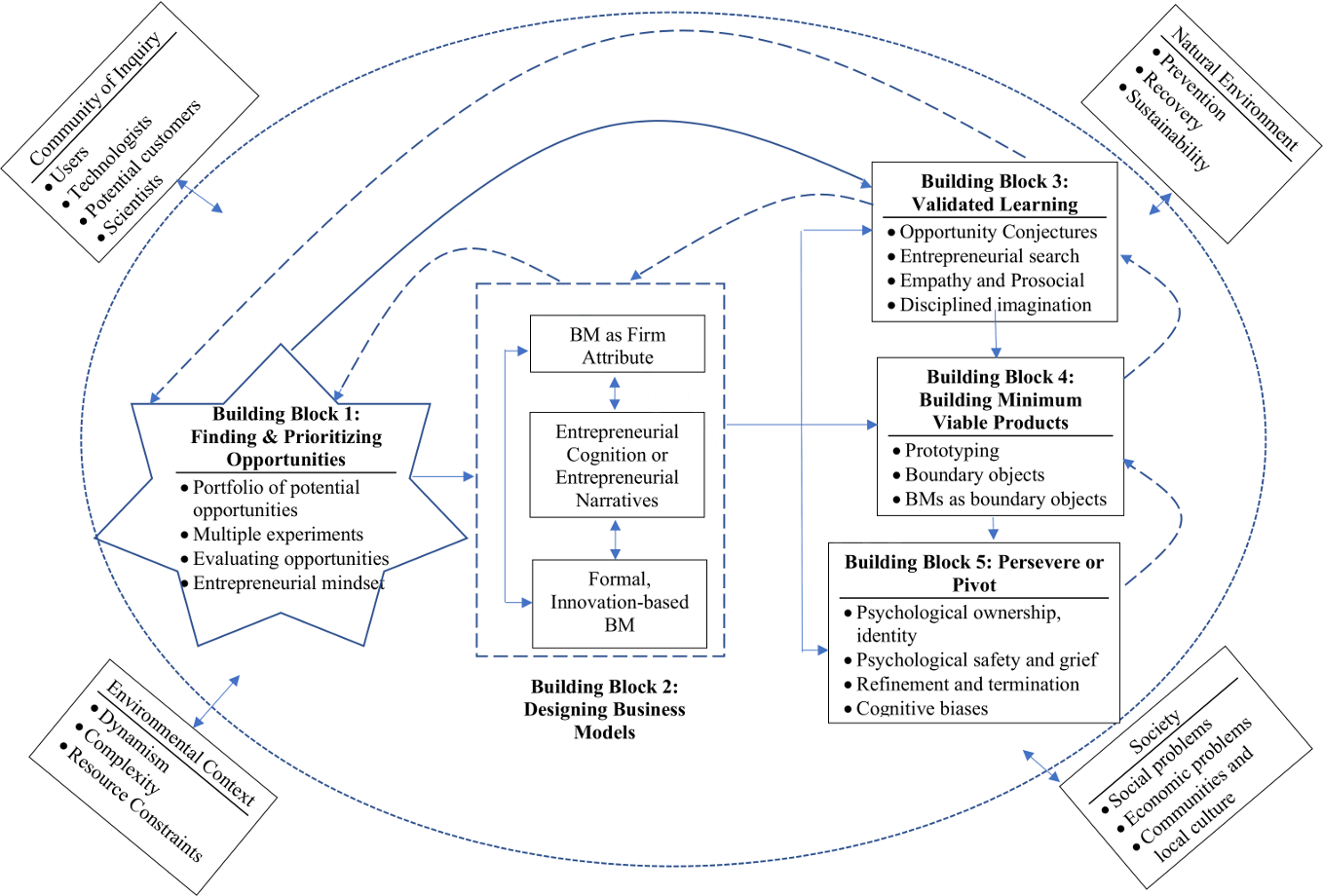
Building a startup model by combining practitioner knowledge with current and future academic research.
The first context is that of the community of inquiry—an informal group of stakeholders involved in the evaluation and development of a potential opportunity (Autio et al., 2013; Shepherd et al., 2015). Indeed, we are only just starting to understand the various ways such a community can facilitate the startup process. For example, Seyb et al. (2019) showed how communities of inquiry are involved in prototype testing and thus help entrepreneurs develop and refine their emerging ventures. Although there have already been calls for entrepreneurship research on communities of inquiry (Shepherd et al., 2015), we highlight here the criticality of this need given the lean startup framework’s reliance on “external” participants for testing (and reformulating) hypotheses using MVPs. These members (of startups’ communities of inquiry) may include users, customers, technologists, scientists, and so forth. It seems to us that the formation, interaction, and emergence of a community of inquiry is highly important in the emergence of a startup and thus begets the question of how the different groups within a community of inquiry emerge, impact the lean startup process, and become organized by (or organize) founders.
Second, practitioners have offered the lean startup framework as a way to learn under conditions of uncertainty (Blank, 2013; Ries, 2011). Likewise, the environmental context is typically represented in the strategic management literature in terms of resource scarcity, volatility, and complexity (Dess & Beard, 1984), with new venture strategy scholars generally focusing on dynamism (e.g., McKelvie et al., 2018) or high velocity as a combination of dynamism and complexity (Kiss & Barr, 2015). Although it appears reasonable to assume a dynamic or high-velocity environment when investigating entrepreneurial activity, these environmental dimensions can be considered a continuum (vis-à-vis a dichotomy). Therefore, rather than assuming all startups face the same environmental conditions (because they involve entrepreneurial action), there is an opportunity to explore how different levels of the various environmental dimensions influence the lean startup process. In particular, an important question to address is whether the approach is of less relevance under more predictable conditions—that is, is lean startup less effective when entrepreneurs choose to create a venture to exploit a potential opportunity that is relatively low in uncertainty (e.g., a potential opportunity in a stable, munificent environment)? This idea is analogous to Gruber’s finding that in “highly dynamic environments, entrepreneurs will gain [the] most value from planning when they focus on select planning activities, and speed up the planning task . . . [whereas in] less dynamic environments, they are better off pursuing a munificent approach to planning” (2007: 782). Perhaps the greater the environmental dynamism, the wider the lens needed to generate a sufficient set of potential opportunities, the more simultaneous experiments required to gather a variety of information, and the more frequent the need for MVPs. Perhaps in more complex environments, the startup process needs to rely on more elaborate MVPs or, alternatively, more narrow MVPs that test different aspects of the environment. Future research will make an important contribution to the startup literature by exploring the moderating role of the various environmental dimensions.
Third, the natural environment is another key context in which startups are embedded and in which the lean startup process may play an important role. The natural environment needs to be protected from further damage, and current damage needs to be mitigated. Startups appear to play an important role in addressing (but also exacerbating; Shepherd et al., 2013) these natural environmental issues (Shepherd & Sutcliffe, 2011; Wigger & Shepherd, 2019; York et al., 2016). However, does the lean startup process differ for business models focused on positive outcomes for the natural environment relative to business models focused on economic outcomes and also to hybrid business models that strive for some form of “balance” between the two? For example, recent research has acknowledged the unique challenges entrepreneurs face in balancing an economic logic and a nature-based logic in hybrid organizations (e.g., Haigh & Hoffman, 2011). However, how are such hybrid ventures created in the first place? How do these “competing” logics impact, for example, the content of hypotheses, the means by which hypotheses are tested, and the interpretation of information generated from such testing? That is, competing logics (perhaps in founders’ minds) are likely impactful well before an organization emerges. Therefore, developing knowledge about how to manage the competing logics of a hybrid organization might be putting the cart before the horse; we suspect there is much to learn by investigating the lean startup of hybrid ventures (vis-à-vis economic-based ventures and ventures at various levels of hybridity; (Shepherd et al., 2019).
Finally, the notion of hybridity also applies to grand societal challenges, such as those proposed by the Sustainable Development Goals of the United Nations, including climate change, inequality and poverty (e.g., Wry & Zhao, 2018), and the deterioration of communities and local cultures (Peredo & Chrisman, 2006). Again, we hope that future research will enlighten us on how the lean startup process differs for starting social ventures, for starting ventures to address different social problems, and for starting ventures at different levels of hybridity to address specific social problems. For example, what is the nature of hypotheses for a social startup, how are such hypotheses refuted or accepted, and what does an MVP look like for a social startup? Currently, the “one size fits all” approach to lean startups is, on the one hand, unsatisfying but, on the other hand, represents a great opportunity for future research to advance knowledge and for practitioners to be more precise in their startup activities.
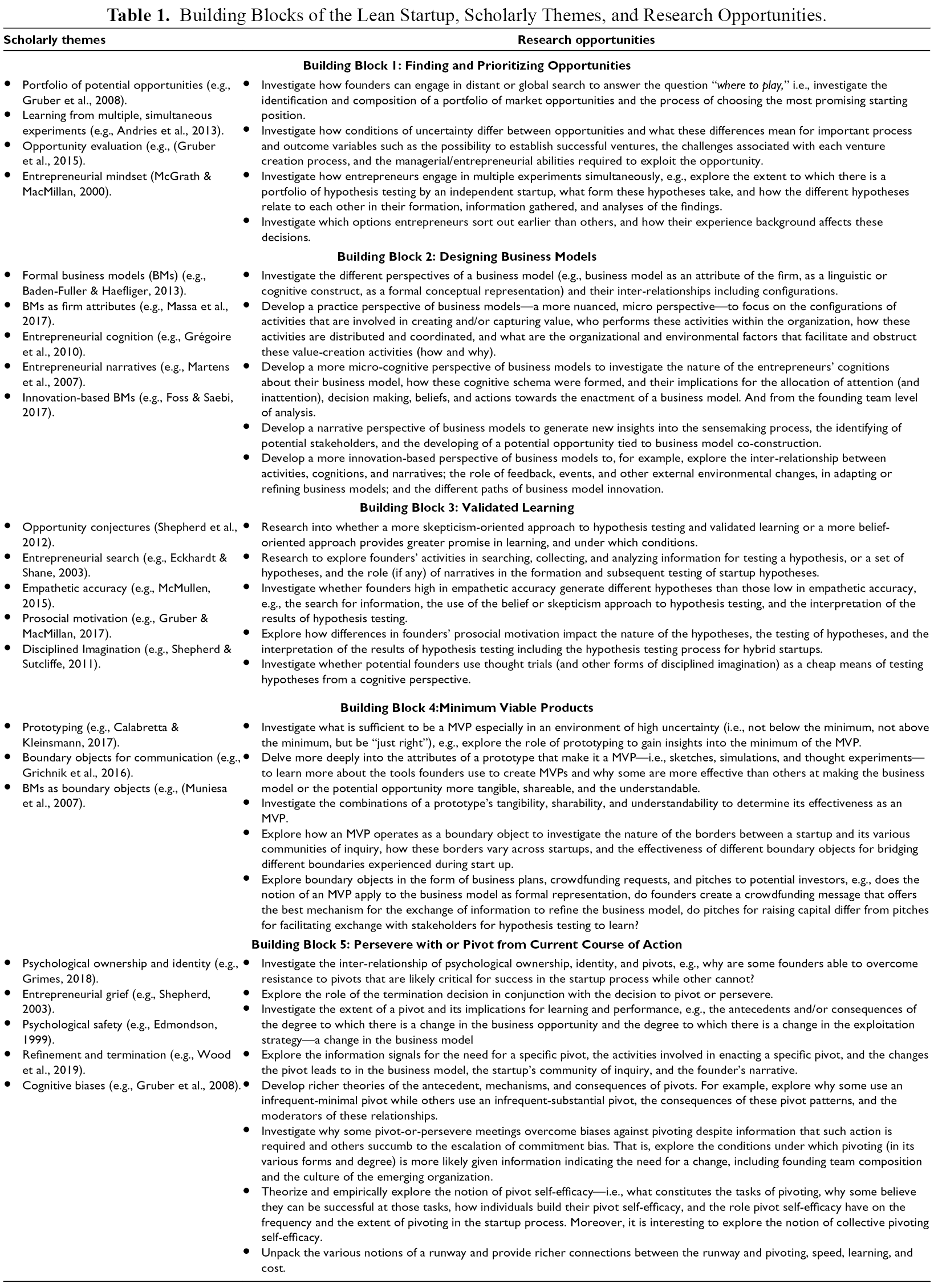
In sum, the preceding sections portrayed the different building blocks of the lean startup framework and outlined several important opportunities for future research. Table 1 and Figure 2 provide an overview of some of the main ideas discussed above.
Building Blocks of the Lean Startup, Scholarly Themes, and Research Opportunities.
Conclusion
In this article, we took the building blocks of the lean startup method—a practitioner perspective of the startup process—to organize prior academic research and to highlight the need for further scholarly investigation. Importantly, the lean startup framework and its five building blocks has inspired many ideas for ways scholars can engage in future research to further our understanding of the startup process. The hope is that this future research will continue to close the practitioner–academic gap. Although our review covered the core building blocks of the startup process (Blank, 2013, 2019), it is important to note that we did not attempt to represent all aspects and, in particular, left out those related to scaling (cf. Ries, 2011). Such a review was not our purpose; rather, our purpose was to take these building blocks and use them for inspiration to organize current research and propose future research. Future work can follow a similar procedure as that used in this article to “pull out” other aspects from the lean startup method, from other popular practitioner-based approaches (e.g., design thinking; Brown, 2008; the Lean Canvas; Maurya, 2011; etc.) or from other organizational lenses (Contigiani & Levinthal, 2019) to gain further inspiration for organizing prior research and proposing new research. Such work will continue to close the practitioner–academic gap.
Of course, equally important for achieving this goal of closing the practitioner–academic gap by using academic frameworks to organize existing practices and develop new approaches. Indeed, Adam Grant (professor at the University of Pennsylvania) said that Sheryl Sandberg (COO of Facebook) has asked him for research-based frameworks to inform her work. This transfer of knowledge might take the form of creating extended practical implications sections in journal articles; publishing research in more practitioner-based journals (e.g., Harvard Business Review, Sloan Management Review, and Business Horizons) and in practitioner-targeted books (perhaps jointly written with a practitioner); and using academic frameworks to make sense of current events published as interviews, op eds, and commentaries in newspapers, magazines, newscasts, and podcasts. Furthermore, we believe that a significant opportunity lies in designing business tools that draw on scholarly knowledge and that allow practitioners to access academic insights in a “ready-to-use” fashion—as illustrated by the Business Model Canvas (Osterwalder & Pigneur, 2010) and the Market Opportunity Navigator (Gruber & Tal, 2017).
Not every scholar needs to play every possible role in decreasing the practice–academic gap, but performing one of them might have a number of flow-through benefits. Our focus in this article was to use practice as an inspiration for advancing knowledge of the startup process in the entrepreneurship literature, but we were also mindful of how this research can eventually help practitioners and students. There is much to learn about startups, and we hope our article inspires additional research on this important topic.
Footnotes
Declaration of Conflicting Interests
The author(s) declared no potential conflicts of interest with respect to the research, authorship, and/or publication of this article.
Funding
The author(s) received no financial support for the research, authorship, and/or publication of this article.
