



Abstract
This editorial aims to advance the use of qualitative research methods when studying entrepreneurship. First, it outlines four characteristics of the domain of entrepreneurship that qualitative research is uniquely placed to address. In studying these characteristics, we urge researchers to leverage the plurality of different qualitative approaches, including less conventional methods. Second, to help researchers develop high-level theoretical contributions, we point to multiple possible contributions, and highlight how such contributions can be developed through qualitative methods. Thus, we aim to broaden the types of contributions and forms that qualitative entrepreneurship research takes, in ways that move beyond prototypical inductive theory-building.
Researchers are regularly encouraged to submit qualitative work to entrepreneurship journals. Yet, more often than not, authors of qualitative research encounter challenges to getting their work published, including having to excessively justify the selection of a qualitative approach towards an entrepreneurial phenomenon in the first place (Neergaard, 2014). Partly such challenges appear to stem from a recent push for more analytical rigor (Maula & Stam, 2019; Wiklund et al., 2019). Standards for publishing research in any tradition have been raised (McMullen, 2019), with greater emphasis being placed on the strengths of research design and the number of observations to warrant causal inferences. In this context, general standards for “rigor” are similarly imposed on qualitative research (Harley & Cornelissen, 2018). Here, popular templates such as Gioia et al.’s (2013) grounded-theory methodology alongside Eisenhardt’s method for theory building from cases (Eisenhardt, 1989; Eisenhardt & Graebner, 2007) are helpful in the sense that they provide a standard for qualitative procedures and presentation.
While such templates are popular with qualitative researchers, their widespread adoption also highlights some key challenges. First, not all qualitative research in entrepreneurship fits these templates, as they explore different types of phenomena or embrace different (ontological) assumptions. Besides the issue of fit, the general progress in the field of entrepreneurship might even be hampered when researchers restrict themselves to a limited number of dominant templates for qualitative research (e.g., Baker et al., 2017; Cornelissen, 2017; Eisenhardt et al., 2016; Gehman et al., 2018; Köhler et al., 2019). Second and relatedly, such templates encourage researchers to follow a particular format and style, overlooking the breadth of approaches qualitative research has to offer. As entrepreneurship scholars, we feel that methodological plurality should be embraced and that researchers should be open to consider a variety of qualitative methods that enable different forms of analysis and offer the potential for novel theorizing of entrepreneurship processes. An important advantage of qualitative work, in comparison to quantitative methods, is that it allows entrepreneurship researchers to inductively or abductively build theories, in close interaction with contexts, meanings, and processes. Third, it is often unclear which entrepreneurship-related characteristics and theories particularly fit well with which types of qualitative work. This makes the choice for a particular method appear to be based more on judgment about what will get published, rather than a clear and logical understanding about what works for the phenomenon and theoretical aims involved.
To advance the study of entrepreneurship using qualitative methods, and to provide guidance for authors who aim to publish such work in Entrepreneurship Theory and Practice and similar quality journals, this editorial first outlines four characteristics of the domain of entrepreneurship that qualitative research is uniquely placed to address. These characteristics point to specific questions for research that can only be understood, we argue, using the plurality provided by different qualitative approaches, including less conventional approaches. Therefore, throughout our discussion we suggest suitable qualitative methods for data collection and analysis. Second, we draw out different ways in which qualitative methods can provide a theoretical contribution; by building theory, elaborating theory, and qualifying theory. Here, we stress a variety of aims and contributions for qualitative research over and beyond inductive theory-building which is often seen as the prototype of a qualitative research contribution (Reinhardt et al., 2018).
Entrepreneurship Characteristics that Require Qualitative Research
It is often argued that qualitative research fits well with studying novel, underexplored, or hard-to-measure entrepreneurship phenomena. In the absence of existing theory, qualitative research can break new ground and develop new constructs and candidate explanations (cf. Edmondson & Mcmanus, 2007). Indeed, qualitative research has been important for developing theories on emerging phenomena such as crowdfunding (Short et al., 2017), sector-based entrepreneurship (De Massis et al., 2018), the sharing economy (Li et al., 2019), lean startup (Shepherd & Gruber, 2020), and digital entrepreneurship (Nambisan et al., 2019).
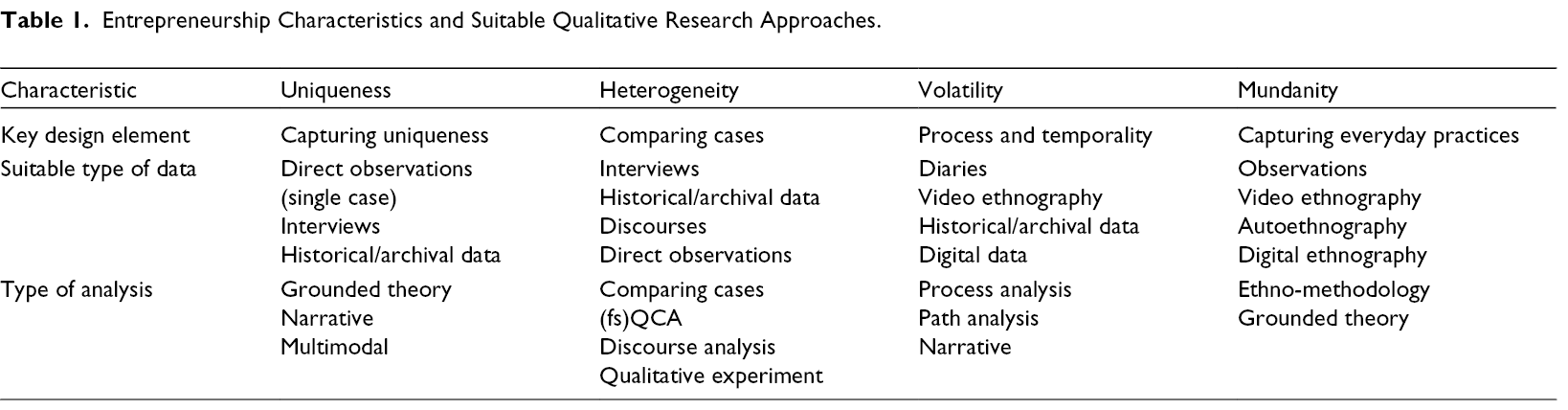
Rather than the outdated image of seeing qualitative research as primarily ‘exploratory’ in nature (Neergaard, 2014), qualitative research is well positioned to make substantive theoretical contributions to understanding entrepreneurship and in ways that go beyond just exploring new phenomena. We believe that four specific characteristics of entrepreneurship fit especially well with qualitative methods, namely the uniqueness, heterogeneity, volatility, and mundanity of entrepreneurial phenomena. As shown in Table 1, for each of these characteristics of entrepreneurship, we spell out promising sources of qualitative data and fitting types of analysis. In the subsequent section, we then discuss more generally how qualitative data and analyses can be linked to specific theoretical aims.
Entrepreneurship Characteristics and Suitable Qualitative Research Approaches.
Uniqueness
Several important aspects of entrepreneurship, such as hyper-growth, are infrequent and sometimes have an extreme or extraordinary character (Davidsson, 2016). Similarly, some key concepts and phenomena of interest for entrepreneurship are highly skewed; including for instance human capital, social capital, financial capital, experience, munificence, and the outcomes of entrepreneurial activities (Crawford et al., 2015). Whereas many quantitative studies struggle with how to make outliers fit the modeling technique (Aguinis et al., 2013), qualitative research is unencumbered by such limitations and has the potential to shed light on aspects that explain remarkable outcomes, such as extraordinary performance or catastrophic failure. As in Malcolm Gladwell’s (2008) bestselling book titled Outliers, which describes cases of unique performance or failure, qualitative researchers may analyze the common or rather unique factors within extreme cases. Researchers can study the characteristics of firms that, for instance, accumulate an abundance of social capital or resource slack, or ventures that are extra-ordinary performers. Since there are only few ‘unicorn’ organizations like Google, Uber and Adyen, the best way to understand their emergence, development and probably the unique features of such organizations is through comparative case studies or otherwise in-depth single case studies that seek event-based process explanations rather than variance explanations (Van de Ven & Engleman, 2004).
Data on such cases can be gathered through historical research methods (Argyres et al., 2020) or through combinations of interview and archival methods. An example is Alvarez et al.’s (2015) study of the creation of the king crab industry by entrepreneur Lowell Wakefield and his team. Using historical data, including company communication, government documents, newspaper articles, other studies, and retrospective interviews, their study describes the creation of an entrepreneurial opportunity, including the creation of the market, and the influence of industry and related institutional constituents on the venture.
Increasingly, such case-based data may also be multi-modal in nature, involving image- and video-based data besides language and texts. Entrepreneurship scholars who then want to capture the facets of such unique phenomena may best do so by writing out a ‘thick’ narrative description of the entrepreneurial processes involved (Garud et al., 2014), either at the individual level or at the level of more general entrepreneurial processes (Gartner, 2007). Such narration provides a thickness and depth that is unique to the context and reveals the intimate and salient details of the setting. Later on, more specific techniques of narrative bracketing and storying may then be used to depict in a more analytical sense a general sequence of events and to substitute a rich empirical description for a full-bodied narrative explanation. Alternatively, or next to such a narrative analysis, grounded theory procedures of coding and constant comparison can also guide the identification of distinctive and common features in such unique cases (Strauss & Corbin, 1998).
Heterogeneity
Entrepreneurship is a very heterogeneous field, with large differences in the type and scale of activities that entrepreneurs perform (Welter et al., 2017). Moreover, entrepreneurs often face radically different circumstances as they navigate diverse institutional, economic, and cultural environments. Interestingly, entrepreneurs also deal with the same conditions in very different ways, as shown by Dolmans et al. (2014) in their process study looking at how entrepreneurs perceive resource availability differently over time, depending on shifting imagined resource-usages and perceived resource availability. Combining such distinctly different cases in one single analysis importantly runs the risk of finding ‘weak’ results which are true on average, but not for most of the individual cases (Davidsson, 2016). Qualitative research offers the distinct advantage to zoom in on the particulars of different cases to generate in-depth understanding of crucial differences in activities and conditions, illuminating ways in which entrepreneurs can best deal with the circumstances presented.
To study heterogeneity, comparative case studies (Eisenhardt, 1989; Eisenhardt & Graebner, 2007; Yin, 2003) are one common way to analyze how a limited set of key characteristics leads to particular outcomes. The key feature of comparative case studies is comparison facilitated through careful case-selection, either using replication logic (i.e., selecting cases that would confirm the core factors in the emerging pattern with maximum variation on other dimensions), or theoretical polar-type sampling (i.e., selecting cases that differ on a few conditions which theoretically should influence the outcome variable(s)). Such comparative analysis is often informed by triangulating interview and archival data. Beyond established comparative case methods, we point to the potential of Qualitative Comparative Analysis (QCA) for analyzing sets of cases and comparing them along different dimensions (Douglas et al., 2020).
Besides comparative case studies and QCA, we also highlight the potential of discourse analysis to study heterogeneity, in this case in particular the heterogeneity—and potential convergence—of voices, which is relevant as entrepreneurship is also an important aspect of public and organizational discourses. Discourse analysis includes many different traditions, ranging from more theory-informed approaches, such as post-structuralist discourse analyses, to conversation analytic approaches that try to identify emergent themes in discourse data, as texts. An example is the study by Malmström et al. (2017) on how gender stereotypes are, as subjects, constructed in entrepreneurial discourses, and have in turn a performative effect on funding decisions made by venture capitalists.
Volatility
Entrepreneurial endeavors can change fundamentally over time, for instance in terms of activities and scope, as well as performance (McMullen & Dimov, 2013). Entrepreneurs act under conditions of uncertainty (McMullen & Shepherd, 2006), even though the types and levels of uncertainty can differ and also change over time (McKelvie et al., 2011). Qualitative research is particularly suited for illuminating the patterns and different types of processes that constitute entrepreneurial endeavors, including the messy origins of venture emergence. Such research can result in conceptualizing patterns over time as well as defining degrees of change and variation. Here, recent work on pivoting points to how entrepreneurs and entrepreneurial ventures can pivot in multiple ways (see for example, Grimes, 2018; Kirtley & O’Mahony, 2020), ranging from incremental adaptations to radical breaks that even might urge the need to establish different entrepreneurial entities and identities. Moreover, we know from prior research that entrepreneurs have different perspectives on time – involving perceptions of the past, present and future – that play a role in entrepreneurial processes (Lévesque & Stephan, 2020).
Adopting a process perspective using rich, qualitative data gives scholars insight into volatility, serving to provide explanations of the emergence, change, and flows that drive entrepreneurship. Process studies can draw on multiple types of data and use various types of analyses (Langley, 1999; Langley et al., 2013). To avoid the problems related to retrospective accounts, such as unobserved memory decay and hindsight bias, it is recommended to collect when possible ‘real time’ data, created during the process that is being observed, maybe in combination with more reflective, retrospective data such as interviews.
Diary studies can be used for this purpose as these have the benefit of providing nearly real-time information on volatile processes, alongside personal interpretations and imaginations reflecting people’s experiences (Bolger et al., 2003; Van Burg & Karlsson, 2020). For instance, Kaandorp et al. (2020) explored weekly diaries from entrepreneurs enrolled in a venturing program to study the networking behavior of 28 nascent entrepreneurial ventures. Finding large differences in networking activity, they discovered that highly active networkers differed from others in the way they evaluated and reacted to responses to their initial contact attempts. Also social media data may be a helpful data source to capture dynamic and evolving communication processes targeted at particular audiences (cf. Schneider, 2018; Toubiana & Zietsma, 2017). An example of this is the study by Fischer and Reuber (2011) on how a moderate degree of Twitter-based interactions enabled and supported entrepreneurs to become more effectual, whereas a high amount of such mediated interactions led to “effectual churn”.
Video-based data can also give researchers quick access to data with context, timing, and visual features, providing the possibility to observe embodied and material aspects of entrepreneurial processes in medias res (Christianson, 2018). In a review of video-based methods, Ormiston and Thompson (2020) distinguish three ways of using video for researching entrepreneurship as it plays out: videos of entrepreneurship ‘in motion’ such as pitches (e.g., Clarke et al., 2019), videos generated by entrepreneurs, for instance for crowdfunding platforms (e.g., Balen et al., 2019), and researcher oriented videos such as interviews and focus groups.
Finally, a rather unconventional, but promising way to study volatile processes is to follow the involved material artifacts rather than entrepreneurial actions (cf. follow-the-money), thus moving beyond the actions of individuals (cf. Fletcher et al., 2016; Thompson et al., 2020) and centering on the processes instead. For instance, Berends et al. (2011) used a combination of archival sources and interviews to follow the development of the aircraft material Glare from its early inception to its final application on a major aircraft. Following the twists, turns, half-stops and dead ends in this story, Berends et al. (2011) pointed to the perseverance of entrepreneurial individuals as the backbone of the development.
While it is challenging to depict the richness of information on different processes in such data sources, generally process analysis starts with describing and coding key characteristics around relevant episodes and constructs, and generating visuals to explore patterns in the data (Langley, 1999; Miles & Huberman, 1994). After exploring different ways of representing the data, researchers can subsequently select the most insightful visuals and present them together with a narrative analysis that explains the patterns in these visuals.
Mundanity
Even though much entrepreneurship research is focused on explaining and understanding innovation, growth, and performance, most ventures are rather mundane, commonplace small businesses that simply reproduce pre-existing organizational forms (Aldrich & Ruef, 2018). Interest in mundane entrepreneurship is picking up, in particular in the growing stream of entrepreneurship as practice (Thompson et al., 2020), but also in, for instance, theorizing imitation and ‘necessity’ forms of entrepreneurship (e.g., Dencker et al., 2020; Frankenberger & Stam, 2020). To study ‘everyday’ entrepreneurship (Welter et al., 2017), qualitative research is especially well positioned to extend understanding about aspects which are hard to measure like, for instance, sensemaking, entrepreneurial identity, perseverance, family embeddedness, and the day-to-day small variations in entrepreneurial behavior. Moreover, attending to mundane entrepreneurial practices also goes beyond ontological individualism that focuses on what entrepreneurs do, and rather attends to relational, embodied, mediated and organized aspects of these practices (Thompson et al., 2020), situating the individual in her/his entrepreneurial context.
Ethnographic methodologies are well-suited to study such mundanity. Through immersing oneself in a research site for a longer period of time, everyday ‘normal’ and ‘regular’ aspects of entrepreneurial life can be captured, which would be forgone in interviews or diaries and are unlikely to be covered in retrospective accounts or surveys. Beyond the rich anthropological-based way of ethnography – which still has a lot of underexploited potential in entrepreneurship studies (Johnstone, 2006) – autoethnography, video ethnography, and digital ethnography, alongside other new forms of ethnography (Rouleau et al., 2014), are less conventional approaches that need more attention. Autoethnography refers to either an ethnography of one’s own group, or to an ethnography that is highly reflective of the situatedness of oneself in the context of study, and thus is likely to be more transparent about the role of the researcher than other methods (Fletcher, 2011). Video ethnography, particularly in the form of event-based (e.g., pitches) or participant-led videos (e.g., crowdfunding videos, company coverage; Whiting et al., 2018), is one way to get beyond a focus on researcher-generated material, and has been relatively unexplored terrain (Clarke, 2011). For instance, crowdfunding videos have so far only been studied quantitatively, thereby significantly reducing their richness (Ormiston & Thompson, 2020). Finally, digital ethnography, collecting digitally mediated interactions such as through email, Twitter and Whatsapp, helps to create webs of interactions, and especially may perform well when looking to identify dominant and marginal voices (Akemu & Abdelnour, 2020; Schneider, 2018).
Developing Theoretical Contributions
For each of the characteristics outlined above – as well as other entrepreneurship themes and phenomena – qualitative research can deliver substantial theoretical contributions. Qualitative research is known for its ability to cover relatively unexplored phenomena and for drawing out new conceptual categories in the form of constructs, process models and propositions (Gioia et al., 2013). At the same time, qualitative research can also be used to elaborate, qualify or deepen existing theory (Lee et al., 1999) by adding contextual variation, drawing out boundary conditions and approaching or establishing the causal mechanisms underpinning established relationships. Whilst there may yet be other theory development related purposes for qualitative research (see e.g., Leitch et al., 2010 on interpretive research), we focus here on three forms: theory building concerning new phenomena, theory elaboration through contextual variation, and qualifying theory by uncovering causal mechanisms.
Theory Building: New Concepts and Explanations for New, Emerging Phenomena
A first recognized route for qualitative research is for it to be used inductively to conceptualize new constructs, relationships, or processes around new or emerging phenomena in entrepreneurship. As Edmondson and Mcmanus (2007) argue in their work on methodological fit, inductive qualitative work can break new ground and lead to the development of new constructs and new candidate explanations (in the form of a process model, for example) that then perhaps at a later stage can be tested using quantitative methods. Indeed, a core strength of qualitative research is that it enables new ways of conceptualizing, with new phenomena often serving as a fertile ground for challenging prevailing theoretical assumptions and for charting new theoretical terrain (Bamberger & Pratt, 2010). For example, in a recent multi-method study of entrepreneurial pitches, Clarke et al. (2019) first used a qualitative study to inductively develop theory on different styles of pitching; uncovering among other things distinct variation in nonverbal behaviors as part of different pitches. Conceptualizing these previously neglected nonverbal aspects of communication, they test in a subsequent experiment the role and effectiveness of different pitching styles and of different nonverbal behaviors on actual investor decision-making.
The main method of theory building in entrepreneurship research is grounded theory (Glaser & Strauss, 1967). Given the emphasis that is placed on theory development in entrepreneurship, it is oftentimes seen as the epitome of qualitative research (Suddaby et al., 2015). At the same time, it is important to realize that various understandings of grounded theory circulate, with different implications for how the method is being used (Murphy et al., 2017; Suddaby, 2006). In the more interpretive version of the method, grounded theory consists of providing a data-informed thematic representation of the sensemaking of individual entrepreneurs and of processes of social construction (Cornelissen, 2017; Suddaby, 2006). Such themes can be considered ‘theory’ providing they reveal “patterned relationships between social actors and how these relationships and interactions actively construct reality” (Suddaby, 2006, p. 636). Other versions of grounded theory (Gioia et al., 2013; Murphy et al., 2017) are more formal-analytical in nature and suggest inductive and abductive steps to derive conceptual categories in the form of general constructs and a transferable process model “that can eventually extend to concrete, testable hypotheses derived from those theoretical models” (Murphy et al., 2017, p. 291).
Importantly, in both the interpretive and formal-analytical approaches, efforts to build theory are deeply informed by informant-centric, primary data so that any resulting theoretical interpretations are said to be ‘grounded’. The difference, however, is their route towards theory-building and what they focus on as the theory that is produced. For the formal-analytical approaches, there is then a further difference between the inductive Gioia approach and the abductive approach suggested by Kreiner and colleagues (see Murphy et al., 2017; Reinhardt et al., 2018). The Gioia approach advocates an inductive ‘tabula rasa’ (clean slate) approach where researchers are led by the data and by informant-centric labels and terms before they make any conceptual abstractions. Kreiner and colleagues (Murphy et al., 2017) suggest a more abductive approach of bringing in possible theoretical perspectives early on in the analysis of the data – which they label as a ‘twin slate’, in focusing on both theory and first-order data concurrently. Whereas inductive versions of grounded theory typically acknowledge an abductive step later on in the process of analysis, to contextualize and refine emergent findings (e.g., Langley, 1999), the Kreiner (2016) approach advocates an abductive conceptual leap much earlier on with theories being used as lenses to order and integrate the emergent insights.
Theory Elaboration: Elaborating Contextual Conditions
Qualitative research can also be used to elaborate existing theory by interrogating boundary conditions and by constructively complicating a theory by bringing in observed contextual variation. Indeed, much existing qualitative work investigates specific contextual conditions and phenomena that influence entrepreneurial processes and outcomes (Garud et al., 2014; Welter, 2011). Perhaps particularly in the case of entrepreneurship, context always plays an important role in understanding and explaining what is happening (Leitch et al., 2010). Being tightly embedded in a research context allows qualitative researchers to better appreciate how unfolding events are shaped by the temporal, spatial and historical context in which the research object is situated (Bansal et al., 2018). This approach also enables a better understanding of the lived experiences of entrepreneurs and how their interactions play out in context and place (Jack, 2005; Jack & Anderson, 2002; McKeever et al., 2015). Having observed such contextual variation, researchers can then in turn elaborate and refine a theory by specifying how and when variations in context affect entrepreneurial processes and outcomes. For example, recent qualitative work has shown the importance of paying attention to how entrepreneurship processes differ in emerging economies, showing important differences in the role of social embeddedness (Khavul et al., 2009) and in one’s occupational identity (Slade Shantz et al., 2018) compared to Western contexts, and attending on the basis of such differences to processes with unique importance in emerging economies.
One qualitative method for uncovering such contextual variation that has to date been hardly used in entrepreneurship is qualitative comparative analysis (Douglas et al., 2020). QCA involves a package of comparative case-based methods that are suited to addressing contextual variation and to drawing out variable processes or patterns. Practically, researchers go about this through a constant comparative method (similar to grounded theory method, see Kreiner (2016)) and by using Boolean set-theoretical logic to first develop ‘truth tables’ of all the recorded and thus “present” conditions in the contexts of different cases and their possible intersections. They then go through a structured reasoning process using modal logic to develop explanatory models of possible configurations of causal conditions, bearing in mind that conditions may vary and that multiple conditions may together be associated with an outcome or effect. On this basis, researchers are urged to both “determine the number and character of the different causal models that exist among comparable cases” (Ragin, 1987, p. 167). Douglas et al. (2020) show how QCA allows entrepreneurship researchers to draw out such contextual variation by revealing differences across cases and by being able to identify “multiple entrepreneurial pathways that are otherwise hidden in the data” (Douglas et al., 2020, p. 3). For instance, using QCA McKnight and Zietsma (2018) studied 30 cleantech firms and identified which sets of differentiating and conforming entrepreneurial strategies led to successful commercialization under different conditions, such as technology radicalness and relationships to incumbents.
Another underutilized method for elaborating contextual conditions is the qualitative experiment (Kleining, 1986). While experiments in entrepreneurship are on the rise (Williams et al., 2019), they are often quantitative in nature. Yet, experiments can also be used qualitatively to gain in-depth understandings of how interventions come to influence the mindsets, experiences, and behaviors of participants and why they produce outcomes in some contexts but not in others (Prowse & Camfield, 2013). Unlike the comparative case method or QCA, qualitative experiments enable researchers to carefully vary and control contextual stimuli ex ante, instead of having to classify cases ex post based on a restricted range of observable contextual conditions. Qualitative experiments thus allow entrepreneurship scholars to create extreme or unique cases that may otherwise be difficult to study. For instance, if one were to qualitatively examine interaction processes in entrepreneurial teams, then random or purposeful assignment of participants to venture teams would generate important variation in team contexts that helps overcome self-selection and success bias in real-world teams (Jung et al., 2017). While viable in the lab, qualitative methods hold particular promise for contextualizing findings from field experiments. Understanding why interventions like the launch of an entrepreneurial training program (Field et al., 2010) or assignment of (entrepreneur) mentors to students (Eesley & Wang, 2017) (fail to) produce certain outcomes requires that researchers deeply engage with the context in which the intervention takes place. As called for by action researchers (Cassell & Johnson, 2006; Leitch, 2007), participatory and collaborative research practices permit entrepreneurship scholars to closely observe and work with study participants, thereby generating in-depth understandings of how distinct features of the experimental context shape an intervention’s impact on entrepreneurial activity and outcomes.
Theory Qualification: Searching for Causal Mechanisms
A third important theorizing role for qualitative research is to qualify the underlying mechanisms of observed and theorized processes or relationships in the entrepreneurship domain. In this way, qualitative research can be used to deepen existing theories. Oftentimes, theories in the entrepreneurship field can explain an important part of what we observe, but frequently also suffer from unexplained variance and conflicting findings. Causal mechanisms provide meso- and micro-level explanations which basically are simple explanatory models of why a certain outcome is produced in a particular context (Hedström & Ylikoski, 2010; Van Burg & Romme, 2014). These explanatory mechanisms can shed light on such unexplained variance and conflicting findings. A focus on explanatory mechanisms thus serves to qualify underlying processes, yielding the building blocks of emerging or existing theory. An example is Uzzi’s (1997) classic study on firm embeddedness, which carefully explicates the different mechanisms at work that produce beneficial or detrimental effects of a firm’s embeddedness.
We believe that such a mechanism-based approach is useful for entrepreneurship research and that qualitative research is a prime avenue for being able to qualify such causal mechanisms. A first reason is that qualitative research gets close to the action and is thus, compared to quantitative research, better able to uncover the ‘cogs and wheels’ in action that generally can be seen to produce the observed outcome (Davis & Marquis, 2005). A second reason is that the notion of mechanisms is positioned in between description and universal laws (Elster, 2007), with mechanisms being identified and invoked in context to explain processual or configurational data (Van Burg & Romme, 2014).
When entrepreneurship researchers set out to find such mechanisms in their qualitative data, they operate largely abductively by posing various mechanisms as potentially explanatory of the observed patterns and processes in their data. A mechanism is in the first instance a schema or mental model of how parts interact (derived from other literatures, studies and settings), and which, once projected, can be examined for its veracity. One key point here is that even if the mechanism, as the ‘deeper’ causally contiguous process connecting entrepreneurs, their activities, other events and outcomes, cannot itself be directly observed in an empirical context, it nonetheless leaves hypothesized traces of interacting processes and of effects that can be studied and verified (Hedström & Swedberg, 1996, p. 290).
To get to such mechanisms, researchers are advised to move beyond a basic description of their model and of the relationships between concepts by interrogating the basic explanatory principle that is at work. One approach is to focus on explaining why an outcome was produced or came about. Such an outcome could be a puzzling or startling finding, such as the positive and negative effects of social networks (cf. Uzzi, 1997), or more generally something of significance for entrepreneurs or entrepreneurship (e.g., growth, exploitation of opportunities). Most qualitative research is uniquely placed to start with an observed outcome and then dig into understanding the causes and processes that may have led to such an outcome. For instance, based on prior work Van Burg and Romme (2014) show that learning, practice, and other socially situated mechanisms, being inferred and subsequently validated through partial observations of parts and outcomes, can be effectively entailments of the broader mechanisms for opportunity identification, creation and exploitation. Once researchers have identified the causal mechanism or mechanisms, they can make this an explicit part of the theoretical discussion around their model.
The Need for Plurality
While existing templates such as the ones provided by Gioia et al. (2013), Langley (1999) and Eisenhardt (1989) provide some hands-on guidance in doing and reporting qualitative research, we aim to broaden qualitative inquiry beyond these templates to deepen understanding and further theorizing of entrepreneurial phenomena. For any particular study, researchers may choose to combine existing analytical templates with rather unconventional methods to interrogate their data and develop theory, while paying careful attention to the consistency of such combinations.
Plurality not only applies to combining different analytical templates, but also to the ways in which findings and patterns in the data can be presented. We encourage researchers to go beyond the ‘minimum standard’ in terms of showing data in illustrative quotes, visuals and data tables, and to look for additional and innovative ways to illuminate the core patterns they have found. Visual aids help to split or combine pieces of fragmented data, allowing scholars to test assumptions, discover new meanings, and make sense of emerging patterns (Ravasi, 2017). New analytical methods (e.g., word clouds, word trees, social graphs, history flows) and visualization tools (e.g., Tableau, Qlik, Bime) may similarly enable entrepreneurship scholars to develop more insightful representations of qualitative data (Ertug et al., 2018; George et al., 2016). Such a presentation of evidence should be tailored to the study’s theory and empirical context and done in ways that maximize theoretical insight by uncovering hidden patterns and allowing readers to develop their own interpretations of the data (see Greve, 2018, pp. 429–430 for specific guidelines). Whilst this editorial does not discuss mixed methods research as such, quantifying qualitative data may be a strategy to create summaries of qualitative data, whether visual or otherwise, that show the patterns in a different way. For instance, the network study by Van Wijk et al. (2013) is an excellent example of how qualitative data about network-relationships, collaboration, agency and idea-development go hand-in-hand with quantitative calculations and visualizations of network changes and their effects.
Especially in view of the plurality of qualitative methods, as a final note we would like to stress the important role of transparency (e.g., Bluhm et al., 2011; Lincoln et al., 1985; Yin, 2003) to enable readers to really grasp what researchers have done in their studies. Best practice recommendations for transparency in the design, implementation and reporting of qualitative entrepreneurship research are already captured in many editorials, methodology chapters, and books; advice which we do not need to repeat here (Bansal et al., 2018; e.g., Bansal & Corley, 2012; Berends & Deken, 2019; Cunliffe, 2011; Graebner et al., 2012; Reay, 2014). Yet, we do recognize that authors might fear that transparency and attention to detail will lead to excessively long manuscripts that are more likely to be rejected because editors and reviewers would more easily identify a study’s methodological limitations. We argue the opposite is true; transparency allows editors and reviewers to better understand the key methodological tradeoffs in a particular study and be more sympathetic towards its potential limitations. In particular, we recommend that authors prioritize those aspects of their studies that require more elaborate reporting and discuss those in a detailed manner in manuscripts. ETP indeed encourages authors of accepted papers to publish supplementary materials and data files in online appendices and requires, upon initial submission, that they explicitly discuss any data overlap that might exist with other manuscripts.
Conclusion
Qualitative research has been of tremendous value for developing some of the most foundational theories in entrepreneurship research. Not only is qualitative research important to build, elaborate, and qualify entrepreneurship theories, it also is an important way to build further understanding of the unique, heterogeneous, volatile as well as mundane characteristics that define the field of entrepreneurship. However, as qualitative methods become more diverse and sophisticated, there is a need for researchers to broaden the set of methods they employ and use them more creatively and rigorously to advance entrepreneurship research.
Through this editorial we have purposefully sought to inspire scholars to move beyond the dominant templates for qualitative research and consider alternatives that can enable novel theorizing. We truly hope that this editorial and related initiatives will allow entrepreneurship scholars to further leverage the unique advantages of qualitative work for creating and accumulating knowledge of the many complex and intriguing entrepreneurial phenomena that are unfolding in today’s world.
Footnotes
Acknowledgements
We thank Hans Berends, Issy Drori, Dries Faems, and Jakomijn van Wijk for their very helpful comments on an earlier draft of this article. We are also grateful to the Editor, Friederike Welter, and two anonymous reviewers for their constructive comments which helped shape this editorial.
Declaration of Conflicting Interests
The author(s) declared no potential conflicts of interest with respect to the research, authorship, and/or publication of this article.
Funding
The author(s) received no financial support for the research, authorship, and/or publication of this article.
