



Abstract
This paper explores the relationship between the study of entrepreneurs and the entrepreneurs we study. While scholars typically adopt a detached, third-person stance for the purpose of explaining and predicting entrepreneurial action, entrepreneurs instead operate in a first-person stance of deciding what to do. The two stances cannot be reduced to one another. We argue that an engaged dialog—a second-person stance—can bring scholars and entrepreneurs together into a unifying practical decision-making perspective. By working to develop this integrative voice in scholarship, we can collapse the dualism of rigor and relevance.
The interplay between theory and practice reveals itself in the tension between rigor and relevance in research (e.g., Frank & Landström, 2016; Hodgkinson & Rousseau, 2009). The pure pursuit of rigor creates boundaries around academic conversations, as communities develop around their idiosyncratic disciplinary training and research perspectives (Gartner et al., 2006), and produces esoteric theorizing (Wiklund et al., 2019). In the spirit of closing this gap, the notion of engaged scholarship has emerged as “participative form of research for obtaining the different perspectives of key stakeholders in studying complex problems” (Van de Ven, 2007, p. 9). At the same time, its ethos poses a deeper question of scholarly accountability: for whom do we write? As we will argue below, this question is particularly pertinent to the domain of entrepreneurship as distinct from organization and management studies.
One useful way of addressing the question “For whom do we write?” is by asking “To whom do we make ourselves accountable for what we write in our scholarly publications?” or “To whom do we have to justify what we say?” Typically, it is other scholars who will be potential reviewers, editors, readers, and responders rather than the entrepreneurs about whom we are writing. As a result, most entrepreneurship scholarship consists of conversations between academics about entrepreneurs but excludes the perspectives of the entrepreneurs being discussed. When entrepreneurship scholars try to explain theoretically entrepreneurs’ decision-making practices from a purely third-person perspective, it is often for the purpose of being better able to predict or even influence how entrepreneurs will make decisions in certain contexts. However, entrepreneurs themselves adopt a first-person perspective on their decision-making. They are not interested in predicting what they will do, but deciding what they should do in their specific situation. We will argue this distinction poses a serious challenge for entrepreneurship scholars because what distinguishes entrepreneurs from nonentrepreneurs is their first-person practical intention to venture off the beaten path. If we as scholars lose contact with entrepreneurs’ first-person practical decision-making perspective then we are in great danger of not merely becoming irrelevant to practicing entrepreneurs, but of failing to even study the core phenomena we claim to be studying—however “rigorously” we do it.
Unlike the broader field of organization and management studies—in which phenomena are well defined in that they pertain to organizations and managerial activities that already exist—the phenomenon of entrepreneurship is future focused (Venkataraman, 1997), yet is to be studied in the present. In stepping into the unknown or the unaccustomed, entrepreneurs disclose new worlds (Sarasvathy, 2012; Spinoza et al., 1997) that are yet to emerge and thus may not be immediately understood or accepted, pursuing initiatives that venture capitalist Mark Andreessen calls “nonconsensus” or plain crazy. Therefore, to appreciate the entrepreneurial is to become sensitive to the practical context of the acting entrepreneur, turning it into a dialogical space, entwining scholars’ conceptual rigor with entrepreneurs’ openness to novelty. In short, we need to look behind the label “entrepreneur.”
Yet, in the body of work we have created as entrepreneurship scholars, we take the entrepreneur for granted, as distinctly familiar. We take it as given that certain empirical observations represent instances of entrepreneurship or operate with the abstract categories of entrepreneurship, entrepreneur, and entrepreneurial action, of which we presume that empirical instances exist. In so doing, we overlook the very conditions from which these categories arise, and thus miss what distinguishes them from other topics, persons, and actions.
Ten years ago, this hunch arose in the Unbearable Elusiveness of Entrepreneurial Opportunities as the category that defines entrepreneurs (Dimov, 2011). It was grounded in a distinction between formalist and substantive conception of opportunities—the formalist conception seeking to capture opportunities in an a-personal sense as an encompassing concept, and the substantive conception recognizing that the opportunity concept is just a gateway to uncovering the multitude of idiosyncratic ways that people venture forward. A formalist conception helps impose meaning from the outside using a third-personal perspective, while the substantivist conception helps uncover meaning from within the entrepreneur’s first-person perspective, that is, reveal the diverse, personal nature of being entrepreneurial. There are thus two distinct scholarly points of view elicited by these conceptions: one of an external observer committed to objective, stable points of reference and the other of an engaged dialogist committed to the shared interests of coping with the vicissitudes of the world. That these views largely remain disjointed is puzzling, to say the least.
This paper aims to bring these views together into an integrative conception of entrepreneurial scholarship. To do so, we outline and reflect on the tensions between the third-person tenets of rigorous research and the first-person substance of entrepreneurial practice. We then seek common ground in the mediating role of a second-person perspective, the development of scholarly sensitivity to the substantive questions of entrepreneurial practice, and enacting a stance of accountability to the entrepreneurs we study.
The Literary Tribe
In the 1970s, Bruno Latour conducted an anthropological study of a scientific laboratory, aiming “to observe scientists with the same cold and unblinking eye with which cells, or hormones, or chemical reactions are studied” (Latour & Woolgar, 1979, p. 12) and to translate the observations into the code of his profession. “It strikes our observer that its members are compulsive and almost manic writers. Every bench has a large leather-bound book in which members meticulously record what they have just done against a certain code number. This appears strange because our observer has only witnessed such diffidence in memory in the work of a few particularly scrupulous novelists” (p. 48). This outside observer perceived “an essential similarity between the inscription capabilities of apparatus, the manic passion for marking, coding, and filing, and the literary skills of writing, persuasion, and discussion” (p. 51). Even manipulating the brains of rats could be seen as an activity that eventually produces a high value diagram. “For the observer, then, the laboratory began to take on the appearance of a system of literary inscription” (p. 52). From the perspective of the scientists participating in the research, however, the anthropologist observer misses the point of their activity.
Now imagine that you present a scholarly paper on an entrepreneurship topic at a management research conference. After your presentation, you meet someone who says that they are trying to learn more about entrepreneurship theory and then enthusiastically asks you if they could read and provide you with comments on your paper. A few weeks later, the person contacts you and explains that they found your paper fascinating in virtue of it fitting into a certain citation pattern, using certain grammatical forms, and creating a certain emotional tone by using certain types of words. The commenter then presents various suggestions along these dimensions to help you increase the number of citations you are likely to receive once published. Further discussion reveals the person to be agnostic about what your research question is, what your answer is, and how you answered it. It turns out that this person studies entrepreneurship theory by collecting scholarly papers on entrepreneurship and then computationally analyzes citation patterns, grammatical styles, and emotional tone and relates these to citation counts. It is unclear why anyone would care to do this, but we are assured of the rigor of the methods and of the goal of providing new insight into entrepreneurship theory.
From the perspective of those of us building, debating, and refining entrepreneurship theory, this strange person does not even know what the theory is, and seems to be able to identify papers as being about entrepreneurship only by virtue of being presented at conferences (or conference sessions) about entrepreneurship. It would thus seem unclear to us how such a research project could provide us with useful insights into entrepreneurship theory. It seems that if one wanted to research entrepreneurship theory then one would at least need to know what the theory is for, what its key claims are, what the arguments behind it are, and the general academic conversation surrounding it. Divorced from all these things, “entrepreneurship” theory becomes little more than a word associated with certain text documents. One can rigorously analyze these texts as mere data, but it would not be an analysis of entrepreneurship theory as theory. To understand these documents as being about entrepreneurship theory, one cannot look at the text as mere data, but as a contribution to the scholarly conversation in which the texts play a role. This is not a trivial matter. One does not read scholarly articles in the same way that one reads fiction, newspaper articles, or letters from friends. Part of becoming a scholar is learning how to read scholarly texts in one’s discipline.
Just as the scientists in Latour’s study might react with anger at being represented as participants in some literary activity, so too would we entrepreneurship scholars be put on edge by the strange person’s claim that they study entrepreneurship theory by examining citation patterns. And yet, we could appear strange to the community of entrepreneurial practitioners in a way that is closely analogous to the way that the peculiar entrepreneurship researcher appears to us. Just as the peculiar entrepreneurship researcher identifies us as entrepreneurship scholars by virtue of our attending certain conferences or publishing in particular journals, so do we identify entrepreneurs by their having recently registered their business, indicating self-employment status in a national labor survey, or being included in the Kauffman database. Just as we can dismiss the strange person as having no idea about the substance of entrepreneurship theory, so too can we be dismissed as having limited idea about the substance of entrepreneurial activity.
In each of these cases—the anthropologist studying the lab scientists, the peculiar entrepreneurship theory researcher studying scholarly texts, and the entrepreneurship scholars studying entrepreneurs—those studying the practices of others do not make themselves and their characterizations of the practices accountable to those whose practices are being studied.
Where Is Wally/Waldo/Holger/Charlie/Walter?
Where’s Wally? is a series of books from British illustrator Martin Handford. They challenge us to find the elusive Wally with his iconic features among busy, intricate scenes. Over 30 years, the books have sold over 70 million copies worldwide in 31 languages. In the USA and Canada, Wally is Waldo, in Denmark Holger, in France Charlie, and in Germany Walter. Likewise, in the busyness of daily business life, our challenge as entrepreneurship scholars is to find the “entrepreneurs” so that we can observe and understand what they do.
Imagine for a moment walking into an airport lounge, train station, café, or office building, and then trying to identify an entrepreneur. What would be required? Whereas Wally retains his iconic visual features across pages and languages, entrepreneurs cannot be so readily identified by sensory cues, and without appeal to language. This makes the identification of entrepreneurs notably different from the identification of other social or professional roles that people perform. In many cases, we can use the situational setting and artifacts to make inferences about the person: if we see them finishing wood and assembling a chair, we could identify the person as a carpenter; if we see a person standing in front of children seated in rows, we could identify the person as a teacher; if we see a person using a stethoscope to examine someone’s lungs, we could identify the person as a doctor. In each of these cases, we can make reasonable estimates about the roles people play without drawing from any sort of verbal cues. In contrast, entrepreneurs cannot be identified in this way. Even if we are familiar with the settings in which people act and with the artifacts people use, we would still not be able to single out anyone as an entrepreneur unless we were to attend to and understand what they say and write. A linguistic description is indispensable, particularly when all that is driving a person’s actions is their vision of a different world (Dimov, 2018), when they connect the dots around us in ways that we cannot yet intuit (Baron, 2006).
Neither who the people are (e.g., Gartner, 1989) nor what they are doing (in a bodily sense) are necessary or sufficient evidence for classifying them as entrepreneurs. In this sense, “entrepreneur” is a role that we ascribe to people based on the meaning of their actions, rather than on the basis of their observable behavior. In the absence of any tangible markers (e.g., company, website, products, and registrations) in the very early stages of a process that can eventually be described as entrepreneurial once such markers become enacted, we are left with a person’s vision and intention as the only sources of meaning for their actions.
In his seminal work, Mind in Society, Vygotsky (1978) articulates the idea that, with the development of abstract thought, meaning begins to dominate action and, in this way, action becomes a pivot through which a person can move in a field of meaning. The fields of vision and meaning begin to diverge once children can separate object and concept to create imaginary situations in which thought becomes separated from objects. These ideas suggest that the meaning of an action that would lead us to describe the person behind it as “entrepreneur” arises from the imaginary situation (field of meaning) in which the person operates via this action. In entrepreneurship research, this imaginary situation is captured by the notion of opportunity as a possibility for introducing new goods or services (Venkataraman, 1997). The label “imaginary” is appropriate here as the initial articulation of what an entrepreneur is trying to do is nothing but a linguistic act (Dimov, 2018). It is by virtue of envisioning such an imaginary situation—to which the person can meaningfully refer as “opportunity”—and acting under its guidance, that the person “becomes” an entrepreneur.
In this sense, the entrepreneurial role is defined by particular states of consciousness and intentionality. What is unique about consciousness and intentionality is that they have a first-person ontology and, as such, are not reducible ontologically to neurophysiology, even if they can be causally explained by neurophysiological processes (Searle, 1994). The key, as Searle points out, is making explicit the distinction between ontology (what is it?), epistemology (how do we find out about it?), and causation (what does it do?). The quest for objectivity makes epistemology assume a third-person stance, yet “the third-person character of the epistemology should not blind us to the fact that the actual ontology of mental states is a first-person ontology” (sect. 261). Mental states are always someone’s mental states—the first-person point of view is primary. In other words, a first-person ontology is not reducible to a third-person ontology, that is, “a mode of existence that is independent of any experiencing agent” (Searle, 1994).
The question for us as entrepreneurial scholars is how to gain access to the first-person perspective of the entrepreneur when we are not the entrepreneur. It is in a first-person sense that the entrepreneur’s practical decision-making perspective reveals itself, defined by the question of deciding what should be done, rather than predicting what will (likely) be done.
First-Person versus Third-Person Perspectives on the Reasons for Entrepreneurial Action
We argued above that what distinguishes entrepreneurial from nonentrepreneurial action is the intention or reasons behind the action which give it its meaning. Furthermore, we argued that it is only through language that entrepreneurial intentions can be expressed and examined—particularly in the early stages of the entrepreneurial process. Thus, one important way for distinguishing between the first- and third-person perspectives on the reasons for entrepreneurial action is through statements which articulate the reasons for those actions. Suppose that entrepreneur E intends to do entrepreneurial action A. Let us also suppose that R1, R2, R3… are different reasons that might be espoused for why E does A. Person 1, Person 2, and Person 3 are people other than entrepreneur E.
First-person perspective: E says to Person 1, “I have decided to do A because R1”
Third-person perspective: Person 2 says to Person 3, “E has decided to do A because R2”
The first-person perspective on A belongs to the entrepreneur who intends on performing that action. The scholar studying the entrepreneur may be tempted to see what E says to Person 1 as merely a report of E’s intention and their reasons—thus as something to be recorded as data. Unfortunately, when scholars do this, they miss the practical social significance behind the speech act that is distinctive to its expressing a first-person perspective. When E speaks to Person 1, she is trying to justify her decision to person 1 with the invitation and expectation that Person 1 will hold her rationally responsible and perhaps challenge the soundness of the reason and the appropriateness of the decision. E might say, for example, “I have decided to start this venture because I have developed a great product that people would pay a lot of money to own.” Furthermore, the reason that E gives would very likely not be of the causal-psychological sort. For example, it would be rather peculiar for E to say, “I have decided to continue investing in this because I have fallen victim to the sunk costs fallacy,” or “I have decided to start this venture because I have unusually high levels of self-confidence.” E would not say such things as someone in the midst of deciding how to act and trying to justify their action to their audience. Rather, E would only say such things as someone observing their own action as a phenomenon to be explained, as people sometimes do when they reflect on why they made some past decision.
The third-person perspective on entrepreneurial action A is the one commonly adopted by entrepreneurship scholars in conversation with one another. It belongs to someone who is neither the entrepreneur performing the action, nor someone in conversation with that entrepreneur. Therefore, even though Person 2 and Person 3 are exchanging reasons with one another as they converse about E, they are not talking to E and thus may not be making themselves accountable to E, nor adopting E’s practical decision-making perspective in deciding the appropriateness of the action. In this context, the reasons that Person 2 and Person 3 might give one another for why E decides to do entrepreneurial action A could very well be of the causal-explanatory form. They are reasons in the sense that they allow Person 2 and Person 3 to make predictions about the actions the entrepreneur might undertake, rather than being reasons given to the entrepreneur for why they should or should not undertake the action. From the third-person perspective, one can thus treat entrepreneur E and her decision-making as phenomena to be explained rather than as an autonomous person with a practical decision-making perspective to be engaged with and shared.
As can be seen, the difference between the first-person and third-person perspectives on the reasons for entrepreneurial action is not simply grammatical. It is not just a matter of substituting the first-person pronouns with the third-person pronouns (or proper names), turning sentences such as “I decided to do that because….” into “S/ he decided to do that because….” The critical difference between the first- and third-person perspectives on reasons for entrepreneurial action does not just lie in whose action is being discussed, but in who is talking to whom about whose action. It determines whether the reasons given are about the entrepreneurial decision-maker, or for the entrepreneurial decision-maker.
When scholars treat reasons expressed from the first-person perspective as mere data rather than as socially situated speech-acts serving particular practical purposes, they destroy crucial distinction between the first- and third-person perspectives. This frees these scholars to (mis)interpret entrepreneurs’ reasons given in the first-person perspective as though they were from the same third-person perspective adopted by the scholar. It thus allows scholars to ignore the substance of the entrepreneurs’ reasons—as pertaining whether a certain action should or should not be undertaken—so that the scholar can instead treat all entrepreneurs’ reasons as mere psycho-social reports from which predictions are to be made. This may seem like an innocuous simplifying assumption, but it comes at a great cost: we miss the point of entrepreneurs’ first-person reasons, just as the peculiar entrepreneurship scholar (discussed above) misses the point of entrepreneurship theory when they study entrepreneurship papers using complex citations’ analyses.
Korsgaard on Theoretical versus Practical Reasons for Action
Philosopher Christine Korsgaard (1996) makes an insightful distinction between two different attitudes that people can adopt when giving reasons for action: theoretical and practical. In simplest terms, the difference between these is that the former involves asking, “What action will be performed given what we know of the various causal antecedents in play?” and the latter involves asking, “What action should be performed given what we know of the situation and the various ends desired?” From the theoretical perspective, actions are seen as deterministic phenomena to be explained and predicted according to causal regularities like any other natural phenomena. From the practical perspective, agents are seen as autonomous and actions are seen as free and open to decision, thus standing in need of justification rather than explanation. Therefore, the practical perspective is thoroughly normative in ways that the theoretical perspective is not. None of this suggests that intentional actions are uncaused, but only that the logic of causal explanation/prediction is different from the logic of practical justification. Korsgaard points out, “the two standpoints cannot be mixed because these two enterprises - explanation and decision - are mutually exclusive” (p. 204). The causal laws of theory are about us—they describe and explain what we do. In contrast, the considerations of practice are addressed to us (for us)—they govern what we do. In this sense, there is no standpoint from which both the theoretical and practical conceptions apply, “for freedom is a concept with a practical employment, used in the choice and justification of action, not in explanation or prediction; while causality is a concept of theory, used to explain and predict actions but not to justify them” (p. 204).
This distinction between the first-person practical perspective and the third-person theoretical perspective on entrepreneurial action creates the difficult situation whereby much of mainstream entrepreneurship scholarship adopts a third-person perspective and is thus unable to identify or address the sorts of first-person intentions that are distinctive of entrepreneurs and entrepreneurial action. The very thing that makes an action entrepreneurial is the intention behind it (as argued above), and intentions are defined by their justificatory role in the first-person practical reasoning (Brandom, 1994). An entrepreneur’s intention is her reason for deciding to act in a particular way, not the entrepreneurship scholar’s reason for predicting that the entrepreneur will act in a particular way. Paradoxically, the more that entrepreneurship scholars try to study entrepreneurial action from a detached third-person perspective, the less they can address those aspects of action that make them distinctively entrepreneurial. In the extreme (but common) case, entrepreneurship scholars are in danger of looking a lot like the peculiar researcher of entrepreneurship theory who studies citation-patterns and grammatical forms rather than engaging with the actual content of entrepreneurship theories. In both cases, the researchers miss the point of the practices they claim to be studying rigorously.
Sharing Practical Decision-Making Perspectives
In light of the discussion above, we are left with the following question, “If we cannot identify and fruitfully study entrepreneurs and entrepreneurial action from a detached third-person theoretical perspective, then how can we study entrepreneurial phenomena without ourselves becoming entrepreneurs?” The answer, we will argue, lies in our ability to integrate practical decision-making perspectives shared with others through mutual accountability.
Korsgaard argues that the foundation of ethical behavior between two individuals resides in their valuing one another’ ends simply in virtue of the other person having chosen them. Once people adopt and share each other’s ends, they then hold one another responsible for judgments about the means to achieving those ends, just as they would hold themselves responsible for such judgments. Accordingly, these persons would make themselves accountable to others’ reasons just as they make themselves accountable to (and take seriously) their own reasons. This sharing of ends and reciprocity of reasons brings people together into a unifying practical decision-making perspective. They are working together—keeping one another accountable—to achieve some mutually shared ends.
We thus share a practical decision-making perspective with someone by finding value in the ends that they value and sharing reasons with that person in regard to achieving that end. This does not require that we wish for the same ends for ourselves, but only that we can see those ends as valuable because they are valued and chosen by persons whose autonomy we respect. For example, people will commonly value and promote the hobbies and aspirations of their spouses not because they hold the same aspirations and hobbies, but simply because those aspirations and hobbies were the ones chosen by their spouses. Likewise, we might help direct a stranger to a particular religious institution in which they want to participate even if we have no personal inclination toward that (or any) religion. The person’s attending their religious meeting becomes valuable to us because it is valuable to them as people whose autonomy of choice we respect. Had the stranger wanted to get to the airport instead then that is what would have been valuable to us.
Essential to sharing a perspective is a mutual reciprocity whereby persons hold one another responsible for taking (or intending to take) different courses of action. Even though our interaction with the stranger is very brief, it nonetheless involves our sharing reasons from within their practical decision-making perspective. We cannot simply state how we personally would get to the desired location, because this may not be helpful to the stranger. We have to engage the stranger to find out what sorts of directions will be appropriate for them in relation to their and our knowledge of the city, what mode of transportation is most appropriate, and what navigational devices (e.g., GPS or maps) are available. Importantly, the interaction will fail if the stranger disregards our statements about the lay of city, or we disregard their statements about what they do and do not know of the city, and what their preferred mode of transportation is. We must be responsible to each other in order to achieve the desired ends, or even clearly understand what the desired end is.
Expectations of reciprocity of ends and reasons can vary substantially across different types of interpersonal relationships. For example, spouses would have greater expectations of reciprocity between one another than strangers would. However, a certain minimum amount must be present for there to exist any mutual understanding and ethical behavior between individuals—or even to be able to recognize someone as a practical decision-maker. It is precisely this sort of respect for individual’s autonomy and their choice of ends which grounds the importance of consent in liberal society. We limit our own autonomy out of respect toward the autonomy of others. The alternative is to treat individuals not as autonomous persons but as objects that we can manipulate and control for our own ends—without any care or consideration for how our actions impact their pursuing their own ends.
Adopting the Second-Person Perspective on Entrepreneurial Action
While our focus here is not specifically on the foundation of ethics, Korsgaard’s account of reciprocity and perspective-sharing provides a key insight into solving the problem of how entrepreneurship scholars could gain access to entrepreneurs’ first-person perspectives and the entrepreneurial vision embedded in them. Even though entrepreneurship scholars cannot gain access to an entrepreneur’s vision or intention by passively observing it, they can integrate it into their work by actively sharing in the entrepreneur’s practical decision-making perspective. That is, in addition to studying entrepreneurs as phenomenal objects whose behavior we try to predict and explain—a perspective that serves policy purposes but one from which entrepreneurial intention is inaccessible—we can also study entrepreneurs as fellow rational and autonomous agents with whom we can share practical-decision perspectives.
The obvious question becomes, how would sharing a practical decision-making perspective with an entrepreneur allow an entrepreneurship scholar to have access to the intentions which make someone an entrepreneur? The answer to this question lies in the close relationship between intentions and justification of action. A key part of what distinguishes action from mere involuntary bodily behavior (e.g., a muscle twitch) is, not surprisingly, intention. According to some well-developed theories of action, what distinguishes intentions from mere causes of bodily behavior is that they are subject to rational justifications (Brandom, 1994; Davidson, 1963). We can try to give a causal explanation for unintentional behaviors (e.g., tripping and falling), but upon having characterized the behavior as unintentional it makes no sense to demand a rational justification for it in the same way that we might demand justification for someone who acts intentionally (e.g., dropping to the ground—perhaps to hide from someone). Neither does it make any sense for someone to say that they intend to accidentally trip and fall in the future—though it makes perfect sense for them to predict that it will happen at some point.
What the foregoing discussion reveals is that if entrepreneurship scholars wanted to study entrepreneurial intentions then we cannot just talk about entrepreneurs. We need to talk to entrepreneurs to get at and understand their reasons. This goes beyond immersive research approaches such as ethnography, open or semistructured interviews, or diary studies in that we play a more active, participative role of holding them responsible and perhaps challenging their reasons (and they ours). Through this, we could meaningfully deploy the conceptual arsenal of our third-person vocabulary, making it accountable to the entrepreneur while also prompting new articulation of their reasons. What we are therefore proposing is that we can access an entrepreneur’s first-person practical decision-making perspective on their action by adopting a second-person practical perspective toward the entrepreneur and their action. Indeed, this mirrors Korsgaard’s position regarding the centrality of the second-person perspective in ethics (Korsgaard, 1996, 2007).
Second-person perspective: Person 1 says to E, “You have decided to do A because R3”
The second-person perspective on A belongs to someone in conversation with the entrepreneur who decides to do A. Admittedly, it would be a little peculiar for Person 1 to say to E what E’s reasons are for doing A. It might be best read as an invitation for E to clarify her intended action and the reasons justifying it. It may be more common for someone in Person 1’s position to say, “You should/should-not do A for reason R3.” We are less interested in what is specifically said than what the speaker and the entrepreneurial actor are doing in these sorts of conversations more broadly: sharing a perspective by sharing ends and reasons with one another. One could, for example, imagine Person 1 as being some sort of mentor. In order to be a successful mentor, Person 1 cannot treat E as a mere data-point to be explained. Rather, Person 1 must value and respect E’s chosen ends as they reason together about the appropriateness of different means to reach those ends. It would be inappropriate for Person 1 to attempt to make mere predictions about E and her actions instead of sincerely discussing with her the reasonableness of the actions that she is considering. For example, it would be inappropriate for Person 1 to say that E has decided to be an entrepreneur because she came from a family of entrepreneurs, or that E discovered and pursues some opportunity because she has such-and-such background knowledge. While such statements may be true, E is likely to find them irrelevant to her decisions about whether she should become an entrepreneur pursuing such opportunities. Such statements would be suggestive of a lack of shared perspective between Person 1 and E because they are about the entrepreneur rather than directed to the entrepreneur as a decision-maker—unless the entrepreneur herself was viewing her action or decision as a phenomenon to be explained rather than as something to be practically deliberated about.
Adopting the second-person practical perspective toward entrepreneurs and their actions has the benefit of allowing us to share in entrepreneurs’ first-person perspectives without ourselves being the entrepreneurs we study. Doing so would enable us to calibrate the detached third-person theoretical perspective common to much entrepreneurship research while also bringing new concepts and perspectives into scholarly conversations.
Conducting Entrepreneurship Research From the Second-Person Practical Perspective
It is one thing to know that we entrepreneurship scholars should adopt a second-person practical perspective on entrepreneurs and their actions; it is another thing to know how we should conduct entrepreneurship research in this way. How do we complement the third-person theoretical perspective on entrepreneurship with a second-person practical perspective? In order to begin answering that question, we re-examine the third-person perspective on reasons for entrepreneurial action.
Third-person perspective: Person 2 says to Person 3, “E has decided to do A because R3”
What distinguishes the third-person perspective from the second-person perspective is neither the absence of perspective sharing nor mutual accountability. After all, Person 2 and Person 3 may very well be sharing ends and reasons with one another in regard to explaining and predicting E’s actions. They would thus be making themselves accountable to and sharing practical perspectives with one another. The distinguishing feature of the third-person perspective consists in the fact that the speaker and the hearer are not holding themselves accountable to, and therefore not sharing a perspective with, the person whose action they are discussing. This makes it substantively different from the first- and second-person perspectives. What Person 2 and Person 3 are going to treat as good reasons for why entrepreneur E does action A will depend upon how Person 2 and Person 3 hold one another responsible for the reasons that they give—regardless of how their own views align with those whose action they are theorizing about. A good example of this can be seen in the peer review process in academic publishing (though it also holds in more informal ordinary conversations as well). A scientific discipline develops particular standards of rigor in virtue of how its members hold one another responsible for what they say. What is taken to be adequate evidence for some proposition in a discipline is whatever members of that discipline are willing to accept as adequate evidence. These standards change over time and differ across groups.
Correspondingly, the particular standards to which scholars within a scientific discipline are held accountable with regard to what conclusions they can appropriately draw (e.g., what propositions they can justify or refute) depends crucially on whom they make themselves accountable to. This is equally true of linguistic communities (and subcommunities) more broadly. When a botanist writes a peer reviewed journal article about fruits to other botanists, they care not that lay persons and customs officials often classify fruits differently than their fellow botanists do—for example, in classifying tomatoes as vegetables. The botanist (in this context) is in conversation with other botanists for the goal of doing biological science, not for cooking nor for administering customs laws. However, if the botanist were talking to a customs officer about how they might legally transfer a large amount of tomatoes across the border then they are making themselves accountable to the customs agent for the sake of adhering to customs laws. In this context, the botanist is transporting vegetables and it is largely irrelevant that tomatoes are classified as fruit among his botanist colleagues. The botanist is not and should not hold herself nor the customs agent responsible to other botanists as if they were publishing in a peer-reviewed biology journal. Given their shared ends, they should be concerned with legal rather than biological standards of justification.
What the above example of the botanist illustrates is that questions of what standards one holds oneself accountable to go hand in hand with question of whom one holds oneself accountable to. Most contemporary entrepreneurship scholarship takes a third-person perspective on entrepreneurial actions and their reasons. Typically, when entrepreneurship scholars publish journal articles, we make ourselves accountable to our scholarly peers, not the entrepreneurs whose actions we are writing about. That is, the conversation that we join as entrepreneurship scholars may be about entrepreneurs, their actions, and their reasons for acting, but it is not a conversation in which the entrepreneurs being studied participate. Because entrepreneurs are not taking part in the conversation, scholars are not directly accountable to them and are thus free to theorize about the reasons for entrepreneurial action in ways that may diverge significantly from how the entrepreneurs being discussed conceptualize their own actions and reasons.
It is for similar reasons that entrepreneurship scholars cannot access entrepreneurs practical decision-making perspectives simply by having entrepreneurs fill out questionnaires. A questionnaire will not substitute for a genuine conversation because it attempts to force the entrepreneur to understand the practical perspective of the researcher rather than the other way around. The whole interaction between the researcher and the entrepreneur becomes framed around the entrepreneur assisting the researcher. An entrepreneur sincerely participates in the research project because they value what researcher is doing even if they only have a vague conception of what it is. They might even be highly dismissive of the relevance of management research to their own venture, but nonetheless respect that some people value doing research. The participating entrepreneur thus makes herself accountable to the researcher by trying to interpret and answer the survey questions in ways that will help the researcher. The shared ends guiding the interaction is the scholar’s entrepreneurship research project, not the entrepreneur’s being successful in their venture. It is likely that the research participant learns more about entrepreneurship research than the entrepreneurship scholar learns about entrepreneurship. It is also an open question whether entrepreneurship research based on such methods tell us more about how entrepreneurs understand and interpret the researcher’s project than they tell us about entrepreneurial practice.
We illustrate this idea in Figure 1. In this diagram, we present the mainstream perspective of entrepreneurship research whereby scholars are talking to and accountable to one another (as indicated by the solid arrows). They look at what entrepreneurs might say (indicated by the dotted arrow) as mere data to be incorporated into their research, yet are generally agnostic about the entrepreneur’s own perspective. Entrepreneurs might partially share in a scholar’s perspective by trying to understand and fill questionnaires. The scholar’s perspective is constituted by a practical interest in how to conduct rigorous research. They only hold themselves accountable to other scholars in doing this. The entrepreneur’s perspective is in regard to succeeding in their venturing efforts. They may share their perspective with certain key stakeholders.
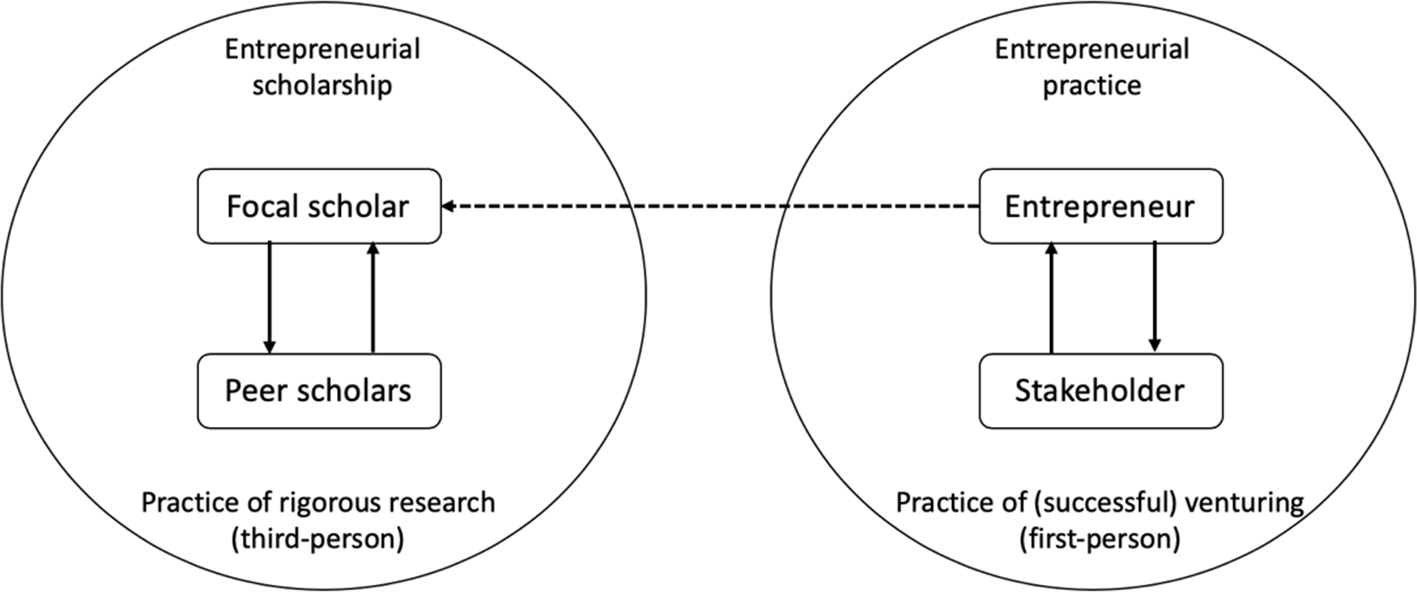
Mainstream view of scholarship.
As entrepreneurship scholars, we find ourselves in the following predicament. On the one hand, we deem it necessary to adopt a third-person perspective when we publish our research because we make ourselves accountable to other scholars rather than to entrepreneurs. On the other hand, we need to be able to identify and understand (including appreciate) people’s first-person intentions in order to identify and understand them as entrepreneurs (particularly in the very early stage of the entrepreneurial process). How do we resolve this tension?
We have to make a practical decision regarding whether, as entrepreneurship scholars, we should study entrepreneurs as mere phenomena acting according to regularities, or rather as autonomous agents whose actions we can only begin understanding if we share their perspective with them. This is the practical problem that we are presently debating and exchanging reasons about. It would be fruitless and disingenuous to try and settle this debate about how we should proceed by making predictions about how we will decide—perhaps appealing to psycho-social factors.
Mediated Accountability to Entrepreneurs
A key part of the solution to the challenge just raised is to adopt a second-person practical perspective on the entrepreneurial actors and actions that we are studying (as argued above). This means not passively observing entrepreneurs, but actively engaging them so that we can share their ends and reasons, and thus their perspectives. We do this by acknowledging and integrating their entrepreneurial goals such that we make ourselves partial in their success. This does not mean that we must become business partners with the entrepreneurs or invest in their ventures. At the very least, it means that we must engage with entrepreneurs in conversation about their ventures. We need to find out what exactly they are trying to, and how what they are trying to do is valuable to them, and how they plan to go about achieving their desired ends. We then value what they are trying to do not because we want to do the same, but simply because those particular ends were chosen by them and because we as entrepreneurship scholars (presumably) value successful entrepreneurship.
A first step for complementing third- with second-person scholarship is bringing the entrepreneurs’ practical decision-making perspective to our fellow scholars, so that it plays a central role in our shared practice of conducting rigorous entrepreneurship research. It is, after all, precisely this perspective which makes the persons we study entrepreneurs and thus provides the core content of the practice we claim to study.
In taking this approach, we have a responsibility to accurately present the entrepreneur’s perspective of and reasons for what they are doing rather than what we theorists might perceive them as “actually” doing for whatever psycho-social reasons. Even though the entrepreneurs whom we discuss with our fellow scholars are not part of our scholarly conversations, we should act “as if” the entrepreneurs being discussed were present in our conversations as silent participants. We thus act as if they could rebuke us for mischaracterizing their position to others. And this raises a difficult question, “How are we actually accountable to the entrepreneurs we study when we discuss their perspectives with our fellow scholars?” Our answer, and one of our key recommendations for entrepreneurship scholars in this paper, is that entrepreneurship scholars should keep one another accountable for conducting entrepreneurship research from within entrepreneurs’ practical decision-making perspectives. In short, part of entrepreneurship scholars’ shared practice of conducting rigorous research should entail adopting a second-person perspective and holding ourselves accountable to the entrepreneurs we study.
We illustrate this idea in Figure 2. Scholars make each other accountable for accurately capturing the perspectives and intentions of the entrepreneurs they are studying. The responsibility that scholars have to correctly articulate the entrepreneur’s perspective is mediated through their responsibility to other scholars. They likewise might only share the entrepreneur’s perspective as if they were a silent participant in the entrepreneur’s conversation.
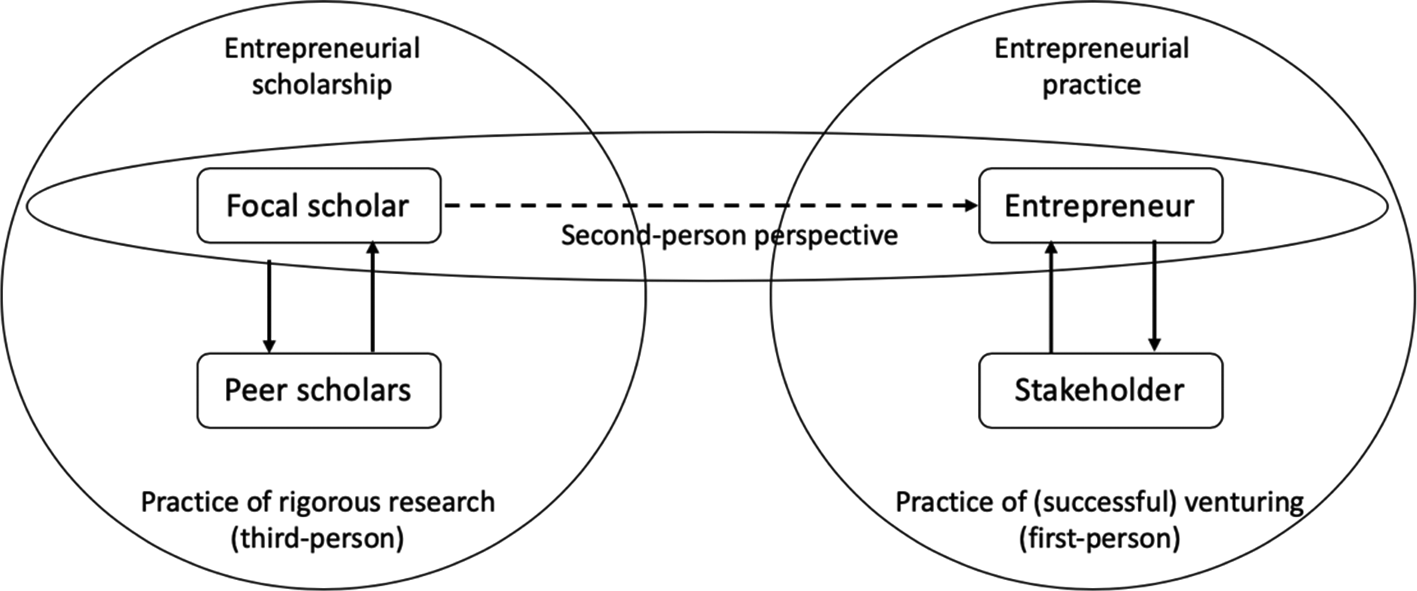
Mediated accountability to entrepreneurs.
This mediated accountability is not ideal, but it is an important step in the right direction. Our expectation is that the need for mediated accountability to entrepreneurs through other scholars would fade once the practice of entrepreneurship scholarship becomes increasingly dependent on and intertwined with the practice of entrepreneurship. Instead of discussing entrepreneurs in the third person, scholars will eventually describe themselves and their research as sharing in entrepreneurs’ project and perspective of successfully starting new businesses, thus leading them to talk about entrepreneurs in the first-person plural: “we.” Most scholars will still not be entrepreneurs, and most entrepreneurs will still not be scholars, but entrepreneurship scholarship will be sensitive to the practical decision-making perspectives of entrepreneurs by making it in integral part of research practice.
We illustrate this idea in Figure 3. The diagram shows how research and venturing practices are brought together. By sharing perspectives, the researcher becomes more attuned to entrepreneurial practice, and entrepreneurs and stakeholders help define research questions. It nonetheless allows that entrepreneurs do not themselves become researchers, and that scholars do not themselves become entrepreneurs. Rigorous research will require more reciprocity between scholars and entrepreneurs, and scholars will make themselves more directly accountable to entrepreneurs. Rigor will presume relevance.
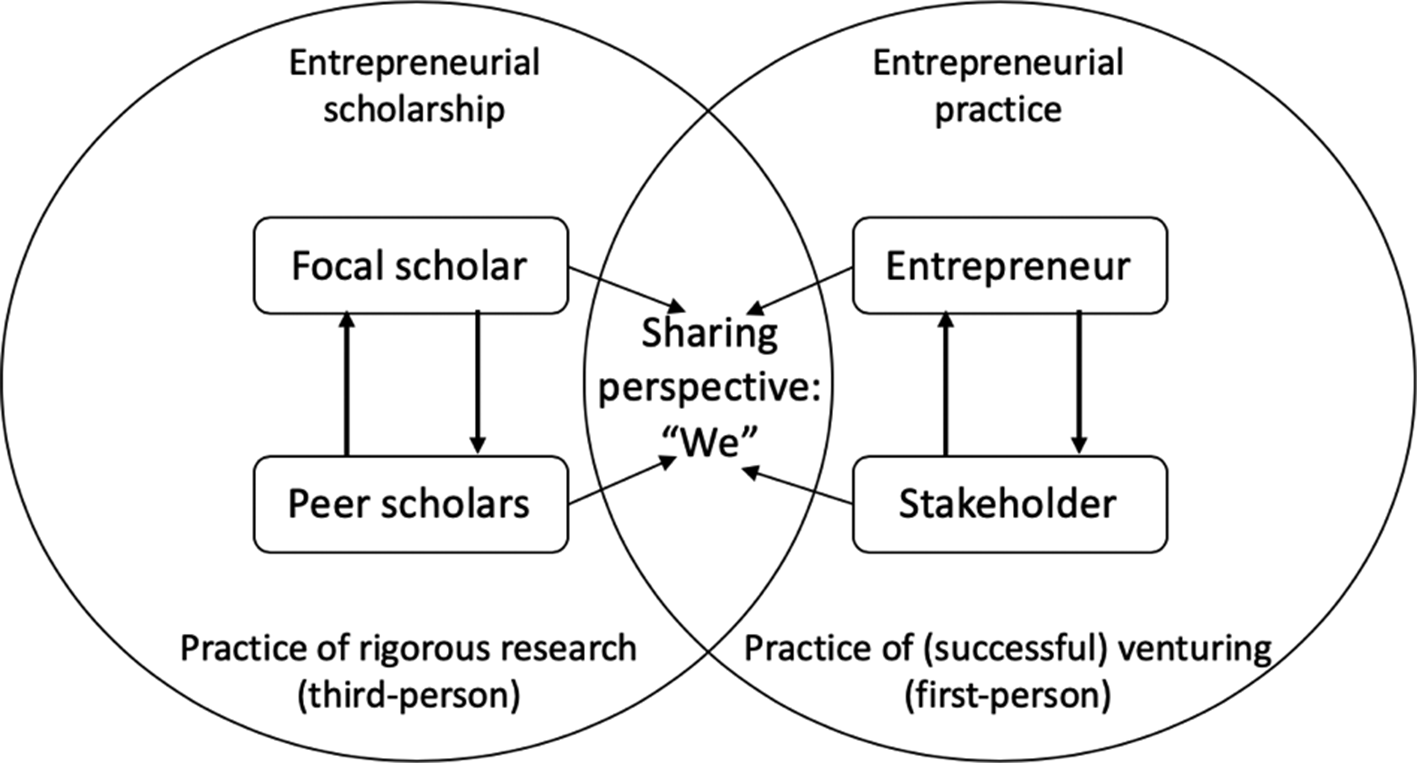
Integrative “we” voice.
Integrating Theoretical Vocabulary With Entrepreneurial Practice
Of course, mischaracterization is not the same as characterizing differently. Entrepreneurship scholars are free to describe entrepreneurs’ perspectives using various bits of theoretical vocabulary so long as it can be plausibly argued that entrepreneurs would be in agreement with the characterization if they understood the theoretical vocabulary. For example, suppose that an entrepreneur describes themselves as planning to create a business which takes particular materials conventionally seen as valueless and transforms them into something valuable in unexpected ways. Depending on various other contextual features, it may be very appropriate for scholars to characterize this as an instance of “bricolage” (Baker & Nelson, 2005) even if such a characterization was not available to the entrepreneur themselves. Once theoretical vocabulary is used to categorize portions of entrepreneur’s practical decision-making perspectives, scholars are able to theorize about aspects of entrepreneur’s practical perspectives, and perhaps infer new conclusions and recommendations that were not otherwise available to the entrepreneurs.
Scholars play the role of gathering the perspectives of a vast range of entrepreneurs, analyzing and debating them with other scholars and then making them available to other entrepreneurs to use in their decision making. Instead of seeing entrepreneurship scholarship as a repository of facts largely detached from entrepreneurs’ own perspectives or interests, we see entrepreneurship scholarship as a complex network (almost a platform) through which entrepreneurs can share and learn from the entrepreneurial experiences of others.
The responsibility that scholars have toward the entrepreneurs they study is in some ways analogous to the responsibility that a lawyer has toward her clients. The lawyer is responsible for representing the interests of their clients when negotiating on their clients’ behalves even if their clients are not present at the negotiations. Furthermore, lawyers are also free to translate their clients’ positions into the appropriate legalese to more effectively achieve the desired legal objectives—even though the clients themselves did not use such terminology when making their positions known to the lawyer. It would be unethical, however, for the lawyer to present their client’s position in legal terminology that mischaracterizes the client’s position, such that they come across as agreeing to something that they never intended to agree to.
Discussion
In the preceding sections, we presented arguments for making entrepreneurship researchers accountable to the entrepreneurs we study and embedding such accountability in our research practices. This involves developing sensitivity and allegiance to entrepreneurs’ practical decision-making perspectives via the adoption of a second-person perspective of the entrepreneurial process and integrating this perspective into our work. We envision that, instead of discussing entrepreneurs exclusively in the detached sense of a third person, scholars will eventually describe themselves and their research as sharing in entrepreneurs’ projects and perspective of venturing into the unknown, thereby adopting the first-person plural “we.” A number of implications arise from this line of reasoning, prompting us to reflect upon our research practices, highlighting new paths forward and identifying latent strengths.
Connecting With Entrepreneurs’ First-Person Perspective
By articulating and advocating a second-person view, we call on scholars to develop sensitivity and responsibility toward the entrepreneurial community. Insofar as the entrepreneurial intention/vision is essential to entrepreneurial practice, theorizing about what is essential to entrepreneurial practice must be done from within the entrepreneurial perspective, and not wholly imposed from scholars’ (purported) bird’s-eye perspective on entrepreneurial practice. This means that the theoretical propositions that we propose and test as part of our scholarly activity should make contact with entrepreneurs’ practical perspectives, such that at least some of the constructs related in those propositions must be identifiably part of the practical decision-making perspective of the entrepreneurs being studied. These might be as simple as the types of companies the entrepreneurs intend to create, the various risks the entrepreneurs associate with their respective ventures, or their motivations (i.e., reasons given) for starting a firm. These are not mere “psychological” characteristics of the entrepreneur any more than entrepreneurship scholar’s reasons for choosing one theory over another is purely “psychological.” To treat them as such is to take an exclusive third-person perspective. These are the entrepreneurs’ reasons that make up their respective perspectives. This is the space that we need to inhabit if we want to theorize about what is uniquely entrepreneurial.
Being a Silent Participant in Entrepreneurs’ Conversations
Entrepreneurship scholars can adopt a second-person perspective toward entrepreneurs and their reasons for acting without directly engaging in conversation with the entrepreneurs they study. We may, for example, learn much about entrepreneurs’ first-person perspective by examining the conversations that those entrepreneurs have with their business partners, mentors, or key stakeholders. But when we interpret these conversations, we need to do so as if we were part of the conversation, assessing the reasonableness of the reasons being exchanged in the conversations—not to determine whether the entrepreneurs are ultimately correct, but in order to share in and thus understand entrepreneurs’ decision-making perspectives. It is in these reasons that we find the intentions that distinguish entrepreneurs from nonentrepreneurs.
However, the entrepreneur’s conversations that we use for evidence in support of our scholarly research need to adopt the entrepreneur’s problem-solving perspectives on their venture. This rules out using as data those conversations about entrepreneurs’ ventures where entrepreneurs are exchanging reasons with persons who do not themselves care about, nor wish to share the entrepreneurs’ practical decision-making perspective about their venture. For example, when an entrepreneur registers their business or fills out a survey, she will likely attempt to adopt the practical decision-making perspective of those who process the business registration or who are conducting the survey, rather than the other way around. The information provided in these ways will therefore not reveal the entrepreneurs’ own practical decision-making perspective regarding advancing their venture.
Building on the Strengths of Conventional Research Methods
We anticipate that the second-person entrepreneurship scholarship could be interpreted as a threat to conventional entrepreneurship research. It might be argued, for example, that entrepreneurship scholars should not engage in complex theorizing or apply sophisticated research methods because these practices are not part of entrepreneurs’ own first-person practical decision-making perspective. This is not at all our position. Through its broader, deeply reflective, interdisciplinary insights, our scholarly research can enrich entrepreneurial practice. Indeed, entrepreneurs value conversations with academics because of the questions we ask and the way we reflect back their points. Our valued ability to interpret, connect, and synthesize is reflected in Lewin’s famous maxim “there is nothing so practical as a good theory.”
To this end, a mere relabeling of the features of entrepreneurs’ perspectives is unfruitful unless it allows entrepreneurs to make new and useful inferences in their decision-making practices. This is where theoretical propositions come into play. They propose new inferences that can be made between different theoretical concepts (or constructs) that address features of entrepreneurs first-person practical decision-making perspective. Thus, scholarly practice can be roughly understood as aiming to determine which propositions (and thus which inferences) are correct by developing and applying expertise in various sorts of research methods. In regard to the correct application of theory and research methods, scholars probably should not hold themselves accountable to entrepreneurs, but other scholars. In this domain, they are the experts. However, scholars will still need to make themselves accountable to and actively engage entrepreneurs in order to determine which propositions actually pertain to entrepreneur’s first-person perspective and can thus act as a practical reason for entrepreneurs. If the proposition makes no contact with entrepreneurs’ first-person entrepreneurial intentions, then we have to seriously question whether that proposition actually pertains to entrepreneurship (as opposed to people or social actors more broadly).
While the second-person entrepreneurship research does not prevent the use of conventional research methods, it may complicate it. For example, suppose we want to research how entrepreneurs manage or adapt to various sorts of risk that they encounter with their ventures. From a third-person research perspective, we might measure risk in terms of various features belonging to entrepreneurs’ local economy, and the risks associated with their chosen industry. Risk, as it is measured in this perspective, is simply a feature of the totalizing view of the environment and not necessarily part of entrepreneurs’ first-person practical decision-making perspective. Practicing entrepreneurs may identify and assess risk entirely differently from us or from one another, and these differences may have a substantial impact on how they conceptualize what they are doing. Studying entrepreneurs from a second-person perspective requires that we interpret entrepreneurs’ various idiosyncratic perspectives before assessing which aspects of their perspectives instantiate the theoretical constructs we are interested in.
When we present theoretical statements about an entrepreneurial action to our fellow scholars, we need to do so from the perspective of someone being part of the entrepreneur’s conversation. We thus bring fellow scholars into the conversation, while trying to keep ourselves accountable to the entrepreneurs whose conversations we are discussing—as if they were silent participants in our scholarly conversation. Insofar as the entrepreneurial intention/vision is essential to entrepreneurial practice, theorizing about what is essential to entrepreneurial practice must be sensitive to the view within the entrepreneurial perspective. Therefore, in recommending the second-person research perspective, we by no means oppose the use of rigorous research methodologies. Rather, our aim is to increase the rigor of entrepreneurship research by encouraging scholars to adopt the more integrative second-person perspective that is more effective for studying the intentions distinctive of entrepreneurial practice. A fruitful step in this direction is building on interpretivist approaches that focus on closer understanding of intentions and personal meaning in a forward-looking sense (Nordqvist et al., 2009; Packard, 2017). Another example is the accompanying paper by Shepherd and Gruber (2020), which seeks to integrate the vocabulary of the Lean Start-up community of contemporary entrepreneurial practice with the theoretical vocabulary of entrepreneurial scholars. And there is also the performative approach to entrepreneurship, focusing on how the meaning of entrepreneurial actions is made and remade over time and emphasizing what entrepreneurs do and say in practice (Garud et al., 2018).
The Value of Theoretical Concepts
At this point, one might agree that conventional empirical research methods are useful when conducting second-person perspective entrepreneurship research, yet still be skeptical about the value of theoretical concepts or constructs that are not native to entrepreneurs’ first-person perspective. Against this worry, we argue that our emphasis on the importance of entrepreneurs’ first-person perspective does not diminish but rather enhances the value of abstract entrepreneurship theory—so long as the entrepreneurship theory addresses features relevant to entrepreneurs’ first-person perspective. Part of what makes entrepreneurship scholarship worthwhile is that it can provide entrepreneurs with new ways of conceptualizing their entrepreneurial practices. However, if we instead took a purely third-person research perspective then entrepreneurship theory will have much less value for practicing entrepreneurs.
Entrepreneurship research provides concepts that can change practice, for example, effectuation, creative destruction, business model, disruptive innovation, and bricolage. Our scholarly contribution thus lies in providing a meta-structure that lets us compare, analyze, and share the experiences and perspectives between entrepreneurs. New concepts can provide fruitful new ways of perceiving. For example, in Deutscher’s (2011) engaging account of language and perception, the word for blue was the last to appear in human languages. Thus, in ancient times, Homer would describe the sea as “wine-dark” in the Odyssey and people could detect color differences but fail to give them separate names. As blue things are relatively rare in nature, the only ancient culture with a word for blue were the Egyptians, who were also the only culture able to produce blue dye. The broader point here is that classificatory consciousness, or claiming that something is thus-and-so, involves learning, concept formation, and the use of symbols: “instead of coming to have concept of something because we have noticed that sort of thing, to have the ability to notice a sort of thing is already to have the concept of that sort of thing, and cannot account for it” (Sellars, 1963, p. 176).
Just as the introduction of new color concepts provide new ways of seeing, so too can the scholarly introduction of new concepts provide new ways for entrepreneurs to frame and think through their practical decision-making problems. As we illustrated with the concept of “bricolage,” scholarly concepts can reveal something important across multiple entrepreneurs’ practical decision-making perspectives and enable us to highlight, study, and compare different entrepreneurial practices. We might, for example, classify different ways that entrepreneurs conceptualize their venture, or decide to develop their business in one direction rather than another. Or we can give a name to something that entrepreneurs intuitively do, such as in the concept of effectuation as a different logic of action (Sarasvathy, 2001). Given how different entrepreneurs are from one another, significant interpretive work is required to engage different entrepreneurs’ perspectives to determine whether they can be classified one way rather than another. The conceptual language that arises from this process facilitates perception, reflection, communication and learning.
After all, most of us hold the title of PhD—Doctor of Philosophy—and philosophy is “the art of forming, inventing, and fabricating concepts… All concepts are connected to problems without which they would have no meaning” (Deleuze & Gattari, 1994, p. 2, 16). At stake, here is whether the problems that give rise to concepts are the ones that entrepreneurs experience (i.e., first-person view) or ones that scholars experience in discussing entrepreneurs among themselves (i.e., third-person view). The important bit is that the concepts we create to give the recommendations are both based on and are directed to the practical decision-making perspective of entrepreneurs. Entrepreneurs who learn to use these concepts themselves will acquire new ways of reflecting upon and understanding their actions via the logic of the theories the concepts belong to. They now have an additional framework which has been vetted by entrepreneurship scholars (and their peer review practices) who have made themselves accountable to entrepreneurs
Adopting a second-person perspective within our entrepreneurship research allows us to think more deeply about what our practice of theorizing can bring to the practice of entrepreneurship. When theorists adopt the second-person perspective toward entrepreneurs, it brings the two practices and their associated accountabilities together. In this way, theoretical concepts play a dual role. On the one hand, they help make sense of the entrepreneur’s perspective; on the other hand, they have theoretical significance in discourse between scholars.
A New Approach to Collapsing the Theory-Practice Divide
We attribute the theory-practice divide to the adoption of two mutually exclusive deployments of reason: the logic of causal explanation/prediction is different from the logic of practical justification. As Korsgaard’s perspective helps flesh out, the former generates a conversation about entrepreneurs and their actions as objective facts to be described and explained; while the latter generates conversation addressed to entrepreneurs about what actions should be done. The gap will persist to the extent that scholarly conversations about entrepreneurship fail to engage the practical decision-making perspective of practicing entrepreneurs. But the way for entrepreneurship scholarship to engage the practical decision-making perspective of practicing entrepreneurs is by those conducting such scholarship to make themselves accountable to those practicing entrepreneurship. Talking to entrepreneurs to understand their reasons and thus their perspective naturally eliminates the theory-practice divide by intertwining the practice of theorizing with the practice of entrepreneurship. While scholars need not be entrepreneurs, and entrepreneurs need not be scholars, entrepreneurship scholarship can be conducted from within the practical decision-making perspectives of entrepreneurs, and entrepreneurs can make use of entrepreneurship scholarship that addresses the practical problems they face.
This entails moving away from what Dewey (1960) terms “spectator theory of knowledge,” whereby the object of knowledge “has being prior to and independent of the operations of knowing” (p. 196). This attempt to isolate and extract—to distil knowledge into something that is situation-, person-, and value-free—also strips theoretical objects of their significance and relevance for human purposes by severing the connections to the background whole that make them intelligible in practice (Dreyfus, 1991). Even if such a-contextual abstract knowledge is useful for explaining the past from a third-person perspective, it may fail to address anything practically relevant in people’s first-person practical decision-making contexts.
The second-person view thus plays a mediating role between the “high ground” of well defined problems that lend themselves to technical solutions and the “swampy lowland” of confusing problems that defy technical solutions (Schon, 1987). It can translate the a-personal nature of the third-person view into principles which entrepreneurs can internalize (i.e., they become actionable). Similarly, it can translate the immersed nature of the first-person view into broader insights to which others can relate. Perhaps, this is as simple as not losing sight of Henry Bergson’s maxim, “Think like a man of action, act like a man of thought.” The second-person view can help populate the abstract categories of scientific explanation with the content of discursive and other social practices. This will enable scholars and entrepreneurs to connect diverse experiences and develop mutual sensitivity and a spirit of solidarity. After all, they share a common goal of making the world a better place.
Conclusion
The “ivory tower” of academia conveys a traditional sense of privileged seclusion and separation from practicalities. For many years, the field of entrepreneurship research fought for gaining entry and legitimacy within academia. Now that we are inside, we need to reclaim the sensitivity that gave rise to the field in the first place. A robust scholarly voice finds an integrative “we” that brings together the practices of research and venturing.
We can complement the rigor of reproducibility that arises from a third-person stance, with the rigor of interpretation that accrues from a second-person perspective. In addition to focusing on whether some result is reproducible, we should focus on developing fruitful interpretations as to why the results are different in different contexts. Adopting a second-person perspective to interpret an entrepreneur’s first-person perspective means understanding the reasonableness of their reasons from our own lights. Better interpretations are those that help us see more rather than less reason in what entrepreneurs say and do, and can account for more of what they say and do (Davidson, 1975). The second-person perspective involves a critical normative dimension of assessment which the third-person perspective does not.
Footnotes
Declaration of Conflicting Interests
The author(s) declared no potential conflicts of interest with respect to the research, authorship, and/or publication of this article.
Funding
The author(s) received no financial support for the research, authorship, and/or publication of this article.

Author Biographies