




Abstract
Recognizing the importance of various types of artifacts for entrepreneurship, design science (DS) has been proposed as an inclusive approach that combines relevance and rigor. By enabling researchers to go beyond their traditional roles as observers and analysts of established artifacts to help design new artifacts, DS can improve the relevance of entrepreneurship research. However, there is a paucity of knowledge on how this type of research can be published in leading entrepreneurship journals. In this editorial, we seek to provide practical guidance on how to craft and assess DS studies that target Entrepreneurship Theory & Practice (ETP) and other top-tier journals.
Introduction
Entrepreneurship researchers ideally combine relevance and rigor (Wiklund et al., 2019) and are thus increasingly interested in various types of artifacts related to entrepreneurship practice (e.g., Berglund et al., 2020). Accordingly, design science (DS) has been proposed as a promising approach that effectively combines relevance and rigor (e.g., Dimov, 2016; Romme & Reymen, 2018). DS, which was initially defined in The Sciences of the Artificial (Simon, 1996), can be conceived as a problem-solving research strategy that facilitates the production of novel instrumental knowledge for the design and implementation of actions, processes, and systems to achieve desired practical outcomes, that is, to create things that serve human purposes (e.g., Hevner & Chatterjee, 2010; Hevner et al., 2004; Holmström et al., 2009; March & Smith, 1995; Romme, 2003; Van Aken et al., 2016). 1 In the domain of entrepreneurship, such artifacts include business models (e.g., Osterwalder, 2004; Osterwalder & Pigneur, 2010; Snihur et al., 2021) and design principles for new ventures or other entrepreneurial phenomena (Sarasvathy et al., 2008; Van Burg et al., 2008; Zhang & Van Burg, 2020).
While DS has longer traditions in some adjacent disciplines, such as information systems (e.g., Hevner et al., 2004; March & Smith, 1995) and operations management (OM) (e.g., Holmström et al., 2009), the value of DS has recently also been recognized in the entrepreneurship domain (e.g., Berglund, 2021). Thus, it is timely and relevant to consider how entrepreneurship scholars can engage with DS. Given the timeliness and relevance of the DS approach for the Entrepreneurship Theory & Practice (ETP) community, this editorial thus focuses on crafting and assessing DS-based entrepreneurship research. We aim to provide guidance for authors, reviewers, and editors concerning DS in entrepreneurship, thereby complementing recent ETP editorials on quantitative research (Maula & Stam, 2020), qualitative research (Van Burg et al., 2022), and literature reviews (Rauch, 2020). Accordingly, we review and extend existing DS frameworks in entrepreneurship (Dimov, 2016; Romme & Reymen, 2018) and adjacent fields (Hevner et al., 2004; Holmström et al., 2009; March & Smith, 1995; Romme, 2003) to provide guidance to entrepreneurship scholars who aspire to draw on DS to produce publishable contributions for ETP and other top-tier entrepreneurship journals, and to the reviewers and editors who evaluate such studies.
In the following sections, we seek to address the following questions: What is DS and why is it relevant for entrepreneurship scholars? What are the strengths and challenges of DS in entrepreneurship? What can scholars learn from existing DS publications in top-tier journals in entrepreneurship and adjacent fields? What DS outputs will be considered publishable contributions by ETP and other top-tier entrepreneurship journals? How can scholars craft and implement DS-based work to increase the likelihood of publication in ETP? Finally, what novel opportunities are there for DS-based work in the field of entrepreneurship?
DS Research in Entrepreneurship
As a science of the artificial, DS focuses on problem-solving or “how things ought to be,” in contrast to the descriptive-explanatory sciences that investigate “how things are” (Simon, 1996, pp. 4–5). 2 Accordingly, DS focuses on research objects as artifacts; that is, objects do not simply “exist out there”—to be taken for granted—but are conceived as having been designed in the past or as being designed in the future. The emphasis on design implies that artifacts are intentional materializations that serve or fulfill specific human purposes. Of interest here are not only how such artifacts operate and what their effects are, but also how they can be (re)created in other contexts. In entrepreneurship practice, such artifacts include business models, pitches, prototypes, and new venture teams (Berglund & Glaser, 2022). These entrepreneurial artifacts can be categorized in terms of their abstract (e.g., business model or entrepreneurial identity), material (e.g., physical or digital prototype), or narrative (e.g., business plan) nature (Berglund & Glaser, 2022). As such, many entrepreneurial phenomena that have spurred substantial amounts of entrepreneurship research, including approaches such as venture capital and crowdfunding, were created by practitioners at some point in the past to solve specific problems or take advantage of new technologies and, thus, can now be studied by scholars. With the rise of new artifacts such as cryptocurrencies, blockchain technology, and initial coin offerings, new entrepreneurial phenomena have been emerging (e.g., Bellavitis et al., 2021). Moreover, grand challenges such as climate change have fueled a growing demand for problem solving oriented research to produce scalable solutions (Ferraro et al., 2015; George et al., 2021; Shepherd & Patzelt, 2022). Given that DS research in entrepreneurship focuses on designing novel artifacts, the potential research topics are vast and not limited to existing entrepreneurial phenomena.
Although DS has not yet been widely understood or adopted by entrepreneurship scholars, its underlying premises have long been present in studies developing new and improved entrepreneurial practices (Wiklund et al., 2019). Some prominent examples of DS in entrepreneurship include the research on design principles for effectuation (Sarasvathy et al., 2008), business model development (e.g., Osterwalder, 2004; Osterwalder & Pigneur, 2010), and the development of university spinoff programs (Van Burg et al., 2008). In addition, while not always explicitly labeled as DS, various entrepreneurship scholars have sought to design and evaluate (new) practices and design principles in many other areas such as entrepreneurial team formations (Boss et al., 2021; Lazar et al., 2020, 2021), government venture capital programs (Alperovych et al., 2020; Jääskeläinen et al., 2007), corporate venture capital programs (Burgelman et al., 2021; Hill et al., 2009), accelerator programs (Cohen, Fehder et al., 2019; Cohen, Bingham et al., 2019), and entrepreneurial ecosystems (O’Shea et al., 2021; Talmar et al., 2020; Wurth et al., 2021).
As noted by Berglund et al. (2018), DS-based researchers typically conceive of theories as tools for business design whose validity is related to their ability to facilitate task completion, that is, to improve the practice of entrepreneurship. Moreover, attempts to assess DS through the lens of explanatory science (Arend et al., 2016) may create tensions that impede the adoption and application of DS approaches.
Despite these potential challenges, DS-based contributions are likely to open new streams of entrepreneurship research. For example, practice-oriented research on business model canvas design (Osterwalder, 2004; Osterwalder & Pigneur, 2010), lean startup methodology (Ries, 2011), and customer development processes (Blank & Dorf, 2012) have spawned critiques, refinements, and further developments (Bocken & Snihur, 2020; Felin et al., 2019; Shepherd & Gruber, 2021; Zellweger & Zenger, 2022), complementary frameworks (Felin et al., 2021; Gruber & Tal, 2017), and empirical evaluations (Camuffo et al., 2020; Leatherbee & Katila, 2020).
A key strength of the DS approach is that it provides ample opportunities for scholars to engage in collaborative work with practitioners and thereby bridge the relevance–rigor gap. In many ways, DS represents the edge of scientific activity that is closest to practice by prioritizing purposes, situations, and instrumental levers. In this respect, practical implications are not an afterthought but a central pillar of DS work that focuses on formulating robust means–ends relationships (to be) enacted in specific situations. However, major challenges arise from the combined effort to design relevant artifacts for entrepreneurship while producing (publishable) new knowledge. In this respect, DS may be more challenging in the entrepreneurship field than in adjacent disciplines, such as information systems, because of the inherently creative and disruptive nature of entrepreneurial activity wherever it occurs; the uncertain, complex, immaterial, and socioeconomic (rather than the merely technological) nature of entrepreneurship artifacts; and the extensive periods often required to observe the outcomes of the design choices regarding many such artifacts. Indeed, Simon (1996) argued that two properties of studied (arti)facts drive the need for a DS approach: human intentionality and environmental contingency. He also suggested that these two key properties of an artifact render a descriptive-explanatory approach insufficient and incomplete.
Evidently, human intentionality and environmental contingency comprise the core of the entrepreneurship domain, even more so than in adjacent disciplines: “Entrepreneurial artifacts, such as value propositions and business models, are inextricably linked to the entrepreneurial intentions driving them, and moreover, cannot be decoupled from the environmental settings in which they were created and the environmental conditions expected in the future. (…) As such, the properties of human intentionality and environmental contingency imply that entrepreneurship research is a science of the artificial, that is, it involves both creative design and scientific validation” (Romme & Reymen, 2018, pp. 1–2). The inclusive nature of DS is a key strength that also generates its principal challenge. That is, the multifaceted nature of DS work implies major hurdles to validating relevant knowledge claims and, as a consequence, to publication in scholarly journals, which typically expect manuscripts to focus on a single hypothesis, model, or idea.
The inclusive nature of DS is also evident in the broad variety of focal artifacts and the knowledge outputs resulting from DS-based work. Above, we argued that artifacts can vary in terms of their abstract, material, and narrative nature. Dimov (2016) maps the variety of knowledge artifacts in terms of constructs, models, and methods. Extending the classification of March and Smith (1995), Romme and Reymen (2018) categorize artifacts in entrepreneurship research in terms of values (i.e., degree of importance of a particular action or opportunity for a particular scholar or practitioner); constructs (i.e., vocabulary to describe particular entrepreneurial problems or challenges); models (i.e., a set of propositions expressing the relationships between constructs); design principles (i.e., solution-oriented guidelines for a certain entrepreneurial problem or challenge); and practices (i.e., any application or instantiation of values, constructs, models, and/or principles in an entrepreneurial context).
While all these knowledge outputs are valid in DS research, in the remainder of this paper, we focus on how studies informed by DS can make a substantial contribution to scientific knowledge that merits publication in a top entrepreneurship journal such as ETP. As such, we start from the premise that any entrepreneurship study that merely produces a novel practice, method and/or set of design principles without these being grounded in well-defined constructs, values, and/or models, does not provide the type of theoretical contribution expected by ETP and other top journals. That is, we take the “&” in the title of this journal very seriously in the sense that any (novel) entrepreneurial practice must be properly theorized to obtain a deeper understanding of how, why, and when it works to make a sufficient contribution and to spur and guide its adoption elsewhere. Therefore, in the remainder of this editorial piece, we flesh out guidelines for how to craft and assess DS-based manuscripts in which theorizing is a key step.
Crafting Entrepreneurship Research Informed by DS
Motivating DS Research
Scientific work seeks to align the empirical world and the theory produced by research as a map of certain aspects of that world. Given the complexity and dynamism of the (entrepreneurial) world and our purposes in it, such alignment can be achieved in two directions: theory-to-world and world-to-theory (e.g., Sergeeva et al., 2021). With theory-to-world alignment, our aim is for the theory to match the world by ensuring that there are facts in the world that support our theory. With world-to-theory alignment, our aim is for the world to match the theory, that is, to fulfill our purposes and aspirations, as reflected in the designs we seek to implement. In both cases, the complex process of alignment represents a distinct research methodology. In effect, we either (1) seek the best theoretical account of the world as it is or (2) seek to act in the world to fulfill our intentions. The primary direction of DS is clearly the latter approach, that is, world-to-theory.
Therefore, a key step in crafting a DS-based study is to realize that DS is not a specific method but a generic world-to-theory methodology that conveys a distinct stance toward entrepreneurial artifacts, as they could be or as we intend them to be. This stance should be communicated clearly upfront (i.e., in the title, abstract, and introduction) in any article reporting on a DS-based study. Such upfront clarity serves to create realistic expectations, thereby helping reviewers and editors make an informed decision about whether to accept the invitation to engage with the manuscript as a reviewer or editor. For example, both the title and the abstract of the paper by Van Burg et al. (2008) explicitly refer to the world-to-theory intention of their study by stating in the abstract,
“Academic entrepreneurship by means of university spin-offs commercializes technological breakthroughs, which may otherwise remain unexploited. However, many universities face difficulties in creating spin-offs. This article adopts a science-based design approach to connect scholarly research with the pragmatics of effectively creating university spin-offs. This approach serves to link the practice of university spin-off creation, via design principles, to the scholarly knowledge in this area” (p. 114).
Overall, DS knowledge contributions can involve new solutions to old problems (e.g., Baldassarre et al., 2020; Osterwalder, 2004); old solutions extended to solve new problems, also called “solution spotting” (Holmström et al., 2009) or exaptation (Gregor & Hevner, 2013; Seckler et al., 2021); or radical breakthroughs with new solutions to solve new problems (Gregor & Hevner, 2013). Refining this known/unknown means/ends matrix in the entrepreneurship research context, Seckler et al. (2021) recently also highlighted that DS studies examining known solutions to known problems have an important role as evaluation studies. The evaluation of the effectiveness of an entrepreneurship education program design by Campos et al. (2017) is an example. While radical breakthrough studies involving completely new solutions to new problems are rare (similar to completely new theories in explanatory research) (Gregor & Hevner, 2013), evaluations of existing means–ends relationships offer more incremental contributions, thus placing greater weight on the quality of the empirical analysis, for example, causal identification (Shaver, 2020).
Positioning DS as a generic methodology also implies that DS studies can draw on many different types of research designs and methods to collect and analyze data—such as case studies, experimental designs, surveys, intervention studies, and idealized design methods. Consequently, a research project that is grounded in explanatory science and another project that draws on DS may share the same method (e.g., a case study) but will pose fundamentally different questions and produce distinct findings. Accordingly, unlike the conventional conception of a theoretical contribution as a new or better explanation of existing empirical facts, a theoretical contribution in DS pertains to new or better blueprints for action in response to certain challenges. Therefore, a study informed by DS seeks to generate new facts, rather than explain or accommodate discrepant facts.
For any study to be publishable in a journal such as ETP, the research community must affirm that the study’s knowledge outputs meet certain standards. Fulfilling these standards is not a matter of following a single recipe, but is rather a question of conducting a productive conversation (Huff, 2009). For DS work, this process is somewhat analogous to the major challenges that manuscripts using qualitative data have previously faced in top journals (Graebner et al., 2012). Just as DS and explanatory science can share a specific method, they can also share a research community. Moreover, because these two approaches will address different questions and deliver different findings, the research community must engage in different conversations and deploy different evaluation methods to assess the contributions of their knowledge outputs.
The DS Research Cycle
DS and mainstream approaches to entrepreneurship research are complementary and connected. They both (1) employ imagination and reasoning in the articulation and manipulation of theory as a map of/for the world and (2) seek direct engagement with the world to better explain it by matching it with a theory OF it (i.e., theory-to-world) or to manipulate it in accordance with a theory FOR (changing) it (i.e., world-to-theory). Accordingly, we can define mainstream science as a cycle of theorizing and justifying and describe DS as a cycle of creating and evaluating (March & Smith, 1995). However, it is difficult to disentangle the two types of scientific activities—which underscores their complementary and intertwined nature—because our attempts to change the world reflect our current understanding of it, and our understanding of the world reflects our attempts to change it. In this sense, human beings continually create new artifacts and can apply science to improve such creation processes. Consequently, in these processes, we create facts that become part of our world, and we use science to explain them. In its design mode, science builds a better future, whereas in its explanatory mode, science helps make sense of the past and anticipate the future.
When adopting the DS approach, the main shift is from exclusively studying extant phenomena to (also) envisioning, designing, and testing solutions for major problems (Simon, 1996). Intuitively, DS is, therefore, about creating a future reality with a specific purpose in mind as well as conducting systematic studies through observation and experimentation to serve those future-oriented aspirations. Thus, a new artifact design cannot be isolated from the body of knowledge that informs its production. In this sense, DS is often conceived as a cycle consisting of different complementary phases and corresponding research activities, all of which are important for DS-based contributions (Holmström et al., 2009; March & Smith, 1995; Romme, 2003; Romme & Reymen, 2018). For instance, creating and evaluating are part of exploratory design activities, whereas theorizing and justifying are part of scientific validation efforts. That said, these four phases of the research cycle vary in their outputs, methods, and criteria (Holmström et al., 2009; Romme & Reymen, 2018). Hence, Figure 1 provides a visual overview of the creating-evaluating-theorizing-justifying cycle across the theory and practice domains (i.e., the solid curve in Figure 1). To distinguish a DS approach from a more mainstream research cycle of explanatory research, the dashed curve in Figure 1 shows a typical cycle of how one theorizes (e.g., by reviewing and synthesizing the literature), derives an empirical research question, and then gathers and analyzes the data. Using the same cycle, one can also start with data collection and then proceed to theory building, as in inductive theory building studies.
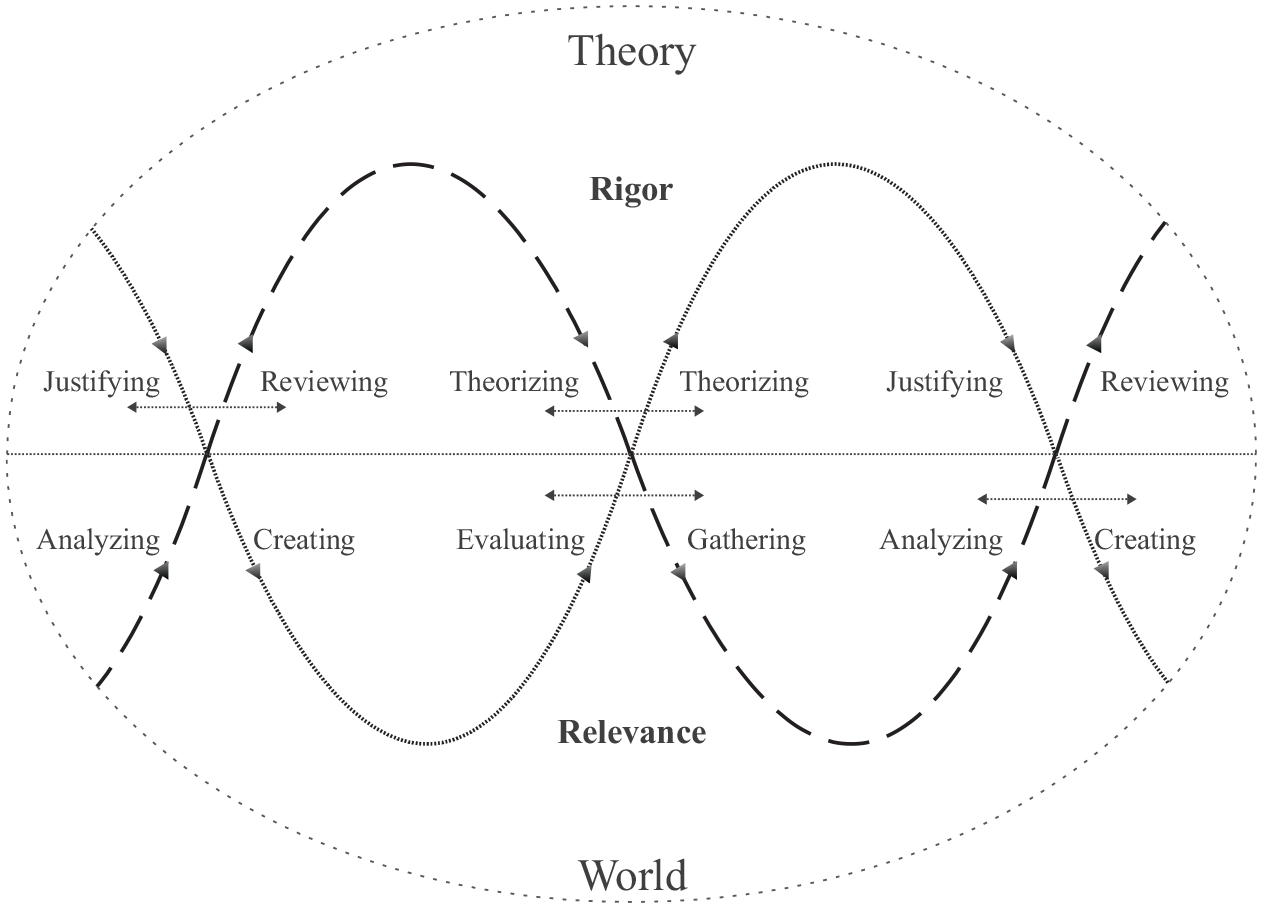
Cyclical nature and complementarities of DS (in solid curve) and explanatory research (in dashed curve).
Given the complementary nature of the two cycles involving explanation and design, Figure 1 also highlights the various jump points whereby one can transition from one cycle to the other by shifting the research orientation. In this sense, these transitions can be conceived as different ways to motivate DS research when using explanatory research as a starting point. First, having reviewed the literature on a topic, one can synthesize its insights as a justification for the creation of an artifact whose effectiveness in bringing about the desired outcome can then be evaluated. Similarly, by engaging in theorizing efforts, one can transition from conceiving a theory OF the world to positioning it FOR the world, thereby shifting the focus regarding whether the theory can guide the solving of specific problems or challenges. A third motivational path relates to situations where gathered evidence or exploratory work is geared toward evaluating the effectiveness of specific practices, which, in turn, would inform theoretical efforts to improve them. Finally, the analysis of evidence can be used as a launchpad for the creation of a new artifact, whose effectiveness can then be evaluated.
In Table 1, we build on various existing frameworks to provide guidance regarding research activities, key criteria, evaluations of resulting outputs, and strategies to enhance scholarly contributions within each phase and across phases. We distinguish four key phases that we describe below: creating, evaluating, theorizing, and justifying. Notably, we do not use the terms testing or validating” to label any of these phases because the inclusive nature of DS implies that testing and validation occur throughout the research cycle (March & Smith, 1995; Romme & Reymen, 2018). Testing and validating efforts can affect both pragmatic reasoning in the creating/evaluating phases, as one seeks a path forward, as well as systematic scientific reasoning in the theorizing/justifying phases, as one seeks to explain outcomes. The terminology of testing/validating is thus widely used in DS-based studies; however, it is approached somewhat more flexibly than in mainstream entrepreneurship research. Accordingly, while we leverage guidelines on DS methodology from adjacent fields (e.g., Hevner & Chatterjee, 2010; Hevner et al., 2004; Holmström et al., 2009; Peffers et al., 2007), 3 we also acknowledge the unique nature of artifacts in entrepreneurship research and practice, thus providing tailored guidance. For instance, once an IT artifact such as a software application is developed, it can be easily executed and is assumed to run well on any computer with the same operating system. In contrast, an artifact in entrepreneurship such as a novel business model is unlikely to work equally well across a heterogeneous population of new ventures due to greater uncertainties, complexities, and environmental contingencies. Hence, DS research in entrepreneurship faces the additional challenge of considering how, why, and under what circumstances a novel artifact works and how that artifact can be further developed.
Guidance on Crafting and Assessing DS Studies in Entrepreneurship.
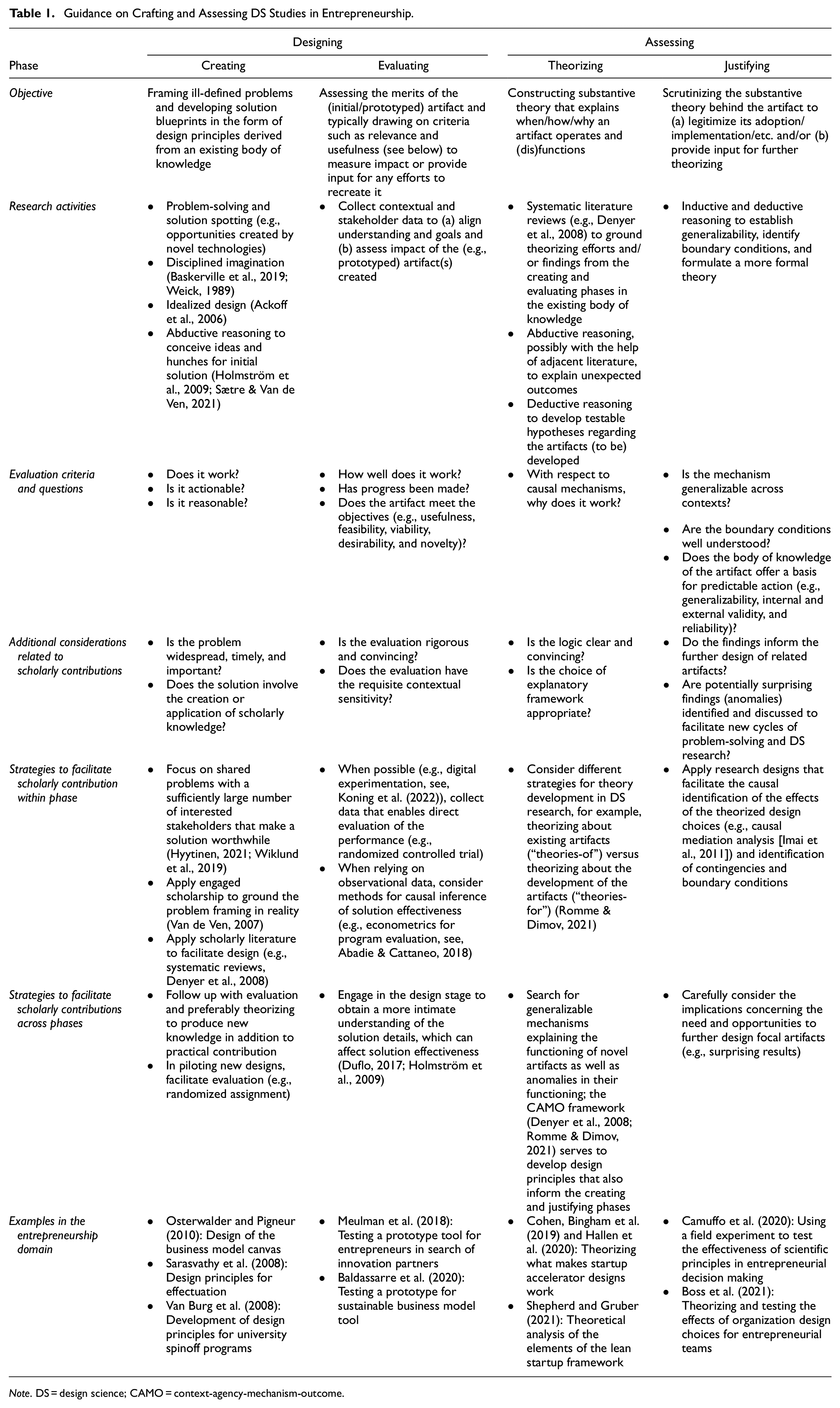
Note. DS = design science; CAMO = context-agency-mechanism-outcome.
Creating
In the creating phase, the focus is on framing an ill-defined practical problem and developing a solution blueprint (as an artifact) by synthesizing and articulating appropriate design principles that can guide practical activity. In an entrepreneurship context, not all DS contributions are based on creating and implementing a new artifact, as advocated in certain extant guidelines for DS research (Hevner & Chatterjee, 2010; Peffers et al., 2007). Instead, many DS knowledge contributions are likely to relate to framing new problems (Holmström et al., 2009) or developing improved solutions. 4 In novel contexts, when implementable solutions or even robust design principles are not yet feasible, initial contributions may take the form of rigorously formulated design hypotheses.
To develop alternative solutions to an identified problem (i.e., means–ends propositions), various techniques, such as disciplined imagination and idealized design, serve to enhance creativity without sacrificing rigor (Ackoff et al., 2006; Baskerville et al., 2019; Weick, 1989). If such solutions are not actually carried out, one must frame the problem and evaluate design principles on their own merits, which is the DS equivalent of a conceptual paper in explanatory research, that is, it proposes but does not test a theory. This entails the evaluation of the relevance and novelty of a problem; the reasoning involved in the derivation of design principles; whether such principles involve manipulable factors, that is, can they be enacted in practice; and the coherence of these principles with other, well-established principles or associated problems. In future-oriented work on design principles, Delphi and similar methods can also be adopted (e.g., Jiang et al., 2017). Moreover, when engaging in solution development, to avoid unnecessarily reinventing the wheel, one complementary approach is to search for existing designs in related domains which were developed for different purposes but are adaptable to the focal problem (e.g., Hodgkinson & Healey, 2008).
For entrepreneurship scholars who (also) seek to produce novel and publishable knowledge, a focal problem shared by practitioners and scholars can facilitate publication (Hyytinen, 2021; Van de Ven, 2007). For example, Alperovych et al. (2020) highlighted the shared interest of policy-makers and scholars to better understand the substantial heterogeneity in the design of government venture capital funds, which are created by policy-makers worldwide to support young innovative companies, and they sought to identify the most effective design parameters. Based on interviews with entrepreneurs, investors, and other experts, Osterwalder (2004) concluded that a systematic process, absent in the extant literature at the time, was needed to develop business models. Finally, a lack of organizational capabilities to produce spinoff ventures at many universities of technology motivated the study by Van Burg et al. (2008). The common thread in all these examples is their deliberate attunement to conversations and challenges in entrepreneurial practice.
Ill-defined problems often require efforts to collaborate with practitioners to frame them clearly (Hyytinen, 2021; Kapasi & Rosli, 2020; Wiklund et al., 2019) and engage in a “reality check” (Van de Ven, 2007) to tackle relevance–rigor challenges by jointly producing knowledge (Van de Ven & Johnson, 2006). However, despite the frequent benefits, collaboration with practitioners may not always be equally feasible, for instance, when the focus of DS research is on very long-term problems or problems with great externalities that are of great interest to the ecosystems or society but of lesser interest to individual entrepreneurs or organizations. Nevertheless, for any research targeting top-tier journals with a broad scholarly readership, the significance of the problem (e.g., solving grand challenges), novelty (i.e., potential to initiate or change the scholarly conversation), and actionability (i.e., insights for practice) of a topic increase the potential impact of the scholarly contribution (Colquitt & George, 2011). Thus, to enhance publication potential, it helps to focus on field problems and generic solution designs that are relevant to a large scholarly audience (e.g., Van Aken et al., 2016). Even if an initial solution can be evaluated only in a highly specific setting (e.g., one company), it is crucial to ensure that this solution draws on design principles involving novel and generalizable theoretical mechanisms. One way to do this is to carefully review and leverage the extant body of relevant theoretical knowledge, which is discussed below in the subsection on theorizing.
Evaluating
In the evaluating phase, the focus is on creating a solution blueprint and determining the merits of an actual initial (e.g., prototyped) solution by, for example, drawing on criteria such as usefulness, feasibility, viability, desirability, efficacy, and novelty and providing input in support of efforts to adapt the initial solution. The primary aim of the evaluation phase is thus to establish the pragmatic validity (Worren et al., 2002) of a created artifact, typically in collaboration with the practitioners involved. This ensures sensitivity to the salient context and alignment with the goals or purposes of the stakeholders involved. This type of evaluation tends to be essentially formative (Venable et al., 2016) and serves to generate input and feedback for redesigning the artifact. Evaluation is an important part of DS research and should not be constrained to ex post evaluation, as ex ante evaluation can improve the DS process (Vom Brocke et al., 2020). The research methods that are often used in such pragmatic evaluations are experimentation (e.g., with users of an artifact or its prototype) and interviews. However, other evaluation methods (e.g., focus groups) can also be used depending on the nature of the focal artifact (Peffers et al., 2012). Prototyping is often useful in this phase (e.g., Baldassarre et al., 2020). For example, Meulman et al., (2018) tested a prototype tool for entrepreneurs in search of innovation partners by having six lead users apply the tool and then interviewing them about their experiences. O’Shea et al. (2021) evaluated their initial construct of a sustainable entrepreneurial ecosystem by conducting two rounds of interviews with experts and participants in a regional entrepreneurial effort in Finland. For prospective evaluation, other approaches such as simulations can also be useful (Duflo, 2017; Holmström et al., 2009; Hyytinen, 2021).
By merely creating and evaluating an artifact, we may obtain a descriptive sense of whether something works, but we will not necessarily (fully) understand why. Hence, to increase the chances of publishing their work in a top journal, DS scholars must also engage in theorizing and justifying. Nevertheless, the creating and evaluating phases may provide a strong basis for publishing impactful work in other journals (e.g., Meulman et al., 2018; O’Shea et al., 2021; Talmar et al., 2020).
Theorizing
In DS work that begins with the creating and evaluating phases, the subsequent theorizing phase entails developing a theoretical understanding of why a solution works or, in the case of a solution blueprint, why its proposed principles merit serious consideration. Notably, DS projects can also begin with the theorizing phase to facilitate problem framing and develop initial design principles (Sagath et al., 2019; Zhang & Van Burg, 2020).
A theory can be defined as a statement that predicts which actions will lead to specific results as well as why and under what circumstances such phenomena will occur (e.g., Whetten, 1989). A theoretical understanding of why and under what circumstances a novel solution works is critically important for its practical value. A historical example of this is the development of aircraft technology. Before humans could fly safely using airplanes, the initial design principles of having wings were refined using multiple experiments that often ended in crashes. Accordingly, this initial body of practical knowledge had to be complemented with an improved theoretical understanding (e.g., Bernoulli’s principle) before manned flights could be made safe and predictable under varying circumstances (Christensen & Raynor, 2003).
In the context of DS research, this theorizing phase can be facilitated by an intimate knowledge of the details of the solution design, which creates synergies with the previous phase (Holmström et al., 2009). In addition to abductive reasoning, which can provide ideas and intuitions concerning plausible hypotheses (Behfar & Okhuysen, 2018), in this phase, scholars frequently engage in inductive and deductive reasoning. Initial theorizing frequently leads to plausible theories and substantive, mid-range theories that may not yet be fully generalizable. To develop both mid-range and general theory, one can draw on the context-agency-mechanism-outcome (CAMO) framework (Denyer et al., 2008; Romme & Dimov, 2021), 5 which employs instrumental norms as action guides, as discussed above. The C, A, M, and O dimensions in this framework help develop highly contextualized mid-range theories that can then be decontextualized into more generalized (A-M-O) causal relationships (e.g., Van Burg et al., 2008).
As a research method, systematic literature reviews are often used in the theorizing stage (e.g., Denyer et al., 2008), frequently in combination with research synthesis work, to develop and infer key constructs, causal mechanisms, and design principles from the literature (Van Burg & Romme, 2014). When reviewing and synthesizing the salient literature, it is crucial that the various inductive, deductive, and abductive steps are made as transparent as possible.
Justifying
In the justifying phase, the goal is to systematically test the initial theory, for example, how it is supported under varying circumstances, and to develop it into a more generalizable, formal theory that enables the reproduction of activities and outcomes. Whereas the testing activity in the evaluating phase is geared toward pragmatic validity and relevance, in the justifying phase, it specifically serves to enhance the rigor of the theory that supports the artifact(s). As such, efforts in the justifying phase tend to be more summative than those in the evaluating phase (Venable et al., 2016). Anomalies in theory that are found in an empirical test can trigger abductive research to find new solutions and thereby start a new cycle of DS research. For example, business plans were assumed to be pivotal in new venture development and funding until the early 2000s (DeThomas & Grensing-Pophal, 2001; Stutely, 2007; Timmons et al., 2004), when both practitioners and researchers empirically scrutinized their effectiveness and began to question their value (e.g., Kirsch et al., 2009). Although the value of business plans as documents was then increasingly questioned, the value of planning efforts was found to be positive (Brinckmann et al., 2010; Delmar & Shane, 2003; Shane & Delmar, 2004). Subsequently, practitioners and scholars have been designing more iterative and effective business modeling approaches to support venture development activity (Blank, 2013; Camuffo et al., 2020; Leatherbee & Katila, 2020; Osterwalder, 2004; Osterwalder & Pigneur, 2010; Ries, 2011; Shepherd & Gruber, 2021).
The research methods often used in the justifying phase include confirmatory methods including case studies that focus on the applicability of the focal artifacts in novel contexts (Sagath et al., 2019; Snihur et al., 2021), quantitative analyses (Cumming et al., 2020; Dushnitsky & Stroube, 2021), and experimental designs (Boss et al., 2021; Campos et al., 2017; Camuffo et al., 2020; Harrison & List, 2004; Kotha et al., 2022). Specifically, carefully designed field experiments can provide rigorous new knowledge with respect to the effectiveness of the developed artifact(s) (Chatterji et al., 2016; Harrison & List, 2004; Levitt & List, 2009). An excellent example of this is the field experiment by Camuffo et al. (2020), which used a randomized control trial to study the effectiveness of scientific thinking in entrepreneurial decision-making. When it is not possible to implement randomized experiments, one can draw on appropriate econometric methods to ensure the rigor of the justifying phase. For instance, modern quasi-experimental research methods for program evaluation (e.g., Abadie & Cattaneo, 2018) provide opportunities for more rigorous tests of a designed artifact and its theoretical framing. Rapidly evolving new methods such as staggered difference-in-differences analysis are increasingly instrumental in facilitating a more rigorous assessment of the treatment effects of design choices in entrepreneurship with varying adoption times (e.g., Athey & Imbens, 2022; Callaway & Sant’Anna, 2021). We do not expect that such quantitative approaches can be used in the justifying phases of all DS studies in entrepreneurship as such a requirement would bias the focus of DS research too much toward contexts in which large amounts of quantitative data can be collected, for example, established entrepreneurial practices that have been widely adopted. 6 Despite these limitations, it is notable that entrepreneurs operating in digital settings have been widely embracing and using online controlled experiments, often called A/B testing, 7 which are employed, for instance, to develop and test their value propositions (Osterwalder et al., 2015).
Iterating Between Phases
Any entrepreneurship study involves iterations between various research stages. However, a single DS study may draw on hundreds of iterations (back and forth) between the four phases, as illustrated in Figure 1 and Table 1. It is, therefore, a common practice in DS to maintain extensive logbooks of the various iterations in the research process (McAlpine et al., 2017), thereby enhancing the transparency of the research steps and the reliability of any results. This logbook practice is similar to documenting and reporting the various steps in gathering data and preparing it for analysis in explanatory research to facilitate its reproducibility. Thus, a logbook contains reports of each iteration through the DS cycle, providing detailed descriptions of how and when data were collected and analyzed, what was learned from the analysis, how the artifact was adapted in response to these learnings, and so forth. In the final published version of articles in top journals, these extensive logbooks may merely be mentioned (given the usual length restrictions of any paper), but when needed for sufficient transparency and reproducibility, they can be made available to reviewers and editors when submitting manuscripts to such journals, for example, as methodological appendices.
Notably, DS studies can begin in any of the four phases in Table 1. However, the most common routes are as follows. First, one begins by framing the problem and creating an initial artifact, subsequently pragmatically evaluating it, and then developing and justifying the theory behind the artifact (e.g., Meulman et al., 2018; Romme & Endenburg, 2006). Another common route is to begin by reviewing the relevant literature to theorize and justify the problem (e.g., the causal mechanisms explaining it), subsequently creating an initial solution/artifact and obtaining input from participants/users to further develop it, and then conducting an extensive scientific test to further justify the theory (e.g., Campos et al., 2017; Camuffo et al., 2020; Kotha et al., 2022). More exceptional is research in which both routes are used simultaneously (e.g., Van Burg et al., 2008) for instance, so that an initial problem is defined through conversations with practitioners while the research team engages in an extensive literature review. Here, the research team simultaneously creates and theorizes and then continually iterates between all four phases until a final solution is developed and implemented. Finally, DS studies may start from the evaluation phase and abductively move on to the creation phase, for example, frame and solve new problems by adapting an existing solution, also termed as solution spotting.
Assessing Entrepreneurship Research Informed by DS
While the assessment of any manuscript cannot be reduced to a simple scoring scheme, we now turn to providing structured guidance on how to review entrepreneurship manuscripts informed by DS. Although there are many potential dimensions to consider when evaluating a DS manuscript, 8 we posit that, essentially, the assessment boils down to two main criteria: (1) Contribution: has the research problem, as articulated in the manuscript, been established as worth solving and does it offer a pragmatic value if solved?, and (2) Reasoning: has the research problem been solved well using sound reasoning?
Framing the Contribution: A Pragmatic Research Problem Worth Solving
The first main assessment criterion focuses on what the study is about and the contribution the findings make to entrepreneurship theory and practice. DS research can produce many types of outputs, as described earlier, involving new solutions to existing problems, new problems solved by existing solutions, new solutions to new problems, and evaluations of how effectively extant solutions solve existing problems (Gregor & Hevner, 2013; Holmström et al., 2009; Seckler et al., 2021). Moreover, the focal artifacts, such as practices, models, and constructs (Romme & Reymen, 2018), can vary in their abstract, material, and narrative nature (Berglund & Glaser, 2022). But the publishable product sought by ETP and other top journals is scientific knowledge in the form of well-crafted articles. When journal reviewers or editors assess a DS manuscript, the articulation of how it enriches existing practice (e.g., Worren et al., 2002), how it fits and contributes to the extant body of knowledge, and why it is important are critical. Above, we highlighted that an unresolved problem (rather than unexplained facts) is a key premise for a DS study. Therefore, the study must not only clearly frame the problem addressed but also describe how it contributes to its solution, for example, by enabling new or different blueprints for action. As noted above, Van Burg et al. (2008) offer an example of such clear DS contribution articulation concerning their study on design principles for university spinoffs.
The world-to-theory stance of DS research and the centrality of the design of focal artifacts imply that pragmatic validity is extremely important (Holmström et al., 2009; Van Aken et al., 2016). This means that knowledge must be actionable, enabling certain practitioners to do new things by solving certain problems or fulfilling their purposes (Worren et al., 2002). For example, a key question in the creating phase is whether the designed artifact performs the task, and central concerns in the evaluation phase are how well that artifact performs the task and whether progress has been made (March & Smith, 1995). Overall, DS manuscripts face the same competition for limited journal space and reader attention, thus underscoring the importance of carefully framing the contribution (e.g., Bergh, 2003; Grant & Pollock, 2011). As in traditional papers, this contribution can consist of many aspects (e.g., theoretical, empirical, and methodological contributions), of which ETP requires at least some level of theoretical contribution. A theoretical understanding of why, how, and when the focal artifacts (should) work is central to the codified knowledge arising from DS research, and therefore, it is a natural component of it.
With respect to the framing of the contribution, the four phases outlined earlier are helpful not only for understanding where a study fits within an overall DS cycle, but also for ensuring that it explicitly connects to the adjacent phases (as depicted in Figure 1). For instance, a study focused on creating a new artifact, that is, framing a problem in a new way and suggesting a blueprint for its solution, must ensure that the creation phase is well connected with the justification and evaluation phases. That is, it must build on established entrepreneurship mechanisms and elaborate on how the effectiveness of the artifact can be evaluated. Similarly, a DS study focused on theorizing must be connected to the evaluation of evidence and the enhancement of entrepreneurial mechanisms. An example is Osterwalder’s (2004) thesis that covered the two first phases of the DS cycle and laid the foundations for the business model canvas framework (Osterwalder & Pigneur, 2010).
The solid curve in Figure 1 may enable editors and reviewers to adapt existing conceptions of what constitutes a good theoretical contribution to the context of a DS study. Thus, the value of a proposed new theory arises not from how the relationships between existing facts are accounted for, but from clarifying how certain theoretical mechanisms can be deployed in the creation of new artifacts. Much of what makes a study interesting resonates well with Davis’s (1971) classic account of how impactful work balances between the obvious and absurd in confirming and denying specific assumptions of the audience. In conventional explanatory research, such assumptions relate to how empirical facts are linked to and related via theoretical concepts. While Davis’s logic of what is interesting is retained in DS, the latter replaces existing facts with newly created (arti)facts and replaces empirical relationships with action pathways. In this sense, the interest of editors and reviewers would be peaked by a manuscript that reveals promising novel pathways that are pragmatically valid.
Soundness of Reasoning: A Research Problem Well Solved
In addition to establishing that the research problem is worth solving and its solution is pragmatically valid, another key consideration is whether the problem is solved well using sound reasoning, that is, how has the study been implemented and, as a consequence, how valid and convincing are the findings. With soundness of reasoning, we refer to the credibility of argumentation and the appropriateness of research design and methods (e.g., Mantere & Ketokivi, 2013). As in explanatory work, both the value of a study’s contribution and the quality of its argumentation and supporting evidence are crucial (Sonnenberg & Vom Brocke, 2012). To the extent that an artifact is deemed suitable for or performs the task, soundness of reasoning is important to ensure internal and external validity. The assessment of internal validity pertains to whether such effectiveness can be attributed to the very theoretical mechanisms that informed the design of the artifact. In turn, considerations of external validity relate to whether the artifacts are relevant for and usable in other situations.
Soundness of reasoning is, therefore, critical in choosing an appropriate research design for the research problem addressed and applying it appropriately. For the reviewer to be able to assess this, all methods used in the DS process must be explained, justified, and carefully implemented with completeness, clarity, and credibility (Zhang & Shaw, 2012). As a conceptual example, Shepherd and Gruber (2021) connect the widespread lean startup approach to solid theoretical underpinnings to better understand why and how it works. As an impactful conceptual study in the spirit of solution spotting (i.e., known solutions to solve new problems), Nambisan (2017) considers the opportunities that digital artifacts create for entrepreneurial practice and identifies two major implications for entrepreneurial practice, namely, less bounded entrepreneurial processes and outcomes and a less predefined locus of entrepreneurial agency. As an empirical example of a sound evaluation of the effectiveness of a new entrepreneurial practice, Camuffo et al. (2020) implement a carefully designed field experiment that offers a rigorous test of the specific mechanisms of scientific reasoning in the practice of entrepreneurial experimentation to facilitate the improvement of this entrepreneurial practice.
When considering these criteria and examples of published entrepreneurship research in top-tier journals, it is evident that, as yet, there are not many examples that easily meet all the criteria we have outlined for DS research given that DS research in entrepreneurship is still a relatively novel phenomenon and many of the best examples in top-tier journals are not explicitly framed as DS research (e.g., Camuffo et al., 2020; Shepherd & Gruber, 2021). Also, some studies explicitly framed as DS have been published in other journals, possibly due to challenges in convincing reviewers and editors about the soundness of reasoning in the studies.
While we expect that a growing number of entrepreneurship scholars will engage in DS-based work that satisfies both main criteria, it is also important to note that the relative weights of these criteria vary depending on the phase. Table 1 offers some additional questions to consider. Whereas pragmatic validity plays a key role in the creating and evaluating phases, various conventional criteria regarding the soundness of reasoning (e.g., reliability and internal and external validity) are more applicable in the theorizing and justifying phases. Nevertheless, both the outcome and the process that generates it are relevant. Therefore, in assessing whether a focal problem is important (i.e., substance), it is also necessary to establish whether the problem is carefully framed (i.e., process). Similarly, in assessing whether a solution is effective (i.e., substance), it is also key to determine how rigorously its effectiveness is evaluated (i.e., process). Regarding the theoretical mechanisms identified in DS studies, the quality of theorizing is pertinent. Finally, the rigor of the analysis, for example, the identification of contingencies and boundary conditions, is relevant in determining the generalizability of key findings in the justifying phase.
Conclusion
The world of entrepreneurial practice is not ready-made, and entrepreneurship scholars can do more than simply observe and analyze. Many important entrepreneurial practices and constructs, such as venture capital finance, lean startup methods, and business modeling tools, did not always exist. Rather, they are artifacts that were created at some prior point in time. Similarly, many novel entrepreneurial practices, constructs, and policies will be designed in the future. In other words, entrepreneurship practice and policy entail what external observers can see as a naturally occurring design activity. Thus, the question for entrepreneurship scholars is whether such activity can be enhanced through science, that is, whether it can be systematized into a body of knowledge, thereby improving its art and skill (Niiniluoto, 1993). Is the role of entrepreneurship scholars limited to simply describing and explaining these new artifacts, after practitioners have designed and adopted them? Or can and should entrepreneurship scholars play a more proactive role in enhancing the art and skill of entrepreneurship policy and practice by tackling pressing problems and (co)designing various new artifacts through DS research? Our answer to the latter question is affirmative; however, thus far, no work has articulated how rigorous DS work on entrepreneurship should be designed or how the quality and contribution of such studies can be assessed.
Accordingly, the DS approach can be instrumental in helping entrepreneurship researchers contribute to both entrepreneurship theory and practice. In addition to outlining the DS approach and considering its strengths and weaknesses for entrepreneurship research, we have described various research design issues in crafting DS-based studies and elaborated on how to assess them. A key finding from this exercise is that the only unique feature of DS-based research is its focus on world-making or world-to-theory alignment. If this deliberate purpose of a DS study is consistently rolled out in data collection, data analysis, and other research activities, it must meet similar criteria as that of mainstream work with respect to validity and soundness of reasoning. This editorial piece may thus function as a valuable resource for authors, reviewers, and editors, especially for those who seek to enhance the publication potential of studies informed by DS.
Footnotes
Acknowledgements
The authors gratefully acknowledge the insightful comments from Jan Holmström, Ari Hyytinen, and Johan Wiklund.
Author’s Note
Dimo Dimov is also affiliated with Reykjavik University, Iceland.
Declaration of Conflicting Interests
The author(s) declared no potential conflicts of interest with respect to the research, authorship, and/or publication of this article.
Funding
The author(s) received no financial support for the research, authorship, and/or publication of this article.
