




Abstract
We explore how digital technologies are helping address grand challenges to tackle climate change and promote sustainable development. With digital technologies, entrepreneurial organizations have adopted innovative approaches to tackle seemingly intractable societal challenges. We refer to these broadly as digital sustainability activities. By focusing on the digital toolbox employed by pioneering organizations, we propose a research agenda that generates novel questions for entrepreneurship, business models, and ecosystems as well as new ways of thinking about trust and institutional logics. We believe that digital sustainability can spur empirical advances in entrepreneurship, innovation, and strategy with potential for positive impact on society.
We observe a convergence of two seemingly disparate trends in business with consequences for entrepreneurship theory and practice. The first trend relates to the heightened attention to the climate emergency and the need for societal actors to take on expanded roles in the production of environmental and social value (Di Domenico et al., 2010; Embry et al., 2019; George et al., 2012; Howard-Grenville et al., 2014). Earth’s dire situation has been brought to the fore by diverse stakeholders. The European parliament recently followed the UK and Canadian governments in declaring a climate emergency. In popular media, Netflix and David Attenborough’s “Our Planet” and a wave of activists are raising awareness among the general public. Among scientists, the IPCC (2018) report on climate change and the devastating IPBES report on biodiversity loss (Díaz et al., 2019) restate insights known for decades in ever more forceful terms. In business, companies are voluntarily or, under pressure of investors, governments, and other stakeholders, committing to ambitious environmental goals (Delmas et al., 2019; Nave & Ferreira, 2019; Pacheco et al., 2014; York et al., 2018). This is the sustainability imperative.
The second trend involves the rapid digitalization of the economy. A variety of new technologies are forming a digital toolbox of solutions that challenge the status quo. Artificial intelligence and machine learning (AI/ML) are advancing exponentially and both businesses and governments are competing in a race to harness its potential. While PwC (2017) estimates AI will add some 14%—or USD 15.7 trillion—to the global economy by 2030, observers raise concerns ranging from adverse employment impacts to the ethical implications of AI-based decision making (Jarrahi, 2018). As AI/ML begins rapidly altering resource allocations within and across economies, the Internet of Things (IOT) promises to connect billions of devices in webs of autonomous communication. The resulting “smart” houses, transportation systems, electricity grids, and cities will increase economic flows by lowering transaction costs (Pasolini et al., 2018) in ways that make lives easier and increase welfare. And simultaneously, distributed ledgers or blockchains are resurfacing from their initial hype with a promise to reorganize transactions in fairer, more decentralized, open access, efficient, and reliable ways (Hammi et al., 2018). Some insiders consider blockchain so transformative it will instigate the next “infrastructure inversion”—the previous three being driven by steam, electricity, and the Internet—that will fundamentally alter the global economic and institutional infrastructure and our very social fabric (Antonopoulos, 2015). This is the digital imperative.
The convergence of the sustainability and digital imperatives is beginning to gain traction in the private and public sectors (Merrill et al., 2019), but has yet to galvanize systematic and rigorous academic research. While a growing cadre of social scientists attend to inclusion (George et al., 2012, 2019), natural resource management (Delmas et al., 2019; George et al., 2015; George & Schillebeeckx, 2018; Markman et al., 2016), and societal grand challenges (George et al., 2016), management scholars have yet to embrace the urgency of climate change and sustainable development in their work. With this article, we hope to inspire fellow academics and practitioners to increase their focus on and advocacy for entrepreneurial organizations developing digital sustainability activities. Given the scientific consensus on the urgency and gravity of the challenge to combat man-made climate change, our scholarly communities should not remain on the side lines. Beyond looking in and helping students—from undergraduate to executive education—understand what is at stake, our managerial studies can encourage and guide leaders and institutions to lead the way to a carbon-free society.
In our exploratory research, we see entrepreneurial actors employing digital technologies to tackle crucial sustainability challenges. They have done so, not only through technological innovation, but also by developing business models that infuse innovations with new purpose. The activities of these actors, their business models, and the problems motivating their work form the focus of this article. We define digital sustainability as the organizational activities that seek to advance the sustainable development goals through creative deployment of technologies that create, use, transmit, or source electronic data. The digital nature of these activities enables them to be less constrained by geographic boundaries and enhances scalability leading to higher impact. In addition, the objectives guiding these activities focus on the creation of socioecological value as an integral part of an economic proposition, thereby disarming the trade-off between profit and purpose. This differentiates the digital sustainability lens from more established lenses we discuss below.
In the following section, we paint a picture of the climate emergency by summarizing key findings in the natural sciences and revisit four complementary phenomenological lenses investigating sustainability problems and the role of entrepreneurship. We then abstract from their foci to extract six high-level problems that underpin the organizational challenge of tackling sustainability, after which we delineate our novel perspective focusing on digital sustainability. Next, we propose six digital sustainability pathways that creatively use the new digital toolbox to address some of the most important challenges we face as a species. We conclude with a proposed research agenda on digital sustainability.
Overview of the Literature
Planetary Boundaries
Perhaps the foremost challenge facing humanity is a three-pronged overshooting of planetary boundaries beyond which sustaining life as we know it becomes precipitously untenable (Rockström et al., 2009; Steffen et al., 2018). Critical pathways leading to overshoot and collapse involve runaway global warming due to carbon-intensive industrialization, overconsumption of nitrogen and phosphorous, and wholescale biodiversity loss. An overwhelming body of scientific work describes the link between industrial pollution and self-reinforcing feedback loops that drive additional greenhouse gas emissions (Lenton et al., 2008). Feedbacks range from methane release from thawing permafrost (Dean et al., 2018) and the dieback of boreal forest (Burke et al., 2017) to albedo loss from shrinking ice caps and melting sea ice. Cognizant of the slow rates of natural, terrestrial carbon sequestration, climate feedbacks reveal humanity racing stubbornly toward a point of no return (Bendell, 2018).
Second, industrial agriculture’s overreliance on nitrogen and phosphorous inputs is poisoning waterways, producing massive algae-blooms and coastal dead zones, and threatening global food security (Conijn et al., 2018). Nitrogen pollution poisons infants and contributes significantly to global warming (James et al., 2018), exemplifying the interrelatedness of environmental factors in a complex nexus (Schillebeeckx et al., 2018). The overuse of chemical fertilizers, driven mainly by animal-rich diets, remains the primary driver of nitrogen and phosphorous pollution.
Third, nearly 50% of all Earth’s individual animal populations are suffering from habitat destruction (land consumption) and poaching (animal consumption) that will—if unabated—drive an estimated one million species to extinction in the next decades (Díaz et al., 2019). The IPBES report finds that unprecedented declines in biodiversity threaten over 80% of SDG targets related to poverty, hunger, health, water, cities, climate, oceans, and land. Overuse of grazing land for livestock, deforestation, and pernicious demand for rare animal parts as medicines and status symbols remain major drivers of species loss today. Countering these existential threats to our natural ecosystems, while staying within the safe operating space for six other planetary boundaries, is the most pressing issue of our time (Rockström et al., 2009).
Grand Challenges
Grand challenges as a thematic focus reached mainstream management research only recently (George et al., 2016). Grand challenges comprise specific critical barriers whose removal would significantly help solve globally important societal and/or environmental problems. “Grand challenges” thus engage a broad problem scope ranging, from global warming, aging populations, inequality, and poverty to health, resource scarcity, and the elusiveness of sustainable livelihoods. Addressing these complex problems requires coordinated and collaborative efforts at the firm, community, state, and regional level as well as behavioral change to produce solutions across political and geographic boundaries (George et al., 2016).
The grand challenge lens is largely agnostic about the focal actor. Scholars have engaged grand challenges by looking at incumbents (Luo et al., 2016), NGOs (Mair et al., 2016), single-purpose organizations (Cobb et al., 2016), partnerships (Doh et al., 2018), and supply chains (Kim & Davis, 2016). Others have engaged communities (Berrone et al., 2016), bureaucracies (Heese et al., 2016), emergent organizations in disaster relief (Williams & Shepherd, 2016), and the policy–research interface (Vakili & McGahan, 2016).
Thanks to the rich contexts offered by grand challenges, theoretical lenses in this emerging area of scholarship are equally diverse. Recent contributions have focused on resource dependencies and nexus thinking (George et al., 2015; Schillebeeckx et al., 2018), framing (Reinecke & Ansari, 2016; Wright & Nyberg, 2017), as well as the pursuit, promise, and limitations of inclusive growth (George et al., 2019; Halme et al., 2012). Others have drawn attention to capability perspectives (Ansari et al., 2012) and to dynamic institutional fields in “entrepreneurial contexts relevant to grand challenges and wicked problems” (Briscoe et al., 2018). In sum, the grand challenges approach envelops a variety of actors and means through which the SDGs are being tackled.
Such contextual and theoretical breadth makes the grand challenges approach at once inclusive and potentially cumbersome. As a relatively nascent perspective, it may lack the clear identity needed to rally a cohesive group of scholars to rapidly advance thinking in this space. Further, grand challenges’ scope inevitably leads to a need for multidisciplinary, multimethod research that is often difficult to publish in academia, particularly within such long-established fields as sociology and economics (Ferraro et al., 2015). Though hybrid fields like strategy and entrepreneurship may more readily draw on multiple bodies of theory, the shared language problem and some of the more dogmatic institutional incentives may persist—at least indirectly—in restraining progress in cross-disciplinary scholarship, thereby perpetuating the gap between (social) science and sustainability practice (Banks et al., 2016; UN Environment, 2018).
While the grand challenges literature is relatively nascent, the managerial literature of the last few decades has cultivated a variety of subfields focusing on related, nontraditional forms of entrepreneurship. These nontraditional forms typically combine the profit motive with extra-fiduciary motivation and new logics. Three of these entrepreneurship lenses inform emerging advances in digital sustainability.
Forms of Entrepreneurship
Social entrepreneurship (SE) is probably the most studied form of nontraditional entrepreneurship. The literature focuses on the use of market-based methods to address social issues and create social value through the creative recombination of resources (Miller et al., 2012). Considerable debate persists about the nature and identity of the social entrepreneur, the tensions between social and commercial outcomes, and the definition of social value (Dacin et al., 2010; Saebi et al., 2019; Wry & York, 2017). Despite these debates, scholars generally agree social entrepreneurs deploy “a business logic in a novel and entrepreneurial way to improve the situation of segments of the population that are excluded, marginalized, or suffering and are themselves not capable of changing this situation” (Saebi et al., 2019, p. 1), while realizing business opportunities with priority given to social wealth creation versus economic wealth creation (Hollensbe et al., 2014; Mair & Martí, 2006).
Social entrepreneurs exhibit a willingness to subordinate the profit motive to selected prosocial objectives (Austin et al., 2006). While they often address widespread problems like poverty, malnutrition, and health, they typically do so in specific geographical contexts, which limit their ability to scale. Indicative studies have focused on organizational work to empower women (Datta & Gailey, 2012), overcome poverty (Alvord et al., 2004), and expand access to finance to disadvantaged communities (Azmat et al., 2015). In these ends, an entrepreneur’s choice to deploy a for-profit or nonprofit model may hinge upon the focal social need and the nature of the opportunity by which the firm can capture some of the produced value to survive (Peredo & McLean, 2006).
Institutional entrepreneurship (IE) is rooted in institutional theory (DiMaggio, 1988) and a recognition of organizations’ embeddedness within their various social, economic, and political contexts. These contextual webs convey opportunities, costs, and benefits on market actors through constituent logics (Lounsbury & Boxenbaum, 2013) that in turn constrain and stabilize behavioral routines. DiMaggio (1988) identifies institutional entrepreneurs as actors who envision and enact new institutions as a means of advancing interests previously suppressed by incumbent logics. To illustrate, seminal work by Greenwood and Suddaby (2006) studies institutional work by the big five accounting firms who—while shaped by their context—enact changes to that context to pursue new aims. The work illuminates a “paradox of embedded agency” that has inspired Battilana and D’aunno (2009) to unpack “the tension between the notion of actors as strategic agents and the powerful influence of institutional forces on human agency” (p. 96). A salient topic in IE is then the investigation of actors who become motivated and enabled to change the structures within which they are themselves embedded.
This paradox proves especially salient in poorer, resource-deprived contexts marked by institutional voids. Here, entrepreneurs need first to build institutions from whole cloth before investing effort to reshape them to advance a given set of particular interests (Mair & Marti, 2009; Stephan et al., 2015). Recent examples examine the role of collective emotions in shaping institutional change and rebuilding in the wake of a natural disaster (Farny et al., 2019) and the role of social movements in legitimizing and accelerating the market penetration of wind energy (Pacheco et al., 2014).
Sustainable entrepreneurship (STE) is a more recent addition to entrepreneurial study amidst complex, social, and environmental problems (Shepherd & Patzelt, 2011). While many large firms have built corporate social responsibility departments to generate prosocial outputs from a subset of firm activities while separating those activities from core processes since the definition of sustainable development in the Brundtland (1987), a smaller subset of firms have sought to incorporate prosocial choices into their core strategies, practices, and processes (Aragón-Correa & Sharma, 2003; York et al., 2018). In this line, Hall et al. (2010) trace the emergence of STE in practice as a progression in firm orientation. This progression initially manifests in a shift in goal-setting away from reducing environmental impacts—doing less harm—and “going green” (Ambec & Lanoie, 2008) toward a more transformative commitment to correct a market failure at the crossroads of the economic, social, and environmental realm (Cohen & Winn, 2007). The most ambitious sustainable entrepreneurs then intentionally seek net positive environmental impacts (Levinsohn, 2011).
In its mature form, STE may thus link together a heightened attention to improved processes with a triple bottom line to balance firm production of economic, social, and ecological value. Here, transformative change empowers a “systems view” of the firm in its socioecological context and a toolbox for sustainable impact. As sustainable entrepreneurs reshape capital structures and corporate cultures, they engender a growing population of organizations for whom the pursuit of sustainability has become a core economic opportunity and a way to forge novel capabilities (Bansal & Roth, 2000). Hoogendoorn et al. (2017) identify sustainable entrepreneurs as those “who start a business to serve both self-interests and collective interests by addressing unmet social and environmental needs” (p. 1), capturing the field’s coalescing focus on not only the firm but also its founders and its mission.
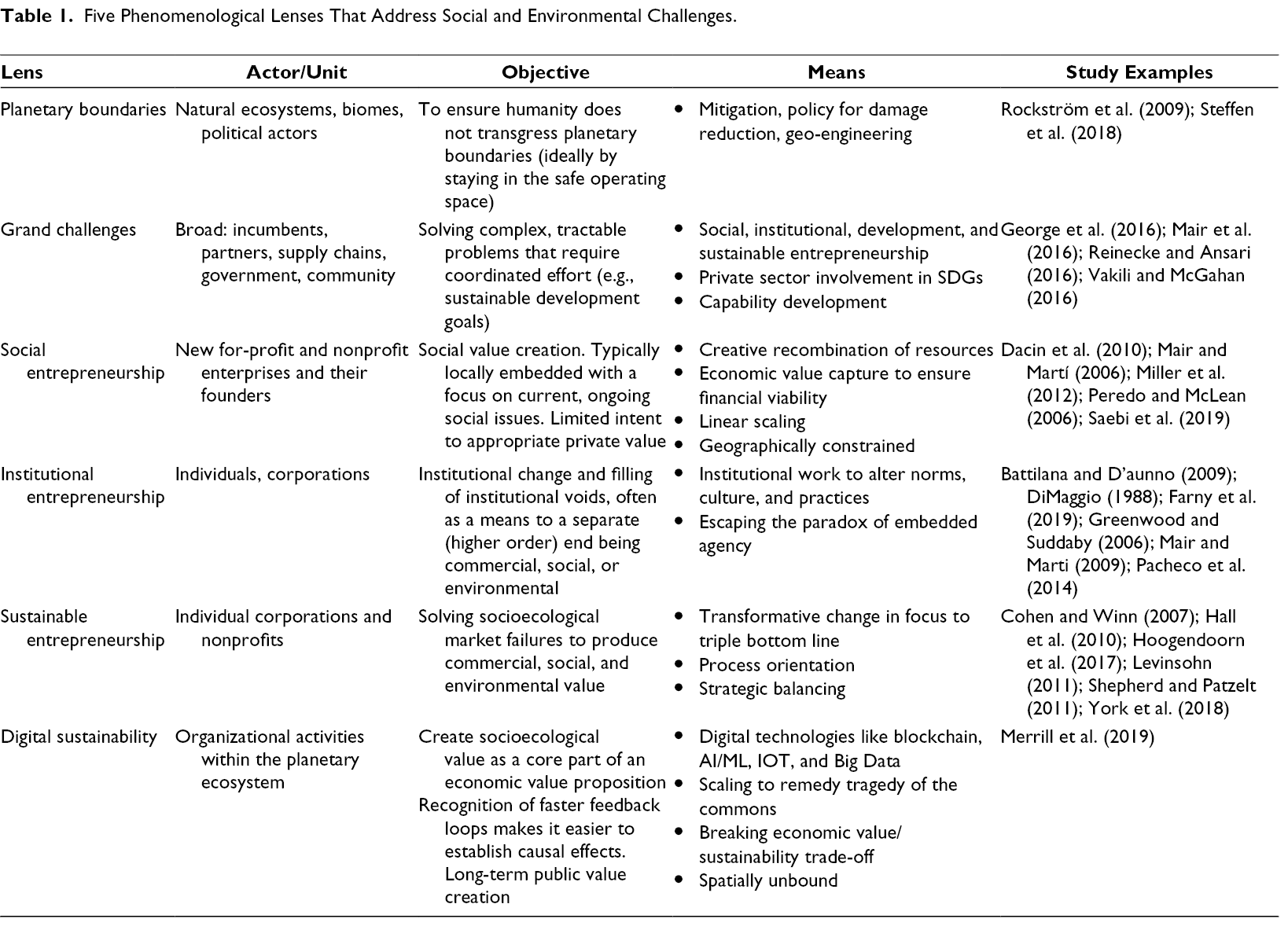
Table 1 provides an overview of the planetary boundaries perspective, the grand challenges approach, and the three nontraditional entrepreneurship lenses. The depiction indicates for each the primary focal actor or unit of analysis, the central actor’s commonly agreed-upon objective, and the essential means or behavior of that actor being studied. To this table we add the sixth lens of digital sustainability, which we will discuss later.
Managerial Problems of Mitigating Climate Change and Advancing Sustainability
Planetary boundaries, grand challenges, and the forms of entrepreneurship offer different toolkits with which to plot a course to impact. Planetary boundaries draw chiefly on the natural sciences while the other four lenses leverage diverging theoretical approaches (ways of thinking), attend to distinct sets of focal actors (areas of study), and explore various outcomes (research and organizational objectives). Yet, despite their differences, we believe these fields’ “raisons d’être” exhibits clear common cause. To produce impactful research, organizational scholars work to distil challenges into tractable managerial problems, capture their underlying causes, and link their engagement to practice.
To support this effort, we next advance six managerial problems that undercut attempts to drive positive change toward sustainability, and whose study promises insights toward solutions. We select these problems (from among a potentially wider universe of options) as they conceptually align with the design elements that characterize the activity-system perspective on business models (Zott & Amit, 2010, p. 217). These authors define an “activity in a focal firm’s business model… as the engagement of human, physical, and/or capital resources of any party to the business model (the focal firm, end customers, vendors, etc.) to serve a specific purpose toward the fulfilment of the overall objective” and suggest that weaving such activities together is the essence of business model design (Zott & Amit, 2010). The activity-system perspective proposes three design elements: content, structure, and governance. These three align with the six sustainability challenges we highlight. What we know and how we value natural capital is the content of digital sustainability’s focus. Similarly, challenges with communication, coordination, and trust require the (re)structuring of organizations and markets in ways pioneered by digital sustainability activities. Finally, the governance aspect addresses the actors involved and exposes difficulties with reaching disenfranchised populations and the institutions that (fail to) govern sustainable development.
We exclude from the analysis a wealth of problems that are less clearly related to business model design or are driven by local and regional differences that require a more contextual understanding These include but are not limited to issues of ethics, such as the question of anthropocentrism in utilitarian logics (who matters), and power, as regarding, for example, the means and legitimacy of actors who have established the rules of the game in which organizations operate from day to day.
Problems of Knowing
Much of the consumption underlying the global overshoot of planetary boundaries flows from two knowledge gaps. The first involves a failure to generate and disseminate valuable information concerning the condition of the natural biosphere on which civilization relies, as well as the types and magnitudes of impacts our behavior has on all forms of life. When prices fail to reflect the true costs of unsustainability, market participants too often remain unaware of the shadow costs of their choices. As such, they do not incorporate the real impacts of consumption and production choices into decision making. A lack of knowledge not only puts more sustainable goods and services at a disadvantage, it erodes the economy’s ability to efficiently husband Earth’s stock of social and natural capital.
In confronting problems of knowing and empowering more responsible patterns of production and exchange, organizations contend with a second and related type of knowledge gap concerning known unknowns and unknown unknowns. To illustrate the former, we can quantify annual global increases to the atmospheric carbon stock with a high degree of certainty. We can further detect, with great certainty, increases in global temperatures. Yet we confront much greater levels of uncertainty in apportioning emissions across countries and firms. To the latter, we further face “unknown unknowns” in quantifying thermal forcing from noncarbon-based greenhouse gases like methane, which may prove an enormous and increasing—though ill-understood—contributor to global warming (Dean et al., 2018). To take another case, computer models have made great headway mapping the likely impact of rising sea levels on coastal real estate (Bernstein et al., 2019), but have struggled to quantify the impacts of still poorly understood climate feedbacks and nonlinear changes to major earth systems (Bonan & Doney, 2018) on near-future conditions. Even seemingly more solvable problems like finding out the root causes of bee hive collapse remain largely unsolved (Hallmann et al., 2017). These blind spots undermine efforts to establish the full set of factors underlying the true social cost of carbon and so calibrate a demonstrably science-based, rather than politically mandated, global carbon management system with which to preserve the value of one of Earth’s most valuable assets, a stable climate.
Problems of Valuation
As Dees (2017, p. 4) observes, “[i]t is inherently difficult to measure social value creation. How much social value is created by reducing pollution in a given stream, by saving the spotted owl, or by providing companionship to the elderly?” A key challenge in achieving sustainability involves quantifying the value of mitigating negative spillovers or producing marginal increases in shared socioecological value. Emerson notes in this light that “it has been taken as a virtual given that most elements of social value stand beyond measurement and quantification” (2003, p. 40), not in the least because of the difficulty of parsing the value of a single action’s contribution to an often harder to identify objective and beneficiary.
Difficulty in quantifying socioecological value remains a central reason real costs remain hidden. Where calculations are expensive or contentious, not only do the true costs of unsustainability remain obscure, so too do the benefits of achieving discrete goals. Biologists have made progress establishing how much carbon one tree absorbs, and economists make strong arguments for quantifying how much dirty energy a solar array displaces. Yet firms that quantify changes to the rate of carbon emissions do so in the absence of broader agreement on the true cost of atmospheric carbon (Presse & Paetzhold, 2018). Relatedly, entrepreneurs struggle to secure a consistent price for ecosystem services. While firms are starting to see success in measuring habitat gains by combining satellite sensing, AI, and machine learning, they still struggle to ascertain how much value society places on preventing a given species from going extinct. Where progress on assessing impacts fails to translate into consensus on valuing outcomes, firms face reduced incentives to bear certain opportunity costs to make risky investments in sustainability actions.
Problems of Communication
While better science may eventually inform a global carbon tax with the potential to obviate a portion of the valuation problem for carbon (e.g., Presse & Paetzhold, 2018), industries continue to generate massive, negative footprints in water (e.g., meat production), land (e.g., palm oil), and other forms of natural capital. Consumer products driving these “externalities” range from meat to chlorine bleach, dry cleaning chemicals, microfiber clothing, disposable razor blades, consumer electronics, and single-use plastics. Plastic waste in particular poisons marine ecosystems and consumers of seafood and shellfish the world over (Lebreton et al., 2017) and much of this waste stems from the “throw-away” products of a handful of multinationals who deploy vibrant social responsibility programs and espouse their commitment to sustainability.
Yet even as impact valuation grows tractable, organizations working for sustainability may struggle to clearly communicate their value propositions to consumers, in effect struggling to market the value proposition of discrete and collective investments in socioecological value to a wider audience. This may in part result from the complexity of information related to sustainability efforts and the long range of their anticipated effects. Another problem involves humans’ bounded rationality and limited attention spans and biological characteristics that lower consumers’ willingness to invest scarce cognitive resources in unpacking multifarious value propositions soliciting concrete reallocations of day-to-day spending. This “friction” in the communication of socioecologically efficient opportunities is further exacerbated by the actions of unsustainable product producers who invest significant resources in counter-narratives.
Problems of Coordination and Trust
Coordination is often critical both for creating socioecological value and for capturing some of that value for communities. Key challenges include high costs of establishing sustainable patterns of exchange, forging agreements on valuing sustainability efforts, assessing an equitable distribution of that value among stakeholders, and enforcing those distributions (North, 1991). Coordination costs are particularly pernicious for sustainable business due to the complexity of the socioecological systems in which organizations devise “impact projects.” Such projects often produce new shared value along multiple vectors (social, environmental, etc.). Organizations who work to coordinate these projects often bear significant and often difficult-to-anticipate coordination costs to quantify social value propositions, make these comparable to inform trade-offs among partners, and market outputs to stakeholders in a credible fashion.
This last point, of credibility, resonates with the challenge of trust. Where trust is lacking, parties to a collective effort become exposed to risks of opportunistic behavior by collaborators. Not only does a sustainable business incur high coordination costs, it must credibly forgo the capture of the full value-add of work whose positive spillovers flow to third parties of the world at large. Implicit “sacrifice” of value by the organization leads to a situation in which entrepreneurs rely on subsidies, donations, and volunteers to offset the value-capture problem. Such reliance on altruistic support to cover the costs of coordinating economic behavior for creating and marketing socioecological value “further muddies the waters of market discipline” (Dees, 2017, p. 37), as firms can no longer be expected to reach efficient investment levels based solely on utilitarian logics.
Problems of Access and Reach
Problems of access come in two complementary types: access to people and access for people. Sociopolitical issues “in the arenas of public discourse and action” underpin these two problems of access (Hilgartner & Bosk, 1988, pp. 53–54). Lack of access to people occurs when “not everyone has access to a product or service that is generally seen as a meaningful enhancer of social or economic wellbeing” (George et al., 2019, p. 14). Reaching people in the bottom of the pyramid (BoP)—living on less than $2/day—is often hard because common operational models fail to service hard-to-reach customers, leaving these markets unexploited. A lack of access results in exclusion from service (e.g., the digital divide) and from finance (e.g., being unbanked). Whereas problems of access to people describe challenges in provisioning, problems of access for people change the perspective and describe challenges in institutionalized exclusion or social rules that exclude certain groups of people from drawing benefits from private or public goods. Where demographic characteristics like gender identity, religion, and race limit the access of certain groups to specific services and products, total welfare suffers due to an increase in both market inefficiency and injustice.
For companies working on sustainability, access challenges reduce their ability to efficiently generate impact at scale. Lack of access to people at the BoP distances firms from those populations for whom the “bang for a buck” of impact spending is often highest, whose consumption decisions could well prove the most price sensitive (responsive to intervention), and whose day-to-day decisions (such as poaching endangered species for subsistence) have some of the most profound consequences for husbanding natural resources. Lack of access for the most vulnerable also reduces their ability to advocate for institutional change or otherwise improve connections between marginalized communities and the organizations and resources that often prove so critical to developing sustainable livelihoods and transferring the fruits of socioecological investments across boundaries.
Problems of Institutions
Institutional failures form an additional and systemic challenge for sustainability efforts. In many contexts, the weakness and/or corruption of governance regimes translate into profound disadvantages to firms who either work to internalize their own negative spillovers or call consumer attention to opportunistic behaviors by competitors. Where weak institutions allow regulatory capture to become the norm, even well-intentioned organizations struggle to convince stakeholders that contributing to the social good will not simply be exploited by competitors (e.g., Pacheco et al., 2014; York et al., 2018). Nowhere is this dynamic clearer than in common pool resource management, as for public forests, fisheries, and shared watersheds. When institutions cannot place credible checks on exploitative behavior by private and state-owned organizations, any initiative to contribute to the public good will most likely devolve into an opportunistic windfall for predatory competition. From a race to the top, these environments deteriorate rapidly into a spiral of overconsumption and abuse.
Finally, even when governments are not corrupt, limitations in capacity may leave many legitimate authorities unable to hold organizations to any meaningful regulatory standard. Highlighting the potentially catastrophic results of such challenges in governance, scientists recently concluded a swath of firms from various provinces in Eastern China have restarted mass-producing chlorofluorocarbons long banned under the Montreal Protocol (McGrath, 2019), in spite of widespread regulation to enforce their moratorium. For the institutional actor, such limitations may be due to a lack either of capacity (and/or resources) to enforce rules or of sufficient information with which to identify rule-breakers. At the extreme, limitations in governance manifest as institutional voids, where the regulatory function de facto ceases to exist.
Digital Toolkits and Business Model Innovations to Address Sustainability Problems
The problems discussed earlier paint a sobering picture. Yet we propose that many of these problems can be meaningfully addressed through the deployment of exponential digital technologies that underpin new activities and new business models. Traditionally, responsibility for producing public goods (e.g., national parks, clean water) has fallen to the State, due to its ability to coordinate shared investments and prevent outsiders from freeriding on shared benefits. Now, entrepreneurial start-ups, nonprofit ventures, and incumbent organizations engaging in digital sustainability activities are tackling problems that were once the strict prerogative of governments, NGOs, and international agencies, pursuing a variety of objectives that principally relate to the preservation and regeneration of the natural world.
If we follow the ecosystem-as-structure approach proposed by Adner (2017), we can interpret all organizations that are actively seeking to create public value by supporting and regenerating natural capital as nodes in a global, distributed ecosystem. In the absence of a central platform actor driving these activities, localized hot-pockets of decentralized production are increasingly, and jointly, pursuing common objectives. Digital sustainability activities regularly employ ecosystem architectures as force-multipliers. Actors devoted to digital sustainability support ecosystem-level coordination among disparate players, enabling them to work together toward shared objectives related to sustainable development. Horyou, the Regen Network, and Veridium are just a few examples of organizations operating in this manner.
The technologies most commonly used in digital sustainability activities include distributed ledger technologies (blockchain), artificial intelligence and machine learning (AI/ML), Big Data Analytics, mobile technology and applications, sensors and other IOT devices, and other telemetry tools like satellites and drones. Table 1 highlights key and distinguishing features of the digital sustainability lens, relative to established perspectives on planetary boundaries, grand challenges, and entrepreneurship.
Five Phenomenological Lenses That Address Social and Environmental Challenges.
Of fundamental importance to the success of this ecosystem and its constituent actors is the low-cost scalability of exponential technologies. A capacity for replication makes digital toolkits resemble the scale-free resources described by Levinthal and Wu (2010). In addition, the open source and collaborative nature of many initiatives within the digital sustainability ecosystem further accelerates the scaling of coordination and trust. For instance, blockchains can help organizations sustain systems of shared value and exchange while remaining spatially unbound, such that loose networks of actors in diverse locations in the world can share and exchange material resources in their work to address a sustainability problem threatening current and especially future generations at a global scale.
Digital sustainability activities are thus characterized by high scalability and ecosystem coordination. Together, these properties enable actors to break the trade-off between private and public value. Specifically, through digitization, it becomes possible to coordinate investments across a wide array of ecosystem-level actors, appropriate a portion of the residual benefits of public goods, and enable the broader market to value the impacts of socioecological investments.
For instance, when a public forest is tokenized, tokens can represent the preservation and/or production of ecosystem services—including carbon sequestration—to which token holders in the wider market can lay legitimate claims and trade these claims in markets for ecosystem services. Tokenization drives a productive wedge between public ownership and private benefit appropriation (in terms of “bragging rights”) while the most important benefits (in terms of climate stabilization) remain public. Discrete claims are similar to emission rights, but rather than incentivizing a one-off cash-out for a forest sponsor or donor, tokens represent long-term, fungible investments in shared natural capital. Further, ecosystem players who cocreate the platform on which the tokenization occurs can share in the reputational gains of solving a sustainability problem of coordinating investments in public forests.
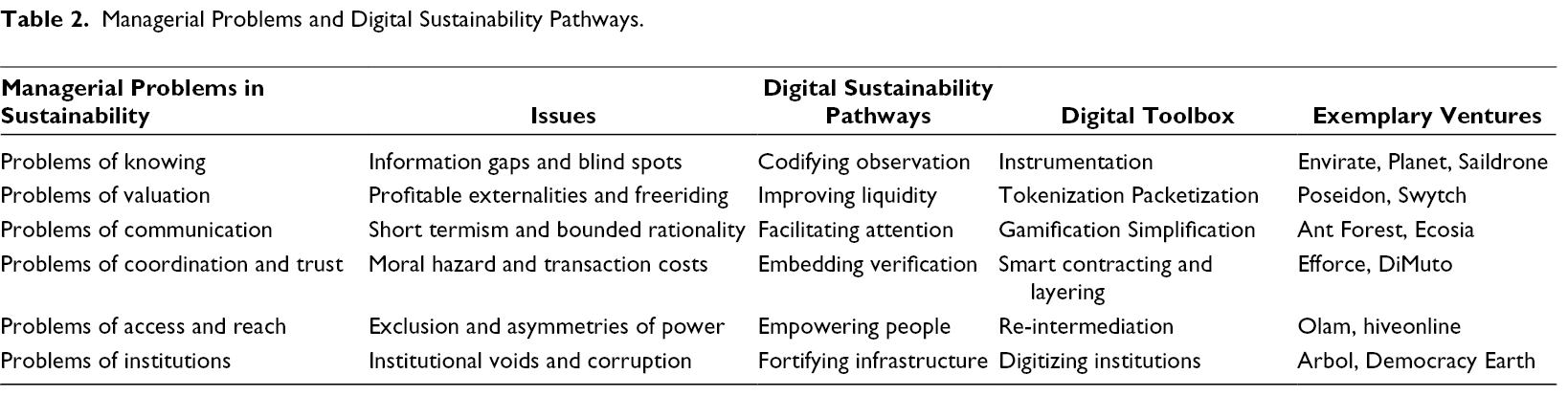
To illustrate in greater depth how digital sustainability is already beginning to make headway in the world, we next discuss six pathways we consider instrumental in tackling the challenges we face. Table 2 reviews the six managerial problems and links them to digital sustainability pathways that organizations can use to shape socioecological outcomes. We discuss each pathway separately, illustrate relevant, enabling innovations of the digital toolbox, and provide examples of noteworthy activities and actors.
Managerial Problems and Digital Sustainability Pathways.
Codifying Observations to Address Problems of Knowing
New use-cases for technologies that enable short- and long-distance observation empower actors to collect high-resolution data on specific natural biomes and their interactions with wider ecosystems. These telemetry tools help firms observe and quantify aspects of nature, distil new knowledge on the functioning of complex socioecological systems, and codify those observations into instruments and insights to guide action. By making these insights available across the value chain, firms may succeed in both creating and capturing a portion of new socioecological value. Key technologies range from satellites, drones, and the IOT to technology-assisted citizen science. These tools fill knowledge gaps and mitigate blind spots and improve the quality and quantity of knowledge with which decision makers may assess business risks and market failures relevant to the balanced production of economic, social, and ecological value.
Nascent ventures have started to use such tools to codify observations about the natural world to produce shared value. Planet Labs operates an armada of micro-satellites that provides “ultra high frequency, high resolution monitoring [which] is taking Earth science to a completely new level” (Greg Asner, lead scientist at the Carnergie Airborne Observatory). 1 Saildrone builds and operates a growing fleet of unmanned drones that sail around our oceans independently, collecting high-resolution atmospheric and deep oceanic data to disrupt a market traditionally reliant on expensive buoys and manned vessels. Envirate uses people’s sensory inputs (seeing, feeling, and smelling) to rate how humans experience the natural world through a simple smart phone application. After codifying raw observational data, the second step these organizations take entails turning data into tangible information and instruments to inform decision-making.
Using advanced machine learning, Planet Labs has trained algorithms to correlate the spatial structure of private satellite data to the very detailed and expensive LiDAR data. They thus created low-cost indicators of how earth’s natural capital evolves over time. Saildrones are equipped with over 40 sensors to track fish and mammal populations, map sea beds, and monitor temperatures, currents, and hurricane intensities. The company turns these data into quasi-real-time information feeds to facilitate clients’ decision making. Envirate turns crowd-sourced information into open access codified heat maps of the earth, over time demarcating zones of environmental improvement and degradation.
All these organizations share a goal to create nonappropriated value by making their activities and instruments available to a wider ecosystem. Planet Labs’ “Ambassador Program” brings its observation tools to the scientific community to help investigate important socioecological questions. In an interview with the authors, Saildrone’s Liz Douglas told us that the company always asks itself “what is the scientific purpose of this job?” If the answer is missing or unclear (i.e., if public value creation is low), they just won’t do it. By collaborating with incumbents, Envirate inspires the allocation of resources for CSR programs to areas with the highest possible impact rather than those with the lowest political hurdles.
Improving Liquidity to Tackle Problems of Valuation
Digital sustainability activities also entail the use of emerging technologies to create new markets for ecological public goods and services that were previously prohibitively difficult to measure and/or exchange. Two interesting elements in the digital toolbox that support new market formation are tokenization and packetization. The former refers to the application of a digital proxy, such as a blockchain token, to represent a previously amorphous unit of natural capital. The latter, often employed as a supplement to tokenization, describes a process of bundling data into small packets that contain valuable information and enable a much greater distribution of risk and ownership. Singaporean start-up Maecenas for instance tokenizes and sells 49.9% of an art work’s ownership rights to people who want to own a tiny fragment of a masterpiece, expecting greater resale value in the future. Together, tokenization and packetization allow businesses to render natural capital into well-defined, small, fungible, and tradeable units, for which new markets can set prices (e.g., for commons-destroying spillovers) and generate rewards for investing in ecological public goods.
Poseidon, a Malta-based foundation, is tokenizing carbon credits from conservation programs in the Andean rainforest onto the Stellar blockchain and packetizing those credits into “carbon by the gram.” Swytch tracks, verifies, and tokenizes renewable energy produced and associated avoided carbon emissions. Both groups packetize valuable provenance information into their tokens and then sell them to interested parties. Poseidon specifically focuses on enabling micro-transactions to offset the footprint of retail products and services, such as filling up a tank of gasoline, in a bid to help consumers attain “carbon-neutral” consumption. The foundation for instance partnered with Ben & Jerry’s ice cream and ultra-fast vehicle manufacturer BAC, which now offsets double its production emissions through Poseidon and helps clients offset miles driven during their yearly maintenance. 2
By packetizing granular data on energy production, including exactly what was produced and where, when, and how much carbon emissions have been displaced by a unit of renewable power, Swytch gives token buyers increased flexibility and accuracy when claiming attribution for carbon reductions in their sustainability reporting. Both Poseidon and Swytch thus support the transition to a postcarbon economy by adding liquidity for consumers and producers of environmental benefits (carbon credits and kilowatt hours of renewable power). Swytch leverages a very advanced AI system to allocate a value to each kilowatt hours of renewable energy by accounting for factors including risk, institutional capacity, and availability of alternative supplies, ensuring that higher risk projects receive higher rewards to support a more efficient market evolution.
Facilitating Attention to Confront Problems of Communication
Because the meta-challenge of sustainability is so complex and fast evolving, consumers often feel their efforts are meaningless or lack awareness of where their energies may be best directed. In response, some firms now leverage digital tools to communicate simple, engaging sustainability messages to large populations. These activities often build on processes of gamification, transposing prosustainability behaviors into fun, social, and competitive environments. By contextualizing users’ sacrifices and micro-commitments within an encouraging game, new ventures along these lines may not only generate impactful behavioral change, but also develop a more engaged user-base through the repeated and paired provision of a simple, yet laudable, service and a clear, environmental message.
As an example of gamification, Ant Forest is a green initiative within the Chinese payment and lifestyle application AliPay. Ant Forest has evolved into a social game that tracks and rewards green lifestyles (e.g., walking to work, paying bills online, taking the metro etc.) with “energy points” representing grams of carbon saved. Energy points have become valuable commodities users can spend to plant and nourish digital trees or sponsor land conservation. To ensure consistent engagement, Ant Forest allows users to steal small amounts of energy from friends or help water friends’ digital trees. The parent company, Ant Financial, plants a real-life tree for each digital tree a user raises to maturity. Since 2016, Ant Forest has increased customer satisfaction and strengthened Ant Financial’s brand identity as a global leader in sustainable finance, while planting 500 million trees in Inner Mongolia. By October 2018, Ant Forest reports almost 400 million regular users.
Another form of facilitating attention involves simplification, a process of effortlessly embedding a prosustainability impact in a daily activity. A fine example is Ecosia, a search engine that uses 80% of its advert revenue to plant trees to fight global warming. Since its launch in 2009, Ecosia and its user community report planting over 61,000,000 trees in Ethiopia, Brazil, Indonesia, and Spain. Ecosia differentiates itself from market leaders by establishing sustainability as its core business logic and value proposition. In the company’s own words: “we’re interested in trees, not your data.” Ecosia enables users to contribute to tree planting by simply installing Ecosia as their default search engine. A comparable tool is “Tab for a Cause” from the company Gladly, Inc. This simple plugin shows users a beautiful landscape and advertising each time they open a new tab in their Internet browser and donates 30% of add-revenue to one of nine charities based on a user’s choice. Not surprisingly, Tab for a Cause has made it easy to integrate Ecosia into all new tabs, helping users double their impact with zero new effort.
Embedding Verification to Counter Problems of Coordination and Trust
Organizations are employing digital tools to reduce transaction costs and moral hazard in sustainable supply chains. Many key technologies in this space are similar to those being used to solve problems of valuation, with a heightened focus on solving coordination problems in the production and distribution of shared value. Pioneering organizations in digital sustainability are now embedding verification processes within the architecture of exchange systems. Embedding verification enables diverse market players to engage in arm’s length—and often trustless—buying and selling with much-reduced risks of freeriding and opportunism. Key innovations include smart-contracting (hardcoding terms of trade into transaction flows to automate business logics) and layering, a process of digitizing evidence of (sustainable) provenance for storage within immutable, tamper-proof ledgers. These tools promise to solve adverse selection problems that have disadvantaged superior, sustainable products in open markets.
A key challenge in economic exchange, especially in international trade, involves ensuring the quality and provenance of goods purchased from sellers at the far side of the world. DiMuto
Efforce is a blockchain-based energy-saving trading platform seeking to revolutionize the market for Energy Performance Contracting (EPC) for infrastructure upgrades that reduce energy costs. An energy service company (ESCO) proposes improvements to an industrial facility, which are then financed by a finance partner. The facility pays back the ESCO and finance partner based on energy savings. EPC regularly returns 20%–25% in energy savings and promises 20%–25% returns for financing partners. Yet uncertainty about moral hazard (including cheating, underreporting of savings etc.) has kept the EPC market small relative to its potential. EFFORCE now retrofits facilities’ smart meters with an algorithm that outbounds contract-encoded tokens reporting energy savings unto a public ledger, thereby ensuring reliable verification which facilitates the coordination of economic action and improves the functioning of the EPC market.
Empowering People to Reduce Problems of Access and Reach
Digital sustainability activities can be used to increase access and reach in ways that promise to empower previously disenfranchised communities that often lack access to formal, efficient markets. This exclusion is one of the principal reasons why it is so often expensive to be poor. Innovations driven by digital technologies can balance power and information asymmetries to underpin business solutions at the “base of the pyramid.” Solutions manifest both at the supply side (to empower small-scale production) and at the demand side (to better reach customers and consumers).
At the supply side, Olam, an agribusiness multinational based in Singapore, is working to digitize the origination process for crops like cocoa across its global network. By equipping small-scale farmers with mobile phones armed with a digital sales platform, Olam cuts out price-setting middlemen and provides higher prices to farmers. To develop this platform, Olam managers used a user-centric design-thinking method to learn from farmers what the value-add of middlemen is (largely assessing crop value and estimating transaction costs) and how it would need to adjust its supply chain operations to prioritize minimal disruption at the farmer level. In collaboration with scientists, they digitized the valuation of cocoa based on moisture content using image recognition and machine learning so that they could create a real-time pricing tool that would make earnings for farmers more predictable and pricing more transparent and less susceptible to the bargaining and haggling power of middlemen. Via digital re-intermediation, Olam can now pay farmers more, improve the stability of supply, and widen margins while encouraging digital “lock-in” to their digital platform (Olam Direct).
On the demand side, hiveonline is a digital exchange system for the unbanked. The Danish start-up provides a contracting and accounting system for formal and informal, generally unbanked, microbusinesses that enables reputation building, social network verification using phone records for KYC, and tokenization of natural capital assets. The overarching goal is to provide digital proof of creditworthiness and thusly expand access to finance and employment for impoverished communities. In Niger, hiveonline’s platform intermediates between community-lending circles who lack access to financial services and Village Savings and Loan Associations. Through their technology, they can help their financial partners reduce risk and empower local businesses.
Fortifying Infrastructure to Lessen Problems of Institutions
Last, digital sustainability organizations can fill institutional voids and reduce agency costs in the generation of sustainable value. Institutional voids can arise from trust problems rooted in corruption and other failures of institutions and governance. By fortifying existing or developing novel digital infrastructures in a decentralized and/or peer-to-peer way, organizations are providing new goods and services or ensuring rights and titles. Key innovations include blockchain to support trustless exchange, the collateralization of social capital, and mechanisms for building consensus. By digitizing institutions, these technology and business model innovations allow organizations to solve governance failures and allow new and existing markets to reduce dead weight loss and expand socioecological surplus.
Arbol is pioneering a global, location-specific, peer-to-peer index insurance market using blockchain, smart contracts, and public weather data. The platform addresses unmet needs of farmers whose livelihoods hinge on local events like droughts and heat waves and for whom existing insurance products are ill-suited due to inflexible terms and prices driven by large US agrobusinesses. Arbol’s tokenized smart contracts are transparent and cost effective (no human interaction), paying out a preset amount whenever an agreed-upon weather threshold is reached to replace output ambiguity (i.e., damage) with input alignment (e.g., more than 125 ml of rainfall in a 3-month period). As a P2P platform, Arbol also enables anyone to enter as an underwriter and absorb counterparty risk by trading in a new asset class, which is why the platform has been appealing to both classic insurance companies that find new ways of underwriting local risks and to hedge fund managers looking for new asset classes that are uncorrelated from major markets. Tokenized contracts can also be traded on a secondary exchange, ensuring underlying capital remains liquid during the contract period.
Ukraine has followed in Georgia’s and Sweden’s footsteps to develop a land registry for its farm land on the blockchain, after recognizing that “its current system is vulnerable to fraud that leads to conflict over ownership” (Verbyany, 2017). In places like Ukraine, where trust in the government may be low, such solutions can enhance transparency and ensure that no illicit activities underpin the auctions of state land leases. Democracy Earth is a nonprofit technology company that built a platform that helps others build democratic, transparent, and incorruptible decision processes for organizations. The organization has broad goals that all fall under the hat of personal sovereignty, including returning ownership of user data on social platforms to the people, online, anonymous, and incorruptible voting, which enables quadratic voting as well as vote delegation to more erudite or more able people (Jacomet & Deville, 2017).
To summarize, we present a stylistic model (Figure 1) of how digital technologies are being used to tackle climate change and to boost sustainability. This model connects the six problems we identified as fundamental causes of our limited ability to achieve sustainability objectives to the proposed digital sustainability pathways that tackle each problem through the digital toolbox. The objective of digital sustainability activities is to create highly scalable market offerings that directly improve socioecological outcomes.
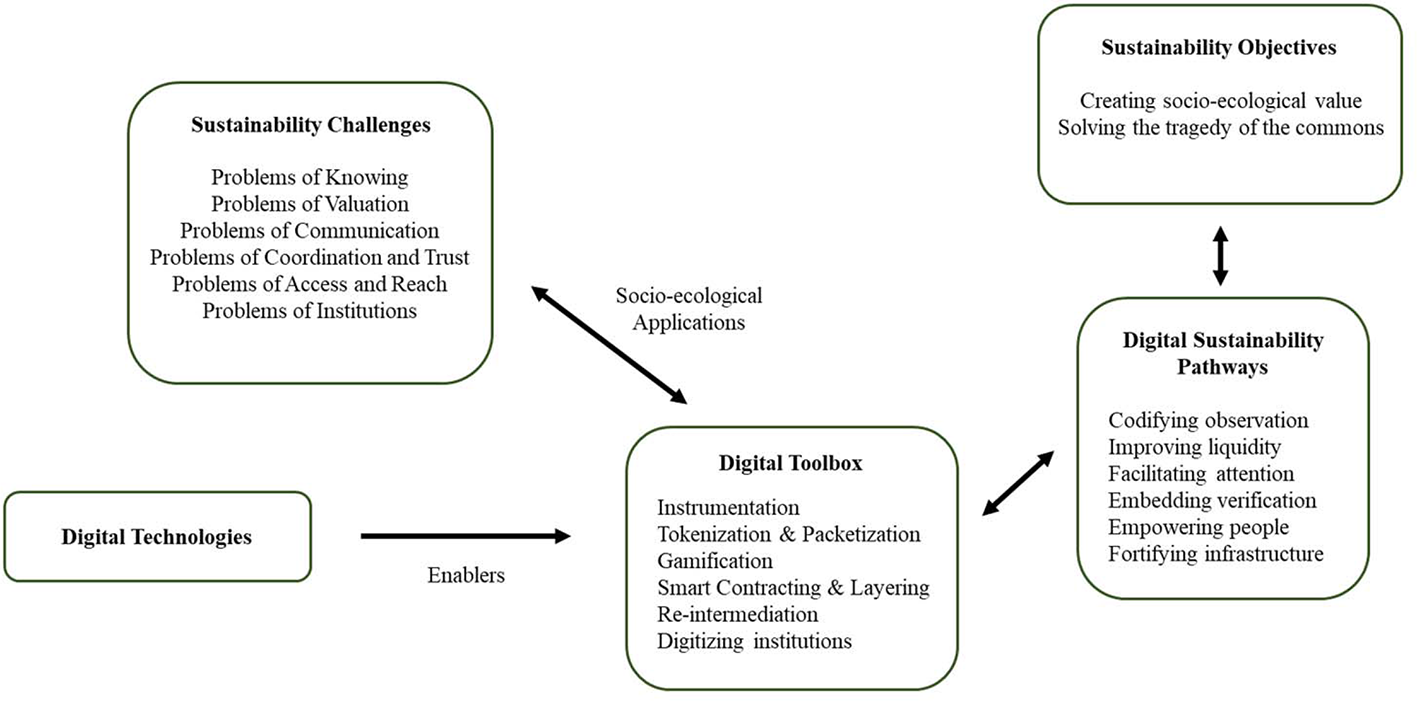
Stylistic model of digital sustainability.
A Research Agenda on Digital Sustainability and Entrepreneurship
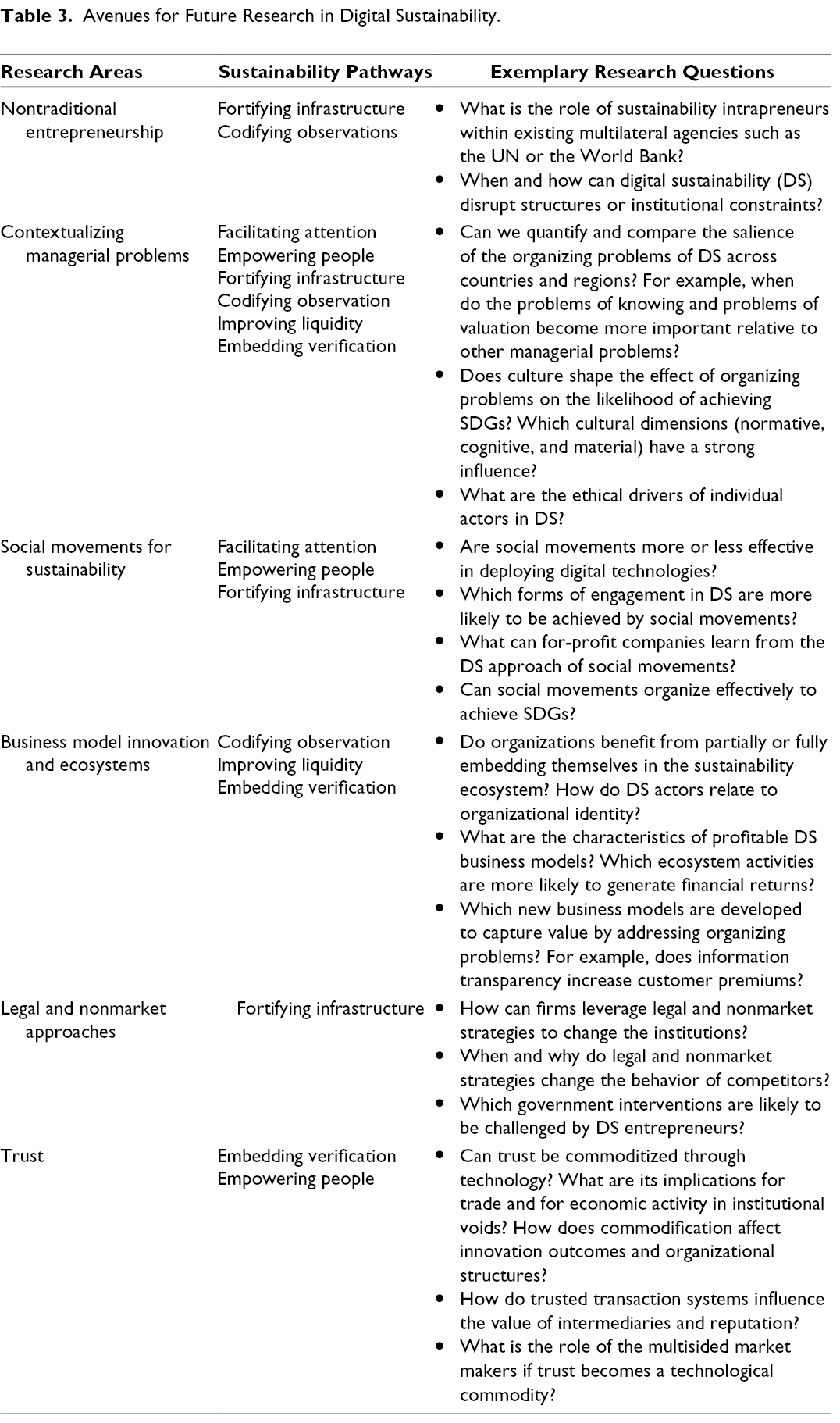
We reviewed the planetary boundaries approach and four managerial lenses and presented digital sustainability as its own idiosyncratic lens with a unique combination of focal units of analysis (organizational activities), objectives (focus on sustainability and socioecological value creation), and means (spatially unbound, scalable deployment of digital technologies). These lenses are a selection of the approaches present in our field that investigate questions of global importance in relation to sustainability. In entrepreneurship for instance, an additional yet scarcely developed lens is the one of development entrepreneurship as an integration of institutional, social, and business entrepreneurship (McMullen, 2011). In order to stimulate debate and invite our colleagues to join conversations about how digital technologies are transforming the way organizations tackle sustainable development, we introduce a variety of other perspectives and possible research questions in Table 3. While the first two rows stem from topics discussed earlier, the next four are briefly introduced in the below.
Avenues for Future Research in Digital Sustainability.
Social Movements for Sustainability
Social movement theory has also been used as a lens to discuss sustainability topics such as degrowth (Demaria et al., 2013), climate justice (Pettit, 2004), and climate change more generally (Jamison, 2010). Relevant social movements manifest as more loosely organized entities that, while lacking the formal organizational structure of entrepreneurial firms, nevertheless strive toward similar goals as social or sustainability entrepreneurs. To take an extreme example, a growing chorus of scientists now argue—based on the scientific evidence—the inevitability of catastrophic global warming and at least partial societal collapse (Bendell, 2018). Humanity’s increasingly dire position has inspired a growing array of loosely coupled social movements such as the “Extinction Rebellion” movement in the United Kingdom to refocus people’s professional and personal life on deep adaptation through resilience, relinquishment, and restoration.
From a digital sustainability angle, it would be valuable to study how social movements use digital technologies to expand and activate their user base to achieve their ends and whether such social movements behave differently from engaged corporate stakeholder communities. While quantitative data around these types of loosely coupled organizations may be hard to come by, in-depth case studies of activist organizations like “Avaaz” or problem-focused organizations like “charity: water” would be of interest, given that both have excelled at leveraging digital and mobile technologies to boost the size and concomitant power of their community. Comparative studies between social movements, digital sustainability actors, and corporate actors that all seek to address a similar problem would be of great interest.
Business Model Innovation and Ecosystems
Our conceptualization of digital sustainability as a new lens that explicitly focuses on activities undertaken within a larger ecosystem that works toward the achievement of the SDGs marries the business model approach advocated by Zott and Amit (2010) with the ecosystem-as-structure approach proposed by Adner (2017). Adner (2017) starts from an overarching value proposition that can only be accomplished by a multitude of interdependent activities that are performed by a diverse set of actors. Zott and Amit (2010) see the business model as an activity system that consists of content (in terms of value proposition), structure (how activities interact), and governance (who is leading and who is involved). An activity is the engagement of resources “by any party to the business model,” thus including stakeholders, buyers, and suppliers, “to serve a specific purpose toward the fulfillment of the overall objective” (p. 217).
Looking at organizations as constellations of activity systems, some of which fit into an ecosystem-as-structure that seeks to achieve the SDGs, is challenging but relevant from the nexus perspective that stresses the interlinkages between all types of activities in the achievement of sustainability goals (Bock & George, 2018; Schillebeeckx et al., 2018). Activity-centricity also opens up the possibility that some actors are fully embedded within the ecosystem while others only have one activity in this ecosystem. This possibility of partial affiliation raises interesting questions as to how organizations deal with conflicting logics (Purdy & Gray, 2009; Zhao & Lounsbury, 2016), how external audiences evaluate partial category membership (Durand & Paolella, 2013; Hsu et al., 2009), and how actors whose activities are fully embedded within the ecosystem perceive the activities of those who straddle ecosystem boundaries (Rossignoli et al., 2018).
Legal and Nonmarket Approaches
We identified six managerial problems that underpin the current climate and sustainability crisis and presented pathways to tackle these issues rooted in the creative deployment of digital technologies, yet digital is not the only way. Tempus Energy, a UK-based energy service company that provides demand flexibility solutions (using the smart grid and smart appliances to balance electricity demand to lower the need for peak electricity capacity), won a European Court of Justice case, forcing the United Kingdom to revisit its capacity market regulation, which was interpreted as illegal subsidy (The UK government pays big fossil fuel suppliers for providing peak capacity that sits idle most of the year; Sara Bell, CEO Tempus, private communications.).
More generally, over 1,300 legal actions over climate change have been taken against both governments and firms globally (Laville, 2019). Besides legal and digital strategies, there remain other nonmarket strategies organizations could undertake to achieve the same ends (Baron, 1995a, 1995b; Capron & Chatain, 2008). There is surely a need for more research on nonmarket strategies and to learn more about whether these nonmarket strategies are complements or substitutes to digital strategies. Conversations with Tempus’ CEO showed this legal strategy was a direct consequence of an anteceding nonlevel playing field for the digital solution the company wanted to bring to market. Process studies of how various nonmarket strategies are used by institutional and development entrepreneurs could provide rich insights into how organizational activities are sequenced to achieve preset goals.
Trust and Digital Sustainability
Some of the activities we discussed rely on blockchain technology and the embedding of verification into economic exchange transactions. As distributed ledger technology is known as trustware because it replaces interpersonal trust with technological verification, many have wondered what the implications will be for those businesses that are in the business of being a trusted intermediary (Hammi et al., 2018; Schramm, 2019). This new form of technological trust offers a lot of possible benefits. It can reduce the capacity of actors to behave opportunistically (reducing the need to be vulnerable), enhance input verifiability (facilitating control), ensure transparency and traceability during transaction time and transportation (improving monitoring), boost the speed of settlement (reducing nonpayment risk), and leverage actor embeddedness in an ecosystem (increasing reputational risk of nonconformity).
Yet, trust is more than a mechanism to avoid opportunistic behavior of the other party. Research has found that trust plays an important role in team, organizational, and collaborative innovation (Barczak et al., 2010; Dovey, 2009; Fawcett et al., 2012) and it is unlikely that “technological trust” can replace the same mechanisms. While in health care, for instance, the ability to share data anonymously and have confidence they cannot be tampered with offers great opportunities for research and development (Mettler, 2016), there are undoubtedly application areas where blockchain-mediated economic exchange could hamper flexibility to respond and undermine innovative practices. Entrepreneurship scholars interested in trust should see this as a unique opportunity to theorize about various trust dimensions and the contingencies of trust across various types of entrepreneurial activity.
Conclusion
A variety of phenomenological lenses co-exist that each have an idiosyncratic perspective on how to tackle climate change, sustainable development, and the creation of socioecological value. To this, we add the digital sustainability lens that focuses on activities undertaken by entrepreneurial and incumbent firms that rely on digital innovations to create scalable socioecological value. We highlight six problems that hide beneath the surface of sustainability and are directly relevant to management and entrepreneurship theory and practice. To address those problems, we formulate digital sustainability pathways grounded in innovative and creative deployment of digital technologies.
Most of the actors we provide as examples in this emerging field of digital sustainability have been young entrepreneurial ventures that create socioecological value around which they develop an economic proposition. We believe these organizations, and those that will follow their example, will play a pivotal role in how the global industrial complex will respond to climate change and other grand challenges. While many hurdles need to be jumped before we can even begin to dream of a sustainable economy, we remain hopeful that entrepreneurial ventures will find solutions that become so powerful they can overcome the lack of urgency manifest in most governments and large parts of civil society. Climate scientists say we have about 10 years left to take drastic action if we want to avoid the worst effects of climate change. The time to act is now.
As scholars, our role is first and foremost to observe, analyze, and bring insights back to industry. Digital transformation is undoubtedly one of the most influential trends affecting businesses now, and climate change the most existential threat. Some of the most exciting research ideas and entrepreneurial ventures are due to the convergence of the digital and sustainability imperatives. We hope others will be inspired to start studying these actors, their activities, and spur their students and colleagues into action.
Footnotes
Declaration of Conflicting Interests
The author(s) declared no potential conflicts of interest with respect to the research, authorship, and/or publication of this article.
Funding
The author(s) disclosed receipt of the following financial support for the research, authorship, and/or publication of this article: Gerard George and Simon Schillebeeckx gratefully acknowledge the support of SMU and the Singapore Ministry of Education through the grant 16-C207-SMU-023 “Sustainability and Natural Resources: Seeding an SMU Community and Research Agenda on Food and Water with an Asean Focus”. Gerard George is grateful for the financial support of The Lee Foundation (Singapore) for the Lee Kong Chian Chair Professorship.
