




Abstract
Policymakers increasingly demand private enterprises to help solve social and ecological challenges faced by nations worldwide. In this article, we use Toulmin’s rhetoric model to explain how European Union policy rhetoric articulates the meaning of entrepreneurship for sustainable development. Our findings demonstrate a “rhetoric mix” of argumentations through which policy rhetoric conveys three meanings of entrepreneurship—beneficiary in corrective sustainability, contributor in constructive sustainability, and opportunistic operator in assertive sustainability—and imposes shared beliefs that frame the policy discourse. In conclusion, we introduce a framework of “rhetoric mix” to advance research on entrepreneurship policy discourse and sustainable entrepreneurship.
The urgent need to find solutions to “grand challenges,” the pressing ecological and social problems faced by nations around the world, has firmly propelled sustainable development onto the political agenda (Ferraro, Etzion, & Gehman, 2015; George, Howard-Grenville, Joshi, & Tihanyi, 2016). Alongside this development, policymakers have increasingly called upon the private sector to help solve the challenges of our times by elevating “sustainable entrepreneurship” as a means of producing economic, social, and environmental value (Muñoz & Cohen, 2018a; Roy & Singh, 2017). Since grand challenges, such as climate change or income inequality, are multifaceted and often lack clarity of evidence on how they should be addressed (Kimmitt & Muñoz, 2018; York, Vedula, & Lenox, 2017), the argumentation used by policymakers is an important rhetorical means for defining institutional priorities and motivating action (Harmon, Green, & Goodnight, 2015; Harmon, 2018; Reinecke & Ansari, 2016). Entrepreneurship in sustainable development is a highly contentious theme in policy debates (Paschen & Ison, 2014; Perren & Dannreuther, 2013) because “any understanding of sustainability is necessarily underpinned by the explicit or implicit ideology of the social actors that drive the debate” (Davidson, 2014, p. 5). Scholars have also emphasized the versatility, and clash, of portrayals of entrepreneurship in public discourses pertaining to economic, social, and environmental goals (Dey & Steyaert, 2010; Mason, 2012; Nicholls & Teasdale, 2017; Perren & Jennings, 2005). Despite these advances, however, we know little about the underlying argumentations and values used by policy rhetoric in articulating the meaning of entrepreneurship for sustainable development, and in defining “what should be sustained and developed” with sustainable entrepreneurship (Shepherd & Patzelt, 2011).
To explore the complexity pertaining to policy discourse on entrepreneurship and sustainable development, we draw from rhetoric analysis, which helps us to reveal the argumentative structures and beliefs that are embedded in policy communications (Cornelissen, Durand, Fiss, Lammers, & Vaara, 2015). Our research builds on Toulmin’s (Toulmin, 1958/2003) rhetoric model to ask: How does policy rhetoric convey the meaning of sustainable entrepreneurship? We apply Toulmin’s model to our analysis because it expands the literature on entrepreneurship policy by offering a novel focus on how rhetoric shapes the meaning of entrepreneurship as a practice, and sustainable development as a context within which entrepreneurship is situated (Harmon et al., 2015). Here, Toulmin’s rhetoric analysis particularly identifies the claim and data of arguments so as to uncover the reasoning (warrants) and the generally accepted beliefs (backings) which underlie an argumentation structure. Based on this analytical approach, our study examines 43 policy documents (2010, 2017) published on the basis of the European Union’s (EU) launch of “Europe 2020 – A strategy for smart, sustainable and inclusive growth” in 2010. The EU offers a suitable and revelatory policy setting in which to address our research question, chiefly for the reason that the EU has become an influential institution in societal debates on sustainable development and entrepreneurial support programs across its 28 member states (Mukhtar & Redman, 2015). Thus, in contrast to other supranational institutions such as the United Nations—influential in addressing sustainable development—or the Organisation for Economic Co-operation and Development (OECD)—influential in supporting enterprises—the EU is active in both areas (Dannreuther, 2007; Van Schaik & Schunz, 2012).
The key insight of our analysis is to demonstrate a “rhetoric mix” of argumentations by which policy rhetoric conveys multiple meanings of entrepreneurship in the context of sustainable development. We identify three dominant meanings—entrepreneurship as beneficiary in corrective sustainability, as contributor in constructive sustainability, and as opportunistic operator in assertive sustainability—and explain how those distinct meanings result from different argumentations and beliefs underlying the rhetoric. On this basis, we expand the research on entrepreneurship policy discourse (Perren & Jennings, 2005; Perren & Dannreuther, 2013; Nicholls & Teasdale, 2017) by introducing a framework of “rhetoric mix” that explains the nuanced variation in fundamental beliefs within an entrepreneurship policy discourse established by a single powerful institution. Further, we add to the policy research on sustainable entrepreneurship (Dey & Steyaert, 2010; Nicholls, 2010; Muñoz & Jara, 2017) by demonstrating that a rhetoric mix endorses and marginalizes interpretations of the priorities of sustainable development and the responsibilities of entrepreneurship in framing sustainable entrepreneurship discourse. In conclusion, we offer new directions for rhetoric research (Harmon et al., 2015; 2018) at the intersection of entrepreneurship, institutions, and sustainability (e.g., Gehman, Grimes, & Cao, 2019; Parker, Gamble, Moroz, & Branzei, 2019); in particular, this serves to further our understanding of how the rhetoric mix reflects and influences the foundation of powerful institutions and their valuations of why and how enterprises should pursue sustainable development.
Literature Review
Entrepreneurship research has emphasized that, since the 1980s in particular, entrepreneurship discourses have often emerged as, and reinforced, a meta-narrative of the free-market capitalist system, which portrays the entrepreneur as a functional actor supporting the wider economy (Anderson, Drakopoulou‐Dodd, & Scott, 2000; da Costa & Silva Saraiva, 2012; Jennings, Perren, & Carter, 2005). Recent studies suggest that, in political programs, the depictions of entrepreneurship are subjected to states’ interests and ideological beliefs (Perren & Jennings, 2005; Perren & Dannreuther, 2013). These ideals suggest how and by whom entrepreneurship should be practiced (Ahl & Nelson, 2015; Niska & Vesala, 2013) and so inflect entrepreneurs’ communication (Chandra, 2018; Ruebottom, 2013). The language of entrepreneurship also “provides an economic and moral rationale that can be mobilized flexibly to support a range of policy initiatives and ideological positions” (Grey, 2004), such as neoliberal and capitalist market logics (Dannreuther, 2007; Kenny & Scriver, 2012; Nicholls & Teasdale, 2017). Hence, the predominant assumptions conveyed in policy discourse can perpetuate policy approaches across countries and economic systems whilst suppressing alternative perspectives on sustainable development (Berglund & Johansson, 2007; Klyver & Bager, 2012; Xheneti, 2017).
The steadily increasing reference to sustainable development goals in political programs has also magnified the complexity of policy discourses conveying the meaning of private enterprises for society (Kouri & Clarke, 2014). Recent research on sustainable development has pointed toward the challenge for societies to “meet the needs of the present without compromising those of the future” (WCED, 1987) within a discursive context that encompasses an “overwhelming range of different—often contradictory—and controversial views of the preferred destiny of the sustainable development project” (Davidson, 2014, p. 197; Hedrén & Linnér, 2009). Scholars further suggest that controversial views often emerge because policymakers’ rhetoric follows ideological paradigms (Hugé, Waas, Dahdouh-Guebas, Koedam, & Block, 2013), as for instance in the representation of societal risks (Paschen & Ison, 2014), scientific evidence (Lefsrud & Meyer, 2012), and the responsibilities of public and private actors (Roy & Singh, 2017). These rhetorically imposed beliefs shape the political agenda of a country (Kambites, 2014), and of supranational organizations such as the OECD (Lehtonen, 2009), and they also construct a political “discursive mix” of entrepreneurship pertaining to economic, social, and environmental values (Elkington, 1998; Heinonen & Hytti, 2016; Muñoz & Cohen, 2018a; Steyaert & Katz, 2004). With this in mind, understanding the meaning of entrepreneurship for sustainable development in policy discourse calls for addressing the question of “what should be sustained and developed” through sustainable entrepreneurship (Shepherd & Patzelt, 2011), but also how and why entrepreneurship should contribute to sustainable development guided by the rhetoric of powerful political institutions.
The economic meta-narrative of entrepreneurship notwithstanding, research on sustainable entrepreneurship (Hall, Daneke, & Lenox, 2010; Markman, Russo, Lumpkin, Jennings, & Mair, 2016; Muñoz & Cohen, 2018a) has begun to explain entrepreneurial narratives through which entrepreneurs assign meaning to sustainable venturing (Fuller & Tian, 2006; Poldner, Shrivastava, & Branzei, 2017; Muñoz & Cohen, 2018b). This research draws attention to the emotive and esthetic discourses employed by sustainable entrepreneurs, but also to how this creates multifaceted tensions rather than simply balancing business goals with ethical ambitions (Poldner et al., 2017). To date, only few studies have focused on how meanings of entrepreneurship associated with societal development can be understood through key political actors’ ideas, values, and language usage (Berglund & Johansson, 2007; Dey & Steyaert, 2010; Nicholls, 2010; Nicholls & Teasdale, 2017). Drawing on content, corpus, or discourse analytical tools, these studies have greatly enhanced our knowledge of discourses—and the conflicting views they may exhibit—by explaining the explicit content and ways of communicating through which different (ideological) portrayals of entrepreneurship are constructed (Ahl & Nelson, 2015; Mason, 2012; Muñoz & Jara, 2017; Perren & Sapsed, 2013). Despite these advances, however, little is known about the deeper implications of the linguistic structures underlying entrepreneurship policy discourses (Green Jr & Li, 2011), and chiefly, how political actors argue for values and priorities toward entrepreneurship and sustainable development and, through this, convey the meaning of sustainable entrepreneurship.
Against this backdrop, our study turns to rhetoric analysis for insight into how a powerful policy institution conveys meanings of sustainable entrepreneurship. Rhetoric analysis emphasizes rhetoric as a way of “knowing” (Alvesson, 1993) and typically concentrates on persuasive policy texts to unmask their underlying interests (Green Jr & Li, 2011; Suddaby, 2010). Beyond highlighting rhetorical structures used to manipulate an audience (Brown, Ainsworth, & Grant, 2012; Erkama & Vaara, 2010), scholars of “new rhetoric” focus on the ways in which rhetoric subconsciously shapes our perceptions of the surrounding world (Green Jr & Li, 2011). To expose the underlying assumptions in policy argumentation, our aim is to understand the structure of policy communication by applying the rhetoric model of Stephen Toulmin (1958/2003) (Harmon et al., 2015; 2018; Suddaby & Greenwood, 2005; Suddaby, 2010). Toulmin’s model concentrates on the logic of argumentation instead of the eloquence of its composition (Schroeder, 1997), and assigns structural components (i.e., claim, data, warrants, and backings) of an argument with different roles in the making of meaning(s). This allows us to “determine precisely how arguments and their underlying logic” (Cornelissen et al., 2015, p. 22) are constructed, and how rhetoric shapes both the meaning of certain practices (e.g., entrepreneurship) as well as the context within which they are located (e.g., sustainable development). In particular, an explicit focus on beliefs (backings) in policy rhetoric helps reveal whether “the institutional context is straightforward and social actors’ interests are reasonably aligned”, or whether conflicting interests result in debate over the fundamental grounds of argumentation (Harmon et al., 2015, p. 81).
Methodology
Research Context and Data
The study of the policy rhetoric on sustainable entrepreneurship is a line of research as yet in its infancy. In order to provide for an in-depth examination of the construction of meaning in policy documents, our analysis focuses on a single political instance, the empirical context of which is the EU. We believe the EU offers a suitable policy setting in our search for an answer to this contribution’s main research question, chiefly for the reason that the EU has become an influential institution in societal debates on sustainable development and entrepreneurial support programs across the entirety of its 28 member states. In contrast to other supranational institutions such as the United Nations (which has been influential in addressing sustainable development) or the OECD (which has focused on supporting enterprises and the economy), the EU is active in both areas (Dannreuther, 2007; Mukhtar & Redman, 2015; Van Schaik & Schunz, 2012). This development has been reinforced by the EU’s 10-year jobs-and-growth strategy “Europe 2020 – A strategy for smart, sustainable and inclusive growth,” launched on March 3, 2010, to integrate the intertwined goals of economic, social, and environmental sustainability. The Europe 2020 strategy is rooted in the earlier initiatives of the Treaty of Amsterdam, which adopted sustainable development as an overarching objective of the EU in 1997, and on the separate Sustainable Development Strategy, first published in 2001 and renewed in 2006. Moreover, EU policies have long acknowledged the role of entrepreneurship, for instance by frequently stating that “more than 20 million SMEs in the EU – that represent 99% of businesses – are the key driver for economic growth, innovation, employment and social integration.” 1 Building on the Europe 2020 strategy, seven Europe 2020 flagship initiatives were introduced, six of which also explicitly address the role of entrepreneurship and SMEs. 2
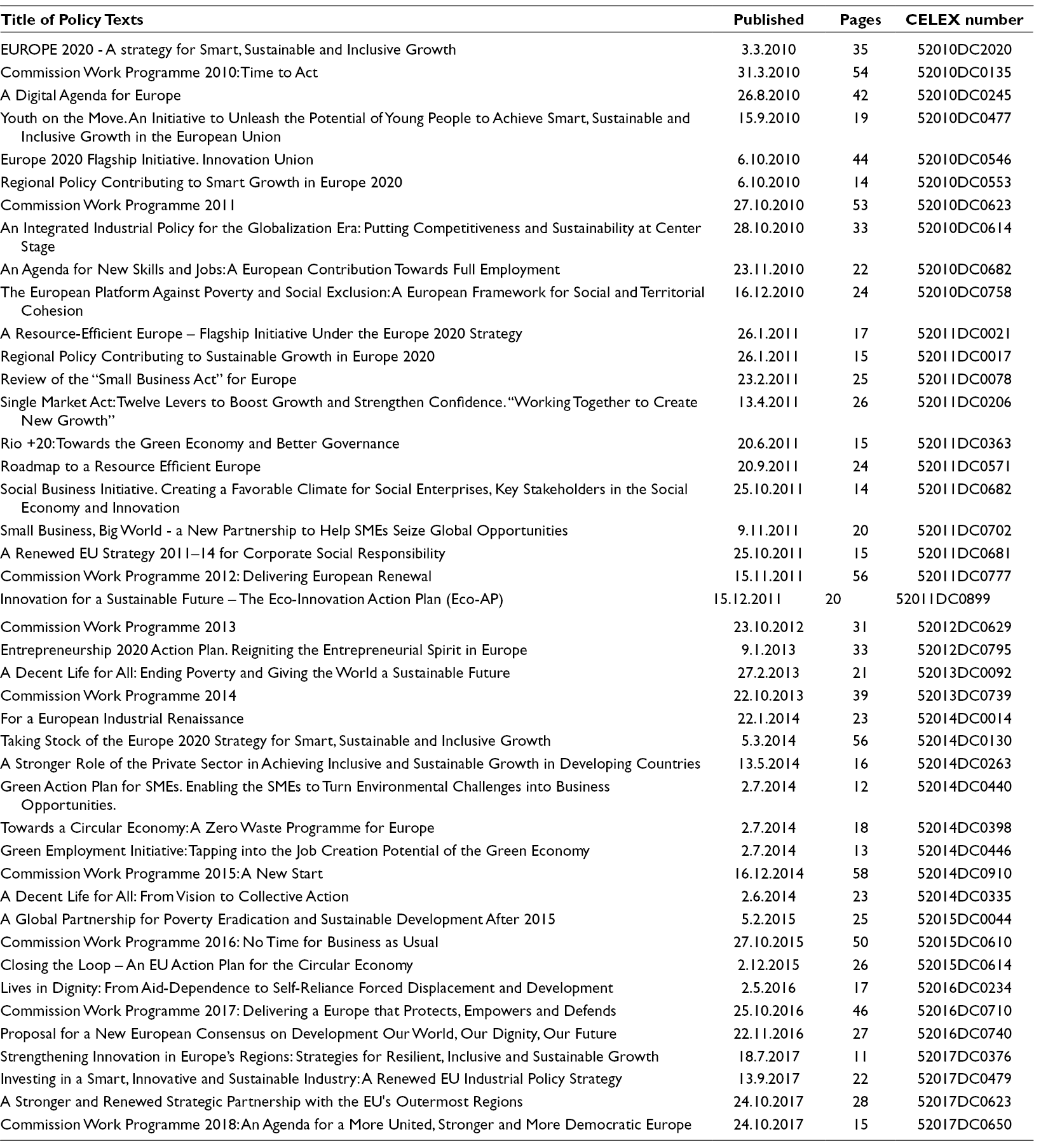
Overall, our analysis uses policy documents retrieved from the publicly accessible EUR-Lex database (available at http://eur-lex.europa.eu). In particular, our database comprises the Europe 2020 strategy document and its EU 2020 flagship initiative documents. Further, we searched for policy texts published by the European Commission after the Europe 2020 strategy was adopted in 2010, and which comprised terms referring to (a) “sustainable development” (e.g., sustainability, sustainable, social, environmental); and (b) “entrepreneurship” (e.g., entrepreneurship, entrepreneur, entrepreneurial, SMEs). Following this, we also included policy documents, such as the Single Market Act document, the annual Commission Work Programmes for 2010–2018, and the follow-up report on the Europe 2020 strategy. This initial process resulted in the identification of 54 policy documents of importance to us. After careful perusal of the documents and following discussion within the research group, we excluded 11 policy texts due to their limited value in examining policy discourse that addressed both sustainable development and entrepreneurship. Hence, our main analysis comprises 43 policy documents published between 2010 and 2017 and amounts to a total of 1,197 pages of text. Table 1 presents a detailed overview of our data and sources.
Overview of Data.
Analytical Framework
Consistent with our aim to examine policy rhetoric on sustainable entrepreneurship, we build our analytical approach on Toulmin’s (1958/2003) model of rhetoric. Following “Toulmin’s model,” an argument consists of four basic components. 3 At the explicit level, there is to be found an ultimate claim and the use of data that provides information necessary to support the claim. However, the persuasive power of the argument particularly draws from reasoning (warrant) which helps to explain the connection between data and claim, whereas the meaning of the reasoning relies on beliefs (backings) that are generally accepted within a selected institutional context, or argumentative field (Toulmin, 1958/2003, p. 235). Toulmin’s classic example of an argument from a legal context that applies its particular standards of appropriate argumentation is illustrative here:
Data: (because) Harry was born in Bermuda
Claim: (therefore) Harry is a British subject
Warrant: (since), a man who is born in Bermuda will generally be a British subject
Backing: (on account of) the following status and other and legal provisions
In our analysis, we apply Toulmin’s (1957/2003) model to analyze the EU’s policy rhetoric. In policy communications, the claims comprise “policy proposals” which present the central policy aims and actions that shall be taken to achieve the overarching goals. Data in turn provide “policy-relevant information” designed to convince readers of the appropriateness of the proposals (Dunn, 1990). The following example by Dunn (1990) illustrates an example of policy argumentation, where the warrant (i.e., reasoning) is important in order to explain the meaning of the policy proposal (i.e., claim) and why it is relevant to the interests of the speaker (i.e., backing), given the current political conditions (i.e., data):
Data: (because) the Soviet Union is placing offensive missiles in Cuba
Claim: (therefore) the United States should blockade Cuba
Warrant: (since), a blockade will force the withdrawal of missiles by showing the Russians that the United States is determined to use force
Backing: (on account of) that an increase in the cost of an alternative reduces the likelihood of that alternative being chosen
Another example by Gage, (1986/2006) explains how warrants can also be important in assigning meaning to both data (Warrant #1) and claim (Warrant #2) in connection to backings:
Data: (because) animals are tortured in experiments that have no necessary benefit for humans such as the testing of cosmetics
Claim: (therefore) Congress should ban animal research
Warrant #1: (since), the well-being of animals is more important than the profits of the cosmetics industry
Warrant #2: (since), only Congress has the authority to make such a law
Backing: (on account of) that the corporations can simply move from state to state to avoid legal penalties
These examples draw attention to the notion that the analysis of argumentation used in policy texts does not focus on assessing the evidence and logic of an argument in order to determine whether it is “true.” Rather, rhetorical analysis seeks to understand the reasoning (warrant) that assigns meaning to the argument by evaluating the necessary rules of interpretation and inference (Freeman, 2005; Hitchcock & Verheij, 2005). Hence, in contrast to “warrant-using arguments,” which deductively apply established warrants (e.g., legal stipulations) to arrive at new conclusions, “warrant-establishing arguments” materialize when the argument is generated through the data and claim. This means that “in this type of argument the warrant, not the conclusion, is novel, and so on trial” (Toulmin, 1958/2003, p. 112).
Assessment of the shared beliefs (backings) further uncovers the values and priorities that help reveal “the deeper-level consensus regarding the general acceptability of the underlying institutional arrangement” (Harmon et al., 2015, p. 82). For instance, in the argument offered by Dunn (1990) above, the identified backing highlights the belief that increasing costs will hinder hostile acts by the Soviet Union, and thus support the ultimate goals of the United States. In the case of (Gage, 1986/2006) example, the belief is that high-level legal restrictions are seen as the appropriate solution for preventing corporations from detrimental activities, and reaching the goal of improved animal welfare. Hence, these arguments are supported by the beliefs on the power of costs and legal rulings; if these backings were refuted, the arguments would no longer stand. Assessing these arguments in connection to broader argumentation by these speakers would make it possible to abstract the backings further and characterize them as reflecting, for example, financial or authoritarian beliefs.
Data Analysis
Following Toulmin’s (1958/2003) work, we understand policy rhetoric as the construction of meaning through argumentation structures. In order to explain the argumentation, we analyze the EU’s policy rhetoric in four steps following Toulmin’s model: (a) preparation of the observation ground by identifying relevant arguments; (b) examination of claims and data of the argument structure; (c) interpretation and categorization of warrants as the reasoning embedded in the argument; (d) identification of varying meanings of sustainable entrepreneurship, and evaluation of backings as the beliefs underlying these distinct meanings within the argumentative field, which is the institutional context of the EU. Figure 1 illustrates the analytical procedure.
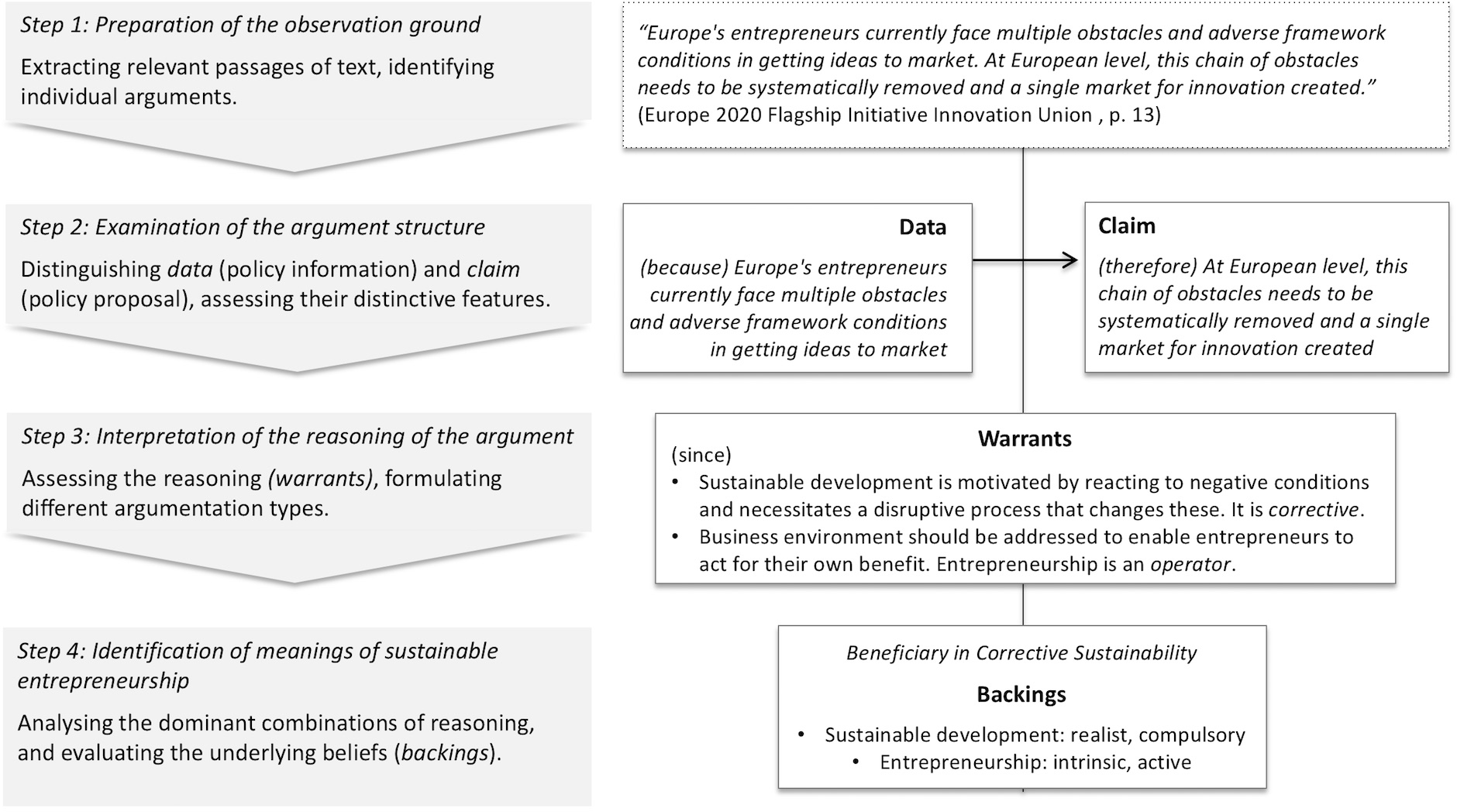
Analytical procedure following Toulmin’s rhetoric model.
Step 1: Preparation of the observation ground
We began our analysis by carefully reading and re-reading the policy texts so as to gain a comprehensive overview of the general content and themes. In this way we extracted all relevant segments of text from the 43 policy documents which contained an explicit reference to entrepreneurship, and then proceeded to divide the texts into distinct arguments following Toulmin’s (1958/2003) connection between data and claims. In our analysis, we treated information on “policy conditions” within and surrounding the EU as data, and considered claims to consist of “policy proposals” for EU bodies to engage in different strategic actions, as presented below:
Data: Despite substantial progress in recent years, the large majority of the Member States still face serious and identifiable challenges regarding smart regulation and the business environment, especially for SMEs.
Claim: Increased and more systematic efforts need to be made by Member States to reduce administrative burden, to pursue better regulation and e-government policies, to apply the “think small first” principle and to simplify support schemes.
Due to the nature of policy texts, these two components of any given argument were not necessarily connected to each other in an immediate manner. Often, the policy texts outlined the conditions and policy aims, and then proceeded to make several claims, all of which were justified with the same data. In some cases, an argument covered several paragraphs of complex formulations, whereas in other cases an argument was expressed concisely in one or two sentences.
Step 2: Examination of the argument structure
In the second step of our analysis, we assessed each argument in more detail with the aim to inductively identify emerging categories (Shepherd & Sutcliffe, 2011) of claims and data as the basis for understanding the particular positioning of entrepreneurship within the argumentation on sustainable development. In our categorization, we focused on the general qualities of the argumentation, rather than its specific content (such as those pertaining to economic, social, or environmental conditions and goals) as this allowed us to contrast the argumentations throughout the EU’s policy discourse.
After several rounds of iteration, we identified two important qualities of data: time and tone. Time explains whether the data focused on descriptions of existing statistics and definitions and present conditions within the EU or in its environment, or on future expectations and forecasts. Tone refers to presentation of the policy information either in a positive light that presents strengths and opportunities, or in a manner that emphasizes negative implications and portrays weaknesses and threats. Examples of the four types of data (formulated as the combination of these two qualities) are presented below.
Present, positive: The Single Market, with 500 million consumers, 220 million workers and 20 million entrepreneurs, is a key instrument in achieving a competitive industrial Europe.
Present, negative: Existing models focus on specific policy areas and sectors such as energy and transport. They cannot capture fully the impact of resource use on ecosystems, enterprises, the economy and society as a whole, or the interdependence of policy measures.
Future, positive: According to recent estimates, achieving our target of spending 3% of EU GDP on R&D by 2020 could create 3.7 million jobs and increase annual GDP by close to €800 billion by 2025.
Future, negative: This may not only lead to a widening productivity gap in Europe between companies who make resource efficiency improvements and those who do not, but also weaken the overall competitiveness of European firms as well as the chances of many SMEs to position themselves in global value chains.
In regard to claims, our analysis revealed two types of policy proposals. The first type describes policy proposals which emphasize macro-level activities that do not target the enterprises. The second type refers to policy proposals that focus on top-down activity directly supporting entrepreneurship.
Macro-level: The Commission will also support business-academia collaborations through the creation of “Knowledge Alliances” between education and business to develop new curricula addressing innovation skills gaps. They will help universities to modernize towards inter-disciplinarity, entrepreneurship and stronger business partnerships.
Top-down: This initiative will set out priorities to improve the business environment, especially for SMEs, and to support the development of a strong and sustainable industrial base able to compete globally.
In addition, we concluded that important differences exist in terms of the data and/or claim focusing either on discussing the current or prospective character of entrepreneurship for society, or on the present or expected contextual conditions supporting entrepreneurship. As a result of the second step of our analysis, we identified distinguishable features in the claims and data across all arguments. These were used to examine how they form different reasoning (warrants) in regard to sustainable development and entrepreneurship.
Step 3: Interpretation of the reasoning of the argument
In the third step of our analysis, we proceeded to uncover warrants. These represent the (implicit) reasoning underlying the argument structures (Toulmin, 1958/2003) and are crucial for understanding the meanings embedded in the argumentation.
To identify warrants, we evaluated the reasoning that explained (a) the relevance of data: what made the policy conditions important in relation to the goals; and (b) the relevance of the claim: what made the policy proposal suitable for achieving the desired goals under these conditions. The reasoning involving these two aspects would articulate why and how sustainable development should be pursued. In a similar vein, we focused on identifying the reasoning on the importance of entrepreneurship, as well as its expected contribution to these goals. Following this procedure, we formulated the identified warrants of each argument into logical statements (Toulmin, 1958/2003), and then grouped them into larger categories.
For instance, in the example presented in Figure 1, the argument reads as follows:
Europe’s entrepreneurs currently face multiple obstacles and adverse framework conditions in getting ideas to market. At a European level, this chain of obstacles needs to be systematically removed and a single market for innovation created.
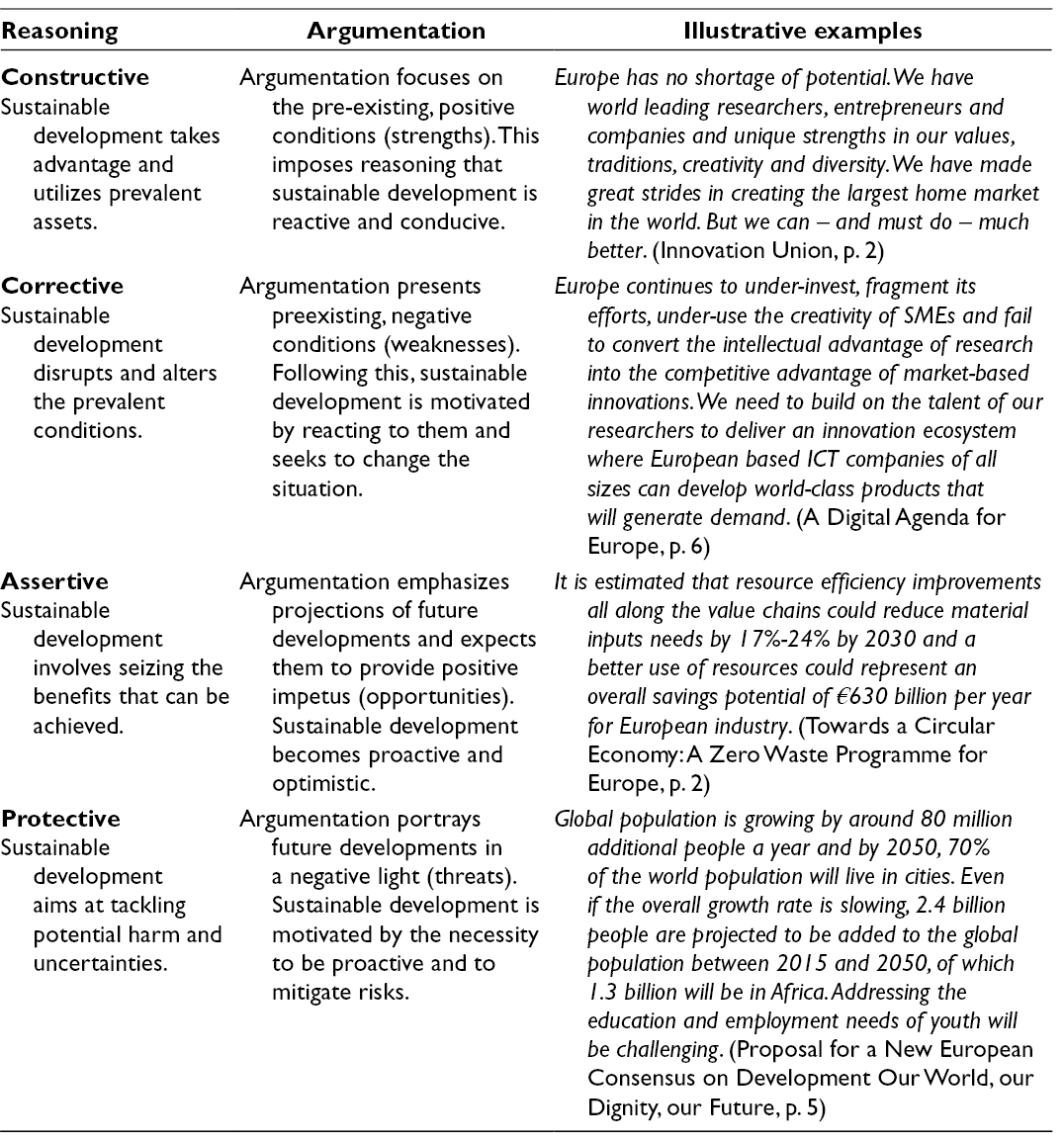
Here, the motivation for sustainable development activities stems from the need to react to the current negative conditions, and consequently, the argument relies on reasoning that sustainable development necessitates a disruptive process to alter the presently negative situation. While grouping the argumentations into main types, we named this type of argumentation “corrective.” Following a similar analysis, we identified warrants that reason sustainable development to be a conducive process in reaction to the present positive situation, or a pro-active endeavor that anticipates either the positive or negative future developments.
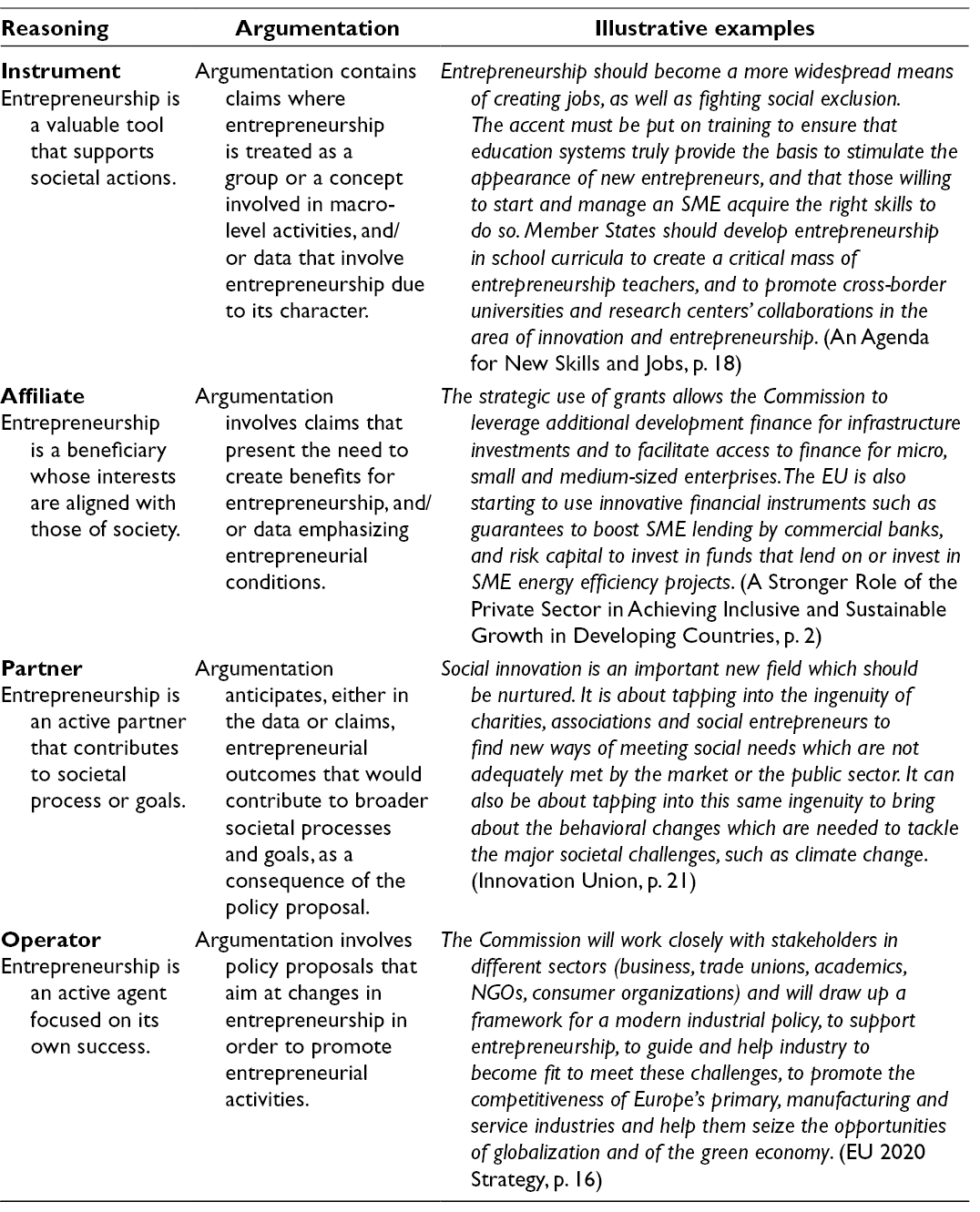
Focusing specifically on entrepreneurship, we concluded that the reasoning on its role can be formulated in the following manner: because framework conditions are adverse (data), therefore the chain of obstacles needs to be removed (claim), since this will allow entrepreneurs to get ideas to market (warrant). The reasoning thus emphasizes that for sustainable development to be attainable, it is important that enterprises are able to operate; it highlights entrepreneurial actions and expects enterprises to participate in the pursuit of sustainable development by successfully carrying out their own business activities. Notably, although in most cases, the reasoning underlying an argument is implicitly present, in this example the excerpt “getting ideas to market” explicates the warrant. After assessing the reasoning in all arguments, we named this type of argumentation “operator.” Following this form of analytical interpretation, we identified a total of four types of argumentations on entrepreneurship within the context of sustainable development, which focus on either its entrepreneurial character, conditions, actions, or outcomes, and embed it in varying forms of actor–beneficiary relationships. Specifically, we found that the warrant can rely on entrepreneurial conditions as the sole motivation of policy action. Similarly to the warrant depicting entrepreneurship as an operator, this type of warrant does not expect particular societal focus from entrepreneurship but rather portrays it as the recipient and beneficiary of policy support. In turn, warrants may build on the usefulness of the entrepreneurial character for policy initiatives, or expect enterprises to create specific outcomes and, following these lines of reasoning, highlight the role of entrepreneurship as a contributor that generates benefits for society in general.
As a result of this analytical step, we define four types of argumentations on sustainable development, all of which differ in terms of the motivations and processes of sustainable development: constructive, corrective, assertive, or protective. We further identify four types of argumentations on entrepreneurship within the context of sustainable development, all of which accentuate different aspects of entrepreneurship and expect varying contributions from it: instrument, affiliate, partner, or operator. These are described with illustrative examples in Tables 2 and 3.
Argumentations on Sustainable Development.
Argumentations on Entrepreneurship in Sustainable Development.
Step 4: Identification of meanings of sustainable entrepreneurship
After formulating the main categories of argumentations on sustainable development and entrepreneurship separately, we proceeded to assess their interplay in policy texts in order to understand how they would together convey meaning on “sustainable entrepreneurship,” and which underlying beliefs (backings) these combinations of argumentations would reflect.
To do this, we first coded each argument based on its argumentation on sustainable development and entrepreneurship, respectively, and assessed how the different combinations of argumentations clustered into larger groups that would represent distinct meanings of sustainable entrepreneurship. Specifically, we sought to depict the most dominant meanings that carried a unique reasoning on both sustainable development and entrepreneurship by explaining what is expected from entrepreneurship, and for what kind of sustainable development it is mobilized.
Based on our analysis, we distinguished that when the argumentation on sustainable development was corrective, it was typically associated with one that portrayed entrepreneurship as an affiliate or operator, which both position it as a beneficiary of the policy proposals. In connection to constructive sustainability, entrepreneurship was portrayed as a partner or instrument, which means that it was considered to be a contributor that does not solely work for its own benefit but for the good of society. In the case of a perspective where sustainable development was approached as a proactive endeavor motivated by potential future developments, entrepreneurship was dominantly associated with assertive sustainability that presents opportunities from which the enterprises as operators can benefit. As a result, we identified three central meanings assigned to sustainable entrepreneurship, which were named as: entrepreneurship as beneficiary in corrective sustainability, as contributor in constructive sustainability, and as opportunistic operator in assertive sustainability.
We then moved on to analyze the distinguishable underlying beliefs (backings) accentuated by the identified combinations of argumentations. Whereas the identification of warrants concentrated on clarifying the rather operational reasoning embedded in the argumentation, the interpretation of backings sought to pinpoint contrasts between rhetoric at a deeper, more abstract level. Hence, instead of assessing the explicitly communicated goals of the policies (e.g., “in order to promote a ‘highly competitive social market economy,’” or “the EU’s priority to become a sustainable economy”), which could be interpreted as backings, our analysis focused on the unspoken beliefs that were taken for granted in the argumentation.
To illustrate our interpretative process, we return to the example discussed in Step 3 (Figure 1), where we termed the portrayal of sustainable development as “corrective” and entrepreneurship as an “operator.” Here, we argue that the reasoning on sustainable development as a rather reactive endeavor that tackles the deficiencies of the present situation promotes a realist (rather than visionary) approach toward value creation; by emphasizing negative conditions and the disruptive process, the rhetoric suggests that change is relatively compulsory (as opposed to a voluntary pursuit of additional benefits). In the argument, the emphasis on entrepreneurial activities accentuates that entrepreneurship is considered to be an active agent (instead of a passive concept/target). At the same time, entrepreneurship is portrayed as conveying benefits for itself and, thus, believed to encompass intrinsic (rather than instrumental) value that can be appreciated independently from societal outcomes.
Findings
In this study, we examine how the EU’s policy rhetoric conveys the meaning of sustainable entrepreneurship. Our findings reveal three different meanings of sustainable entrepreneurship. Expanding upon our findings, we conclude with a framework that describes how a “rhetoric mix” of argumentations can be applied by a single political institution to convey multiple meanings of sustainable entrepreneurship.
Meanings of Sustainable Entrepreneurship in European Union Policy Discourse
We identify three dominant and distinct meanings of sustainable entrepreneurship, which we term entrepreneurship as beneficiary in corrective sustainability, as contributor in constructive sustainability, and as opportunistic operator in assertive sustainability. These portrayals of sustainable entrepreneurship result from composites of argumentations and encompass a distinct perspective toward what is expected from entrepreneurship, and for what kind of sustainable development it is mobilized. Table 4 summarizes the three meanings of sustainable entrepreneurship and provides illustrative examples.
Meanings of Sustainable Entrepreneurship in Policy Rhetoric.
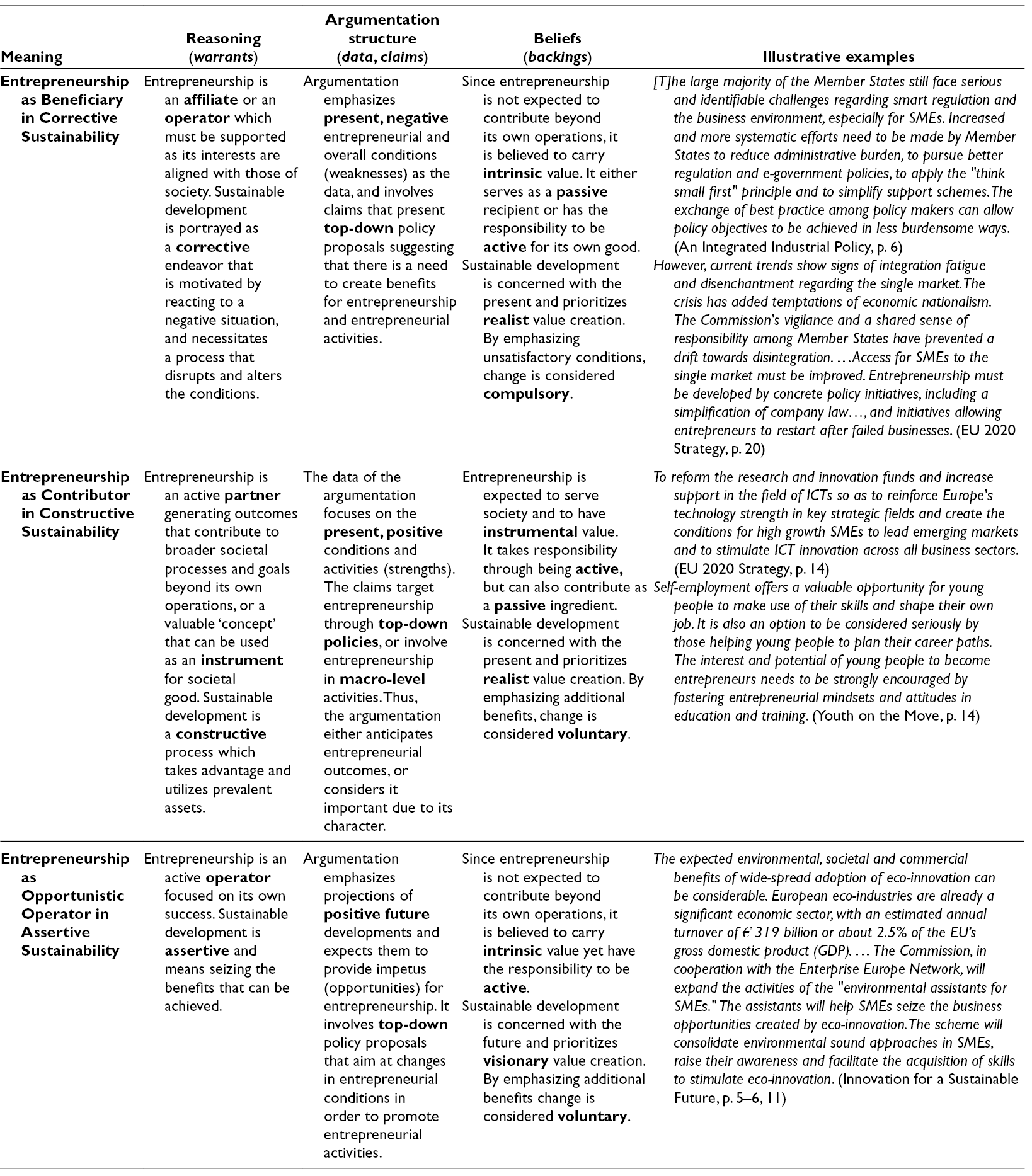
We will illustrate each of the three meanings with a short example that effectively demonstrates the argumentation structures conveying the particular meaning. These examples are drawn from various policy documents to provide a versatile overview of the policy communications on entrepreneurship and sustainable development across the intertwined goals of economic, social, and environmental sustainability. All of the excerpts that we have selected are located in the very beginning of the respective policy documents (Entrepreneurship 2020 Action Plan, Social Business Initiative, and Green Action Plan for SMEs) to introduce the readers to their main content.
Entrepreneurship as beneficiary in corrective sustainability
Since 2008 Europe has been suffering the effects of the most severe economic crisis it has seen in 50 years: for the first time in Europe there are over 25 million unemployed and in the majority of Member States small and medium-sized enterprises (SMEs) have not yet been able to bounce back to their pre-crisis levels. Before the on-going economic and financial crisis, the European economy faced structural challenges to its competitiveness and growth, and obstacles to entrepreneurship. [Data] ….To bring Europe back to growth and higher levels of employment, Europe needs more entrepreneurs. [Backing] As a follow-up to the Small Business Act review of April 2011 and of the Industrial policy communication adopted last October, the proposed Action Plan sets out a renewed vision and a number of actions to be taken at both EU and Member States’ level to support entrepreneurship in Europe. It is based on three pillars: developing entrepreneurial education and training; creating the right business environment; role models and reaching out to specific groups. [Claims] (Entrepreneurship 2020 Action Plan published in 2013, p. 3)
In the above vignette, the argumentation builds on policy information (data) about current realities, and it emphasizes the conditions that are undesirable. Specifically it is argued that, in addition to the general structural problems faced by the EU’s economy, the economic crisis still causes additional limitations to entrepreneurship. In response, the policy text argues for top-down policy proposals (claims) that target these circumstances. We maintain that the argument relies on reasoning that the creation of a more fertile entrepreneurial environment is, as such, a societal aim (warrant #1), and that sustainable development requires reacting and disrupting the present situation (warrant #2). The explicit backing communicated in the excerpt elevates economic sustainability as the ultimate goal of policymaking, in which entrepreneurship is vital.
In this type of argumentation, the rationale is that entrepreneurship should benefit from policy activities. Sustainable entrepreneurship is portrayed as an affiliate which is rather passive in nature and which would share the benefits generated by policymakers and other societal actors: it is the task of the EU and its member states to support entrepreneurship, to create the right business environment, and to provide education that enhances the skills of future entrepreneurs. In addition, we find that entrepreneurship may also be characterized as an operator expected to actively engage in business operations, or (as in the case of the above vignette) to carry on their practices and thus “act as a role model” for peers. Nevertheless, the rhetoric maintains that it is unnecessary to place demands on entrepreneurship beyond the fact of its existence or its engagement in activities that contribute to its own success. Hence, the belief (backing #1) is that entrepreneurship—regardless of whether it is passive or active—encompasses intrinsic value that is independent from further societal justification. The condition for entrepreneurship to be able to fulfill its tasks is that it receives appropriate societal support.
At the same time, the argumentation involves reasoning that connects entrepreneurship with an understanding of sustainable development as a corrective endeavor, where a society reacts to present problems and seeks to disrupt ongoing developments such as unemployment and limited economic growth. Our findings suggest that by emphasizing the existing negative situation that is less-than-ideal—even without being subjected to higher ambitions of sustainable development—the rhetoric reflects and imposes a belief (backing #2) that sustainable development constitutes a compulsory engagement which prioritizes the creation of value within current realities. This is evident in the vignette above, where it is argued that enterprises’ first priority must be to “bounce back to their pre-crisis levels.”
Entrepreneurship as a contributor in constructive sustainability
The single market needs new, inclusive growth, focused on employment for all, underpinning the growing desire of Europeans for their work, consumption, savings and investments to be more closely attuned to and aligned with ‘ethical’ and ‘social’ principles. [Backing] …The public consultation for the SMA revealed high levels of interest in the capacity of social enterprises and the social economy in general to provide innovative responses to the current economic, social and, in some cases, environmental challenges by developing sustainable, largely non-exportable jobs, social inclusion, improvement of local social services, territorial cohesion, etc. [Data] …The Commission seeks to support the development of social enterprises and to learn from their experiences in support of the whole of the economy. In this Communication, the Commission is pursuing two aims: To introduce a short-term action plan to support the development of social enterprises, key stakeholders in the social economy and social innovation. To prompt a debate on the avenues to be explored in the medium/long term. [Claims] (Social Business Initiative published in 2011, pp. 2–5)
In this vignette, the argumentation predominantly describes policy information (data) to highlight the positive developments which create demand for (pro-social) businesses as well as the particular capabilities of those enterprises, such as their social innovativeness, which could serve as advantageous strengths. Following this, the policy proposals (claims) describe top-down activities that target entrepreneurship and seek to provide it with fertile operational conditions, and macro-level activities that involve entrepreneurship. Importantly, these are proposed in the interest of enterprises consequently producing valuable societal outcomes, instead of solely being able to carry out successful entrepreneurial activities (warrant #1), and to build on the assets at hand in order to pursue conducive sustainable development (warrant #2). These activities are backed by the importance of social sustainability, and the achievement of inclusivity and alignment with ethical principles.
Here, the main reasoning is that it is important for policymakers to support (pro-social) enterprises because, by doing so, the enterprises create outcomes which are beneficial to society. By creating non-exportable jobs and enhancing local social services, enterprises can significantly help to solve social and environmental challenges. It follows that here sustainable entrepreneurship represents a partner that actively contributes to the well-being of society in general by providing innovative responses. We find that this representation of entrepreneurship can be complemented with a portrayal of it as a passive player, an instrument, that can be used by policymakers in their own, separate activities, where they for instance learn from social enterprises. In both cases, the rhetoric conveys a belief of sustainable entrepreneurship as an active/passive concept that bears instrumental value (backing #1) for sustainable development, either due to the concrete results it produces, or due to the inherent importance of its character. Here, the important condition that must be met is that sustainable entrepreneurs, for instance, display the “high levels of social and environmental responsibility” by which social enterprises are characterized in the policy documents.
In this kind of argumentation, sustainable development is portrayed as a constructive endeavor motivated by positive assets and inherent potential readily exploitable by society. This type of rhetoric views sustainable development as a realistic but largely voluntary endeavor (backing #2) pursued in order to generate additional positive results, such as social and territorial cohesion—it is not an endeavor by which to “reach pre-crisis levels,” as was the case in the first meaning of sustainable entrepreneurship discussed above. Such a focus on value creation arises from an interest in how enterprises can currently contribute, instead of focusing on their expected behaviors or uncertain future prospects.
Entrepreneurship as opportunistic operator in assertive sustainability
It is estimated that resource efficiency improvements all along the value chains could reduce material inputs needs by 17%–24% by 2030. Moreover, in the EU, currently, 60% of total waste is not recycled, composted or reused, which indicates an enormous leakage of valuable resources and significant business opportunities for small and medium-sized enterprises (SMEs) that can apply and sell green products, services and solutions. Business opportunities can also be created from integrating more circular business models and green technologies into existing and future SMEs across all sectors, including services. [Data] The Europe 2020 Strategy outlines the EU’s priority to become a sustainable economy and set ambitious objectives for climate action and energy efficiency. [Backing] The Small Business Act (SBA) highlighted that the EU and Member States should enable SMEs to turn environmental challenges into opportunities. The Green Action Plan (GAP) gives a clear direction and framework for how the EU, in partnership with Member States and regions, intends to help SMEs exploit the business opportunities that the transition to a green economy offers. This initiative concretely presents a series of new or revised SME-oriented actions proposed at European level. The GAP aims to (1) improve resource efficiency of European SMEs, (2) support green entrepreneurship, (3) exploit the opportunities of greener value chains, and (4) facilitate market access for green SMEs. [Claims] (Green Action Plan for SMEs published in 2014, pp. 1–2)
In the third meaning of sustainable entrepreneurship that we identify, the argumentation focuses on the part of policy information (data) that can generate positive future developments for enterprises. As argued in the vignette above, “enormous leakage of valuable resources,” “more circular business models and green technologies,” and “transition to a green economy” all offer business opportunities that can be pursued in the future. Based on this information, the policy proposals (claims) describe macro-level activities which either involve entrepreneurship or which target it—significant for the reason that this is expected to lead to entrepreneurial activity which is beneficial to the enterprises themselves (warrant #1) and to contribute to sustainable development as a proactive process that seizes future potential (warrant #2). The argumentation relies on the backing that the policymaking is important for the achievement of climate and energy-efficiency goals.
In this type of argumentation, sustainable entrepreneurship becomes an operator whose interests collide with those of wider society in such a way that it is sufficient for entrepreneurship to focus on its own business and aim at creating benefits for itself. Entrepreneurship is allocated the role of taking advantage of positive opportunities which arise in connection to the threats and challenges of sustainability. As a result, enterprises can become more efficient, more active in the markets and, for instance, “sell green products, services, and solutions.” As the importance and contribution of entrepreneurship stems from its anticipated activities, and because there are no further expectations on their outcomes, the rhetoric imposes an understanding that entrepreneurship is an active agent that carries intrinsic value (backing #1). However, here the prerequisite for the importance of sustainable entrepreneurship is that entrepreneurs enhance their knowledge of green technologies and services, and adapt their behavior accordingly.
At the same time, sustainable development is characterized as an assertive engagement that takes advantage of opportunities arising from projected developments in society and the wider world. We argue that the optimism and positive undertone inherent in the argumentation highlight a belief that sustainable development is a rather visionary and voluntary process (backing #2), that is, necessary not for combating “below-par” performance but for striving for further improvements. The proactive argumentation which emphasizes the anticipated developments, such as the reduction of material inputs needs, promotes a future-oriented approach toward value creation, thereby indicating that policy initiatives and entrepreneurship are less urgently needed.
“Rhetoric Mix” of Entrepreneurship Policy Argumentations
Building on our findings, we elevate the notion of the “rhetoric mix” of argumentations as a means of explaining how policy rhetoric conveys the meaning of sustainable entrepreneurship. To depict this we highlight two central rhetoric devices: First, we argue that the rhetoric mix encompasses an interplay of argumentations on entrepreneurship and sustainable development, and that by doing this, it defines varying meanings assigned to sustainable entrepreneurship in policy communications. Second, we propose the rhetoric mix to carry particular values and beliefs that serve to frame the policy discourse on sustainable entrepreneurship. Figure 2 presents a generative framework which elucidates the core foundations of sustainable entrepreneurship in policy argumentation.
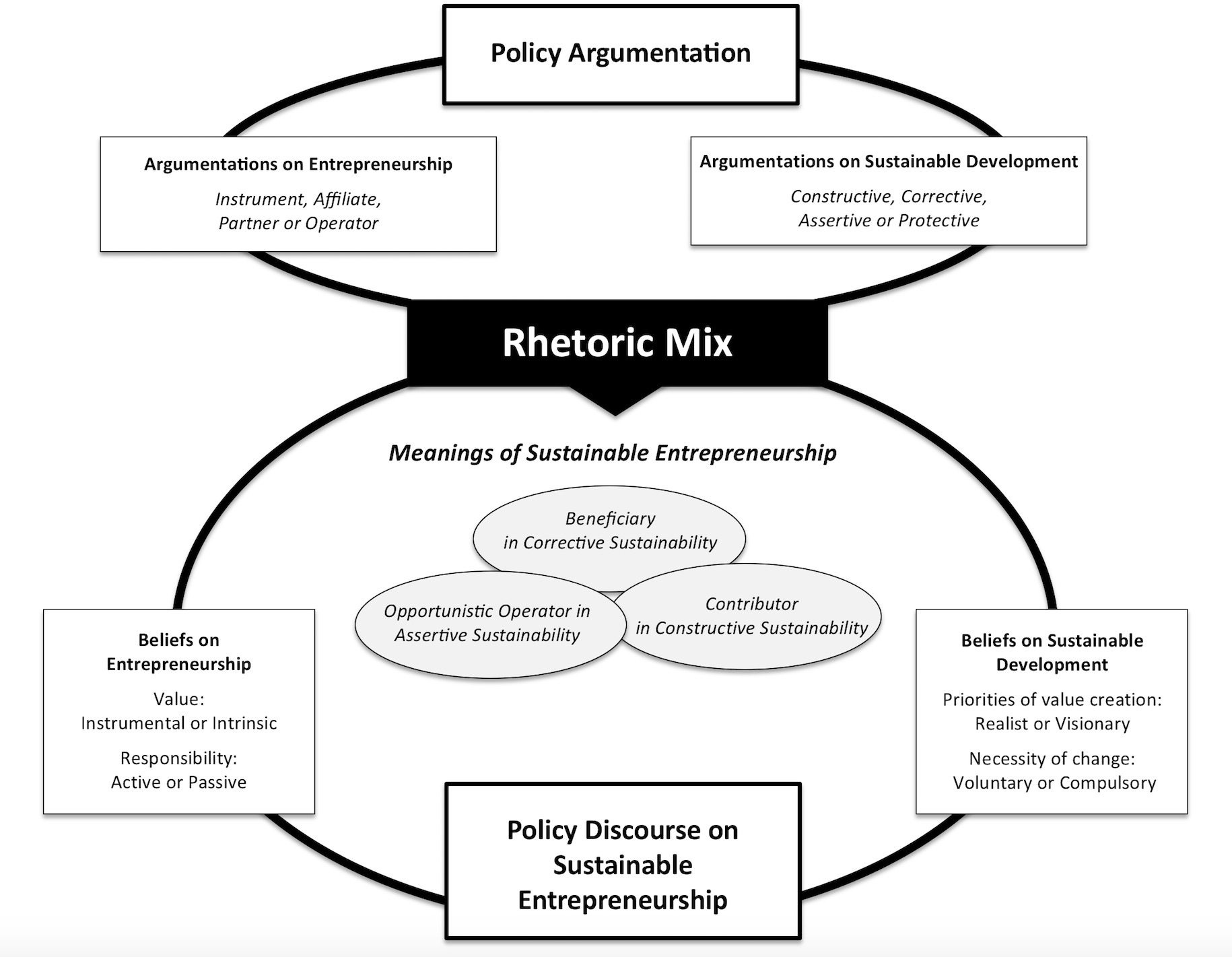
"Rhetoric mix”: Argumentative policy framing of the sustainable entrepreneurship discourse.
Rhetoric mix as argumentations conveying multiple meanings of sustainable entrepreneurship
We suggest that the rhetoric mix explains how different forms of argumentations are brought together to assign meaning to policy goals and means. Here, we emphasize that the particular policy goals and means gain meaning not solely in the explicit contents of argumentation, but that their meanings emerge from what is not said—or said only between the lines (Green Jr & Li, 2011; Toulmin, 1958/2003). Indeed, the policy proposals explicitly emphasize processes and actor-roles through which policies can contribute to the desired goals, and policy texts offer information that explicates which entities are considered relevant and how they serve as obstacles or facilitators of policymaking. However, by looking at the reasoning underlying the presentation of these particular realities and concomitant recommended actions, we open a window to understanding how deeper meanings are “taken-for-granted” even as they are imposed. For instance, scrutiny of their argumentations reveals ideals which are not stated as explicit aims, and the policy proposals gain a more radical, or more modest, undertone depending on the manner of their justification.
We maintain that the rhetoric conveys meaning of sustainable entrepreneurship by arguing simultaneously how entrepreneurship is perceived, as well as how sustainable development, as its immediate context, is depicted. In particular, the rhetoric highlights the importance of varying aspects of entrepreneurship (its characteristics, conditions, activities, or outcomes), embeds entrepreneurship within particular actor–beneficiary relationships in broader society (Table 2), and contextualizes it with certain motivations and processes of sustainable development (Table 3). Turning to the findings of this study, the first meaning we identify, entrepreneurship as beneficiary in corrective sustainability, stems from combining the argumentations of entrepreneurship as an affiliate or operator with the reasoning of sustainable development as a disruptive endeavor. The second meaning, entrepreneurship as contributor in constructive sustainability, brings together the notion of entrepreneurship as a partner or instrument in conducive developments. The third meaning, entrepreneurship as opportunistic operator in assertive sustainability, merges argumentations of entrepreneurship as an operator with a visionary and optimistic perspective toward sustainable development. As a consequence of this, the argumentation used in policy has grave implications for understanding the complexity and multiplicity of the meanings of sustainable entrepreneurship. Although entrepreneurship may be found to be valuable for sustainable development throughout the policy communications, the depiction of its particular role varies across the forms of argumentations employed. We find that the first meaning demands little from sustainable entrepreneurship, in that it portrays entrepreneurship as the beneficiary of policy (or entrepreneurial) action, and also the third meaning leaves it up to the enterprises themselves to decide on which tasks they find valuable enough to adopt. Here, these two meanings approach entrepreneurship as an element that is as such intrinsically important without subjecting it to specific expectations on the produced outcomes. The second meaning, in turn, emphasizes entrepreneurship’s central role as a provider of social benefits, and imposes beliefs on entrepreneurship’s instrumental value for society. The reasoning in this argument builds on the valuable characteristics of entrepreneurship, and is dependent on enterprises truly possessing these particular qualities. Hence, the focus tends to be on “social” enterprises—defined as the ones that fulfill these requirements. Furthermore, in cases where the first type of argumentation is applied, sustainable development is portrayed as a compulsory and crucial project requiring immediate reaction. It is argued that the pursuit of these goals necessitates reacting to and disrupting the current state of affairs, thereby indicating that the present situation is already dire. The latter two depict a more voluntary undertone in terms of the necessity for change: the second meaning conveys an understanding of sustainable development as a reactive process that builds on existing assets, while the third additionally assumes sustainable development to be characterized by future opportunities that can be taken advantage of by the enterprises and, thus, contains a more speculative perspective as well as “pull factors” in the interest of value creation. Consequently, we argue that although the three meanings of sustainable entrepreneurship do not necessarily contradict each other, they nevertheless involve differences in terms of approach, and we argue this to have an effect on the framing of sustainable entrepreneurship policy discourse.
Rhetoric mix as framing of policy discourse on sustainable entrepreneurship
We argue that the rhetoric mix generated in policy argumentation not only conveys individual meanings of sustainable entrepreneurship, but that the mix also carries taken-for-granted assumptions and beliefs that are imposed upon the policy discourse on sustainable entrepreneurship. We suggest that the policy argumentations involved in the rhetoric mix encompass underlying beliefs on why and how policy actions should be pursued, and how it perceives entrepreneurship as an actor and activity. We propose that these beliefs surface in policy rhetoric. They lead to placing an emphasis on certain social realities as policy-relevant information, and they result in suggesting specific policy proposals. At the same time, the interplay of these beliefs and the tensions pertaining to the rhetoric mix influence which particular aspect of entrepreneurship and sustainable development become implicit conventions in policy discourse. With this approach, our work is in line with the broader body of framing research, which argues for the recursive interconnectedness of language and cognitive frames guiding our actions; language makes use of the existing and dominant assumptions whilst it can be used simultaneously to strategically influence the perceptions and activities of others by choosing to evoke specific understandings of the realities which pertain in the wider world (Cornelissen & Werner, 2014).
Our findings unearth two important features that explicate the viewpoint on sustainable development in the argumentation, namely the beliefs on the priorities of value creation and the necessity of change. Characterizing the different priorities in light of the definition of sustainable development proffered by the United Nations (WCED, 1987), we conclude that, once a realist approach toward value creation is applied, sustainable development is perceived as a rather reactive endeavor primarily concerned with “meeting the needs of the present,” as opposed to the more visionary approach which emphasizes sustainable development as a proactive and future-oriented project, the priorities of which lie in “not compromising the needs of the future.” In addition, the characterization of policy conditions as being positive and fruitful carries a belief of sustainable development as a voluntary engagement, where the necessity for change can be debated. Deviating from this view, the rhetoric can portray sustainable development as a project which necessitates disruption of ongoing or future developments, and suggest that change is vital and compulsory.
Similarly, we determine that the variation in policy argumentations heightens varying beliefs on the value and responsibility of entrepreneurship. Our findings draw attention to the appreciation of entrepreneurship as transporting instrumental value that is dependent on the utility of entrepreneurship in contributing to societal goals. In turn, it may be believed to encompass intrinsic value that can be appreciated independently from the outcomes of its activities, presumably since entrepreneurship and society as a whole have interests in common. In this case, the usefulness of entrepreneurship may also be assumed at an even deeper level, hence explaining the absence of hints to this state of affairs in the argumentation. Furthermore, the argumentations wield great influence over policy discourse by proposing either the idea that entrepreneurship is a passive participant assumed to automatically become involved; or, alternatively, emphasizing that entrepreneurial operations and agents actively decide on their own strategic direction.
Identification of these beliefs on sustainable development and entrepreneurship which surface in policy argumentations allows us to further evaluate their tensions and interplay. The specific rhetoric mix, revealed in our findings, accentuates the intrinsic value and centrality of entrepreneurship; it must be urgently supported and it can potentially support its own success in the future. In addition, entrepreneurship is “allowed to” contribute and considered capable of using its inherent potential to generate positive societal outcomes. Sustainable development is urgently needed when it aims at improving the entrepreneurial conditions and activities but, significantly, the policy rhetoric depicts it as a rather voluntary endeavor that enterprises are free to commence either presently, or in the future. At the same time, the mix of argumentations does not assume that entrepreneurship necessarily adopts responsibilities as an active agent, but instead elevates its value as a passive and useful concept that can be integrated in policymakers’ projects. Importantly, by promoting these specific perspectives the rhetoric mix marginalizes alternative viewpoints. For instance, our analysis did not reveal entrepreneurship to be depicted as an actor that would potentially produce negative outcomes, nor was entrepreneurship considered instrumental in mitigating the future threats of sustainability. Similarly, although climate change and environmental threats are generally considered to pose a grave danger to society, our analysis shows that, from an entrepreneurial point of view, the EU characterizes these developments as sources of business opportunities. This kind of rhetoric, we argue, unavoidably colors the perception of sustainable development in policy discourse.
Discussion and Further Research
The central contribution offered in this article is that we introduce the notion of “rhetoric mix,” defined as the application of multiple types of argumentations in meaning-making. We argue that the rhetoric mix serves as an important means to explain how a multitude of beliefs and value priorities concerning entrepreneurship, as well as its context, perpetuate the meaning(s) assigned to entrepreneurship by an individual political instance. Concomitantly, the argumentative framework developed in this article sheds light on how a rhetoric mix conveys meanings of sustainable entrepreneurship through the interplay of policy argumentations, and how the taken-for-granted assumptions embedded in the rhetoric mix further frame entrepreneurship policy discourse. By focusing on the rhetoric of an individual policymaking body—the EU—we have provided a novel empirical account of three rhetorically constructed meanings on sustainable entrepreneurship: entrepreneurship as beneficiary in corrective sustainability, entrepreneurship as a contributor in constructive sustainability, and entrepreneurship as opportunistic operator in assertive sustainability. These three meanings offer a fresh base from which to understand policy portrayals of sustainable entrepreneurship. Based on these insights, we suggest several implications for research on entrepreneurship policy discourse and sustainable entrepreneurship.
Implications for Researching Entrepreneurship Policy Discourse
The emergence of sustainable development onto the political agenda has connected entrepreneurship with notions of value creation beyond the economy and added nuances to its assigned societal role. Recent research examining how policy discourses portray the role of entrepreneurship for society, in domains which go beyond merely its service to the economy, has largely fallen into two groups: one that focuses on the content of the communications and applied discursive structures (e.g., Mason, 2012; Muñoz & Jara, 2017; Perren & Dannreuther, 2013; Perren & Sapsed, 2013), and one that seeks to understand “how the words use us” (Green Jr & Li, 2011) by adopting a discourse-analytical approach (e.g., Ahl & Nelson, 2015; Nicholls & Teasdale, 2017; Perren & Jennings, 2005). To add to these approaches, we emphasize the necessity of bridging explanations of argumentation structures with the broader beliefs reflected in, and shaped by, the rhetoric itself to explain how policy discourse conveys meaning of entrepreneurship.
The notion of rhetoric mix offers a novel, structural perspective toward policy rhetoric. In particular, we advance knowledge on the interplay of the components of argumentation and develop an understanding of the structures of influential policy texts and their role in assigning meaning. Here, we emphasize that the making of meaning(s) depends on the combinations of argumentations defining what the role of entrepreneurship is, as well as for what types of motivations and processes it becomes elevated. We illustrate how the rhetoric model of Stephan Toulmin, 1958/2003 can be applied to uncover the complexity of reasoning embedded in the argumentation and show how the conveyed meanings depend on the explicit structures of an argument (data and claim) as well as the warrants and backings which typically are less readily observable. Hence, we acknowledge that policy rhetoric includes both the deliberate use of persuasive language as well as the injection of meaning-making at a more subconscious level (Green Jr & Li, 2011). Policy rhetoric not only applies a set of conventions or agreed sets of rules but, instead, it also establishes new warrants that are suggested to serve as a “logical proof” of the relevance of particular policy information and the validity of proposed policy actions (Toulmin, 1958/2003).
The notion of rhetoric mix also draws attention to the ways in which the policy communications of an individual policymaking body may include nuanced variation in its fundamental beliefs and generate multiple meanings of entrepreneurship. By introducing this notion we add to the ideas of Steyaert and Katz (2004), who propose that debates on entrepreneurship across a multitude of social and economic contexts result in a “discursive mix.” We suggest that the rhetoric mix shows how the institutional complexity becomes reflected within a particular policy context. We argue that the assessment of the dominant assumptions prevalent in the rhetoric mix reveals the norms and values that are taken-for-granted in the political context (Van Dijk, 1997). The specific nature of the rhetoric mix uncovers the core reasoning used by individual policymakers, and in any specific policy discussion—whilst also pinpointing which possible meanings are not represented in policy communications. The further analysis of the nature, coherence and changes of the rhetoric mix opens up avenues for exploring how the application of a multitude of argumentations reflects on the policy institution (Harmon, 2018) and relates to broader institutional changes (Harmon et al., 2015).
Finally, we elevate the viewpoint that discursive political practices “need description and analysis in their own right” (Van Dijk, 1997, p. 41). In addition to potentially leading to concrete policy activities that influence the realities of entrepreneurs, entrepreneurship policy discourse also influences public cognition, general opinion, and the acceptance of a political agenda—with consequences that may well extend beyond the scope of individual policy initiatives. The framework of “rhetoric mix” that we have developed explains the exact “processes of framing as meaning construction” (Cornelissen & Werner, 2014, p. 206). We argue that the structures of argumentation play a central role in explaining how rhetoric reflects and imposes particular beliefs that produce “knowledge” (Alvesson, 1993) on entrepreneurship and sustainable development. By bringing to light the implicit elements of argumentation, we become able to unpack the different perspectives toward entrepreneurship and sustainable development and move beyond assessing the contents of policy programmes so as to engage in a more profound discussion of the rationale underlying these initiatives (Garud & Gehman, 2012; Van Eemeren, 1995).
Implications for Researching Sustainable Entrepreneurship
The current study contributes to the literature on sustainable entrepreneurship (Hall et al., 2010; Moroz, Branzei, Parker, & Gamble, 2018; Muñoz & Cohen, 2018a) by complementing the predominant investigative focus on the motivations and perceptions of sustainable entrepreneurs (Fuller & Tian, 2006; Muñoz & Cohen, 2018b; Poldner et al., 2017) with a conceptualization of “sustainable entrepreneurship” as a societal and political phenomenon (Berglund & Johansson, 2007; Dey & Steyaert, 2010; Nicholls, 2010; Nicholls & Teasdale, 2017). Importantly, we offer “rhetoric mix” as a framework through which to understand the interplay of tensions surrounding entrepreneurship in sustainable development in the context of policy argumentation. Prior studies have often emphasized how sustainable entrepreneurs face the challenges of balancing business goals and ethical aspirations in order to gain legitimacy in the eyes of their stakeholders (Kibler, Salmivaara, Stenholm, & Terjesen, 2018; Muñoz & Cohen, 2018b; Ruebottom, 2013). We expand this view by highlighting that the portrayals of sustainable entrepreneurship are influenced by perspectives on sustainable development as either compulsory or voluntary, and from choosing to prioritize a realist or a visionary approach toward value creation.
To continue on this path, we bridge sustainable entrepreneurship research with prior works that have argued that policy discourses subject the depictions of entrepreneurship to states’ interests and ideological beliefs (Perren & Jennings, 2005; Perren & Dannreuther, 2013). Here, we move away from discussing how sustainable enterprises presently choose to tackle various sustainability goals (Markman et al., 2016) and instead accentuate the normative roles assigned to these actors through policy rhetoric (Ahl & Nelson, 2015; Niska & Vesala, 2013). We show that entrepreneurship can indeed be expected to actively take advantage of available opportunities arising from the need for sustainable development. Nevertheless, enterprises can also be assumed to carry instrumental value in servicing the sustainability goals of society—entrepreneurship may even be considered to be intrinsically important and a rather passive target of sustainability policies. In particular, we identify that in addition to the fundamental yet under-explored question of what it is that should be sustained and developed through sustainable entrepreneurship (Shepherd & Patzelt, 2011), varying understandings of why and how enterprises should pursue sustainable development in the eyes of policymakers suffuse societal meanings of sustainable entrepreneurship.
Significantly, the policy perspective on sustainable entrepreneurship we have developed contributes to the research on sustainable development discourses which have shown how policy rhetoric paints a picture of the goals and means of sustainable development (Lefsrud & Meyer, 2012; Paschen & Ison, 2014; Quental, Lourenço, & da Silva, 2011). Often this research focuses on understanding policy reactions to sustainability challenges and views the positioning of particular actors as a mere consequence or reflection of a broader sustainability paradigm (Davidson, 2014; Hopwood, Mellor, & O'Brien, 2005; Hugé et al., 2013). Our study brings to light how sustainable development, although being a widely debated theme in its own right, also gains meaning through the portrayals of a particular actor or practice, such as entrepreneurship. This notion invites researchers to pay attention to the mobilization of an “entrepreneurship discourse” that supports ideological or political aspirations (Dannreuther, 2007; Grey, 2004; Kenny & Scriver, 2012; Nicholls & Teasdale, 2017), and to critically evaluate how the nuanced and contradicting tensions of entrepreneurship policy discourse may color the perception of sustainable development as a whole.
Directions for Future Rhetoric Research at the Intersection of Entrepreneurship, Institutions, and Sustainability
It goes without saying that our study has several limitations. In order to encourage future studies to build on and further develop our framework, we identify a number of avenues that can inform research at the intersection of entrepreneurship, institutions, and sustainability (e.g., Gehman et al., 2019; Kibler et al., 2018; Kimmitt & Muñoz, 2018; Moroz et al., 2018; Muñoz & Cohen, 2018a; Nicholls & Teasdale, 2017; York et al., 2017). In particular, we invite future rhetoric research to deepen our understanding of the variety of discursive means applied across different institutional levels of policymaking, to address the involvement of different private and public actors, and to develop a richer account of the conceptualization of entrepreneurship in sustainable development.
Given that the study of policy rhetoric in the context of entrepreneurship remains a nascent line of research, we focused on gaining initial insight into the argumentation structures that explain how policy rhetoric conveys meanings and frames policy discourse. We therefore decided to use data from a single policy institution (the EU) and focused on policy documents published during a period that, although extending over the course of 8 years, nevertheless follows the execution of a specific 10-year strategy. To expand on this, future studies could address the making of meanings of entrepreneurship by assessing changes in rhetoric over time (Harmon, 2018), as well as analyze the evolution of values and valuation of enterprises in the context of sustainable development (Gehman et al., 2019; Parker et al., 2019). How did the present beliefs become imprinted in policy discourse by earlier rhetoric? When and how do certain claims, which require justification, become data or backings, which can be used in support of new claims?
Further work would also be well-positioned to take a closer look at the prevalence of particular meanings at different institutional levels of policymaking (local, national, and transnational), and to analyze how specific beliefs on entrepreneurship and its context find their way into policy rhetoric, and how they potentially vanish. This would serve to explain how framing processes evolve across macro-, meso-, and micro-levels of policy environments (Cornelissen & Werner, 2014; Reinecke & Ansari, 2016; York et al., 2017), and how, in diachronic perspective, “hybridity” in the argumentation of policy rhetoric diverges or becomes more condensed. Here, further studies could also expand the investigative focus beyond textual materials and involve data from oral communications and multimedia contents which evoke more affective, esthetic and stylistic elements than policy documents (Schroeder, 1997; Willard, 1976). With this in mind, recent studies have analyzed the rhetorical means through which a governmental body evokes emotions and affective associations to gain support for the political process in parliaments and amongst the general public (Moisander, Hirsto, & Fahy, 2016), or the visual devices that entrepreneurs apply to construct the notion of sustainable entrepreneurship (Poldner, Shrivastava, & Branzei, 2017). These types of analytical extensions would be particularly useful in order to contrast policy discourse with other societal discourses, such as those disseminated by the media. Going further down this line, future studies could reflect the “esthetic turn” of rhetoric—allegedly initiated by Friedrich Nietzsche—which suggests that esthetics should not only be viewed as a means for persuading the audience but as a foundation of rhetoric that, in fact, assigns power and appeal to particular communicative devices (Greene, 1998).
Another line of research could develop the proposed argumentative approach beyond the analysis of rhetorical practices and focus on illuminating dynamics between various actors. As the applications of Toulmin’s model best lend themselves to studies which evaluate the justification and rationale of argumentation (Schroeder, 1997), our study analyzed neither the collective effort of creating these policy documents nor the readings and reception of the policy texts by their audiences. It would be highly desirable for future studies to expand on the single-actor focus adopted in our study and scrutinize the power relations, the specific qualities of speaker and audience, as well as the accustomed linguistic practices that all influence the dynamics of argumentation (Willard, 1976). Here, for instance, speech communication theory and works on “informal logic” have advanced argumentation theory since the publication of Toulmin’s work, and applied analytical frameworks that more precisely assess the particular linguistic and situational context and what is accepted as “sufficient” or “relevant” (Van Eemeren, 1995). Focusing on speech, compelling research avenues involve studying the reasons leading to the “hybridity” of backings in policy rhetoric, and the impact thereof upon policymakers (Harmon, 2018). Does the hybridity reflect the presence of competing voices within political governance, or is it a deliberate choice that aims at “inspiring local and situated responses without requiring consensus on either means or ends” (Ferraro et al., 2015, p. 380)? How do the committees of the EU, its member states, and regional administrations “translate” the EU’s policy rhetoric into local environments? And, ultimately, how does the type of rhetoric impact upon the maintenance or change of institutions (Harmon et al., 2015), the legitimacy of entrepreneurial actors amongst key constituents across regions and national systems (Kibler, Kautonen, & Fink, 2014; 2018), or the efforts of private businesses in tackling grand social and ecological challenges (Wright & Nyberg, 2017)?
Our findings initiate further discussion on the different ways of conceptualizing the ways in which entrepreneurship contributes to sustainable development. In particular, we urge further research that applies the notion of rhetoric mix to engage in assessing the multitude of beliefs (backings) on entrepreneurship as well as its immediate context. We argue that this analytical framework unlocks promising avenues for analyzing the uniformity or fragmentation of the discourse on sustainable entrepreneurship across central policy goals and within different policy documents. For example, we note that the EU often concentrates on a single dimension of sustainable development (economic, social, or environmental) in any particular policy document. However, this may not as such reflect fragmented discourse on entrepreneurship. In order to assess potential clashes in beliefs, we should delve deeper than a mere discussion of the organization of policy documents, and assess the variation in argumentation structures through which entrepreneurship gains meaning. Following a similar logic, future studies could illuminate the ideological differences in the meaning of social and sustainable entrepreneurship (Kimmitt & Muñoz, 2018) for further institutional actors who are important in debates on sustainable entrepreneurship (e.g., the UN, the OECD, national governments). These studies could inform us of the existence of beliefs other than those found in our study, which for their part shape the way in which discourse on sustainable entrepreneurship is framed.
Conclusion
This study has developed understandings of the “rhetoric mix” of argumentations used in policy discourse on the role of private enterprises in helping to solve pressing economic, social, and environmental challenges. To achieve this, we used Toulmin’s rhetoric model to explain how the EU’s policy rhetoric articulates the meaning of entrepreneurship for sustainable development. Building on our key findings, we developed a novel framework of “rhetoric mix” that explains how the interplay of argumentation structures conveys multiple meanings of entrepreneurship and sustainable development, and suggests how the assumptions prevalent in the rhetoric mix frame the notion of sustainable entrepreneurship in policy discourse. It follows that policy rhetoric on sustainable entrepreneurship carries deep discursive implications that impose beliefs on the priorities (the why) and necessities (the how) of sustainable development, as well as the value and responsibilities of entrepreneurship. In conclusion, we suggest that by revealing the beliefs and reasoning behind policy argumentation, we become better equipped to engage in critical discussions about the appropriate solutions for the pressing ecological, and social challenges of our times.
Footnotes
Acknowledgments
We are thankful for the immensely valuable comments offered by the editor Wouter Stam and the two anonymous reviewers during the review process. We also thank Alex Nicholls, Fergus Lyon and Steven Parham for their helpful suggestions.
Declaration of Conflicting Interests
The author(s) declared no potential conflicts of interest with respect to the research, authorship, and/or publication of this article.
Funding
The author(s) disclosed receipt of the following financial support for the research, authorship, and/or publication of this article: We gratefully acknowledge the financial support received from the Academy of Finland.

Notes
Author Biographies