




Abstract
A 9-mo-old, male domestic shorthair cat was presented for castration because of mounting behavior observed by the owner. On physical examination, the cat was bilaterally cryptorchid, but had penile spines. Abdominal exploration through a midline laparotomy revealed 2 pairs of masses. All 4 masses had gross features of testes, and ranged from 7 × 5 × 5 mm to 12 × 6 × 7 mm, with associated epididymal tissue. Histologically, each mass contained seminiferous tubules consistent with testicular tissue, and epididymal tubules, confirming a diagnosis of polyorchidism; deferent ducts were not found. There was no evidence of neoplastic, infectious, or inflammatory disease. Mounting behavior ceased 4 wk post-surgery. Histologic confirmation of more than 2 testes is needed to establish a diagnosis of polyorchidism, a rare congenital anomaly that has been reported infrequently in the veterinary literature; reports have been of animals with triorchidism, with the exception of 1 cat with 4 intraabdominal testes. Our report emphasizes that, although rare, polyorchidism should be considered in cryptorchid cats, or whenever penile spines are present in a previously castrated cat. Our case also highlights the value of checking for penile spines in a bilaterally cryptorchid cat if abdominal ultrasound is not an option to aid in surgical planning.
The presence of more than 2 testes in any species is a rare finding. Few reports of polyorchidism appear in the literature, and few have histologic evidence to support the diagnosis. In recent years, ultrasonography has helped to aid surgical planning by locating intraabdominal testes prior to exploratory laparotomy.7,12,13 Here, we report a rare case of a cat with bilateral cryptorchidism and polyorchidism, with 4 intraabdominal testes.
A 4.14 kg, 9-mo-old, intact male domestic shorthair cat was presented for castration. Two wk prior to presentation, the cat had begun to exhibit mounting behavior with 2 female cats in the household. There was no history to suggest prior castration of the subject cat. On physical examination, the cat was bilaterally cryptorchid with no palpable testes in the scrotum or groin. The owner declined abdominal ultrasound examination to aid in surgical planning. However, penile spines were obvious on examination.
A midline laparotomy revealed 4 intraabdominal masses: 2 on the left side near the associated kidney and 2 near the right inguinal ring (Fig. 1). These masses had the macroscopic appearance of testes. All were pink, ovoid, and firm, with associated epididymal tissue. The masses measured from 7 × 5 × 5 mm to 12 × 6 × 7 mm. The masses on the left side were associated with spermatic cords.
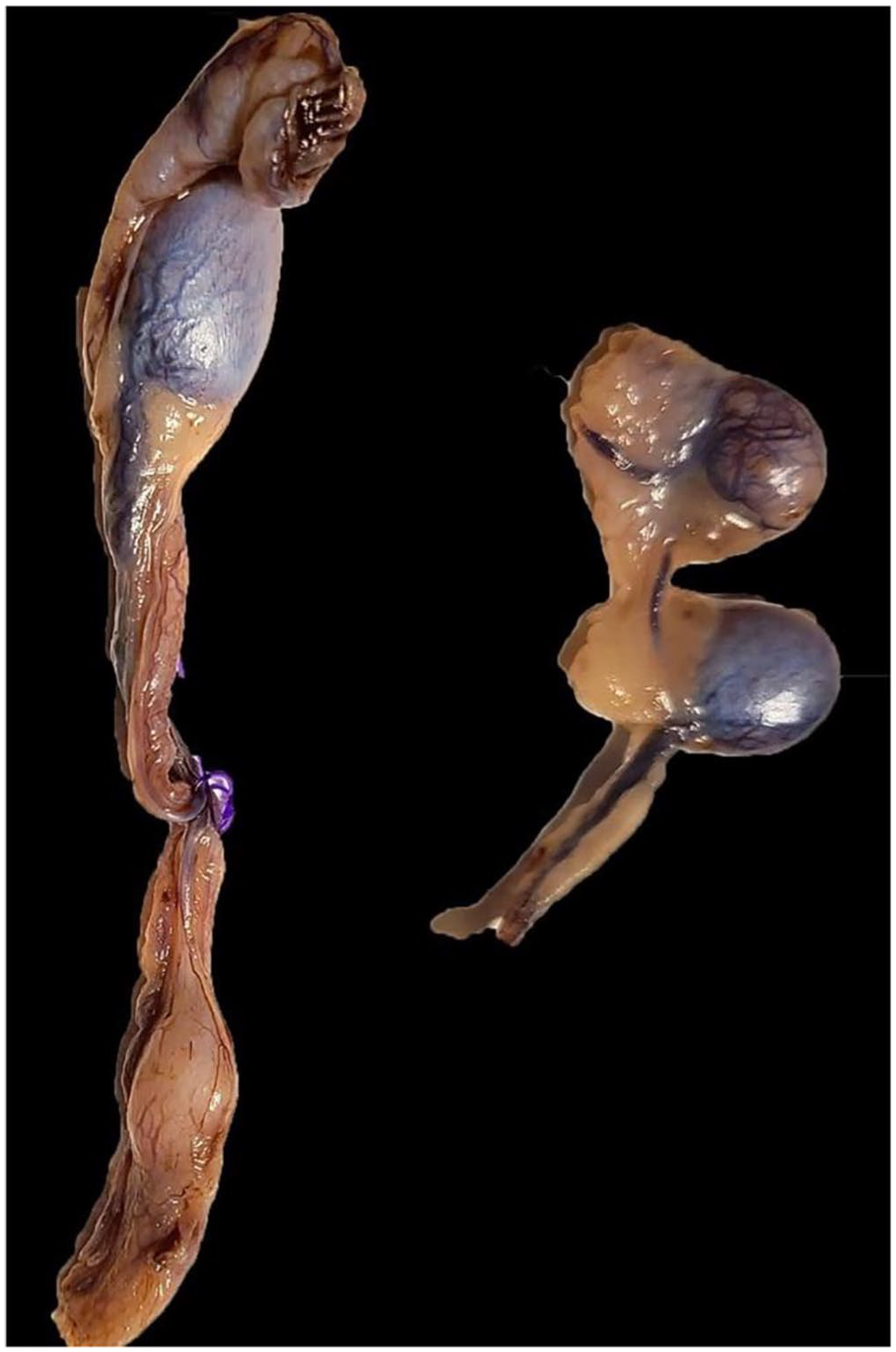
The 4 intra-abdominal testes after surgical removal from a 9-mo-old, male domestic shorthair cat; left side testes on the right of the image, right side testes on the left.
All 4 masses contained seminiferous and epididymal tubules on histologic examination (Figs. 2, 3), confirming a diagnosis of polyorchidism; deferent ducts (ductus deferentes, vas deferentia) were not found. Active spermatogenesis was absent in the 4 testes and no identifiable spermatozoa were observed in the epididymides. There was no evidence of neoplastic, infectious, or inflammatory disease.
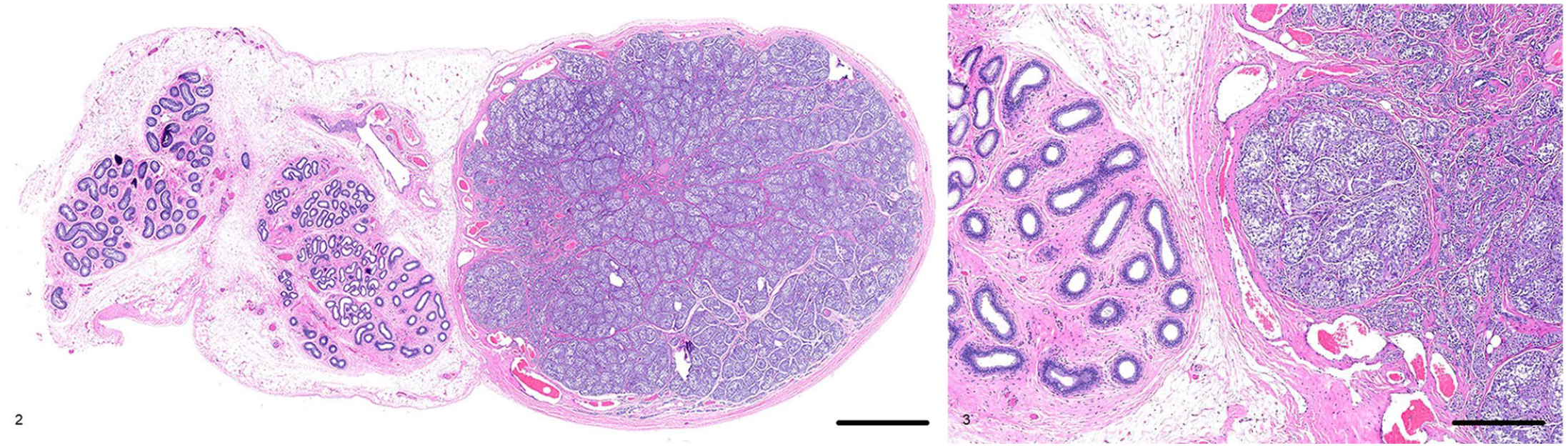
Microscopic findings in one of the intraabdominal testes removed from a 9-mo-old, male domestic shorthair cat.
A conversation with the owner 4 wk post-operation revealed that the mounting behavior had ceased. A physical examination 6 wk post-operation revealed the absence of penile spines. Penile spines are testosterone dependent and will atrophy by 6 wk after castration 9 ; the presence of spines in a “castrated” cat would thus suggest that a source of testosterone remains.
Published reports of polyorchidism are uncommon in the veterinary literature and include reports in 2 cats,11,12 2 dogs,1,13 3 horses,4–6 and 1 hummingbird 14 ; however only 4 of these reports included histology. To our knowledge, only 1 other case of 4 intraabdominal testes in the cat has been reported, in which 3 testes were found on the right side and 1 on the left. 12
Two classification systems have been proposed for polyorchid testes in humans. The system proposed by Leung was based on the anatomy of the testis, epididymis, and deferent duct 8 ; there are 4 proposed types of polyorchidism. The supernumerary testis could be testicular tissue alone (type A), could be accompanied by its own epididymis (type B), could have its own epididymis with a deferent duct shared with a neighboring testis (type C), or could have its own epididymis and deferent duct (type D). The system introduced by Bergholz and Wenke grouped testes initially by the presence (type A) or absence (type B) of a deferent duct. Type A was further subdivided into 3 groups: A1 (own epididymis and deferent duct), A2 (own epididymis sharing deferent duct with neighboring testis), A3 (shared epididymis and deferent duct), and A4 (shared epididymis but own deferent ducts). Type B was subdivided into type B1 (own epididymis) and B2 (no epididymis). 2 All 4 testes in our case had epididymides, but there were no identifiable deferent ducts grossly or histologically. These features would rule out the possibility of type A polyorchidism based on the Leung classification, but types B, C, and D would remain possible, given that the deferent ducts may have been removed inadvertently during surgery. Using the Bergholz–Wenke grading system, our case would be most consistent with a subgroup B1 classification of polyorchidism, because each testis had its own epididymis (assuming there was no inadvertent removal of the deferent ducts during surgery). 2
Cryptorchidism is seen commonly in small animal practice, with an overall prevalence of 1.0–1.3% in cats 15 and a predisposition toward Persian cats. 10 The prevalence in dogs is 3.3–6.8%. 15 Left- or right-sided inguinal cryptorchidism without preference to side was believed to be the most common form in the cat, with bilateral cryptorchidism being less common.10,15 Abdominally retained testes have been found to be devoid of sperm, but testes located outside the abdomen may produce sperm, although this does not necessarily imply fertility. 9 Incompletely descended testes are at higher risk for torsion, and are 13.6 times more likely to develop neoplasia in dogs. 3
Footnotes
Acknowledgements
We extend our sincere thanks to Feline Friends of Ellwood City and their President Wendi Stafford for allowing Bryan Lohr the privilege of caring for this patient; Tracy Bruno for helping with theliterature search; and Dr. Francisco Uzal for his expert help with image editing.
Declaration of conflicting interests
The authors declared no potential conflicts of interest with respect to the research, authorship, and/or publication of this article.
Funding
The authors received no financial support for the research, authorship, and/or publication of this article.
