




Abstract
The 2 predominant circulating subtypes of influenza A virus in the dog population, equine-origin H3N8 and avian-origin H3N2, constitute a potential zoonotic risk. We determined the prevalence of influenza A antibodies in 496 dogs in Poland and found 2.21% of sera positive by commercial ELISA. Hemagglutination inhibition (HI) assays indicated 7.25% of sera positive using equine H3N8, swine H3N2, and pandemic H1N1 antigens, with the most frequently detected immune response being to H3N2. Considering interspecies transfer, reassortment ability, and close contact between dogs and humans, infections of dogs with influenza A virus should be monitored.
Influenza A viruses (IAVs) are highly contagious pathogens that can cause isolated infections or large outbreaks in a wide variety of animals. Dogs have not typically been considered a natural host of this orthomyxovirus. Canine influenza A virus (CIV) subtype H3N8 was first identified in 2004 in the United States, but retrospective studies have suggested that H3N8 CIV emerged in dogs in ~ 1999. 3 Further studies have shown that H3N8 CIV was present in many places across the United States. 2 Molecular analysis of the viral genome revealed 96% homology with equine influenza A virus (EIV) subtype H3N8, suggesting direct transmission from horses to dogs. 3 Some years later, the H3N2 subtype of CIV of avian origin was identified in South Korea, 14 but subsequent data showed the H3N2 CIV to be widely distributed in East Asia. 22 H3N2 CIV emerged in the United States and Canada through the importation of infected dogs. 18 Given the spread of CIV in the United States and East Asia, serologic surveillance is being maintained.16,21 In Europe, an outbreak of influenza caused by H3N8 EIV was confirmed in English foxhounds in 2002. 4 No other outbreaks in Europe have been recorded to date, but seroprevalence data for H3N8, H3N2, and pandemic H1N1 (H1N1pdm) viruses have been reported in Germany and Italy.5–7,12 Recognizing the deficiency of information in Europe, our aim was to determine the seroprevalence of IAV infections in dogs in Poland.
The canine sera used in our study were originally submitted to the National Veterinary Research Institute in Pulawy, Poland (2016–2017) for mandatory verification of the effectiveness of rabies vaccination of dogs under the aegis of the Pet Travel Scheme and, therefore, these dogs were not selected for testing because of their demonstration of clinical signs of respiratory diseases. The animals came from all parts of the country, thus representing the general population of pet dogs in Poland. We tested 496 canine sera by both a hemagglutination inhibition (HI) test and enzyme-linked immunosorbent assay (ELISA). HI tests were performed for 3 Polish isolates of IAV: equine A/equine/Pulawy/1/2008 (H3N8), swine A/swine/Poland/04711/2013 (H3N2), and pandemic A/swine/Poland/15620/2012 (H1N1pdm). 11 The homology of hemagglutinin (HA) sequences between H3N8 or H3N2 strains used in HI tests and CIV strains (isolated in the United States or China) is presented in supplementary materials (Supplementary Table 1). Before the HI test, all sera were treated with receptor-destroying enzyme (RDE; Denka Seiken, Tokyo, Japan) to remove nonspecific reactions. Briefly, 3 volumes of RDE were added to each serum for 16 h at 37°C. A HI titer ≥ 16 was treated as a positive result. The use of cutoff 32 for positive results is recommended and ensures high sensitivity and specificity of the HI test. 1 We adopted a cutoff of ≥ 16 to increase detection of weak-positive sera, at the expense of specificity. The procedure was carried out according to the instructions in the OIE Manual of Diagnostic Tests and Vaccines for Terrestrial Animals using chicken erythrocytes. 19 An ELISA was used to screen samples for the presence of influenza antibodies (ID Screen influenza A antibody competition assay; IDVet, Montpellier, France) according to the manufacturer’s instructions. This assay detects antibodies to the conserved nucleoprotein (NP) antigen of the IAV, regardless of HA or neuraminidase subtype.
We identified 36 of 496 (7.25%) sera as positive for IAV using the HI test. The percentages of sera with antibodies by subtype were 1.41% for equine H3N8, 4.23% for swine H3N2, and 1.61% for swine H1N1pdm (Fig. 1). The median HI titers were 64, 32, and 16 for the H3N8, H3N2, and H1N1pdm subtypes, respectively. The range of HI titers for all positive samples was 16–256 (Fig. 2). Of the 36 HI positive sera, 10 had reactions with more than one antigen. In these cases, sera were considered positive for the subtype with which they had the highest reactivity (Supplementary Fig. 1). In the ELISA, 11 of 496 sera tested were positive (2.21%), of which 6 were also positive in HI (Table 1). No subtype was identified for 5 of the sera positive in the ELISA. Both tests used are not specific to CIV. The CIV designation should be restricted only to those IAV strains that can propagate in dogs and have a unique genetic signature.
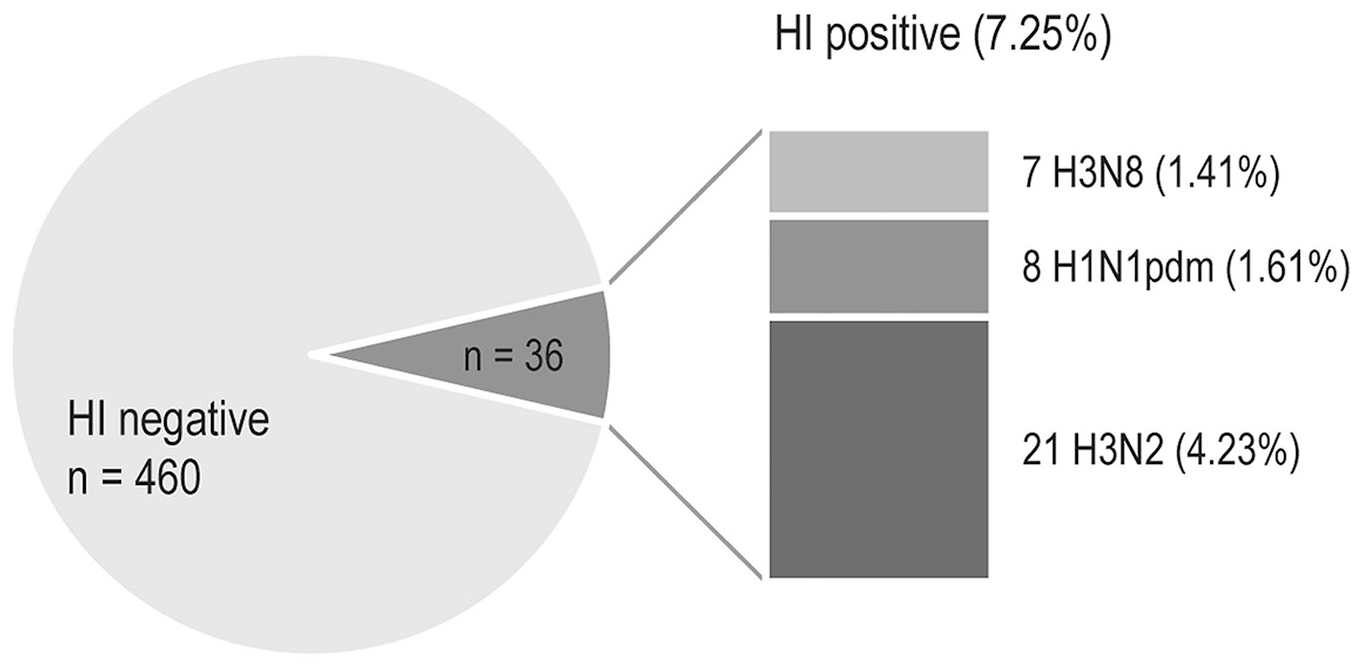
Hemagglutination inhibition results of 496 canine sera, with 3 influenza A virus subtypes: equine H3N8, swine H3N2, and swine H1N1pdm.
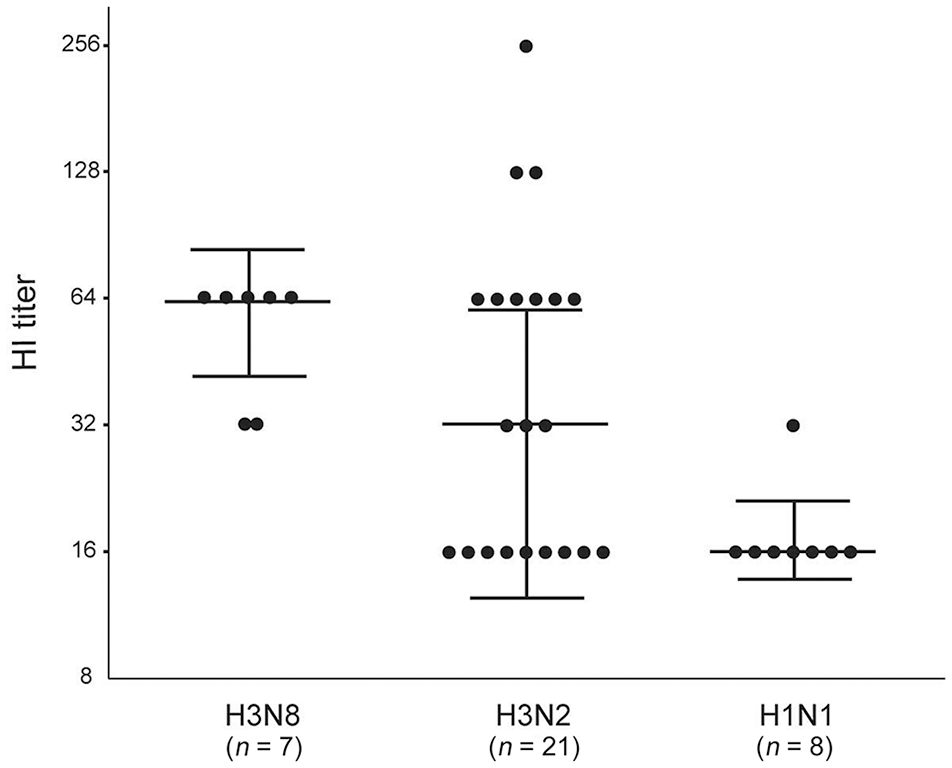
Hemagglutination inhibition titers of canine sera for equine H3N8, swine H3N2, and swine H1N1pdm subtypes of influenza A virus. Median value and 95% confidence intervals are indicated by long and short horizontal lines, respectively.
Subtypes of influenza A virus among ELISA-positive (n = 11) and -negative (n = 485) samples.

HI = hemagglutination inhibition.
The seroprevalence of influenza in dogs in Europe has been studied in Italy and Germany. In Italy, the positive results obtained in a NP ELISA were 0.5–3.5%. HI positive reactions were obtained for H3N8, H3N2, and H1N1pdm subtypes of IAV (using canine H3N8, equine H3N8, swine H3N2, and H1N1pdm antigens).6,7,12 Seroprevalence was lower In Germany, 7 of 736 sera (0.95%) were positive in an NP ELISA, and antibodies against H1N1pdm were detected. 5 We found a reaction with the swine H1N1pdm strain in a small number of dogs (1.6%) in our current study; infections with H1N1pdm have been confirmed in Poland, both in swine and humans.11,13 Generally, in Europe, the percentage of dogs seropositive in NP ELISA is low, whereas the results of the HI test indicate a higher percentage of seropositive animals.
The seroprevalence of CIV has been studied worldwide, notably in countries in which outbreaks of canine influenza have been reported, such as the United States or China. In a 2019 report of testing for canine H3N2 in pet dogs in the United States, 3.53% of sera were positive in ELISA and 2.21% in HI. 8 Although only a low seroprevalence of canine influenza is usually recorded in the United States, seroprevalence can reach high levels in influenza-endemic areas.8,9 Studies carried out among dogs in Hong Kong have shown that seroprevalence rates of canine H3N2 or H3N8 (0.9%) were lower than those of human IAVs H1N1pdm or H3N2 (7.5%), indicating that humans may serve as the major source of exposure to IAV for dogs in a densely populated city. 17
Among the ELISA-negative samples, we detected positive sera in the HI test. A similar tendency has been observed in previous studies.9,12,17 This divergence might arise from the kinetics of anti-NP and anti-HA antibodies; anti-NP titers detected by ELISA decrease over time, as observed for avian influenza.10,15 Additionally, ELISA for swine influenza detects mainly IgG antibodies, whereas the HI test detects IgM as well as IgG antibodies; hence the ELISA may not identify positive animals at the early stage of infection. 20 NP-based ELISA is therefore indicated as a suitable tool for surveillance purposes, but it can give false-negative results. On the other hand, not all sera positive in ELISA have been assigned a specific serotype of IAV. It is possible that the strains used in HI are incompatible with strains circulating in the dog population. Given the limitations of the tests used, it seems advisable to use both tests in parallel to check the seroprevalence of IAV in dogs.
Although rather low seroprevalence is noted generally, it seems advisable to monitor the seroprevalence of IAV infection in both pet and farmed dogs, especially in the context of H1N1pdm distribution. Given the population of dogs estimated at 700 million worldwide, the close contact between humans and dogs, and the susceptibility of dogs to infection by IAVs of both mammalian and avian origin, serosurveillance in dogs may be useful.
Supplemental Material
Supplemental_material – Supplemental material for Serologic investigation of influenza A virus infection in dogs in Poland
Supplemental material, Supplemental_material for Serologic investigation of influenza A virus infection in dogs in Poland by Malgorzata Kwasnik, Marcin Smreczak, Jerzy Rola, Kinga Urbaniak and Wojciech Rozek in Journal of Veterinary Diagnostic Investigation
Footnotes
Acknowledgements
We thank Urszula Bocian for excellent technical assistance.
Declaration of conflicting interests
The authors declared no potential conflicts of interest with respect to the research, authorship, and/or publication of this article.
Funding
The study was supported by KNOW, Ministry of Science and Higher Education, Poland [05-1/KNOW2/2015 (K/02/1.0)].

Supplementary material
Supplementary material for this article is available online.
References
Supplementary Material
Please find the following supplemental material available below.
For Open Access articles published under a Creative Commons License, all supplemental material carries the same license as the article it is associated with.
For non-Open Access articles published, all supplemental material carries a non-exclusive license, and permission requests for re-use of supplemental material or any part of supplemental material shall be sent directly to the copyright owner as specified in the copyright notice associated with the article.
