




Abstract
Persistent buffalo mastitis caused by Staphylococcus spp. gives rise to economic losses and may be resistant to antimicrobial therapy. The aim of the present study was to determine resistance patterns and the presence of mecA, blaZ, and efflux pump in Staphylococcus spp. isolated from cases of mastitis in Brazilian buffalo herds. Susceptibility to antimicrobials was determined by the disk diffusion test and detection of the mecA and blaZ genes by polymerase chain reaction. The efflux pump screening test was performed by growing samples in Muller–Hinton agar containing ethidium bromide. The percentages for resistance to the drugs tested were: 71.8% to penicillin, 49.2% to amoxicillin, 65.8% to oxacillin, 62.3% to cefquinome, 44.7% to cephalonium, 45.2% to ciprofloxacin, 32.6% to enrofloxacin, 58.7% to erythromycin, 42.7% to florfenicol, 34.6% to gentamicin, 35.1% to trimethoprim–sulfamethoxazole, 8.5% to tetracycline + neomycin + bacitracin, 43.2% to cephalothin, 38.1% to streptomycin, 58.7% to tetracycline, 31.6% to norfloxacin, 45.2% to ceftriaxone, 43.2% to nitrofurantoin, 57.7% to doxycycline, and 53.7% to cephalexin. Simultaneous resistance to 4 or more antimicrobial drug groups was observed in 112 isolates, using the mecA (11) and blaZ (79) genes, and efflux pump (47). It is concluded that Staphylococcus spp. isolates from cases of mastitis in Brazilian buffalo show varying levels of resistance to antibiotics, and caution should be exercised in choosing therapeutics in order to minimize the risk to public health.
Mastitis is one of the most important problems for ruminant dairy herds around the world. 7 Economic losses are associated with the drop in quantity and quality of milk production, as well as the increased costs involved in treatment and control programs. 5 Brazilian buffalo herds are composed of 3 Indian (Murrah, Jafarabadi, and Carabao) and 1 European breed (Mediterranean). In Brazil, many studies have reported a mastitis prevalence of approximately 40% on buffalo farms. 4
The main etiological agents of subclinical mastitis are coagulase-negative staphylococci (CNS), Staphylococcus aureus, Streptococcus spp., and Corynebacterium spp. 4 Staphylococcus aureus has been recognized as the most important cause of ruminant mastitis. 1 Coagulase-negative staphylococci are considered emerging agents of subclinical or mild clinical mastitis. 20 Multi-drug resistance (MDR) may be found in S. aureus and CNS isolates from mastitis. 12,20
Two genetic mechanisms are associated with resistance to the β-lactam class of antibiotics in Staphylococcus spp. 15 The most important is production of β-lactamase that may be mediated by the blaZ gene. 15,20 Resistance to methicillin (and β-lactams) is also associated with the mecA gene, which codes for penicillin-binding protein 2a (PBP2a), a cell wall synthetic protein with low affinity in binding to β-lactams. 10 One study has suggested that the mec cassette was acquired by S. aureus from CNS. 13 Efflux-mediated antimicrobial resistance is based on an energy-dependent cell process and associated with resistance to several drugs, such as macrolides and disinfectants. 2 The present study aims to determine the antimicrobial resistance of Staphylococcus spp. isolated from mastitis in buffalo from northeastern Brazilian herds, as a way of ascertaining the prevalence of antimicrobial resistance determinants, such as mecA and blaZ genes and efflux pump.
One hundred and ninety-nine Staphylococcus spp. isolates from buffalo mastitis were analyzed. The isolates were from the states of Pernambuco (n = 7), Alagoas (n = 57), Bahia (n = 105), and Ceara (n = 30). The biochemical tests employed for Staphylococcus spp. classification were free coagulase production, DNAse, and catalase. 17
The resistance pattern of Staphylococcus spp. isolates was determined using a disk diffusion test. 3 The drugs tested were penicillin (10 IU), amoxicillin (30 µg), oxacillin (5 µg), cefquinome (8 µg), cephalonium (30 µg), ciprofloxacin (30 µg), enrofloxacin (5 µg), erythromycin (10 µg), florfenicol (30 µg), gentamicin (30 µg), trimethoprim–sulfamethoxazole (25 µg), tetracycline + neomycin + bacitracin (25 µg), cephalothin (30 µg), streptomycin (10 µg), tetracycline (30 µg), norfloxacin (10 µg), ceftriaxone (30 µg), nitrofurantoin (30 µg), doxycycline (30 µg) and cephalexin (30 µg). The MDR rate was calculated by dividing the number of resistant antimicrobial groups by total of tested antimicrobial groups. 11 Escherichia coli American Type Culture Collection (ATCC) 25922, S. aureus ATCC 25923, and Pseudomonas aeruginosa ATCC 27853 were used as a control for the antimicrobial tests.
For the purpose of mecA and blaZ genes detection by polymerase chain reaction (PCR) assay, previously described primers and cycle conditions were used. 14,19 Bacterial genomic DNA was obtained by thermal extraction. 8 DNA from methicillin-resistant S. aureus was used as a positive control. An ethidium bromide procedure was selected to screen the efflux pump in Staphylococcus spp. 2 Isolates were grown in Mueller–Hinton (MH) agar containing ethidium bromide (0.5 mg/ml). The efflux-mediated resistance was considered present when colonies did not show any fluorescence under ultraviolet examination.
The number of Staphylococcus spp.–resistant isolates according to the disk diffusion test can be seen in Figure 1. The resistance percentages to the drugs tested were: 71.8% for penicillin, 49.2% for amoxicillin, 65.8% for oxacillin, 62.3% for cefquinome, 44.7% for cephalonium, 45.2% for ciprofloxacin, 32.6% for enrofloxacin, 58.7% for erythromycin, 42.7% for florfenicol, 34.6% for gentamicin, 35.1% for trimethoprim–sulfamethoxazole, 8.5% for tetracycline + neomycin + bacitracin, 43.2% for cephalothin, 38.1% for streptomycin, 58.7% for tetracycline, 31.6% for norfloxacin, 45.2% for ceftriaxone, 43.2% for nitrofurantoin, 57.7% for doxycycline, and 53.7% for cephalexin. The MDR rate varied from 0 to 1 (Table 1). Eighteen (9%) Staphylococcus spp. isolates were sensitive to all antimicrobial drugs tested. Isolates multi-resistant (n = 112) to 4 or more antimicrobial drugs groups simultaneously were observed (Table 1). Forty-seven (23.6%) Staphylococcus spp. isolates were resistant to all tested drugs.
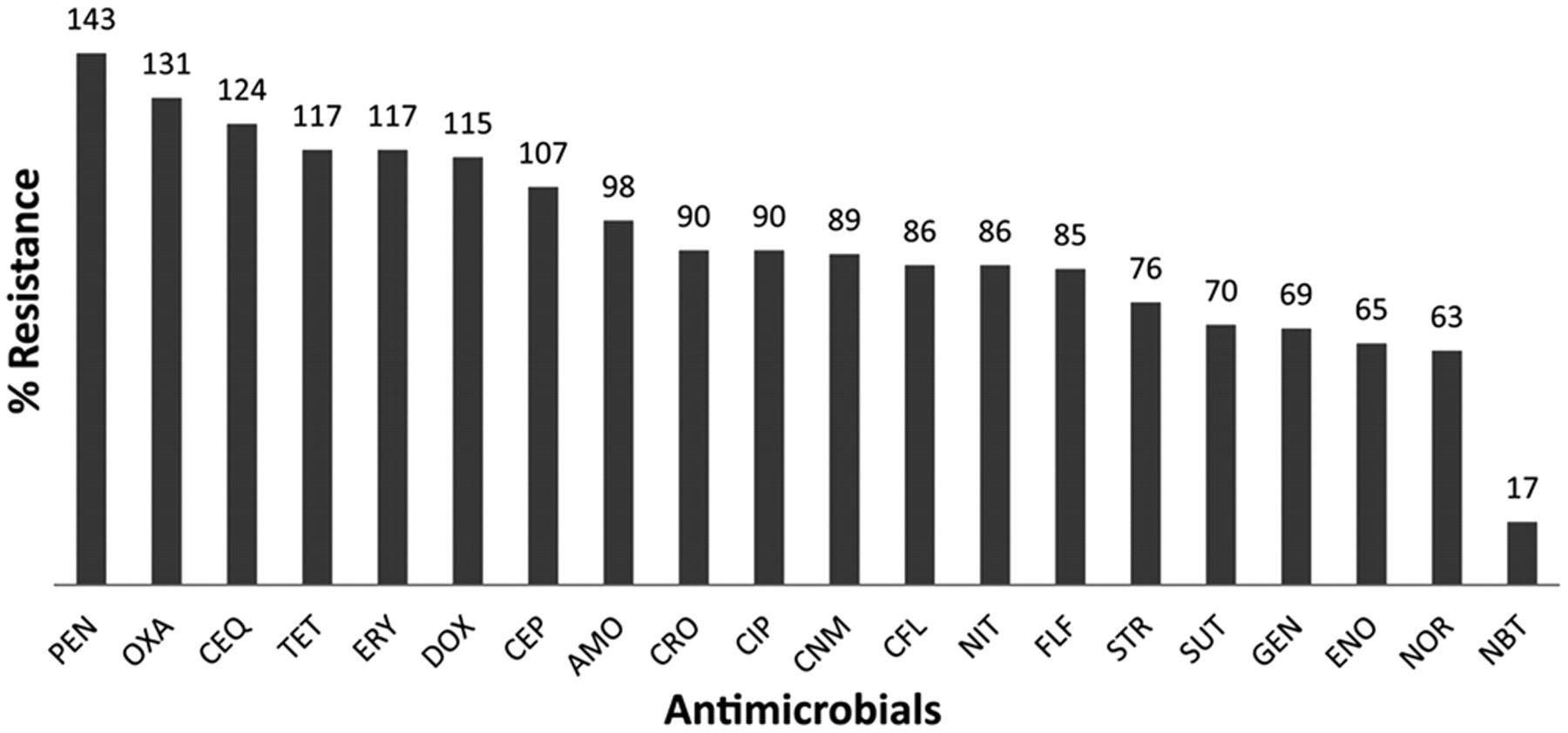
Number of resistant Staphylococcus spp. isolates detected in the disk diffusion test. PEN: penicillin; AMO: amoxicillin OXA: oxacillin; CEQ: cefquinome; CNM: cephalonium; CIP: ciprofloxacin; ENO: enrofloxacin; ERY: erythromycin; FLF: florfenicol; GEN: gentamicin; NBT: tetracycline + neomycin + bacitracin; CEP: cephalothin; STR: streptomycin; TET: tetracycline; NOR: norfloxacin; CRO: ceftriaxone; NIT: nitrofurantoin; DOX: doxycycline; CFL: cephalexin; SUT: trimethoprim–sulfamethoxazole.
Distribution of resistance genes according to multi-drug resistance (MDR) rates in Staphylococcus spp. from buffalo mastitis in Brazil.
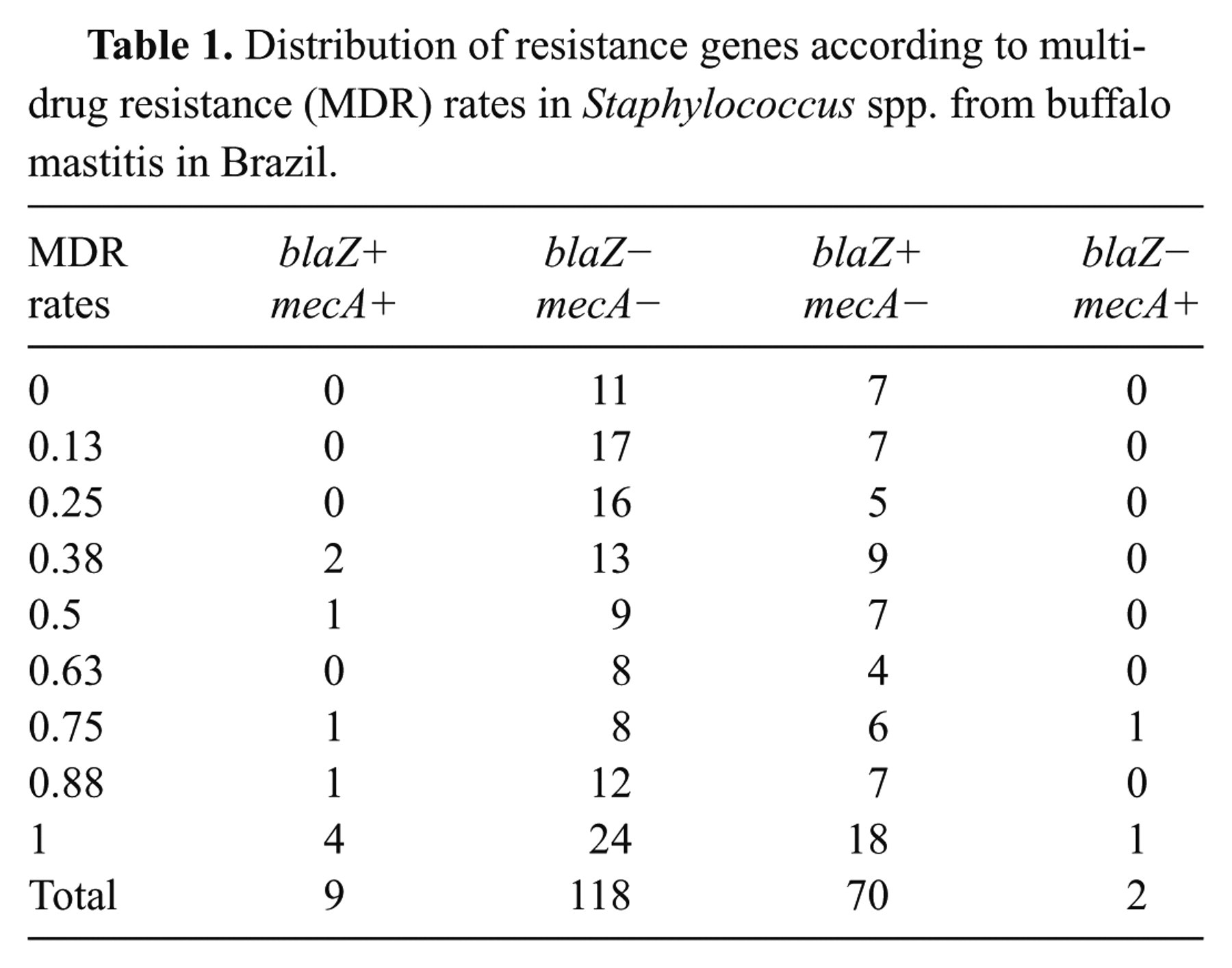
Polymerase chain reaction amplifications for mecA and blaZ genes were positive in 11 (5.5%) and 79 (39.6%) of Staphylococcus spp. isolates, respectively. Both genes were simultaneously amplified in 9 (4.52%) isolates (Table 1). One hundred and eighteen isolates tested negative for both the mecA and blaZ gene.
In the screening test for efflux pump, 47 isolates (23.61%) were considered positive. This number is lower than the number of erythromycin (macrolide)-resistant isolates (n = 117). An association between mecA, blaZ, and efflux pump was observed in 5 Staphylococcus spp.
Studies performed using Staphylococcus spp. found a high percentage of isolates showing sensitivity to all tested drugs. 1,16 In the present study, only 18 isolates were sensitive to all tested drugs, corroborating previous findings with S. aureus from mastitis in cattle. 12 The MDR rates observed in the present study were higher than those described by other researchers. 16,19
The percentage of resistance to β-lactams was variable, with the highest resistance being to penicillin (71.8%) and lowest to cephalonium (44.7%). A study that evaluated the resistance of Staphylococcus spp. from various ruminant species, including 33 from buffalo, showed lower penicillin resistance. 1 In CNS from bovine milk, lower resistance to β-lactams was detected. 19 However, similar results to those from the present study have been reported in the literature. 12 Coagulase-negative staphylococci are more resistant than S. aureus and may be a source of β-lactam resistance genes. 20 High levels of resistance to a specific antibiotic may be associated with frequent and long-term use. 12,16 There is low antimicrobial drug usage in the buffalo herd targeted in the present study, but the animals were raised close to cattle, in which the use of antimicrobial drugs is significantly higher.
Resistance to oxacillin, a marker for methicillin resistance, was found in 65.8% of the Staphylococcus isolates, which was a higher percentage than that observed using mecA amplification by PCR (5.52%). Ten mecA-positive isolates were resistant to oxacillin and 1 isolate was oxacillin sensitive. Similar results have been reported in the literature, suggesting that variations in the expression of resistance may be associated with growth conditions. 12 In Brazilian buffalo, mecA (5.5%) and blaZ (39.6%) genes were detected in Staphylococcus spp. isolates using PCR, as in other studies, which suggests that blaZ is the most important mechanism for β-lactam resistance. 15 In cattle CNS, the presence of mecA (7.14%) and blaZ (18.45%) genes have been reported in animal and animal CNS isolates, with a frequency of only 5.6% in animal samples. 19 In a previous study, methicillin-resistant S. aureus was not found in buffalo isolates. 1 Coagulase-negative staphylococci may be the origin of the mecA gene in S. aureus, but this is not the case for the blaZ gene. 15 However, transfer of the mecA and blaZ pool of genes may occur between human and animal Staphylococcus spp. isolates. 10,15 Staphylococcus spp. may harbor blaZ and mecA genes simultaneously. 19 Similar results were observed in the buffalo isolates analyzed in the present study. The blaZ and mecA genes are penicillin-binding proteins with a common ancestor and are co-repressed to prevent toxic effect. 18
Forty-seven out of 117 erythromycin-resistant isolates presented efflux pump in MH agar containing ethidium bromide. The resistance to macrolides and tetracycline may occur as a result of several mechanisms other than efflux pump, such as enzyme modification and ribosome protection. 6 No identified resistance mechanisms are usually found in CNS isolates with macrolide resistance. 19 In the present study, quinolones and gentamicin presented low resistance results as have been described in the literature. 12 Gentamicin and enrofloxacin are considered the most effective drugs for treatment of S. aureus mastitis in buffalo and cattle. 9 The association of antimicrobial drugs may be useful for antimicrobial therapy in mastitis. 16 In the present study, the lowest resistance was obtained with a 3-drug combination (tetracycline + neomycin + bacitracin), suggesting potential for mastitis treatment.
As shown in other studies, 19 5 isolates presented 3 antimicrobial resistance mechanisms simultaneously. This indicated the spread of mechanisms associated with antimicrobial resistance among Staphylococcus spp. in Brazilian buffalo. A genetic relationship between S. aureus isolates in Brazilian buffalo and those in human beings and other ruminants has been reported. 1 Buffalo Staphylococcus spp. isolates show differences in resistance patterns, with penicillin meeting the greatest resistance and tetracycline + neomycin + bacitracin the least. Multi-drug resistance was observed among Staphylococcus spp. isolates in the current study. Genes associated with β-lactam resistance (mecA and blaZ) were amplified by PCR. Efflux pump was detected in resistant isolates. In conclusion, Staphylococcus spp. isolates from cases of mastitis in Brazilian buffalo show varying levels of resistance to antibiotics, and caution should be exercised in choosing therapeutics in order to minimize the risk to public health.
Footnotes
a.
Ludwig Biotechnology Ltd., Alvorada, Rio Grande do Sul, Brazil.
The author(s) declared no potential conflicts of interest with respect to the research, authorship, and/or publication of this article.
The research was financially supported by FACEPE (APQ-0629-5 .05/08).