



Abstract
Two outbreaks of mortality in juvenile barramundi (Lates calcarifer) with a high prevalence of gastrointestinal cryptosporidiosis are described. Juvenile barramundi at a separate hatchery and grow-out facility were demonstrating markedly increased mortality rates. Histological examination in all cases indicated a heavy infection of Cryptosporidium-like organisms within the distal stomach and proximal small intestine. Electron microscopy confirmed a diagnosis of cryptosporidiosis; however, speciation was not possible.
Cryptosporidia are protozoal, apicomplexan, intracellular parasites that usually infect the gastrointestinal epithelial cells of a range of vertebrate species. 6,11,14 Among production animals, cryptosporidiosis causes significant economic losses and remains a potential zoonotic condition. 14,15,19 Cryptosporidium parvum, one of the causative agents of human and animal cryptosporidiosis, has been widely examined. 3,4,15 Increasing molecular characterization of organisms previously held under this name have led to further speciation, to the point where currently, more than 18 species are recognized and catalogued with a reasonable degree of confidence, 18 with further expansion of species likely to occur. 5 In contrast, little reported literature exists concerning piscine species, and minimal data are available regarding its pathogenicity, host range, or taxonomy. The first report of cryptosporidia from a marine fish was in 1981 8 when Cryptosporidium nasorum was identified. Since that report, 2 additional species, Cryptosporidium molnari (or C. molnari–like organism) 2,15 and Cryptosporidium scophthalmi, 1 have been added to the literature. Little is known, however, regarding the prevalence or host ranges of piscine cryptosporidia.
Barramundi (Lates calcarifer) is a species of increasing commercial value in Australia and Asia. Wild stock are considered an important and valuable recreational resource (Schipp G, Bosmans J, Humphrey J: 2007, Barramundi farming handbook. Northern Territory Government. Darwin, Australia. Available at http://www.nt.gov.au/d/Fisheries/Content/File/NT_Barra_Farming_Handbook_Online_1107.pdf. Accessed on October 29, 2010). The farming of barramundi is of increasing significance to Australian aquaculture. In 2004, the State of Queensland produced 1,437 tons of farmed stock worth over US$11.57 million, while in New South Wales, average annual production is just over 100 tons (New South Wales Government, Industry and Investment: 2009, Aquaculture facts and figures 2009. Available at http://www.dpi.nsw.gov.au/fisheries/aquaculture/publications/general/facts. Accessed on October 29, 2010). Internationally, production has risen from 10,000 tons in 1990 to more than 35,000 tons in 2009 (Food and Agriculture Organization of the United Nations: 2010, Species fact sheets: Lates calcarifer (Bloch, 1790). Available at http://www.fao.org/fishery/species/3068/en. Accessed on October 29, 2010). The current knowledge base relating to disease occurrence in this species is limited. Two non–peer-reviewed citations have indicated the sporadic presence of Cryptosporidium-like structures from farmed barramundi; however, no indication of associated pathology has been inferred. 9,7
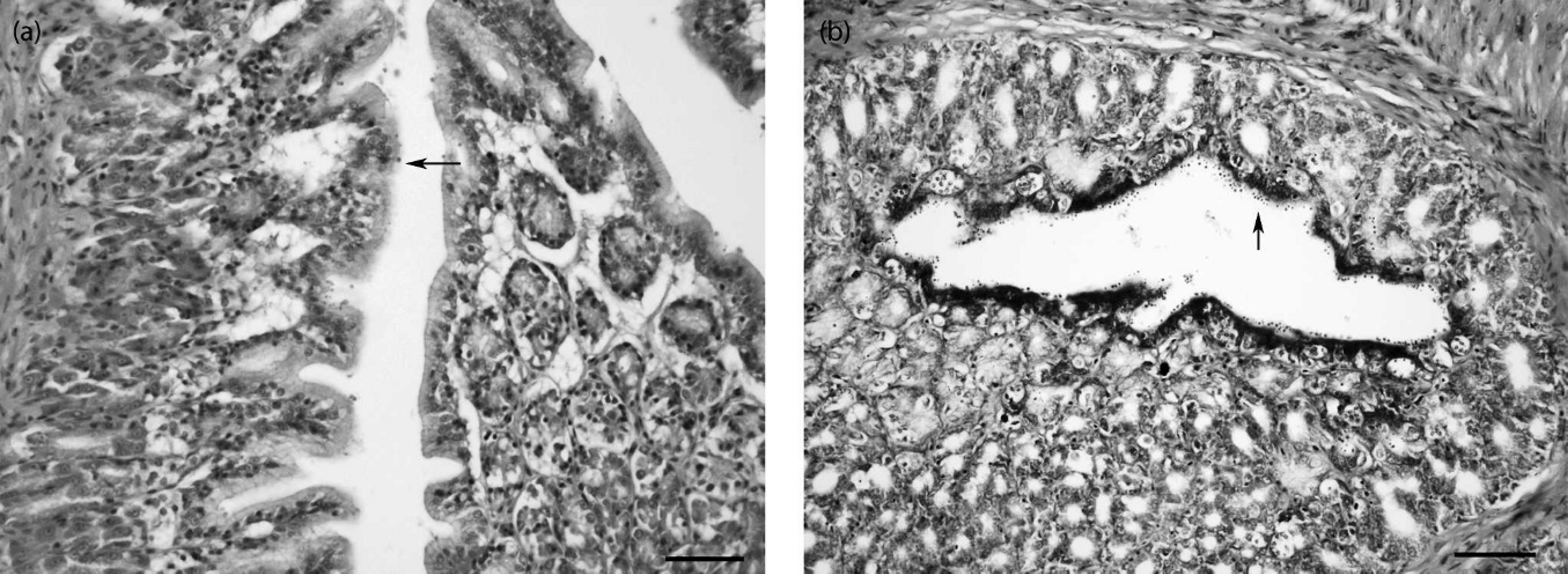
Stomach, barramundi (Lates calcarifer).
The following article describes 2 related outbreaks of mortalities in immature hatchery barramundi, in which a high prevalence of Cryptosporidium-like organisms were noted. To the authors' knowledge, the present study is the first description of significant mortality in farmed barramundi in which a high prevalence of Cryptosporidium-like organisms has been noted.
In case 1, increased mortalities in 35–45-mm (9-week-old) barramundi from an intensive tank-based aquaculture operation were noted. The fry had been purchased from a hatchery 3 weeks earlier and had been in good condition. Of the 15,000 fry purchased, 3,000 died within a 1-week period. A second batch of similarly aged fry, purchased from the same source, was housed in 2 quarantine isolation tanks at the same farm. Affected mortalities were 8,000 out of 10,000 (tank 1) and 1,000 out of 10,000 (tank 2) over a 2-week period. Sixty freshly dead fish (evenly sampled from both tanks) were submitted for necropsy, histological examination, and screening for nodavirus infection. Gross examination was unremarkable, and nodavirus polymerase chain reaction testing was negative. Entire fry, which had been fixed in neutral buffered 10% formalin solution, were examined histologically. In all fish examined, there were numerous faintly basophilic, 1–2-μm spherical structures in close apposition to mucosal surfaces of the stomach and proximal small intestines (Fig. 1a). Surface epithelium of heavily infected stomach and small intestine was lined by cuboidal, often attenuated epithelium. Diffusely, the lamina propria contained mild collections of mixed mononuclear inflammatory cells. No other pathological findings were noted. Bacterial culture of myocardium, kidney, and spleen were unremarkable.
Case 2 is a parallel investigation relating to rising mortalities that was in progress at the source hatchery. At this site, moderate emaciation was noted in approximately 2% of its 30–40-mm fingerlings. The fish were noted to congregate at the surface, demonstrated pallor, and displayed mild abdominal distension. A low-grade mortality accounting for 10–20 fish per day per tank (10,000 per tank) raised concern. Three days after initially noting the changes, a small sample of 7 representative fish were processed for histological examination, as described above. There was a mild lymphocytic and histiocytic accumulation of the small intestinal and gastric submucosal layer, with occasional spherical Cryptosporidium-like organisms noted at the apical aspect of gastric and enteric mucosal epithelia in 29% of samples examined. Shortly after this finding, mortalities significantly increased to 1,100 per day and were associated with a moderate lymphocytic and plasmacytic gastroenteritis. Large numbers of similar organisms were noted on the mucosal surfaces (Fig. 1b). Mortalities subsided once fingerlings reached 40–45 mm in length. Total cumulative mortality comprised 20,000 fish.
Selected tissue samples from extant paraffin blocks of both cases were processed for examination by transmission electron microscopy. Tissue samples were excised with a surgical scalpel. The tissues were deparaffinized in xylene for 1 hr, transferred to acetone, and then rehydrated in an ethanol series. Specimens were transferred to Karnovsky fixative containing 3.5% glutaraldehyde, 1.5% paraformaldehyde, and 0.1% sodium chloride for 4–6 hr. The tissues were rinsed in phosphate buffered saline and postfixed in 1% osmium tetroxide for 1 hr, and then rinsed thoroughly with phosphate buffered saline and distilled water before being transferred to 2% uranyl acetate for 1 hr. Tissues were dehydrated in an ethanol series, transferred to acetone, and embedded in Spurr resin before being allowed to polymerize at 70°C for 10 hr. Ultrathin sections were mounted on copper grids, stained with uranyl acetate and lead citrate, and examined and photographed with a transmission electron microscope. Ultrastructurally, abundant spherical structures of approximately 4 μm were noted closely apposed to the mucosal surface (Fig. 2a). The structures were surrounded by a membrane resembling an irregularly undulating parasitophorous vacuole (Fig. 2b). At the attachment zone, distinct feeder organelles were noted in direct apposition to the gastrointestinal epithelium (Fig. 2b). The adjacent luminal surface had a loss of villus projections (Fig. 2b). The histological and ultrastructural findings were considered consistent with cryptosporidiosis.
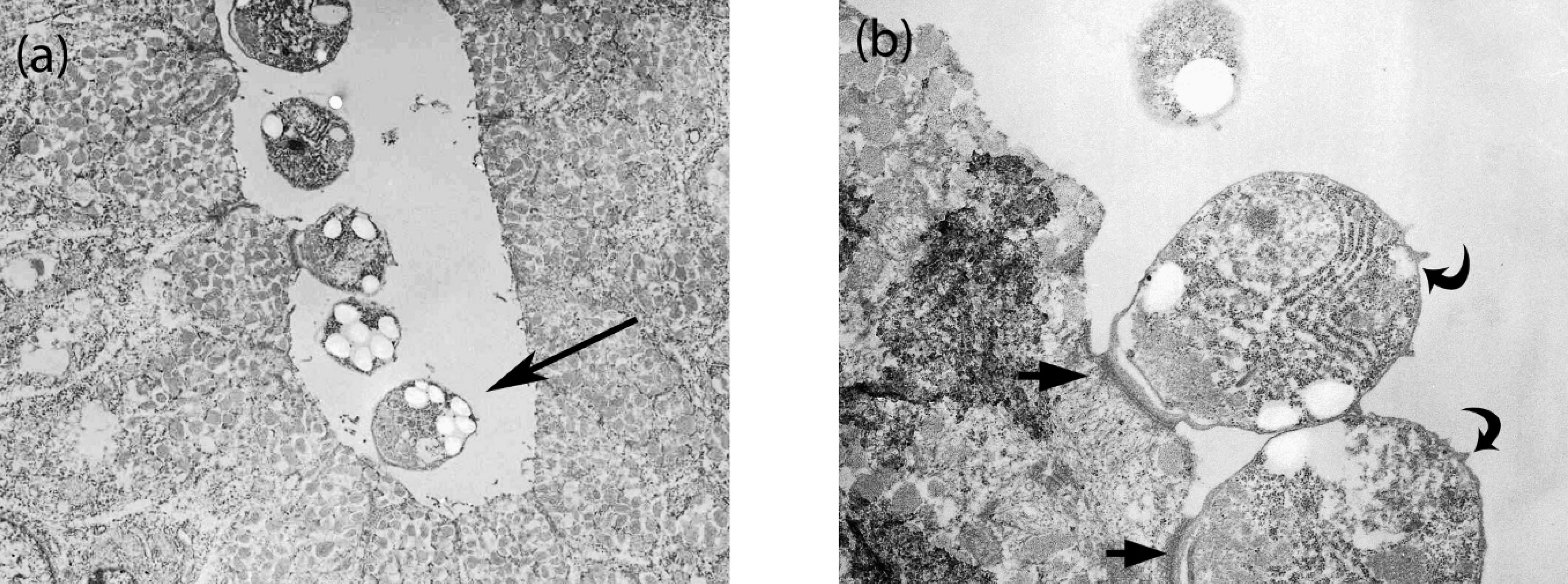
Stomach, barramundi (Lates calcarifer).
Information regarding cryptosporidiosis in piscine species is limited and includes individual descriptions from farmed species, wild-caught catfish, and ornamental and captive wild fish. 13 No reports were found in the peer-reviewed literature regarding infection of intensively farmed barramundi, a species of increasing importance in Southeast Asia. Cryptosporidiosis is typically a disease of herd or flock animals, and it should prove of little surprise that an outbreak of such significance could occur in intensively farmed fish, such as barramundi. More detailed studies examining the incidence of cryptosporidiosis in aquatic species suggest that their presence could be of increasing significance to aquaculture on a global scale. 2,5,9,14 In the current 2 outbreaks, both populations were under significant physiological stress; in the case of the hatchery mortalities, an unusually large run of fingerlings were entering the system, and stocking rates were far in excess of normal. With regard to the grow-out facility, the initial phase of transportation and acclimatization is inherently stressful to stock and likely contributed to expression of disease.
In the current cases, despite the presence of mild to moderate histological lesions, including microvillus loss and atrophy noted ultrastructurally, there was no clinical suggestion of gastrointestinal disease per se. However, this can be difficult to ascertain in such physically immature fish. After the identification of Cryptosporidium-like organisms at the grow-out facility, depopulation of the entire nursery holdings was carried out. The affected tanks were chemically disinfected over a 5-day period with Virkon a and a generic chlorine-based product. All filtration biobeads were discarded. No disease or agent has been identified in subsequent submissions.
The initial presentation at the grow-out facility was of great concern because all water was sourced from noncontaminated aquifer reserves; thus, fecal contamination from this source was highly unlikely. However, the additional hatchery cases strongly supported the importation of the condition from the hatchery source. This has significant biosecurity implications for an industry that relies on movement of immature stock to grow-out facilities. The widespread presence of wild, free-moving wildlife in and around onshore aquaculture facilities could be a potential source of contamination. Both wild marsupial and placental animals commonly harbor Cryptosporidium spp., 6,12 and the sites in question were located in rural environments. Molecular speciation of the current organisms is underway to determine the most likely source of origin, and the potential for zoonotic infection. Considering the nature of numerous zoonotic Cryptosporidium spp., this should remain a high priority. 4,16,17,19
The diagnosis of cryptosporidiosis is possible from routine histological samples; however, the speciation remains challenging in generalist diagnostic laboratories. In the current case, fresh tissues and fecal casts were not available for further diagnostic evaluation, and formalin-fixed tissues were postfixed in glutaraldehyde for electron microscopy. With regard to the ultrastructural characteristics, the presence of an irregularly undulating parasitophorous membrane and other ultrastructural changes are not sufficient to attempt speciation. Previously reported ultrastructural studies 5,10 have not attempted to speciate the organism on the basis of such characteristics.
The current paper is the first description of mortality in farmed barramundi in which significant enteric pathology and the presence of gastrointestinal Cryptosporidium-like organisms have been noted. The strong supportive evidence of histologic and ultrastructural findings were not able to assist in speciation because of the complete absence of baseline data relating to the incidence and speciation of Cryptosporidium spp. in farmed barramundi.
Acknowledgements. The authors thank Dr. Ryan O'Handley of the University of Adelaide for assistance with ultrastructural interpretation.
Footnotes
a.
Antec International Ltd., Sudbury, Suffolk, United Kingdom.