



Abstract
A total of 147 Enterococcus faecium and 165 Enterococcus faecalis isolates from fecal samples of chickens and pigs at slaughterhouses in Korea were tested for their resistance to 8 growth-promoting antimicrobials commonly used in animals and quinupristin and dalfopristin. Resistance to most antimicrobials was very common among both E. faecalis and E. faecium. In particular, E. faecalis showed almost no susceptibility to all the antimicrobials tested except penicillin and flavomycin, to which 1.4% and less than 24% showed resistance, respectively. Although the prevalence of resistance was lower than in E. faecalis, E. faecium showed relatively uniform resistance to all the agents tested. Among the antimicrobials tested, virginiamycin and penicillin were the most effective against E. faecium isolates: less than 31% and 41% showed resistance to those 2 antimicrobials, respectively. Penicillin was the only agent that showed relatively strong activity against both E. faecalis and E. faecium. Resistance observed in E. faecalis and E. faecium against most antimicrobials used for growth promotion was more prevalent in Korea than in European countries. The current study is the first report of resistance against feed additive antimicrobials in enterococcal isolates from livestock in Korea.
The massive use of antimicrobials as therapeutics and for growth promotion could lead to a problem of increasing resistance in bacteria of human and animal origin. 27 More than half of the feed additive antimicrobials belong to classes of antimicrobials used in human medicine, including penicillins, tetracyclines, macrolides, and streptogramins. 28 The use of antimicrobial animal feed additives has the potential to increase the selection of resistant zoonotic bacterial pathogens. 4 In Korea, usage of veterinary pharmaceuticals is typically greater than in the majority of other countries. The amount of veterinary antimicrobials used as feed additives in Korea in 2004 was approximately 600 tons, 21 a 20-fold higher quantity of growth promoters than were used in the United Kingdom in the same year. 17 A wide range of antimicrobial feed additives are currently used in Korea, including virginiamycin, penicillin, bacitracin, erythromycin, flavomycin, lincomycin, tylosin, and tetracyclines. Quinupristin and dalfopristin (Q/D) were approved to treat vancomycin-resistant Enterococcus faecium infections in Korea in 2001.
Enterococci in the normal fecal flora of animals have been widely accepted as an indicator bacteria for the detection of the prevalence of resistance due to the use of growth-promoting antimicrobial agents. 7,38 The heavy use of growth-promoting drugs in food animals has caused an increase in antimicrobial resistance in enterococci of animal origin. 39 European countries have reported resistance against growth-promoting antimicrobials, including avoparcin, in enterococci isolated from animals. 5,7,38 However, no information is available on the resistance against antimicrobials used as growth promoters in enterococci isolated from livestock in Korea. Therefore, the objective of the current study was to determine the species distribution of enterococci and resistance patterns of E. faecium and Enterococcus faecalis isolated from chickens and pigs during 2002–2003 to growth-promoting antimicrobials widely used in Korea.
During 2002–2003, a total of 631 fecal samples of chickens (n = 257) and pigs (n = 374) were obtained by rectal swab from individual animals at the time of slaughter in poultry and livestock slaughterhouses. In the case of the fecal samples, animals originated from 52 chicken farms and 81 pig farms located throughout Korea. Approximately 5 or fewer fecal swabs were collected per farm, and care was taken during the procedure to avoid environmental contamination. Each rectal swab was inserted into Cary-Blair medium, a before being sent to the laboratory for isolation and identification. Each sample was inoculated into bile-esculin azide broth a at 35°C for 24 hr, then streaked on mEnterococcus agar b and incubated at 35°C for 24 hr. Identification of enterococci was performed using VITEK system c : Briefly, 3 or more colonies showing enterococcal morphology, including Gram-positive, catalase-negative, and growth and blackening of bile-esculin agar, were streaked onto tryptic soy agar b plates and incubated at 35°C for 24 hr. Each bacterial suspension adjusted to a turbidity of 0.5 MacFarland standards was inoculated onto the VITEK Gram-positive identification card, according to the manufacturer's recommendations. Of 667 enterococcal isolates, 147 E. faecium (105 from chicken and 42 from pigs) and 165 E. faecalis (72 from chicken and 93 from pigs) strains were selected so that no more than 3 isolates per farm were included in the analysis. According to the guidelines developed by the National Committee for Clinical Laboratory Standards (NCCLS), 30,32 minimum inhibitory concentrations (MICs) of E. faecium and E. faecalis were examined against 9 different antimicrobials, most of which are used as feed additive antimicrobials, as follows: penicillin, bacitracin, erythromycin, flavomycin, lincomycin, tylosin, tetracycline, virginiamycin, and Q/D. The microbroth dilution method using Sensititre d custom antimicrobial susceptibility plates was used for all of the antimicrobials except virginiamycin, e for which manual microdilution was conducted. The MIC breakpoints for Q/D (≥4 μg/ml), penicillin (≥16 μg/ml), erythromycin (≥8 μg/ml), and tetracycline (≥16 μg/ml) were based on NCCLS. 29 For bacitracin (≥128 μg/ml) and tylosin (≥16 μg/ml), MIC breakpoints proposed by a previous study 10 were used. For flavomycin, breakpoints for E. faecalis (>8 μg/ml) and E. faecium (>256 μg/ml) were determined as described previously. 3,8 For lincomycin (≥8 μg/ml), the MIC breakpoint was based on CIPARS (2004). For virginiamycin, the NCCLS breakpoint for Q/D (4 μg/ml) was applied. 29 A growth control well was used as a reference for interpreting the growth patterns in each plate. Enterococcus faecalis ATCC 29212 was used as the quality control strain for antimicrobial susceptibility testing. The MIC was recorded as the lowest concentration of antimicrobial that inhibited visible growth.
Overall distribution of Enterococcus species from feces of chickens and pigs.*

Numbers in parentheses are percentages.
The species distribution of 667 enterococcal strains isolated from 631 fecal samples of chickens and pigs is presented in Table 1. A total of 8 different species were identified among the chicken isolates: E. faecium and E. faecalis were found to be the predominant species, accounting for 82.8% of the total, and others included Enterococcus avium, Enterococcus durans, Enterococcus gallinarum, Enterococcus hirae, Enterococcus casseliflavus/gallinarum, and Enterococcus uberis. Of those species, E. avium and E. uberis were not detected and only 6 species were identified among pig isolates, and E. faecalis was found to be the predominant isolate, followed by E. hirae and E. faecium. Most studies conducted in Korea have been focused on vancomycin-resistant enterococci or antimicrobial resistance in E. faecium and E. faecalis, 24 and very limited data were available on species distribution among enterococcal isolates from livestock in Korea. The differences in species distribution could be due to several factors, including isolation and identification methodology, the stage of production from which the sample was taken, and the geographical position of the farm. 10,14 Generally, however, the species distribution among enterococcal isolates observed in the present study was similar to those of previous studies on poultry 6,10,14 and pigs from other countries. 10,18,22
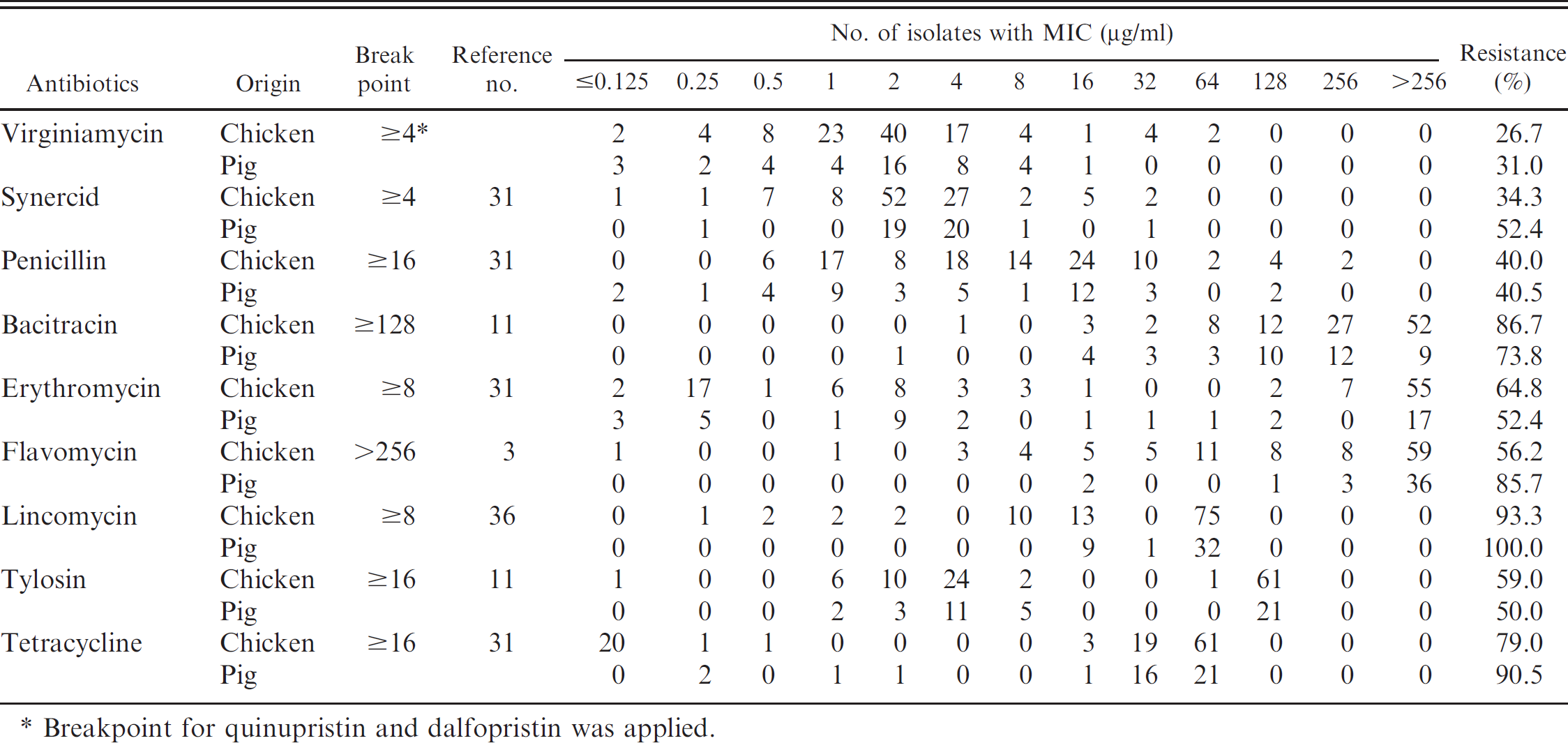
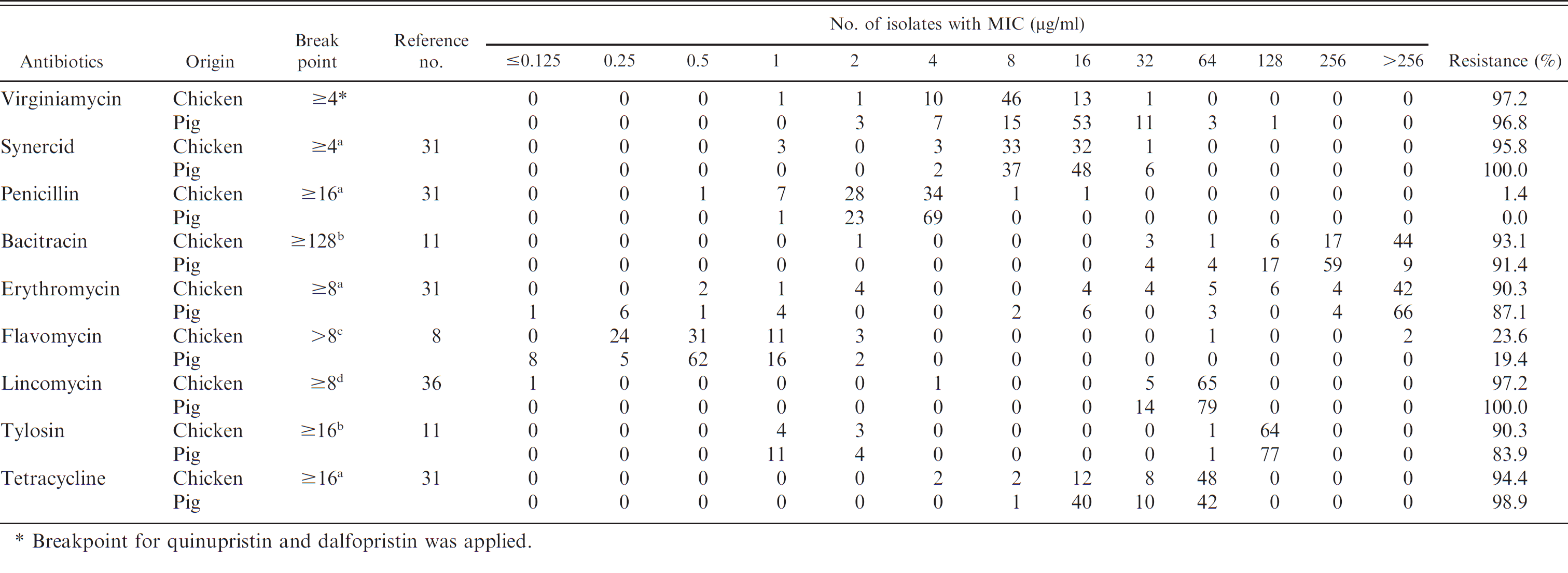
Eight antimicrobials used as feed additives and Q/D were tested in the current study, and resistance was very common in both E. faecium and E. faecalis isolates. The distribution of MICs for E. faecium and E. faecalis is shown in Tables 2 and 3, respectively. Regardless of the animal origin, distributions of MIC values for individual antimicrobials were similar among E. faecium isolates and among E. faecalis isolates, respectively. The prevalence of resistance was also similar in both isolates from pigs and chickens for most agents tested. Enterococcus faecalis showed almost no susceptibility to all the antimicrobials tested, except penicillin and flavomycin, to which almost none and less than 24% of E. faecalis showed resistance, respectively. Enterococcus faecium is reported to be the more useful indicator than E. faecalis, because it is considered a more significant resistance gene reservoir for antimicrobials used as growth promoters in animals. 5 It was also reported 3 that resistance against antimicrobials used solely for growth promotion was more prevalent in E. faecium than in E. faecalis. In the current study, however, the overall prevalence of resistance observed in E. faecium was lower than that in E. faecalis, except in the case of penicillin and flavomycin, to which E. faecium showed considerable resistance.
Among the antimicrobials tested, virginiamycin was the most effective agent against the E. faecium strains in the current study. Virginiamycin belongs to the streptogramin group of antimicrobials and has been used as a growth promoter in livestock worldwide. As a result of the cross-resistance of virginiamycin with Q/D, the parenteral streptogramin in human medicine for the treatment of infections with vancomycin-resistant E. faecium, 9 virginiamycin has been banned in the European Union since 1999. However, it is still being used as a growth promoter in poultry and pigs in Korea. Although Q/D is rarely used in hospitals in Korea, there is an increasing tendency of Q/D resistance in E. faecium isolates from humans in Korea. 33 Only 1.7% of E. faecium clinical isolates were reported to be resistant to Q/D in 2000, 12 and this value increased to 10% in 2004. 33 More importantly, Q/D resistance was observed in almost all vancomycin-resistant E. faecium isolated from Korean patients in 1998 and 2005. 23 Enterococcus faecalis are naturally resistant to Q/D, and, thus, assessment of the Q/D resistance is mainly of interest for the species E. faecium. 9 Since no breakpoints for virginiamycin have been established by NCCLS, breakpoint for Q/D (4 μg/ml) were applied in the present study. 26 About 27% and 34% of E. faecium isolates from poultry and 31% and 52% from pigs were resistant to virginiamycin and Q/D, respectively. Similar to the result of the present study, Q/D resistance was observed among 39% and 57% of E. faecium isolated from chickens and pigs in Germany. 9 Comparable resistance rates were also determined for E. faecium isolates from pigs in Denmark 2 and from poultry in The Netherlands. 40 In this regard, several studies inferred that the use of virginiamycin may not be the sole reason for the high rate of resistance to Q/D. Recently, a high prevalence (28.9%) of Q/D-resistant E. faecium isolated from humans was also reported in Greece, 16 where the use of streptogramins is limited and where virginiamycin has never been introduced into veterinary use. Meanwhile, a low rate of Q/D-resistant enterococci was observed elsewhere in Europe and the United States, where virginiamycin has been used in animal husbandry. 13
Distribution of minimum inhibitory concentrations (MICs) of antibiotics for Enterococcus faecium isolates from chickens (N = 105) and pigs (N = 42).
Breakpoint for quinupristin and dalfopristin was applied.
In the current study, penicillin showed the strongest antimicrobial activity against E. faecalis, and only 1 of 165 (0.6%) isolates showed resistance. Although about 40% of E. faecium showed resistance to penicillin, it was effective against the E. faecium strains, next to virginiamycin. Enterococcus faecalis was reported 15 to be more susceptible to penicillin than the other strains. A previous study 9 from Germany also reported that 42.9–63.6% of penicillin-resistant enterococci isolates from poultry belonged to the species of E. faecium. A similar result was found in Danish poultry. 7 Meanwhile, all E. faecalis and 94% of the E. faecium isolated from food of animal origin in Germany were reported to be sensitive to penicillin. 34 As previously described, 29 in the current study the vast majority of E. faecalis strains (98.1%) were found to have penicillin MICs ranging between 1 and 4 μg/ml. Also, many E. faecium strains have an MIC of >8 μg/ml, with the majority ranging between 16 and 32 μg/ml. Since penicillin is the mainstay of therapy for enterococcal infections, development of high-level resistance (128–512 μg/ml) to this drug in E. faecium has become a serious clinical problem over the past decade. 37 In the present study, 5.4% (8/147) of E. faecium strains had MIC values to penicillin that were ≥128 μg/ml.
Flavomycin is an antimicrobial that has been used solely for growth promotion. 3 Except for penicillin, flavomycin was the only agent active against E. faecalis isolates in the present study. The resistance observed in the study is, however, fairly high compared with that described in previous studies from Germany, in which 94% 34 and over 96% 9 of E. faecalis isolates showed sensitivity to flavomycin. Also, 90% of E. faecalis isolates were inhibited at 0.5 μg/ml of flavomycin in a previous study, 3 while over 98% of the E. faecalis isolates had MIC values of ≤2 μg/ml in the current study. Meanwhile, E. faecium is known to be naturally resistant to this growth promoter antimicrobial. 4 In the present study, 56.2% (chicken isolates) and 85.7% (pig isolates) of E. faecium were resistant to flavomycin, and 64.6% of the E. faecium strains showed flavomycin MIC values of >256 μg/ml. This result differs from the finding of a previous study, 3 in which all E. faecium strains were resistant to flavomycin and the MIC for 90% of E. faecium isolates had been inhibited (MIC90) and was >256 μg/ml. Other investigators have shown varying rates of resistance to flavomycin among E. faecium strains: 77.4–90.9% of chicken isolates, 93.3–100% of pig isolates, 9 and 72–93% isolates from food animals. 1
Bacitracin has had an important role as a growth promoter in animal husbandry, 35 but studies on bacitracin susceptibility and resistance in enterococci are limited. 25 In the current study, 73.8–86.7% of E. faecium and 91.4–93.1% of E. faecalis strains showed resistance to bacitracin. Resistance to tetracycline was also observed frequently (79–90.5% of E. faecium and 94.4–98.9% of E. faecalis); these values are much higher than those from previous studies from Germany. 9,34 The main reason for the high resistance to tetracycline may be the fact that this antimicrobial is the most commonly used antimicrobial in Korea, where it is used as both a therapeutic and nontherapeutic antimicrobial in veterinary medicine. Tetracyclines accounted for over 50% of the sales of antimicrobials for animals in Korea. 19,20 Erythromycin is a representative macrolide antimicrobial and often the drug of choice for treatment of several infections. In the present study, 56.2–85.7% of E. faecium and 87.1–90.3% of E. faecalis showed resistance to erythromycin. This is markedly higher than values associated with previous studies, in which 18% and 7% 34 and 42.9–53.3% and 4.8–27.6% 9 of E. faecium and E. faecalis strains, respectively, showed resistance. Tylosin is also a macrolide antimicrobial related structurally to erythromycin, and cross-resistance between these 2 antimicrobials is reported. 14 While most of E. faecalis (83.9–90.3%) were resistant to tylosin, relatively low rates (50–59%) of resistance were observed among E. faecium strains. The prevalence of resistance to tylosin was similar in both pig isolates and chicken isolates. The result of the present study is remarkably higher than that reported from Germany. 9
Distribution of minimum inhibitory concentrations (MICs) of antibiotics for Enterococcus faecalis isolates from chickens (N = 72) and pigs (N = 93).
Breakpoint for quinupristin and dalfopristin was applied.
The current study presents resistance profile in E. faecium and E. faecalis isolated from chickens and pigs against antimicrobials that are used commonly as feed additives in Korea. To the authors' knowledge, this is the first report of antimicrobial resistance against feed additives in Korea, and no domestic data was available for comparison. Compared to other countries, a higher prevalence of resistance to most feed additive antimicrobials was observed in Korea. It is well known that resistant bacteria are more prevalent in Korea than in other industrialized countries. 17 One of the main reasons for this may be the fact that usage of veterinary pharmaceuticals in Korea is greater than in most other countries, potentially because of their intensive use as feed additives. 17
Acknowledgements. This work was supported by National Veterinary Research and Quarantine Service, Ministry for Food, Agriculture, Forestry and Fisheries, Republic of Korea.
Footnotes
a.
BD BBL, Spark, MD.
b.
BD Difco, Spark, MD.
c.
BioMérieux, Hazelwood, MO.
d.
Trek Diagnostic Systems, Inc., West Sussex, United Kingdom.
e.
Bayer Korea, Seoul, Korea.