




Abstract
Based on the authors' laboratory experience indicating that increased bacterial contamination in Mycobacterium avium ssp. paratuberculosis (MAP) cultures may be because of the addition of brain heart infusion broth (BHI) during the decontamination process, this study was designed to examine whether BHI is a required component for the isolation of MAP from ESP® broth cultures. Twenty-six National Veterinary Services Laboratory (NVSL) proficiency test samples supplied for the year 2005 were used for the comparison. Two paired sets of samples were processed in the experiment. In one set, the hexadecylpyridinium chloride monohydrate (HPC) and antibiotic brew were prepared in half strength BHI and for the other set, HPC and antibiotic brew were prepared in sterile distilled water. Culture of the 26 samples using the BHI/HPC decontamination method identified 13 (50%) positives, whereas culture using the water/HPC decontamination method identified 14 (54%) positives. The proportions of samples with a positive result did not differ significantly between the 2 decontamination methods. Although in most cases it took longer to identify a positive result by the BHI method, the difference between methods with respect to the number of days to a positive culture result was not statistically significant. Retrospective data collected from the Animal Disease Diagnostic Laboratory, Ohio also suggest that inclusion of BHI in the decontamination protocol may not have any effect on MAP recovery or contamination rate. Elimination of BHI from broth cultures may increase the sensitivity of MAP isolation, and reduce the cost of testing.
Culture is considered the most definitive diagnostic test for the detection of Mycobacterium avium ssp. paratuberculosis (MAP), the organism causing Johne's disease (JD) in ruminants. 5 MAP is a very slow growing and fastidious Mycobacterium and requires the siderophore, Mycobactin J for its growth. 8 Conventionally, fecal cultures are carried out in Herrold's egg yolk (HEY) media with Mycobactin J and confirmation is based on Mycobactin dependency. 5,7,8 Automated broth culture systems are available and permit faster growth of MAP and confirmation is made by PCR or culture for Mycobactin J dependency. 5,6 In all these culture methods because of the fastidious nature of MAP, a long incubation period is required to grow this organism. Therefore, decontamination of the fecal sample is critical before inoculation of the samples for the recovery of MAP. Commonly used decontamination agents include sodium hydroxide, hexadecyl pyridinium chloride (HPC), and benzalkonium chloride. 7,8 Even with the use of decontaminants, because of the nature of the samples and prolonged incubation period, fungal and bacterial contamination is a common problem in MAP culture procedures.
To overcome some of these contamination issues, Dr. Shin recommended a double incubation method in 1989 (Report of the committee on Johne's Disease, Proceedings of the 93rd Annual Meeting of the U.S. Animal Health Association, 1989, pp. 380–381). Later in 1992, the method was fully described by Dr. Whitlock et al. (Culture techniques and media constituents for the isolation of Mycobacterium paratuberculosis from bovine fecal samples, Proceedings of the Third International Colloquium on paratuberculosis. 1992, pp. 94–111). In this method the fecal sample is incubated in HPC prepared in half strength brain heart infusion (BHI) broth overnight followed by centrifugation and reincubation of the pellet in an antibiotic mixture prepared in half strength BHI. The rationale for using BHI was to germinate spores of fungi and bacteria to vegetative forms and the antibiotic mixture was subsequently added to destroy the vegetative forms. The National Veterinary Services Laboratory (NVSL) protocol sent along with JD proficiency test samples recommends the use of half strength BHI broth in the decontamination processes.
In 2003, Animal Disease Diagnostic Laboratory (ADDL), Ohio started to observe an unusual level and type of contamination in HEY tubes inoculated with bovine fecal samples. The contamination occurred as early as 3–5 days after inoculation and appeared as red pigmented bacterial colonies on the surface of the HEY media. The contaminating organism was identified as Pseudomonas fluorescens. Several precautions to eliminate contamination were unsuccessful. Because the members of genus Pseudomonas are notorious for acquiring antibiotic as well as disinfectant resistance and because of the possibility of quaternary ammonium compound (QAC) resistance in Pseudomonas species, 2,3,4 it was decided to prepare HPC and antibiotic brew in water instead of BHI. This decision was made on the assumption that the QAC resistant Pseudomonas fluorescens was not killed by HPC or the antibiotic brew but was allowed to overgrow in the presence of nutrient rich BHI and resulted in contamination of HEY tubes. Exclusion of BHI from the decontamination process abruptly stopped the contamination of inoculated HEY tubes. Therefore this study was conducted to evaluate whether elimination of BHI has any effect on the recovery of MAP from broth cultures.
Twenty-six NVSL proficiency test samples sent in 2005 were used in this study. Two paired sets of samples were processed. For one set of samples the HPC and antibiotic brew were prepared in half strength BHI and for the other set the same were prepared in sterile distilled water. Briefly, 2 g of fecal sample was mixed with 35 ml of water and 5 ml of the supernatant was transferred to 0.9% HPC solution prepared in water or half strength BHI. After overnight incubation and centrifugation at 900 × g, the corresponding samples were transferred to antibiotic brew a (contains amphotericin, nalidixic acid and vancomycin) prepared in water or BHI. After overnight incubation, samples were inoculated into ESP para-JEM broth a containing supplements as recommended by the manufacturer. Samples were incubated in the ESP para-JEM system a until the signal or 42 days. All the signal positive samples were acid-fast stained and all the acid-fast positive samples were confirmed by PCR targeting 2 MAP specific targets IS900 and 251. 6 All signal negative samples were acid-fast stained after 42 days of incubation and all acid-fast positive samples were confirmed by PCR. 6
McNemar's chi-square test was used to compare the proportions of positive culture results that were obtained in paired testing of samples by the BHI and water decontamination protocols. Cochran's Q was used to compare the proportions of positive results obtained by the 2 decontamination methods with the proportion identified as positive by official NVSL results. Wilcoxon's matched-pairs signed-rank test was used to compare the number of days to a positive culture result for samples that were positive by both decontamination protocols. All testing assumed a two-sided alternative hypothesis, and P-values < 0.05 were considered statistically significant. Calculations were performed using commercially available statistical software. b
MAP recovery from sample sets processed with BHI/HPC and water/HPC was compared. The results were also compared to the official results from NVSL. Nineteen (73%) of 26 samples were identified as containing MAP by NVSL, with 6 of the samples being omitted from final results because fewer than 70% of laboratories participating in the check test had identified them as culture positive. Culture of the 26 samples using the BHI/HPC decontamination method identified 13 (50%) positive results, whereas culture using the water/HPC decontamination method identified 14 (54%) positives. The proportions of samples with a positive result did not differ significantly between the 2 decontamination methods (McNemar's chi-square = 0.33,1 df, Exact P = 1.0). However, both methods identified fewer positive samples than the official NVSL results (Cochran's Q = 8.86, 2 df, P = 0.012). If the 6 samples lacking a consensus by participating laboratories were removed, there was no significant difference between any of the testing methods with respect to the proportions of positive results (13/20 [65%] for the NVSL results, 12/20 [60%] for BHI decontamination, and 13/20 [65%] for water decontamination; Cochran's Q = 2.00, 2 df, P = 0.368).
Of the 12 samples that had a positive result by both the BHI/HPC and water/HPC decontamination protocols, a positive result was obtained more quickly by the BHI method for 3 (25%) samples, by the water method for 8 (67%) samples, and the culture times were equivalent for 1 (8%) sample. Table 1 shows results of both methods and NVSL results. In the BHI/HPC method there were 3 samples that were signal negative and acid fast positive, which were identified at the end of incubation. Although in most cases it took longer to identify a positive sample by the BHI method, the difference between methods with respect to the number of days to a positive culture result was not statistically significant (Wilcoxon signed-rank test, P = 0.091).
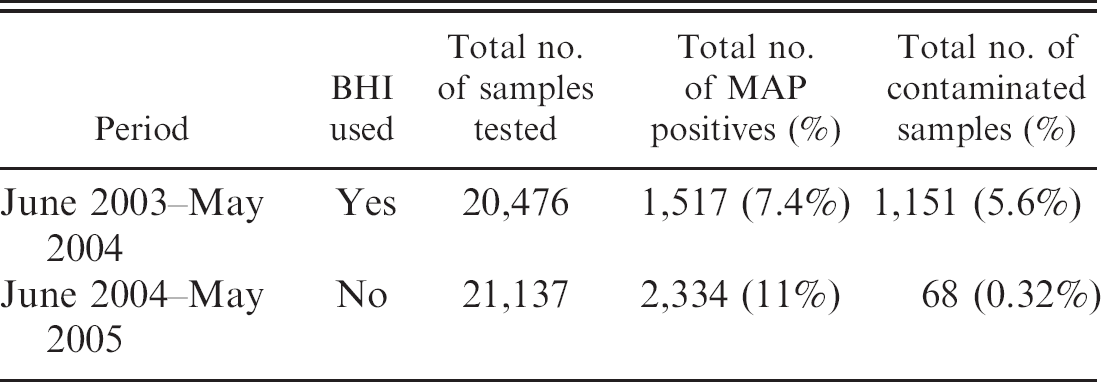
The Animal Disease Diagnostic Laboratory, Ohio and Veterinary Diagnostic and Investigational Laboratory, Tifton have eliminated BHI from the MAP culture procedures. Table 2 presents data for MAP recovery and contamination from samples cultured on HEY media at ADDL, Ohio. BHI was included in the decontamination process from June 2003 to May 2004 and BHI was not used in the decontamination process from June 2004 to May 2005. The fecal samples were processed using the centrifugation protocol provided by NVSL and were inoculated onto 3 HEY tubes with mycobactin J and 1 HEY tube without mycobactin J. The positive tubes were confirmed either by mycobactin dependency or PCR. Contaminated tubes were the tubes unreadable because of overgrowth of bacteria or fungus.
Less contamination rate and increased percentage of MAP recovery was observed during the period when BHI was not used. However, this data should be interpreted with caution because the number of positive herds submitted during each period and the quality of the samples may have influence on the MAP recovery and contamination rate. As the original intention of inclusion of BHI was to reduce contamination, it is important to note that elimination of BHI from the decontamination process did not result in an increased contamination rate. Some level of contamination is inevitable and acceptable in MAP culture. In a previous study, it was observed that 50% of the total ESP broth cultures and 67% of MAP positive cultures had viable bacterial or fungal contaminants. 6
The use of BHI in decontamination steps increases the contamination rate when HPC resistant bacteria are present in the sample. HPC resistant bacteria are not uncommon in fecal samples because quaternary ammonium compounds are used in many household and farm disinfectant preparations and they are a common ingredient in solutions used to prevent mastitis. 1
Comparison of culture results by decontamination method for 26 paired bovine fecal samples evaluated using an automated liquid culture system for the detection of MAP.*
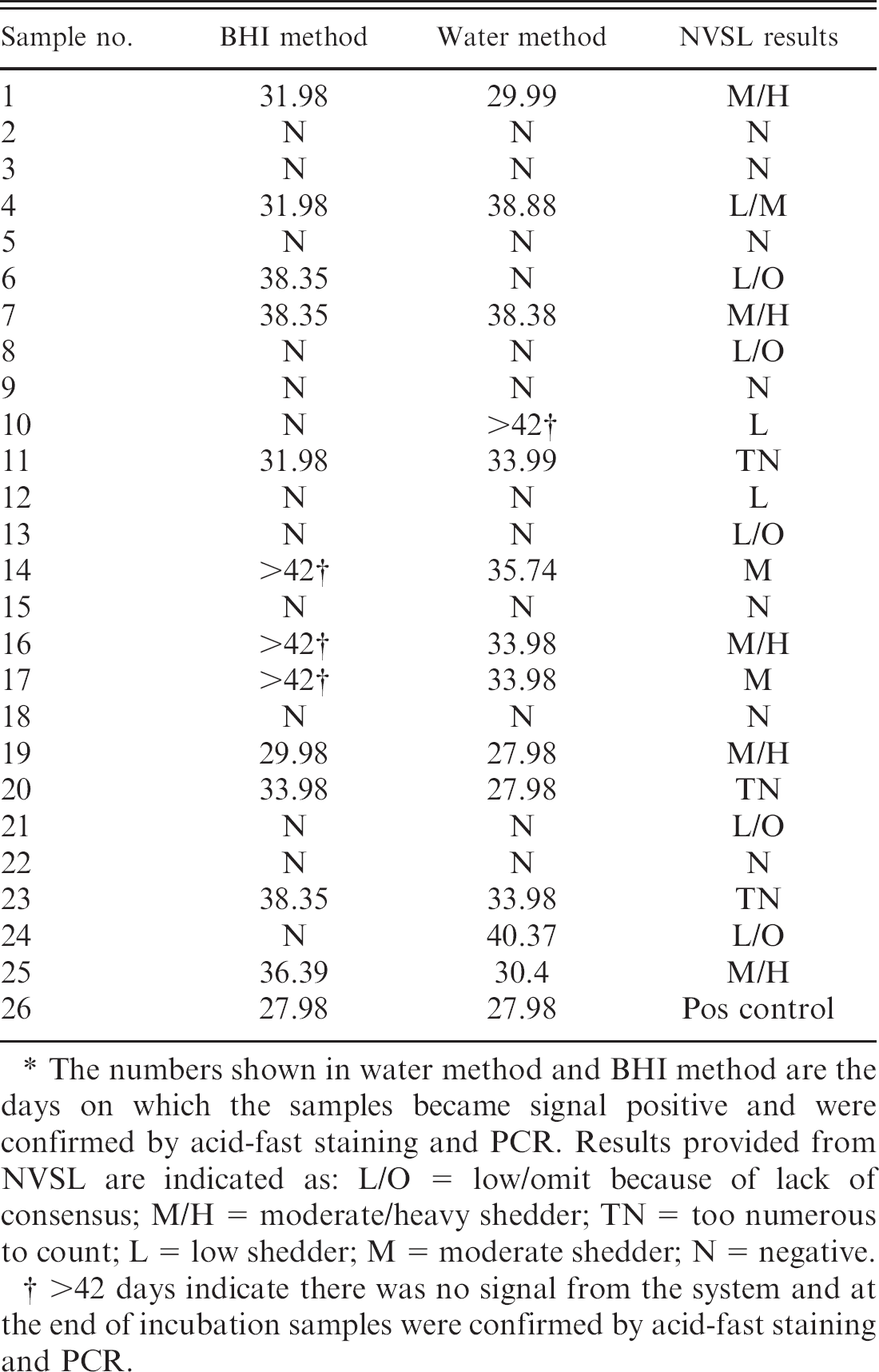
The numbers shown in water method and BHI method are the days on which the samples became signal positive and were confirmed by acid-fast staining and PCR. Results provided from NVSL are indicated as: L/O = low/omit because of lack of consensus; M/H = moderate/heavy shedder; TN = too numerous to count; L = low shedder; M = moderate shedder; N = negative.
>42 days indicate there was no signal from the system and at the end of incubation samples were confirmed by acid-fast staining and PCR.
Increased degree of contamination in liquid cultures may lead to false positive signals and may prevent the growth of MAP. In HEY tubes, the organism will cover the entire surface of the media making it impossible to read the tubes. A low level of contamination is not an issue in broth cultures because acid-fast staining can differentiate between contaminant bacteria and Mycobacteria and subsequent PCR will confirm the presence of MAP in the sample. It will be difficult to observe MAP colonies on solid media because contaminants overgrow and cover the surface of the media. However, geographical differences and climatic conditions may contribute to the level and type of contamination in MAP cultures.
The cost of BHI for the MAP decontamination process is US$ 0.10 per sample, not including the labor for preparation and sterilization of BHI. This study suggests that BHI may not be a required component in the decontamination procedures used in MAP culture and elimination may result in increased MAP detection rate and also may reduce cost of testing.
Data on percentage of positives and rate of contamination on MAP cultures from ADDL, Ohio.
Footnotes
a.
Trek Diagnostic Systems, Westlake, OH.
b.
SPSS version 12.0, SPSS Inc., Chicago, IL.