



Abstract
Fecal culture has been the primary method used to diagnose paratuberculosis in goats. It is laborious, slow, and expensive. Validation of enzyme-linked immunosorbent assays (ELISAs) on milk samples could make paratuberculosis testing more widely available for goat farmers. The aim of this study was to determine the accuracy of serum and milk ELISAs for paratuberculosis, relative to fecal culture, in Chilean dairy goats. Eight dairy goat herds were selected. Feces, blood, and milk samples were collected from all female goats >2 years old. Fecal samples were cultured using Herrold egg yolk medium with mycobactin J and antibiotics. Serum and milk samples were tested using a commercial ELISA kit for Mycobacterium avium subsp. paratuberculosis antibody detection. A total of 383 goats were tested by ELISA and fecal culture. The sensitivity of ELISA on serum and milk relative to fecal culture was 74.3% (95% CI: 59.8-88.8) and 60% (95% CI: 43.8-76.2), respectively. The corresponding values for ELISA specificity based on the percentage of non-M. avium subsp. paratuberculosis-infected goats testing ELISA-negative were 98.6% (95% CI: 96.6-100) and 99.3% (95% CI: 97.9-100) on serum and milk, respectively. Proportions of positive results for serum and fecal samples were significantly different, whereas the proportions of positive results for milk and fecal samples were not significantly different. The milk ELISA had a moderate level of agreement with fecal culture results (Kappa = 0.57). The paratuberculosis ELISA on goat milk samples may be a cost-effective, accurate alternative to fecal culture.
Paratuberculosis was first reported in Chile by Gringbergs and Caorsi, 3 who described the disease in cattle in the Valdivia province. Since then numerous cases of bovine paratuberculosis have been diagnosed clinically and bacteriologically in Chile. 15,17 The disease has also been described in sheep, 17 and more recently it has been reported in goats. 6 In many countries, paratuberculosis is common in goats, and its effects on production can be economically significant. 1,7,9,13 However, the herd prevalence in goats in most countries, including Chile, is unknown. Prevalence estimation as well as paratuberculosis control and prevention programs depend on the application of accurate diagnostic tests.
Diagnosing paratuberulosis by culture is laborious, slow, and expensive. The cost of paratuberculosis testing is a significant impediment to infection surveillance and control, particularly for small ruminant industries, because of the low economic value of each animal. Validation of enzyme-linked immunnosorbent assays (ELISAs) on milk samples could make paratuberculosis testing more affordable and more widely available and provide a useful tool for the management of this disease by dairy goat farmers.
The goal of this study was to determine the accuracy of serum and milk ELISAs for paratuberculosis, relative to fecal culture, in Chilean dairy goats.
Eight dairy goat herds from different geographic areas of the country (central and southern regions) were selected for the study. Four herds were intensively managed (stabled throughout the year), larger on average, and composed primarily of imported goat breeds, primarily Saanen. A history of paratuberculosis based on positive serology tests and clinical cases was kept on each herd. The other 4 herds were extensively managed (never stabled), rarely included animals purchased from other herds, and had no previous history or even knowledge about the disease. Age was the primary criterion for animal testing, with a view to increasing chances of detecting seroconversion to Mycobacterium avium subsp. paratuberculosis (MAP).
Feces, blood, and milk samples were simultaneously collected one time from all female goats >2 years old from October 2004 to January 2005. Feces were collected per rectum, transferred to a plastic bag, kept at room temperature, and cultured within 12 hr of collection. Blood samples (10 ml) were obtained from the jugular vein using Vacutainers, a and after clotting and centrifugation, the serum was harvested and frozen at −20°C until tested. Milk samples were obtained by manual milking into 50-ml plastic tubes, transported to the laboratory, and frozen at −20°C until tested. Briefly, fecal samples were cultured using a homemade Herrold egg yolk medium with mycobactin J b following the processing protocol developed at Cornell University. 14 At the end of the incubation period (9 mo), colonies resembling MAP and showing mycobactin-dependance were counted and confirmed by IS900 polymerase chain reaction (PCR) technology using specific primers for IS900 (P90 and P91). 15 Serum and milk samples were tested in duplicate wells using a commercial ELISA kit for MAP antibody detection. c Sera were tested according to the manufacturer's instructions for cattle. Milk samples were centrifuged (2,000 × g for 10 min), and a portion of the skim milk fraction was pipetted off from below the cream layer. This milk fraction was then treated like a serum sample with exception to the protocol: the milk was mixed with ELISA kit diluent at a ratio of 1: 2 instead of 1: 20, as was done for serum. The absorbance reading in all ELISA plate wells was measured at 620 nm using an automatic ELISA reader. d
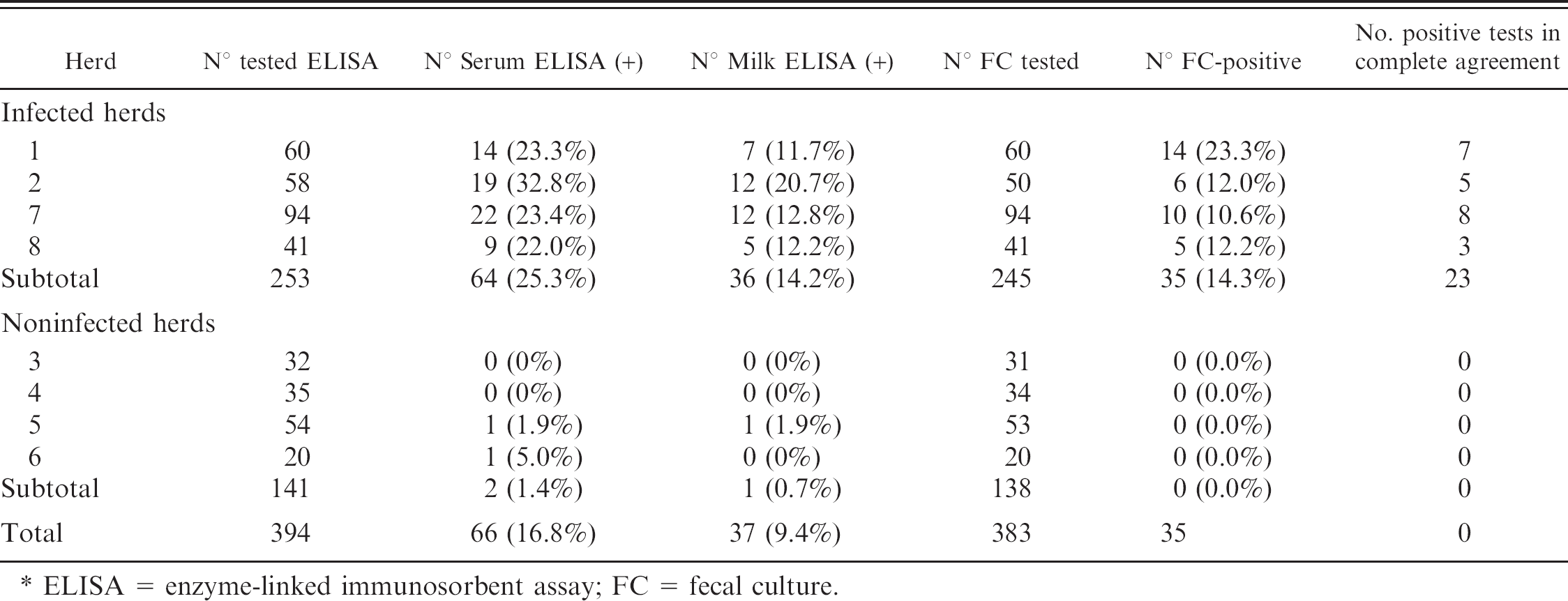
Number of goats tested for paratuberculosis on 8 Chilean dairy herds by serum and milk ELISA and fecal culture. *
ELISA = enzyme-linked immunosorbent assay; FC = fecal culture.
The case definition for a MAP-infected goat was isolation of MAP from a fecal sample. The case definition for a noninfected goat was a goat originating from a herd where none of the goats tested were fecal culture-positive. 13
ELISA optical density (OD) readings were transformed to S/P values as per manufacturer's directions:

All assays were run in duplicate, and all assays with a between-well coefficient of variation of ≥10% were repeated, and the second result was used for data analysis. The manufacturer's recommended cut-off for a positive assay in cattle, S/P ≥ 0.25, was used to define a positive serum or milk ELISA result.
Sensitivity was defined as the percentage of fecal culture-positive goats testing ELISA-positive. Specificity was defined as the percentage of non-MAP-infected goats testing ELISA-negative. The level of agreement between results for serum and milk samples was determined by calculating the Kappa value. The McNemar test was used to compare paired population proportions of positive results for the 2 ELISAs. Agreement levels between each of the 2 ELISAs and results of fecal culture were determined by calculating the Kappa value. Finally, paired population proportions of positive results were compared between each ELISA and fecal culture results by use of the McNemar test. All statistical analyses were done using InStat. e ELISA results were also evaluated at the herd level. Because ELISA S/P results by herd did not show homocedasticity and were not normally distributed, the ANOVA Kruskal-Wallis test was used, followed by the multiple comparative Dunn test. e
Among the 394 goats sampled, only 383 were tested by fecal culture, because 11 animals had no fecal material in the rectum at the time of sampling. These 11 animals were not included in the test accuracy estimation. Among the 8 herds, 4 had a total of 35 fecal culture-positive animals (9.1% of all sampled animals or 14.3% of goats tested from infected herds). The fecal culture-positive animals were categorized according to the shedding status as low (<50 cfu/g, 26 animals), medium (50-300 cfu/g, 6 animals), and heavy (>300 cfu/g, 3 animals) shedders. In the other 4 herds, no goats had a positive fecal culture. Among all goats tested, 66 (16.8%) goats had a positive serum ELISA and 37 (9.4%) had a positive milk ELISA (Table 1).
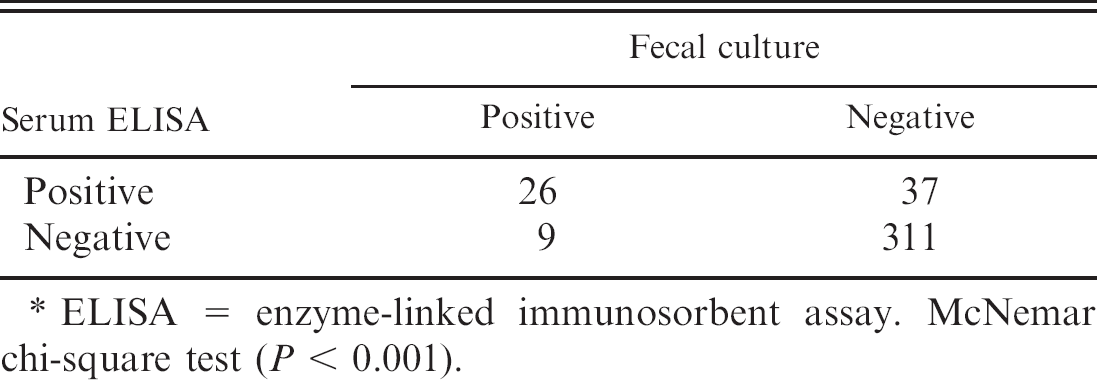
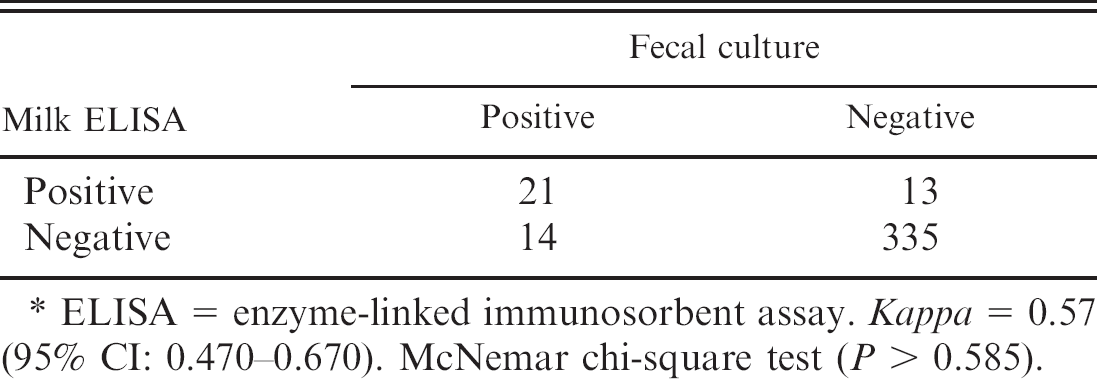
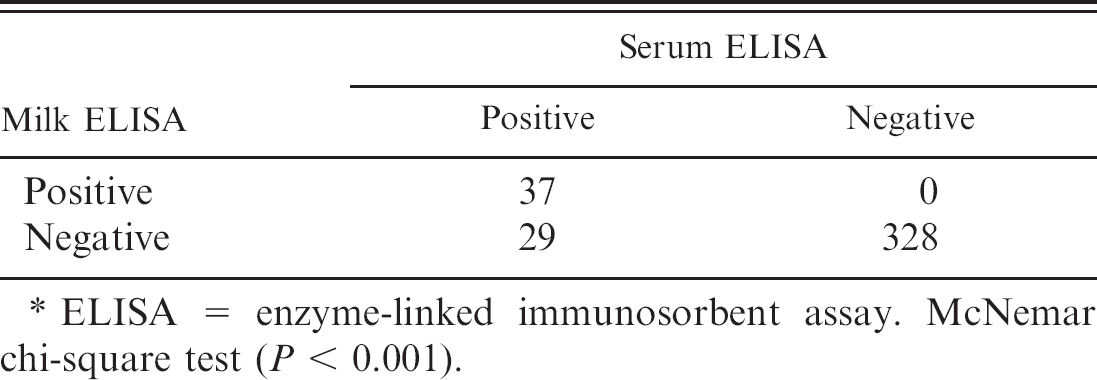
Of the 35 MAP-infected goats, 26 and 21 were serum and milk ELISA-positive, respectively (Tables 2 and 3). Because of the small sample size of the noninfected goats (n = 138), Receiver Operator Characteristics (ROC) analysis was not possible; therefore the manufacturer's recommended cut-off for interpretation of serum ELISA results for cattle was used. At the S/P cut-off of $0.25, the sensitivity of the serum ELISA was 74.3% (95% CI: 59.8-88.8) and the sensitivity of the milk ELISA was 60% (95% CI: 43.8-76.2). ELISA specificity was 98.6% (95% CI: 96.6-100) and 99.3% (95% CI 97.9-100) on serum and milk, respectively. The P value for the McNemar chi-square test showed that proportions of positive results for serum and fecal samples were significantly different (P < 0.001) (Table 2). By contrast, the P value for the McNemar test showed that proportions of positive results for milk and fecal samples were not significantly different (P > 0.585) (Table 3), and the level of agreement between results of milk ELISA and fecal culture was high (Kappa = 0.57). The P value for the McNemar test (P <0.001) (Table 4) indicated that proportions of positive results for milk and serum samples were significantly different.
Cross classification of serum ELISA and fecal culture results. *
ELISA = enzyme-linked immunosorbent assay. McNemar chi-square test (P < 0.001).
Composite results of both serum and milk ELISAs showed significant difference among the 8 goat herds tested (P < 0.001). Using fecal culture as a reference test, the serum ELISA sensitivity and specificity based on herd status are comparable to those of other publications on serum ELISA accuracy for diagnosis of paratuberculosis in goats. 1,8,11,13 Sensitivity of the milk ELISA was slightly lower than for the serum ELISA but the assay specificity was higher than that of the serum ELISA. When the ELISA was used on milk samples there was a higher level of agreement with the results of fecal culture (Kappa = 0.57), and the proportion of positive results for milk and fecal samples did not significantly differ (P > 0.585) (Table 2). These findings extend similar observations made previously on milk ELISA accuracy in US goat herds. 13 Milk ELISA for diagnosis of paratuberculosis in cattle has a sensitivity and specificity comparable to that of serum ELISAs in cattle, albeit lower than that observed in goats. 2,4 This could in part be attributable to the stringency of the reference test used for comparison or the antibody dilution found in high-producing dairy cattle as compared to goats. Also, milk ELISA sensitivity in cattle is affected by lactation stage, a factor not taken into account in the present study. 10
Among the 8 study herds, only 4 were infected, and a significant difference was seen in serum and milk ELISA results between infected and noninfected herds (P < 0.001). Furthermore, agreement among tests was higher in the more heavily infected herds; therefore, herd infection status was reflected in the serum and milk ELISA results (Table 1). The infected herds were generally larger, managed intensively, and systematically violated most recommendations for control of paratuberculosis by herd management, including routine introduction of animals of unknown paratuberculosis test status from herds of unknown MAP infection status. 5,16 These herds experienced clinical cases of paratuberculosis and even mortalities caused by the disease.
Cross classification of milk ELISA and fecal culture results. *
ELISA = enzyme-linked immunosorbent assay. Kappa = 0.57 (95% CI: 0.470-0.670). McNemar chi-square test (P > 0.585).
Cross classification of serum and milk ELISA results. *
ELISA = enzyme-linked immunosorbent assay. McNemar chi-square test (P < 0.001).
The 4 noninfected herds were managed extensively but did not import goats from other herds. Also, there was no mixed grazing with other susceptible rumminant species, a possible risk factor for paratuberculosis. 12 Thus, although these 4 herds also systematically violated other recommended management practices for control of paratubercu-losis, they did not experience problems because of paratuberculosis.
The present study found that caprine paratuberculosis is present and probably prevalent in Chile, particularly in those dairy goat herds that are modernizing through the introduction of animals to improve the genetic capacity of goats for milk production. The paratuberculosis milk ELISA for goats is fast and inexpensive. Although the milk ELISA sensitivity is lower than that of serum ELISA, milk ELISAs can be an effective method for detecting heavy fecal shedders (Tables 5 and 6). It offers the dairy goat industry a new affordable tool with which to control paratuberculosis. As with all indirect diagnostic tests for paratuberculosis, it is important that at least 1 culture-confirmed case of paratuberculosis be demonstrated in the herd before placing confidence in the ELISA results; also, the infection status of ELISA-positive goats should be confirmed with culture before removal based on ELISA results alone in subclinical goats.
Acknowledgement. This study was supported by the Microbiology Department, Faculty of Sciences, Universidad Austral de Chile.
Relationship between serum ELISA results and MAP-shedding status. *
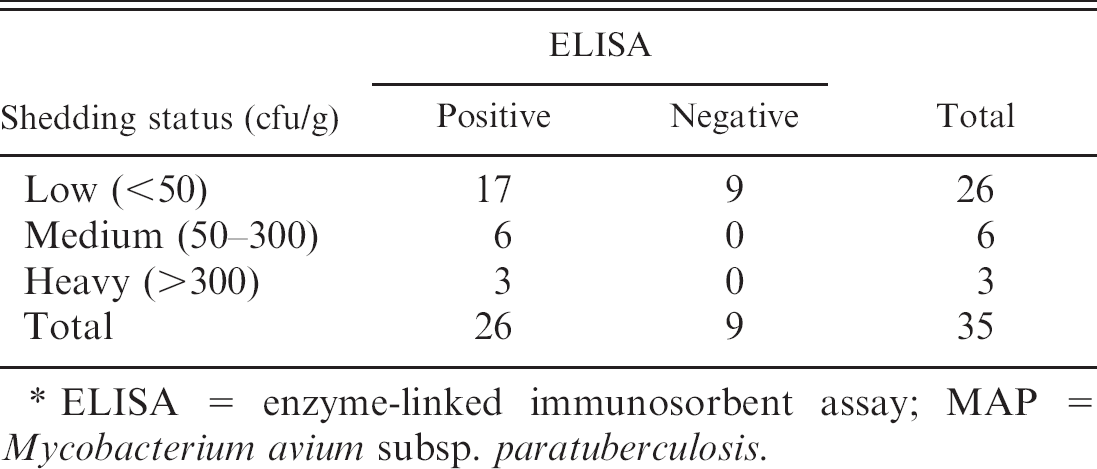
ELISA = enzyme-linked immunosorbent assay; MAP = Mycobacterium avium subsp. paratuberculosis.
Relationship between milk ELISA results and MAP-shedding status.
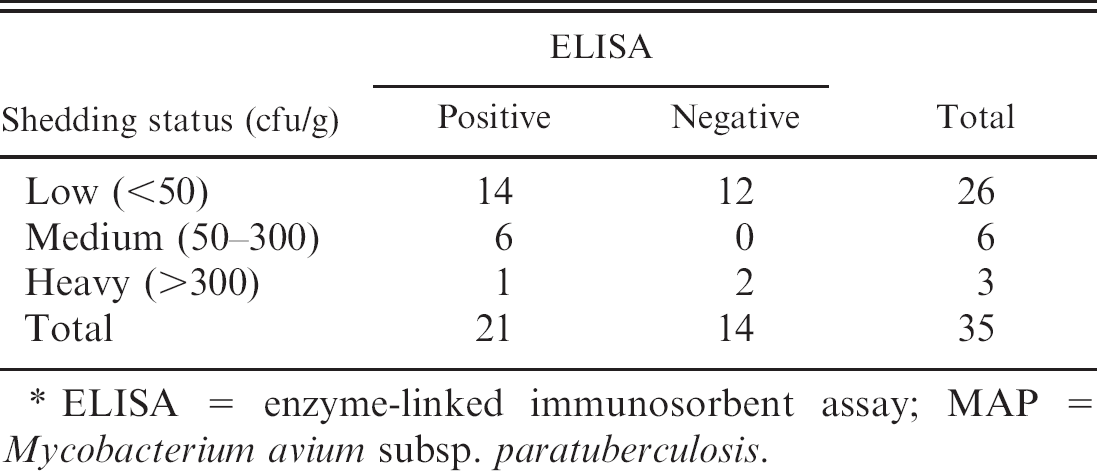
ELISA = enzyme-linked immunosorbent assay; MAP = Mycobacterium avium subsp. paratuberculosis.
Footnotes
a.
BD Diagnostics, Loveton, MD.
b.
Allied Monitor, Incorporated, Fayette, MO.
c.
IDEXX Laboratories, Inc., Westbrook, ME.
d.
BIO-TEK Instruments, Inc., Winooski, VT.
e.
Instat version 3.00 for Windows 95; GraphPad Software, Inc., San Diego, CA.