




Abstract
Objectives
People with mental illness can experience low levels of physical activity, low self-esteem, loneliness and social disconnection. This pilot study examined short-term benefits of participating in belly dance classes on mental and physical health.
Methods
Participants were recruited into one of two dance groups; each had a maximum of 12 people. They attended four weekly one-hour classes, completed questionnaires at baseline and after 4 weeks and participated in group discussions after each class.
Results
Twenty-one women participated, aged 19 to 87 years. At baseline, 52.4% rated their current mental health and wellbeing as very good or excellent increasing to 66.7% after 4 weeks and eight participants (38.1%) were receiving treatment for mental illness. After 4 weeks, 81% reported improved physical health and 76% noticed social improvements. All participants (100%) reported classes had a positive impact on their mental health and wellbeing and commented they felt more connected, less anxious, less self-conscious, happy and relaxed.
Conclusions
These findings suggest a brief series of belly dance classes may increase self-confidence, social connectedness, and overall mental and physical health. Belly dance could be a novel approach to address challenges such as social isolation, self-stigma and inactivity experienced by people with mental health conditions.
People with mental illness such as depression or psychotic disorder often have low levels of physical activity, 1 experience negative feelings such as low self-esteem, loneliness and social disconnection, 2 and may have impaired cognitive functioning. 3 Evidence shows that dance movement therapy (DMT), which is delivered by a trained art specialist and includes a psychotherapy component requiring clinical and psychological assessment, is associated with improvements in physical, emotional and cognitive areas,4–8 which suggests that other forms of dance could provide similar benefits.
Belly dancing, also known as Arabic or Middle Eastern dance, is a culturally based form of dance movement and physical activity integrating controlled, isolated body and arm movements. There are different styles that are available in the community and can be adapted for people of different ages, abilities and physical capabilities. Taught by a dance instructor, it has been practiced by both men and women, young and old, for many years.
People who engage in belly dancing report experiencing a healing effect, a sense of community, belonging, and support; improvement to their mood; and feeling more empowered, specifically improved self-confidence. 9
To date, few studies have explored belly dance as an intervention to improve mental health and wellbeing. Existing studies have mainly focused on the impact of belly dance on physical illnesses, particularly among women undergoing treatment for breast cancer.10–12 These studies reported that belly dance had a positive effect on self-esteem and body image and was associated with a reduction in depressive symptoms.
This pilot study aimed to: (1) examine the feasibility and acceptability of conducting belly dance classes to improve mental health and well-being in a general population sample; and (2) assess the short-term benefits of belly dance on participants’ mental and physical health and well-being.
Methods
In this pilot study, participants were allocated into one of two belly dance groups based on their availability. Each group attended a one-hour weekly class over a 4-week period. Classes were run by a professional belly dance and somatic movement instructor and were limited to 12 people to ensure participants had plenty of room to move. The dance instructor was not part of the research team, and the classes were run in the instructor’s community-based studio. The belly dance intervention used in this study was not part of a DMT program and did not include a psychotherapy component. Classes followed a flexible format allowing the instructor to adapt the format according to participants’ needs and abilities. It included a warmup, followed by the dance instructor leading participants through some basic belly dance movements incorporating somatic movements, and ending with breathing and stretching movements. Somatic movements complement belly dance as it focuses on body awareness, isolation and internal sensation.
Participants were recruited from the general community through recruitment flyers, social media, multiple emailing lists, e.g., university staff and student distribution lists and people forwarding the information to others. All participants gave written informed consent and completed a self-administered questionnaire before the first class and at the end of the study. The questionnaires were developed and administered via REDCap, a secure electronic data capture tool hosted at the University of Western Australia. 13
Data collected included sex, age, postcode, marital status, previous dance activity and current mental health treatment (see supplementary file). To assess changes in health, we asked participants to rate their mental and physical health on a scale from excellent to poor. At baseline, participants identified what they expected to gain from the classes and at the end of the study we asked them to rate the impact of participating in the dance classes from strong positive to strong negative impact. After each class brief group discussions were held enabling participants to socialise and provide written or verbal feedback if they chose to, including a rating of the class. There were no prompts given by the dance instructor or researcher to guide the group discussions. These comments were collated and reviewed. Participants were reimbursed a nominal amount to cover transport and other costs they might have incurred.
Approval to conduct this study was provided by the University’s ethics committee on 23 April 2024, in accordance with its ethics review and approval procedures.
Results
A total of 21 people participated in this pilot study. They ranged in age from 19 to 87 years (median = 45). Nineteen participants identified themselves as female, 1 non-binary and 1 preferred not to answer. Eight participants (38.1%) reported currently receiving treatment (medication/therapy) for a mental illness and 47.6% had previously attended dance classes. The majority (85.7%) expected that participating in the belly dance classes would result in increases in physical activity, 61.9% expected more social interaction, and 52.4% felt it would relieve stress. All (100%) participants completed the study, with 85.7% attending all four classes. Any non-attendance was due to illness.
Participants self-reported current mental and physical health at baseline and end of study (N = 21)
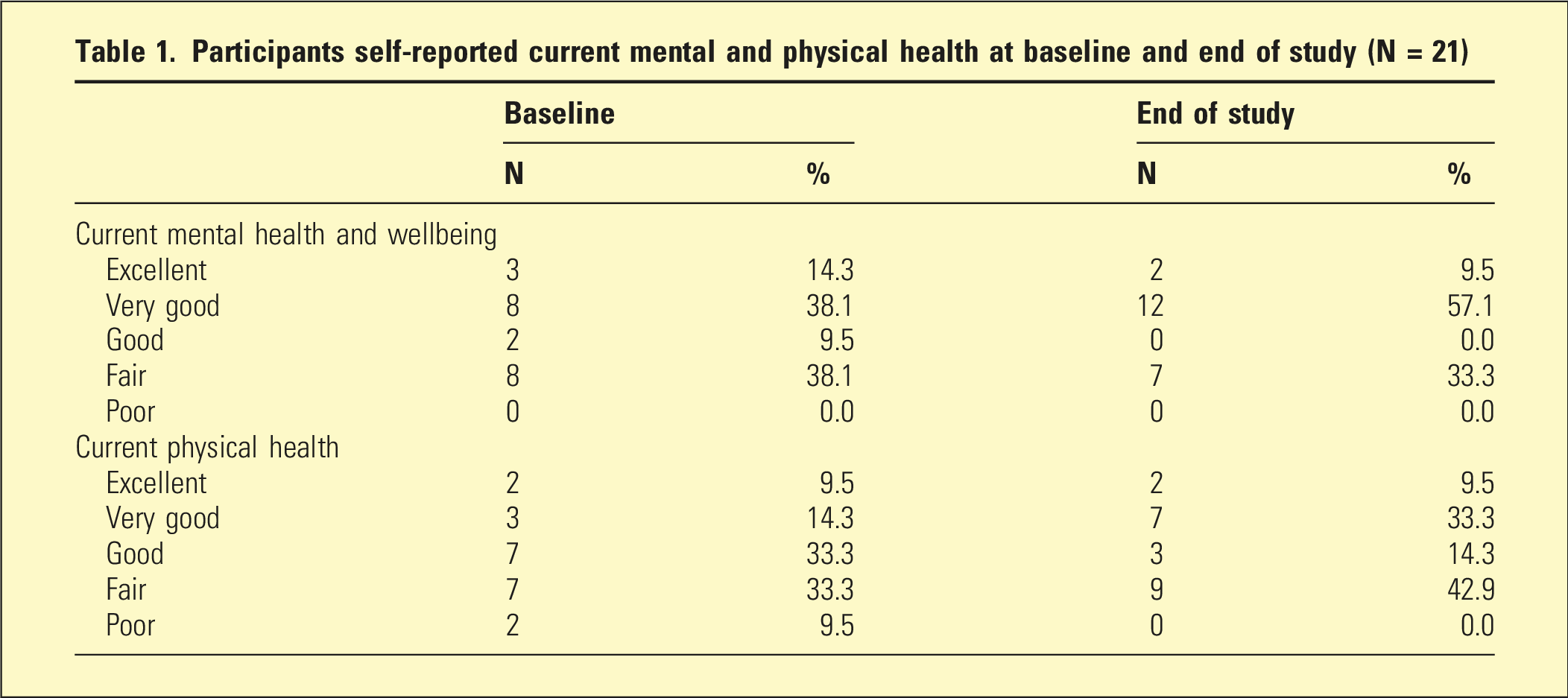
Feedback from group discussions included that they felt more connected, less anxious, less self-conscious, happy and relaxed. Quotes from participants included “I was very anxious before but feeling more relaxed and centered” and “Feeling mentally tired beginning of class, at end felt connected, nice to interact with people and laugh”.
Discussion
This pilot study was conducted to assess the feasibility and acceptability of belly dance classes as an intervention to improve mental and physical health and wellbeing. All participants completed the 4-week study, with 85.7% attending all four classes. Qualitative data collected indicated that for this population, belly dance was an acceptable intervention. One participant said “What a fantastic opportunity. Classes made muscles loosen up, huge rush of dopamine, head felt lighter. Some days I didn’t want to leave the house, but I forced myself to and so glad because I benefited from it mentally”. Any non-attendance was due to illness; therefore, it is reasonable to assume that if they had been well, we may have had 100% attendance for all four classes.
Over the 4 weeks, the data showed that most participants reported an overall improvement in their mental and physical health which are similar to findings from other studies (Leite, de Bem Fretta, 11 Boing, Baptista 10 and Szalai, Levay 12 ) which had longer intervention periods. This suggests that short-term participation in belly dance classes could be beneficial to mental and physical health. Shorter interventions may promote attendance as it may be easier to commit to attending four to six classes run on a regular basis rather than longer periods. In addition, this aligns with classes run in the community which are usually offered for a 6 to 8 week term. The short discussion group at the end of each class provided an opportunity to socialise in a comfortable and safe environment and may have contributed to increased feelings of self-confidence and social connectedness.
Our results are consistent with previous research reporting positive outcomes of belly dance interventions across diverse populations, including individuals experiencing gendered victimization, 14 sexual harassement, 15 fibromyalgia, 16 and cancer.10,12
While causal inferences cannot be drawn from the current pilot study, the combined findings across populations suggests that belly dance may represent a valuable intervention to support people living with mental illness. Further research is required to confirm this and to see which specific clinical mental health populations may benefit most and whether specific strategies would be required to support implementation across different populations.
Strengths and limitations
This was as pilot study with a small sample size. The participants were all female and may have been more favourable to trying the classes reflecting why the classes were well attended with no withdrawals. The use of the term “belly dance” may have discouraged men from considering taking part. However, the shorter period of classes (4 weeks) and incorporating time for discussion at the end of classes supporting connection-building may have contributed to continued attendance.
Conclusions
Belly dance is an activity that is available in the community that is widely accessible. It’s a fun form of dance that can contribute to improved fitness, coordination, mobility and self-esteem. The belly dance classes taught in this study incorporated somatic movements, which focus on the internal experience of movement and allows participants to connect with their body and be more aware of how it moves. The classes provided a flexible and comfortable environment in which everyone could participate regardless of their age, gender, size, background or ability. In consultation with clinicians, researchers, dance instructors and people with a lived experience, belly dance classes could be adapted to provide a community-based intervention for those living with a mental illness.
Footnotes
Acknowledgements
We would like to acknowledge Keti Sharif, professional Belly Dance and Somatic Movement teacher, who conducted the dance classes and Susie Hincks, Meeting for Minds co-founder and lived experience research partner for her input and support of the study.

Ethical considerations
Approval to conduct this study was provided by the University of Western Australia Human Ethics Committee (approval no. 2023/ET000995), 23 April 2024, in accordance with its ethics review and approval procedures.
Consent to participate
Written Informed consent was obtained from all participants.
Author contributions
G.Valuri was involved all aspects of the study, including the conceptualisation & design, conducting the pilot study, collecting and analysing the data and writing – original draft, review & editing. A.Waterreus was involved in the conceptualisation & design of the study and writing – review & editing.
Funding
The authors disclosed receipt of the following financial support for the research, authorship, and/or publication of this article: Funding was received from The University of Western Australia, School of Population & Global Health 2023 Staff Incentive Scheme.
Declaration of conflicting interests
The authors declared no potential conflicts of interest with respect to the research, authorship, and/or publication of this article.
Data Availability Statement
Data sharing is not possible as data is identifiable.