



Abstract
Objective
To explain the new test for complying with the mental health principles under the Mental Health and Wellbeing Act 2022 (Vic).
Conclusion
The principles carry over limitations from the previous Mental Health Act 2014 (Vic) while also containing new features. The ‘all reasonable efforts to comply’ and ‘proper consideration’ tests resemble the existing test under section 38(1) of the Charter of Human Rights and Responsibilities Act 2006 (Vic) that also apply to public mental health services. Taking these duties together, public mental health services, including hospital and community mental health boards, clinical directors and clinical governance processes, will need to show concrete evidence of specific rights and/or principles being deliberated in their decisions.
On 1 September 2023, the Mental Health and Wellbeing Act 2022 (Vic) (
This paper provides an overview of the new principles in the Act and how Charter obligations require a functional positive duty to demonstrate how rights are complied with, not just in clinical decision-making, but also in the broader governance of a health service. The paper begins with a brief account of the failures under the previous Act and the Charter. Next, it highlights introducing new mental health principles into the Act and the duties and enforcement mechanisms available. Finally, it closes by providing practical advice about how practitioners and operational leaders can demonstrate compliance with these duties. Such advice may inform how human rights are implemented at service-levels in various Australian and New Zealand contexts.
Where we have come from
The Royal Commission into Victoria’s Mental Health System held that the mental health system had ‘catastrophically’ failed to meet expectations.
7
Among the many issues were discriminatory mental health laws and a failure by services to comply with the minimum standards within those laws.
1
Oversight bodies such as the Mental Health Complaints Commissioner (
Rights under the Charter of Human Rights and Responsibilities Act 2006 (Vic)
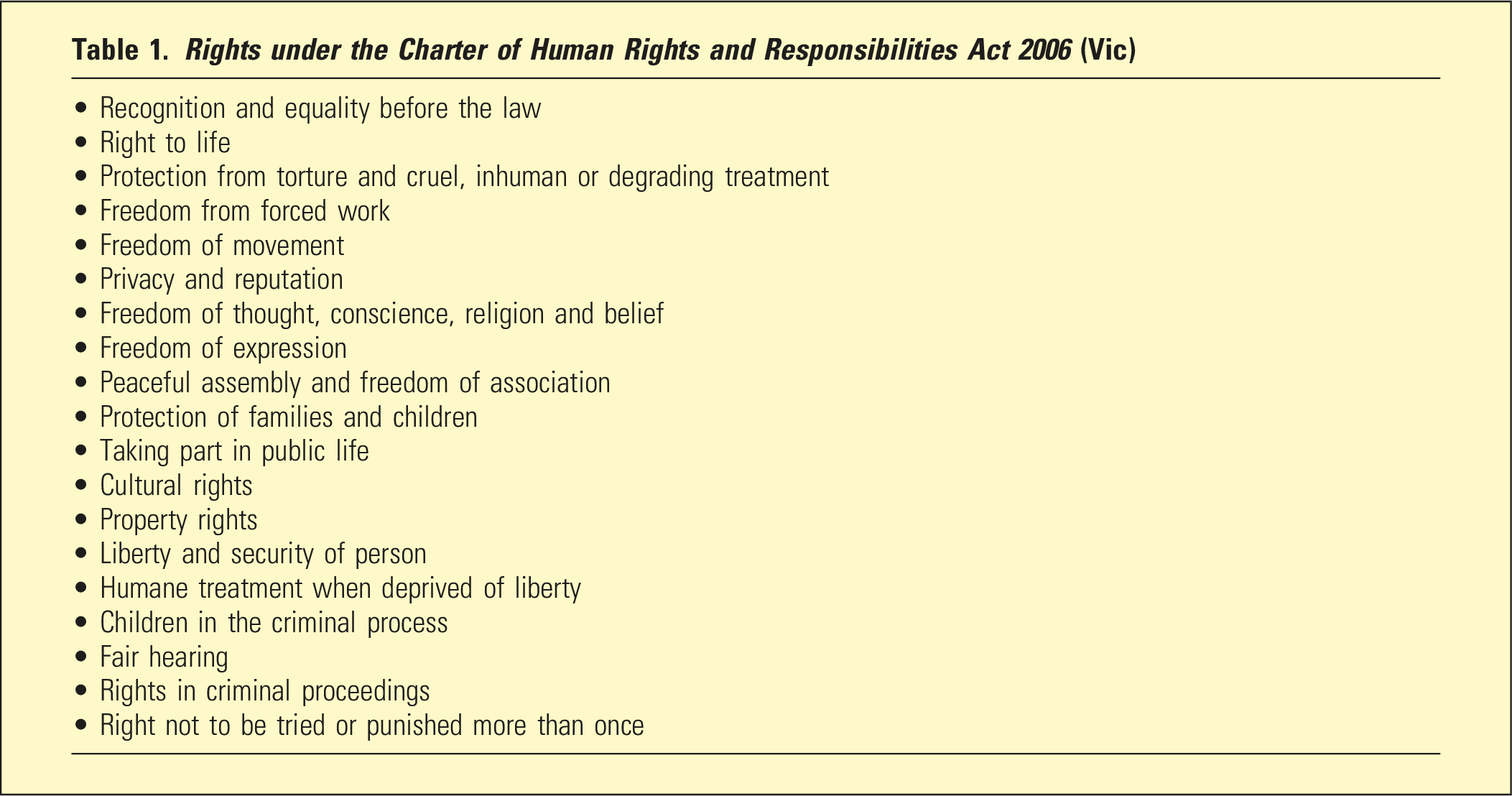
The Victorian Government and public mental health services have often failed to comply with this duty. 4 The Victorian Government had not shown proper consideration of relevant human rights across various parts of its systems management and service commissioning processes. Public mental health services’ models of care, how they are operationalised in risk-averse environments, and how clinical governance processes monitor them often fail to show proper consideration of relevant Charter rights. 4 These failures in public administration and clinical governance need change as part of a new mental health system.
The introduction of the Act
The passing of the Act presaged the creation of a range of new bodies as well as changes to the previous Commission, which now has a broader focus on stigma reduction and systems monitoring, with powers to conduct own-motion inquiries under the new name of the Mental Health and Wellbeing Commission (
Changes to the mental health principles were one such rights-related change. Under the previous Act, decision-makers exercising a function under the Act had to ‘have regard’ to the principles. The new Act and its principles create a longer list of 13 mental health principles (detailed in Table 1) and treatment decision-making principles to apply to treatment decision-making (not covered in this article).
Mental health principles under the Mental Health and Wellbeing Act 2022 (Vic)
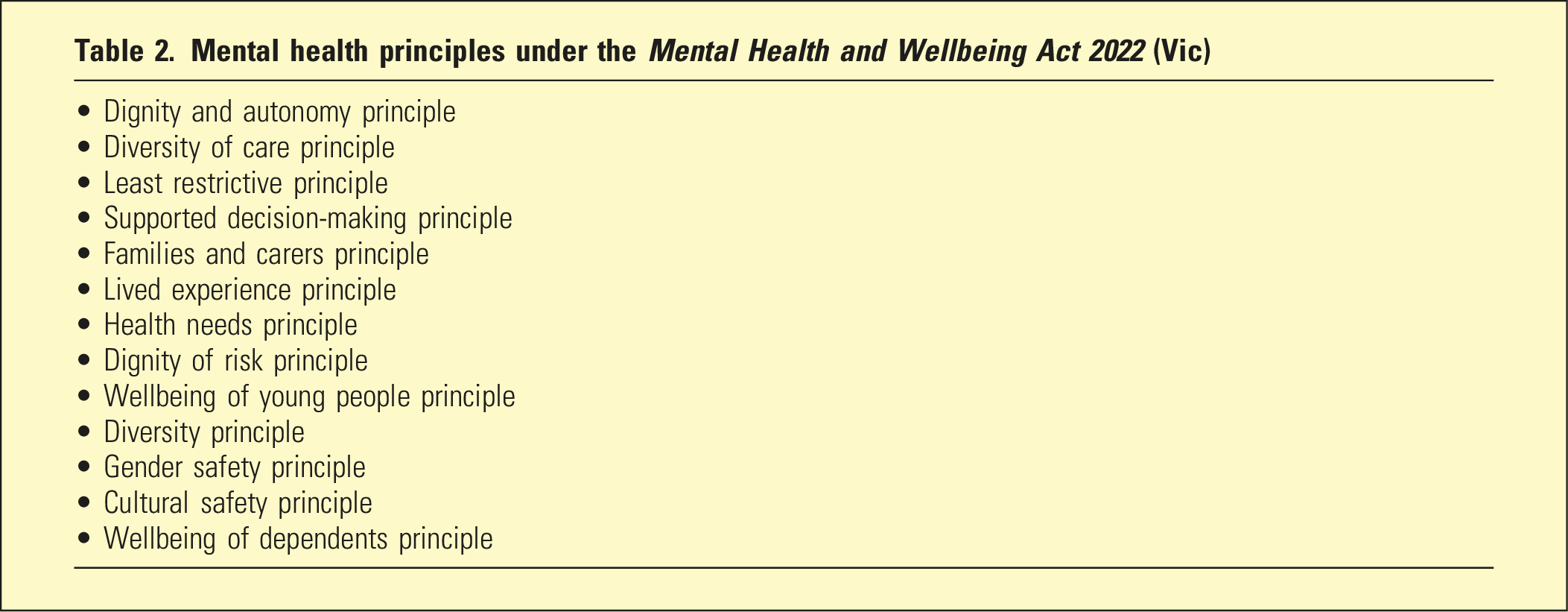
There are important enforcement and monitoring processes attached to these obligations. The new Commission will, like the previous Commission, have the power to handle complaints under the Act. This remit includes complaints about compliance with other provisions of the Act, about the provision or non-provision of services, about compliance with these principles and about the failure of a mental health service to deal with an internal complaint properly. Mental health services will also need to demonstrate how they have sought to give effect to one or more principles under the Act in their annual report.
The value of the principles and the Charter obligations is that they impose a duty on mental health service providers to seek to proactively address possible human rights issues. They do so by generating the duty at all levels of service delivery – with the requirement to demonstrate it with evidence. The challenge that this poses is that these legal tests can be, at times, cumbersome. Therefore, guidance on how and where hospital and community mental health boards and executives can practically comply with obligations under the Charter and the Act’s principles is crucial.
Translating the law into practice
Mental health and human rights laws are often criticised for being cumbersome and confusing. This may partly explain why the introduction of mental health principles has failed to change practice previously.
5
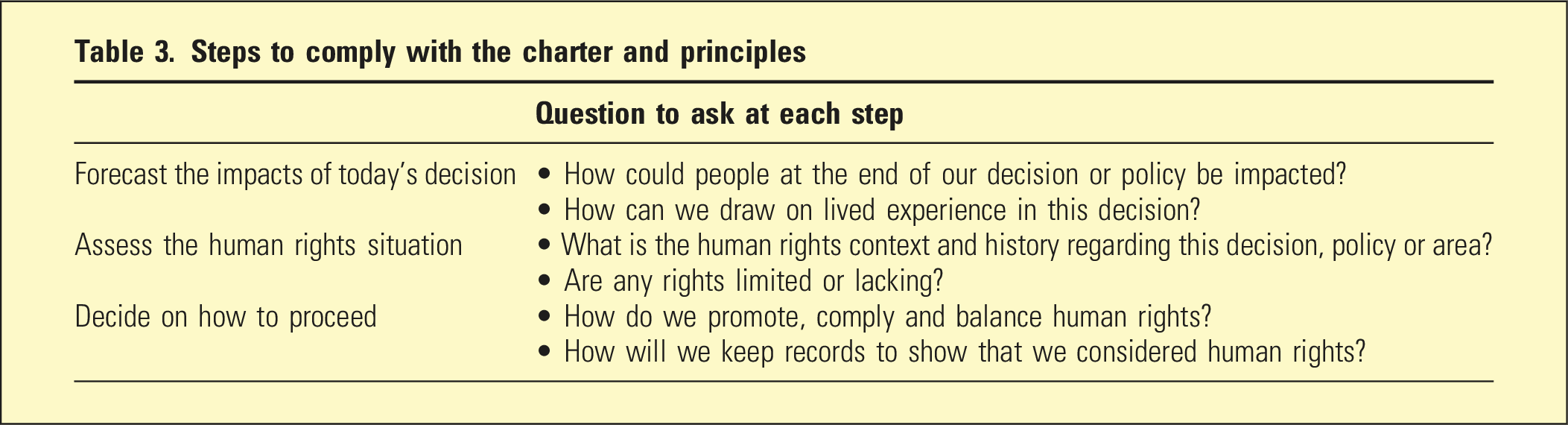
A new model – called the Human Rights at the Heart Model (
Steps to comply with the charter and principles
Examples of where human rights duties apply at governance, executive and management levels
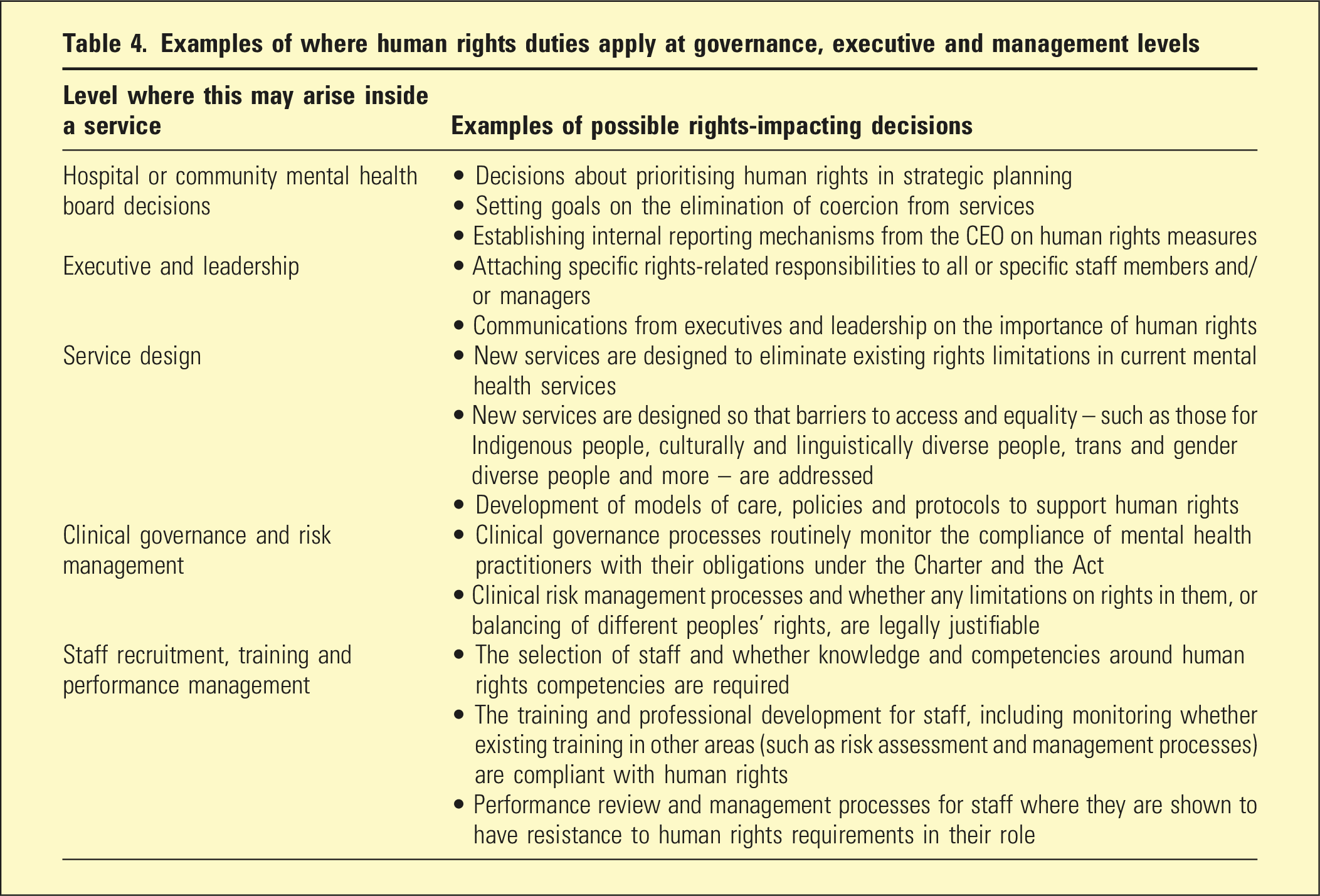
The HRatH three-step model (Forecast, Assess and Decide) may offer a helpful framework and serves as a constant reminder. It not only helps organisations adhere to the law and enhance governance and operational decisions but also underscores the fact that legal obligations and the risk of non-compliance extend beyond clinicians. Board members and executive staff who establish working conditions for mental health workers also share in the responsibility. Those board and executive staff should comprise of, and collaborate with, consumer workforce members.
Conclusion
The new mental health laws in Victoria build upon existing duties outlined in the Charter. The scale of legislative change in these reforms should not be overstated and reformers should learn from the failure of the previous Act that rights and principles are not self-executing. Their achievement also requires meaningful evaluation based on periodic reviews and strong alignment with international human rights measures 5 and improved regulatory oversight. 8 Nevertheless, renewal of mental health laws and principles provide an opening to challenge the status quo in mental health services by emphasising the importance of leadership in preventing human rights issues before they manifest. The HRatH model may provide a way for leaders to practically bring a human rights focus to their daily decision-making.
Footnotes
Disclosure
The author(s) declared the following potential conflicts of interest with respect to the research, authorship, and/or publication of this article: The author wishes to disclose that they provide paid training to public mental health services and statutory bodies utilising the Human Rights at the Heart (HRatH) model. The original model was developed for the Victorian Government in 2023. The author alone is responsible for the content and writing of the paper.
Funding
The author(s) disclosed receipt of the following financial support for the research, authorship, and/or publication of previous work that informed article: The author was funded as a consultant to provide guidance to the Department of Health (Victorian Government) on human rights. That guidance has informed this paper.
