



Abstract
Objectives
This study aims to explore the feasibility and impact of Schwartz Rounds® led by psychiatrists/mental health professionals in an urban Australian public hospital setting and to develop strategies for optimising participants’ experiences.
Methods
Being a mixed-methods study collecting qualitative and quantitative data through post-Rounds evaluation surveys, this study thematically analysed responses from 105 participants attending four consecutive monthly Rounds between February and May 2023 to assess the perceived benefits and challenges of Schwartz Rounds.
Results
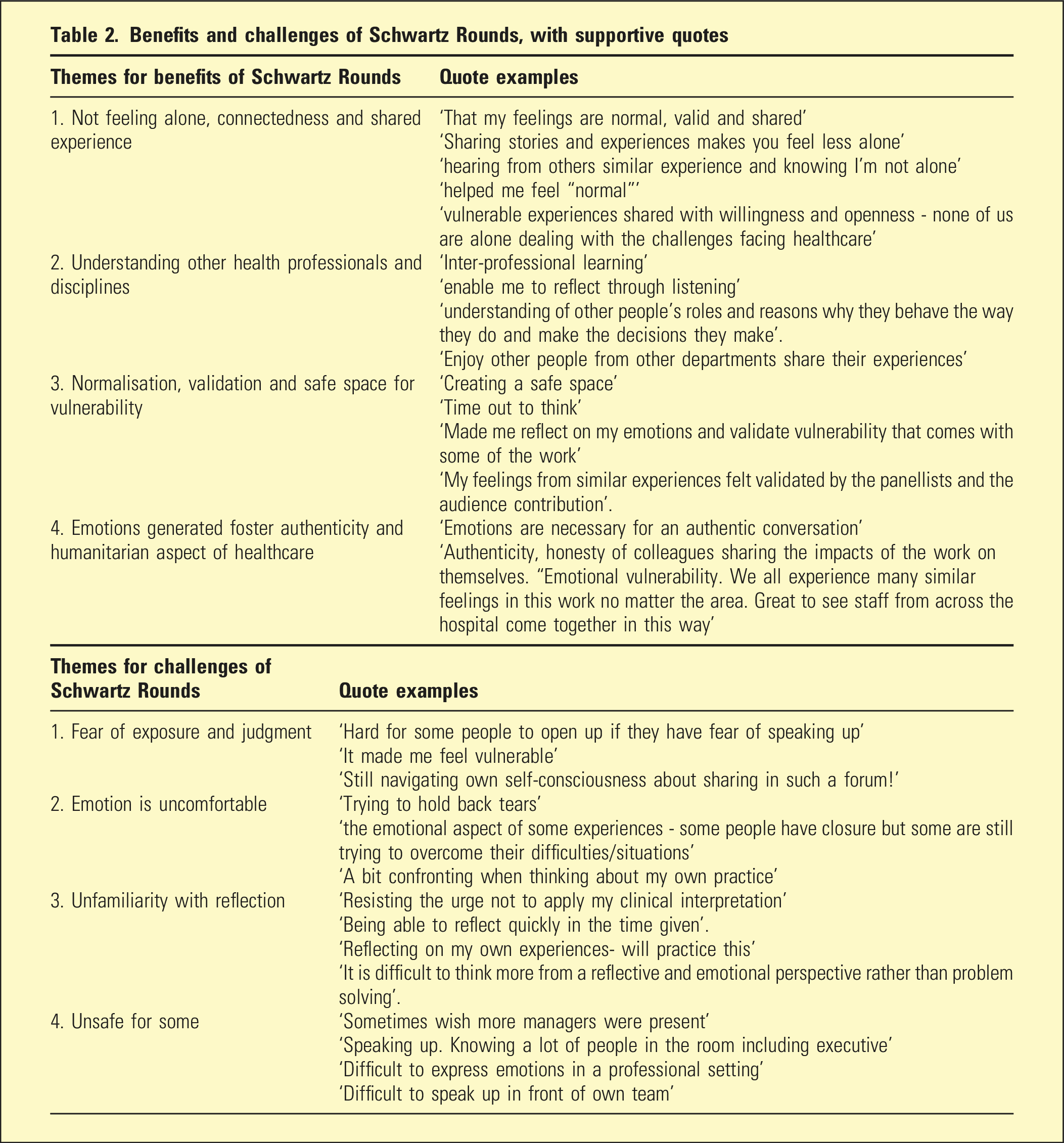
Respondents highly valued the Rounds and felt cared for by the healthcare organisation. Themes related to perceived benefits included (i) Connectedness and shared experience; (ii) Understanding other professionals; (iii) Normalisation of emotional distress, validation and a safe space for vulnerability; and (iv) Fostering authenticity and humanitarian aspects of healthcare. Challenges included (i) Fear of exposure and judgment; (ii) Emotional discomfort; (iii) Unfamiliarity with reflection; and (iv) Safety concerns.
Conclusions
This study suggests acceptability and feasibility of implementing Schwartz Rounds within an Australian public health setting, particularly when facilitated by skilled mental health professionals. The outcomes provide preliminary support for the use of group interventions to enhance staff collegiality and culture in healthcare settings, thereby addressing critical needs for health professional wellbeing.
Emerging evidence1,2 has shown that healthcare workers (HCWs) experience higher rates of work-related stress, burnout, depression, anxiety and suicidal ideation compared to the general public. This was exacerbated by the COVID-19 pandemic and its protracted impact across healthcare systems. 3 Importantly, the wellbeing of staff can directly impact patient safety, 4 the quality of compassionate care delivered, and in turn, the quality of patient experience.5,6 As such, healthcare systems around the world have identified an urgent need to prioritise HCW wellbeing and promoting compassionate patient care.
Schwartz Rounds® offer a structured group forum where clinical and non-clinical staff meet regularly to discuss the social and emotional aspects of working in healthcare. Developed by the Schwartz Center for Compassionate Healthcare, the Rounds provide an opportunity to take ‘time-out’ and reflect in a collegial and safe space. 7 The initiative was inspired by the late Kenneth Schwartz who, in an article in the Boston Globe, 8 reflected on his own experiences of authentic and compassionate care whilst being treated for terminal cancer. As he remarked, ‘the smallest acts of kindness made the unbearable bearable’. At present, in the face of the aforementioned challenges in our health systems, Schwartz Rounds have been adapted for many healthcare settings to foster reflective practice and promote psychological wellbeing of the workforce. 9
Drawing from the experience of Schwartz Rounds implementation, evidence from the US and UK has suggested that attending Rounds is correlated with improved HCW wellbeing and relationships with colleagues, and with more empathic and compassionate patient care. Maben et al. 10 found that, based on the Rounds’ inception, framework, conceptualisation and mechanism, there are unique features of Rounds not shared with other organisational interventions and unique outcomes of Rounds including increased connection and reduced isolation.
In Australia, there has been a slow but progressive uptake of Schwartz Rounds in Australian hospital settings. However, their efficacy and acceptability in the Australian setting has not been tested, nor has the role and impact of psychiatrists/mental health professionals as facilitators been explored.
Objectives
The aims of this study are to: (i) qualitatively explore the perceived benefits and challenges of Schwartz Rounds facilitated by psychiatrists/mental health professionals in an Australian public hospital setting; and (ii) develop greater understanding of the impact of Rounds in developing strategies for optimising the Rounds’ participant experiences.
Methods
Study design and setting
This was a mixed-methods study examining qualitative and quantitative data derived from post-Rounds evaluation surveys following Schwartz Rounds delivered in a large urban Australian public hospital.
The organisation made a Member Agreement with the Schwartz Center for Compassionate Healthcare, giving the organisation access to the Schwartz Rounds programme, expert training and opportunities to recognise compassionate care and leadership, and participation in a global compassionate care community. Members of the Schwartz Team received training in Schwartz round delivery.
The first Schwartz Rounds were delivered in the hospital on 14 February 2023.
The Schwartz Team consisted of a ‘leadership’ committee of eight, led by a psychiatrist, including a mental health clinical nurse consultant, social worker, nurse educator, chaplain, neurologist, psychiatry registrar and admin officer. This was supported by a larger ‘planning’ committee of 20 staff representing the diversity of professional roles from around the hospital.
Rounds occurred monthly at a consistent time in a large lecture theatre. Participants signed in using their staff numbers. Rounds began with the facilitator setting the frame for the session including ground rules, goals and outlining its structure. Two to three prepared panellists shared a personal experience for 4 minutes each, related to a pre-determined topic. Facilitators then encouraged the audience to introduce themselves by name, reflect on what they heard and share their own experiences and emotional responses. Facilitators ensured adherence to the frame, intermittently summarised the discussion and highlighted the emotional content of the audience contributions. The session concluded with final reflections from panellists, information of the next session and a request for the audience to complete the evaluation survey.
Participants
Participants included both clinical and non-clinical staff members who attended the Rounds, with the data collection starting from its inception in February to May 2023.
Data collection and analysis
Data were collected as part of the routine sign-in and post-Rounds evaluation from participants who completed an evaluation survey. At the end of the Rounds, participants were provided with a QR code for participants to scan using their smartphone to complete the evaluation survey. Data collected were directly populated onto REDCap data management system. 11
Demographic data were collected.
The two questions used for the qualitative analysis were those from the main survey (see Appendix 1) that prompted a free text response, namely: (1) What did you find helpful from your experience at the Schwartz Rounds?; (2) What did you find challenging about your experience at the Schwartz Rounds and how we could improve? We used inductive thematic analysis for the qualitative data analysis. The responses to the two open-ended survey questions were coded across the dataset until data saturation achieved. Authors KCYL and KL undertook selective initial coding; then all three authors (KCYL, KL, CP) used the process of constant comparison to search for meaningful patterns and consolidated these codes to generate themes. 12
This was supplemented by quantitative frequency data for data triangulation purposes.
Reflexivity
Championing Schwartz Rounds across the State, the authors were heavily invested in state-wide Schwartz Rounds implementation and mentoring. Accordingly, the authors’ personal investment in the success of Schwartz Rounds may have influenced data analysis. Reflexivity regarding this potential positive bias was considered in every step of the study from inception to end.
Ethics
The Quality Assurance research (2305-05) was approved by Western Sydney Local Health District Ethics Committee.
Results
Demographic details of the respondents in the post-Rounds evaluation survey
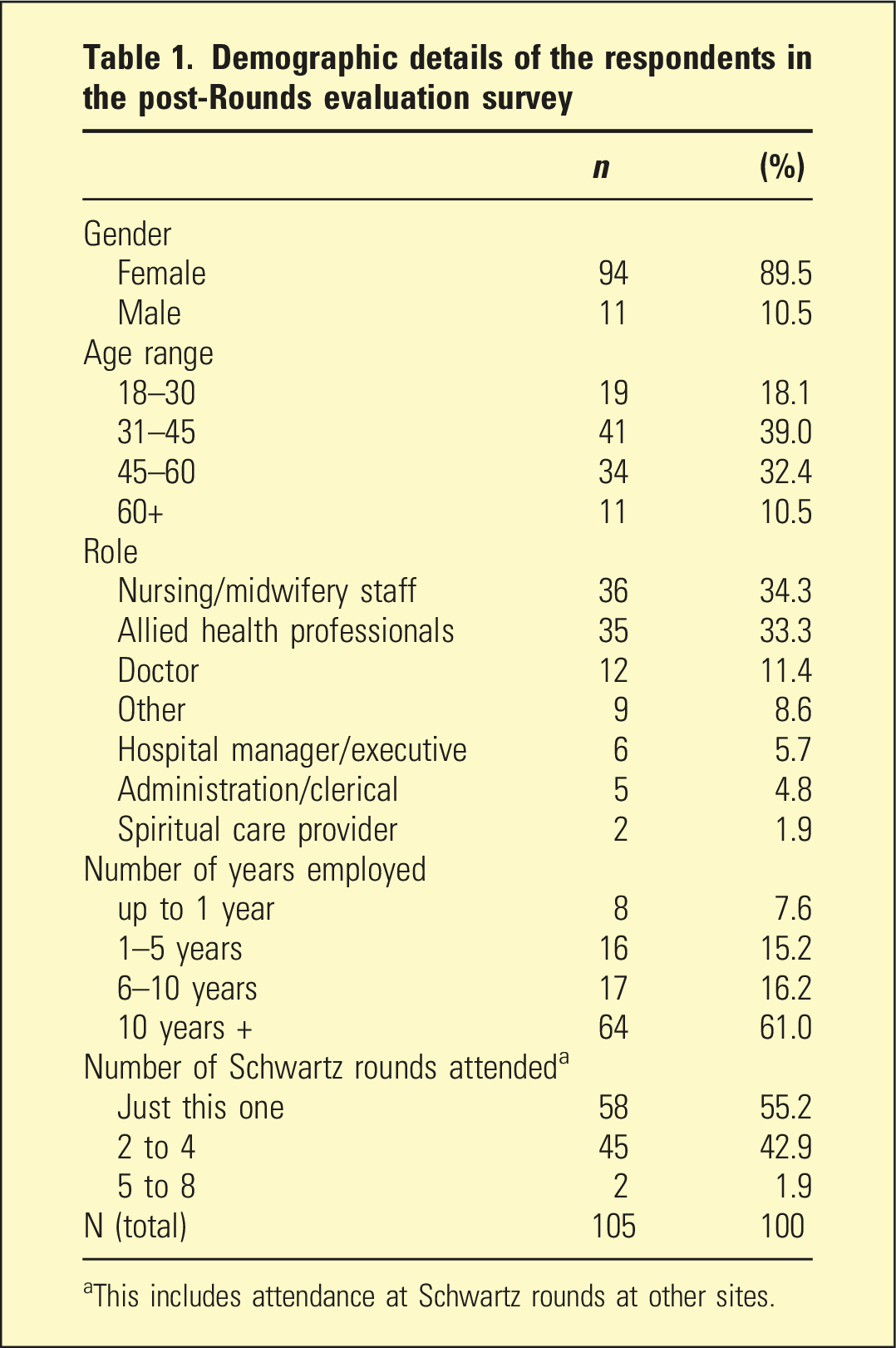
This includes attendance at Schwartz rounds at other sites.
Benefits and challenges of Schwartz Rounds, with supportive quotes
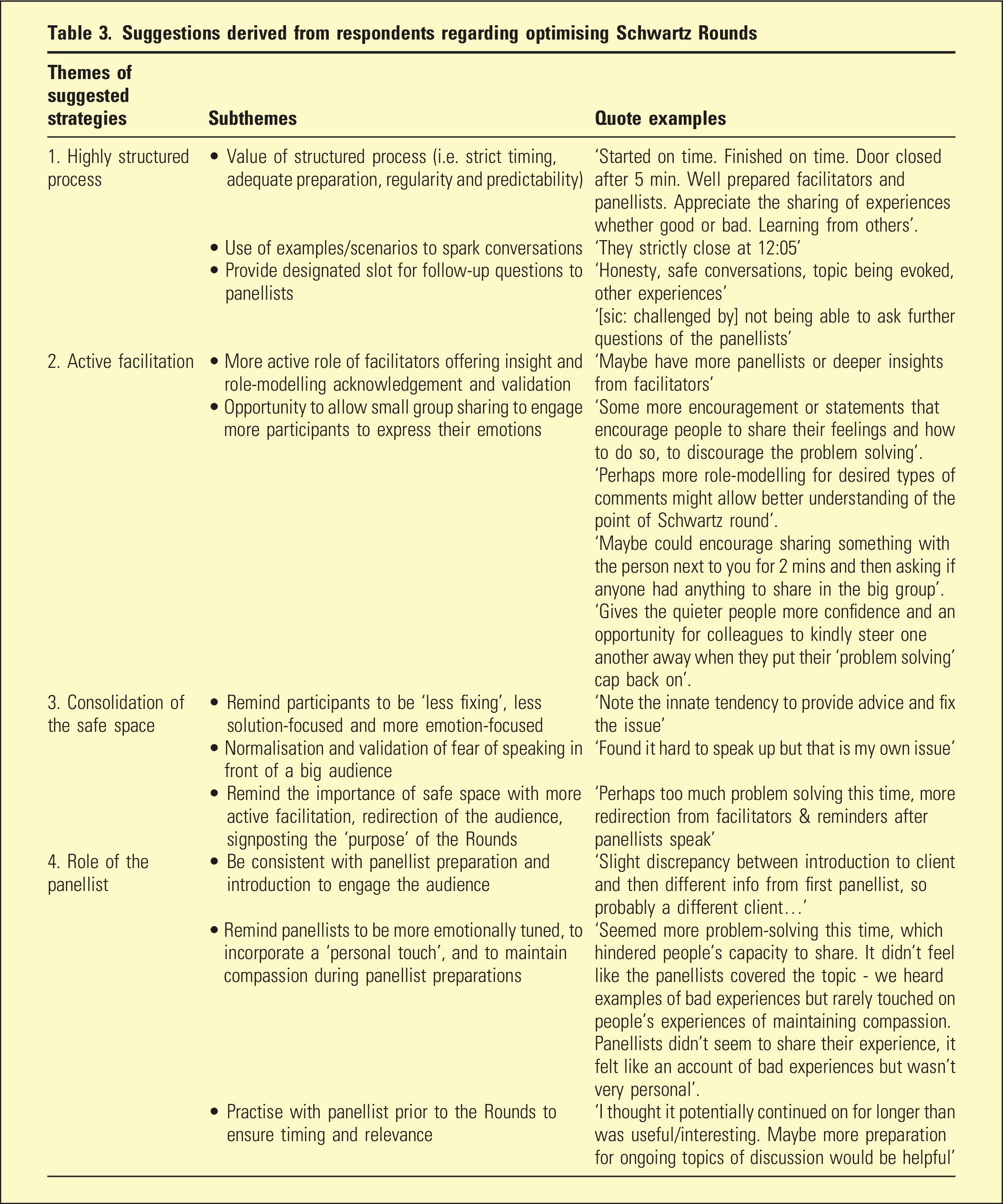
Suggestions derived from respondents regarding optimising Schwartz Rounds
Over the study period, almost all (99%) of respondents described their overall assessment of the Rounds as positive or very positive, and 100% would recommend Rounds to colleagues. 97.1% agreed or strongly agreed that they felt safe at Rounds. 100% either agreed, or strongly agreed that Rounds provided them with opportunity to reflect on their experiences of caring for patients and families. Most participants (93.3%) either agreed or strongly agreed that attending the Rounds made them feel that their organisation cared about their wellbeing.
Discussion
As far as the authors are aware, this quality assurance study, evaluating qualitative responses of Schwartz Rounds participants, is the first of its kind within an Australian public hospital setting. We await results of an important feasibility and impact study of Rounds delivered in a similar tertiary hospital setting. 13 From our data, staff were almost unanimous in their positive assessment of Rounds which offered a safe opportunity for reflection as well as the sense of being ‘cared for’ by the healthcare organisation. This was echoed by the emergent themes including: (i) Connectedness and shared experience; (ii) Understanding other health professionals; (iii) Normalisation of emotional distress, validation and a safe space for vulnerability; and (iv) Emotions fostering authenticity and humanitarian aspects of healthcare. Equally instructive for quality improvement and shared learning, were the identified challenges including: (i) Fear of exposure and judgment; (ii) Emotion is uncomfortable; (iii) Unfamiliarity with reflection; and (iv) Unsafe for some.
The themes identified in relation to benefits of Rounds were in keeping with findings from the US and UK.10,14 Perhaps useful in understanding the mechanisms by which such benefits might be achieved is to liken Rounds with some of the benefits of group psychotherapy, as defined by Yalom. 15 Yalom highlights 12 therapeutic factors, many of which might be correlated with our emergent themes, including Yalom’s Universality (‘we are all in the same boat’) which resonates with our emergent theme of Connectedness and shared experience; while Yalom’s Interpersonal learning and Development of socialising techniques resonates with Understanding other health professionals; and Yalom’s Catharsis may correspond to the emergent theme of Emotions fostering authenticity and humanitarian aspects of healthcare. We emphasise that Schwartz Rounds are distinct from group psychotherapy. However, some of the strategies identified here were usefully employed to invite more active facilitation and support for panellists, using psychotherapeutic techniques such as offering insight, acknowledgement, validation, normalisation and containment with structured processes and boundaries to enhance emotional, psychological and cultural safety. These techniques are akin to ‘common factors in therapy’ and the Contextual Model that explains how all psychotherapies produce benefits. 16 The challenges identified in this context, particularly the confronting nature of emotional expression, exposure and vulnerability in HCWs suggests we cannot underestimate the latter issue of safety. While this does suggest a role for baseline psychotherapeutic training for facilitators, it also suggests a need for empirical comparative outcome studies for different types of facilitators with different skillsets, and ultimately, protocol development to reduce variation in practice.
By creating a safe environment conducive to reflective practice, the Rounds begin to enable meaningful, contained conversations which may foster empathy and professionalism. While unfamiliar to some of our Rounds participants, reflective practice is widely used across health and delivered in a variety of ways.17,18 Rounds appear to promote reflection.
In healthcare environments often described as ‘toxic’ with alienation between frontline staff and management, 19 our data suggested the potential for Schwartz Rounds to facilitate a degree of rapprochement, with 93% of respondents reporting feeling cared for by the organisation.
Importantly, if we consider Schwartz Rounds as an agent of systemic cultural change promoting both wellbeing and interdisciplinary collaboration and support, widespread rather than skewed engagement is important. The over-representation of females (90%) and non-medical staff (89%) in our participants is almost identical to that observed in other studies. 10 This finding is important grist for the mill of continuous improvement of Schwartz Round delivery, by increasing engagement of the whole spectrum of staff and thereby (hopefully) increasing the impact of Schwartz Rounds.
Limitations and further research
Given the restriction of available data from participants who completed the surveys after the Rounds, the sample cannot be said to be fully representative of all HCWs and the variety of disciplines who attended the Rounds. Moreover, participation of Rounds and the completion of surveys were entirely voluntary. Those from our data set potentially had a skewed view favouring the Rounds (or the opposite). Nevertheless, the response rate of 47% is quite high.
Future studies may include a replicable controlled trial study, with valid outcome measures such as the Maslach Burnout Inventory, 20 the Professional Quality of Life Scale 21 and the Schwartz Center Compassionate Care Scale, 22 or comparisons with other forms of reflective practice. Our findings might be extended further with investigation of factors that enhance benefits of Schwartz Rounds (e.g. facilitator factors such as facilitator preparation and style, or the setting of Rounds) while addressing some of the challenges related to psychological safety.
Conclusion
Our study showcased positive acceptability and feasibility of Schwartz Rounds adapted within an Australian public health setting. The potential role of a facilitator trained in psychotherapeutic techniques to illicit safe reflection and emotional expression needs to be examined further. The outcomes also contribute to the body of literature that has emerged in the wake of the COVID pandemic on using group interventions in healthcare settings to foster staff collegiality, shared experiences, and morale, as well as modelling for other localities where such gaps are also identified.
Supplemental Material
Supplemental Material - A hospital-wide group approach to promote open dialogues of workplace issues and staff wellbeing with Schwartz Rounds
Supplemental Material for A hospital-wide group approach to promote open dialogues of workplace issues and staff wellbeing with Schwartz Rounds by Kelvin CY Leung, Kiran Lele and Carmelle Peisah in Australasian Psychiatry.
Footnotes
Acknowledgements
The authors would like to thank the members of the leadership committee who contributed to the establishment and success of the Schwartz Rounds in our facility. In alphabetical order: Adrianna Sheppard, Alison Grifiths, Anabel De La Riva, Andrew Bleasel, Kate Bradford, Kim Hobbs, Peter Hockey, and Tegan Dawson.
Declaration of conflicting interests
The author(s) declared no potential conflicts of interest with respect to the research, authorship, and/or publication of this article.
Funding
The author(s) received no financial support for the research, authorship, and/or publication of this article.
Ethical statement

Supplemental Material
Supplemental material for this article is available online.
References
Supplementary Material
Please find the following supplemental material available below.
For Open Access articles published under a Creative Commons License, all supplemental material carries the same license as the article it is associated with.
For non-Open Access articles published, all supplemental material carries a non-exclusive license, and permission requests for re-use of supplemental material or any part of supplemental material shall be sent directly to the copyright owner as specified in the copyright notice associated with the article.
