



Abstract
Objective
Up to three billion, of the eight billion people in the world, play videogames. Gaming is a significant global sociocultural influence. This primer will aid psychiatrists in understanding sociocultural milieux of gamers, who include patients and their communities.
Method
A rapid narrative review.
Results
Benefits include expression of personality, identity and culture through social aspects of gaming. Improved physical health, neurocognition, self-efficacy and quality of life are associated with gaming in those with certain mental health disorders including schizophrenia. Harms may include in-game discrimination, disordered gaming, as well as encouragement of online gambling. There is no longitudinal association between violent games and youth aggression.
Conclusions
Psychiatrists should enquire about gaming as part of the sociocultural milieux of patients’ lives, and the perceived mental health benefits and harms of gaming.
“Being human totally sucks most of the time. Videogames are the only thing that make life bearable.” - from the novel Ready Player One by Ernest Cline
Glossary of gaming terms
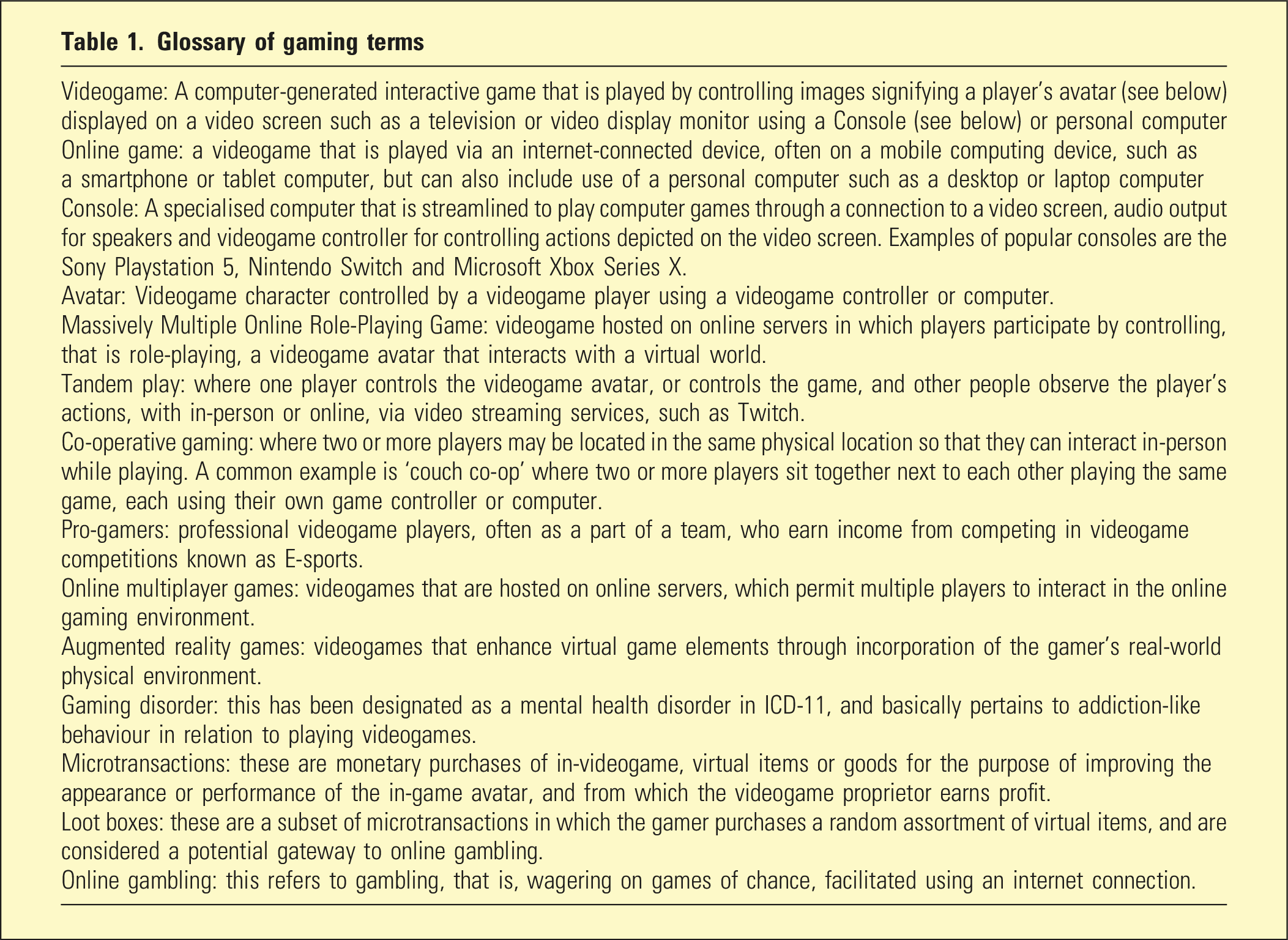
Why and how do people play video games?
Like most human pastimes, gaming is often a social activity. 4 Technological advances and increasing social acceptability have led to increased uptake and socialisation through immersive video and online games, 4 as evinced in world population participation levels. 1 Players seek achievement through performance in the game, social connection with other players, and immersion in the gaming experience and milieux. 5 These aspects are exemplified in massively multiple online role-playing games (MMORPGs) 5 such as the World of Warcraft or Elder Scrolls Online.
Social aspects of gaming may be most relevant to psychiatrists from a patient perspective. Popular online games include multiplayer games such as Apex Legends, Call of Duty, Diablo IV, Fortnite, Minecraft or Starcraft 2. 6 Players can socially connect, especially for cooperative game goals, 4 for example, Diablo IV players can form an online group of up to four players to navigate the game landscape and tackle challenges and tasks together, and compete together in larger group challenges. 7 Social tandem play occurs when one player is in control of the game, but others are watching, and can advise.4,8 Co-operative gaming, when two or more players are physically co-located, can enhance nostalgia, such as the experience of two friends playing together. 4 A minority of pro(fessional)-gamers earn income from gaming competitions known as e-sports. 9 We discuss the experiences of the majority of recreational gamers.
Benefits of gaming
Videogames had beneficial effects in reducing stress, isolation, anxiety and depression during the lockdown phases of the COVID-19 pandemic and more generally.10–13 A systematic review of 24 studies of the impact of videogames during the early pandemic found that there was evidence of a complex relationship, including benefits of online multiplayer and augmented reality games reducing anxiety, depression, loneliness and stress during stay-at-home restrictions for adolescents and young adults. 10 A cross-sectional NZ study of 2107 gamers found that 88.4% experienced emotional benefits from gaming, with men perceiving first-person shooter and stealth games were beneficial, while women found mobile and life simulator games more beneficial. 12 A recent narrative review found there was evidence that commercially-available videogames could benefit gamers in ameliorating anxiety and depression. 13 A systematic scoping review of 18 RCTs and 20 uncontrolled trials of videogame impacts on mental health found that there were benefits for youth in at-risk, to mild, and moderate mental ill-health categories. 14 This is in addition to interest regarding ‘Serious games’ that apply the positive properties of games to provide therapy and support to patients. 15
There is also evidence that commercial videogames are therapeutic for people with diverse challenges, including increasing social connectedness in young men with Duchenne muscular dystrophy, 16 and are associated with improved physical condition, neurocognition, social functioning, self-efficacy and quality of life in people with schizophrenia. 17 A systematic review of 28 studies of players of videogames found that there were benefits for reduced stress and anxiety in healthy people, as well as for Parkinson’s disease, depression, post-traumatic stress disorder, physical disabilities and chronic medical conditions. 11 There may be added mental health benefits for trans and gender diverse young people in being able to explore their identity expression through gaming avatars in a safe virtual environment. 18 Videogame makers are showing increasing awareness of the importance of allowing diverse avatar creation, for example, the recent Baldur’s Gate 3 fantasy role-playing game allows a vast range of gender and sexual orientations amongst other options.
A systematic review of RCT interventions to enhance neuroplasticity found different types of video games may be beneficial to brain structure and function. 19 Another found pro-gamers show structural and functional alterations in multiple brain regions and increased attention, sensorimotor function and cognitive control. 20 There are also significant correlations between time spent playing video games and mental flexibility, planning, visual working memory, visuospatial processing, fluid intelligence and verbal working memory performance. 21
Harms of gaming
There are a range of potential harms. Social discrimination occurs, especially for those who are lower-ranked on the game and are younger, and those who manifest the personality factors of low agreeableness and neuroticism. 22 Female gamers unfortunately experience harms from harassment, and stereotyping. 23 Disturbed sleep is common for habitual gamers. 24
Although there remains controversy as to the association between violent videogames and aggression, a recent review observed that there are meta-analyses both for and against an association, as well as concerns regarding publication bias, and although the American Psychological Association (APA) linked aggression and videogames, the APA position has also been criticised. 25 A recent meta-analytic review that adjusted for publication bias found no longitudinal association between violent videogames and youth aggression. 26
Gaming disorder is considered a rather controversial potential harm, characterised as: persistent gaming behaviour, impaired control over gaming participation and functional impairment for at least 12 months, as accepted in international diagnostic criteria, such as the 11th Edition of the International Classification of Diseases. 27 Gaming disorder is centred upon exclusion of other activities: failure to attend to work and important responsibilities, loss of real-world social contact, missing life experiences and opportunities, and lack of normal daily routine and self-care. 28 Gaming disorder prevalence is estimated at 2–3%, similar to rates of obsessive-compulsive disorder and some substance-related disorders. 27 However, there remain significant gaps in the evidence-base regarding the influence of methodological issues for case ascertainment, mental health comorbidity, cultural and demographic issues. 27 A systematic review of 24 studies during pandemic stay-at-home restrictions found a prevalence of 3.05%, as well as evidence of detrimental effects for vulnerable individuals for stress, anxiety, depression and loneliness. 10 Four effective interventions for gaming disorder were identified in the most recent systematic review: group counselling, craving behavioural intervention, cognitive-restructuring intervention and short-term cognitive-behavioural therapy. 29
Gamers may be encouraged to gamble online, such as in gaming which involves in-game microtransaction purchases to progress levels/achievements, and the inclusion of features that reward achievements, or random item-assortments known as ‘loot-boxes’. 30
A meta-analysis of studies of primarily male, US/European gamers found that higher conscientiousness was protective against the harms of problematic gaming, likely because of conscientious persons’ organisation and goal direction in general, including in ‘real life’. 31
A recent scoping review of studies of videogames as mental health interventions found most protocols lack evaluation of potential harms and this is likely an area that requires improvement based on the harms above. 15
Limitations
This is a limited scope narrative review, and there remain gaps in the evidence-base regarding both benefits and harms of gaming, especially in relation to knowledge of effects on those with mental illness, diverse backgrounds, and the effects of demographic, social and cultural factors.
Gaming and mental health
Videogaming engages the social nature of play, sense of achievement in mastering the game and immersion in an imaginary world. Psychiatrists should enquire about gaming in order to better empathise with their patients’ lives, to understand their sociocultural milieux, and improve therapeutic rapport: 1. Acknowledge and normalise gaming as an avocation like any other. Familiarity with games and gamer slang (https://englishonline.britishcouncil.org/blog/25-english-gaming-phrases-and-what-they-mean/) can assist rapport. 2. Ask about gaming as an enjoyable social pastime. What is the patient’s gaming sociocultural milieu? Does the patient experience any social discrimination within or against gaming? Does gaming improve overall social relationships? 3. What types of games does the patient play and how do they play? Ask the patient what the game involves, how, and why they play. 4. What does the patient enjoy or gain from gaming? 5. When, in what venue, and for how long does the patient play? 6. Is the patient experiencing any potential harms from gaming, such as symptoms of gaming disorder and excessive in-game purchase spending or online gambling.
Footnotes
Disclosure
The author(s) declared no potential conflicts of interest with respect to the research, authorship, and/or publication of this article.
Funding
The author(s) received no financial support for the research, authorship, and/or publication of this article.
