




Abstract
Objective
We report on the extent of veteran homelessness in Australia, what has already been done to address it and what actions are recommended to further improve the response.
Conclusions
Work conducted by not-for-profit organisations and the Department of Veterans’ Affairs are outlined with positive prospects for significant coordinated action to further address the situation reported.
We now know that a lot of Australians have served or are currently serving in the Australian Defence Force (ADF). For the first time, the 2021 Australian Census included a question about military service which found 84,865 were current and 496,276, or around 2% of the Australian population, were former serving members. 1 Previously, the Department of Veterans’ Affairs (DVA) could only estimate the total number of veterans based on those who chose to register with them.
Estimated prevalence of 12-month mental disorder in Transitioned Australian Defence Force (ADF) - Key findings 4

Major studies on the mental health of serving military personnel and veterans in Australia4–6 along with extensive investigations of veteran suicide7–9 have informed concerns about veteran homelessness. Suicide and suicidality is more prevalent in people experiencing homelessness than those who are not.10,11 United States research has shown that veterans have a 2 to 3 times higher risk of homelessness, 12 and that being homeless increases the risk of veteran suicide, which has in turn led to an increased effort to address homelessness as a way of reducing veteran suicide. 13 However, it is worth noting there are significant differences between the US and Australian veterans’ compensation and health care systems.
While there is no definitive source of information on the prevalence of veterans’ homelessness in Australia, it has been suggested that veterans are overrepresented in the homeless population of Australia, with 5800 veterans estimated to be homeless over a 12 month period. 14 Another study found that 5.6% of people sleeping rough in Australia were veterans, with veterans more likely to spend longer periods of time sleeping rough. 15 Also, 1300 persons who identified as current or former serving members of the ADF were assisted by Specialist Homeless Services in 2020–21 with 54% identifying as homeless and 46% at risk of homelessness. 3 However, Nielssen et al. 16 did not find a single DVA client among 2140 adults who attended an inner-city homeless hostel clinic and had been admitted to a hospital in NSW between 2008 and 2021, suggesting either a lack of individuals identifying as former serving ADF members or a lack of uptake of DVA services by veterans who are homeless or at-risk of homelessness.
Homeless veterans in Australia are at a higher risk of experiencing psychological distress and are at significantly higher risk of suicidality, with evidence indicating that veteran suicidality increases in the period prior to homelessness, 10 emphasising the need to include housing stability as part of the mental health assessment of veterans. 10 Moreover, the risk factors for veteran homelessness, such as the presence of mental disorders, including substance use disorders, overlap with those for suicide.10,13,14
What has been done?
State and territory governments have primary responsibility for delivering housing and homelessness services, and partner with the Commonwealth under the National Housing and Homelessness Agreement. Commonwealth, state and territory governments work together to prevent and address homelessness, and aim to improve access to affordable, safe and sustainable housing for Australians, including veterans. DVA works with state and territory housing and homelessness agencies to facilitate pathways for veterans to access their services, while also encouraging state and territory agencies to consider the support services DVA can offer their clients.
The Community Housing Industry Association (CHIA) is the national peak body representing registered not-for-profit social and affordable housing providers to policy and key decision makers in the Federal Government and its agencies. Motivated by Australian Housing and Urban Research Institute (AHURI) research commissioned by DVA 17 that found veterans were less likely to access mainstream services and reported high rates of dissatisfaction with services provided, CHIA together with RSL Care SA, have been collaborating to strengthen housing responses for homeless veterans. This research also identified that pathways to veteran homelessness, while similar to those of the general homeless population, also differ in that there can be a very rapid descent into homelessness for veterans once they separate from the ADF. 18
With support from DVA, CHIA developed a toolkit 19 for community housing organisations (CHOs) to enable them to more effectively respond to veterans who are eligible for social or affordable housing. Whilst CHOs are experienced in working with vulnerable tenants, many of whom have complex needs, veteran households have rarely been assisted. The toolkit is composed of a range of practical resources that explain the veteran experience, the role CHOs can play in assisting homeless veterans and how to best to enable veterans to sustain their tenancies. 19
As the intention was to produce a guide that would change practice, the toolkit project received input from services that are currently providing support to veterans who are homeless or at risk of homelessness. It also brought together CHOs with veteran service organisations to test ideas and build relationships where none had existed. The toolkit also incorporates a standard that sets clear criteria against which CHOs can assess whether the services and accommodation they provide are veteran friendly.
The Australian Government recently made several commitments to support veterans who are homeless or at risk of homelessness. The 2022–23 Budget included establishment of the $10 billion Housing Australia Future Fund which includes a $30 million commitment to build more housing and fund specialist services for veterans who are experiencing homelessness or at risk of homelessness. 20 Also, $3.6 million was promised to establish the Scott Palmer Services Centre in Darwin that will provide temporary accommodation for veterans experiencing homelessness.
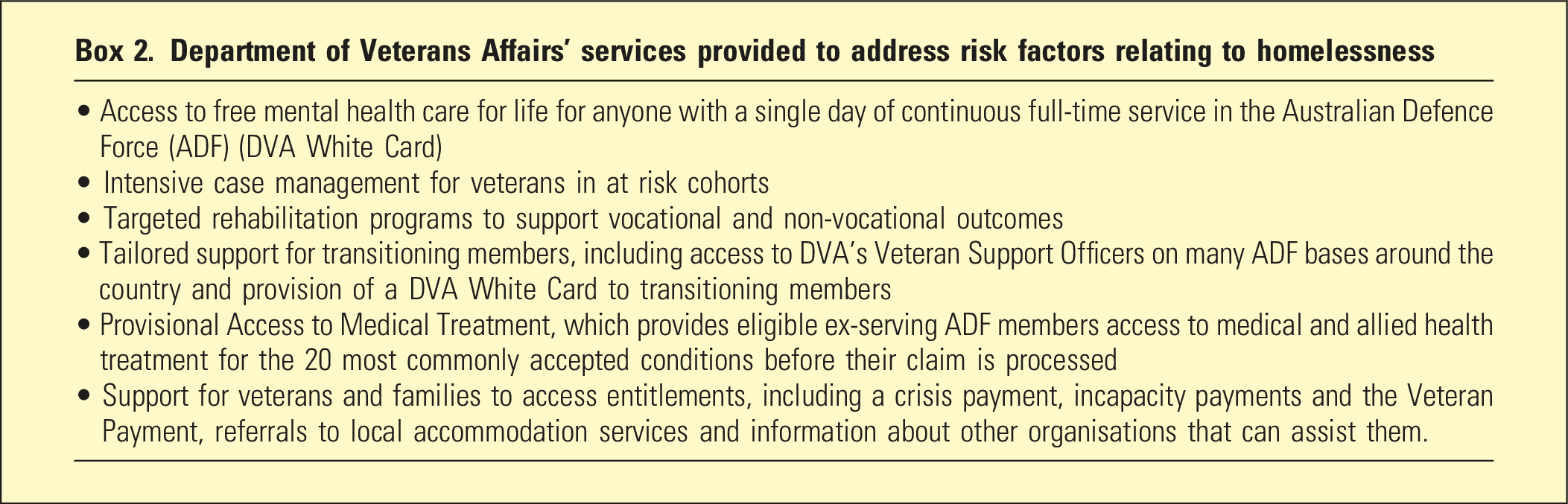
Department of Veterans Affairs’ services provided to address risk factors relating to homelessness
What do we need to do?
A variety of intensive, outreach, and community mental health services are required to support veterans experiencing homelessness. 13 Such services should coordinate with housing support and addiction services to provide more effective treatment with the aim of preventing suicides. 13 Housing First, which aims to provide stable accommodation as the initial step, is increasingly viewed as an effective approach to address psychiatric disorder associated with homelessness. 21
The interim report of the National Commissioner for Defence and Veteran Suicide Prevention recommended revising transition processes for serving members to include an assessment of housing vulnerability. Those identified as being vulnerable were recommended for support to contact community housing organisations to discuss housing options and pathways. 9 This seems a practical and direct recommendation that could be readily implemented with rapid results.
While the toolkit project revealed that improved CHO practice is just one element of the service system that needs to change if veterans in housing stress are to be helped, acknowledging DVA constraints in terms of accommodation provision is critical in developing a response for homeless veterans. However, the CHIA has identified three areas where the Commonwealth, state and territory governments can provide further assistance. Firstly, to address the need for more veteran accommodation options. Currently, there are only a few housing projects specifically targeted at the veteran community in Australia. Those that exist were initiated primarily by non-government veterans’ services and CHOs and set up without government support. In almost all cases there are no formal links with DVA or other veteran support services. Most existing projects are designed to meet crisis needs (up to 3 months) through to medium-term accommodation (18 months). Where projects have been evaluated, they have demonstrated positive outcomes, including enhanced mental health and wellbeing and employment.18,22 They have also highlighted problems where longer term ‘move on’ housing is lacking.
Secondly, to identify specific veteran housing needs, then provide access to tailored, intensive, outreach, community mental health services to allow a response to veteran needs that goes beyond the currently limited emergency assistance available from Open Arms Veterans and Families Counselling, the treatment arm of DVA.
Finally, to provide housing that is specifically linked to specialist support services. AHURI research has demonstrated that for some veterans, a positive transition process from service would be enabled by targeted accommodation linked to specialist support services.
Conclusion
The Australian Government has committed to build housing and fund specialist services for veterans who are experiencing homelessness or at-risk of homelessness. 20 This is in addition to the current range of supports and programs to address the risk factors of veteran homelessness, including mental health care and supports. However, further research is required to determine if current Commonwealth, state and territory governments’ supports, including DVA and Open Arms mental health and case management services, have the capacity to engage with the estimated numbers of veterans experiencing homelessness and connect them with the right housing supports. If not, further funding for the development of support services including direct clinical service delivery by DVA may be required.
Footnotes
Acknowledgements
The authors acknowledge the grateful assistance of the Department of Veterans’ Affairs in the preparation of this paper. The Commonwealth Department of Veterans’ Affairs was consulted about this paper.
Declaration of conflicting interests
The author(s) declared the following potential conflicts of interest with respect to the research, authorship, and/or publication of this article: DW is a member of the Department of Veterans Affairs, Chief Health Officer’s Mental Health Expert Advisory Group. KH is an employee of the Royal Australian and New Zealand College of Psychiatrists. SC is contracted by Community Housing Industry Association (CHIA) to support the development of housing resources for community housing organisations.
Funding
The author(s) received no financial support for the research, authorship, and/or publication of this article.
