




Abstract
This conceptual paper explores the psychological dimensions of agricultural work. Agriculture is a cornerstone of human civilisation and a critical domain for achieving global sustainability. Multiple sectors in agriculture's diverse value chain face challenges related to climate change, labour shortages, supply chains and transport, production and storage, and technological transformation. Psychology, particularly vocational psychology and career development, offers valuable theoretical and empirical insights and interventions for individuals’ career development and the industry's workforce development. The paper includes examples from a program of research and development pertaining to aspects of agriculture including on-farm labouring work, mechanical and machinery work, technology adoption, and career education. We propose an agenda for advancing psychological theory, research, and practice for better understanding and enhancing career development in and for agriculture.
Keywords
The Psychology of Agriculture and Sustainable Careers
Agriculture is not merely an economic sector—it is a vital system that sustains human life and environmental integrity. From soil and sea to supermarket, agriculture encompasses a vast array of occupations, each contributing to the production, processing, and distribution of food and fibre. Despite its importance, agriculture faces significant challenges: climate conditions, aging workforces, urban migration, threats to supply chains, rising input costs, and technological disruption. These issues threaten the sustainability of agricultural sectors and the well-being of those who work within them. Moreover, these threats to agriculture are also threats to humanity. Humanity cannot survive without agriculture.
The Organization for Economic Co-operation and Development (OECD) and the Food and Agriculture Organization's (FAO) Agricultural Outlook 2023–2032 (OECD/FAO, 2025), forecasted agricultural and fish production to grow by 14%, with middle-income countries leading expansion through technological adoption, capital investment, and intensified inputs. Productivity gains will underpin most growth, although land and animal herd expansion will remain relevant in regions with limited access to modern technologies. The OECD-FAO expects that rising incomes and urbanisation will shift dietary patterns toward more nutrient-rich foods, particularly livestock and fish products. Global caloric intake from these sources is projected to rise by 6%, with a more substantial 25% increase in lower-middle-income countries. Despite these positive gains in access and production, persistent nutritional disparities remain, especially in low-income countries, where average intake of nutrient-rich animal foods will fall below recommended levels, threatening progress toward the United Nations’ Sustainable Development Goals’ (SDG) nutrition targets.
In 2021, approximately 1.3 billion people were employed in agrifood systems, representing 39.2% of the global workforce; in 2022 agriculture employed 892 million people, accounting for 26.2% of total employment (Food and Agriculture Organization, 2024). A recent OECD study of agriculture's workforce (Ryan, 2023) found that employment in agriculture continues to decline, with a shift from family to hired labour, particularly seasonal and migrant workers. Furthermore, agriculture's workforce is ageing, with limited new entrants, especially among youth and women.
Technological change is reshaping labour demand, increasing the need for digital, managerial, and entrepreneurial skills. Agriculture suffers from significant skills mismatches in social, technical, and digital competencies, despite agriculture being a heavy technology industry. Agricultural workers generally have lower formal education levels compared to other sectors, and vocational and tertiary enrolment in agriculture remains low, despite increasing complexity in farm operations. These trends underscore the importance of understanding the psychological and vocational dimensions of agricultural work as its various sectors adapt to technological, environmental, and demographic shifts.
Psychology offers a rich theoretical and empirical foundation for addressing agriculture's workforce challenges. Within the broad disciplinary field of agricultural science there is emerging realisation that sustainable agricultural practices are influenced not only by contextual factors such as culture and traditions, but also by psychological factors that influence farmers’ and farm workers’ attitudes, decision-making, and actions (Dean & Schultz, 2023; Ofosu-Ampong et al., 2025). Similarly, psychological theories and research have significantly contributed to understanding farmer economic and decision-making behaviour (Sok et al., 2021; Villano et al., 2023), attitudes toward sustainability and “net zero” (Maltby, 2024), and promoting ergonomics and safety behaviour on farms (Irwin & Poots, 2018), which are very high risk workplaces with the presence of heavy machinery, chemicals, and extreme weather. Despite the potential, vocational psychology and career development have contributed relatively little to solving agriculture's workforce problems (McIlveen, 2015; McIlveen & McDonald, 2019). Vocational psychology's ostensible absence from the field of agriculture must be resolved if it is to earnestly contribute to solving global problems such as population movement, poverty and malnourishment, and management of natural resources essential for human existence.
In this paper, we overview a program of research, the vocational psychology of agriculture (McIlveen, 2015; McIlveen & McDonald, 2019) as a multidisciplinary endeavour that integrates psychological theory, research, and practice to support sustainable agricultural work and careers. We highlight examples of agricultural work to raise awareness about literally vital but understudied occupations addressed in our program of research including backpacker farm workers (Kossen et al., 2021), mechanical trade workers (Black et al., 2025), cotton farm workers (McDonald, 2017), veterinary practitioners (Hamilton, 2019), and agricultural scientists (Lovric, 2020). This research program has used different qualitative and quantitative research methodologies and theories including social cognitive career theory (SCCT; Lent, 2013; Lent & Brown, 2013), job demands-resources theory (JDR; Bakker & Demerouti, 2017), technology acceptance model (TAM; Davis, 1989), theory of work adjustment (TWA; Dawis & Lofquist, 1984), and the systems theory framework of career (STF; Patton & McMahon, 2021). Finally, we offer directions for future research and development to articulate a disciplinary agenda for the psychology of agriculture and its diverse types of work, occupations, and careers.
Psychological Dimensions of Agricultural Work and Careers
On-Farm Labouring Work
Farm work is physically demanding, dangerous, and often performed in isolated environments. Psychological constructs such as identity, resilience, and self-efficacy are critical for sustaining engagement. Kossen et al. (2021) conducted a qualitative study of international backpackers working on Australian farms under the Working Holiday visa scheme. Their findings revealed that backpackers often face precarious work conditions, including physically demanding labour, low pay, and uncertainty about job continuity. By using JDR theory (Bakker & Demerouti, 2017), the study identified hindrance demands such as role ambiguity, poor produce quality, and lack of training; as well as challenge demands like time pressure and harsh environmental conditions. Despite these challenges, job resources, such as relational support, fair pay, and opportunities for autonomy, contributed to positive experiences of work. Personal resources including English language proficiency and a positive attitude also buffered the effects of job demands.
The psychology of working theory's (PWT; Duffy et al., 2016) emphasis on decent work (Blustein et al., 2023) includes safe working conditions, fair remuneration, rest time, and congruent social values. Kossen et al.'s (2021) findings underscores the need for ethical employment practices and policy interventions to ensure that backpackers have access to decent work in agriculture, especially given evidence of the prevalence of depression (23%; CI 95% 16.5–31.2) and anxiety (22%; CI 95% 16.4–29), and stress (30.4; CI (95% 19.2–44.5) among migrant farm workers (Yema et al., 2025).
Farm work is contingent upon contextual affordances within the work environment. SCCT (Lent, 2013; Lent & Brown, 2013) was used to investigate cotton farm workers’ satisfaction and engagement (McDonald, 2017). Perceived organisational support (POS) emerged as a significant direct predictor of job satisfaction and work engagement; while proactive personality indirectly influenced job satisfaction through POS and work engagement, emphasising its role in shaping the work environment. Supportive employers played a crucial role in fostering positive work environments, enhancing self-efficacy, and promoting alignment with organisational values. Furthermore, their conservation values congruence was identified as a critical factor, directly predicting work engagement and indirectly influencing job satisfaction; suggesting that alignment with sustainable farming practices enhances worker motivation. The workers’ self-efficacy contributed indirectly to job satisfaction through conservation values congruence and volition, highlighting its role in fostering a sense of agency and alignment with farming values. Also, work volition constructs revealed nuanced insights, with perceived constraints negatively impacting conservation values congruence; while volition directly predicted work engagement and indirectly influenced job satisfaction. The farm workers described the ideal worker as someone who demonstrates initiative, adaptability, and commitment to learning, aligning with the construct proactive personality.
Mechanical and Machinery Work
Farm work is dependent on self-efficacy, knowledge, and skills for the operation and maintenance of heavy machinery (National Center for O*NET Development, 2023). Recent research by Black et al. (2025) used SCCT (Lent, 2013; Lent & Brown, 2013) to explore the career motivations of agricultural mechanical trade workers. Using qualitative interviews with 19 mechanical trade workers, the study examined key SCCT constructs including self-efficacy, outcome expectations, satisfaction, dispositional traits, and contextual affordances. Thematic analysis revealed that participants’ mechanical trade self-efficacy was often formed in childhood through hands-on experiences, vicarious learning, and social persuasion. Outcome expectations were shaped by values such as variety, compensation, autonomy, and ability utilization. Satisfaction was expressed both in terms of job-specific tasks and broader occupational identity. Contextual barriers included physical demands, repetitive tasks, limited learning experiences, and technological complexity. Contextual support includes organisational, supervisory, and co-worker relationships.
Limited learning experiences regarding lowered numbers entering the trade, the quality and depth of training experiences across industries, and technological developments, were linked with concerns about the industry's sustainability. The study affirmed SCCT's utility for understanding the motivations, persistence, and satisfaction of agricultural mechanics, highlighting the importance of realistic interests, grit, and conscientiousness in sustaining career engagement. These findings supported the broader application of SCCT to agricultural occupations and underscored the need for targeted career development interventions to attract and retain skilled workers in this vital sector.
Technology Acceptance and Adoption in Agriculture
Farm work is increasingly technologically advanced. The digital transformation of agriculture—often referred to as Agriculture 4.0—has introduced a wave of technological innovations, including automation, robotics, sensors, and data-driven decision support systems. These technologies promise increased productivity, efficiency, and sustainability. Their successful implementation, however, depends not only on technical feasibility, but also the psychological readiness and attitudes of agricultural workers and farmers, as well as the capacity of their supply and service networks.
Technology adoption in agriculture is not merely a matter of access or cost; individual perceptions, workforce structures, and social dynamics affect adoption. Farmers’ attitudes toward technology, including their beliefs about its usefulness and ease of use, shape their willingness to adopt and integrate new tools into their practices (McDonald et al., 2022a). McDonald et al. used the technology acceptance model (TAM; Davis, 1989) to study technology adoption among Australian cotton growers. TAM posits two primary predictors of technology acceptance: perceived usefulness (i.e., enhance job performance or outcomes) and perceived ease of use (i.e., easy to learn and integrate into existing systems). McDonald et al. (2022a, 2022b) revealed that:
Perceived usefulness was the strongest predictor of whether growers were currently using or considering automation. Ease of use was more salient for those who had already adopted technology, influencing continued engagement and satisfaction. Workforce factors, such as the proportion of entry-level employees and satisfaction with staff, were associated with attitudes toward technology. Growers who practiced effective people management were more likely to perceive their workforce as adaptable to technological change.
Barriers to adoption included structural limitations (e.g., drought, infrastructure), cost concerns, lack of trust in technology, and satisfaction with traditional practices. These findings underscore the importance of psychological and social factors in shaping technology uptake. As agriculture continues to digitise, fostering positive attitudes and psychological resilience among workers will be key to sustainable workforce development.
Career Development Learning
Changing demographics, issues such as climate change, and the digital revolution are changing the career opportunities that exist within the agriculture industry (O’Dea et al., 2022). Gaining the knowledge, capabilities, and educational supports to navigate this changing world of agricultural work is essential for both future and current workforce; that is students exploring agricultural careers and transitioning to the world of work and developing current workers’ career management for their sustained engagement in agriculture.
School to Work Transitions to Agricultural Careers
As global populations become increasingly urbanised, the next generation of workforce (primary and secondary school students) are more disconnected from the world of agricultural work. Students consistently demonstrate a lack of knowledge about agriculture, and this extends to their knowledge of the variety of meaningful careers (Cosby et al., 2022). Perhaps of more concern, is the lack of access to learning experiences that can provide students with exposure to the four sources of self-efficacy and outcome expectations that support the development of agricultural career interests within schools (McDonald et al., 2022b). Educators play essential roles in supporting students to make connections between classroom learning and careers, while partnerships with industry can provide both teachers and students with greater access to current knowledge and connections to agricultural work contexts.
Studies utilising SCCT have attempted to better understand how career development learning interventions can be improved. Investigations with young people working on farms have sought to better understand the experiences that contribute to agricultural vocational identify formation. The systems theory framework of career development (Patton & McMahon, 2021) has informed investigations into ways industry can support agricultural careers education in schools (McIlveen & McDonald, 2019). Some findings that support the design of career development learning experiences include:
Educators who have a strong awareness of the many agricultural job opportunities available are more likely to encourage students to consider agricultural careers (McDonald et al., 2025). Educators who have had direct experiences with the agricultural sector have stronger self-efficacy to discuss agricultural careers with students (Cosby et al., 2024). Agricultural career pathways evolve for young people through social contexts. Positive work environments and agricultural communities play important roles in fostering agricultural vocational identity (De Guzman et al., 2025). Industry bodies including Australian Rural Research and Development Corporations are strongly connected to Industry-School partnership systems through their role in innovation that shapes the future of work in the sector. Despite this positioning, many remain only informally involved and have not strategically allocated resources to support career development learning in schools (O’Dea et al., 2024).
Career Development for the Current Workforce
For the current workforce, job tasks are changing, and upskilling is needed for people to adapt and further develop their careers. The theory of work adjustment (TWA; Dawis & Lofquist, 1984) posits a number of considerations for achieving satisfactory job performance in the face of changing workplace expectations, while SCCT points to the impacts that increasing self-efficacy can have on farm worker job satisfaction (McDonald, 2017). Increasing both technical and non-technical skills proficiency is an adaptation strategy that enables people to gain confidence and competence to continue in their agricultural careers. While the term “non-technical skills” has been used by industry, those involved in career development would be more familiar in conceptualising these as employability skills. In studies with the current workforce populations the following findings provide insights into career development learning:
Digital skills such as technology operation and data monitoring, analysis, and interpretation are of increasing importance to aquaculture industries, and workplace-based learning is essential for people to develop digital capability skills (McDonald et al., 2024a). Micro-credentials in technical skills may be provide on-farm workforce with accessible education pathways to increase their skill proficiency and gain recognition for the skilled nature of their career in agriculture (Cosby et al., 2023). Non-technical skills such as communication skills, teamwork and collaboration skills, and cross-cultural competence are needed by many on-farm workers to thrive in their jobs, including those in seasonal or entry level roles. Furthermore, non-technical skills such as self-management, time-management, understanding individual differences and strategic thinking and planning are needed for people to rise in responsibilities to that of supervisor or managers, and further develop careers within the industry (McDonald et al., 2024b).
Future Directions for Research and Development
We now turn to potential future directions for developing the psychology of agriculture (McIlveen, 2015; McIlveen & McDonald, 2019) by focusing on four key themes: developing a paradigmatic theory to advance research and practice; articulating a pedagogy of careers and employability learning for careers in agriculture; integrating of the psychology of agriculture with other psychological theories of sustainability and eco-generativity; and, exploring the organic connectedness of careers in agriculture through the notion psychological sense of place.
A Social Cognitive Framework for Agricultural Careers
Social Cognitive Career Theory (SCCT; Lent, 2013; Lent & Brown, 2013) is a leading contemporary theory of career self-management. The social cognitive tradition includes core constructs of self-efficacy, outcome expectations, interests, goals, and actions. These elements interact dynamically to shape career trajectories in agriculture, reinforcing self-efficacy and outcome expectations through observation, persuasion, experience, and affective arousal. These core constructs interact with personal traits and contextual factors to shape career behaviour. SCCT has been applied to careers in science, technology, engineering, and mathematics (STEM), but its utility extends to agriculture, where similar dynamics of learning, motivation, and environmental influence are at play.
McIlveen and McDonald (2019) adapted SCCT as a suitable theory for the vocational psychology of agriculture as a conceptual framework for understanding work and careers in agriculture. Furthermore, SCCT has been used to generate and test hypotheses about factors which affect self-efficacy, outcome expectations, and their antecedent inputs in occupations such as: agricultural mechanical trade workers (Black et al., 2025); cotton farm workers (McDonald, 2017); veterinary practitioners (Hamilton, 2019); and agricultural scientists (Lovric, 2020).
Of course, SCCT is not the only theory amenable to application to careers in agriculture. The JDR (Bakker & Demerouti, 2017) has, for example, been used to investigate the work of backpacker farm workers (Kossen et al., 2021). A significant benefit of SCCT over other theories of career development is not only its inclusive scope of factors ranging from distal contextual affordances, personal inputs, and dispositional traits, but also its emphasis on learning. In the forerunning social learning tradition, SCCT is a learning theory evidenced by its feedback loop - whereby experience influences the core social cognitive factors of self-efficacy and outcome expectations through observational learning, experiential learning, persuasion, and affective arousal (McIlveen & McDonald, 2019).
Pedagogy for Agricultural Career and Employability Learning
Consistent with the social cognitive/social learning tenets of the SCCT, is the need for a pedagogy of career development focused on careers in agriculture. The science of vocational psychology and profession of career development effectively contribute to students’ education and training pathways through interventions including one-on-one career counselling, class-based teaching and learning, and broad-based multimedia resources. Whilst there is evidence of the effectiveness of career development (Whiston et al., 2017), clearly conceptualised and operationalised pedagogies of career development learning are rare. Most career development frameworks are more focused on enumerating career management skills than in conceptualising transformative learning processes in the tradition of McIlveen's (2012) vision of transformative career development learning.
In an effort to address this gap, Healy (2023) advanced a comprehensive pedagogical framework for careers and employability learning (CEL) in higher education, as a dynamic learning process, integrating theories from career development and employability research. Central to this framework is the assertion that careers and employability learning is a psycho-social process rather than a static outcome, which conceptually aligns with the social cognitive/learning tenets of SCCT. Healy underscores the importance of recognising employability as being contextual, influenced by socio-economic, cultural, and political conditions. He calls for pedagogies that acknowledge and respond to these complexities.
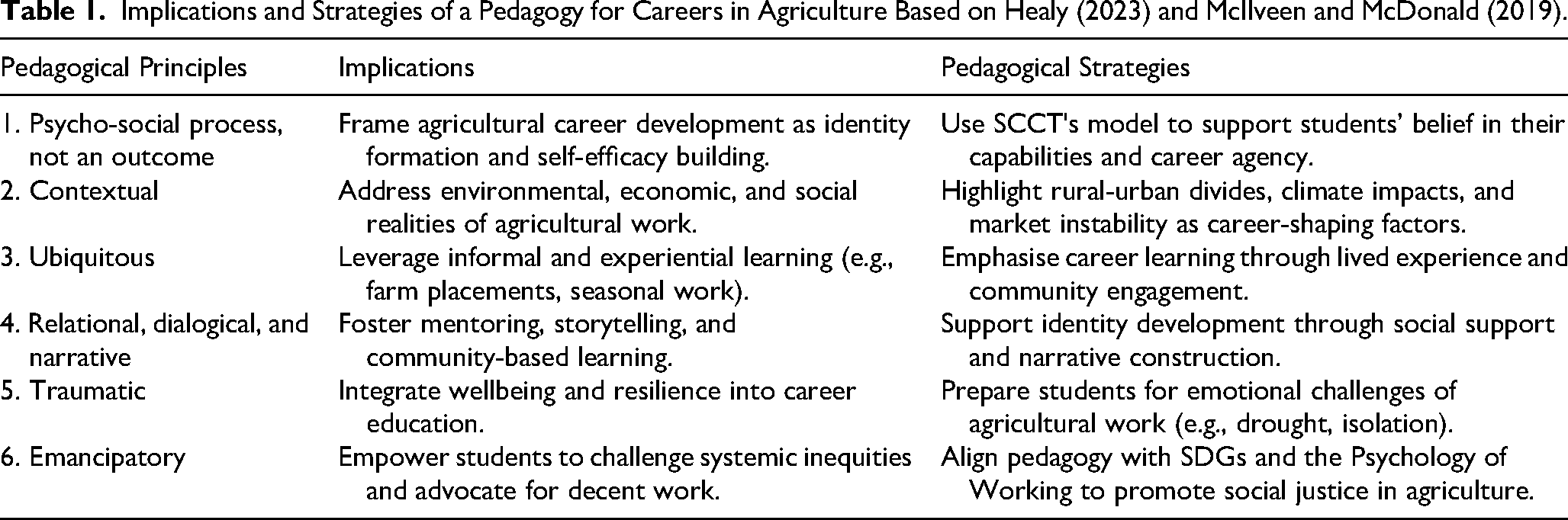
Healy (2023) proposes six pedagogical principles that foreground CEL's complexity, dynamism, and transformative potential. First, CEL is a psycho-social process rather than a fixed outcome, emphasising identity formation, adaptability, and reflective learning over the attainment of static skills and competencies. This principle challenges the dominant outcome-oriented models by integrating processual learning theories from career development that account for the evolving nature of career identity. Second, CEL is inherently contextual, shaped by socio-economic, cultural, and political environments. Employability is not universally transferable but contingent upon the learner's circumstances, including geographic location, social capital, and systemic barriers. Third, CEL is ubiquitous, occurring across formal, informal, and incidental learning environments. Drawing on theories such as planned happenstance and chaos theory, Healy underscores the importance of recognising and leveraging unplanned and everyday experiences as sites of career learning, such as those that may occur in experiential learning and in community service and engagement. Fourth, CEL is relational, dialogical, and narrative, highlighting the co-construction of employable identities through interactions with educators, peers, employers, mentors, and professional communities. This principle aligns with narrative and constructivist approaches to career development, where identity is “negotiated” and validated through social processes. Fifth, CEL can be traumatic, acknowledging that career transitions, shocks, and systemic inequities can disrupt learners’ sense of self and wellbeing. Agriculture is particularly prone to traumatic conditions—such as isolation, exploitation or physical risk— and environmental and economic shocks, such as drought, flood, disease, or market collapse. Healy calls for pedagogies that are sensitive to these disruptions and that integrate support for emotional resilience. Finally, CEL can be emancipatory. Rather than reinforcing discourses that individualise responsibility for employability, Healy advocates for a socially just pedagogy that empowers students to critically engage with and challenge structural constraints (Kenny et al., 2023).
This new vision positions CEL as a vehicle for personal and collective transformation, enabling learners to pursue meaningful, equitable, and sustainable career pathways in agriculture. Here we present implications of Healy's framework for the vocational psychology of working and CDL targeting careers in agriculture. Table 1 summarizes implications and strategies for agricultural CDL.
Agricultural career development should be framed as an evolving process of identity formation, self-efficacy, and meaning-making. Drawing on the SCCT, pedagogy should not focus exclusively on the skills needed for agricultural work, but also support students to explore their career identity and develop self-belief and outcome expectations through observation, persuasion, experience, and affective engagement (McIlveen & McDonald, 2019).
Agricultural work is deeply embedded in environmental, economic, and social contexts. Pedagogy must address the realities of rural life, climate variability, and market instability, while also challenging urban-centric biases. This includes acknowledging the structural barriers and affordances that shape students’ career aspirations and outcomes, as both Healy and McIlveen and McDonald argue.
Agricultural career learning should not be confined to formal curricula. Instead, it should leverage informal, incidental, and experiential learning opportunities—such as farm placements, community engagement, and seasonal work—to foster career exploration and adaptability.
Career pedagogy in agriculture should prioritise storytelling, mentoring, and community-based learning. Students should be encouraged to construct and share their career narratives, engage with role models in the industry, and participate in dialogical learning that validates their emerging professional identities. To do so would also encourage better integration into rural communities outside of the workplace, which in turn supports greater resilience.
Given the volatility of agricultural work—due to climate shocks, economic pressures, exploitative working conditions, and social isolation—career education must incorporate wellbeing, resilience, and psychological support. Pedagogical strategies should prepare students for the emotional dimensions of agricultural careers, including coping with uncertainty and failure, as highlighted in both frameworks.
A pedagogy for agricultural careers must challenge deficit narratives and neoliberal assumptions that place responsibility solely on individuals. Educators have an ethical duty to empower students to critically engage with systemic inequities in rural labour markets, advocate for decent work, and contribute to sustainable development.
Implications and Strategies of a Pedagogy for Careers in Agriculture Based on Healy (2023) and McIlveen and McDonald (2019).
These principles can be integrated with educational and psychological research into the most effective approaches to teaching and learning (Hattie, 2009) along with research into the most effective career development interventions (Whiston et al., 2003, 2017).
Sustainability, Sustainable Development, and Eco-Generativity in Agriculture
The psychology of sustainability and sustainable development (Di Fabio, 2017; Di Fabio & Rosen, 2018, 2020; Hartung & Di Fabio, 2024) offers a transformative lens through which agricultural work can be understood—not only as a means of production, but as a domain of human flourishing, environmental stewardship, and intergenerational responsibility. This perspective emphasises the regeneration of psychological and ecological resources, whilst advocating for a positive-oriented approach that supports both individual well-being and planetary health. The notion eco-generativity (Di Fabio & Svicher, 2024) implies an action-oriented, strengths-based approach to the psychology of sustainability and sustainable development.
Sustainability science (Sahle et al., 2025) focuses on preserving environmental resources and promoting ecological balance. The psychology of sustainability expands this view by integrating psychological processes that support adaptive, regenerative, and future-oriented behaviours (Hartung & Di Fabio, 2024). It considers multiple environments—natural, personal, social, organisational, and global—and their interrelationships, proposing that sustainable development must be psychologically sustainable as well (Di Fabio & Rosen, 2020).
In agricultural contexts, this means fostering psychological resources that enable workers to develop their sense of eco-generativity to cope with uncertainty, engage meaningfully with their work, and contribute to sustainable practices. It also involves designing interventions that promote resilience, hope, and a sense of purpose among agricultural workers and communities.
Eco-generativity is a novel construct that extends Erikson's (1959, 1963) concept of generativity to ecological and social domains. It encompasses the motivation to care for the environment and future generations, integrating ecological concerns, social responsibility, environmental identity, and hope. In agriculture, eco-generativity manifests as a commitment to sustainable farming practices, conservation behaviours, and community engagement. It reflects a future perspective, where individuals act in the present to ensure a liveable and healthy environment for those to come. This aligns with the values of many agricultural workers who see their labour as part of a legacy of stewardship and care.
The psychometric model of eco-generativity (Di Fabio & Svicher, 2024) includes four core dimensions:
Ecological Generativity: Actions aimed at preserving and enhancing the natural environment (e.g., minimizing waste, using energy wisely). Social Generativity: Engagement in community-oriented behaviours that benefit future generations. Environmental Identity: A sense of connection and belonging to the natural world. Agency/Pathways: A belief in the possibility of positive outcomes and the capacity to achieve them.
These dimensions are particularly relevant in agricultural settings, where workers often face environmental challenges and must rely on psychological resilience and community support. Promoting eco-generativity can enhance motivation, well-being, and sustainable behaviour across the agricultural value chain.
Eco-generativity complements existing vocational psychology frameworks such as SCCT and PWT by adding a sustainability-oriented dimension. It provides a motivational basis for career interest and commitment in agriculture, especially among younger generations concerned about climate change and ecological degradation.
Educational and career development programs can incorporate eco-generativity by:
encouraging reflection on environmental values and identity; promoting hope and agency in addressing ecological challenges; dsigning experiential learning opportunities that connect students with sustainable agricultural practices; and, supporting narratives of purpose and legacy in agricultural careers.
Integrating eco-generativity into vocational psychology would inspire a more holistic understanding of agricultural work—one that honours both the psychological needs of workers and the ecological needs of the planet.
The Psychology of Place in Agricultural Careers
Place attachment refers to the emotional bond individuals form with specific geographic locations, encompassing feelings of belonging, comfort, and identity (Scannell & Gifford, 2010, 2017). Within this framework, place identity is a subdimension that reflects how physical settings and symbolic meanings of place become integrated into one's self-concept (Hauge, 2007; Raymond et al., 2010). These constructs are particularly salient in rural and agricultural contexts, where the land is not only a workplace but also a source of cultural, familial, and personal meaning. For Indigenous communities, these symbolic meanings may be particularly strong, connecting them to their ancestors and lore across centuries.
Research demonstrates that place identity significantly predicts individuals’ intent to stay in regional communities (McIlveen et al., 2022; Riethmuller et al., 2021), suggesting that psychological ties to place may outweigh economic considerations in career decision-making. McIlveen and McDonald (2019) note that rural communities offer close, supportive cultures that can positively shape career expectations; but often lack the economic opportunities needed to retain workers, with many believing better prospects exist in cities. Lifestyle preferences vary significantly, with some deterred by social isolation and limited services, while others value open space and small-town community life. The conceptualization of a vocational psychology for agriculture was extended by McIlveen and McDonald (2019) to contextualise current initiatives in psychology to progress the United Nations’ Sustainable Development Goals (2015) with respect to the psychology of working (Blustein, 2006, 2013) and decent work (Blustein et al., 2016). McIlveen and McDonald (2019) posit that social support and meaningful work in global food and clothing production can drive commitment to agricultural careers, provided that rural employment offers decent working conditions and fair compensation.
This relationship between work quality and career commitment demonstrates that positive work environments enhance wellbeing; while healthy, supported workers remain more engaged and productive. Luke et al. (2024) demonstrated strong links between wellbeing and employment in rural communities, showing how place-based factors influence both career decisions and mental health outcomes. Additionally, healthcare and education professionals in rural areas often cite place attachment as a reason for staying, despite limited resources (Beccaria et al., 2021; Cosgrave, 2020; McCredie et al., 2025). Indigenous Australians have profound connections to “Country,” which influence career decisions and wellbeing (Bishop et al., 2006), while many youths in agriculture leave rural areas for education reasons but intend to return due to place identity (Pretty et al., 2003). This complexity appears in varying responses to agricultural work, where some are deterred by social isolation and limited services, while others find meaning in the open space and community relationships that rural areas provide.
Understanding place attachment and identity has practical implications for attracting and retaining agricultural workers. Career development practitioners should explore clients’ sense of place as part of career counselling, particularly when working with rural youth, itinerant workers, or individuals considering relocation. While models like SCCT (Lent & Brown, 2013) and STF (Patton & McMahon, 2021) acknowledge contextual affordances, they lack specific mechanisms to account for the psychological experience of place. McIlveen et al. (2022) argue that place identity is a critical, yet under-theorised, factor in career development, especially in agriculture and regional industries.
Conclusion
Psychology has much to offer agriculture. We have laid a foundation for the vocational psychology of agriculture to support the world's agricultural workforce. By applying vocational psychology and career development theory and principles, psychology and career development scholars and practitioners can contribute their expertise to growing a sustainable workforce for agriculture. The integration of psychological science and practice into agricultural systems is possible, it is necessary, it is literally vital.
Footnotes

Funding
The authors received no financial support for the research, authorship, and/or publication of this article.
Declaration of Conflicting Interests
The authors declared no potential conflicts of interest with respect to the research, authorship, and/or publication of this article.