



Abstract
Despite widespread evidence that green-collar work is increasingly sought as a career pathway, it remains largely undifferentiated in job descriptions and recruitment sites, leaving environmentally oriented school-to-work, and just transitions, underserved. Digital Recruitment Platforms provide databases for the analysis of green-related knowledge skills, abilities and other characteristics by job seekers and career counselors. A frequency analysis of job needs and opportunities on a New Zealand digital recruitment site was conducted in December 2024. In terms of content, a diverse range of green roles was differentiated in terms of adjacent green collar work (existing and generic skills in sustainability-oriented work contexts) and core green collar work (output or process based green work, that may be direct or indirect).In terms of process a context-sensitive protocol is described, which is potentially transferable to aid just transitions; to help meet CSR obligations for organizations, and to inform workforce planning for governments and multilateral institutions.
Introduction
Climate change is one of the leading global challenges today. It poses an existential crisis to the world of work, as Earth's temperature continues to rise beyond the experience of modern Humanity. The degradation of our ecosystems from greenhouse gas emission, resource extraction, waste production, agricultural practices, water and energy consumption and manufacturing are destabilizing our forests and oceans enabling extreme weather events and causing disastrous impact on people, communities and societies.
The Psychology of Sustainability and Sustainable Development (Di Fabio, 2017; Di Fabio & Cooper, 2023) is an area of applied psychological science that offers a psychological framework to understand and promote healthy and sustainable environmental, social and economic systems (Hartung & Di Fabio, 2024). The United Nations 17 Sustainable Development Goals and 2030 Agenda goals are focused on creating these systems through eradicating poverty, and tackling inequalities, creating sustainable cities and communities, protecting the planet, providing access to education, ensuring responsible production and consumption and creating decent work for all. The Psychology of Sustainability and Sustainable Development, embedded in the transdisciplinary framework of Sustainability Science (Komiyama & Takeuchi, 2006; Sahle et al., 2025; Takeuchi et al., 2017), gives its contribution in responding to challenges of achieving the 17 SDGs, highlighting the critical impact that psychological processes have on cognition and behavior. Central to sustainable development is the world of work, as it sits at the center of production and consumption, poverty and inequality, climate action and sustainable and equitable societies. The world of work can be considered the main driver of both the Anthropocene (the epoch of global warming caused by human beings) and the ‘Capitalocene,’ whereby capitalism is propelling environmental destruction and increasing wealth inequalities (Malm, 2015; Maree, 2024; Moore, 2015).
Pushing these terms together has created the portmanteau of the ‘anthropocapitalocene,’ to describe how human beings are wreaking chaos on the planet (Guichard, 2022). In order to shift human beings towards a commitment to sustainable and equitable development, the world of work must shift to address these global challenges. Vocational guidance and career counseling have a pivotal part to play by simultaneously holding the importance of climate action alongside the well-being of people at work. In doing so this can help to more generally advance human security in an increasingly unstable global environment (Hartung & Di Fabio, 2024; Maree, 2024). A crucial way of meeting these global challenges, delivering climate action, enabling decent work and contributing to secure and healthy societies is through green collar work and relatedly, the development of people's careers. This article explores that vista through the prism of green collar work, which is defined as (i) decent work that seeks to respond to vocational career aspirations, either directly or indirectly through the means of production and consumption, to (ii) protect the planet and its/our ecosystem (Di Fabio, 2017; Kenny & Di Fabio, 2024).
Most policy development in this space remains relatively macro-oriented rather than focused on facilitating real-life career choices (Di Fabio & Cooper, 2023). At the highest levels, climate change mitigation has been tackled with international strategies, goals, policies, regulations and agreements. The seminal 1987 Brundtland Report continues to guide global co-operation around sustainable development (Velenturf & Purnell, 2021). The United Nations Sustainable Development Goal (SDG-13), Climate Action is coupled with related goals around Life on land (SDG-15) and Below Water (SDG-14) as well as SDG-12 Responsible Consumption and Production. The 1987 Montreal Protocol was concerned with protecting the ozone layer, and the 1997 Kyoto Protocol initiated binding targets around reducing greenhouse gas emissions. More recently the 2015 Paris Accords was formed to limit global warming (Cifuentes-Faura, 2022). These high-level commitments alongside the impacts and implications of dwindling and finite natural resources have provided the impetus for shifts, ideally through Just Transitions to circular and greening economies. These economies strive for low emission or net-zero emissions of greenhouse gases and have been conceptualized through plans such as the European Green Deal. The objective is to “…. transform the EU into a fair and prosperous society, with a modern, resource-efficient and competitive economy where there are no net emissions of greenhouse gases in 2050, and where economic growth is decoupled from resource use” (European Commission, 2019, p. 1).
At a more mid, and vocationally related level, creating a fair and prosperous society will require efforts towards social sustainability and Decent Work (SDG-8) with such work defined by the International Labor Organization (ILO) as providing a fair income, social protection, secure and healthy workplaces, and equality of opportunity (ILO, 2024). Linking Decent Work (SDG-8) to Climate Action (SDG-13) through a transition to greening economies will not only contribute to fair and prosperous societies but globally as well. These transitions, for example, are predicted to create a net global gain of 18 million jobs by 2030 through shifts to sustainable energy (Kleibrink et al., 2023). Similarly, projections in the Asia-Pacific region estimate that a net-zero transition by 2030 will create 180 million jobs, and by 2070 contribute $47 trillion.
At a more micro and everyday level, shifts into greening economies require everyday public support from individuals. The world's largest survey on climate change in 2024 indicated that this support is extremely high. The responses from 77 countries who represent 87% of the global population showed that 80% wanted their country to do more about climate change, 72% want a quick move away from fossil fuels, and 56% thought about climate change either daily or weekly (UNDP, 2025). Not surprisingly, such aspirations have spilled over into the world of work in general, and career choices in particular. In their latest annual global survey of Millennial and Gen Z work and career aspirations, for instance, Deloitte (2025) finds that fostering environmental sustainability is a top concern for both generations, who further take measures to limit their own environmental impact, including career decisions (ibid). Protecting the environment is in their views, the societal challenge where businesses have the greatest opportunity to drive change, as they have changed jobs and industries to better align their own careers with that aspiration – and plan to do so in the future, by actively researching environmental practices of companies.
A Great Detachment
At an everyday, individual level, fueling such career searches is a widespread discontent with the world of work as it currently exists. The 2025 Gallup State of the Global Workplace Report indicates that humanity may be standing on “the edge of a new era of work” (Gallup, 2025, p. 4). Standing on this precipice, people are reporting a sense of increasing disconnection from work coupled with growing deterioration in wellbeing. Globally, disengagement at work has risen to 79% of employes with an estimated cost of $438 billion in lost productivity in 2024. People report they are struggling (58%), stressed (40%), and approximately 50% of employes surveyed were actively looking for other work (Gallup, 2025). Such trends indicate a growing demand for visible pointers, and perhaps evidence-based ways of finding them, for career and vocational transitions across all generations. This paper aims to outline a process, or protocol, for deriving such a pointer.
There are specific reasons that contribute to worker disengagement, and over the last five years these have included post-pandemic turnover, disrupted supply chains, technologies and AI transforming workplaces, as well as tensions around flexible and remote work (Gallup, 2025). There are reliable indications that people are increasingly seeking purpose-driven and meaningful work. This is not something new. In the 1960's and early 1970's many people sought more human-centered work motivated by intrinsic rather than extrinsic rewards (Braungart & Braungart, 1980). Primarily this work was driven by the need to ‘show up and do-good for others’ (Hopner & Carr, 2024). More recently, there has been more radical shifts with people seeking existential purpose, in part through work, taking course within the Great Resignation and Quiet Quitting (Formica & Sfodera, 2022).
The complete or partial disengagement from work, reflected in/by the Great Resignation and Quiet Quitting, is attributed to several motivations. For some, it was a refusal to continue to be party to precarious work and a wish for job security; for others it constituted a reassessment of work-life balance or an opportunity to travel in a new direction in life. Specifically, people have indicated that poor pay, lack of respect, toxic workplace cultures, and a lack of fulfillment as well as a desire for meaningfulness of work and alignment with employing organizational purpose drove disengagement (Formica & Sfodera, 2022). Overall, however, people are increasingly seeking decent work in which they are fairly paid, treated with respect, and which provides meaning and purpose that meets the cost of living but also fits with their values.
According to the Theory of Career Construction, people construct themselves through identity making, relationships with others and within socio-cultural and global contexts; and they will deploy these constructions to help shape the direction of their career or vocational pathways (Savickas, 2013). Leaving behind the stable career that typically mapped across an individual's working lifetime, the twenty-first Century has seen the prominence of both the boundaryless career, where there is a focus on self-initiated mobility and agility (Carr et al., 2005, 2021), and the protean career, driven by values, personal development, and autonomy (Savickas, 2013).
Coupled together, the notion and reality of the boundaryless protean career requires people to create a subjectivity, which fits within a world of work, and guides them across livelihood changes and career transitions. This creation of subjectivity, and the agency which is enabled becomes important in career transitions that occur through choice, or when forced through job loss, world events, such as pandemics or through other ruptures in employment. Constructing a career becomes a process of …” realizing that one's present vocational situation evolved from past experiences and then connecting these experiences through the present situation to a preferred future” (Savickas, 2013, p. 159).
Changing present situations to a preferred future has increasingly been linked with environmental concerns and green commitments. Overarching any desire for decent and rewarding work is the deepening climate crisis. Humanity now exists in the Age of the Anthropocene where dangerous changes to the Earth's biosphere are driving extreme weather events, rising sea levels, global warming and diminishing air quality (UNDP, 2022). Making Just Transitions to greening and circular economies requires the development and promotion of green jobs, or what is commonly referred to as green collar work (Hopner et al., 2024). This type of work can be seen as both a response to the climate crisis and a vocational pathway that sits within the framework of the twenty-first century boundaryless protean career.
This paper thereby provides an analysis of the livelihood, vocational and career ‘green’ possibilities which seek to meet the more macro-level responses put in place for climate action, such as the SDGs protocols and multilateral agreements concerned with circular economies, and which sustainably manage limited resources, and avoid any further damage to the environment (Price-Waterhouse-Coopers, 2024).
A Green A ttachment
Defining Green Jobs and Sustainable Work
There is no uniform consensus on what defines a ‘green job,’ but it is largely seen as “decent work in a sustainable low carbon world” (UNEP/ILO/IOE/ITUC, 2008, p. vii). The ‘Green Jobs Initiative’ is a partnership between the United Nations Environment Program, International Labor Organization, International Organization of Employers and the International Trade Union Confederation suggested, that this was work in sectors such as agriculture, manufacturing, research and development, and service and administration that make substantial contributions to promoting environmental quality. This included protection of biodiversity and ecosystems, de- carbonizing economies, reducing energy and water consumption and addressing pollution and waste (UNEP/ILO/IOE/ITUC, 2008).
The European Commission states that a green job is “one that directly deals with information, technologies or materials that preserves or restores environmental quality” (Data Europa-EU, 2022). Similarly, the OECD color jobs as green if they involve the production of goods and services which have limited damage to the environment, soil, air and water (Stanef-Puică et al., 2022). Economists have added to these definitions by introducing ‘shades of green’, arguing that ‘green jobs’ contribute to socio-ecological change through a focus on renewable energy (Colijn, 2014).
Green jobs can further be seen in terms of outcomes, more commonly termed outputs, and/or in terms of processes. Outputs-based green jobs are concerned with the production of goods and services which contribute to environmental quality (Bowen, 2012), such as electric transport, recycled clothing, organic farming, solar power installation, and waste management. It is argued that these outputs-based jobs may consist of direct green employment (green work activities) or indirect green employment, where work activities relate to some sort of supply function to those in directly green sectors, e.g., supplying electric batteries fitting electric cars (Apostel & Barslund, 2024). Process-based green jobs on the other hand focus on sustainability of production or operational processes. Within these processes there is a focus on renewable energy and energy efficiency, and waste and pollution reduction (Stanef-Puică et al., 2022), including jobs such as hydroelectrical engineers, emissions reporting analysts, water ecologists, and climate change advisors.
Green jobs can be either outputs- and/or process-based, direct or indirect but central to both are standards of decent work (Stanef-Puică et al., 2022). By and large, the creation of green jobs as decent work, which protects the environment, has come to be seen as a means of climate action, ecological management, and poverty eradication (Stanef-Puică et al., 2022). Green jobs then become seen as Sustainable Work, reflecting the sustainability of interdependencies between environment, society and the economy. This more holistic definition of Sustainable Work considers the social, environmental and geographical, and centralizes workers within global interconnections (Herzog & Zimmermann, 2025).
Measuring Green Jobs and Sustainable Work
Definitions of Green Jobs and Sustainable Work range across dimensions and concepts, as so does measuring these. In their extensive literature review of measuring and characterizing green jobs, Apostel and Barslund (2024) suggest that there are two main ways in which green jobs are identified, namely via an entity-level approach and via an occupation-specific approach. The entity-level approach categorizes organizations, industries and sectors as green and therefore work in these areas as a green job. This categorization can be top-down whereby entire industries and sectors are designated green, such as in the U.S Bureau of Labor Statistics (BLS) Green Goods and Services (GGS) survey which delivers an output-based top-down industry specific estimations of green jobs. Conversely there can be a bottom-up when individual organizations or companies are determined to be green (Apostel & Barslund, 2024).
Entity-level approaches can also use process-based data to determine green jobs such as the BLS Green Technologies and Practices (GTP) (Apostel & Barslund, 2024). There may also be both an output-based top-down and/or bottom-up approach possible in the entity-level approach (Apostel & Barslund, 2024). Onwards from 2017, European Union countries have been required to report employment data for the Eurostat- defined environmental goods and services sector (EGSS). The Eurostat EGSS is concerned with measuring (1) environmental activities defined as protection of the environment and natural resource management, and (2) environmental products and services. The EGSS definition has been used, for example, to produce NACE (CPA/CN) codes to list environmental products. NACE is widely used by the OECD, and the UN is now a global standard (Apostel & Barslund, 2024).
The other main way to measure green jobs has been through the occupation-specific approach, which classifies work activities, and specific job or occupation, as ‘green.’ Recently this approach has relied on a task-based method, defined as work that produces an end-product and is distinguished from skills or the capabilities required to perform the task. In the US, EU and OECD countries, O*NET is a common occupation-specific classification system and output- based approach to measure green jobs or occupations drawing on both skills and task(s)-related information. There are three categories of green jobs within O*NET. Green Increased Demand (GID) jobs mean higher demand in green economies, but no change to task activities. In Green Enhanced Skills (GES), the purpose of the job remains steady but tasks change. Green New and Emerging (GNE) jobs are new jobs, with new tasks (Apostel & Barslund, 2024).
The current study respects entity-level top-down approaches by examining industry categories to generate the number and types of green jobs being advertised. We incorporate bottom-up approaches by including the organizations that are advertising green jobs. We also differentiate between outputs - and process-based career roles, by distinguishing between jobs that make green products/services, vs. mitigate impacts of production through sustainable procurement, recycling, and other forms of CSR. Such differentiation identifies green demand, enhancement and GNE.
An aim in this study is to describe a process, and outcome, which facilitates a matching of supply and demand at the individual or company level. Digital recruitment platforms let employment supply meet employe demand, and may inform workforce planning, integrating macro, mid- and micro-levels. Job advertisements can thus become a script for tasks skills and career capabilities required for green collar work (Deloitte, 2022). These scripts can be used as a means to identify adjacent green collar or work defined as proximity to contexts where the employer is committed to sustainability or in a sector which engages sustainable processes or produces sustainable outputs but where jobseekers can use more generic and existing skills, qualifications and knowledge (i.e., receptionist in a sustainable flooring company). This is important for jobseekers who are committed to contributing to sustainability but unable or unwilling to upskill or transition to other green work due to financial and time costs.
The job scripts can also be used to help to initiate an orientation process for those who are considering or aiming for core green collar work, defined as requiring specialized green expertise (knowledge skills and abilities), that are central to shifts to circular economies, critical for decarbonizing efforts and climate resilience. These may be output (producing biodegradable packaging), and process based (green supply chain management), direct (installing solar panels) and indirect (lawyers specializing in environmental regulations)
The present, initial study aims to: (1) map the occurrence and distribution of green-collar job opportunities across sectors in New Zealand; (2) distinguish between adjacent and core green collar forms of sustainable work; and (3) derive key career capabilities from job descriptions.
We further focus on the following exploratory but specific research questions: RQ1: Which sectors most frequently offer green-collar job opportunities, and how are these roles distributed in terms of adjacent and core green collar work. Under this question, we might expect that adjacent green collar work is more likely to be distributed across all 30 classifications whereas core green collar work is more likely to be concentrated in technical sectors, such as in Engineering and in Manufacturing, Transport and Logistics, These sectors may be carbon intense requiring shifts to low carbon emissions or sectors which are greening through management of circular economies featuring renewable energy production and use, or waste management RQ2: As Knowledge, Skills, Abilities, and other characteristics (KSAOs) can be generic and unchanging in adjacent green collar work, then only the identification of specific expertise or green KSAOs frequently associated with core green collar work will be made across different work and career sectors.
Method
SEEK is a predominant and popular job database and employment site in New Zealand, connecting job seekers with companies looking for talent to meet employment opportunities (https://www.seek.co.nz/). It offers a wide range of jobs, allowing users to search and apply for positions based on various criteria like location, salary, and work type. There are 30 industry or sector classifications on SEEK. They range from Accounting to Trades and Services (see Table 1). SEEK also provides tools like profile creation, personalized career search experiences, and company profiles to enhance the job search process. Crucially for this paper, SEEK is a comprehensive platform for both job seekers and employers in New Zealand, facilitating connections and career development opportunities. Data about green collar work was collected between 7/12/2024 to 18/12/2024. The total number of jobs on the Seek Database for all the classifications combined was N = 13,709. The word “sustainability” was then entered as a search term, and the jobs were examined across each of the 30 classification areas (n = 1,793, or13% of jobs total of 13,709 on the SEEK database at the time). Because the word ‘sustainability’ is not a guarantee of green work, each job was then further scrutinized for how relevant it was in terms of sustainability when defined as linked to protecting the environment.
Number of Jobs by Classification.
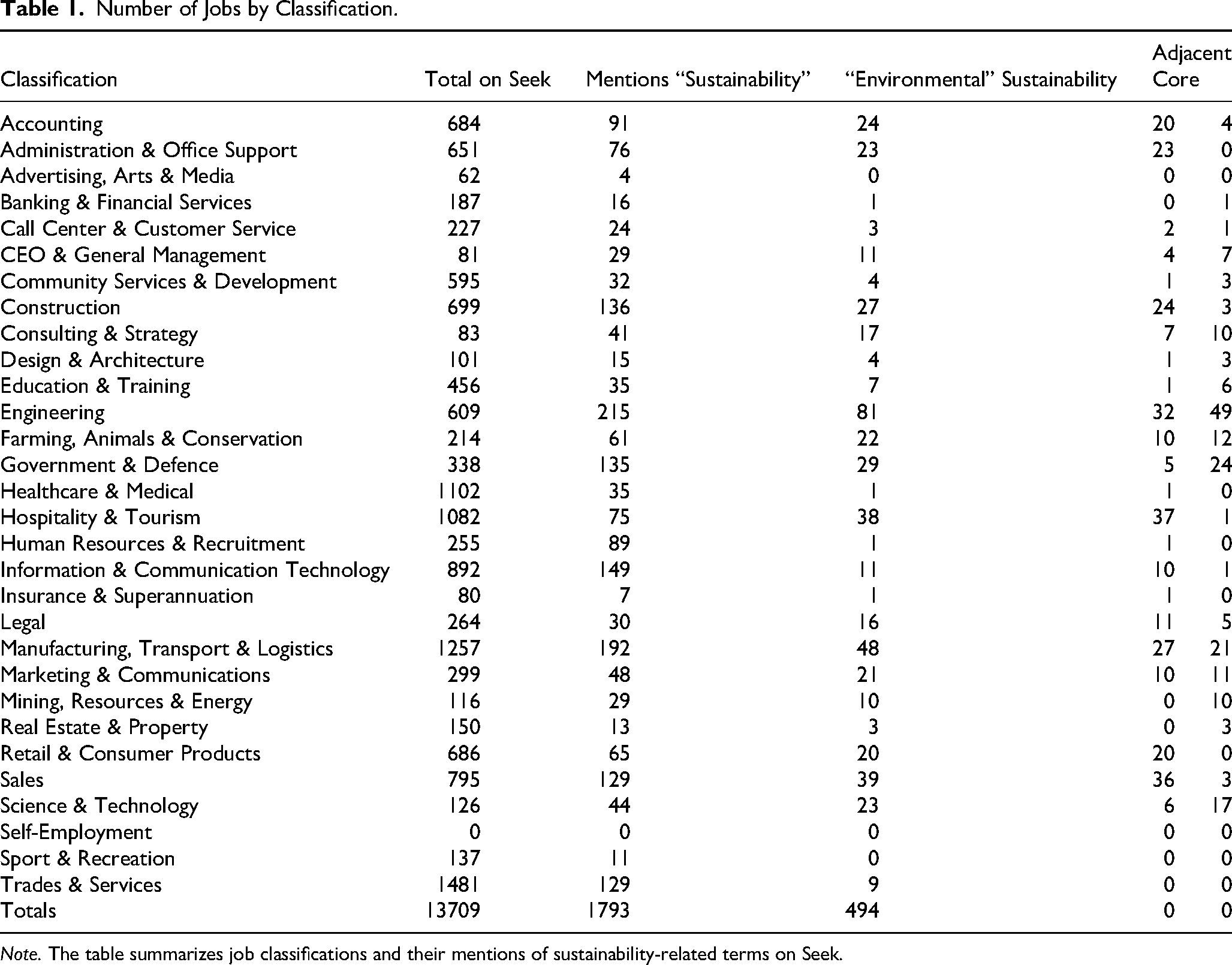
Note. The table summarizes job classifications and their mentions of sustainability-related terms on Seek.
The first two authors collated these data. First, the 30 classification areas in Seek were randomly assigned (15 to each author). We then downloaded any job advertisement that related in some way to protection of the environment. Jobs advertisements were discarded if the term ‘sustainability’ was used in terms of social, or community sustainability, although the use of the word ‘sustainability’ in these contexts was rare. Most commonly, sustainability that was not related to the environment was concerned with the financial sustainability, or to the long- term longevity of the business/organization itself; and/or simply failed to say anything beyond the word ‘sustainable’ itself. Thus, for inclusion in our secondary dataset, the job being advertised had to be substantively ‘green’.
These retained Job advertisements were then examined to identify whether the output of the work was producing goods and/or services which were ‘green’ or the contributed to processes which supported environmental sustainability either directly or indirectly (
These were the advertisements in which both raters were confident that sustainability - understood as green collar work - was relevant. The Job Specification information itself, for each job, was also captured literally 1 , downloaded and assembled in folders that related to each of the 30 classifications. A spreadsheet was compiled that noted the Classification, Job Title, Employer Name, Location, Pay information if applicable.
In total, 494 job advertisements were downloaded (see Table 1) by following the above protocol. Each captured advertisement was then classified by the rating author, according to whether the job being advertised was
Thence, we only copied the Knowledge, Skills, Abilities and Others (KSAOs), of core green collar work verbatim from the 195 job advertisements (Appendix I). Drawing on the O*Net categories used to measure green jobs or occupations, a direct record could then be made of what KSAOs were required in terms of Green Enhanced Skills (GES) where jobs where the purpose remains stable but tasks change (e.g., an electrical engineer working in the renewable energy sector) and Green New and Emerging Jobs (GNE) which are new jobs with new tasks, such as climate scientists or climate change advisors. Capturing this information is useful for jobseekers and career counselors to ascertain what new KSAOs were required for career capabilities to undertake green collar work that was focused on environmental protection and sustainability. It could also be used to inform Vocational, Education and Training and workforce planning and development.
Results
The frequencies for each of the job classifications are captured in Table 1. This data illustrates, among other things, that the concept of sustainability has now undergone a career development of its own and no sector can be imagined without it. Although there is a risk of it becoming just a ‘buzzword’, the actual search for it is an indication that there was real demand, however varying. From Table 1, it is evident that green collar work was not distributed randomly across the main pre-existing categories of career opportunities. There were clearly some categories in which opportunities for green collar work were greater than others. Based on “Environmental” sustainability tallies, the top three categories, in this context, at this time, were 1. Engineering, 2. Manufacturing, Transport & Logistics, and 3. Sales. Table 1 also reveals that the top five sectors, with the highest proportion of overall green roles (adjacent and core), were, in descending order, Engineering (81), Manufacturing Transport and Logistics (48), Sales (39), Hospitality and Tourism (38), and Government & Defense (29).
Reflecting on patterns, and in terms of service and production sectors, we turn to our specific research question RQ1. Here, the sectors which most frequently offered green-collar opportunities were where we initially expected, specifically in Engineering (32 adjacent and 49 core green-collar jobs), and in Manufacturing, Transport and Logistics (27 adjacent, 21 core). Surprisingly too, however, by differentiating between adjacent and core green collar roles it was apparent, from Table 1, that there are greater adjacent green career opportunities in Construction (24) compared to (3) core green collar jobs. Marketing and Communications evinced a relatively promising joint opportunity for green careering, i.e., both adjacent (10) and core (11), whilst in Call Centre and Customer Service there were few opportunities either adjacent (2) or core (1). Hence overall, Table 1 was informative, in the Information theory sense of providing unexpected findings.
Figure 1 is a summary figure on the distribution of green jobs, in the form of a bar chart. It captures the variegation in green jobs classified by sector, as well as the differences between adjacent and core job, and career opportunities, for example in Accounting and Sales, as well as the preponderance of adjacent over core green jobs, excepting for example Engineering.
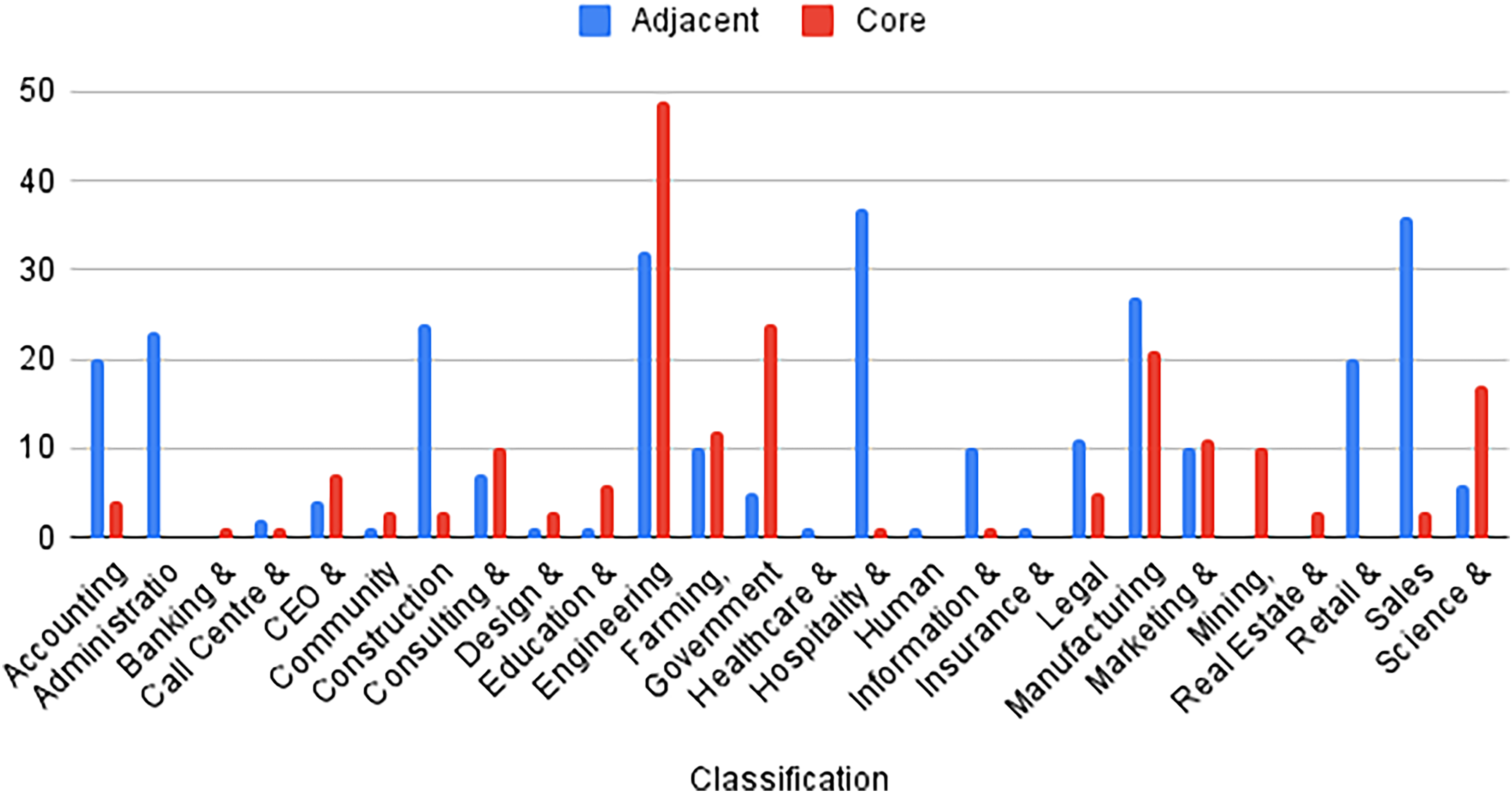
Frequency Distribution for Adjacent and Core Green Collar Work by Job Classification. Note: Adjacent Green Collar Work is jobs that utilize existing and generic KSAOs for an employer committed to sustainability in some form. Core Green Collar Work is outputs and process-based, direct and indirect green work.
Discussion
Green Collar work was understood in two forms. The first of these was adjacent green collar work was defined as work that used existing generic skills for an employer committed to sustainability. Jobseekers who are unable or unwilling to upskill or change career direction can use job databases and a protocol such as ours to seek work, that enables them in some way to contribute to environmental sustainability. This may be in the same sector or in another which attracts them. The same information may be useful, in a similar way, to career guidance professionals.
Core green collar work was either output or process-based work that indirectly or directly contributed to environmental sustainability. This might be work such as recycling or waste management that involves new tasks but not necessarily specific green expertise or skills. Core Green Collar Work may also be output- or process-based, indirect or direct work, which requires specific green expertise or KSAOs. Examples of such KSAOs would be emissions reporting, carbon auditing, and measuring climate-related targets.
We captured the KSAOs and job titles in Appendix I that specifies green expertise, i.e., knowledge, skills and abilities and others, which are explicitly required for core green collar work. We wanted to detail what specialized green skills are required now, and possibly in the future in order to protect the planet to and work towards green societies and circular economies. Such KSAO specifications may be useful for job seekers who want to make the most difference in terms of climate action, for workforce development and future vocational education and training. Ultimately, bundled KSAOs of different levels became visible, coalescing a rough indication of the KSAOs actually required, which should be of interest to jobseekers and career advisors who assess whether specific extant qualifications and knowledge apply, vs. whether development of new ones is required. For example and with respect to RQ2, from Appendix I, there was a preponderance of knowledge skills and abilities in climate analytics, mapping and reporting, from Accounting (e.g., ESG reporting) and Design & Architecture (proficiency in data interpretation), to Legal (Knowledge of sustainable procurement), Sales (Understanding of solar PV technology), Construction (solar or wind experience/Ability) and Manufacturing (Knowledge of hazardous waste handling regulations and procedures). There was a further cross-cutting form of O capability, beyond compliance, which might be described as leadership and persuasion, in a strategic, net zero direction, such as: “Lead the design…of climate related targets” (Accounting); “Lead a shift in directions in a green fields role” (Call Centre and Customer Services); “Advocate, promote, and market protected natural environments” (CEO & Managers); “Forge new connections…” (Mining); and “promote water sensitive design” (Engineering).
If a client's aspirations and KSAOs fit this kind of profile, they may be a good fit for the green job Career counselors can play an important role in aiding job seekers to choose which type of green collar work is the best fit. This will require counselors to draw out the current work situations of their client and align this with future aspirations and goals, which are grounded in ‘identity narratives about self and work’ to make healthy and stable transitions to new livelihoods, occupations and careers (Savickas, 2013, p. 168). Having identified the preferred future self in the world of work, either as a job seeker or a career advisor, our protocol would enable the seeker or advisor to check the KSAOs that are required for the role(s). This process may indicate career education and counseling to provide vocational guidance to develop new beliefs and attitudes needed to help people become authors and agents of their own lives, and to support psychological transitions to new forms of training, education or professional development. In doing so, career counseling can provide a conduit to the possibilities of a more satisfying and balanced life, or Just Transition (Savickas, 2013)
In that key, career development regard, Maree (2024) has argued for a shift for career counseling to enter in the era of the Counsellocene, an approach which recognizes the interdependence of livelihoods, occupations and careers with the health of the environment, and thereby wider ecosystem. This approach promotes the psychology of sustainability and sustainable development through guiding jobseekers through a lens of ecological awareness towards green collar work, that also could deliver social workplace justice, and close economic inequities.
Certainly, growing numbers of workers are seeking decent work that is protective of the planet and provides prosperity. Coming first in 2021, the Great Resignation was a term coined to make sense of the 47 million Americans who refused to return to work following Covid-19 lockdowns. It was a time when many people in the hospitality, retail, leisure, healthcare, professional and business sectors desired significant changes within their workplaces or about the type of work they were doing. For those who remained in regular employment, disengagement took the form of Quiet Quitting manifesting in limited commitment to their jobs and to the organizations who employed them (Formica & Sfodera, 2022).
The majority of those who led the Great Resignation, and the Quiet Quitters are cohorts of Millennials (1981 to 1995) and Gen Z (born between 1996 to 2012). (Paulise, 2021) It is estimated that Millennials make up 75% of the global workforce in 2025 (Purdue Global, 2025), and by 2034 80% of the workforce will be Millennials, Gen Z and the first adult Gen Alpha (World Economic Forum, 2025). It is thought Millennials characterized by the ‘we culture’ prize flexibility, risk taking and work-life balance. While Gen-Z may be more cautious than Millennials, both cohorts seek meaningful work that reflects their values and desire for authenticity, and to be at the forefront of culture change (Paulise, 2021). These values include Climate Action under SDG 13 (Deloitte, 2024). In supporting the construction of careers which fit the desire for meaningful work and enable the synchronicity of self with imagined and actual realities, it may also be possible to address the growing devastation to the planet (Hartung & Di Fabio, 2024)
Overall, the desire to participate in environmentally sustainable or ‘green work’ is reportedly the case for both young workers such as Gen Z and Millennials (Impakter, 2023) but also for older workers as well (Wiernik et al., 2013). This has important implications for entry into the workforce and career development across time in the dynamic world of work. The use of job databases as a source for research allows an examination of the real-word formal jobs market at any given point in time and place.
We envisage that such market information can be updated on a regular basis, using AI software, in order to keep pace with the rapidly changing world of work and careers (Lent, 2024), and the need for career guidance to be attuned, in real time, to the dynamic local and regional jobs and work market, whether in Australia, New Zealand, or elsewhere (IRENA & ILO, 2024).
The information on job advertisement digital platforms lists the KSAOs required for employment in any given area. This information can be used for Vocational and Education Training as well as for workers seeking a career shift or for professional development. The idea of sustainability is central to green jobs or green collar work, and more importantly for this article, community of professional career guidance practice readership, green career development. It is closely aligned with sustainable development, sustainable economies, and sustainable growth. Central to all of this is protection of the planet and a sustainable career environment (Di Fabio, 2017; Di Fabio & Cooper, 2023; Kenny & Di Fabio, 2024).
Careers in the twenty-first century are located in landscapes which are characterized by escalating growth in digital technologies, globalization, robotics and artificial intelligence, and increasingly unstable societies. In the age of the boundaryless protean careers, approaches such the Counsellocene support people to agentically move through work trajectories, which are framed in eco-awareness. In turn, this holds the power to strengthen the psychology of sustainability and sustainable development at micro, meso, and macro levels (Hartung & Di Fabio, 2024), Through career theory and practice, people will be accorded the opportunity and dignity of sustainable and meaningful work. It is vital that both theory and practice shape policy, which contributes to the agenda for decent work, protective of people, prosperity, and planet.
In the final analysis, this paper has offered a way for digital platforms to contribute to that agenda, through their capacity to be a meeting place for employees, employers, and government workforce development agencies to connect, in the service of sustainable livelihoods and careers. In this way, the protocol we have outlined may be useful for not only helping those who may have been under-served by traditional career services in this era of Great Disruption (above), but also as an outreach bridge between technology and counsellor-based Professional Career Development services (Lent, 2024). In that prospective and future regard, we found that green work in New Zealand is developing and intersecting with conventional recruitment sectors. Such intersections in turn have the potential to contribute to emerging models of sustainable career development, career identities and trajectories (Maree, 2025).
Limitations and Future Research
In terms of limitations the data collection period was a short window in time, and therefore we were unable to comment on what proportion of green collar work is offered on average annually. It may well be that the number of jobs identified was influenced by the time of year (close to holiday season, seasonal considerations for rural based work etc.). It is useful to examine local contexts for direct relevance, however, the focus only one Island Nation country - New Zealand - means that we were unable to identify whether there is ‘typical green collar work’ across international contexts, or whether this type of work was location specific, or both. Future research should examine cross- national comparisons, to help elucidate the nature and frequency of green work alongside longitudinal monitoring of green job dynamics to plot changes across time.
Longitudinal analyses of this nature will also indicate the impacts of global challenges, developments and different and dynamic sociopolitical contexts. It would also be extremely useful to gather data and analyze the perceptions of jobseekers and career counselors about the definitions of green work, and what might be most popular or desirable. This would help to guide vocational education and training, as well as public and private financial investment in particular sectors.
In conclusion, the manuscript addresses a societally important and underexplored topic. With more precise objectives, theoretical anchoring, methodological detail, and increased formal refinement of results and discussion, the development of protocols from digital platform enabled recruitment sites offers a novel multi-level, meaningful and special contribution to the literature on sustainable development as the fourth paradigm for twenty-first century careers (Hartung & Di Fabio, 2024) as well as for career development policies.
Supplemental Material
sj-docx-1-acd-10.1177_10384162251351150 - Supplemental material for Green Collar Work: Implications for Career Development
Supplemental material, sj-docx-1-acd-10.1177_10384162251351150 for Green Collar Work: Implications for Career Development by Veronica Hopner, Stuart C Carr and Ingo Matuschek in Australian Journal of Career Development
Footnotes

Funding
The authors received no financial support for the research, authorship, and/or publication of this article.
Declaration of Conflicting Interests
The authors declared no potential conflicts of interest with respect to the research, authorship, and/or publication of this article.
Supplemental Material
All supplemental material mentioned in the text is available in the online version of the journal.
Notes
References
Supplementary Material
Please find the following supplemental material available below.
For Open Access articles published under a Creative Commons License, all supplemental material carries the same license as the article it is associated with.
For non-Open Access articles published, all supplemental material carries a non-exclusive license, and permission requests for re-use of supplemental material or any part of supplemental material shall be sent directly to the copyright owner as specified in the copyright notice associated with the article.
