



Abstract
The aim of this review was to synthesise and appraise the evidence on the impact of media on career decisions. Academic databases were searched for papers that investigated the link between media and career choice. There was some evidence that audiovisual media (i.e., movies, TV, video games) impacted career choice, with further evidence that print media was influential. Males and those from racial minority groups were more influenced by media than others. There was a limited focus on specific careers, although it is evident that people are influenced to pursue career pathways in STEM, the criminal justice system, and marketing owing to media exposure. Overall, there is some evidence that media influences career choice, with audiovisual approaches more effective over print/text. However, this evidence is limited to a narrow range of careers. More rigorous research is warranted to develop our understanding of how media can influence career choice.
Introduction
Choosing a career may be considered a significant milestone in a person's life. As people enter education systems, they progress through years of study until they are primed to enter the jobs market (Marciniak et al., 2022). At around age 15, young people start considering what careers they would possibly like to pursue (Ahmed et al., 2022; Fenwick, 2023). This is an important decision, given the impact that it can have on people's social, economic, and emotional wellbeing (Hartung, 2011).
Dominant theories in this field began to emerge in the mid-twentieth century. Holland's (1959) Theory of Career Choice proposes that people primarily choose careers based on their own personality type and the attraction of working with like-minded people. While Holland's (1959) categories are based on largely static individual personality traits, other individualist theories have focussed on more dynamic and life-spanning traits of the person as being key to understanding career choices. Super (1957)'s developmental theory of career choice places career choice and development within the framework of the growth and development of the individual. Super (1957) maintains that the act of an individual making career decisions is an expression of that person's self-concept and that as this sense of self grows, a person's engagement with their career evolves. Later in the twentieth century, career theory that focussed on structural and societal influences on career choice emerged. Law (1981) proposed Community Interaction Theory which posits that people's career choices are primarily influenced by interactions they have in the social groups to which they belong. Law (1981) discusses how these influential interactions occur in the modes of modelling and feedback and how the values and esteem placed on different roles within social groups are communicated.
There is evidence that several practical factors can influence a person's decision to pursue a particular career pathway, including expected salary, anticipated job satisfaction, potential for learning experiences (Ahmed et al., 2022), in addition to the influence of peers and teachers (Karlsson & Noela, 2022). Qin and Alonso Trillo (2023) highlighted the influence of extrinsic, intrinsic, and social motivation on career intention for those entering a career in music teaching. The role of extrinsic, intrinsic and social motivators was also observed by Tey et al. (2020) with regard to careers in science, technology, engineering, and mathematics (STEM). Abessolo et al. (2017) identified that people are driven by personal values that develop in terms of career goals. A subjective and personal relationship to career as a motivating factor was also observed by Freed et al. (2013), who found that an interest in specific patient populations, autonomy, and financial considerations were considerable influences on career choice. These studies highlight the interpersonal and intrapersonal factors that can influence career choice. Conversely Moreau's (2015) comparative study on the factors motivating the choice to become a second level school teacher in France and England highlights the degree to which “career choices are constrained by the socio-structural factors at play in national contexts” (p. 415), emphasising the influence of external societal factors on career choice.
Another influence which should be considered is media. The influence of media on an individual's behaviours and attitudes is well attested. It has the potential to influence individual choices and perceptions across a broad spectrum of issues (Liu, 2023). Gerbner and Gross (1976) understand media (specifically television) as a means of cultivating a “socially constructed ‘reality’ [which] gives a coherent picture of what exists, what is important, what is related to what, and what is right.” (p. 176) Gerbner and Gross (1976) develop this idea into a system of analysis called Cultivation Theory. They apply this theory to enquire “into the assumptions television cultivates about the facts, norms, and values of society” (p. 182). The real-world impact of media can be further substantiated with recourse to Framing Theory, a system of analysis which considers the focus placed on events by the media and attributes meaning to this focus. Framing theory can contextualise the correlation between media focus and cultural salience, that is, the presence of an issue in media and its resulting traction in society (Bateson, 1972). In their analysis of the relationship between voter attitudes and framing of contemporary political issues in mass media, McCombs and Shaw (1972) echo Gerbner and Gross’ (1976) assertion that popular opinion is constructed by media, stating that “most of what people know comes to them ‘second’ or ‘third’ hand from the mass media or from other people” (1972, p.177). Media does not passively reflect society: it dictates and shapes it. More presciently, the specific media which an individual or group engages with will meaningfully cultivate and direct their choices and worldview (Liu, 2023; McLuhan, 2000).
Several studies have concluded that media can influence interest in careers, both positively and negatively. Levine et al. (2021) argue that children utilise media as a guide for role models and to obtain knowledge of possible careers. They found that children exposed to STEM media show a higher interest in STEM careers. Consequently, TV programmes such as Grey's anatomy, ER and news feed “pop ups” depicting STEM have been shown to impact student's opinions of STEM careers. In some cases, these programmes led to a change in students’ opinions of these careers, resulting in some considering a career in STEM; in other cases, these depictions led to negative attitudes about these careers (Zigmont & Wolfe, 2022). Similarly, media portrayals of teachers’ low salary and disruptive classroom environments have been shown to discourage teaching as a possible career (Padhy et al., 2015). Moreover, generalisations and stereotyping of certain ethnic groups portrayed in the media may provoke negative cogitations towards career choice. Historically, television has been critiqued for its stereotyping and limited inclusion of ethnic and minority groups (Gordon, 2016). Gordon (2016) reported that media stereotypes depicting lower intelligence and education levels may adversely influence youth perceptions of academic achievements and thus limit career pathways in ethnic groups.
Given the influence of media in general, and the impact that media can have on perceptions of and attitudes towards careers, it is likely that media can also influence people's decisions to pursue their career pathways. However, to date, there have been no attempts to synthesise the evidence. Therefore, the aim of this systematic review was to synthesise and critically appraise the available evidence on the impact of media on people's career decisions.
Methods
Review methods and reporting were based on the Preferred Reporting Items for Systematic Reviews and Meta-Analyses (PRISMA) checklist (Page et al., 2021). In order to enhance transparency, we registered the protocol with the Open Science Framework (registration number MASKED TO FACILITATE ANONYMOUS PEER REVIEW). For inclusion purposes, empirical studies of any design were considered eligible. We excluded other sources, such as dissertations and editorials.
Eligibility Criteria
To determine study eligibility, we used the PICOS framework, which stands for: Population, Intervention, Comparison, Outcomes, and Study Design (Methley et al., 2014; Richardson et al., 1995). Studies were deemed eligible for inclusion with the proviso that they were conducted with any population who had been influenced by the media to select a career; we also included papers with populations who were on a particular pathway to a career as a result of media influence (e.g., where students were pursuing a university degree to obtain employment in a specific sector) (Outcome). Any Interventions related to mass media and social media were considered eligible for inclusion; media-based interventions developed by researchers were excluded. Studies both with and without Comparators were considered eligible for inclusion. In terms of Study Designs, empirical papers were considered eligible, while we excluded literature reviews, theoretical papers, conference abstracts, editorials, letters to the editor, dissertations, and study protocols.
Search Strategy
Searches for relevant studies were conducted across seven relevant academic databases, which were: Academic Search Complete, Business Source Complete, PsycArticles, PsycInfo, SocINDEX, the British Education Index, and ERIC. We also conducted a hand-search of the reference lists of studies in order to minimize bias and identify additional studies not initially identified (Vassar et al., 2016). Search terms were informed by previous systematic reviews on media (Goodwin & Behan, 2023) and career choices (Akosah-Twumasi et al., 2018); truncations were then applied to these keywords to maximize retrieval, across title or abstracts. A combination of the following keywords were used: (film* OR movie* OR “motion picture*” OR cinema* OR television OR TV OR video* OR media OR multimedia OR news* OR “video game*” OR “social media” OR radio OR book* OR music OR song* OR play* OR theatre OR comic* or edutainment or stream*) AND (influence* OR impact* OR effect* OR affect* OR factor*) AND ([career* OR job* OR work* OR occupation* OR profession* OR employ*] within 5 words of [decision* OR choice* OR choos* OR motivat* OR interest* OR purs*]). The search was limited to records published in the English language within the last ten years (2014–2024). The search was first conducted on September 1st 2024 and then updated on 10th October 2024.
Study Selection
Identified records were transferred to a Microsoft Excel spreadsheet document. Duplicates were then identified by MD and deleted. Initially, a screening by title and abstract was conducted by two authors, independently (JG & RG), with each record subjected to eligibility criteria. Next, the full text of each potentially identified record was screened by two authors, independently (JG & RG). Any conflicts were resolved by a third author (JF).
Data Extraction and Synthesis
To minimize reporting bias, data were extracted onto a standardised data extraction table (Goodwin & Behan, 2023). This was conducted by JG and cross-checked for accuracy by LP. Findings are presented through a narrative synthesis.
Quality Assessment
The quality of all seven papers were critically appraised. This was completed, availing of the tools prepared by the Joanna Briggs Institute (Lockwood et al., 2015; Moola et al., 2020). To minimize bias, critical appraisal for all records was completed by one author (JG) and then cross-checked by a second author (LP).
We also assessed the level of evidence. This was completed using the Scottish Intercollegiate Guidelines Network grading system (Healthcare Improvement Scotland, 2011). Under the Healthcare Improvement Scotland (2011), studies are graded from the lower level of 4 (expert opinion) to the higher level of 1++ (high-quality meta-analyses and systematic reviews of randomised controlled trials). A grade ranging from D to A is then given. Again, to minimize bias, the level of evidence was completed by two members of the team, with JG conducing the initial assessment, and cross-checking performed by LP.
Findings
We initially identified 8610 records through screening (see Figure 1). We identified and then removed 2185 duplicates. Next, we screened 6425 papers, applying the eligibility criteria to title and abstracts, which led to 6390 papers being excluded. Following this process, 35 papers remained for full-text screening, 29 of which were excluded due to not meeting the eligibility criteria. Through hand-searching of reference lists (Vassar et al., 2016), one additional relevant paper was identified. A total of seven studies were included in this systematic review.
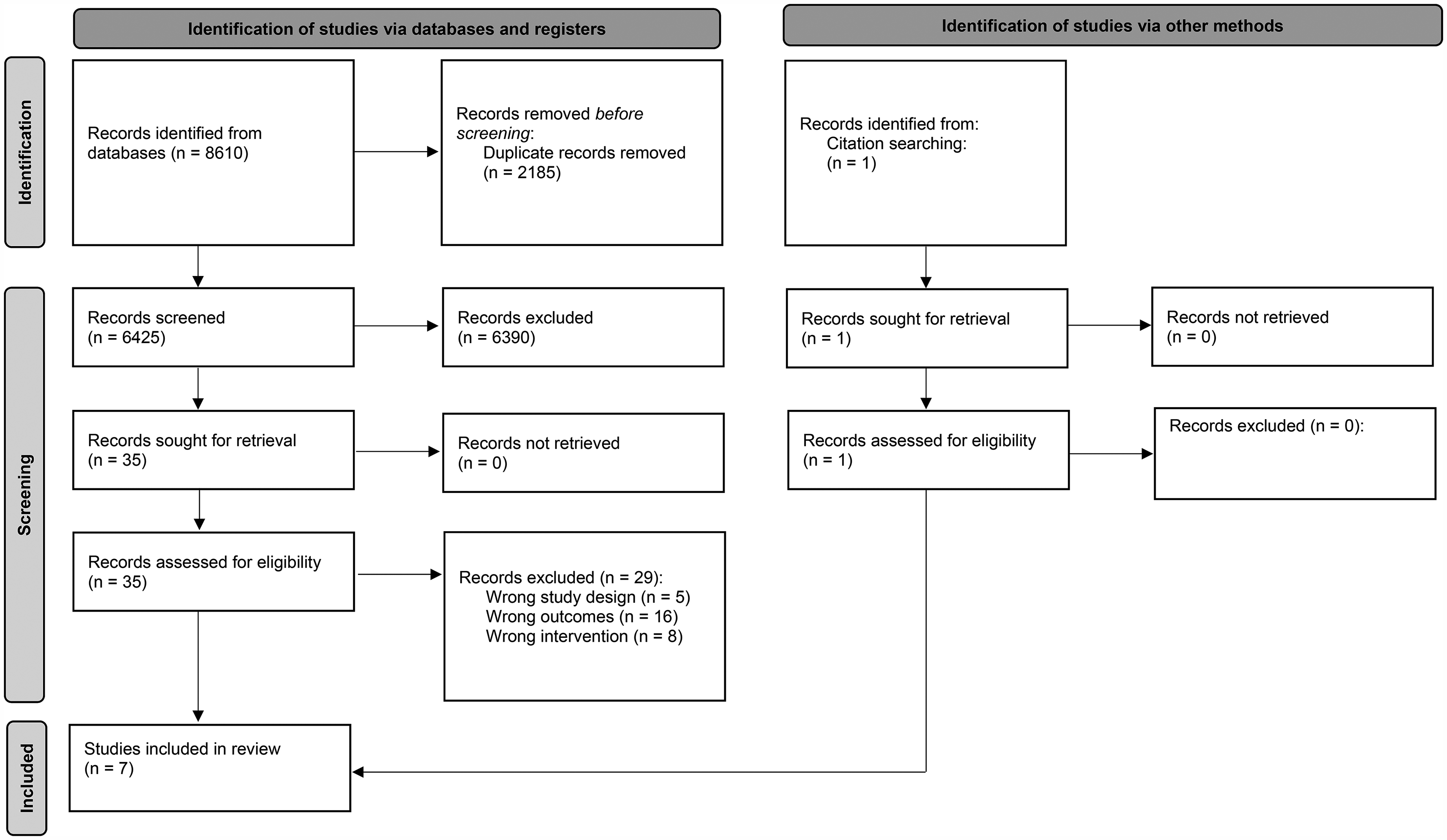
Study Identification, Screening, and Selection Process.
Study Characteristics
There were four cross-sectional studies, two qualitative studies, and one longitudinal study. Most studies (n = 6) included university students, with one of these also focusing on professionals. One study included a sample of new graduates. Studies were conducted in the USA (n = 3), Hong Kong (n = 1), Pakistan (n = 1), Spain (n = 1), and Vietnam (n = 1). Sample sizes ranged from 17 (Sáinz et al., 2020) to 15,752 (Chen et al., 2023). The media focus across the studies was on unspecified media (n = 2); “mass media” (n = 1), a range of media including reading, TV, online videos, and video games (n = 1), TV and movies (n = 1), video games (n = 1), and crime-related TV shows and novels (n = 1). Study characteristics are presented in full in Supplementary File 1.
Quality Assessment and Level of Evidence
Neither qualitative study (Mate et al., 2017; Sáinz et al., 2020) indicated that ethical approval had been sought, nor did they address the influence on the researcher, or vice-versa. The voices of participants were not adequately represented by Mate et al. (2017) as is not clear how representative quotations are. Several studies (Chen et al., 2023; Collixa-Cox & Furst, 2019; Lee, 2015; Walters et al., 2022) measured media influence with non-validated instruments, using Likert-type scale approaches. Moreover, confounding factors were not identified by Chen et al. (2023), Collica-Cox and Furst (2019), Lee (2015), and Saleem et al. (2014), and strategies to deal with such factors were not stated in any study. Limited details about the study subjects and the setting were reported by both Chen et al., (2023) and Saleem et al. (2014). Despite these limitations, no study was excluded as a result of quality appraisal.
Each study scored 3 on the level of evidence grading system (Healthcare Improvement Scotland, 2011), indicating an overall descriptive and non-analytic approach. An overall grade “D” was awarded, which corresponds with a low level of evidence.
Media Format
In a cross-sectional study, Saleem et al. (2014) found that non-specific mass media had a significant influence on career choice (p < 0.05). Three studies (Chen et al., 2023; Sáinz et al., 2020; Walters et al., 2022) reported on a combination of media and their influences, where the influence of one particular medium could not be singled out. In a cross-sectional study, Chen et al. (2023) reported that TV/gaming had a significant total effect on career interest (p < 0.001); however, this effect was mediated via an internalization mechanism. In a longitudinal study, Walters et al. (2022) found that, although TV/movies were not considered influential when compared with other sources (e.g., “outside experts”) in 2014, this had changed in 2021, with these forms of media regarded as more influential than outside experts, teachers/professors, and friends. The difference between the two year groups was significant (p < 0.001). In a qualitative study, several participants identified that their career choice was influenced by media to which they had been exposed to in their youth (Sáinz et al., 2020). They acknowledged that characters from books, cartoons, and movies were considered as role models for them.
Other studies addressed the impact of specific media. In a cross-sectional study, Collica-Cox and Furst (2019) reported that books were regarded as unlikely to have an impact on career choice, with only 5% (n = 3) acknowledging the influence of this medium. On the other hand, just under a quarter of students (n = 15) either agreed or strongly agreed that TV shows had influenced their career pathway. The influence of TV was also apparent in Mate et al.'s (2017) qualitative study, with one student commenting that they were influenced to pursue their major in marketing following exposure to a TV commercial. Lee (2015) considered the influence of video games in their cross-sectional study. It was reported that this medium can have a significant relationship on career pathways chosen by students (p < 0.001).
Demographic Characteristics as Mediating Factors
Several studies neglected to supply sufficient demographic context. However, there was some limited evidence that gender and race/ethnicity mediated the influence of gender. Sáinz et al. (2020), in their qualitative study, found that only one female participant had been influenced by media (science fiction movies, specifically) to pursue her career choice. The authors reported that males were more likely to cite media as an influence on career choice, although it should be noted that the specific number of males who stated this was not supplied. Similarly, in a cross-sectional study, Lee (2015) reported that females were not as influenced by video games to pursue a career in STEM when compared with males (p < 0.001). It was also found that racial minority (as defined by the authors – African American, Hispanic, and Native American) students were more influenced than White or Asian students (p < 0.05).
Specific Career Pathways
Interest in pursuing a career in STEM was influenced by media, as revealed in cross-sectional surveys conducted by Chen et al. (2023) and Lee (2015). Qualitative findings reported by Sáinz et al. (2020) also acknowledge that STEM career pathway selection is influenced by media.
Studying criminal justice in university was also influenced by media consumption (Collica-Cox & Furst, 2019; Walters et al., 2022). In Saleem et al.'s (2014) cross-sectional study, recent graduates from business schools acknowledged the influence of mass media on their career choices.
Discussion
The aim of this systematic review was to synthesise and critically appraise the evidence on the impact of media on people's career decisions. We found that the overall level of evidence, using the Healthcare Improvement Scotland (2011) tool was low, and we also uncovered several methodological issues. Quality appraisal also revealed that ethical approval may not have been granted. Rigorous methodological approaches need to be followed in order to order to sufficiently progress high-quality scholarly research (Hays & McKibben, 2021). It is also important that strict, ethical processes are followed (Pan, 2020). A robust evidence base for the impact of media on career choice needs to be developed; however, more scholarly, rigorous and ethically transparent approaches are warranted.
Notwithstanding these methodological concerns, there are some key findings to address. Although there was some limited evidence that books can impact career choice, TV, movies, and video games appear to be more influential. Previous research has illuminated the benefits of a more audiovisual approach over printed media for a variety of topics. For example, audiovisual media has been shown to be more effective in improving knowledge, understanding, and recall of health information (Saab et al., 2024; Schubbe et al., 2020), encouraging people to seek help for mental health (Goodwin & Behan, 2023), and assisting people to quit smoking (Kim et al., 2020). This can be explained in the context of Howard Gardner's multiple intelligences theory, which “identifies eight intelligences: linguistic, logical-mathematical, spatial, musical, bodily-kinesthetic, interpersonal, intrapersonal, and naturalistic” (Sherman et al., 2023, p. 45). The more intelligences that can be employed, the more we can consolidate learning, enhance knowledge retention (Pllana, 2021), and foster problem-solving skills (Qiu, 2025). Crucially, audiovisual approaches can utilise several intelligences at once (Green, 2019; Steffes & Duverger, 2012). While there is evidence that multimedia/audiovisual approaches are utilised to promote career options (Struyk, 2024), there are many examples where an exclusive print/text strategy is adopted (Kavanagh, 2023; Nathan, 2023; Piccardo, 2024). Given the impact of audiovisual media to exploit multiple intelligences simultaneously, and the findings of the current review, consideration should be given to these approaches when advertising career pathways.
Despite the evidence that media can influence career choice, we also found that other factors, namely gender and race/ethnicity, mediated this correlation. Smith et al. (2018) reported that, of the top 100 films released in the year 2017, only 33 films portrayed a female lead or co-lead. Similar findings have been observed in TV shows (González-de-Garay et al., 2020). Smith et al. (2018) also revealed that films from this year featured predominantly (70%) White characters. Moreover, 20 films featured no Black or African American characters, 37 no Asian characters, and 43 no Latino characters. Representation within media narratives is important; a lack of significant representation leads to “power imbalances, unequal distribution of cultural authority in society, and unequal access to the means of symbolic representation and meaning-making” (Belfiore, 2020, p. 383). Considering there is evidence that White male representation in media encourages these individuals to pursue certain career pathways, stakeholders should have more engagement with the media, advocating for the inclusion of less represented demographic groups. Moreover, future research should consider the relationship between enhanced representation of these groups in media and the impact this has on career choice.
We also found that most studies focussed on third level students who were on a pathway to pursuing a particular career. There are of course third level students whose course of choice corresponds directly with the career they will enter: many students will undertake undergraduate programmes in, for example, nursing or engineering, and will ultimately secure employment in these professions (Ait Ali et al., 2024; Burnik & Košir, 2017). Some programmes of study are broader, and other careers do not require any formal tertiary education (Yavuz, 2024). As such, the influence of media on a wide range of careers, such as, for example, careers in healthcare and the creative sector is still not clear. It would be useful to better understand the role that media plays in the wider spectrum of employment, so that targeted approaches can be adopted; further research is warranted here.
Given the impact that media can have on career choice, there may be scope to include multimedia approaches within career development services. As noted by Keele et al. (2020), career development services need to take a broader approach than just a “once-off conversation” one. They argue that students respond better to more personalised strategies, suggesting the integration of small group reflective activities and 1:1 career development support. Indeed, fostering curiosity about developing one's career can be achieved through the promotion of self-reflection within schools (Damodar et al., 2024; Savickas & Porfeli, 2011). Multimedia approaches can be implemented easily within the school environment and have shown promise in encouraging young people to reflect on complex phenomena (Aventin et al., 2019; Goodwin et al., 2024). As such, career development opportunities within schools may benefit from embracing multimedia strategies in enhancing reflection among students and assisting them in making decisions about potential career pathways.
This review has several limitations which should be acknowledged. We included published peer-reviewed literature in our review, only, excluding grey literature. It should be noted that many more studies reporting on the influence of media on people's career choices may be available through the wider grey literature. We only reviewed papers published in the past ten years, and we acknowledge that literature pre-dating this period may have further informed our findings. Finally, with a “D” award, the overall level of evidence was low, and this can also be considered to be a limitation.
Conclusion
Based on our findings, there is some evidence to suggest that media has the potential to influence career choice, particularly audiovisual approaches. As such, there is scope to enhance the career development of young people by including media-based approaches within school curricula. However, the evidence in this area is limited to a narrow range of careers at present. More robust research in this area is warranted. It is recommended that a longitudinal approach should be taken, exploring the relationship between media in exposure in youth, young adulthood, and ultimate career choice. Should sufficient high-quality, homogenous data become available, future systematic reviews should employ meta-analytical techniques. More robust qualitative research is also recommended, exploring the impact of media on career choice across a range of careers.
Supplemental Material
sj-docx-1-acd-10.1177_10384162251345578 - Supplemental material for Can Media Influence People’s Career Choices? A Systematic Review
Supplemental material, sj-docx-1-acd-10.1177_10384162251345578 for Can Media Influence People’s Career Choices? A Systematic Review by John Goodwin, John Finn, Michael Dowling, Leanne Pearson and Rachel Gough in Australian Journal of Career Development
Footnotes

Funding
The authors disclosed receipt of the following financial support for the research, authorship, and/or publication of this article: This systematic review was supported by funding received from The Nursing & Midwifery Board of Ireland.
Declaration of Conflicting Interests
The authors declared no potential conflicts of interest with respect to the research, authorship, and/or publication of this article.
Supplemental Material
Supplemental material for this article is available online.