




Abstract
This study aimed to understand recent graduates’ experiences of finding relevant work and perceptions of work readiness. Semi-structured interviews with 15 recent graduates from non-clinical health degree programs were conducted. Interviews, analysed thematically, explored work readiness definitions and skills and attributes, contribution and deficiencies of their courses to employability, and suggestions for improving the curriculum. Three major themes were identified: (1) career planning and decision making; (2) the process of finding a job; (3) bridging the gap from university to the workplace. Focusing on navigating the career uncertainty of broad degree programs, gaining and translating skills and experience, making the most of opportunities and maintaining a good attitude throughout were identified as possible avenues to support preparation for the health workforce. In practice, enhancing the information available regarding career options from non-clinical health degrees, through graduate tracking, and bolstering student capacity to handle uncertainty through authentic learning experiences is recommended.
Introduction
Growth in higher education is creating unique challenges for undergraduate students in navigating their readiness for work, which is often overshadowed by levels of uncertainty (Kwok, 2018). Since 2000 the number of young adults enrolled in higher education has increased significantly, with 40% of late-teenage Australians at university in 2020 (Norton, 2023). However, coupled with skilled migration this growing number of graduates has created a bottleneck for graduate employment. There are now many more graduates each year than there are graduate positions (Norton, 2023). In addition to the lack of graduate positions, young Australian adults have identified insufficient work experience, lack of technical and career management skills as barriers to gaining full-time roles (Foundation for Young Australians (FYA) & alphabeta, 2018). This is mirrored by employer perceptions that students lack the required skills to succeed in the workplace (Gonzales, 2017). Consequently, universities are shifting to measuring student success by graduate employability or work readiness – the degree to which a graduate is employable (Suleman, 2018).
Contemporary responses to addressing work readiness include embedding employability skills or graduate attribute development throughout curricula (Ritter et al., 2018), providing work-integrated learning (Lasen et al., 2018) and co-curricular activities (Jackson & Rowe, 2023), and career interventions (Soares et al., 2022) either via curriculum embedded modules (Teychenne et al., 2019) and/or investing in career services which provide counselling and workshops (Brown et al., 2019). Whilst these approaches have been shown to enhance students’ perceived work readiness, post-graduation evaluations are often limited to reports on whether graduates are employed or not (Challice et al., 2020; Healy et al., 2022). Insight into the careers of graduates and whether they have been equipped adequately is needed.
This is particularly relevant for graduates of broader degree programs, where the career options may be less certain (Pickenpaugh et al., 2022). For example clinical health degrees such as Medicine, Pharmacy and Physiotherapy have clear graduate pathways resulting in high employment – 92–96% of surveyed Australian graduates of these courses were employed full-time within four to six months (Challice et al., 2020). In contrast, health services and supports degrees such as public health had 20% lower full-time employment rates shortly after graduation (Challice et al., 2020). This indicates that finding employment in more general health positions may be more complex, requiring a range of career management and employability skills (Buunaaisie et al., 2018).
Focus on clinical competencies in health professions education, suggesting that passing competency thresholds deems students employable, has limited research on health graduate employability (Leadbeatter et al., 2023). While more evidence has been collected over the past decade, a broader perspective on employability may be needed, especially as current health graduates are more likely to have varied career pathways, deviating from initial professions which they were trained for (Leadbeatter et al., 2023). To determine if this cohort of students have unique experiences of employability it is also important that this research be positioned and integrated into the existing employability and career development literature (Healy et al., 2022).
This study aimed to understand and explore the needs and experiences of work readiness of recent graduates of broad health degrees. The research questions we aimed to answer were: 1) what are the perceptions of work readiness for recent health graduates?; and 2) what do recent health graduates think would have helped them better prepare for the workforce?
Methododology
We undertook a descriptive qualitative study adopting phenomenological methodology, which aims to understand the meaning of a phenomenon from the perspective of the individuals who directly experienced it (Giorgi, 1997). This methodology was deemed most appropriate to explore the experiences of recent health graduates who had entered the workforce. The study was approved by the University Human Research Ethics Committee (#19654).
Researchers
The research team all hold undergraduate degrees in broad health science based disciplines. All researchers had an insider perspective of graduate employability, having experienced the entered the workplace from a broad health degree. Three of the authors have supported students with this transition, specifically through the coordination of student placement units, working with industry to prepare students for the workplace. Reflexivity was applied to examine how world views and relationships were influencing interpretation through regular discussions throughout the data collection and analysis processes.
Participants
Graduates participating in this study were from a single, large research intensive university located in Australia. Graduates were eligible to participate if they had graduated at least six months prior to the time of interviewing. The degree programs included Bachelor of Health Sciences, Bachelor of Public Health or Bachelor of Biomedical Science undergraduate degrees including associated double degrees (e.g., Bachelor of Health Science / Bachelor of Business) or an Honours degree which have a combined average number of 600 graduates per year. To ensure participants could describe experiences of finding work or working related to their degree, graduates that were completing a postgraduate degree directly after completing their undergraduate degree or had not been looking for work relevant to their degree were not eligible.
Participants were recruited via convenience sampling through existing networks, advertisements on LinkedIn and snowball sampling whereby participants were asked to invite peers they knew who met the eligibility requirements. All fifteen persons who responded or were referred to the study and contacted the researchers were eligible to participate and agreed to be interviewed. Participation was voluntary with no incentives provided. At the completion of the 15 interviews researchers decided that the sample (272 pages of text) was rich enough to answer the research questions (Malterud et al., 2015).
Data collection
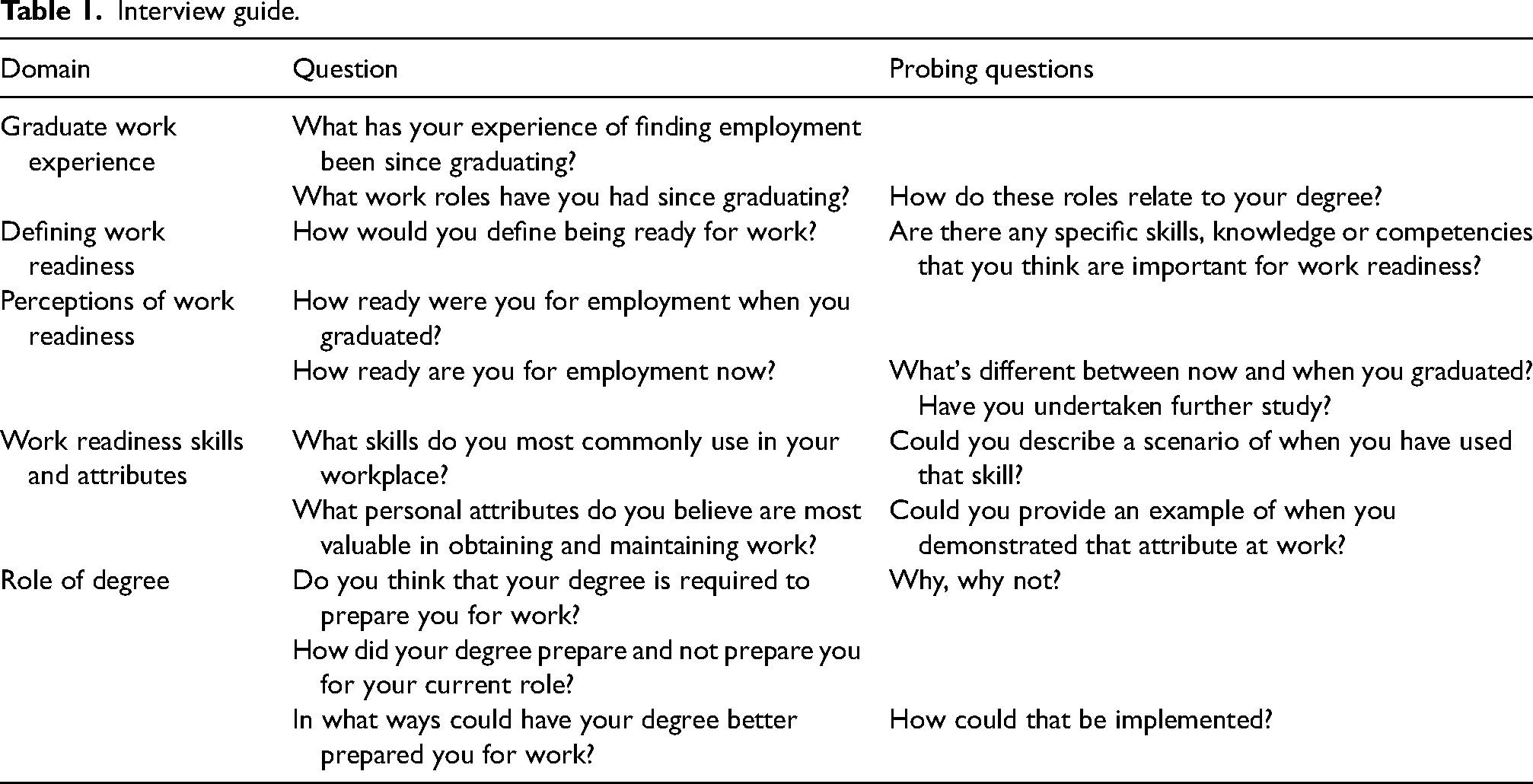
Semi-structured interviews were conducted from July 2019 to February 2020 by the authors, either via phone or in person. The interview guide (Table 1) was developed by the research team based on their experiences and a review of the literature. The guide covered the following domains: post-graduation work experience, definitions of work readiness, perceptions of personal work readiness after graduating, skills and attributes of work readiness, and the role of their degree for work readiness.
Interview guide.
Data analysis
Interviews were audio-recorded and transcribed verbatim by the lead author. The duration of interviews varied from 24 to 59 min. In alignment with a descriptive phenomenological approach (Sundler et al., 2019), multiple immersive read throughs of the transcripts were conducted by the lead author before they were openly coded. Transcripts were also read by a second researcher, for investigator triangulation. During the open coding process, data was broken down into segments of meaning and labels were applied (Sundler et al., 2019). This involved labelling sections of text without an existing framework or set of codes and then grouping the codes into common categories. Themes, categories and codes were documented and organised in tables and reviewed by co-authors for feedback and consensus before being converted into a coding guide for analysis. All transcripts were coded independently by two authors in NVIVO 20.3. The results, outlined below, are presented thematically.
Results
The undergraduate degrees completed by participants included either single or double Bachelor degrees in Health Science (n = 7) with Honours (n = 2), Biomedicine (n = 2) with Honours (n = 2), Public Health Science (n = 1), or Science with Honours (n = 1). On average, participants were three years post-degree completion (range 0.5 to 6 years). There were existing relationships with participants as either teacher and student (n = 2) or colleagues (n = 4), others were unknown to the interviewer (n = 8). Four participants had either completed or were completing formal post-graduate education.
Three main themes were identified: making career choices, the process of finding a job, and bridging the gap from university to employment. Quotes are provided to support each theme, with only those most illustrative of the overall concept presented.
Career planning and decision making
The majority of participants described how their career choices, including which course they chose to study, were driven by their strengths and interests – what they were good at, liked and enjoyed. Secondary to this were considerations of job security, alignment with the values of organisations, and skill development. Most participants viewed their career in the shorter term, focusing more on the next step, allowing for flexibility, rather than a static lifelong career. …. you know in my dad's day and age where you would find an organisation and stay there for 25 years. I am not looking for something that is long term. I don’t think we have been groomed to see jobs as that anymore in our generation so I am looking for the next couple of years. (Participant 8)
Many participants expressed uncertainty about what their career options were after their degree, reflecting the broad nature of their degrees with no set profession. For those who described struggling with uncertainty and feelings of being lost, taking time to reflect, plan, map and consult with others on their careers was of benefit. Overseas travel, through the escape from their everyday environment, commitments and influences, was a means of allowing that time and space. When I was at the peak of feeling quite lost and unsure I just booked a holiday and I went overseas … just kind of going away being away from friends and family and kind of the external pressures or influences to really work out what I needed to do for myself and I think that really helped. (Participant 2)
Exposure to professionals was also identified as a means of navigating career uncertainty. This included making the most of existing relationships with family and friends to have professional conversations, being exposed to professionals within their course whether that be their teachers or guest speakers and through volunteering or placement experiences. These experiences aided in enhancing awareness about the different opportunities available beyond the more obvious roles (e.g., health promotion officer), or large employers of health graduates (e.g., government health departments). … having those guest lecturers that was a real pivot moment in my degree. Which is really memorable for me to think health exists in areas … where you wouldn’t physically think… (Participant 11)
The process of finding a job
Participants used several means to find jobs. These included searching on job seeker websites (ethical jobs, seek), professional job networking platforms such as LinkedIn and checking websites of local government councils or hospitals, sports clubs, finding relevant graduate programs, and cold calling/emailing relevant organisations. One of the challenges of these methods was determining what to search for. Participants highlighted that whilst they were looking for work in a particular field such as health promotion or public health, the job titles for relevant roles varied and did not often include the terms health promotion or public health. Chances are health promotions jobs won’t be called health promotion officer. They will be health promotion in disguise as health planner, or social planner, or you know project coordinator. (Participant 8)
For most participants successfully landing their first job after university involved numerous applications and experiences of rejection. This could be before or after proceeding through to assessment centres and/or interviews. The most frustrating forms of rejection seemed to be those where no feedback was provided which one participant cited as ‘radio silence’. Particularly when the time taken to complete applications, with specific criteria, was extensive for no outcome. Disheartening and brutal were words used to describe this process which could take months or even years and many applications. I think it took me about three to five, well five months to before I actually found a job, a job that was related to the degree… Its fairly brutal. It takes, it takes a lot out of you I think if you get rejected a handful of times. (Participant 5)
Coping mechanisms to deal with rejection largely centred around resilience and persistence. Participant 5 had a unique method whereby they expected the rejection so anything other than that was a relief. Participants also indicated the need to keep engaged with the field, through something such as volunteering, to maintain positivity and reduce feelings of helplessness when job seeking.
Participants who started considering and taking action in relation to their career during their degree seemed to have a shorter time frame to obtaining relevant work. By starting during their degree some participants even managed to secure roles during the final year of their degree. I just started throwing out my resume at everything and really didn’t have much luck in the first half of the year and then I sent like 120 applications, something ridiculous, in the second half of the year I was fortunate enough to get three offers. (Participant 14)
Bridging the gap from university to the workplace
The number one mechanism for bridging the gap from university was gaining experience. This included placements, internships and authentic learning experiences (e.g., project work) available within courses, volunteering and the nature of part-time/casual work alongside university. Part-time/casual work experiences that more closely aligned with the professional field the graduates wanted to work in were valued more highly, not only because of the skills but also the connections.
These experiences assisted with the development of key workplace skills identified by participants which included: working with others, working with data, project work, time management, oral and written communication for diverse audiences, critical thinking, giving and responding to feedback and problem solving. Whilst participants felt that their degrees had provided opportunities to develop many of the skills, they identified greater microskill development (e.g., writing a media release, social media campaigns, design thinking, interviewing, running focus groups) as needed. One of which was event planning, which is not taught but was evident in most of the participants’ roles. I run forums, conferences, workshops, book launches you know like everything and you are so often writing a running sheet… You’re doing everything from end to end and we didn’t do event planning at uni. (Participant 10)
Whilst many participants expressed their desire for having had more opportunities to gain experience during the degree, they recognised that the experience alone is insufficient to guarantee career success. Articulating the value of these experiences, whether extracurricular or in-curricular was pivotal to career navigation and success. I think also just understanding how the skills that I learnt from uni as well volunteer work and my part-time job could be transferable to you know to a career … I think you know and you get the opportunity to talk about that in an interview about how just transferable your skills actually are. (Participant 4)
Participants indicated that university career services, career skill development (e.g., resume writing), and conversations with teachers and mentors were instrumental in aiding with bridging the gap. Without these supports participants often struggled to translate their skills and the value of their degree on their own. However, many alumni indicated that whilst they understood the importance of these resources now, they didn’t use/take advantage of them as much as they could have during their degree. finishing uni just seems like such a far off thing that I was like I have got time to do that later… I probably could have taken advantage of those opportunities. (Participant 13)
Graduates who undertook a four-year degree program, either due to a double-degree or honours program, seemed to be able to make greater use of the opportunities available to them both during and after their degree. They also viewed this as an advantage over their peers and would recommend it to others. But given that extra year, it actually did make a difference… it might have just been that extra year of just development, learning and just took me a bit more time as well to just get my head around everything. (Participant 3)
Due to various circumstances, not all graduates were able to make the most of the opportunities available to them. Reasons identified related to personal circumstances such as health challenhes and a lack of famililal support.
In addition to skills and experience, many participants emphasised the importance of attitude: having a strong work ethic, demonstrating initiative, willingness and resilience, and being authentic, positive, confident and self-aware. Actions described that demonstrate these attitudes included simple things such as saying hello to others, putting your hand up for anything even when it's not your role/job description, and acknowledging your limitations. These actions impact how you are perceived by others, and how willing they are to ‘champion’ you. it's not about who you know or what you know it's about who knows you and what they know about you. (Participant 10)
Discussion
This study aimed to understand recent health graduates experiences of finding relevant work and perceptions of work readiness. It found that the participants of this study shared varied experiences including difficulties making career choices, finding a job and bridging the gap from university to the workplace. However, many participants were able to overcome these challenges, with their experiences providing possible avenues to support preparation for the workforce. Focusing on navigating the career uncertainty of broad degree programs, gaining and translating skills and experience, making the most of opportunities and maintaining a good attitude throughout were identified as important.
The career uncertainty described in this study aligns with research on students with undeclared majors (Pickenpaugh et al., 2022) or affiliations with non-professional faculties such as arts (James et al., 2021; Quinlan & Corbin, 2023). The uncertainty in this study can largely attributed to the lack of information, particularly regarding occupations, which has been reported as a key determinant of career uncertainty among university students (Botha & Mostert, 2013) and central to Law and Watts (1977) DOTS model (Decision learning, Opportunity awareness, Transition learning, Self-awareness) which prov
One of the primary mechanisms students sought to account for lack of information was through professional conversations, particularly with teaching staff. This finding is supported by a study of UK bachelors graduates which some students attributed their changes in career interest to interactions with staff (Quinlan & Corbin, 2023). However, staff have also been reported as lacking information (Amiet et al., 2021). This is partly because many teaching staff have only worked in academia, so do not have relevant training or experience to draw upon (Amiet et al., 2021) but also because the current data on employment outcomes of graduates is limited, particularly for broad undergraduate degrees (Krasna et al., 2021). Future research that collects more specific information on the career outcomes of these graduates through platforms such as LinkedIn would be of benefit (Patton, 2012). This would allow for the determination of not only if they are employed, but where they are employed and in what roles, addressing the information gap for students and staff supporting students.
The ability to cope with uncertainty was highlighted in the attitudes participants viewed as important to career success. Self awareness to be able to determine strengths and values, willingness to take the time to reflect, inititative to seek and utilise the available resources, all whilst being resilient (Brewer et al., 2019). In particular, numerous studies have demonstrated the inverse association of resilience with tolerance for uncertainty/ambiguity. This then poses the question of the role of university in preparing graduates for the workforce. Whilst skill development and providing opportunities to gain experience are still crucial, the development of tolerance of uncertainty is pivotal in preparing them for the workplace (Lazarus et al., 2023). Key approaches to enhancing tolerance of uncertainty are to develop resilience and adopt curiousity, which are aspects of career construction theory adaptation model (Brown et al., 2021). Broad degrees may benefit from curricula that fosters tolerance of uncertainty alongside incorporating opportunities for experiential learning. Providing these opportunities in-curricula and addressing barriers to participation may support graduates to navigate the uncertain world of employment.
Many participants, in hindsight, realised they did not make the most of the opportunities and/or resources available to them. This indicates that despite what the university offers, the student's readiness for change may be a more pertinent factor. Lack of readiness has been linked to career uncertainty (Botha & Mostert, 2013). Graduates of four year programs did seem to make better use of those opportunities. This could have been due to greater readiness, but also more time for thinking, planning, and actioning processes related to making career choices and finding a job. In many parts of the world, including North America, it takes at least four years full time to complete a Bachelor degree, whereas in countries such as Australia a Bachelor degree can be completed in three years or sometimes even two. Consideration for the costs and benefits of extending degree programs or even better linking undergraduate and postgraduate programs, to maintain access and understanding of opportunities, could be worthwhile.
There are some limitations to this study. Whilst a strength of this study is a focus on broad degree which are different to career specific degrees, this may limit the transferability of findings to the broader graduate experience. Attempts were made to ensure the sample size was adequate to achieve sufficient information power (Malterud et al., 2015). The dense sample specificity and strong quality of dialogue enhanced the information power. However, the broad aim, limited theoretical background, and cross-case analysis strategy may could mean that the sample size in this study may have been insufficient.
Conclusions
This study provided insight into the work readiness and career journey's of recent health graduates. The findings highlighted that career uncertainty is a key area of concern for graduates of non-clinical degres, such as health sciences. In practice this could be addressed through integration of curricula that fosters tolerance of uncertainty alongside incorporating opportunities for experiential learning. In addition to enhancing uncertainty tolerance, reducing the uncertainty through greater information on career options is warranted.
Footnotes
Acknowledgements
The authors wish to thank all of the participants for their time and support of this research project.
Author's Note
Daniel Czech is currently affiliated with the School of Biosciences, University of Melbourne, Australia.
Declaration of conflicting interests
The authors declared no potential conflicts of interest with respect to the research, authorship, and/or publication of this article.
Funding
The authors disclosed receipt of the following financial support for the research, authorship, and/or publication of this article: This work was supported by a Monash University Faculty of Medicine Nursing and Health Sciences Learning and Teaching research grant.
